Glen Helfand

Why the art world hates “Work of Art”

Insiders can't stand the new Bravo show. But are they just afraid that its contestants will succeed?

Is the art world too sensitive to see itself in the corrosively shiny veneer of reality television? To hear artists and art critics kvetch on blogs, in the arts press and at art openings, it appears Bravo’s new series, “Work of Art: America’s Next Great Artist,” is ruffling feathers.

“Just watched 1st epi of bravo’s ‘work of art.’ truly terrible,” wrote an artist friend in her Facebook post. “What’s with all the painters? and since when did ‘i can’t sell this’ become a valid critique?” Jenn Graves, art critic for Seattle’s Stranger, emphatically concurred: “The show was horrible. Really, truly awful. Critic Jerry Saltz was the biggest disappointment for me: Is it the editing, or does he really believe that the mission statement of art is, ‘Art is a way of showing the outside world what your inside world is like.’ So is vomiting.” “The overall quality of artist-crew is at best uneven,” writes Regina Hackett in ArtsJournal. Even one of the show’s judges, the aforementioned Jerry Saltz, noted his ambivalence in a New York magazine blog posting: “Art on TV and in movies always comes off creepy.”

Contemporary art has never quite jibed with mainstream media. Art, it seems, gets close to the mainstream only when it combines big money and pop iconography — Damien Hirst, Banksy, Jeff Koons, or the perennial Andy Warhol, who famously cameo-ed on “The Love Boat.” But the show has somehow recruited major auction house kingpin Simon de Pury as the mentor figure, and persuaded the venerable Brooklyn Museum to host a solo show of the winning artist (a longtime museum trustee resigned in protest against the Bravo partnership). Both are participating in the show despite the risk of being called “sellouts,” one of the art world’s biggest insults.

Part of the reason art so rarely flourishes on TV is that most artists are reluctant to be represented in the mainstream media. Just hearing people on television discuss “the work” in art-world lingo, makes us art-world denizens shudder: In the context of highly formatted cable entertainment, it sounds put on and pretentious. The judges on “Work of Art,” for example, look for art that makes them “feel” (“Your art didn’t make us feel anything” being one of host China Chow’s steely dismissal lines), and then there are the clownish, obviously expensive designer clothes they wear to their so-called crits. It’s enough to make you wonder why artists would want to participate (the casting calls attracted hundreds of hopefuls).

Nao Bustamante, a contestant who works primarily in performance and is in the first episode relegated to the egotistical villain role, admitted in a recent interview that her participation came with artistic intent. “I went on as a narrative experiment,” she told me, meaning to upset the standard narrative of an artist’s career. One thing you don’t learn on the show is that an art career currently adheres to a chronology: first an MFA, then gallery representation, a string of exhibitions (and maybe sales), a teaching job, a museum retrospective and death (which increases the value of the artwork).

“I wanted to shake up that model, make it uncomfortable,” Bustamante said. It’s an artistically honorable sentiment, though it’s fairly clear that her attempts at challenging the system didn’t always survive the harsh editing of reality TV. (True to form, “Work of Art” includes archetypal characters familiar to anyone who frequents gallery openings — though “curated” for catty drama potential, leaving out the eggheads and socially awkward artists.)

“Work of Art” attempts to offer an intimate view of the place where artistic creation happens, but it doesn’t quite pull that off, in part because it sticks faithfully to the reality TV structure. Like other shows in the genre, the producers make contestants jump through hoops, in accelerated time frames, to make stuff — a format that has very little to do with real-world creative activities. Artists are as likely to make a portrait in nine hours as a chef combining Cheetos and balsamic is likely to make a great meal. In episode 3, the contestants created book covers, a challenge that ignores the distinctions between fine and commercial art. It’s no wonder the results weren’t very good.

That said, the show does seem to be getting better, and it’s unclear what, exactly, the show’s harshest critics are so worried about. That “Work of Art” will create the unfounded expectation that artists can produce at the snap of a finger? Or that they might actually appreciate winning that grand prize and getting some air time? Or are they just worried that the “mysteries” of the art world will be exposed to middle America?

To cross over into pop culture, we need art icons who can flourish in public, the way Marina Abramovic — an artist whose power and charisma courts and can withstand the glare of the media lights — did with her MOMA retrospective. Is it any wonder that Jeff Koons, whose work is all about pop sentiment, was the only artist to be mentioned by name — twice — in the premiere? “Work of Art’s” $100,000 prize wouldn’t even qualify as a down payment on one of his million-dollar sculptures, but it is a modest price to pay to put working artists, semi-realistically, on the cultural radar. For that, I plan to keep watching.

Glen Helfand is a Senior Adjunct Professor at the California College of the Arts, a curator and a critic. His writing has appeared Artforum, Art on Paper, the San Francisco Bay Guardian.

Art as turn-on

A new book, coauthored by John Waters, is like looking behind the scenes at a perverted gallery opening.

It takes a special someone to find contemporary art sexy. It’s not difficult to find someone who gets a little frisson of pleasure from a photo of the naked and nubile, or the unflinching documentation of a subversive act of penetration. But there’s something rarer and more perverse about being turned on, both physically and mentally, by complex, perhaps obtuse works at the Museum of Modern Art or those crazy galleries in Chelsea.

That is one of the premises of the brain- and sometimes groin-titillating new volume by filmmaker-artist John Waters and critic-curator Bruce Hainley. In “Art: A Sex Book” the kind of contemporary artworks that usually lead unseasoned viewers to simply scratch their heads and dismiss the whole arena of hoity-toity galleries are sprayed with an alluring conceptual scent of musk. The authors give a new and often sexy spin to images that don’t initially scream with sensuality, and they offer more serious consideration to images with uncloaked porno roots — for example, Claude Wampler’s indelible photograph titled “Scrotum Yarmulke,” a wacky image of a guy pulling his balls over the head of his lapdog.

Like beauty, the notion of sexiness is in the eye of the beholder, and here the eyes belong to a pair of art world denizens with well-articulated, somewhat exclusive tastes that careen from high to low and back again. It’s fairly common knowledge that John Waters has a thing for the perverse as well as contemporary art — passions that came together in his 1998 film “Pecker,” wherein he satirizes both the making and the consumption of contemporary art. Besides making films, he’s a noted collector and has some fun with gallery-world conventions by making his own photo pieces and clever sculptures (which will be the subject of an exhibition at New York’s New Museum in February).

L.A.-based Bruce Hainley, who spearheaded this publishing project and invited Waters to collaborate, is one of the most interesting and opinionated voices in contemporary art criticism. His writing for Artforum offers a particularly queer eye for art and culture. (In his 2003 top 10 list in the current issue of the mag, he cites the So Cal soap “The O.C.” as “Douglas Sirk on Ecstasy,” a notion that deeply resonates in certain circles.)

“Art: A Sex Book” is a collaboratively organized group exhibition — one with a perversely carnal theme — in book form. The idea that the author-curators are creating a “sexual space” is made evident by titling the book’s chapters “rooms.” Each contains thematically or visually connected artworks that enhance an erotic reading. These spaces are simply numbered, and behind each “door” are provocative visual morsels that reveal the pleasure in curating, in pointing to unexpected connections between unlikely images. Given Waters’ involvement, it’s not surprising that the tone of the project is queer, as in peculiar.

How else can one term the inclusion of inherently unsexy works like a reproduction of a one-hour-photo receipt by “Kids”-meister Larry Clark or a deadpan color image of a generic airport tarmac by the Swiss art duo known as Fischli & Weiss? You’ll have to read the transcripts of the often entertaining, sometimes pretentious conversation between the two authors to get the context, which is intermittently convincing. These interview-style texts, however, also point to the erotic allure of a good dialogue, one that meanders from the hipster sacred to the profane.

Waters and Hainley introduce the volume revealing their stance as collectors and critics:

“JW: Contemporary art is sex. The artists, the cute kids working in the galleries, the paperwork from the galleries, the crating and shipping, all the young ‘hangers on’ crashing the openings — it’s all about sex.

“BH: Sex is a prime motivator for making contemporary work, even when the art doesn’t seem to have anything to do with sex or nudity. Making art — especially if it’s interesting art — is a sexy occupation.”

But they’re not above getting irreverent about things. Here they are discussing a thick, oozing 1992 painting:

“BH: What do you imagine the drips and stains in Carl Ostendarp’s Pillow Talk to be?

“JW: Well, they’re brown. So I always think it’s what they used to call a ‘log jam.’ However, someone I know said ‘cum.’ I don’t think anyone would ever say ‘Jello.’ Maybe it’s ‘skid marks.’”

Of course, there are more graphic iterations of flesh and curious practices here. There are a few pop artifacts like the cover of the gay-for-pay Old Reliable video catalog, with its selection of naked, cigar-chomping str8 dudes brandishing hard-ons, and a good selection of male stripper snapshots by the infamous fan with an Instamatic, Gary Boas (who also offers a fantastic 1975 picture of thespian goddess Geraldine Page with truly scary hair).

But more often the carnality is filtered through more artistic eyes. Jeff Burton, who has created an interesting body of work by photographing from the sidelines of gay porn shoots, is represented here with more explicit imagery than he’s published before. The pictures, most dated 1999 and scattered through the book, are shots that while graphic aren’t necessarily erotic. One pinkish-hued photo shows two dicks docking (that is, one tucked into the other’s foreskin); another depicts a side view of a formidable but limp penis dangling disembodied in a dark glory hole. The curved dick contrasts with a grid of chain that dominates the composition. In the parlance of contemporary art history, the picture evokes Eva Hesse’s merging rigid modernist structure with the pliable uncertainty of genitalia.

A queer heterosexual viewpoint is represented by pervy images of women by Richard Kern, who contributes a memorable image of a voluptuous mother-daughter duo who fondle their large breasts and genitals on a couch. Waters aptly comments that it’s difficult to tell which woman is which. Another of Kern’s images, of a woman whose rope-bound breasts are reddening balls, is paired with a more enigmatic formalist sculpture by Vincent Fecteau — an artist that Hainley fervently champions and Waters collects — a piece that features two small wooden spheres set within a vaguely architectural space. This kind of unexpected juxtaposition is Waters and Hainley’s more usual trope in this volume, and quite often it leads us in fascinating, eye-opening directions.

That said, this Sex Book doesn’t always transcend the chilliness of its art-world-insider position, even if the art-speak is peppered with references to funky things like camel toes and trade. But the authors aren’t necessarily aiming for mass appeal. Waters has described his playful interest in equating a gallery’s back room, that place with the secret stash of goodies that dealers reserve for special customers, with the similarly named grope chamber in a smoky gay bar. If those two locations have meaning for you, “Art: A Sex Book” will feel just like home.

Continue Reading Close

Soft shoulder

"Curve" offers a curiously ambivalent look at female nudes -- from cheesecake feminist critique to women-as-sushi.

The female nude is ancient, one of the first things we learn about in that junior college art history course. She’s the full-figured Venus of Willendorf, the bare-breasted, nursing Madonna in religious paintings, the figure studies attributed to so many male art historical kingpins. You know the drill — nude women having an impressionist al fresco lunch with clothed guy; the nude descending staircase; the naked women covered in Yves Klein Blue and writhing on blank canvas.

Fast forward to the 1970s, when feminism and ideas about gender-specific gazes were the ideology du jour, and the female nude became a contested art genre. The political implications of unclothed women as subject became too loaded to be about pleasure or appreciation, except for boorish sorts who ignored signals of political correctness and brazenly exercised a libidinous eye.

Contemporary art is engaged in a constant reshuffling of ideas, images and the ways we receive them. These days pluralism rules, anything goes in a sea of approaches and media-generated image overload. And so we find the publication of “Curve: The Female Nude Now,” a compilation of mostly new nudes by artists who don’t so much curve around pre-existing notions as twist them into a plethora of slightly new positions.

Books filled with naked women are ubiquitous; what sets this one apart from the start is its authorship by a mostly female band of art critics (a token man rounds out the crew). They write for such tony and trendy periodicals as Artforum, Art in America, Interview, and Time Out New York. Linda Yablonsky, who contributes a provocative, tone-setting introduction, is also the author of a novel called “The Story of Junk,” a tale of a lesbian drug dealer. There’s a cachet of art world hipness, and a readily acknowledged female gaze to this useful, if not exactly titillating, collection of contemporary nakedness.

What we find is a polymorphous range of recent art that somehow acknowledges the female form, and not always literally. In the aforementioned introduction, the accompanying photograph, by Sarah Charlesworth, depicts a parted red velvet curtain with a telescope penetrating the rich folds. “This picture has less to do with what lies behind the curtain than with the powerful sense of desire it evokes, the desire to see,” writes Yablonsky. It’s a sentiment that also brings to mind that little man operating the machinery in the Wizard of Oz.

“Curve” offers a mixture of high art (painting, photography, sculpture) and fashion photography, by dozens of male and female artists, of various generations. The noticeable thread is the conceptual subtexts that are now attached to familiar images of the female nudes. Arranged alphabetically with spreads devoted to single artists whose works span the last decade, the book aims less for thematics than for laying out a multifarious range of practices, with short text illuminating aspects of each artist’s work.

Themes nevertheless emerge. Perhaps the most blue-chip trajectory are the paintings of John Currin and Lisa Yuskavage, who both create ambivalent images of voluptuously Pop women in luscious painterly styles. Currin is the subject of a current museum retrospective, and is here represented with two paintings in a style that brings to mind that old German master Lucas Cranach. They’re pictures of a curvaceous strawberry blonde wearing filmy clothes and panties that somehow manage to blur the distinctions between what they call “draperies” in art history books and low-priced contemporary fashion. The model for the pictures is famously Currin’s wife, artist Rachel Feinstein, an idea that seems to add a collaborative element — that she’s willing to submit to a kind of image with unclear motivations. And ironically, it’s that wiggly intentionality, along with Currin’s masterful painting style, that makes the images so memorable.

Yuskavage also is well-known for painting images of women she knows, only they hardly look realistic. Her nude and lingerie-clad ladies take their misty, candy-hued color schemes from old Playboy illustrations. They’re moody boudoir portraits that are a curious mixture of cheesecake, color theory and feminist critique. One of her most famous works is called Day, and features a woman, bathed in yellow light, lifting a camisole to inspect her impressive bosom and hourglass figure. The sunny overtone to the picture is akin to acidic overexposure, a sugar headache. In another work, a topless woman wearing seemingly beaded panties stands in a room awash in fleshy pink; her skin looks blanched; her expression is stern but not pained. The combination of seductiveness and curious defiance affirms a deep ambivalence and the ability to enjoy the body while somehow acknowledging its hefty ideological implications.

The same holds true for a number of photographers included here, and they manage to keep things spicy with a conceptual overlay. Katy Grannan, a recent Yale grad, makes images of naked young women that become more intriguing when you learn that she procured her models through a classified ad in a local paper offering 50 bucks to women to allow her to photograph them in their homes in Poughkeepsie, N.Y., in whatever way they chose. It just so happens that most of them asked to pose in the buff. What this trend means about contemporary womanhood is anybody’s guess, but the intriguing thing is the way their suburban homes overshadow their appealing bodies.

Curious settings also inform the photographs of Justine Kurland, whose landscapes are populated by groups of nude white women who seem like garden nymphs attending to beds of flowers or communal vegetable gardens. Malerie Marder’s color photographs show unclothed females, with ordinary bodies, in what seem like motels or generic interiors. The short entry on her work reveals that these are actually close friends and family, stripped of sartorial armor. One shows a naked middle-aged woman posing near a clothed young man. The relationships are never made explicit; again it’s the lack of resolution that packs a muffled punch. Ditto for Vanessa Beecroft’s performances in which corps of powdered, Barbie-like models stand around with disaffected expressions. The biographical tidbit that Beecroft has had an eating disorder somehow lends a bit of credibility.

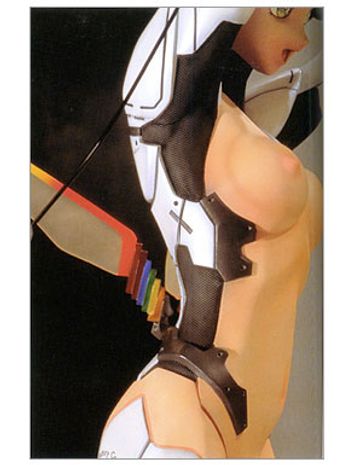
If anything, the ambiguity is the bottom line here, even when the images are by men. What are we to make of Jock Sturges’ infamous images of pubescent girls frolicking at the beach, pictures that the text reiterates were seized by the FBI under suspicion of pornography? There’s something more disturbing, not to mention unforgettable, about Japanese artist Makoto Aida, who makes fantastical manga-like prints of women as sushi — being bound up into a maki roll or having a giant male hand squeeze roe out of a woman’s vagina. Thankfully, there’s a superhero vibe to Takashi Murakami’s cartoonish paintings and sculptures, one of which features a pop goddess spewing a ring of milk from her over-inflated breasts. There are plenty of examples by artists of both genders that reference pornography (graphic and digitally filtered to a blur), the difficult nature of mediated body image, and sometimes even a genuine, pleasurable appreciation for naked ladies. “Curve” may mark multiple vista points in the winding road of undress, but thankfully, the journey doesn’t end here.

Continue Reading Close

A girl in every port

A search for cultural roots takes photographer Reagan Louie into Asia's sex industry.

Sexual tourism is a red-hot button on the scale of politically correct travel. While ostensibly about pleasure, jetting off to partake in exotic, erotic smorgasbords for a price is an activity that taps directly into deeply ingrained perceptions of gender, race and uncomfortable global intercourse between First, Second and Third World cultures. For San Francisco Bay Area photographer Reagan Louie, this rich territory, spiked with ideological land mines and oases of sparkling female beauty, serves as something more complex and ambiguous.

As a second-generation Asian American, Louie has made a personal and artistic practice of traveling East in a photographic search to reclaim his roots. In the 1980s, he visited his father’s birthplace in China, creating a visual record of the eye-opening, vibrant color pictures that for him, and many viewers, create a link between China and Chinese American identity. “A psychologist might say that my search had been caused by ‘cultural marginalization,’” he wrote of that series, “In Search of a True Life” — something that for him became an ongoing project about postcolonialism.

In the mid-1990s, during picture-gathering trips to Asia, Louie homed in on the sex trade, which is the basis of his recently released book, “Orientalia,” as well as an exhibition at the San Francisco Museum of Modern Art, “The Photographs of Reagan Louie: Sex Work in Asia” (through December 17).

These are portraits of women in China, Japan, Thailand, Korea and Southeast Asia that, for the artist, express a dynamic of Asian male sexuality as seen through images of women. The pictures are crisp and colorful visions of clothed and unclothed prostitutes — hostesses in karaoke bars, masseuses, or employees in betelnut kiosks or glassed-in shacks on roadsides that sell various pleasures to go. Sometimes these women are seen with men, but more often they look to the camera and, by extension, to the photographer from a difficult-to-read position. As SFMoMA curator Sandra Phillips describes them in her wall text, the pictures “offer a dispassionate examination of a topic that is both controversial and conflicted.”

This is the angle Louie takes in conversation about his art. “All my work is about how society shapes an individual to some degree,” he says. “The first time I went to Asia in 1980, I experienced a different kind of dynamic between men and women. Not that we [Asian men] are exactly emasculated in the U.S., but we’re somewhat neutered. Asia has very masculine societies; men have a dominant role. I was aware of it from the beginning, but I didn’t know what to do with it.”

His first-ever visit to a sex emporium in Hong Kong, where he was shooting during the hand-over from the British in 1997, was an eye opener that jumpstarted the project. Louie, a family man with wife, kids and a dignified job as a professor at the San Francisco Art Institute, entered a new world that offered very distinct examples of the gender dynamic.

“Asian men and their interactions with the sex industry are like a frat party; there’s a lot of joking around and playfulness. It’s not just about sex — there’s a full sense of socialization. It’s a very Asian thing, and I saw it often in different countries. ” The primary venues, he says, are karaoke parlors with private rooms. A photograph taken in China in 2000 depicts such a scene, with three women smoking, singing, eating and drinking with a couple of men in what looks like a living room but may be a private karaoke chamber in the Enjoy Business Club, a glitzy, neon-trimmed establishment photographed elsewhere in the series. The image is far more social than salacious. In another, perhaps taken in the same location, a man and a woman chastely croon together while watching the video screen.

More often, the pictures are of women on their own or in an artistic encounter with the photographer. Few of the models look directly at the camera — their indirect glances serve as a protective mark of professional distance. “I’m shy,” Louie admits. “The camera allowed me to enter those places and to meet those people.”

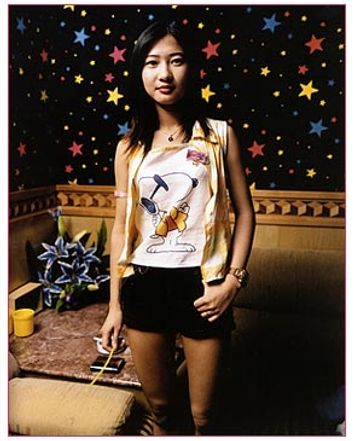
Once inside, he finds multiple layers of social evidence. He photographs a Chinese bar girl named Ting Ting in front of star-patterned wallpaper. She appears to be in her early 20s and is wearing a miniskirt and Snoopy T-shirt, an element that subtly introduces a specter of Western influence (evidence that appears frequently in the photos). It takes a moment to notice the tag that reads “N-30″ taped to her shoulder, clearly a number identifying her as merchandise. It’s not easy, however, to discern her internal state as her expression is a blank, vague smile, and the lighting is at a professional level that eclipses a sense of documentary spontaneity. This, like all the others, is clearly a posed picture.

There’s a similar quality to the much raunchier “Yuan Yuan, Macau,” a 1999 hotel room scene that depicts a nude woman sitting in a chair, matter-of-factly exposing her genitalia. Her head is tilted back slightly into the executive-gray curtains, her face made up and her eyes hidden beneath stylish wire-rimmed sunglasses. The picture, in some ways, addresses the difficult dichotomy between body and mind with an almost shocking brazenness.

Such images raise lots of difficult questions. Are these women being demeaned or empowered? Are they exoticized or exploited? The ambivalence is much of what makes these pictures interesting, as is the way that they are framed both in the book and the exhibition.

“I didn’t do anything furtively — without the girls there would be no pictures. I paid them for their time, which introduced a collaborative nature. Most of the pictures are staged — the women arranged themselves for the camera.” Clearly the notion of the artist entering an economic transaction with a model parallels the usual parameters of the hooker/john interchange. It’s a thorny, provocative aspect of these pictures that raises the obvious question: Did the artist partake in the services on the menu? Louie responds coyly: “Is taking pictures a form of sex?” Was he even tempted? “Sometimes they’re sexy, they’re good at their job. They know how to draw a man in.

“I’m full of contradictions and conflicts,” he continues. “I implement myself, but it’s not a ‘Heart of Darkness’ vision. I wanted to depict survivors, not victims.”

Louie is quick to point out, in the standard porn terms, that all the models are over 18 (at least that’s what they told him), and he’s wise to avoid that political quagmire. But his project doesn’t completely skirt potentially controversial topics. There are images that depict interracial desire — a white woman with a Japanese man, an Asian female with a white man in Hong Kong — as well as ones that point to aspects of community, commodity and fetishized identities. Louie doesn’t attempt to cover all the bases. He doesn’t photograph male sex workers or offer a critique of sex tourism — an aftereffect of global capitalism that often illustrates incredible international inequities and the enduring specter of racial stereotyping. He’s aware of all these things, but in the end, he admits this is more the product of an artistic vision, something that began to fascinate the artist and consumes him. He leaves the theorizing to others, especially other artists, whose work he has included in his own show to provide a historical context. Pictures by Picasso, E.J. Bellocq (famous for his early 20th century portraits of New Orleans whores — see Brooke Shields in “Pretty Baby”), Cindy Sherman and Japanese photographer Yasumasa Morimura offer other takes on the sex industry.

Another to whom Louie turns is self-proclaimed “activist hooker” Tracy Quan, whose iconoclastic opening essay in “Orientalia” challenges various mainstream readings of the business, mainly the zones between selling fantasy and the realities of carnal commerce.

Quan writes that her job is “about enchantment, not just service.” She feels a profound sense of shame when she learns that the pricing system at a Hong Kong brothel, as seen in a sign in one of Louie’s pictures, is predicated on ethnicity (Malaysian and Philippine women go at bargain basement rates). Yet she also admits to identifying with the fantasy of Julia Roberts in “Pretty Woman,” and weighs in on the side of pleasure over politics. She admits, for example, that for those low-priced women she hopes “not for ‘social justice’ … but the outright privilege of being a special, exotic treat.”

She has more pointed opinions about the hegemony of feminism. “I envy the prostitute who hasn’t been confronted daily, as I was from an early age, with feminist attitudes and ideologies,” writes Quan. “When I look at these pictures, I imagine that these women are much freer because they are not bogged down by feminist arguments.”

Such statements seem constructed to deflect criticism, but may also fuel the show’s controversy. “What does it say about the current dialog that they’re contextualizing these photographs with the words of a strong, activist hooker’s voice who doesn’t necessarily identify with feminist or activist concerns?” ponders Tina Takemoto, a professor of visual studies at California College of the Arts in Oakland. “Would these pictures still be interesting without Quan’s statements?”

“Without Tracy’s kind of progressive view of sex workers, I couldn’t do this project,” Louie admits. “I chose to do this work to explore if an artist could successfully take on a loaded subject like that on its own terms, and not sugarcoat it.” Some will argue that Louie’s extremely glossy pictures, presented in the museum in an impressive, life-size scale, do just that: put a plastic product sheen on a complicated situation.

Ultimately, it’s these unresolvable questions that make Louie’s project memorable. It’s impossible not to be seduced or rankled by them, and to clarify our own stance in relation to the issues. “At the end of the day, you have to give shape to your own experience,” Louie says. “I work very intuitively. I wasn’t calculating that I was going to find my roots, I just take the pictures and follow their lead.”

Continue Reading Close

Naked vinyl

Bachelor-bait record cover art of the 1950s and '60s focused on the essentials: Boobs, drinking and stag parties!

In a time decades before Tipper Gore invented parental warning labels, there was a brand of LP sticker that was brandished as a proud advertisement of adults-only maturity. The album cover of early-1960s vintage “Hollywood’s Most Intimate Smoker Stories by Mr. X” (a tobacconist to the stars?) features a picture of a nude woman arching her back over the arm of an ample green brocade sofa, much bigger than a loveseat. Catch my drift? A big red rectangle — not unlike the one employed by Todd Solondz during that nasty scene in “Storytelling” — covers her body, on it the words “This is a removable label,” one you can easily lift off “without damaging the photo underneath.” Oddly, the photo underneath already offers a view of her exposed nipples, and the sticker has the effect of drawing our attention to the funky coffee table in the foreground.

Opening the delightfully trashy “Naked Vinyl: Bachelor Album Cover Art,” is like ripping off that red rectangle to reveal a world of boobies, boobies, boobies and drinkies, drinkies, drinkies! It’s a trashily enchanted universe where women naturists had an innate predisposition for come-hither looks, bouffant hairdos and exotic dance routines. Or at least they had the ability to hold a pose for a few extra bucks to help the guys spice up their stag parties — the events the so-called bachelor music was made to accompany.

Stag parties! Such an odd, now mythic, term. Who really knows if they were truly the wild bongo shindigs where martinis shook, fondue pots bubbled and panties flew. Or were they for the legions of nebbish bachelors (and husbands) who were buying, hiding and privately devouring Playboy? Whatever, the stag party was an all-male universe, a place where guys got together to ogle images of women, to boast and guffaw about their sexual conquests and to drink gin.

The book was compiled by two young British guys with definite vinyl fetishes — world-traveling gadabout Tim O’Brien and the ruggedly named Mike Savage, who actually opened his own record shop in Bristol with the fittingly corporeal moniker, Prime Cuts. And they combed through the bins to uncover three decades worth of ribald record covers — taking things up through the ’80s. It’s worth noting that this entertaining collection of randy sleeves is the size of a single: 7 inches instead of 12. Shrinking down the scale isn’t a problem, as these covers aren’t quite the masterpieces of design and photography or physical perfection that we’ve come to expect from contemporary CD cover graphics.

Neither are these LP covers a part of the nostalgia that has fueled the cocktail music craze and the gleamingly polished bachelor-era revisionism of “Down with Love” recreations. This is the land of campy squares of low-budget cheese and cheesecake, of nameless bandleaders and club-circuit comedians who tapped into a “blue” vein to move the merchandise. It was the babes that sold these records, plain and simple.

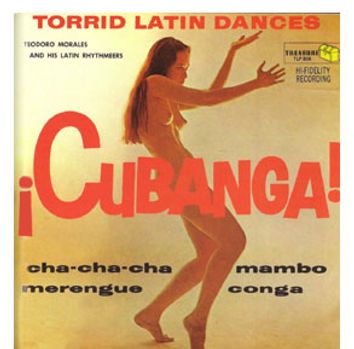
Anyone who has fingered the LPs, perfumed with the scent of musty mildew, at garage sales or small-town thrift stores has doubtlessly seen these ladies of the records, or at least the genres pictured in this book. They’re those 1950s instrumental albums –the Nordic-sounding Hugo Winterhalter’s island melodies illustrated by a sexy native girl dressed only in a lei (hubba hubba), or the more authentically monickered Teodoro Morales and his Latin Rhythmeers offering the “torrid Latin dances” they call Cubanga! illustrated with a totally naked chick who is getting, well, all torrid. Miss Cubanga to you. And let us not forget the Eastern exotic whiff of Aphrodesia that seemed to be everywhere back in oh-so-sexy late 1950s America.

Was this the precursor to World Beat in the days before political correctness? (The authors thoughtfully include some sample song lyrics that affirm this: “Although he looks as small as Ghandi/ In Spain they call him Mucho Grande / oh how his muscles can expandy, Handy Andy of mine.”) The roots of globalism.

Bollocks! These albums were sexist, racist, homophobic and cheerfully alcoholic. But back then, you could be that way without fear of retribution. The collection finds its raunchy inspiration in the genre of the stag party record, albums marketed to “bachelors and broad-minded men.” (Wink, wink.) These sophisticated gents were peddled “spicy songs” and spoken words — potty-mouth burlesque numbers like “I’m a Virgin, But I’m on the Verge” “She Likes to Lick, Lick, Lick,” “Things are Soft for Grandma, Since Grandpa’s Eighty-Four” and “My Pussy Belongs to Daddy.” (None a classic I might note). There is a “sexucational” album of songs sung by Madame Mame, which presents the notion of the bawdy Mae West type who could be one of the boys as she performs songs like “Better Come Bill Bailey,” “I Blew Louie in St. Louie,” and “If You Think You’ve Got It Hard.” Someone must have busted a gut laughing over that one.

Some of the records offered comedic bedroom farces, ribald comedy acts (which included rather vicious gay jokes), a woman’s voice purring her inside story of sex for pay. (Heck, this was also the roots of scripted autobiographical one-person shows!)

The effectiveness of the packaging of cheesecake cover and coarse salt contents seems endearingly complete — this is one record collection for which you don’t necessarily yearn for an accompanying CD compilation of the original songs.

The ’60s, the era of Mad Libs and gag gifts, saw a few clever entrepreneurs finding the gold in the form. High In-Findelity, a mock record label, marketed only the fleshy covers, with insert cards stating, T-shirt style, “I bought this album for you as a gift — sorry I couldn’t afford the record!” But that didn’t necessarily mean these were cheapskate gift givers; the covers were complete conceptual gestures — OK, gags — in which the songs needed only be mentioned, not actually included (that is, until recording technology allowed us to make our own theme-song sets on cassette). “Great Piano Pieces,” for example, featured a gaggle of bodacious, buck-nekkid babes at the keyboards, benches and polished tops of pianos. Suggested tracks that could be included: “Dizzy Fingers” and “Kitten on the Keys.” A similar formula applied to “Music for Hangovers” (suggested cut: “Soused on the Border”) and the funniest of all — “Songs for Swinging Mothers,” which features pregnant women on a swing set, with suggested song titles like “Careless Love,” “I’ve Got You Under My Skin” and “Get Me to the Church on Time.” Hardy har har.

Another, more sophisticated genre would be the mood-setting instrumental music to strip or bellydance to (one, issued by a cosmetic company, offered “Music to Bathe By” with a photo of topless, Pre-Raphaelite styled maidens among the lilies) implying that they could serve as “marital aids.” These have the aforementioned dancers or undraped femme curled up on the fur rug, expressing her Mystic Moods with one of those terra cotta-colored wine bottles of rosé nearby.

Ah, sex used to be so simple. When the authors carry their theme up through the ’80s, covering the more liberated eras of disco and coke, the book loses its focus. The notion of mature audiences shifts here, sometimes to include the soft-core Club Med fantasies of sexy couples on European beaches (where women didn’t need bikini tops) or it morphs into the trippy surrealist landscape of a woman’s curvy body — a bit of ’60s drug influence and ’70s freedoms, but there’s not nearly enough of it. And when wading into more recent days, we begin to wonder about all the covers that aren’t included: the glam rock, androgynous Bowie influences, bisexuality and Rolling Stones scandals.

I personally missed a little discussion of the Roxy Music pinup girls, who were styled with winks of male pleasure and postmodernism. Perhaps they were a little too sophisticated for this kind of bachelor party. “Naked Vinyl,” as a book and as a genre, has the adolescent appeal of a whoopee cushion. Well used, in small doses, an album like “Giggles for Guzzlers” has its historical place as a nostalgia trigger — especially if you’re a stag.

Continue Reading Close

Three days in the Valley

Photographer Larry Sultan finds poignancy before and after the action on porn sets.

The dirty secret of the porn video industry is that it churns out a rather mundane, commonplace product, as pervasive as the daily penis enlargement and celebrity skin spam we all get in our e-mail boxes. Porn films maintain the aura of naughtiness, yet they’re part of a huge, income-generating business that enters into just about every home in America. Seen Ron Jeremy and his curvy female colleagues on that late-night infomercial lately?

Larry Sultan has managed to mine that quotidian vein of the sex-film industry with his continuing series of on-set color photographs. They’re titled “The Valley,” after the sprawl of Southern California suburbia they call the San Fernando. The area exists in the psychic shadow of the Hollywood sign, the back of it, and so it’s somehow fitting that this sea of subdivisions should evolve into the capital of an independent film production of the adult variety. Over time, the lived-in ranch houses and McMansions have served as locations for any number of sex scenes for Vivid, Wicked and a few other major erotic film companies.

In pictures that he’s been taking since 1999, after a magazine commission to illustrate a story on adult filmmakers, Sultan captures the oddly commonplace aspects of these movie locations. After earning the trust of the directors and actors, who have felt his pictures respect them, Sultan has been a regular working guest on many an adult film set. While these seem to be ordinary locations — bedrooms in bedroom communities — Sultan’s pictures are imbued with a sense of theatrical magic. While he rarely offers full-on views of rehearsed raunch, he piggybacks on to cinematic lighting, which results in curiously beautiful stills poised between high artifice and real life.

In “Suburban Street, West Valley Studio,” he shows us what initially seems like the façades of some pristinely Spielbergian suburb, a perfection that shatters when you look to the left of the picture and notice the lighting equipment and hardware that indicate that this is merely a backdrop in a studio — perhaps one occupying an industrial park on the outskirts of a postwar neighborhood. The balanced view, equal parts document and fantasy, is highly refreshing in art world contexts, and Sultan’s photographs, which are on view through February at Stephen Wirtz Gallery in San Francisco, will be the subject of a major exhibition at the San Francisco Museum of Modern Art in 2004 as well as published in book form by Scalo. (Sultan also has increasing practice as a fashion and commercial photographer, shooting for various international Vogue editions, Details and even Kate Spade.)

It’s worth noting that Sultan, who has long lived in Marin County, spent a good portion of his youth in the San Fernando Valley. He’s interested in locations that have some personal connection to his own life, which relates back to his breakthrough body of work, the early 1990s series called “Pictures From Home,” in which he photographed his aging parents in the golf and highball glam of their high suburban life in the valley. These Technicolor-ish quasi-candids have been highly influential in the burgeoning realm of domestic documentation. So it’s fitting that the current pictures are concentrated in the somewhat iconic burgs of Tarzana, Encino, Woodland Hills, Van Nuys and Sherman Oaks. Ventura Boulevard fascinates him, as do areas above the more recently settled Granada Hills. “That edge-of the-valley area is fascinating,” he says. “It represents where my parents lived.”

Sultan picks the productions he photographs based on their neighborhood, as well as their narrative. Most porn films emulate genres of mass media — there are deluxe sci-fi productions as well as horror-referencing titles like “Interview With a Vibrator” — but Sultan is interested in mundane narratives, ones patterned on sitcoms, or Lifetime-style betrayals of housewives. Still, it’s not about particular films or actors. Sultan is at a loss when asked to name the films that he’s taken pictures of.

He is, however, very aware of the tone of the experience, describing hanging around during actual production as boring and slow. The typical film shoot lasts for three days, and Sultan often is there for the duration, going through various levels of interest and engagement. “By the third day I’m desperate and bored and fascinated; everything is worn off,” he says. “By then, I’m more adventuresome and able to see nuances. I’m not interested in porno and sexuality, but the things that occur on the side of it.”

In “Cabana,” for example, he shows us a poolside tryst as seen through the thorny tangles of a rose bush. We’re far more aware of the striped canopy and the two-story stucco building in the background than the patches of skin visible through the foliage.

There is a bit of “Entertainment Tonight’s” “behind the scenes in Hollywood” appeal to these pictures, as they reveal and reflect the artifice of filmmaking. Yet the shiny veneer of media has been replaced with an elusive humanity that seems far too real to be presented on TV. The films, after all, are often shot in actual homes, rented out for just this purpose. “There are only maybe 50 houses used as sets, and I’ve been to many more than once,” Sultan admits. “There are people who make a living renting out their places. Sometimes they’re housewives or single mothers. You enter a house that’s currently being lived in, all of their things are there. It’s like you’re stepping into a life that’s lived. They often don’t even clear off the mantelpieces or the toys in the kids’ rooms.”

One of Sultan’s creepier images depicts a canopied bed in a little girl’s room, complete with dolls positioned on the shelves. More often, though, the settings comfortably reveal real-life decorating sensibilities and the frayed edges of actual use. “West Valley #11,” one of Sultan’s more recent photos, is an interior focused on a deluxe wood wall with a grid of square holes, one of which frames the reclining head of a woman, perhaps in the throes of thespian ecstasy. It’s the golden-hued wall, however, that dominates the composition — along with the gallon jug of water (or is it a Costco bottle of lubricant?) and jumbo roll of paper towels.

Sultan also creates intriguing portraits of actresses and actors captured between takes. One of his best is the ebullient “Chandler Ave.” (2000), in which a blond woman in tight, vibrantly blue pants and midriff-baring top reclines on a contrasting yellow vinyl couch. She’s smiling playfully, her head tilted back; her upswept hair rests just below a tacky painting of a bucolic landscape. It takes a while to notice the freckles on her face and that her hand is deep in her Spandex pants in an act of self-pleasuring. It’s a picture that’s finely balanced between knowing and innocence, domestic interior and constructed reality.

While Sultan admits he finds it far more interesting to photograph actresses, who are the more revered, beautiful and better-paid aspects of heterosexual porn, he also has turned his eye to the actors. “Man in Garden, Mission Hills,” a picture from 2000, is an exterior night shot in which a naked actor stands near a stucco and brick gate. A swath of light illuminates a sexy statue perched near the gate, as well as the subtle sheen of the condom this well-endowed stud may have just slipped into, preparing for a take. Cases and camera bags are piled near him, at the base of a tree, identifying this as a real working environment, one infused with its own sense of mood, drama and important, not-so-little details.

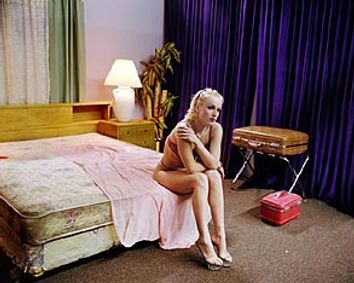
It is, however, the women who pervade, and Sultan says that in some inexplicable way he identifies with their acts of self-transformation. In “Sharon Wild,” from 2001, the sinewy blond actress sits on the edge of an unmade bed, the corners of which look to have been clawed to tatters by a house cat. In the background, a couple of suitcases suggest a sense of traveling showmanship. Wild has a dazed, slightly forlorn look in her eyes, and her exaggerated platform shoes have a way of making her calves look rather shapely.

The actress’s hard-to-read expression is one that may bring to mind the exploitation of women in the business, but Sultan steers away from such readings. “I cannot operate with judgment,” he says. “I won’t photograph when it’s an ugly situation; I’ve been sickened by certain productions and the way people are treated. I prefer to work with directors and sets where there’s a sense of family.”

Therein, in the sense of personal connection, lies one key to the success of Sultan’s photographs. “I get to stand in people’s backyards where I grew up, to be able to be inside of them, to wander around without getting arrested,” he says with a laugh. “I’m trying to find an opening, something that delights me in these settings. At its best, it’s like going home.”

Continue Reading Close

Page 1 of 3 in Glen Helfand

www.salon.com/writer/glen_helfand/index.html