Sarah Seltzer

America’s appalling holidays

From Loyalty Day to Confederate Memorial Day, a trip through our country's more disconcerting celebrations

(Credit: PhotosbyAndy via Shutterstock)

Perhaps you were shocked this month when you read that years ago, thanks to its association with international workers and the anarchist movement, May Day was officially named Loyalty Day by the federal government to avoid the appearance of condoning dissent. It’s creepy and Orwellian, but it’s not that unusual.

AlterNetIn fact, naming in general in the post-9/11 era, as in the Patriot Act, the Department of Homeland Security and more has reached particular heights of absurdity. And now, in post-corporate personhood America, we also have the grand pleasure of watching everything, from stadiums to streets, get new names after the same companies that try to woo our dollars and influence policy.

But this isn’t a new American tradition. A simple search of other official national and state holidays shows that region by region, we have some pretty appalling holidays on the books. Here are just a few.

Loyalty Day: May 1, the anniversary of the Haymarket Massacre, was originally commemorated as Labor Day or International Workers day. Later the American government tried to counterbalance this with an Americanization day that later, under President Dwight D. Eisenhower, morphed into “Loyalty Day,” — “a special day for the reaffirmation of loyalty to the United States and for the recognition of the heritage of American freedom.” On Loyalty Day, flags are supposed to be flown and celebrations of America held. But not this year, when May Day celebrations came back and took the streets.

Patriot Day: Not to be confused with Patriot’s day, the New England holiday that commemorates the battles of Lexington and Concord (and the Boston Marathon and Fenway home games), Patriot Day is the official designation for the anniversary of September 11th, 2001. As a born and bred New Yorker, I certainly will never let that anniversary go by without remembering–and I don’t object to its being a recognized observance — but it’s another Orwellian name, one that prioritizes duty to country over memory of a loss. To me, 9/11 is not really about honoring national borders, but the opposite.

Robert E. Lee’s birthday and other Confederate commemoration fetes: Several states, including ArkansasAlabamaFloridaGeorgia and Mississippi, don’t let Martin Luther King Jr.’s birthday be celebrated without tacking on this commemoration of the Confederate general who led armies into the field to defend the genocidal institution of slavery. This is the first of a few official holidays in the former states of the confederacy that are a little bit sketchy.

So along with Robert E. Lee’s birthday we have Confederate Memorial day, officially celebrated in nine states at various times, mostly in the spring. In fact, Texas has two holidays:Confederate Memorial Day and Confederate Heroes day. And then there’s Jefferson Davis’ birthday, also officially celebrated in a handful of states.

Not all the residents of these states are even aware of this passel of holidays, as this blogger at “Left in Alabama” wrote:

I have obviously lived under a rock until lately. I had NO idea that Confederate Memorial Day and Jefferson Davis’ birthday were state holidays. I did know that for some reason my kids’ school lists Martin Luther King, Jr. Day as the King/Lee holiday. That doesn’t sit well with me.

This underscores the point. Weird holidays aren’t about culture (I could only find a handful of actual “Loyalty Day” celebrations on the Internet but about law: Southerners of all persuasions should be able to celebrate their region without having to commemorate one of America’s darkest hours.

Speaking of America’s other darkest hours, Berkeley, California, led the way in officially changing Columbus Day to Indigenous People’s Day, now celebrated by various tribal governments. Others, sensing the problem with having a long weekend dedicated to the father of a genocide, have renamed the day “Italian Heritage Day” or stopped celebrating it at all. I say: keep the long weekend, mandate that it be used to honor those whose stolen land we stand on.

The worst states to be female

Ohio, Virginia, Kansas and South Dakota are leading the conservative war on women's health

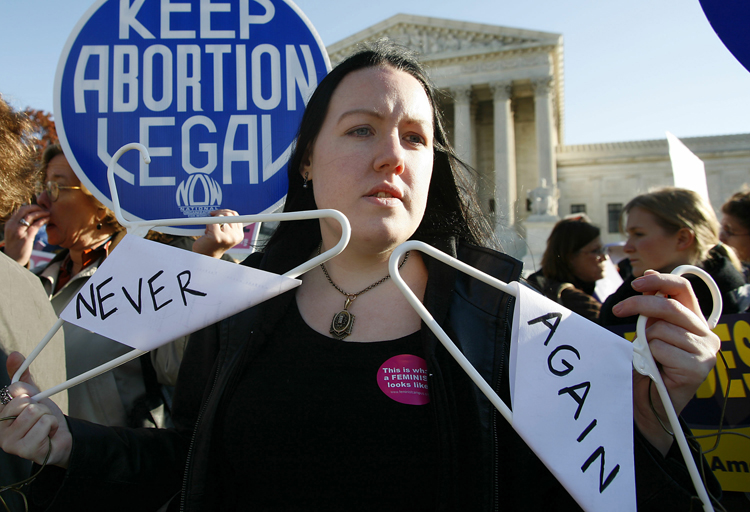
A pro-choice activist protesting in front of the U.S. Supreme Court in Washington November 30, 2005(Credit: Reuters)

Every day, it becomes a little bit harder for women to get the healthcare they need in America, particularly if that healthcare has anything to do with sexual and reproductive health.

AlterNetThe “war on women” began almost the moment that 2011′s new class of legislators took their oaths of office, and it’s still going on as we speak. Anti-choice groups have successfully created blueprint legislation for waiting periods, parental consent laws, mandatory ultrasounds and targeted regulations of clinics. These kinds of laws have been passed in statehouse after statehouse.

With such a steady attrition of rights, it’s hard to keep up the momentum, anger and outrage that we felt this winter and spring. But people should still be outraged, because a number of states are avidly participating in a race to the bottom, determined to outdo each other in restricting access to abortion, chipping away at the fundamental promise of Roe v. Wade, and belittling women and their healthcare providers in the process.

Leading the way are Ohio, Virginia, Kansas and South Dakota. Other states, like Indiana and Missouri, already have so many restrictions of various types in place that they’re going to be hard to catch up with.

Here’s a rundown of what’s happening state by state, and which states are really making it worse for woman.

Ohio: A fetal heartbeat law that would outlaw abortion before most women know they’re pregnant

Ms. Magazine’s Holly L. Derr reports from Ohio on a new law that has dire implications:

Now that the Ohio Senate is back in session, the bill may be taken up at any time. The measure would outlaw abortion after a fetal heartbeat can be detected, which is often as early as six weeks into the pregnancy. At that point, many women don’t even know they are pregnant. The bill passed the House in March and stands a good chance in the Republican-dominated Senate. It then needs just the signature of proudly pro-life Governor John R. Kasich.

Derr notes that this law, too extreme even for Ohio Right to Life, is designed to trigger a lawsuit and get entangled in a costly court battle — even though its proponents claim to be against frivolous government spending. She writes that the situation in Ohio is already dire: “I hate that this same state Legislature has already passed House bills to ban abortion after 20 weeks (before the Supreme Court-recognized threshold of viability), to prevent private insurance companies from covering abortion and to prevent public hospitals from performing the procedure altogether.”

Indeed, it’s the combination of restrictions like these that makes it more and more difficult for women to find help when they need it.

Kansas and Virginia: Back-door regulations to shut down clinics

There’s another kind of threat at work in Kansas and Virginia. TRAP, or “targeted regulation of abortion provider” laws, are burdensome restrictions that are designed to put abortion clinics out of business. And in Virginia, passing a new set of these laws has been deemed an “emergency.”

The new rules attracted the attention of the editorial board of the Washington Post, which called them “onerous and unnecessary”:

The rules will require existing clinics to meet construction and design standards mainly intended for new hospitals — not existing outpatient facilities such as abortion clinics. The rules mandate the minimum width of hallways; ceiling height; the size of operating rooms; numbers of parking spots; and other requirements that will be physically impossible, or prohibitively expensive, for many clinics to satisfy.

In a state where abortions are already difficult to obtain, these regulations mean one thing: Clinics will shut their doors, and low-income, disabled, single parents, and otherwise disadvantaged women who can’t travel out of state will be out of options and out of luck.

These laws are based on similar TRAP regulations in Kansas that are now the subject of an intense legal battle.

South Dakota: “Informed consent” laws full of lies and manipulation

South Dakota has been the focus of endless legal, legislative and ballot-box battles over abortion — even though the Guttmacher Institute tells us there are barely any providers in the state: “In 2008, 98% of South Dakota counties had no abortion provider. 76% of South Dakota women lived in these provider-free counties.”

Nonetheless the Legislature and anti-choice lobby in the state has remained zealous, producing a number of insanely difficult restrictions that center around the bogus concept of “informed consent.” Right now a judge has upheld parts of a law requiring any woman seeking an abortion to be told that she will “terminate the life of a whole, separate, unique, living human being,” a statement that of course is subject to debate. The court did strike down the part of the law that says abortion can lead to suicide.

Another judge blocked an even worse law, perhaps the most paternalistic, biased and dangerous law of its kind, requiring a 72-hour waiting period combined with a visit to an anti-choice, almost exclusively Christian, “Crisis Pregnancy Center” before an abortion could be obtained. This law actually made it through the legislative process.

Indiana, Missouri, Oklahoma, Utah and others: Nearly every restriction on the book, including limitations on insurance coverage.

While these states vie for the most obscene anti-women laws, a number of other states continue to have a panoply of restrictions, as this interactive chart from “Remapping Debate” indicates (see this post for the chart).

Indiana, for instance, isn’t one of the states with the fewest number of providers. But it does have limitations on abortion coverage for insurance, counseling and waiting periods, parental involvement laws, hospital requirements, and TRAP laws on the books, among others.

The “limitations on insurance coverage” stipulation that well over a dozen states have adopted is a particularly alarming restriction because it means that abortions will have to be paid for out-of-pocket, creating a nearly insurmountable obstacle for poorer women.

Fighting Back Strategically

With this race to the bottom seeing no end in sight, what are pro-choicers doing to fight back? The answer is, carefully vetted lawsuits that aim to hit the anti-choice movement where it’s most vulnerable.

Back in May, as the war on women gained national attention, Emily Bazelon covered the issue for the New York Times Magazine, explaining which lawsuits the pro-choice movement was focusing on:

Instead, lawyers representing their side have been challenging the laws that hurt women most — which are also the ones most likely to sway public opinion back to their side. Can it really be good politics for a state to tell private health insurers what kind of coverage for women’s health they can and can’t provide? Or to take away the money that allows Planned Parenthood to prescribe birth control and treat S.T.D.’s? Quinnipiac and CNN polls from earlier this year both found majority support for continuing government financing of Planned Parenthood. There’s also a clear argument against laws like the ones that permit Virginia to regulate abortion clinics like hospitals …

Bazelon wrote that she believed this strategy would work, even though it’s frustrating not being able to go on the offensive and push back against every single bad law coming down the pipes:

These are precisely the kinds of cases that lawyers in support of reproductive rights should pursue, because they portray abortion foes as radical. The South Dakota fight shows that in the name of protecting women, abortion opponents are willing to demean them — by forcing them to visit a crisis pregnancy center and listen to unsupported medical claims … It’s not just a good legal strategy; it also offers the movement the strongest chance of taking back the statehouses, where the real action is.

She’s right, of course, that the end-game has to be electoral: Only changing the makeup of state legislatures, electing more Democrats and, more important, more pro-choice women, will be able to effect a more widespread rollback of these restrictions.

Only a solidly pro-choice government can stop the endless competition between states to make themselves more and more inhospitable to women at a time when jobs, money, childcare and healthcare are already sparse.

Continue Reading Close
www.salon.com/writer/sarah_seltzer/index.html