Sarah Vowell

Michaelllllll Jorrrrrdan!

Forget the NBA playoffs. At the IMAX movie "Michael Jordan to the Max," the greatest player who ever was lives again.

I used to live in Chicago and I moved away not so long after Michael Jordan retired. What was the point of sticking around? Like I was going to sit there year after year, on the same couch facing away from Lake Michigan, and look at the same TV while who — Shaq? — won the NBA championship? No more throwing open the windows after Bulls wins to better hear my neighbors in the high-rises next to the lake banging on their balcony railings with joy, as the cars on Sheridan Road honk their horns in time to “Sweet Home Chicago” on their radios.

Have you ever been part of something like that? Sheltered beneath some grand, citywide umbrella of agreement? In arguably the most segregated metropolitan area in the nation, where even the two baseball teams splice the town in half, brother against brother, North vs. South, the fact that almost every kid in every neighborhood and ‘burb owned a No. 23 Michael Jordan T-shirt was a relief. Which is why on the afternoon in 1998 that Jordan announced his retirement, after leading the Bulls to six NBA championships, you couldn’t walk down the street without looking into bloodshot eyes. I admit it: I, too, cried.

All of which is to say, there’s a new Michael Jordan IMAX movie and if you don’t mind embarrassing yourself by rooting for a basketball team that no longer exists playing games you’ve already seen, and you can bring yourself to ask the box office cashier for a ticket to something called “Michael Jordan to the Max,” then my lord is it fun. It might not be “good,” in that its hokey narration is delivered by the hokey Laurence Fishburne; in that most of its talk is sports talk, which can almost always be boiled down to “try hard” or “try harder”; in that its footage is limited to mostly Jordan’s final season. Still, it’s lovable like the “Gladiator” movie is lovable — sweaty and principled and wispy about the glory that was Rome.

Directed by Don Dempf and James D. Stern, the film has a back-and-forth structure. It outlines a bare-bones Jordan bio — basically, North Carolina kid who doesn’t make the varsity team one year in high school becomes biggest sports hero of all time by working hard and being nice to his parents — in between IMAX-shot footage of his final championship series against the Utah Jazz.

Because of the colossal IMAX screen and the hugeness of the Jordan talent/persona, the whole experience is suitably large, though most of its loveliest moments are small. A cameo by comedian and Chicagoan Bill Murray finds him mugging for the IMAX crew, holding up his tub of popcorn in the United Center asking, “How big does that look on IMAX?”

A shot of the press assembled on the court in Salt Lake City includes a reporter behind a sign reading “Bosnia-Herzegovina” and alludes to the fact that even in the war-weary Balkans, maybe especially in the war-weary Balkans, news of MJ’s last exploits warrants sending someone all the way to Mormonville. (In fact, I know a war correspondent who was about to be killed by one of the factions in the former Yugoslavia and when he told his executioner he was from Chicago, the guy yelled “Michael Jordan!” and put down his gun.) And during the scene at a sports camp for kids in which Jordan passes the ball to this little blond girl on his team, who makes a basket and then beams at her hero, even the Bulls-hating Knicks fan next to me took a break from his grudge long enough to lean over and coo, “Oh my God, that was cute.”

The most shocking thing to be reminded of in “Michael Jordan to the Max” is not one of Jordan’s aerospace maneuvers, though there are plenty of those. It was astonishing to see the team reassembled — to see the band back together. Like old movies of the Beatles on that London rooftop or Nirvana after Dave Grohl joined up, hearing the United Center announcer yelling “Michaelllllll Jorrrrrdan” as he runs out to stand next to Scottie Pippen and Dennis Rodman and Luc Longley and Toni Kukoc and Ron Harper and Steve Kerr, you can’t believe your luck. Giants among us, that sort of thing. Pictures float by like they’re falling from the family album: Michael in the arms of Scottie as Luc looks on; Dennis driving Karl Malone of the Jazz stark raving mad as Michael sails past them; the smile on Jordan’s face as you hear the play-by-play “Kerr for three!”

“Michael Jordan to the Max” is putting a damper on my progress. I not only moved away from Chicago — even more embarrassing, I moved to New York, and I have been trying to talk myself into being a Knicks fan. I am, as they say, learning to love. I do feel for sad old Patrick Ewing — who doesn’t? And I’m fond of Latrell Sprewell, being a sucker for cool hair. But King Lear-level disappointment and op-art cornrows aren’t exactly the stuff great marriages are made of.

The day before I saw the Jordan film, during Game 4 of the NBA’s Eastern Conference Finals, I had made it three-and-a-half quarters rooting for the Knicks against the Indiana Pacers. Three-point-five quarters cheering for the Knicks is my personal record. But when Pacers star Reggie Miller, who is more beautiful than the bust of Nefertiti in Berlin’s Egyptian Museum, missed a shot I heard myself groan and I knew I was on Indiana’s side. By Game 5, I was not only up against my crush on Reggie Miller: Thanks to “Michael Jordan to the Max,” I had Bulls on the brain. Staring at the television, where Sprewell had just made a really tricky basket, an old Randy Newman lyric came to mind: “I’m looking at the river, but I’m thinking of the sea.”

The book on film

Director Martin Scorsese presents a new series of books about film, starring James Agee, Vachel Lindsay, David Selznick and "2001."

I reserve the right to be expansive,” Steve Earle said on Saturday. The ex-junkie, ex-con singer-songwriter was giving a presentation at the New Yorker Festival of Books at a Manhattan club called Float. As I recall, he was discussing the difference between story songs and less narrative ones. But in declaring his “right to be expansive” he hit on the pleasures of watching an artist who’s been around a while move through the world. Every so often, Earle would play a song on his acoustic guitar, and his voice has never sounded as wonderfully delicate or as hard. Yet when he talked about his current life — he’s been writing poetry (a haiku a day), teaching a class at Chicago’s Old Town School of Folk Music and running a record label (which has the terrific South Philadelphia band Marah on its roster) — he came across as all over the place, which is to say generous and interested and up to his ears in the cause of art.

Earle has become an elder, and the best kind — a cultural icon at midcareer who manages to find a little time away from his own work to talk up his old bluegrass heroes and help out sweaty young rock ‘n’ rollers. There has always been a loveliness about the great artists who take their audiences along with them to other work: Kurt Cobain endlessly fawning over the long-lost Raincoats, Woody Allen’s upcoming theatrical presentation of Marcel Ophuls’ 1970 documentary, “The Sorrow and the Pity” and, not least, film-professor-to-the-nation Martin Scorsese’s new Modern Library series devoted to the movies. As the series editor, Scorsese has chosen four books, with more to come, devoted to his beloved cinema: “Agee on Film,” “Memo From David O. Selznick,” Vachel Lindsay’s 1915 book “The Art of the Moving Picture” and “The Making of ’2001: A Space Odyssey.’” Each volume contains an introduction by a different film critic, including David Denby and Stanley Kauffmann.

A showcase of film criticism from the 1940s, the memos of a Hollywood producer, the first book to discuss film as art and a compendium of documents surrounding a sci-fi epic might say more about Scorsese than it does about American movies. The latter two especially must appeal to whatever part of Scorsese’s brain thought “Kundun” was a really good idea. The “2001″ book, with Stanley Kubrick interviews, source materials, histories and various ephemera, probably only matters to diehard fans (of which I am not one) or the student of special effects, who might be able to get something out of bits of info like “the Oxberry animation stand equipped with a 65 mm Mitchell camera was used for shooting backgrounds of stars, Earth, Jupiter, the Moon, as well as for rotascoping and shooting high contrast mattes.”

Poet Lindsay’s “The Art of the Moving Picture” is so arcane and weirdly old-fashioned it probably could have stayed out of print; read it in an attic if you must read it at all. Having previously written odes to the first movie stars, Lindsay wanted film to aspire to the greatness of painting and sculpture. His eccentric, finger-wagging task is to point filmmakers to very specific, usually forgotten works of art. Like a doddering docent in a musty museum, he directs his tour group to some Venetian equestrian statues, proclaiming, “Look upon them and ponder long, prospective author-producer.” Kauffmann’s introduction calls him “dated and cranky,” though often hilariously so, as when Lindsay rages against musical accompaniment to the silents, suggesting that the audience just talk instead. Go out and get the Lindsay book if, like Scorsese, you’re always phoning up the warehouse of obscurity that is Facets in Chicago to order videos you can’t scratch up anywhere else. But if, like me, you spent most of the new Sandra Bullock movie wondering how to get your hair to look like that, you’re only going to need or love the two volumes of the Modern Library series that follow.

Reissuing “Agee on Film” is Scorsese’s only obvious move. A collection of journalist and novelist James Agee’s film writing between 1941 and ’49 (mostly for Time and the Nation), the book generally consists of reviews of movies I’ve never heard of made by people I don’t care about. Its value is the value of all great film criticism, from Pauline Kael to Libby Gelman-Waxner — namely, a visceral insistence on what movies can be or do.

The smartest film critics are able to dissect what is high-minded and profound about movies, while never forgetting that the appeal of celluloid is often lurid and violent and beyond all reason. In his 1948 piece on Laurence Olivier’s screen version of “Hamlet,” Agee has the nerve to celebrate what the movies can do for Shakespeare instead of the other way around. Writing about 19-year-old Jean Simmons’ Ophelia, he notes that she “is a product of the movie studios exclusively. Yet she holds her own among some highly skilled Shakespeareans. More to the point, she gives the film a vernal freshness and a clear humanity which play like orchard breezes through all of Shakespeare’s best writing, but which are rarely projected by veteran Shakespearean actors.”

One of Agee’s best reviews, that of “National Velvet,” finds him in love with Elizabeth Taylor, for whom, he admits, “I have been choked with the peculiar sort of adoration I might have felt if we were both in the same grade of primary school.” This despite the fact that he sees her as somnambulant and a limited talent. But film is alchemy, not rocket science. Agee writes, “Since I think it is the most hopeful business of movies to find the perfect people rather than the perfect artists, I think that she and the picture are wonderful, and I hardly know or care whether she can act or not.”

“I have learned to avoid trying to improve on success,” producer Selznick wrote of adapting Margaret Mitchell’s “Gone With the Wind” for the screen. “One never knows what chemicals have gone to make up something that has appealed to millions of people, and how many seeming faults of construction have been part of the whole.” The book of Selznick memos, originally published in 1972, is repackaged with an introduction by Roger Ebert and makes a nice companion to the Agee. The book is arranged chronologically between 1926 and 1965 — the studio system’s golden age — and follows his career from MGM to Paramount, RKO, MGM again and his own Selznick International.

In this assortment of memos to actors, directors, writers and other filmmakers, Selznick manages to live out the god complex so often associated with producers while at the same time exhibiting a constant and touching sense of detail. Here was a man pledged to movies, to everything about movies. That meant money and promotion and popularity, but it also meant how stories are constructed and told. Selznick cared. There’s a lot of the juicy, megalomaniacal behavior the reader would hope for in the rantings of a Hollywood mogul, the tastiest being a letter to David O. Selznick from Ingrid Bergman written by David O. Selznick — i.e., a letter to himself from himself. “I forgot everything you had done for me,” he has her apologize.

And yet Selznick’s memos during the making of “Gone With the Wind” contain wise, sophisticated thoughts on narrative structure. What is kept out of a story is just as important as what is kept in, and Selznick’s notes on what to steal from Mitchell’s book and what to drop are insightful, not to mention wickedly funny. Noticing that Mitchell tends to repeat herself, he informs writer Sidney Howard, “An outstanding case of this is the repetition of what you might describe as ‘nights of love.’ Certainly, I think one scene of husbandly rape is enough. How the hell we can even use one is going to be a problem.”

That nights-of-love euphemism also highlights one of the other pleasures of the Selznick memos. His struggles call forth what it was like to make movies in the middle of the century, telling stories about life and its racier bits before motion pictures could use any old word. The “damn” controversy — whether Clark Gable’s Rhett Butler can utter the “Frankly, my dear” line — is instructive. Selznick’s letter to the Motion Picture Producers and Distributors of America is fascinating propaganda from a truly other world. “I do not feel that your giving me permission to use ‘damn’ in this one sentence,” he wrote, “will open the floodgates and allow every gangster picture to be peppered with ‘damns’ from end to end.” (At which point Al Pacino’s Tony Montana, reading along over my shoulder, pissed himself laughing and fell to the floor.)

Making America safe for sacrilege. In his tales of, to use a nice word, innovation, Selznick’s memos read not unlike the journals of Lewis and Clark. New countries are being discovered, streams forded, mountains crossed. We forget, nearly a century later, how the movie pioneers had to invent so much from scratch, and one of the joys of Selznick’s ravings is how those inventions unfolded. For example, who now thinks about the fact that in order for sound pictures to be made, soundproof soundstages had to be constructed? And so, when Paramount’s new and only soundstage caught fire, Selznick recounts his boss, B.P. Schulberg, hitting on the idea of shooting in the middle of the night, because they don’t call it silent night for nothing.

James Agee wrote in 1945, “I will probably always like the films of David Selznick better than reputedly condescending aesthetes like me are allowed to like such things; for I think that more than most things that come out of Hollywood they show both genuine talent, as distinct from mere professionalism, and a genuine love for movies, as distinct from mere executive concentration on them.” That is what makes “Memo From David O. Selznick” the most valuable member of Scorsese’s series. Concerned with everything from Gable’s shirt collars to Marlene Dietrich’s hair, Selznick, like Scorsese, is so in love with pictures he can’t help reminding the reader why she fell in love with movies in the first place. And fandom doesn’t get any more expansive than that.

Continue Reading Close

The Dixie Chicks, TV Guide and me

America's favorite weirdly schizophrenic magazine comes bound in leather in swanky hotel rooms.

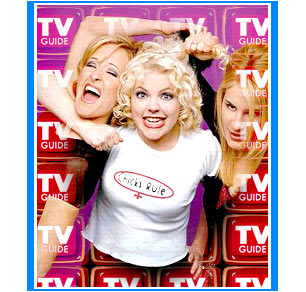
The other day I was staying in a nice hotel. When I was poking around the room, looking at room-service menus and the little shampoo bottles and the like, I came across a small, leather-bound folder on the bedside table. And inside this sober folder was this: Under the words “dixie chicks” in orange and pink lowercase letters was a photo of the country-pop trio — smiling bleached blonds in pink and orange, one of them contorted like a circus acrobat with her legs in the air.

They were on the cover of TV Guide, which promised “Men, Money and (Sing It) ‘Goodbye Earl’! The Sassy Country Trio Gets Down to Serious Girl Talk.” Looking around at the room’s mahogany and marble, it made sense that such a trashy cover of such a trashy magazine had to be hidden in such an elegant setting.

Something about the room said, “I only watch PBS.” The room said that; I said to myself, Haven’t gotten this issue yet, and plopped down in a wing chair to read about the band I love to hate. (Well, first I looked in the movie listings, as I do every week, to see if “The Man With the Golden Arm” would be playing, but it never is. In the March 11 issue, however, it was 28-down in the magazine’s crossword puzzle, “Man With the Golden ___.”) As for the Dixie Chicks, what is more fun than reading a Q&A with singers you don’t like talking about their early years, in which they were paid $100 to sing Bette Midler’s “The Rose” at an open-casket funeral to banjo accompaniment?

TV Guide is a weakness of mine. I drop everything when it comes in the mail. Partly because TV Guide and I are in the same business, and that is the business of noticing things. Just as I was thinking about how the character of Spike has blossomed on “Buffy the Vampire Slayer,” TV Guide critic Matt Roush wrote just such an item. I have a thing for character actors and so does the magazine. I had no idea that two of my favorites of the current season — Jane Kaczmarek as the mom on “Malcolm in the Middle” and Bradley Whitford as Josh Lyman on “The West Wing” — were married until TV Guide did an item on their late-breaking, dual success. And, though one doesn’t really read this pulp pile for the writing, it does contain the occasional fine, funny piece by — how’d he get here? — Joe Queenan.

Queenan’s sidebar to the April 15 episode’s guide to children’s television, in which he writes about watching “Angel” and hockey with his children, hints at how parents might make watching TV alongside their kids an educational experience. “When my son asks me if ‘Angel’ is historically accurate in its portrayal of young Angel as an 18th century Irish vampire,” he wrote, “I inform him that vampires traditionally come from Eastern Europe and not Ireland, because real-life monsters would never be taken seriously if they spoke with a brogue. Similarly, when my daughter asks what the qualifications are for a position as an NHL referee, I remind her that the official job application is written in Braille. It’s nice to be able to contribute.”

TV Guide might be the weirdest magazine in America, and thus the periodical providing the most accurate representation of American life. Its strangeness derives mostly from its schizophrenia. It is utterly rosy and dumb, except when it’s being perceptive and harsh.

For example, in the same issue as the mindless Dixie Chicks interview is the prickly Susan Stewart’s “Hits & Misses” column. She writes about a Romance Channel documentary devoted to women and shoes that makes the shaky semiotic claim that “Shoes are ‘a downward displacement of breasts.’” Stewart also points out, referring to Jane Seymour’s biopic turn as abolitionist Fanny Kemble, “The fact that slavery was bad doesn’t mean every movie that criticizes it is good.” She gives it a score of two out of 10.

The magazine’s bright, often idiotic covers — probably the main reason the hotel’s management felt the need to hide it behind leather — give the reader the impression that it covers TV with unconditional love. But one of the nice things about TV Guide is how mean it often is.

The identity of TV Guide might be summed up by the name of its most beloved feature: “Cheers & Jeers.” This section often cheers the moments I myself have loved — the real sentiment when David Letterman brought his medical team and nurses onstage to thank them, the fine recent work of “Nightline” in Russia. (Did you see Ted Koppel with the gay kids in the disco?)

The jeers, though — there isn’t a pompous blowhard in this country they’ll spare. Recent targets include the “Antiques Roadshow” appraiser who faked a sword segment; the length of the Academy Awards (“Jeers to four hours and eight minutes of anything”); Whitney Houston’s lame attempt to dub her husband Bobby Brown as “the original R&B king” at both the Grammies and the Soul Train Awards; and, my personal recent favorite, Alex Trebek. In an item marked “Jeers to know-it-alls” the magazine chided the “Jeopardy!” host for patronizing the host and contestants of “Who Wants to Be a Millionaire.” After Regis Philbin (who, Trebek pointed out, came in last on his two appearances on “Celebrity Jeopardy!”) invited Trebek to be a “Millionaire” contestant, Trebek said no. “Cheers & Jeers” lives for such anecdotes of poor sportsmanship.

They even cheer representations of jeering. For example, in the April 15 issue they loved the “Inside TVLand” special on “The Andy Griffith Show,” which brought to light the fact that the actress who played Aunt Bee hated Andy Griffith.

I think I love TV Guide because its pages mimic the experience of watching TV: crap, crap, crap, swoon. I don’t know what TV Guide would call the previous sentence. Cheer within a jeer? Or jeer within a cheer? It doesn’t matter. This is television — can’t have one without the other.

Continue Reading Close

Songs that kill

In the dark comic world of "American Psycho," pop is an essential soundtrack to murder.

In Bret Easton Ellis’ 1987 novel “Rules of Attraction,” Paul, a college student, describes the records playing at a party. “The Pretenders turn into Simple Minds,” he muses, “and I was grateful because I could not have stood there if there had been no music.” The Ellis oeuvre is full of playlists, beginning with his first novel, “Less Than Zero” (named after Elvis Costello’s first single). He writes very noisy books: MTV in bedrooms and living rooms; tapes and radios cranked up in cars. And Paul’s words — the idea that Ellis’ mostly aimless characters’ lives would be unbearable without a soundtrack — hint at something we don’t like to talk about when we talk about entertainment.

People who care about pop music, and I am one of them, like to discuss songs as liberators, as catalysts, as jokes or friends. But what of the term background music? Just as often, probably more often, listeners use music as a kind of stopgap. I like to think of fandom as a way of being in the world, but so often it’s a way of avoiding the world, a barrier, a wall. Witness the witty scene in the new charmer “High Fidelity.” In that film version of Nick Hornby’s novel, John Cusack’s Rob, a record-store owner, holes up after his girlfriend’s left him and tries to put it out of his mind by reorganizing his record collection “autobiographically.” He sits among his stacks of albums as if in a fort.

Ellis writes deftly about people who shouldn’t be doing what they’re doing, and one way they live with themselves is by shutting off the silence that is the examined life’s requisite. You cannot examine your life too closely if you’ve got “Walking on Sunshine” full blast on your Walkman, as serial killer Patrick Bateman (played by Christian Bale) does in the new screen adaptation of Ellis’ “American Psycho.” I always thought good people needed good music to make a good life, but do the bad-to-worse characters of Ellis’ imagination need music to drown out the sound of their own consciences?

Another novelist, Richard Price, seems to think so. In “Freedomland,” Brenda Martin, a character inspired by the Susan Smith case, is suspected of killing her young son. When this damaged woman doesn’t have soul CDs screaming out of her boombox, she’s wearing a Discman and hearing them on headphones. “She was listening to something now, staring straight ahead and moving her lips to the lyrics,” Price writes. “Lorenzo [the detective assigned to her case] could hear ‘Feel Like Breaking up Somebody’s Home’ coming through her phones, minute and metallic. He didn’t hold the music against her, figuring that the phones were there to keep her brains from leaking out her ears.”

Is that what Katrina and the Waves are doing for “American Psycho’s” Bateman? Keeping his brains from leaking out his ears? In another scene in the film, Bateman’s in a limo with his Walkman on, his girlfriend beside him. “I’m trying to listen to the new Robert Palmer tape,” he says, “but Evelyn keeps buzzing in my ear.” The book, to my mind Ellis’ funniest, is loaded with instances of music getting in the way. For example, Bateman, talking to an acquaintance at a club, narrates, “Luckily, the long version of ‘New Sensation’ by INXS drowns out his voice.” Or, at the same club — and this is in the movie also — “Pump Up the Volume” (a title that might be the secret theme of the Ellis oeuvre) covers up the words Bateman’s sneering at the bartender: “You are a fucking ugly bitch I want to stab to death and play around with your blood.” He says this while smiling.

In the novel, some of the most hilarious bits are the periodic chapters in which Bateman delivers veritable “Trouser Press” entries on his favorite musicians. He loves Huey Lewis and the News, Phil Collins and Whitney Houston. There were times in the ’80s I heard their records and thought you’d have to be crazy to like them. Psychotic, actually. What genius that a stuck-up, insane, murderous yuppie would call Houston’s “The Greatest Love of All” “one of the best, most powerful songs ever written about self-preservation and dignity.”

Of course! “The Greatest Love of All,” lest we forget, posits that the greatest kind of the grandest emotion is not romantic true love or the love of a parent for a child but “learning to love yourself.” It is probably the most solipsistic pop tune ever written, and that’s why Bateman likes it. As he says, “Since it’s impossible in the world we live in to empathize with others, we can always empathize with ourselves. It’s an important message, crucial really, and it’s beautifully stated on this album.”

The genius of director Mary Harron’s film “American Psycho” is the way she juxtaposes Ellis’ musical tirades into the action. In the movie, she has Bateman delivering his manifestos while he’s killing people. Harron’s comic timing is impeccable. Now, when Bateman’s talking up Huey Lewis and the News he’s jabbering that their album “Sports” is “a personal statement about the band itself” as he ax-murders a guy. After he’s finished the guy off, Bateman absorbs “Hip 2 Be Square” with blood all over his face; he lights a cigar, and — something Ellis would probably never let him do — actually listens to the song. Even though sometimes the reader feels like Ellis is letting Bateman get away with murder, the author punishes his protagonist: He has no peace; and despite the fact that Bateman shall have music wherever he goes, it’s Collins’ “Sussudio,” which strikes me as punishment enough.

Regarding Ellis’ “Less Than Zero,” Greil Marcus once wrote, “In ‘Less Than Zero’ pop music is just weather — everybody talks about it but nobody does anything about it. You don’t know what Clay or his friends get from it, what they want from it, why he turns on MTV every chance he gets. The constant pop-song references bounce off the flat surface of the prose: no song ever plays.”

I think part of the reason Ellis douses his characters with music but hardly ever lets them engage with it is because they don’t deserve that kind of joy. Ellis is a father who grounds his children and unplugs their stereos as punishment.

One reason I love Ellis’ books, and those of his confrere Jay McInerney, is that they have little to do with me. I started reading them as a youngster in Montana in the ’80s and their coked-up, nihilistic nightclubbing New York was as foreign to me as a National Geographic photo spread. That was their appeal.

My culture was lovable “Young Fresh Fellows” songs (“When I’m down I think of you/My friend Ringo,” went my favorite), camaraderie and cheap beer. And I think books like “Bright Lights, Big City” and “American Psycho” were written for relatively stable, relatively nice people like me. Because the fucked-up cokeheads the books are frequently about wouldn’t have had the quiet time, not to mention the quiet minds, to actually sit still and read. Remember how the protagonist in “Bright Lights, Big City” was always meaning to spend the evening at home, ensconced with the great American novels?

If debased characters like Bateman and, by extension, debased people need heartfelt music and heartfelt culture, heartfelt people need representations of debasement. It’s cathartic. I can’t tell you how amusing it was to read Ellis’ and McInerney’s friend Tama Janowitz’s book “Slaves of New York” — filled with characters whose life decisions are dictated by the insane Manhattan real estate market — lying in bed in my $92-a-month Montana apartment.

If we Montanans got a lot of cheap thrills rubbernecking at Ellis’ and McInerney’s barren New York and L.A. in the ’80s, we got what we deserved in the ’90s, because after all those rich New Yorkers and Angelenos got out of rehab, they went straight to Montana, jacking up the property values so that I’ll never be able to afford a house in my formerly cheap hometown.

But of course, the New York novelists are on that tip, too. In McInerney’s last book, “Model Behavior,” a journalist who writes celebrity profiles brags, “Already my word-processing program contains macro keystrokes which instantly call up such phrases as ‘shuns the Hollywood limelight in favor of spending quality time with his family at his sprawling ranch outside of Livingston, Montana’ (CNTRL, Mont).” Takes me back to 1989: I was at work at the ski hill, wiping down the bar in rhythm to the Rolling Stones, and in walks Dennis Quaid, of the Livingston Quaids, asking for a beer.

Continue Reading Close

All this useful beauty

The hottest art show in America is never better than Tom Cruise in his underwear. Wouldn't a nice Kate Spade handbag be so much more practical?

Seeing the new Whitney Biennial is like struggling through some interminable Jackie Chan movie — minute after bleak minute of watching a bunch of cartoon characters dork around. If this museum show collects the best American art has to offer at this moment, then the American century really is over. Good thing the Whitney owns all those nice old existential Edward Hopper paintings it keeps trotting out every few months — it’s going to need them. I didn’t learn anything, wasn’t moved and only smiled once at the biennial: at Paul Pfeiffer’s “The Pure Products Go Crazy,” a digital video loop (alluding to William Carlos Williams’ line that “the pure products of America go crazy”) of young Tom Cruise humping the couch in his tighty-whities in “Risky Business.”

The delight of seeing Cruise flail around only underlines the biennial’s misfortune. Opening four days before the Academy Awards, which, for the first time in recent memory, honor an embarrassment of film riches, the exhibit makes one wonder if this is simply a season of moving pictures, not hanging ones. Except that 15 blocks north of the Whitney, the Smithsonian’s Cooper-Hewitt National Design Museum is hosting its first triennial, “Design Culture Now.” Where the biennial seems pointless and stale, the triennial is full of surprises. If painting and sculpture seem to be enduring some kind of crisis, advertising, housewares, graphics and industrial design seem to be flourishing at fine art’s expense. Both shows demonstrate how current visual practitioners play with, and are indebted to, art history. But the utilitarian designers have something over the artists-for-art’s-sake, and that is utility itself.

Much has been made of the Whitney’s inclusion, for the first time, of Internet art in its biennial. Including such art seems like a good idea until one enters the chosen sites. John F. Simon Jr.’s Web site, “Every Icon,” for example, is a grid containing 32-by-32 black and white squares programmed to move around through every possible geometric configuration. According to the museum, “On an average home computer, it will take several hundred trillion years for the process to conclude, when every square is black.” Watching it for five minutes feels like a trillion years. “Every Icon” might be a sly attack on abstraction’s critics, pointing out that geometric compositions have endless prospects, but it doesn’t come off sly — only endless. By comparison, Kate Spade’s crisp “Vertical Bucket Handbag” in the design show — a cotton striped purse with multicolored, horizontal lines — exudes a similar devotion to straight lines, but at least is handy enough to hold lipstick and gum.

“Design Culture Now” affords examples of how the ideas of artists can trickle down into everyday objects. Pablo Picasso’s 1943 sculpture “Bull’s Head,” in which the animal’s head is suggested by a bicycle seat and its horns are formed by bike handlebars, is given loving tribute in the “Picasso Internet Radio.” Designed by Paul Pierce and Dennis Erber for Thomson Consumer Electronics, the radio is shaped like the Picasso bull, but its “horns” transmit sound like an old-time Victrola. It is a playful thing, a sculpture that is both tool and toy.

When the Whitney artists update the classics, on the other hand, it feels less like a playpen and more like an essay exam. Jasper Johns’ famous flag paintings of the 1950s are given homage not once, but twice. Yukinori Yanagi has turned “Three Flags” into an ant farm. And Hans Haacke’s infamous and ugly “Sanitation” installation incorporates a “Three Flags” variation hung between quotations from Rudy Giuliani, Jesse Helms, et al. written in Nazi script.

Having ants eat away at Old Glory, and hanging it next to piss-ant sentiments (like “Sanitation’s” Pat Buchanan quote calling the First Amendment “the last refuge of the modern scoundrel”), are obviously tactics meant to reposition Johns’ flags with regard to contemporary politics. But it seems to me Johns’ flags are doing just fine accomplishing this on their own. Did anyone notice that Johns sold the Metropolitan Museum his 1955 “White Flag” at the end of 1998, during President Clinton’s impeachment trial? It didn’t take a great leap of the imagination to read into it an American flag bled dry of color while the Senate was bleeding its taxpayers in the name of the Constitution.

Who knows what appealed to the Whitney curatorial team about Vic Muniz’s photo of Theodore Gericault’s painting of “The Raft of the Medusa” rendered in Bosco chocolate sauce. It is smeared and it is brown. Perhaps the curators were temporarily nostalgic for grandeur, for a time when painting meant something, told stories, transformed acts of God into works of art. Once, describing Gericault’s great shipwreck canvas, novelist Julian Barnes asked how catastrophe gets turned into art. He wrote, “We have to understand it, of course, this catastrophe; to understand it, we have to imagine it, so we need the imaginative arts. But we also need to justify it and forgive it, this catastrophe, however minimally. Why did it happen, this mad act of Nature, this crazed human moment? Well, at least it produced art. Perhaps, in the end, that’s what catastrophe is for.”

Those words were ringing in my head when I came across a series of objects that are the wittiest, the most beautiful and the most disturbing pieces in either show, because the 19th century did not corner the market on calamity. At the design triennial, the Boym Design Studio’s little “Disaster Buildings” are as pretty as they are dark. Miniature monuments in nickel, they call to mind metal souvenir trinkets of the Eiffel Tower or Statue of Liberty. Constantin and Laurene Leon Boym’s treasures, however, commemorate other, less romantic structures — namely, the Unabomber’s cabin, the Watergate complex, the World Trade Center and the reactors of Three Mile Island. Sites of terrorism, treason and disaster. And then there is the most disquieting structure of all, Oklahoma City’s Murrah Building. It is cast after the bombing, the insides toppling in and gutted. Which is all the more gruesome considering that it is on sale in the museum gift shop. It is, after all, a paperweight, and undeniably heavy.

What would it be like to live with these things, holding down stacks of notepaper and mail? Would the bills seem less dire if held in place by the shack where Ted Kaczynski constructed his murderous letter bombs? Maybe. The “Disaster Buildings” are beautiful and questionable, accessible and mysterious, petty and tragic all at once. In other words, they’re doing what art was always supposed to do, and if they keep one’s in basket from blowing out the window, well, that would be no disaster.

Continue Reading Close

“T for Texas/T for Tennessee”

From "Waltz Across Texas" to "The Tennessee Waltz": Will Bush or Gore dance his way to the White House?

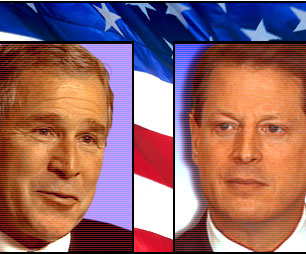
Walking home from a Super Tuesday party — or whatever one calls a get-together with a bunch of people sitting around eating pizza and screaming at CNN — I found myself humming Jimmie Rodgers’ “Blue Yodel.” Once it became official that Gov. George W. Bush of Texas and Vice President Al Gore of Tennessee were to be their parties’ candidates in the presidential election come November, “Blue Yodel” was a natural choice. (You might know it by its first line: “T for Texas/T for Tennessee.”) Of course, the song is sung from the point of view of a man who’s off to buy a “pistol just as long as I’m tall” to shoot his sweetheart, and then a shotgun to kill the man who stole her, so it has more to do with the governor’s affinity with the National Rifle Association than with the vice president’s critique of the same, but still, it’s a good, handy song and quite a relief. It’s not like we had an Arkansas vs. Kansas theme to whistle last time around.

“Blue Yodel” was just the beginning. In the days since I cast my ballot in that primary, my head has been an overheated jukebox, flipping from one Texas or Tennessee tune to another, from Johnny Cash doing “Tennessee Stud” to Gene Autry’s “Deep in the Heart of Texas,” Marty Robbins’ “El Paso” backed with the Louvin Brothers’ cover of “Knoxville Girl” and Lyle Lovett’s “That’s Right (You’re Not From Texas)” with a segue into Red Foley’s “Tennessee Saturday Night.” There are so many songs taking up so much mental energy, I’m kind of hoping the serial killer from Bruce Springsteen’s “Nebraska” drives into my cerebral cortex and blows them all away; as he might put it, one of the meannesses in this world is the weird concentration of songs and singers in Texas and Tennessee.

In a political campaign, three kinds of songs resonate for the electorate. There are the songs the candidates and their staffs choose to fire up their rallies. For example, Gore has been blasting Bachman-Turner Overdrive’s “You Ain’t Seen Nothing Yet” and Shania Twain’s “Rock This Country.” (You’d think he was running for office in Canada.) Bureaucrat Bush has also been known to dabble in BTO, going with “Takin’ Care of Business,” though in my opinion he might want to look into a 1989 song by the Reivers of Austin, Texas, called “Star Telegram.” It’s one of the prettiest evocations of the lovely, lazy side of the American dream, a family unwinding in a Fort Worth back yard, sweet Kim Longacre singing “with Orange Crushes in my hand.” Seems to me that’s the kind of life politicians are supposed to be aiming to give us — a nice hot Texas day barbecuing with Grandpa, where the worst problem to tackle is the gosh-darn chiggers. Because, as Pat Robertson said of Bush, he has done some very good things for Texas, things that would also work “in the United States.”

Then there are the songs we sing to ourselves that portray candidates as we see them. When I watch Bush’s face on television, the jukebox in my brain — granted, not a particularly subtle machine — drops the needle on Jimmie Dale Gilmore’s “Dallas,” in which “Dallas is a rich man with a death wish in his eyes.” Either that or, if I’m in an apathetic mood, a lost Mel Tillis classic called “Coca Cola Cowboy.” “You walked across my heart like it was Texas,” Tillis crooned, “and you taught me how to say I just don’t care.” Then again, in his Super Tuesday victory speech, Bush proclaimed his support for the “generation next,” so I guess he’s a Pepsi man.

The Tennessee and Texas songs represent the more organic third category, the sort of no-brainers Paul Shaffer and the CBS Orchestra play to introduce the candidates as they walk on, assuming Bush’s death wish includes ever going on “Letterman” again. I called one of my favorite Texans, country music historian Bill C. Malone, author of the forthcoming “Don’t Get Above Your Raising: Country Music and the Southern Working Class,” and asked him if he had any Texas-song advice for the governor. “To me, it would be ‘Waltz Across Texas,’ that Ernest Tubb song. It’s just a real nice song,” says Malone, adding, “I don’t want to do anything that would help George W., though.”

“Waltz Across Texas” is sweet, and certainly waltzing across Texas “with you in my arms” is a lot prettier of a picture than the one presented in its Democratic counterpart, “The Tennessee Waltz,” a Tennessee state song that Gore has been known to croon. It was co-written by Pee Wee King, who coincidentally died on Super Tuesday as Gore was waltzing away with the delegates. (My favorite version, a sad lullaby by chanteuse Sally Timms, appears on the “Straight Outta Boone County” CD compilation from Chicago’s Bloodshot Records.) Gore’s covering “The Tennessee Waltz” seems ill-advised, considering the actual content of the song: A man takes his sweetheart to a dance and introduces her to his buddy, and the buddy steals her away, leaving the singer brokenhearted. For a Clinton administration official to sing a song about infidelity is like a two-step in the wrong direction.

But perhaps Gore sings “The Tennessee Waltz” not for its words but to capture a little of its crossover mojo. Malone says that the song is a landmark in American popular culture, the tune that made country music pop music. It was recorded several times by hillbilly groups in the late ’40s, but made its mark in a 1950 version by Patti Page, which hit No. 1 on the pop charts. In the process the song made Acuff-Rose the No. 1 country-music publisher in America, Malone says, and created Nashville as we know it. As he writes in his book “Country Music U.S.A.,” “‘The Tennessee Waltz’ alone must be given much of the credit for country music’s commercial surge and the future integration of America’s popular music forms.” Malone calls it “just a pleasant, lackluster song.” To paraphrase Bush, the song was a uniter, not a divider, so no wonder pleasant, if lackluster, Gore wants to associate himself with its breakthrough success.

Of course, wouldn’t it be nice if Gore threw off the hokum of Nashville and went around singing my favorite song about his real hometown, Washington? He could do Parliament’s “Chocolate City,” looking voters and NRA lobbyists in the eye while shouting, “You don’t need the bullet when you’ve got the ballet,” and asking, “Are you up for the down stroke?”

Continue Reading Close

Page 1 of 13 in Sarah Vowell

www.salon.com/writer/sarah_vowell/index.html