Susan Straight

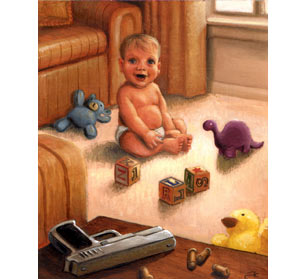
Love me, love my guns

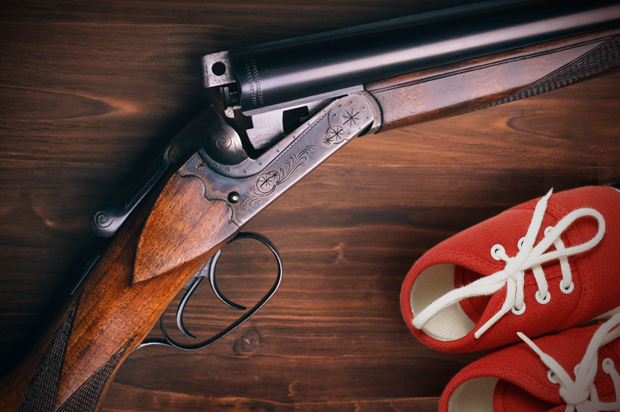
A shotgun tumbled from a closet and my husband drifted from my heart.

  • more
    • All Share Services

Love me, love my guns

I never saw a gun until I was 24. I didn’t grow up in Mayberry; I grew up in Southern California. In my old neighborhood, drugs and alcohol fueled many parties and fights. One night, my younger brother and his friends had an altercation at the end of the street; from my bedroom windowsill, I watched them run home. A boy named Sammy had a knife; someone hit him in the head with a baseball bat. He was killed.

In junior high, where I met my future husband Dwayne, we witnessed mass fights and riots. I saw girls with razors in their hair and boys with fists. There were more riots in high school; boys fought viciously, one with a tire iron. Fights could be brutal; our friend B.D. got his jaw broken over a quarter in a parking-lot craps game. But no one was killed in school, and no one had guns.

Dwayne had seen guns in his neighborhood. Many fathers there, originally from the South, still hunted. On New Year’s, they shot guns in celebration.

But Dwayne never had a gun. When we were newly married, hanging out at my longtime girlfriend’s house as drugs really exploded in our city, Dwayne was terrified when my girlfriend’s husband pulled out a semiautomatic pistol from under the couch. A potential customer, or killer, had knocked. I was upstairs with my friend and her new baby.

Later in the car, Dwayne told me we couldn’t visit them again. “He pulled out a piece. We can’t take that chance,” he said. “Could be the cops. We could get caught in a shootout.” He shivered, I remember clearly, and said, “I heard him cock that baby. Click, click.”

Thirteen years later, a shotgun fell on my head as I searched the closet for baby clothes, and my heart leapt in fear, like a small animal tethered to my breastbone. Dwayne hadn’t told me about the shotgun, never mentioned we were armed. I suddenly imagined him holding the gun, cocking that baby. Shuck, shuck.

Since college, Dwayne had been working with juvenile offenders at a correctional facility. Many of their crimes involved guns. When I was five months pregnant with our first child, Dwayne worked graveyard shift. One night, a juvenile pretended to take an overdose of stashed pills, and Dwayne had to escort him to the hospital. A man jumped from the bushes and shot Dwayne in the chest with a Taser stun gun. Dwayne staggered, but his size, his sheepskin jacket and his bravery blunted the shock. He punched the man, knocking him down, and ran after the hobbling juvenile headed for a van. Then another man emerged from the van, pointing a .38 at Dwayne’s face. Dwayne had no choice; he had to back away.

He didn’t tell me. He didn’t want me to faint, to upset the baby. But I read about the escape in the paper and then I saw the burn marks on his jacket. When he described what had happened — to me and later to the court during trial — I heard what bothered him most: the unfairness of the gun. Bravery and size and loyalty don’t match up with bullets.

I confronted him about the shotgun, after gingerly laying it on the floor. I knew nothing about bullets or shells or what the heavy black weapon might do. Dwayne sighed. He said our city had become increasingly unsafe, with car-jackings and drive-by shootings and random violence. He’d gotten the shotgun for protection, for the intruder that might break into our house. He would be ready to protect us — his little family. He would be a good husband and father; repelling evil was his job.

But I saw him fall in love with the guns themselves, the seduction of the barrels and oil and wooden stocks with carving, the power of caliber. He bought a handgun, then another, and spent hours comparing weapons with our next-door neighbor and my brother. Our neighbor, a very conservative guy, had gleefully told us that he thought a burglar had tested his bedroom window one night. “All he has to do is put a finger over the sill, and he’s inside the threshold of my property. I can blow his ass away. It’s my right.”

My brother acquired his first gun when he was very young, from a recently-fled drug dealer’s residence. Now he lived in a rural orange-grove area, and he shot at coyotes who killed his animals, and at drug runners who used the groves for transport. Sometimes he joked that he only shot what moved.

Dwayne began shooting at the range, and shooting in the groves with my brother. Even my brother was impressed when my husband bought a Chinese-made SKS assault rifle. “How many rounds would it take to kill a possum in the yard?” I joked. But I was scared. I didn’t want anyone pushing on my window screens, but neither did I want the burden of a dead person lying across the sill.

The guns themselves fascinated me for a short time, but underneath my curiosity I was terrified. I never learned to shoot them like the neighbors’ wives, who went to the range. Instead, I opened the oven and there they were, baking at a low temperature as part of the cleaning process: a 9 mm handgun, the shotgun.

Dwayne spent hours in the garage cleaning and oiling them and making his own ammunition with a reloader. He spent hundreds of dollars on weapons, bullets and accessories. Hobbies are expensive. But these were weapons. Not for play — they could only shred targets or skin and bone.

“Only a shotgun, for intruders, and the shells are somewhere else,” I’d been told that day, after the closet. But then I found a handgun on the dresser under a knit cap, within easy reach of our daughters. There was a gun in the camper when we took vacations, a gun in the glove compartment of the car. All those years, I’d been afraid of the police stopping Dwayne, a black man, and now I was even more scared, because what if they saw a gun in the glove compartment?

Every night, while I graded papers, Dwayne was in the garage making shells or sorting bullets or oiling a gun barrel. I watched him, I asked him about the guns and I wrote about them in my last novel. I imagined being a teenage boy, surrounded by gangs and death, who falls in love with weapons as defense; who cannot kill but who cleans and stores and loads the guns to protect his own sanity. But my imagination was still afraid, and when I knocked on the closed wooden door, very late, my husband answered wearing his 9 mm in a shoulder holster. Who was I? Was I on the threshold?

We had three children, and suddenly he had 10 guns. I didn’t feel protected. I felt like I was living with a different man, one who didn’t play basketball and read Sports Illustrated like before, one who baked his guns clean and read Guns & Ammo. Our house and garage and vehicle, my spouse, carried instruments of death. The 9 mm handgun on the dresser, shockingly heavy to me, could have been picked up, dropped, fired, by fingers smaller than mine. And I couldn’t forgive that.

When we visited our old neighborhoods, drugs and guns were everywhere. Our girls approached the car of a childhood friend and I saw an Uzi on his front seat. The stubby barrel was barely hidden. I nearly screamed. A relative had a derringer, tiny and palm-sized, in his car. When I finally told Dwayne I didn’t want to live like this, he replied, “This is real life.” But I didn’t want it to be my life, my children’s lives. Guns and his work and this real life had engendered a paranoia, a mistrust, a secrecy and a fatalism that I couldn’t share.

On our last walk together, without the kids, we took a trail in the nearby river bottom, a place we’d explored as children. Stepping down a narrow path through fall-browned brush and wild grapevines fallow for winter, we saw in the tall bamboo a homeless encampment where dogs barked at us from the entrance. Then we were in a clearing near the water, and a huge snort came from the arundo cane. Feral pigs lived there, though we’d never actually seen one. They can weigh 200 pounds, tusks included, and they’ve charged riders on horseback.

Dwayne pulled a 9 mm handgun from his back waistband and aimed toward the cane. I was amazed. “Back up,” he whispered. We both did. The snorting was grumpy, not enraged, and then the cane trembled as the pig crashed the other way.

I stared at the gun. “So you were gonna shoot the pig?” I said, and Dwayne tucked the gun under his shirt. “And when that pissed him off, he was gonna charge the littlest person — me.”

“I didn’t bring this for wild pigs,” he said unapologetically, as we walked back. “I brought it for wild people.”

I know he’s right — the wild people are out there, but inside my house, there are no wild people. My daughters hate guns. They hate seeing guns in constant advertisements for movies, and on TV news, which in Southern California often consists of freeway chases ending with drawn guns, or videotape of convenience-store robberies where people wave guns. They hate their uncles’ guns, and they hate their father’s guns.

Is this because I’ve told them to? Because they’re girls? No. It’s instinctive fear. I’ll never forget volunteering in a kindergarten class, sitting near the circle of children while they talked about a book. Then a boy said his dad’s gun could have killed the monster. The teacher said, “Guns are scary.” She looked shocked. “How many people in here have seen guns?”

I drew a quick breath when my middle daughter Delphine raised her hand, along with nine or 10 other kids, and said, “My dad has a gun in his car.”

“Mine does, too,” the first boy said. “It sits on the seat next to me.”

The teacher glanced at me, incredulous, and I was ashamed. For all of us.

My daughters are afraid of pit bulls, of the stranger waiting to kidnap them. I was afraid of those things; I still am. But my kids are truly afraid of guns, of their presence everywhere.

This breaks my heart: that they are so young and know too much. I have a desk drawer full of bullets. Yes. I have found spent ammunition on my sidewalk, and several years ago a teacher at the girls’ former preschool poured 10 bullets into my cupped hand, her eyes full of tears. She said her 10-year-old son was given the bullets in their apartment complex, encouraged to get a gun. She moved to North Carolina soon after that.

I have 10 of Dwayne’s bullets in the drawer, too. He lives a short distance from us. One night at dinner my youngest, then 2 years old, mentioned the gun she’d found under the couch at Daddy’s house, and then Delphine frowned and mentioned the two she’d seen under the bed. They’d been playing hide-and-seek.

I felt twinges of pain between my hipbones, where my babies rested inside me, where fear always circles for me now. “It was only a BB gun,” Dwayne said when I called him, immediately, angrily, incredulous. “And the rifles were in a case.”

“Well, OK, and I’m glad she has that third eye in her forehead for when the other one gets shot out,” I said.

For me, saying, “You’ll shoot your eye out with that thing” is not a joke. I know a woman blind in one eye from BBs shot by siblings. On the phone, I went ballistic. I went postal. Gun phrases, now an integral part of our culture.

I told him the kids couldn’t visit under these circumstances, and we argued for days. I said I didn’t care if the guns had only been stored under furniture temporarily. I still remembered the dresser, the glove compartment. And now, a year later, the guns were stored in a locker at the foot of his bed. The girls whisper to me that they hate sitting on the blanket-covered metal chest. “It’s scary to sit on the guns. They’re in there.”

The shotgun, the same one that clunked me on the head, is hidden in my house — the one that started this whole thing, the one Dwayne left behind when he moved out. “So you can protect yourself,” he said when I called him about it. (A year after he left, I got on a ladder to vacuum the moldings and found more than 30 cartridges stored around the room, beneath the ceiling, where he could easily reach them.) I haven’t loaded it; I don’t want to know how. I have held it, looked at it in the mirror, made that shuck-shuck sound, put it away.

My children are my life. I don’t want scars anywhere on their bodies or in their brains and hearts. The way parents were afraid of polio in the 1950s, scared of public pools and free-floating germs, I am afraid of guns. I picture anonymous gun barrels while I wait outside the chain-link fence at school, while I walk across the store parking lot where someone was shot a few years ago.

Was my mother ever afraid of bombs like this, after surviving World War II in Switzerland? Was my father-in-law afraid after surviving Depression life in Oklahoma?

All his relatives had guns. I remember watching westerns with him years ago. “There’s the Colt .45,” someone would say with reverence. “The peacemaker,” someone else would chime in. “Tamed the Wild West.” But Dwayne’s father would reply, “All we ever shot in Oklahoma was dinner squirrel or rabbit.” He never had a gun, other than an ancient hunting rifle, which Dwayne keeps in his collection.

People hunt people now. That’s the difference. That’s what Dwayne was trying to say, over and over, to me. How did we come to this, all of us?

I am afraid of the wild people, just as he is. And when I think about a wild stranger touching my children I even wish, briefly, for a handgun. On our strolls to 7-11 for Slurpees, I watch everyone passing us on the busy street, on the eucalyptus-lined sidewalks. I plan what I will do to a possible attacker. I admit it — I visualize “the great equalizer,” the peacemaker, the one thing that would make me, 5-4 and 105 pounds, able to repel anyone who tried to hurt my girls.

Then do I understand how Dwayne feels? Do I understand how any of them feel — husbands with guns or boys like the two I saw outside my living-room window, comparing handguns and then tucking them into their waistbands before getting back on their bikes? A gun gives anyone all the power in the world. Here in America, the most powerful country in the world, we have the most guns of all. And we are all, almost all of us, afraid of each other.

In my bedroom, perched high in the moldings, there are probably stray green shotgun cartridges. Somewhere in my house, tucked away, is a shotgun. I don’t think of them as protection; they don’t provide any relief. I think the gun was one of my ex-husband’s favorites, left behind as a phantom guard in his absence.

Maybe it makes him feel safe.

Funk soul mother

Once my ex-husband and I danced to the funk as if we had no choice. Now, in the kitchen on Saturday nights, I clean, listen, dance, remember.

  • more
    • All Share Services

Make my funk the p-funk,
I wants to get funked up
Make my funk the p-funk
I wants my funk uncut
– “P-Funk (Wants to Get Funked Up),” Parliament

Saturday night is ’70s night on my R&B oldies radio station, which I
can only get in the kitchen. So from my blue Formica counter with the
permanent halo-like blisters where my ex-husband once dripped Krazy Glue,
the ancient radio plays loud, bass-heavy funk. Every radio in this house
is small and old, except for the small and new one in my daughters’ room.
Their father gave the radio to my oldest girl for her 8th birthday, her
first since he left.

Since I have to listen to this station in the
kitchen, I clean the floor, the counter, the cupboard doors. My kitchen
is shinier than it has been for years. It is fairly free of funk, using
the definition my husband and my friends always employed when they spoke of
it as dirt. Clean this funky house, man; get this funkhole in shape; man,
your house is funky.

It’s Saturday night. The music bumps. The girls have taken their baths.
I have washed their long black wavy hair, and they dance in the kitchen in
their nightgowns for a moment, the beat of Kool and the Gang spilling
across the linoleum. “Mama’s playing funk again.”

They know it is the music of my teenage years. Of riding in the car, of
dancing in too-hot living rooms with bodies pressed all around while music
throbbed from cheap speakers and we sweated to 20-minute songs by
Funkadelic, who counseled, “Don’t fake the funk.” We had dances with
names like the Rock, the Gigolo, the Cowboy, the Freak, the Body Language.

Tonight, while I move around the kitchen with a damp dishtowel and the
Dustbuster, the girls laugh because the DJ plays “Your Love Is Like the
Holy Ghost.” I can’t help it; I show them what we used to do, my friends
and me, across from their father and his friends.

- – - – - – - – - – - – - – - – - – - -
-

On a Saturday night a few weeks ago, I was invited to a party. But I had
spent my baby-sitting time that week going to a lawyer’s office, where my
husband and I ended our 13-year marriage. My daughters do not know
this yet. They ask a lot of questions, and we both try to answer. They
are edgy much of the time if I go anywhere except work, and so I know the
party is out. All day, we hung out in the yard, the girls and me, and then
my mother and niece came over. We decided to go out for an early Chinese
dinner, something we had never done. Why not? It was Saturday evening.
We deserved to splurge. I drove everyone to the restaurant, thinking the
aquarium fish would entertain the 2-year-old. The girls picked the
place, telling me they had been here once with their father. “The
placemats on the table tell you your birth year,” my 8-year-old said.
“Mama, you’re the Year of the Rabbit.”

That seemed appropriate for my life. I often watched
silently, hunched over, chewing, while trying to gauge everyone’s mood.

We entered the restaurant, and somehow the heavy glass door hit my oldest
daughter’s foot. She was crying in the booth, and I was thinking she’d made a
big deal of stubbing her toe, when she pulled off her shoe to reveal a big
toenail halfway torn off. Blood and meat and tears. Everyone winced and
looked away. The waiter hadn’t even brought the placemats. Year of the
Constant Disaster, more likely.

We left quickly. I dropped off everyone else but the injured party and
took her to urgent care at the clinic. We waited in the crowded Saturday
night reception area, talked about school for distraction until she cried
silently, trying not to look at the people staring at her bare foot, toes
wrapped in dampened restaurant napkins.

When we were ushered into a room, she looked around at all the equipment,
sobbing now, and I talked. All emergency rooms look scary. I told her I
was scared the last time I was in a room like this, two weeks before she
was born, when severe carpal tunnel syndrome was aggravated by my pregnancy
to the point that I had nerve damage in my thumbs. I couldn’t hold a fork,
brush my teeth or drive. I joked about how today, my numb, feeling-free
fingers are often useful, as when I can handle hot pans without protective
gloves. But she asked why I didn’t get medicine back then, in that
emergency room.

“Because the medicine might have hurt you, inside my belly.”

“You just had to hurt?”

“Yup. I had to choose between you and the medicine.”

“And you picked pain?”

She was so impressed. It did sound impressive, put that way. But when I
looked at the sterile silver instruments, thinking of my times in emergency
rooms with her and the other two girls, the terror of spinal taps and
seizures and high fevers and IVs, that before-children pain felt like
nothing. The scary stuff was now, every day, the scarlet fever and
pneumonia and stitches we’d been through so far. The years ahead seemed
more frightening than I could ever explain to anyone.

Then the doctor came
in. He inspected, trimmed, bandaged and counseled against possible
infection. My daughter hobbled out on my arm.

We ended up back home, eating in the breakfast nook off the kitchen,
and I turned the radio up loud: “Skintight” and “Love Rollercoaster” from
the Ohio Players.

I swung and stepped, hanging wet clothes on the drying rack over the heater
vent, thinking of the yucky bandages of my life, suddenly remembering the
definition of funk I’d found more than a decade ago in a book by the writer
I idolized. During the ’70s, for me, it was funk and Toni Morrison.

She wrote about conservative black women who controlled their lives and
homes because that made them good, made them worthy.

These girls soak up the juice of their home towns … they learn the
rest of the lesson … how to behave … In short, how to get rid of the
funkiness … The dreadful funkiness of passion, the funkiness of nature,
the funkiness of the wide range of human emotions …

Wherever it erupts, this Funk, they wipe it away; where it crusts, they
dissolve it; wherever it drips, flowers or clings, they find it and fight
it until it dies. The laugh that is a little too loud; the enunciation a
little too round; the gesture a little too generous. They hold their behind
in for fear of a sway too free.

I read those words in my local library when I was 14. I didn’t fully
understand Toni Morrison’s first novel, “The Bluest Eye,” published in
1970. I knew a marriage fell apart, and the images of childhood were so
powerful I have never since eaten watermelon without thinking of the
husband’s memory of the fruit. But in that passage, I understood only
peripherally what Morrison was talking about, because I was a child of the
’70s, and we were swaying our booties, rocking them and bumping them
to the funk of beats low and vicious and everlasting. We were dancing to
Parliament Funkadelic songs that began, “A toast to the booty, for how else
can we praise the rear, unless we attack from the back?”

Funk music. In the car, with the windows down, or on a crowded dance
floor, we moved while a bass player unleashed rhythmic spirals of deep
sound that thumped against our collarbones and breastbones; the drumbeats
pounded our shoulders one way, our hips the other, and then the guitars
bent our knees. The bottom-heavy sound was unmistakable — not R&B, not falsetto love
songs. It shook the rear-view mirrors and shivered windows
and made us dance as if we had no choice but to answer the beat.

My ex-husband was then my high school boyfriend. During the day I read
Toni Morrison, loving the words and images, but by night we rode with our
friends in lowered cars, playing loud funk, all of us bouncing in the same
rhythm so that the car bounced, too. We went to house parties, dancing
until our shirts were translucent, and I loved the smell of my
first and only love: Jergens lotion mixed with cotton and sweat.

- – - – - – - – - – - – - – - – - – - -
-

My ex-husband may be listening to ’70s funk, too, on Saturday nights.
He has been gone two years, but he still has his mail sent here because
he keeps moving, and I hold a promotion postcard that has arrived several
times advertising Funk and Soul Night at a local dance club. Apparently, he
had gone there with friends and decided he’d like to be on their mailing
list for events. Except he put my address down. So I get to look at the
cards and wonder how much of a good time he’s having, listening to the
funk. His might be live and in person.

Mine is beating against the old 1957 stove I clean, since I made bacon for
the girls this morning and the shiny grease is spattered on the white
enamel. Clean, listen, dance, remember.

- – - – - – - – - – - – - – - – - – - -
-

Every year, I read “Sula,” Toni Morrison’s second novel, published in 1973.
Long before she was a Pulitzer Prize winner and national treasure, I had
seen in the library the paperback cover of a young black woman who looked
so much like a friend of mine. In fact, my husband used to laugh when he
saw the familiar cover in my hand.

“You’re reading that book again?” he used to say. “How many times
is this?”

I used to laugh, countering with, “How many times have you seen that John
Wayne movie, the one you watch every year, where you mouth the dialogue as
they holler over the shooting?”

I do have many parts of “Sula” memorized. I have underlined some of my favorite
passages, like the one I quoted in a graduate school paper I still have.
As evocative and poignant and precise as the passages were, I never thought
I’d be living them.

After Sula sleeps with her best friend Nel’s husband, then dumps him, and
after he leaves Nel with their three children to raise alone, the two women
meet when Sula is on her deathbed.

Sula says, “Me, I’m going down like
one of those redwoods. I sure did live in this world.”

Nel says, “Really? What do you have to show for it?”

“Show? To who? Girl, I got my mind. And what goes on in it. Which is to
say, I got me.”

“Lonely, ain’t it?”

“Yes. But my lonely is mine. Now your lonely is somebody else’s. Made by
somebody and handed to you. Ain’t that something? A secondhand lonely?”

For 20 years, I whispered that phrase as my aspiration: soul-stirring
writing, as perfect as a nautilus shell. But I am not Sula. I am trying
not to be Nel. This is how Sula looks at Nel:

“Now, Nel was one of them. One of the spiders whose only thought
was the next rung of the web, who dangled in dark dry places suspended by
their own spittle, more terrified of the free fall than the snake’s breath
below.”

I try not to be terrified. I laugh with my girls in the kitchen, show them
how we used to dance, tell them that sometimes things don’t work out but
that doesn’t mean I’m sorry I did what I did: fell in love, danced and had
a good time, had three daughters. And I do what I do: go to work, cook,
read and laugh and study with them, clean and dance.

“Tear the Roof off the Sucker” comes on the radio. The chorus is, “We want
the funk, give us the funk … we’re gonna turn this mother out.”

I have to laugh. When we cruised in borrowed cars blasting these songs,
the funk was not supposed to lead to babies. The funk was fun. I have a
lot of friends, male and female, who danced with me back in those days, who
will not give up the funk. They had babies. They left their babies with
their mothers or friends or spouses; they dance and drink and party on,
every night. But the funk of life remains, the other version, and someone
has to deal with it.

Weeks ago, we sat in the lawyer’s office discussing the divorce agreement.
Passionless, tiring, resigned — half of everything. Except the funk. My
husband left for the first time when our third child was 4 months old.
A few weeks later, I called him in a panic because I’d seen a large black
widow spider run behind the dryer. She had babies, too; her egg sac,
like a ping-pong ball encased in wispy cotton, was ensconced out of my
reach. I had a 6-year-old, a 4-year-old and the baby; we spent plenty of
time in the little laundry room that used to be a porch. Washing and
drying all those clothes, the funky dirt of pant knees and sweaty work
blouses.

He was distant on the phone. “I guess you better pull out the dryer and
kill them.”

I couldn’t forgive him for that. Dangerous funky stuff was his job. We
had fallen into traditional roles after the kids came. In our teens and
early 20s, I’d been mostly fearless; walking streets long after dark,
driving all over the country, facing down menacing strangers with my pepper
spray. But with each child born, I turned more fearful, more protective of
them and of me. I cooked, cleaned and did the laundry; he cut the grass,
washed the car and killed things.

In that moment, I knew all the nasty stuff of life was mine. Alone. After
the kids went to bed, I pulled out the dryer and smashed the spiders with
my sandal — the one the girls called “Mama’s mosquito shoe,” since that was
what I usually killed with the flat sole.

This winter, when we saw a black widow hanging from the living room
ceiling, I didn’t even think about it. I climbed on a chair, knew I had
only one shot if I didn’t want the spider falling in my face, and whapped
it with the shoe. There is no one to call, and no time to be afraid.

- – - – - – - – - – - – - – - – - – - -
-

The funk of life is mine. The spider bodies, the poop when someone is sick
and can’t make it to the toilet, the crust around the noses when the girls all
had the flu this winter. They visit their father one or two nights a
week, but when they’re sick, they stay home with me. The funky part can
never be exported. No one else wants throw-up. The blood on their elbows
and knees. The mud from their shoes that leaves little brown squiggles on
the floors. The scabs on their skin, and around their hearts. All this is
mine, to clean and acknowledge, to erase and to ease.

But I get the other part, too. This Saturday night, we were all in the
kitchen. We spent the day at an aquarium doing research for an
oceanography project, then going to the Pic ‘N Save for small water glasses
(29 cents) in place of test tubes for science fair projects: permeability
in soil and solubility in water. We also bought cheap valentines (we need
72!) and premature plastic Easter eggs, which my youngest girl likes to
practice hiding at least two months ahead.

Since I was stuck in the kitchen, dancing to “Jive Turkey” by the Ohio
Players (which the girls found hilarious), I loaded the dishwasher.
Tonight they were engrossed in putting names on the Valentines, taking the
Easter eggs apart and generally hanging around. So I made chocolate chip
cookies. Look, I know this is not what a woman my age is supposed to do
every Saturday night. I’m supposed to let the kids know I’m autonomous,
I’m an adult with my own life, I’m supposed to get a baby sitter and go out.
Maybe to the movies, maybe dancing.

But there’s always laundry: funky socks, jeans with mud bowls at the knees.
If I don’t wash and fold now, the week gets wrecked. Suddenly I heard that
song that we danced to at a wedding, my ex-husband and I. I was 21. We
would be married a year later. I remember that reception with such clarity; I can see our clothes, smell our perfume and laughter and punch breath
mingling, our Soul Train-style dance line. Sister Sledge’s “We Are
Family”: “I got all my sisters with me,” the women sang.

I scrubbed the juice stains from the sink, laughing, my hips swaying. The
funk is totally different now. Like an old friend told me years ago, life
doesn’t get better, or worse, just different. I understand now, I thought,
dipping my shoulders to the beat.

Continue Reading Close

Page 4 of 4 in Susan Straight