
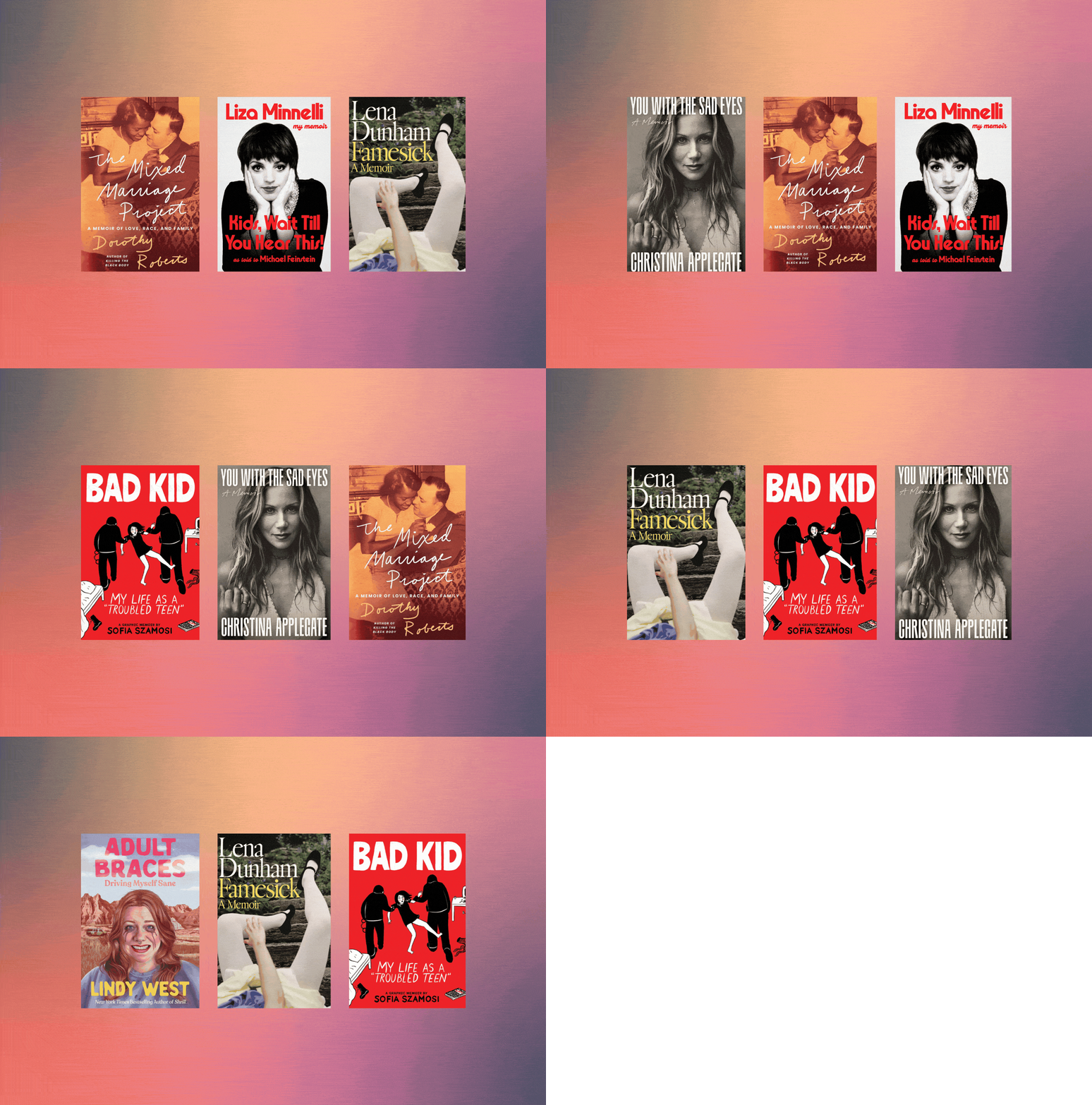

“The Mixed Marriage Project: A Memoir of Love, Race, and Family“
Dorothy Roberts
[One Signal, February 10]
When legal scholar Dorothy Roberts was growing up in 1960s Chicago, she assumed that her white father’s anthropological work — writing about the lives of interracial couples throughout the historically segregated city — had begun after he married her Jamaican immigrant mother. After his death, she was stunned to find that her father’s research had begun more than a decade earlier, and that her mother eventually became a critical part of it. Reading 500 interviews conducted with mixed-race couples, many of whom married at a time when most of Chicago’s residential-housing stock was part of racially restricted covenants, Roberts realized that her father’s work grew out of a core belief that interracial marriage was crucial to ending structural racism.
Realizing that for many of these couples assimilation with white society was more of a concern than dismantling racial barriers compelled Roberts to revisit her own experience as the Black daughter of a white father, and her discomfort with embracing that part of her identity. “The Mixed Marriage Project” is Roberts’ attempt to understand her own complex identity, gain insight into her parents’ dynamic as colleagues as well as partners, and revisit a time and place when couples like her parents were determined to show that love was strong enough to break barriers.
“You With the Sad Eyes: A Memoir“
Christina Applegate
[Little, Brown, March 3]
Before Christina Applegate made her name with 11 seasons of playing “Married…With Children” mallrat Kelly Bundy, she was a child star whose career began when she was a toddler. As with many child stars, acting was a lifeline for Applegate during a tumultuous childhood in Los Angeles; similar to many other young women, her teen years were spent in a self-conscious spiral of body dysmorphia and eating disorders. At 36, she underwent a double mastectomy after a breast-cancer diagnosis, but didn’t feel able to speak out about it. When she was diagnosed with multiple sclerosis in 2021 — right as her career was flourishing with a lead role in the dark comedy “Dead to Me” — Applegate didn’t want to keep yet another secret.
“You With the Sad Eyes” is the raw, honest result. It chronicles the actor’s coming of age in the public eye with absent and addicted parents and all the mental and physical stressors that came with her overlapping spheres of privilege and precarity. She began writing the book, she told The Hollywood Reporter, when her diagnosis reordered her priorities: with the MS diagnosis, she said, “all the things I thought were important shifted. For a long time, it felt impossible to find the meaning in everything I’ve been through, but for the first time in my life, I’ve been able to stop and reflect.”
“Adult Braces: Driving Myself Sane“
Lindy West
[Grand Central Publishing, March 10]
Lindy West’s first memoir, 2016’s “Shrill: Notes From a Loud Woman,” was a literary game-changer: a book of essays that was unapologetically bloggy, it captured on the page the spirit of peevish clapback that flourished in online spaces like Jezebel (where West was once a contributor) and Feministing. In short essays that dismantled conventional wisdom about media fat-shaming and stared down lazy, reflexive misogyny, “Shrill” resonated with readers who wanted more than crumbs of size-inclusive representation; the critically lauded Hulu adaptation that built on the book’s themes by way of a wildly appealing ensemble cast.
West’s new outing is about what happened when her confident, fearless public persona collided with depression, insecurity, and polyamorous upheaval in her marriage: She embarked on a road trip to Key West, Florida, to put as much space as possible between the life she was no longer sure about and the person she wanted to become. It’s a heroine’s journey where the heroine is, West promises, dropping “blistering gossip about myself” as she goes, and occasionally pulling off the road to take in America’s beauty, majesty, and total weirdness.
Want more from culture than just the latest trend? The Swell highlights art made to last.
Sign up here
“Everybody’s Fly: A Life of Art, Music, and Changing the Culture“
Fab 5 Freddy
[Viking, March 10]
Anyone who’s ever wondered what it was like to live in New York City at the center of a massive cultural shift created by rap music and street art can’t ask for a better tour guide than Fred Brathwaite, aka Fab 5 Freddy. A producer, graffiti pioneer, screenwriter and consummate scenester, Brathwaite came up in the 1970s and ’80s when NYC was still inspiring artists, not just pricing them out.
“Everybody’s Fly” is a portrait of a melting-pot downtown art scene of Black and white, fine art and street art, MTV and Max Roach. Brathwaite moved in circles of unprecedented creativity, alongside Jean-Michel Basquiat, Robert Mapplethorpe, Grandmaster Flash and many more. But despite his outsized influence (he brought rap out of the boroughs and into suburban living rooms as the host of “Yo! MTV Raps”), Fab 5 Freddy has never gotten all the credit he deserves or the space to tell his countless stories. “Everything’s Fly” should make that right.
“Kids, Wait ‘Til You Hear This!: My Memoir“
Liza Minnelli
[Grand Central Publishing, March 10]
It’s difficult to even say her name without adding jazz hands, so you already know the tea spilled by stage-and-screen legend Liza Minnelli in her very first memoir is going to be top-tier. And given that the 78-year-old EGOT embarked on the project because she was sick of unauthorized representations that got details of her family and her life wrong (“I was mad as hell . . . it’s my own damn story, I’m going to share it with you because of all the love you’ve given me”) “Kids, Wait ‘Til You Hear This!” is packed with record-correcting realness. The original nepo baby (complimentary) has had a busy life of Oscar-winning roles, sold-out concerts and cult-favorite TV characters. But she’s also navigated substance abuse — both her own and her famous mother’s — tabloid-bait relationships and marriages, and, in 2000, a case of viral meningitis that doctors were sure would claim her voice.
Minnelli’s life has played out alongside, and often in collaboration with, some of the 20th century’s greatest trendsetters and entertainers, from Halston and Andy Warhol to Peter Sellers and Mikhail Baryshnikov; and her stories pull readers back to a pre–Us Weekly era when boldfaced names could live more private lives. She may have a few words for the Twitter account known as LizaMinnelliOutlives, which for several years reported on notable deaths. (“Liza Minnelli has outlived Henry Kissinger. The former Secretary of State was 100 yrs old and lived much longer than many people had hoped.”) Once asked what she thought of the goof, Minnelli didn’t mince words: “[I]it is predicated on the idea that I should not be alive, which I find hurtful and offensive.” That she’s still here is reason enough to celebrate.
We need your help to stay independent
“Bad Kid: My Life As a ‘Troubled Teen‘”
Sofia Szamosi
[Little, Brown & Co. Ink, March 10]
Countless horror stories from the billion-dollar troubled-teen industry have seeped into the news in recent decades, and this debut graphic memoir is not here to launder the system’s deservedly poor image. “Bad Kid,” told through the eyes of a child, is evidence that not enough has been done to shut it down. Szamosi was 13 the first time her mother let two strange men abduct her from bed in the middle of the night, 16 the second. In both instances, she ended up spending months in the wilderness, stripped of autonomy and cut off from her family and friends.
So-called therapeutic or wilderness schools make money by convincing parents to sign over temporary custody for anywhere from 12 to 18 months of “Scared Straight”–style threats and punishments meant to “fix” drug abuse, depression and acting out. “Bad Kid” charges that what they actually do is reinforce kids’ fear that something is wrong with them. Szamosi depicts her surroundings in panels whose black/white/red harshness reflects an environment meant to isolate its captives until they are broken or traumatized into pliability or good enough at acting good to leave. (“Eat. Sleep. Pretend to be fixed. Repeat,” reads one panel.) Just as notable is its portrayal of “bad” kids defying a system that wants them to verbally abuse and rat each other out. The book’s final page is a letter from the author to fellow bad kids: “We are all so much more than what we’ve done . . . those things are part of our stories, but they do not define us.”
“Even the Good Girls Will Cry“
Melissa Auf der Maur
[Da Capo Press, March 17]
Artist/musician Melissa Auf der Maur’s memoir is not a book about Courtney Love. But because Auf der Maur stepped in to play bass in Love’s band, Hole, following Kristin Pfaff’s 1994 overdose (which happened only months after the suicide of Love’s husband, Kurt Cobain), it is also not not a book about Courtney Love. It’s Love’s magnetism that lures Auf der Maur away from the tight-knit arts scene in her hometown of Montreal, and it’s her self-destructive brilliance that holds the band together. For Auf der Maur, touring with a band as popular as Hole is exhilarating; trying to write and record with one that’s as grieving, substance-abusing and seemingly cursed as Hole forces her to consider what she wants from a creative life.
Before she had a front-row seat to the corporate co-optation of alternative rock, Auf der Maur had the mystical certainty, lost to a pre-digital era, that one record can change everything. There’s a scrapbook-ish, nostalgic quality to the book’s photos and newspaper clippings, along with its ruminations on families of origin and chosen families. And there are entertaining cameos from Billy Corgan (a dreamy/scary power puppeteer), Dave Grohl (a devoted boyfriend/kind of a douche), and Rufus Wainwright (a childhood friend–turned–profligate drughound). And Auf der Maur’s honest affection and empathy for her reckless, mercurial and manipulative foil shine through: If 2026 is the year that Love gets a long-overdue redemption arc, Auf Der Maur deserves some of the credit.
“Famesick: A Memoir“
Lena Dunham
[Random House, April 14]
At the other end of the disclosure spectrum, Lena Dunham’s “Famesick” is a second memoir that, unlike her first, comes along at a time when its author has been out of the pop-culture mainstream for long enough that people might miss her. “Girls,” after all, has benefited from both a millennial reassessment and a new generation’s embrace of early-2010s nostalgia; her brief onscreen moments in her recent Netflix series, “Too Much,” were a reminder that she can do absolutely nothing and still display crack comic timing.
More important is that Dunham wrote “Famesick” in a very different mindset than she wrote 2014’s “Not That Kind of Girl.” If the latter was Dunham writing whatever crossed her mind and then navigating the resulting fallout, “Famesick” is the more thoughtful result of having to live beyond her wunderkind era and shoulder the various repercussions of interpersonal strife and chronic illness. She has compared the new essay collection to being in conversation with women’s memoir as a genre, name-checking inspirations past and present. No woman is an island, but she writes, “Just remembering that a book can feel like an outstretched hand was enough to right the capsized canoe that was my inner life.”
“Ugly: A Letter to My Daughter“
Stephanie Fairyington
[Penguin Random House, May 5]
As a child, journalist Stephanie Fairyington was so unconvinced she was related to her effortlessly beautiful mother that she “once snuck into her closet to sift through a security box in which she kept important documents to see if she was indeed the woman listed on my birth certificate.” In “Ugly,” she writes to her own daughter of the many forces that expect girls and women to be ornamental, and the ways that, as a gender-nonconforming queer person, she has tried to model refusal. Fairyington knows it’s unlikely that she’ll spare her child from the actual forces of obligatory femininity, but “Ugly” is her attempt to put them in a political, social and sexual context.
Part self-portrait and part portrait of civilizational preoccupation with perfection, “Ugly” skips back and forth in time, tracing the path of racial and cultural beliefs that are now entrenched in history, literature and popular culture. Fairyington sometimes leans on theorists, from Umberto Eco to Judith Butler, to make points that might be clearer (to her daughter, as well as other readers) in her own thoughtful voice. But as a bittersweet ode to hope and a consideration of ugliness as a tool of resistance, “Ugly” has a powerful grace.
Read more
about memoirs
