
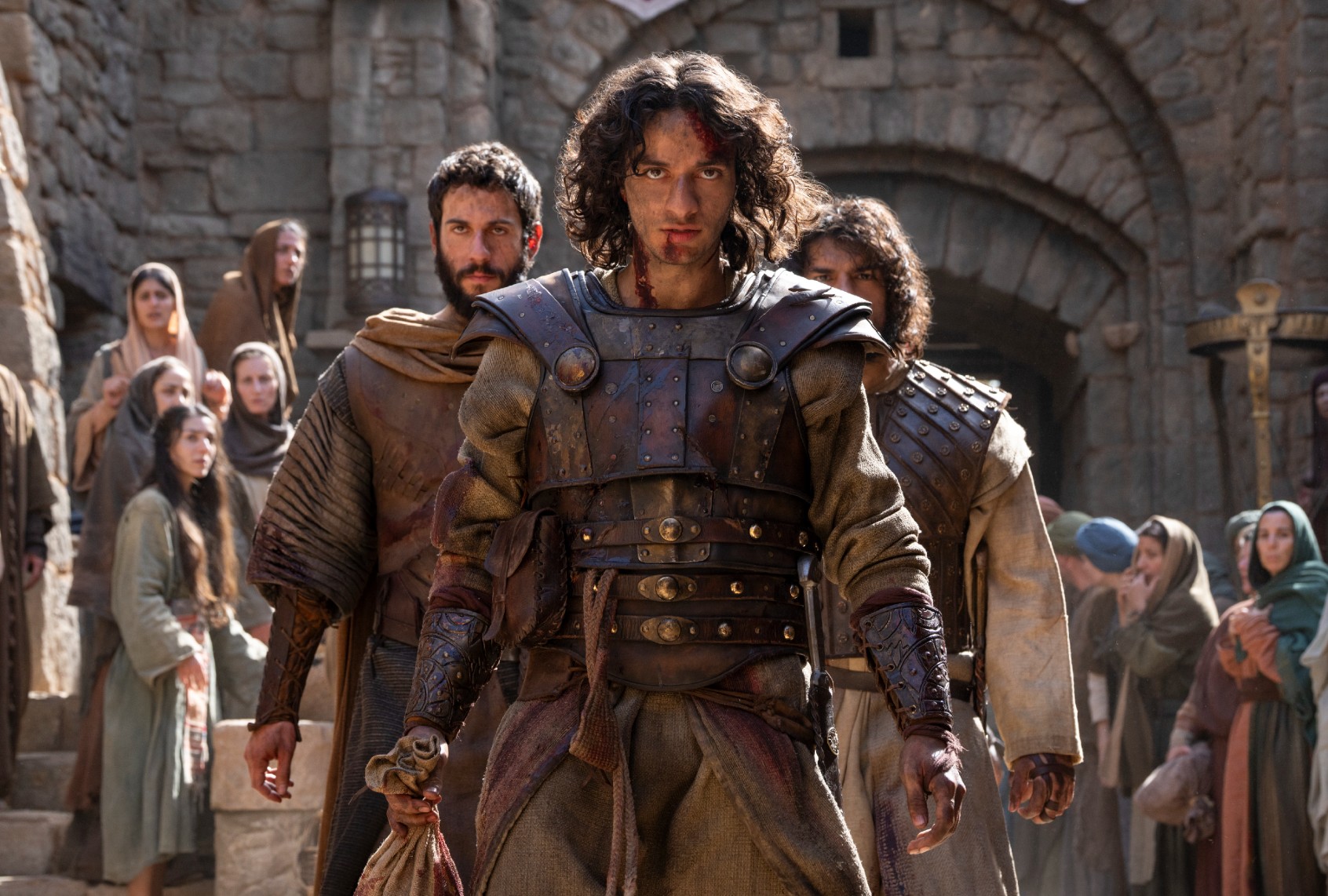

Plenty of Old Testament stories fall under the heading of Too Hot For TV. The Bible verses that inspire “House of David” have several, including one preordained romance between its titular hero (played by Michael Iskander) and Mychal (Indy Lewis), the youngest daughter of King Saul (Ali Suliman).
To reward David for slaying Goliath, Saul offers the recently promoted sheepherder the hand of his eldest, Mirab (Yali Topol Margalith). When David refuses, insisting on marrying his true love, the king demands a disgusting bride price.
If you’ve done time in Bible study, you may know what I’m talking about. For the sake of everyone else, here’s what the Good Book says: David is ordered to prove his worthiness by delivering 200 Philistine foreskins to the king.
The drama’s version of Saul tries to be a fair man, so he asks for only a reasonable number of foreskins — still quite a few, but 200? That’s a bit much. But David, being superpowered by God and eager to win Mychal, overdelivers to a spectacular degree. Luckily for us, “House of David” showrunner Jon Erwin emphasizes the grueling battle required to pull this off instead of the field surgery. When David heaves his prize-winning bag on the floor of his future father-in-law’s throne room, you can almost hear the wet, bloody thwap as it lands.
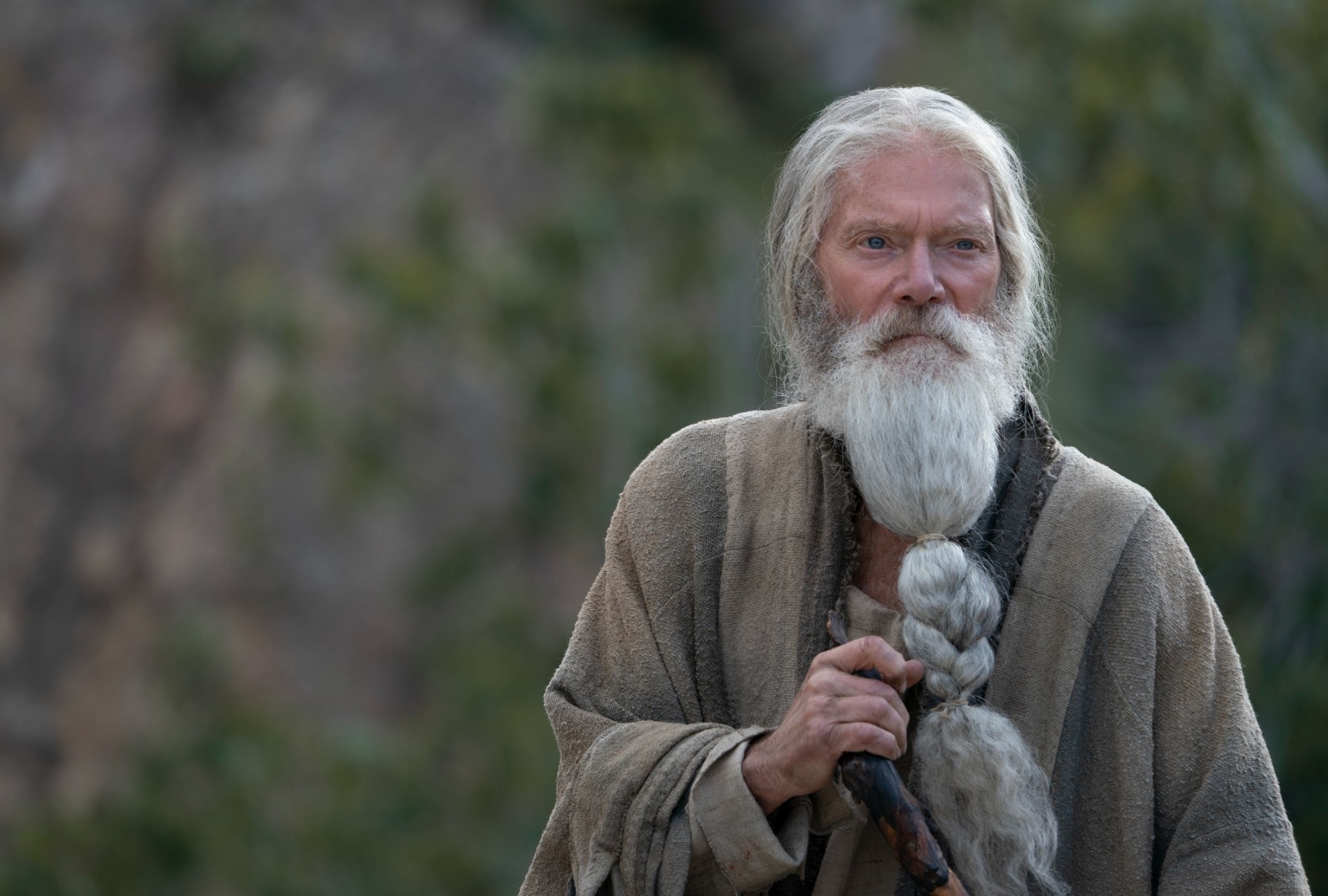
(Jonathan Prime/Prime) Stephen Lang in “House of David”
Secular and Christian popular culture swim in opposing halves of divided entertainment waters, despite broadcast TV’s lengthy history of featuring Christian-leaning shows, including “Touched by an Angel,” “Joan of Arcadia” and, however regrettably, “7th Heaven.” Holiday programming is an exception: Over Easter weekend, ABC will air Cecil B. DeMille’s “The Ten Commandments,” same as it has almost every year since 1973. Charlton Heston’s traditional parting of the Red Sea once occupied uncontested territory over Easter and Passover, save for when NBC reran Franco Zeffirelli’s 1977 miniseries “Jesus of Nazareth,” followed by 1985’s “A.D.,” dramatizing the Acts of the Apostles.
But this spring holds a surfeit of Scripture-inspired scripted alternatives.
On Friday, Season 2 of “House of David” began streaming on Prime Video, while Fox’s three-part limited series “The Faithful: Women of the Bible,” starring Minnie Driver as Sarah and Jeffrey Donovan as Abraham, made its network premiere on March 22. Its second installment, focusing on the story of Rebekah (Alexa Davalos), debuts Sunday. “House of David” is Christian entertainment’s answer to “Game of Thrones” or “The Lord of the Rings: The Rings of Power”; Erwin even styles the prophet Samuel (Stephen Lang) as its Gandalf figure.
It and “The Faithful” join “The Chosen,” the story of Jesus and his disciples now in its fifth season, along with “Martin Scorsese Presents: The Saints,” a Fox Nation production. Its episodic encores are currently airing on Fox as a lead-in to “The Faithful,” whose showrunner, René Echevarria, is an old hand at both network and cable, and whose work includes “The 4400.”
Building on its success with “The Chosen” and “House of David,” last year Prime Video greenlit “Joseph of Egypt” from “Greenleaf” creator Craig Wright, who wrote for such series as “Six Feet Under” and “Dirty Sexy Money.” We can expect to see more veteran TV writers pitch Bible adaptations, too, and what comes from that may not necessarily be more sword-and-sandals period pieces. An upcoming Tyler Perry project for Netflix, “Ruth & Boaz,” transplants an Old Testament love story into the 21st century.
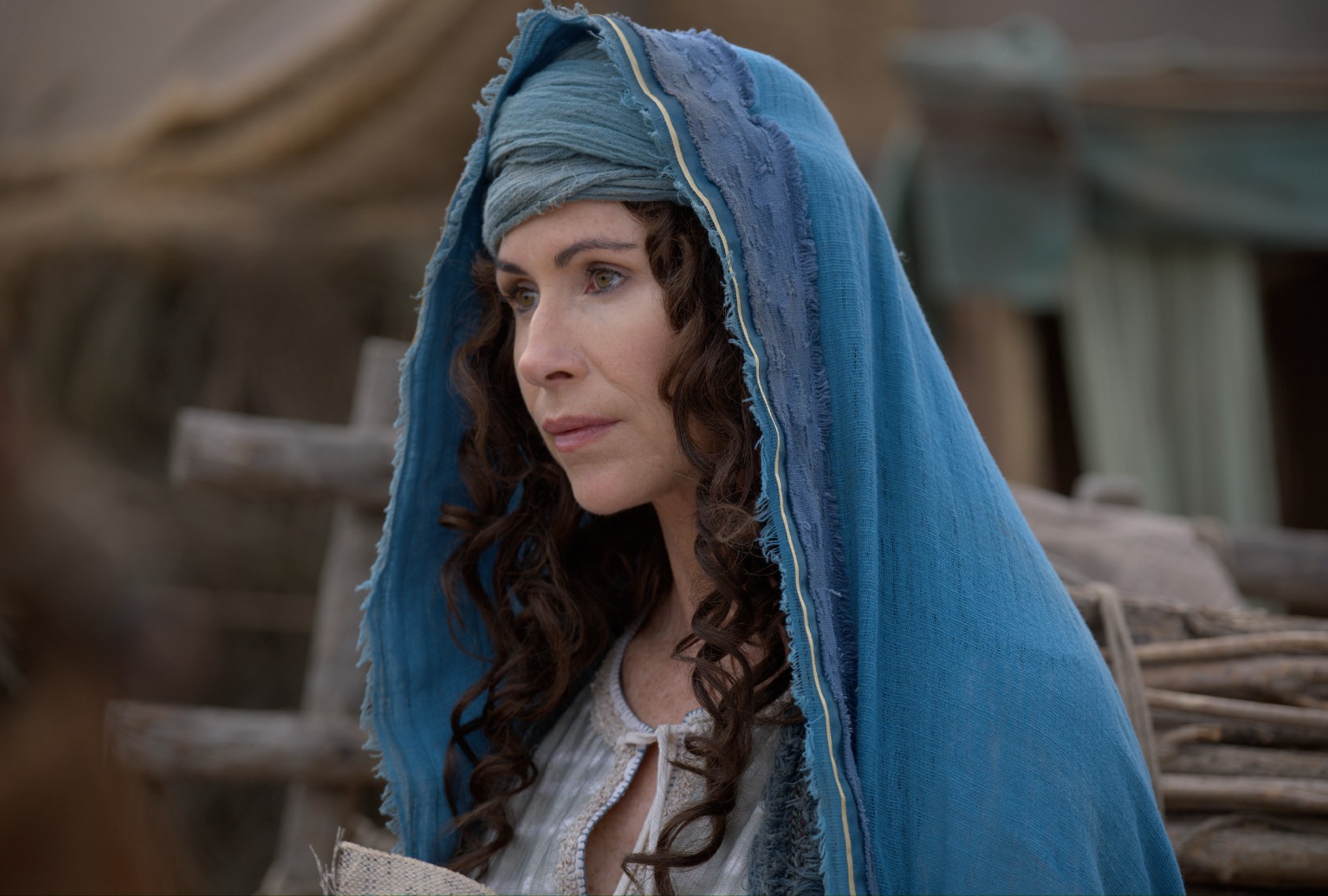
(Fox) Minnie Driver in “The Faithful”
Secular and Christian popular culture swim in opposing halves of divided entertainment waters, despite broadcast TV’s lengthy history of featuring Christian-leaning shows.
Erwin co-founded The Wonder Project, the company behind “House of David,” with Kelly Merryman Hoogstraten, a former Netflix and YouTube executive. Among Wonder Project’s recent shows is “It’s Not Like That,” a romance starring Scott Foley as a widowed pastor who falls for a divorced woman played by Erinn Hayes. The perceived similarity to Netflix’s “Nobody Wants This,” a rom-com pairing a rabbi with an agnostic podcaster, is probably intentional. Cloning hits is a time-honored television indulgence.
It’s easy to view this ecclesiastical content upswing as reflective of the country’s rightward political trend, which accelerated post-9/11. But in the estimation of groups like late conservative Christian leader James Dobson’s Focus on the Family and Parents Television and Media Council, broadcast TV abandoned whatever Christian values it might have aligned with decades ago. Dobson and other right-wing leaders deplored the sex and violence in prime-time shows dating back to the 1980s, but they take specific issue with shows depicting queer characters and relationships. Where the harvesting of a blasphemous enemy’s privates sits with these decency arbiters, I cannot say.
The robust ecosystem that arose in objection to network and cable’s unholiness moved Netflix, Amazon and Fox to claim slices of the underserved fundamentalist market. Certainly politics’ gravitational pull informs some of Hollywood’s revived friendliness to Christian content, but most of what’s driving streamers is profit potential. In 2017, Amazon paid J.R.R. Tolkien’s estate $250 million for the rights to produce “Rings of Power.” With production costs factored in, the company’s five-season investment is expected to exceed $1 billion.
Meanwhile, the Bible bursts with globally familiar stories, all of which are in the public domain. While “House of David” contains plenty of action set pieces, their scope is beefed up by AI-generated imagery — more than 350 shots in Season 2 alone, Erwin told Wired, citing budget constraints. That Middle-earth money has to come from somewhere.
We need your help to stay independent
Although their popularity waxes and wanes like everything else, stories inspired by biblical texts have had a consistent presence on TV and film since the industry’s dawning. As “The Ten Commandments” hits its 70th anniversary this year, Moses’ staff passes to Ben Kingsley, who stars in “The Old Stories: Moses,” a companion piece to “House of David” premiering later this spring. Kingsley previously played Moses in an eponymously-titled 1995 production for TNT, part of a 27-installment collection that ended in 2002 with “Apocalypse” – an appropriate subject, perhaps, considering the time’s prevailing anxieties. But it began in 1993 with “Abraham,” progenitor of the Abrahamic religions and the co-star of “The Faithful.”
One of that show’s executive producers, Carol Mendelsohn, was the defining showrunner of “CSI: Crime Scene Investigation.” Critics slammed that procedural’s pattern of punishing sexuality and kinks that conservatives viewed as deviant, but times have changed. In “The Faithful,” violence is meted out by God’s hand and often witnessed from a distance, as when Abraham and his flock gawk from afar at the cosmic destruction of Sodom.
Otherwise, the main distinction is presenting these chapters from the viewpoints of two of the Bible’s most famous women.
It’s easy to view this ecclesiastical content upswing as reflective of the country’s rightward political trend, which accelerated post-9/11. But in the estimation of groups like late conservative Christian leader James Dobson’s Focus on the Family and Parents Television and Media Council, broadcast TV abandoned whatever Christian values it might have aligned with decades ago.
That also has unsettling contextual implications that the writers can’t gloss over. Sarah and Rebekah’s divinely ordained purpose is to give birth and guide the men in their lives to their greatness, reflecting the Christian Nationalist vision of how women should live even now. In the first installment, Sarah declares Abraham to be her entire world and waits for God to save her from being ravished by a handsy Egyptian royal. It must be said that the offending pharaoh is one of the few brown actors in a mostly white cast playing figures who were born and lived in the Middle East.
Viewed in the halo glow of the tradwife’s ascendance, its version of empowerment is severely compromised. Many pastors would point out that’s just how it was back then. Supposedly, we should say, the Holy Writ’s relationship with reality is sketchy, at best. Never mind the miracles — according to Scripture, Sarah lived to 127 years old, while Abraham was kicking up dust until he was 175.
The surging interest in “House of David” comes with its own eyebrow-raising implications, however, especially when considering the evangelicals’ excuse of citing God’s predilection for choosing imperfect men to enact His will to justify backing a nonstop liar, felon, adulterer and warmonger.
Iskander’s David is a young man whose youthful piety and heroism make him a sympathetic figure, notwithstanding the bag of cold cuts. If this show gets picked up for as many seasons as “The Chosen,” we may eventually see our nice shepherd boy cheat on his cherished princess with Bathsheba, a married woman. To claim her, David facilitates her husband’s death. No soap opera can beat the Bible when it comes to mess.
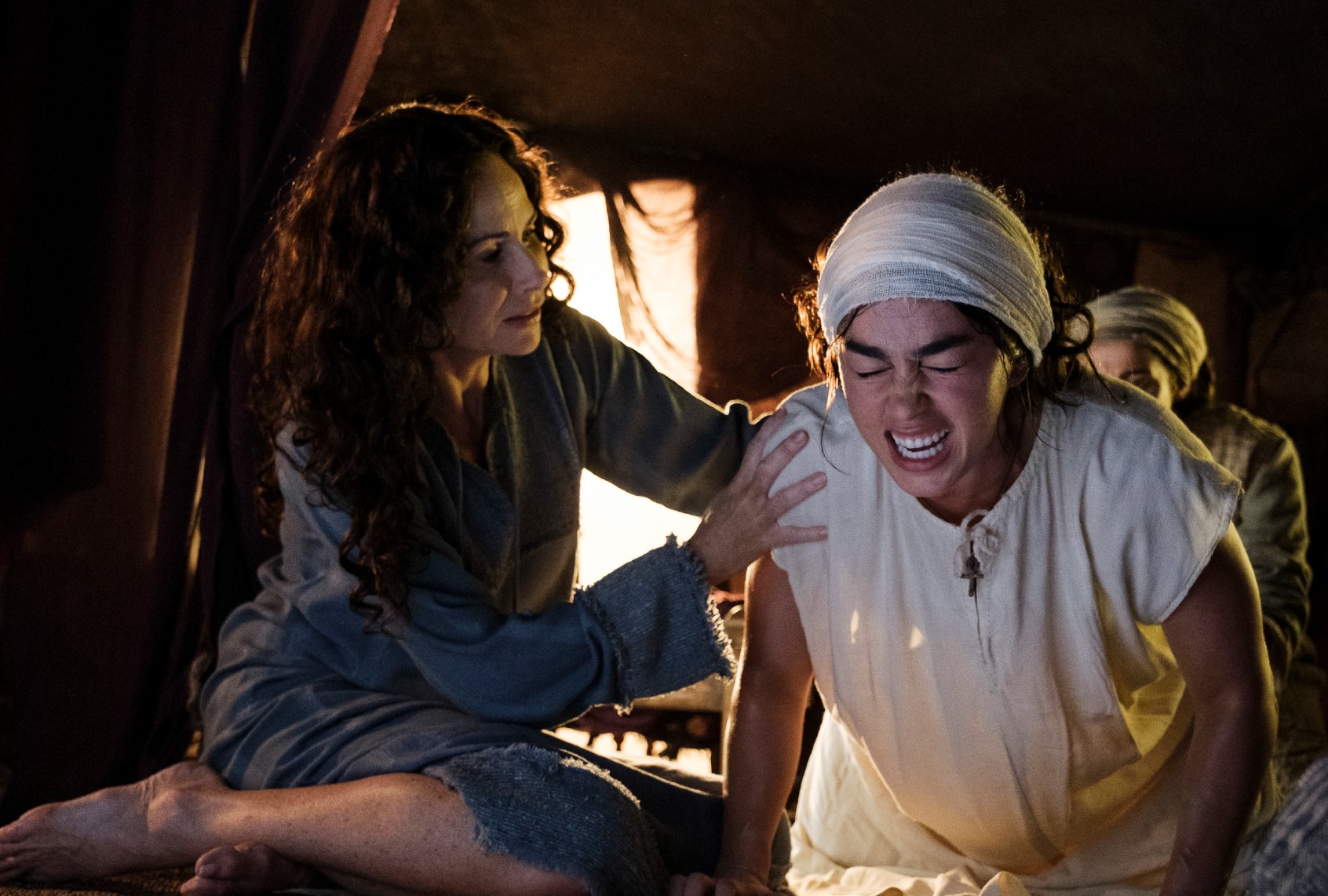
(Fox) Minnie Driver and Natacha Karam in “The Faithful”
We’ll take that over the insistent blandness and flatlining performances that “The Faithful” is serving. For instance, one of the Bible’s best-known passages has God test Abraham by demanding he bind and sacrifice Isaac. “The Faithful” skips that, perhaps estimating its devout protagonist couldn’t win back viewers after threatening his cherubic child with a knife.
Network audiences are also skipping “The Faithful,” but its sluggishness isn’t to blame for the premiere’s anemic ratings. In 2013, “Survivor” creator Mark Burnett produced “The Bible,” a History Channel miniseries that pulled 13.1 million viewers for its opening telecast — and it was intellectual novocaine. I recall feeling absolutely nothing after enduring it. But the series thrived because it had little competition, certainly nothing of better quality. That’s no longer the case.
Want more from culture than just the latest trend? The Swell highlights art made to last.
Sign up here
The story of King David has been told many times, even recently. Angel Studios’ all-ages 2023 animated series, “Young David,” seeded the ground for its feature-length film, “David,” which premiered at the end of 2025. To date, it has grossed more than $80 million in the United States and Canada. In comparison, the domestic box office take for “One Battle After Another,” the Oscar winner for best picture, topped out at just under $73 million.
No soap opera can beat the Bible when it comes to mess.
By emulating epics like Peter Jackson’s “Lord of the Rings” trilogy, the live-action “House of David” opens its story to a much broader audience than most Christian content. If its viewership shares some crossover with “Rings of Power,” that shouldn’t be surprising. Tolkien once described his defining high fantasy in a frequently quoted letter as “a fundamentally religious and Catholic work.” Erwin’s stated goal, as described at a 2025 event covered by Variety, is to make his show “like a gigantic billboard pointing to the Bible.”
That’s good news for viewers who reject entertainment that isn’t informed by Scripture. That segment is far outnumbered by people who may fit the contemporary definition of philistines, non-religious viewers who are only in it for the pulse-pounding swordplay and palace intrigue. To them, “House of David” and its ilk may not be the greatest stories ever told, but they can be as gripping as most legends. By streaming standards, that’s enough to keep anyone planted in their living room’s pews.
“House of David” is streaming on Prime Video. “The Faithful: Women of the Bible” airs at 8 p.m. Sundays through April 5 on Fox, streaming the next day on Hulu.
Read more
about how TV on a holy roll:
