Spring Offer: Get 1 Year, Save 58%

A eulogy for the United States on its birthday

Dearly beloved, we are gathered here today to pay our respects to the dearly departed United States. It was dearly loved, and it has now definitely departed.

We continue to celebrate its birth on the 4th of July with an awe-inspiring fireworks display on the National Mall after imbibing copious amounts of liquor at millions of backyard barbecues waving the red, white and blue and removing a finger or two exploding fireworks at home. Some of us will fire guns in the air. Some of us will die miles from where someone fired a gun into the air. Few of us will recognize or mourn the country’s death: dated July 1, 2024.

Millions of us remain stuck at the first stage of grieving: shock and denial. But, just look at the corpse. Riddled with bullets from numerous mass shootings, overheated and bloated by climate change its leaders denied, it was ultimately brought to a near-death state by a combination of cancerous activities that made the body politic unable to function. Ultimately, and tragically the United States died of self-inflicted wounds.

If we are to ever move forward, we must at least acknowledge this simple fact: The United States of our forefathers is gone. Justice John Roberts wrote the majority opinion of the Supreme Court that acted as the final bullet to the country’s head. That’s right. John Roberts is the equivalent of John Wilkes Booth. Going forward the President of the United States has immunity from prosecution for any “official” act taken while in office – effectively placing the president above the law. The ultimate arbiter of what an “official act” is will be the Supreme Court. This places the court squarely in the middle of partisan political squabbles in which the founders didn’t want them involved. Thus, The Court is guilty of establishing an autocracy we stood against during our revolution.

Millions of us are at the second stage of grief in this process; we feel the pain and some feel the guilt, though at this point most members of the MAGA party are gleeful that they finally killed democracy. 

We are thus and still, a house divided against itself. Mitch McConnell, the Heritage Foundation, Bill Barr and conservative so-called Christians celebrate the death as if the nation’s demise is Christ rising from his tomb and walking among us. The delusions across the country were spread by the doctors of democratic death during the last six decades as the patient withered and died; Richard Nixon, Ronald Reagan and Donald Trump are chief among them.

The United States had a good run. Born from an oppressive tea tax imposed by Britain without the consent of the governed, slave and land-owning patriots across the original 13 colonies rebelled and tried to institute a government that derived its powers “from the consent of the governed.” A bold ideal that wasn’t reality, as women and Blacks had no voice in the government originally. But as Martin Luther King Jr. later declared, “The arc of the moral universe is long, but it bends toward justice.”

Slavery ended, women got the vote, education improved and by the beginning of the 20th Century the democracy appeared in robust shape. Most people trusted government institutions, and while Jim Crow policies and economic disparity during the “Gilded Age” enabled many to question the country’s vitality, an overwhelming majority of us ignored the warning signs.

World War I saw the rise of the U.S. internationally. After coming through the Great Depression, as trying a time as the country had ever seen, Franklin D. Roosevelt rallied the country and told us “the only thing we have to fear is fear itself.” The country rose to the challenge and the greatest generation that weathered the depression and served in World War II also created the atomic bomb and made us a Superpower. Little could the U.S. know that its greatest success contained its greatest challenge and ultimately lead to its death. Of course, it didn’t appear that way at the time – to those who were doing okay. 

Underneath it all was the generational accumulation of poverty, lack of education and healthcare along with racism and misogyny. 

Meanwhile, President Dwight D. Eisenhower warned us about greed and the military-industrial complex. We didn’t listen. After 170 years of existence, the United States was riding high on its hubris and dominating the International stage. We warred for profit. We partied like drunken frat boys. We dictated to other countries as if we held the moral high ground. We preached our purity, our ethics and our success. When we thought it necessary, we not only preached, but we forced others to our will. Why not? The United States? F the world. We ran it.

The bright side of all of this optimism and hope for the future reached a climax with John F. Kennedy. During his inauguration, the youngest president ever elected said “Ask not what your country can do for you, ask what you can do for your country.” Speaking to our ability to work together, the Kennedy inaugural address led many to think the U.S was at its healthiest among nations on the planet, past, present and perhaps in the future. “The energy, the faith, the devotion which we bring to this endeavor will light our country and all who serve it – and the glow from that fire can truly light the world,” he said with pride and without prejudice.

But, the national disease, though showing symptoms few understood, had spread and before the end of Kennedy’s first term he was assassinated in Dallas – and to this day all of the facts about that grim day have not been made public. That enabled the calls of conspiracies and deep state accusations to take root. Now the disease was in public view.

A short time later the country turned on itself again, killing M.L.K who swore there was a moral arc of the Universe. Six weeks later Bobby Kennedy, who eulogized King, was gunned down in Los Angeles. A chaotic 1968 Democratic convention in Chicago led to Mayor Richard Daley’s police force beating and jailing protestors. The ensuing Chicago Seven trial showed how little faith the people now had in the political system, how disparate the system was and how authoritarian it had become. 

In retrospect, most of us missed the signs of the fatal illness. We celebrated our freedoms in art and music, but The Hays Act still dominated movies and Jim Morrison was banned from Ed Sullivan’s show after he sang “girl we couldn’t get much higher." The ability to illogically accept two incongruous trains of thought highlighted the country’s split personality.

We need your help to stay independent

Some of us marched for peace while our government made war. Norman Solomon said in “Made Love Got War,” for those who understood the facts that whistling past graveyards came to seem natural. “The planet is now at its worst in terms of prospect for human survival,” he warned us.

The United States didn’t listen. When the World Trade Center fell to terrorists, for a brief moment we were united, but we split into our scared little corners shortly afterward. The terrorists, in a way, had won. Or more accurately, the national disease was too far advanced for the United States to think cogently. We passed the Patriot Act. Elsewhere, we were so uneducated that we passed “No Child Left Behind” – which left an entire generation of American children undereducated and unprepared for adulthood.

Our infrastructure began to fail. We didn’t embrace universal healthcare. We refused to pass responsible gun legislation. Our elected officials became more vituperative and less intelligent. We graduated from a robust economy that built a thriving middle class, to a bloated “trickle down” economy that fed the filthy rich and robbed everyone else. The age of robber barons had returned. We entered a technological dark age that further fed the national illness.

The disease claimed our cognitive functions. Unable to connect, unable to take care of ourselves, our institutions couldn’t stand. In the final stages of the disease, the country withered – electing older men to the highest office while Congress and the judiciary retreated from the high water of progress to embrace Christian Nationalism. It was as if the country knew it was dying and was appealing to a higher power to save it because it was no longer capable of saving itself. Women lost the right to healthcare. Legislators demanded we teach the Ten Commandments in public schools – in a country that prided itself on the separation of church and state in order to avoid the centuries of strife that plagued Europe. The high tide of the American ideal was long gone. What remained was a walking, emaciated corpse.

As the Supreme Court fired the fatal bullet, President Joe Biden tried to bring hope, but only reminded us how far we’ve fallen.

“Today, the Supreme Court took a bulldozer to the democratic credo that no one—including presidents and former presidents—is above the law.” But people didn’t listen. They were too busy being upset over a recent debate appearance. The media, long ago having abandoned its mission of providing information to the public, instead tried to entertain us with wild accusations and shocking headlines – all for the sake of money.


Want a daily wrap-up of all the news and commentary Salon has to offer? Subscribe to our morning newsletter, Crash Course.


Three years ago, after Donald Trump’s second impeachment trial, Mitch McConnell explained, ‘We have a criminal justice system in this country… And former Presidents are not immune from being held accountable.’ That the last gasp defending the United States came from one of the chief architects of its demise should not escape anyone’s attention. Today, with the blessings of a politicized Supreme Court, Presidents now are presumptively immune from criminal prosecution for using their office to assassinate political rivals, organize a military coup, or take bribes. 

The rest of us live at the whims of a corpse. Many are in the fourth state of grief: depression. Some would rather die than go forward. “If they would rather die,” said Scrooge, “they had better do it, and decrease the surplus population.”

To take an upward turn and embrace hope and a better future from this political death (the last steps in the grieving process), the U.S. electorate must find a way forward. Biden said he doesn’t support the president being made a king. “So should the American people dissent. I dissent,” he said before he prayed to God to “help preserve our democracy.”

Placing four additional justices on the Supreme Court is the most legitimate step to take if we wish to revive, not preserve, our democracy. The question everyone is lost arguing about now, is who is best to do it?

It isn’t Donald Trump. Millions are now unsure it’s Joe Biden – and it seems an overwhelming majority of Americans are thus stuck in the third stage of grieving; anger and bargaining.

What, I ask, are they hoping to bargain for?

The President said when you get knocked down, you get up again. He may be a Tubthumping fan of Chumbawamba, but the United States cannot get back up again as long as the President is above the law.

The United States is dead. Long live the United States.

Gold mining could wipe out this rare desert fish. Conservationists are trying to save it

The Oasis Valley speckled dace is a distinctive fish, with an elongated body covered in black freckles over a gold or silver-hued surface. Unfortunately for this rare species of dace, they only reside in a single spot on the planet: The springs which feed Nevada's Amargosa River. Now the Oasis Valley speckled dace is at risk of extinction by more than half a dozen gold mines in the same area, according to a new petition filed by the Center for Biological Diversity.

Calling for emergency protection for the Oasis Valley speckled dace under the Endangered Species Act, the Center for Biological Diversity argues that immediate aid is necessary because the fish faces "existential threat." The various gold mining projects draw groundwater down which could dry out both the springs and outflows with the Oasis Valley speckled dace reside. the most imminent threat to the fish, according to the petition, is the North Bullfrog Mine, currently under permitting by the U.S. Bureau of Land Management. Dewatering as a result from that mine could drain groundwater levels in the fish’s habitat by as much as 13 feet. Six other such mines are proposed in the immediate area.

Additionally, the rare fish is endangered by other human activities such as redirecting water for human needs, trampling and habitat damage from cattle and burros, pumping groundwater for solar energy development and climate change.

“The Amargosa River is in the crosshairs of the international gold-mining industry, and the Oasis Valley speckled dace could be its first casualty,” Patrick Donnelly, Great Basin director at the Center, said in a statement. “If we don’t take immediate action, we could lose this biologically important little fish and the precious, rare desert springs it needs for survival.”

I’m flying an American flag in protest

I recently bought and began to display the American flag at our home. 

I found one from a company that makes its flags here in the United States but didn’t consider that the standard size might be wrong for our house. When fluttering in the wind by our front door, the flag was so outsized it seemed our modest Cape Cod might tip over.

Family and friends arriving at our house seemed bemused to see it, and some even warily inquired about whether I was feeling okay. My wife was also concerned because I hadn’t discussed the purchase with her, and neighbors might get the wrong idea about our politics. In flying a regulation American flag and doing it without my wife’s knowledge, I had no idea at the time that I’d pulled a Double Reverse-Alito. (Not being in a position to refuse bribe-y “gifts” from billionaire pals, I cannot claim to have pulled a Triple Reverse-Alito.)

Given that twice-impeached former president and convicted felon Donald Trump and his MAGA wing of the Republican Party are working hand in hand with strongmen in Russia, Hungary, and elsewhere to talk down the future of the United States and seize permanent minority power, I thought it important for us (you know, libtards living, as we are wont to do, in Wokestan) to reclaim the most potent symbol of our democratic republic.

To do so seems essential because many players on the other side have flipped the American standard upside down, in more ways than the Alitos and their fellow insurrectionists (including Justice Clarence Thomas’ wife, “Ginni”) did in January 2021. They have done the same with political comity, the idea of statesman-like compromise and our other traditional democratic norms, leading to this bizarre, openly fascistic era in which we must listen to a pathologically insecure man-child who admires dictators, scorns the rule of law and has a Supreme Court standing back and standing by to rewrite the Constitution to allow him to become a dictator himself. Hey, grinning John Roberts is just out there calling balls and strikes as he rings up democracy on pitches nowhere near the plate.

After two gut punches — the Supreme Court's confused, open-ended decision on presidential immunity and the media’s incessant focus on an awful debate night for President Biden rather than the more than 50 lies told by Donald Trump —  how can I still fly the American flag when everything we hold dear seems on the verge of tipping over?

In any case, moderates, liberals, and progressives have varying levels of distrust of any sign of nationalist fervor or performative displays of patriotism. To many of us, peaceably assembling to protest, honoring those who serve the nation, advocating for our least fortunate citizens, subscribing to newspapers to keep up with the issues facing the country and humanity in general and working to expand voting rights are examples of what a patriot does. 

The far right long ago absconded with the American flag. And we just…let it go, which makes about as much sense as handing the interpretation of our Constitution, devised and written by brilliant minds, to the decidedly unintellectual and shamelessly ideological likes of Samuel Alito or Clarence Thomas. (They both talk about following the north star of our “history and traditions”? How about ruling non-ideologically and in good faith, which has always been the tradition for being a judge?)

It is long past time for moderate Americans of all political stripes — the vast majority of us — to band together, to not only decry what the right has been doing with the symbol of our nation while supporting an ignorant, hateful man constantly on the take who promises to walk away from our historical allies and put an end to democracy as we know it and jail journalists and his political opponents.

Not only is the flag overly present in commercial uses, but it also is mishandled by the right, sometimes grotesquely so.

The Stars and Stripes have often been used as a symbol in protest. The harm, I’ve always thought, was not from that but from the sheer ubiquity of display — the American standard flapping, as a marketing tool, often in absurdly oversized form, day and night, rain or shine, over big-box stores and used car lots — lessening the impact of seeing the flag aloft appropriately above public buildings like schools, libraries and government offices, marking them as something special and important, something that belongs to all citizens. The flag may be displayed on the caskets of people who served in the military, the symbol of the republic honoring the sacrifices, sometimes the ultimate, they gave to their fellow citizens.

Not only is the flag overly present in commercial uses, but it also is mishandled by the right, sometimes grotesquely so. It is as if they are attempting in a multifaceted way, as with their continuous campaign of disinformation for their ongoing attempted coup, to discredit its very meaning.

It appears black and shows up on T-shirts, ballcaps and pickup trucks. It’s emblazoned on underwear and on certain golden sneakers (for a mere $399 and manufactured … where?). The flag hung upside down outside the home of Alito — who as a Supreme Court justice is supposed to, at minimum, appear to be non-partisan — as a sign of distress a week after the insurrection and three days before Joe Biden’s inauguration. He blamed it on his wife (but who’s to blame for that lame flagpole?). And that other pro-insurrectionist flag at the Alitos’ beach house. He placed the onus on his wife again.

Seeing the flag flying anywhere and everywhere is dispiriting. I’ve written about how a guy in our town parades around the suburban streets in a souped-up golf cart with a full-sized American flag flapping furiously behind —  a one-man Trump rally. My mind, heart and soul object to everything about his display of so-called patriotism.

But you can’t blame him for following his vulgar leader’s bad form. Trump nearly sexually assaults the American flag whenever he sees one standing alone — “I don’t even ask, I just start kissing.” It’s revolting not only to witness his performative pawing of the symbol of our country to market himself as a “super-patriot” but also to consider that his supporters enjoy that kind of oafish display.

Having received five deferments from military service, Trump more than earned his nickname “Cadet Bone Spurs,” an appropriate moniker laid on him by someone who sacrificed much in service to her country. Later in life, Trump went on to further discredit himself, both as a twice-impeached president and as a commander-in-chief who regularly denigrated those who had served and threatened our NATO partners. Remember when he accepted a Purple Heart from an actual veteran? Any other politician doing that would have had to find something else, outside of public service, to do for a living.

For heaven’s sake, the guy couldn’t accept that he lost the last election and was such a baby about it he left Washington rather than attend the inauguration of the new president.

We need your help to stay independent

One can imagine flag pins Donald Trump should be wearing on the lapel of his poorly fitting suits — the Russian, the Hungarian, and the Confederate battle flags come to mind — but our flag is, without question, not one of them. Trump incessantly claims that without him in charge, the United States would be a wreck, a failed country, an apocalyptic disaster. No one in history has psychologically projected more about his own plans or has demeaned the presidency, and the country in the eyes of our allies, as much as Donald John Trump. And that is only partly why American historians rank Trump the worst of all presidents

Speaking of which, the next time you see Trump sporting his “45” cap (or his wishful “45-47” version), remember, that’s his historical ranking. Dead last. Trump loves to say that Biden is the worst president in history (as he did at the first debate) for the same reason he is driven to incoherently burble about “the Biden crime family.” He is always the schoolboy with the dopey “I-know-what-you-are-but-what-am-I?” retort.

The American flag ought to get a restraining order against Trump.

The rules about displaying the flag state that it should not be used as clothing or in advertising in any way, but apparently we need to add that the American flag must not be groped or used for self-aggrandizement. When it comes to Trump, the Red, White and Blue ought to get a restraining order.

And many on the right, given their out-in-the-open allegiance to other countries like Russia and Hungary simply have been misusing and even abusing the flag for years. Police were beaten and stabbed with American flags during the insurrection at the Capitol, where other “patriots” carried their preferred flags, most for Trump or the Confederacy, which, as everyone knows by now, is essentially the same thing. Debasing the national standard goes hand in hand with how Republicans have vilified government service for decades. Like so many things they say they care most about — family values, the rule of law, freedom from government interference in private life, loving one’s country — it’s all been one long con.

Clearly, none of that means anything to them now. As Salon’s Amanda Marcotte wrote  about attacks by the right on Dolly Parton, “Under the leadership of Donald "Make America Great Again" Trump, Republicans have grown to loathe most everything they used to hold in high regard.” How can you call yourself a patriot when you scorn Dolly, fanboy the Russian president and cheer as your leader calls the United States a failed country? It’s in keeping, though, with the right’s brand of gaslighting and fearmongering the public 24/7. That they’d eventually go after an American icon like Parton is no longer surprising. It is typical projection when bogus Christians, such as they, claim she is delivering a false gospel. Marcotte notes that it is also typical cult behavior for MAGA to invoke religious language to separate people from the pull of the larger culture. That’s what cults do.

Expertise, journalism, the rule of law, the actual teachings of Jesus, the American flag as it was designed — everything that represents a threat to the authoritarian movement, to a slavish devotion to the red-capped Dear Leader now raving with less coherence and with more promises of violence should he win, has to be derided or twisted in the minds of his supporters. Trump’s MAGA followers must be pulled further and further out of the mainstream culture so they might be willing to do unthinkable things.  

That first flag, too large for our modest house, we folded in the prescribed manner and took to our local elementary school, where we had long ago volunteered and where my wife had worked. The principal was pleased with the donation and gave us a nice tour of the place we hadn’t seen since our daughters had attended. 

When you see Trump sporting his ‘45’ cap, remember, that’s his ranking.

I plan to fly our new flag in good weather on federal and state holidays and bring it in at sundown. The rules say it is fine to fly it at all times if it is lighted at night and is an all-weather flag during bad weather, but I want to be more mindful about it, to give it more meaning in my own life. As ubiquity robs potency from a symbol, convenience strips meaning from our actions.

As many noted, the difference between what President Biden had to say in France on the 80th anniversary of D-Day and the daily self-involved, often incoherent bluster and whining of Trump could not be more stark. 

Yes, Biden’s performance at the first debate was not strong. He spoke too quickly and sometimes lost track of the point of his argument. He attempted to both say what he came to say and fact-check the firehose of lies being spewed by Trump. He seemed both over-prepared and under the weather. The more vibrant candidate on the stage was the smug lifelong criminal who cheerfully lied his way through the entire evening and refused to answer many key questions. Biden was absolutely on the mark when he said to Trump, “You have the morals of an alley-cat.” 

But he could have rightly started every one of his responses with some variation of “That’s absolute nonsense.” And he could have refused to normalize Trump by engaging in stupid golf banter. (Or he could have just remarked, “Oh, the game that relies on personal honor? I read you cheat even at that.”) There were so many other things he could have said about the twice-impeached, felonious con man who incited a deadly riot at the Capitol, skipped out on the inauguration, and flew off to lick his wounds, comforted by box after box of classified government documents. 

Still, as a friend of mine said, read the transcript. One of the two men is honest, an experienced leader who cares about all Americans. As MSNBC’s Rev. Al Sharpton put it, “I’m very concerned that on a couple of occasions in the debate Joe Biden couldn’t finish his sentence, but I’m more concerned about the sentences Donald Trump did finish.”


Want a daily wrap-up of all the news and commentary Salon has to offer? Subscribe to our morning newsletter, Crash Course.


For what it’s worth, the next day Biden was again full of energy and fight, quite unlike the editorial board of The New York Times, which might have taken a day or two to think it over before quailing. As he does so often, MSNBC’s Lawrence O’Donnell brought insightful perspective to the debate and the historical context. Biden polls well against Trump and so does Kamala Harris. So, what are we talking about? Even if you think Biden is declining mentally and physically, so is Trump, who is also not only criminally minded but has a justified fear of Alzheimer’s.

This is a battle over meaning and your day-to-day rights, a clear choice between a reasonably forward-thinking political party and one that ran out of ideas and naturally refused to appeal to more Americans. The Republican Party devolved into a cult of personality because they gave up on doing the hard work of governing. The former Party of Lincoln appeals not to the “better angels of our nature” but the opposite. 

In his first inaugural address, President Lincoln famously said, “We are not enemies, but friends. We must not be enemies. Though passion may have strained it must not break our bonds of affection.” Today’s MAGA leaders insist that their political opposition is the enemy, even using language to demonize and dehumanize those of us who still believe in the American experiment. They simply have nothing left to offer except hate. 

We must take back the symbols and spread the word. As poet Langston Hughes wrote in “Let America Be America Again,” even in its failings, America has promise worth fighting to build upon: 

O, yes,

I say it plain,

America never was America to me,

And yet I swear this oath—

America will be!

Happy Independence Day, to the overwhelming majority of us who feel a strong allegiance to the rule of law(and a Supreme Court not in the tank for one, objectively traitorous, candidate, so much so as to smooth the way to dictatorship); to the separation of church and state; to people with expertise in science and public service; to public school teachers, local librarians, overworked nurses, hustling union organizers and a wildly underappreciated president overseeing a strong economy and forging renewed strength in our democratic republic and deeper relations with our historic allies. To all those who believe in the Constitution as a living document and to good faith collegiality in politics — in the very face of a Supreme Court pushing us toward a theocracy in which the likes of Leonard Leo and Lauren Boebert would determine our fate —  it’s time to take back the American standard.

“You’re gonna see just millions being poured in”: After Bowman defeat, AIPAC targets Cori Bush

The fundraising arm of the American Israel Public Affairs Committee (AIPAC), the nation's leading pro-Israel lobbying group, successfully helped defeat Rep. Jamaal Bowman, D-N.Y., in a brutal primary race last month — and now it's targeting progressive Rep. Cori Bush, D-Mo.

The super PAC, the United Democracy Project (UDP), over the weekend dropped more than $63,000 into the incumbent's Aug. 6 primary race, splitting a Friday sum evenly between ads and messaging opposing Bush and supporting her challenger, St. Louis prosecutor Wesley Bell. The group put another $13,000 behind Bell Sunday, according to Federal Election Commission reports.

The latest independent expenditure report capped off just over a week of ramped-up UDP spending in the race, which saw 13 separate contributions totaling over $1.1 million from June 21 to June 30 (in contrast with the nine the PAC submitted from late May through June 18), per FEC data, and brought the total amount of funds the PAC has funneled into the Missouri primary thus far to nearly $3 million, according to Open Secrets.

"What anyone running against an incumbent, certainly somebody running against Cori Bush in St. Louis, needs is money just simply to introduce themselves, to get their name out for the voters," Peverill Squire, a University of Missouri professor of political science, told Salon.

While the money contributed to Bush's opponent "won't guarantee that the other candidate will win," it does "make the race more competitive" and offer him "a much better chance to break through all the clutter" in the media environment and "at least remind people there's a primary coming up," he said.

AIPAC, along with other pro-Israel groups, has backed moderate pro-Israel candidates as part of its pledge to unseat lawmakers who have been critical of Israel, focusing particularly on the so-called "Squad" — progressives like Bowman and Bush who've been vocal in their opposition to Israel's retaliatory offensive in Gaza. Though the committee counts its supporters on both sides of the political aisle, its relatively recent foray into fundraising offers its slate of wealthy Republican donors — who accounted for nearly half of all donors to Democratic candidates this year, according to an early June Politico analysis — the opportunity to pour money into and exert influence over Democratic primary races. 

The group previously said it expects to spend more than $100 million in pursuit of that effort this election cycle and appears to be following through. It contributed nearly $4.8 million to ads supporting Bowman challenger George Latimer and has spent just over $2.1 million on media backing Bell so far. 

"Super PACs now can just come in and throw millions of dollars into a race," Ray La Raja, a University of Massachusetts-Amherst professor of political science and co-director of the UMass poll, told Salon. "Typically, the political parties support an incumbent, and they don't get involved, usually. But these other groups who are sometimes affiliated with the party, not necessarily, can throw in money."

"It kind of eliminates that accountability for the party when these interest groups, these outside groups, can just throw in millions of dollars like that," he added. "That's what happened in New York. It's going to happen in St. Louis. It may happen in other races, but those two races, definitely AIPAC is weighing in."

According to Open Secrets, UDP shoveled nearly $15 million into the New York District 16 primary, most of which went into opposing Bowman, in the span of just over five weeks, making it the most expensive House primary in history. Bowman went on to lose the nomination to Latimer, the Westchester County executive, by 17 points last Tuesday.

Such a sum, experts told Salon, is an "extraordinary" amount of money to see put into a congressional primary.

"What you saw in New York was way beyond anything one could normally anticipate seeing spent in a primary campaign," Squire said. "It's a large sum even for a general election campaign. That's sort of a one-of-a-kind event. What we're seeing in Missouri is some money coming in and a competitive race, at least from what we can tell."

We need your help to stay independent

Seeing incumbents being challenged seriously, much less at all, is atypical, he added, noting that those who are challenged "tend to have some obvious weakness — either personal scandal or a mismatch with the district" — bringing them down. 

Such was the case with Bowman. While UDP's heavy spending likely played a role in the New York progressive's loss, he was already saddled with controversy after he pleaded guilty to a misdemeanor for pulling a fire alarm on Capitol Hill during a government funding vote last year and suggested over a decade ago that 9/11 was a conspiracy, according to Politico.

Much like with Bowman, scandal has left Bush vulnerable in her race. The Missouri Democrat is under multiple federal investigations over alleged misuse of campaign funds for private security, including payments made to her now-husband. Though Bush has denied any wrongdoing, her legal troubles have forced her to dish out a significant amount of campaign money for legal fees. 

"In general, 'weak' incumbents are at risk to primary challengers and since both of these districts are safely Democratic, any Democratic super PAC would jump at the opportunity to get a new candidate in that they prefer — especially if they are a single-issue PAC," Christian Cox, a professor of economics at the University of Arizona who has researched campaign contributions and dark money in congressional house elections, told Salon.

Unlike Bowman, however, Bush is in a much stronger position, La Raja said. Even before proclaiming his outspoken stance against the United State's military support of Israel and calls for a ceasefire — which La Raja described as Bowman's going "way out on a limb" given that his district has a large Jewish population — the Democrat's district had "changed considerably," becoming "more white, more upscale" and costing him some of his base.

"Bowman was falling behind in the polls much sooner," La Raja added. In contrast, "it seems neck and neck with Bush and Bell, so I don't think it's exactly similar."

Responding to Bowman's defeat last week, Bush issued a statement calling out AIPAC as a "threat to democracy."

“AIPAC and their allies—backed by far-right Donald Trump mega donors—poured a tidal wave of cash into this primary race showing us just how desperate these billionaire extremists are in their attempts to buy our democracy, promote their own gain, and silence the voices of progress and justice," she wrote. "There should be no question about the need to get Big Money out of politics.”


Want a daily wrap-up of all the news and commentary Salon has to offer? Subscribe to our morning newsletter, Crash Course.


Hours after the New York congressman's primary defeat, pro-Israel group Democratic Majority for Israel (DMFI) released internal polling that showed Bush had 42 percent support — one point behind Bell.

While that data point fell within the margin of error of the poll, the survey was striking given that Bell trailed by 16 points in the previous DMFI poll from January, according to The Daily Beast.

"Bush is still seen favorably, but assessments of her and her performance are moving in a negative direction, while Bell’s image is improving, leaving him with an underlying image advantage," pollster The Mellman Group, wrote in the memo

“With some six weeks to go and 11% [of voters surveyed] still undecided, this race can go either way, but Bell has achieved a slight advantage," it added.

One key takeaway from the New York District 16 Democratic nomination race and the independent expenditures is that primaries are increasingly becoming a site of competition in elections, "especially in districts where the general election is reliably safe for one party or the other," Conor Dowling, a professor of political science at the University at Buffalo, told Salon, arguing that such a change could lead super PACs and PACs to "become more involved in primary elections in subsequent election cycles."

"I would expect UDP to continue with their strategy of painting some of these incumbents as out of touch with their district as that’s a more broad-based appeal than focusing on Israel and Gaza," he added.

UDP has appeared to follow that formula. The group launched its campaign against Bush much earlier than it did with Bowman, dropping its first ad in the Missouri race at the end of May months before the August primary. It had also already allotted $2.5 million to ads, which is likely to increase, Politico noted, citing ad tracker AdImpact. While that amount pales in comparison to what UDP shelled out in Bowman's race, the media market in New York being more expensive than it is in St. Louis makes such a sum significant. 

Like in its ads against Bowman and other races, the PAC avoided discussing Israel or its war in Gaza, with its first ads in Bush's primary emphasizing Bell's experience. More recent messaging unloaded on Bush the same accusations of not supporting Biden and pushing her own agenda. 

"Right now, my guess is they're probably getting his name recognition up, the challenger," La Raja predicted. "As you get closer to the election, the attack ads against [Bush] are going to get heavier and heavier and heavier. If he stays neck and neck with her, you're gonna see just millions being poured in."

"She's gonna have to defend her record," he added. "Not necessarily her record on the Gaza situation, but she's going to have to defend her record in other ways. It's going to be a very grueling two months for her."

For now, Squire speculated, Bush is likely in a "good" but "uncomfortable" position. She has the advantage of incumbency, while also seeking re-election in a district where she "knocked off" incumbent Lacy Clay in the 2020 congressional primary. She's also had her fair share of controversies, while also doing "all the things of bringing resources back to the district and taking credit for it," he said.

"The best thing to keep in mind is this will probably be a low turnout event, so both candidates are probably trying to build up their turnout machine," Squire said. "Bush will probably be advantaged because she's been through this before and has a core of people that she can count on to show up."

What Voyager 1’s near-death experience says about the future of space exploration

From more than 15 billion miles away, NASA engineers last April began repairing a space probe that is headed to the constellation of Ophiucus, though it won't arrive for some 38,000 years. NASA launched Voyager 1 in 1977 and it has already outlived expectations, but the space agency hopes to continue receiving data from the probe until at least 2030. Yet after Voyager 1 experienced a computer glitch in November, it began transmitting incomprehensible data (which isn't entirely unusual for it), prompting NASA to initiate those long-distance fixes.

After some uncertainty if any of it would work, the repairs succeeded. Even better, when Salon spoke with NASA about the problem of fixing distance spacecraft, the experts were optimistic about its future and what it says about space exploration in general.

To understand why, it is first necessary to break down what happened to Voyager 1 in the first place. In November, the space probe sent a signal that did not include any data. Engineers figured out that the issue was either with the flight data subsystem (FDS) or the telemetry modulation unit (TMU). By the last week of February, NASA sent a "poke" to Voyager 1 to prompt the FDS to send a memory readout with data; not only did this succeed, but NASA soon uploaded a separate command that caused Voyager 1 to reply with a full memory readout that helped them identify the specific issue with the FDS.

"The team confirmed that the issue is with the FDS," NASA Jet Propulsion Laboratory media relations specialist Calla Cofield told Salon. "A chip responsible for storing 256 words of the FDS memory has a stuck bit (the code is stuck at a 0 or a 1), indicating the part failed, either due to age or due to external particle damage. This section represents about 3% of the FDS memory. The team would need to relocate the portion of the software code stored on the damaged chip."

During the April mission, NASA transmitted a command to the Voyager 1 to both relocate the portion of the impacted FDS software code and redirect references to that code to other places in the spacecraft software. 

"On April 20, the team received engineering data from the spacecraft, indicating that the command was a success," Cofield said. "All indications suggest the spacecraft is fine after five months of no contact." 

The team began once again receiving scientific data from Voyager 1 on May 19, and by June all of the science instruments on Voyager 1 had resumed sending usable data. Even so, Cofield added that "housekeeping [is] still ongoing with the spacecraft."

Of course, this is not the end of the issue; Voyager 1 is not the only space probe out there that may some day require repairs. Currently there are two other space probes that have left the Solar System and remain operational, Voyager 2 and New Horizons. Additionally NASA has sent out two other probes that are now defunct, Pioneer 10 and Pioneer 11. Can the lessons which allowed NASA to repair Voyager 1 be applied to these and other distant space craft?


Want more health and science stories in your inbox? Subscribe to Salon's weekly newsletter Lab Notes.


"All indications suggest the spacecraft is fine after five months of no contact."

"The future is less about repairs than about finding ways to work around problems," Bob Rasmussen, a member of the Voyager flight team, said. "We know several life-limiting factors and have strategies for preserving capability as long as possible. We can’t predict outright failures though, so we need to deal with them as they arise."

This is not to say that Rasmussen is entirely hopeful about NASA's ability to salvage malfunctioning probes. In 2019, the agency had to turn off a heater for the cosmic ray subsystem instrument in Voyager 2 to conserve the probe's power. In April NASA further kept Voyager 2 chugging along by tapping into a small reservoir of backup power that is used to fuel the onboard safety mechanism. By doing this, NASA believes it can keep the craft powered with enough juice that they will not need to shut down a scientific instrument until 2026.

Voyager 1 and 2, meanwhile, are always on the verge of a more lasting breakdown. Even if all of their systems perform optimally going forward, the spacecrafts are still not expected to survive past the 2030s. If anything, the fact that they lasted this long is a testament to the skill and dedication of the 1970s engineers who built them. Unfortunately, there could be a day when more than one of their vital systems simply ceases to properly function.

We need your help to stay independent

 
"Worst case is that both can fail at any time," Rasmussen said. "Not all failures are recoverable. For many, we would never be able to tell what happened, because contact would simply cease."

Rasmussen added that the best case scenario is that Voyager 1 continues to function for another five to 10 years. "We have a long-term strategy for gradually reducing activities as power wanes and for using degraded modes of operation," Rasmussen said. "But we also know what happens to best laid plans."

On a tragic note, June was also the month in which Ed Stone, the man who pioneered the Voyager missions and led their missions for half a century, died. In their obituary for former Jet Propulsion Laboratory director, NASA wrote that Stone was "a trailblazer who dared mighty things in space" and "took humanity on a planetary tour of our solar system and beyond, sending NASA where no spacecraft had gone before."

Defense rests in Menendez trial with no testimony from the man himself

After launching a defense in a historic and sprawling bribery trial, New Jersey Senator Bob Menendez’s legal team rested their case Wednesday, opting not to put the embattled legislator on the stand.

Menendez told U.S. District Judge Sidney Stein that he would not testify, allowing the defense to close its case and pave the way for closing arguments, but did provide an unsworn statement after the fact.

"From my perspective, the government has failed to prove every aspect of this case," he told reporters outside a federal courthouse in New York.

The prosecution wrapped its arguments up last Friday after seven weeks of testimony from Menendez’s associates, government officials and investigators, and the chief counsel of the U.S. Senate Select Committee on Ethics. Closing arguments are set to begin next week.

As Politico noted, the defense sketched out a preview of closing statements, hinting that they aimed to place doubt on whether the bribery schemes occurred.

“There’s no direct proof of the schemes alleged,” Menendez attorney Adam Fee reportedly said in a courtroom session without jurors present. “It’s only about the strength of inferences.”

Prosecutors, who told jurors during opening statements that Menendez was a senator “on the take,” painted a vivid picture of a corrupt senator and his wife’s lavish lifestyle, fueled by bribes in exchange for personal and political favors.

Accused of serving as a foreign agent of Egypt in addition to being charged with 16 felonies in 2023 alongside his wife for multiple bribery schemes — including allegedly accepting gold bars and a new car — Menendez gave up his post as chairman of the Senate Foreign Relations Committee after an indictment dropped. He is leaving open a re-election bid. 

Israel approves the largest Palestinian West Bank land grab in three decades

Israel, escalating its campaign to seize territory in the West Bank and accommodate 500,000 new settlers, is pushing forward with the largest single appropriation of Palestinian land since 1993, according to major news outlets.

The impending seizure and conversion of these areas into state land, approved by the Israeli government last month and publicized by Peace Now on Wednesday, encompasses five square miles and, like other seizures that were approved and implemented earlier this year, threatens the mass eviction of Palestinians already living there. Israeli policy dictates that state land is effectively off-limits to Palestinians and can only be leased to Jewish settlers.

This year's land seizures, spearheaded by Israeli Finance Minister Bezalel Smotrich and aimed at connecting two existing Israeli settlements along the border with Jordan, further dismember Palestinian territory and, according to critics of Israeli settlement, undermine efforts to create a Palestinian nation-state.

In an audio recording from a National Religious Party–Religious Zionism convention, Smotrich appears to confirm that undermining such efforts is precisely the point. “We will establish sovereignty . . .  first on the ground and then through legislation. I intend to legalize the young settlements,” Smotrich said in comments reported by Haaretz. “My life’s mission is to thwart the establishment of a Palestinian state.”

Smotrich also admitted that Israel is preparing to annex the whole West Bank “without the government being accused of annexing it." Israel has already built 100 settlements across the territory, housing around 500,000 Israeli Jews and providing them with a springboard to extend further control into the surrounding areas. Three million Palestinians also living in the West Bank are mostly crowded into the 40% of territory still administered by the Palestinian Authority.

Groups of Israeli settlers, often armed by the Israeli government, have carried out violent attacks on nearby Palestinian villages, whose inhabitants sometimes respond in kind. Those clashes, and an Israeli security crackdown that has imprisoned thousands of Palestinians in the West Bank, have escalated since the eruption of war between Israel and Hamas in October 2023.

Most of the international community regards Israeli settlement in the West Bank as an illegal violation of Article 49 of the Geneva Convention. U.N. spokesperson Stéphane Dujarric called the most recent land grab “a step in the wrong direction,” adding that “the direction we want to be heading is to find a negotiated two-state solution.”

Judge blocks Biden trans healthcare discrimination ban from taking effect in early Loper-Bright test

A U.S. District Judge in Mississippi has blocked a Biden administration proposal to ban discrimination based on gender identity — including transgender status — among healthcare providers.

The policy, finalized in May of this year, clarified existing sex discrimination protections within the Affordable Care Act to include discrimination protection against transgender people. The Health and Human Services change came as part of a slew of anti-discrimination protections for the LGBTQ+ community from the Biden administration.

Citing Loper-Bright v. Raimondo — the Supreme Court decision last week that killed the landmark Chevron Doctrine, a legal principle that gave agencies the power to enact policy not explicitly written into law — Judge Louis Guirola blocked the policy from taking effect ahead of its Friday start date.

Judge Guirola noted in the ruling that, under the new doctrine, courts must “exercise their independent judgment in deciding whether an agency has acted within its statutory authority.”

Challenges to the rule came from Republican-led Attorney General offices in 15 states — including Tennessee — arguing that the policy put “gender ideology over medical reality” in court.

Applying to recipients of federal funds, it would have required Medicare to pay for some transgender healthcare procedures including hormone therapy, according to the state plaintiffs.

But the policy only extended anti-discrimination protections to transgender patients, and didn’t influence how patients would be treated. Judge Guirola wrote that the states’ push was likely to succeed, issuing an injunction on the plan for now. 

Tennessee Attorney General Jonathan Skrmetti championed the loss for transgender patients and the Biden administration in a statement. 

“Today a federal court said no to the Biden administration’s attempt to illegally force every health care provider in America to adopt the most extreme version of gender ideology,” Tennessee Skrmetti said.

“Coconut-pilled”: VP Harris’ online stock skyrockets after Biden debate performance

Vice President Kamala Harris is experiencing a meteoric uptick in online engagement following a frenzy of speculation on the fate of President Joe Biden’s candidacy after a widely criticized debate performance last week.

The “Veep”-reminiscent Harris, whose name floats near the top of hypothetical lists to replace her running mate, flew somewhat under the radar for the first three years of her term, popping up occasionally to break key ties in the Senate or rally for Biden administration legislation.

But Harris’s name is getting some more oomph behind it, with “Kamala” and “KHive” breaking into X’s trending topics, per NBC News. Also on X, “coconut tree,” and accompanying videos, emojis, or images of Harris are circulating. 

“Coconut tree” refers to a meme stemming from a May 2023 speech in which Harris recalled words of wisdom from her mother: “You think you just fell out of a coconut tree? You exist in the context of all in which you live and what came before you.”

Though the campaign — and Harris — have been vocal about Biden staying in the race, social media users and betting markets are leaning into the possibility of a Harris-led ticket.

Harris is the favorite, by a wide margin, to head the Democratic ticket amongst betters, per betting aggregation platform Oddschecker, which puts the Vice President at +137, ahead of President Biden’s +250 odds. 

Several  pundits, including Medhi Hasan, formerly of MSNBC, have thrown their weight behind Harris and proclaimed themselves “coconut-pilled.”

But the president has yet to drop out, with his inner circle citing the risks to the race if he were to exit.

While changing the ticket could be harmful to Democrats’ chances by itself, Harris has been plagued with notably low favorability ratings for much of her term, battling racist and misogynistic critics on the right and criticism of her track record as California Attorney General from the left.

A New York Times article, claiming that Biden told an unnamed “ally” that he was considering dropping out of the race, further pushed Harris’ name up on the trending charts before the White House denied the report.

“No one’s pushing me out,” Biden told advisors on a Wednesday call, per the Times. “I’m not leaving.”

Bette Midler trolls SCOTUS with “Wizard of Oz” parody tune: “If you only had a heart!”

Bette Midler has found a way to rip the Supreme Court in style — through song, of course.

The Tony and Grammy-winning singer on Tuesday took to social media to criticize a recent SCOTUS decision that is expected to allow former president Donald Trump to receive broad immunity from criminal charges for "official acts" taken while in office. "Thumbs down to autocracy! #VoteBlue2024ProtectDemocracy," Midler captioned the post.

"Justice Thomas, it's distressin'/ The sins you ain't confessin'/ We saw you on the plane/ You could judge women fairly/ And have ethics more than barely/ If you only had a brain," Midler sings in the song, which is a parody of the "Wizard of Oz" tune, "If I Only Had a Brain."

“Neil and Brett, you spiteful judges/ We gals are holding grudges/ Keep church and state apart/ You could be less disruptive, in all matters reproductive/ If you only had a heart,” another verse goes. Midler's updated take was written by Eric Kornfeld and Marc Shaiman. Entertainment Weekly reported that Midler previously worked alongside Kornfeld and Shaiman to produce a separate parody song bashing Trump. 

Exclusive poll: Media coverage hurt Biden, who leads only among voters who didn’t see the debate

President Joe Biden hoped that a strong debate showing against Donald Trump would reset his struggling campaign, but a new poll shows that he is going in the wrong direction thanks to a disastrous performance and a subsequent news cycle that baked in the image of a tired, mumbling old man.

Provided exclusively to Salon, the latest survey by Democratic pollsters BSG found that it doesn't matter where voters get their news: more than 7 in 10 of those polled said they heard Trump won the debate. And while respondents choose Trump over Biden by a mere 46% to 45% if the election were held immediately, overall, Trump rockets to a 51% to 46% lead among those who said they watched the full debate, rather than just clips, with Biden enjoying a 3% lead only among those didn't tune in, which is within the poll's 4.3% margin of error.

"The news cycle coming out of the debate on Thursday night has repeated and described President Biden's performance as not meeting expectations and being stumbling and problematic and raising concerns about his readiness for office," BSG Managing Director Mike Kulisheck told Salon. "And that narrative that has been repeated and broadcasted and discussed over the past four days has resulted in a broader perception that Biden lost the debate relative to Trump has begun to raise concerns about his broader candidacy among voters."

The poll is the second conducted by BSG since the debate. The first, published by Salon on Monday, found that 6 in 10 likely voters now doubt that Biden could complete a second term in office. BSG has provided campaign advice for several Democratic politicians, including former President Barack Obama.

In the latest poll of 802 likely voters, 45% of whom watched all or part of the debate, there is an unmistakable shift in Donald Trump's direction, with 10% of respondents say they are more likely to vote for him now, compared to 18% who are less likely to vote for Biden. That's roughly in line with the previous poll, which surveyed only those who watched the debate live.

Three-quarters of the respondents in the latest poll said that Trump won the debate, compared to 63% in the first poll. Biden did improve in some metrics — he was seen as more truthful by 20 points compared to 16 previously — but the effect of subsequent coverage and re-posted clips has clearly hurt him.

Other polls, including leaked internals, show a more precipitous decline for Biden, particularly in swing states, as well as states that were considered relatively safe for Democrats. Either way, lagging behind Trump by any margin falls well short of Democratic hopes that Biden would use the debate to pull ahead of his rival, and has raised urgent questions within the party over his continued viability as candidate. Reports have emerged that Obama has privately expressed concern that time is running out for his former vice president.

Trump's campaign and right-wing media continue to highlight Biden's debate performance in their ads, hoping to press home the impression that he is incapable of leading the country with any semblance of energy.

We need your help to stay independent

"The data is worrying for Democrats," Kulisheck told Salon, "but Biden still has opportunities to show another side of his campaign, beginning with the ABC interview this week, followed by more appearances, and then the convention in August and the second debate in September." He continued: "What is critically important is for the Biden campaign to show voters a President Biden who is strong, capable and ready to be elected to a second term."

The Biden campaign appears to be gambling on their candidate's ability to do just that, even as a growing chorus of Democrats say that keeping him on the ticket is a dangerous risk to take as Trump appears ever closer to the White House, plans to reshape the federal government in tow.

Ann Wilson shares cancer diagnosis as Heart postpones tour

Ann Wilson, lead singer of classic rock band Heart, revealed she had been diagnosed with cancer, leading the band to postpone the remaining dates of its Royal Flush Tour.

"I underwent an operation to remove something that, as it turns out, was cancerous," Wilson said in a July 2 statement, per The Associated Press. "The operation was successful & I’m feeling great but my doctors are now advising me to undergo a course of preventive chemotherapy & I’ve decided to do it." Wilson also shared that her doctors advised her to undergo preventative chemotherapy and step away from performing for a year "in order to fully recover." 

Wilson continued, "To the ticket buyers, I really do wish we could do these gigs. Please know that I absolutely plan to be back on stage in 2025. My team is getting those details sorted & we’ll let you know the plan as soon as we can.

“This is merely a pause. I’ve much more to sing,” she added. “Respectfully, this is the last public statement l’d like to make on the matter.”

Bandmate and sister Nancy Wilson also said in an Instagram post, "Happy to let you all know that the HEART tour is still coming your way, but we need to take a temporary pause . . . Rescheduled dates are on the way so stay tuned."

Heart has produced rock hits like "These Dreams," "Crazy on You," "Magic Man," and "Barracuda," since the 1970s. The AP reported that Heart canceled the European leg of its tour in May, citing a “time-sensitive but routine procedure" that Ann needed to have. 

Biden sources say Harris likely to take over if president steps aside, but no decision has been made

President Joe Biden reportedly told an ally his candidacy is at risk if he has another bad public performance, the New York Times reported.  

Biden is scheduled for an interview with George Stephanopoulos of ABC News on Friday and two campaign stops in Pennsylvania and Wisconsin over the holiday weekend, which will likely be make-or-break appearances for the president. 

“He knows if he has two more events like that, we’re in a different place,” the anonymous ally told The New York Times.

Shortly after Times reported the information, White House spokesperson Andrew Bates said the claim was “absolutely false."

The conversation, as reported, would be the strongest indication yet that Biden himself is seriously considering whether he can recover after last Thursday’s disastrous debate performance. Post-debate, many have called for him to step down, now including Democratic lawmakers.

If Biden does choose to drop out, Vice President Kamala Harris would the top choice to replace him, according to senior sources in the Biden campaign, the White House and the Democratic National Committee, Reuters reported. A big advantage for Harris is that she would be able to take over the money and infrastructure from Biden’s campaign, the sources said. 

In a new Reuters/Ipsos poll, 42% of voters said they would vote for Harris compared to 43% for Trump, a statistical tie given the survey's margin of error. In the same poll, Biden and Trump are also tied, with each receiving the support of 40% of respondents.

Despite all the speculation, several of Biden’s allies emphasized that he is very much still in the race and will do everything he can to prove he is fit to serve another term, the Times reported.


Three ways to eat more nutritiously

When it comes to staying healthy, diet is one of the best things you can do to look after your body.

If you want to eat more nutritiously but don't quite know how, here are a few easy changes you can make that will benefit your health.


1. Be adventurous

Plenty of unusual or unconventional foods that might not be a normal part of your diet are full of nutrients and microorganisms that can have many health benefits.

Sea vegetables, for instance. These have existed for thousands of years and are a staple food in traditional Asian and coastal cultures. These vegetables are nutrient dense and contain antioxidants (molecules that neutralise harmful "free radicals" in the body), essential fatty acids, fibre, iodine and proteins not found in land-based foods.

This is due to the unique growing conditions and biological adaptations of sea vegetables, which lead to a distinct nutrient profile – making them a valuable addition to the diet. Some of their benefits include being anticancer and antiviral, preventing blood clots, regulating cholesterol levels, and having antioxidant properties. They may also prevent cardiovascular disease and non-alcoholic fatty liver disease.

Certain sea vegetables – such as algae – can be added to other foods to boost their taste and health benefits. Research shows that adding algae to foods such as cheddar cheese and toasted bread is a great way to increase protein content. The blue-green algae spirulina is particularly beneficial – packed with vitamins, minerals, antioxidants and protein. It's even used as a supplement by Nasa astronauts on space missions.

Sea moss, edible seaweeds (such as nori) and algae (such as mozuku) are just some of the sea vegetables you might consider putting on the menu.

Bitter greens – such as dandelion, beetroot, nettles and mustard greens – are all nutrient dense and have antioxidant properties. They're also shown to support gut health and digestion as they're packed with fibre.

Fermented foods, such as kimchi, sauerkraut and kefir, are associated with lower risk of chronic diseases (including heart disease, type 2 diabetes and cancer) and better weight management. They're also rich in probiotics, which promote gut health and improve digestion.


2. Season generously

Using a variety of herbs and spices when cooking not only enhances the overall sensory experience of your meal, they also provide several wellbeing benefits.

Spices such as turmeric, ginger, garlic, as well as cinnamon, cloves and oregano, are thought to have antioxidant and anti-inflammatory properties due to the array of chemical compounds they contain.

Many of these chemical compounds complement each other – and may even counteract several disorders, including heart disease, chronic inflammation and diabetes.

Cinnamon has also been shown to help regulate blood sugar levels, which is particularly important for managing diabetes.

Ginger, peppermint and fennel are all associated with better digestive health. But if you're looking to improve your immune health, you should aim to include plenty of garlic, thyme and oregano in your meals.

Because of how flavourful herbs and spices are, you'll probably use less salt and sugar when cooking your meals – which could reduce the risk of conditions such as hypertension, diabetes and heart disease. Chilli peppers may also be a useful weight management tool, as the capsaicin they contain (which causes the spicy sensation) boosts metabolism and promotes fat burning.

One last benefit of using herbs such as saffron and rosemary is that they're are linked to improved mood and cognitive function. Even the aroma of rosemary may be enough to enhance memory and concentration.


3. Eat seasonally and locally

Incorporating seasonal food into your diet is not only good for your health, it's also good for the environment.

Seasonal fruit and vegetables are often fresher, taste better and may have higher nutrient content because they do not need to be stored and transported. Locally grown, seasonal food usually needs fewer chemicals and preservatives because they don't need to be transported far distances. And because these foods don't spend as much time in storage and transit, there's less chance of spoilage and waste.

It's worth noting, however, that while storage and transportation may be linked to some loss of micronutrients, these losses are considered minimal – especially in relation to not eating fruit and veg at all.

If you can, try preserving some fresh seasonal produce – either by dehydrating, canning, freezing or fermenting them. This extends their shelf life and preserves some of their nutritional value.


How you eat

It isn't just your diet that's important in helping you eat more nutritiously. The way you eat is also important.

For instance, mindful eating can help promote a healthier relationship with food, which can in turn improve digestion and weight management. This is because mindful eating emphasises being more conscious of your hunger and fullness queues, which can prevent overeating.

The more aware you are of the food you're eating, the healthier and more balanced the food choices you may make.

The size of your plate is also important when it comes to maintaining healthy eating habits. For example, smaller plates give a visual perception of more food. In a society where overeating is common, using the correct portion sizes may help you eat a more balanced diet.

By making just a few small changes to your daily diet, you can improve how nutritious it is and boost your health and wellbeing.

Hazel Flight, Programme Lead Nutrition and Health, Edge Hill University

This article is republished from The Conversation under a Creative Commons license. Read the original article.

“Top Chef” finalist Savannah Miller talks eggs, North Carolina and why taking risks is “addictive”

I'm a sucker for competitive reality TV and have been for over twenty years. Generally, though, I like the storylines, the editing, the competitive aspect and the psychological and sociological components more than any individual competitor. Every once in a while, though, a special contestant comes along and I root for this person with vim and vigor, much like one might root for a favorite sports team. 

On "Top Chef: Wisconsin," that cheftestant was Chef Savannah Miller.

As noted right in my review of the very first episode, I noted that while Savannah's screen-time was limited (I don't even remember if she got any confessionals), her presence stood out and I loved the sound of her avgolemono sauce. But that was just the start.

Miller remained quiet and under the radar for the first five or six episodes, but she was a near-constant presence visually. This signaled me to the fact that she must become a significant competitor sometime down the road. And was I ever proven right.

In the episode "Chaos Cuisine," Miller first stood out, earning rave reviews for a dessert featuring mustard greens, along with a narrative through-line told both in confessional and to guest judge Matty Matheson that this was her attempt to right a wrong from years and years ago. And it paid off, putting her in the top three for the first time that season. 

In the next two episodes, her presence was quieter again, but from "The Good Land" and on, Miller took off, winning multiple challenges and becoming the narrative force of the back-half of the season with practically more confessionals than any of her competitors. Many argued that she became the undisputed front-runner, a come-from-behind competitor who began clearly coming into her confidence, feeling her oats and positively dominating from there on out.

Over the course of the next four episodes (sans a bad cut and lackluster dish in episode ten), Miller would win at least one challenge per episode; in episode 12, Miller netted a "Top Chef" record, becoming one of the few over the course of the series to win both a QuickFire and an elimination challenge in one episode. 

Unfortunately, though, the six-week break between the main competition in Wisconsin and the finale in Curacao and on a Holland America cruise ship seemed to put a halt to her amazing momentum. The final four challenge saw her fall to the bottom two, while the ingenuity and meticulousness she previously displayed seemed to get away from her in the big finale meal.

Nonetheless, Miller was a tour-de-force and a joy to watch and it should go without saying that I'm so thrilled to see where her career goes from here — or if she might appear on another "Top Chef" season sometime down the road!

Obviously, Miller had many top moments, but one that I think sort of encapsulated her entire "Top Chef" showing was her eloquent speech to the judges' as she presented her potato pave dish with chicken jus and charred onion-cherry sauce. She spoke about how a pave calls for nothing more than potatoes and a few other simple ingredients, but the real stars of the show are time, heat and pressure, which turn the humble potato into something extraordinary.

Miller likened the pave's journey to her own, and in doing so, not only met the challenge at hand, but also perfectly summed up her time on the show up until that point. 

I had the pleasure to connect with Savannah to chat about her "come-up" in the industry, her preparations for the show, her strategizing during challenges, how "Top Chef" unlocked a ferocious competitiveness in her and her desire to "cement [her] name in the North Carolina restaurant scene" — and I have no doubt she will do just that. 

Top ChefSavannah Miller on "Top Chef" (Stephanie Diani/Bravo)

The following interview has been lightly edited for clarity and length.

Hi! I’m still amazed by your pave with cherry and onion sauce and chicken jus. I’m definitely going to make my own iteration of it one of these days. I coincidentally have an obsession with both chicken jus and charred onions and would love any tips you might have for making it?

I'm glad you enjoyed the dish. It was one of my favorites this season. Who doesn't appreciate chicken jus, onions, and potatoes? I love the idea of taking humble ingredients and elevating them, especially when it's a dish that feels so close to my personal journey in the season.

For the jus, I recommend getting a very good roast on your chicken bones prior to starting. More caramelization means a more intense flavor in the final product. The charred onions are so easy, just keep removing layers of the onion as it becomes charred, ensuring that every layer has an even cook. It can be slightly astringent at first, but the char also helps bring out some natural sweetness of the onion and I like to pair it with sweet ingredients to help balance the flavors.

I’d like to talk about your dessert in “The Good Land”. Kristen’s description made it sound amazing! What led to that inspiration?

My inspiration for the dessert in "The Good Land" was really of the moment.

Prior to us having to cook, Sean and Elena cooked us a meal to help inspire us. It really worked for me. We had a delicious dessert that was a variation of red bean jelly, and a sweet squash puree. I loved the textures and natural flavors that we were able to pick up on while eating it. I knew I wanted to do a dessert for my course, but after that meal and once I saw the ingredients available in the kitchen, I knew I wanted to do my take on something similar to the dessert we had the day prior.

In the beginning of episode 13, you mentioned that that indigenous challenge was part of “woke” you up and you haven't turned back since. What about that prompt do you think was so noteworthy for you?

The prompt of the challenge was ultimately to let the indigenous ingredients shine. That's an ethos I've carried with me throughout my career and something I go back to when I'm editing a dish.

I always ask myself, "Am I doing everything I can to highlight these ingredients and flavors?" Maybe that's toning a specific flavor down to enhance the overall balance of a plate, or it's limiting how much we're manipulating something from its original state. It's different every time, but I think the fact that honoring these ingredients was the ultimate goal in this challenge, I was able to relate to it better.

I also took many more risks than usual and really second-guessed myself leading up to the judges' table. You never know for sure how they will react, and I was so pleasantly surprised. After that episode, I gained more trust in myself to take risks and believe in my own decision-making in the kitchen.

Top ChefSavannah Miller on "Top Chef" (David Moir/Bravo)

Tell me a bit about your "pedigree" or your come up prior to Top Chef?

I grew up in Southern Pines, North Carolina and worked in a few corporate restaurant kitchens before attending culinary school at The New England Culinary Institute in Montpelier, Vermont. I graduated and moved to Massachusetts to work under Chef Matthew Jennings who owned and operated the restaurant Townsman in Downtown Boston. I started here fresh out of school and very green.

For almost four years, I gained an immeasurable amount of experience learning from not only Jennings, but every single person in that kitchen. I was able to use it as my training grounds, and I worked almost every position in that restaurant before eventually moving on. I was turning 22 and looking for a change of scenery, so I decided to move back to North Carolina, but to a city I had spent very little time in, Durham.

Over the course of the first year, I had a few different positions, ranging from being a full-time pastry chef to leading a small pop-up at night in a local bakery space. I met my mentor Mike Lee in 2018 while he was beginning to plan the opening of the third restaurant in his group called M Tempura, where I currently work. I've led this kitchen for the last 6 years with the exception of stepping away to help open Glasshouse Kitchen during the summer of 2022.

We need your help to stay independent

I find the fry, even just visually, on the fish you cook in Restaurant Wars and the pork you won the Quick Fire for to look excellent. Do you think that might be from working with tempura extensively? Or do you attribute that to something else?

I do have a lot of experience frying. Tempura frying is very specific and wildly different from the breading/cooking/resting of the fish or the pork loin, but it all comes down to the same skill set.

At M Tempura, we were open for lunch service for years prior to Covid, and I can't tell you how many pork katsus I've fried. I think just taking a little extra time and making sure you're doing things with care make a big difference.

It's so cool to see how well you've "done your research," like how you knew about the keshi yena, the lionfish, the wok in the Tom Quick Fire, etcetera. Is there anything in particular you attribute that to? Are you just especially perceptive?

I do feel like this experience brings out a certain "awareness" in a lot of people. I felt like I was always waiting for the next big surprise from producers, so I was on my toes the whole time and trying to take notes of things going on around us.

For the woks specifically, I would have definitely tried to use one already at that point in the competition if they had been there the whole time, so I knew they were placed recently.

As for the research done prior to the show, I will attribute it to being very competitive naturally but also my self-awareness of my own skills. I knew I wasn't going to be the most technically trained chef walking into that season or the one with the most kitchen experience. I had to work hard in other areas to have a fighting chance to win. We're all capable of researching and preparing, and I think a lot of us in Wisconsin did our homework. It left me with more time to be creative when I already knew the history and inspiration behind the challenge subjects.
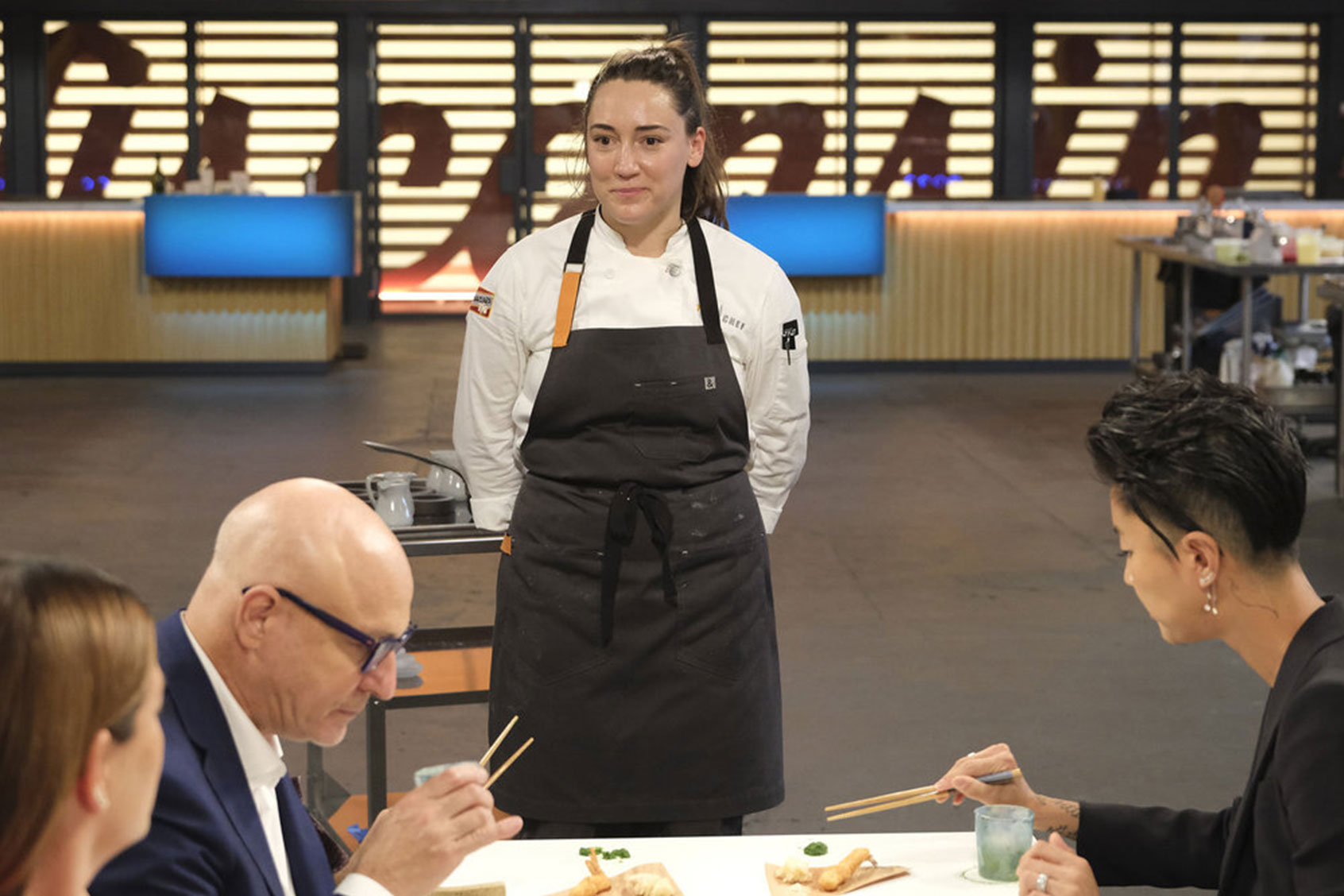
Top ChefTom Colicchio, Savannah Miller, and Kirsten Kish on "Top Chef" (David Moir/Bravo)

Did you have a favorite challenge? Conversely, was there a challenge you weren’t especially enthused by?

My favorite challenge of the season was by far the indigenous challenge. I loved the concept of creating dishes using only ingredients that were sourced for us by Chef Sean and Chef Elena.

As chefs, we so often rely on things like dairy and cane sugar to provide depth and flavor to our food. This challenge was so unique and really pushed our limits.

For my least favorite, I would have to say it was the fish boil. Aside from injuring myself, I had a hard time feeling inspired by this challenge and my food suffered because of it. I also find a lot of creativity when shopping for my ingredients so while I loved the opportunity to work with Shota, I felt that I kept running into circumstances that affected my ability to perform the way I wanted to.

Which dish were you proudest of?

The dish I am most proud of this season is my mustard green dessert during the chaos challenge. I truly felt like I was pushing my limits conceptually and doing something that scared me, and to be rewarded for that was such a fantastic feeling. There was so much on the line for me during that cook. I needed to redeem myself from the original dish I had flopped on almost 10 years prior and the obvious pressure of being on "Top Chef" in the first place.

I gained so much confidence from this challenge because I took a risk, and it paid off. That feeling for me was addictive, and I wanted more of it.


Want more great food writing and recipes? Subscribe to Salon Food's newsletter, The Bite.


Do you have a number one favorite ingredient to work with?

One of my all-time favorite ingredients to work with would have to be the humble egg. I really appreciate how versatile it is.

If you have eggs, you have the foundation to make such a wide variety of food: meringue, omelets, creme brûlée, carbonara, ice cream, aioli, and even chawanmushi!

In its simplest form, yolks can be cured and used to add salt and umami while finishing a plate, or you could add a runny yolk to literally anything to bring more fat and luxuriousness to a bite instantly. They can be used in so many technical problem-solving ways as well. Whipping the whites to create light and airy textures in desserts or tempering the yolks to thicken sauces and bases of all kinds.

Love eggs. Love 'em.

What was your favorite moment?

My favorite moment on air was when I saw Kristin's reaction to my jelly cake during the indigenous challenge. We always receive feedback during judges' table, but it's rare that we get to actually see the judges' immediate reactions to trying our food. I had no clue how much of a hit it was across the board, and it filled me with joy and pride to watch it for the first time.
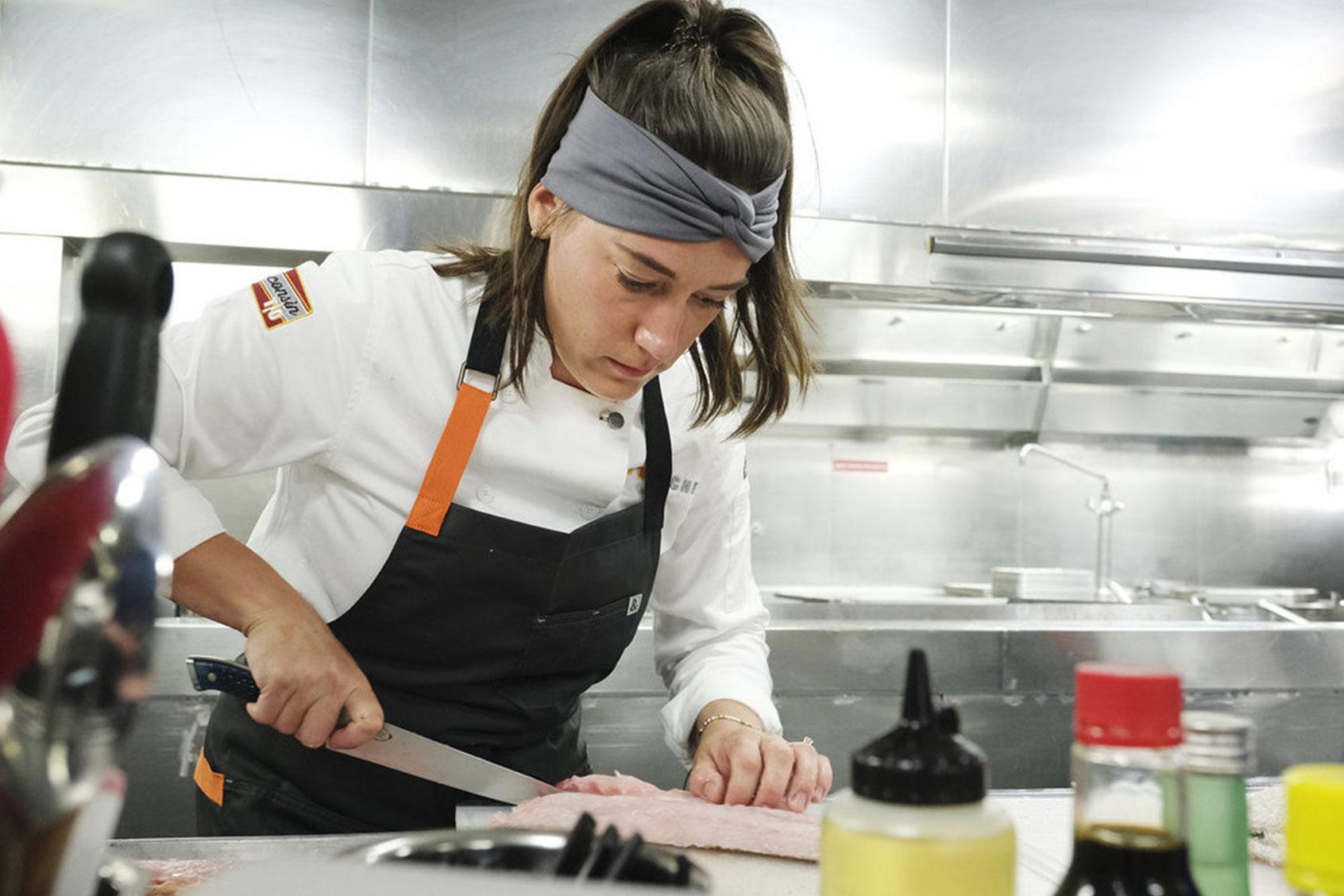
Top ChefSavannah Miller on "Top Chef" (David Moir/Bravo)

Why do you cook? What stands out for you as a formative moment that got you into cooking or food at large? 

I've been passionate about cooking and working in restaurants from a young age.

As a kid, going out to eat was my nirvana. It felt so ceremonial and special. I loved the production of choosing a restaurant, getting seated, and enjoying new and different foods.

My aspirations for being a chef grew as I got older and started working my first few jobs as a teenager. In high school, I worked in two restaurants during my senior year and spent more time on the line than I did going to class. I felt so drawn to the camaraderie of a team working in tandem to perform the nightly task of providing hospitality to their guests.

I've always felt that restaurants are so important to our communities and our ability to connect with other people. I think this belief is what ultimately drew me into kitchens in the first place, and along the way, I fell in love with the ability to self-motivate, communicate, and relate to others through cooking.

What is your favorite cooking memory?

I have a lot of really great cooking memories, but something that stands out is a story that comes from my time working as an intern at Townsman when I was 19.

I was tasked with making the pierogis for the restaurant. After weeks of making the dough, forming, and blanching them every other day, I got really good at it. Finally having something on the prep list that was specifically delegated to me because I had excelled at it felt good. I was straight out of school and surrounded by all-star cooks who could run laps around me. So, to receive that type of positive feedback from people you admire in a restaurant at that level, I didn't even care about how tedious of a prep task it was because it became special to me.

As time passed, I was able to teach various new employees the process, and those are fond memories for me as well. To be a young and inexperienced cook myself but still realize that I have knowledge worth passing on to others was invaluable.

What’s next for you? 

Right now, I'm running the kitchen at M Tempura in Downtown Durham and really loving the interactions I get with our guests: The OG regulars and the new faces who are fans of the show.

My fiancé and I are planning our wedding for 2025 and are working to figure out what we want next.

I love this area and don't plan on leaving Durham anytime soon. My dream is to cement my name in the North Carolina restaurant scene and my ultimate goal is to open and operate my own businesses. Whether it's a restaurant space or something more catered to private events, I want to keep celebrating milestones with people and providing a place for any celebration, big or small.

After filming "Top Chef," I've also found a new passion for competition cooking and the entertainment industry as it relates to cooking. I'm not sure what the future holds, but I feel confident that this is just the beginning of a lot of new adventures, and I'm so grateful for it all.

“The Bear” confronts Carmy’s nightmare: A boss who believes in creating excellence through pain

Joel McHale’s living nightmare of a New York chef turns up for the first time in the second episode of “The Bear,” malevolently hovering inches from the hero’s right shoulder. Horrific doesn’t begin to sum up the man’s management skills properly – he is concentrated nuclear fallout in human form. A plague of acid vomit.

Moments after he strides into the scene, firing a line cook for messing up a sauce, the celebrated culinary master sets to barking random numbers into Carmen Berzatto’s (Jeremy Allen White) ear to throw off his system.

Then come the toxic whispers. “I get it – you have a short man's complex. . . . Is why you have the tattoos and your cool little scars and you go out and take your smoke breaks? It’s fun, isn't it? But here's the thing: you're terrible at this. You're no good at it.”

Charring his star employee with curses, he berates him for his supposed slowness and orders him to repeat, “Chef, I’m so tough.”

“You are not tough,” the man responds. “ . .  .You are talentless . . .You should be dead.”

We’ve all had at least one manager who’s unforgettable for all the wrong reasons. Maybe he constantly undermined your skills and took credit for your successes, as McHale’s chef does to Carmy. Maybe she prioritized your output over your mental and physical health. McHale’s character is horrendous to such a degree that some who watched the first two seasons of “The Bear” theorized he didn’t exist, that he was merely a figment of Carmy's lowest insecurities.

Feeding that hypothesis are the times the past manager manifested as an illusion, as during the soft opening for The Bear when Carmy thinks McHale’s thug is judgmentally staring at him from a corner, malevolent grin plastered across his face.

But he’s real, and as “Forever,” the third season finale finally reveals, he has a name: David Fields. A moniker so commonplace as to make someone who wants to be great resolve to conquer the mountaintop at all costs, delivering a kick in the teeth to anyone who might threaten to join him on his peak.

Carmy is such a contender, so Fields leaves the kid’s soul covered in scar tissue. But Carmy also exemplifies the best of what his other mentors imparted to him – great chefs like Daniel Boulud, who teaches him to hear music in sizzling oil.

Or The French Laundry’s Thomas Keller, who gently speaks to Carmy about the profound spirituality of their profession and the legacy he’s continuing, all while teaching him how to truss a chicken.

Even more, there is Olivia Colman’s Chef Andrea Terry, the founder and heart of Ever who, in the third season finale, marks her retirement with the dinner to end all the restaurant’s dinners for everyone who has worked for her and everyone who is anyone in the culinary universe.

Including David Fields.

The BearJeremy Allen White as Carmy in "The Bear" (FX)
Carmy can’t help staring down Fields to a degree that makes his dinner companions Sydney Adamu (Ayo Edebiri) and his old friend Luca (Will Poulter) uncomfortable. When they ask who he’s staring at, and Carmy says his name, they both recoil.

Carmy’s obsession with him, and the fact that he still describes him as the “worst and one of the best chefs in the world” takes Luca by surprise. Mostly because Luca is confident and composed, correcting Carmy by saying, “Used to be one of the best chefs in the world.”

McHale’s character is horrendous to such a degree that some who watched the first two seasons theorized he didn’t exist.

But Carmy can’t be reeled in. Curse words sputter out of him like a lawn sprinkler as he describes his old boss as “very probably mentally ill. Dead inside. Cold. Never turns it off. Accomplishes more by 10 a.m. than most people do in a lifetime. I don’t think he sleeps. I don’t think he eats. I don’t think he loves. Hates black pepper for some reason.”

Then, to his friends’ shared horror, Carmy leaps out of his seat to chase his torturer to the bathroom.

Participating in the workforce at any level guarantees a person will deal with a terrible boss, but it’s how and whether you carry them into your future that matters.

Distilling this into action, causes and effects becomes the crux of Carmy’s third season journey when in striving to realize his and Syd’s dreams, he alienates her and cousin Richie (Ebon Moss-Bachrach), his childhood friend and front-of-house managers.

Syd trained at the Culinary Institute of America but she didn’t stage at the world’s greatest restaurants like Carmy did. They connect because she understands Carmy, and he sees in her the potential he had when he was first striking out, only without the bedrock of family dysfunction and psychological abuse that enabled him to absorb Chef Fields’ abuse.

That informs Carmy’s faltering efforts to refrain from turning into his tormentor even as he demands excellence. When it’s time to impart that lesson to Richie he sends him not to Fields’ hellfire but to Ever, where Colman’s Chef Terry ensures her kitchen is a place of efficiency and serenity, or as much as any in a world-class kitchen can be.

We need your help to stay independent

Ever’s emphasis on excellence is an extension of the respect she has for her employees and her customers, and the respect she has for food and the art of preparing it. Carmy carries that with him too, along with the memory of her shutting down Carmy’s aggressive tone with a firm, “Quiet, chef.”

A sign bearing a version of her motto “Every Second Counts” hangs over Syd, Carmy, Marcus, Tina and everyone else in The Bear’s kitchen.  But Carmy’s interpretation of its meaning differs from what Chef Terry imparts to her people because of the scars Chef Fields left on his soul.

The BearOlivia Colman in "The Bear" (FX)

So it is that on the last night of Ever, the man always wringing himself inside out to be better than the best finds himself between those mentors.

Strange how the worst experiences in our lives needle more extremely in our brain than the best ones, isn’t it? On “The Bear” Carmy’s warmest memories of Chef Terry and Luca, with whom he worked at Ever, are fragments. Whereas Carmy can recall every intonation in Fields’ insults.

Participating in the workforce guarantees a person will deal with a terrible boss, but it’s how and whether you carry them into your future that matters.

Studies on workplace satisfaction abound with more media outlets paying attention to them in the aftermath of the pandemic, especially with the prevalence of quiet quitting. Self-help guides on handling terrible bosses are everywhere, along with data associated with how terrible managers can shorten your lifespan and murder a company’s health, several cited in this 2018 Harvard Business Review article.

The 46% of Monster.com poll respondents who identified micromanagement as a reason to leave a job may have found the version Chef Fields exerted on Carmy particularly uncomfortable. Less, probably, than when he confronts the man at Ever’s funeral dinner. There are few if any manuals on what to do in those circumstances although (I can confirm from personal experience) it happens.

“The Bear” very helpfully shows us what not to do by having Carmy finally come face to face with the man who gave him ulcers, panic attacks and nightmares, and having Fields smugly reply, “You were an OK chef when you started with me. And you left an excellent chef. So you're welcome.”

As for the ulcers and the rest, Fields reframes those as “I gave you confidence and leadership and ability.”

“My life stopped,” says an apoplectic Carmy. An unmoved Fields responds, “That's the point. Right? . . . You wanted to be excellent. So . . . you concentrated and you got focused and you got great. You got excellent. It worked. You’re here. Look at all this.”

All that, after Carmy confesses to the main who ground him into a pulp that he can’t get him out of his brain, to which Fields coolly replies he doesn’t think about Carmy at all.


Want a daily wrap-up of all the news and commentary Salon has to offer? Subscribe to our morning newsletter, Crash Course.


“The Bear” has much to say about what greatness requires, largely landing on the side of care and nurturing over the notion that has long prevailed in creative professions that the road to genius and acclaim requires enduring and surviving fiendishness.

Mind you, Chef Terry doesn’t entirely sidestep that ego trap; as she tells Richie in the second season episode “Forks,” she was arrogant when she was younger until a public faceplant in the industry humbled her. Neither does she do much to humble her lead chef (Adam Shapiro) when he launches into a pre-service tirade.

And this is the other side of the choice set before Syd as the season ends – step into greater responsibility and possible acclaim with an unknown chef manager who claims to believe in her or remain with her good-hearted, determined and haunted current partner carrying his worst mentor’s teachings into his management style.

He’s caught between Fields’ flawed belief that fear pushes forth excellence and Terry’s trust that caring for others gets us over the hump, like the cheesy proverb about the two wolves inside us all. By feeding the rabid one, Carmy risks making Fields' harm a part of his legacy, passing along the recipe of how bad bosses yield others down the road.

All episodes of "The Bear" are streaming on Hulu.


Head of group responsible for Project 2025 threatens violence if people challenge their “revolution”

The president of the Heritage Foundation, the right-wing think tank behind a project to reshape federal government as a tool of conservative causes, issued a warning to opponents that a "second American Revolution" could turn bloody if they resist.

Kevin Roberts appeared on the Real America's Voice network to celebrate a string of Supreme Court rulings that weakened the federal government's administrative reach and provided absolute immunity to Donald Trump and potentially other presidents for "official acts."

“We’re in the process of taking this country back,” Roberts declared. “No one in the audience should be despairing.”

Roberts, arguing the need for a "vigorous executive," said that the "radical left" was furious because his side is "winning."

"And so I come full circle on this response and just want to encourage you with some substance that we are in the process of the second American Revolution, which will remain bloodless if the left allows it to be," he said.

Last weekend, Roberts appeared on MSNBC to defend Project 2025, the plan to stack the federal civil service with Republican loyalists and enact a litany of policies, including the dissolution of the Department of Education, removing guardrails to protect American consumers and privatizing Social Security.

He also justified the dismantling of federal abortion rights by repeating Donald Trump's false claim that Democrats want abortion to be legal “three days after the person’s born."

Even if Republicans lose, the party's presidential nominee has himself suggested that a violent attempt at revolution might still occur. Asked explicitly if he thought there would be political violence if he loses in November, Trump told Time magazine that "it always depends on the fairness of an election."

Michelle Obama could beat Trump in a landslide, new poll suggests

Michelle Obama is the only Democratic candidate who would beat Trump in a hypothetical 2024 election matchup, a new poll suggests. 

The best-selling author and wife of former President Barack Obama would beat Trump by over 10 points, with 50% of voters saying they would vote for Obama and 39% saying they would vote for Trump, according to the latest Reuters/Ipsos poll

The poll also finds President Joe Biden tied with Trump, each receiving 40% in a two-way race. In this matchup, 8% of voters said they would vote for somebody else and 8% of voters said they would not vote.

All other hypothetical Democratic candidates trail behind the former president and presumptive GOP candidate. Vice President Kamala Harris sits just one point behind Trump at 42% to Trump’s 43%, within the poll's margin of error, and California Gov. Gavin Newsom sits at 39% against Trump’s 42%.

Obama also topped the charts in favorability scores, with 55% of voters having a favorable opinion of the former first lady. That’s 10 points higher than either Trump or Biden. 

Following Thursday’s presidential debate, more than half of voters said Biden should drop out of the race and just under half said the same of Trump.

Despite her popularity among American voters, Obama has said many times that she has no desire to run for office. 

“As former First Lady Michelle Obama has expressed several times over the years, she will not be running for president. Mrs. Obama supports President Joe Biden and Vice President Kamala Harris’ re-election campaign,” Obama’s communication director said in a statement to MSNBC earlier this year.

Judge suggests Trump felony sentencing may no longer be “necessary” after SCOTUS immunity ruling

In wake of the Supreme Court's ruling that presidents are granted total immunity for "official acts," a path has opened for Donald Trump to avoid sentencing for his conviction on falsifying business records to hide an affair with adult film actress Stormy Daniels. According to The New Republic, Juan Merchan, the judge who presided over the hush-money trial that landed Trump with 34 felony convictions, is no longer certain that sentencing, which was delayed to September, will ever happen.

“The Court’s decision will be rendered off calendar on September 6, 2024, and the matter is adjourned to September 18, 2024 at 10:00 AM for the imposition of sentence, if such is still necessary, or other proceedings,” New York State Supreme Court Justice Juan Merchan wrote in a letter Tuesday. The sentencing was supposed to take place on July 11, just days before the Republican National Convention.

On Monday, Trump's lawyers filed a pre-motion letter requesting that the conviction be set aside and the sentencing delayed in light of the Supreme Court's decision, arguing that even though Trump's crimes occurred before he assumed the presidency, some of the evidence used should have been redacted. Merchan ruled against a similar motion in April on the grounds that it was "untimely."

With sentencing delayed by at least two months, the lawyers will have ample time to argue that Merchan should not have dismissed the first motion and that the evidence from Trump's time in the White House should not have been introduced. Prosecutors did not oppose the delay, writing to Merchan that "although we believe defendant’s arguments to be without merit, we do not oppose his request for leave to file and his putative request to adjourn sentencing pending determination of his motion."

“Time is running out”: Even Obama worries Biden will lose as Dems brace for bad NY Times poll

President Joe Biden has made four minutes of prepared, public remarks since the Supreme Court’s right-wing majority handed Donald Trump what could amount to dictatorial powers. His first unscripted appearance won’t be seen by voters until Friday, when ABC will begin airing clips of an interview with George Stephanopoulos that the Biden campaign hopes will reset the conversation and get the public and press to move on from the president’s abysmal debate performance last week.

It's not good enough and it won't erase the very recent past.

It’s not just that Biden did poorly in the debate. Defenders of his continued viability as a candidate argue that all incumbents do bad their first time out. Former President Barack Obama, recall, lost his first 2012 match up with Mitt Romney, spurring anxiety attacks and questions about whether a once-in-a-generation political talent should even remain on the ballot.

But Biden is not Obama and it wasn’t just a mediocre aberration, the version of the president that 50 million people watched on stage. It was, according to political analyst Larry Sabato’s Crystal Ball, “the worst performance ever by a major party candidate in a general election presidential debate.” It was “so bad,” indeed, “that it has forced us to reassess some of our assumptions about the race,” with the nonpartisan group deciding to downgrade the key battleground state of Michigan from “Leans Democratic” to a “Toss-up.”

It was so bad it overshadowed Trump’s own deranged performance: a mix of incoherent babbling about Democrats killing literal babies and a barrage of racist lies about immigrants, who are in fact less prone to criminality, as a group, than the presumptive Republican nominee and his political allies. Polls suggest voters generally hated what they saw and heard, but they clearly hated Biden’s showing more, clear majorities rating him as honest and decent but also unfit for the job.

Biden’s inner circle has dismissed concerns as either media hit jobs or the neurotic fretting of liberals rightly anxious about Project 2025, a blueprint for authoritarianism authored by the conservative Heritage Foundation, and a Trump presidency no longer bound by the rule of law. They point to recent polls showing that Biden’s debate performance has only cost him a couple points, if anything.

But Biden does not have a couple points to spare and the debate was not supposed to be another obstacle for his campaign to overcome; it was supposed to be the reset — the public appearance that was supposed to remind viewers that the economy is actually pretty good and the president far more capable than viral clips would suggest — not the thing that would require one.

And it’s not just pundits with a deadline to meet who are deeply worried about the president’s ability to compete this fall. According to The Washington Post, Obama himself, while publicly hewing to the line that it was a one-off bad debate, is privately expressing fears that Biden’s already difficult path to reelection has been made that much harder by the president appearing as a the worst-case scenario of himself on prime-time television. Although he has not urged Biden to step aside, per the Post, he has spoken directly with the president to “offer his support as a sounding board and private counselor.”

We need your help to stay independent

Speaking to donors on Wednesday (after raising more money than Trump in the month of June), Biden attributed his poor debate to a strenuous schedule, noting he “nearly fell asleep” during the debate because he had “decided to travel around the world a couple times” in the weeks preceding the event. But the president also had nearly a week of downtime at Camp David before he stepped foot in Atlanta.

At least some donors are now thinking of cutting Biden off, hoping to compel a change in the ticket before August’s Democratic National Convention.

“Seventy-two percent of people want something different,” James Carville, the quintessential Democratic insider, said on a call Tuesday with donors to Democratic SuperPAC American Bridge, Semafor reported. “Why not give it to them?”

Carville's comments are a reflection of widespread concerns in the party. Questions about Biden’s fitness are not merely a product of a media frenzy but what people saw with their own eyes, causing them to reassess the path forward. As one donor said, per Semafor: “Continuing to have President Biden at the top of the ticket is giving people an excuse to vote for Donald Trump.” Said another: “What can we as donors do to encourage the change in the ticket?” (In their own call with donors, the Biden campaign’s resident pollster could only say that "a large majority" of 2020 Biden voters were still with him.)


Want a daily wrap-up of all the news and commentary Salon has to offer? Subscribe to our morning newsletter, Crash Course.


The conventional wisdom is that only someone like Jill Biden can encourage her husband to pass the reins to someone else, such as the most viable replacement: the 59-year-old vice president, Kamala Harris. But, assuming Biden is a patriot who does not want to share responsibility for the demise of democracy in November, he could also be persuaded by frankness — the raising of alarms — from elected Democrats.

Some of the concerns expressed could be characterized as rats fleeing a sinking ship. Rep. Jared Golden, D-Maine, penned an article openly welcoming another Trump presidency, saying the Republican “is going to win” and “I’m OK with that.” Another swing-district centrist, Rep. Marie Gluesenkamp Perez, D-Wash., likewise declared that “Biden is going to lose to Trump,” a product she said of “the damage [that] has been done by that debate.”

It’s easy to dismiss such comments as treachery from lawmakers who may only be nominal Democrats, but it’s an indication of which way the wind is blowing. Less easy to dismiss, from the left, is Rep. Lloyd Doggett, D-Texas, a stalwart progressive who on Tuesday became the first elected Democrat to explicitly call on Biden to step aside — a call that came the same day as former House Speaker Nancy Pelosi, D-Calif., publicly conceding that it’s legitimate to ask whether Biden’s debate performance was one bad night or an actual “condition.”

The calls for Biden to step aside will grow, particularly as new polls come in. Just Wednesday morning, the Biden campaign sent out an all-staff bulletin claiming internal polls show a statistically tied race, with the president dropping only a few tenths of a percent, but warning that the next survey from The New York Times/Siena College would likely “show a slightly larger swing in the race,” Politico reported.

Speaking to MSNBC, former Rep. Julián Castro, D-Texas, who challenged Biden’s mental fitness during the 2020 Democratic primaries, pleaded with the president to make a touch decision — and to make it now.

President Biden should fulfill his promise to be a bridge to the next generation of leadership and allow a stronger Democratic candidate to prevent a disastrous second Trump term,” Castro said Tuesday. “Time is running out.”

“Full speed ahead”: DOJ plans to pursue criminal cases against Trump even if he wins in November

Officials in the Department of Justice will continue to pursue the federal criminal cases against Trump even if he wins the presidential election in November, The Washington Post reported Tuesday.

The DOJ has a longstanding policy that a sitting president cannot be criminally charged or prosecuted, but officials told CNN they believe that rule does not apply to a president-elect. That means if Trump wins in November, he could still be on trial until he is inaugurated in January 2025, per CNN.

Law enforcement officials have long known that Trump’s two federal indictments would come with a time constraint due to the DOJ policy, The Post reported.

Further delays to Trump’s election interference trial are likely after Monday’s Supreme Court decision ruled Trump may claim immunity for most of the actions he took while president. Following the ruling, Trump’s sentencing in the New York hush money trial was postponed until September

Any court activity involving a president-elect would be uncharted territory and proceedings would ultimately be up to the court to decide, The Post reported.

“The Justice Department isn’t governed by the election calendar. Its prosecution of Trump is based on the law, the facts and the Justice Manual — the department’s bible that lays out the post-Watergate norms that have prevented it from being weaponized,” Anthony Coley, a former Justice Department spokesman for Attorney General Merrick Garland, told The Post. “Until those norms change, or they’re ordered otherwise, I’d expect this Justice Department to be full speed ahead. And they should be.”

The imperial presidency: Republicans just pulled off their longest con

In 1973 the Senate Watergate Committee uncovered a plan that had been hatched three years earlier by a man named Tom Charles Huston, a White House liaison to the Interagency Committee on Intelligence (ICI), a group chaired by FBI Director J. Edgar Hoover to monitor "left wing radicals." The Huston Plan, as it was known, laid out detailed operations to burglarize the homes and conduct electronic surveillance of these co-called radicals and even detain anti-war protesters in camps to be created in western states. President Richard Nixon signed off on the plan only to rescind his approval a few days later under objections from Hoover himself.

It was one of a number of nefarious plots uncovered during the investigations, including the actual burglarizing of Pentagon Papers whistleblower Daniel Ellsberg's psychiatrist, an order to bomb the Brookings Institute and the Watergate burglary itself. The Huston Plan was one that was never carried out but went directly to the president who signed the order.

I bring this obscure bit of Watergate lore up because it was the Huston plan that precipitated a very important historical question posed to Nixon by David Frost in their interviews in 1977:

So, what in a sense you’re saying is that there are certain situations and the Huston plan or that part of it was one of them where the president can decide that it’s in the best interest of the nation or something and do something illegal.

Nixon infamously replied, "well, when the president does it … that means that it is not illegal."

That answer caused a national uproar. The mere idea of a president being above the law, especially one who had been driven from office and then pardoned for his crimes by his successor, was outrageous. 

Nixon further explained that position in some detail:

[I]f, for example, the president approves something … approves an action, ah … because of the national security or in this case because of a threat to internal peace and order of, ah … ah … significant magnitude … then … the president’s decision in that instance is one, ah … that enables those who carry it out to carry it out without violating a law. Otherwise they’re in an impossible position.

Frost followed up asking if the "black-bag" jobs that were authorized in the Huston plan would have been made legal by his action. Nixon said:

Well … I think that we would … I think that we’re splitting hairs here. Burglaries per se are illegal. Let’s begin with that proposition. Second, when a burglary, as you have described a black-bag job, ah … when a burglary, ah … is one that is undertaken because of an expressed policy decided by the president, ah … in the interests of the national security … or in the interests of domestic tranquility … ah … when those interests are very, very high … and when the device will be used in a very limited and cautious manner and responsible manner … when it is undertaken, then, then that means that what would otherwise be technically illegal does not subject those who engage in such activity to criminal prosecution. . .

He went on to say that he wasn't suggesting that a president is above the law, just that during wartime and "virtual revolution in certain concentrated areas at home" the president has extraordinary powers under the Constitution.

It sounded completely daft at the time and reinforced most of the country's belief that Nixon was a tyrannical monster who never should have been anywhere near the presidency. He sounded absolutely nuts. However, there was a small group of conservative legal thinkers who agreed with Nixon's views of presidential power and thought it was a shame that Congress and the courts had taken it upon themselves to usurp the imperial power of the presidency. 

The fact is that the presidency had been accumulating power ever since WWII. One of the stalest political tropes around is that once attaining power institutions and leaders rarely give it up and it's true. By the time Nixon came along to crudely abuse the presidency to punish his political enemies, the presidency was already hurtling out of control. And sadly the reforms put in place after Watergate didn't hold for very long. 

The Reagan administration set about evading and disarming them immediately and a whole generation of young legal Reagan revolutionaries adopted the view that Nixon was right and the presidency had been inappropriately emasculated. They pushed novel new legal concepts like the "unitary executive" theory which puts strong constraints on any congressional authority to grant independent authority to executive branch agencies. 

Five members of the Supreme Court came up in that legal atmosphere. Chief Justice Roberts and Justices Clarence Thomas and Samuel Alito were lawyers in the Reagan administration and Neil M. Gorsuch and Brett Kavanaugh were in the George W. Bush administration. Justice Amy Coney Barrett didn't work directly for a president, and notably dissented in part of the majority opinion, but she did work on Bush v. Gore with Kavanaugh and Roberts. This was a fundamental belief among the elite legal minds of the conservative movement. 

We need your help to stay independent

But according to NPR Supreme Court correspondent Nina Totenberg, this isn't just about ideology. They were also shaped by a long-standing gripe that their presidents had been unfairly constrained and harassed. It's personal for them:

It is apparent that the Supreme Court majority, like the average MAGA voter and Donald Trump himself, is filled with bitter resentment. In fact, I would suggest that this entire unitary executive, imperial president philosophy stems from grievance over Richard Nixon being forced out of office all those years ago. The ruling in Trump v. United States was the culmination of many years of careful, strategic planning by the right-wing legal community. The six partisan justices in the majority played the long game and when they got the chance to implement their dream of an imperial presidency they did not hesitate. Not even the prospect of allowing a corrupt president unlike any other, including Richard Nixon, gave them pause. 

Perhaps like Senate Majority Leader Mitch McConnell, they are counting on the Democrats to "take care of him" so they feel free to overlook his obvious criminality to advance their pet cause. Or maybe they are just grateful that his crimes gave them the opportunity to address the issue that's animated them for so long. Either way, they have not only given  Donald Trump a get-out-of-jail-free card they have weaponized the presidency knowing what criminals like Nixon and Trump are capable of. It's not at all unfair to assume that's exactly why they did it. 

“I’m not a church boy”: RFK denies eating dog but admits he has “so many skeletons in my closet”

Independent presidential candidate Robert F. Kennedy Jr. on Tuesday denied allegations in a new Vanity Fair report that he ate a dog but sidestepped sexual assault claims from a former babysitter.

Last year, RFK Jr. sent his friend a photograph from 2010 where he posed beside an unidentified woman and the remains of what appears to be a barbecued dog, according to the report. In a culturally insensitive text, Kennedy told his friend, who was traveling to Asia, that he might enjoy a restaurant in Korea that includes dog on the menu — suggesting that the environmental lawyer tried some himself. 

The report also alleged that when he married his second wife and his sister’s close friend, Mary Richardson, in 1994, people in the know were aware that he was texting damning and sexually explicit photos of other women. What was unclear was whether he had their consent.

Richardson and Kennedy hired Eliza Cooney, a 23-year-old recent college graduate with an interest in working on environmental causes, as their part-time babysitter.

According to Cooney, Kennedy nonconsensually rubbed her legs under the table, stood shirtless in her bedroom waiting for her to rub lotion on his back and a few months later groped her in the pantry — sliding his hands over her ribs and breasts. The Vanity Fair piece is the first time Cooney, now 48, said she was able to speak out about the matter.  

“My back was to the door of the pantry, and he came up behind me,” she told Hagan, describing the alleged sexual assault. “I was frozen. Shocked.”

Kennedy on Tuesday denied that he had ever eaten a dog.

“The article is a lot of garbage. The picture that they said is of me eating a dog, it’s actually me eating a goat in Patagonia on a whitewater trip many years ago on the Futaleufu River. They say … they have an expert that has identified that as a dog carcass. It’s just not true,” Kennedy said on the "Breaking Points" podcast. 

Kennedy did not deny Cooney's allegation, saying that “the other allegations” are part of a “very, very rambunctious youth.”

“I’ve said this from the beginning. I am not a church boy. I am not running like that. I said … I had a very, very rambunctious youth. I said in my announcement speech that I have … so many skeletons in my closet, that if they could all vote, I could run for king of the world,” Kennedy said, adding, “Vanity Fair is recycling 30-year-old stories, and I, you know, am not gonna comment on the details of any of them.”

In 2010, Kennedy left his wife for “Curb Your Enthusiasm” star Cheryl Hines and stripped her of his last name and custody of their four children. Richardson's family blamed his infidelity for her 2012 suicide after she fell into alcoholism and a deep depression.

Inspired by Nora Ephron’s famous quote about her own cheating husband Carl Bernstein, who she said was “capable of having sex with a Venetian blind,” Kennedy’s friends allegedly joked that “it’s safe to say he would sleep with an Ottoman,” Hagan reported.

We need your help to stay independent

Recent news surfaced a court testimony wherein Kennedy said he had a tapeworm, which he apparently acquired from food he ate during his visit to South Asia, that consumed a portion of his brain. Kennedy cited the worm incident to explain his "brain fog" but according to the report, the more likely reason his family points to is 14 years of heroin abuse that he started using when he was 15.

It is commonly known that Kennedy's drug use was quite wild during his Harvard days and well into his days in the Manhattan district attorney's office, according to Hagan. One time while at school, he is said to have leapt between the gap of two six-story buildings. He was known to have a pet owl in his house and walked around with a live snake on campus. 

In 2018, Kennedy was the key figure involved in a vaccine controversy in the American Samoan islands where he created public pressure against the MMR vaccine after it killed two children. Although the nurses later confessed to administering the vaccines incorrectly, the Samoan prime minister was forced to halt the vaccine. Eventually, the island was hit with the largest measles outbreak in its history, infecting 5,707 citizens and killing 83. 

“Robert F. Kennedy Jr. had everything to do with that. And that shows you how disinformation can kill,” according to a pediatrician and member of the FDA’s advisory committee on vaccines, Paul Offit.

Donald Trump’s debate rout feeds his dictatorial desires

After watching Thursday night’s presidential debate, I needed to go for a walk to clear my head. As is my habit during these last eight or so years, I walked down Michigan Avenue here in Chicago. I stopped at a 24-hour Walgreens store and purchased a bottle of Pepto Bismol for my sour stomach. I walked for a few miles and then stopped at Trump Tower. I looked up at his ugly building, that foul obelisk, and muttered “this is far from over.” I put the bottle of Pepto up to my lips and drank about half of it.

My words were not born of surprise. It was just resignation at what I have been warning about since before President Biden was elected in 2020 and the events of Jan. 6 and all the other horrible things that have continued to happen as the Trumpocene lingers and the MAGA movement and the other neofascists endure and grow stronger.

I am not a “doomsayer” as some have suggested. I am a realist and a pragmatist who is trying to prepare the American people, and specifically the political class and my fellow travelers in the news media, for the reality that the fight against Trumpism and American neofascism will be a very long one and that denial and hope-peddling and happy pills will not save them or us.

Donald Trump is a professional wrestling heel. He lies. He cheats. He steals. He is hyper-manic. Trump is a bully who is driven by social dominance behavior and authoritarianism. Trump is also an egomaniac with a god complex. He has shown himself to be deeply attracted to violence in its many forms. He is a sexual assaulter as proved by a court of law. Trump is a convicted felon. 

Most importantly, Donald Trump is also a master propagandist and a juggernaut, a human shark, who will not stop in his quest to be the country’s first dictator with unlimited power to seek revenge and retribution against anyone who dares to oppose him or that he and his MAGA people deem to be “the enemy.”

Donald Trump will always attack. That is his preferred mode of operating in life. A presidential debate or other adversarial situation where he can operate more or less without restraint, is Trump's preferred hunting ground. To defeat such a foe, Joe Biden (or anyone else) must attack and do so repeatedly. If Biden makes a mistake, or shows weakness or doubt, he is pounced upon with little chance of recovery. Unfortunately for him, the Democratic Party and the future of American democracy this is exactly what happened during the debate last Thursday.

The audience for these debates is not the partisans and others who have already made up their minds about who to vote for in November. The audience is the low-information, undecided, and other “squishy” potential voters in the middle. Based on public opinion polls, focus groups, and other measures, these voters are looking for a reason to vote against Donald Trump – or to vote at all. President Biden gave them no reason to vote for him. To make matters worse, Biden’s woeful performance may have actually pushed those voters into Donald Trump’s arms.

To borrow from professional wrestling, Trump “guzzled” Biden and stomped a mudhole in him. It was almost certainly one of the worst defeats in a presidential debate in modern American political history. From the very first moments of the debate, Biden was on the defense and overwhelmed. It was a sad thing to watch. I say that as someone who supports him and was hoping that "Champion Biden" would appear (the man who gave the 2024 State of the Union address), rather than this weak and diminished version of himself. In boxing, mixed martial arts and other combat sports, a fighter will often talk about how his will was broken by an opponent. Defeat in such a case is not merely physical, but psychological and spiritual. I worry this is what Biden feels after his drubbing by Donald Trump last week.

Trump was expertly prepared. His team, as I and others have been warning, are not the amateur-hour pretenders that surrounded him during his first campaign and then administration. These are very serious people as seen with Project 2025, Agenda 47 and their other plans to end American democracy on “day one.” Liberal schadenfreude and mockery — the sugar high and empty calories for too many in the so-called “resistance” and liberals in the media — will not stop these dangerous and determined professionals.

We need your help to stay independent

Trump used classic propaganda and verbal warfare tactics such as consistently labeling his opponent with negative terms that are highly emotional and visual (Biden and the Democrats are “baby killers” and are encouraging an “invasion” by Black and brown criminals and lunatics from Latin and South America who are killing Americans). Trump actually believes his lies are true. This makes Trump a very dangerous opponent for an intelligent and reasonable person like President Biden (or anyone else who believes that “fact” and “truth” matter in politics). Trump would use Steve Bannon’s tactic of flooding the zone with waste and the Russian propaganda technique known as “the firehose of falsehoods” to drown and flummox Biden, who literally could not process the absurdities that were coming out of Trump’s mouth with such confidence and speed.

Trump also took all of the horrible things that are true about him and turned them against President Biden, claiming he was a criminal and a danger to democracy, and killed hundreds of thousands of people because of a negligent response to the COVID pandemic. In Trump's telling, Biden hates America and wants to destroy it. Biden will cause World War III. Biden is insane. Biden destroyed the economy.

There is also the reality that Donald Trump has repeatedly threatened to have Biden and other leading Democrats put in prison and convicted of treason. The traditional punishment for treason is death. Beyond threats of prison for false crimes, Trump and his spokespeople have repeatedly made threats of violence against Biden and other Democrats. Given the enormity of the stakes, both personally and for the country, Biden was likely unnerved if not actually frightened.

During their closing statements, Trump’s crushing defeat of Biden continued — the president by that point had basically surrendered. Trump attacked with even worse lies and invective and character assassination. What did Biden do? He said something about lead pipes. Donald Trump was in his glory: Mission accomplished. The image of a victorious Trump and a defeated Biden was the last thing that the viewers would see.

Words cannot do adequate justice to what transpired during the debate. These events had to be witnessed in real time in order to fully appreciate them. (Writing at Mother Jones, David Corn makes this brave attempt.

CNN’s moderators, Dana Bash and Jake Tapper, allowed Trump to lie dozens of times and did not intervene. The mainstream news media’s obsolete commitment to balance, objectivity, fairness and the "horse race" has normalized the aspiring dictator and his American neofascist movement. The mainstream news media as an institution is not built for such a fight, and so far has refused to adapt.

I reached out to political strategist Cheri Jacobus for her insights about the presidential debate and the news media. She responded by email:

Biden is old and his voice was hoarse. He also had every detail, fact and figure to offer at the debate, and a thorough knowledge of his policies. 

Trump is old and Trump lied. A lot. Trump lied at historical and shocking levels. And because everything — and I mean EVERYTHING — he said was a lie, Trump had no facts, figures, or data to back up his claims. He lied about abortion, taxes, Charlottesville, Afghanistan, the debt and matters that have been captured on video, and more. 

Moderators Dana Bash and Jake Tapper sat there and let Trump lie. The decision to not fact-check a debate where Donald Trump was a participant in was journalistic malpractice. A disgrace. And because even a third-grader knew Trump would lie and lie and lie, it's not a stretch to assume that CNN was intentionally helping Trump, just as they did in 2015-2016.  This was no accident. That there was no question about Trump's crimes, guilty verdicts, indictments and upcoming sentencing was jaw-dropping.

Worse, "journalists" on social media were enjoying playing political pundit (on Biden) rather than buckling down to immediately and thoroughly fact-check every one of Trump's lies. Even as the news-cycle clock was ticking, many so-called "reporters" were opining on Biden and gossip, rather than doing their jobs to inform a public that CNN had betrayed.

Journalism is dead.

However one explains or rationalizes it, Trump verbally beat up Biden for 90 minutes.

I also asked communications scholar Reece Peck for his reactions. He also responded by email: 

This debate was an unmitigated disaster for Joe Biden. Whether you are right or left, a political junkie or a casual viewer, Biden’s elderly appearance and incoherent delivery overshadowed everything, including Trump’s bombast and outlandish lies. Biden’s hoarse, weakened voice and constant coughing were the first things that stood out. Apparently, he had a cold. Other aesthetic elements distracted the audience from the substance of his points, particularly when discussing Russia and Trump’s threat to global democracy. The visual close-ups of Biden’s face during Trump’s speaking turns were constantly unsettling: the blank stare, his mouth agape and frozen. Ideally, our democracy should follow a deliberative logic; it should be strictly about who has the best argument. But this is not the democracy we have. Our politics is hyper-“mediatized,” meaning the public’s primary interface with policy and elections happens mainly through the aesthetic lens of television and online video. Hence, a politician’s success significantly hinges on their ability to be an effective media performer. Biden’s debate performance last night—particularly the “we will finally beat Medicare” glitch moment—sent the exact opposite message his camp intended to convey: Biden is incompetent and too old to be president. The Democratic Party has a lot to think about right now. …

If you could evaluate Trump’s performance in isolation (which, unfortunately, we can’t), it would have been a disaster as well. All the Trumpian things that usually turn off independents and average voters were on display: his cockiness, his cruelty, his sixth-grade vocabulary,and hyperbole (“the best economy in history,” “the worst president ever”). Most notably, Trump spent the entire debate drawing from his tired anti-immigrant playbook. Whether it was about health care, the VA, jobs or social security, for every single question Tapper and Bash posed, Trump would respond with some screed about hordes of psychotic, criminal immigrants flooding the southern border. He even used the anti-immigrant frame on questions about African American inequality and Jan. 6. For all this talk about a rising pro-working-class brand of Republican populism supposedly exemplified by the likes of J.D. Vance and Josh Hawley, we heard nothing new from Trump. He spouted the same old lines about how “the whole world is laughing at us,” playing us for the fool and beating us in the global economy, lines he was repeating on the Howard Stern show in the 1990s.

On cue, highlighting the failures of President Biden during the debate (and more generally) and the strength of Donald Trump, their respective campaigns sent out emails. Trump was full of braggadocio, perhaps deservedly so.

I just obliterated creepy, sleepy Joe Biden on the debate stage. I WON!

I WAS RIGHT ABOUT EVERYTHING.

Biden resorted to his old line about “malarkey”:

Folks, I just stepped off of the debate stage. And I have to tell you this: I have never heard so much malarkey in my whole life.

Here’s the truth: Donald Trump is running a campaign of revenge and retribution. He wants to forever alter what we stand for as a country, to throw decency, honesty, and integrity all by the wayside. And he will hurt anyone to help himself.

If it's true that President Biden was ill, his campaign team should have demanded a postponement. I also kept wondering who the hell had prepared Biden. Were they incompetent, or was he doing what he was instructed to do, with advice based on what his aides felt he could reasonably accomplish? If so, that too is a damning indictment.

Where do we go from here?

Biden and the Democrats need to assess what happened, consolidate their forces and make some radical changes in their strategies and tactics. They are behind in the polls and Trump has gained more momentum. Once just the stuff of idle speculation, the question of whether Biden can defeat Trump, and whether he should be replaced as the Democratic nominee, now loom large.

The planned second debate should be canceled. Why risk it? Trump, given his professional wrestling heel instincts and his propaganda skills, can even present such a choice as benevolent and merciful. Trump could tell his faithful that it would be bad for the country for him to humiliate "Sleepy Joe" a second time. 

There are events where we will all remember where we were when they happened. The 9/11 attacks, the Jan. 6 Capitol riot and Trump’s felony conviction offer examples. Last week's presidential debate between Biden and Trump is now one such moment. To paraphrase Lenin, there are decades where nothing happens, and there are weeks where decades seem to happen. That certainly applies to Donald Trump’s destruction of Joe Biden on June 27, 2024, and what it may mean for the future of American democracy.