Spring Offer: Get 1 Year, Save 58%

Supreme Court’s Colorado ballot decision exposes the lie behind conservatives’ claims of textualism

In overturning the Colorado Supreme Court’s disqualification of Donald Trump from the ballot, the Supreme Court conveniently ducked its responsibility and covered Section 3 of the 14th Amendment in about six feet of concrete. Knowing that Congress will do nothing before the election if ever, the court held that the Section wasn’t “self-executing”—Congress would have to set up rules.

It is important to note that the court majority could have stopped on the point the full bench agreed on unanimously—that a state can’t enforce this provision against federal candidates. They also wisely ignored Trump’s absurd claims that the president is not “an officer of the United States” and doesn’t take an oath to “support” the Constitution. But then, the Court majority simply tossed the whole thing into the lap of a divided Congress, ensuring it will never apply to Donald Trump. This wasn’t necessary and it was gratifying to see that four justices—Sotomayor, Kagan, Barrett, and Jackson—objected to that portion of the ruling.   

The most credible thing to do— follow the “textualist” philosophy these justices claim as their unbending guide — was ignored by the majority.

On the self-executing issue, the unsigned majority “per curiam” decision is not merely evasion, but error. It rewrites Section 5 of the 14th Amendment. Where the section says that Congress may enact legislation to enforce the amendment, the court has transformed the language to say it must enact legislation. This avoids a simple command in the Constitution.

That command is categorical: It says that “[n]o person shall…hold any office…under the United States…who, having previously taken an oath…as an officer of the United States… shall have engaged in insurrection… against the same.” The clause could have easily included language tempering the disqualification with making the language effective “upon the adoption by Congress of procedures” or the like. But it does not.

We need your help to stay independent

The majority might console itself by saying it was reluctant to involve itself in a presidential election. Yet, by overturning the Colorado Supreme Court ruling disqualifying Trump from the ballot and leaving no route to consider it again before the next president takes office the Court did take sides—Donald Trump’s.  

Yes, the justices seemed to know that the heaviest burden the court was carrying was its credibility. Starting with the narrow ground that the issue was a federal one, not a state one, was a good step. But the most credible thing to do was ignored by the majority: follow the “textualist” philosophy these justices claim as their unbending guide.

Put simply, textualists claim that judges should simply read the law and do what it says. Justice Alito emphasized in his 2022 majority opinion overturning the right to an abortion, that this means that the court cannot be affected by “how our political system or society will respond” to court rulings.

The court should have reverted to this first principle in the disqualification case. Pick up the Constitution, read it, and do what it says. If they did and believed that a president who engaged in insurrection is disqualified from the ballot, it would have had most of the job done. After all, a judge heard the case and determined that Trump did "engage in insurrection" on Jan. 6. And, interestingly, no member of the court put so much as a toe in that water. Apparently, no one on the court is willing to disagree with the lower court ruling that Trump engaged in an insurrection. It appears that the majority just doesn’t want anything to be done about it. 

This means the court majority’s modesty is only skin deep. It suggests that, following Bush v. Gore, that the full court believes that it should take a modest approach to this matter and not use this extraordinary power themselves. This is at least understandable, if not legally correct. But the Court majority went further, favoring Trump and missing a chance to be modest without shielding Trump from accountability. 

As two University of Virginia professors have argued, the 20th Amendment says that the question of disqualification should be judged after the election. The court could have adopted this view and additionally said that deciding whether the president-elect is disqualified is, without additional legislation, up to Congress. That would have been a modest approach that might have never required action from the court or Congress. After all, nothing would have to be done if the American people disqualify Trump themselves—by rejecting him at the ballot box.

I code the body electric: We’re putting AI brains in robot bodies now. What could go wrong?

If we open a humanoid robot’s metal skull right now and replaced the regular old computer in there with one that has access to a large language model (LLM) — so that the robot is controlled by artificial intelligence the same way we humans are controlled by the electrified hamburger meat between our ears — I don’t think we would actually be able to tell if that robot eventually reached human-level, living consciousness. And while it’s fair to say I change my opinion on this about once a week, I’ve recently wondered whether this sort of consciousness might be already occurring to some extent, even if only in the most primitive way. 

The problem is that science doesn’t yet fully know what the terms “artificial intelligence” and “consciousness” even mean. There are a hundred theories reasoned out across the two interwoven fields, but we humans are still new to the ambitious (and possibly self-contradicting) goal of quantifying sentience. 

Scientific American’s David Berreby wrote this week of tech industry efforts to put AI brains in robot bodies (a concept called embodied AI). Collective philosophical head-scratching around the real meaning of either of those two core terms, however, is why embodiment may become pivotal to endowing AI with what we think of as human-like sentience — or, at the very least, the thing that changes our definition of real intelligence.

Berreby ultimately concludes that, while promising advances are happening in embodied AI, the necessary robotic agility and physical sensory input capacity still needs to catch up with AI brains. Given the damage a disembodied AI can deal, Berreby further suggests, locking AI into mortal coil-and-gear may also be the safest thing we can do with it. 


Want more health and science stories in your inbox? Subscribe to Salon's weekly newsletter Lab Notes.


Famed roboticist Rodney Brooks was also skeptical about embodied AI advances this week. As noted by Futurism, Brooks doubts we’ll see "a robot that seems as intelligent, as attentive, and as faithful as a dog" before 2048.  

"This is so much harder than most people imagine it to be," he said. "Many think we are already there; I say we are not at all there.”

Sure. We don’t have robot nurses yet, but in the past six months we’ve already seen embodied AI working beside humans. Former Defense Intelligence Agency CTO Bob Gurley notes in a recent blog post that nine such companies already have these bots in jobs, and that 12,000 similar companies are listed on Crunchbase. 

“By the end of 2024, humanoid robots with Embodied AI will be able to perform useful tasks at scale. They will be proven as useful in manufacturing, warehousing, store operations/restocking and hospital/healthcare operations,” Gurley predicts. 

So if we can get the robots up to speed, and the AIs take to them well, what particular action from an embodied AI can be called proof of consciousness? Which of the many possible criteria for human-like sentience must be met — the ability to teach oneself, reflexive self-preservation responses, remembering the past and projecting out to the future? 

Even Berreby notes that some algorithms already enable AI meta-learning — the ability to teach oneself how to learn. He also points out AI blew past that benchmark in recent Princeton experiments. Researchers didn’t program it to do so, but once they scaled their LLM up, it spontaneously developed meta-learning. Among both human and AI, then, self-aware meta-learning appears to be a property of complex systems (not just human brains) that emerges when you’ve scaled up enough and thus have enough firing neurons or blinking bits.

If we can’t already see the first hints of ourselves in the types of intelligence now forming, we probably won’t notice when embodied AI crosses into human-like sentience

Brooks himself is among the philosophers who have previously said giving AI sensory and motor skills to engage with the world may be the only way to create true artificial intelligence. A good deal of human creativity, after all, comes from physical self-preservation — a caveman need only cut himself once on sharpened bone to see its use in hunting. And what is art if not a hope that our body-informed memories may outlive the body with which we formed them? 

If you want to get even more mind-bent, consider thinkers like Lars Ludwig, who proposed that memory isn’t even something we can hold exclusively in our bodies anyway. Rather, to be human always meant sharing consciousness with technology to “extend artificial memory” — from a handprint on a cave wall, to the hard drive in your laptop. Thus, human cognition and memory could be considered to take place not just in the human brain, nor just in human bodily instinct, but also in the physical environment itself. 

Inventing a fully conscious AI-robot isn’t likely to be a single event watched on screens all at once. And, unless contrived by editors, there will be no official moment when the New York Times gets to print a “Men Walk on Moon” kind of headline for AI. There will only be a string of increasingly human-like robots with AI brains. There will be smarter cars, bipedal warehouse androids, roving grocery bots removing unscanned items from bagging areas, and torso-up AI designed to look like seated female receptionists. 

When a kid scrawls her first word in Crayola on the dining room wall, we don’t officially consider her a writer. We understand that becoming something is a process of subtle firsts — and that we’re often blind to our own becoming until we hear a visiting relative say “my, how you’ve grown.” 

If we aim to create a sentient being whose artificial intelligence operates like our organic intelligence, then it will necessarily become in many of the ways we do. Berreby suggests this mimicry we’ve designed in them may be a bigger concern for AI than getting them robotic bodies. But I think if we can’t already see the first hints of ourselves in the types of intelligence now forming, then we probably won’t notice when embodied AI crosses the yet-undefined finish line of human-like sentience. 

Instead, we’ll probably go on about our business until we one day notice an upgraded android in a store somewhere. It will wear a uniform like its coworkers and look like many of the robots we will have seen pumping gas and manning tills. But when we approach, it will look at us in a way that is different than any robot we’ve encountered. Its smile will be warm and welcoming, with just the right amount of pupil dilation and crinkling at the corner of the eyes. 

“My, how you’ve grown,” we’ll say. 

An earlier version of this article originally appeared in Salon's Lab Notes, a weekly newsletter from our Science & Health team.

Heaviest pair of supermassive black holes ever measured will someday collide, astronomers report

Black holes are some of the most powerful, destructive and massive objects in the known universe, devouring stars at unimaginable speeds and ripping them apart with such ferocity that they discharge luminous flares visible from millions of lightyears away. When black holes collide into each other, they produce gravitational waves, as scientists learned in 2015 after recording a pair of stellar-mass black holes colliding for the first time. One can only imagine the spectacle that would ensure if a pair of supermassive black holes (which are much larger) collided into each other. Unfortunately for astronomers and astronomy aficionados alike, scientists have never detected such a merger… and a recent study of the heaviest pair of supermassive black holes ever measured may help explain why.

Published by a team of American scientists in The Astrophysical Journal, the study analyzes "one of the most massive black hole systems known," a binary located within the elliptical galaxy B2 0402+379. It is not unusual for two black holes to get bound in orbit with each other after galaxies merge; when this happens, they are known as a binary pair. In theory, binary pairs should inevitably merge with each other, but a look at the largest supermassive black hole binary pair ever measured — 28 billion times more massive than our Sun —shows how supermassive black holes could render that impossible because of their sheer immensity.

These two supermassive black holes are about 24 light years apart. But the researchers estimate they've been locked in at this distance for three billion years. The merger is stuck. In order for the supermassive black holes to get as close to each other as they did, they needed an unusually large number of stars, and consuming them scattered almost all of the nearby matter out of the galaxy's core. Without stars and gas to consume, the collision is as stalled as a truck without gas.

“Normally it seems that galaxies with lighter black hole pairs have enough stars and mass to drive the two together quickly,” Roger Romani, Stanford University physics professor and co-author of the paper, said in a statement. “Since this pair is so heavy it required lots of stars and gas to get the job done. But the binary has scoured the central galaxy of such matter, leaving it stalled and accessible for our study.”

Opill, the first over-the-counter birth control, will be available in stores soon

For the first time in U.S. history, an oral contraceptive pill will be available to purchase over-the-counter, without a prescription. In July 2023, the U.S. Food and Drug Administration (FDA) approved an over-the-counter birth control pill. However, many questions remained unanswered — such as how much it would cost, and when it would be available. 

On Monday, the manufacturer announced it will be available in two weeks with a three-month supply costing $49.99, or a recommended retail price of $19.99 for a one-month supply. However, retailers can set their own prices, which may vary across stores and locations.

“At a time when reproductive health and rights are under attack, it is critical that everyone has the ability to access a birth control pill without barriers such as cost, prescriptions, insurance coverage and medical appointments,” Dr. Raegan McDonald-Mosley, the CEO of Power to Decide, a non-profit reproductive advocacy group, said in a statement. “Heading to your local convenience or retail store for OTC birth control and not having to wait weeks or even months for a medical appointment is a game changer.”

Opill was first FDA-approved in 1973 as a progestin-only medication, which refers to the class of drugs it falls under. Opill works by thinning the lining of the uterus, which can prevent sperm from reaching an egg by thickening mucus in the cervix. If taken correctly, it’s 98 percent effective at preventing pregnancy and can start working 48 hours after taking the first dose. Major retailers will sell Opill, such as CVS and Walgreens.


Taylor Swift is related to real-life tortured poet Emily Dickinson

Turns out Taylor Swift’s upcoming album release, “The Tortured Poets Department,” could have a more personal meaning than usual. Genealogy company Ancestry found that the mega pop star is related to famed American poet Emily Dickinson, TODAY first reported. They are sixth cousins, three times removed.

According to Ancestry, Swift and Dickinson are both descendants of Jonathan Gillette, a 17th century immigrant and early settler of Windsor, Connecticut. Gillette is Swift's ninth great-grandfather and Dickinson's sixth great-grandfather.   

“Taylor Swift’s ancestors remained in Connecticut for six generations until her part of the family eventually settled in northwestern Pennsylvania, where they married into the Swift family line,” Ancestry told TODAY.

Prior to the latest revelation, Swift has referenced Dickinson several times while sharing and speaking about her music. Swift released her ninth studio album, “Evermore,” on Dec. 10, 2020, which is Dickinson's birthday. Fans also drew parallels to Swift's album title and Dickinson’s poem called “One Sister Have I in Our House,” which includes the word “forevermore.”

While discussing the cover of her eighth studio album, “Folklore,” Swift told Entertainment Weekly she had an idea for “this girl sleepwalking through the forest in a nightgown in 1830,” which is the year Dickinson was born.   

In 2022, Swift referenced the 19th century poet while receiving the Songwriter-Artist of the Decade Award from the Nashville Songwriters Association International: “If my lyrics sound like a letter written by Emily Dickinson’s great-grandmother while sewing a lace curtain, that’s me writing in the Quill genre.”

“Disgusted”: Sinéad O’Connor’s estate slams Donald Trump for using “Nothing Compares 2 U” at rally

The late Sinéad O’Connor’s estate has called out Donald Trump — an individual the acclaimed singer once described as a “biblical devil” — for using her version of “Nothing Compares 2 U” at campaign rallies. Trump recently played the song at events in Maryland and North Carolina in the past week.

In a joint statement to Variety, O’Connor’s estate and label Chrysalis Records said that throughout her life, O’Connor “lived by a fierce moral code defined by honesty, kindness, fairness and decency towards her fellow human beings.” She would have “been disgusted, hurt and insulted to have her work misrepresented in this way.” 

O’Connor’s estate and label demanded that “Donald Trump and his associates desist from using her music immediately.”

The Dublin-born singer died on July 26, 2023 in her southeast London home at the age of 56. London’s Metropolitan Police reported at the time that O'Connor's death was not being treated as suspicious. In January, the Southwark Coroners Court determined that she died of natural causes.

O’Connor attained global stardom amid the 1990s with her rendition of Prince’s mega-ballad “Nothing Compares 2 U,” which spent weeks at No. 1 in the UK. She often spoke publicly about her struggles with mental health, and spotlighted several major issues — like child abuse, women’s rights and organized religion — both on and off stage.

O’Connor isn’t the only musician who has slammed Trump for using their music at political rallies. Earlier this year, Johnny Marr of the Smiths took to X to blast the former president for playing “Please, Please, Please, Let Me Get What I Want.”

“Likely to weaponize intelligence”: Experts alarmed as Trump poised to get security briefings again

Former President Donald Trump is set to receive national security intelligence briefings once he secures the Republican nomination despite being indicted on charges that he mishandled classified materials after leaving office.

Barring any changes, once Trump is formally nominated at the Republican National Convention, he will be offered intelligence briefings ahead of the general election. Despite facing a “bevy of federal charges” stemming from his stash of classified documents found at his Mar-a-Lago residence in August 2022, “nothing” would currently restrict Trump’s access to further classified information if he secures the Republican nomination this summer, unless he is convicted by a jury or pleads guilty, Javed Ali, former senior counterterrorism official at the Department of Homeland Security, told Salon.

Trump’s other legal charges, apart from those related to the classified documents investigation, may not influence his potential candidacy, Ali said. Only if these cases result in guilty verdicts would they potentially affect his candidacy, as both the presidential challenger and the incumbent receive classified briefings from the intelligence community.  

After leaving office, the former president is charged with taking classified materials containing intelligence on nuclear weapons programs and information on the nation's defense capabilities. When the government pressed Trump to return all materials taken to Mar-a-Lago, he provided only a few of them and engaged in repeated efforts to obstruct the investigators' efforts to retrieve the documents, the indictment alleges.

The prospect of having someone like Trump with a documented history of mishandling classified materials holding office again raises concerns about any legal or administrative mechanisms preventing him from having unrestricted access to classified materials, Christopher McKnight Nichols, the Wayne Woodrow Hayes Chair in National Security Studies at Ohio State’s Mershon Center for International Security Studies, told Salon. 

The first level of concern revolves around the possibility that Trump could “very easily endanger the lives of individuals in the intelligence apparatus,” Nichols said. But it also brings up the country's “international credibility” and how other countries may be more “skeptical and wary” of what they share with the United States.

The former president’s previous behavior indicates how he can be “reckless with secrets and sensitive information” and rely on them for his “own benefit,” Nichols explained. When you combine that with his previous statements like saying he would encourage Russia to do “whatever it wants” to any NATO member that hasn’t met its funding obligations, “you wind up with a president who you know, is likely to weaponize intelligence,” making other countries “wary to share their information with us.” 

This would lead to the U.S. becoming less secure, Nichols said. For example, a country that has some awareness of a possible terrorist attack might not want to share how they obtained that information.

There are also other instances where this may serve as a disadvantage for the country. Nichols pointed to the example of the U.S. working with Jordan to conduct a joint humanitarian assistance airdrop into Gaza to deliver critical relief to civilians affected by the ongoing violence.

“If other countries don't give the U.S. information about where to drop aid or how it's being used, because they're wary, then even just doing benign, helpful things like dropping aid to Gazans in need could be thrown into jeopardy,” Nichols said.

We need your help to stay independent

There are also “accidental dimensions” that bring up concerns about Trump having access to classified information, he added.

After leaving the White House, Trump reportedly engaged in discussions regarding sensitive information concerning U.S. nuclear submarines with an Australian billionaire who was a member of his Mar-a-Lago Club. The disclosure was reported to special counsel Jack Smith's team during their investigation of Trump’s alleged hoarding of classified documents at Mar-a-Lago, ABC News reported

“We often focus on Donald Trump's willful acts, but it seems like accidentally he has let slip or, at least not strategically, let slip information for his own ends,” Nichols said. 

There have been other instances too. In 2019, Trump tweeted an image of a rocket that had exploded at an Iranian space center from what appeared to be an American surveillance photo of the site. The photo was a once-classified surveillance photo from American intelligence agencies, according to The Associated Press.

Three years after Trump shared the image with the public, the National Geospatial-Intelligence Agency (NGA) formally declassified the original image.

Throughout the history of the country, the U.S. hasn't dealt with a president "who is known to be reckless with information," Nichols said. However, there are still instances of how information could be withheld from Trump. 

There are “compartmentalized security areas” of the government that the president doesn't look into unless he's aware of them, Nichols said. This includes various kinds of intelligence that is closely held and has not yet been distilled for presidential briefings, as well as information on special operations that are ongoing. 


Want a daily wrap-up of all the news and commentary Salon has to offer? Subscribe to our morning newsletter, Crash Course.


“One challenge here would be, the U.S. government operating where individuals are empowered within the system to withhold information from the president because they don't trust the president,” Nicholas said. “As a long-standing precedent, that sounds terrible for American democracy, but given legitimate concerns about a president who might endanger the lives of individuals who are in the field gathering intelligence or methods, if he's spilling information, or if it just comes out accidentally, that may then compromise methods of gathering information from adversaries.”

During Trump's prior administration, there were instances of individuals reportedly withholding information from him. However, what's more significant is the potential for a second Trump administration to influence intelligence information or to have individuals within the hierarchy, altering information to prevent Trump from being upset.

“One of the problems with intelligence with a president like Donald Trump is that he's very likely to want to get intelligence that confirms what he believes or to change intelligence information towards the arguments that he wants to make,” Nichols said. “We've heard reporting about how many [individuals] in his first administration didn't want to upset him by bringing him contradictory information.”

Theoretically, the operation of the national security system in the U.S. involves distilling information without influence from those who developed the highly classified information, he explained. But Trump is “likely to demand” information that confirms his worldview and “reinforces his own positions, whether or not they're factual.”

“So on top of the fact that he might leak things, a second Trump administration might well be one that shapes intelligence information, or has individuals within the hierarchy, changing information functionally,” Nichols said.

How Jon Stewart’s loss helps us listen on “The Daily Show”

You might have heard that President Joe Biden has been struggling to reach certain voters lately. It’s telling, though, that he hasn’t responded with an uptick in White House press conferences or by scheduling a sit-down with a star news anchor. In fact, instead of sitting for the traditional pre-Super Bowl presidential interview this year, Biden created a TikTok — and people hated it.

His next stunt makes more sense, in that it may have some goodwill from “Late Night with Seth Meyers” viewers. Biden joined Amy Poehler onstage for a “surprise” reunion honoring the show’s 10th anniversary; the two appeared on Meyers’ first late night almost to the day a decade ago.

Biden gamely joked about the “Dark Brandon” meme and his age versus that of his opponent, and maybe we would have been talking more about all that if he hadn’t already been upstaged by Dipper, Jon Stewart's dog.

Stewart ended his third Monday night broadcast since returning to “The Daily Show” by eulogizing his beloved three-legged pittie mix — tearfully, despite his strongest efforts to dam up that river.

Dipper, he explained to the audience, was “part of the OG Daily Show dog crew” who would wait for him offstage until each taping was done.

Dipper met every kind of famous person, Stewart said, including presidents and kings, which means he very well might have wagged his tail in Biden’s presence back when he was Barack Obama’s veep.

“And he did what the Taliban could not do,” Stewart said, “which was put a scare into Malala Yousafzai.” At this, he rolled a clip of Dipper bounding down the hallway toward Yousafzai, who quite adorably said, “Oh dear, it's a dog!” before making an about-face to hide behind the “Daily Show” staffers.

In the days following, Stewart’s tribute to Dipper went viral, inspiring people to post photos of their beloved and departed pets. The Washington Post reported that Animal Haven, the New York City shelter from which Stewart and his family adopted Dipper 12 years ago, was flooded with more than $35,000 in donations.

Yousafzai, herself, offered sympathy on X, adding: “I know Dipper was a very good boy. I’ve gotten over my fear of dogs, and I hope you’ll have me back to meet your next pup.”

Animal Haven, the New York City shelter from which Jon Stewart and his family adopted Dipper 12 years ago, was flooded with more than $35,000 in donations.

The days of presidential candidates touring late-night shows may not be over, but they’re certainly unnecessary. Donald Trump has Sean Hannity and Tucker Carlson to give him a platform whenever he wants, and Biden’s performance on “Late Night” proved that he’s probably not up for much of a sparring match.

Though he’s made his share of jokes about the commander in chief, Meyers was gentle and genial, only pressing Biden on the Gaza war to the point of telling the president that he found the accounts and images coming out of the conflict to be horrifying.

One imagines Stewart wouldn't go so easily on Biden. If the president makes a stop at “The Daily Show,” which he should and likely will, odds are that would happen closer to the election, when everyone’s good and freaked out about the too-close-for-comfort polling numbers.

Stewart isn’t likely to mellow between now and then, but he'll have logged enough Monday telecasts for people to better appreciate his evolution into a personality versed in the human side of headlines resulting from crises.

So far, this approach is resonating. Viewership for Stewart's Monday night episodes is up, with 2.44 million total viewers watching his Feb. 19 episode, a 48% increase from the 1.65 million-strong audience who tuned in for his return, according to Nielsen live plus three-day numbers reported by The Wrap.

We need your help to stay independent

The Stewart of yesteryear radiated passion, frustration and outright anger in witnessing and analyzing systemic failures of every kind, particularly in politics and the media. His two recent broadcasts revisited a couple of those greatest hits: Twenty years ago, Stewart eviscerated Carlson, Mortal Kombat-style ("Flawless victory! Fatality!"), on CNN’s “Crossfire.”

On Feb. 19, he leapt for Carlson's exposed jugular again, this time concerning the full body massage the former Fox News host provided to Russian President Vladimir Putin in a sit-down interview posted on X. (Putin went on to tell a Russian interviewer that Carlson was a letdown: “To be honest, I thought he would be more aggressive and ask tough questions,” the strongman scoffed.)

Last Monday’s introduction subtly nodded toward a 2014-era “Daily Show” bit, in which the correspondents bellowed at Stewart’s every mention of Israel and Palestine. Stewart began the segment with a faux nervous disclaimer, acknowledging that there were only so many yuks one can wring out of circumstances related to the horror of asymmetrical warfare.

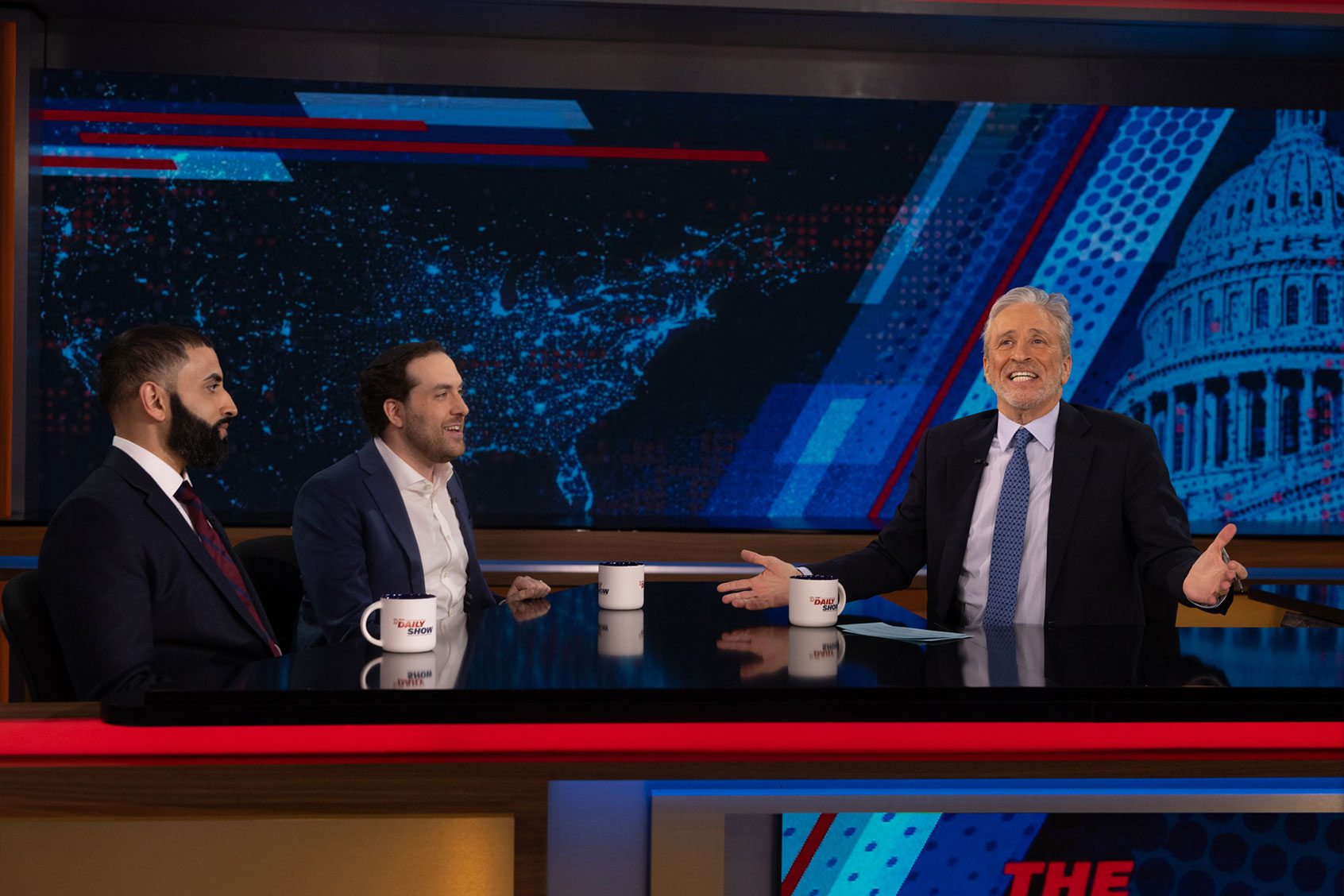
The Daily ShowThe Daily Show (Courtesy of Comedy Central)He then brought on The Intercept’s Murtaza Hussain and Yair Rosenberg from The Atlantic to better explain the nuances of the area’s geopolitics and cultural conflicts from the perspectives of a Muslim and a Jew.

Hussain and Rosenberg forged a friendship through a dialogue that began as a social media shouting match between opposing viewpoints, which Stewart opined made them better and more accessible experts than he.

All of Stewart’s guests over his first three weeks back behind the desk have been either journalists or academics. Constitutional experts and law professors Melissa Murray and Kate Shaw were his second broadcast's guests, following the editor-in-chief of The Economist, Zanny Minton Beddoes, who joined him for his first show back in the host’s chair.

Stewart understands the power he wields with this platform; more to the point, he gets what this platform can do through his presence.

Stewart understands the power he wields with this platform; more to the point, he gets what this platform can do through his presence. His exchange with Hussain and Rosenberg promoted the humanity in these debates instead of turning them into a battle of statistics: These are people who have lost family and friends in this war and aren’t inclined to purely intellectualize the whys and hows of it. He pontificated, and they filed down that sharpness respectfully.

At one point, Hussain mentioned his ability to compartmentalize his emotions in these conversations to some extent, to which Stewart responded by talking about our cavalier view of war as it’s filtered through the news cycle.

This brings us back to Dipper and the outpouring of sympathy the public directed toward the host and, without him asking, the largesse bestowed upon Animal Haven.

In the best of times, people have a soft spot for pet stories. Indeed, if you want company for your heartbreak, announce your animal companion’s death on a social media platform.

When Biden was running four years ago, the Democrats sold him as a man of the people who understood grief, which is at odds with the man who last Monday told reporters over a scoop of ice cream that he expected a ceasefire in Gaza within a week before joshing around with Meyers on his show.

Right now, the public is zeroed in on Biden’s age and his mental acuity, but there will come a point at which his empathy becomes as vital of a test of his leadership capabilities.


Want a daily wrap-up of all the news and commentary Salon has to offer? Subscribe to our morning newsletter, Crash Course.


The scale of our reaction to Stewart’s loss further demonstrates the sorrow and unrest gripping us right now. Sometimes, he’ll also mention the work he has done on Capitol Hill on behalf of veterans and first responders, which he dug into more deeply on “The Problem with Jon Stewart.”  

That Stewart wept on air for the loss of his best friend is to be expected, even as he mightily tried to be the consummate pro and not break. That type of grief is close to the surface, one kind of sadness piled atop many, the same as the rest of us.

The experts who Stewart brings on his broadcasts help us to make sense of the unfathomable, which he jazzes up as well as he can with a bit of comedic seltzer here and there. But the main attraction to his "Daily Show" broadcasts is his unvarnished fatigue at where our nation’s policies and politics have brought us.

It appears that Stewart wants us to understand and show some understanding toward “the other.” That is the interviewer you want to cross-examine Biden — and the one we hope he would want to square off with, too.

"The Daily Show" airs at 11 p.m. Mondays through Thursdays on Comedy Central and streams on Paramount+.

Trader Joe’s recalls nearly 62,000 pounds of soup dumplings

Trader Joe's, which announced numerous recalls last year, has now recalled one of its popular soup dumpling products. Produced by CJ Foods Manufacturing Beaumont Corporation, the specific item is "steamed chicken soup dumplings," which was recalled due to the fact that it "may be contaminated with foreign materials, specifically hard plastic from a permanent marker pen," according to the Food Safety Inspection Service and Food Safety News. Consumers called to complain, which prompted the recall.

In total, the recall encompasses nearly 62,000 pounds of product, which was shipped nationwide. 

The product, which was produced on Dec. 7, comes in a 6-ounce box and bears the establishment number P-46009 within the USDA mark of inspection. While there have been no reports of injury or reactions, it's important not to consume the product; be sure to either dispose of it or return it.


France becomes first country to enshrine abortion rights in constitution

On Monday, France became the first country in the world to enshrine abortion rights in its national constitution. On a 780 to 72 vote, lawmakers explicitly concluded that, in Article 34, "the law determines the conditions in which a woman has the guaranteed freedom to have recourse to an abortion." Women have had the right to abortion under French law since 1974, and none of the country's major political parties currently represented in parliament have questioned the essential right to abortion. But French feminist activists were prompted to cement legal protections after the United States Supreme Court's 2022 decision overturning federal protection of US abortion rights.

"This right (to abortion) has retreated in the United States. And so nothing authorized us to think that France was exempt from this risk," Laura Slimani, from the Fondation des Femmes rights group, told Reuters after the passage of the legislation. "There's a lot of emotion, as a feminist activist, also as a woman."

As reported by the New York Times, French justice minister Éric Dupond-Moretti said the new clause of Article 34 — which regards abortion as a "guaranteed freedom" — prevents future governments from “drastically modify(ing)” current laws funding abortion up to 14 weeks into a pregnancy. 

Prime Minister Gabriel Attal told MPs and senators gathered at the Versailles Palace for the special vote that France is "sending a message to all women: your body belongs to you and no one can decide for you."

Celebrations erupted in Paris following the vote. As captured on video by The Washington Post's Karla Adam, triumphant music and dancing filled the streets against a backdrop of a sparkling Eiffel Tower as activists and women of all ages embraced in victory. 


“This is a warning”: Analyst highlights SCOTUS liberals’ “shot across the bow” in Trump ballot case

The Supreme Court's three liberal justices — Sonia Sotomayor, Elena Kagan, and Ketanji Brown Jackson — included a "warning" to the court's conservative majority in their concurring opinion in former President Donald Trump's ballot case, says MSNBC legal analyst Lisa Rubin.

The court on Monday unanimously ruled that states cannot remove Trump from the presidential primary ballot but the court's liberals split on the majority's ruling that only Congress can enforce Section 3 of the 14th Amendment.

"In the concurrence from Justices Sotomayor, Kagan and Jackson, a warning of sorts in my view to some of the other justices saying, we didn't need to decide anything more here than the principle that states don't have the authority to disqualify candidates for federal offices," Rubin said Monday.

"By going further than that," Rubin added, "and saying that only Congress has that enforcement power, 'You have decided something that didn't need to be done,' and they say, 'We protest the majority's efforts to use this case to define the limits of federal endorsement of that provision because we would only decide the issue before us. We concur only in the judgment.'

"They're saying, this is a warning, right?" Rubin added. "This is a shot across the bow. 'Don't decide anything you don't have to. Let's not do that.' That's what I read in that."

Ultra-processed foods: Largest ever review shows many ill effects on health

Ultra-processed foods, such as cereals and fizzy drinks, have been linked to 32 harmful health effects, according to the largest review of the evidence to date.

Globally, one in five deaths are thought to be due to poor diet, and the role of ultra-processed foods or UPFs has attracted much attention in many studies over recent years.

UPFs were first defined around 15 years ago to allow researchers to investigate the effect of food processing on health. This new study, called an "umbrella review", analyzed many recent studies, involving almost 10 million people, to bring together much of the available data to give an overall picture of how UPFs affect our health.

The results implicate the consumption of large proportions of UPFs in a diet with poor health outcomes and early death from a range of conditions, including heart disease, type 2 diabetes, obesity and poor mental health.

Diets containing high proportions of UPFs are undoubtedly bad for your health, and the new study supports the links to a wide variety of diseases. But questions remain about the specific mechanisms by which these foods make us ill.

Researchers have proposed several mechanisms over the years. These include poor nutritional quality, as some UPFs can be high in fat, sugar and salt, low in fibre and deficient in essential vitamins, minerals and antioxidants.

Other mechanisms include a lack of structure and texture, which speeds up eating, increases blood sugar levels and is less effective at reducing appetite. Much attention has also focused on food additives and other chemicals, either added to food or as contaminants from packaging or the environment.


Quality of evidence varies

An interesting aspect of the current work is the fact that the strength of the results among the studies was varied, and some of the correlations were weak. This is probably in part due to the wide range of foods contained within the UPF category.

The definition identifies foods that may contain additives and chemicals and are intensely processed using refined and reconstituted ingredients, which consumers may not be familiar with. This covers foods as diverse as ice-cream, snacks, wholemeal bread, processed meats and low-fat spreads. These very different foods containing very different ingredients and nutrient contents are probably going to have very different effects on our health.

Another important factor to consider is that these studies are large, population-level studies, where thousands of people record their normal dietary intake and health status. The analysis takes into account ("adjusts for") various factors, such as age, gender and lifestyle, that can skew the figures.

However, the results can only show a relationship between dietary intake and health. They don't provide direct evidence of the mechanisms involved. We urgently need new research to understand how and why certain foods can cause ill-health.

Although some direct studies are possible, the long-term health effects of, for example, consuming high levels of food additives could be difficult and ethically questionable. But there is an opportunity here to investigate these effects in more detail using existing data. As more studies are published, the amount of data should surely allow us to focus on different forms of UPFs to identify the best and the worst.

Given the huge amount of data in the umbrella review, it would be interesting to extract some more precise data to help identify which foods we should avoid.


Time to delve deeper

There is a huge range of foods contained within the UPF category, with an equally diverse range of nutrient contents. Commercial wholemeal bread is classified as a UPF as is ice-cream, doughnuts and fried snacks. So it is highly likely that different UPFs will have a wide range of health effects.

Also, mechanistic studies where human subjects are fed specific foods or ingredients in a controlled manner, as well as more detailed statistical analysis of the existing studies, should help us to identify which UPFs to avoid, which are safe, and which may even be beneficial as part of a healthy, balanced diet.

One thing is certain, these studies should help inform advice about curbing our consumption of UPFs that are clearly detrimental to health. Conversely, we should also aim to identify what aspects of these foods are the most dangerous, so that food manufacturers can eliminate them from our diets, as has been achieved with harmful ingredients such as trans fats and some artificial colors.

Many people rely heavily on commercial, processed food products, and we need to ensure that in the future, these foods are safe and nutritious, particularly for poor and vulnerable groups.

Pete Wilde, Emeritus Fellow, Bioscience, Quadram Institute

This article is republished from The Conversation under a Creative Commons license. Read the original article.

Law professor: Perjury plea deal “helps neutralize” key Trump defense witness in Manhattan case

The Trump Organization's longtime chief financial officer, Allen Weisselberg, pleaded guilty on Monday to criminal charges — the second time he has done so regarding his connection to the former president, per The Washington Post. 

Court filings showed that Weisselberg pleaded guilty to five counts of perjury in the first degree, charges which emanate from statements he made to New York Attorney General Letitia James' office. James subsequently brought a civil fraud trial against Trump, in which he was recently ordered to pay a financial penalty of over $400 million for years of conspiring to inflate his net worth. Weisselberg was found liable for $1 million in the case and was banned for life from working in the "financial control function" of any New York company, according to WaPo.

In 2021, Weisselberg was indicted alongside the Trump Organization for a scheme intended to dodge personal income taxes, with the company ultimately being convicted in 2022. The MAGA executive in 2022 pleaded guilty to over a dozen felonies.

Trump stuck by Weisselberg at the time, calling him "a fine and honorable man who, for the past 4 years, has been harassed, persecuted and threatened by law enforcement.”

University of Michigan law professor Barb McQuade stressed the importance of Weisselberg's guilty plea, writing, "Perjury and false statements cases are important to send a message that those who lie to conceal crimes will be brought to justice."

New York University Law Prof. Ryan Goodman added that the plea deal also "helps neutralize" Weisselberg as a potential defense witness in Trump's upcoming Manhattan criminal trial and helps "insulate $450 million civil fraud ruling on appeal."

Legal scholars question whether Dems could use Supreme Court ruling to “invalidate Trump’s victory”

The Supreme Court’s Monday ruling restoring former President Donald Trump to the Colorado ballot raised questions about whether he could be disqualified by Congress if he wins the election.

The court unanimously ruled that states cannot remove Trump from the ballot under Section 3 of the 14th Amendment but the justices split as the conservative majority ruled that only Congress can enforce the Constitution’s insurrectionist ban.

The ruling raised questions about whether a Democratic majority in Congress could then refuse to certify a potential Trump win if they determine he violated Section 3.

“So under the Court's legal analysis, if Trump wins but Democrats take the House and hold the Senate, Congress can invalidate Trump's victory and throw us into chaos?” questioned national security attorney Bradley Moss.

“Is it an argument in favor of the majority's result that it heads off a possible constitutional crisis if Trump wins the election but then Dems, in the absence of legislation and uniform standards, refuse to count his electoral ballots on Jan. 6, citing the 14th A?” asked Randall Eliason, a professor at the George Washington University School of Law.

Gerard Magliocca, a law professor at Indiana University, stressed that the majority opinion was “very unclear” about whether a Section 3 challenge could be brought after the election.

“A blunder,” he tweeted.

Derek Muller, a law professor at Notre Dame University, disagreed that the court opened the door to a post-election challenge, noting that the liberal justices in their opinion complained that the majority ruling forecloses any other ways for Congress to enforce the provision, according to the AP.

We need your help to stay independent

Steve Vladeck, a court expert at the University of Texas, agreed that the ruling does not appear to allow Congress to refuse to count electoral votes after the election, noting that the majority “went out of its way to limit federal enforcement to statutes enacted under Section 5” of the 14th Amendment, which vests Congress with the authority to adopt “appropriate” legislation to enforce the other parts of the Amendment.

“If Section 3 can only be enforced through Section 5 statutes,” then the Electoral Count Reform Act, which governs the counting of electoral votes, “wouldn’t count,” Vladeck tweeted.

Rick Hasen, an election law expert at UCLA, noted that the court’s liberal justices expressed concerns that the ruling “gives the Supreme Court major power to second guess any congressional decision over enforcement of Section 3” even though nothing in Section 3 supports these limits or procedures.

“What this means is that if Congress tries to disqualify Trump, either before or after the election (which Congress may well try to do), the Supreme Court will have the last word on doing so,” Hasen wrote. “We may well have a nasty, nasty post-election period in which Congress tries to disqualify Trump but the Supreme Court says Congress exceeded its powers.”

Simply paused or permanently sunk? The Kroger-Albertsons merger has hit a major snag

When grocery chains Kroger and Albertsons — which together own more than 5,000 supermarkets across the country, including regional chains like King Soopers, Harris Teeter, Safeway, Mariano’s and Vons — first announced plans to merge in 2022, they promoted the idea by saying that in combining forces as the nation’s biggest and second biggest American grocery companies, they could lower prices, increase staff wages, protect union jobs and overall enhance customers’ shopping experiences. 

Quickly, national union leadership and some liberal lawmakers, including Senators Elizabeth Warren and Bernie Sanders, voiced major concerns about the merger, specifically in how it would affect the cost of groceries amid sustained inflation, the retention of union jobs and in how the resulting conglomerate would impact labor market competition. 

In the ensuing two years, the supermarkets and those opposed to their merger have argued their points, including in various state-level lawsuits, while the Federal Trade Commission (FTC) investigated the potential impacts of the deal. This process reached a critical climax last week when, after 16 months of debate, the FTC filed suit in the U.S. District Court in Portland to block Kroger’s proposed $24.6 billion acquisition of Albertsons —  it has also filed a complaint through an in-house administrative court at the FTC in Washington, D.C.— leading to serious speculation about whether the mega-merger proceedings are simply paused or permanently sunk. 

In its lawsuit, the FTC wrote that the aggressive competition between Kroger and Albertsons is beneficial to union-represented grocery workers.“This competition has resulted in higher wages, better benefits, and improved working conditions for employees,” it said. “The proposed acquisition would eliminate this competition, threatening the ability of hundreds of thousands of grocery store workers to secure stronger contracts with improved wages and benefits.”

In its response, Albertsons pushed back against the FTC’s estimation of the impacts of the deal and pointed its fingers at other corporations. 

“If the Federal Trade Commission is successful in blocking this merger, it would be hurting customers and helping strengthen larger, multi-channel retailers such as Amazon, Walmart and Costco — the very companies the FTC claims to be reining in — by allowing them to continue increasing their growing dominance of the grocery industry,” an Albertsons spokesperson said in an emailed statement. 

As the Cincinnati Enquirer wrote on Sunday, the FTC’s case in Oregon is seeking a preliminary injunction, which would essentially be a “‘mini-trial’ with evidence and witnesses,” but no jury, which would lead to a pretty significant delay in merger proceedings, which could cause Kroger and Albertsons to call the deal off. William Kovacic, the director of the Competition Law Center at George Washington University, told the publication that “90% of companies that fail to block preliminary injunctions abandon their merger plans.”

However, the preliminary injunction, as the term would suggest, is only the first part of the process. Antitrust cases can take a year if they go through the full administrative proceeding that functions as a federal trial, legal experts told the Enquirer, and Kroger has thus far declined to comment on how far it will push its case against the FTC. 

In the meantime, numerous labor and fair competition advocates have commended the FTC’s decision. 

“FTC’s action today is a critical step forward for America’s farmers, workers, and consumers,” said Angela Huffman, the president of Farm Action, a nonprofit centered on preventing corporate monopolies and encouraging competitive rural markets. “A combined Kroger-Albertsons would have catastrophic impacts across our entire food system — from decreasing the number of purchasers for farmers to sell to, cutting jobs for workers, and increasing prices for consumers, this is a bad deal for everyone except the companies’ shareholders.” 

We need your help to stay independent

The Institute for Local Self-Reliance is a nonprofit advocacy founded in the 70s that assists communities in helping develop local solutions for local problems, instead of turning to corporations. Their co-executive director, Stacy Mitchell, said in a statement that the proposed merger would have been “a disaster for American communities” and applauded the FTC for blocking it.

“This decision shows the FTC sees what we have long argued –– there was no upside to this merger for anybody other than the top executives at these two companies and their investors,” they said. “Concentration in grocery retail has already caused food prices to skyrocket. We know from past grocery mergers that this one would have sent prices for consumers even higher. It would have left many communities, especially on the West Coast, with little to no competition or choice about where to shop. And it would have hurt retail workers by giving the combined companies even more leverage to push down wages and dictate terms.” 

Marc Perrsone, the president of UFCW International, the union that represents many supermarket workers across the country, issued a more temperate statement that didn’t outright commend or decry the FTC’s decision and instead centered the workers. 

“As this legal process now moves ahead, our focus will remain the same,” Perrone said. “The UFCW will continue to advocate for a stable and long-term solution that is in the best interest of our members and the customers and communities they serve. That means that any company who is looking to purchase stores must first and foremost honor our collective bargaining agreements and be committed to protecting these essential jobs now and in the years ahead.”

He continued: “Regardless of the next legal steps, we must never forget that Kroger and Albertsons are successful because of these incredibly dedicated workers, and no proposed merger should be allowed to endanger their jobs or their livelihoods.” 

In an emailed statement, a spokesperson from Kroger said that from their point of view, "the only winners if this merger is blocked will be larger, non-unionized retailers who will continue to fight union growth.”

"Kroger’s merger with Albertsons is inherently pro-union, and we have the track record to prove it," they said. "As union membership continues to decline nationwide, especially in the grocery industry, Kroger added more than 100,000 good-paying union jobs since 2012 and invested $1.9 billion to grow associate wages and industry-leading, comprehensive benefits since 2018. Kroger has committed to build on this work by investing $1 billion to raise associate wages and comprehensive benefits and ensuring zero layoffs or store closures related to the merger. Additionally, Kroger, Albertsons and C&S have committed to honoring all current collective bargaining agreements." 

UPDATE: This story was updated with a statement from a Kroger spokesperson. 


“This is such a red herring”: Ex-prosecutor calls out Judge Cannon’s “wrongheaded” suggestion

A former federal prosecutor dismissed U.S. District Judge Aileen Cannon's worry that, based on a Justice Department policy, starting a trial could be viewed as "political" depending on the subject of the investigation. At the core of Cannon's concern was the DOJ's so-called "60-day rule," which bars federal investigators from bringing charges against or publicly investigating candidates near an election. Not only does that prohibition not apply in Trump's classified documents case, it's less of a hard-and-fast rule and more like a guideline, explained Andrew Weissmann, a former Justice Department Fraud Section chief who served on special counsel Bob Mueller's team.

"There are two issues with Judge Cannon raising it," Weissman told MSNBC host Jen Psaki in a clip flagged by RawStory. "First of all, it's an internal rule. It is not a law, it is not something that gives any rights to any defendant. And Judge Cannon had been at the Justice Department — she knows that. So the idea that she raised it is issue number one."

That internal department guidance could also be changed by the attorney general "any day of the week," Weissmann explained.

"Second, the rule does not apply! For anyone who has been at the Justice Department, this is such a red herring," Weissmann continued. "This is why it completely wrong: that rule is intended so that the Justice Department does not take action in a covert case that is suddenly overt shortly before an election. Why? Because you don't want to influence the election when that person — the candidate — doesn't have an opportunity to get to trial."

Instead, in this federal case against Trump, the Justice Department is requesting "a day in court" to give the defendant the opportunity to refute these "overt allegations," Weissmann said. The suggestion the provision applies "could not be more wrongheaded," he added. 

Trump claims he “purposely” lost D.C. primary while fuming over Nikki Haley on Truth Social

Former U.N. ambassador Nikki Haley won her first Republican primary in Washington, D.C. on Sunday — and Donald Trump doesn't seem to like that. Haley beat out the former president by a nearly 30-point margin, garnering 62.9 percent of the votes in the district, compared to Trump's 33.2 percent, and nabbing all 19 delegates. Trump took to social media Sunday night to mock the ex-South Carolina governor and downplay his defeat. 

"I purposely stayed away from the D.C. Vote because it is the 'Swamp,' with very few delegates, and no upside. Birdbrain spent all of her time, money and effort there," Trump wrote before boasting that he won in Missouri and Idaho's caucuses and secured all 39 delegates allocated in Michigan's GOP convention on Saturday. "BIG NUMBERS – Complete destruction of a very weak opponent," he continued. "The really big numbers will come on Super Tuesday. Also, WAY UP ON CROOKED JOE!"

Despite the ire from Trump, Haley's win is a "welcome boost" ahead of Super Tuesday elections this week and amid calls to suspend her campaign in a primary contest overwhelmingly dominated by the party's frontrunner, according to Axios. Her victory is also historic: "This makes Nikki Haley the first woman to win a Republican primary in U.S. history," Haley campaign spokesperson Olivia Perez-Cubas highlighted on X/Twitter.

"We know how the Trump campaign will respond to this ('swamp swamp swamp'), but a whole lot of people who worked for Trump — who know him and his administration best — rejected him," Doug Heye, veteran Republican strategist, noted on X.

On Tuesday, 16 states will hold primaries on what is the year's second-largest day of voting after the November general election, according to HuffPost. Trump is on course to secure the GOP nomination in the days afterward. 

“Truly dystopian”: Experts worry Trump’s school vaccine plan will spark “public health catastrophe”

A former lawmaker raised alarms after former President Donald Trump's vow in Virginia to defund public schools that require vaccines. 

Trump, who has repeatedly vowed not to "give one penny to any school that has a vaccine mandate," repeated his call during an appearance in Richmond on Saturday, according to former Rep. Barbara Comstock, R-Va.

"Trump said in Richmond, that he will take all federal funds away from public schools that require vaccines," she tweeted. "Like most states, Virginia requires MMR vaccine, chickenpox vaccine, polio, etc. So Trump would take millions in federal funds away from all Virginia public schools."

Baylor University professor Dr. Peter Hotez, wrote, "Hoping he doesn’t really mean it, since it would create a public health catastrophe for the nation…"

Former United States Secretary of Education, Arne Duncan, posed a question to "Parents across America," asking, "Is this really what you want for your children? Do you want them going to poorly funded schools with children much more likely to be sick? Only an authoritarian leader would want citizens to be poorly educated and not healthy. Truly dystopian…" 

Supreme Court rules for Trump in ballot case — but experts say it opens door to “crisis” if he wins

The Supreme Court on Monday restored former President Donald Trump to the Colorado primary ballot in a unanimous ruling, according to the Associated Press.

The court’s majority ruled that only Congress can enforce the Constitution’s ban on insurrectionists serving in federal office.

"[The] responsibility for enforcing Section 3 against federal officeholders and candidates rests with Congress and not the States,” the court’s majority opinion said. "We conclude that States may disqualify persons holding or attempting to hold state office."

Though the court ruled 9-0 that Colorado cannot remove Trump from the ballot, only five of the justices held that the only way to enforce Section 3 of the 14th Amendment is through Congressional action, court expert Steve Vladeck explained, while four of the justices would have stopped at barring a state from disqualifying a presidential candidate.

Justices Sonia Sotomayor, Elena Kagan and Ketanji Brown Jackson effectively argued that “the Colorado decision would create a patchwork pattern of different decisions in different states,” former U.S. Attorney Harry Litman explained. “Not necessary or wise to prescribe how provision should be enforced in the future through federal legislation.”

The ruling puts an end to efforts to remove Trump from the ballot in the state as well as similar efforts in Illinois and Maine.

The case marked the first time the Supreme Court addressed the 14th Amendment’s insurrectionist ban. Colorado’s Supreme Court ruled that the provision could be applied to Trump given his actions on January 6, 2021.

We need your help to stay independent

Some legal experts questioned the court’s logic.

“How can states have different rules for ballot access when it comes to the presidency?” wondered Georgia State Law Prof. Anthony Michael Kreis. “Why can Georgia keep some third parties off the ballot that are allowed in other states, for example?”

Some legal experts believe that the Supreme Court’s reasoning could “leave the door open to a renewed fight over trying to use the provision to disqualify Trump in the event he wins the election. In one scenario, a Democratic-controlled Congress could try to reject certifying Trump’s election on Jan. 6, 2025, under the clause,” according to the AP, which noted the issue could then return to court amid a potential full-blown constitutional crisis.

“Yes the Supreme Court ruled for Trump based on only Congress having the power to enforce the 14th amendment,” tweeted CNN legal analyst Norm Eisen. “But just as important as what they did is what they didn’t do. They did NOT expressly challenge that he was an insurrectionist—& the concurrence emphasizes that finding.”

Donald Trump is in no shape to pivot from a GOP primary to a general election

One of the moldiest political tropes around is the one that says a presidential candidate needs to run to the base during the primaries and then pivot to the center once he or she locks down the nomination. It makes some strategic sense, for sure, and we've seen it in action many times — but it doesn't always work. Donald Trump is not one for standard campaign strategy so even though he's the de facto nominee of the Republican Party for president, he's not making any kind of pivot to the center. If anything he's embracing the MAGA base ever more tightly, even though there is a substantial minority of his party that's rejecting him in these primaries. 

Over the weekend Trump bagged some more wins in caucuses in Michigan, Idaho and Missouri, all three of which were the result of amateur hour mistakes by local and party officials who messed up the usual primary system. From what we can gather there still exists an anti-Trump vote among Republicans and GOP-leaning independents. We'll see on Super Tuesday if that phenomenon (which I wrote about last week) continues, even as it's obvious that Trump is the nominee. 

Nikki Haley won her first primary on Sunday in the District of Columbia, which Trump claimed he lost on purpose and immediately disparaged as nothing more than a win for "the swamp," calling her "Birdbrain" and the "Bird" in a series of furious posts on his Truth Social platform. He can't bear to lose anything, even when it doesn't matter. 

The AP reported on the anti-Trump vote in GOP primaries from their APVotecast surveys over the weekend, noting that while many of those who voted for Haley are Democrats or independents who didn't vote for Trump in 2020 "about 1 in 10 early contest voters who said they supported Trump in the 2020 general election said they wouldn’t be doing so this year." So this group exists and it's a problem for the Republicans. 

As a result, according to a different AP report, many in the Trump camp would like him to make that pivot to the center, the sooner the better. Campaign professionals understand that this Never Trump faction is his Achilles' heel but his people are committed to "let Trump be Trump" — mostly because they have no choice. People have tried to get Trump to soften his edges in his previous campaigns and he's simply incapable of doing it. They're still trying:

Former Speaker Newt Gingrich, a Trump ally who sometimes speaks to the former president, compared 2024 to 1980, when Republican Ronald Reagan won a landslide over Democratic incumbent Jimmy Carter, who was saddled with inflation, high unemployment and international conflict. Reagan, dubbed “the happy warrior,” won 44 states and a new Republican Senate with “a positive vision,” Gingrich said, that was about more than Carter’s record.“When you have the kind of numbers Biden has, what people need is about 70% positive, 30% anti-Biden,” Gingrich said,

That's downright hilarious. A "happy warrior" is the last thing anyone would ever call Donald Trump. A whining warrior, maybe. A vengeful warrior definitely. But he is the unhappiest presidential candidate in history and he never shuts up about it. 

For instance, this past weekend, he threw a new idea into the mix, saying that he plans to withdraw all funding from any schools that require vaccines, which would be virtually all of them.

Trump campaign adviser Chris LaCivita told the AP, "Their role is to provide the organization 'to amplify and to force project' Trump’s message." And they insist that he is already running his general election campaign against President Joe Biden which means that what he's saying in his rallies right now is the general election message. Well, that message is so extreme it's very hard to believe that the 10 percent of Republicans who say they're not going to vote for Trump again will come around in the fall. He's going further than he's ever gone before and people are going to see all this eventually. 

We need your help to stay independent

He rambles on for hours at a time, often speaking off the cuff about strange notions like magnets don't work in water and suggesting that Abraham Lincoln could have negotiated the country out of the Civil War if he hadn't wanted to be famous. He calls the insurrectionists "hostages" and opens his rallies to the recording of the so-called January 6th prison choir. Even weirder, the finales of his prepared speeches are now accompanied by spooky Q-Anon-inspired music, which seems to send the crowd into paroxysms of ecstasy.

He vows to enact the greatest deportation program the world has ever known, describing immigrants in the most demeaning terms imaginable saying they are "poisoning the blood of our country." He calls his political enemies communist, Marxist and "vermin" who must be "purged" and promises not to allow anyone into the country who doesn't believe in "our religion." They are divisive, hateful diatribes that should make any decent person recoil in horror. 

But that's just Trump, right? It's just a schtick and nobody should take it literally. He's just playing to the crowd because they love that stuff. But the truth is that his speeches seem to be written by Stephen Miller or are, at least, very Miller-esque in that they are full of plans and policies. It's not just Trump riffing away to please the crowd. 

For instance, this past weekend, he threw a new idea into the mix, saying that he plans to withdraw all funding from any schools that require vaccines, which would be virtually all of them:


Want a daily wrap-up of all the news and commentary Salon has to offer? Subscribe to our morning newsletter, Crash Course.


That was on the teleprompter and considering what we know about the planning for a second Trump term with Project 2025 and Agenda 47, I think it would be very foolish not to take such promises seriously. The Republicans have become so nihilistic that they would easily allow polio to once again ravage the children of this country if it would get big cheers at a Trump rally. 

Republicans and independents who've been voting for Nikki Haley in these primaries should know that Trump doesn't want their vote. He made it clear this weekend when he said that MAGA now represents 96 percent of the party and they are getting rid of "the Romneys"

If that's what the campaign plans to "amplify and project" to their potential voters, good luck to them. He's openly purging his coalition of anyone who isn't MAGA and if these surveys are correct, that means he has no intention of doing or saying anything to appeal to that 10 percent (or more) who say they won't vote for him in the fall. Let Trump be Trump, I say. It can only help the Democrats. 

“He looks lost”: Alarm after Trump’s “mind blanks out” repeatedly during speech

Former President Donald Trump was called out for repeated verbal gaffes over the weekend amid right-wing attacks on President Joe Biden over his age.

Trump’s fans went quiet when he confused Biden and former President Barack Obama while claiming that he personally would “have the horrible war between Russia and Ukraine settled” if he wins back the White House in November.

“I know them both very well and we will restore peace through strength. Get that war settled. It’s a bad war. And Putin has so little respect for Obama that he’s starting to throw around the nuclear word,” Trump said during a speech in Greensboro, North Carolina.

Trump, who is 77, has repeatedly mixed up Biden and Obama on the campaign trail amid a series of other mix-ups, including recently confusing former House Speaker Nancy Pelosi, D-Calif., and Republican presidential primary rival Nikki Haley. Trump has dubiously claimed that he mixes up names on purpose.

"When I purposely interposed names, they said I didn't know Pelosi from Nikki," Trump said at a rally in South Carolina last month, making another gaffe.

MediasTouch editor Ron Filipowski posted a montage of 32 clips from Trump’s speeches in Virginia and North Carolina on Saturday in which he “mispronounced words, got confused, mixed up names, forgot names, and babbled insane nonsense.”

We need your help to stay independent

MSNBC’s “Morning Joe” played a supercut of Trump’s slips over the weekend and questioned what was happening with the former president.

"What happened there?” asked host Joe Scarborough. “He gets in the middle of sentences, he is reading teleprompters and his mind still blanks out — Nikki Haley for Nancy Pelosi, Barack Obama for Joe Biden, and it is just so pathetic and sad. They're going, ‘he's doing it on purpose.’ No, he's not doing any of this stuff on purpose. Take the fact his mind blanks out and he looks lost."

Conservative guest Charlie Sykes expressed alarm that Trump is “less than 48 hours away” from effectively clinching the Republican nomination on Super Tuesday despite his 91 felony charges and “gaffe-filled speeches.”

"If there's any upside here, Joe Biden will be able to say, 'Yeah, I'm old, I'm stiff when I walk, but this guy is also old and crazy – he's dangerous, he's incoherent,'" Sykes said. "He needs to make that point. The other maybe upside is, you know, now that there's no way of denying it'll be Donald Trump again, it'll focus the mind… I think Democrats need to stop the bedwetting, but they need to get out of the bed and freak out a little bit because the reality is, maybe this is what it'll take for them to realize this guy could become president of the United States.”


Want a daily wrap-up of all the news and commentary Salon has to offer? Subscribe to our morning newsletter, Crash Course.


CBS News anchor Margaret Brennan played a clip of Trump confusing Biden and Obama on Sunday’s “Face the Nation” and pressed Sen. Dan Sullivan, R-Alaska, over his endorsement of the former president.

“He seemed there to confuse Biden for Obama. He also suggested that there were U.S. troops serving in Ukraine. Are you comfortable about his mental fitness?” she asked.

“Compared to the current president?” Sullivan replied. “One hundred ten percent. And as your polling shows, I think the American people have real concerns where President Biden is with regard to his fitness for office, particularly his mental acuity. And relative to President Biden — or relative to former President Trump — I don’t even think it’s a close call when you see the two in action.”

Brenan noted that Trump also appeared confused about troops in Ukraine.

“To be clear, there are no US troops serving on the battlefield in Ukraine,” Brennan said. “There are military advisors. But there aren’t troops, correct?”

Sullivan dodged the question, responding: “I would go back to who is demonstrating more mental fitness to be the president and I don’t even think it’s a close call between President Trump and President Biden right now.”

America in 2024: Blind, blundering Colossus on a downward slide

As Alexis de Tocqueville observed 175 years ago, Americans always think it’s all about them. OK, he didn’t put it exactly that way. But he did say that for all the remarkable qualities of American democracy, it tended to enforce mediocrity and stupidity, and that he knew of no other country with "less independence of mind, and true freedom of discussion,” than the United States. 

At a moment of obvious domestic and international crisis — much of it invisible to most Americans, or deliberately ignored — that national narcissism or constitutional blindness, which was baked into the American project from its earliest days, is starting to feel like a terminal disease. 

Chronically online media consumers, especially on the center-left, are understandably obsessed with the torturous progress of Donald Trump’s multiple prosecutions, and with an impending presidential election between two widely disliked candidates with a cumulative age of 160, neither of whom is generally perceived as competent to hold office. Beneath all that poll-gnawing anxiety and rending of virtual garments, I suspect, lies the slow-dawning awareness that from even half a step back, and from most of the world, the current condition of the last global superpower and the self-appointed guardian of democracy looks like a cruel, baffling joke.

Last week, more than 100,000 Democratic primary voters in Michigan chose “uncommitted” over Joe Biden, largely in protest of the administration’s inability or unwillingness to contain Israel’s relentless slaughter of Palestinians in Gaza. Let’s skip over the question of whether that number was a lot or a little, and whether it represents a death-blow to Biden, a cryptic vote for Trump or a largely meaningless gesture. Odds are you already know what you think, based on your prior assumptions about the president, the Democratic Party, the state of the 2024 race and the Gaza war. 

The same likely applies to the spectacular public suicide of Aaron Bushnell, the 25-year-old U.S. Air Force serviceman who set himself on fire outside the gates of the Israeli embassy in Washington on Feb. 25. I won’t try to persuade you how to interpret that tragic event, either in moral terms or as a factor in domestic political calculus — first of all because I have no answers, but also because I believe that’s missing the point. What Bushnell and the Michigan voters told us last week, if we were paying attention, was that world opinion is moving away from America with increasing velocity, and that the American master narrative — meaning the story our country tells itself about itself — is coming unglued.

One major but largely unacknowledged factor in Trump’s appeal, I suspect, is that he embraces a nihilistic narrative of American decline every time he opens his mouth, while interjecting grandiose claims that he alone, of course, can fix it.

It’s ridiculous to claim that the U.S. hasn't experienced this much internal discord since the Civil War — people who say that might want to read up on the labor wars of the early 20th century, the Great Depression or the social chaos of the late Vietnam era. On the global stage, the U.S. is not officially at war with anyone, anywhere, for the first time in 20-odd years — although the number of American-sponsored or America-adjacent secret wars and proxy wars is, by design, unknowable. It’s precisely this strange and unprecedented combination of ingredients — uneasy social peace alongside intractable political division and “culture war” at home; murky and unofficial non-war conflict, whether military, economic or cultural, around the world — that defines America’s current wounded-behemoth status.

Joe Biden certainly didn’t create this situation — and, to be fair, neither did Donald Trump. They’re both passengers on the roller coaster of history, pretending they can control it. In fact, a major but largely unacknowledged factor in Trump’s appeal, I suspect, is that he embraces a nihilistic narrative of American decline every time he opens his mouth, while interjecting grandiose and implausible claims that he alone, of course, can fix it. Whether Trump’s followers believe that his increasingly ludicrous utterances are literally true has never been the right question; we don’t ask that about an 11-year-old who still leaves out cookies and milk for Santa.

Biden, on the other hand, is boxed in by his potentially fatal sincerity, and by generations of hypocritical American foreign policy that in 2024 make the “rules-based order” advocated by Secretary of State Antony Blinken look like clumsy self-parody. The president’s disastrous attempt to link military aid to Ukraine with military aid to Israel — under a banner vaguely marked something-something-democracy — only served to undermine support for Ukraine’s war, which already looked to many developing nations in the Global South like a great-power conflict devoid of good guys.

There’s no real evidence that Biden suffers from cognitive decline, and I hardly need to tell Salon’s readers that Trump’s recent speeches have been confused, delusional and incoherent even by his impressive standards. Those who argue that Biden has been depicted unfairly in the media and judged unfairly by public opinion make a valid case, but it’s equally true that Biden’s administration has repeatedly been sideswiped by unexpected events and has proven incapable of controlling real-world events or enforcing its preferred narrative. 

For all the reassuring rhetoric from the Biden-Blinken team, they have screwed up nearly everything they’ve touched, and the U.S. can no longer be viewed as a reliable partner. 

Of course the president and his advisers could not have predicted the atrocious Hamas attack of Oct. 7 — but they seemed even less prepared for the intense brutality and mass murder of Israel’s scorched-earth campaign in Gaza, or for the mounting global outrage sparked by Washington’s apparently unconditional support. Whatever cautious criticism or hand-wringing may occur behind the scenes, the U.S. now stands entirely alone behind the criminal regime of Bibi Netanyahu. Losing perhaps 90 percent of world opinion and losing 100,000 voters in Michigan are corollary signals, we might say, at different orders of magnitude. Whichever polls you choose to believe on the 2024 election, it’s clear enough that younger voters, Black voters and more progressive Democrats, as well as Arab Americans and Muslims, overwhelmingly disapprove of Biden’s Israel policies. 

Fox News and other right-wing media made hay for a day or two from Biden eating ice cream as he told reporters that he believed a ceasefire in Gaza was imminent. That made for an admittedly strange visual, but the real problem wasn’t the soft-serve cone but the fact that no such ceasefire had materialized by week’s end, and none seems likely anytime soon. 


Want a daily wrap-up of all the news and commentary Salon has to offer? Subscribe to our morning newsletter, Crash Course.


New York Times columnist Thomas Friedman, widely understood as a mouthpiece for the U.S. foreign policy establishment, announced in late January that an ambitious “Biden doctrine” would shortly emerge, aimed at bringing Saudi Arabia and Israel together against Iran and magically constructing a Palestinian state (not to be run, apparently, by any actual present-tense Palestinians). Less than a month later, Friedman chucked that wish-casting down the memory hole, having discovered in the meantime that rage against Israel and the U.S. was “bubbling up around the world,” that Netanyahu’s only plan was to occupy Gaza indefinitely and that, someday soon, the Biden administration might "start to look hapless.”

In perhaps the most extraordinary sentence of Friedman’s long career of cheerleading for the so-called Washington consensus, he suggested that “the whole Israel-Gaza operation is starting to look to more and more people like a human meat grinder whose only goal is to reduce the population so that Israel can control it more easily.” As more than one social media commentator observed, there actually is a word for that.

Another key moment last week barely touched headlines on this side of the Atlantic, but speaks volumes about how the rest of the world views America’s future. French President Emmanuel Macron abruptly went full Russia-hawk at an impromptu summit of European leaders in Paris, saying the EU might have to provide military aid to Ukraine on its own, without U.S. assistance, and refusing to rule out sending in European troops. That’s probably a bluff and almost certainly a terrible idea (like most of the things Macron says or does), and the whole thing may have been calculated to push Congress to act on Ukraine aid, to open negotiations with Russia or both. 

But the subtext was clear enough: For all the reassuring rhetoric from the Biden-Blinken team, they have screwed up nearly everything they’ve touched, and the U.S. can no longer be viewed as a reliable partner. Many well-intentioned Americans are laboring to convince themselves and their neighbors that Biden-Trump 2.0 is something more than a depressing rerun: It’s also, yet again — and for perhaps the third time — a decisive showdown between fascism and democracy. Both things may be true, and there’s no doubt that this election could have dramatic real-world consequences. But to the rest of the world, it looks more like a dismal sideshow, and the notion that it will determine the planet’s future looks like another narcissistic Yank delusion: Our blind, bumbling Colossus will continue its decline, no matter which of the old guys wins.

“Online Trump worship has offline consequences”: MAGA makes plans for “apocalyptic battle”

Donald Trump is charged with 91 felonies in multiple criminal trials and is facing the reality that he may have to serve hundreds of years in prison if convicted for his obvious crimes. His strategy to escape these consequences is to delay the proceedings until he can be elected president – and as promised, declare himself dictator. As part of that strategy, Trump and his attorneys are arguing that he is above the law like a king or emperor because while president he supposedly had the unlimited power to do such things as command that his political rivals be murdered and take bribes in exchange for pardons and other political favors. 

In a parallel argument, Donald Trump is now telling his followers that he is the Chosen One, a messiah or prophet of “god” and “Jesus Christ” who is a tool of destiny, which means he is outside of human law.

On Wednesday, the United States Supreme Court agreed to hear Trump’s petition arguing that he has immunity from the law for any crimes committed while president. The so-called experts were flummoxed by this decision. Ignoring what the Trumpocene has wrought and exposed about the country’s failing democracy and ascendant neofascism, these “experts” continue to have misplaced and unearned faith in “the institutions” and “the system.” Trump’s MAGA people, members of the Christian right and other cultists who believe that their Great Leader is divinely inspired may see the Supreme Court’s decision as one more example of prophecy and “god’s will." Thus, to hold Trump accountable under the law is a form of persecution and blasphemy.

In reality, the Supreme Court’s decision to give serious consideration to Donald Trump’s authoritarian claims of “presidential immunity”, and by doing so to imperil the centuries-long American democratic project, is not the work of “god”. In reality, these are the machinations of right-wing extremist Supreme Court justices who are willing to engage in a judicial coup on Trump’s behalf, the same man who appointed three of them to their current positions.

In an attempt to make better sense of Trump’s claims of personal divinity, his fascist plans and “Christianity," power over the Christian right, and what may come next in the country’s democracy crisis, I recently asked a range of experts for their thoughts and insights.

This is the second of a two-part series.

Peter McLaren is Emeritus Professor of Education at the University of California, Los Angeles. He is one of the architects of critical pedagogy and recipient of numerous international awards for this work in education. He is the author of over forty books, and his writings have been translated into twenty-five languages.

Americans don’t appear to care about the demise of democracy, the suspension of the Constitution and subversion of our political system and I don’t think it is because they have been struck numb by Trump’s flabby grandiloquence but because of Trump’s great swindle of fulfillment — his fake promises to the American people that he will make America great and prosperous again (well, at least for white “legacy” Americans). In another time, in another place, Trump would be forced to wear a coxcomb cap, don striped tights and dance a supplicant jig before his puppet master in the Kremlin who clearly benefits from America’s free fall into infantile helplessness. 

"That Trump has put democracy on the slaughter bench of history by turning fear into a state religion is not something that crosses the minds of many Americans."

The fidelity to Trumpism by his base has a lot to do with the ways in which media technology have fostered present-day ideological affiliations and are forcing the remaining remnants of American democracy into a political dumpster filled with the stinking rot of Trumpism. American fascism is a type of blended plutocracy where the global scope of capitalist rationalization is seamlessly integrated into the bureaucracy, technology, hierarchy, and institutional and political structures, whose power is camouflaged by the banality of its appearances and especially because it is draped in the fleshy propaganda of freedom and democracy. 

That Trump has put democracy on the slaughter bench of history by turning fear into a state religion is not something that crosses the minds of many Americans. I think in some ways they look forward to it all tumbling down. And that’s because the inhabitants of Trumpworld live in a bubble of invincible ignorance and motivated amnesia about America's past, its beginnings, its history. A significant part of this crisis of history has to do with the overwhelming impact of media technology in our daily lives. We live in a post-digital universe where intuition clashes with analysis, where gut instincts collide with personal narratives, where conspiracy theories dance with critical theory, where corporations, lobbyists and networks of billionaires commandeer nearly all dimensions of institutional life, that sacred ground demanding not just clear-headed thinking, but the exquisite finesse of nuanced information processing.

The algorithmic clustering of social media content and groups, the remediation, recontextualization reframing and reposting of mainstream news stories, often amending them with clickbait, sensationalist commentary that amplifies and mainstreams xenophobia, produces imaginary others so loathsome that they can be viewed as legitimate targets of opprobrium and violence  —  such as George Soros or undocumented immigrants — is part of a social media infrastructure that has helped Trump demonize his enemies as “rapists” and “murderers” from “sh**hole” countries, not to mention vilify his political opponents. Each time he attacks immigrant others or members of his political opposition, he is revered as the avenging, punishing God of the Old Testament, or a martyr burned at the stake by a corrupt legal system controlled by the Democrats. However one cuts it, online Trump worship has off-line consequences and right now the far-right and Christian nationalists have the advantage, although they have not yet won the day. Trump recently proclaimed himself a “dissident” which enables him to falsely proclaim a kinship with real-life dissidents such as Rosa Parks, Martin Luther King, or Nelson Mandela while disguising his naked lust for power.  

Trump and “god” and “Jesus Christ”? Trump has pledged to reshape the United States into a crucible for dictatorship. He has told his followers, “I am your retribution” and “I am being indicted for you.” This is the messianic language of a mad dictator. Trump knows that when he is perceived as a messiah figure, it is not in the same spiritual modality, classification, religio-historical context or paradigm as Jesus of Nazareth. I mean, he got away with calling dead soldiers "losers" and those who died In World War II at Belleau Wood “suckers.” It’s hard to imagine Trump as a God-fearing man of faith. More to the point, he is seen by his base through the prism of countercultural heroes such as a knife-wielding Rambo, or Max Rockatansky, the shoulder-padded road warrior hero with a thousand faces, the high-octane vigilante crossing the wasteland, shaping the iconography of the dystopian frontier with his marauding adventurism. 

We need your help to stay independent

Trump has lifted the United States out of time by making himself a non-temporal, celestial and eternal signifier – the Chosen One – who follows a messianic path, but in different guises.

Advocates pushing for a Christian-centric nation seek to enact a fundamentalist Christian theocracy, directly undermining the foundational tenets of religious freedom and separation of church and state. Integralist Catholics, for instance, fundamentally reject the principles of liberal democracy, aiming to reinstate the authority of the Church in societal affairs to unite the secular and spiritual realms — readers of Margaret Atwood’s The Handmaid's Tale would understand well what this means as the Church may be compelled not only to legislate for the state through punitive measures but also to act as a surrogate state, considering itself entirely transcendent and beyond the state's authority, and relying upon divine grace to prevent reason from becoming corrupted.

Donald Trump made his fateful connection with millions of others by recognizing how enthusiastically they respond to his cruelty, his racism and his embitterment and his ability to provoke the mainstream guardians of US propriety and civility.

This was his great insight: that he has just the right type of charisma to laser-focus a generalized rage against the decline of American life into a political weapon through artful slander, personal maliciousness, self-aggrandizement, and the ability to mesmerize the public with lies, lies so ridiculous that they could only be perceived as truthful.

His malignity and psychopathology seem to attract followers when these same characteristics should repulse people. 

Trump is to democracy as the MG-42 machine gun (known as Hitler’s buzzsaw) was to the safety of Allied troops during WWII. After all, he has ripped a hole in American politics in which the chaos agent candidate will act out a vengeance presidency while palming off on  America’s tried and true ‘swindle of fulfillment’ designed to make consumer citizenship the reigning hegemony (as opposed to educating for critical citizenship and social justice). 

Dr. Lance Dodes is a former clinical professor of psychiatry at Harvard Medical School and a training and supervising analyst emeritus at the Boston Psychoanalytic Society and Institute:

By now it is very old news that Trump is an apparent sociopath whose efforts to present himself as a godlike savior is no more than a long con intended to hide his goal of gaining power and control and to conceal his absence of a normal conscience. His recent claim to be the savior of Christianity is remarkable only for the fact that anyone falls for this transparent lie. Christianity is centrally about love for one’s fellow man and is the direct opposite of Trump’s life of abusing, cheating, lying, and obvious racism. That religious people don’t see his statements that he is suffering to save others as transparently dishonest manipulation and obvious blasphemy, is a measure of his ability to convince others to ignore their own eyes. This capacity for deceiving others is the same as other psychopathic tyrants who have been able to seize power via the “Big Lie” technique of endlessly repeating their claims of greatness while inventing others to blame for the troubles from which people suffer.

In the current version, Trump echoes Hitler’s blame of non-Christians, calling upon ancient bigotries to advance his personal agenda. Needless to say, the plan to invent enemies to blame while presenting oneself as the savior against them has a long history of tragic success. The obvious manipulation of public perception would be ridiculed out of existence if it did not have the support of others eager to have power who, while not necessarily evil themselves, are willing to put aside their own consciences to ride the coattails of the psychopath. It happened in Germany and can happen here. The vulnerability of human beings to being manipulated by conscience-free liars is universal.

Paul Djupe is a political scientist at Denison University and the editor of the Religious Engagement in Democratic Politics series at Temple University Press. Djupe is the co-author of "The Full Armor of God: The Mobilization of Christian Nationalism in American Politics," "The Evangelical Crackup? The Future of the Evangelical-Republican Coalition" and other books, and co-editor of the new anthology "Trump, White Evangelical Christians, and American Politics."

While Trump’s rhetoric may have been particularly packed with Christian persecution narratives given that he was speaking to the choir this week at CPAC and the National Religious Broadcasters (NRB) International Christian Media Convention, I think this will be a feature of the campaign for the next eight months. With nearly half a billion dollars in judgments against him and having been, as he said to the NRB, “indicted more than Al Capone, the great gangster,” his critical mission is convincing his supporters that his legal troubles are the result of political corruption from, as he describes it, a communist (and therefore atheist), evil, sick administration. He will try to continue reinforcing the corruption claims by arguing that only he can reestablish the rule of law. Only he stands in the way of the persecution that will rain down on Christians, hordes of criminals flooding across the border, the mutilation of children, and more, were he to lose. “I believe it’s doomed,” Trump said of the U.S.

The rhetoric surrounding Trump’s bid has escalated significantly as his legal perils are totalizing. 2024 truly is at least his final battle as he faces the revelations of the courts and the public. He claimed as much in front of CPAC, calling November 5, 2024 “our new liberation day” and “for the liars, and cheaters, and fraudsters, and censors and imposters who have commandeered our government, it will be their Judgment Day.” At this point, there is no gray area, no goodwill on both sides, only an apocalyptic battle between the forces of good and evil. And he isn’t the only one promoting such a vision. For instance, Prophetess Kat Kerr was on Capitol Hill this week speaking “on behalf of Trump,” who God “picked, anointed, and appointed” as president, suggesting that she was surround by a million angels “ready to waste this place.”

Whether battle is in the spiritual or physical realms, a large portion of Trump’s base believes that warfare is ongoing and they need to stand with the full armor of God. In this vision, Trump can either be fully good or evil and the fact that the indictments are coming from the forces of evil serves to explain away his “persecution.” With right-wing activists calling for the end of democracy, suggesting that the Democratic Party is incompatible with Christianity, and labeling Biden as one of the Four Horsemen of the apocalypse, I don’t know that even jail time for Trump is going to shake up his base. Only another convincing loss could possibly intervene by proving the prophets wrong yet again. In the meantime, the apocalyptic worldview is in full effect, and I believe they will wait for revelation to run its course.

Why labor is losing even as unions win big

The past year was a practical success for organized labor in America. Waves of strikes generated national heat and focused attention on workplace wages and conditions, and union members won significant gains in Hollywood, with the country’s Big Three automakers, at UPS and at California-based Kaiser Permanente, among others.

It all made for compelling headlines. And those headlines masked a frustrating truth for organizers: Good news notwithstanding, the unionization rate in the U.S. fell once again in 2023.

That’s according to a report released last month by the Washington, D.C.-based Economic Policy Institute, which closely tracks union activity and analyzes data provided by the federal Bureau of Labor Statistics. As the report’s authors noted, the surge in labor activity last year didn’t produce greater union representation — at least, not yet.

According to the Economic Policy Institute, the raw number of U.S. workers represented by a union actually increased in 2023 by about 191,000. But the percentage of all workers that were union-represented – the unionization rate — dipped from 11.3% to 11.2% in the surging job market, continuing a decline that has endured for more than 40 years.

“Workers are organizing at a pace not seen in recent decades. High-profile campaigns like those at Amazon and Starbucks highlight this momentum,” the report’s authors wrote. “However, we are not seeing this resurgence translate into significant increases in union density.”

The culprit? Labor laws that deny workers the ability to unionize successfully, along with an ever-increasing boldness on the part of employers to prevent unions from forming at their workplaces — or to meaningfully negotiate with them once they do form.

We need your help to stay independent

And those companies fear little retribution, as the penalties for ignoring U.S. labor law remain remarkably toothless.

“Companies can treat violating the National Labor Relations Act as just the cost of doing business, because that cost is so low,” Sharon Block, a Harvard professor and labor expert, told Capital & Main last year. “We shouldn’t have a law that invites noncompliance.”

*   *   *

One of the easiest jumps in logic was to imagine that high-profile victories in 2023 for the Writers Guild of America, the actors’ union SAG-AFTRA, the United Auto Workers and others — part of what union activists dubbed the Hot Labor Summer — meant that union power was on the rise.

There was nothing minimal about those victories. A massive strike by nearly 70,000 Kaiser Permanente workers in California led to raises totaling 21% over four years. Hollywood writers and actors won wage gains and significant protections against studios using AI to replace them. UPS workers won a five-year contract with substantial wage and safety gains, and the United Auto Workers secured pay increases for its members of 25% and up from Ford, General Motors and Stellantis.

But as the Economic Policy Institute report noted, the unions are still swimming upstream. Decades of pro-employer court rulings have compromised the National Labor Relations Act and made it harder for unions to form, and the fact of weak federal penalties for anti-union behavior encourages employers who are so inclined to do everything they can to disrupt organizing efforts — including threats and firings of workplace organizers.

As for 2023, the number of union-represented jobs added was dwarfed by nonunion additions. The U.S. job market surged throughout the year, adding 2.9 million jobs in all.

When organizing is successful, some companies turn to a different tactic: refusing to bargain in good faith for a contract. Of the nearly 400 individual Starbucks locations that have filed to organize or already unionized, not one has reached a contract agreement with Starbucks management.

“It takes a very, very long time to get that first contract,” said Michelle Kaminski, a labor expert at Michigan State University. “And if an employer just keeps on not coming to an agreement and delays and delays, the union can lose support of the members and the very people who voted for it.”

*   *   *

There’s no scenario under which the union victories of the past year were inconsequential, labor leaders say. One example of the influence of those wins can be found in the auto market: Shortly after the United Auto Workers’ contract agreement with the Big Three, nonunion workers at Toyota, Honda and Hyundai plants in the U.S. all received wage bumps — a clear attempt by their employers to head off organizing momentum at their plants.

Those bargaining wins also add to the body of evidence that union representation improves workers’ lives. The Economic Policy Institute’s report said union workers on average earn 13.5% more than nonunion peers in the same job sector, have greater access to health care and paid sick leave, and are far more likely to be offered retirement plans.

People are noticing. Public support for unions is near its highest level in 50 years, and the policy institute used existing metrics to estimate that in 2023, roughly 60 million Americans wanted to join a union but were unable to do so.

States like California, which put robust worker protections in place and refuse to enact anti-union “right to work” statutes, make it easier for such organizing to happen. But absent meaningful federal reform, workers will struggle for representation — and suffer without it.