Spring Sale: Get 1 Year, Save 58%

Drinking water used to be simple. Not anymore

I am obsessed with beverages. I typically have three-plus on my desk (or on my person) at any given time. From water and iced teas to juices, coffees, smoothies and protein shakes, I am truly awash in liquids. Water, though, has always been my number-one favorite. It is truly one of the most reliable constants.

I recall a family friend years and years ago joking that my family was keeping Poland Spring in business because we would so often be trotting around an inexplicable amount of the bottles when we were out and about. Conversely, a pet peeve of mine — not to yuck anybody's yums, of course — has always been people who make a point of how they "don't like" or "don't drink" water because it doesn't "taste good" or it "tastes like nothing." 

There is, legitimately, no item on earth that quenches and refreshes like good ol' water — especially when you've eaten something especially heavy or you've accidentally eaten the equivalent of your body weight in candy

In 2023, though, drinking water isn't all that simple. Even when eating out, the first question you get at many restaurants is "can I get you tap, sparkling or still?" For those who struggle with decision making (or Libras in general — a.k.a me), it can be challenging.

Furthermore, drinking water at home or when on the go is equally challenging: Is tap water safe where I live? Which brand of bottled should I choose? Should I buy one of those enormous stainless steel water bottles that strangely cost $80? How should I best go about hydrating myself properly?


Want more great food writing and recipes? Subscribe to Salon Food's newsletter, The Bite.


It isn't easy, so Salon Food chatted with nutritionists and dietitians Frances Largeman-Roth and Deborah Malkoff-Cohen to get the rundown on all things water.

Manhattan-based registered dietician and founder of Nutrition by DMC Deborah Malkoff-Cohen notes that the body is already made of 60% of water and that consuming water helps to regulate body temperature, aid in digestion, prevent constipation, improve skin health, aid in reproduction, deliver nutrients to tissues and tons more. Sorry to those who just "don't drink water," but it's truly a non-negotiable. 

So, to start, what exactly is the difference between all of the different waters? Frances-Largeman Roth, registered dietitian nutritionist and the author of the cookbook Everyday Snack Tray, states that purified water is "free from microbes and chemicals. Water can be purified through reverse osmosis, distillation or iozonization," while plain tap water "has been treated with chlorine to kill anything harmful and often also has fluoride added to improve dental health."

Beyond those, Largeman-Roth explains that distilled water is "water that has been brought to the gas phase (steam) and then brought back to the liquid phase."

"This not only removes impurities, it also removes about 99.9% of the minerals in water." she said. "The flavor of distilled water is very bland because it doesn’t contain any calcium, sodium, magnesium or potassium." Meanwhile, per Malkoff-Cohen, spring water is naturally-filtered, in a way, "over several years, where rain seeps though the ground and is filtered by the earth through rocks and minerals."

Separately, nursery water is a type of distilled water plus other minerals added back in, which is best for baby formulas. 

We need your help to stay independent

As far as alkaline, Largeman-Roth notes that it usually has a pH of about 8 or more, while regular water stays around 7. These waters can help to "bring down the acidity in your body," which could help with issues like acid reflux. However, it doesn't mean that necessarily helps you to hydrate any better. Malkoff-Cohen says the alkaline water push is merely hype and not necessary — more of a buzzword than anything else.

So, now that we understand the differences between the main waters on the market, how much should we be drinking? 

While many have always heard that it's best to consume eight glasses of water per day, that doesn't take "athletes or people taking lots of medications into account," according to Largeman-Roth, since many medications, including laxatives, diuretics and Type 2 diabetes medications are often dehydrating. 

Largeman-Roth also notes that bottled water is generally something to avoid. Not necessarily because of the water itself, but because of the impact that those plastic bottles have on our environment. She personally swears by a reasonably sized, 20- to-30 ounce bottle instead of a super-sized or uber-expensive one; those aren't really not necessary. 

Still unsure how much you need? Maloff-Cohen notes that an easy way to determine your needs is by taking your weight in pounds and dividing it in half. That number is how many ounces of water you should be drinking in a day. 

"Hydration is dependent on the amount of water consumed — not the type," she said.

As long as you're actually drinking water in the first place, it really doesn't matter if it's purified, spring, distilled, tap or spa water infused with a bevy of herbs, vegetables and fruits. Water is water! Drink enough of it and your body (and brain) will thank you. 
The doctors with long COVID who have been left behind

The first four months after being diagnosed with long COVID, Dr. David Heeger couldn’t walk a lap around the block without his wife holding him up. He couldn’t even sit upright, for that matter, for more than an hour. A year before, he’d been helicopter skiing in Alaska.

“Not that I've ever been poisoned, but I imagine that's what it feels like,” Heeger told Salon in a phone interview. “You can't do anything, everything hurts and it is a helpless feeling.”

Heeger, a neuroscientist and tenured professor at New York University, feels fortunate that he is able to afford the medical care he needs with an income not affected by his disability. Through getting involved in advocacy groups pushing for more research into the causes of and treatments for long COVID for a population that largely feels they have been left behind, he has seen how devastating long COVID can be, leaving people unemployed and unable to afford medical care, sometimes isolated in their homes without anyone there to care for them.

“It’s horrific,” he said. “It is hard to get through a meeting without tearing up.”

Still, for Heeger — along with 18 million Americans — long COVID has turned his life upside down. He shut down his research lab and lives a quieter life, mostly isolated and seeing friends occasionally outside so as to not risk reinfection. 

Long COVID is a condition thought to be caused by the SARS-CoV-2 virus remaining in the body, causing symptoms of COVID that last for anywhere from a few months to years. It is characterized by severe fatigue, brain fog and other neurological issues, palpitations and a range of other symptoms. The U.S. Department of Health and Human Services classifies the condition as a disability because of the physical and mental impairment it causes.

In an analysis of worker's compensation claims in New York published in January, 71% of people with long COVID couldn’t work for at least six months since the pandemic began. Other research conducted out of the Brookings Institution indicates 15% of the nation’s 10.6 million unfilled jobs could be attributable to long COVID, altogether costing the country at least $170 billion in lost wages.

These losses are likely even higher among frontline workers who were more frequently exposed to COVID-19 in the early stages of the pandemic, working long hours with limited personal protective equipment to keep patients from succumbing to the mysterious new virus. Colliding with issues like burnout, unmanageable workloads and mental health conditions stemming from the pandemic that are making clinicians leave the workforce in record numbers, long COVID threatens to undermine the very health system designed to treat people with the condition.

In a July report from the British Medical Association, one in five doctors were unable to work or had to significantly reduce their hours due to long COVID, and nearly half said they had reduced or eliminated their income and were relying on savings to make ends meet. More than half also said their long COVID developed after an initial infection during the first wave of the pandemic in 2020, when they lacked personal protective equipment.

Long COVID threatens to undermine the very health system designed to treat people with the condition.

“Healthcare workers who fell ill caring for COVID positive patients unprotected at work, face [the] threat of being abandoned in their hour of need,” wrote Dr. Kelly Fearnley, the chair and co-founder of Long COVID Doctors for Action on X (formerly Twitter). “Those who are not absent with long COVID are burnt out and leaving in droves.”


Want more health and science stories in your inbox? Subscribe to Salon's weekly newsletter Lab Notes.


Assuming a similar portion of U.S. healthcare workers are impacted by long COVID, as many as 200,000 doctors could be at least partially out of work due to long COVID. In a 2021 study published in Mayo Clinic Proceedings, one in five healthcare providers said they planned to leave the profession within two years. Although COVID-19-related anxiety and depression were factors contributing to these intentions, the study found that burnout and feeling undervalued were actually the main reasons for the changing workforce. That is, healthcare workers were already making plans to leave the healthcare system pre-pandemic — and the effects of long COVID are likely leaving even more out of work.

Meanwhile, the American Hospital Association last year expected half a million nurses to leave the workforce, although Nurses United has said there isn’t a nursing shortage as the association suggests — just a shortage of nurses who are willing to withstand the current workplace conditions. Healthcare worker strikes have also been playing out at Kaiser Permanente and Prime Healthcare, among others.

There isn’t a nursing shortage as the American Hospital Association suggests — just a shortage of nurses who are willing to withstand the current workplace conditions.

Yet demand for healthcare is only increasing as made plain by the COVID-19 pandemic. Along with an aging population with increasing rates of chronic conditions like diabetes, obesity and heart disease, Americans have lower rates of practicing physicians and fewer hospital beds than most other countries, according to a 2022 report from the Commonwealth Fund. Some say it’s a matter of when, not if, the next pandemic strikes, while this year saw a record-breaking number of climate disasters and soaring heatwaves that each put additional strains on the healthcare system. And 2023 was probably the coolest summer this generation will ever see.

Dr. David Putrino, a long COVID researcher and professor of rehabilitation medicine at the Icahn School of Medicine at Mount Sinai, said he has many colleagues who are healthcare workers who got sick with COVID in the early stages of the pandemic and have been coping with various levels of debilitation since then.

“We were already in trouble in terms of burnout and the number of people leaving the profession,” Putrino told Salon in a phone interview. “We certainly experienced another big bump with long COVID affecting healthcare workers.”

Researchers are still finding out more about the nature of long COVID and who is most at risk. Recent studies suggest it could be caused by dormant viruses in the body reactivated through COVID-19 or that reservoirs of SARS-CoV-2 linger in the body. Earlier this month, a new study suggested long COVID could also be caused by serotonin depletion caused by the virus. The Centers for Disease Control and Prevention (CDC) says it can present in 7% of the population or one in five people who are infected with SARS-CoV-2.

Heeger and other long COVID advocacy groups have called upon Congress to increase funding for long COVID research. As he wrote in a blog tracking his experience with long COVID, a trial he participated in conducted by Putrino was not funded by the National Institutes of Health (NIH) and instead had to be supported through philanthropy. As someone who has done 30 years of research, Heeger knows that better research outcomes tend to follow the money. 

We need your help to stay independent

“If there were to be 10 [times] more funding for long COVID research, biomedical scientists with a broad range of experience and expertise would flock to it,” he wrote. “Some of them would have ideas that would lead to key insights, enabling us to predict which individuals would have bad reactions to the vaccine, and critically how to better treat the underlying causes (rather than just the symptoms) of long COVID.”

Without effective treatments, long COVID joins a long list of stressors already straining the healthcare system. Healthcare workers with long COVID, some of whom have also treated patients with the condition, know all too well how destructive it can be.

“It's a devastating healthcare and humanitarian crisis,” Heeger said. “It's [also] an economic crisis.”

Movie icon Richard Roundtree of “Shaft” dies at 81 due to cancer

Richard Roundtree, who played one of the first Black action heroes in the blaxploitation '70s era of film, died at 81 of pancreatic cancer on Tuesday in his Los Angeles home, his manager said.

The blaxploitation actor starred in the 1971 "Shaft" film series that depicted Roundtree's iconic character John Shaft, a private detective with a brown leather jacket with a turned-up collar and a dark mustache. The film's theme song even won an Oscar for best original song, describing Shaft as “a sex machine to all the chicks,” “a bad mother” and “the cat who won’t cop out when there’s danger all about.” 

Roundtree also had success off the film screen, before "Shaft," with a successful theater career. The actor was in the Negro Ensemble Company. In his first theater role, he starred in a 1967 production of “The Great White Hope,” starring as a fictionalized version of Jack Johnson, the early 20th century’s first Black heavyweight boxing champion.

After "Shaft," Roundtree extensive onscreen career continued with movies and TV series like “Earthquake," “Man Friday,”  “Inchon,”  “City Heat” and "Roots." He even reprised his role as Shaft in the 2000s Samuel L. Jackson-led reboot of the action film series.

Jackson tweeted: "The passing of Richard Roundtree is a real blow. Loved being around him, learning, working, laughing & feeling Blessed to have an idol live up to who I expected him to be!! Thanks for making us feel REAL GOOD about ourselves! Rest In Power."


Judge drags Trump lawyers for wanting trial delay over COVID but refusing to wear masks

New York Supreme Court Justice Arthur Engoron on Tuesday rejected objections Donald Trump's unmasked attorneys raised to the hearing moving forward given their COVID-19 concerns, ordering the former presidents $250 million fraud trial to continue.

At the start of Tuesday's hearing, Trump lawyer Chris Kise announced that four members of the attorney general's office had contracted COVID-19 last week and complained about the office's lack of notification regarding the exposures, Politico's Erica Orden reported. He added that he's sitting farther away from the prosecutors' table because he is concerned about being exposed. 

"We have the leading candidate for president of the United States in this courtroom today," Kise said, adding, "I don't think we should really be here today" before arguing for court to be postponed. He further accused the attorney general of disregarding health protocols because "nothing else matters, except for pursuing President Trump," reported MSNBC legal analyst Lisa Rubin. But Engoron pushed back, noting that no member of the defense was wearing a mask even though they are welcome to.

"Masks are available. We will proceed,” the judge decided, adding, per RawStory, that he hoped the trial would progress "briskly" because former Trump lawyer Michael Cohen was slated to take the stand. Masked prosecutor Louis Solomon stood to declare that he had adhered to all CDC guidelines for isolating, testing and masking, and echoed the judge's point. 

But that order didn't persuade Trump lawyer Alina Habba, who then requested a separate microphone from the defense because she did not wish to use a "contaminated" mic, despite remaining unmasked. "Relations are frayed: Solomon, visibly frustrated, notes the mic was provided by the AG’s office and they are free to bring their own," Rubin reported.  


If the GOP speaker circus fails Trump, this centrist group has a plan to save him in 2024

As the saga of the House Speaker's race continues, it's obvious that this Republican House majority is more dysfunctional than at any time in history. This week was supposed to yield a new crop of candidates, among them at least one or two who could bring about a consensus among the moderates (sic) who hail from Biden districts, the institutionalists who allegedly care about maintaining the U.S. system of government and the nihilists who just want to blow everything up. It's not going well.

There have been a number of shifting demands from these various factions but we now know that the one inviolate criterion is that any new speaker must be an election denier. On Tuesday, their leader Donald Trump made it very clear that he will not allow anyone who has ever crossed him in that way to have the gavel. So when Tom Emmer, R-Minn., who voted to certify the election on January 6, was nominated for the job, Trump trashed him on Truth Social for failing to understand "the Power of the Trump Endorsement." He then reportedly got on the phone with members to make his wishes known. Within the hour Trump reportedly told a confidante of Emmer, “he’s done. It’s over. I killed him.”

It's tempting to see this as a simple Trump ego power play. Emmer didn't kowtow to the Big Lie so he wanted revenge and he got it. I'm sure that's a big part of his motivation for interfering that way. After all, what difference can it really make to him who is the Speaker of the House in this Congress? Well, if you think about it, it might make a very big difference. If he decides to once again contest the election results if he doesn't win, having a puppet in the job could be very helpful to his plans to attempt another coup. Does anyone think he wouldn't try it? 

We need your help to stay independent

Obviously, he wouldn't have the same levers of power that he had as president in 2020 to do things like attempt to enlist the Justice Department (DOJ) in his scheme. But that was actually a small part of the plot and it failed anyway. Most of what they did was an outside game, with the Team Crazy lawyers taking the lead along with attempts to coerce state and local election officials to rig the election after the fact. But it also required the cooperation and participation of "the Republican congressmen" who Trump referred to as his accomplices when pressuring DOJ officials. Many of them were aware of the "fake elector" plot and were more than prepared to step up if Vice President Mike Pence had done his part to usurp the Constitution. 

It's very fitting that a supercilious centrist group like No Labels would deliver the death blow to American democracy. 

It may sound crazy that Trump would even attempt such a thing again considering all the legal jeopardy he's facing in both federal and state court for what he did last time. But that's exactly why he is most likely to try it again. It's the one sure thing he can count on as a get-out-of-jail-free card. (And yes, if he's found guilty in the Georgia case and he finds his way back to the White House anyway, I'm sure he believes there's no reasonable enforcement method. Are they going to send the Fulton County sheriff to the White House to bring him to jail? Would the Secret Service let them do it?) 

Luckily for Trump, there's an outside group that's determined to help him do it this time and they've got a serious plan.

The centrist think tank Third Way has been warning the public about their erstwhile allies No Labels for a while now. (It's a sign of the times that such a split would happen between two groups allegedly representing the "center.") Now they're sounding a deafening alarm. 

We've known for a while that No Labels has been planning to run an independent candidate which they have assured everyone they would only do if it would not play spoiler and elect Donald Trump. Such assurances have always been empty since their pollster Mark Penn (who is married to Nancy Jacobson, the leader of the organization) has been MAGA-friendly for years. Third Way's new memo explains their change of plans:

Since they launched their third-party presidential effort last year, the No Labels Party has repeated a central refrain: “our bipartisan ticket, led either by a Democrat or a Republican, will not be a spoiler — we are in this to win.” But that has now changed. No Labels has made clear that their new plan is to put a Republican at the top of their ticket. And because they can’t win the presidency outright, they’ve indicated that their intention now is to exercise leverage over the winner by denying both major parties 270 Electoral College Votes (ECVs). That radical new plan would ensure a second Trump term.

No Labels' spin is that by putting a Republican on the top of the ticket they will be denying Trump a victory — but that's not true. In fact, the whole thing is much more likely to deliver him back to the White House. Their own polling shows that this No Labels ticket could result in denying either party the required 270 electoral votes they need. And we know what that means:

None of this is speculation. No Labels put out a chart based on their new polling that shows their candidate (from either party) can’t win …

Their chief strategist has said publicly they are preparing for a contingent election in which they try to win a few states and deny Trump and Biden 270 electoral votes. This, No Labels believes, would give them leverage to cut a deal by promising their electors’ support to whichever major party candidate they deem more worthy.


Want a daily wrap-up of all the news and commentary Salon has to offer? Subscribe to our morning newsletter, Crash Course.


It's very special that No Labels believes it can or should "cut a deal" to install the next president without winning a majority of electoral votes. Apparently, Donald Trump has convinced these supposedly principled centrists that corrupting the election even more than he did is perfectly respectable. 

But that's not what would happen in this situation anyway. They would have to somehow coerce electors into voting their way which isn't likely so the actual outcome would be that no party reaches the 270-vote threshold and it goes to the House of Representatives where the party that has the most delegations decides. Guess which party has more delegations? The Republicans, all of whom would be ecstatic to have the chance to steal the election for Donald Trump. 

If you think this House speaker election is a three-ring circus, this would be a nuclear meltdown. But I have to say it's very fitting that a supercilious centrist group like No Labels would deliver the death blow to American democracy. I'm sure they'll find a way to blame the Democratic hippies for it anyway.

DeSantis slams Trump over declining abilities: He’s “lost the zip on his fastball”

Florida Gov. Ron DeSantis, a Republican presidential candidate far behind Donald Trump in the polls, seemed to suggest that the former president's abilities were on the decline in remarks he made while campaigning in New Hampshire Tuesday, Mediaite reports. With him at his side, DeSantis said that New Hampshire Gov. Chris Sununu was right in saying that retail politics are about "being able to answer questions."

"And what Donald Trump does now, he is wedded to the teleprompter. He can’t get off that teleprompter, any time he does, he says things like ‘Don’t vote.’ He’s telling people not to vote like we have all the votes we need. Really? Wait a minute, you lost the popular vote to Hillary Clinton in 2016. You don’t have all the votes you need,” DeSantis said. "And so I think that it’s just shown this is a different Donald Trump than 2015 and 16. Lost the zip on his fastball, has a sense of entitlement — all this stuff — doesn’t think he has to go through and earn it like other candidates, and that’s just not going to fly in Iowa and New Hampshire."

DeSantis went on to advocate for elevating a candidate who can win the general election, arguing that there are too many people who aren't going to vote in Trump's favor and naming third-party candidate Robert F. Kennedy Jr. as a "another wrinkle" in the race. He also lamented Trump's handling of the early COVID-19 pandemic and how he "created" and "elevated" former National Institute of Allergy and Infectious Diseases Director Anthony Fauci. The voters who are still frustrated with the government's COVID-19 response, "I think they may default to Kennedy," DeSantis concluded. "So I think he will hurt Trump way more than he would hurt any other candidate. And that makes it even a tougher uphill battle."

We can’t stop Antarctica from melting, as scientists warn we are entering “uncharted territory”

Imagine a future in which sea level rise is so severe that apocalyptic floods are a regular occurrence. Hundreds of millions are displaced as their coastal regions become uninhabitable, and as humanity struggles to survive, the map of the Earth's southernmost region gets radically redrawn. According to a recent study by the British Antarctic Society, climate change has passed a crucial tipping point for the West Antarctic Ice Sheet. There is simply no way for this massive natural wonder to avoid massive melting.

"Mitigation of greenhouse gases now has limited power to prevent ocean warming that could lead to the collapse of the West Antarctic Ice Sheet."

"We find that rapid ocean warming, at approximately triple the historical rate, is likely committed over the twenty-first century, with widespread increases in ice-shelf melting, including in regions crucial for ice-sheet stability," the authors write. "These results suggest that mitigation of greenhouse gases now has limited power to prevent ocean warming that could lead to the collapse of the West Antarctic Ice Sheet."

Even worse, all of the climate simulations produced by the United Kingdom's national supercomputer arrive at the same conclusion: regardless of whether humanity reaches its most ambitious Paris Agreement targets or mid-range emission scenarios, we will continue to see an ever-accelerating increase in the melting of the West Antarctic Ice Sheet during the 21st Century.

This research came at the same time a paper published in the journal BioScience updates an important 2019 document known as the World Scientists Warning of a Climate Emergency. The original document, which was signed by over 15,000 scientists in more than 163 countries, declared that "scientists have a moral obligation to clearly warn humanity of any catastrophic threat and to 'tell it like it is'" before concluding that "planet Earth is facing a climate emergency."

The update states that "time is up" in terms of staving off ecological catastrophe due to human-caused climate change, adding that we are "entering an unfamiliar domain regarding our climate crisis, a situation no one has ever witnessed firsthand in the history of humanity."

We are "entering an unfamiliar domain regarding our climate crisis, a situation no one has ever witnessed firsthand in the history of humanity."

The twelve co-authors note that, out of the 35 vital signs for Earth tracked in the original report, 20 are now at record extremes, including 38 days with recorded global temperatures that exceeded the planet's preindustrial levels by more than 1.5 degrees Celsius. In addition, Earth may have had an average global surface temperature recorded on one day in July that is the highest seen on Earth in 100,000 years. All of these developments pose threats to humanity ranging from large regions becoming uninhabitable to growing issues with food security. Indeed, the number of people facing chronic hunger increased by 122 million between 2019 and 2022, from 613 million people to 735 million people.


Want more health and science stories in your inbox? Subscribe to Salon's weekly newsletter Lab Notes.


"Scientists have a moral obligation to clearly warn humanity of any catastrophic threat and to 'tell it like it is.'"

“Without actions that address the root problem of humanity taking more from the Earth than it can safely give, we’re on our way to the potential collapse of natural and socioeconomic systems and a world with unbearable heat and shortages of food and freshwater,” study lead co-author and former Oregon State University College of Forestry postdoctoral researcher Christopher Wolf said in a statement.

A study last month in the journal Science Advances arrived at a similar conclusion. It noted that there are nine planetary boundaries that humanity cannot exceed if life on Earth is to remain sustainable. Climate change is only one of those boundaries, and it is one that humanity is obviously exceeding. Yet we are also at existential risk for six of the nine categories, including land system change, freshwater change, biosphere integrity, novel entities (like plastics, pesticides, industrial chemicals, etc.) and the flows of biological and geological chemicals. 

"We can think of the Earth's resources as the currency that supports us," the study's lead author Dr. Katherine Richardson, professor in Biological Oceanography at the University of Copenhagen's Sustainability Science Centre, told Salon at the time. "The planetary boundaries framework is like a bank statement — it tells us how much of various components (resources) of the Earth system we can allow ourselves to us without greatly increasing the risk that our activities will lead to dramatic and potentially irreversible changes in the overall environmental conditions we experience on Earth."

Tom Emmer drops speaker bid within hours: The MAGA cult is in a death spiral

Rep. Jim Jordan, R-Ohio, finally bailed out on his bid to be speaker of the House last week, but the crop of contenders that rose up in his wake was not an improvement. Of course, that isn't the biggest surprise in an era when the best way to win over GOP primary voters is to be the kind of man that women cross the street to avoid. Still, the statistics are grim. Of the eight contenders who went in for the nomination Tuesday morning, six had voted to overturn the 2020 election of President Joe Biden. The other two, Rep. Tom Emmer of Minnesota and Rep. Austin Scott of Georgia, don't deserve any medals, however, because they signed a legal brief in 2020 asking the Supreme Court to steal the election for Donald Trump. 

Despite his vote to certify, Emmer, the House majority ship, was coup-friendly enough to back this fascist scheme so criminal that three of Trump's former lawyers have now pled guilty for their roles in the conspiracy. Still, that was not enough to save him. Despite being elected as their nominee in the GOP conference Tuesday, Emmer's role as presumptive speaker lasted mere hours before he gave up trying to win enough votes on the House floor to make it official. 

And, just to keep things kooky, House Republicans got together and nominated yet another guy with a painfully generic white man name, Mike Johnson of Louisiana. It does not bode well for Mike that he looks like Eric Cantor, a previous House GOP Whip who was defenestrated in a pre-Trump right wing purity purge. 

It's time to update the tired jokes about whether a politician can outlast a head of lettuce. For Republicans eyeballing the gavel, time should be measured in hours, not days. Emmer's time in the spotlight lasted about as long as Martin Scorsese's latest film. Perhaps the next presumptive Speaker will make it a full Barbenheimer

If it's starting to seem like Republicans don't care about reopening Congress, well, you're not paranoid. As Aaron Blake of the Washington Post reported Monday, new polling data shows that, for hardcore MAGA voters, destroying the ability of a democratic system to function is really the point. More than a third of Republican voters polled agreed that they "don’t care if Congress elects a Speaker." That number went up to 40% with people planning to vote for Trump in the primary, and up to 43% with viewers of Newsmax, the most shamelessly pro-Trump cable network. 

Emmer's time in the spotlight lasted about as long as Martin Scorsese's latest film. Perhaps the next presumptive Speaker will make it a full Barbenheimer. 

The fight is exposing a serious split in the GOP, Harvard political scientist Danielle Allen writes. On one side are those who "communicate no basic regard for the Constitution," because they see democracy as an impediment to their own power and "a desire to impose cultural homogeneity by fiat." Then there are those who, either out of genuine regard for democracy or fear of the chaos that would follow a fascist takeover, are trying to keep basic government functions on the rails. In Congress, at least, the latter group is shriveling into a non-entity. 

The few pro-democracy Republicans keep using the word "embarrassing" to describe the inability of their House caucus to elect a leader. But at least one, Rep. Michael McCaul, R-Tex., went further. On ABC, he called the situation "dangerous," and argued "it empowers and emboldens our adversaries like [Chinese President] Chairman Xi [Jinping] who says, you know, democracy doesn’t work."

We need your help to stay independent

For MAGA diehards, however, that's all upside. The entire point of Trumpism, to be clear, is to convince Americans democracy cannot work. Because of this, the same forces really don't mind if foreign adversaries run by dictators see this as an opportunity to undermine the United States. On the contrary, empowering enemies of American democracy here and abroad was a clearly articulated goal of the most MAGA members of Congress in the GOP conference, per Politico reporting:

Rep. Marjorie Taylor Greene (R-Ga.), for example, asked each contender about whether they would conduct intense oversight of Homeland Security Secretary Alejandro Mayorkas and Attorney General Merrick Garland — the latter over his handling of detainees from the Jan. 6 Capitol riot.

“I want to know, which one you have the balls to hold them accountable?” Greene asked the speaker candidates inside the room, according to a source familiar with her remarks.

The eight candidates also got quizzed on their approaches to new aid for Ukraine, which many House conservatives oppose.

Their three priorities are getting out of the way of Russian President Vladimir Putin's illegal war on Ukraine, supporting the Capitol insurrectionists, and trying to force the U.S. to violate its legal obligation to admit asylum seekers. What holds these three issues together is contempt for democracy and for international efforts, post-WWII, to curtail fascism and prevent genocide. 


Want more Amanda Marcotte on politics? Subscribe to her newsletter Standing Room Only.


Even the longstanding belief that Republicans are for "national security" does not hold water in the MAGA era. As McCaul's comments suggest, Republicans have no problem winking flirtatiously at foreign dictators who yearn to see a weak United States that could be defeated in a war. But we also see it in Sen. Tommy Tuberville, R-Ala., and his war to dismantle the military readiness of the U.S., one blocked promotion at a time. Because of all the other chaos in the news, Tuberville's anti-military campaign isn't really at the forefront of the media radar, but he shows no signs of relenting in his efforts to destabilize the chain of command. Even after the Hamas attack on Israel, Tuberville has refused to let the American military function normally. 

The entire point of Trumpism, to be clear, is to convince Americans democracy cannot work.

Tuberville's "official" reason for the promotion blockade is that the U.S. military grants leave and financing to service members who must travel for reproductive health care, including abortion. But Tuberville enthusiastically endorsed failed Senate candidate Herschel Walker, despite Walker paying for the abortions of his various mistresses. We can safely say his claim that this is about abortion funding is a lie. He is, however, one of the most rabidly MAGA, anti-Ukraine, and Putin-friendly members of the Senate. Likelier is that he shares Putin's distaste for an American military that is pro-democracy, especially when the commander-in-chief is Biden. We see this in Tuberville's undisguised disdain for any efforts by military leaders to keep the troops loyal to American democracy. Tuberville has complained repeatedly and loudly about military programs to expel soldiers with fascist sympathies, claiming that white nationalists are simply great patriots and "Democrats ought to be ashamed" for believing white nationalists are bad people.

White nationalists, as a reminder, believe that only white people should be allowed American citizenship, and that everyone else should be de-naturalized and even kicked out of the country. It's not just Democrats who see this view as incompatible with military service. Over 40% of Americans don't meet the white nationalist definition of "white." Of white Americans, a huge chunk are non-Christian or liberal, rendering them "illegitimate" to white nationalists. Most, if not all, top military brass wisely believe it's a bad idea to have service members who want to genocide most of the population. 

And, of course, it cannot be restated enough that these MAGA blowhards in Congress continue to back Trump, who has declared every election — even the one he won — to be a fraud. This isn't just about Trump's fragile ego. It's about a larger and ongoing agenda to discredit democracy and pave the way for a strongman-led autocracy. The failure to elect a Speaker isn't just about GOP incompetence. It's the latest manifestation of an anti-democracy movement's efforts to weaken the U.S. government, in hopes it collapses and they can take over without voters threatening to take their power away. 

Hamas, Israel and “terrorism”: If we have to use the label, at least let’s use it honestly

Labels are central to the politics of media. And no label has been more powerful than “terrorist.” 

A single standard of language should accompany a consistent standard of human rights, which the world desperately needs. “If thought corrupts language,” George Orwell wrote, “language can also corrupt thought. A bad usage can spread by tradition and imitation, even among people who should and do know better.”

No amount of rhetoric from defenders and apologists of Hamas can change the reality that the group committed mass murder in Israel two weeks ago. The horrific and indiscriminate killings of more than 1,000 Israeli civilians of all ages meets the dictionary definition of terrorism.

It is equally true that no amount of rhetoric can change the reality that the Israeli government has engaged in mass murder during the last two weeks. Israel’s horrific military actions in Gaza have already killed several thousand Palestinian civilians of all ages. That too meets the definition of terrorism.

But U.S. media outlets routinely avoid evenhanded use of the “terrorist” label, which is applied to organized Palestinian killers of Israelis but almost never to organized Israeli killers of Palestinians.

This reflexive media bias does not in any way mitigate the horrendous crimes committed by Hamas in Israel. Nor does it in any way mitigate the horrendous crimes that are being committed — on an even larger scale, and increasing daily — by the Israeli government in Gaza. 

By any consistent standard, if we refer to Hamas as a terrorist organization, then the same description should fit the Israeli government. But such balance and candor remain intolerable in mainstream media and political discourse. It would be too honest. Too real.

U.N. Secretary General António Guterres engaged in some candor on Tuesday, saying that while there was no possible excuse for the atrocities committed by Hamas in Israel, they had not occurred in a moral or political vacuum, and decades of suffering by the Palestinians had played a role. Such honesty was greeted with outrage by the Israeli government.

Terrorists and their defenders always have excuses when their tactics include the ruthless killing of civilians. But we’re choking on a nonstop supply of smoke-blowing rhetoric — what Orwell called political language “designed to make lies sound truthful and murder respectable.”

Some have contended that the word “terrorist” should be excluded from news accounts because it is an inherently subjective judgment. After the 9/11 attacks, the Reuters news service explained its policy this way, in the face of considerable criticism and derision: “Throughout this difficult time we have strictly adhered to our 150-year-old tradition of factual, unbiased reporting and upheld our long-standing policy against the use of emotive terms, including the words ‘terrorist’ or ‘freedom fighter.’ We do not characterize the subjects of news stories but instead report their actions, identity or background.”

We need your help to stay independent

That position seems highly reasonable, but remains an outlier among major media outlets. We seem to be stuck with the “terrorist” word. Ending the routinely slanted, selective use of the "T-word" would certainly be an improvement; more realistically, we should at least recognize and reject its flagrantly skewed usage. It functions in sync with an array of tilted reporting patterns.

Terrorists and their defenders always make excuses when their tactics include the ruthless killing of civilians. But right now we’re choking on a nonstop supply of smoke-blowing rhetoric.

Since the latest Israeli assault on Gaza began, U.S. news outlets have repeatedly used euphemistic words like “strike,” “hammer,” “pressure” and “retaliate” to blur the meaning of what it means to human beings when a densely populated area is attacked with thousands of powerful bombs. There has been some vivid reporting from within Gaza, but the overwhelming bulk of coverage of the Israeli government’s wide-ranging terrorism has been abstract, even impersonal, in ways that coverage of Hamas terrorism has not been.

One factor that makes this blurring easier is that Hamas' atrocities mostly occurred up close, with the murderers and murdered often facing each other, whereas the Israeli atrocities have been committed from high above or at a great distance, with bombs and missiles. While international media outlets like Al Jazeera English and the U.S.-based news program "Democracy Now!" have consistently provided high-quality and frequently heart-rending reportage about the carnage and terror in Gaza as well as in Israel, such humane and equitable reporting has been scarce among mainstream U.S. media outlets.


Want a daily wrap-up of all the news and commentary Salon has to offer? Subscribe to our morning newsletter, Crash Course.


Americans have been acculturated to assume, consciously or otherwise, that killing people with high-tech weaponry from the air is a civilized and even "normal" way to go about the business of war — if the U.S. or its allies are doing it, that is — in sharp contrast to the low-tech efforts of adversaries. This outlook assumes a privileged vantage point, far from those on the receiving end of “sophisticated” firepower coming from the U.S. government and its clients and allies.

Apologists for Israel point out that Hamas intentionally targets civilians and the Israeli military does not. That is a distinction without a difference for the people killed, maimed and terrorized by the Israeli military — commanded by leaders who know perfectly well that the likely civilian death toll will be high. The cover story about not “targeting” civilians is a comfortable rationalization for the slaughter of civilians that self-righteously denies the obvious reality.

Given the extreme pro-Israel, anti-Palestinian spin of U.S. mass media — a more evenhanded use of the “terrorist” label is highly unlikely. But we should strive to challenge the biases at work, and to understand the deadly consequences.

Do we live in a computer simulation like in The Matrix? My proposed new law of physics suggests so

The simulated universe theory implies that our universe, with all its galaxies, planets and life forms, is a meticulously programmed computer simulation. In this scenario, the physical laws governing our reality are simply algorithms. The experiences we have are generated by the computational processes of an immensely advanced system.

While inherently speculative, the simulated universe theory has gained attention from scientists and philosophers due to its intriguing implications. The idea has made its mark in popular culture, across movies, TV shows and books – including the 1999 film The Matrix.

The earliest records of the concept that reality is an illusion are from ancient Greece. There, the question “What is the nature of our reality?”, posed by Plato (427 BC) and others, gave birth to idealism. Idealist ancient thinkers such as Plato considered mind and spirit as the abiding reality. Matter, they argued, was just a manifestation or illusion.

Fast forward to modern times, and idealism has morphed into a new philosophy. This is the idea that both the material world and consciousness are part of a simulated reality. This is simply a modern extension of idealism, driven by recent technological advancements in computing and digital technologies. In both cases, the true nature of reality transcends the physical.

Within the scientific community, the concept of a simulated universe has sparked both fascination and scepticism. Some scientists suggest that if our reality is a simulation, there may be glitches or patterns within the fabric of the universe that betray its simulated nature.

However, the search for such anomalies remains a challenge. Our understanding of the laws of physics is still evolving. Ultimately, we lack a definitive framework to distinguish between simulated and non-simulated reality.

A new law of physics

If our physical reality is a simulated construct, rather than an objective world that exists independently of the observer, then how could we scientifically prove this? In a 2022 study, I proposed a possible experiment, but it remains untested today.

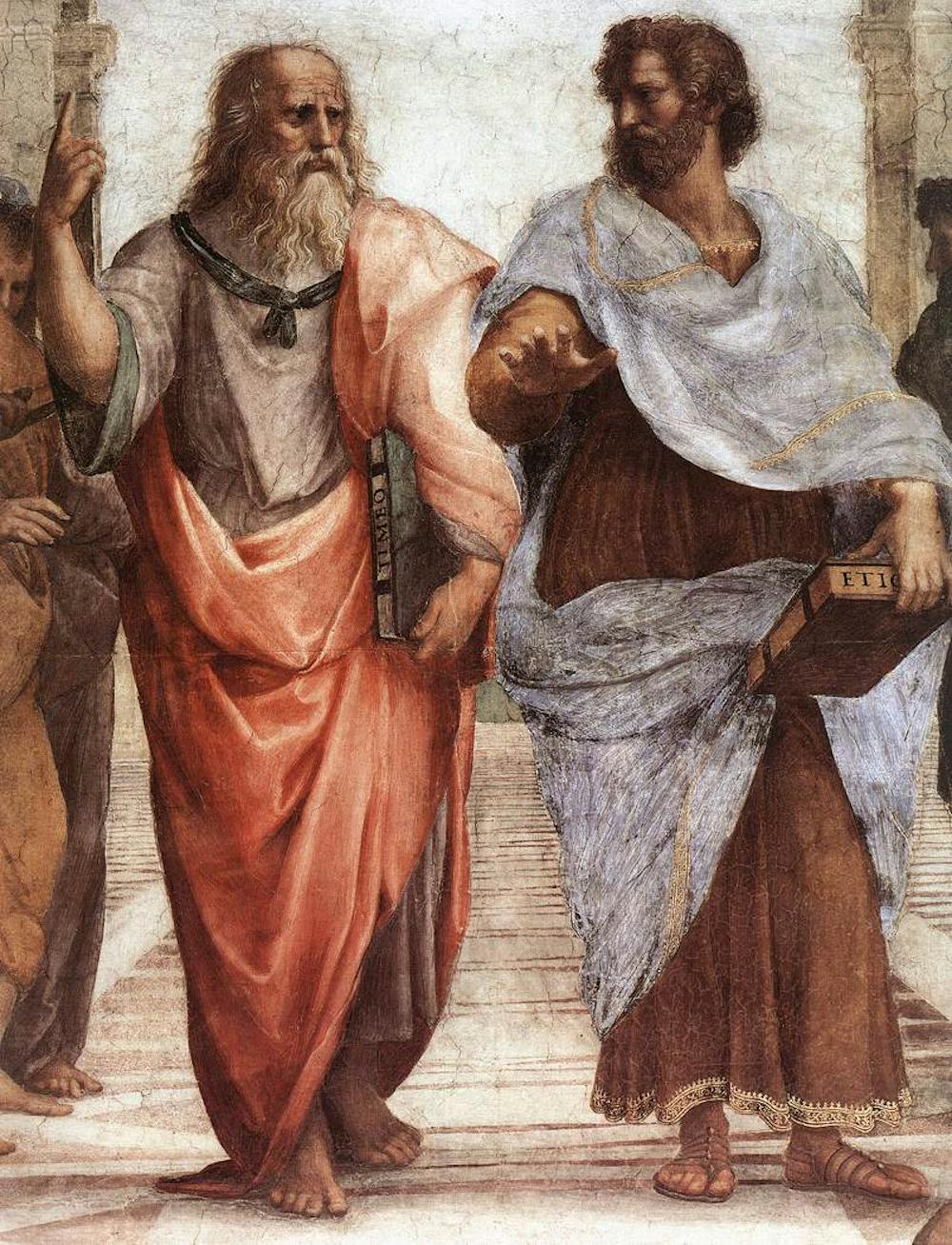
Raphael's The School of Athens, depicting Plato (left) pointing upwards, in reference to his belief in the higher forms.

Plato (left) pointing upwards, in reference to his belief in the higher forms. wikipedia

However, there is hope. Information theory is the mathematical study of the quantification, storage and communication of information. Originally developed by mathematician Claude Shannon, it has become increasingly popular in physics and is used a growing range of research areas.

In my recent research, published in AIP Advances, I used information theory to propose a new law of physics, which I call the second law of infodynamics. And importantly, it appears to support the simulated universe theory.

At the heart of the second law of infodynamics is the concept of entropy – a measure of disorder, which always rises over time in an isolated system. When a hot cup of coffee is left on the table, after a while it will achieve equilibrium, having the same temperature with the environment. The entropy of the system is at maximum at this point, and its energy is minimum.

The second law of infodynamics states that the “information entropy” (the average amount of information conveyed by an event), must remain constant or decrease over time – up to a minimum value at equilibrium.

So it is in total opposition to the second law of thermodynamics (that heat always flows spontaneously from hot to cold regions of matter while entorpy rises). For a cooling cup of coffee, it means that the spread of probabilities of locating a molecule in the liquid is reduced. That’s because the spread of energies available is reduced when there’s thermal equilibrium. So information entropy always goes down over time as entropy goes up.

My study indicates that the second law of infodynamics appears to be a cosmological necessity. It is universally applicable with immense scientific ramifications. We know the universe is expanding without the loss or gain of heat, which requires the total entropy of the universe to be constant. However we also know from thermodynamics that entropy is always rising. I argue this shows that there must be another entropy – information entropy – to balance the increase.

My law can confirm how genetic information behaves. But it also indicates that genetic mutations are at the most fundamental level not just random events, as Darwin’s theory suggests. Instead, genetic mutations take place according to the second law of infodynamics, in such a way that the genome’s information entropy is always minimized. The law can also explain phenomena in atomic physics and the time evolution of digital data.

Most interestingly, this new law explains one of the great mysteries of nature. Why does symmetry rather than asymmetry dominate the universe? My study demonstrates mathematically that high symmetry states are the preferred choice because such states correspond to the lowest information entropy. And, as dictated by the second law of infodynamics, that’s what a system will naturally strive for.

I believe this discovery has massive implications for genetic research, evolutionary biology, genetic therapies, physics, mathematics and cosmology, to name a few.

Simulation theory

The main consequence of the second law of infodynamics is the minimization of the information content associated with any event or process in the universe. This in turn means an optimization of the information content, or the most effective data compression.

Since the second law of infodynamics is a cosmological necessity, and appears to apply everywhere in the same way, it could be concluded that this indicates that the entire universe appears to be a simulated construct or a giant computer.

A super complex universe like ours, if it were a simulation, would require a built-in data optimisation and compression in order to reduce the computational power and the data storage requirements to run the simulation. This is exactly what we are observing all around us, including in digital data, biological systems, mathematical symmetries and the entire universe.

Further studies are necessary before we can definitely state that the second law of infodynamics is as fundamental as the second law of thermodynamics. The same is true for the simulated universe hypothesis.

But if they both hold up to scrutiny, this is perhaps the first time scientific evidence supporting this theory has been produced – as explored in my recent book.

Melvin M. Vopson, Associate Professor of Physics, University of Portsmouth

This article is republished from The Conversation under a Creative Commons license. Read the original article.

Expert: Trump’s lawyers making “nonsensical arguments” in effort to evade Jan. 6 charges

Attorneys for Donald Trump filed several motions on Monday asking Judge Tanya Chutkan, who is overseeing the federal election subversion case against the former president, to throw out several of the most important charges, largely based on the argument that the case was brought by "biased prosecutors” and that it violates Trump's First Amendment rights.

In court submissions filed just before the judge's deadline of midnight on Monday, Trump's legal team asserted that he was the target of political persecution by the Biden administration and that “the First Amendment embraces and encourages” Trump’s actions following the 2020 election.

The ex-president's lawyers characterized the charges against him as legally flawed, arguing that the indictment cannot and should not establish any connection between him and the Jan. 6, 2021, attack on the U.S. Capitol, since Trump has not been charged with inciting that riot, as The Washington Post reported

“Allegations in the indictment relating to these actions, when President Trump has not been charged with responsibility for them, is highly prejudicial and inflammatory because members of the jury may wrongfully impute fault to President Trump for these actions,” the filing said.

Trump’s arguments about the First Amendment are “weak,” since special counsel Jack Smith carefully crafted his charges to avoid criminalizing Trump's speech, said Temidayo Aganga-Williams, a white-collar partner at Selendy Gay Elsberg and former senior investigative counsel for the House Jan. 6 select committee.

“Instead, Trump’s affirmative actions and agreements are the target of the prosecution,” Aganga-Williams told Salon. “Trump was free to think and say what he wanted about the election results. He was not free to take unlawful actions to overturn those valid results.”

Aganga-Williams added that the Trump team's multiple motions to dismiss the federal indictment have "one goal — to prevent this case from ever reaching a jury."

Trump faces four counts in the federal case to be tried under Judge Chutkan in Washington, including conspiring to defraud the United States and to obstruct an official proceeding. The charge of obstructing an official proceeding has previously resulted in convictions against individuals involved in the Jan. 6 Capitol breach. Trump pleaded not guilty in August.

We need your help to stay independent

His attorneys argued in this week's filing that because of the “longstanding tradition of forceful political advocacy” in the country, Trump was not provided with any “fair notice that his advocacy in this instance could be criminalized.”

Such arguments are “nonsensical,” Bennett Gershman, a former New York prosecutor and law professor at Pace University, told Salon. 

“Every person, including Trump, has the right to engage in ‘forceful political advocacy,’” he said. “But Trump and his co-conspirators went far beyond advocacy. Trump and his cohorts engaged in a criminal conspiracy to subvert the results of a lawful election by illegal means. To endorse this argument would be to sanction any action taken under the guise of political advocacy, including violence and even political assassination.”

Such motions to dismiss indictments are “routine” and are almost always “rejected,” Gershman explained. The indictment charges Trump with a conspiracy to overturn the election by fraudulent means. 

“The lawyers are making another nonsensical argument that special words need to be used to establish criminal charges,” he said. “There is no such requirement.”

“Every person, including Trump, has the right to engage in ‘forceful political advocacy.’ But Trump and his co-conspirators engaged in a criminal conspiracy to subvert the results of a lawful election by illegal means."

Trump's legal team also argued that the charges against him should be dropped since the indictment fails to provide sufficient evidence to support them, emphasizing that it never alleges Trump employed "deceit or trickery" when allegedly organizing an alternate slate of electors following Joe Biden's electoral victory, according to CNN.

The former president's attorneys also advanced a theme Trump himself has emphasized on numerous occasions: the claim that the prosecution itself appears politically motivated. 

“Three days after President Trump formally announced his candidacy, the Special Counsel was put in place as part of a flawed effort to insulate Biden and his supporters from scrutiny of their obvious and illegal bias,” his attorneys wrote.

Prosecuting Trump for actions he undertook while president, his lawyers claim, demonstrates a selective approach by special counsel Jack Smith, who was appointed by Attorney General Merrick Garland last November.

But such claims of “selective or vindictive prosecution” are occasionally made but almost always rejected, Gershman said. To be sustained, they would have to show "bad-faith motivation," meaning evidence that a person had been accused of a crime for political or otherwise insidious reasons.”


Want a daily wrap-up of all the news and commentary Salon has to offer? Subscribe to our morning newsletter, Crash Course.


As part of their legal argument, Trump’s lawyers contended that “countless millions,” including the former president, believe that “fraud and irregularities pervaded the 2020 Presidential Election,” and that Trump simply “gave voice” to such concerns, demanding that political leaders work to restore integrity to the elections by investigating them.

Trump’s team “consistently argues” that Trump was merely expressing beliefs about election fraud that were widely discussed in the public sphere, Aganga-Williams pointed out, but have also consistently omitted a "critical fact” borne out in enormous amounts of public evidence: “Namely, it was Trump and his allies who were spreading the baseless claims about election fraud in the first place,” he said

Aganga-Williams also predicted that Trump’s claims of "selective prosecution," which attempt to blame President Biden for Trump's prosecution, will also be “a loser” in front of Judge Tanya Chutkan.  

“Other Jan. 6 defendants have unsuccessfully raised similar arguments over the last two years and Trump will not fare any better,” Aganga-Williams said. “Trump’s request for a hearing on this issue is an attempt to create a sideshow.”

NHL players can now say gay

NHL players can now let their Pride flag fly.

On Tuesday, the NHL reversed a ban on using Pride Tape — rainbow-striped hockey tape — and other shows of LGBTQ+ support on the ice. "After consultation with the NHL Players Association and the NHL Player Inclusion Coalition, players will now have the option to voluntarily represent social causes with their stick tape throughout the season," said the league in a statement.

The ban had been put in place over the summer, along with outlawing special jerseys. However on Saturday, Arizona Coyotes’ Travis Dermott used Pride Tape to specifically protest the ban. 

"None of the players really saw me put it on my stick," Dermott told the Athletic in an interview. "It was kind of just an, 'All right, I'm doing this, and we're going to deal with the consequences and move forward, and hopefully I'll have a positive impact on some people that needed that positive impact.'"

GLAAD celebrated the win.

"GLAAD data shows that Americans widely seek out brands and employers who take a stand in support of LGBTQ rights; and 70% of non-LGBTQ Americans agree that companies should publicly support and include the LGBTQ community through their corporate practices," GLAAD President and CEO Sarah Kate Ellis said in a statement. "Allowing players to express themselves while participating in this sport means encouraging individual choice and free expression, including actions that show support and make hockey more welcoming to all."

The league's first Pride Night of the season will take place Friday, Oct. 27.

Emmer out: Republicans’ third speaker nominee withdraws hours after winning contentious vote

Just hours after House Republicans — with much dissent — nominated Rep. Tom Emmer, R-Minn., to replace former Speaker Kevin McCarthy, R-Calif, Emmer bowed out of the speakership race on Tuesday. 

House Republicans are now in talks about suspending conference rules to open the speaker nominations, which would do away with the candidate forum, according to Punchbowl News' Jake Sherman and John Bresnahan. If successful, the move would make Reps. Kevin Hern, R-Okla. and Mike Johnson, R-La., candidates.  

Just before reports of Emmer's dropping out, several Republican members of Congress told CNN correspondents Melanie Zanona and Manu Raju that his candidacy was "on the verge of collapse." The development marked an acceleration in the House GOP's turbulent in-fighting, which sparked McCarthy's historic ouster earlier this month and has since delayed the elevation of a new House speaker.

Freshman Rep. Anna Paulina Luna, R-Fla., a MAGA Republican, publicly declared she did not vote for and would not be voting for Emmer on X, formerly Twitter, Tuesday afternoon following the official, closed-door role-call vote nominating him that saw 26 Republicans state their intentions to vote for someone else. Many of the Republicans' reservations about the Minnesota congressman stem from his record on fiscal and social issues, particularly his support of gay marriage, which Georgia Rep. Rick Allen told Punchbowl News was a disqualifier for him. Former President Donald Trump also expressed his disapproval of Emmer's bid for the speakership, deriding the Minnesota Republican on Truth Social as a "RINO," or Republican in name only hours after he secured the GOP nomination. 

"I have many wonderful friends wanting to be Speaker of the House, and some are truly great Warriors. RINO Tom Emmer, who I do not know well, is not one of them. He never respected the Power of a Trump Endorsement, or the breadth and scope of MAGA—MAKE AMERICA GREAT AGAIN! He fought me all the way, and actually spent more time defending Ilhan Omar, than he did me—He is totally out-of-touch with Republican Voters," Trump began before further questioning Emmer's loyalty to him. "Voting for a Globalist RINO like Tom Emmer would be a tragic mistake!" he added.

Trump's attack came as Emmer worked to garner more votes to secure the speaker's gavel in a full floor vote. He had reportedly vowed to remain in the voting chambers until he garnered a full 217 but was seen leaving the voting chamber without so much as a word in the late afternoon Tuesday before Punchbowl News' report. "So at this point, House Republicans are literally ungovernable," Politico correspondent Rachel Bade tweeted of the GOP dissent against Emmer. "Enough of them continue to prioritize revenge against their political enemies & enhancing their own power over the good of their own party."

The House speakership has been vacant for the last three weeks, a time period which has seen the quick rises and quicker downfalls of two other hopefuls: Reps. Steve Scalise, R-La., and Jim Jordan, R-Ohio. Scalise dropped out of the race just a day after receiving the nomination after a group of GOP holdouts' refused to back him, while 122 Republicans voted to boot Jordan from the race in a secret ballot last week after he failed three attempts to be elected speaker. 

We need your help to stay independent

White Castle is hiring robots as fry cooks and seeing improvements in service and order accuracy

Robots are slowly taking over White Castle, albeit in a more helpful rather than menacing manner. The Ohio-based fast-food chain has been implementing Miso Robotics' "Flippy 2" as fry cooks across the country, according to a recent report from Today. The initiative first began in September 2020, when White Castle installed the original "Flippy" in a Chicago area restaurant. Following an upgrade to "Flippy 2" at the original test location in November 2021, White Castle decided to introduce the trusty robot to more locations nationwide.

According to a 2022 statement from Miso Robotics, "Flippy 2" has been successful at boosting efficiency and quality of service both in and out of the kitchen: “Flippy 2 alleviates the pain points that come with back-of-house roles at quick-service restaurants to create a working environment for its human coworkers that maximizes the efficiency of the kitchen. The improved workflow allows for the redeployment of team members to focus on creating memorable moments for customers.”

Miso Robotics said the rollout of the machines is being phased by region and is still in the planning stages, per Today. An unnamed spokesperson for White Castle also told the media outlet that the rollout is still ongoing and will eventually be in “nearly one-third of the company's approximately 350 brick-and-mortar White Castle restaurants across the Midwest, Southwest and the New York area.”

As of Oct. 13, there have been 17 robots installed, said Jamie Richardson, vice president at White Castle.

A former McDonald’s chef shares the best store-bought alternative for classic Big Mac sauce

Turns out, you don’t have to make a trip to your local McDonald’s to get your hands on its famed Big Mac sauce. A former Mickey D's chef has revealed where you can purchase an almost exact rendition of the condiment. In a new TikTok, chef Mike Haracz shocked fans nationwide after he shared a dupe for the Big Mac sauce that is currently available at Walmart.  

“Do you want to buy Big Mac sauce from the store? I'm a former McDonald's corporate chef and I have your best option,” Haracz said in his video. “This is if you don't want to make Big Mac sauce at home, which I have a recipe pinned up at the top of my TikTok [account] that is a little bit closer.”

Haracz continued, saying fans of the popular fast food chain’s sauce who are looking for something that’s both “store-bought” and “already purchased” should try Walmart's Great Value Secret Sauce. The sauce, Haracz said, is “closest” to the Big Mac sauce that is “served in the restaurant.” 

“This version has a little more sweetness that probably has to do with water activity and food preservatives and whatever — things that you don't care about, because you just want the best Big Mac sauce you can buy from the store,” he added when describing the sauce’s key flavor differences.

Haracz said he tried multiple sauces but Walmart’s Secret Sauce took home the top prize for being nearly “identical” to the Big Mac sauce. The condiment, which is available for $2.08, is the “closest thing you could get from the SuperMarket,” he said.


Want more great food writing and recipes? Subscribe to Salon Food's newsletter, The Bite.


Viewers were thrilled with the new revelation and praised Haracz’s recommendation. Others, who tried Walmart’s sauce before, attested to its great taste:

“Wow!! This is what’s in my fridge right now,” wrote one enthusiastic commenter, while another said, “Don’t sleep on great value products.”

“Oh man! I bought this over the summer. It’s a winner for sure,” wrote another fan of the Secret Sauce.

College student with heart condition dies after drinking Panera “charged lemonade,” lawsuit says

According to a lawsuit filed in the Philadelphia Court of Common Pleas on Monday, a 21-year-old college student with a heart condition, Sarah Katz, died after drinking a heavily-caffeinated drink from Panera; her parents assert in the suit that Katz likely thought the beverage would be safe to drink because the chain’s marketing of the product does not reflect its high caffeine content

The large size of Panera’s large Charged Lemonade, per the New York Times, has more caffeine than a 12-ounce Red Bull and a 16-ounce Monster Energy Drink combined. However, it is advertised as being “clean.” Katz had Long QT Type 1 Syndrome, a heart condition that necessitated avoiding highly caffeinated beverages.  “If she didn’t know that this was an energy drink, it makes the family concerned about who else doesn’t know,” Elizabeth Crawford, the Katz family’s attorney, told the publication. 

In a statement, Panera said it was “saddened” to learn of Katz’s death: “At Panera, we strongly believe in transparency around our ingredients. We will work quickly to thoroughly investigate this matter.”


Adele called herself a ‘borderline alcoholic’. But is that a real thing?

British singer-songwriter Adele says she has quit drinking, describing herself as a "borderline alcoholic" when she was in her 20s.

She joins a growing number of people who are trying to quit or reduce their drinking.

But what does "borderline alcoholic" mean and is it a real thing?


It's not all-or-nothing any more

In the early days of alcohol treatment, people used to think of problems with alcohol as all-or-nothing. They used to believe there was something different about people who had problems with alcohol and those who didn't. That's how the idea of the "addictive personality" came about.

But now we think of drinking on a continuum. It goes from not drinking at all to dependent drinking. And people can move up and down that continuum at different points in their lives. The old saying "once an alcoholic, always an alcoholic" doesn't apply any more.


How much is it OK to drink?

The Australian national alcohol guidelines say healthy men and women should drink no more than ten standard drinks a week and no more than four a day. So that's about two to three drinks three to four times a week. Most Australians drink within these guidelines.

If you drink over those guidelines you are more likely to experience a number of long- and short-term problems including alcohol dependence, cancers, diabetes and heart disease. The risk of problems increases the more you drink and the more frequently you drink.

About 25% of Australians drink at risky levels and around 6% drink at such high levels that they would probably be dependent. Daily drinking is associated with dependence.


So when is someone an alcoholic or a borderline alcoholic?

The term "alcoholic" is rarely used by health professionals any more. It can make people believe there is nothing they can do about the problems they might be experiencing. Historically, that's what the early treatment providers believed in the 1930s and that myth has continued. But some people find identifying as an "alcoholic" helpful to maintain their goal of quitting drinking.

Health professionals have never used the term "borderline alcoholic". But in describing herself that way Adele is really saying alcohol is having too much of a negative impact on her life and like many others has decided to do something positive about it by taking a break.


Which terms do we use now?

Now, we tend to talk about "dependence" on a continuum from mild to moderate to severe. We also talk about the range of problems other than dependence that people can experience, which also lie on a continuum.

The threshold for whether someone is a problem or dependent drinker is not just how much they drink (although that is important), but also how severe the alcohol-related problems are.

Problems with alcohol don't always correlate with consumption. Some people can drink a moderate amount and have a lot of problems and others can drink a lot and appear not to have many negative consequences.


I'm worried about my drinking. What next?

If you are wondering if you are drinking too much you can check online with a free and anonymous assessment.

Signs you may have a problem with alcohol include:

  • having trouble stopping once you start drinking

  • wanting or trying to cut back but slipping up frequently

  • spending a lot of time drinking or recovering from drinking

  • having cravings to drink alcohol, such as if you come home from work and reach straight for a drink

  • dropping the ball at work, study or home because you've been drinking, such as not being able to do your work because you're hungover

  • continuing to drink alcohol even though you know it's causing problems with your health, friends, work or relationships

  • giving up or reducing social and work activities to drink instead

  • drinking when it's not safe, such as before driving or swimming.

If you find you aren't getting the same effects from alcohol as you used to or you need more and more alcohol to get the same effect, you have probably developed a dependence.

Sometimes people who are very dependent can experience withdrawal symptoms when they stop – strong cravings, nausea, sweating, agitation and anxiety.

The more of these signs you have, the more likely you are to be dependent on alcohol.

If you have any of these signs, taking a break from alcohol for a few months or longer can help. If you find that's too hard, you can try sticking within the Australian alcohol guidelines by reducing the number of drinks per occasion and increasing your drink-free days.


There's help

Sometimes when people experience some of these problems they need a bit of help to keep them on track. You can talk to your GP who can refer you to a psychologist or treatment service. Or you can try self-help options such as the Hello Sunday Morning's Daybreak app (a community of people supporting each other to change their relationship with alcohol). If your problems are more severe, you can try something like SMART Recovery (evidence-based group support for alcohol and other drug problems).


If you are worried about your own or someone else's alcohol or other drug use, you can contact the National Alcohol and other Drug Hotline on 1800 250 015 for free, confidential advice.

Nicole Lee, Professor at the National Drug Research Institute (Melbourne), Curtin University

This article is republished from The Conversation under a Creative Commons license. Read the original article.

In “Julia” season 2, Julia Child visits the French Riviera — and the White House kitchen

“Julia” — Max’s heartfelt show about the life of legendary chef Julia Child and the rise of her esteemed television series, “The French Chef” — is returning soon for a second season of joyful, culinary escapades.

As revealed in the season two trailer, which was released on Tuesday, following her major decision to renew the contract for her cooking show, Julia (Sarah Lancashire) heads off to the south of France, where she visits a slew of renowned restaurants and admirable chefs. Julia is accompanied by her devoted husband Paul (David Hyde Pierce), who, as we remember, encouraged her to “say ‘yes’ to everything for as long as we can” in the season one finale.

Back in the states, Julia’s cooking show and her own celebrity are both on the rise. But tension is also brewing behind-the-scenes. Alice (Brittany Bradford), who is now a full-time producer on “The French Chef,” struggles to revamp programming for the WGBH station. Judith (Fiona Glascott), Julia’s book editor, comes to a head with the male-dominated publishing industry of the 1960s. And Russ (Fran Kranz), Julia’s former producer on the show, is still against putting out feel-good content that appeals to the mainstream.

“Through her singular joie de vivre, [Julia] and her team must navigate WGBH, the White House and a threat from their past, while continuing to spearhead female-driven public television and confront social issues still prevalent today,” per a Max press release for the new season.

In addition to Lancashire, Pierce, Bradford, Glascott and Kranz, Bebe Neuwirth and Robert Joy will return to reprise their lead roles. The show also stars Isabella Rossellini as Simca and Judith Light as Blanche.

“Julia” will feature eight episodes in its second season. The show is slated to debut with three episodes on Nov. 16, followed by one episode weekly through Dec. 21.

Watch the trailer for season 2 of "Julia" below, via YouTube:

Longtime Trump lawyer Michael Cohen takes the stand against former boss in one “heck of a reunion”

Donald Trump's longtime "fixer" and former lawyer took the stand against him on Tuesday and alleged that the former president "arbitrarily" inflated the value of his real estate assets in order to secure better insurance premiums.

Cohen testified during Tuesday's hearing in the former president's New York civil fraud case. Cohen, who severed his relationship with Trump five years ago, is a key witness in the lawsuit brought by New York Attorney General Letitia James, which accuses Trump of exaggerating and devaluing his family companies' properties to make business deals. The case threatens to dismantle part of the business empire that catapulted Trump into celebrity and the Oval Office.

According to Reuters, the key witness told the judge that Trump instructed him to "reverse-engineer" the values of many of the Trump Organization's holdings so the company's statements of financial condition would display the assets as having "extremely high values with low liabilities in order to secure better insurance premiums."

The holdings' values would be "whatever number Mr. Trump told us," Cohen said ahead of the trial's lunch break. 

We need your help to stay independent

Cohen also acknowledged his complicity in crimes he said he committed for the former president's benefit at the start of his highly anticipated testimony in Trump's civil fraud case, CNN reports

A prosecutor from the New York attorney general's office questioned Cohen about the crimes he pleaded guilty to in 2018, which include tax crimes, campaign violations and lying to Congress. Cohen responded with a lengthy answer rehashing the crimes and outlining why he made public statements about the legitimacy of his conviction.

He had previously testified before Congress in 2019 about Trump's involvement in the hush-money plot involving both former Playboy model Karen McDougal and adult-film actress Stormy Daniels, who claimed to have had affairs with Trump — allegations Trump has denied.

"I acknowledge my complicity in the Stormy Daniels matter, but I never paid Karen McDougal," Cohen said, clarifying that payments to McDougal were made through AMI, the National Enquirer's former owner. 

Trump did not react when Cohen spoke about the hush-money payments, instead staring straight ahead at the witness. 

Cohen also acknowledged that he lied to Congress during a 2017 hearing pertaining to the amount of times he spoke to Trump about a Trump Tower Moscow project by saying they had only three conversations when it was actually 10. 

"I did that at the direction of, in concert with and for the benefit of Mr. Trump," Cohen claimed said.

He added that that statement was written in discussions with a number of Trump's close associates, including Ivanka Trump, Jared Kushner and Trump Organization legal counsel Alan Garten. Though Trump attorney Chris Kise objected to that statement, New York Supreme Court Justice Arthur Engoron's overruled it.

Cohen explained that he felt he had to address the public information about him.

"When all of this started, it was overwhelming. The amount of disinformation misinformation, mal-information about me. It was overwhelming and enormous," he said.

Despite public statements countering the federal charges against him over the years, Cohen confirmed that he eventually took a plea deal and served a sentence to take responsibility for each of the counts he pleaded guilty to. 

The start of his testimony follows shortly after he and Trump traded jabs upon arriving to the courthouse Tuesday morning. 

"This is about accountability, plain and simple," Cohen — one of the former president's most vocal critics since they cut ties five years ago — told reporters as he entered the courthouse, adding that the determinations in the case are all for the judge to make.

Trump called Cohen a "liar" when he arrived minutes later, Reuters reported.

"He's a proven liar, as you know, a felon," Trump told reporters before entering the courtroom, referring to Cohen. "We did nothing wrong and that's the truth."

Digs at Cohen's character are part of Trump's and his team's approach to countering the lawyer's testimony, according to CNN, which reports that the defense's strategy is to amplify Cohen's testimony and paint him as the start witness as a means to later discredit him and the case. They also aim to present videos and statements Cohen previously made to portray him as a liar.

Cohen, who began a three-year prison sentence in 2019 but was later released to home confinement, told Reuters Monday that Trump calling him a liar was like "the pot calling the kettle black," adding the acknowledgement that he lied to Congress at Trump's behest that he repeated in Tuesdays testimony.

He also teased his court appearance on X, formerly Twitter, Monday, writing, "I will continue to speak truth to power…no matter Donald’s continued smear and harassment campaign against me. #TeamCohen." 

While exiting the courtroom for a lunch break, Trump took a verbal swing at Cohen again, telling reporters that he's not worried about his testimony because he's not a credible witness.

“He has a horrible record,” Trump said outside the courtroom per CNN. “It’s not going to end up very good for him. We’re not worried at all about his testimony.”


Want a daily wrap-up of all the news and commentary Salon has to offer? Subscribe to our morning newsletter, Crash Course.


Cohen, on the other hand, told reporters while walking out for the break that his appearance in court is a "heck of a reunion."

Trump voluntarily dismissed earlier this month a $500 million lawsuit he filed against Cohen earlier this year shortly after his indictment in Manhattan District Attorney Alvin Bragg's criminal case pertaining to the hush-money payments to Daniels. The GOP primary frontrunner has occasionally appeared in court over the past month for his civil fraud trial, leveling inflammatory complaints to reporters that the case is a distraction from his campaign. 

He arrived in New York Monday after a campaign stop in New Hampshire and just days after Engoron fined him $5,000 for violating a limited gag order, which the judge imposed after Trump shared a social media post attacking Engoron's principal clerk and identifying her personal Instagram account. Trump deleted the post from Truth Social, but last week Engoron discovered the post had remained up on Trump's campaign website since the order and issued the fine, warning that future violations would result in "far more severe" sanctions.

Ahead of the trial's start, Engoron found last month that Trump had defrauded banks and insurers by inflating his net worth and the value of his assets, ordering the dissolution of key businesses in Trump's real estate portfolio. The ruling is on hold while the former president appeals.

In addition to the $250 million in fines, James is also seeking a permanent ban against Trump and his co-defendants, sons Eric and Don Jr., from running any businesses in the state and a five-year commercial real estate ban against Trump and the Trump Organization. Trump has denied wrongdoing in the case and defended the valuations of his properties, dubbing the suit a "fraud" and a political witch hunt.  

From screens to stovetops: Exploring the tactile delight of culinary bookshops

I had some time to kill on a recent Saturday afternoon in Portland, Oregon, so I popped into Vivienne Culinary Books, a pint-sized culinary book and kitchenware consignment shop on a wedge-shaped corner in the Hollywood District. 

Ten minutes melted into 45, as I got absorbed in a lovely cookbook by Judith Jones, “The Pleasures of Cooking for One.” I mentally filed away a crispy, layered potato side dish with garlic (I’d add more, I decided) and ample butter that Jones made once for Julia Child; Jones was Child’s longtime publisher at Knopf. Then I examined the mandu technique illustrated in Hugh Amano and Sara Becan’s comic book cookbook, “Let’s Make Dumplings!”: Make half moons and pinch the ends together to form “plump little belly buttons.”

Meanwhile, shop owner Robin Wheelright cooked lunch for a few patrons seated at the tiny bar at the front of the store, near where I stood moments later, cackling aloud at chef Lou Rand Hogan’s gift for turning a campy phrase in the humorous, brilliantly economical 1965 cookbook, “The Gay Cookbook,” the first cookbook aimed exclusively at a gay audience

“The easiest canapes are the sort where you smear some kind of a cheese mix on some kind of packaged cracker, and possibly add a dab of garnish,” wrote Hogan in a chatty introduction to the hors d’oeuvres. “We know a mad character in San Francisco (where there is a large percentage of mad characters) who puts pineapple cheese (out of those little glass jars) on round crackers and tops this with a candied violet, no less. Gawd, Mabel, how gay can you get?”

In this one-dimensional era of online shopping and mindless scrolling — punctuated by unnervingly targeted advertising — we’ve lost touch with the visceral delights of meandering around in a single-subject bookshop. I realized it had been years since I bought a cookbook in a physical store. My standard practice upon hearing about a new cookbook or culinary memoir has become to check online at Bookshop or Amazon. Sure, while there, I might stumble upon a tempting, related title from the site-generated “hot cookbooks” roundup (or, if I was shopping on the latter, throw on an order of LED light bulbs). 

We need your help to stay independent

At Vivienne, I had the time to organically engage with the books for inspiration — whether to revisit pasta from scratch with help from Vicky Bennison’s “Pasta Grannies: The Official Cookbook,” or try my hand at growing porch vegetables under the warm guidance of gardener Maggie Stuckey in “The Container Victory Garden.” I found emotional sustenance, too — immersing myself in gay life in Hogan’s mid-century San Francisco and in Naz Deravian’s roving Iranian diaspora in “Bottom of the Pot: Persian Recipes and Stories.” (The latter prompted an ache to return to my home kitchen and attempt Deravian’s golden, crunchy tahdig.) 

“You don't know what you’ll discover, browsing in a shop,” Wheelright told me later. “And when you're looking for things online, ideas don't generate in the same way.”

Wheelright debuted Vivienne in its current form in 2021. The chef/owner of the former seasonal cafe of the same name pivoted to offering takeout due to the pandemic before deciding to re-concept the space into a culinary book shop and wine bar that also offers cooking demos and classes. She sees Vivienne as a vehicle for kitchen sovereignty in her community.

Vivienne Culinary Books' Secret BarThe Secret Bar (Photo courtesy of Vivienne Culinary Books)

“Our mission is to have people be able to feed themselves,” Wheelright said. “And if you really get into me, I oppose the industrialization of food, which is problematic on so many levels: for us, the planet, the animals, the soil. If you look at our food system from that perspective and think about how to feed ourselves in a sustainable way in cities, it goes to growing food locally, shopping farmers’ markets and community-supported agriculture. We support that at the cookbook store by teaching people how to utilize products at their hands — like flours, grains, and pantry goods.”

Understanding that the notion of food sovereignty might not resonate with everyone who darkens Vivenne’s door, Wheelright seeks out books that have value beyond mere collections of recipes — those that foster engagement through photography or illustration, prose or personal stories. Intimate classes and cooking demos from visiting authors including Ivy Manning (“Tacos A to Z: A Delicious Guide to Nontraditional Tacos”) and Viola Buitoni (“Italy by Ingredient: Artisanal Foods, Modern Ingredients”) further aid the tactile end of this sunny shop’s mission.

It was a sorely needed reminder that the rational, oft-tedious act of feeding ourselves also contains therein gratification and sensual delight.

“It’s a great way to learn to cook and have a great experience,” Wheelright said. “That’s another way we can create a social platform for people to interact in person.” 

She paused here to reiterate that “social” didn’t refer to some digital content-sharing platform. Indeed, other than to check the time, I left my phone in my pocket for the duration of my visit to Wheelright’s shop, caught up in surveying the shelves for treasures beneath the glow of twinkle lights. It was a sorely needed reminder that the rational, oft-tedious act of feeding ourselves also contains therein gratification and sensual delight. It can restore us, reconnect us to the earth and our loved ones, transport us somewhere new or uncover some buried nostalgia. 

“We have a lot of times we have to eat in our life, everyday,” Wheelright said simply. 

I did make one online purchase as a result of my outing at Vivienne; however, this was mainly due to my already overloaded carryon. “The Gay Cookbook,” from Vivienne’s online store, will arrive next week. I hope it’s the same copy I held in the store.


In a first, bird flu reaches Antarctica, threatening to wipe out tons of penguins and other birds

2023 has been a bad year for emperor penguins. In August, a study in the journal Communications Earth & Environment found that the loss of polar ice in Antarctica is likely to lead to a "catastrophic breeding failure" for penguins throughout Antarctica, eventually causing them to be unable to naturally sustain their own species by the end of the century. But a virus may get them first. A new report by the British Antarctic Survey confirms the existence of highly pathogenic avian influenza (HPAI) on Bird Island in Antarctica's South Georgia region — a discovery that has potentially devastating implications for local bird populations.

The British Antarctic Survey became aware of HPAI on Bird Island after they were informed that individuals in a bird species known as brown skua were displaying symptoms; some were dying. Test samples confirmed the presence of HPAI, with scientists speculating that it was spread from South America by birds returning from their migrations.

"The presence of HPAI could have serious implications for the Territories' abundant seabird colonies and [Government of South Georgia & the South Sandwich Islands] and British Antarctic Survey are working in partnerships to monitor the ongoing impacts," the scientists explain in their report.

“There are species on some of the Antarctic islands and sub-Antarctic islands that are unique to those islands, and only occur in small numbers, in hundreds or thousands,” Thijs Kuiken from Erasmus University Rotterdam in the Netherlands, who was not involved in the study, told New Scientist. “If the virus reaches those populations, they are in threat of extinction.”

A totally objective Halloween candy ranking

It's that time of the year again. We're rapidly approaching the final week of October and there are things that need to be discussed. I'm not talking about how to plan your Thanksgiving menu or decorate your home for the holidays. I'm not here to share advice on how to make the best sugar cookie or pour the perfect espresso martini. I'm here to discuss far more serious matters: Halloween candy.

Sure, my trick-or-treat days may be long behind me, but that doesn't mean I don't enjoy my share of holiday candy every October. Once the Duane Reade and Rite Aid in my neighborhood fill their shelves with bags of assorted candies, I can't help but grab one or two. After all, that's a perk of being an adult. You don't have to wait and see which treats the neighborhood elders drop in your pumpkin-shaped bucket — you can simply walk down the block and buy what you want.

So, without further ado, here is a completely objective (and perfect) ranking of the top 10 Halloween candies on the drugstore shelves.

10. Tootsie Rolls

These babies get a bad rap from candy fans who claim they're too sticky or boring — but to me, they're a quintessentially nostalgic candy. Right up there next to those foil-wrapped, strawberry-filled hard candies and the Dum-Dums lollipops that were always in waiting rooms. If a Tootsie Roll is in a nearby candy bowl, I'm grabbing it.

9. Sour Gummy Worms

Finding a small, individually wrapped package filled to the brim with sour gummy worms? That's a top-tier Halloween-candy-bucket surprise. Julia, how is it only number nine then? Fantastic question. This is a serious, high-stakes, cut-throat candy ranking and I have to be ruthless. Onto the next.

8. Skittles

Despite the recent drama around Skittles, I can't act like it isn't a candy any kid would be stoked to find in their candy bucket. You know, taste the rainbow and all of that.

7. Caramel Apple Lollipops

If you don't remember these neon green lollipops covered in hardened caramel, I feel bad for you. Sure, it took (what felt like) hours to eat just one — thanks to its ability to easily chip a tooth or rip out a filling — but once you got through the sticky and sweet caramel layer and hit that sour apple lollipop, it felt like you had just accomplished the greatest childhood feat.

6. Tootsie Pops

Another lolly worthy of recognition is the Tootsie Pop. I'm not sure if it's thanks to the iconic branding — I'll never forget that cartoon owl testing how many licks it takes to get to the center of a Tootsie Pop — or if I just love a hard candy with a chewy center, but I'll never turn one down.

5. Starburst

I shouldn't have to explain this one. They're reliable, even the worst flavor (sorry, yellow) is still good and they're individually wrapped, which is perfect for Halloween handouts.

4. Snickers

When you go through your Halloween candy haul and find a Snickers — even a mini one — you know you got lucky. Great texture, great flavor — no complaints from me.

3. Mounds

All of you Almond Joy and Mounds haters: I don't want to hear it. How can you not love dark chocolate and coconut? If you disagree, you need to grow up.

2. Kit Kat

Light, crispy, perfectly sweet and satisfying to snap in half. What else do I even need to say?

1. Reese’s Peanut Butter Cups

This shouldn't surprise anyone. You can't go wrong with the PB cup in any form — mini, regular, big cup, pumpkin-shaped or dipped in white chocolate to look like a ghost. They're the ultimate candy to find in your Halloween bag. Is it unfortunate for anyone with a peanut allergy? Absolutely and I genuinely send my condolences.

HONORABLE MENTIONS: Twix, Twizzlers, Hershey's Bars (dark chocolate only), Sour Patch Watermelons and M&Ms

CANDY I NEVER WANT TO SEE IN A HALLOWEEN BUCKET: Candy Corn, Circus Peanuts, Smarties, Mike & Ike's, Raisins/Raisinets

“A gigantic pool of nos”: Dozens of Republicans reject Tom Emmer, GOP’s third nominee for speaker

After a series of secret ballots — in which he racked up nearly 100 objectors — and an official roll call vote that saw more than 25 Republicans publicly state their intentions to vote for someone else on the House floor, Rep. Tom Emmer, R-Minn., became the third nominee to replace ousted Rep. Kevin McCarthy, R-Calif., as speaker in the past three weeks.

Emmers, who currently serves as the majority whip, reportedly received 117 votes from the Republican conference in closed-door votes after five rounds of voting. House Republican Conference Vice Chair Mike Johnson of Louisiana got 97. The day started with eight candidates.

In an official roll call vote, Emmer received what Punchbowl News' Jake Sherman described as "a gigantic pool of nos."

Emmer, unlike the majority of candidates, voted to certify the 2020 presidential election results. He was, however, one of more than 100 Republicans who signed an amicus brief asking the Supreme Court to throw out Joe Biden’s wins in Georgia, Michigan, Pennsylvania and Wisconsin.

Members of the ultra-conservative House Freedom Caucus were divided on Tuesday's vote, with members like Rep. Marjorie Taylor Greene, R-Ga., voting against Emmer and for Rep. Jim Jordan, R-Ohio, who lost his bid for speaker last week after three rounds of failed votes, and Rep. Matt Gaetz, R-Fla., who lead the revolt against McCarthy, voting for Emmer on roll call.

For his part, Emmer has reportedly vowed to stay in voting chambers until the conference can get to 217 before allowing a full floor vote.

Trump unleashes mini-Kraken; seeks dismissal of Jack Smith’s entire Jan. 6 case

Donald Trump is seeking to have the election subversion charges against him dismissed from the indictment filed against him by special counsel Jack Smith in Washington. In a series of late-night dismissal motions, the former president's lawyers asserted that Smith's case "does not explain" how Trump committed the alleged crimes enumerated in the indictment. Trump has been accused of conspiring to obstruct the certification of the 2020 election, conspiring to deprive Americans of a fair election process and conspiring to defraud government officials administering the election, actions which Smith and his team of prosecutors argue subsequently led to the Capitol insurrection of Jan. 6, 2021.

In these new court filings, Trump's lawyers contend that the case criminalizes Trump's "political speech and advocacy," thereby violating his First Amendment rights. The motions also argue that Trump has been politically targeted by the Biden administration and that the connection between the indictment and the Capitol riots is not tenable because Trump has not charged with inciting the attacks, as the Washington Post notes.

“Because the Government has not charged President Trump with responsibility for the actions at the Capitol on January 6, 2021, allegations related to these actions are not relevant and are prejudicial and inflammatory. Therefore, the Court should strike these allegations from the Indictment,” wrote Trump attorneys Todd Blanche, John Lauro, Emil Bove and Gregory Singer.

“The indictment must be dismissed because it seeks to criminalize core political speech and advocacy that lies at the heart of the First Amendment,” they added.

Trump's new legal arguments rest on the "claim that criminalizing his post-election behavior would similarly criminalize ordinary political advocacy like lobbying or protest," writes Politico's Kyle Cheney. The former president's lawyers "cited a newly released opinion by the D.C. Circuit Court of Appeals to contend that Trump could not be accused of 'corruptly' attempting to interfere with Congress’ Electoral College proceedings on Jan. 6, 2021" if Trump's efforts were construed as a legitimate form of "political advocacy."  

We need your help to stay independent

Trump's defense team "literally wants the court to order Jan 6 references be stricken from the indictment," tweeted CBS congressional correspondent Scott MacFarlane, quoting the defense argument that because Jan. 6 is "a high-profile issue on which the public has high awareness and strong opinions," including any reference to that event would be "prejudicial and inflammatory." 

Smith's indictment charges that Trump was the leading force in concocting falsehoods about widespread vote fraud in the 2020 presidential election. In a separate Monday filing, Trump's attorneys respond by describing the former president as "one voice among countless millions," whose opinions cannot be held responsible for deceiving millions of others about the integrity of the election.


Want a daily wrap-up of all the news and commentary Salon has to offer? Subscribe to our morning newsletter, Crash Course.


“Virtually every American, including the cited public officials, had similar access to much of this same information, including a mountain of publicly reported facts and opinions, which were the subject of wall-to-wall media coverage throughout the post-election period and beyond,” the filing states.

“To assert that President Trump, as one voice among countless millions, was somehow capable of unilaterally ‘tricking’ or ‘deceiving’ these individuals, who include some of the most informed politicians on the planet, simply by advocating his opinions on this contentious issue, is beyond absurd.”

Trump's federal trial in Washington, overseen by U.S. District Court Judge Tanya Chutkan, is scheduled to begin on March 4, 2024, as the first of his four felony cases to go to trial.