

















American Spring
Occupy heats up
Watch the video of Natasha Lennard’s interactive Q&A on the future of Occupy VIDEO
(Credit: Michael Coniaris) As winter thaws, the hot spots of the Occupy movement are seeing the first ripples of resurgence. From New York to Oakland, Calif., crowds are returning to the streets, but will the plan for a May 1 General Strike spark an American Spring or will the movement splinter and fade into Tea Party-like irrelevance? Watch the Salon webcast with Occupy correspondent Natasha Lennard to hear her thoughts on these issues:
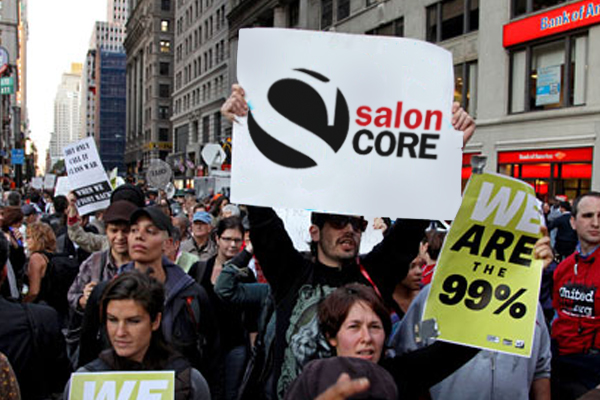
To participate in upcoming Salon webcasts with staff and friends, join the Salon Core community.
How to make Occupy catch on
To build a fairer economy, we need to reclaim time-tested progressive narratives
An Occupy Wall Street demonstrator pastes signs to a foreclosed property in Brooklyn on Dec. 6, 2011. (Credit: REUTERS/Mike Segar) Were history a guide to today’s politics, progressives would be redoubling their efforts to turn the still-unraveling crisis of capitalism into an opportunity for system-changing reform. Certainly they would be doing everything within their power to combat the logic of austerity and entitlement-slashing that has crystalized into a new Washington “consensus,” and instead to shape the debate around issues of employment, inequality, the erosion of the safety net, and the unprecedented concentrations of wealth and economic power that have survived the Great Recession intact. But they would also move to engage the debate at a deeper level: in terms of what a just, equitable and socially as well as financially productive economy looks like and what roles the state and the market should play in bringing it about.
Continue Reading CloseAlice O'Connor is a professor of history at the University of California Santa Barbara, where she teaches and writes about the history of U.S. social policy, political economy, and the politics of wealth and poverty. Her publications include "Social Science for What?: Philanthropy and the Social Question in a World Turned Rightside Up" and "Poverty Knowledge: Social Science, Social Policy and the Poor in Twentieth Century United States History." More Alice O'Connor.
America’s last hope: A strong labor movement
To achieve economic justice in the 21st century, we need to fight for democracy in the workplace
The fate of the labor movement is the fate of American democracy. Without a strong countervailing force like organized labor, corporations and wealthy elites advancing their own interests are able to exert undue influence over the political system, as we’ve seen in every major policy debate of recent years.
Yet the American labor movement is in crisis and is the weakest it’s been in 100 years. That truism has been a progressive mantra since the Clinton administration. However, union density has continued to decline from roughly 16 percent in 1995 to 11.8 percent of all workers and just 6.9 percent of workers in the private sector. Unionized workers in the public sector now make up the majority of the labor movement for the first time in history, which is precisely why — a la Wisconsin and 14 other states — they have been targeted by the right for all out destruction.
Continue Reading CloseDorian T. Warren is a Fellow at the Roosevelt Institute. He is also an Assistant Professor of Political Science & Public Affairs at Columbia University. You can follow him on Twitter @dorianwarren. More Dorian Warren.
America’s failed promise of equal opportunity
To achieve a truly fair society, we need to look to Lincoln, not Jefferson
Americans are increasingly aware that the ideal of equal opportunity is a false promise, but neither party really seems to get it.
Republicans barely admit the problem exists, or if they do, they think tax cuts are the answer. All facts point in the opposite direction. Despite various tax cuts over the past 30 years, not only have income and wealth inequality dramatically increased, but the ability of individuals to rise out of their own class has declined. Social stagnation is increasingly the norm, with poverty rates the highest in 15 years, real wage gains worse even than during the decade of the Great Depression, average earnings barely above what they were 50 years ago, and more than 80 percent of the income growth of the past 25 years going to the top 1 percent. In fact, since 1983, the bottom 40 percent of households have seen real declines in their income and the same goes for the bottom 60 percent when it comes to wealth. We know what the economic status quo does: It redistributes upwards.
Continue Reading CloseAlex Gourevitch is a postdoctoral research associate at Brown University's Political Theory Project. He also co-authors the blog The Current Moment. More Alex Gourevitch.
Aziz Rana teaches law at Cornell University and is the author of "The Two Faces of American Freedom," recently published by Harvard University Press. He writes on American constitutional development, with a particular interest in issues of citizenship, immigration and national security. More Aziz Rana.
The progressive vision America needs
Only a strong alternative to free-market ideology can solve our economic and political woes
(Credit: AP) The 2012 presidential election is rapidly shaping up to become a critical battle for the future of the American economy. In his State of the Union address, Barack Obama attempted to draw a sharp contrast with the “you’re-on-your-own economics” on display in Republican primary debates.
But progressives have their work cut out for them. Despite a triumphant election in 2008, a financial crisis that seemingly discredited the free-market deregulatory fervor and the significant policy achievements of the Obama administration in economic stimulus, healthcare reform and financial regulation, the very notions of government regulation, of social safety nets and of economic fairness are under attack.
Continue Reading CloseK. Sabeel Rahman is a fellow at the Roosevelt Institute, a PhD candidate in Political Theory at Harvard University, and a JD candidate at Harvard Law School. His research focuses on progressive political thought, economic policy and public law. More K. Sabeel Rahman.
The privatization trap
From schools to prisons, outsourcing government's works typically ends with cronyism, waste and unaccountability
An employee of Immigration and Customs Enforcement's Stewart Detention Center in Lumpkin, Ga., waiting for the front gate to be opened. The detention center is operated on contract by Nashville-based Corrections Corporation of America. (Credit: AP) Privatizing the government is one of the most active projects of the early 21st century.
Everything we once expected the government to do — from education to regulatory rule-writing to military operations to healthcare services to prison management — it now does less of, preferring to support markets in which these services are done through independent, profit-maximizing agents. Tools such as contracting out, vouchering and the selling-off of state assets have been used to remake the government during our market-worshipping era.
Continue Reading CloseMike Konczal is a Fellow at the Roosevelt Institute. More Mike Konczal.
Page 1 of 5 in American Spring