Howard Dean
Howard Dean responds to Salon
And we respond to his spokeswoman's dismissal of our story about Dean's paid advocacy work
Howard Dean Howard Dean’s spokeswoman, Karen Finney, has responded to my story on Dean’s turn into paid advocacy work, accusing me of engaging in “lazy journalism.” I think the adjective is not accurate.
Salon has nothing personal against Dean. But we felt that a liberal champion’s reliance on paid advocacy work reveals something significant about our political culture, and possibly about Dean himself. Finney’s statement is presented here in its entirety, along with my responses.
While there may be fair criticisms to be made, its a sham that Justin knowingly ignored a number of relevant facts because they didn’t fit the premise of the story he wanted to write. Criticism of one’s positions or activities is one thing, lazy journalism is quite another.
On the issue of biologics, one that he’s known and had an opinion on long before he was DNC Chairman. For example, Justin did not mention Gov. Dean spent most of his time during the healthcare debate working with DFA and other grassroots organizations advocating for the public option as one of the most outspoken advocates. During that debate he was very transparent about his position on and support for biologics legislation sponsored by Reps. Anna Eshoo (D-Calif.), Jay Inslee (D-Wash.) and Joe Barton (R-Texas) in the House (H.R. 1548) and in The Biologics Price Competition and Innovation Act introduced by Sens. Edward Kennedy (D-Mass.) and Mike Enzi (R-Wyo.).
Here’s the rest of what he said at the time about a commonsense and fair approach:
“A commonsense and fair approach, similar to the process and timeline currently in place for generic versions of chemical-based medicines, would allow the original developer of the biologic to protect the proprietary data used to develop the medicine for at least 12 years. A shorter exclusivity period would prematurely rob biotech innovators of their intellectual property and destroy incentives to develop new cures. Most firms would be unable to recoup their investments in new medicines, which ordinarily top $1 billion and involve 15 years of research and development. If we discourage investment, we jeopardize the development of the next generation of breakthrough medicines and cures.”
On the issue of the MEK, he is not a paid advocate. He was paid for a handful of speeches, but has not been paid for his advocacy. His focus has been on the human rights issues. In an op-ed on Huffington Post he outlined some of the facts he felt had been ignored in recent articles, but his key point is that there are 3400 unarmed men, women and children currently in Camp Ashraf who should not be left for slaughter after having been promised they would be protected. Here’s an excerpt:
“There are key facts, which have been obscured, omitted or ignored in recent articles written about these 3,400 unarmed people. First, a lot has changed since the MEK was classified as a terrorist organization in 1997. In recent testimony to Congress by Martin Indyk, former U.S. Ambassador to Israel and Assistant Secretary of State for Near East Affairs under Clinton, it was revealed that the motivation behind the ’97 classification was to help open a dialogue with the ruling party of Iran.
Second, in July 2010, the U.S. Appeals Court in Washington DC ruled that the group was actually not given due process in 1997 and ordered the State Dept. to reevaluate the terrorist designation. Notably the governments of France, Britain and the EU have already ruled that the MEK is not a terrorist organization. Currently the only two nations that remain in agreement on what is now a discredited classification are America and Iran.
Third, in 2003 the U.S. military peacefully disarmed the inhabitants of Camp Ashraf. American FBI agents visited Ashraf and questioned all of the 3,400 residents. None were found to be associated with terrorists or terrorism. The US military made a promise in writing that each resident would be protected against outside threats.
Fourth, in 2009, and again in 2011, American troops were ordered to leave the vicinity of Ashraf by the Iraqi Government — then led by Prime Minister Maliki. Iraqi troops went into Ashraf and killed 47 unarmed civilians in cold blood. Most of the hundreds who were wounded were denied medical care as American troops stood idly by just a few miles away.
Fifth, while the residents of Ashraf are currently asking to be re-located to other countries, the plan currently being pushed by Lawrence Butler from the US State would instead relocate them to another area in Iraq and “guarantee” their safety. Yet neither the American or Iraqi governments have thus far kept their word to the residents of Ashraf.
“America gave its word to the MEK that we would protect them. We believe that allowing 3,400 people to be murdered in cold blood and breaking that promise is wrong. We believe that in the end this debate is about America, not the people in Ashraf. America is a country that values freedom and the rule of law. We must keep our word and help the people of Ashraf get out of Iraq. We must support those who peacefully and through democratic means fight for their freedom. If we fail and again stand by as 3,400 unarmed men, women and children, in Ashraf are murdered by the Iranian Government or its Iraqi proxies, we diminish ourselves as a great nation. Its time for America to keep its word to the people in Ashraf.”
My response:
On the issue of biologics, Finney contends Dean has “known and had an opinion on long before he was DNC Chairman.” Finney said as much on background to me, but in my reporting I found no evidence that Dean had weighed in on biologics before 2009, when he joined the D.C. lobby shop McKenna Long and Aldridge. McKenna works for the biotech industry’s trade group.
Finney did not allude to the facts she presents here when I originally emailed with her. If she had, I would have reported them. Since it’s always possible that I missed something, yesterday I invited Finney to provide a citation for Dean’s involvement on the issue before he was a paid advocate for the industry. She declined to do so.
Remember, the issue here was how long a certain class of drugs — biologics or biopharmaceuticals — would be protected from cheaper generic competitors. Consumer groups wanted a shorter period (five years) while Dean and the industry wanted 12 years of protection. So it’s worth noting that back in 2002, Dean was active in a similar debate — but back then he was arguing in favor of generic competition against brand-name drugs.
“It’s unconscionable how they’re exploiting patent-extension loopholes,” Dean told Forbes, speaking of Big Pharma. He actually founded a coalition to lobby Congress to make it easier for generics to enter the market sooner, thereby lowering prices for consumers.
It is true that the biologics industry is different from the traditional pharmaceutical industry but the fundamental issue is the same. By taking money from the industry, Dean has created the appearance of a conflict of interest.
When it comes to the MEK, Finney argues that “he is not a paid advocate. He was paid for a handful of speeches, but has not been paid for his advocacy.” That seems like a distinction without a difference.
Dean has publicly acknowledged he had never even heard of the MEK until his agent was contacted with a paid speaking opportunity for the group in Paris. (And, remember, the group is known for paying astronomical speaking fees.)
Finney also quotes Dean’s HuffPost column on the MEK and Camp Ashraf. A couple of notes here: First, Dean has misrepresented Martin Indyk’s comments on the MEK, as Indyk himself pointed out in a comment on HuffPost.
The full passage from Indyk’s book on the MEK is both a succinct argument for why the group should be classified as a terrorist group and a refutation of the idea that it was added to the terrorism list purely as (in Dean’s characterization) a way to “open a dialogue with the ruling party of Iran”:
[The MEK] in its early actions had killed Americans. After its expulsion from Iran, Saddam had provided it training bases in Iraq and logistic support for terrorist attacks in major Iranian cities. The MEK returned the favor by helping Saddam crush the Shiite revolt in southern Iraq after the Gulf War. The MEK clearly deserved to be on the terrorism list, but as an anti-Iranian organization it had managed to gain support from some influential congressmen through the sophisticated political operations of its front organization, the National Council of Resistance of Iran … Here was one instance when Clinton could show that he applied the same standards to groups that used terrorism against our foes as well as our friends. We hoped it would be perceived in Tehran as a goodwill gesture.
I won’t quibble here with the broad strokes of Dean’s explanation of the situation at Camp Ashraf, where several thousand MEK members are holed up in Iraq. Finney asserts that Dean’s “focus has been on the human rights issues.”
In fact, his advocacy for the MEK has gone well beyond the question of human rights of the residents of Ashraf. Dean has at least twice argued publicly that Maryam Rajavi, one of the longtime leaders of the MEK, should be recognized as the president of the nation of Iran. That’s a remarkable position that is rarely heard even among MEK’s strongest supporters.
Finally, there are two areas in which Dean could be more transparent. As I noted in the story, he sits on the board of advisors of a venture capital fund, Vatera Health Partners, that invests in biopharmaceuticals. But neither Finney nor Vatera responded to my inquiries about when he took the position.
Why does it matter? Because Dean was doing public advocacy for the industry during the healthcare fight in 2009, and, if he was on Vatera’s board back then, that means he had a personal financial stake in the industry, a time when he was seeking to shape his future. I’m not saying he did. I’m saying he should disclose whether he did.
More important, Dean has declined to reveal whom he has worked for in his capacity as a senior strategic advisor at McKenna Long and Aldridge. It is possible that my story, which covered only advocacy work that has occurred in the public domain, understates Dean’s paid advocacy positions.
Justin Elliott is a reporter for ProPublica. You can follow him on Twitter @ElliottJustin More Justin Elliott.
The seduction of Howard Dean
The liberal firebrand succumbs to Washington's money culture
Howard Dean Howard Dean has long cultivated an image as the plainspoken doctor who speaks for the left wing of the Democratic Party, a role he still plays as a pugnacious pundit on TV. But since his term as chairman of the Democratic National Committee ended in January 2009, Dr. Dean has taken on a less-noticed role: paid advocate for interest groups that would find few fans among the progressive voters once energized by Dean’s 2004 presidential bid.
Dean may not be the worst of the “buckrakers,” those prototypical capital characters who exploit their name and connections without regard for principle. But his recent political forays seem to have diverged from his trailblazing left-liberal past.
Continue Reading CloseJustin Elliott is a reporter for ProPublica. You can follow him on Twitter @ElliottJustin More Justin Elliott.
Today’s most inane 2012 speculation
Politico's Roger Simon imagines Howard Dean challenging the president
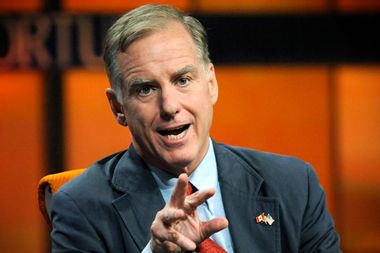
Governor Howard Dean, physician and former chairman of the Democratic National Committee, speaks during the "American Technophile: "How Technology is changing Politics, Governance & Healthcare" panel at the Fortune Tech Brainstorm 2009 in Pasadena, California July 22, 2009. REUTERS/Phil McCarten (UNITED STATES BUSINESS)(Credit: © Phil Mccarten / Reuters) Will Howard Dean challenge Barack Obama in 2012? Politico columnist Roger Simon, who drew Dean from a hat full of cards that he’d written the names of various Democrats on, says probably!
First, Simon lays out the history: Reagan and Clinton were only reelected because they did not face serious primary challenges. But Jesse Jackson almost ran against Clinton, and he would’ve made Clinton lose, because of Whitewater, NAFTA and Troopergate. Thankfully, Rahm Emanuel and Harold Ickes made Jackson not run, thus saving Clinton from being Jimmy Carter.
Continue Reading Close
Alex Pareene writes about politics for Salon and is the author of "The Rude Guide to Mitt." Email him at apareene@salon.com and follow him on Twitter @pareene More Alex Pareene.
Harry Reid and Howard Dean: Fox News enablers
This is what happens when Democrats cave in to right-wing fear campaigns
Governor Howard Dean, physician and former chairman of the Democratic National Committee, speaks during the "American Technophile: "How Technology is changing Politics, Governance & Healthcare" panel at the Fortune Tech Brainstorm 2009 in Pasadena, California July 22, 2009. REUTERS/Phil McCarten (UNITED STATES BUSINESS)(Credit: © Phil Mccarten / Reuters) Harry Reid and Howard Dean had their reasons for coming out against the Park51 project in lower Manhattan last week. Well, at least Reid, who is locked in a tight reelection campaign in Nevada, did. Dean’s motives are a little harder to discern.
But whatever they hoped to accomplish, one thing is indisputable: Reid and Dean both did an enormous favor to the right-wing fear-mongers who have been pushing the “ground zero mosque” hysteria, equipping them with a compelling talking point for the cable news circuit. Here’s a sampling of how Reid and Dean have been invoked in the past few days, often (but not always) on Fox News:
Continue Reading Close
Steve Kornacki writes about politics for Salon. Reach him by email at SKornacki@salon.com and follow him on Twitter @SteveKornacki More Steve Kornacki.
Heroes, villains and cowards of the so-called “ground zero mosque”
Who's defended religious liberty, who's been too scared to, and who truly hates our founding principles?
Top left, clockwise: Mayor Michael Bloomberg, Sarah Palin, Newt Gingrich, Sen. Chuck Schumer, Sen. Harry Reid, President Obama The bizarre, ginned-up controversy surrounding the Park51 project — a proposed Islamic community center, like the 92nd Street Y, including a space for worship, to be built at the site of an old Burlington Coat Factory (which is a store, not a factory) on Park Place in lower Manhattan, near, but not in sight of, the site of the World Trade Center — has exposed not just the blatant Islamophobia (and cheerful willingness to exploit bigotry) of many luminaries of the right, but also the cowardice of many supposed liberals. Just so we know where we stand, and using, as criteria for placement, my own inexact impressions of their public statements, I present the official War Room lists of “ground zero mosque” heroes, villains and cowards.
Continue Reading Close
Alex Pareene writes about politics for Salon and is the author of "The Rude Guide to Mitt." Email him at apareene@salon.com and follow him on Twitter @pareene More Alex Pareene.
Journalism as blood sport?
Howard Dean and I reply to Howard Kurtz's column on the media's supposedly new "crossfire culture"
I’ve already said I’d give Charles Sherrod the last word on the story of his family’s smearing by right-wing media. But I had more than a few thoughts on Howard Kurtz’s provocative Washington Post column, “In journalism’s crossfire culture, everyone gets wounded.” I’ll try to stick to the media critique and leave the Sherrods out of it where possible.
Continue Reading CloseJoan Walsh is Salon's editor at large. More Joan Walsh.
Page 1 of 32 in Howard Dean