Norway

How will Norway cope with terrorism?

The attack by a homegrown Christian militant leaves the peace-seeking nation looking for answers

  • more
    • All Share Services

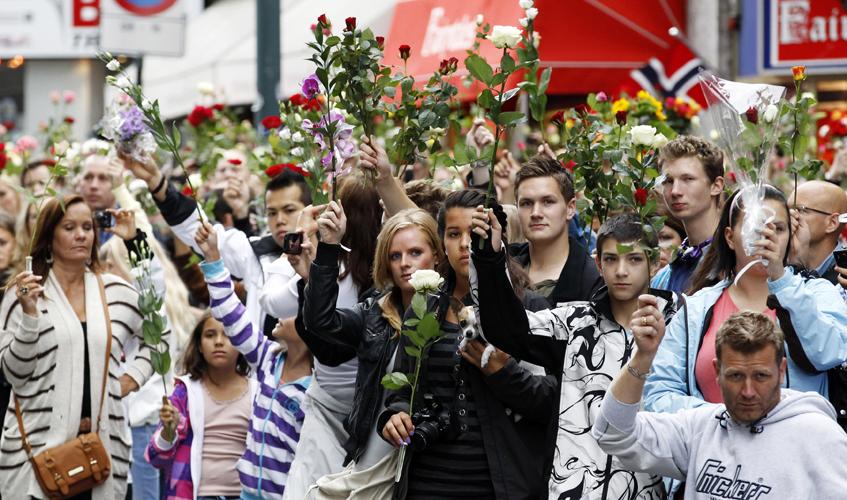
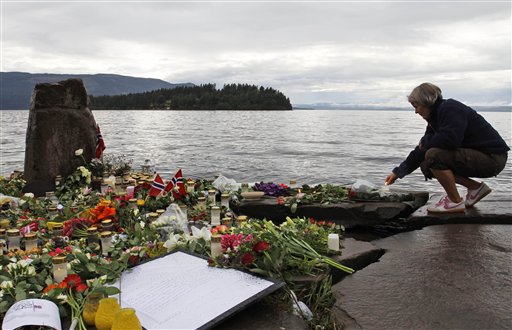
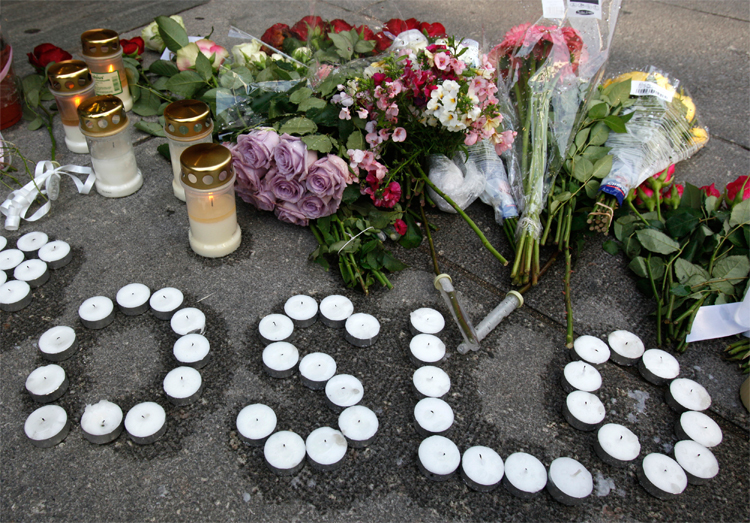
How will Norway cope with terrorism?Candles and flowers are arranged on the ground near the blast site to mourn victims of the attacks

There is very little darkness in Norway this time of year. The summer solstice may have passed, but north of the Arctic Circle the sun never really sets. Further south, in Oslo, night is merely an afterthought in the pearl grey lingering of the day.

July is holiday time in Norway, and a bad time to set up appointments. The king leaves his palace to go sailing, and ordinary Norwegians flock to their mountains and their seashores as the country goes into a kind of exhilaration, as if on a high from so much light lasting so long.

In Oslo, Norwegians flock to their water-front restaurants and bars, perhaps to stroll by the yachts in the harbor, or gawk at the ever-bigger cruise ships that bring boatloads of tourists to their fair shores.

I have written in this space about how Norway’s foreign policy is hard-wired into conflict resolution and trying to bring peace to the many wars that have plagued the world since the end of the Soviet Union. The “Oslo Accords” that almost brought peace to the Israel-Palestine conflict is only the best known.

Norwegians are proud of the fact that the inventor of dynamite, the Swedish Alfred Nobel, chose Norway, then joined with Sweden, to be the site of his Peace Prize, the world’s most important and prestigious award.

But trying to bring about peace and good will, shedding light unto the world has not protected tidy little Norway, with a population of only about 5 million, from the darkness of the human soul, or a mass-murderer who would go to a holiday island to slaughter children.

Norway used to be one of the poorest countries in Europe, with little to export except timber, fish and human beings, who fled poverty in their thousands, many to the American Midwest. The discovery of North Sea oil has changed all that, and today Norway is one of the richest.

Norwegians are relentless egalitarians, and happy with a welfare state that would drive the Tea Party in the United States to distraction. The last thing Norway wants is a politician to come along and tell them they need to lower taxes.

Perhaps because Norway was a colony itself for so long, first of Denmark, and then of Sweden until 1905, Norwegians have always been sympathetic to the plight of colonized people, and when formal colonialism ended, to the down -trodden of Asia and Africa.

Hail a cab in Oslo and there is likely to be a Pakistani driving it. In Bergen it might be a Congolese. I have seen African faces in the little seaport towns high up above the Arctic Circle, where Norway arches over Sweden and Finland to meet Russia. They are testimony to the generosity of Norwegians towards asylum-seekers.

The comfortable, happy life of Norwegians, insulated by their strong currency from the troubles of the euro zone further south, and largely protected from the economic ills of so much of the rest of the world, has now been shattered. Good fortune, peace-making and generosity have not shielded them from the new scourge of Europe: right-wing, anti-immigrant groups that see Europe as under siege from Africans and Asians, especially Muslims.

When the news of the Oslo bombing first came through, some thought it must be the work of Al-Qaida, revenge, perhaps, for Norway’s admittedly small contingent in Afghanistan. Others thought it might be retaliation for Norwegian planes bombing Tripoli. Still others thought it might be a spillover of Muslim hostility toward Denmark, where cartoons depicting the Prophet so riled the Muslim world five years ago.

It was, of course, none of these, but a home-grown Christian fanatic who turned mass-murder against his own countrymen. There will be much soul-searching in Norway in days, months and years ahead.

Not too long ago violence in Europe came from the left, the Red Brigades of disaffected youths who murdered bankers and politicians in Germany and Italy. Today it is the right that is turning to violence, turning against the dark faces in their midst in an exaggerated fear of Muslims. Right-wing, anti-immigrant political parties are moving out of the margins of politics and gaining support all over Europe.

I used to think this would not happen in the United States. But the fuss over whether a mosque could be somewhere in the vicinity of where Manhattan’s twin towers showed me that Americans, too, were susceptible to irrational anti-Muslim prejudices. Indeed, we now learn that Norway’s murderer, Anders Behring Breivik, may have been influenced by anti-Muslim bloggers in America.

In the end, I am convinced that tolerance will win out over prejudice at least in Norway. I wish I could say the same thing for the rest of the world.

Right-wingers blame multiculturalism, abortion for Norway massacre

Anders Breivik's favorite American pundits show no shame in blaming liberals, Muslims for right-wing terror

  • more
    • All Share Services

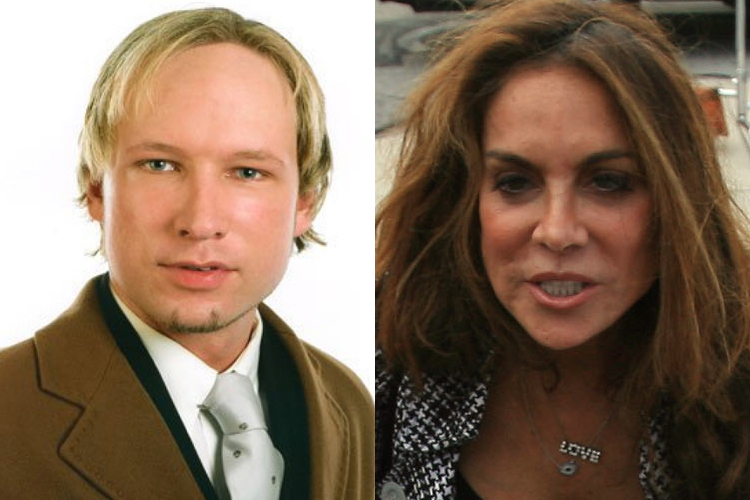
Right-wingers blame multiculturalism, abortion for Norway massacreAnders Breivik and Pamela Geller

After just about every professional conservative chatterer with a blog or a Twitter account rushed to blame Islamic jihadists for the bombing and gun massacre in Norway last Friday, it was revealed that the actual killer was, in fact, a white, Christian, Norwegian-born man, named Anders Breivik. It was further revealed that Breivik is, politically, more or less a Scandinavian Tea Partyer, obsessed with the imagined threat of the Islamification of Europe, and an avowed opponent of “multiculturalism.”

Breivik is a psychopath, but he is a psychopath whose politics are indistinguishable from Pamela Geller’s, to name one American right-winger whose work was approvingly cited by Breivik in his extensive writings.

While I don’t expect a bunch of Islamophobic pundits to take responsibility for a massacre committed in their name, it would be nice if people maybe apologized a little bit for blaming Muslims, first?

Eh, no. Jennifer Rubin, whose initial post on the attack is a monument to complete, colossal wrongness, followed up with a post in which she absolved herself of responsibility (those damn “early reports” are to blame) and blamed generic “evil” for the attack instead of a specific, dangerous ideology. And, she added, we should still totally be afraid of Muslims: “There are many more jihadists than blond Norwegians out to kill Americans[.].” Since then it’s been all debt ceilings and 2012 horse-race bullshit — I imagine if this crime had been perpretrated by a Muslim, Rubin would’ve had a lot more to say about it.

Mark Steyn wrote the stupidest thing I’ve read in at least a month. See, Breivik quoted Steyn, and a bunch of Steyn’s friends and peers, in his “manifesto” — because these conservative writers influenced his thinking — but Steyn says Breivik doesn’t count as Islamophobic because he didn’t specifically kill Muslims. Steyn’s argument is that because Breivik plagiarized portions of his manifesto, he … didn’t actually mean it? And quoting his writing to explain his motivation is apparently the irresponsible work of the liberal media, looking, as always, to smear conservatives: 

So, if a blonde blue-eyed Aryan Scandinavian kills dozens of other blonde blue-eyed Aryan Scandinavians, that’s now an “Islamophobic” mass murder? As far as we know, not a single Muslim was among the victims. Islamophobia seems an eccentric perspective to apply to this atrocity, and comes close to making the actual dead mere bit players in their own murder.

Opposition to Islam was the killer’s stated motivation. He targeted other white Scandinavians because he considered them race traitors. He wrote all of this down, too, so we don’t even have to make guesses about it! He blamed liberals for enabling jihad by supporting “multiculturalism.” (Funnily enough, that is also exactly what Mark Steyn thinks.)

If Steyn’s intentionally obtuse response is the dumbest I’ve read, the Jerusalem Post’s editorial is the most shocking. Because it basically says Breivik is right. He probably shouldn’t have murdered almost 100 people, JPost says, but now is a good opportunity for politicians to enact Breivik’s preferred policies.

Perhaps Brievik’s inexcusable act of vicious terror should serve not only as a warning that there may be more elements on the extreme Right willing to use violence to further their goals, but also as an opportunity to seriously reevaluate policies for immigrant integration in Norway and elsewhere. While there is absolutely no justification for the sort of heinous act perpetrated this weekend in Norway, discontent with multiculturalism’s failure must not be delegitimatized or mistakenly portrayed as an opinion held by only the most extremist elements of the Right.

They want this act of politically motivated violence to … work.

If there’s any humor in this miserable news, it is to be found at Pamela Geller’s place, where she compares herself to the Beatles and Jodie Foster. The comparison isn’t quite apt, though, as Charles Manson and John Hinkley were notorious for misinterpreting harmless pop cultural artifacts. The Beatles song was about a fair ride, it was not actually titled “There Is a Race War Coming.” Breivik seems to have interpreted Ms. Geller’s writing correctly — he just decided to address the “problem” through horrible, violent means.

But right-wingers generally agree that no one should blame right-wing beliefs for Breivik’s horrible crime. Instead, as one RedState contributor argues, we should blame the pro-choice movement. And euthanasia. And `… Al Gore. Is it any wonder that people kill people in a world where Al Gore something something overpopulation? No, no it isn’t. Ye gods.

To sum up: This tragedy can obviously be blamed solely on one truly evil, insane person, and nothing else. Besides multiculturalism. And abortion. It is disgusting to pin responsibility for this massacre on anything besides one crazy person and multiculturalism and abortion. And Al Gore.

I can understand how the self-preservation instinct would make sober reflection among the professional hate-mongering Islamophobia crowd unlikely, but I didn’t really expect everyone to be blaming the liberals for getting shot by a fucking Norwegian Freeper.

Continue Reading Close
Alex Pareene

Alex Pareene writes about politics for Salon and is the author of "The Rude Guide to Mitt." Email him at apareene@salon.com and follow him on Twitter @pareene

What we know about the Norway shooter

The world has learned some shocking details about Anders Behring Breivik, accused of killing over 70 on Friday

  • more
    • All Share Services

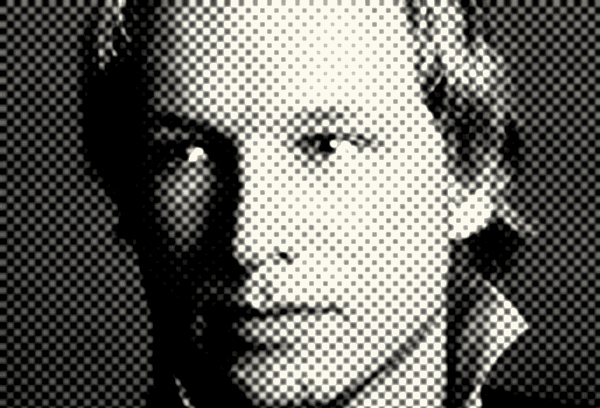
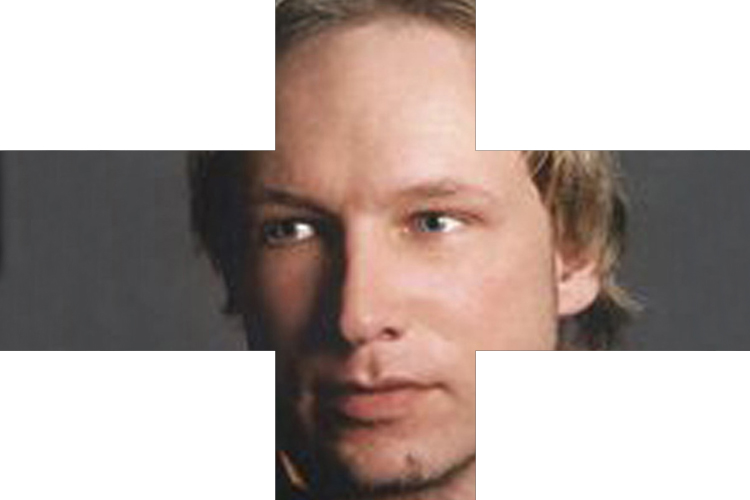
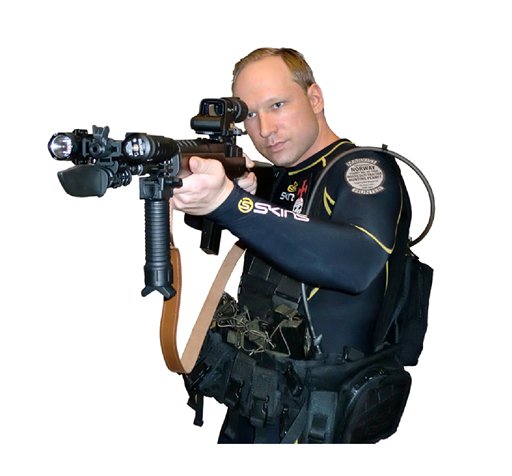
What we know about the Norway shooterEDS NOTE: IMAGE HAS BEEN DIGITALLY ALTERED BY THE ORIGINAL SOURCE TO REMOVE THE BACKGROUND - This image shows Anders Behring Breivik from a manifesto attributed to him that was discovered Saturday, July 23, 2011. Breivik is a suspect in a bombing in Oslo and a shooting on a nearby island which occurred on Friday, July 22, 2011. The Norwegian news agency NTB said Breivik wrote a 1,500-page manifesto before the attack in which he attacked multiculturalism and Muslim immigration. The document, which contained this and other photos, also described how to acquire explosives. (AP Photo/via Scanpix)(Credit: AP)

[UPDATED BELOW]

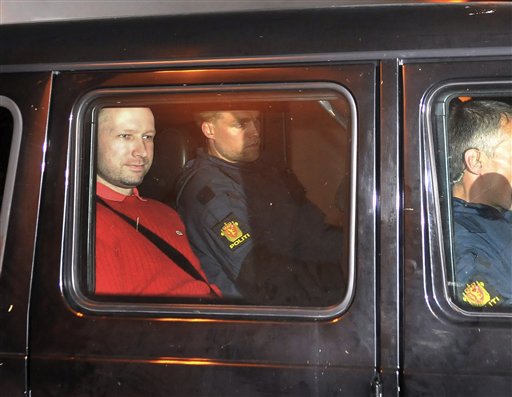
The world was stunned Friday by a double tragedy in Norway: An explosion in the nation’s capital, Oslo, left seven dead, while a shooting spree on the nearby island of Utoya reportedly claimed the lives of 86, mainly teenagers from a Labor Party youth camp. Though many at first suspected the involvement of international terrorism, both acts of violence have now since been pegged to a 32-year-old Norwegian man named Anders Behring Breivik. Breivik has confessed to orchestrating both attacks, and says he acted alone. (Though he made further statements in a  court hearing today — where he pleaded not guilty — that have stoked fears about two more possible terror cells in the country.) Breivik has called his actions “atrocious,” but also “necessary.”

The facts we’ve learned about Breivik in the days since the massacre paint a portrait of a disturbed and isolated man. Unearthed documents have shown that Breivik — the son of a retired Norwegian diplomat — was fiercely xenophobic, railing against Muslims, women, and cultural and political “leftists.” Indeed, ABC News notes that, after his arrest, he told Norway’s acting national police chief that he “wanted to attack Norwegian society in order to change it” and that “he wanted to transform the Western world.” He also called for a “conservative revolution [... and] armed resistance against the cultural Marxists/multiculturalist regimes of Western Europe.” 

Per the Wall Street Journal

In bombing those government buildings and hunting down those campers, Breivik was not taking out people randomly. He considered the Labor Party, Norway’s dominant party since World War II, responsible for policies that are leading to the Islamization of Europe—and thus guilty of treason.

The Oslo bombing was intended to be an execution of the party’s current leaders. The massacre at the camp—where young would-be politicians gathered to hear speeches by Prime Minister Jens Stoltenberg and former Prime Minister Gro Harlem Brundtland—was meant to destroy its next generation of leaders.

Breivik has left extensive documentation of his anger toward multiculturalism and his violent impetus for radical social change. In particular, a number of outlets have picked up on the fact that the man labeled himself a “modern-day Templar Knight,” and a “Christian crusader.” In a YouTube video that showed several pictures of Breivik (including one where he was staring down the cross hairs of an automatic weapon), he apparently wrote this suggestive caption (per the Huffington Post): “Before we can start our crusade we must do our duty by decimating cultural marxism.” The video has been removed from YouTube since the attacks.

The most shocking testament to Breivik’s twisted worldview, however, is a 1,500 page document that he titled “2083: A European Declaration of Independence,” and that reveals Breivik’s infatuation with American cultural conflicts. (At one point, he lambasted American liberals’ “War on Christmas.”) Its sections allegedly included the following: “What your government, the academia and the media are hiding from you,” “Documenting EU’s deliberate strategy to Islamize Europe” and “How the feminists’ ‘War Against the Boys’ paved the way for Islam.” The man cited a number of American, Canadian and English writers in his manifesto — including Robert Spencer, who runs the website Jihad Watch Web, on 64 occasions, the New York Times points out. 

He was also inspired by one of America’s most notorious domestic terrorists: Theodore Kaczynski, the Unabomber. Breivik lifted passages straight from Kaczynski’s manifesto for his own declaration, according to Norwegian website Document.no.

Per the Los Angeles Times:

The website editor noted that the alleged gunman replicated passages 6 through 23 of the Unabomber’s manifesto, but made some slight changes.

For example, Breivik replaced the word “leftist” with “cultural Marxist;” while “leftism” was replaced with “Multiculturalism” and “cultural Communism,” according to Rustad.

The Daily Beast’s Michelle Goldberg, meanwhile, notes the strain of misogyny running through Breivik’s work:

Rarely has the connection between sexual anxiety and right-wing nationalism been made quite so clear. Indeed, Breivik’s hatred of women rivals his hatred of Islam, and is intimately linked to it. Some reports have suggested that during his rampage on Utoya, he targeted the most beautiful girl first. This was about sex even more than religion.

Goldberg also points to statements Breivik has made complaining about the influence of his diplomat stepmother, whom he faults with instituting a “super-liberal, matriarchal upbringing, [that] contributed to feminise me to a certain degree.” Likewise, he wrote, “The female manipulation of males has been institutionalised during the last decades and is a partial cause of the feminisation of men in women.”

Breivik’s actions will undoubtedly cast new attention toward a growing body of fiercely nationalist, and sometimes violent, right-wing movements across Europe. Until now, police had downplayed the threat of such groups, but from here on out, they’ll likely be facing considerably more scrutiny.

UPDATE: Police have revised down the death toll from both attacks to 76. They now believe 68 people were killed in the shooting on Utoya, in addition to eight dead in the Oslo explosion.

UPDATE II: As the hours pass, enterprising individuals continue to parse through Breivik’s massive online “manifesto,” helping to fill in the details of the man’s life and his twisted motivations.

The New Yorker’s Macy Halford has taken a look at Breivik’s literary interests. Halford argues that Breivik’s literary proclivities were central to his violent ideology:

Literature, reading, and writing sit at the heart of Breivik’s crime. During his years building his bomb and laying the plans for his attack, he was also working on his book, which is not simply his book, but a body of literature he wished to bring to wider attention through violent publicity stunts. Like the Unabomber, he fancies himself a writer-prophet, but he is much more community-minded than Ted Kaczynski.[...]Kaczynski’s manifesto adopts the revolutionary “we,” but it has a lonely feeling. Breivik’s, on the other hand, is a boisterous affair, a clip-job compendium for the digital age, cut and paste with relish and speed from communal blogs around the Internet and intended, as Breivik writes in the introduction, for his seven thousand Facebook friends.

As the Christian Science Monitor notes, Breivik was indeed aiming to start a violent anti-Muslim revolution the world over:

Mr. Breivik’s primary goal is to remove Muslims from Europe. But his manifesto invites the possibility for cooperation with Jewish groups in Israel, Buddhists inChina, and Hindu nationalist groups in India to contain Islam.

Meanwhile, Mark Juergensmeyer at Religion Dispatches seems to have isolated the motivation for the title of Breivik’s dissertation, “2086,” consistent with his seeming fixation on a global “anti-jihad”:

I found the answer on page 242 of Breivik’s manifesto, where he explains that on 1683 at the Battle of Vienna, the Ottoman Empire’s military was defeated in a protracted struggle, thereby insuring that most of Europe would not become part of the Muslim empire. The date in Breivik’s title is the 400th anniversary of that decisive battle, and in Breivik’s mind he was re-creating the historic efforts to save Europe from what he imagined to be the evils of Islam.

In hoping to issue an early assessment of Breivik’s place in history, the Guadian’s Henning Mankell drives parallels to the Third Reich: “This is a ghastly return of Übermench mentality that was the mark of Hitler’s Nazism. An idyllic country is once again exposed to the banality of evil.” He goes on to tidily summarize those many personality details we’ve learned about Breivik since Friday:

[Breivik] is torn apart by an inner rage. He is opposed to Muslims. He is opposed to different types of people meeting in a multicultural society. He detests the ambitions of globalism and is willing to attack the very idea of the modern age. He is a cold-blooded Don Quixote tilting at people who live and breathe.

[...]Perhaps he imagines that, in time, he will become the hero that “saved” Norway. Or perhaps he will be satisfied with being inducted into the hall of fame of human monsters.

Continue Reading Close

Is the Norway shooter part of a movement?

Police had an eye on far right groups; they didn't expect an attack from a man who'd left organized politics

  • more
    • All Share Services

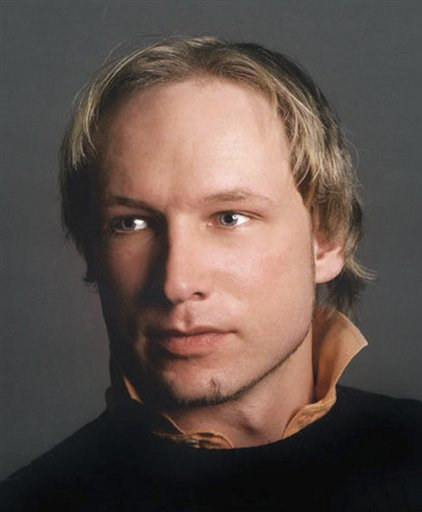
Is the Norway shooter part of a movement?This is an undated image obtained from the Twitter page of Anders Behring Breivik

BRUSSELS, Belgium — The Norway shooter, Anders Behring Breivik, claimed to be a modern-day Templar Knight, a Christian crusader fighting to chase Islam from Europe and rid the world of “Marxists” — his word for democratic political parties.

Before his attacks that killed more than 90, mostly young, people on Friday, Breivik appeared to have been a small fish in the murky waters of Europe’s extreme right political fringe.

If the rambling 1,500 page testament attributed to him and posted on the internet on Friday is authentic, Breivik claims to have founded a movement inspired by the medieval Templars during a 2002 meeting in London with seven rightists from other European countries. (See VIDEO of alleged manifesto.)

What sets Breivik apart from countless other ultranationalist web-warriors is a dedication to use terrorism and mass murder against minorities or Europe’s mainstream political class, as well as a systematic approach to preparing the attacks.

“We will ensure that all category A and B traitors (as he calls supporters of Europe’s mainstream political parties), the enablers of Islamization and the destroyers of our cultures, nations and societies, will be executed,” he wrote. At one point he says 45,000 should be killed.

Before Friday’s attacks in Norway, Europe’s security forces had noted a growth in the scale and sophistication of extreme right-wing propaganda, but believed that the threat of a large scale terrorist attack was on the decline.

“Lack of cohesion, a lower degree of overall coordination of right-wing terrorist and extremist groups, little public support and effective law enforcement operations … went a long way towards accounting for the diminished impact of right-wing terrorism,” the European Union’s Europol, police organization said in it’s 2011 terrorism situation report.

Europe’s underground far-right scene is marked by disunity and conflicting views. Breivik for example describes himself as an anti-Nazi and supporter of Israel as an ally in his crusade against Islam, while other Scandinavian extremists hold rampantly anti-Semitic, neo-Nazi views. Some groups like Breivik support Christian conservatism; others proclaim themselves to be born-again Vikings following the ancient Nordic gods.

Right-wing terrorism has hit post-War Europe in the past: The 1980 bombing of Bologna railway station that killed 80 people was blamed on a neo-Fascist organization; a pipe-bomb attack attributed to a rightist radical in the same year killed 13 people at Munich’s Oktoberfest; self-confessed neo-Nazi David Copeland killed three people and injured 139 in a nail bomb attacks against London’s black, gay and Bangladeshi communities in 1999.

But despite growing incidents of skinhead street attacks on minorities, police who have successfully infiltrated white supremacist groups have downplayed their capacity to launch large-scale attacks in Europe. Breivik seems to have escaped scrutiny from the security forces by acting alone as a “solo cell” as he explained in his web posting.

Support for popularist, nationalist political parties has surged in many parts of Europe in recent years, exploiting concern over the economic downturn and immigration, particularly the growing number of Muslims living in their countries.

From the National Front in France, to the Dutch Freedom Party — whose leader Geert Wilders likens Islam to Nazism — and Norway’s Progress Party, which once listed Breivik among its members, parties formerly treated as pariahs have become part of the political mainstream across Europe. Such parties distance themselves from the violent fringe and many were quick to condemn the attack in Norway.

“The horrible and cowardly attacks we’ve witnessed are contrary to the principles and values underpinning the Norwegian society,” said Progress Party leader Siv Jensen. “It makes me feel extra sad to know that this person once was a member of our party.”

In the Netherlands, Wilders described the gunman as a “sick psychopath” and insisted the Freedom Party, “abhors everything the man stands for.” Breivik had called Wilders a “steadfast” defender of Western values and listed him among the people he’d most like to meet.

After nine years in the Progress Party, Breivik left in 2006, saying he’d lost faith in democratic politics and decided only violent action could bring about the overthrow of multicultural society. He also developed contacts with the anti-Islamic English Defense League, but said they too were “naive” in not switching to a military campaign.

The number of Europeans involved in neo-Nazi and other far right parties is unclear. German intelligence estimates there are 25,000 ultra-rightists in the country, of which 5,600 are hard-core neo-Nazis. “We can observe and increase in the potential for violence and the willingness to use violence to enforce political goals,” it said in a report issued earlier this month.

In Sweden, the far-right internet forum Nordisk.nu has 22,000 users, including Breivik, according to the monitoring group Expo, which was set up by Stieg Larsson, author of the best-selling Millennium series of crime novels.

In the wake of Friday’s attacks, security forces across Europe are reviewing anti-terror policies to focus more on far-right organizations or “lone wolves” like Breivik. British police already warned this month that white-supremacists may try to provoke a violent backlash with attacks on the Muslim community. Breivik talked openly about the need to trigger a civil war to defeat Islam and “cultural-Marxism.”

“For too long, the challenge from right-wing extremism and anti-Muslim sentiment has been dismissed as irrelevant, and glossed in favour of alternative forms of extremism. ‘Far right activists will never get their act together’, so the argument goes. ‘They are disorganized and lack the resources to commit mass murder’,” Matthew Goodwin a University of Nottingham expert on far right extremism blogged on Saturday. “In short, the concept of lone wolves committing mass violence appeared more at home in fiction than political reality. The events in Norway have changed all this.”

Continue Reading Close

Norway ripped by Oslo bomb, youth camp shootings

Gunman claims a dozen or more lives mere hours after explosion killed at least seven in Scandinavian capital city

  • more
    • All Share Services

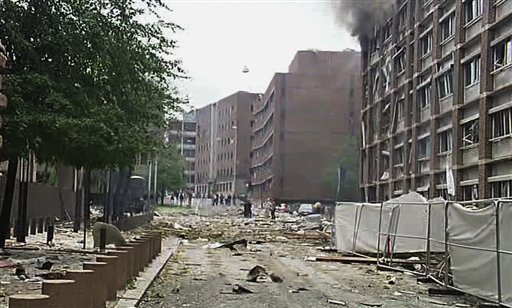
Norway ripped by Oslo bomb, youth camp shootingsIn this video image taken from television, smoke is seen billowing from a damaged building as debris is strewn across the street after an explosion in Oslo, Norway Friday July 22, 2011. A loud explosion shattered windows Friday at the government headquarters in Oslo which includes the prime minister's office, injuring several people. Prime Minister Jens Stoltenberg is safe, government spokeswoman Camilla Ryste told The Associated Press. (AP Photo/TV2 NORWAY via APTN) NORWAY OUT(Credit: AP)

Terrorism struck long-peaceful Norway on Friday when a bomb ripped open buildings including the prime minister’s office and a man dressed as a police officer opened fire at an island youth camp connected to the ruling party. At least seven people were killed in the blast and a witness said more than 20 died in the shootings on the nation’s worst outpouring of violence since World War II.

Andre Scheie told Norwegian broadcaster NRK that he saw “very many dead by the shore” of the camp on Utoya island, where the youth wing of the Labor Party was holding a summer camp for hundreds of youths. He said some victims were shot in the water after trying desperately to swim away. “There are about 20 to 25 dead,” he said.

Police did not immediately confirm the account. but Inspector Bjoern Erik Sem-Jacobsen said a suspect in the shooting has been arrested. He said the gunman, who was dressed as a police officer, pulled out a gun and started firing into the crowd of youths.

Acting Police Chief Sveinung Sponheim told broadcaster NRK that investigators suspect the two attacks are linked.

A square in Oslo, where the Nobel Peace Prize is awarded, was covered in twisted metal, shattered glass and documents expelled from surrounding buildings, which house government offices and the headquarters of some of Norway’s leading newspapers. Most of the windows in the 20-floor high-rise where Prime Minister Jens Stoltenberg and his administration work were shattered.

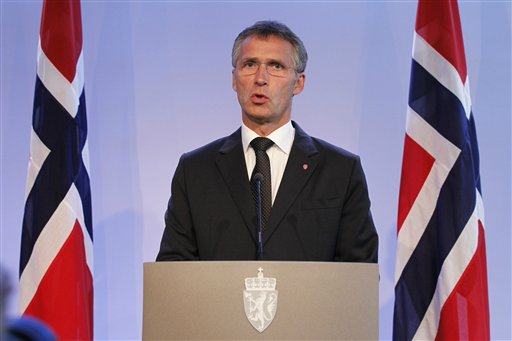
Stoltenberg was working at home Friday and was unharmed, according to senior adviser Oivind Ostang.

Ian Dutton, who was in a nearby hotel, said the building “shook as if it had been struck by lightning or an earthquake.” He looked outside and saw “a wall of debris and smoke.”

Dutton, who is from New York, said the scene reminded him of Sept. 11 — people “just covered in rubble” walking through “a fog of debris.”

“It wasn’t any sort of a panic,” he said, “It was really just people in disbelief and shock, especially in a such as safe and open country as Norway, you don’t even think something like that is possible.”

Public broadcaster NRK showed video of a blackened car lying on its side amid the debris. An AP reporter who was in the office of Norwegian news agency NTB said the building shook from the blast and all employees were evacuated. Down in the street, he saw one person with a bleeding leg being led away from the area.

Oslo police said the explosion was caused by “one or more” bombs, but declined to speculate on who was behind the attack. They later sealed off the nearby offices of broadcaster TV 2 after discovering a suspicious package.

At Utoya, an island outside Oslo, a gunman dressed in a police uniform opened fire at a summer camp, shooting several youths, party spokesman Per Gunnar Dahl told The Associated Press. The annual camp is organized by the youth wing of Stoltenberg’s Labour Party.

“There has been an incident where a man dressed in a police uniform started shooting among the youngsters on the island. This created a panic situation where people started to swim from the island” to escape, he said. Dahl said unconfirmed reports said five people were hit.

The explosion occurred at 3:30 p.m. (1330 GMT), as Ole Tommy Pedersen stood at a bus stop 100 meters (yards) away.

“I saw three or four injured people being carried out of the building a few minutes later,” Pedersen told AP.

The United States, European Union, NATO and the U.K., all quickly condemned the bombing, which Britain’s Foreign Secretary William Hague called “horrific” and NATO Secretary-General Anders Fogh Rasmussen deemed a “heinous act.”

In Washington, State Department spokeswoman Heide Bronke Fulton called the violence “despicable.” There has been no confirmation of any U.S. casualties, she said. The U.S. Embassy in Norway warned Americans to avoid downtown Oslo.

The U.S. has offered help to Norwegian authorities but there has been no specific request for assistance, she said.

The attacks come as Norway grapples with a homegrown terror plot linked to al-Qaida. Two suspects are in jail awaiting charges.

Last week, a Norwegian prosecutor filed terror charges against an Iraqi-born cleric for threatening Norwegian politicians with death if he is deported from the Scandinavian country. The indictment centered on statements that Mullah Krekar — the founder of the Kurdish Islamist group Ansar al-Islam — made to various news media, including American network NBC.

Terrorism has also been a concern in neighboring Denmark since an uproar over cartoons of the Prophet Muhammad six years ago. Danish authorities say they have foiled several terror plots linked to the 2005 newspaper cartoons that triggered protests in Muslim countries. Last month, a Danish appeals court on Wednesday sentenced a Somali man to 10 years in prison for breaking into the home of the cartoonist.

Associated Press writers Louise Nordstrom and Matthew Lee contributed to this report.

Continue Reading Close

Page 3 of 3 in Norway