What the right won’t admit about Reagan
What happens when a caller confronts Rush Limbaugh with the Gipper's actual record?
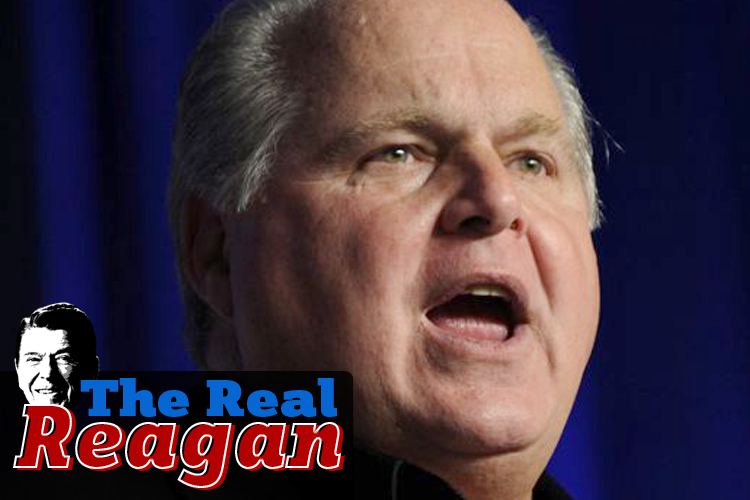
Rush Limbaugh Nothing better symbolized Ronald Reagan’s 100th birthday celebration than that it should fall on Super Bowl Sunday, with Air Force jets roaring unseen over a hermetically sealed stadium, almost, but not quite, drowning out a tarted-up former Mouseketeer who mangled the lyrics of the Star-Spangled Banner.
It was all there: the bombast, the grandiose self-congratulation, the willful blindness, the elevation of showbiz spectacle to patriotic rite. After which, thankfully, a pretty good NFL football game broke out. It’s for pseudo-events like the Super Bowl, I believe, that a merciful God gave us high-def DVRs.
How fitting that George W. Bush, the late President Reagan’s vicar on Earth, was seated in a front-row celebrity box to witness the spectacle. Reagan’s genius as a politician was that he repackaged and sold to millions of Americans the comforting daydreams of the 1950s. Not the ’50s as they were — no Korean War, no Army-McCarthy hearings, no lynchings, no John Birch Society denouncing commie traitor “Ike the Kike” — but as depicted in TV sitcoms like “Ozzie and Harriet, “Leave It to Beaver” and “The Andy Griffith Show.”
Playing the president, Reagan essentially recapitulated the Robert Young role in “Father Knows Best” — firm but fair, and unfailingly optimistic. True, Reagan had a disconcerting habit of conflating film scripts with reality: talking feelingly, for example, of his experiences liberating Nazi death camps at the end of World War II, which never happened.
Captain Reagan of the First Motion Picture Unit served in California for the duration of the war. But he got away with exaggerating, biographer Edmund Morris believes, because he’d spent weeks editing raw film footage from Buchenwald. His emotional reaction was sincere.
To an America still nursing a Woodstock, Kent State, Vietnam and Watergate hangover, Reagan’s performance was reassuring. Although his personal coolness was notorious — aides wondered if he knew their names, and even his children complained that he treated them like strangers — the character Reagan played in the Oval Office was hard to dislike.
That’s not to say Reagan did no harm. George W. Bush’s epic failures came about largely because, unlike Reagan, whose fealty to right-wing ideology was at best inconsistent, he put dogmatic “Reaganism” into action.
Hence the Tea Party, an otherworldly faction greatly reminiscent of daffy ’60s leftists who argued that Marxism hadn’t really failed because true Communism had never been tried.
Consider a telling exchange on — where else? — Rush Limbaugh’s program last week. Presumably by decoying Limbaugh’s screeners, whose job it is to prevent the host from being confronted by anybody who knows what they’re talking about, liberal blogger Mike Stark got through.
Stark said that he couldn’t understand why conservatives idolize Ronald Reagan. He listed his reasons: “Instead of privatizing Social Security,” Stark said, “he raised taxes. We’re all paying higher taxes today out of our paychecks every single week because he decided to save Social Security.”
Talking over Limbaugh’s constant interruptions, he continued. “The Greenspan Commission. He signed it into law, and it raised taxes on Social Security.”
“What?” Limbaugh blustered. “Wait, you’re talking about Reagan or Clinton?”
“I’m talking about Reagan. Reagan did that. He raised taxes on Social Security. He negotiated with terrorists, sending — over and over again — arms to Iran in exchange for hostages.”
That would be the Iran-Contra scandal that probably would have ended in Reagan’s impeachment had he been a Democrat.
Stark went on: Reagan (humanely) gave amnesty to millions of undocumented aliens. When terrorists bombed U.S. Marine headquarters in Beirut, killing 283 Americans, he (wisely) pulled out of Lebanon’s civil war.
“He’s a tax-raiser, an amnesty-giver, a cut-and-runner, and he negotiated with terrorists,” Stark continued. “Why is he a hero to conservatives?”
Limbaugh was beside himself. “Where did you get this silly notion that Reagan raised taxes on Social Security? What websites do you read? Where did you pick that up?”
“Look up the Greenspan Commission,” Stark advised. “It’s not too hard to find. It’s a matter of history.”
He’s right. Reagan increased payroll taxes in 1983. History records that, alarmed by spiraling deficits, he signed tax increases during six of his eight years in office. Even so, his administration tripled the national debt, to almost $3 trillion.
Consistent with the GOP’s faith-based War on Arithmetic, his acolyte Dubya then redoubled the debt to $10.4 trillion, leaving a $1.4 trillion yearly deficit.
Note to the Tea Party: Had President Clinton’s tax policies remained in place since 2001, the national debt GOP politicians pretend to agonize over would no longer exist.
But Stark never got that far, because Limbaugh hit the mute button, then delivered a lengthy soliloquy about how liberals can’t be reasoned with, only defeated. Is there a bigger faker in American life?
“Ronald Reagan,” Sen. Lindsey Graham, R-S.C., has ruefully observed, “would have a hard time getting elected as a Republican today.”
There’s no doubt about it.
Arkansas Times columnist Gene Lyons is a National Magazine Award winner and co-author of "The Hunting of the President" (St. Martin's Press, 2000). You can e-mail Lyons at eugenelyons2@yahoo.com. More Gene Lyons.
When Reagan was (much) less popular than Carter
Will Bunch, author of "Tear Down This Myth," explains how the Gipper was transformed into a conservative demigod
Former president Ronald Reagan By 1992, three years after he left the White House, Ronald Reagan was anything but a beloved former president. As a painful recession gripped the country, the public came to see the Reagan years — which featured a massive defense buildup, soaring deficits and even a stock market crash in 1987 — as the source of their economic woes. Running for president that year, Bill Clinton promised to enact a clean break from the “failed policies of Reagan and Bush.” As Reagan prepared to speak at the Republican National Convention in August, a Gallup poll found that just 46 percent of Americans had a favorable view of him. By contrast, Jimmy Carter, the man Reagan had defeated in a 44-state rout in 1980, was viewed favorably by 63 percent of the American public. The Reagan presidency stood in something approaching disrepute.
Continue Reading Close
Steve Kornacki writes about politics for Salon. Reach him by email at SKornacki@salon.com and follow him on Twitter @SteveKornacki More Steve Kornacki.
Reagan’s embrace of apartheid South Africa
His foreign policy legacy includes an alliance with a racist government
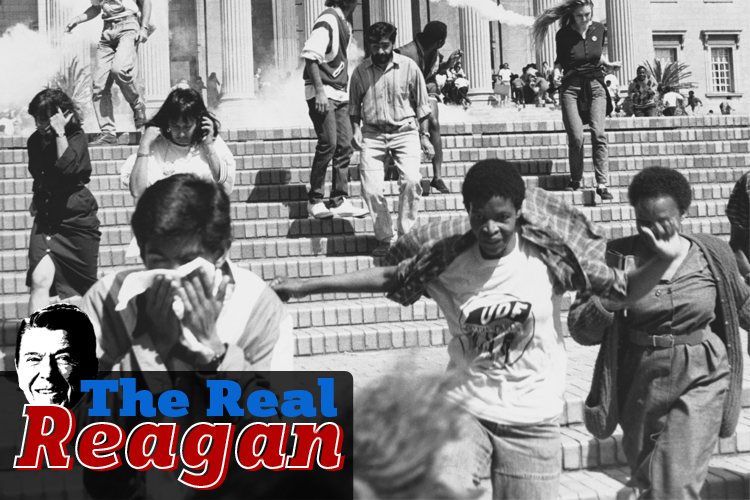
Student demonstrators at Johannesburg's Witwatersrand University flee as police fire tear gas at them during an anti-apartheid protest rally August 31, 1989. The regime of apartheid in South Africa, under which nonwhites were systematically oppressed and deprived of their rights, is remembered as one of the worst crimes against humanity of the 20th century.
Despite a growing international movement to topple apartheid in the 1980s, President Ronald Reagan maintained a close alliance with a South African government that was showing no signs of serious reform. And the Reagan administration demonized opponents of apartheid, most notably the African National Congress, as dangerous and pro-communist. Reagan even vetoed a bill to impose sanctions on South Africa, only to be overruled by Congress.
Continue Reading CloseJustin Elliott is a reporter for ProPublica. You can follow him on Twitter @ElliottJustin More Justin Elliott.
Ronald Reagan cared more about UFOs than AIDS
He often dreamed of the world coming together to battle spacemen, but never gave much thought to an actual killer
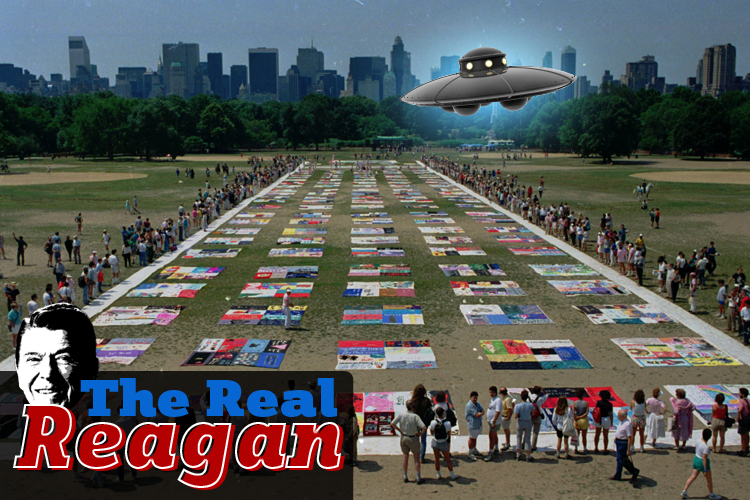
Onlookers watch as almost 1,500 quilt panels bearing the names of New York area residents who have died of AIDS are unfolded on the Great Lawn in New York's Central Park Saturday, June 25, 1988. Ronald Reagan claimed to have seen UFOs on at least two occasions, according to reports from sources as disparate as the Wall Street Journal, Lucille Ball and the National Enquirer. He alerted the Navy to one of his sightings, and he and Nancy believed that Egyptian hieroglyphics referenced extraterrestrial flying crafts.
In 1985, at the first summit meeting between Reagan and Mikhail Gorbachev, Reagan surprised the Soviet premier with this odd line of questioning:
Continue Reading Close
Alex Pareene writes about politics for Salon and is the author of "The Rude Guide to Mitt." Email him at apareene@salon.com and follow him on Twitter @pareene More Alex Pareene.
The era of big spending and massive deficits
We talk with Ronald Reagan's first budget director about the long-term fiscal consequences of the 1980s
Former President Reagan signs the Economic Recovery Tax Act of 1981 It is difficult to think of any single person more qualified to trace the roots of today’s massive budget deficits, Republican tax cut fundamentalism, and overall dysfunctional government than David Stockman, Ronald Reagan’s first budget director.
Stockman arrived at the White House in 1981, part of a new administration ferociously determined to cut taxes and cut spending in pursuit of the “Reagan revolution’s” primal goal of smaller government. But as reported in William Greider’s legendary 1981 Atlantic magazine profile, “The Education of David Stockman,” nothing quite proceeded according to plan. Reagan cut taxes while boosting spending, and we’ve been living with the consequences ever since.
Continue Reading Close
Andrew Leonard is a staff writer at Salon. On Twitter, @koxinga21. More Andrew Leonard.
We fought a war on lies, and lies won
Trashing the War on Poverty, Reagan destroyed the social compact that built the postwar American dream
In this Aug. 4, 1982 photo, unidentified unemployed auto and steel workers picket in front of the White House in Washington, Aug. 4, 1982. Ronald Reagan gave America so many pretty sayings, but when it comes to social equality, he’ll go down in history for his lyrical lie, “The federal government declared a war on poverty, and poverty won.” (He said it many times, many ways; that exact quote is from his 1988 State of the Union address.)
Of course, Reagan was wrong. Poverty declined sharply after the war on poverty commenced. According to the Institute for Research on Poverty, in 1959 the individual poverty rate was 22 percent. It hovered there until about 1964, when it began to drop; by 1973, it was 11 percent. Then it began to climb again, to 15 percent in 1983. Thanks to the economic boom at the end of Reagan’s tenure, it dropped by about a point, and then jumped back to 15 percent by the time President Clinton took office. Under Clinton, it fell to 11 percent. Under George W. Bush, it climbed back over 14 percent, and it has continued to inch upward under Barack Obama.
Continue Reading CloseJoan Walsh is Salon's editor at large. More Joan Walsh.
Page 1 of 2 in The Real Reagan