Amy Reiter

She works too hard for the money

The authors of "Womenomics" challenge professional women to say no to overly demanding jobs -- even in a recession.

  • more
    • All Share Services

She works too hard for the money

Mommy wars, brain drains, opt-out revolutions — working mothers have been through (or at least been warned about) them all. Now comes “Womenomics: Write Your Own Rules for Success,” a new book by Claire Shipman, senior national correspondent for ABC News’ “Good Morning America” and mother of two, and Katty Kay, Washington correspondent and anchor for “BBC World News America” and mother of four. In their book, the news veterans call for women to say no to 60-plus-hour work weeks and overly demanding jobs that yank them away from their families. Instead, they urge working women to use their clout in the workplace to demand fewer hours at the office, turn down non-family-friendly assignments, and take control of their time by working from home more, checking e-mail less and avoiding meetings whenever possible.

They call the lifestyle that they themselves have pulled off the “New All” — defined as “enough professional success, balanced by time and freedom.” In impassioned prose, Shipman and Kay lay out their advice for downshifting our careers, which they contend is what an increasing number of us desire deep down but are afraid to ask for. “Women don’t usually want that promotion,” they write, citing a 2007 Family and Work Institute study that only 28 percent of college-educated women want more responsibility at work, down from 57 percent who said they wanted more in 1992. A second study they cite by the same group found that 34 percent of the top 100 women in 10 top-tier companies said they had, at some point, scaled back their career aspirations. “Why? Not because they weren’t up to the job — but because the sacrifices they would have to make in their personal lives were just too great.”

Of course, that could be because, as sociologist Arlie Russell Hochschild pointed out in her 1990 book “The Second Shift,” which is as apt today as when it was published, the vast majority of the women in dual-career families are still saddled with most of the work at home, and because America’s social support system is woefully lacking. But Shipman and Kay, both of whom have high-powered, presumably well-paid husbands, barely acknowledge these issues in their book, and then do so only to dismiss them. “We know the solution isn’t longer hours at daycare or hiring more babysitters or asking our husbands to stay home,” they write. “Because we’re the ones who want more time — for our children, our parents, our communities, ourselves.”

“Womenomics” aims its message at professional, educated women and includes work-life-balance success stories from women in mid-to-upper ranks of corporate America, finance, academia and law as well as study citations, statistics and Shipman and Kay’s own tips and anecdotes. But the authors don’t seem to recognize that the privileges and power enjoyed by, say, high-profile on-air TV talent may not really extend to your basic workaday accountant or bank manager.

Despite its blind spots and somewhat muddled message (“Womenomics” contends that men and young workers also increasingly desire career flexibility), the book’s call for greater work-life balance and empowerment certainly has its appeal. It may not be realistic, especially in this dismal economy, to advise workers to waltz into their bosses’ offices and ask to spend less time at their desks, or to skip meetings they deem “unproductive,” or to check e-mail only twice a day. But how great would it be if we really could do that without losing our jobs? Nowadays, when our livelihoods seem so tenuous and our home lives so shortchanged, the idea is certainly attractive.

Skeptical but intrigued, Salon got the authors on the phone. Shipman joined the conversation late, delayed, appropriately enough, by an unexpected family matter.

What inspired you to coin the term “Womenomics” and write a book about it together?

Kay: Claire and I have talked over the years, sometimes in secret, about how to carry on working and still make sure we had enough time for family life. At first, our conversations were kind of tentative because we didn’t want to admit to not being ambitious or accepting a big job or going for a promotion or climbing the ladder. I’d call Claire and say, “I’ve just been offered this job. What do you think?” She was my touchstone, the one person who would say to me, “Well, that’s a great job, but this is really going to screw up your time. You’ve worked out this balance with your children. Are you sure you want to be at the White House at 5 o’clock every morning and not leave until 5 or 6 o’clock in the evening? And travel every time the president travels?”

We realized we could confide in each other about how to keep this balance. We’d make choices that might seem counterintuitive, like turning down promotions or saying no to assignments when the expectation was that we would jump at every opportunity. We found ourselves saying no more and more. These are my limits. Then when we started doing economic research, we discovered how much power women have in the marketplace now because of their education and talents. There is a talent shortage. And we thought, Well, if you put those two things together — that most women want to work differently, and we have a lot of clout — you have an opportunity for women to negotiate their time.

You’ve both downshifted your careers personally.

Kay: I was offered the job anchoring the evening news for the BBC. I was at the time a reporter, which allowed me a lot of flexibility to be with my children. I was very excited about the idea of anchoring — it was a new challenge — but the more I thought about it, the more I realized it would mean I went into the office at lunchtime and wouldn’t get home until late at night, five days a week. I couldn’t take on this job I really wanted and preserve the time I wanted with my children. So I went to the BBC, which was really keen to have me do it, and said, “Listen, I can do this four days a week, or I can not do it at all.”

I was sitting on the Capitol steps, waiting to do a live shot for the evening news, and I got this phone call. I knew it was my boss in London and that she was going to say we really want you to do this job, but you have to do it five days a week. I picked it up and my boss, who was a woman, said, “You know what, I don’t want to have just a reputation for being family friendly. I actually want to be family friendly. I’m going to go to my bosses and tell them we have to let you do it four days a week.” That was a real shift moment for me. Because it was the first time I had made a clear decision about saying no to something I really wanted in order to preserve my work-life balance.

Do you think women and men want different things in their careers?

Kay: I think in the last few years there’s been this recognition that maybe we don’t feel the same about our careers and that we want to have time for our lives as well in ways that a lot of men actually do but haven’t demanded. You had that depressing study that came out from Harvard a few years ago that found that women were leaving the professional workforce in great number because they felt that they couldn’t do it all, with these 60-hour weeks.

There’s plenty of scientific evidence too showing that our brains just work differently. We’re more measured in the way we approach everything. We’re less monomaniacal than men tend to be. We want more balance in our lives in almost everything we do. We’re more ambivalent. We also tend to take fewer risks. There’s a whole thing about how if women had been running Lehman Brothers we might not have had this whole crash, because women don’t take those kinds of extreme risks. They don’t have the testosterone that drives them. So you’ve got scientific and social evidence that suggests that women do have a different approach to their careers.

You two recently blogged that a study finding a lack of women in the top echelon of corporate America was, in a sense, good news.

Shipman [joining in]: Yeah, it seems kind of counterintuitive. But people tend to focus on “How many CEOs are there?” as a measure of our success. And obviously, it would be terrific to have more women running corporations or investment banks, but the fact that we have such strength at the mid-level now and we’re so valued now for our management style gives us the power to make a lot of the changes that I guess people thought we’d only be able to make with women at the top.

Do you think women weigh the relative values of time and money differently than men?

Shipman: We have a much broader view of what we value: time, family time, a life that involves more than just simply being at work and earning money. Money is not the only measure of success for us. That makes us a lot more flexible even in a recession, because we’re willing to take different rewards than money: time off, working more flexibly.

Kay: What we find exciting about “Womenomics” is that actually the choices are broader now than they have been over the last 20, 30, 40 years, that women can make decisions that actually suit us, rather than decisions that we tell ourselves suit us. We can have satisfying professional lives, and that might mean aiming to be senior-level or middle rather than the top-level management.

Shipman: It’s not only a male-female issue. Younger workers — Gen X and Gen Y — all want a much broader life. They want more time. They’re not willing to be slaves to the corporate ladder. They value things outside of work and see themselves as more balanced, family-oriented human beings. That’s where we are and where the next generation of workers is, and that’s something companies will have to cope with.

Well, it’s one thing to get companies to accommodate your desired work-life balance when you’re high-profile talent, as you both are. But are you worried that your experience isn’t applicable to everyday, ordinary competent women?

Kay: You have to achieve your targets. This isn’t about giving women or men permission to slack off. Managers will say, “Oh, I don’t want to do this, because how do I know she’s not sitting at home eating Cheerios on the kitchen floor with her kids rather than actually doing her job?” But actually you can see people’s performance almost better this way, because [in a normal office setting] you can spend hours sitting at your desk and surfing the Internet.

Right, you write that the average employee wastes about 80 percent of her time in unproductive tasks or even just trying to look productive.

Shipman: Yes, once a company starts measuring productivity, it doesn’t matter where people are working. Look, if you have a company that’s really old school, they may only be willing to do this for their top performers or their stars. But there are so many companies that understand you don’t have to be a superstar. You just have to do your job. And letting people do their job when and where they want to do it increases productivity.

You have to have a pretty good safety net to be able to do this, right? You both have successful husbands whose salaries you can rely on. [Claire's husband is Joe Biden's director of communications.] Is this really a good time to rock the boat for someone without that?

Kay: Obviously everyone has to look at their own budget, particularly if they’re going to propose taking a shorter workweek and taking less money for it. There’s a big controversy among economists and academics about whether you should ever take part-time positions because do you end up doing 100 percent of the work for 80 percent of the pay. That’s why we talk about how you can be more efficient with your time without going to your boss and suggesting taking a pay cut.

You talk about the strategic no, advising women to check their e-mail only twice a day and not always strive to do their very best all the time. Is that really wise in this environment?

Shipman: Women, particularly high-achieving women, tend to be perfectionists. And that’s one of the things that can hold us back. We spend so much time trying to get the book report exactly right that we’re not noticing that, in fact, the boss would prefer us to have that book report done and this other project done, too. As women, we need to learn to be more strategic about the work we take on. Most of the time good enough really is good enough.

Some of the companies that have allowed employees to work more flexibly surprised me. You note in the book that Wal-Mart has started a flex-time program for its lawyers. I mean, Wal-Mart?

Kay: We were surprised, too. Who would have thought of Best Buy, really, or Capital One? That’s what’s fascinating is which companies have really taken this on as not just a favor that they can bestow on women, but as a whole company strategy.

Doesn’t this all just go out the window in a recession, when people have to put in more face time at the office — not less — and work harder to compensate for colleagues who’ve been laid off?

Shipman: The companies we’ve talked to who’ve used this say it actually becomes more invaluable in a recession. Companies either want to keep their high-performing employees or they see that it’s increasing productivity.

Are you worried about sending the message that women are less committed to their work than men? That’s an old stereotype women, particularly working mothers, have worked so hard to disprove.

Kay: When I found out I was pregnant with my first child — I was 29 years old, I was in Tokyo, and my career was going well for the first time — I walked into the office of my best friend and burst into tears. I said, “Oh my god, no one’s ever going to take me seriously again.” And actually I’ve found it just hasn’t been the case.

Shipman: We have one employer in the book who says that he has nobody on his staff more efficient than working mothers. They get the job done.

Sure, but are those employers maybe the exceptions? Aren’t there a lot of unevolved bosses out there?

Shipman: You’re right, but part of what we’re trying to do is effect change as much as recognize it. Should every woman storm into her CEO’s office and say, “I need to be home at 3 o’clock?” Absolutely not. But we’re hoping it’s a book that lets women see that many people feel the way they do, and that change is starting to happen. We show them some of the ways they can make it happen — in small ways, even if they can’t go all the way.

Kay: Women tend to be quite self-deprecating about their value, and hopefully by showing women just how valuable they are — women are better educated than men, we are bigger consumers, we have management skills that are particularly suited to this environment — we’re giving women a sense that they can take some control over the way they work. We’re not telling them “you can slack off.” It’s just that you can work differently.

How I learned to haggle

To reduce my household budget, I had to stare down my fears and ask the 99-cent store guy for a discount.

  • more
    • All Share Services

How I learned to haggle

The other night, despite recent household budget cutbacks, my husband, kids and I threw a spontaneous (modest) dinner party, inviting two families we’ve recently become friendly with. Upon arrival, one of the men, who’d come straight from his Wall Street office, presented the five assembled children with small gifts: Sour Flush candies, packaged in little plastic toilets with lollipop “plungers.” As the small people gleefully jumped up and down, spreading the sugary contents of their wee loos every which way, the rest of the parents looked quizzically at the bestower of the peculiar presents. “I haggled,” he explained, with a shrug. “I wanted to see how low the guy would go.”

Yes, there are people who haggle just for fun. Me, not so much. The mere thought of asking for someone to knock a buck or two off the price of a damaged item causes my stomach to push against my throat, my vision to narrow, my breathing to grow shallow. But the global economic crunch, plus my own current circumstances — no full-time job, staggering COBRA payments, a house I’d prefer not to foreclose upon, children who require irritatingly regular feedings — dictate that I save wherever possible. And so, a few months back, I got on the horn to the cable company and sheepishly asked if there was a way to lower my monthly payments without sacrificing the children’s TV programming on which my early-morning sleep depends: To my surprise, the customer-service representative instantly slashed my monthly bill in half by cutting some feature I didn’t even know I had. Emboldened, I dialed up the New York Times, my long-distance phone carrier and anyone else I could think of, whittling down my standing monthly charges until they were as slim as a post-NutriSystem Marie Osmond, or — more aptly — as slim as my wallet these days.

I knew there was more budget-trimming work to be done. But negotiating with a faceless stranger is one thing. Haggling in person? Hello, panic attack. I mean, did I really want to be that person? No, I … simply … couldn’t … do it.

According to Delee Fromm, an Ontario-based lawyer and psychologist who lectures and conducts workshops on negotiation, my response is not at all unusual, especially considering my gender. “Women tend to feel more anxiety negotiating than men do,” she tells me, citing a statistic from Linda Babcock and Sara Laschever’s “Women Don’t Ask: Negotiation and the Gender Divide”: Two and a half times more women than men say they feel “a great deal of apprehension” about negotiation. Babcock and Laschever have also found that women initiate negotiations about a fourth as often as men do, and will frequently pay a great deal of money to avoid it; that 20 percent of women refuse to negotiate at all, even when they know it is in their favor; and that men tend to see haggling as a game, whereas women see it more like “going to the dentist.” Ugh.

“Boys, because they’re socialized early playing sports, get the game of it: Look what I got! I scored!” Fromm explains, whereas the majority of women are socialized to be less comfortable with competition. “We’re more relational. We value harmony.” We’re also more pessimistic about the results — and afraid that the other person won’t like us.

Both Fromm and Tom Hayman, owner and CEO of Negotiation Expertise LLC, a national training and coaching company, advise me to get comfortable with negotiation by practicing. “Negotiation is an acquired skill,” says Hayman. “All professionals practice. Confidence comes from the training, the skills and the knowledge.” Hayman suggests I go to a car dealership to work on my technique. Fromm recommends asking for a discount on everything I buy, including my morning coffee. (I now save by brewing at home, but whatever.) “Remember, it’s a game,” she says.

But both scenarios petrify me. “Just say, ‘Is that the best you can do?’ And then be quiet,” says Hayman. “Silence is a great tactic. Many people are uncomfortable with silence. And you can always walk away. In this economy, the market power is on your side.”

That assessment is shared by Rick Doble, proprietor of the Web site Savvy-Discounts.com, co-author of the new book “Cheaper: Insiders’ Tips for Saving on Everything” and the self-proclaimed “king of haggling.” “If you’re ready to buy, businesses really don’t want you to walk out the door right now,” Doble says, noting that merchants’ increasing willingness to come down on price has had a marked effect. While just two years ago, 33 percent of Americans haggled, he says, citing a study by America’s Research Group, today 67 percent do.

According to Doble, you can haggle pretty much anywhere — from Macy’s to Kmart to your local supermarket — but, he suggests, your best bets are hotel rooms, bulk purchases, big-ticket items, anything marked down or damaged, floor models, used items or open packages. In those situations, says Doble, “It’s almost crazy not to bargain.” After all, merely asking for a better price — on, say, an appliance — can save you hundreds of dollars. But, Doble warns, “Don’t ever be disrespectful and knock down the item. And don’t try to haggle with someone who doesn’t have the authority or the time to talk; it’s just a waste of your time.”

Negotiation experts tend to toss around terms like “win-win,” “competitive” vs. “collaborative negotiation,” “BATNA.” But Fromm gives me one tip that really resonates: “Negotiate for yourself as if you are negotiating for others,” she says, noting that women tend to negotiate most successfully — better even than men — when they are doing so on others’ behalf. “Think about all the people that depend on you: your family, your children, whoever, who are going to benefit.”

If I must haggle, let it be for the sake of the children!

So before I can think too hard about it, I drive to my kids’ favorite place of business, the 99-cent store — where everything is now upward of $1.29 — to shop for an upcoming holiday. My extended family is coming to town for a big celebration, so I stock up on several items in bulk. Taking deep, relaxing breaths and focusing on the joy the plastic doodads I’m clutching will bring to my offspring and their cousins, I wait for the long line at the register to taper off. Then I unload the contents of my basket onto the raised counter, look up at the woman on the platform behind it and say, with a surprisingly steady voice, “I’m buying a lot. Would it be possible to get a discount?”

She looks at me, clearly taken aback and a little irritated. “I’d have to get the owner,” she says, as if that will end the conversation.

“OK,” I say.

She rings up three more customers while I wait, probably hoping I’ll give it up and go away, then reluctantly rouses herself and comes back with the owner, a kindly man to whom I repeat my question and fall silent.

He smiles at me. “Well,” he says, “you are buying a lot.”

He turns to the woman at the register. “Charge her 99 cents for these,” he says, pointing to eight items in my basket priced at $1.29. And these,” he says, waving at eight more priced at $1.49.

Then he looks at me apologetically, eyeing two large items selling for $1.99. “I can’t go any lower on those. Just the delivery charges have gotten so expensive.”

“I understand,” I say.

Then he says, “OK, charge her $1.49.”

The woman at the register sourly does as she is told. I thank them both and pay in cash.

The owner thanks me, looks me solidly in the eye and warmly wishes me a good holiday. He really sounds like he means it.

Walking out, I feel strangely elated. It’s not just that I’ve saved a whopping $7.40, a full 20 percent of my total purchase. And it’s not just pride at having accomplished something I have long feared either. More than anything, I have the happy feeling of having made a connection. Instead of another soulless transaction in which neither buyer nor seller can be bothered to look the other person in the eye, I had a real exchange that allowed both parties to acknowledge that, though times are tough and money is tight, we can still help each other out: I by buying what the 99-cent store owner was selling; he by giving me a good price.

I had expected to feel like a charity case, or worse, like a wheeler-dealer, but I came away feeling somehow more human.

And you know what? I might just try it again.

Continue Reading Close

Get rich slow!

Everything you ever wanted to know about your 401K -- but didn't know how to ask.

  • more
    • All Share Services

It’s hard not to feel despondent about your dwindling 401K these days. Gazing on that crushingly puny number on your statement each month can snap you right out of your post-election afterglow and start you on a miserable chant: No, I can’t.

And hearing your parents and neighbors carp about their diminished means doesn’t help — they have guaranteed pensions to rely on, after all, something that may be all but obsolete by the time those of us in our 20s, 30s and 40s even think about retiring.

So is there any hope to be found on the retirement front? Is there anything you can do to right your listing 401K ship and steer happily toward that blissful retirement horizon? Like so many others, I was curious. And also like so many others, I don’t really understand half of what I’ve ever been told about 401Ks — named, unsexily enough, after a section in the Internal Revenue Code that allows employees to save for retirement by having money taken directly out of their paychecks (before they’re taxed on it) and invested in some combination of mutual funds including stocks, bonds or money market funds, as they instruct. I also wondered how to adjust my retirement-planning behavior in response to a plunging stock market, widespread layoffs and even wider-spread declarations of doom.

So David Wray seemed like a good man to talk to. Wray is the president of the Profit Sharing/401k Council of America and author of the book “Take Control With Your 401(k): An Employee’s Guide to Maximizing Your Investments.” He also happens to be about as upbeat about your chances for a decent retirement someday as a person can be in these economically troubled times.

Sure, things are looking financially bleak and no one knows what further misfortune awaits in the coming year, but, Wray predicts, long-term, America will take two steps forward for every step it has taken back — and if you plan carefully and play things right, you can see your shriveled retirement account recover, even soar. Yes, Wray says, you might actually come out of this dark time in better financial shape than ever.

The question, of course, is “how”? So I asked Wray to explain in the simplest terms possible why we should all keep chucking our hard-earned money into our 401Ks only to watch it get sucked away, exactly how to “balance” our “portfolios,” as everyone instructs us to do, and whether we should just give it all up and surrender to the notion of a destitute old age. Speaking on the phone from his office in Chicago, he patiently did his best to talk to me about retirement like I’m 5 — a 5-year-old who happens to have a house, a husband, two children and decades to work until retirement, that is.

As someone of modest, solidly middle-class means, who’s been putting some portion of my paycheck into my company 401K, which is not matched, I should be panicking right about now, right?

No, you should not be panicking. There is an underlying assumption to saving and investing, and that is that America will continue to be a successful place. That’s a fundamental assumption.

But is that a bad assumption?

That’s a good assumption. We have over 200 years of experience here. America has the most productive economy — and the most entrepreneurial, innovative workforce — in the world. We have tremendous natural resources. So it’s a certainty that America will continue to be a very successful place to be, economically.

That’s not just patriotic rah-rah? I mean, we made some pretty bad mistakes.

People can make mistakes, and they do. That’s why it’s not a straight line to the stars. We have cycles of growth and retreat. That is historic. But if you look over time, our country continues to move upward. So am I confident? Absolutely.

But I can’t even look at my 401K. I’m sure it’s gone way down. And here I am, putting more money into it.

Well, as a young person, you shouldn’t look at the values, because the values are not relevant. Let’s say you’re 40 years old — I’m 61, so 40 is young to me — and you have $40,000 in your plan.

Is that a shameful amount?

No, absolutely not. Remember, the goal here is to have money when you retire. Something is better than nothing. So, OK, let’s say on Dec. 31, you had $40,000. And that money was invested 70 percent in equities and 30 percent in some kind of fixed investment.

What’s a “fixed investment”?

It would be bond funds, money market funds, stable value funds.

So 70 percent in stocks and 30 percent in some version of those?

Right. So what’s happened is the value of your equities is down — let’s say it’s down 40 percent. So that 70 percent, that $28,000 is now worth — well, we need a calculator. [Quiet tapping] It’s now worth $16,800. The rest of the portfolio is plugging along, giving you a pretty crummy return: 2 percent. So the other part of your portfolio, the $12,000, is worth [an additional] $240. So what you’ve got in your 401K, total, is … $29,040.

Down from $40,000 a few months ago? That’s pretty cruddy.

That’s not good. But you’re not selling. You haven’t lost anything, because you’re not selling anything. Now, for the last nine months, you’ve been putting money in the plan.

That’s true, and the market is nice and low.

Right, so the same amount of money buys you more stocks. Let’s say your salary is $40,000. The typical 401K participant is putting in 10 percent of their salary, between them and their employer. So $4,000 a year is going in. So we put in three-quarters of that. So $3,000 is now in the plan, and $2,000 is buying those very low equities. And $1,000 is going into your fixed account, which is giving you another 20 bucks. So what you’ve done is, the basis on your equity has come down a little.

What does that mean?

The basis is the amount of money you paid for your equities. So you’re bringing down the average cost of the stocks. So what happens is when the market goes back up, your portfolio will go up faster than it went down. And certainly if the market gets back to where it was, you’re ahead, because you’ve been buying low.

So I should be putting even more money in my 401K right now.

That’s correct. If you are a long-term investor, and you are. The target age for retirement is 67 years old. And for our hypothetical 40-year-old, Social Security is going to give them 100 percent of their benefit when they’re 67 years old. That’s the rule.

Is that true? Can we depend on that really?

My own view is absolutely. I believe that the benefits promised in Social Security for nearly everyone will be met. There may be some modest adjustment. But the benefits will be there. When you’re 67, you’re going to get something.

How much will our hypothetical 40-year-old be able to count on, do you think?

It depends on their final income. The median wage worker who retires at the opportunity to get the full Social Security benefit is probably getting around 35 to 40 percent of final pay. You can go onto the Social Security Web site. They have a calculator. It gives you various ways to model what you would get. So you could put our 40-year-old making $40,000, and it will tell you what this person will get when they’re 67.

OK, let’s talk about allocations, where and how I invest the money in my 401K. What should I be doing now? I have my 401K, I’m putting money into it. You say it’s OK if I just put it in the file each month when it comes in the mail and pretend it isn’t there. But that’s assuming I made good choices about allocations in the first place, right?

Whatever you did, you’re going to have more than you would have if you had done nothing.

But let’s say I took the standard advice and chose a balanced portfolio, but then after making my initial allocations, I never touched them again. That’s fine, you say?

That’s bad. What you should do is sit down and do a long-term financial plan.

Who does that?

Well, no one does it, probably, but I thought you wanted a “best-case” scenario.

And, believe me, when people get to be about 50, they start thinking about this. When people get over 40, and certainly over 45, they start thinking about retirement.

Oh my god! I guess I’ll have to adjust my thinking.

You have to start thinking about the future. Think about this: You’re going to live to be 100 years old. Have you thought about that at all?

No.

Well, you might want to start thinking about that. When people get older and approach retirement, they start thinking, “Oh, I’m not going to be working for the rest of my life. Well, I better have some savings,” and they start saving for retirement. And the earlier you have that thinking process the better off you are. Because then you can start to put in place a plan that will help you accomplish whatever you think you need to accomplish.

And when you make your asset allocation, you need to rebalance every year. You need to go back and put your percentages back in order.

How do I know how to rebalance? I didn’t know how to balance the first time.

Well, companies give you materials. There are modeling programs. And more and more companies are giving the opportunity for participants to say, “I don’t want to do this. Do it for me.” It’s called lifestyle funds and –

I wish more companies did that. The 529 college savings fund I started for my son automatically allocates and adjusts based on his age and when it’s estimated he’ll attend college, and the return on that is much better than my piddly little attempt at 401K allocation. But many of us have no idea how to allocate. We feel good if we’re just putting money into it. We feel like if we’re putting money in, it will take care of itself. But that’s pretty dumb, right?

You want to make an informed decision. Fortunately, there has been a recognition over the last five years that many workers would rather have somebody else do this for them. And so more and more companies are doing this. It should be fairly universal within a short period of time.

So pretty soon 401Ks will be idiot-proof?

Well, I don’t know that it will be idiot-proof, but the company will say, “Look, you don’t have to do this. It’s your money. But if you don’t want to do anything, check this box. We’ll take care of it for you.”

What portion of my paycheck should I be putting away for retirement, given the fact that I also have a mortgage and day-to-day living expenses, and I need to be saving money for college for my kids?

We want to recognize that people have to live for the moment, too. But people really, really ought to try to get 10 percent in their plans, as kind of a floor.

How should we educate ourselves about how to allocate our 401K money right now?

Well, the good news is that what’s happened over the last year and the last few months especially has caused the 401K community to make even more information available to participants if they want it. The providers who support 401K are hiring more people to be on the other end of phone lines. So people should check their plan. There’s probably an 800 number you can call if you want to talk to someone. It’s never been easier to talk to them. There’s a tremendous amount of information.

Well, that’s the problem. There’s either not enough information or there’s too much information.

Well, more companies are providing people who can give you advice. A lot of the sites have online advice. If you want to spend a half an hour loading in financial data and things about your plan, it will give you a recommendation. It will say, “Here’s your situation,” and it will suggest, “Here’s what you should do.” And often you can call to get advice. Back in 1993, the companies didn’t give advice. Now more and more companies are providing those services.

I’ve heard a lot of companies are starting to take away their 401K matching. What’s going on? Is this the end of the 401K match? Are we all on our own now?

Well, there are two kinds of matches. There are matches that are fixed, that are part of the plan, and then there are variable matches. Companies that have fixed matches, for those to be suspended is very unusual — G.M., for instance [which announced in October that it would suspend its matching program]. At a lot of the companies, the match is discretionary, which means that the company makes the match if it can. Now usually the company makes the match. It’s in the best interests of everybody if there’s a match. People contribute more. They’re better off. The point of the whole system is to build loyalty from your workforce. Taking away the match is not a way that you make your workforce happy.

Remember, companies compete for workers and its 401K is one way that they do that.

Right, but if there’s widespread unemployment and workers are a dime a dozen and companies have to cut something, then what’s the motive for keeping it?

I don’t know. All I can say is that historically the overall matching rate declines when things are slow. And they’re higher when things are good. But companies by and large continue some kind of contribution into the plan. It is important that your current people showing up to work are committed, that they show up to work ready to go, and this is one of the ways that you help that happen and you can keep your good workers. It may be slow finding jobs, but there are jobs out there. Even in the worst of times, there are people getting new employment.

So you don’t think matching is going to go away.

No, it’s not going to go away. In 2001-2002 we went through a very bad period. People forget. I mean, in 2001 the economy stopped for a month. So we had a similar pattern back then. A few people, not many, suspended their fixed match. Some others who had these variable amounts reduced them because the companies were financially challenged. And then when things got better, the matches were brought back or the discretionary matches went back to their higher levels. But remember, this is a company-by-company decision. Even in the worst of times there are going to be companies that are doing very well. Because bad times for some are good times for others.

Do I have to worry about the company holding my 401K going bust?

No. Whatever it’s worth, it’s in there, it’s yours. You don’t have to worry about that.

So should I behave differently with an unmatched 401K than I would with a matched 401K?

If you’ve done your master plan and you know where you want to be, if the company is not contributing, you have to recognize that you either make up that difference yourself of you accept there will be less at the end of the day.

We’re back to the master plan?

Frankly, people should even just do a personal one-year budget. That’s a good start.

You sit down and you figure out, OK, what is the future? How long do I want to work? Have I talked about this with my spouse? You and your spouse should be having this conversation so you’re on the same wavelength.

OK, so tell me what we need to consider.

Well, you need to look at your family’s health history. You need to look at your own personal health history. Health is critical. But as you plan for your future, it’s even more important because the variation in health experience is enormous. Some people are going strong, and they’re 93 years old. And some people can’t pick up a telephone, and they’re 63. You should look at your current assets. Your current jobs. How much you’re making. How much of your money you’re currently saving. You need to do an inventory of where you stand, what your current assets are, and you need to look at where you are going to be in 15 or 20 years.

So how much do I need to retire, how much do I need to have saved?

I don’t really think there’s a single target.

But then I don’t really know what I’m aiming for, exactly.

I can give you a rule of thumb that will guarantee a retirement where you basically can continue to spend like you were before.

That sounds good. Go ahead, scare me. I’m ready.

I’m going to scare you. We’ve done a lot of studies: Ten times final pay. So if your final pay is $50,000, you should have $500,000 in a 401K plan [when you retire].

OK, I may not ever get there, but that’s actually lower than I thought it would be. So our 40-year-old with the $40,000 salary and the $40,000 in their 401K, are they on track for that?

We can see where they are. So our hypothetical person is contributing 10 percent of pay, and they’re in a diversified portfolio. Making certain assumptions — that they get salary increases, not huge ones, but just a steady middle-of the road increase — they’ll be making $88,852 a year when they retire at age 67. So their goal is to have $888,520 saved. And with their current rate of pay, their total savings will be $817,772. So they’re $70,748 short.

That’s not so bad.

That is not bad. 401K is about getting rich slowly. The power of compounding is enormous. Now what if you don’t make any contributions? Let’s change the formula.

Let’s say this hypothetical person loses their job. They have their $40,000 in their 401K, and they just let it run. They roll it into an IRA and don’t do anything else. They’ll still have $319,522 by the time they retire. They’re almost halfway to their goal because of the $40,000 that they already have.

And even with the economic downturn, you’re optimistic that we’ll continue on track.

Yes, with an understanding that, as you get closer to your retirement, you’ll cut down on your investments in stocks. You’re going to increase the fixed investments and cut down the volatile ones. Because you don’t want to be ready to cash in your $800,000, and because the market did what it did the last three months, it’s suddenly $600,000.

So a few years before I retire, I start to shift my investments, little by little.

Yes, and those target funds that we were talking about, the companies do that automatically for you, when you get closer to when you need the money. On the other hand, you need to look at your own situation. Because maybe you’re like my dad, who took his final paycheck when he was 85 years old.

Wow.

So some people keep going. Some people want to retire when they’re 58.

Aren’t there huge consequences for that at this point? Can anyone retire that early anymore?

If you have enough money. It depends on your circumstances. There are people who are extremely thrifty. We don’t really see them much.

I try to save and make careful choices, but I don’t know if I’ll ever be in a position financially to retire.

That’s why doing a plan and some calculation will help. Right now, part of what’s driving all the fear is the uncertainty. And I think if people would sit down and figure it out, they’d feel better.

Yeah, well, sure, if everyone had someone to figure out the calculation they’d feel better, and you’re saying companies are starting to do that — because there’s been a recognition of the workers’ overwhelming cluelessness.

Also the recognition that the need for help is universal. And the companies have responded. In 2000, 2002, the cold water got thrown on us. We’ve seen an explosion of support for 401K participants in the last five years. Automatic enrollment, automatic rebalancing, the increase in advice.

So is it more likely or less likely that we’ll end up destitute?

What we have to look at is that currently, people who are retiring today are retiring in good shape. I don’t see why future generations shouldn’t continue to do very well in retirement. I think we all have to recognize that we’re all going to live to be 100 years old. That’s the good news. The bad news is, we’re going to have to take care of ourselves in this period. But the balance sheets of everyone in America are going to be stronger when we get out of this.

Continue Reading Close

Ding-dong, “the bitch” is dead?

Evaluating the legacy of Mr. Blackwell, dead at 86, whose annual worst-dressed list inspired laughter -- and cruelty.

  • more
    • All Share Services

Poorly dressed celebrities can breathe a little easier and let their bellies muffin-top right over their unflattering jeans. Richard Sylvan Selzer, known to the world as list-maker Mr. Blackwell, died Sunday in Los Angeles of complications from an intestinal infection. He was 86.

Will he be missed? Well, that may depend on whether you’re a famous woman unfortunate enough to ever wander down a red carpet — or out to dinner or to the deli to pick up diapers — without consulting a stylist. For nearly five decades, the bit-part actor turned clothing designer/critic with a knack for self-promotion issued his annual wisecracky list of famous women he contended were the world’s “worst dressed.” And often, his take-downs weren’t just snarky; they were downright brutal. In 1963, for instance, he knocked Elizabeth Taylor for being “plump” and said her sartorial style looked like “the rebirth of the zeppelin.” Of Barbra Streisand he once said, “She looks like a masculine Bride of Frankenstein.” Camilla Parker-Bowles? “The Duchess of Dowdy.” Sharon Stone? “An over-the-hill Cruella De Vil.”

His recent victims include Lindsay Lohan (“From adorable to deplorable”), Britney Spears (“Her bra-topped collection of Madonna rejects are pure fashion overkill”), Renée Zellweger (“a painted pumpkin on a pogo stick”), Amy Winehouse (“part ’50s car-hop horror”) and Mary-Kate Olsen (“a tattered toothpick trapped in a hurricane”).

Ha-ha-ha … heh-heh … ahem.

I’m willing to concede that Mr. Blackwell’s list may have been deliciously irreverent — his Brooklyn-born snap-snap bitchness excitingly brash and bracingly honest — when he first launched it into a celeb-worshiping world 48 years ago. And of course he couldn’t have predicted the cruel culture he would spawn. (The Associated Press today credits him with paving the way for Joan Rivers and celebrity fashion bashers.) And, to be fair, even Mr. Blackwell seemed to be experiencing moments of mercy — if not outright pangs of regret — in recent years, commenting in 1998 that he did not intend “to hurt the feelings” of the people he skewered and writing in 2008 that he was sure his targets were “all wonderful people beneath the deluge of dreck they drape themselves in.” In 2000, he told Salon that he “abhorred the idea of being remembered for something ‘so negative.’” He even spared Britney Spears from a spot on his final list because “I felt that it was inappropriate at this time to make comment, when her personal life is in such upheaval.”

And though it may be inappropriate at this time to make comment, when his life is now completely over — and it may be particularly rich coming from someone who wrote  about gossip for years — I won’t miss Blackwell’s list. Yes, it was meant to be all in good fun (after all, he called his autobiography “From Rags to Bitches”). Yes, the list occasionally included men. And yes, Blackwell also named best-dressed celebrities and can’t be blamed that no one remembers those. But in routinely ripping into women for having the audacity to age, to fatten (or to lose weight — either way you couldn’t win), and to declare a personal style at variance with accepted norms, he preyed upon our ugliest, sneering insecurities. And if his list faded in import because of the full-time, online chop shops — TMZ, Perez Hilton and Gawker, to name a few — he could at least be proud that they are all, in many ways, his own demon spawn. That’s quite a legacy.

So here’s to you, Mr. B. You gave us more schadenfreude-tinged laughs than Björk’s Oscar-night swan dress.

Actually, no, you didn’t.

Continue Reading Close

Who will save public schools?

You! says Sandra Tsing Loh, whose hilarious "Mother on Fire" is a rallying cry for urban parents who can't afford a fancy private institution.

  • more
    • All Share Services

Who will save public schools?

To listen to a podcast of the interview, click here.

To subscribe: Click here to add Conversations to iTunes or cut and paste the URL into your podcasting software:

Once upon a time, Sandra Tsing Loh was a poster child for the First Amendment — “the Jennifer Aniston of amendments,” she says — popular, glamorous, easy to love. This was back in 2004, shortly after Justin Timberlake ripped off part of Janet Jackson’s costume and revealed her bejeweled right breast to the Super Bowl-halftime-show-watching masses. Freedom of speech was very much on everyone’s mind — and when Loh got fired for inadvertently uttering the F-word on her Los Angeles public radio show, she found herself a cause célèbre.

“It was amazing. Suddenly I was the coolest thing,” she says now, recalling the heartfelt letters and enraged editorials written on her behalf, the invitations to swanky events. “When you’re finally in that little updraft, you’re like, ‘Oh, this is the high life — fantastic!’”

But not long after her big media moment, Loh — who has five books and one-woman shows to her credit, has been a regular commentator on NPR’s “Morning Edition,” PRI’s “Marketplace” and Ira Glass’ “This American Life,” and now holds forth on everything from science to women’s issues on her two Los Angeles radio shows and in the Atlantic Monthly, where she is a contributing editor — found her real cause: rescuing our urban public schools. Yes, yes, she can hear you yawning. “This public education thing is so huge, yet … it’s so unsexy,” she says. “I would go to parties and people would back away. ‘Oh, there’s Sandra. She was fired last year for obscenity. Now she’s into public school. Good luck with that.’”

Those people haven’t read Loh’s hilarious new book, “Mother on Fire: A True Motherf%#$@ Story About Parenting.” Or maybe they just don’t live in a big city and have kids they can’t afford to send to private school. Anyone who does will be riveted by Loh’s lively, furiously paced, brutally frank account of her own search for a school for the elder of her two daughters — or, as she dubs it, “the year I exploded into flames.” They will also undoubtedly, and regretfully, recognize their own shameful insanity, their own unshakable obsessions, their own false starts and interludes in which they followed false prophets (private school admissions officers, mothers who think they have all the answers, therapists who live cloistered, tastefully appointed lives).

For any parent who has ever worried that her children will end up uneducated and deprived of art and music because she has chosen a career in the creative fields rather than, say, podiatric surgery, for any parent who has ever dissolved in tears after being ignored by the self-important secretary behind the desk at her corner public school, for any parent who has ever felt the searing pain of unrequited love after touring a fancy private school or suffered an existential crisis while considering a move to the suburbs, “Mother on Fire” will function as much-needed salve — and inspiration. Because if public school is the urban middle class’s tragic fate, it is also one that can end in a catharsis. And after we follow Loh on her journey — through fluorescent-lit schools, complicated female friendships, the elaborate dances of decades-old marriages — we emerge euphoric, flush with community spirit and able to laugh at our own insanity.

Still shaky from my own all-consuming quest to find a school for my 5-year-old son (he’ll enter kindergarten in one of New York City’s fine public schools in September), I spoke with Loh. I reached her at her bungalow home in Van Nuys, Calif., where she was no doubt surrounded by women’s literature, PTA fliers and thousands of her daughters’ tiny socks.

Why does the search for school make parents so crazy?

I think it’s partly a generational thing. I’m 46. In our 20s, women in my generation, we all wanted to be Laurie Anderson. “Oh, she’s playing violin on roller skates on an ice block in New York City and going directly from that to her Warner Bros. ‘O Superman’ tour.” So we thought that’s what you do: You stay true to your own artistic principles, you don’t compromise anything, and then you end up with a giant record deal, all this money and a fashion spread in British Vogue. You go to college, don’t get married, don’t have kids, become Laurie Anderson, make all this money and sing your song. And then our 30s came along, and reality set in.

And now that we have had kids, parenting has become so consumerized. Even when your baby is in the womb, you have to eat a certain kind of kale and put the Mozart headphones over the belly and have the right kind of sleep pillow. And because communities have fallen out, where you don’t have the grandmother or the aunt around to help you, you’re just kind of alone in your fear bubble. Into that void come the lactation consultants and the new mommy groups that are all heavily marketed. The mommy Web sites, if you are unfortunate enough to read them, have the Bugaboo stroller ads — all the “advice” is always laden with stuff that you’re supposed to buy.

You’re just in the habit of swiping the Visa and solving all your parental problems. So by the time you get into preschool, everybody is kind of fear-based and chattering. And even the 2-year-olds are trying to practice their block work to get into the best kindergarten. You’re pretty much surrounded in this bubble by people who are going to swipe their Visas and get themselves out of the horrible public school system. Which I had never directly experienced.

It’s a key theme in your book: how people fear public schools — without knowing anything about the public schools.

When I was at public radio looking at kindergartens for [my older daughter] Madeline, for months I did not meet anybody who had their kids in public school in Los Angeles, which is really shocking. I’m a journalist so my friends are journalists: magazines, newspapers, even public radio. Nobody had their kids in public school. That’s why I would never think of just going to the corner school and poking my head in. Because that’s like going to the DMV.

My generation is so used to having our public spaces look like the Starbucks, with the beautiful lighting and the little bit of Nina Simone and my coffee that’s blended a certain way from Costa Rica. So the first time you walk into a public school, you go, “Oh my God the lighting is really ugly. Why are those flags drooping so sadly there? Why does the person typing not look up?” It’s a real shock to the system.

And yet when you looked inside it, you found some surprising things.

I did. There’s so much catastrophizing about public school by people who have not set foot in there for decades because “no one goes there.” I really don’t think our school system is an evil borg force. It’s sort of like the government. It’s not even efficient enough to be a borg of total evil, even if it wanted to be.

So yeah, you find many things. It’s like Costco, as opposed to a specialty store like Dean & DeLuca. The Dean & DeLuca is very inviting, it’s personal, it’s got the beautiful lighting and everything is where you’d expect to find it, but you’re spending an arm and a leg. Costco has hellacious lighting and the parking is terrible and you’ve got these huge towers of paper towels. But if you comb through those aisles, you see hothouse tomatoes on sale and Glenlivet for, what, $10? I remember one time seeing Yo Yo Ma actually play at our local Costco! You’ll find some amazing value in there if you just get over the lighting and look. And as a middle-class person — because there’s a huge divide that’s fallen out between the upper class and lower class [in our cities] — we just have no choice. The good school district is $1.5 million homes. Private schools when I was looking were starting at $14,000 and now they’re definitely in the 21s. Especially for two kids, it’s really unaffordable.

So part of it is that we’re accustomed to paying our way out of parenting trouble spots, but is choosing a school for our kids also about our own identities as parents?

I think identity is definitely a part of it. And it may be something that we women are going through at this peculiar time in our lives. I know a fair number of women who have opted out in that Lisa Belkin way [Belkin's 2003 Times magazine cover story told the story of Ivy League-educated women leaving the workplace to stay home with their children]. They just simply — no matter what feminist argument you try to throw at them — really are happy to be out of the grind of the workforce. But then they’re looking around and thinking, well, what do I do next?

There’s the competition of getting into these schools, which in a way replicates what one may have had in the workforce — but in a way that you go, I can win this game, though, because it’s just kids. I had, at the beginning, a false confidence that I could game this system. People would go, “Oh, call this number of this person on this card, they’d love to have you guys at their school. You’re at public radio, that’s so cool!” So there was a moment of flattery — before I realized that public radio is like being the genteel poor in L.A. It doesn’t actually count for that much. I thought it would, and it didn’t. Only Ira Glass’ name counts.

Even if you can’t afford it, the private schools can be awfully alluring.

That’s what’s so fascinating about them. I often thought, you know, if I wanted to make some money, I could start a private school. I could start it out of my own house in Van Nuys and call it “The Cottage” or “The Bungalow.” And you know we’ve got mulberry trees around here, and they’re dying, but we could call it “The Mulberry Cottage.” And we could start a newsletter. I became fascinated studying the newsletters of all the private schools.

There was one nearby here where the newsletter was all written by the parents, which is, when you think of it, a little infantilizing. There were men and women writing about how, that day, the first graders had looked at rain coming down on petals. And one parent was writing about his own memories of rain coming down on petals. So the newsletter was an ad hoc literary magazine for the bored parents to think about their own childhoods. In a way these private schools allowed a certain class of parent a way of being that they didn’t find anywhere else in society. And especially in L.A., where people find themselves cut off and it’s really very hard to find your tribe. Sometimes a private school will give you a sense of tribe that you don’t find anywhere else in the city.

That’s interesting, because we’ve lost a sense of community by not sending our kids to public school, too. When we were kids our parents just marched down to whatever public school was handy and enrolled us, and that was our community, because those were our neighbors.

Oh, absolutely.

But now there’s all this fear, all this isolation. How did we get here?

You know, the magnet system is so complicated in L.A. We would throw these soirees called “Martinis and Magnets” to explain the system and then ply the crowd with martinis just to ease the pain.

I started doing these questionnaires. I’d say, “OK, before we get started: On a scale of 1-10, how terrified are you of your local kindergarten?” 11! “Have you ever set foot inside that kindergarten?” No! “Do you know any living soul who has ever set foot inside that school?” No! “How do you know the school is so bad?” Uh, neighbor …? Nobody had any direct experience of that school, but they were so terrified.

And the other thing we would do on this questionnaire. I’d say, “What was your peak educational moment?”

One woman wrote, “None! The day I left grad school was my peak educational moment, and I want to spare my 4-year-old the same experience.” And you’d go, well, that’s not very promising.

And another person wrote, “My peak educational moment was in graduate school in modern dance choreography, the day we turned our chairs in toward each other in a circle and were able to finally share freely.” And then you’re going, OK, so you’re trying to re-create in kindergarten what you had at the graduate modern dance choreography level. This just is not possible, it’s not realistic, and it actually may not even be very good for your 4-year-old who probably just needs to learn to hold a pencil and sit in a room without twiddling.

On the other hand, public education has to come into the 21st century. They have to say, “Good morning, may I help you?” at the front desk. And maybe in big public school systems there haven’t been enough highly demanding, aggressive parents to say, this is insane. We are going to sue you unless you say “Hello.” I think the two poles can come a little closer together.

Well, I’ve had that experience at the front desk at some schools. And then I’ve found, as you did when you dove a little further into the system, these pockets of amazing people working in the school system — who really care and want to make a difference. It’s your Costco theory: You look a little further, and you find the gourmet tomatoes. So how do you get people to look? And have you noticed a change since you first became an evangelist for public education?

Yes. When I began, in 2004, nice, liberal, Democrat, NPR-listening people [in Los Angeles] did not even discuss public school. They just slid you the card of some private school under the table. Now the conversation is very much on the table. It feels like there is a bulge in families whose kids are going into public school now. It’s the tipping point of the real estate prices being so ridiculous. And we were one of those families that, had we been able to buy our way out of the problem, I would have been the first one off the train. Because I thought, it’s undoable. I can’t fix it. But we just could not move from our house and buy a $900,000 house. And we couldn’t afford the $30,000 a year for my kids to go to private school either.

That’s when I thought, how bad is that corner kindergarten anyway? If they even take them off my hands for three hours, that’s free childcare right there, and then I’ll drill them on the alphabet. It really cannot be worth this much money. And then I visited, and I realized, well, they do have an alphabet and they do have a playground and they teach them numbers — this is not bad. And I started putting back my expectations.

Many of us turn to public schools because we really don’t have a choice.

Everyone has been outpriced. Because the generation before us, those dreaded baby boomers, they swiped the Visa and left nothing behind. It was like strip mining. They took what they could and left nothing for the rest. Not that I blame the boomers, but why not? Let’s blame them! They stopped the war, then they worked at corporations, and they were done — and they still think they’ve saved the world. But in terms of public education, many of them left a blasted landscape behind.

So you think this is really our generation’s fight?

I think so. When busing occurred in the ’70s, it was not in a very sophisticated way. So in L.A., you had white Jewish Valley children being bused to South Central. I’m all for cultural blending, but I think it has to be done in a smart and thoughtful way. And it was not done that way. So that was the first big exodus — in the ’70s. Now you have these children in their 40s going, you know, it may be time to do this legacy a different way. I think it is.

It’s also a shift in terms of conversation. I think for good liberal Democrats of my ilk, for people to sit around and say, “Public education, no one can go there” — I don’t think that’s a fight that should be allowed to be abandoned in conversation anymore. It’s a bit like if you said, “Yeah, I toss my recycling right into the landfill. I don’t even bother to separate my recyclables. What’s the point? We’re all going to hell, anyway.” That wouldn’t pass in nice company. I think we need to start changing the conversation so it’s not just a given that we’re going to send our kids to private school and that that’s better.

Part of the appeal with private school is that it’s full service: Once you write the check, you don’t have to do a thing. That’s a big difference between what we public school parents face. We need to get in there and actively make things happen. For instance, you started a music program at your public school.

At our school, they’re learning to read like gangbusters, the teachers are great, the solids are definitely there. But they didn’t have instrumental music. So I found out that VH1 gives grants of new musical instruments to schools, and I did a lot of fancy footwork to get these instruments to our school. Sometimes with these school grants, it’s like the Mafia truck drives up and stereos fall off. And it’s like, get the stereos! I don’t know where we’ll put them, but get them! It was like that with these instruments. We got them, and then I had to find a music teacher and then pay the music teacher. It was a bit of a thing to unravel. Yet for me it was sort of fun.

We needed an after-school program. We didn’t have one. And our PTA, we were able to start an after-school program with arts and crafts — and even piano. Piano lessons, they’re $55 for half an hour to teach a 6-year-old. We can’t afford that either. And if we don’t have affordable piano lessons, no one will play the piano. So we got these affordable lessons. I’m in a pocket of bohemian parents who have a little extra time and can teach an art or craft class. Five dollars a lesson, maybe $6, pretty cheap. We scholarship people for free and we still have money left to pay our violin teacher. It’s an economy of scale. We know how to rub quarters together and make something.

It sounds like you’re advocating volunteerism as a way out of our parental fear bubbles.

Yes, and I think many times people who are in those bubbles feel so much more trapped and alarmed about their children. In my book, I drew a lifeboat, where, at the very tip of the lifeboat, are the top 1 percent of the earners. They’re both dual lawyers. Their children are set financially. But they’re the people that are most anxious that Dylan doesn’t have a native French speaker in second grade. The whole thing will collapse! They’re looking over the tip of the lifeboat and seeing the sharks circling, rather than looking behind them and seeing how much luckier they are than the rest of the country. When you look at immigrant children, four out of five English-learning immigrant children will not even have one native English-speaking friend. And white children are actually the most segregated of all tribes in America right now because they’re so kept from the other children. And that’s really alarming for these immigrant children who are not even going to be around native English speakers so they can have a better chance of those higher ways of learning the language. Our children are going to be totally fine.

It’s like we’ve forgotten how to think communally.

Right, even with play dates. When you first have a child, you realize either I can hire a baby sitter for every single hour that my kids need to be watched, or if I can make a mommy friend, they can go over there for two hours while I work and then they can come over here for two hours and then she can work. Just on a basic level, you start seeing that there are financial advantages to forming little tribes and groups, that you can save a lot of money.

And I think that goes back to the public school thing, where on one affluent block, in Los Angeles, every morning about 7 a.m. you see the four Lexuses and Range Rovers bolting out of the driveways and going to four different private schools in four different remote parts of the city. If they each just went to the corner public school and took one year of tuition — $25,000 a year — and put it into that school for one year, that would be $100,000. That school could buy a new gym, and everyone would save so much money — you’d save gas, you’d save the planet — if people just looked around and started thinking a little more communally rather than competitively. And we may have to do that in these apocalyptic times.

I feel good about the apocalypse. Because I think people will have to relearn their habits, and I think it’s going to be better.

Continue Reading Close

Che anything

The filmmakers behind "Chevolution" explain how Che Guevara's face ended up on all those T-shirts, posters, beer bottles and bikini bottoms.

  • more
    • All Share Services

Che anything

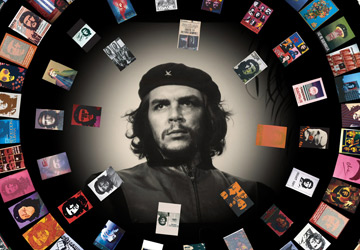
You know the picture all too well: the black beret flecked with a tiny white star; the grim, resolute set of the mouth under a patchy, perpetually hip mustache; the soft-looking flyaway locks of hair lifted as if by the breezes of change. And in those upward-cast eyes? Fury, disappointment, determination … action.

Ernesto “Che” Guevara, the Argentine-born Cuban revolutionary now dead more than 40 years, is everywhere. His iconographic image — a photograph snapped at a mass funeral in Havana by Alberto “Korda” Díaz Gutiérrez and subsequently co-opted and adapted by publishers, artists and pretty much anyone with a Xerox machine — has long been a symbol of protest and the little guy rising up against the ruling power. Today, it gazes at us from T-shirts, posters, album covers, coffee mugs, key chains, beach towels, beer bottles, cigarette packets, bikini bottoms — and even, briefly, an advertisement for Smirnoff vodka. Korda’s snapshot of Che, which he titled “Guerrillero Heroico,” may well be the most widely reproduced image in the history of photography.

Why this image? Why Che? Those are the questions Trisha Ziff and Luis Lopez set out to answer with their fascinating documentary “Chevolution,” which this week played to sold-out crowds at the Tribeca Film Festival and will be shown in June at the Silverdocs festival just outside Washington, D.C. The film, which evolved from a book and museum exhibition by Ziff that has traveled the U.S. and is currently touring Europe, examines the image’s power — the mythology of the man within the frame and the vision of the man who snapped it — and traces its journey from the pivotal revolutionary moment it was taken in 1960 to its first publication on the day of the Bay of Pigs invasion in 1961 to its resurrection on the occasion of Che’s death in 1967. It looks at the “perfect storm” of events that led to the photo’s proliferation. Along the way, Ziff and Lopez spoke not only with Che biographers and historians, but also his friends, Korda’s family and colleagues, artists who have used the image in their work, young people who have embraced the image, others who shun it — and, yes, a few Che T-shirt wearers with no idea who Guevara was or what he stood for. Also in the interview mix: Gerry Adams, weighing in on the image’s power in Ireland; Antonio Banderas, who played Che in “Evita”; Gael García Bernal, who played him in “Motorcycle Diaries”; and Bolivian Sen. Don Antonio Peredo.

Salon was curious about Ziff and Lopez’s perspective, so we caught up with them by phone mid-festival.

Trisha, what brought you to curate an exhibit and make a film about the phenomenon of this one iconic photo? What was the moment of inspiration?

Ziff: Really the whole thing began in 2001 when Alberto Korda died. I had met him a few times in Mexico and I was reading the obituaries. Here was a man who’d photographed all his life and he was essentially being remembered for a single image. What impacted me was how somebody’s life in our culture is just reduced down so drastically to very specific things. It’s almost like we become our own commodity. And obviously in his case the world remembers Korda for taking the Che image. So the representation of his life was really a 60th of a second. That had a real impact on me — that fleetingness of our reality.

Right, we really never know what we’ll be remembered for, which moment will define us.

Ziff: We think having our children or something else we did is what made our lives and who we are, and yet the world sees things very differently. That discourse in my head got me thinking of the image. And I tried to write a short story about it and failed miserably because essentially I’m a curator, so I thought, well, I wonder what would happen if you did an exhibition about only one image. I wonder if they — the viewer, the audience — would find it interesting enough. So it became a curatorial exercise for me: Could I do that? Then it began as an exhibition at the California Museum of Photography in Riverside — and it spiraled out of control, which is what happens with that image. It’s amazing. It’s like a rolling stone. It just goes on. And that in some ways has happened with the film now too.

The image really does seem to have a life of its own — or really many, many lives: as a sign of political protest, an image in pop art, a fashion statement. Can you talk about the factors that led to its proliferation?

Ziff: I think there are very specific elements that are in many ways serendipitous. The image was taken in 1960 at this very powerful moment, when a ship bringing arms to the revolution exploded in Havana harbor. Castro thought it was the work of the CIA — they call it this big terrorist act against the Cuban people at the beginning of the revolution — though it’s never been proved that it was. But it was a mass funeral. It was a huge moment, a watershed moment in the history of the revolution. The image was taken at the moment that Cuba turned to the Soviet Union for help, obviously before the missile crisis.

It’s on the roll of film along with all the other images Korda took that day of Castro holding up the different explosives that were found on the boat. And Simone de Beauvoir and Jean-Paul Sartre were in Cuba at that time too and they’re also on that roll of film. So you have this kind of historic roll of film, but [the Che image] never spoke to the precise moment — it wasn’t published the next day in the newspaper. And then when it is published, it’s published as a kind of stock head-shot of Che Guevara, advertising a conference that he’s going to speak at — and the time it’s published is the day of the invasion of the Bay of Pigs. So you have this incredible moment when it’s taken and this other very important historic moment in the beginnings of the revolution and the invasion. And then it kind of gathers momentum, and when it’s published the third time it’s in the context of the death of Che. It’s held high on these placards protesting the murder of Che by the CIA in essence with the Bolivian Army, and that’s a moment that explodes in itself. So context is a huge part of the image.

And yet it has spun way out of its original context …

Ziff: It did that early on. In ’68 it was already becoming an iconic image of protest and change outside the context of his life. Of course all the commercialization came later. The image was almost like the resurrection — the image sort of left the body of the man and immediately became iconic in that way, but very specific to what was taking place in Europe. The critique of the Soviet Bloc, the right to vote in Ireland, the anti-Vietnam War protesters in the United States, the anti-military movement around the Olympics that was taking place in Mexico: It was about Che and yet it wasn’t. Very early on, it wasn’t.

In some contexts, who Che was is still relevant to the image’s power, yet the image has moved beyond the person who took it and the person in it.

Lopez: What we try to explore in the film is that there is a mythology that grows from Che and it happens in all sorts of ways in different cultures, and that’s one aspect of it. And there’s also this development of the icon itself. And what’s interesting to me is that there’s this open source where no one really specifically controls it. And it keeps changing and remodifying. It becomes this open vessel that’s constantly evolving without one person or group really dictating where it goes.

Let’s talk about the things that contributed to this historic level of proliferation: the lack of copyright in Cuba at the time; Korda’s decision to give it away to Italian publisher Giangiacomo Feltrinelli, who widely reproduced it on posters; the high-contrast version Irish artist Jim Fitzpatrick designed “to breed like rabbits,” to name just three. Can you trace the mechanics of the proliferation of the image?

Lopez: I think there were several factors that caused the image’s explosion that sometimes we discuss as a perfect storm. It’s almost like it could only happen with those sets of circumstances present. There is Che and his mythology and legacy, but also there’s other factors. Like the lack of copyright at the time in Cuba, which helped it to be passed around and dispersed quite freely. Other things that we touch upon: the cult of celebrity that was developing at that time, with young heroes and people having posters of James Dean and Elvis and Marilyn Monroe. Another factor is the development of pop art and Andy Warhol taking images of historical figures or popular culture figures and creating art. There’s also the era of protest: Prague spring and Paris and Mexico City and Berkeley. So there are all these factors that came together on this one image that helped it explode.

It’s interesting now that Korda’s estate is trying to protect the copyright and prevent unauthorized uses of the image — and that Korda himself successfully sued Smirnoff to stop the company from using it in its vodka ads a few years back. The film, I thought, didn’t really take a firm position on that. Was that a deliberate choice?

Ziff: From my point of view as someone who’s worked with photography and photographers for 30 years, I have a very clear position, which is honoring the rights of the photographer, the rights of the photographer’s family, copyright law. This is such a unique image in that so many people do believe it’s public domain, and in the film we give them a voice to say that. And then at the end we come back and we give Diana [Díaz, Korda's daughter, who oversees his estate] her voice. I mean there is massive debate today in Cuba about who owns that image: Should that image be a free image for the Cuban people to use and represent the revolution or should it remain in copyright to the estate? It’s a pretty cut-and-dried debate because we do have international laws and Cuba now acknowledges those laws. And Diana is absolutely within her rights to implement those laws as any holder of copyright would be.

You also include the voice of a Cuban-American, a young guy talking about his negative associations with Che — his embrace of armed conflict, the violence. But you didn’t dwell on that perspective too long. Was that also a deliberate choice?

Lopez: First and foremost we wanted to explore the phenomenon of a photograph and an icon. We wanted to explore why did this happen, how did this happen. At the same time we felt it would be irresponsible not to give some other perspectives. We had some understanding that there are opposing ideas and voices in all of this.

I’m kind of curious about all the man-on-the-street interviews with people wearing the Che T-shirts who have no idea who he is. I’m wondering about the process of finding those people. I’m guessing it wasn’t very hard to do.

Ziff: We went to gathering spots. At Venice Beach, we waited about five minutes for a Che T-shirt to come along. Maybe we were very lucky, but they happened pretty quickly in London, in different places. What happens is once you become sensitized to the image, you hate it, because you start seeing it everywhere. You realize our world is saturated by Che T-shirt wearers. So it wasn’t that difficult, but it was interesting the level of ignorance.

I would say it’s culturally specific, too. Because if you were to walk through the streets of Belfast or Dublin or Mexico City and you ask people “Who’s on your T-shirt?” they’d know. I think it’s quite culturally specific to the United States and to education in the United States and what people are taught and not taught in the States. It’s quite mind-boggling as a non-American.

On my way to New York for the festival, I sat next to a Tibetan monk on the plane and I was looking at some of the early reviews with the Che image on them. He leaned across and he said, “I see that man in so many countries, but not in my country, not in Tibet. Is he a musician?”

Do you think the image has lost or gained power in its explosion? Or both?

Ziff: I think both. It’s changed. It metamorphoses. It travels. It takes on new meanings. It gets attached to different moments. In Mexico City, you don’t really see that image without seeing the image of the Zapatistas, and it becomes an image about indigenous voices and the rights of the indigenous and independents. The schoolteachers strike in Oaxaca, it’s the same thing. It becomes this strong image of a struggle and specific in some contexts and in others this much more generic image used in protests we wouldn’t even associate with it, like green issues or whatever.

What are some of the strangest things you’ve seen the image on?

Ziff: A doormat. Wipe your feet on Che Guevara!

Lopez: I just saw a “Che-r” T-shirt: Cher’s face with the beret.

Ziff: You see that a lot. People just put a black beret and a star on other people: Libera-Che, Che-ney. You can go on and on Googling them.

There’s your next exhibition.

Ziff: Oh, please God, no.

Do you think the image will ever run its course? Is there an end?

Lopez: I don’t think so. It seems to me that the image just has such staying power and resonance. I think certainly not in my lifetime. It won’t go away.

Continue Reading Close

Page 2 of 133 in Amy Reiter