Charles Taylor

Shilling for Hitler

Eminent historians defended Holocaust denier David Irving in the name of free speech and scholarship. Deborah Lipstadt's account of her libel trial with Irving proves how colossally wrong they were.

  • more
    • All Share Services

Shilling for Hitler

Let’s imagine that there was a writer who took as his subject World War II. And let’s suppose that because of his ability to amass and cite journals, transcripts, paperwork and all manner of documents, he gained a reputation as a meticulous researcher. Now let’s say that the conclusion the writer drew from all of his research was an unshakable conviction that World War II never happened. It was, he insists, a massive fraud, and he declares under oath, “No documents whatever show that World War II had ever happened.”

Now let’s allow things to get curiouser and curiouser.

Despite this writer’s farcical conclusion, historians of World War II, men who have spent their professional lives studying and documenting the war, still insist on the soundness of his research. It is possible, they say, to draw faulty conclusions from solid fact-finding. They do not bother themselves with the obvious question of how good the quality of any research can be if it can be used to support what is patently false. One historian says he and his colleagues should be able to admit the view of those with whom they may not be “intellectually akin.”

When journalists began writing about the work of this WWII debunker, they refer to it as an alternate interpretation or a controversial point of view. One suggests that the writer has opened a useful dialogue around the question “Who decides what ‘happened’ in the first place?”

Eventually, a historian, aware of the esteem in which some of his colleagues hold this writer, agrees to put the writer’s famed research to an intensive examination. What he finds is a consistent pattern of deliberate misquotation, misinterpretation and outright lies designed to support the writer’s conclusions. Anything that hasn’t supported those conclusions has been either discarded or altered. This historian concludes that “deceptions … had remained an integral part of his working methods across the decades.” Even this does not deter other historians from continuing to profess admiration for the WWII debunker. One even writes that the debunker possesses “an all consuming knowledge of a vast body of material.” And another, apparently unaware of how he is defaming his profession, announces that no one “could have withstood [the] kind of scrutiny” that the historian had subjected the debunker to.

If you change “World War II” to “Holocaust” in the above paragraphs, you have a pricis of how the Holocaust denier and fascist sympathizer David Irving has been both praised and damned. Except for that change, each of the quotes above has been made by or about Irving. The line about Irving’s “all consuming knowledge” was said by British military historian Sir John Keegan. The claim that no historian could have survived the scrutiny accorded Irving was made by another acclaimed British historian, Donald Cameron Watt.

What is particularly notable about those two quotes from the leading harrumphers of the “maps and chaps” school of history is that they came after Irving’s crushing defeat in a libel case that Irving himself brought against the American historian Deborah Lipstadt. (Keegan and Watt were subpoenaed by Irving to testify on his behalf.) Lipstadt, professor of modern Jewish and Holocaust studies at Atlanta’s Emory University, had, in her book “Denying the Holocaust,” called Irving a “Hitler partisan wearing blinkers” who distorted, skewed and manipulated evidence and documents “in order to reach historically untenable conclusions.”

For this, Irving brought a libel suit against Lipstadt and her British publishers, Viking Penguin, in British courts, a suit Irving offered to settle for 500 pounds and a promise not to reprint Lipstadt’s book. Lipstadt and Viking Penguin declined, even though facing off against Irving in London meant operating under the asinine British libel laws in which the burden of proof is placed on the accused. After a four-month trial adjudicated not by a jury but by Judge Charles Gray (both parties decided the material was too complex for a jury to digest), Gray handed down a decision that, to anyone sentient and breathing, ended the myth of David Irving as a historian. In his judgment, Gray not only said that Irving was an “antisemite” and a “racist” but that his “falsification of the record was deliberate and … motivated by a desire to present events in a manner consistent with his own ideological beliefs even if that involved distortion and manipulation of historical evidence.”

Two accounts of the trial followed in 2001. Richard Evans, the British historian who had undertaken a massive examination of Irving’s corpus for Lipstadt’s defense team (the above quote about deception being an integral part of Irving’s working methods is from Evans), published the thrilling intellectual detective story “Lying About Hitler” (whose publication was delayed in the United Kingdom because Evans’ original publisher was nervous that Irving might sue). And the writer D.D. Guttenplan wrote “The Holocaust on Trial,” which provides a lucid narrative of the trial while playing right into Irving’s hands with a sophomoric and shallow discussion of what Guttenplan believed to be the issues raised at that trial. In one passage, Guttenplan writes that taking “so much” for granted — “so much” referring to “Adolf Hitler’s murderous intentions, the horrifying efficiency of the death camps, the fatal consequences for the Jews” — “conceals” the questions of “How do we know these things really happened?” and “How do we know [the witnesses] are telling the truth?” To which the only response is: How do some people live with themselves?

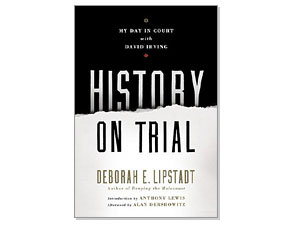
Now, five years after crushing Irving in a British court, Deborah Lipstadt has provided her own account of her ordeal in “History on Trial: My Day in Court With David Irving.” Hers is the most detailed account of the trial yet, and the most crazy-making.

It isn’t Lipstadt who drives you nuts — it’s Irving. The man comes off as something dreamed up in a collaboration between the Monty Python crew, George Orwell and P.G. Wodehouse (who might well have been forecasting the arrival of David Irving when he concocted the homegrown fascist Sir Roderick Spode). To sit in a court for weeks on end and listen to Irving’s endless insistence that black is white and up is down would be enough to make the most patient among us feel as if we’d slipped into Bizarro world, and Lipstadt is clearly not a woman blessed with patience. (Having a similar temperament, I find that one of the most likable things about her.)

Due, I’m guessing, to her discipline as a historian — an ability to follow an argument, to provide evidence along the way, to quickly seize upon contradiction and prevarication — Lipstadt gives a detailed account of the trial that never loses its suspense, readability or momentum. Or humor. Lipstadt feels guilty when some absurdity of the trial causes her to laugh. But how else do you react to a moment like the one that occurred during Irving’s closing statement, when he addressed Judge Gray as “mein Führer”?

Long before she landed across the aisle from him in a British court, Lipstadt was fighting not only Irving’s reputation as a reputable historian, but also the people who simply wanted to dismiss him as a crackpot. David Irving is surely that, but he is not just that. And Lipstadt’s deepest accomplishment in “History on Trial” is in the doggedness with which she drives home the danger of David Irving.

I have to admit to losing patience with Lipstadt at times. When the documentary filmmaker Errol Morris shows her his film “Mr. Death,” about Holocaust denier Fred Leuchter, Lipstadt says that Morris’ amusement with Leuchter’s cracked theories “was, however inadvertently, helping Irving make his case.” Morris certainly has a penchant for treating the people who come before his camera as freaks, and he often milks their oddities for laughter, but that’s far from helping Irving to make his case. It’s more likely that Morris finds Leuchter’s claims so outrageous he can’t conceive of how anyone can take them seriously. But you understand how Lipstadt’s experience keeps her from laughing: She is all too familiar with people, and not just fools, willing to take Holocaust deniers seriously.

Sooner or later, every Jew who perceives anti-Semitism as an encroaching danger gets described as hysterical or paranoid. The flattering self-deception at the root of that reaction is a way of consigning anti-Semitism to the past, of saying, “Surely we’ve become more civilized than that.” “History on Trial” makes the case, as did “Lying About Hitler,” that we have not become so civilized we are above tolerating David Irving.

Irving’s supporters — and I include in that group not just the pathetic fools who greet with laughter his comments about “Auschwitz Survivors, Survivors of the Holocaust, and Other Liars,” or “ASSHOLS,” at the white-supremacy rallies and conferences he often addresses, but the more upscale fools who are not Holocaust deniers but who continue to believe in his efficacy as a historian — have long tried to cast those who oppose Irving as enemies of free speech.

This is the tack Christopher Hitchens has long taken when writing about David Irving, and it is worth dwelling on him, as his writing provides a useful compendium of Irving apologias. In a June 1996 Vanity Fair column after St. Martin’s Press canceled its contract with Irving to publish his biography of Joseph Goebbels, Hitchens, styling himself the macho defender of the First Amendment, called the anti-Irving articles that led to St. Martin’s actions “hysterical and old-maidish.” Of the historians condemning Irving he wrote, “These are supposedly experienced historians who claim to have looked mass death in the face, without flinching. And they can’t take the idea of a debate with David Irving?”

The sly implication of those lines is that Irving’s opponents are afraid to confront him. What Hitchens ignores is the position that Deborah Lipstadt has taken for years: that to debate Holocaust deniers implies they are expressing a fact-based vision of history. Shilling for Hitler, Irving is expressing no such thing.

To see this you need look no further than the Goebbels biography that Hitchens is so hot about. In a May 2001 review of the Evans and Guttenplan books for the Los Angeles Times Book Review, Hitchens wrote, of St. Martin’s decision, “St. Martin’s gave no reason of historical accuracy for its about-face.” The implication being that none exists.

What Hitchens perhaps did not know in 1996, and seemingly chose not to mention in 2001, are the falsifications in the Goebbels bio that Richard Evans discovered in his examination of Irving’s work. An example: In the book, Irving cited a statistic on the number of cases of fraud perpetrated by Jews in 1933 Germany. Irving’s rather insalubrious source for this claim was Kurt Daluege, the head of the German Order Police in the early ’30s, and later in charge of the extermination of Jews on the Eastern Front. But having decided to quote a Nazi, Irving apparently decided that he himself could do a better job of making the Nazi case. Daluege had claimed that, under the Nazis, the number of fraud cases dropped from 31,000 in 1933, to 18,000, a majority of which he claimed were committed by Jews. In Irving’s book these statistics were twisted into the following sentence: “In 1932 [sic] no fewer than thirty thousand cases of fraud, mainly insurance swindles, would be committed by Jews.”

Giving Hitchens the benefit of the doubt about the lies of the Goebbels book still does not excuse this claim from his 1996 Vanity Fair article: “And, incidentally, [Irving] has never and not once described the Holocaust as a ‘hoax’.” Restricting ourselves just to what Hitchens could have known before writing that, we find that, testifying at the 1988 trial of a Canadian Holocaust denier, Irving said, “No documents whatever show that a Holocaust had ever happened.” What’s the defense of this? That Irving doesn’t use the word “hoax”? OK then. How about these?

In a 1991 speech, Irving said, “Until 1988, I believed that there had been something like a Holocaust … but [in] 1988 … I met people who knew differently and could prove to me that story was just a legend.”

In 1990: “The holocaust of Germans in Dresden really happened. That of the Jews in the gas chambers of Auschwitz is an invention.”

And, again, in 1991: “More women died on the back seat of Senator Edward Kennedy’s car at Chappaquiddick than died in the gas chambers of Auschwitz.”

Remember, Hitchens’ defenses of Irving did not appear on, to use his own phrase, “some ghastly Brownshirt Web site,” but in Vanity Fair and the Los Angeles Times Book Review. Inevitably, in the L.A. Times piece, Hitchens brings up the totem of Irving enablers, “the censorship of Irving.” What is he referring to? St. Martin’s Press did not censor Irving; it chose not to publish his book because its chairman, Thomas J. McCormack, was sickened by the thought of publishing a book whose subtext, he said, was “the Jews brought this onto themselves.” St. Martin’s did not prevent the book from appearing elsewhere, and in fact, the Goebbels bio was published in Britain, from where the faithful could order it.

Any honest person who talks about David Irving and the censoring of history has to acknowledge that the censoring has been attempted by David Irving himself. This is what the libel trial was about — Irving’s attempts to censor Lipstadt’s “Denying the Holocaust” — though, as the trial showed, the claims Lipstadt made against Irving are demonstrably true. This is not the only piece of litigation Irving has attempted or threatened. His lawsuit threats delayed for years the British publication of historian John Lukacs’ “The Hitler of History.” When it did appear in Britain, it was published in an edition that bowdlerized Lukacs’ case against Irving. These very real attempts to quash the work of historians are never mentioned by Irving’s defenders. But somehow, the work of historians who set out to prove the deceptions in Irving’s work is depicted as an attempt at censorship, or a way of inhibiting historical examination.

It might be worth pointing out here that Lipstadt, who is Jewish, makes a point in “History on Trial” of speaking against censoring Holocaust deniers, not just from a freedom-of-speech standpoint but from the standpoint that censorship gives work the allure of the forbidden. And she is harsh and direct on the use of the Holocaust to strengthen Jewish identity. “Jews,” she writes, “have survived despite antisemitism not because of it.”

But even pointing those things out feels somewhat shameful to me. It’s almost as if Lipstadt has to be proven “not too Jewish” before her case against Irving can be taken seriously. The only thing that makes her Jewishness relevant is that the reaction against Lipstadt (especially some of the initial British press reaction, which Evans wrote of in “Lying About Hitler”) seems to me to be of a piece with the chiding given Jews for being too sensitive or fearful or paranoid about anti-Semitism.

But to paraphrase the old ad for Levy’s Real Jewish Rye, you don’t have to be Jewish to be alarmed at David Irving. Considered solely as a historian, how could Deborah Lipstadt be privy to knowledge about Irving’s long history of lying, deliberately misquoting documents, and baiting Jews in his speeches and not be appalled and disgusted at the persistent myth of David Irving as a misguided chap who is nonetheless a reliable researcher? If the practice of history means taking into account verifiable facts, how could Lipstadt not be alarmed by the failure of two eminent historians, John Keegan and Donald Cameron Watt, to alter their view of Irving after the trial proved his work worthless? Irving did not lose, as Keegan claimed he did, for “faults” of interpreting “an all consuming knowledge of a vast body of material.” He lost for a consistent pattern of deceit. Keegan’s claim that Lipstadt was a member of the “self-righteously politically correct” when she had not testified, and when he, by his own admission, had not read her work, raises the question of what political correctness possibly has to do with an assertion that the Holocaust actually happened.

Lipstadt is probably right in suspecting that Keegan and Watt were annoyed by what they saw as the impertinence of a woman and a Jew who did not know her place. What seems to bother Irving’s defenders is the very notion of professional and intellectual accountability. Running into Lipstadt after the trial, Watt said to her, “None of us could have withstood that kind of scrutiny.” In a column for the Evening Standard, he said, “Show me one historian who has not broken out into a cold sweat at the thought of undergoing similar treatment.” What Lipstadt was perhaps too polite to say to Watt was that any historian who wishes to be worthy of the title had damn well better be able to withstand that kind of scrutiny.

On the other hand, the case made against Irving has consistently been made to sound like intellectual tyranny. And that risks obscuring one of the most important lessons to be gleaned from Irving’s unsuccessful libel case against Lipstadt, namely that intellectual accountability entails moral accountability. The work of Keegan and Watt, and of other historians who have more tentatively applauded Irving’s “scholarship,” should not be dismissed because of that praise. But now that Irving’s mendacity has been revealed, and his research proven thoroughly and irrevocably worthless, those who have praised him have a choice to make. If they choose to stand by their view of Irving, they must, in this at least, be judged as having abandoned the very concept of historical fact, which Richard Evans defined as “something that happened in history and can be verified as such through the traces history has left behind.” It is not a simplification but the essence of this case to ask how you can trust any historian who defends a Holocaust denier.

When my piece on the Evans and Guttenplan books ran in Salon in May 2001, I received an e-mail from David Irving that ended, “You appear not to know that June 20, 2001 sees the start of our appeal in the London courts, and after that a lot of journalists, not just you, may well be quaking in their evil smelling boots.”

The next month, Irving’s attempt to appeal Judge Gray’s decision was unequivocally turned down for the third and final time. I won’t speak for the odor of my shoes. But, to paraphrase something said to her during the trial, I do know that Deborah Lipstadt has managed to scrape a major piece of shit off the boots of history.

“Nobody Knows”

This deceptively simple Japanese film about four children abandoned by their mother evokes the work of Vittorio De Sica and Satyajit Ray.

  • more
    • All Share Services

There’s a special poignance to children who, because of circumstances, are forced to conduct themselves with the seriousness of adults. As Akira, the 12-year-old protagonist of Hirokazu Kore-eda’s quiet, devastating “Nobody Knows,” Yûya Yagira maintains an air of watchful self-possession throughout the film. Akira is the oldest of four children, all from different fathers, who are abandoned by their mother in their small apartment. Akira, who must keep his three siblings a secret from his landlord, is the only one of the children allowed outside. When he realizes his mother is not coming back, he fully assumes the role he more or less already fulfills as head of the family.

Humanist filmmakers have long favored making movies about children and old people, believing that how we treat the most vulnerable among us is a measure of our own humanity. Akira reminds you of the children who have populated the films of Vittorio De Sica or Satyajit Ray, and, more unexpectedly, of the elderly Carlo Battisti in the title role of De Sica’s “Umberto D.” Unlike Umberto, Akira does not hide his predicament from others because of pride: Having been separated from his younger brother and sisters when the family attempted to get public assistance, he is determined to keep them all together.

What makes Akira kin to Umberto is the mixture of desperation and dignity in Yûya Yagira’s performance (for which he won the best actor award at last year’s Cannes Film Festival). Akira is a bright, sensitive kid and it hurts to watch him. You sense the potential for being wide open existing side by side with the necessity to be closed off. For much of the movie Kore-eda merely observes as Akira goes to the market for groceries, comes back to cook dinner, sends his mischievous younger brother, Shigeru (Hiei Kimura), off to take a bath, and keeps the house in running order. The small pleasures he allows himself, like stopping off at a convenience store to read a manga that he can’t part with the money to buy, only emphasize how grimly focused he is.

For all Akira’s persistence, there’s an inescapable air of resignation to him. When his sister Kyoko (Ayu Kitaura) asks him when their mother is coming back, he speaks the truth, “She’s not,” as if there’s nothing to be done about it. This is a kid without even the pretense of hope, wised up before he has any right to be. Yagira is completely in tune with Kore-eda’s deceptively simple style (as are all the children — little Momoko Shimizu, heartbreaking as Yuki, and Hanae Kan as an outcast schoolgirl who becomes the kids’ accomplice). This is one of those rare performances that could only be given in movies, a performance that penetrates to the heart of film acting — behaving unself-consciously in front of the camera. That it comes from so young an actor makes it all the more remarkable.

Kore-eda based this film on a true case in Japan, but it’s got none of the worked-up drama we associate with movies about child abuse, and none of the menace we associate with actors playing abusers. It’s easy at first to believe that the mother (played by the Japanese actress You) is simply a working woman trying to do her best. She’s a monster, as self-absorbed as it’s possible to be, but one who hides behind her schoolgirl bangs and greets everything in a chirpy little voice.

We see her at the beginning, in the family’s new apartment, opening the suitcases in which she’s smuggled little Shigeru and Yuki. She’s clearly trying to make them feel better, to treat the whole thing as an adventure, but it becomes clear the kids are baggage to her. In one scene she demands of Akira, “Don’t I have the right to be happy?” It’s the most weight she brings to any declaration she makes. Her effect on the kids is insidious, treating everything as a game, telling Kyoko that she isn’t missing anything by not going to school since kids who are different are picked on. So by the time she’s flown the coop, the kids are staying holed up in their increasingly shabby apartment for no reason other than obeying their mother’s rule — even though it’s that rule that is keeping them from getting help. Even the separation that help would entail is preferable to the state they’re in as the money Akira counts and recounts compulsively dwindles and the apartment’s electricity and then water are cut off.

Though squarely in the category of humanist filmmaking, “Nobody Knows” can throw you because Kore-eda’s unemphatic style can trick you into thinking that he doesn’t dramatize the events he is showing. Though for all its surface naturalism, “Nobody Knows” is highly stylized. Kore-eda turns shots of the kids’ hands involved in some task, or a discarded toy, or little Yuki sliding her feet into her shoes for a clandestine birthday trip outside, or Akira stroking the suitcase in which Yuki is being smuggled, into beautifully understated tableaux. And the airiness of the light that penetrates the dim apartment has a siren cruelty to it — this is the world the kids are cut off from. There are passages that feel flatter, more repetitive than they need to be, and perhaps the film could stand to lose some of its 140-minute running time. But that occasional flatness is the price paid for what’s daring about the film.

Kore-eda is depicting stasis here, a situation that, ultimately, has no resolution, that deprives the audience of even the catharsis of tragedy. That makes “Nobody Knows” a very upsetting experience. The film is too understated to be a tract, but there is an undeniable element of accusation in the title, implyng that the ignorance it alludes to is willed. In one shot, we see Shigeru’s dirty feet walking unnoticed past the feet of two well-shod middle-class women bragging of how well their kids are doing in school.

Akira’s story of his mother being away on business is a transparent lie and the kids’ increasingly ragged look should alarm anyone. It’s a trace of irony that the only person who does anything for the kids, a convenience store clerk who smuggles canned food out the back of the store to Akira, is the one whose help costs him something. Or maybe Kore-eda means the clerk’s actions as a small mark of the decency still possible in the world he’s showing us. But the actions of the other adults in the film suggest that “nobody knows” is another way of saying “nobody cares.” Kore-eda doesn’t create the simultaneous sense of being destroyed and exalted that the greatest humanist movies do, but he’s stayed true to his title.

Continue Reading Close

The most liberal president of the 20th century

Nick Kotz's new book about the civil right years argues convincingly that the true hero of the American left is LBJ.

  • more
    • All Share Services

Toward the end of Nick Kotz’s “Judgment Days: Lyndon Baines Johnson, Martin Luther King Jr., and the Laws That Changed America” comes a startling bit of information about the disastrous 1968 Democratic Convention in Chicago. “Barely noticed during violent clashes between police and antiwar demonstrators,” Kotz writes, “the proud integrated delegation from the Mississippi Freedom Democratic Party was seated in place of the Mississippi regulars. Fannie Lou Hamer, now an official delegate at last, received a standing ovation from the convention as she took her seat.”

That such an event could happen merely four years after the 1964 Democratic Convention in Atlantic City, N.J., where the Mississippi Freedom Democratic Party was denied recognition in favor of the Mississippi delegates who were chosen via a system that prevented blacks from voting, is a mark of how far and how fast the civil rights movement had come. That it could be so little noticed is a measure of how quickly the movement was being eclipsed by Vietnam.

Fannie Lou Hamer — who had led the charge for the MFDP in 1964, testifying before the credentials committee about the violence faced by blacks who tried to register to vote, and then dismissing the compromise the party offered the MFDP with “We didn’t come all this way for no two seats” — was a living presence at a convention that, for all the turmoil both inside and outside the hall, was haunted by ghosts. Absent was Lyndon Baines Johnson, who in 1964 had found Hamer’s televised testimony so damning of the Southern Democrats he needed to gain the party’s nomination that he convened a press conference to knock her off the air. Five months earlier, depressed by the growing reaction against the Vietnam War, convinced the war was unwinnable but unable and unwilling to extricate himself from it, Johnson announced his decision not to seek reelection. A few days after that, Martin Luther King Jr., who believed that LBJ’s removal would pave the way for the end of American involvement in Vietnam, was shot to death in Memphis, Tenn. Two months later, the candidate whom many, including King, expected to bring the troops home, Robert F. Kennedy, was murdered in Los Angeles.

And yet the heartbreaking trajectory that Kotz details in his rich and necessary book suggests that even if King and Kennedy had lived, even if Johnson had been the Democratic candidate in 1968, the civil rights movement still would have frayed irreparably.

The hope and fervor and uplift that accompanied the end of legal segregation in the South began to dim when it became clear that segregation’s demise had barely begun to address the resentment that centuries of oppression had left behind, or the poverty suffered by blacks throughout the country. Hard on the heels of the 1965 Voting Rights Act came the Watts riots, an event that shocked both LBJ and King because it expressed that for many black Americans, the new laws had changed nothing. The Poor People’s Campaign, a six-week protest held in the early spring of 1968 in Washington to highlight poverty, had fizzled, failing to equal the impact of the 1963 March on Washington or 1964′s Freedom Summer or the campaigns in Birmingham and Selma, Ala. And the emergence of Black Power proponents (typified by Stokely Carmichael, then head of the Student Nonviolent Coordinating Committee) changed the tone and inclusiveness of the movement.

By 1968, civil rights had ceded to Vietnam as the most urgent issue in American political life. King had recognized earlier than most the link between civil rights and Vietnam. Despite Johnson’s insistence that America could have both guns and butter, King knew that the Congress could not fund both the antipoverty and education programs of LBJ’s Great Society and a war. And the disproportionate numbers of blacks and poor who were drafted was as insidious a practice of institutionalized racism as any that had been defeated by legislation.

The connection between civil rights and Vietnam was denied by those who criticized King for speaking out against the war, many of them his past supporters. A New York Times editorial called the two issues “distinct and separate,” while the Washington Post referred to the linkage as “sheer inventions of unsupported fantasy.” King was right to see the moral and economic consistency in working to end poverty and opposing Vietnam. But his critics in the civil rights movement — among them Whitney Young of the Urban League, and the NAACP board of directors who unanimously voted to condemn King — were not wrong to believe that focusing on Vietnam would inevitably mean taking America’s attention off civil rights. That shift of focus coincided with an unspoken sense of weariness on the part of whites who, though only some said so out loud, wondered, after the Civil Rights Act and the Voting Act and Johnson’s War on Poverty, “What more do blacks want?”

It was a question that could be an expression of outright racism; of naiveti about how much it would take to better the lot of black Americans; of a patronizing expectation that blacks should be grateful for the recognition of rights that never should have been denied, and resentment that their fawning gratitude never came. It was a question that even Lyndon Johnson asked. Johnson acknowledged the destructive legacy of racism, as in a speech articulating the basis for affirmative action (though it was not called that yet) in which he said, “You do not take a person who, for years, has been hobbled by chains and liberate him, bring him up to the starting line of a race and then say, ‘you are free to compete with all the others,’ and still justly believe that you have been completely fair.” But, a man of enormous and fragile ego, he still felt personally betrayed by the Watts riots. “After all we’ve accomplished,” he asked. “How could it be?”

“All we’ve accomplished” was not just a politician’s vanity. One of the great virtues of “Judgment Days” is the case it makes for LBJ as the most liberal American president of the 20th century. That statement will no doubt anger or amuse those who still insist on seeing Johnson’s shameful deceptions regarding Vietnam as the totality of his presidency; those who confuse politics with the priesthood and recoil from Johnson’s pragmatic mastery of political deal-making; or those who wish for all the change that power can effect without understanding that you first have to have the power to effect change.

Near the beginning of “Judgment Days,” Kotz writes of Johnson in the hours following JFK’s assassination, finally retreating to his bed only to sit up until 3 a.m. with a small group of aides. Johnson began talking passionately and determinedly about how he intended to pass the civil rights bill, a voting rights bill, a bill to allow Americans to pay for higher education, and how he was going to realize Harry Truman’s cherished dream of providing healthcare to the elderly. “No president since Franklin Delano Roosevelt in the 1930s,” Kotz writes, “had attempted such a broad assault on social and economic inequality.” Furthermore, Johnson was talking this ambitiously only a few hours after the murder of a beloved president. And he was not dissuaded when, two days later, a poll showed that 70 percent of Americans did not believe he could govern as well as JFK.

Liberals were suspicious of Johnson’s record of voting with the segregationist Dixiecrats on every civil rights bill that came before him during his time in the House and the Senate. But as much of a burden as the presidency came to be to Lyndon Johnson, it was also his liberation as a politician. Having attained the highest office in the land (and not sure he would be able keep it come November ’64) Johnson began acting like the politician he always dreamed he could be.

This was a man who had been an ardent New Dealer. Johnson had shepherded the rural electrification bill that brought electricity to the Texas hill country where he grew up. He had seen the effects of poverty on the poor Mexican students he had taught during his time as a schoolteacher. And, as Robert Dallek reported in the first volume of his LBJ biography, “Lone Star Rising,” after visiting Germany in the ’30s, Johnson arranged passage to Mexico for Jews, who were then smuggled into Texas job-training camps that Johnson had helped set up to aid his constituents in finding work during the Depression. At the opening of a Houston synagogue in 1968 where LBJ and Lady Bird were the guests of honor, members of the congregation approached Mrs. Johnson to tell her they’d be dead if it hadn’t been for her husband.

Of course there were political considerations behind Johnson’s socially progressive legislation. Always concerned about his place in history, Johnson wanted to prove himself worthy of the liberal legacy of JFK.

What should long ago have become a plain fact of American history but remains hostage to political myth is that LBJ dwarfed JFK as a president. Johnson’s vision, his willingness to cast civil rights and the war on poverty as moral issues, his shrewd use of the power of the presidency to ensure the passage of his bills, makes Kennedy’s timid, halfhearted gestures toward civil rights seem puny in comparison.

For Kennedy, civil rights had the inescapable air of noblesse oblige, something that he would get around to when he deemed the moment was right, expecting blacks to be patient meanwhile. Civil rights neither engaged his sympathies nor resonated with his experience the way it did with Johnson’s. For Johnson, civil rights was the cornerstone to realizing his gargantuan and romantic vision of the presidency. Wanting to, as he said, “out-Roosevelt Roosevelt” and “out-Lincoln Lincoln,” Johnson attempted nothing less than to end the Civil War by enshrining the New Deal as the highest legislative expression of American principles.

Two quotes from Kotz’s book suggest the breadth of Johnson’s vision and the timidity that characterized Kennedy’s presidency. On May 30, 1963, Johnson made the hundredth Memorial Day speech on the battlefield at Gettysburg. He spoke with more bluntness, eloquence and urgency about the plight of American blacks than any president had to that time. “One hundred years ago,” Johnson began, “the slave was freed. One hundred years later, the Negro remains in bondage to the color of his skin. Until justice is blind to color, until education is unaware of race, until opportunity is unaware of the color of men’s skins, emancipation will be a proclamation but not a fact. The Negro today asks justice.” Then, rebuking those who, like Kennedy, feared that civil rights must not proceed too fast, Johnson said, “We do not answer him — we do not answer those who lie beneath this soil — when we answer ‘Patience’.”

Contrast Johnson’s simple realization of the necessity of swift and decisive action with a comment made by Bobby Kennedy, then the attorney general in his brother’s administration, that Johnson’s advocacy was coming “when it was not useful.” What the attorney general meant was that he feared Johnson was harming JFK’s reelection chances in Southern states. But his words need to be examined. How is it possible for the highest law enforcement officer in the land to envision any time when it is “not useful” for American citizens to be accorded their constitutional rights?

As others, like King biographer Taylor Branch, have done, Kotz makes a steady, consistent, irrefutable case for all the ways in which JFK lagged on civil rights, even to the point of allowing the bill he introduced in June 1963 to languish as it became clear he would face Goldwater in 1964. But those facts have done little to diminish the seemingly unassailable myth of JFK as the great friend to civil rights. Part of that, of course, is a sentimental attachment to a man who died so horribly so young. Much is due to feelings that are not so defensible.

Even before JFK’s assassination, people treated LBJ, as they have other white Southerners from Elvis Presley to Bill Clinton, with a finicky WASPish disdain for what they perceived as vulgar. Reporter David Broder’s infamous comment about Bill Clinton in Washington, “He came in and trashed the place, and it’s not his place,” is the most blatant example of that attitude, a way of talking about white Southerners as if they were hillbillies who put their feet on the furniture. Broder’s message was clear: Those people have no place in our country.

Whatever their differences, this was not an attitude King held toward LBJ. Kotz reports that before King’s first meeting with Johnson, King’s advisor Clarence Jones told him, “You’ve got more in common with Lyndon Johnson than you do with John F. Kennedy or with me. White and black people in the South share the same culture — food, music, religions, speech. You need to talk with him like no one else can.” King himself later said he was happy there was a “fellow Southerner” in the White House concerned about civil rights.

What I’m getting at is that, legitimate grievances with LBJ’s politics, his ego, his crudeness, his mendacity and scheming aside, there has always been something inescapably patrician and white in the contempt for LBJ. Ralph Ellison wrote of this in his 1965 essay “The Myth of the Flawed White Southerner.” “No one,” said Ellison, “has initiated more legislation for education, for health, for racial justice, for the arts, for urban reform than he. Currently it is the fashion of many intellectuals to ignore these accomplishments and promises of a broader freedom to come, but if those of other backgrounds and interests [emphasis added] can afford to be blind to their existence, my own interests and background compel me to bear witness.” Contrast that with Mary McCarthy, recalling, in 1974, hearing the news six years earlier that Johnson was not seeking reelection. McCarthy and colleagues were in a Hanoi hotel room listening to Johnson’s speech on Armed Forces Radio and reports “dancing, kissing, hugging each other … I felt a dazed pride myself. We had helped to bring the war to an end.” McCarthy immediately acknowledges the naiveti of that belief. And no one in March ’68 could have foreseen the hell of the next five months that would give rise to Richard Nixon’s election in November.

But even without Cassandra-like foresight, McCarthy, belonging to one of the “other backgrounds and interests” of which Ellison wrote, perceived LBJ’s presidency with striking narrowness. It was not white intellectuals like Mary McCarthy who had benefited most from LBJ’s presidency. And it would not be white intellectuals who would suffer most when not only the war continued but civil rights were rolled back at home under the law-and-order ethos of the Nixon years. (Ellison ended his essay by saying, “President Johnson will have to settle for being recognized as the greatest American president for the poor and for Negroes, but this, as I see it,” he added with an implicit chiding of those whose vision was less expansive than his, “is a very great honor indeed.”)

None of this excuses the very real harm LBJ did. His passion for civil rights stands side by side with his allowing FBI director J. Edgar Hoover to direct a massive smear campaign against King. Hoover went so far as to violate FBI policy by deciding not to inform King of threats against his life, and even mailing to his home an audiotape, made from wiretaps, of King’s extramarital affairs with a note suggesting that King kill himself to keep the tape from becoming public. Kotz details how LBJ aide Bill Moyers gave FBI agent Cartha “Deke” DeLoach the go-ahead to disseminate the bureau’s surveillance on King. (Kotz tells of an FBI agent trying to persuade Atlanta Constitution editor Eugene Patterson to publish a story of King’s affairs. Patterson refused, telling the agent, “What you’re doing is the story … the federal police force of the United States doing this to an individual citizen.” Does anyone believe an editor today would show that discretion?)

Kotz writes of how much LBJ feared Hoover’s power. He does not excuse Johnson for giving that thug so much leeway, but he doesn’t make the mistake so many have made with Johnson and take that as the whole of the man.

Kotz tells the story of the relationship between Johnson and King as a tale of the tenuous marriage of idealism and pragmatism. It’s to Kotz’s credit that he does not depict it as an either/or choice. Which is what makes his section on the 1964 Democratic Convention and the MFDP so irresolvable. You feel how disgusted the MFDP and its supporters were at the prospect of seating a delegation controlled by the Mississippi Democratic Party, a power structure that intimidated blacks and protected the murderers of civil rights workers Andrew Goodman, Michael Schwerner and James Cheney, and the killers of many others. At the same time, there is no doubt what a catastrophe a walkout on the part of the Mississippi delegation would have been: It would have triggered a walkout by other Southern delegates and seriously weakening LBJ’s chance of reelection. So the unquestionable morality of seating the MFDP butts heads with this chilling potentiality: President Goldwater.

I came to “Judgment Days” wondering what there was left to say about this subject and these two men after Dallek’s “Lone Star Rising,” after the two volumes already published of Taylor Branch’s trilogy “America in the King Years,” after the documentary “Eyes on the Prize.” I should have realized that, like World War II, the civil rights era is a seemingly inexhaustible storehouse of narrative, and like World War II, an era in which America had to decide whether it was willing to live up to its stated principles.

Specifically, by keeping his focus on the relationship between Johnson and King in the years from 1963 to 1968, Kotz has allowed us to see the struggle of each to balance idealism and pragmatism. He may focus more on Johnson than King (as I have), but Johnson is a figure whose achievements are less acknowledged than they should be. And Kotz has found an ineluctable sadness in both men. Kotz writes on the insecurities of Johnson and King with what you might call empathetic bafflement. King, perpetually weary from an exhausting schedule and with a mournful fatalism toward the martyrdom he expected at any moment, and LBJ, as ruthless and effective a politician as America has ever produced, but also one who wanted the public’s love and knew he would not have it, who was not even satisfied with his crushing defeat of Goldwater (he wanted to know how anyone could have voted for his opponent) — each of them were contradictions. But both were visionaries convinced of the morality of their cause and racked by constant, nagging self-doubt. Committed to civil rights, they were shadowed by Vietnam, a stalking ghost through the story of “Judgment Days,” ready to swallow it whole. It is a measure of their mutual achievement and of their personal sadness that you put down “Judgment Days” believing them, on some essential, irreducible level, brothers under the skin.

— Editor’s note: This story has been corrected since its original publication. —

Continue Reading Close

Why did “Finding Neverland” snag an Oscar nomination?

It's not -- despite what some would want us to believe -- because it's the choice of "values voters."

  • more
    • All Share Services

Why did

Every year’s list of Oscar nominations is immediate fodder for industry analysts, social commentators, et al., out to divine how this year’s academy choices reflect society.

For instance, it’s predictable that we’ll hear how the five acting nominations given to four black actors represent a real leap forward for African-Americans in the industry. If only someone would explain how Jamie Foxx gets a supporting actor nomination for a movie (“Collateral”) in which he starred, or how the academy managed to ignore all the actresses in “Ray.” (“Which Desperate Housewife will get a Golden Globe” generated more ink than will “Why were Regina King, Sharon Warren and Kerry Washington passed over.”)

Among the more creative pundits this year is Ted Baehr who, his publicists tell us, is chairman of the Christian Film and Television Commission and host of “an annual gala film awards extravaganza known as the ‘Christian Oscars’. ” (Appearing this year, Pat Boone, Guy and Ralna, the Oral Roberts Dancers, and a special tribute to “A Man Called Peter.”) Baehr has rated four of the five best picture nominees — “The Aviator,” “Finding Neverland,” “Million Dollar Baby” and “Sideways” — to see how they align with the all important “values voters.” (Apparently “Ray” is too far outside the pale to even discuss.)

“The Aviator” came in second (three stars and an “Extreme Caution” warning for moral content). “Million Dollar Baby” and “Sideways” got the “lowest moral content rating of ‘Abhorrent’.”

The big winner in Baehr’s moral sweepstakes is “Finding Neverland,” to which he awarded four stars and which he says “has hardly any objectionable content; it is filled with positive, moral attitudes that encourage a hopeful outlook in place of depression and defeat in the depiction of Paywright [sic] J.M. Barrie’s enduring success, ‘Peter Pan’.”

So, does that explain the best picture Oscar nomination for “Finding Neverland” — a modestly acclaimed movie (not here) with middling box office (about $33 million over 10 weeks — about the same as last weekend’s opening of “Coach Carter”)? Did the academy throw a sop to flyover country?

A better explanation is that “Finding Neverland” is Oscar-friendly in every conceivable way. The academy has long doted on period movies and the biographies of the famous. “Finding Neverland” belongs to a line of movies that includes “The Story of Louis Pasteur” (best actor, Paul Muni, 1936), “The Great Ziegfeld” (best picture, best actress, Luise Rainer, 1936), “The Life of Emile Zola” (best picture, 1937) and the best of them, “Yankee Doodle Dandy” (best actor, James Cagney, 1942). In that way, for academy voters, the appeal of “Finding Neverland” is comparable to the appeal of “Ray” or “The Aviator.”

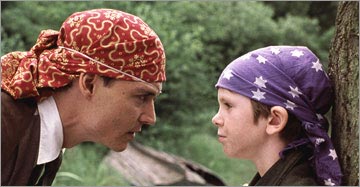
“Finding Neverland” also has the advantage of being what A.O. Scott at the New York Times recently dubbed the “midsize” movie. It allows academy voters to believe that they are supporting indie movies while not straying too far outside their mainstream tastes. (The same could be said of “Sideways.”) And it certainly doesn’t hurt the film that the academy likes the cast, having nominated Johnny Depp and Kate Winslet before, and again this year (Kate Winslet, for “Eternal Sunshine of the Spotless Mind”). And it also has another advantage: the backing of Miramax, a studio renowned for its effective Oscar campaigning (it also produced the 11-time-nominated “The Aviator”).

There’s also a logistical problem that Baehr doesn’t acknowledge. Movies of the size and pedigree of “Finding Neverland” often don’t reach the multiplexes where many values voters go to the movies until after the academy has recognized them. (It’s no coincidence, for instance, that “Sideways” just went into wide release this past weekend.) If more highly touted pictures like “Million Dollar Baby” and “Phantom of the Opera” are just entering mass release (part of the studio’s platforming campaign), it figures that a smaller picture like “Finding Neverland” is going to be on fewer screens.

Nothing Baehr says about “Finding Neverland” is necessarily wrong. You can’t imagine the values crowd finding anything to object to in it. But the fact that there’s nothing in it to turn that audience off is a ways from concluding that it was made or marketed to placate them. It’s hard to find a specific family-values pitch in the tag line from the movie poster, “Unlock Your Imagination,” or in the movie’s hero who shuns convention to live the life his fancy dictates. Yes, Depp’s Barrie does form a family unit with Kate Winslet’s fatherless boys, but so what? Since when did the idea of family become the sole province of conservatives?

Continue Reading Close

Master of the ordinary

Haruki Murakami's latest novel unveils a world in which the fantastic is trite and the everyday profound.

  • more
    • All Share Services

For all the fantastic and farcical happenings in Haruki Murakami’s “Kafka on the Shore” — amnesia that renders the one who suffers it capable of talking with cats; an evil spirit building a flute of stolen souls, both human and animal; another spirit, this one a benevolent pimp, disguised as Colonel Sanders; a woman whose longing for the lost love of her youth gives rise to a ghost of her younger self; fish and leeches raining from the sky; two Japanese soldiers from World War II standing guard in a forest at the gates to the afterlife — it’s the most ordinary things that attain poetry and weight.

I came fairly late to Murakami (and still haven’t caught up) because I confess to being one of those readers who, hearing that a novel contains elements of fantasy and the surreal, imagine something that’s impossibly arch while straining to inspire wonder. Even those of us who are turned off by the drabness of much contemporary realist fiction don’t particularly want to read books about spouses that become pets, or goldfish who are really the Buddha, or gardens that contain entrances to subway stations.

Murakami escapes the forced winsomeness that often hampers novelists who dabble in the fantastic, largely because the deceptive plainness of his language makes the sudden appearance of something strange as matter of fact as stopping off for a cup of coffee. With the exception of one episode so grotesque it throws you out of the novel, none of the oddball things that happen in the course of “Kafka on the Shore” stick out. They don’t add up, either, but this is one of those novels where the book the author seems to think he’s writing is less affecting than the one he’s actually written.

Temperamentally, “Kafka on the Shore” is a coming-of-age story. On his 15th birthday, Kafka Tamura, the son of a famous sculptor, leaves home and heads north. The reasons seem, at first, typically adolescent. Kafka feels he doesn’t fit in at the upscale private school he goes to. He feels suffocated by his father and bereft of any real connection to him. Kafka says his plan is to “journey to a far-off town, and live in a corner of a small library.” And that’s just what he does. The town he settles in has a private estate that’s been turned into a public library. Kafka befriends Oshima, the library’s pin-neat assistant, and winds up living in a spare room in the former mansion, doing minimal chores in exchange for a roof over his head and the chance to be surrounded by books.

Less easily classifiable circumstances creep into the narrative. Part of what drives Kafka from home is the desire to find the mother who deserted the family years before, taking Kafka’s small sister with her. The boy is also fearful of an Oedipal prophecy his own father made to him at a young age. Kafka’s father has told him that he (Kafka) will murder his father and sleep with his mother. And the father goes Sophocles one better by claiming Kafka will sleep with his sister as well.

Alternating chapters with Kafka’s story is the tale of Nakata, a gentle old pensioner who lost the ability to read and write after a childhood accident and who lives simply and contentedly by himself, making a little extra money by searching for lost cats. He’s especially suited for that task because he’s able to converse with cats.

Had I not yet read Murakami and came upon that bit of information in a review or on the jacket copy, I’d flip the page and reason that this book wasn’t going to be on my night table anytime soon. But, again, Murakami introduces the conceit with little fanfare: “‘Hello there,’ the old man called out. The large, elderly black tomcat raised its head a fraction and wearily returned the greeting in a low voice.” And so we’re into a conversation between a man and a cat before we have time to object. And the scene proceeds so smoothly, so uninterested in any cutesy effect that might be wrung from it, that you simply go with it.

You go, too, with the stranger things that follow. After a violent episode occurs in the course of Nakata’s locating a lost cat (too horrendous to support the tired moral lesson it seems to be relating; if I have to have a moral lesson, can’t it come without animals being tortured?), the old man sets out on a journey because there is something he must do. What that is or even where he will have to do it, he doesn’t know. All he knows is that he’ll know the place and the task when he finds it. Hoshino, a young trucker who gives him a ride part of the way, ends up Nakata’s traveling companion and protector, drawn into Nakata’s vague quest, gradually realizing he’s happy to go along.

Too much of “Kafka on the Shore” can be summed up by “X may or may not be …”: Nakata may or not be an older version of Kafka. The girl Kafka meets on a long bus ride may or may not be his lost sister. The woman who runs the library where he finds a refuge and a job may or not be his lost mother. Nakata may or may not have killed an evil spirit who may or may not be Kafka’s father.

Murakami is too refined, too unadorned a writer for “Kafka on the Shore” to go spinning off into incomprehensibility. And if I read him right, the conclusions he’s reached here are homiletic: The world offers no promises of safety; knowing ourselves means knowing the worst we are capable of; regret for the past deadens us to the present; and, most strongly, a full life means running the risk of encountering the pain and violence the world holds.

The combination of pat lessons and loose narrative threads might be a fatal one for any book, especially a book as big (nearly 500 pages) as this one. But I loved reading “Kafka on the Shore.” The book may not, finally, add up (or not to anything deep), but it never feels hackneyed. Murakami has written a novel where the fantastic is trite and the everyday is profound.

Throughout “Kafka on the Shore,” Murakami’s writing strikes a singular balance between the ascetic and the sensual. A simple meal, a nap, the feeling of lying in the sun, the satisfying sweat you develop from exercise, the joy of having books to read — in other words, some of the simplest pleasures you can imagine — are rendered with the type of simplicity that only comes from extraordinary refinement. (Perhaps Murakami writes so beautifully about sex because, as with the fantasy elements of his novels, he treats it naturally, not as something apart from life.) Murakami, a great jazz fan, does something in his prose comparable to what Miles Davis did in his great ’50s work: His notes are spare but so carefully chosen that together they feel rich. You don’t think about what has been eliminated but about the essence that has been distilled into the unadorned words.

There are moments in “Kafka on the Shore” that could feel impossibly sappy. Hoshino, the truck driver who accompanies Nakata on his quest, wanders at one point into a deserted cafe and suddenly finds himself enraptured by the Rubinstein, Heifetz and Feuermann recording of Beethoven’s “Archduke Trio.” Around the same time he goes on the spur of the moment to a double bill of “The 400 Blows” and “Shoot the Piano Player” and finds himself responding to the movies unlike any he’s ever bothered with. This is the kind of awakening usually reserved for adolescent characters. It’s unusual to read it happening to an adult character, and I think it’s significant, heartening, a show of faith on the author’s part that culture is not something reserved for the select few but is open to anyone who opens themselves to it.

Unexpected relationships are at the heart of the book, the relation between Hoshino and strange old Nakata, between Kafka and Oshima, between Kafka and Miss Saeki, the director of the library he settles in. Murakami places great weight on empathy. Time and again characters reveal secrets about themselves, the sort that could put barriers between them. (Oshima, in particular, has a secret that in lesser hands could have turned him into a freak or an object of pity; instead it makes him seem an even rarer bird than he is.) Those secrets are the tests Murakami puts before his characters, to see if they are worthy of inclusion in his book. It’s not a snobbish test. It’s the writer’s way of saying these are the people he chooses to spend time with. He’s not interested, here at least, in characters who can’t make that simple leap of empathy.

In big ways, “Kafka on the Shore” doesn’t work. The ways in which it consistently does work, taken together, are a bigger accomplishment than the book’s fuzzy and banal themes. It’s the summations Murakami works toward that are unsatisfying here. The countless moments in which he writes of life as a gift could almost be plunked down in stories as prayerlike as Jean Giono’s “The Man Who Planted Trees” and feel right at home. Murakami is one of those rare writers who can render contentment without making it feel like complicity. And one of the rarer ones who can make decency attractive.

Continue Reading Close

“Elektra”

Zap! Pow! Kerplunk! This flick starring Jennifer Garner as a comic-book assassin-heroine is hardly a killer.

  • more
    • All Share Services

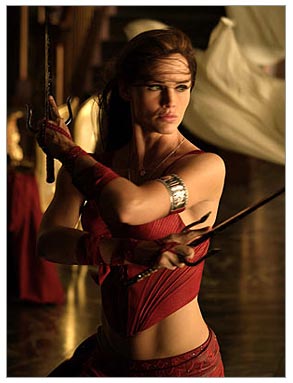
A couple of nifty images and physical action that’s filmed with clarity raise hopes — in the opening sequence, at least — that “Elektra” might be a distraction from the January doldrums. Our first glimpse of the assassin-heroine is a rustle of red and black cloth atop a roof in a snowstorm. When she enters the lair of the target she’s stalking, we see her as he does, reflected from head to toe in a glass of scotch he’s holding up to the firelight. There’s an emphasis in the opening on Elektra as a whispery presence. Jennifer Garner doesn’t so much sneak into her target’s fortress as materialize inside it. It makes a nice break from the bombast of most action movies.

There are a couple of neat images later on, too: a deadly Sapphic kiss between Elektra and a villain whose touch causes the living to wither and die (the kiss takes place in a forest as green leaves fall off trees and create a shower of black around them); and an eagle tattoo that comes to life, leaving its bearer’s chest.

The sad thing about “Elektra,” though, is that it reveals that for all the millions of dollars now spent on them, comic-book movies are being made with no more distinction than the cheapest old Saturday-afternoon serials. When studios weren’t sure whether comic-book movies would make money, some care was actually taken to make the presentation something special. That’s how we got Tim Burton’s two “Batman” movies. Now you see that type of care only intermittently, in the first “X-Men” movie and, despite their problems, in that movie’s sequel and the first and second “Spider-Man” films.

“Elektra” is more and more what comic-book fans, and moviegoers in general, are being fobbed off with. Elektra, a martial-arts-trained assassin, was created by Frank Miller while he was working on the “Daredevil” comic book (Garner also played the character in the 2003 “Daredevil” movie) and brought back to life for the comic series “Elektra Assassin.”

What exists of a plot here makes fleeting reference to Elektra’s resurrection at the hands of her old martial-arts master (played by Terence Stamp, who, even in tripe like this, holds his status as one of the three or four most elegant men ever to step in front of a movie camera). And there’s some Freudian mumbo jumbo about Elektra’s having lost her mother at an early age and coming to develop a relationship with a young girl who shows the same abilities she did.

What’s missing — apart, of course, from a plot — is any character development. The movie doesn’t make it clear or plausible why Elektra decided to use her gifts to become a paid assassin. And when she finds that her next target is that sympatico young girl and the girl’s father (the winning Goran Visnjic, not fully awake here), we haven’t, at that point, been made to feel the connection that compels her to become the teen’s protector. Nor do we much care about the young prodigy, since the actor playing her, Kirsten Prout, is an unappealing kid whose affect is somewhere between goody-goody and bratty.

Garner’s role is so underwritten that she has little to do in the nonfighting scenes but brood. It’s impossible not to start thinking of Sydney Bristow in “Alias,” not because of any limitation on Garner’s part but because the writers of that show always give us enough information to know what’s going on in Sydney’s mind when she’s in one of her black moods. In the fighting scenes here, as badly and chaotically directed by Rob Bowman as the action scenes in “Alias” are clear and clean, Elektra might just be another one of Sydney’s disguises — albeit one that manages, through the clumsiness of the filmmaking, to be both cheesy and humorless.

In the past, comic-book fans have raised a ruckus whenever they felt one of their beloved icons was getting shortchanged in its translation to the screen. Sometimes unfairly — they bitched about Michael Keaton in “Batman” before even seeing his performance (which was brilliant), and Keanu Reeves seems to be getting the same treatment for the upcoming “Constantine” solely because he’s not British. Maybe studios just ignore comics fans now, figuring they will always have complaints. Or maybe comics fans have seen so many lousy film adaptations (especially of Marvel characters) that they just feel beaten down. It’s about time, though, for them to start raising some serious chat-room hell about the shoddy movies being marketed to them. If the studios are going to go to the trouble and expense of bringing those flat panels to life, would a little craft and imagination be too much to ask of them?

Continue Reading Close

Page 2 of 127 in Charles Taylor