Nancy Isenberg

Santorum mangles the Founding Fathers

It's the GOP insurgent, not Obama, who is waging a war against religious freedom

James Madison and Rick Santorum (Credit: Wikipedia/Reuters/Rick Wilking)

Each time presidential candidate Rick Santorum rears his righteous head, it is to exploit a social issue that is of no import in a national election.  But he knows that the way to keep the cameras pointed at him one more day is to manufacture a new bit of hysteria.

Last Thursday, Joan Walsh reported on Santorum as he clamored to punish non-Catholics by limiting their access to contraceptives if their workplace was in the hands of the Catholic Church.    She rightly pointed out that he “absolutely mangles” what the founders said about religion.  Raising the specter of the atheistic French Revolution and its notorious use of the guillotine, the former Pennsylvania senator planted a seed in the minds of his hearers: A left-driven tyranny was where the anti-Christian Obama administration would be heading next.

The fear-monger tosses out familial metaphors with devilish glee.  At once subverting patriarchy within the home and turning the federal government into Big Brother, the sitting president stands in moral opposition to all that is good.  And only the moral policeman Rick can stop him.

“They are taking faith and crushing it,” Santorum howls at the political left. “When you marginalize faith in America, when you remove the pillar of God-given rights then what’s left is the French Revolution…. What’s left are no unalienable rights.  What’s left is a government that will tell you who you are, what you’ll do and when you’ll do it. What’s left in France became the guillotine.”

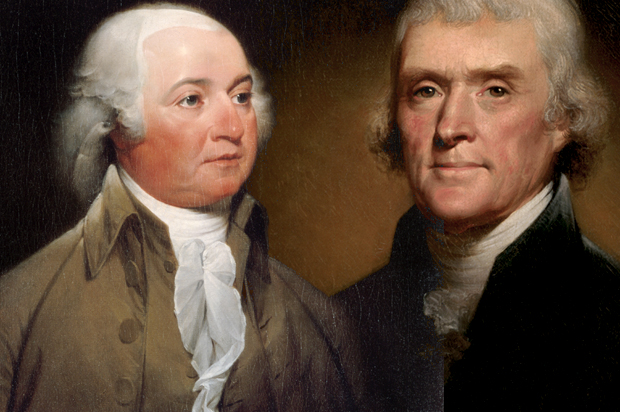
This is a combination of really bad history and undisciplined demagoguery.  What we’d like to focus on is not the fractured logic of the demagogue so much as the perversion of history by the two-term senator.  We consider it quite sad that a presidential candidate in 2012 should be resurrecting the same dirty campaign tactic that accompanied the charge that Thomas Jefferson, for five years U.S. minister to France, would, if elected president, shut down churches and burn bibles.

Start with the fact that in his superficial evocation of the 1790s, Santorum was referring not to the French so much as he was unconsciously reviving the propaganda used by New England Federalists against the “atheist” Thomas Jefferson, who championed freedom of conscience and refused to wear his religion on his sleeve.  From 1793 on, conservative Yankees predicted that the social chaos of Paris would wash ashore in America.  Indeed, conservative academics of our own time view the French Revolution as the first step toward the Russian Revolution and the rise of the Soviet Union–all of which fits neatly with the crack-brained Tea Party narrative in which President Obama is a sworn socialist and enemy of capitalism.

Mitt Romney is not beyond indulging in the same polemical game, associating Obama with European social programs.  Yet Santorum does what the Mormon cannot, by playing the “Catholic card” in his effort to “other” the president.  It is an especially bizarre move in historical relief, because the Federalist critics who most loudly warned of the French-tainted Jefferson were New England Calvinists who feared Catholics as much as they feared French anarchy.

Federalists termed the French Revolution a “contagion,” a violent, sickening, uncivilizing process.  If Santorum sees the metaphorical blade of the guillotine hanging over the heads of the Catholic bishops, it is well worth noting that eighteenth-century conservatives were so carried away by their own outlandish predictions that their panicky congressional majority passed a series of repressive laws, the infamous Alien and Sedition Acts in 1798, which first targeted French émigrés and then U.S. citizens who needed to be silenced.  The Sedition Act authorized the imprisonment of journalists and politicians who criticized the president.  The main purpose of the legislation was, as James Madison observed, to shut down free and open political debate–to derail democracy.  Cleverly drafted, the Sedition Act allowed the government to punish critics of the president, but not the vice president.  Why the omission?  Because in 1798, John Adams’s vice president was the unAmerican Thomas Jefferson.

It certainly seems that Rick Santorum reads the First Amendment just as the Federalist Congress of 1798 did.  As we all know, though, the First Amendment was intended to uphold religious freedom, protect speech, and ensure liberty of conscience.  Madison, who conceived the First Amendment, defended the last of these three principles as a deeply private, individual right shielding citizens from the coercive, invasive force of a church or state government.

It is Santorum, not President Obama, who is waging a war against religion.  It is the fear-mongers who endanger religious freedom.  Why should the Catholic Church impose its doctrines on employees who are not Catholic?  Why should any who are not Catholic be deprived of access to a health insurance benefit solely because they are employed by a Catholic hospital or university?  Why should the Church be permitted to impose its doctrines on an individual who not a member?  The First Amendment does not grant any church the power to deprive individuals of rights.

Santorum is waging a war not only on religion but on all Americans who do not share his faith.  The Catholic Church has every right to impart its doctrines; its members can accept or reject them.  The majority of Catholic men and women have rejected the particular doctrine prohibiting the use of contraception.  Employees possess the right to insurance and the right to adhere to their own religious beliefs.

As Madison argued in a 1788 letter to Jefferson, religious fanaticism was as serious a danger to religious liberty as excessive state authority.  In his words, “rights of conscience” were undermined by “overbearing majorities” who were intent on advancing the interests of a particular “religious establishment.”  In plain and simple terms, the founders meant to protect individuals against excessive encroachments by church as well as state.

We might all wish to heed Madison’s further warning:  “It is a melancholy reflection that liberty should be equally exposed to danger whether the Government has too much or too little power.”  Religious liberty required the protection of state authority, in creating a barrier around the individual and guarding against intrusions from religious institutions.

The fact remains that President Obama is no more a French Revolutionary Jacobin than Jefferson or Madison.  It appears, in fact, that the president has a very clear understanding of religious liberty, appreciating the boundaries between church and state just as Madison intended.  His promptly conceived compromise solution, respecting religion without restricting rights, fits the balanced, reasonable approach our founders prescribed when they fought, state by state, to eliminate state funding and sanctioning (i.e., disestablishment) of privileged sects.

If the last three years tell us anything, 2012 will not usher in a new Age of Reason.  Fanaticism will continue to seize the news cycle.  Rick Santorum has learned (perhaps from Donald Trump and birther mania) that the best way to grab the headlines is to ramp up the epithets, bark the loudest, and fantasize a history that never was.


An unlikely role model for Obama

James Madison was a weak and easily intimidated president, until he learned to stand up to Congress

Former president James Madison and President Barack Obama

We present a parable of sorts, about a president who learned to overcome his reluctance to confront Congress and went on to earn a prominent place in history.

As our 44th president, a one-time constitutional law professor, knows well, the framers intended for Congress to be the most active branch of government — they were far more afraid of executive tyranny than filibuster. This explains why James Madison, the fourth president, and the authority on the sacred secular text hammered out by compromise in Philadelphia, proved himself a most dynamic force as a representative from Virginia in the First, Second, and Third Congresses of the United States. But once he was elected president in 1808, he became a mild, even weak national executive.

Like 44, 4 was rationally and not emotionally driven. Two hundred years ago today, he was finding it near impossible to extricate himself from a looming war of questionable value to America’s national interests; and in his first term, the House of Representatives did more to direct the course of human events than he did.

Perhaps that is what we are seeing in President Obama’s strict adherence to a Madisonian perspective, unable to enact his preferred policies while Congress stews. Obama acquiesces, and then gets blamed for the mess he’s been put in. This is why his avid supporters are losing faith. Madison failed to live up to his promise, too. Detractors joked that he was “Whiffling Jemmy” as election 2012 (whoops, that’s 1812) approached; and he faced opposition from within his own party — from New York powerhouse DeWitt Clinton, a former close ally of Madison’s. In the general election, the incumbent narrowly defeated Clinton, who in effect ran as a third-party candidate.

Now, we’re not suggesting that President Obama has anything to fear from a New York powerhouse named Clinton. But, to move ahead with the parable, here’s what happened to the good and true James Madison: Elected to a second term, he saw the error of his ways and finally took charge, displaying his disgust with a Congress that would not act in the best interests of the country.

Madison, under the care of three physicians for a life-threatening fever, had watched as his Cabinet became a breeding ground of discontent. One day in 1813, after he had resolved to refortify his inner circle and had dispatched his most trusted, Treasury Secretary Albert Gallatin, to negotiate in Europe an end to the futile War of 1812, a committee from Congress came to him. As a group, they challenged his authority to appoint a Cabinet member to a diplomatic job. Madison let them know, in no uncertain terms, that Congress could not dictate to the president. He rejected the resolution in their presence. They bristled. Win or lose, he stood his ground, convinced of his superior understanding of the Constitution.

As far as the Constitution is concerned, Madison, though he is generally thought of as the original originalist, several times changed his interpretations about questions of the balance of powers in government. If he could, so can President Obama. Madison would be stunned, stupefied, and nauseated to learn that huge corporations get excessive tax breaks and have the federal government in a stranglehold. His were simpler times. Big business was supposed to work with the state, not drain it by purchasing congressmen.

As a congressman, Madison stood up to the speculative orgy that conveyed vast tracts of land to the wealthiest Americans while depriving hardscrabble farmers of the means to get out from under. That’s right, like today’s veterans, Revolutionary War veterans had their property foreclosed upon, as the wealthy profited. And like Obama, Madison believed fundamentally in political justice and in economic practices aimed at preventing the growth of a separate class, a moneyed aristocracy, divorced from the needs of ordinary people.

The political paralysis we are living in the midst of is not the fault of President Obama, unless you believe that reasonableness is un-American. The filibuster rule in Congress bears some responsibility. Positive policy is repeatedly thwarted by a vocal, do-nothing minority. When we think of something like the ground zero mosque panic that beset the nation last year, only to disappear before some other spectacle, which then yielded to the rising panic of the debt ceiling crisis, it seems these days that as panics come and go, “crazy” succeeds in moving the polls. So it is no single thing, but a debilitating combination of stubbornness in ideology, the panic-spectacle-makes-news impulse, a herd mentality, powerful lobbies, and procedural changes in Congress that make panic-stricken dysfunction the rule of Washington. That and, of course, the Republicans’ stated purpose of doing everything possible, no matter whom they hurt in the process, to make Obama look foolish.

There is one more piece to add to the parable. After the Constitutional Convention, Madison was unhappy because he did not get what he really wanted in the compromise that his colleagues hammered out. He wanted a powerful, censorious Senate composed of the best and brightest whose “absolute negative” (veto power) over unsound state legislation would make it impossible for ignorant, unenlightened state and local officials to hold back progress. Yes, Madison would have been happier with a federal Constitution that overrode the locals and allowed the federal government to underwrite improvements in expanding the nation — good roads, safe bridges (and, if we are to translate the concept into modern categories), high speed rail, clean energy.

The petite, sickly 4th president looked more like Michael Dukakis in a tank than George W. Bush on an aircraft carrier or Barack Obama at the podium. Which is precisely why the telegenic 44th president, capable of tremendous eloquence onstage, should be in a position of strength if he wins reelection (a big if right now) to recapture the public’s enthusiasm and enact real change instead of dithering with the short-sighted.

If the mild-mannered “Great Little Madison” could stand up to Congress, certainly Obama should be able to. He’ll do what it takes to get reelected, of course, and then, let’s hope, be more proactive and less congenial to the Tea Party purists and the filibuster-tainted, fear-mongering, epithet-mangling corporate mascots, elected on the basis of superficial attributes, whose motives Americans have learned to treat as suspect.

And if he doesn’t win reelection next year, another presidential parable might apply: the story of Grover Cleveland, the only president to serve two non-consecutive terms.  When he sought reelection at the end of his first term in 1888, Cleveland won the national popular vote, but still lost to Republican Benjamin Harrison in the Electoral College. Cleveland was candid. He took strong positions and stuck to them. He also got saddled with a massive economic meltdown in his second term, which resulted in three consecutive Republican presidents in his wake.

But Obama hasn’t lost yet, so for now, his best bet is to take a cue from President Madison, who learned not to be too nice when the opposition was dominated by folks who only directed their decision-making toward tactical, short-term gains. In Madison’s second term, the British burned Washington, which should have killed his reputation. And yet, by maintaining his integrity, 4 has fared well in history. 44 could do worse. Let’s hope he doesn’t.

Andrew Burstein and Nancy Isenberg are professors of history at Louisiana State University and coauthors of “Madison and Jefferson” (Random House, 2010).

Continue Reading Close

Sarah Palin’s vacation from history

Her constant mangling of our history is indicative of nothing so much as the state of America's celebrity culture

Sarah Palin and Paul Revere

On MSNBC’s “Hardball” Tuesday night, Chris Matthews ended the show with an extended comment about Sarah Palin’s crude concept of America. “I don’t think she’s at all interested in American history,” he said, characterizing her as a professional troublemaker.

Well, of course she’s not interested in American history. Hearing her stumble over her words as she mangled the story of Paul Revere was depressingly familiar. As history professors specializing in the Revolutionary era, we have heard our share of students returning muddled answers to basic questions. The difference between them and the former half-term governor, though, is that they are generally careful not to embarrass themselves. When they haven’t read the assignment, they’ll lower their heads and pray the professor doesn’t see them. If called out, they’ll promptly admit to a lack of preparation and promise to get their act together. Few of them ever plunge into the great unknown, and flail away, as Palin does routinely, with an off-the-wall answer, followed by a next day do-over amid protest that the professor didn’t get what she meant the first time. College undergraduates possess at least a modicum of self-respect.

It’s our job as professors to tell them what happens when you merely skim the material: You don’t comprehend the historical impact of ideas and events. In short, historical comprehension is measured by the ability to process information thoughtfully.

We should judge Palin as we do college students. She took the Boston tour, read the exhibit descriptions, and learned absolutely nothing. She apparently half-heard what the tour guide presented. Maybe she was busy thinking about how her hair looked. Regardless, she got an “F” on the Paul Revere quiz. And there’s no extra credit. Everyone knows what happens when the ill-prepared student comes to the professor’s office, hoping that by smiling, crying, or inventing excuses she can get her grade changed. But Palin thinks she can get away with an appearance on friendly Fox News, pretending that what she said was historically true. At least this time, Chris Wallace’s grin provided evidence that he wasn’t buying her dubious do-over.

Palin has a knack for blaming others for her spectacular blunders. In her ghostwritten post-campaign biography, “Going Rogue,” she accused Katie Couric of being rude when the CBS anchor asked, “What newspapers and magazines did you regularly read?” In a long-after-the-fact explanation, Sarah claimed she was tongue-tied only because she was flabbergasted. It was a matter of honor for her to refuse to answer the big-city bully.

Really, though? The ploy Palin (or ghostwriter) constantly uses is that of misdirection: Blame Couric instead of your infallible self by making it an issue of honor rather than ignorance. The dodge makes it seem that Palin could have answered but chose not to–never mind that it was a simple question.

The most obvious reason to read regularly, and read in depth, is to exhibit the kind of curiosity that makes you a more interesting person. We are wont to ask our students what reading they do outside of class. It’s only a gotcha question if you do not read. Should Palin get a free pass when she displays her outstanding lack of curiosity about American history?

What is ignorance? It has nothing to do with where you are born or whether or not you are comfortably situated in the middle class. To be ignorant is to be unaware: the state of being uninformed, unknowing, unlearned. The word comes from the Latin ignōrans, ignōrāre — to not know. It is related, of course, to the verb “to ignore.” Our society values competence and the ability to think clearly. Whether to read and discover, or to ignore, is a choice.

Sarah Palin’s real problem is that she is not embarrassed by her ignorance. Rather than recover from a misstep by engaging with a competently written text, she will generate a tactical comeback based on something an aide tells her. The impulse to ignore means that she will never truly be prepared. She will continue to fudge the facts and return, thoughtlessly, to the offensive with one of her platitudinous old reliables: Paul Revere loved freedom. And gun rights. Only the true believers, those who love her pouty, angry poses, will agree that she was right all along about the patriot silversmith.

Okay, Sarah. Here’s your guide to what you need to know about Paul Revere. He did not ring bells or fire warning shots. He did not warn the British. He did not defend “freedom.” And he did not yell, “The British are coming!” because he was a British subject in 1775. As Professor David Hackett Fischer explained in his book “Paul Revere’s Ride,” Revere would have shouted, “The regulars are coming!” That is, the regular army. Americans in and around Boston were called “country people.” Revere was not defending a nation, because the nation we became did not exist yet. Before the phrase “United States of America” was born with the Declaration of Independence, those resisting British power, identifying with the Continental Congress, were collectively known as the “United Colonies.”

Paul Revere became a legendary figure not in 1775, when he rode, but around the time of the Civil War, owing to the phrasings of Henry Wadsworth Longfellow. The poet’s famous work, “Paul Revere’s Ride,” invented a mythic lone rider who sent up his “cry of alarm to every Middlesex village and farm” and held the “fate of the nation” in his hands. To be historically correct, Revere was asked by the courageous Harvard-trained physician Joseph Warren to ride out of Boston and warn Samuel Adams and John Hancock that the regulars were pursuing them. But he didn’t make it past Lexington, where Adams and Hancock were staying, because he was detained by British soldiers. He never reached Concord.

Nor was he alone in this enterprise. A rider named William Dawes followed an alternative route from Boston, outpacing Revere, and there were many others who acted as messengers. It must surprise all of us who attended elementary school that “One if by land, two if by sea,” the lantern message celebrated in Longfellow’s poem, was not performed by Revere; nor does he receive the message on the opposite shore. The lantern did not make much of a difference in the night’s events. Bells rung or shots fired as the regulars approached Lexington were carried out by unnamed locals. The people opposing the soldiers were roused, indeed–not by Revere, but by a host of country people.

If there must be a hero of that night, as the battles of Lexington and Concord impended, it was Dr. Joseph Warren, who was martyred two months later when he took up arms as a simple soldier at the Battle of Bunker Hill. And why was it that Longfellow wrote the “Midnight Ride” poem in 1861? As the grandson of a man who knew Revere personally, he was looking for a historic model in rallying New Englanders to take up the gauntlet against slavery and defend the ideal of liberty on the eve of the Civil War.

Getting history right should matter more to the politicians who invoke it in limelight-grabbing statements before the cameras. Sarah Palin’s constant mangling of our history is indicative of nothing so much as the state of America’s celebrity culture. If she travels in a big fancy bus, adorned with a mock-up of the Constitution, it is imagined that she loves America and loves its history. The truth is that her approach to the nation’s past is merely an extension of her ongoing Reality TV show. Instead of the wilderness of Alaska, of which she is admittedly something of an expert, she is venturing into a foreign country when she weighs in on United States history.

We are not so cynical as to suggest that her visit to historic sites was completely contrived. But when she boasts of how proud she is of “real” Americans of today or yesteryear, she ought to know what she’s talking about. Chris Matthews says he thinks she sees the federal government as the modern equivalent of an oppressive British government circa 1775. He sees her purposes as sinister. He reads national politicians for a living.

For us, the matter is more one of a basic respect for knowledge. For without intellectual engagement (and working at getting facts straight), you’re not qualified to tell TV viewers that you have a vision for America’s future. Sarah Palin has cashed in on being the McCain campaign’s most unforgettable foul-up; as a result, she is able to go on vacation pretty much whenever and wherever she wants. This time, though, she took a vacation from history.

Continue Reading Close

Is Obama “American” enough for the far right now?

Why even killing of the world's most notorious terrorist probably won't eradicate the scourge of "birtherism"

In this image released by the White House, President Barack Obama makes a point during one in a series of meetings in the Situation Room of the White House discussing the mission against Osama bin Laden, Sunday, May 1, 2011. National Security Adviser Tom Donilon is pictured at right. (AP Photo/The White House, Pete Souza)(Credit: AP)

Now that President Obama and his national security team have proven their mettle in pursuing and finally eliminating the supreme Islamic terrorist, a question arises: Will the not-insignificant chunk of voters who have rejected the president’s basic legitimacy — expressing skepticism about the circumstances of his birth in the face of conclusive proof that he was born here — be more likely to view Obama as “American” now?

On CNN’s “Reliable Sources” over the weekend, Washington Post reporter Nia-Malika Henderson suggested that the birther movement may not be about race. She compared the buzz around the issue to those conspiracy-minded individuals who tied Bill Clinton to the “murder” of Vince Foster in 1993 — an observation that other have made as well. It just seems too easy to describe the ruling passion of those who label President Obama a secret Muslim (or, to recall Mike Huckabee’s infamous slur, a Kenyan revolutionary), as strictly racist. History, though, yields enough clues to suggest that journalists who look for alternative explanations are wrong.

Birtherism has a distinctive history. If you go to the birther.org website, you will find a history lesson along with their creed: “The Birthers: Dedicated to the Rebirth of the Constitutional Republic.” Much like the Tea Partiers, birthers have linked themselves to America’s founding fathers. Their fealty to the Constitution is centered on a single phrase in Article II that requires the president to be a “natural born citizen.”

What does the all-important phrase mean? Birthers interpreting Article II say that “the president must above all else be loyal to this nation.” It is a “self-evident” truth that such loyalty is drawn from nature–and they are quite explicit about what that means: “kinship, our most primitive and natural form of citizenship, from blood”; a nativity which comes “from the soil,” or “place of birth.” It is an ideal of kinship that energizes the birther movement—the transmission of civic identity by descent, through bloodlines, from parents to children.

The website also makes it clear that, for birthers, a natural-born president must have natural-born parents, and that civic identity only exists in a homogeneous population. “If the parents were split in their loyalties,” the website declares, “the child would be split in loyalty to America.” Mixed heritage is thus a liability, for it undermines proper patriotic breeding. Indeed, for the birthers, the breeding question is inextricably linked to a person’s genetic vulnerability.

President Obama was raised by his white, midwestern mother, and her parents. But his actual upbringing matters not a bit to birthers. For most of them, Obama is his father’s son, because kinship is measured though the traditional order of the father’s line. To make their claims stick, birthers have had to erase President Obama’s mother from the fanciful narrative of his African birth. Just as Glenn Beck indelicately declared that Obama had an instinctive hatred of white people, birthers divorced him from his mother’s family. The father he hardly knew remains the dominant force in his life; the president cannot be an American because he is loyal to his patriarchal line, that is, to his father’s race.

Not surprisingly, the birthers have the Constitution all wrong. The delegates who attended the convention in Philadelphia in 1787 were not much concerned with the president’s nativity. In establishing the chief executive’s qualifications, the initial proposal focused on age and duration of residency, and said nothing about his being a “natural born citizen.” The founders made no mention of any requirement that the parents of the president be natural born citizens either. Nor, for that matter, did they require the president to be a Christian. Abigail Adams, the wife of the second president, referred to her daughter-in-law, Louisa Catherine, who married John Quincy Adams, as a “half blood”; by this cultural (though not legalistic) designation she meant that one parent was American, the other English. In sum, the founders could easily have specified that the president have “natural born” parents. But they did not. The reason is obvious. Any talk about kinship and bloodlines bore the taint of aristocracy and royalty, a caste system the founders had rejected during the Revolution.

The convention delegates did, however, vigorously debate the requirements for senators and representatives. Some delegates expressed fears of “foreign attachments”; future vice president Elbridge Gerry of Massachusetts indulged in some wild conspiracy mongering when he proposed longer residency requirements for House members to prevent the possibility that foreign governments (he meant the British) might send spies to infiltrate the federal government. He hoped that, in the future, only the native-born would be eligible to serve in the House.

Yet even Gerry could never have imagined the 21st-century birther conspiracy, the most extreme versions of which evoked the “Manchurian Candidate,” a plot so cleverly devised that the institution of the presidency could be subverted by placing a secret Muslim in the White House. In fact, the deepest fear the founders expressed had nothing to do with the president’s qualifications. Instead, it was the military powers with which the Constitution endows him. They worried that as commander-in-chief, he might be bought off by a foreign government and drawn into unnecessary wars at the behest of an ally to whom he felt personally indebted. To counteract their fear, the framers insisted that Congress alone be authorized to declare war.

Despite all their efforts, the birther movement cannot look to the founders for its inspiration. Their ideas grow out of a traditional obsession with the legal status of free blacks and mulattos in the decades before the Civil War. When a firestorm of debate flared over Missouri’s admission to the Union in 1819-1820, northern and southern congressmen tangled and principles yielded to racial prejudices. Missouri’s proposed constitution barred blacks from entering the state who were not the legal property of white men. While northerners argued that free blacks were not “aliens or slaves,” but “free citizens,” opposing politicians and jurists twisted the law to justify the argument that native born free black Americans could be denied the same constitutional protections that native-born white Americans claimed. In the years before the South finally seceded, judges issued decisions in which free blacks were described as “our wards” or “strangers to our Constitutions.” Mississippi’s highest court categorized free U.S. residents of African descent as “alien strangers.”

The question of how to define a natural-born citizen reached the Supreme Court in the notorious Dred Scott case of 1857. Chief Justice Roger B. Taney (appointed by unapologetic slave-owner Andrew Jackson) argued that free blacks were never contemplated by the founders as part of the national community. Insisting that African Americans were not recognized as citizens in any state, before or after the Revolution, he dismissed all contrary evidence. To Taney, as with the birthers, facts were irrelevant.

Taney’s goal was to restrict citizenship to one of two processes: naturalization or biological inheritance. Blacks had been explicitly excluded from citizenship in the federal Naturalization Act of 1790, he noted. Even more telling, according to constitutional historian James Kettner, Taney wished to ignore “volumes of judicial precedents emphasizing place of birth without regard to ancestry.” Taney thus transformed “natural born citizen” into a racial category.

The birthers have the same idea in mind. Ultimately, they don’t really care what it says on President Obama’s birth certificate, short or long form. For these modern-day Taneyites, Obama’s citizenship is questionable because his civic identity is tainted by descent — he is, unmistakably, the son of an African man. The birthers, like Taney, believe that a natural-born citizen must be possess the right pedigree: he must descend from the same race as the founders, or be born on U.S. soil in the image of the founders. For Taney, the national community was a closed community. Even if they haven’t gone so far as to say so explicitly, for today’s birthers the presidency is an exclusive club.

Their obsession with placing Obama in Africa at the moment of his birth was a means to diminish the influence of his mother, Stanley Ann Dunham. Republican hopefuls Newt Gingrich and Mike Huckabee deliberately circulated the strange story that Obama’s politics can be traced, genetically, to the anti-colonial revolutionary rhetoric that once existed in his father’s homeland.

But what about the equally ridiculous claim that Obama’s paternal grandmother testified to her grandson’s birth in Kenya? Why did that idea capture birthers’ imaginations? Here, historical precedent may again shed light. In 1907, a law was passed in the United States stating that any natural-born female who married an alien automatically lost her citizenship. She was expatriated without her consent. Compare that to the law that prevailed from 1855 to 1922, by which any alien woman who married an American citizen immediately became a citizen, bypassing the normal naturalization process.

It was a longstanding tradition in American history that a wife’s civil and political rights came through her husband. Under the law, marriage made husband and wife “one person.” The argument that citizens cannot have two allegiances was applied to wives: her first allegiance was to her husband. She could not vote or exercise political rights, because she had no independent civic identity. Her husband acted as her political proxy, voting in her stead. Recall that women did to receive the right to vote until 1920.

The birthers, too, in recurring to antiquated racist assumptions, assume that President Obama cannot have dual allegiances. Either he is all-American or else his true loyalty resides elsewhere. Birthers have made Obama’s mother a cipher all over again. Her political identity was subsumed into her African husband’s. In effect, he “voted” for her. Because she is deceased, it has been easy for birthers (not to mention the hubristic Donald Trump) to erase the president’s mother from the picture. She was never able to testify. And her World War II hero father presumably had no need to; his service to his country should have spoken volumes.

At the time of the 1907 law, women who married aliens were considered unpatriotic. Until 1967, interracial marriages could still be considered illegal in most southern states. What matters to birthers, subconsciously or otherwise, is the taint of foreign blood, the taint of African blood, Obama, Sr.’s alien status. Stanley Ann Dunham had made an unnatural and unpatriotic choice of a husband.

The racism of the birther movement, then, is not just a wacko conspiracy. Adherents of this new old cause have a large following because of our country’s troubled history. Of course, Americans are by no means the only culture to rationalize discrimination on racial and gender grounds. It happens on every continent, constantly. In the modern age, anxiety over what makes a “real” American is most often tied to wartime, or “Cold War time”; but in this case, it was the “national emergency” of a person becoming president whose physiognomy tapped into vestigial fears.

Finally, there is the newly hatched probe (thank you, once again, Donald) into the president’s educational pedigree. For hardcore birthers, President Obama cannot possibly deserve his office. There must be a catch somewhere. How, akin to “uppity” free blacks past, did he move into elite circles from which black aspirants were traditionally barred? The world has been turned upside down for birthers.

The term “birther” has always sounded idiotic. If they want a more legitimate-sounding name, they should call themselves “descenters.” For what they really seem to be defending is that every child inherits his nationality from his father, just as he inherits his surname: Barack Hussein Obama II instead of Barry Dunham.

In their campaign to unearth the secret life of President Obama, birthers make descent more important than consent — the republican principle that Americans choose their officeholders by popular election. For them, nature trumps consent. According to their logic, natural-born presidents have natural-born American parents. And by nature, they mean the traits passed down from one’s ancestors to his rightful heirs. We’ve seen this logical construction before: it worked for something known as the “divine right of kings.” Loyalty to the sovereign? Didn’t we, at some point, declare national independence in order to move beyond that sort of thinking?

So maybe those who suggest that it’s not just racism that motivates the birthers really are on to something. Maybe it’s something that really is un-American..

Continue Reading Close

What they really mean by “American exceptionalism”

Obama's cosmopolitan bearing and generous spirit are being translated as subversive of a "real" American character

People gather at the Capitol for a "Remember in November" rally to express opposition to government spending, particularly bailouts and economic policies backed by President Obama and Democrats in Congress, in Washington, Sunday, Sept. 12, 2010. (AP Photo/J. Scott Applewhite)(Credit: J. Scott Applewhite)

Newt Gingrich can’t get enough American exceptionalism. In “A Nation Like No Other: Why American Exceptionalism Matters,” due out soon, the former House speaker and prospective Republican presidential candidate gives a new definition to the term, linking it directly to conservatives’ understanding of the importance of the individual relative to the power of government. “That is why President Obama and the Left hate American Exceptionalism,” he writes. They hate it because it stops them from expanding government power? That’s a pretty crazy argument.

Gingrich holds a Ph.D. in history, so he shouldn’t mind if we investigate where the notion of American exceptionalism came from as we track what it has come to mean. Let’s begin with some early examples of the phenomenon:

In 1771, Connecticut clergyman and future Yale president Timothy Dwight published a poem that spoke to a continent’s promise. “AMERICA’S bright realms arose to view, / And the old world rejoic’d to see the new.” The newness of America, its unexplored expanse, produced a kind of ecstatic expectation among Revolutionaries, which enlarged as Britain acknowledged independence in 1783. In that year, another of Yale’s presidents, Ezra Stiles, proclaimed that a “great people” would arise in America; and that by the year 2000 they would outnumber the Chinese, as a nation “high above all nations which [God] hath made.”

In his momentous First Inaugural Address in March 1801, Thomas Jefferson called America “the world’s best hope.” That same month, to Dr. Joseph Priestley, scientist and theologian, he wrote, even more sublimely: “We can no longer say there is nothing new under the sun. For this whole chapter in the history of man is new. The great extent of our republic is new.” Jefferson and his peers were men of the 18th-century Enlightenment, at once idealists and pragmatists. Their complete adoration of science augmented a belief that the world would improve as tyranny was overthrown, the cause of education promoted, religious superstition undone, and the lives of all people enriched. Americans rejoiced in calling theirs an “infant empire,” morally strong and liberty-loving.

The United States was an experiment in republican government being carried out on an unimaginably large scale. From the start, American patriots needed a “brand,” because they were competing for global stature with the well-developed, culturally and militarily advanced nations of Europe. Already on the defensive owing to the canker of slavery that infected the body politic — it troubled the founders deeply — they had to find ways to rationalize the violence that attended government-sponsored continental conquest. So they broadcast a self-anointed identity as the moral benefactors of all whom they encountered.

Surely, Newt Gingrich would be uncomfortable with the central role played by the French in promoting the positive concept of American exceptionalism. In 1782, the French cosmopolitan J. Hector St. John de Crèvecoeur authored the well-read “Letters of an American Farmer” and posed the question: “What Then is the American, This New Man?” Born in France, Crèvecoeur migrated to New France (Canada), and became an American citizen before spending his last years back in France. The French aristocrat Alexis de Tocqueville traveled to the United States in the 1830s, studying its institutions and mores, concluding as his literary predecessor had that Americans were unique. He found that their penchant for community, for joining reform-minded associations and acting in concert, made them different from Europeans.

Early Americans’ sense of their exceptionalism conferred collective self-confidence. They saw America as fresh, unsullied and unique in its mission; its political culture, more humane than any other on earth. They wrote, in a maritime era, of American merchant seamen going ashore in distant lands and spreading the word of American liberty. It made good copy, reassuring them that their countrymen stood as moral exemplars everywhere. Liberty was infectious: They would bring new life to the effete Old World and encourage political progress there.

The cosmopolitan Enlightenment had morphed into democracy’s worship of individual and collective acquisitiveness. In his recently published book, “The Citizenship Revolution,” historian Douglas Bradburn writes: “The cosmopolitanism of the Revolutionary Age dissipated in the Romantic exceptionalism of the nineteenth century. With the opening of the boundaries of the United States into the vast space beyond the Mississippi, the country turned its mind away from Europe and began a century of precocious aggression and expansion within its own hemisphere.” The secular missionaries of the founding era easily graduated to “benevolent exploitation” of America’s wild, privileging the “infant empire’s” vision of growth over the rights of “less civilized” Indians and Mexicans. Romantic novels about proud Western pathfinders fed the spirit of exceptionalism.

And so it was until the imperial age that succeeded the Civil War, as the U.S. competed for colonies. Hawaii, the Philippines, Cuba were just the beginning. A modernizing military was dispatched overseas to match, and finally exceed, what the European powers had been doing all along. The degree of confidence in America’s superior system continued to enlarge, as political and economic freedom produced invention and industrial combinations that government used to grow its military and extend its reach abroad.

These, then, are antecedents. Putting Gingrich’s claims aside for the moment, two questions Glenn Greenwald posed in Salon on March 29, with respect to the administration’s limited role in Libya and elsewhere in the Islamic world, remain unanswered: “Does the U.S. indeed occupy a special place in the world, entitling and even obligating us to undertake actions that no other country is entitled or obligated to undertake?” And, “Is it merely our superior military power, or is there something else that has vested us with this perch of exceptionalism?” It is unlikely that the public will agree on its answers to these questions any time soon.

We should pause for just a second to reflect on how the actual term “American exceptionalism” was first used in print. According to the Oxford English Dictionary, it was Marxist periodicals of the 1920s that adopted “exceptionalism” in recognizing that labor conditions in America suggested a strategy distinct from that which communists were using to advance their cause in Europe.

With or without Newt Gingrich, the tone communicated by the ever-evolving term “American exceptionalism” will continue to be an indicator of one’s political identity. It is unfortunate that the political discourse these days dictates that you can’t love your country if you don’t believe in its exceptionalism. Such oversimplification is one of the reasons why national campaigns focus on symbolic language instead of substantive problems and the alternative plans candidates propose to resolve them sensibly.

Exceptionalism seems to mean, “We lead, others follow.” Instead, let’s try: In spite of our commanding power, we lead judiciously by consulting with allies and seeking widely agreed-upon solutions to international crises. Can’t America be unique among nations without dictating? That seems to be the true articulation of President Obama’s view of the contested term. His restrained view of exceptionalism (the Brits have theirs, the Greeks theirs, too) is an attitude, a sensibility, responsive to recent history; it flows from the recognition that the Bush-Cheney crowd promptly squandered the goodwill of the world after 9/11 by making unilateral decisions, and invading Iraq under false pretenses. But in a speech at Liberty University last fall, Gingrich insisted that Obama’s reference to the Brits and Greeks “proves” that he doesn’t have “any idea what American exceptionalism is.”

Has America lost its mojo in the Obama age? Wall Street’s reckless self-aggrandizement and persistent joblessness aside, there’s no reason to think it has. But the panicky voices that cynically (perhaps destructively) call for artificial testaments of jingoistic pride make it sound like the president, with his measured approach to just about everything and his fundamental discomfort with strutting and boasting, is not “American” enough.

Let’s call things what they are: Personalizing the exceptionalism question is a partisan tactic. The president’s cosmopolitan bearing and generous spirit — the core values of the secular Enlightenment that gave birth to the idea of America — are being translated as somehow subversive of a “real” American character. It’s never explained, of course; but when it’s not code for a critic’s sublimated racism, it’s the fear-projecting notion that we are locked in a cultural zero sum game and if the U.S. compromises on its long-declared justification to use its power wherever it wants to, then somehow the nation forfeits its preeminence and cedes to the Europeans (or worse, China) the claim to 21st century dominance.

If this devaluation of American power occurs, it will not come as a result of a president’s reasonableness. In any case, Obama has only compromised America’s values by allowing the conservatives’ perverse message of fear (e.g., Obamacare will take away your freedom) to win adherents. American exceptionalism is, in truth, not a tangible or measurable quality, but a buzzword that promises — with no reliability — that the sky won’t be falling any time soon.

Historically, exceptionalism has never been incompatible with isolationism. Those who consider Obama poisoned by “foreign ideas” (as conservatives of the 1790s claimed Jefferson was!) are expressing the flip side of an argument; whether it makes logical sense hardly matters. Gingrich’s new book, called a “blockbuster” and a “game-changer” by his publisher, wants to make the conversation about big versus small government. He also promises to bring God into the equation, as part of his 2012 effort to distance Obama from both Christian values and what the history-conscious conservative cherishes most: the founders’ God-scented definition of American exceptionalism. Of course, Gingrich’s premises are wrong: Exceptionalism made convenient use of, but did not need, God; and it was never about left versus right.

Gingrich earned his Ph.D. from Tulane University in 1971, the year that Liberty University was founded by Jerry Falwell. Newt’s dissertation, never published, was titled: “Belgian Educational Policy in the Congo, 1945-1960.” We would not challenge his authority in this area. But he claims to be an authority on U.S. history, where his reading appears to be rather selective. At Liberty, when he previewed his forthcoming book, he warned that “American Civilization is in greater trouble today and in greater danger of disappearing than it was in 1971.” He went on, seizing his new mantra: “American exceptionalism refers directly to the grant of rights asserted in the Declaration of Independence.” And who does he say is to blame for deliberately undermining a proper reverence for America’s founding documents? “The secular socialist assault on historic America has been growing for more than two generations among our intellectual elites in schools and news rooms and the entertainment industry and increasingly among judges, bureaucrats, and now elected officials.”

This is what we have to look forward to as Newt traverses the country in quest of next year’s GOP nomination. He will reduce the notion of American exceptionalism to simple black and white. The new American exceptionalism debate will invite insecure potential voters to add to their existing stock of catechisms: They don’t care to explore the spectrum of meanings that the word “freedom” possesses; they know “socialism” only as “government invasion”; and they survive on the faith that America is “the greatest country in the world.” And that’s how things will remain for a while, because subtlety doesn’t poll well.

Andrew Burstein and Nancy Isenberg are professors of history at Louisiana State University and coauthors of “Madison and Jefferson.

Continue Reading Close

Still lying about history

Haley Barbour is catering to those who fondly recall the Reconstruction-era resistance of southern whites

D.W. Griffith's 1915 film "The Birth of a Nation" featured a character very similar to Nathan Bedford Forrest

Surprise! Mississippi Governor Haley Barbour has put his foot in his mouth. His impulse when confronted by reporters earlier this week was to refuse to condemn those in his state who would resurrect the infamous Confederate General Nathan Bedford Forrest, slave trader and Grand Wizard of the Ku Klux Klan, and put his image on a commemorative license plate. “I don’t go around denouncing people,” Barbour said.

Nostalgia for the “War Between the States” is a fact of American life. But Barbour’s failure to do the right thing comes close on the heels of another embarrassing episode in which the onetime chairman of the Republican National Committee claimed that racial segregation and violence had not marred his hometown of Yazoo City, Mississippi during his younger years in the 1950s and early 1960s.

The reason for Barbour’s latest gaffe is that his Tea Party constituency wants to “take the country back” to Nathan Forrest’s time, Reconstruction, when something “had to be done” to arrest the trend of Black Republicans undermining the power structure of the white South. The Obama administration is the perfect foil: A liberal black man from the Land of Lincoln (or maybe Africa?) is imposing the heavy hand of federal authority on the “prostrate” South all over again.

Now, here’s where historical perspective comes in. Forrest’s appeal can be ascribed to early Hollywood. Someone very much like him was glorified in the D. W. Griffith silent film, “The Birth of a Nation,” a record-breaking production released in 1915 and commended by the Virginia-born President Woodrow Wilson. With a little movie magic, the rapacious Forrest was remade into Ben Cameron, the “Little Colonel,” a suave, heroic figure with black curls and a dapper mustache.

In the movie, watching impatiently as his fellow whites are crippled politically and government corrupted, Cameron organizes a secret militia — the KKK. Unlike the men actually aligned with the historical Nathan Forrest, who wore hoods and looked like bandits, Griffith cast them as medieval knights. The Little Colonel thus becomes the savior of the South, rescuing Lillian Gish from the black Republican lieutenant governor, who has kidnapped her, tied her up, and intends to make her marry him. The message of the film is one of white unity: as old sectional divisions fade away, Union and Confederate veterans stand together against their racial opposite. One of the subtitles puts it this way: “The former enemies of North and South are united again in defense of their Aryan birthright.”

That’s the Forrest image, courtesy of Hollywood. Today’s southerners probably know very little about the real Forrest, but they have seen him revived in “Forrest Gump.” The Tom Hanks character was both namesake and descendant of the general. In fact, the dramatic charge on horseback of Griffith’s movie was spliced into the blockbuster 1994 film. In another sense, though, the new Forrest is an unflattering reincarnation, because Gump is mentally disabled and blindly moves through history with no real consciousness of what is happening around him.

But perhaps that’s the appropriate analogy, because Haley Barbour pretends to be as naive as Gump when he sees no evil. In Tea Party times, the governor finds that political life is a box of chocolates: you never know what you might get. Of course, Barbour knows what’s inside the box. As a seasoned politico, he wants to have his chocolates and eat them, too. Winking at the Dixie-Gray Tea Partiers who’ll believe he’s really one of them, he simultaneously avoids any explicit endorsement of their game of symbols. In the name of southern honor (i.e., white honor), he refuses to bow to liberal pressure or the NAACP, just as the Little Colonel refused to shake hands with the black Republican governor in the silent film. Let us next imagine Colonel Barbour at a rally for Civil War re-enactors, saying proudly: “No, sir, I do declare, I will not tarnish the Old South’s history nor forsake its standard bearer, General and Grand Wizard Nathan Bedford Forrest.”

It seems clear that Forrest was chosen for the dubious honor of gracing the Mississippi license plate because he is notorious. He has his own chapter of the United Daughters of the Confederacy, established not in Tennessee (his birthplace), and not in Mississippi, but in Indiana; and not in 1877, when he died, but in 1996. Nor does Forrest reflect any of the glory given to General Robert E. Lee, whose popularity among the women of the South led a grateful people to erect numerous statues to him in town squares across the region. Lee was the Confederacy’s George Washington, hailing from one of the first families of Virginia, and the son of General “Light Horse Harry” Lee, who fought in the Revolution and who famously eulogized Washington as “First in the hearts of his countrymen.”

Forrest, in contrast, played a central part in one of the most despicable murder sprees of the Civil War. At Fort Pillow, in Tennessee, black soldiers (twice as many as white) were brutally slain after having surrendered. Forrest was an officer out of control, one who violated the rules of war and that vaunted sense of honor supposedly so dear to the Confederacy. Nathan Bedford Forrest — the historical figure, not the movie version — embodied racial hatred in the most vicious way. He was elected the head of a terrorist organization after the war ended; it is well known that attacking civilians and spreading fear through violence was the modus operandi of the KKK. So, to put the ignoble Nathan Bedford Forrest on a Mississippi license plate would be no different than featuring Timothy McVeigh on an Oklahoma tag.

People lie about history all the time. It is common practice among politicians, as we all know. Occasionally the lie comes in the form of symbols that speak to history but thinly veil enduring prejudices of our own time. Governor Haley Barbour appears not to care that his old boy’s game does not play well outside certain corners of the South. And there are an awful lot of southerners who are dog tired of whistling Dixie and calling for nullification and secession. These are empty symbols without legitimacy in modern America.

Haley Barbour may try to ride the Little Colonel’s coattails in defense of the Old South, but it won’t take him far. It can be said with some assurance in 2011, whether it’s Barbour or Bachmann or any other Republican, that those who play dumb when it comes to history will find the White House one gated community they’ll be barred from entering.

Andrew Burstein and Nancy Isenberg are professors of history at Louisiana State University, and most recently co-authors of “Madison and Jefferson.”

Continue Reading Close

Page 1 of 2 in Nancy Isenberg

www.salon.com/writer/nancy_isenberg/index.html