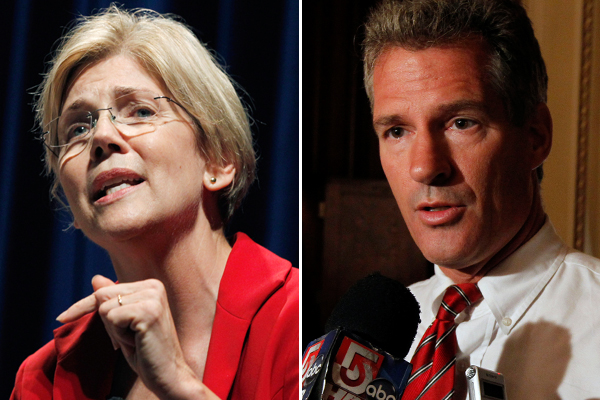
The so-called People’s Pledge seemed like a somewhat gimmicky win-win proposition for both incumbent Republican Sen. Scott Brown and his Democratic challenger, Harvard professor Elizabeth Warren, in their race for the seat once held by Ted Kennedy. The idea, proposed by Brown, was to staunch the flow of super PAC money into the race with an agreement of elegant simplicity: If a candidate is attacked by name in an ad, then the one who comes off looking better is obliged to donate half the cost of the ad buy to a charity of the other candidate’s choice. Pretty simple: Why shoot yourself in the foot, right?
The trick in the gimmick became clear this week when Brown announced that he was holding up his end of the pledge, agreeing to pay half the costs of an ad from a group called Coalition of Americans for Political Equality (CAPE PAC) and asking it to pull its Google ads promoting him. The group’s website is now offline. Jeff Loyd, a Tea Party activist from Arizona who chairs the PAC, confirmed that his group spent all of $673.99 in pro-Brown online advertising with Google.
Brown’s ostentatious willingness to be the first to trigger the enforcement mechanism against himself displays a street-smart opportunism that the Warren camp, for all her populist credentials, lacks. Far from shooting himself in the foot, the penalty amounts to $327 out of the $13 million in his campaign coffers. It was money well spent to help burnish his image as a moderate and man of the people, even as he raises more than $2 for Warren’s every $1. (Warren has raised $6 million to date.)
“Sen. Brown is a man of his word,” Brown’s campaign manager, Jim Barnett, trumpeted in a letter to CAPE PAC. “And as a result of your advertising on his behalf, he will honor the agreement by paying out of his campaign account an amount equal to 50 percent of your spending. In short,” the letter continued, “while your advertising on his behalf is clearly intended to be helpful, it is actually costing his campaign valuable resources.”
CAPE PAC’s Loyd said he killed the ads reluctantly at Brown’s request.
“We regret the candidates in this race are asking for groups like ours to suspend our constitutionally guaranteed freedoms to campaign in support of whatever candidates we choose,” he said. “However, we respect the wishes of our supporters and as such will honor their requests to suspend our advertising campaign in support of Senator Brown.”
The statement from Brown’s campaign stressed that this was the very first time that either candidate had taken tangible action to enforce the pledge: “Notably, two pro-Warren groups, ReThinkBrown and BoldProgressives, also ran Google ads after the signing of the historic People’s Pledge,” it added pointedly, putting Warren on the defensive.
The Warren campaign seemed to be slightly caught off guard by the GOP attempt to co-opt the money-in-politics issue. It found itself in the unenviable position of having to acknowledge Brown’s move to honor the pledge, even while defending itself against a cheap shot thrown late.
“To the best of our knowledge, those ads [bought by ReThinkBrown and Bold Progressives] were run prior to the [Jan. 23] pledge and were taken down almost immediately,” Warren spokeswoman Alethea Harney told Salon. “We’ve asked Warren supporters to provide us with suggestions for the charity,” she added.
Defanging Warren on her big issue — money in politics — is a smart tactic for a Republican looking to get reelected in the most liberal state in the country. By not acting like a Republican, and sometimes reaching across the aisle, Brown has stood out as a voice of reason in the GOP wilderness who sticks with his party only 54 percent of his time, according to a Congressional Quarterly study of his 2011 voting record.
After an initial burst of enthusiasm that launched Warren’s campaign with great fanfare last fall, the Brown campaign has eclipsed her. Warren, who was leading a few weeks ago, now trails by 9 and 10 points, according to two recent polls. By compromising with the president now and then, and distancing himself from the Tea Party movement that swept him into office, Brown never misses a chance to tout his record as a flexible pragmatist. All mention of the Tea Party has been scrubbed from his site.
While Brown voted against tax hikes on the rich, he has gone against the GOP grain by backing a sweeping bill to curb insider trading by members of Congress; Republican leaders favored a narrower bill. He also supported the Obama administration’s plan to allow homeowners to refinance their mortgages if they are “underwater,” owing more than what their homes are worth.
At the same time, Brown has sided with Big Oil consistently and supported an effort by fellow Republicans to ban the Environmental Protection Agency from regulating greenhouse gases linked to global warming. Most egregiously, he stood squarely with the Senate GOP on contraception, co-sponsoring the narrowly defeated Blunt Amendment that would have permitted employers and insurers to restrict access to birth control.
Yet this proved to be a safe gamble in Massachusetts with its large number of Roman Catholics who use birth control faithfully. Even if most parishioners who make it to the pews each Sunday believe insurers should offer contraception in their employee healthcare benefits package, they don’t mind if their senator takes the same stand that’s preached from the pulpit. That issue, stalking Romney through the primaries, has not hurt Brown much, even after Brown was roundly condemned by the Kennedy clan for misrepresenting his predecessor’s position on contraception.
Brown’s new persona was on display last week when he told a group of military veterans on the north shore of Boston a colorful tale about how he managed to get Obama on board with his insider trading bill by calling out to the president after his State of the Union speech.
“The whole row cleared out and, therefore, I actually get to walk up right next to the aisle as the president’s coming up, and I’m saying to myself, ‘Man! He wants an insider trading bill. I have one,’” Brown told the vets. “So I said, ‘Mr. President, my insider trading bill is on Harry Reid’s desk. Tell him to get it out.’ And he looked right at me and he says, ‘I will. I’ll tell him to get it out.’ Problem was he was miked up live with Fox.”
Brown boasted dubiously that the exchange brought the bill to the Senate floor where it passed, proof, he said, that he “gets things done.” It’s a winning strategy for a Republican in Massachusetts, and he only needs to look at his latest polling numbers, which show him leading among independents, voters under 50, voters over 65, and in central and western Massachusetts, according to the most recent survey from Western New England University.
The departure of Maine’s GOP Sen. Olympia Snowe, the most bipartisan member of Congress, also served to boost Brown, as she gave him a ringing endorsement on Thursday. ”In an institution characterized by gridlock and partisanship, Scott Brown is a much-needed breath of fresh air,” Snowe said in a statement.
As Brown bobs and weaves to the center, Warren has to figure out how to lay a glove on him. She hasn’t done so in a while.
Cracking down on contraception was never the way for Mitt Romney to ingratiate himself with voters in Massachusetts, even the Roman Catholics who mostly see it as a moral neutral. Now that that position is coming back to haunt Romney like the ghost of Christmas past, he’s taking cover with the religious right. And after last night’s surprising three-state sweep by social conservative Rick Santorum he’ll need all the cover he can get.
Some Catholic leaders in Massachusetts are already (finally) speaking up against what they see as Romney’s politically convenient about-face in the emergency contraception debate. C.J. Doyle, executive director of the Catholic Action League of Massachusetts, told Salon he didn’t want to “let Romney off the hook because the initial injury to Catholic religious freedom came not from the Obama administration but from Romney’s administration”; he explained that there was a preexisting exemption for religious institutions already in the Massachusetts law that was stripped out on the advice of Romney’s gubernatorial legal counsel. “President Obama’s plan certainly constitutes an assault on the constitutional rights of Catholics, but I’m not sure Governor Romney is in a position to assert that, given his own very mixed record on this.”
Doyle said Romney was “very consistent at working both sides of the street on the same issue,” but his record on this has been “one of cynical and tactical manipulation.”
He agreed that Romney’s old pro-choice agenda has been somewhat overlooked by his conservative religious brethren. Romney can only pray that they hold off, and they may do so just as long as he continues to kowtow to them. Coming out in favor of the Susan G. Komen Foundation’s decision to pull the funding plug on Planned Parenthood covered his right flank this week, though evidently not well enough for conservative voters. Romney said, unequivocally, that the government should follow suit, but yesterday’s election results could complicate his well-documented problems motivating conservative voters.
It all seemed to reach a crisis point in the campaign as voters spent yesterday coalescing around Santorum, the staunchest social conservative in the race. Santorum won first in the Missouri primary, then in Minnesota’s caucuses and, finally and most impressively, in Colorado, which Romney had dominated with 65 percent of the vote four years ago.
None of these contests award delegates, but the results are gloomy for a candidate looking to consolidate his lead. Newt Gingrich’s best showing for the day was a third in Colorado but, with Santorum, he’s giving Romney a fright.
Romney is suddenly now so opposed to contraception that he vowed this week to eliminate all funding for federal family planning and make women pay out of pocket for birth control. That’s a long way from what’s on offer in the Bay State thanks to our former governor.
Going way back to 1994, when he backed abortion rights as a Senate candidate, Romney’s wife, Anne, made a $150 gift to Planned Parenthood on their joint checking account. The Boston Globe published this photo, which shows Romney at the fundraising event for Planned Parenthood in Cohasset, Mass. By 2002 he was back on the campaign trail again, this time as a gubernatorial candidate promising to maintain the family-planning status quo in Massachusetts.
Caught back-footed, Romney just issued a petition attacking the president for “using Obamacare to impose a secular vision on Americans.” He said that “this kind of assault on religion will end if I’m president of the United States.”
His strategy has been working, sort of, because leading conservatives have largely laid off. James Dobson, a leader of the religious right, declined a request for comment on Romney’s reversal of the emergency contraception exemption or, going back further, his run for the Senate as a pro-abortion candidate. So did his former group, Focus on the Family.
Romney’s campaign had no comment.
Continue Reading
Close
BOSTON—If there’s a lonely glimmer of hope in the gloom and doom over money in politics, it was born this week in Boston with the signing of the People’s Pledge agreement to extinguish the onslaught of SuperPac ads polluting the Massachusetts airwaves, ten months before the nation’s most closely watched Senate race comes to an end.
The brainchild of Harvard Professor Elizabeth Warren, the darling of the left—yet prompted by Senator Scott Brown, the Tea Party centerfold who took Ted Kennedy’s seat—the key enforcement mechanism is remarkably simple in its conception: the candidate favored in a third-party ad on TV, radio or online must make a contribution worth half of the ad’s costs to the opposing candidate’s charity of choice within three days of broadcast.
The negative air war that was predicted two years ago as a consequence of the Supreme Court’s Citizens United ruling could very well be thwarted in this one key race. It’s the little engine that could, nationally, but if the Massachusetts experiment in self-punishment proves enforceable here, it could catch on elsewhere, sort of like the Pledge of Allegiance against dirty politics, a yardstick that blunts the worst consequences of the high court’s decision.
Or it may prove to be a campaign game changer only in a blue state like Massachusetts where an incumbent Republican is covering his left flank with a clean-money pledge. In red states where there’s a Democratic incumbent, say, the People’s Pledge is much less likely to take root.
Warren, the less-well-known newcomer who needs to do more flesh-pressing to win over undecided voters, may benefit more from the pact than Brown, who took the late great lion of the Senate’s seat in a stunning upset runoff election in 2010. It was Brown’s camp that came up with the idea, and Warren, personally, who gave it teeth, essential enforcement mechanisms being a forte that would seem to separate this woman from the boys on Capitol Hill, should she take back Brown’s Senate seat for the Democrats.
The People’s Pledge is most likely to rise or fall with her political fortunes, which is to say its potential is every bit as promising as the smart money’s long-shot favorite to be our first female president. A regular on the Daily Show With Jon Stewart, where she re-appeared last night as her apple-cheeked, all-American self, looking professorial, but without the affected demeanor, Warren comes across as the down-to-earth daughter of, as she told Stuart, “a guy who sold fencing.” Warren went on to give a little history lesson about the 1940s, when she was born, when the government went to bat for the middle class, the same government that today goes to bat almost exclusively for the 35,000 lobbyists that swarm the halls of power
The deal, signed by both candidates, will be watched by none more closely than the shadowy, big-money SuperPacs that have hijacked the 2012 election season. Above all else that means Karl Rove and the Koch brothers who back his billionaire front group, the American Crossroads GPS think tank, which has already sunk more than $1 million into the Brown-Warren contest.
Rove may be pleased to know that not one Boston radio or television outlet has agreed to comply—it’s business after all and, as Ronald Reagan said, the politics of America is business—though they will feel nearly irresistible pressure to do so over the next few days as both campaigns mail a co-letter asking media outlets to forgo what amounts to a nice chunk of change for the local market.
The liberal League of Conservation Voters, which just bought a $2 million ad buy against Brown, said it would honor the deal Still there was a muted response in the blogosphere, a place normally divided over the wisdom of grotesque sums being spent on vulgar attack ads. The truce was noted widely if dispassionately. Daily Kos merely observed that the campaigns had swapped letters about the sums being spent already. The site noted that Brown had called on Warren to condemn the ads, and the Warren had responded last Friday with her idea to stand together beyond mere words. Brown accepted, the Daily Kos noted generously, even though the U.S. Chamber of Commerce had said it would become “significantly involved” in defeating his opponent.
Similarly, Talking Points Memo ran with a straight-up “we intend to comply” story quoting a Massachusetts Democratic Party official.
The muted response may be a consequence of the hardened skepticism about plugging the flow of SuperPac money. Sending letters to TV stations and advocacy groups asking them to curb the ads amounts to “an interesting and commendable effort,” said Paul Ryan, a lawyer for the Campaign Legal Center, which works on behalf of tighter campaign funding laws. “But I’m not entirely convinced it will be effective.”
Ryan said that issue ads, traditionally used to dodge limits on direct candidate advocacy, may blur the lines, complicating compliance.
Though no other group has come out against the pledge, the Democratic Senatorial Campaign Committee and National Republican Senatorial Committee have not yet said if they’ll try to call off the dogs in their own parties.
All that can be said for sure is that populist politics appears ready to trump the billion-dollar campaign industry in at least one race in the cradle of liberty. But if the People’s Pledge really takes off in Massachusetts, putting your money where your SuperPac mouth is may be the only way to avoid wearing the dirty-money badge of shame. Best case scenario: In the era of Citizens United, the People’s Pledge could yet become an unavoidable rite of American politics.
Continue Reading
Close
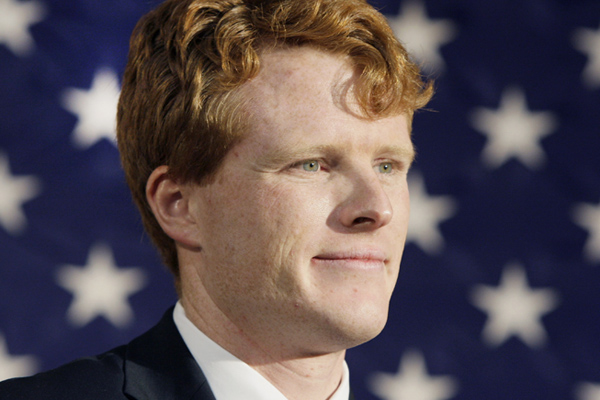
BOSTON — Where does noblesse oblige end and craven nepotism begin? It’s a question that’s sure to be heard in Massachusetts as Joseph Kennedy III vies for the 4th District seat vacated by Rep. Barney Frank. The 31-year-old assistant district attorney, a son of former Rep. Joseph P. Kennedy II and a grandson of the late Robert F. Kennedy, has zero political experience apart from helping Uncle Teddy on his final campaign before he went off to the great Kennedy compound in the sky. Still, Joe III announced yesterday that he was “considering” a run, selling himself as a selfless public servant for entering the family business.
Why should we buy it? Where does the fair-haired kid get off thinking he is the best person who’s to hold the seat held consecutively by such towering political figures as the President John F. Kennedy and House Speaker Tip O’Neill.
Because he can’t dodge his roots, the assistant district attorney (which is pretty much an entry-level job right out of law school) is sticking to the selfless-service narrative, like some great patrician politician from the era of his maternal great grandfather, Honey Fitzgerald, the mayor of Boston.
“My decision to look seriously at elected office is grounded in a deep commitment to public service and my experience — both my own and that of my family — in finding just, practical, and bipartisan solutions to difficult challenges,” he said yesterday in announcing his exploration committee, which allows him to begin raising money. All righty, then.
It’s a calculated campaign gamble, as “Kennedy fatigue” is now a chronic condition in Massachusetts. Even Boston’s south shore, long known as the Irish-Catholic Riviera, is souring on the clan. So basking in the faded glow of Camelot may not be the best way to get yourself elected here. Even if his resume is covered in ivy (Stanford undergrad, Harvard Law), and he spent two years in the Peace Corps (the Dominican Republic is not exactly a hardship post), there are no guarantees in American politics, even for a Kennedy running for the old Kennedy seat in the bluest of blue states. Noblesse oblige is one thing. If it’s claimed on the pedigree coattails of fading dynasty, it won’t wash.
Joe III may find himself in an uphill struggle against more experienced candidates, including Boston City Councilor Michael Ross. So family consigiliere Paul Kirk was trotted out to sing the praises of the freckled redhead, even while anticipating questions about the possible arrogance of Kennedy power. “He’s a very mature but at the same time self-effacing man, well grounded, and he’s in it for the right reasons,” Kirk said repeatedly to Massachusetts media outlets.
Kirk made the point that the assistant DA could be doing things with his life other than stooping to hold office with congresssional pond scum. Of course he could. He’s a Kennedy. But why bother? No American will ever forget that his grandfather and grand-uncle gave their lives for this country. But, equally, who can deny that the bloodstream has thinned through the downstream generations? From Caroline’s flubbed attempt to fill Hillary Clinton’s seat to Uncle Patrick’s visits to rehab clinics to Daddy Joe II’s clumsy efforts at marriage annulment, the clan has coughed up one selfless career after the next.
Now comes this young man in a hurry at what was assumed to be the tail end of the family’s political life span, with last year marking the first time in 63 years that a Kennedy has not held office in Washington. He is the next generation, the first of the so-called fourth generation to run, selflessly, for public office. Kennedy dynasty 4.0.
It’s a ritual we saw played out 25 years ago when 3.0 came to power. I clearly remember how diminished the brand name felt when Joe Kennedy II took his seat in the 8thCongressional District of Massachusetts. It was a gorgeous Washington day and I found myself side by side with the congressman, waiting for a “Don’t Walk” light to change at a Capitol Hill intersection. “Hey, Joe,” I ventured. “I’m one of your back-home constituents.”
“Oh yeah,” he said, coming back at me with that square-jawed, all-American Kennedy aplomb, a touch of friendly overtone to his voice. “And what were you doing up there?”
“Not much,” I said. “Just hacking it out as a cabbie after college in Boston.”
“That’s funny,” he said, “I’ve always wanted to be a cabbie.”
“That’s funny,” I returned, “I’ve always wanted to be a Kennedy.”
My badda-bing punch line explains the ambivalence we Massachusetts voters feel about the patronizing arrogance of power that comes with the Kennedy brain. What irks all but the mushiest of Massachusetts liberals is the sense of entitlement that gets wrapped in do-gooder claptrap. That line was wearing thin decades ago when the patrician era of American politics coasted to a close. In this economy, amid the Democratic backlash against the monstrously rich, it’ll be harder than ever to make that claim fly. Americans have lost faith in the rich, because even the best of them let us down. Even the Kennedy name, a name synonymous with wealth, may feel the whip end of populist resentment.
Just ask Democratic senatorial candidate Martha Coakley. Pre-ordained as Sen. Ted Kennedy’s rightful successor, Coakley took the electorate for granted, campaigning hardly at all, and for her hubris was bested by Scott Brown, a professional pretty boy who ran as a Tea Party clone in an Everyman’s cherry red pickup truck. The late-great lion of the Senate wasn’t just rolling in his grave, he was clawing through the casket.
Continue Reading
Close
BOSTON — Call it “the week that was” when it comes to shredding the Constitution. First the Senate passes a rider to the defense bill that would make it legal for the military to arrest American citizens anywhere in the world, including U.S. soil, at the whim of the executive branch — this or any future executive branch.
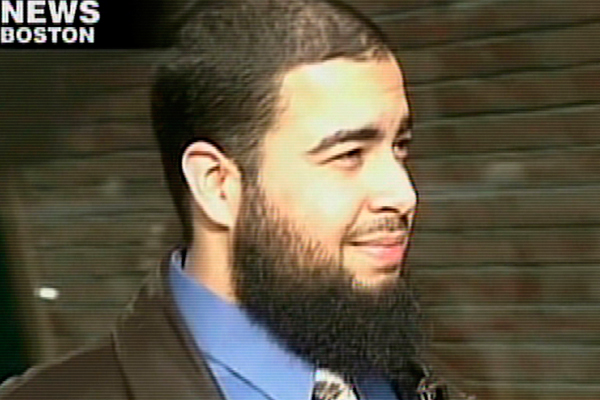
Then comes the conviction yesterday of a Massachusetts man for viewing and translating jihadi videos online. The eight-week trial featured starkly contrasting portrayals of the bearded Muslim, Tarek Mehanna, a Sudbury, Mass., fundamentalist who traveled to Yemen and has made no secret of his contempt for U.S. foreign policy.
His Boston legal team haloed him as a kind and loving man, if an angry and opinionated intellectual type. They argued he was being persecuted for his disapproval of U.S. foreign policy. The government countered with the belief that Mehanna was just the sort of hater who’d take glee in seeing Americans getting gunned down in bloody shopping malls.
American Muslims took it on the chin big-time this week, between the Mehanna case, the more troubling rider to the 2012 National Defense Authorization Act now waiting for the president’s signature, to say nothing of home improvement chain
Lowe’s yanking sponsorship of the “All American Muslim” show on TLC. If the president signs the defense bill unamended, it will represent the single biggest civil liberties betrayal of his presidency.
The implications are profound and simple.
“They both came out the same week, but they are part of a pattern of putting to one side the fundamental freedoms we’ve taken for granted. We’re into a whole new legal terrain,” said Nancy Murray of the Massachusetts chapter of the American Civil Liberties Union. ”As the Senate gutted the Bill of Rights, just as it gutted the right to due process and the right to trial by jury, the whole notion of presumption of innocence goes out the window. And the scary thing is that it could be applied to all U.S. citizens.”
When not watching Lowe’s ads on the popular reality show, Muslim parents are sure to hit the pause button for a quiet word with their children about expressing strident opinions online. And they won’t mean maybe, either, because sentencing for Mehanna is set for as soon as April 12, and he may never see the light of day again — he could be sentenced to life in prison. The message is unequivocal: You’d better watch your Muslim mouth.
Mehanna made no bones about watching jihadi videos and translating them for friends; no bones about lending CDs to people in the Boston area in order, as the prosecution asserted, to create like-minded youth; no bones about discussing with friends his views of suicide bombings, the killing of civilians, and dying on the battlefield in the name of Allah. He translated texts that were freely available online and looked for information there about the 19 9/11 hijackers too. He even inquired into how to transfer files from one computer to another, and how to keep those files from being hacked.
However unpopular those acts may be, civil libertarians say they fall well within the margins of First Amendment protection. They are bracing themselves for repeal, but their immediate concern is the ending of posse comitatus, a far more serious matter. If the president, a constitutional scholar, signs the Senate-passed defense bill as is, then in the stroke of a pen he’ll have re-answered the age-old joke: “Is this a free country, or what?” The answer will be a resounding “or what,” but it’s no joke. Coming on the same week that the Bill of Rights had its 220th anniversary, you have to ask what’s more depleted these days: America’s outrage or its unkeen sense of irony?
The ACLU of Massachusetts submitted a brief in the Mehanna case, but it was refused by Judge O’Toole, who felt it was not suitable for this trial. The amicus curiae urged the court to proceed with the utmost care to prevent protected speech from constituting the sole basis for charges of conspiring to provide material support to terrorist groups. The brief said Mehanna had “engaged in discussions and watched and translated readily available media on the topics of global politics, wars, and religion, all of which are topics of public concern. That his views may be offensive or disagreeable, or that they may ‘create like-minded youth,’ is of no consequence to the heightened protection to which his expression is entitled as a result of the First Amendment.”
Through such acts Mehanna was convicted yesterday of conspiracy to provide material support to al-Qaida. If such speech is not protected as a free expression under the First Amendment, “then the government’s implicit view that such speech could alone support conviction threatens to render the material support statute a vehicle for the suppression of unpopular ideas, contrary to the dictates of the First Amendment and fundamental American values.”
Civil liberties advocates make the “slippery slope” argument. In the 2010 case Holder v. Humanitarian Law Project, which decided whether providing nonviolent aid like legal advice to terrorist groups constitutes material support for terrorism, the Supreme Court ruled that you can advocate as an individual, but if your advocacy is coordinated with an outfit on a terrorist list, then it’s criminal conspiracy and you can be convicted of giving terrorist support.
The ACLU believes that Mehanna’s activities were not shown to meet that test, “so the real reason for convicting him seems to be missing,” Murray said. “The trial featured all sorts of allegations of traveling but there was no hard proof that his advocacy was coordinated with a group.”
Grounds for appeal appear to be more than ample. “For one thing,” said Murray, “the courts should be very worried that it criminalizes unpopular speech. The First Amendment should’ve protected his translating material that he read on the internet. Unless they could’ve said he was doing that at the behest of a terrorist group, they’ve never actually made that direct connection.”
Continue Reading
Close
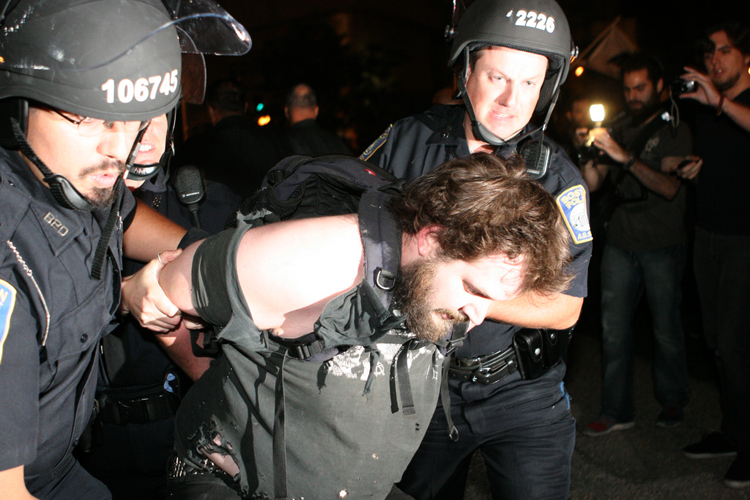
The longest-standing occupation camp in the country folded early this morning when Boston cops pounced in the wee hours, arresting at least three dozen protesters on trespassing charges.
Half of the 300-strong group of on-site and off-site occupiers had struck camp voluntarily 24 hours before when a Boston Superior Court judge lifted a restraining order on the police from closing down the 10-week-old campsite that formed days after protesters in New York had occupied Zuccotti Park off Wall Street.
More than three dozen who remained were arrested this morning, according to Boston Police spokeswoman Elaine Driscoll.
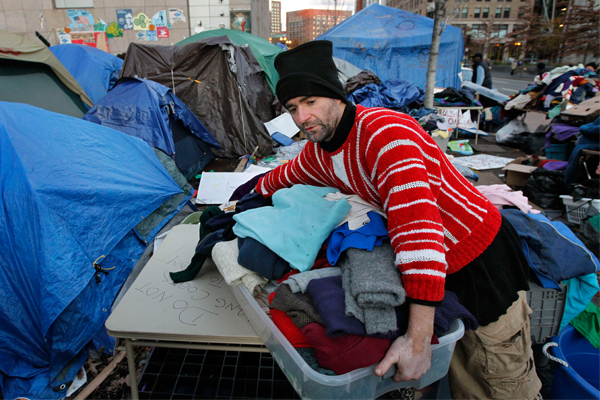
Both internally and in the face it shows to the world, the occupation movement has now reached an inflection point. In the frozen mud of the Dewey Square camp, just outside of the gleaming tower of the Federal Reserve Bank of Boston, the protesters had been hugging and congratulating themselves for hanging in there as the hardcore, even while sorely disappointed that others had decamped so obediently after asking Boston Superior Court Judge Frances MacIntyre what was to be done in the event of mass arrests. Her restraining order was lifted 25 hours before the police swooped in. Essentially, the judge agreed that America is not like England, where squatters’ rights are enshrined in law. America is a country where the SWAT teams swoop in on peaceful protesters in public parks.
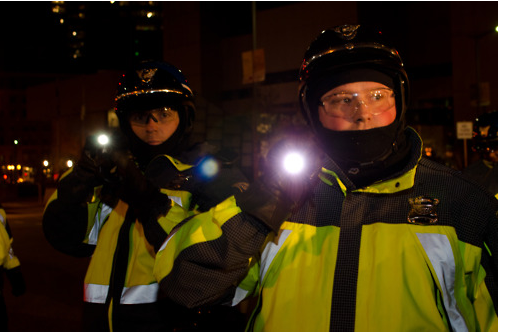
A squad of paddy wagons rolled down along Boston’s Waterfront just before 5 a.m., and riot police using plastic handcuffs took several dozen sleepy campers alighting from their tents for their rudest awakening since 141 were arrested in early October in Boston. “If you don’t leave the park, you will be subject to arrest. You are trespassing,” a police officer said through a megaphone.
“Tell me what democracy looks like. This is what democracy looks like,” demonstrators chanted back. About two dozen linked arms as hundreds of tents were tossed into rubbish trucks.
“They wanted to get arrested. It went very well, and we’re very happy with this operation,” said Superintendent William Evans, an official even protesters admired for his gentle hand in carrying out Mayor Thomas Menino’s orders.
The camp was clearly divided between those who were happy about going into court to seek a restraining order against eviction and those who questioned the wisdom of seeking change through established channels. Dressed in a tartan green kilt, 48-year-old Phil O’Connell nearly came to blows with several of his fellow occupiers, complaining about “the whole fascist attitude of the general assembly where anyone who shows any passion here is seen as violent,” before cooler heads prevailed.
Another activist calling himself Duncan nearly taunted the police, vowing to “defend this camp to the final moment.” He spoke passionately about what was clearly the beginning of the end, some 19 hours after the Boston Police had distributed fliers putting them on notice that they were in violation of public trespass laws. “Our camp is the best opportunity for us to be the change we want to see in the world. That’s why I was dismayed to see part of our camp voluntarily dismantled last night.”
“Look around,” said Brian Kwoba, a 24-year-old occupier from Cambridge. “It looks like a raid happened, but there was no raid. The mayor flinched at us and we punched ourselves in the face. Do we have a movement where the mayor says jump and we ask, ‘How high?’
No. We have a movement now divided about the wisdom of holding public space in the face of police action.
Continue Reading
Close