
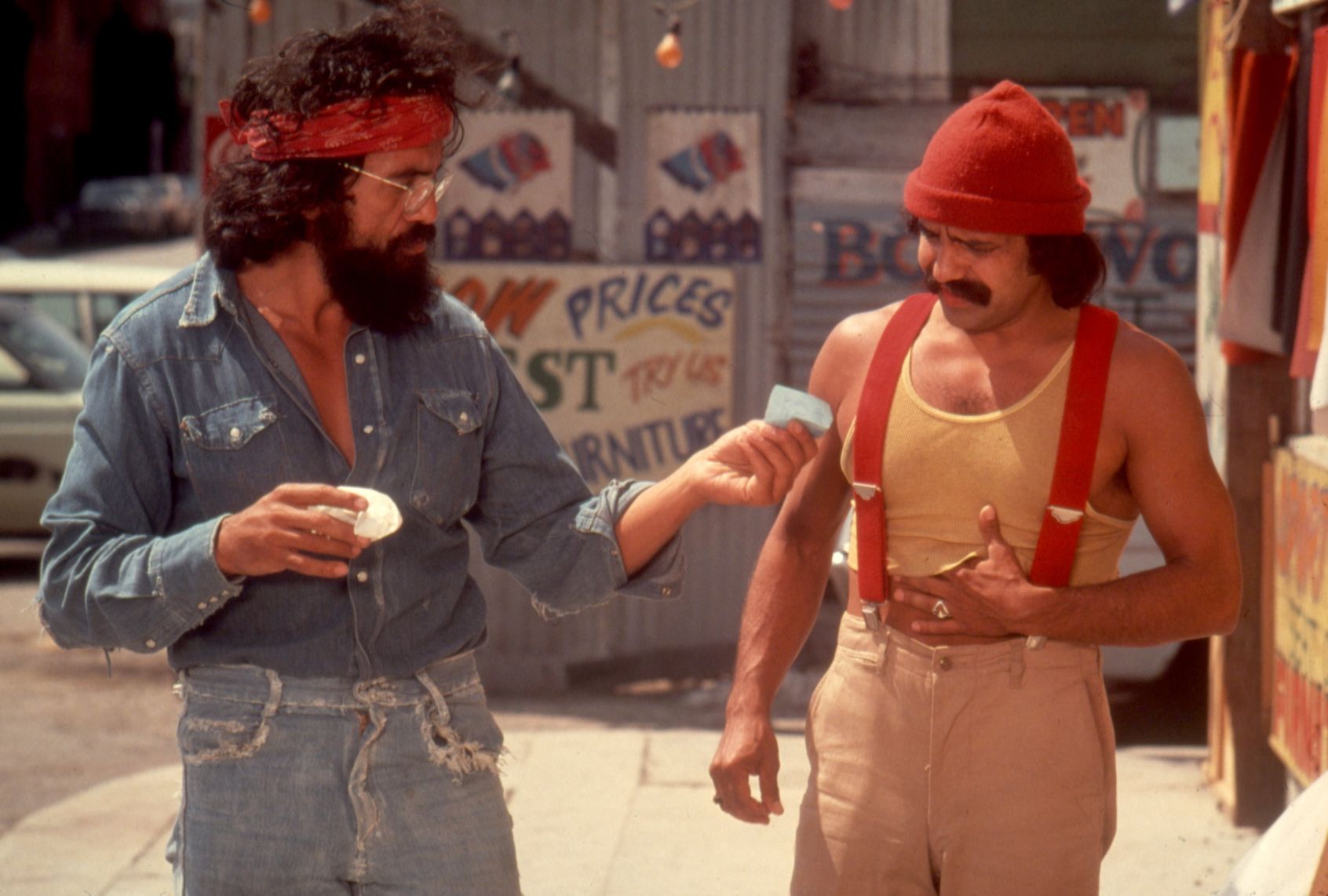

Early in their 1978 film debut, “Up in Smoke,” comedy duo Cheech & Chong inadvertently expose a bit of systemic corruption. Still stoned out of their minds after being picked up by the cops for driving around Los Angeles smoking a massive joint, the two are hauled into court. Noticing that his new friend Anthony (Tommy Chong) is spiraling into a bit of marijuana-induced panic, Pedro (Cheech Marin) approaches the bench to grab a glass of water sitting next to the judge’s gavel. Anthony takes a gulp and spits it all over the courtroom floor, exclaiming that the cup is filled with vodka. With the presiding judge’s faculties called into question, Anthony and Pedro are let go on a technicality, free to seek out their next high. The grass is greener — and far more potent — on the other side of handcuffs.
With 4/20 fast-approaching and state-level marijuana laws changing all over the country, the stoner buddy comedy has never been quite so relevant.
While funny, the scene doesn’t exactly come as a surprise for fans of the comedians. Cheech & Chong were already staples in the counterculture comedy movement by the time their first film was released. Even their meeting had radical beginnings. In the ’60s, Chong’s band The Shades was making a name for itself, touring Vancouver’s nightclub scene. On the side, he’d been developing an improvisational comedy troupe at a strip joint when a mutual friend introduced Marin, believing he’d be a perfect straight man for the act. The two had mutually radical sensibilities: Marin came to Vancouver to dodge the Vietnam War draft, and the pair hit it off, helping to pioneer the stoner comedy movement with music, satire and improv shows before moving to Los Angeles.
But by the late ’70s, Cheech & Chong were well-versed in covertly incorporating social commentary into their act. Those who refuted their work as simple stoner comedy were missing out on some of the more subversive critiques of America during the short but pivotal post-Vietnam, pre-Reagan era. There’s plenty of furtive gags like this throughout “Up in Smoke”: police incompetence, absent parents, anti-war rhetoric and racial stereotypes that function as satire. Many critics, however, dismissed the film as stale, even outdated. The Washington Post’s Art Harris said at the time that the film was an “attempt at Doper’s Delight in [a] post-Woodstock age of Clean Living.”
That narrative, of course, didn’t hold up. While technically not the first stoner film, “Up in Smoke” introduced its own well-loved subgenre to the cinematic canon: the stoner buddy comedy. In the decades since, this variant (or, strain, if you will) has transformed from a kind of underground midnight movie to a box-office-topping sensation. And with 4/20 fast-approaching and state-level marijuana laws changing all over the country, the stoner buddy comedy has never been quite so relevant — able to be discovered or reexplored by potheads, straight-edge viewers and casual weed users of a new generation.
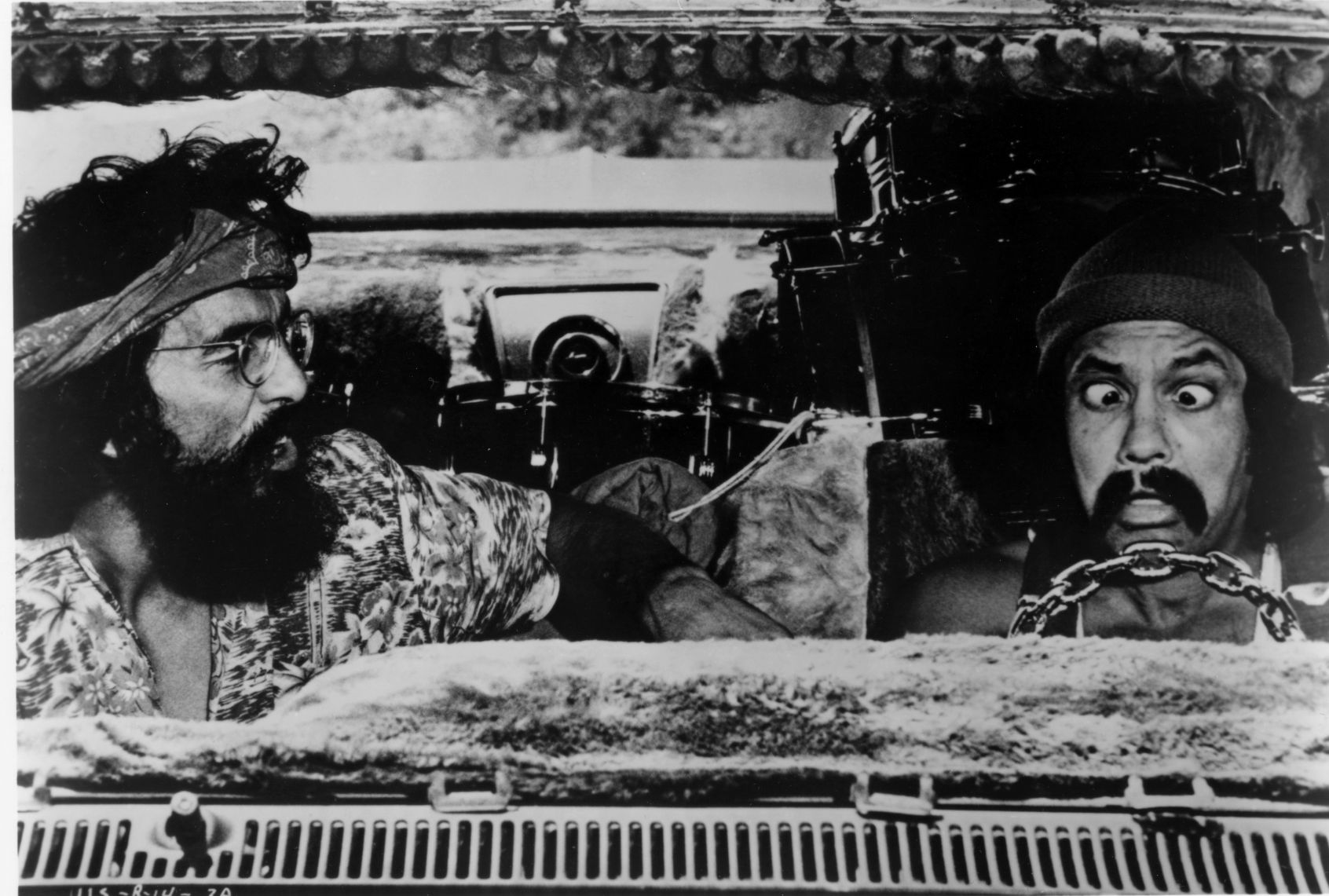
(Michael Ochs Archives/Getty Images) Tommy Chong and Cheech Marin in “Up in Smoke”
Though the film is approaching its 50th anniversary, “Up in Smoke” has remarkably avoided the ravages of time. Its plot is simple yet winding, following Pedro and Anthony as they team up to form a real band, escape the flashing lights of cop cars and endure a perilous journey from Los Angeles to Mexico and back again to perform at a Battle of the Bands showcase. It’s consistently humorous but maintains its incendiary edge, primarily due to the fact that Cheech & Chong were trailblazing (pun semi-intended) in real time, making a movie that was one of the first of its kind — and seemingly having a genuine blast while doing it.
While not universally admired, “Up in Smoke” was a commercial hit. Fans of Cheech & Chong flocked to movie theaters in droves to get their eyes on the film, which was more accessible than some earlier stoner comedies that were deemed too controversial for anything larger than arthouse or exploitation theaters. The movie is well-written but haphazardly made, with some choppy editing and a soundtrack of Cheech & Chong original songs that frequently drown out the dialogue to the point of irritation.
Want more from culture than just the latest trend? The Swell highlights art made to last.
Sign up here
But those aspects are also a major part of the film’s charm. Even to the sober mind, “Up in Smoke” feels like a wild trip. The incongruous editing is akin to zoning out while your buddy is talking, coming-to halfway through their thought and playing along like you understood where it was heading the entire time. The music is as loud and strange as a live concert gets when the smell of smoke from a joint, somewhere in the crowd, spreads over the entire audience to deliver a slight contact high. Even Marin’s incessant flippancy and Chong’s “maaan”s punctuating every other sentence become enjoyable the more time one spends with them. “Up in Smoke” is a veritable amalgamation of marijuana’s effects, translated for the big screen.
Though the film is approaching its 50th anniversary, “Up in Smoke” has remarkably avoided the ravages of time.
But beyond just recreating the sensation of toking up for the multiplex, “Up in Smoke” managed to depict a communal high. Cheech & Chong weren’t just comedians, nor were they mere stoners; they were visions of what it looks like to get high with a friend and joke around — albeit pushed to extreme results. It sounds laughably obvious to say it, but one of the primary reasons people love using marijuana is because the drug dulls inhibitions. I don’t mean that in a “Reefer Madness” kind of way, where impressionable teenagers are going to run out stealing cars and murdering civilians off a puff of the chronic. But weed relaxes and opens the mind, often making it easier to communicate, bounce ideas off one another, or even just laugh together. Sure, THC can quickly turn into a social crutch and become as compulsorily addictive as other substances. But used in moderation, it can just as easily facilitate the perfect night with a friend, watching movies and eating takeout until the two blend together, and suddenly the mind forgets it’s you eating the pepperoni slice, and not Humphrey Bogart.
Are you a Salon Premium member? Join us for members-only Salon Live with White House correspondent Brian Karem and Editor in Chief Joseph Neese on May 13. Register here.
Creating that sense of community with “Up in Smoke” was Cheech & Chong’s secret weapon to success. It’s a movie that you can watch stoned with your friends, about the wild things that might happen when you get stoned with your friends. The film acted as a blueprint for other entries in the stoner buddy comedy subgenre, one that could be refined and built upon in the years to follow. By the time Cheech & Chong’s next movie, aptly titled “Cheech & Chong’s Next Movie,” rolled around in 1980, it didn’t matter that critics panned the film as an unfunny clone of its predecessor; the stoner buddy comedy was alive and kicking. Most importantly, it was profitable.
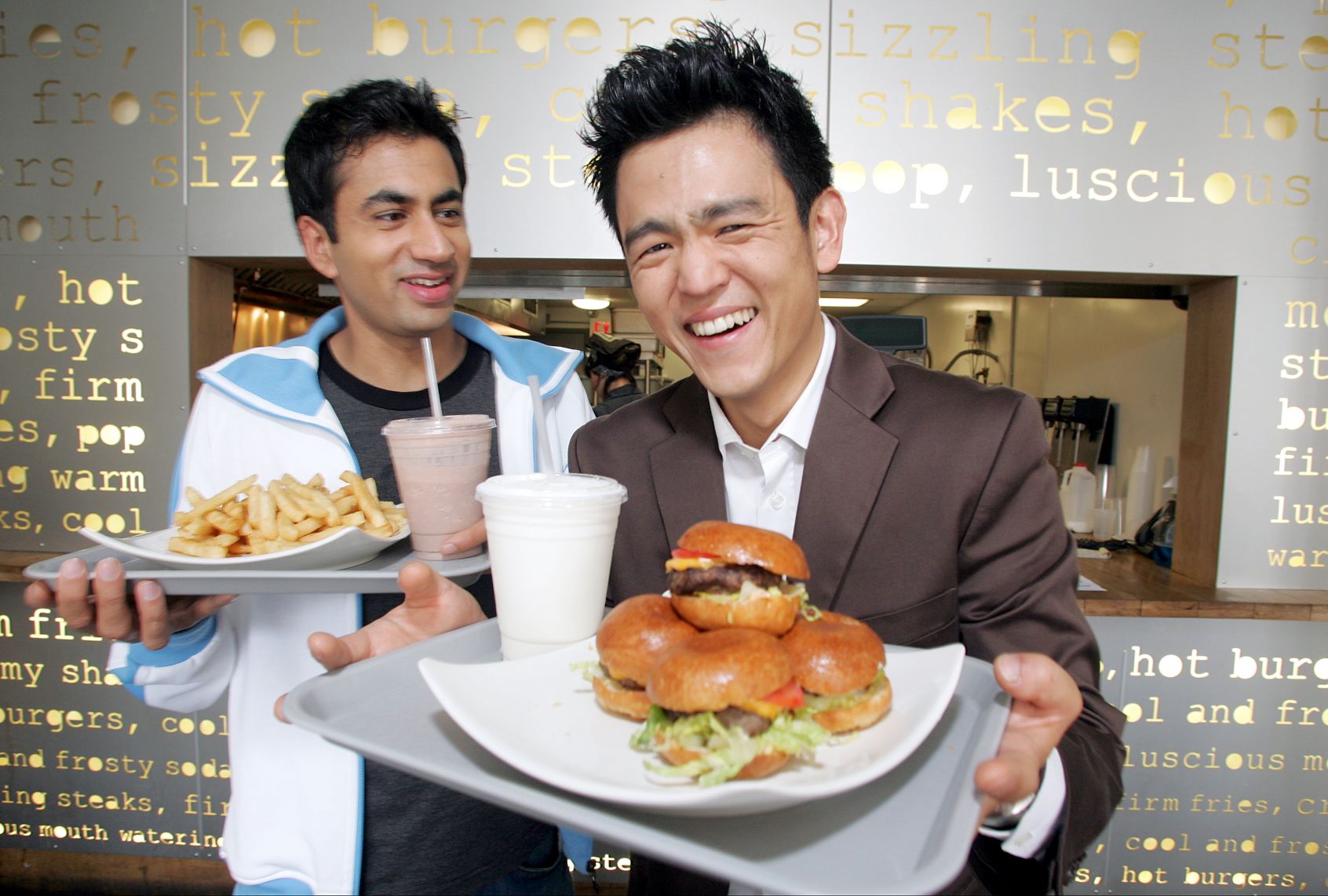
(Todd Plitt/Getty Images) Kal Penn and John Cho pose for a portrait while promoting their movie “Harold & Kumar Go To White Castle” at Pop’s Burger in downtown New York City on July 19, 2004
My introduction to these movies was tense. The fervent anti-drug counseling of my elementary school days was almost too effective on me. The stoner buddy comedies of my generation, like “Dude, Where’s My Car?” and “Harold & Kumar Go to White Castle,” felt like drug ads that would lure me into a life of immorality. For a very long time, my personal rhetoric around pot was a lot like the sex ed scene in “Mean Girls”: If I smoke weed, I will get high . . . and die. Furthermore, weed was largely inaccessible to me until I moved to New York, and even then, I’d have to seek it out. I tried it here and there at the behest of friends, but procuring it on my own felt like it would be an “Up in Smoke”-level epic. I wouldn’t even know where to start.
It wasn’t until marijuana was legalized in the state during my late 20s that I began to purchase it for myself, using the opportunity to work my way back through buddy comedy blind spots. I was shocked to find that “Harold & Kumar Go to White Castle” isn’t nearly as ridiculous or fratty as I believed it to be for so long. On its face, it’s even more subversive than “Up in Smoke,” though it clearly owes its existence to Cheech & Chong’s film — even the ampersand in “Harold & Kumar” reads like an ode to the comedy duo’s influence. Like Pedro and Anthony, Harold (John Cho) and Kumar (Kal Penn) are a pair of stoners in their early 20s, thrust into an unexpected odyssey when an ad for White Castle points their munchies toward a franchise location in suburban New Jersey. The two are so hyperfixated on the idea of sliders, fries and a couple of soft drinks that they’ll stop at nothing to get their hands on the perfect fast food. No substitute will do. Along the way, they cross a band of racist, homophobic punks who taunt and terrorize them, a farmer straight out of “Texas Chainsaw Massacre,” a rabid raccoon, Neil Patrick Harris and local police intent on busting them for possession. It’s a Homeric voyage, if Homer were familiar with the complicated system of roadways and toll stations that is the New Jersey Turnpike.
The film is certainly outrageous and off-color. But for every poorly aged joke, there’s a gag or a bit of veiled social commentary that’s surprisingly progressive for its time. The first “Harold & Kumar” film frequently lampoons police brutality and sticks up for its marginalized characters at every turn. Compared to “Up in Smoke” — a buddy comedy where the buddies were still getting to know each other — “Harold & Kumar” is a stoner movie that celebrates the strength of best friendship. The titular duo work together to get themselves out of every snag, and when they finally do get their hands on their sliders, it’s as satisfying as remembering you have an unopened bag of chips in the pantry, just as the edible is peaking.
We need your help to stay independent.
It’s no coincidence that so many stoner buddy comedies are also sprawling adventures. In writing “Up in Smoke,” Cheech & Chong brilliantly understood that watching an afternoon get weirder as the high gets stronger is a perfect way to keep up narrative pacing. It also portrays the feeling of the mind falling into a drug-induced rabbit hole, where each layer — or, in a film’s case, each new scene — is another revelation. And aside from how well weed lends itself to cinema, it’s also just plain fun to watch things go increasingly haywire for stoned pals. When “Dude, Where’s My Car?” or “Pineapple Express” pushes the insanity to its limit, the films feel like testaments to close friendship. Being stoned out of your gourd all by yourself is no fun, and as a bumbling, bewildered Anna Faris proves in Gregg Araki’s hysterical solo stoner film “Smiley Face,” trips are better with friends.
But if weed is increasingly legal around the country, and so much of the stoner buddy comedy hinges on trying to remain unscathed by the law, where does that leave these types of films? It’s been a minute since we’ve had a proper entry into the subgenre, and one might argue that means legality has dulled the stoner buddy comedy’s once prosperous high. But I’d say that these films were never about avoiding arrest so much as they were using weed as a springboard for all sorts of social commentary. Even if weed is legal, filmmakers can still push the boundaries with stoner comedies. The joy of weed is in its ability to open the user’s mind, and there’s no shortage of trouble for stoner friends to get up to on screen. Despite Cheech & Chong’s recent declaration that “pot is over,” it’s only just begun. Maybe Harold & Kumar can go to the White House to teach us a thing or two.
Read more
from Salon’s culture newsletter, The Swell
