
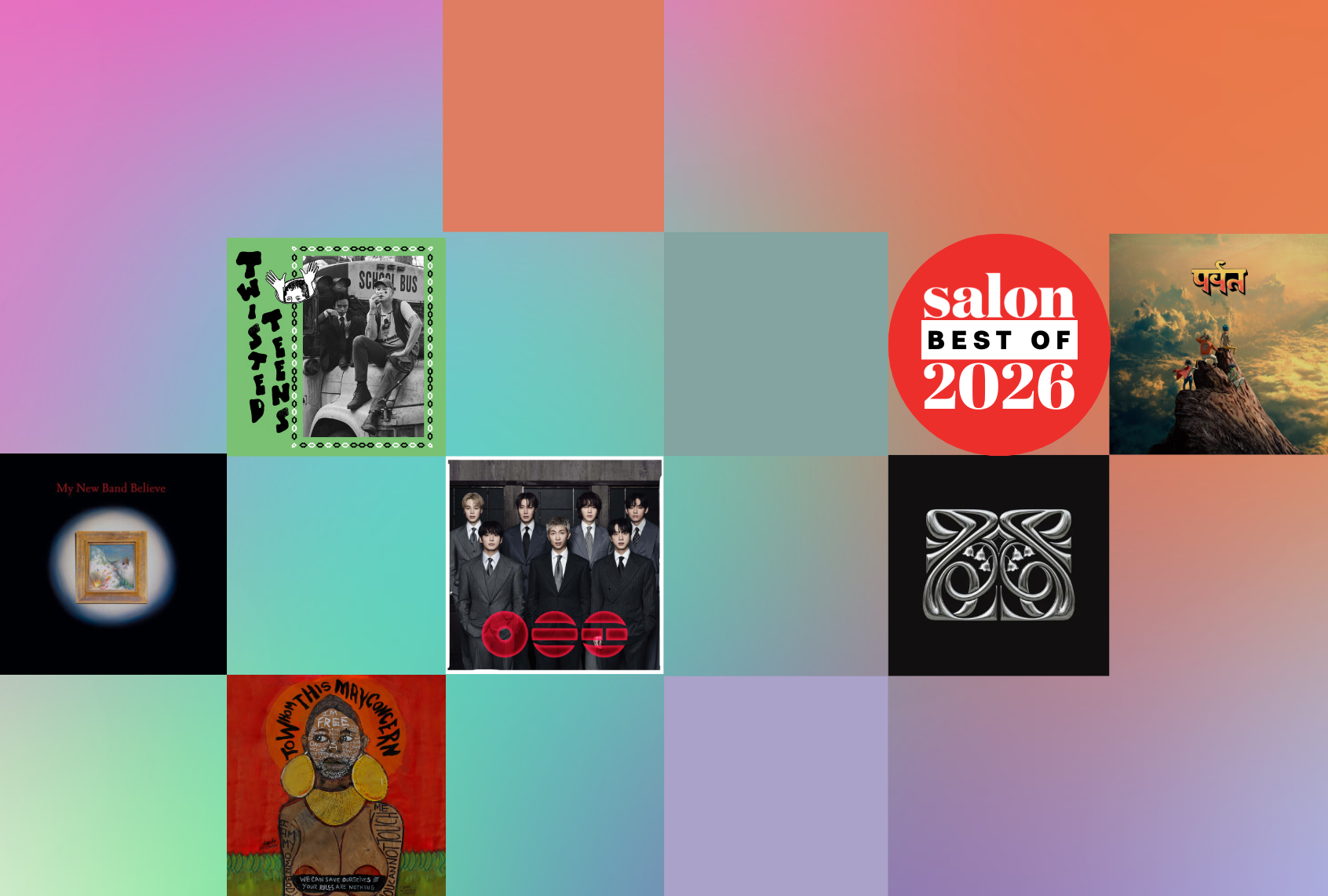

You, dear Salon reader, are discerning and responsible, ready to face the reality of the world we’re living in, for better or for worse. Unfortunately, that may result in feelings of anger, frustration, anxiety or hopelessness. It’s an unfortunate byproduct of caring deeply.
This is precisely why we turn to art, which probes both truth and beauty: the enemies of doomscrolling. Music is perhaps the purest of these art forms, tapping into our lizard brains to regulate our emotions that are seeking to make sense of this precious yet maddening existence.
That’s why your Salon writers and editors have gathered the best albums of the year (so far), all the better to soothe you with. A great song offers pleasure, but a great album – no skips – is a doorway. On the other side lies transformation. Sound possesses power, whether you’ll be weary from dancing or blissed out from the frequencies massaging your nerves.
So crank up the Victrola, press play on Spotify and nestle into your headphones. These albums will keep you energized to thrive another day.
Albums are listed alphabetically by title.
“Arirang,” BTS
I did not have “finally become a fan of the biggest K-pop group in the world” on my 2026 bingo card, but here we are.
From its title “Arirang” (referencing a centuries-old Korean folk tune / resistance anthem) to its head-scratching track “No. 29” (featuring one, long reverberating toll of a 1,300-year-old Buddhist bell) BTS’ comeback album plants its feet firmly in Korean heritage. But it’s an identity as defined by seven modern musicians who had already enjoyed global success, becoming the No. 1 artists in the world early in the pandemic, before going their separate ways to pursue solo work and later enter mandatory military service.
RM commands, “I need the whole stadium to jump,” in the album’s banger opening track “Body to Body” that also weaves in a sample of the aforementioned folk song with traditional drum elements at the bridge, coalescing into a declaration of identity that is loud, clear and fiendishly danceable. Four more attitude-driven hip-hop tracks follow: the defiant “Hooligan,” the Hallyu callout “Aliens,” the cheeky and industrial “FYA” and then “2.0,” a reclamation of their supremacy in a new era . . . accompanied by a music video featuring an homage to Park Chan-wook’s “Oldboy” hallway scene.
While personal narrative is key to the album, “No. 29” acts as an aural demarcation. Nothing is more sublime than transitioning from Jimin’s penetrating vocals of “You know how we do!” on “2.0” directly to the deep reverberations of the ancient bell that soothe and reset. This shifts from the audaciousness of the first half of the album to introspection – starting with the dreamy lead single “Swim” and Tame Impala-produced “Merry Go Round” to the grungy lilt of “Like Animals” and repudiation of their idol status in “they don’t know ’bout us.” The vocoder styling flourish of closing track “Into the Sun” gives one final mood shift as the almost achingly sweet vocals and lyrics transport listeners to a realm of sentiment and gratitude.
During my latest trip to Asia, I played this on my headphones on repeat while I rode the subway . . . and haven’t stopped listening since. Sonically dynamic and unapologetically trenchant, “Arirang” took me on a journey by asserting BTS’ collective powers as mature artists and master storytellers, and I couldn’t help but be inspired. –Hanh Nguyen
“Blame the Clown,” Twisted Teens
If you’ve wondered what would happen when a garage-rocker cowboy is joined by a punk who likes the Western wail of steel guitars, look no further than “Blame the Clown.” This sophomore effort from New Orleans duo Twisted Teens is as much a punk album as it is an Americana folk album, as loud as it is thoughtful, as crunchy as it is tender.
Caspian “C-Bird” Hollywell’s wide-eyed, frenetic energy and howling vocals come up against the sweet, mournful steel pedal guitar of suit-and-tie-wearing “Razor” Ramon Santos. The result can be heard in songs like the hard-driving “Is It Real?” in which Hollywell roars about mental illness and divine intervention, while Santos coats it all in steel honey.
The gumbo of Dixieland punk continues. “100 Bill is Gone!” channels blue-collar money woes, whereas “Circus Clown” is the closest thing we’ll ever get to surf rock from a swamp. It’s also where we get the album title: “I don’t blame the circus/I blame the clown.” There’s “White Hot Coal,” a pensive, acoustic folk rocker with violins as the ghost of an accordion.
“Blame the Clown” is a rough ride through both desperate and jubilant times. Its broken smile won’t let you down. – Garrett Owen
“The Boutique,” Zinadelphia
Artists like Zinadelphia are the reason why Philly has been called the indie capital of the world. She is carrying on the legacy of Philadelphia as not just a great music city, but a city rich in history and heavily influenced by those that came before them. In her latest album, “The Boutique,” Zinadelphia is a funky jazz, indie-pop goddess. Her powerful, unique voice combined with deep, thoughtful lyricism reminds me of icons like Billie Holliday and Patti Labelle combined with contemporary standouts like Lizzy McAlpine and Japanese Breakfast (all of whom are also from Philly). She has stage presence that you just can’t fake. Whatever the X factor is, Zina’s got it.
Listening to “The Boutique,” I feel like I should be smoking a cigarette and drinking the dirtiest martini known to man in a speakeasy, wearing a drop waist silk dress and bright red lipstick. My personal standout song is “Call Up Nancy.” At concerts, she introduces the track with a Penny Lane quote from the Cameron Crowe’s “Almost Famous”: “I always tell the girls never take it serious. If you never take it serious, you never get hurt. If you never get hurt, you always have fun. And if you ever get lonely, you just go to the record store and visit your friends.”
“Call Up Nancy” is an anthem for anyone who’s ever had a ride-or-die best friend. When the relationships fizzle, when the job sucks, when things don’t work out the way you plan, you know they’re always there for you. As Zina sings,
When I get lonely
I know who can console me . . . I don’t get angry,
I just get Nancy
on the phone.
It’s the big band sound that makes you smile and want to get up and dance with captivating lyrics that always leave you wanting more. – Francesca Giangiulio
“F.I.G.” Naomi Scott
Those who grew up during the Golden Age of Disney Channel like myself have been well aware of Naomi Scott’s vocal prowess — bold yet playful and honey-sweet. In the 2011 hit film “Lemonade Mouth,” Scott rose as a massive standout, notably with her defiant, high-energy performance of the pop-rock ballad “She’s So Gone.” Her talents were once again showcased in the 2019 live-action adaptation of “Aladdin” and the 2024 horror flick “Smile 2,” where she also performed her own choreography and co-wrote two of the original songs for the movie’s soundtrack.
With “F.I.G” — Scott’s debut studio album that’s an acronym for “Fall Into Grace” — she establishes her unique sound, sans playing one specific character. But the album itself isn’t purely autobiographical. Instead, it’s inspired by the famous fig tree metaphor from Sylvia Plath’s “The Bell Jar,” where each plump and juicy fig, dangling deliciously on the branches, represents a different life path for the protagonist. For Scott, the figs are reimagined as songs, exploring a different possibility and version of herself.
In “Hellbent,” the album’s opening track, Scott dives into an infatuation so strong that she can’t help herself from acting on those feelings: “’Cause I’m selfish / And you’re everything I want so I’ll be relentless / And I’d do anything to make you mine / Do you mind?” In “Cherry,” she explores the sensuality of patience: “If the cherry’s sweet, it comes right off the bush / Don’t push.” And in “Bliss,” she mourns a relationship that could have been: “What hurts the most /Is we almost had it for a moment.”
“F.I.G” is musical storytelling at its finest. It’s beautifully cohesive, both lyrically and sonically, and vulnerable. It’s pop at its core with a touch of ’80s soul and ’90s R&B, alongside a sprinkle of disco and gospel. It’s old-school cool yet contemporary, seamlessly emulating the sounds and stylings of Kate Bush and Janet Jackson, as well as Dev Hynes (a.k.a. Blood Orange), Jessie Ware and NAO. Once the final track has been played, “F.I.G” beckons us to replay, revel in our emotions and dance once, maybe twice or thrice, more. — Joy Saha
“The Mountain,” Gorillaz
The ninth studio album from British virtual band Gorillaz came to fruition in the wake of creators Damon Albarn and Jamie Hewlett losing their fathers a mere 10 days apart. The two men traveled to India and were inspired by the eastern spirituality’s view on death that was essentially the opposite of their own.
The 15-track album blends Western pop and hip-hop with traditional Indian classical instruments like the sitar and sarod. The album explores themes of death, grief and the afterlife. It also plays homage to previous Gorillaz collaborators who have departed by utilizing unused or alternate takes from past projects.
Highlights include “Orange County,” “The Happy Dictator,” “Damascus” and “Delirium.” “Orange County” is my particular favorite track; it feels light and upbeat with some whistling throughout — yet lyrically explores grief while also giving this feeling of hope in the darkness. In somewhat typical Gorillaz fashion, the album paired with a short film of the band members trekking across India titled, “The Mountain, The Moon Cave and the Sad God,” which is worth a watch if you love 2D animation.
“The Mountain” truly feels like an album thanks to its conceptual nature. The songs flow together in a cohesive manner, and it features performances in multiple languages — which is quite beautiful when you think about how death and grief are universally shared experiences across humanity. It’s arguably the Gorillaz’s best work since “Plastic Beach.” This album is one that I want to continue to spend more time with in the coming months, especially as someone navigating the loss of a parent. – Natalie Moore
Want more from culture than just the latest trend? The Swell highlights art made to last.
Sign up here
“My New Band Believe,” My New Band Believe
Something is eerily wrong in the world of this indie-art-folk post-rock fusion debut from My New Band Believe.
The album is experimental, merging modern art with Romanticism. Its baroque, acoustic sounds of a pastoral countryside in ye olde England mesh disturbingly well with softly sung, darkly opaque lyrics. Whether it be about getting bloody revenge for a family (“Target Practice”), heartbreak over a lover’s passing (“Love Story”), or an unexpectedly sweet and/or terrifying date (“One Night”), this album is beautiful and skin-crawly in equal measure. It’s a gold mine for artistic interpretation.
The eight-minute “Actress” is an aural trip that croons of a lazy wannabe-actress, before it climbs to rocking, triumphal heights with a soaring string section. Does it encourage her dream, or take eight minutes to put them down? Your call. Bandleader Cameron Picton confirmed the song (among others) changes meaning, depending on how he feels.
“In the Blink of an Eye” is full of chaotic drums, woozy vocals, and jangling guitars, with sudden, off-putting pauses, telling a dark tale of growing paranoia and a refrain of “Don’t cry/don’t scream/it’s just/a bad dream.” Yet, the music video focuses on the daily work of a Japanese fisherman. Figure that one out.
Vibes: cursed tea party, haunted cottage, abandoned in a mansion. – Garrett Owen
“Never Be the Same,” Teddy Thompson
Teddy Thompson’s voice is a golden, vivid instrument capable of conjuring joy and caverns of heartache. He’s been plumbing those emotional depths in his songs for nearly 26 years across seven critically acclaimed solo albums, and he’s back at it with his latest — and finest: “Never Be the Same.” Easily one of the year’s best albums, it serves up a delicious aural stew flavored by the musical genres that have long been among Thompson’s primary ingredients: late-1950s rock, classic pop-country and the golden age of soul.
In making “Never Be the Same,” Thompson wanted to allow room for the “devastating moment,” a point in a song where something unexpected can happen, “that one lick where you just melt.” He and producer David Mansfield create those moments time and again: with Thompson’s lonesome tenor and falsetto — and a scorching organ instrumental — on the languid slow-burn “So This Is Heartache”; the swell of strings and emotion on “The Game,” paired with his confession of “what do I know?” of love; and especially his poignant lyrics about his maternal grandmother and her “pale, rock pool eyes” on “I Remember,” which also features a Floyd Cramer-style piano riff that puts a lump in the throat.
Thompson’s career in music has been at turns fulfilling and frustrating; if there were justice in the world, he would be a household name. But, as the old Rodgers and Hart song goes, “Songbirds always eat / if their song is sweet to hear.”
These days, Thompson’s is the sweetest. —Jason Kyle Howard
“To Whom This May Concern,” Jill Scott
Our existence is the result of our ancestors’ survival and ability to imagine a future worth enduring the present’s sorrows. “To Whom This May Concern” is Jill Scott’s way of reminding her listeners of that, fortified with the spirits and songs of Black artists who came before her.
It’s also her first album in more than a decade, one that maintains the neo-soul continuum she’s nourished since her multi-platinum 2000 debut, “Who Is Jill Scott? Words and Sounds, Vol. 1.” But this one, her sixth, dances us through her evolution and many revolutions, serving up everything from jazz to funk to Chicago house on the dance track “Right Here Right Now.” Through it all, she taps into music ancestry blessed and shaped by the likes of Nina Simone, Ella Fitzgerald, Sarah Vaughan and Tina Turner, a few of the trailblazers she name-checks on “Offadaback” while bowing deeply to others like Ma Rainey and the poet Nikki Giovanni through tributes like the blues-heavy “Pay U on Tuesday” and “Ode to Nikki.
Other tracks rewind through eras to pay homage to Black music’s many styles and mothers, bounding across Black music’s geography with dozens of collaborators, ranging from Trombone Shorty to Too $hort. The former, a New Orleans-based band, gives the motivational anthem “…Be Great” its swaggering, saucy brass line; the latter holds the bridge on “BPOTY,” a hellfire condemnation of prosperity gospel Christianity. Overall, though, the force holding aloft “To Whom This May Concern” is joy, the kind woven into a supportive correspondence with a resilient people, a gratitude offering to lineages, a love letter to ourselves and herself. “I might not equate to much to some, but I’m grateful to all the pioneers who stood up for freedom, and its meaning,” she says on “Offadaback,” sagely adding, “They did it for themselves, but ultimately they did it for us…Thank you.” – Melanie McFarland
“Top Spot,” aka “Alternate Dimension,” T.O.P.
Don’t call it a comeback. Or even vindication. This is insurrection.
Choi Seung-hyun – better known as T.O.P., aka Thanos from “Squid Game” Season 2 – quietly served up the most earth-shaking comeback album in South Korea this year. An erstwhile member of the wildly popular boyband BigBang, Choi admitted in 2017 to marijuana usage. Conviction and cancellation swiftly followed. Ending work with his label and group, the rapper left for Europe where he made wine, licked his wounds and worked on music in isolation.
“Another Dimension” is his answer to the years of rejection, pain and incandescent ire, but transmuted into a vibrant, avant-garde, genre-defying gaping wound found within 11 tight tracks. Although no understanding of Korean is necessary to appreciate the experimental production that has always made him a distinctive artist worthy of attention, it’s the lyrical nakedness that elevates the album into a confession, an accusation, an attack on the strictures of South Korean society.
Dissonance and synth-heavy soundscapes open “Self-Crucifixion,” a track that excavates the scorching heat Choi felt under the magnifying glass of public scrutiny, with the back third finishing with audio snippets of the media reporting on his public exploits.
In lead single “Studio 54,” he intones in a bass growl, “Dirty sun, dirty sun, they just ruined my soul,” equating New York’s infamous nightclub with South Korea’s Burning Sun nightclub scandal in which a former BigBang bandmate was convicted of prostitution mediation and embezzlement in 2020. Choi becoming persona non grata for pot hardly seemed fair in light of that horrifying revelation. The song’s Korean refrain and damning alternate title? “Gone Crazy.”
The rest of the album alternates between chaos and control, introspection and criticism, grungy beats and hazy surrealism. He even includes a track “For Fans” that is, as advertised, the most pop-friendly bop across the 37-minute runtime. Seven of the tracks, however, do not meet Korean broadcast standards for various reasons, which is perhaps the most revealing trait of all. This album – 100% independently produced and distributed outside of the powerful entertainment machine that had forged Choi – rejects the dictates of a society that first rejected him. – Hanh Nguyen
“Vol. II,” Angine de Poitrine
When guitarist Khn de Poitrine and drummer Klek de Poitrine perform live, they make triangle shapes with their hands and screech unintelligibly. After listening to their latest album, “Vol.II,” you might find yourself wanting to do the same. The Canadian rock duo make up Angine de Poitrine, which translates from French to angina pectoris — a condition of chest pressure caused by spasms of the heart. Absorbing their hyperactive microtonal math rock can give similar symptoms of tightness in the chest, which is pretty impressive for a Quebec duet that sports absurd papier-mâché masks with giant oversized noses and uses fake names. Like an alien version of the White Stripes, their monochrome costumes are excessively polka-dotted, evoking Dadaism (the early 20th century art movement that augured surrealism and pop art) – all of which would feel like a gimmick if the tunes didn’t land.
Their lead single “Fabienk” is studded with hair-trigger riffs — if you can even call them that — that mix the playful nursery rhyme melodies of Battles with the no-wave drone of Sonic Youth. “Yor Zarad” channels some Eastern tones à la Dick Dale’s rendition of “Miserlou” before spiraling into buzzing crashes that feel almost Zeppelin-like (with extra helium yet extra bass) while “Sarniezz” will feel right at home for fans of Can or LCD Soundsystem. It’s little wonder a viral KEXP performance has garnered more than 15 million views since February — the band is as dancey and mesmerizing as they are out there. – Troy Farah
“WOR$T GIRL IN AMERICA,” Slayyyter
“WOR$T GIRL IN AMERICA” might be Slayyyter’s third studio album, but you’d hardly know it from the fervent reception that accompanied its release. Like Charli XCX’s “Brat” before it, “WGIA$” (as it’s been dubbed by its creator) arrived to a surprising amount of mainstream attention for someone formerly considered a niche artist. Once the princess of glitchy hyperpop, Slayyyter spent nearly a decade steadily refining her sound into something entirely her own, culminating in a sonic landscape that’s studied and referential while indisputably fresh.
Listeners picked up on that, too. The fiery first single, “BEAT UP CHANEL$,” derides inauthenticity in a world where filters and AI are God, while “CRANK” features Slayyyter rapping about getting “so gay off that tequila” before name-checking Richard Linklater in a masterful, three-punchline lyric. Passion, humor and a snarl of defiance run through the album like a bullet. Its energy is unlike anything in pop this decade so far.
But in its softer, more introspective moments, “WGIA$” peels away the layers without losing the hard synths or sonic left-turns that feel so reminiscent of aughts-era electropop. (She frequently refers to the album as “iPod music,” songs she could’ve fantasized and danced to in equal measure growing up.) Album cuts like “$T. LOSER” and “WHAT IS IT LIKE, TO BE LIKED?” find Slayyyter caught up comparing herself to other artists. “GAS STATION” pairs a frenetic synth melody reminiscent of Crystal Castles with lyrics about abandonment. Then there’s the wallop of a closer, “BRITTANY MURPHY,” about seeing herself in someone else’s tragic fate, singing her own eulogy and wondering — maybe even dreaming about — what the world would be like without her. “Do you notice all I’ve done?” Slayyyter softly repeats in the song’s outro. With “WOR$T GIRL IN AMERICA,” the answer is a resounding, all-caps “YES.” – Coleman Spilde
Read more
about music
