Help keep Salon independent

Experts: Supreme Court left a “clear road map” to prosecute Trump — but now it’s “up to Jack Smith”

Former President Donald Trump could still face a criminal trial for allegedly conspiring to overturn the 2020 election – but say that the odds of any trial starting over the next year depends on the results of the election, the speed of pre-trial hearings examining the extent of Trump's immunity and whether special counsel Jack Smith moves to narrow the indictment.

In August 2023, a D.C. federal grand jury indicted Trump on four felony charges for conspiring to thwart his 2020 electoral defeat and the peaceful transfer of power to President Joe Biden. In July, the Supreme Court ruled 6-3 that presidents have "absolute immunity from criminal prosecution" for acts that fall within the "exercise of his core constitutional powers he took when in office." Presidents, according to the ruling, have "at least presumptive" immunity from other official acts, and no immunity for unofficial acts.

That decision tasked U.S. District Judge Tanya Chutkan with weighing whether Trump was acting in an official or unofficial capacity when he made certain tweets and speeches to the public ahead of the Jan. 6 attack at the U.S. Capitol and worked with “private parties” to convince state officials to change votes for Biden to votes for Trump.

The judge is also set to weigh whether Trump can be prosecuted for pressuring Vice President Mike Pence to refuse to certify election results. The decision said Trump has presumptive immunity – but said that the government can rebut that presumption and that it’s up to the District Court to decide whether Trump’s actions posed “any dangers of intrusion on the authority and functions of the Executive Branch.”

Smith earlier this month asked for a three-week extension to respond to Chutkan’s scheduling order for pre-trial hearings. 

South Texas College of Law Houston professor Josh Blackman called that move “significant.”

“He could have been ready to go on day one, but they're still not sure how they're going to proceed,” Blackman said. “I think that does make a difference.”

It’s still unclear what’s ahead – Chutkan could, for example, hold hearings to weigh whether Trump has immunity for certain acts before the November election. The ruling limits not only whether Trump can face charges for certain conduct, but also limits whether prosecutors can introduce protected conduct as evidence.

Chutkan isn’t expected to hold such hearings before the November election. 

And if Trump wins, he wouldn't face prosecution as a sitting president under DOJ policy.

Still — the Washington Post reported that the DOJ plans to pursue charges against Trump up until Inauguration Day.

Stanford Law School professor Michael McConnell, a former federal appellate judge and a senior fellow at the conservative think tank Hoover Institution, said “the case could move along fairly expeditiously” if Smith limits the scope of the indictment to Trump’s private conduct.

"It really all depends on Jack Smith," McConnell said. “If he wants to throw in the kitchen sink, as he has done so far, then there’s going to have to be arguments and probably an appeal.” 

He noted that the Supreme Court’s ruling did not lay out clear-cut rules for what constitutes official and private versus unofficial conduct. 

“But it seems to me, it was clear enough,” he said. “And much of Mr. Trump's conduct, I think, appears private and non-official, and I'm referring here particularly to anything that he had to do, anything he did in an attempt to persuade either state legislatures or state election officials or electors to violate the law.”

We need your help to stay independent

Trump — who has continued to put forth unfounded claims of widespread voter fraud in 2020 — has argued he was acting within his capacity as an executive ensuring the integrity of the elections. 

But McConnell said such calls to state and local election officials don’t fall into that bucket.

“The president has zero authority with respect to the administration of the election,” McConnell said. “He's quite clearly communicating in his capacity as the candidate.”

McConnell said Trump’s communications with Pence might be the “hardest, most gray area.” 

Still, he said those interactions aren’t “that important” relative to Trump’s indictment as a whole.

“It seems to me that if Smith wants to move forward, that he would not give up very much by stripping the indictment of the arguably official conduct,” McConnell said. 

McConnell said the Supreme Court’s ruling “leaves most of the conduct that Mr. Trump has been accused of on the private side of the line.”

McConnell said if Smith does file a narrow indictment, he doesn’t expect that to happen in coming weeks ahead of the election.

“It's almost an abuse of power on his part, in the midst of a presidential election to pursue a case when there is no non-political reason to hurry, and the Department of Justice has a long standing policy of not timing prosecutions in a way that would affect an election,” McConnell said. “We'll see what he does, but I think it's quite improper to move forward quickly, but I think he could if he wanted to.”

Blackman, a scholar at the libertarian think tank Cato Institute who has appeared as a speaker for the Federalist Society, said he sees the immunity ruling as in line with a 1982 court decision granting presidential immunity from civil lawsuits for official acts. 

He pointed to Justice Neil Gorsuch, who took a similar note in his recent book tour – CNN reported that he argued that the Supreme Court’s ruling was a “natural extension” of its Nixon v. Fitzgerald precedent.


Want a daily wrap-up of all the news and commentary Salon has to offer? Subscribe to our morning newsletter, Crash Course.


In a recent Washington Post op-ed, Harvard Law School professor Richard Lazarus said it’s fair to criticize the Supreme Court’s July immunity ruling for offering a too broad definition of presidential immunity.

Lazarus said that the ruling offers a “surprisingly clear road map for the successful felony prosecution of Trump” that doesn’t require evidence involving his official actions.

“The special counsel has more than enough incriminating evidence without it, beginning with the stunning recordings of Trump’s conversations with officials in states such as Georgia,” Lazarus wrote.

Lazarus pointed out that the ruling “leaves little doubt” that Trump lacks immunity for calls and meetings with state and local election officials or speeches that the judge determines Trump made in his capacity as a candidate for office.

Lazarus also said the court was more doubtful about Trump’s conversations with Pence, but said those interactions have “little practical importance for the fundamental question of whether Trump can be prosecuted and convicted of federal felony offenses.”

"It is now up to Smith and Chutkan to follow the pathway created by the Supreme Court to secure Trump’s conviction," Lazarus wrote.

Donald Trump is holding back rural America

"Billionaire" Donald Trump presents himself as the populist champion of the MAGA movement and its white working class, rural base of so-called forgotten or “real” Americans. Like the other demagogues, neofascists and various authoritarians around the world who are riding a wave of “populist” rage at “the elites,” the facts and reality are much different than what their propaganda narrative suggests. 

Donald Trump and the other neofascists in the Republican Party are not populists. They do not believe in true we the people democracy (or social democracy more broadly). In reality, Donald Trump and his forces want to impose a type of dictatorship and a tyranny of the minority (the plutocrats, right-wing Christian extremists and theocrats, White racial authoritarianism, and uncontested white male elite power) on the American people. As historian Timothy Snyder and other leading experts have warned, if Donald Trump and the MAGA movement and the other neofascists are “populists” then their version of populism is sadistic and is fueled by causing pain and suffering.

The ascendance of Trumpism and the larger antidemocracy movement—whose politics and values are more accurately described as right-wing authoritarian fake populism if not outright fascism—reveal a larger problem with language and how America’s news media and political class and other elites (and the general public) too often (mis)understand the relationship between region, culture, race, class, gender, religion and other identities in American society.

Nicholas Jacobs is an Assistant Professor of Government at Colby College. He is co-author of the 2023 book “The Rural Voter: The Politics of Place and the Disuniting of America.” His essays and other writings have appeared in Politico, the Washington Post, and other publications.

In this conversation, Jacobs reflects on the orchestrated chaos of the Age of Trump and how he is trying to navigate it. He explains how language such as “working class,” “elites,” “real Americans,” and of course “MAGA” have been so effectively weaponized by the right-wing, the moneyed classes and other elites because the definitions are unclear. At the end of this conversation, Jacobs reflects on why so many people in rural America support Donald Trump, MAGA neofascism, and the larger "conservative" movement when the policies they have enacted and support have actually done great harm to such communities. 

This interview has been lightly edited for clarity and length.

How are you feeling? How are you managing the Age of Trump more generally, and the torrent of events these last few weeks?

I definitely have a considerable amount of whiplash – moving between the extremes of obsessively refreshing my phone looking for the live update, to the other end, trying my hardest to tune it all out. I say that in full recognition that I can, to some degree, tune it out. I won’t be deported; there are no laws about my body. But I can’t help that in order to make any sense out of every new development, I find it necessary to just disconnect, and I’m needing to do that more and more.

Given your expertise and critical lens, how are you making sense of the Age of Trump and orienting yourself?

"Maybe we should just stop trying to define someone’s interests from afar, and labeling them as sadists when they make a choice that we find incomprehensible."

I think we are always looking for simple stories to make sense of complex events. I’m always reminding myself that our political system is designed to simplify choices: winners and losers, two parties to choose from, a single president to hold accountable. Arguably, those institutional characteristics—we would say “equilibria”—add a lot of resiliency to our democratic system. But that does not mean that the processes by which we get there, or the reasons people vote one way or the other are necessarily simple. This country is big, and its history is long. We often deal in simple averages and tend to focus on the moment. Sure, there is a risk in making everything subject to historical patterns or failing to acknowledge precedent-shattering trends…but there is an equally disorienting risk in simplifying everything down to the good vs. evil or seeing it all as unprecedented. 

I’m reminded that, early on in Trump’s administration, many members of the news media and too many others couldn’t see past the simple story of Trump’s chaos and alleged ineptitude. Thankfully, we are at a point now where so many journalists and academics recognize that the chaos was a smokescreen, designed to cover very well-laid-out plans that had a rationale stratagem. I think we need to ask the same questions when we are given the same simple stories of the electorate. 

Language matters. The right-wing and the larger neofascist movement are experts at weaponizing language. For example, “working class,” “elites,” “globalists,” “real Americans,” “patriotism,” “heartland” and the big one “MAGA”. The Democrats, liberals and progressives have been totally outmatched here. 

Language is powerful because it is ambiguous. You say, “real America” and what comes to mind? The images in your head are going to be different than mine. That is sort of the rhetorical genius behind a slogan like “Make America Great Again.” Great by what standard? Lots of people with different answers can each buy into it. And it goes beyond political slogans, which are deliberately meant to obfuscate and draw would-be supporters in.

I’ve spent a good amount of time trying to make sense of class politics in contemporary American politics. For so many Americans, class is just taken as a given. It’s not something you spend much time reflecting upon because it is what you are born into—the definition is intuitive. And so, when someone claims to speak on behalf of the “working class,” it might actually speak to folks who have never raked hay, changed their own oil, or done a double-shift. But their life circumstances were not the same as those who have never known someone who has. That is what it means to them, even if it is not the same definition academics or journalists carry around. 

There are two sides to this ambiguity—both destabilizing. One is that people don’t see it as a tool for the powerful—that four decades of rhetorical support for the farmer, the worker, and the heartland has left rural Americans and the working class (who live everywhere) in a worse position than ever. But another problem in deciphering our political dictionary exists because so many of us are fixed on one definition. So, when we talk about class politics, analysts on the left are quick to point to trends in income and voting, which seemingly deny the existence of a class cleavage. But if class transcends the snapshot we have of a person’s income at any one time, the truth is we often lack the data or insight to really make sense of why class-laden rhetoric makes sense to a lot of people. We are more or less become hell-bent on pointing out someone’s potential contradictions like a tutor trying to correct someone’s pronunciation—“that’s not how you say it; that’s not what that means!”—rather than trying to understand why it does resonate with a certain individuals or group of people. 

What does it mean to live in “rural America”? To be a “rural American” vs an “urban American”?

It means different things. I also believe that the answer to that question is more complex in rural America than urban America. Yes, demographically, “rural America” gives the appearance of scant diversity. But when I travel into urban spaces, it doesn’t matter if I am in D.C. or San Francisco or Madison, Wisconsin. A city is a city. I know what to expect. I can navigate it with ease. 

We need your help to stay independent

Living in rural America—and I’m fortunate to have seen many different parts—is wildly different depending on where you are. I’m a transplant to rural Maine. I’ll never fully grasp the ins and outs of a community where most of my neighbors can trace their family roots back four or five (and often times more!) generations. There is an illegible history that you only really learn growing up in a place. Yes, that is true of many urban communities. But urban spaces are celebrated as places where anyone can come and make it. That’s terrific, a real strength. The flip side is that the diversity within rural America is not often appreciated because it is not as visible. It is more closed off and exclusionary. That does not mean it isn’t there.  

One of the tensions in my own work, or something that I keep trying to wrap my head around, is the fact that although we use the term “Rural America” quite a bit, I think the last place you would ever hear that phrase uttered is in “rural America.” Yes, rural Americans are increasingly voting in lock-step with one another; the bloc is “nationalized” as we like to say. Therefore, there is a rural vote in America. That category makes sense, but maybe only to journalists and politicos. What tends to make someone rural is hyper-specific to the land and place they tend. And in this way, I don’t think my neighbors are very different from the families that have called Queens, NY home for generations, or the young person that wouldn’t dare think of leaving Chicago. 

That said, what we do see, by and large, is that this sense of identification with a particular place is so pronounced in various rural communities that it sort of takes over. It’s no longer just about the food or what football team to support. It is a long communal memory tied to longstanding relationships with the land. Not every rural person is a farmer, rancher, or miner (the vast, vast majority are not). But if you step into a rural community, you cannot deny the intimate connection with the physical or territorial sense of place. You can’t fabricate it. You can’t build it elsewhere. It is unique, special, and distinguishable. 

Ultimately, it is the foundation for deep polarization, because an identity with a place can become so strong. The story you tell about the space and the land is a personal story and the evidence seems to suggest that it crosses over other important identities: profession, income, maybe even race. When politicians lean into it, we’ve seen it become a powerful source of divisiveness, even if the initial attachment is not negative to begin with. 

What of rural Americans and how they supposedly cling to “guns and god”? What do we actually know empirically about (white) rural America vs the stereotypes about the region(s) and people(s) who live there?

The 2022 Cooperative Elective Study out of Harvard University shows that 51% of rural households have a firearm compared to 24% of those living in an urban area; 47% of rural residents support a ban on assault rifles while 68% of city residents do. The same survey shows that 68% of rural Americans say that religion is very or somewhat important in their lives compared to 60% of urban residents. 33% of rural residents are agnostic, atheist, or “none” compared to 38% of urban residents. 

There are four or so data points there and a thousand different stories you can tell with it. Over twice as many rural people than urban people own guns! But there are nearly as many gun owners in urban America as in rural America. What are they doing with all those guns, if not hunting (something 60% of rural gun owners report doing)? 

Rural America is the hotbed of traditional religious values. But cities are vastly more religious than often portrayed, with a majority of residents finding meaning in their particular religious faith (rates of church attendance and prayer are also not wildly different). Rural residents oppose gun control, barely, but the vast majority of those who oppose a ban on assault weapons live outside rural areas. Non-believers are just as prevalent, statistically speaking, and are the fastest-growing group in rural America, particularly among the young. 

Sure, these are cherry-picked stats. But I selected these not to make a single point, except that the picture between these communities is, yes, more complicated than often portrayed, but actually has a much larger degree of commonality than we like to believe. 

Donald Trump and JD Vance with their fake right-wing populist appeals are experts, like other fake populist authoritarians, at mining peoples' pain and suffering while actually doing little to improve it and in many examples making it worse. How do you reconcile this?

To put it more bluntly: Why do individuals living in communities that were already primed for suffering before COVID continue to vote for the person who so mismanaged the pandemic, arguably making it worse?

That’s one I hear a lot. It’s no different from the argument made during the George W. Bush administration that people were voting against their interests when they supported giving billionaires tax cuts. Now they are in an even more vulnerable position, so we give it a new name. Maybe we should just stop trying to define someone’s interests from afar, and labeling them as sadists when they make a choice that we find incomprehensible. I may disagree with it – often in strong terms – but there is a comprehensibility there. Yes, it is rooted in pain and suffering. I might say it is most important to recognize the profound mistrust that shapes the narrative people hold.

Consider, as one example, the tendency to disparage rural communities’ vaccine hesitancy. Nine times out of ten when I get some vitriolic response to my public writing, this makes its way into the message: How could they just blindly follow that man’s advice to refuse the jab? The more astute will point out that rural communities were primed for greater loss from vaccine hesitancy given rates of comorbidities and a weakened healthcare infrastructure. Sadistic, irrational, rage – all the same.


Want a daily wrap-up of all the news and commentary Salon has to offer? Subscribe to our morning newsletter, Crash Course.


What if we just explored those correlates as a part of a person’s story of how the world treats them and not just another data point to fit our own politically convenient story? How might living in a community rampant with doctor shortages, hospital closures, and underfunded clinics shape one’s views of the healthcare industry? Do they really have your back? Perhaps more importantly: if, as we just discussed, rural community health is so fragile after a decade of pills pouring into your community, what is one likely to think of pharmaceutical companies who are behind the vaccine development? The idea that these corporations place profit above health is not just a cocktail hour talking point gleaned from some book review – it is deeply ingrained in the community’s memory. We can acknowledge people’s reasons even if we don’t share them.

What would the news media's coverage of "rural America" and the Age of Trump look like if there actually were people from those regions in those rooms—especially at the elite agenda-setting media like the New York Times?

I think there are three things that most frustrate me about rural news coverage.

The first is that it is dominated by politics. Maybe that isn’t a rural thing, but my co-author Dan Shea and I did a content analysis of the Times' coverage of rural America over a two year period. We found that Trump was mentioned in over a third of stories—even non-political ones. It’s important, but when that’s the only prism in which we try to understand communities, the rural-urban divide becomes a self-fulfilled prophecy (or wish to sell more papers).

The second thing is that I think we are too quick to make many issues rural vs. urban. The truth is that many of the same structural or social forces at work in rural spaces are operating in urban ones. They manifest differently and the details are important, but if we are to do more than just reform on the margins, then people need to wake up to the common challenges confronting different types of communities. Perhaps because of our overemphasis on differences – especially political – we’ve lost a sense of interdependency between different communities. Rural policy is, at the end of the day, policy. Few things drive me crazier than when I hear about rural communities getting more of their fair share because of agricultural subsidies—again, usually to prove some political point about self-interest, rage, whatever. Never mind that those policies drive inequality, not just in rural communities, but feed back into the same system of finance and corporatization driving inequality globally. Never mind that those subsidies make food cheaper in urban and suburban communities, while those living in poverty everywhere suffer to find nutritious food.

Finally, there is reason to be hopeful in many rural communities. I know, tragedy sells. But when is the last time you read about anything good taking place in a deindustrialized, depopulating, or aging community? Good news is out there, and a lot of it is stereotype-shattering—the recreation of a youth sports league because of new immigrant families; a new arts festival because young people are returning home; a new clinic on tribal land to replace a broken federal system and empower local autonomy. There is a reason people stay. I’d love for non-rural folks to learn about that.

Jasmine Crockett: Election a choice between a “career criminal” and a “career prosecutor”

Sign up for The Brief, The Texas Tribune’s daily newsletter that keeps readers up to speed on the most essential Texas news.


CHICAGO — U.S. Rep. Jasmine Crockett, D-Dallas, blasted former President Donald Trump as a “career criminal” while speaking at the Democratic National Convention on Monday, contrasting his record with Vice President Kamala Harris’ career as a prosecutor and former California attorney general.

“One candidate worked at McDonald’s, while she was in college at an HBCU. The other was born with a silver spoon in his mouth, and helped his daddy in the family business: Housing discrimination,” Crockett said to boisterous laughter. “She became a career prosecutor, while he became a career criminal, with 34 felonies, two impeachments, and one porn star to prove it.”

“Kamala Harris has a résumé. Donald Trump has a rap sheet,” Crockett said. “She presides over the Senate, while he keeps national secrets next to his thinking chair — y’all know what I said the other time — in Mar-A-Lago.”

Crockett was the first Texan in Congress to speak on the DNC main stage. Her presence on the convention program punctuated her exceptional political rise. She is a freshman member of the U.S. House, running for Congress after serving only one term in the Texas House. She has broken out as a viral messenger on Democratic priorities, often clashing with Republicans in public committee hearings.

Crockett’s acumen as a party messenger showed early signs as a state representative, when she was an architect of a 2021 state House Democratic quorum break to stall the passage of Republican-led voting legislation. Before elected office, Crockett was a public defense attorney practicing civil rights law.

She alluded to her past as a public defender, saying Harris was “the kind of prosecutor we longed for.” She brought up Harris’ mandate for police officers to wear body cameras and efforts to reduce criminal recidivism.

Crockett also opened up about Harris caring for her when she was early in her time in Congress. She said Harris consoled her during their first meeting at the Vice President’s residence shortly after Crockett was elected to Congress.

“When I first got to Congress, I wasn't sure I made the right decision,” Crockett said. “That chaos caucus couldn’t elect a speaker and the Oversight Committee was unhinged.”

“She saw right through me. She saw the distress. I immediately began crying,” Crockett continued, holding back tears. “And the most powerful woman in the world wiped my tears and listened. She then said, among other things, ‘You are exactly where God wants you.’ ”

Crockett went on: “The next month, I went viral for the first of many times to come.”

Crockett made a quiet allusion to one of her most famous viral moments where she pushed back at U.S. Rep. Marjorie Taylor Greene, R-Georgia, for mocking her appearance during a committee hearing. During that meeting, Crockett indirectly said Greene had a “bleach blonde, bad built, butch body.”

“The question before us is, will a vindictive, vile villain violate voters’ vision for a better American or not?” Crockett said, giving a knowing smile as the crowd burst into laughter. “I hear alliteration is back in style.”

Other Texans who were on the agenda Monday included Harris County Judge Lina Hidalgo and Democratic abortion rights activist Amanda Zurawski. The first Texan to take the main stage of the national convention was country singer Mickey Guyton, a native of Arlington, who performed “All American.”

Hidalgo, who leads the most populous county in the state, praised Harris for visiting Texas the same week she launched her campaign to distribute FEMA aid in the wake of Hurricane Beryl. Hidalgo also praised Harris for the Biden administration’s work on climate policy, which sent “at least a billion dollars to help us with” protecting “our communities from extreme weather.”

“We deserve leaders who acknowledge the threats, heck, the existence of climate change,” Hidalgo said. “We deserve tough leaders who have our backs. We deserve compassionate leaders ready to help. That’s Kamala Harris and Tim Walz.”

Zurawski sued Texas over its restrictive abortion laws after doctors refused to end her compromised pregnancy, jeopardizing her life. The Texas Supreme Court ruled against her, galvanizing her to advocate abortion access. She has been a surrogate for the Biden and Harris campaign, traveling with the campaign around the country.

She appeared on the stage with her husband Josh on Monday night.

“Every time I share our story, my heart breaks,” Amanda Zurawski said. “For the baby girl we wanted desperately. For the doctors and nurses who couldn’t help me deliver her safely. For Josh, who feared he would lose me, too. But I was lucky. I lived.”

Zurawski pointed out that more than a third of American women of reproductive age live under an abortion ban.

“We need to vote as if lives depend on it,” she continued. “Because they do.”

The Texans shared the convention stage with some of the biggest names in the Democratic Party. President Joe Biden, former Secretary of State Hillary Clinton, New York Gov. Kathy Hochul, and U.S. Reps. Alexandria Ocasio-Cortez and Jim Clyburn were all on the Monday evening program.

Clinton, who was the 2016 Democratic nominee for president, cast Harris as continuing the effort she led as the first woman nominated by a major American party.

“Together, we’ve put a lot of cracks in the highest, hardest glass ceiling,” Clinton said, alluding to her concession speech in 2016. “On the other side of that glass ceiling is Kamala Harris raising her hand and taking the oath of office as our 47th president of the United States.”

Harris also made a brief, surprise appearance on stage to thunderous applause and Beyoncé’s “Freedom,” which has been an anthem of her campaign. Harris thanked Biden for passing the torch to the next generation by stepping off the ticket.

“Joe, thank you for your historic leadership, for your lifetime of service to our nation and for all you will continue to do,” Harris said. “We are forever grateful to you.”


The full program is now LIVE for the 2024 Texas Tribune Festival, happening Sept. 5–7 in downtown Austin. Explore the program featuring more than 100 unforgettable conversations on topics covering education, the economy, Texas and national politics, criminal justice, the border, the 2024 elections and so much more. See the full program.

This article originally appeared in The Texas Tribune at https://www.texastribune.org/2024/08/19/jasmine-crockett-democratic-convention/.

The Texas Tribune is a member-supported, nonpartisan newsroom informing and engaging Texans on state politics and policy. Learn more at texastribune.org.

What got lost in the DNC’s love fest for a lame duck

An observation from George Orwell — “those who control the present, control the past and those who control the past control the future” — is acutely relevant to how President Biden talked about Gaza during his speech at the Democratic convention Monday night. His words fit into a messaging template now in its eleventh month, depicting the U.S. government as tirelessly seeking peace, while simultaneously supplying the weapons and bombs that have enabled Israel’s continual slaughter of civilians.

 “We’ll keep working, to bring hostages home, and end the war in Gaza, and bring peace and security to the Middle East,” Biden told the cheering delegates. “As you know, I wrote a peace treaty for Gaza. A few days ago I put forward a proposal that brought us closer to doing that than we’ve done since October 7.”

It was a journey into an alternative universe of political guile from a president who just six days earlier had approved sending $20 billion worth of more weapons to Israel. Yet the Biden delegates in the convention hall responded with a crescendo of roaring admiration.

Applause swelled as Biden continued.

“We’re working around the clock, my secretary of state, to prevent a wider war and reunite hostages with their families, and surge humanitarian health and food assistance into Gaza now, to end the civilian suffering of the Palestinian people and finally, finally, finally deliver a ceasefire and end this war.”

In Chicago’s United Center, the president basked in adulation while claiming to be a peacemaker despite a record of literally making possible the methodical massacres of tens of thousands of Palestinian civilians. 

We need your help to stay independent

Orwell would have understood. A political reflex has been in motion from top U.S. leaders, claiming to be peace seekers while aiding and abetting the slaughter. Normalizing deception about the past sets a pattern for perpetrating such deception in the future.

And so, working inside the paradigm that Orwell described, Biden exerts control over the present, strives to control narratives about the past, and seeks to make it all seem normal, prefiguring the future.

The eagerness of delegates to cheer for Biden’s mendaciously absurd narrative about his administration’s policies toward Gaza was in a broader context — the convention’s lovefest for the lame duck president.

Hours before the convention opened, Peter Beinart released a short video essay anticipating the fervent adulation. “I just don't think when you’re analyzing a presidency or a person, you sequester what’s happened in Gaza,” he said. “I mean, if you’re a liberal-minded person, you believe that genocide is just about the worst thing that a country can do, and it’s just about the worst thing that your country can do if your country is arming a genocide.”

Beinart continued: “And it’s really not that controversial anymore that this qualifies as a genocide. I read the academic writing on this. I don’t see any genuine scholars of human rights international law who are saying it's not indeed there. . . . If you’re gonna say something about Joe Biden, the president, Joe Biden, the man, you have to factor in what Joe Biden, the president, Joe Biden, the man, has done, vis-a-vis Gaza. It’s central to his legacy. It's central to his character. And if you don’t, then you’re saying that Palestinian lives just don’t matter, or at least they don’t matter this particular day, and I think that’s inhumane. I don’t think we can ever say that some group of people’s lives simply don't matter because it’s inconvenient for us to talk about them at a particular moment.”

Underscoring the grotesque moral obtuseness from the convention stage was the joyful display of generations as the president praised and embraced his offspring. Joe Biden walked off stage holding the hand of his cute little grandson, a precious child no more precious than any one of the many thousands of children the president has helped Israel to kill.

JD Vance is trying to push the Tim Walz test. But does military service matter anymore in politics?

Even though neither major party nominee for president has a military background — one of them avoided service through a series of deferments and a claimed bone-spurs disability — and U.S. armed forces are not currently involved in any ground wars, military matters are playing an outsized role in this year’s election.

That role has four dimensions. First, is the country in a position to apply military force, if and when needed, beyond our borders? Second, what, if anything, will be the armed forces’ role in the event the losing presidential candidate’s supporters seek to contest the results through civil disorder? Third, is military service a particular qualification for public office? And finally, if the answer to the third question is Yes, is some military service more salient than other service?

The first two questions are certain to be addressed as the election draws near – indeed, they will remain on the national screen for the foreseeable future given current hostilities in Europe, the Middle East, and elsewhere. The second question may lose its urgency after Election Day, certification of the results, and the inauguration, unless the example set by former President Trump following his 2020 election loss proves to be a lasting part of American political life.

The fourth question is getting particular attention owing to the current effort to SwiftBoat Minnesota Governor Tim Walz, Vice President Kamala Harris’ choice for running mate. Republicans are working overtime to call into question his account of his service in the Minnesota National Guard and to contrast it with Ohio Sen. JD Vance’s service in the U.S. Marine Corps. The fourth question cannot be divorced from the third, so let me start there.

How important is military service of any kind as a qualification or preparation for high elective office? While many presidents and vice presidents have served in the nation’s armed forces, their services have varied greatly. Some have been senior commanders, such as Ulysses Grant and Dwight Eisenhower, while some were heroic junior officers whose lives were on the line, like Presidents Kennedy and George H.W. Bush. Others served in relatively safe assignments for longer or shorter periods (Presidents Truman, Lyndon Johnson, Ford, and Reagan). Some terminated their service unimpressively, an example being former President George W. Bush, who trained as a pilot but never saw combat and whose service ended in a cushy Air National Guard billet. He went on to serve two terms as president. As did former President Barack Obama. He, like President Joe Biden, never served at all. To date, no woman veteran has been elected to either of the two highest offices in the land. Neither of the current major-party candidates for president has had military service,yet each of them enjoys broad popularity, and barring the unforeseen, one of them will be the next commander-in-chief. And of course, former President Trump has already held that office, even though he did not win the popular vote.

Courage under fire is a rare virtue, and anyone who has had that experience deserves the thanks of their fellow citizens. But does it make a person better qualified to serve as a legislator?

Both candidates for vice president, in contrast, served in the armed forces as enlisted men. One is retired by reason of longevity. The other is simply one of the country’s millions of veterans.

The Senate and House of Representatives, of course, include numerous veterans and military retirees. Many of those who are seeking election for the first time this year make a point about their past service. How relevant is that service? It depends.

We need your help to stay independent

Courage under fire is a rare virtue, and anyone who has had that experience deserves the thanks of their fellow citizens. But does it make a person better qualified to serve as a legislator? In my view, not particularly. On the other hand, military personnel may be called on to display moral courage, and that is unquestionably pertinent to fitness for elective office, since that kind of service may require the individual to resist improper influences. I can think of candidates among the current crop who have done so. 

On the other hand, this kind of moral courage may well be called for in other contexts as well, such as the world of business, education, scholarship, and work as an attorney or judge. I would argue that the real question, when it comes to qualification for elective office, is not whether one has worn the uniform, seen combat, or sustained wounds, but whether one has displayed the broader traits that cross the civil-military divide. These include not only moral courage, but dedication to the Constitution and laws of the land, personal integrity, leadership, setting an example for others, empathy, and plain old good judgment. A civilian who has never considered military service is every bit as capable of patriotism and selfless conduct as a career soldier. In short, simply having worn the uniform is not a compelling credential for elective office; you would need to know a great deal more before deciding how much weight it deserved – and who the competition was.

This brings me back to the fourth question, a question made all the more pertinent right now because of two time-honored practices in American political life: running on your military record (and maybe puffing it here and there), on the one hand, and picking over an opponent’s military record (if any) for blemishes or falsehoods, on the other. The current hand-to-hand combat over service records between the Walz and Vance campaigns, of course, seems particularly absurd given the lack of military service by either former President Trump or Vice President Harris. But let’s leave that aside.


Want a daily wrap-up of all the news and commentary Salon has to offer? Subscribe to our morning newsletter, Crash Course.


Military service comes in many sizes and shapes, so comparisons are hard to make. How do we compare services that are identical in every material respect except for those that Candidate A served during the conscription era while Candidate B served during the All-Volunteer Force Era? How does a draftee with a Purple Heart stack up against a volunteer who wasn’t wounded? Does holding a commission necessarily mean a candidate is better suited to elective office than one who was a noncommissioned officer or a PFC or Seaman Apprentice? Is anyone who served in the Marine Corps inherently more patriotic or more suitable for elective office than someone who served in the Coast Guard or the Space Force – or the Public Health Service, which is a uniformed service but, ordinarily, not an armed force? Where in the pecking order do we place someone who served on active duty for six months followed by years of “weekend warrior” reserve duty (e.g., former Georgia Sen. Sam Nunn) or who received a commission upon completion of ROTC but spent only a few months on active duty for training (e.g., Justice Sam Alito of the Supreme Court)? Is it worse to avoid the draft than not to volunteer when there is no draft? Do we think the less of those who were exempt from conscription as women or as sole-surviving sons and did not volunteer? Are conscientious objectors disqualified for elective office? What about those who can and do serve as noncombatants?

There’s no need to belabor the point: The possible comparisons are nearly infinite and defy neutral principles of evaluation.

Where does this leave candidates and voters this year? My own view is that Gov. Walz has done two things that are both right and politically smart: his campaign has forthrightly conceded that he erred in referring to his service in war, and he has saluted Sen. Vance for his one-hitch service as a Marine. I don’t care if Gov. Walz retired as an E-8 rather than as an E-9, or that he retired with 24 years of creditable National Guard service instead of re-upping for yet another hitch. Nor does it seem to me to make the slightest difference in Sen. Vance’s qualifications to hold the country’s second-highest office that he filled a public affairs billet when he served in Iraq.

A lot is at stake this year. Let’s not get side-tracked with irrelevant cheap shots.

Tim Walz’s climate record? It’s complicated by coziness with fossil fuel companies, experts say

Minnesota Gov. Tim Walz, soon to be coronated as the Democratic Party's official nominee for Vice President of the United States, has stirred enthusiasm amongst the climate movement. Since taking office in 2019, Walz signed into law a bill requiring utilities to provide 100 percent carbon-free energy by 2040 and aligned the state's climate change policies closely with those of another environmentally progressive state, California.

"[Gov. Walz] knows that our natural resources need to be protected."

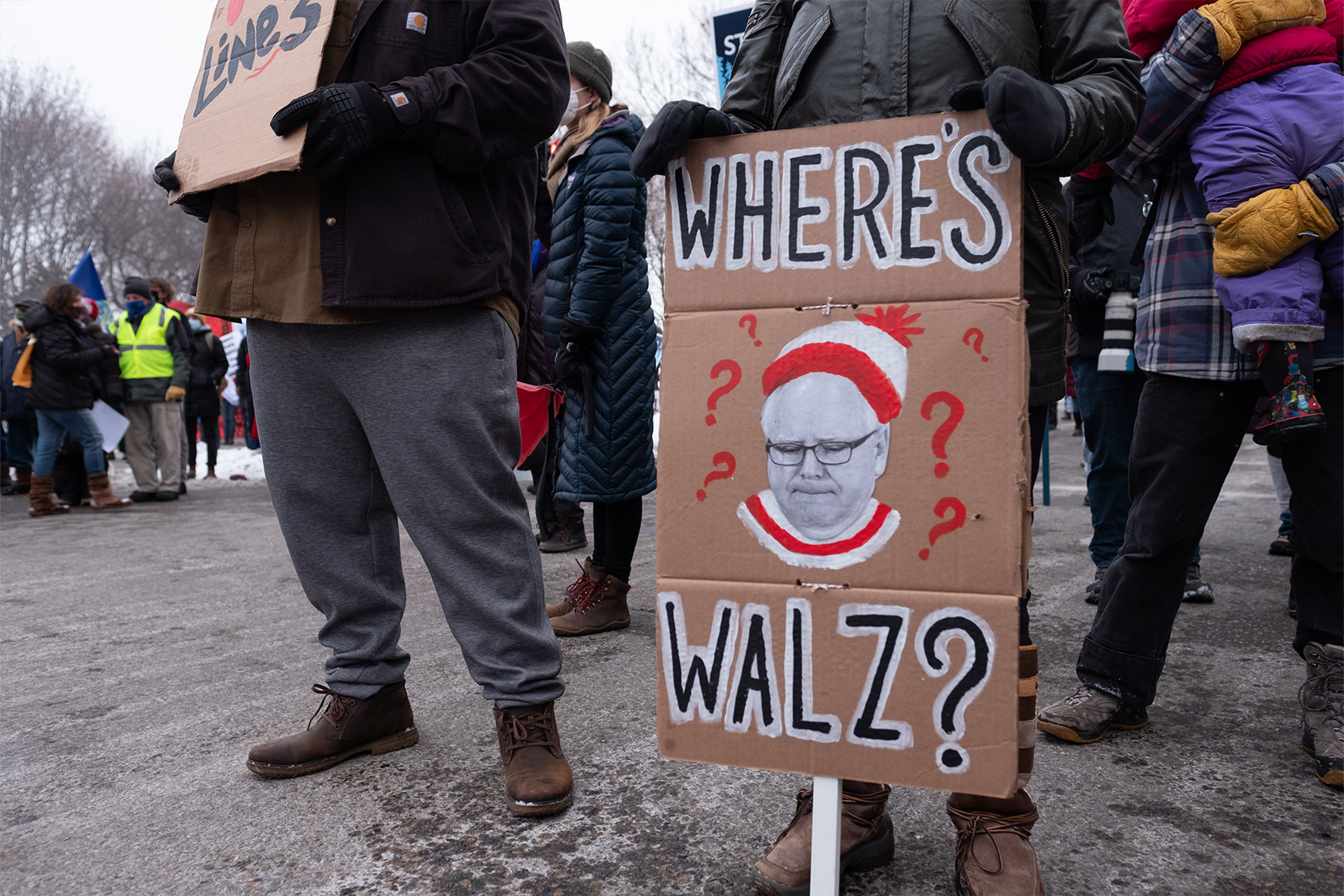
At the same time, Walz allowed an oil pipeline to be built under his watch — and that choice now is haunting him. Specifically, Line 3, an oil pipeline constructed by the Canadian multinational Embridge, primarily built in Minnesota, was fiercely opposed by both environmentalist groups and Indigenous groups. Many protestors were targeted by police, who were funded with millions funneled to them by Endbridge. A militarized police crackdown followed and hundreds of "water protectors" were arrested. Yet critics say Walz did nothing to stand in the way of its construction, which was completed in 2021. (Both the Harris campaign and the Walz office did not respond to Salon's request for comment.)

Stevie O’Hanlon, communications director and co-founder of the climate change activist organization Sunrise Movement, captured this ambivalence when speaking with Salon.

"Tim Walz helped pass one of the most ambitious clean energy bills in the country, with just a one seat Democratic majority," O'Hanlon said. "In total, he helped pass 40 climate initiatives in the 2023 session. He's been successful at getting things done on climate because he's effectively pitched it as a way to improve the lives of working people. Harris and Walz have an opportunity to be a historic administration for climate change."

Then there is a "but."

"Walz's lack of action to stop the Line 3 pipeline and to stand with Indigenous leaders protesting the project is disappointing," O'Hanlon said. "The science is clear. If we are going to stop catastrophic climate change, we need to stop building new oil and gas infrastructure."

Protest sign against Tim Walz Line 3 PipelineA protester holds a sign condemning MN Governor Tim Walz for supporting the permitting and construction of Line 3. St. Paul, MN. January 29, 2021. (Tim Evans/NurPhoto via Getty Images)

Laura Bishop, a former commissioner of the Minnesota Pollution Control Agency who worked under Gov. Walz during his first term, told Salon that she also believes Walz has a "strong" environmental record and has been a "climate champion." She singled out the money he allocated for infrastructure, advancing electric vehicles and improving agricultural practices. Bishop explained Walz's support for Line 3 by pointing out that it had been in planning before the Democrat even took office.

"This was an ongoing project that had been vetted by numerous state agencies and federal agencies," Bishop said. "The pipeline had corroded and was leaking, and a new pipeline was safer than the old ones. So he supported that as well as a vigorous environmental review process. And his general approach on all of these projects, for which this had several different permits — not just under the pollution control agency, but also other state and federal agencies — he really looks at all these permits needed to follow the law, follow the process, and follow the science as well as be transparent and have a rigorous public input and analysis to ensure that these projects protect our resources."

This included reaching out to members of Ojibwe tribe, who protested the pipeline both for its environmental impact and as part of a larger history of anti-Native American genocide.


Want more health and science stories in your inbox? Subscribe to Salon's weekly newsletter Lab Notes.


"Walz's lack of action to stop the Line 3 pipeline and to stand with Indigenous leaders protesting the project is disappointing."

"As someone who has worked in Minnesota, for both me and Gov. Walz, he knows that our natural resources need to be protected," Bishop said. "It's a part of our state, and being as well as how climate change is an existential threat, he really has led and instructed our agencies to work across his administration to find ways to address the climate crisis."

As for the concerns of Indigenous activists, one expert told Indian Country Today that local industry has managed to win over enough Native American leaders that they do not need to convince all of them.

"Enbridge leaders know there's no way for them to win the hearts and minds of all the Native people but they don't have to," Anton Treuer, professor of Ojibwe language at Bemidji State University in Minnesota, told Indian Country Today. "If they can win over just enough to clear enough hurdles to get the next easement or next little contract or permit approved, they know they'll be able to get their work done."

Gina Sutherland, senior advisor in corporate communications and media relations at Enbridge, told Salon that the Line 3 project as being constructed "under the most comprehensive regulatory framework in the history of Minnesota resulting in the issuance of over 60 federal, state, local and tribal approvals. These approvals included the strictest environmental requirements in state history."

We need your help to stay independent

Sunderland said that the corporate leaders behind Line 3 consulted 30 tribes along with the Army Corps of Engineers and incorporated a Tribal Cultural Resource Survey led by the Fond du Lac Band of Lake Superior Chippewa.

"Fond du Lac employed tribal cultural experts who walked the full route identifying and recording significant cultural resources to be avoided," Sutherland said. "As a result of this survey, 60 tribally significant cultural locations were identified and recommended for further avoidance, mitigation treatments or Tribal monitoring, all of which were adopted into project plans." She added that the economic impact of the pipeline has been $5 billion, creating thousands of jobs and stimulating millions in local construction spending.

"Enbridge spent well over $450 million specifically on training and hiring Native workers and with Native-owned businesses in Minnesota," Sutherland said.

Line 3 isn't the only reason Walz has lost points with environmental advocates. As a representative, he also voted to approve the Keystone XL Pipeline and has been criticized for allowing mining projects near waterways that tribes and conservationists say should be protected. Clearly, Walz has a mixed record on the environment, but most of his more controversial choices were made long enough ago that some people see potential for him to follow the science when crafting policy in the future.

“When you’re governor, clearly you’re going to take on a broader set of issues as priorities. Climate change is no exception,” Trent Bauserman, who worked in the Obama White House and as climate adviser to former House Majority Leader Steny Hoyer, told E&E News. “I think he has evolved as his role has evolved and the issue of climate change has evolved.”

L’Eggo my Eggo-flavored coffee: Iconic waffle brand launches new coffee collaboration

In 1972, the Chicago-based advertising firm Leo Burnett provided Kellogg's with a new slogan for the company's newly-acquired waffle brand. It was simple and catchy: "L'eggo my Eggo." Now, over 50 years later, the brand is hoping customers will also tell others to l'eggo their Eggo-flavored coffee. 

According to a Monday release, Eggo is collaborating with Two Rivers Coffee Company to release five waffle-flavored coffees, including Blueberry, Chocolate Chip, Cinnamon Toast, Maple Syrup and Vanilla. Of course, you can double down and savor an Eggo coffee alongside an actual Eggo waffle, but the coffees will also pair beautifully with anything you might be eating for breakfast — or enjoyed any time of the day.

The coffee line, which is compatible with Keurig brewers, will be available from Two Rivers, as well as at retailers like Amazon, Target and Walmart. 

"As a parent, there's nothing like trying to tackle the chaos of the mornings when you're running on little sleep," Joe Beauprez, Senior Director of Marketing for Frozen Foods, said in a release. "Eggo Coffee is that much-needed caffeine boost families need to get through those crazy mornings, plus it pairs perfectly with our Eggo waffles for a truly satisfying and easy-to-make breakfast. We're thrilled to partner with Two Rivers Coffee so we can transform the waffle flavors fans love into the perfect cup of coffee for parents and coffee lovers alike."


This summer’s salmonella-laced cucumber recall linked to nearly 500 cases of illness

Cucumbers have been all the rage lately thanks to TikTok's viral cucumber salad and the meteoric social media rise of the platform's Logan "Cucumber Boy" Moffitt — and thankfully, it appears home cooks are safe to indulge in the trend, too, as a "multi-state outbreak" of salmonella tied to contaminated cucumbers is finally waining. 

As the Centers for Disease Control (CDC) wrote in a report released and updated last week, by July 2, a total of "449 people infected with one of the outbreak strains of Salmonella Africana and Salmonella Braenderup have been reported from 31 states and the District of Columbia." One hundred and twenty-five of those infected were also hospitalized, though none died as a result of the infection, according to the report. 

Based on traceback information collected, the CDC writes that Bedner Growers, Inc. and Thomas Produce Company — both located in Florida — are "likely sources of illnesses in this outbreak," however, the organization notes "these growers do not account for all the illnesses in this outbreak." 

Now, as the companies' respective growing and harvesting seasons are over, "there is no product form these farmers on the market and likely no ongoing risk to the public," wrote the CDC. 

"The true number of sick people in this outbreak is likely much higher than the number reported and the outbreak may not be limited to the states with known illnesses," the agency's report continues. "This is because many people recover without medical care and are not tested for Salmonella. In addition, recent illnesses may not yet be reported as it usually takes 3 to 4 weeks to determine if a sick person is part of an outbreak."

Vegan cheese that tastes like cheese? These startups may have cracked the code

In a video uploaded to YouTube last year, home cook and food influencer Alexa Santos scores a wheel of brie, drizzles it with honey, and flips it into a hot cast-iron pan. "Cheese is the main reason why I can't go vegan," she explains before baking the cheese with blackberries and hazelnuts and smearing it on slices of baguette. 

She was channeling a common sentiment. There are long Reddit threads of would-be vegans confessing their inability to quit cheddar and chèvre. Miyoko Schinner, the founder of the plant-based cheese company Miyoko's Creamery, said in a recent Netflix documentary series that she hears that kind of thing often. "It's so interesting about cheese that people can't give it up," she said. 

I get it, because I'm one of those people. How on earth are we supposed to ditch the most carbon-intensive form of dairy in the face of melty pots of fondue and snowy piles of grated Parmesan? 

Try as though cheese lovers might, it's hard to ignore the environmental toll of cheese. Among major food products, its climate footprint trails only red meat and farmed shrimp. It's emissions intensive because of the methane that dairy cows belch into the air, and also because cheese is a concentrated product — it takes 10 pounds of fresh milk, on average, to produce one pound of cheese, with hard cheeses like Parmigiano Reggiano requiring more milk than soft kinds like ricotta. Cheese is also crazily water intensive, using 516 gallons for each pound, because dairy cows feed on thirsty crops like alfalfa. Meanwhile, Americans have doubled their cheese intake since the early 1980s, largely in the form of pizza. Taking a bite out of America's dairy cheese consumption would have meaningful environmental savings — but so far, there's never been any real sign that possibility could be on the horizon. 

Until now. For the first time, two alternative cheese makers are touting plant-based cheese convincing enough to win over even committed dairy fanatics.

One is New Culture, a San Francisco-based startup using precision fermentation to make a cow-less mozzarella that will debut later this year at the Michelin-starred Pizzeria Mozza in Los Angeles. New Culture hopes to create a new category of "animal-free" cheese that can eventually put traditional dairy out to pasture. Inja Radman, co-founder and chief science officer at New Culture, said, "We're very convinced we can eventually fully displace animal-derived cheese."

The other is Climax Foods, which uses machine learning to identify plant ingredients that can recreate the flavors and textures of blue cheese, feta, brie, and chèvre. The Berkeley-based company, founded by veteran data scientist Oliver Zahn, has big ambitions. A 2022 press release was headlined with the claim that Climax is "[taking] on the $800 billion dairy market" by matching conventional cheese bite for bite. Michelin-starred chefs have praised the faux cheeses — one of which was on its way to a stunning upset victory over dairy wedges at the annual Good Food Awards this spring when it was disqualified at the eleventh hour for still-opaque reasons. The Washington Post compared the vegan cheese's near-triumph to the 1976 Judgment of Paris — the blind taste test where California wines prevailed over French pours, shocking the wine world. 

This level of buzz and ambition may be new for fake cheese, but it's not the first time alt-proteins have tried to win over omnivores. Past efforts have included notable successes like the Swedish oat milk brand Oatly and failures like the McPlant burger, a collaboration between McDonalds and Beyond Meat that the fast-food giant axed in the United States after a test rollout bombed with customers. The trials and tribulations of past alt-meat and dairy companies have made the industry wiser to what does and doesn't make omnivores put substitutes on their plates. As Climax and New Culture eye spots on cheese boards, they're taking cues and heeding lessons from faux food's past. 


The campaign to make alt proteins appealing to everyone is about a decade old, counting from the launch of the Impossible and Beyond burgers, both of which promised to mimic meat in ways past veggie burgers couldn't. Pat Brown, the founder of Impossible Foods, said in 2015 that his company's line of meatless fare would replace animal products by 2035, a prediction that feels ambitious today, given that dollar sales of plant-based meat and seafood are just 1 percent of those of their animal-based counterparts. 

Yet the race to take fake meat mainstream is still very much on. The past couple of years have been marked by product reformulations meant to entice a wider variety of eaters: Beyond has leaned healthier, Impossible has veered more "indulgent," veggie-burger pioneer MorningStar Farms has gone "steakhouse style."

Vegan cheese companies, too, have been making more overtures to non-vegans in recent years. Violife, one of the more recognizable plant-based cheese brands, launched a campaign in 2022 encouraging flexitarians to change their cheese for the planet's sake. Daiya, another brand found in many supermarkets, revamped its cheeses last year to be more cheese-like and unveiled a new brand meant to be more flexitarian-friendly. Yet the market for vegan cheese, like that of fake meat, is still just 1 percent of the size of the dairy cheese market by dollar sales — and it's been sitting at that level for three years running.

Granted, vegan cheese hasn't received the level of investment that fake meat has, but it also has a mass-adoption advantage it hasn't yet cashed in on, according to Brian Kateman, co-founder and president of the Reducetarian Foundation. He points out that since lactose intolerance is common (more than a third of Americans struggle to digest the dairy protein) there's something of a built-in market for alt dairy — but the path has been easier for fake milk. Plant-based milk, which boasts 17 percent the dollar sales of regular milk, just isn't "the star of the dish" the way fake meat is, he reasons, adding that "cheese is kind of somewhere in the middle."

If there's one thing that's become clear in the alt-food world over the past decade, it's that taste trumps everything. According to a 2023 survey by the Food Industry Association, it's the biggest reason eaters either bail on plant-based foods or come back to them after they've tried them once. 

The problem, as Kateman puts it, is that "historically, vegan cheese has sucked." Faux cheeses generally fall into two camps. There are the hyper-processed kinds made of oil and starch that dissolve into goo when heated and, in especially soul-crushing cases, stick to your teeth like glue. And then there are the more artisan faux cheeses, often made of fermented nut milks, which can taste good if you judge them on their own merits but would never be mistaken for actual dairy.

Past vegan cheeses "were not functional," said Radman, of New Culture. "They were not tasty." 

Climax and New Culture are aiming to close vegan cheese's vast taste gap with different technologies.

New Culture's involves using precision fermentation to grow casein, a dairy protein found in milk that Radman said is "the holy grail" for making cheese stretch, ooze, and melt when heated. The process involves training microbes to produce the dairy protein in a lab so that cows don't have to. Other types of precision fermentation are already used in a variety of foods: Artificial flavors like vanillin, the vitamins added to cereal, and the rennet used in most dairy cheese are all precision-fermented. New Culture rounds out its recipe with water, plant-based fats, salt, sugar, vitamins, and minerals. (The company won't reveal what those plant-based fats are until they launch, but Radman said they're ingredients people could find in their kitchens.)

Precision fermentation is not a new technique in the plant-based world: Impossible Foods brews plant-derived heme to make its fake meat bleed. That's just one of the ways New Culture sees Impossible Foods as a role model. Radman said she thinks staying focused on nailing just one product first, as Impossible did with its burger, is a smart approach. And she's not the only one: Entrepreneurs and writers have been calling for plant-based meats and dairy to do less and do it better. For Impossible, the combination of a focused start and a precision-fermented recipe was enough to put it at the front of the meatless flavor pack. A 2023 study found that in both blind and informed taste tests, eaters preferred the Impossible Burger not just over the Beyond Burger, but over actual beef, too — even though most blind tasters could tell it wasn't meat.

So is New Culture the long-awaited Impossible Burger of cheese? Nancy Silverton, the James Beard Award-winning chef behind Pizzeria Mozza, the restaurant that's debuting New Culture, said it's better. She doesn't think vegan substitutes should require making "an excuse. And I think that happened in the world of those Impossible meats and things like that," she said. "I personally didn't think they were great." New Culture's animal-free mozzarella, on the other hand? Silverton calls it "stellar." It's the first vegan cheese she's ever put on the menu at any of her restaurants.

A big part of her assessment comes down to texture. Unlike past nut-based cheeses, Silverton said, New Culture's mozzarella melts smoothly, and has "that little bit of stretch, kind of that creaminess" that you want on pizza. The one thing it's missing compared to dairy cheese, she notes, is the milky flavor that lactose would provide. "But you get all the other satisfying parts of a mozzarella." (Since New Culture's mozzarella hasn't been released yet, I didn't get a chance to taste it myself.)

If New Culture's path toward convincing vegan cheese literally starts with casein, Climax's works backward from the magic ingredient. The company, which launched in 2020, uses an advanced algorithm to sift through data on plant-based proteins and fats to find combinations that can mimic the characteristics of dairy milk. Given the vast biodiversity in the plant kingdom, Zahn said, "It's completely crazy to think that casein is the only protein that melts and stretches under heat exposure." He said there's been a big assumption in the plant-based food world that you either have to grow identical versions of animal-derived ingredients in a lab, or iterate on plant-based recipes manually. Artificial intelligence can accelerate the latter approach, he said — although Climax employs a team of cheese makers to vet ingredients and test recipes. 

Climax's four cheeses are made with ingredients like legumes, seeds, and plant oils. Last year, the company inked a deal with the Bel Group, the maker of Laughing Cow and Boursin, to help the cheese giant reformulate its vegan line. 

Climax's blue cheese and feta, both of which I tried at home, are astonishing for cheese made from plants. The feta tasted exactly like the real deal. The blue, whose top three ingredients are organic pumpkin seeds, organic coconut oil, and lima beans, was very close; it got me at first with its sharp tang and characteristic crumbliness. There were two minor giveaways, however: It wasn't as rich and fatty as a dairy blue, and the texture got slightly gritty when it warmed up in my AC-less kitchen. But would I notice the difference if it were served in a Waldorf salad like the one it featured in last fall at Eleven Madison Park? Doubtful.


Launching in restaurants, as Climax did last year and New Culture will do later this year at Pizzeria Mozza, is a familiar path in the alt-protein world that can give products a foodie halo. Oatly launched its barista blend in 2017 in coffee shops, letting baristas make the case that discerning drinkers order oat milk — a move that fueled the alt-milk brand's rapid rise. Impossible Foods first sold its patties at David Chang's now-closed Momofuku Nishi, which created buzz and acted as a Michelin-starred vote of confidence that meatless burgers really could hold their own next to shoestring fries. Chef endorsements are probably doubly important for fake cheese, since people know it today as disappointing goop.

Zahn, who used to work for Impossible Foods, hopes Climax will distinguish itself from past vegan cheeses with its high protein content, notably lacking in many of the oil-and-starch-based fake cheeses that pepper grocery store shelves. He also hopes its branding will stand out. He said the branding of past alt protein companies, "especially in the beginning, was very tech-bro-ish," signaling no emotion or culture. It's why he chose the name Climax. "I wanted to sound deeply humane and something people really can identify with," he explains, citing the idea of culmination expressed by the Greek root of the word. (Whether the sexual connotations of the name appeal to or alienate customers remains to be seen.)

Revamping how vegan protein brands talk to omnivores has been a topic of discussion in the industry recently. Peter McGuinness, the CEO of Impossible Foods, told Bloomberg TV in June that he thinks plant-based food "launched incorrectly," leading with too much morality. In the beginning, he said, "It was very climate, it was very zealot, there was a lot of rhetoric, it was very anti-cattle industry." One element of what he said echoed what Ethan Brown, the founder and CEO of Beyond Meat, told The New York Times in 2021: Climate just doesn't sell. Radman agrees, and said New Culture's marketing, when it eventually enters the retail space, will be more about food than climate. 

Neither Climax nor New Culture has released a life cycle assessment — a detailed study that measures the environmental impact of foods and other products — though both companies said they plan to. New Culture's preliminary in-house analysis suggests their animal-free mozzarella uses less than 5 percent of the water and land of its dairy-based counterpart, and produces less than 20 percent of the carbon emissions. Previous studies have estimated that other vegan cheeses produce anywhere between 2 percent and 49 percent the emissions of animal-derived cheeses.


Foodie vibes are unlikely to sway mainstream eaters if fake cheeses aren't affordable. Beside taste, price parity is the other white whale that meat and dairy substitutes have been chasing. Bruce Friedrich, founder and president of the Good Food Institute, a think tank that promotes alternative meat and dairy, wrote on X last year that until those two bars are met, "the theory of change has not been tried" for meatless meat. Kateman said taste and affordability are the most crucial factors to get people to buy vegan cheese, too. 

Last year, plant-based cheese was about 30 percent more expensive than conventional cheese on a per-unit basis, according to Daniel Gertner, a business analyst at the Good Food Institute, though he cautions that more data is needed to draw a complete picture of the price difference. 

Both New Culture and Climax say they'll eventually beat dairy cheese on price as they scale. Climax's blue cheese is so far available directly to consumers only through the Bay Area grocery delivery service Good Eggs for $2.88 per ounce — comparable to the high end of artisan wedges. 

But Zahn is resolute that skipping the cow — which he sees as a wasteful middleman between plant ingredients and cheese makers — will make cheese from plants the more affordable option in the end. "I wouldn't be in this business and taking an enormous pay cut over staying at Google or something if I didn't believe we could change the world," he said. "And I would be crazy to think we could change the world if our products couldn't be cheaper."

This article originally appeared in Grist at https://grist.org/food-and-agriculture/best-vegan-cheese-climax-new-culture-alt-proteins/.

Grist is a nonprofit, independent media organization dedicated to telling stories of climate solutions and a just future. Learn more at Grist.org

"This story was originally published by Grist. Sign up for Grist's weekly newsletter here."

“Unconstitutional”: Kroger sues Federal Trade Commission ahead of merger court hearing

Kroger has filed a lawsuit against the U.S. Federal Trade Commission, seeking to block the regulator from reviewing the supermarket chain’s controversial proposed $25 billion merger with Albertsons. According to a Monday release from the company,  Kroger filed a motion for preliminary injunction in the U.S. District Court, Southern District of Ohio, against the FTC’s administrative proceeding challenging the deal. 

The motion alleges the FTC is violating Constitutional practices “because the Administrative Law Judge presiding over the administrative proceeding is not removable by the President of the United States,” and because the regulator is “seeking to adjudicate Kroger's private rights to contract with another private party administratively through the Executive Branch rather than in the independent Judicial Branch.” 

Evidentiary hearings for the federal court proceeding are set to begin on Aug. 26 in the District of Oregon.

"The merger between Kroger and Albertsons is squarely focused on ensuring we bring customers lower prices starting day one while securing the future of good-paying union jobs," said Rodney McMullen, Kroger Chairman and CEO, in a written statement. "We stand prepared to defend this merger in the upcoming trial in federal court — the appropriate venue for this matter to be heard — and we are asking the Court to halt what amounts to an unlawful proceeding before the FTC's own in-house tribunal."

4 ways to cut down on meat when dining out – and still make healthy choices

Many of us are looking for ways to eat a healthier and more sustainable diet. And one way to do this is by reducing the amount of meat we eat.

That doesn't mean you need to become a vegan or vegetarian. Our recent research shows even small changes to cut down on meat consumption could help improve health and wellbeing.

But not all plant-based options are created equal and some are ultra-processed. Navigating what's available when eating out – including options like tofu and fake meats – can be a challenge.

So what are your best options at a cafe or restaurant? Here are some guiding principles to keep in mind when cutting down on meat.


Health benefits to cutting down

Small amounts of lean meat can be part of a healthy, balanced diet. But the majority of Australians still eat more meat than recommended.

Only a small percentage of Australians (10%) are vegetarian or vegan. But an increasing number opt for a flexitarian diet. Flexitarians eat a diet rich in fruits and vegetables, while still enjoying small amounts of meat, dairy, eggs and fish.

Our recent research looked at whether the average Australian diet would improve if we swapped meat and dairy for plant-based alternatives, and the results were promising.

The study found health benefits when people halved the amount of meat and dairy they ate and replaced them with healthy plant-based foods, like tofu or legumes. On average, their dietary fiber intake – which helps with feeling fuller for longer and digestive health – went up. Saturated fats – which increase our blood cholesterol levels, a risk factor for heart disease – went down.

Including more fiber and less saturated fat helps reduce the risk of heart disease.

Achieving these health benefits may be as simple as swapping ham for baked beans in a toastie for lunch, or substituting half of the mince in your bolognese for lentils at dinner.


How it's made matters

For a long time we've known processed meats – such as ham, bacon and sausages – are bad for your health. Eating high amounts of these foods is associated with poor heart health and some forms of cancer.

But the same can be true of many processed meat alternatives.

Plant-based alternatives designed to mimic meat, such as sausages and burgers, have become readily available in supermarkets, cafes and restaurants. These products are ultra-processed and can be high in salt and saturated fat.

Our study found when people replaced meat and dairy with ultra-processed meat alternatives – such as plant-based burgers or sausages – they ate more salt and less calcium, compared to eating meat or healthy plant-based options.

So if you're cutting down on meat for health reasons, it's important to think about what you're replacing it with. The Australian Dietary Guidelines recommend eggs, legumes/beans, tofu, nuts and seeds.

Tofu can be a great option. But we recommend flavouring plain tofu  with herbs and spices yourself, as pre-marinated products are often ultra-processed and can be high in salt.

What about when dining out?

When you're making your own food, it's easier to adapt recipes or reduce the amount of meat. But when faced with a menu, it can be difficult to work out what is the best option.


Here are our four ways to make healthy choices when you eat out:

1. Fill half your plate with vegetables

When cutting down on meat, aim for half your plate to be vegetables. Try to also eat a variety of colours, such as leafy green spinach, red capsicum and pumpkin.

When you're out, this might look like choosing a vegetable-based entree, a stir-fry or ordering a side salad to have with your meal.

2. Avoid the deep fryer

The Australian Dietary Guidelines recommend limiting deep fried foods to once a week or less. When dining out, choose plant-based options that are sautéed, grilled, baked, steamed, boiled or poached – instead of those that are crumbed or battered before deep frying.

This could mean choosing vegetarian dumplings that are steamed not fried, or poached eggs at brunch instead of fried. Ordering a side of roast vegetables instead of hot chips is also a great option.

3. Pick whole grains

Scan the menu for wholegrain options such as brown rice, wholemeal pizza or pasta, barley, quinoa or wholemeal burger buns. Not only are they good sources of protein, but they also provide more dietary fiber than refined grains, which help keep you fuller for longer.

4. If you do pick meat – choose less processed kinds

You may not always want, or be able, to make a vegetarian choice when eating out and with other people. If you do opt for meat, it's better to steer clear of processed options like bacon or sausages.

If sharing dishes with other people, you could try adding unprocessed plant-based options into the mix. For example, a curry with lentils or chickpeas, or a vegetable-based pizza instead of one with ham or salami. If that's not an option, try choose meat that's a lean cut, such as chicken breast, or options which are grilled rather than fried.


Laura Marchese, PhD candidate at the Institute for Physical Activity and Nutrition, Deakin University and Katherine Livingstone, NHMRC Emerging Leadership Fellow and Senior Research Fellow at the Institute for Physical Activity and Nutrition, Deakin University


This article is republished from The Conversation under a Creative Commons license. Read the original article.

Pioneering daytime talk show host Phil Donahue dies at age 88

Legendary daytime talk show host Phil Donahue passed away on Sunday at his home on the Upper East Side of Manhattan "following a long illness," according to a statement from his family shared with TODAY. He was 88.

Donahue's prolific career began operating in full swing with "The Phil Donahue Show," which he started in 1967 in Dayton, Ohio, not far from where he had grown up in Cleveland. The show gained a reputation for being deeply innovative, allowing audience members to ask guests questions and exploring matters deemed controversial: child abuse in the Catholic church, race relations, sex and the AIDS epidemic of the 1980s, among other topics. Donahue went behind bars at a maximum security prison in Ohio to learn more about the carceral system in the U.S. The New York Times reported that Donahue even televised a birth, an abortion, a reverse vasectomy and a tubal litigation. “I want all the topics hot," Donahue was said to have told his staff, per The Times.

Interviewees on "Donahue," as it was later dubbed, included Bill Clinton, Robin Williams, Dolly Parton, Muhammad Ali, Richard Pryor, Gloria Steinham, Nelson Mandela and many more. 

The show, which moved from Ohio to Chicago and then New York City, accrued 20 Daytime Emmy awards over its 29-year run, with its host earning an individual lifetime achievement Emmy Award in 1996, the same year the show ended. Donahue returned to host the show's second iteration six years later; however, it didn't have the same power as before. Depending on who you ask, lower ratings were chalked up to a number of factors including the rise of the more shocking TV talk shows, Oprah Winfrey joining the fray and Donahue interviewing opponents to the Gulf War. Several stations dropped the struggling show, and Donahue himself decided to bow out before it was outright canceled. The last episode aired in 1996.

Donahue also briefly hosted a show for MSNBC beginning in 2002, but was fired in 2003 for his stance against the Iraq War. He later went on to write, co-direct, and produce the documentary "Body of War" (2007), which highlighted an Iraq War veteran. 

In 2024, President Joe Biden awarded Donahue the Presidential Medal of Freedom, alongside Olympic swimmer Katie Ledecky and Academy Award-winning actor Michelle Yeoh.


“A huge argument”: Food Network’s Sandra Lee gives background on viral “two shots of vodka” meme

Food Network host Sandra Lee’s infamous “two shots of vodka” moment, which was captured during a 2008 episode of her series “Semi-Homemade Cooking with Sandra Lee,” quickly transcended its origins to become a viral staple of internet culture. The clip, in which Lee casually pours what appears to be half a bottle of vodka into a cocktail shaker after calling for “two shots,” first gained traction on Vine and YouTube, before eventually finding a new audience on TikTok amid the pandemic as a collective desire for escapism and the advent of Zoom cocktail hours collided. 

But in a recent Instagram post for Delish, Lee revealed some interesting industry backstory behind the moment. “First of all, I was the first one that did cocktails on national television, and especially on cable,” Lee said. “And that was a huge argument when we were negotiating the show, which, by the way, I never wanted to do ‘Semi-Homemade’ as a TV show and no one knows that.” 

Lee said she and network executives negotiated for nine months because they believed “nobody [was] going to enjoy cocktail time” on the show. 

“And I go, ‘You don’t know Colleen Schmidt from Fredonia, Wisconsin,’” Lee said. “‘It’s Sunday. She’s watching the Packers. She’s having a Bloody Mary. We gotta make some cocktails.’” 

You can read more about Lee’s return to food television with Netflix’s “Blue Ribbon Baking Championship” in her new interview with Salon’s Mary Elizabeth Williams

Menopause is all the rage, from Hollywood stars to “The Change”

If you have ovaries and a uterus, and are somewhere in your late 40s or beyond, you will have a body-informed epiphany. It might be barely noticeable. It may stop you in your tracks. You can see when it happens to and for Linda, Bridget Christie’s heroine in “The Change,” because it slaps her upside the head.

The wife and mother of two is clearing plates and trash after her 50th birthday party, planned by a husband who enjoys all the attention and didn’t do any work to make it possible. She even had to bake her own cake. As she cleans house, Linda quietly taps a button on her digital watch to time each chore, recording the tally in a journal once it is completed.

Then she opens an upper cabinet and is pummeled in the noggin by an avalanche of unmatched Tupperware – someone else’s task left for her to do. But the epiphanic ding! hits her as she’s smoothing a Band-Aid onto her forehead wound, and considers the superhero that decorates it: the Incredible Hulk.

The Hulk, she writes in her goodbye note to her husband Steve (Omid Djalili), is the only menopausal role model in the history of TV and film. He reads this to his mother over the phone after Linda has roared away on her old motorcycle.

“It’s not funny, Mum!” Steve said. “I can’t find the towels!”

Oh, but it is funny – because it’s true. Dr. Bruce Banner is not a physician, let alone a gynecologist. Still, being that he is a man of science and completely fictional, he may be able to provide the correct and most basic medical definition of menopause, in that it is a point in time 12 months after a woman’s last period.

Symptoms occurring in the years leading up to that point are referred to by the National Institute on Aging as perimenopause or menopausal transition, which typically occurs between the ages of 45 and 55.

But that doesn’t explain the purported 34 symptoms menopause is thought to encompass, the most Hulk-ish of which make you feel crazy. Maybe not the night sweats or hot flashes, but certainly the brain fog that can temporarily steal your verbal acuity and the mood swings that careen a woman from la-dee-dah to rage blackout in seconds flat, sometimes without warning or reason.

In Christie’s Linda, we have a more relatable menopausal role model than the Hulk, not to mention one that isn’t a radioactive tone of chartreuse. Christie’s brain drops common descriptors (“Can you get the cake knife thing please? It’s flat . . . it’s a triangle . . . you cut a slice of cake with it and it catches it underneath. The cake knife thing!”) She flips out at her checked-out doctor, swallows too loudly and chafes at being dismissed by her family. Then she embraces another common symptom of menopause – not giving a flying bleep about any of it.

Instead of exploding at her negligent loved ones, she breaks free by taking off on her motorcycle to the Forest of Dean in Gloucestershire. The way she sees it, she’s earned her sabbatical from domestic servitude. All the scribblings in her journals, she tells Steve, are a full accounting of her invisible labor over their many years of marriage. She’s simply reclaiming some of her time. Hulk smash.

One year after its U.K. debut, “The Change” has arrived stateside on Britbox, and in time to join a celebrity-endorsed effort to center menopause in conversation.

“Beverly Hills 90120” star Jennie Garth made headlines earlier this month when she candidly called menopause “a daily minefield, both physically & mentally” in an Instagram post. This accompanied a video montage of Garth vigorously strength training.

It wasn’t very long ago that TV shows started acknowledging menopause and other aging realities for women thoughtfully, approaching it not as an ending but a transformation.

“[R]ecently it just feels like my body is fighting against me at times. I forget that there’s so much happening inside me, causing so many changes, that of course i’m not always gonna feel or be able to perform how I’d like to (or expect to),” she posted. “I have to remind myself to give myself some grace! I’m doing the best I can & that makes me feel a little better.”

In May, Halle Berry lobbied for the Advancing Menopause Care and Mid-Life Women’s Health Act, a $275 million bipartisan Senate bill aimed at increasing clinical research into menopause.

“The shame has to be taken out of menopause. We have to talk about this very normal part of our life that happens,” Berry said. “Our doctors can’t even say the word to us, let alone walk us through the journey of what our menopausal years look like.”

We need your help to stay independent

They join Gayle King, Drew Barrymore, Michelle Obama, Naomi Watts and others in publicly discussing their menopause experiences and how little information they were given about this stage of a woman’s life and health.

This increased candor about “the change” has somewhat eased our comfort with talking about menopause. As for why it’s surging right now, we might credit a few related forces. One is that Generation X, which ushered sex positivity into the mainstream, happens to be the main cohort slogging through it. By reputation Gen X is prone to share our displeasure about issues our predecessors silently endured, and insist something be done about it.

The other is that mitigating menopause is highly marketable. Women going through menopause in 2024 have access to a slew of products to treat it, much of it bunk, that our foremothers didn’t. The Telegraph cites a report by Grand View Research saying the global menopause supplement industry is expected to reach $22.7 billion by 2028.

Also, and this is important, there is so much for menopausal women to be enraged about, as JD Vance so generously reminds us. Supporting a woman presidential candidate’s campaign is constructive means of healthily expressing that anger.

In any case, we’re lucky to have forums and figures inspiring approaches to menopause that are empowering as opposed to dire. Around the same time as her social media post, Garth devoted a full episode of her podcast “I Choose Me” to a discussion about destigmatizing menopause with Dr. Mary Claire Haver.

Meanwhile, Miranda July just released what the New York Times hails as “the First Great Perimenopause Novel” featuring a nameless, 45-year-old protagonist who, like Linda, decides it’s high time to take a leave of absence from her family. But while Linda’s adventure is chaste, even after she befriends a handsome, cave-dwelling hermit called Pig Man (Jerome Flynn) who also cuts ties with his old life, July’s woman-on-the-verge shifts to prioritizing sexual and existential pleasure.

“[M]enopausal and postmenopausal women are actually some of the coolest, most powerful, wise and inspiring people on the planet.”

It wasn’t very long ago that TV shows started acknowledging menopause and other aging realities for women thoughtfully, approaching it not as an ending but a transformation.

Women creators, of course, are often the ones taking up that charge, as Pamela Adlon did in “Better Things,” along with Phoebe Waller-Bridge, who wrote a bar-setting monologue in the second season of “Fleabag,” delivered by Kristin Scott Thomas. In her reckoning, menopause is an explosive release of the pain and strength women carry through our lives.

“And then, just when you feel you’re making peace with it, what happens? The menopause comes, the f**king menopause comes, and it is the most wonderful f**king thing in the world,” Thomas’ character Belinda says. “And yes, your entire pelvic floor crumbles and you get f**king hot and no one cares. But then — you’re free! No longer a slave, no longer a machine with parts. You’re just a person, in business.”

Passages like this and the rare, beautiful episodes about menopause (see: the “Better Things” episode titled “Show Me the Magic”) are encapsulated inspirations. “The Change” makes Linda’s shifting sense of who she is a starting point that radiates outward to apply to her new community, too.


Want a daily wrap-up of all the news and commentary Salon has to offer? Subscribe to our morning newsletter, Crash Course.


Linda refuses to accept an older man’s sexual harassment, but she doesn’t ostracize him either. The same goes for the right-wing radio host in the local café railing against feminists and immigrants while working in close quarters with a Black woman who both intimidates and mesmerizes him. And the old growth forest that is enmeshed in the town’s identity is under threat.

Change, and “The Change” are about life’s inevitabilities and learning to accept that some things slip beyond our grasp.

This includes temporary losses, as in when one character admits she couldn’t remember what a toe was called (“I called it a foot finger,” she says), and more permanent ones.

In a 2021 essay, Christie wrote that the trick is to “front it out,” which is what she’s doing with her comedy. “Once we start seeing ourselves in film, TV and books,” she wrote, “the less afraid we will be and the more we will see that menopausal and postmenopausal women are actually some of the coolest, most powerful, wise and inspiring people on the planet.”

Watching Linda remember who she is helps, adding to a conversation that is getting broader, louder, and, in Christie’s interpretation, more joyful.

All episodes of “The Change” are available on BritBox.

Trump is already worried Kamala Harris’ convention speech ratings will top his: report

In conversations with allies and aides, former President Donald Trump is trying to project confidence over his ability to hoard attention, telling them that the viewership for his Republican National Convention acceptance speech was "tremendous" and won't be outdone by Vice President Kamala Harris this week. But sources close to the Trump campaign told Rolling Stone that these boasts are often accompanied by prodding over what they predict her ratings will be on Thursday evening, a sign that Trump is worried about losing to Harris on yet another metric besides crowd size and polling.

So far, Trump is one-for-two in convention speech ratings. He drew more viewers than Hillary Clinton in 2016, but lagged behind Biden in 2020. His queries over the 2024 convention speech match-up against Harris come amid his roiling anger over Harris' large crowd sizes, which apparently cuts deep into the confidence of a man who measures his political power by his visible popularity. Trump has insisted that he drew a larger crowd during the insurrection of January 6, 2021 than Martin Luther King Jr.'s 1963 March on Washington, while falsely accusing Harris of doctoring photos so that her supporters appear more numerous than in reality.

He also boasted about the ratings of press conferences he gave during the COVID-19 pandemic, as the disease left a floundering economy and thousands of dead Americans in its wake.

A Harris campaign spokesperson told Rolling Stone that "yes, of course," they will mock Trump if the vice president's ratings exceed his own, perhaps hoping to get into his head. Trump has a long history of seeking validation over his ratings with aides and TV network officials alike. According to a former Trump White House official, in 2018 the then-president ordered his aides to present evidence to the press that his State of the Union address exceeded all the TV ratings of his predecessors in history, even though no such proof existed.

“He was just getting angry that people in the media were going on TV saying his [first State of the Union address] ratings were lower than other times,” the ex-official told Rolling Stone.

Another former Trump aide, Sam Nunberg, recalled to the Daily Beast that Trump asked him and others to call ABC, Fox, and other network hosts to provide the exact ratings data for an interview he'd just done. Sometimes, Trump would make the call himself.

"Often, they wouldn’t send him the actual numbers but just transmit back something like, ‘They were fantastic, you won.’ He kept very close track of his ratings and always wanted the numbers so he could tweet them," he said.

As politicians point fingers on price gouging, Kroger pledges to slash grocery prices by $1 billion

Since first announcing plans to merge in Oct. 2022, leadership from Kroger and Albertsons, two of the largest supermarket chains in the country, have maintained the deal is necessary in order to compete with the increasingly monopolistic companies, like Amazon and Walmart, that have pushed their way into the grocery business in recent years. It’s a claim that’s been met with significant skepticism from some state-level and federal legislators and analysts who predict the merger would simply result in higher grocery prices. 

“This supermarket mega-merger comes as American consumers have seen the cost of groceries rise steadily over the past few years,” said Henry Liu, director of the Federal Trade Commission's Bureau of Competition, in February. “Kroger’s acquisition of Albertsons would lead to additional grocery price hikes for everyday goods, further exacerbating the financial strain consumers across the country face today.” 

To push back against that narrative, Kroger had previously promised to lower grocery prices by $500 million if the merger gained regulatory approval — a number the company has now increased to $1 billion, likely in an effort to push the deal through. 

In an emailed statement to The Dallas Morning News, a Kroger spokesperson said that since announcing the planned merger nearly two years ago, the company has continued its work “to confirm and increase opportunities to generate efficiencies to invest back in customer prices, associate wages and store experience.”

“After the merger closes, Kroger will invest $1 billion to lower Albertsons’ prices, consistent with Kroger’s track record of fighting inflation and providing value to customers,” the statement continued. 

This announcement from Kroger comes at a tense moment, as two United States senators have called for more transparency from the company regarding its use of electronic shelf labels —which they allege allow stores to “extract maximum profits” — and as the supermarkets and the Federal Trade Commission go to court next week to determine whether the merger will go through. 

We need your help to stay independent

On Aug. 5, Sens. Elizabeth Warren and Robert P. Casey, Jr. wrote a letter to Kroger Chairman and CEO Rodney McMullen to “request further information to better understand the justification for and risks of electronic shelving.”   In 2019, Kroger launched a partnership with Microsoft to develop several new digital tools for their stores, including electronic shelving that would use “digital displays, instead of traditional paper tags, to indicate everything from prices and promotions to nutritional and dietary information,” according to an archived press release from Microsoft

However, Warren and Casey indicate in their letter concerns over whether or not these digital displays — called an EDGE, or “Enhanced Display for Grocery Environment,” Shelf —could be used to unfairly calibrate higher prices for more in-demand items. Citing a report from Marketplace, the senators wrote: 

Widespread adoption of digital price tags appears poised to enable large grocery stores to squeeze consumers to increase profits. Analysts have indicated that the widespread use of dynamic pricing will result in groceries and other consumer goods being “priced like airline tickets,” “creat[ing] a sense of urgency and a sense of scarcity that wouldn’t exist if there were just publicly posted prices that everybody understood,” and allowing “sellers…to … figure out ways to extract the maximum amount of profit from each customer.”

The senators also requested answers to 11 specific questions, including: 

  • For all items that have been subject to dynamic pricing using EDGE, what is the average percentage change in price of those items over the first six months of using the system? 
  • Has Kroger ever used EDGE to change the price of an item more than one time within the same day? 
  • And how will Kroger ensure that it will not use customer data related to ESL platforms to discriminate based on protected classes, such as race, gender or age, when offering personalized prices? 

In a statement to Grocery Dive, a publication that focuses specifically on the industry, a spokesperson for Kroger wrote: “Any test of electronic shelf tags is to lower prices more for customers where it matters most. To suggest otherwise is not true.” 

Warren and Casey have requested a response to their questions from Kroger by Aug. 20, six days before the company, along with representatives from Albertsons, is due to appear in court in Portland to argue against the FTC’s federal lawsuit that aims to prevent the merger. Nine attorneys general — from Arizona, California, Illinois, Maryland, Nevada, New Mexico, Oregon, Wyoming and Washington, D.C. — have joined the complaint.

John Fetterman’s own communications director criticizes his support for Israel to reporter

Sen. John Fetterman, D-Pa., unequivocally backing Israel even as its assault on Gaza wreaks carnage on the civilian population, has seen the departure of several top staffers from his office over the past several months. Now, a current staffer has gone on the record to criticize her boss over his hardline pro-Israel stance to Free Press senior editor Peter Savodnick, who reprinted some of her words in a profile of Fetterman.

"I don't agree with him," said Carrie Adams, Fetterman's communications director, after Savodnick wrapped up his interview with the Pennsylvania senator. “I have a sense that his international views are a lot less nuanced than my generation, because when he was growing up, it was might makes right, and for my generation and younger who, of course, are the ones protesting this, they have a much more nuanced view of the region."

When Hamas attacked southern Israel on October 7, Fetterman joined the rest of the Democratic Party in denouncing terrorism and backing Israel's military retaliation, but angered many of his supporters by refusing to consider a more measured position while human rights watchdogs accused Israel of inflicting collective punishment on Gaza's population or, at worst, committing genocide.

Fetterman opposes conditioning military aid to Israel, recognizing a Palestinian state and a ceasefire deal that does not satisfy the right-wing Israeli government. When asked about the now 40,000 dead Palestinians reported by the Gaza Health Ministry, Fetterman refused to fault Israel, instead putting the blame entirely on Hamas for starting the war. The Pennsylvania senator has also gleefully mocked pro-Palestine activists, drawing accusations of insensitivity and willful ignorance towards Palestinian suffering now and historically under Israeli occupation and blockade.

In the spring of 2024, several of his Senate staff resigned to work in relatively more pro-Palestine spaces, including the progressive Working Families Party and the office of Chicago mayor Brandon Johnson. Communications staffers Nick Gavio and Joe Calvello both complimented Fetterman at the time of their departure, but Savodnick noted that denigrating a former Capitol Hill boss is an extremely rare practice — Adams' criticism of Fetterman was an exception that could indicate a much wider rift.

"This was the first time I’d ever encountered anyone—on Capitol Hill or anywhere else, on the record, off the record, on background, whatever—criticizing 'the principal,'" he wrote.

Fetterman's position on Israel has not only put him at odds with some of his own staffers and young progressives, who formed the core of pro-Palestine protests that swept college campuses this year, but also with more mainstream Democrats who are now publicly critical of Israel's wartime conduct. The senator downplayed his decision to skip the Democratic National Convention in his Free Press interview, maintaining that it was a personal choice unrelated to his position on Israel and Palestine.

Even if Fetterman is skipping town, pro-Palestine protesters have chosen to show up in force, vowing to persist until the Democratic Party takes a stronger posture against Israel's war in Gaza.

“God never hands me a softball”: Sandra Lee explains why she hasn’t worked in 8 years

"Isn't it pretty?" Sandra Lee asks me, and I have to agree. The Emmy Award-winning television host, author and coiner of the word "tablescape " is leading me, via Zoom, to a corner of her living room to show me one of her most prized possessions — the blue ribbon she won for display and design 32 years ago at the Los Angeles County Fair.

"That ribbon is 48 inches long. The head on that ribbon is 16 inches," she notes with the authority of someone accustomed to doing the math. "That ribbon is like the Kentucky Derby or the Westminster Kennel Show."

It's both an artifact of Lee's past and a talisman of her present. She is talking to me a few days before the launch of her latest series, the Netflix competition series "Blue Ribbon Baking Championship." The show, hosted by Jason Biggs, features blue ribbon winners from state fairs nationwide competing for a $100,000 prize.

Lee serves as executive producer and a judge. "Blue Ribbon" marks the second phase of Lee's return to television in a big way this year, after "Dinner Budget Showdown" debuted on the Roku Channel in May. Both shows are deeply personal for the "Semi-Homemade" icon, a woman who spent her childhood stretching pennies and much of her 20s traveling to state fairs and home shows as she built her first business, a drapery kits venture she called Kurtain Kraft. 

Makeup-free and casually dressed in an ivory ensemble that matches her serene white living room, Lee radiates the gal's gal demeanor that has made her a television fixture, first via QVC and then with her Food Network series, "Semi-Homemade Cooking" and "Sandra's Money Saving Meals." At times, she drops her voice conspiratorially, as if we're friends sharing secrets.

She tells me that she loves my red hair. She pauses to report on a pod of dolphins swimming outside her oceanfront window. "I think it is mating season," she cracks. "The dolphins are having a grinder out there." Lee is clearly having a great old time too. But she is also, after several years away from her cooking and entertaining lane, very much here to talk about her work, and her singular goal of getting back to what she loves. 

"In your last moments, are you going to think,'I should have cooked from scratch?' I don't think so."

"When I came out of my fight in 2015, I said, what are my bucket list projects and priorities?' 'Blue Ribbon Baking Championship' was one of them," she says. "If it launches in one season or it stays for 20, I will be happy. But I will see it through."

The fight Lee is referring to is her diagnosis nine years ago of ductal carcinoma in situ, a precancerous condition that can lead to malignant breast cancer. "I had three little dots in three different areas unrelated," she recalls, "but by the time they got in there six weeks later, [my doctor] said it was everywhere. So I was extremely lucky."

Lee underwent a bilateral mastectomy, an experience she shared in her HBO documentary "Early Detection, A Cancer Journey with Sandra Lee." Two years ago, she had a complete hysterectomy to ensure "there won't be any more halo of worry hanging over my head." (A history of breast cancer can increase some women's risk for ovarian cancer.)

During that time, she leaned on a younger sibling for support. "I can't believe how desperately in need of my sister I was at that time," she says. "I'd always been the one that gave, gave, gave. But I really needed her and she was there." 

A big-sister brand of caretaking was built into Lee from the start. When she was two, her teenage mother sent the Santa Monica-born Lee and her sister to live with her grandmother. It's where Lee learned the importance of budgeting — and the consolation of a loved one's kitchen.

"I wanted to be just like Grandma," she wrote in her 2007 memoir "From Scratch." Four years later, her mother returned with a new husband to claim the sisters. Three more siblings soon followed, and it wasn't long before Lee realized her parental figures, hampered by drug addiction and mental illness, were not equipped to care for them. 

"At age 11, I became mom, sister, caretaker and homemaker of our family," she wrote in "From Scratch." Lee spent her childhood handling the welfare checks and food stamps, preparing meals and working odd jobs around her school hours. When I mention to Lee that many of us who grew up in unstable circumstances didn't know how unstable they truly were at the time, she says she had always been aware.

"I didn't realize how many people are like me."

"I knew when I was standing at that register at that grocery store and Gertie Van Dyke was standing behind me with her mom, and they owned the dairy and she always had the prettiest clothes, and I'm pulling out a book of food stamps. I knew that it wasn't right, what was going on. I knew that when I was doing everything I could to get my siblings to school in the morning. That wasn't my job, I knew. But I also knew it was my job. And I knew that a lot of people were like me," she says. "I didn't realize how many people are like me." 

At 16, Lee moved to Wisconsin to live with her birth father, a chapter that took another dark turn when he was arrested and imprisoned for sexually assaulting his then-girlfriend. What had been an awful and humiliating experience for a teenage girl to endure also became a powerful motivator. She got her own apartment at 17, and took charge of her life.

"There were a couple of moments where I wavered, and I had to look in the mirror and say, 'OK, who are you going to be, girl? What's your life going to look like? What road are you going to go down?" she says. "No one had that talk with me. I had that talk with me. I just decided that I was going to live a different life. And I was going to be happy."

"I bought a cargo van that I drove for half my 20s."

While studying at the University of Wisconsin-La Crosse a few years later, Lee's life took another dramatic turn. During a family visit, her aunt and uncle invited her to return to California with them. "It changed everything," says Lee.

She started working at home shows, first for Black+Decker and then for her own fledgling DIY window treatments business. "I went to the L.A. County Fair, and I won that blue ribbon," she remembers. "I went to the Del Mar fair in San Diego, and I paid off all my student loans. I bought a cargo van that I drove for half my 20s."

"It's not the sexiest thing, for a 25-year-old to be driving a white cargo van, so she can put all the props in there and all our booth displays in there and go into storage units and haul that stuff around," she acknowledges. Lee invested in an infomercial, and her telegenic presence gained attention. Soon, QVC and other retailers were at her door.

For a woman whose Wikipedia page cites her under "chef," Lee never especially aspired to the label. She came up in the world of crafts and decor. She's never run a restaurant. In her youth, she took one two-week course at Le Cordon Bleu in Ottawa, an experience that taught her exactly how she didn't want to work — in complicated technique, with fussy ingredients. Instead, she marched to the grocery aisle and had a lightbulb moment when she spied a bag of semisweet chocolate morsels.

Latching on to the emancipating power of the word "semi," she wrote a "Semi-Homemade" cookbook, and then another. She became a bestselling author. But when the Food Network came calling, as she told New York magazine in 2011, she didn't want to film a cooking show — she wanted to make a home-and-garden show instead. The network let her throw in her tablescapes, and she was in. There were some bumps along the way, like the infamous 2003 Kwanza cake. (Like the ghost of Marley, it returns every holiday season to haunt her.) "Semi-Homemade Cooking with Sandra Lee" ran for 15 seasons.

Lee's arrival and ascent coincided with my first years of new motherhood. I can recall watching her on cable in the middle of the restless nights with crying babies, gazing somnambulantly at this perfect blonde creating perfect tablescapes in her perfect TV kitchen. She seemed to be everything that I, a shambling, spit up-stained wreck, was not. Yet what kept pulling me in was a profound sense of recognition. She used ingredients that came out of cans and boxes and tubes. She talked about cutting costs and saving money.

I grew up with cream of mushroom soup in the cupboard and Cool Whip in the fridge and orange juice from concentrate. I knew this woman. She wasn't Martha in Connecticut. She wasn't Gwyneth in Malibu. She was my grandmother, dragging me to the A&P with an envelope full of coupons in her pocketbook. 

"I had days where I was smiling and I was in full hair and makeup. I couldn't have looked happier. And inside, I was dying."

We live in a country where 74% of mothers work outside of the home, and yet the pressure to do it all, perfectly and beautifully, has only become more intense over time. My grandmother, a full-time homemaker, never had a moment's shame about making a pot roast with onion soup mix. Yet today, the dread — the embarrassment — of serving less than Instagram-worthy meals looms large.

When I tell Lee I've felt inadequate for popping a can of Pillsbury, she shakes her head. "There's a lot to feel guilty about," she says. "That's not one of them. What you have to do is really think about your priorities. When you're in your last moments, are you going to think 'Oh, s**t, I should have cooked that from scratch?' I don't think so."

She believes those pervasive feelings of inadequacy are fueled by our omnipresent opportunities for comparison. "We all look at people that are absolutely perfect — or seemingly perfect — in the media," she says. "You don't know the optics of someone else's life. We all think that we do. You see JLo at her Bridgerton birthday party, you don't know if her heart is crushed and crumbling while she smiles and sucks up those tears. I had days like that. I had days where I was smiling and I was in full hair and makeup. I couldn't have looked happier. And inside, I was dying."

Lee smiled through her early days on the Food Network. But her unapologetic brand of shortcut-friendly getting-it-done was not embraced by the more rarified culinary community. This was, after all, the peak of "No Reservations" style "Yes, Chef" -ism, when cooking was supposed to be sexy and aggressive and a little bit dangerous. No wonder she attracted her share of "You can't sit with us" disdain.

Anthony Bourdain called her "Pure evil… the frightening Hell Spawn of Kathie Lee and Betty Crocker." The New York Times blanched that Lee's methods "give people an excuse for feeding themselves and their families mediocre food filled with preservatives" and called her "fairly close to offensive" for endorsing the convenience of paper plates and napkins. Lee, meanwhile, was a ratings and bookselling juggernaut. 

Did the criticism hurt her? "A little bit," she admits, "but I also thought, you don't understand my audience. You haven't gone to a state fair. You don't have a blue ribbon. You don't understand what Middle America is going through." And Lee does. Even now, when she talks about the world of state fairs, she says, "I just don't feel like I'm any different than the girls that are still there."

"It wasn't about being ashamed. It was just about speaking it."

That identification goes both ways with her audience. Her all-too-common hardscrabble origin story has only deepened the connection. She may have a chandelier in her living room now, but Lee's understanding of what it's really like to struggle to make ends meet, and the deep need to hang on to your dignity and joy in the hardest moments, is tangible. 

Yet Lee's personal story wasn't always part of her brand — only after she became a Food Network star did she come forward with the difficult details. "I had no intention of telling my story," she says. "And it was really, really hard the first time I did it. I couldn't hold it together. It makes me cry to think about it now, just sharing that."

Her voice cracks, clearly emotional. "It wasn't about being ashamed. It was just about speaking it. I just wanted to do well, I wanted my family to do well. I wanted our kids to be educated, I want everybody happy. And they are."

Her use of the phrase "our kids" is sincere and expansive. Despite spending most of her childhood raising her siblings and becoming a self-described "weekend mom" for several years to her ex-partner Andrew Cuomo's daughters, Lee has long been clear that she didn't crave traditional motherhood for herself. So when I ask her about the current discourse over the value of people who don't have traditional families, she is thoughtful. 

"First of all, it's not for any of us to judge another person," she says. "That's God's job. Our job is to help one another and to uplift one another."

She wonders, "What part of that makes the world a better place? And if you're not making the world a better place, then what are you doing here? What's your purpose? Do something of value that contributes to the human race and the animal race, because animals are people, too. I really want to say honestly, knock it the f**ck off."

For Lee, doing something to make the world better has frequently taken the form of leveraging her knowledge of how it actually works. While serving as New York State's de facto first lady, she pushed for a "No Excuses" bill to improve early breast cancer detection access and care, including extending testing center hours. Lee understands that for all the emphasis on "the cure," breast cancer is first and foremost about the overextended real woman facing it.

"Early detection is everything for longevity and management," she says. "I knew firsthand that where I came from, none of those women would have survived. I'm not even sure I would. It moves so fast."

"I was shocked at how much grief and anger I had, and how sick I was."

Nearly a decade on, Lee's diagnosis and treatment continue to impact her deeply. "I was really surprised by the people who came out, and I was really surprised at some of the actions of people behind the scenes," she says. "I was shocked that after that diagnosis, Food Network canceled my show."

Lee was diagnosed in 2015 and her show ended in 2016. "I lost some of my spokespersonships," Lee says. "I was shocked at how much grief and anger I had, and how sick I was. And I was delightfully surprised at the friends I had, and how deep their connections to me were. It was very revealing to me what was in my life, and what was not."

Despite her painful beginnings and the ups and downs she's survived, Lee sticks with her mission to lead a happy life. When I ask her about the people who've hurt her along the way, she says, "I don't think about it most days. But when I think about it, it still makes me cry."

She admits, "I'm not sure I'm totally over the pain. I'm not sure that forgiveness is the word, as opposed to just coping and digesting. And using your frustration and those moments of agony to fuel your purpose and your place, and to cement your conviction of how you want to live your life — and how you don't want to be."

"I will hang that wreath on the White House someday."

Lee is now facing forward, ready to make up for any time lost to medical issues and the pandemic. "I haven't worked in eight years," she admits. 

But coming back to TV wasn't about the money, she says. "Coming back was about getting the goals that I set for myself to accomplish."

She describes "Blue Ribbon Baking" as "a heartstring." Over a decade ago, she started looking for what was missing in the competitive TV landscape. She wanted to take the genre back to its origins. Enter the state fair.

"That is where food competitions originated from. But for some reason, God never hands me a softball. He's like, 'OK, if you want to do this, you’re going to have to really do it. And you’re going to have to bring a nation with you.'" 

And after "Blue Ribbon"? She has some thoughts. She told The Hollywood Reporter recently that she's got "15 ideas for shows in my binders" created during the pandemic. She dreams of one day hanging a Christmas wreath on the White House door. When I ask if that dream depends on who is on the other side of that door, she says firmly, "No, that dream is dependent on me. I will hang that wreath on the White House someday before I leave this planet."

And, like everything else in the semi-homemade life of a woman who's never done anything halfway, Lee says, "And that is up to me."


“The dynamics of the race have been totally upended”: Poll shows Harris leading in key swing states

Vice President Kamala Harris leads Donald Trump in five of seven battleground states, according a new poll conducted by Focaldata.

Harris leads by more than the margin of error in Michigan, Wisconsin and Nevada, the poll found. The poll surveyed 651 voters between August 6-16 and was originally shared with Semafor.

Harris leads 48-47 in Pennsylvania and 47-46 in North Carolina, while Trump leads 46-45 in Arizona and 49-45 in Georgia. Inflation and immigration were the top two issues cited by battleground state-voters.

“The dynamics of the race have been totally upended,” James Kanagasooriam, chief research officer at Focaldata, told Semafor. At the same time, he said the race “looks like it has the potential to be extraordinarily close.”

Pennsylvania has emerged as a critical swing state, with both candidates campaigning heavily in the Keystone State this past weekend. Harris and Walz embarked on a bus tour of Pennsylvania before heading to Chicago for the Democratic National Convention. 

Trump also campaigned in Pennsylvania on Saturday, where he drew criticism for personally attacking Harris rather than sticking to policy issues in his speech. 

“Nobody seems to have locked up Pennsylvania, and if that’s the case come election day we will be heading into an election of great uncertainty,” Kanagasooriam told Semafor.

Trump narrowly won Pennsylvania in 2016, but the state voted for President Joe Biden in 2020.

Battleground polls have widely shown Harris taking the lead or narrowing Trump's advantage in battleground states since Biden dropped out.

A New York Times/Sienna College poll showed that Harris and Trump are tied at 48 percent across an average in Arizona, Georgia, Nevada and North Carolina. In a previous poll conducted in May, Trump led Biden 50 to 41 percent across Arizona, Georgia and Nevada.

We’re protecting the ocean wrong

Ocean ecosystems and the marine wildlife that depend on them are under threat as never before. Between overfishing, climate change, plastic pollution, and habitat destruction, it’s a bad time to be a prawn, cod, seabird, or whale.

There’s no single silver bullet solution to the biodiversity crisis, but in recent years, many people in the environmental community have focused on the goal of “30 x 30”: protecting 30% of the planet by the year 2030. Many nations have made promises toward that goal, including the United States, which has adapted it into the “America the Beautiful” initiative.

Measurable goals like this provide nations with clear, quantifiable conservation goals that others in the international community can follow, verify, or use to identify shortfalls and push for more action.

At the same time, many experts warn that number-based targets like “protect 30%” lend themselves to incentives to arguably-kinda-sorta protect as much as possible, rather than protecting the most ecologically important areas. Governments, for instance, can use what’s euphemistically referred to as “creative accounting” — counting things as protected that probably should not be considered protected.

Two new research papers examine some of this creative accounting in the ocean. Together, they stress important things to keep in mind when creating protected areas and when assessing their usefulness.

To Protect a Species, Protect Areas Where They Actually Live

A surprisingly common issue in area-based conservation happens when a government declares a new protected area to help save a threatened species of concern…without first checking to see if the species actually lives within those boundaries.

It happens more often than you might think. A new study published in the Journal of Animal Ecology looked at 89 marine protected areas in Europe that are supposed to protect diadromous fish species (those that migrate between ocean and fresh water, like salmon or some eels) of conservation concern.

Their findings are shocking: Many of these areas protect habitats where those fish species do not live, and very few of them protect the most important core habitat for any diadromous fish species.

“A marine protected area should be an area that protects part of the marine environment,” says Sophie Elliott of the Wildlife Conservation Trust, the study’s lead author. “I say ‘should’ because there are a lot of parks that don’t have enough thought put into them. Quite often things are done quickly without thinking or understanding the situation.”

Sometimes this happens because of limited resources for scientific study. In other words, according to Elliot, we simply don’t know enough about species’ habitat use to protect their key habitat, at least not yet. This is known as the rare-species paradox: Endangered species are often hard to find and study, especially in the vast ocean, so it can be hard to understand what habitat qualities they need to thrive, even if we can hypothesize that protecting certain regions will mitigate some of the threats the species face.

post0136

Other times government officials, in search of positive publicity, announce a new protected area that was studied but wasn’t intended to protect a species.

“We had a series of MPAs that were supposed to have measures in place to protect certain species,” Elliott says. “But then an extra species got tacked on to the stated goals of the MPA, and it wasn’t effective for that species.” She declined to identify examples, given the political sensitivities of some of these protected areas.

In addition to gathering more data and always basing protected-area design on the best available data, Elliott recommends a more holistic approach to designating future protected areas.

“When people think about putting MPAs in place, look at the whole range of biodiversity that exists within it, because there might be many endangered and protected species,” she says. “You need to know what’s in that MPA and do ecosystem-based management” — management focusing on the whole ecosystem and not just individual species. It’s the difference between protecting cod by establishing fishing quotas versus protecting cod by also managing their habitat and predators and food and other things that eat that food. “We’ve long been calling for that, but we aren’t really working toward it at all,” she says.

What Counts As ‘Protected’ Varies More Than You Think

Another key issue in marine protected area management is what should count as “protected.”

Some areas restrict oil and gas extraction but allow any and all fishing. Some allow swimmers and other recreation, while others say people can’t even go scuba diving.

In one glaring recent example, the advocacy group Oceana U.K. found evidence that the United Kingdom allows bottom trawling in many of its MPAs. Bottom trawling is a fishing method that’s extremely destructive to sensitive habitat types; it’s been compared to clear-cutting forests to catch rabbits.

“At the end of the day … there’s no one clear definition of what conservation means around the world,” says Angelo Villagomez, a senior fellow at the Center for American Progress who has studied the issue. “One of the negative externalities of the global push to protect 30% of the ocean is that some governments are more concerned with being able to say that they protected 30% of the ocean than they are concerned with delivering meaningful biodiversity protections.”

Leaving the harbor

Villagomez and his colleagues have identified another big issue: According to their new analysis in the journal Conservation Letters, fully one-quarter of the 100 largest marine protected areas — as catalogued in the United Nations’ and IUCN’s world database of protected areas — are announced but not yet implemented. Many have no clear timeline of when they formal protections might be put into place, or what those regulations might look like.

For now, those areas exist on paper but remain unprotected in the real world. For example, the paper cites the OSPAR MPA network covering 7% of the Northeast Atlantic, which currently appears to have no concrete protections.

This wide range of rules and inconsistent protections makes it harder to protect the ocean — or to count it toward 30×30 goals.

Governments are not supposed to submit anything to the world database of protected areas until something is designated, “but they do, and that’s just the reality,” says Villagomez.

But here’s the biggest problem: The study found that many of the world’s largest MPAs lack the scientific knowledge, funding, and political support to be effective.

“We know that MPAs work when they are well designed and provided the funding to operate,” Villagomez told me. “But for about one-third of the MPAs we studied, based on everything we know about protected area science, they will never result in positive outcomes for biodiversity.”

The conclusions of these two papers are clear: Too many marine protected areas are poorly designed and sited in places where the species they’re ostensibly trying to protect do not actually live. Also, too many allow destructive extractive industries to operate, limiting the benefits of any protection.

Despite these setbacks Villagomez remains optimistic about the future of MPA-based protections.

“The good news is that this works really well about one-third of the time — if you play baseball and you hit the ball 300 out of 1,000 times, you’re going to the Hall of Fame,” he says. “There’s a ton of science that shows that well-designed well-implemented MPAs work, and for one-quarter of the MPAS we looked at, they’re well designed and are just lacking funding for implementation.”

Not just Trump and Vance: John Oliver calls out the “very weird” Republican Senate candidates

John Oliver on Sunday said the Democrats' "weird" label targeting former President Donald Trump and his running mate, Sen. JD Vance, R-Ohio also extends to a selection of Republican Senate candidates from last week's primaries in Minnesota, Virginia, and Wisconsin.

"You know it's getting to him," the "Last Week Tonight" host said after showing a clip of Trump rejecting that he had every been called "weird."

“You tried to buy Greenland. You stared at the sun during a solar eclipse. And you did this,” Oliver said, showing a photo of Trump hugging and kissing the American flag. “That’s not something a normal guy does. I don't know what a normal guy would do because I'm also not one, but I know it's not that."

The host followed by alleging that "the ‘weird’ label has been particularly hard to shake because Republican candidates further down the ballot keep compounding it, including some who won primaries just this week.”

In Minnesota, Royce White, a former NBA player, alt-right podcaster, and a “die-hard Trump supporter as he will tell you,” succeeded in becoming the state's GOP Senate candidate. Oliver aired a clip of White articulating his fervent pro-MAGA stance, in which the 33-year-old said, "Donald Trump could get up on stage, pull his pants down, take a s**t up at the podium, and I still would never vote for you f***ing Democrats again."

"Let that sink in," White added. 

"Ok, it's sunk in now, and I do have some questions," Oliver quipped. "Is there a place where Trump could take a s**t that would make you vote for Democrats again? On a merry-go-round? Would that make you vote for them? What if he s**t inside a gumball machine — would you vote for Democrats then? Or if you went into your bathroom, put the toilet lid down, and s**t on the toilet instead of in it, would you at least consider voting for an independent who caucuses with the Democrats? You know what, let that sink in, and just get back to me."

As Oliver noted, White has been endorsed by former Trump advisor Steve Bannon and radical conspiracy theorist Alex Jones, has claimed that he's unsure that a plane crashed into the Pentagon on 9/11, and posted a map he purported to be of Minneapolis' crime hot spots that was actually just a map of the city's drinking fountain locations. 

Hung Cao, the Republican Senate candidate in Virginia, is likewise a "very strange man," Oliver said, before playing footage of Cao speaking about a location in Monterey, California called Lover's Point. Cao in the clip alleges that Monterey has become a "dark place" proliferated by the Wiccan community. "We can't let that happen in Virginia," the conservative said.

“If Monterey is actually overrun by witches — which it’s not — I’m frankly furious there wasn’t a witchcraft storyline on 'Big Little Lies'!” Oliver jested, referring to the popular HBO show. "How could you deprive us of Nicole Kidman showing up to a moonlit orgy and announcing, 'We come to this place for magic.' Everyone's head would have exploded!"

We need your help to stay independent

While Oliver argued that White and Cao are unlikely to win, other GOP candidates like Wisconsin businessman Eric Hovde — who the host referred to as “Ned Flanders without the raw sexual charisma" — do have a fighting chance. The Trump-endorsed Hovde this week won the primary "easily," according to the Associated Press, moving on to face Democratic Sen. Tammy Baldwin.

Hovde, the CEO of Sunwest Bank, has "taken some flak," however, for spending a significant amount of time at a property he owns in California. It's "something he tried to deflect," Oliver argued, with a video of himself doing a cold plunge in a lake.

"The Dems and Senator Baldwin keep saying I'm not from Wisconsin, which is a complete joke," Hovde said in the footage, which Oliver displayed. "Alright Senator Baldwin, why don't you get out here in this frozen lake, and let's really see who's from Wisconsin."

“Challenging someone to meet you in a frozen lake to score political points is pathetic," Oliver said. "I’d say it was a d**k-measuring contest, but I’m guessing given the temperature of that water yours has disappeared into your body right now.”

“Look, I get Republicans want to get out from under accusations of weirdness," the host continued. "But the way to do that is by stop being so f***ing weird. Because fantasizing about your party’s presidential candidate shitting in front of you? That’s weird. Warning everyone about the influence of Monterey witches? Weird. Inviting your female opponent to join you in a frozen lake? That is very weird."

“And I do apologize for laughing at these people," Oliver added. "Partly because I know it’s not nice, but mainly because as we all now know, JD Vance believes every time someone laughs somewhere in the world, a child loses their groceries for some reason.”

“Wild goose chase”: White House says GOP report exposes impeachment push as “failed stunt”

House Republicans made the case for impeaching President Joe Biden on Monday, claiming that he let his family profit off corrupt business deals made by his son Hunter Biden. 

In a long awaited impeachment report released Monday, House GOP members wrote that Biden “participated in a conspiracy to monetize his office of public trust to enrich his family,” and called his actions “egregious.” The investigation that resulted in the impeachment report was launched last September by then-House Speaker Kevin McCarthy, R-Calif.

The investigation argues that much of Hunter Biden's business deals would not have happened had his father no been in office at the time. It also traced $27 million in payments from foreign entities to Biden family members

“An abuse of power may also be present even if, as some claim, the Biden family was only selling the ‘illusion’ of influence and access,” the report reads.

But the nearly 300-page document does not include any evidence that Biden engaged in corrupt or criminal activity that would warrant impeachment.

Both Biden and his son Hunter have denied that the president was involved in any of his son’s business deals and the White House has been critical of Republicans' investigation since the beginning.

“After wasting nearly two years and millions of taxpayer dollars, House Republicans have finally given up on their wild goose chase,” said White House spokesperson Sharon Yang in a statement. “This failed stunt will only be remembered for how it became an embarrassment that their own members distanced themselves from as they only managed to turn up evidence that refuted their false and baseless conspiracy theories,” she added.

In the report, which is the result of over 30 interviews, Republicans maintain that they do not need to provide evidence that Biden personally profited from his son’s business, adding that grounds for impeachment “need not rise to the level of criminal conduct.”

“It is not necessary for the House of Representatives to show that the dealings involved a quid pro quo to rise to the level of an impeachable offense,” the report reads.

The accusation comes on the same day as the start of the Democratic National Convention, where Biden will speak Monday night.


“It’s working. They believe it”: Experts warn Trump preparing “next version of Stop the Steal”

Kamala Harris' emergence as the Democratic Party's standard-bearer has been met with barrage of claims by former President Donald Trump and his allies that the vice president seized the party nomination in an undemocratic coup and is preparing to rig the election against him. The accusations, barely mentioned at the Republican National Convention in July, are reaching an ever more fevered pitch as Harris pulls ahead of Trump in election polling, with the former president labeling any inconvenience or obstacle for him as an example of election interference.

“This was an overthrow of a president. This was an overthrow,” Trump declared at a rally in Pennsylvania on Saturday, referring to President Joe Biden giving way to Harris on the ticket. “They deposed a president," he continued. "It was a coup of a president. This was a coup.”

In the headier months for Trump when he was leading an apparently tired, stumbling Biden in the polls, the former president crowed that his victory was fait accompli and that the only way Democrats could win was if they cheated. Now that Harris is surging, Trump is saying that's exactly what is happening.

Trump's attempts to cast doubt on election integrity are an echo of his 2020 strategy, where claims that the election was stolen from him by Democratic cheating culminated in an attempted insurrection by his own supporters on January 6, 2021. If he loses again in 2024, those efforts may once again rile his far-right supporters into violence or be weaponized into more a more concrete campaign to overturn the election results, according to national security experts who spoke to the Washington Post.

“This is Donald Trump’s playbook: ‘There’s a deep state, they’re all out to get me,’” said Elizabeth Neumann, a senior official in Trump's Department of Homeland Security. “Even here — as he’s going to have to face a stronger, harder candidate to defeat — his default is, ‘Well, this couldn’t possibly be legal. This is a coup. This is wrong,’ even though there are no facts to back that up.”

While some of the rhetoric is “just for show,” Neumann added, Trump and his allies are also laying the groundwork for the “next version of ‘Stop the Steal.’”

“They’re latching on to this, that what the Democrats just did, that’s a coup,” former Rep. Joe Walsh, R-Ill., told the outlet. “This is what I hear all day. That was the attack on democracy. That’s what they’re going to do to push back on the legitimate charge that Trump tried to overthrow an election four years ago. I come from MAGA world. It’s working. They believe it.”

Since his first election experience in the 2016 Iowa Caucuses, Trump has used a litany of excuses to explain his losses, including claims that millions of people voted illegally and Democrats mailed in torrents of fraudulent mail-in ballots during the COVID-19 pandemic. Now, Trump is falsely accusing the Harris of unlawfully deposing Biden (even though primary voters chose delegates who are free to pledge to another nominee) and using AI images to inflate her crowd sizes, calling for her disqualification on those grounds.

Trump is refusing to commit to accepting the outcome of the election should he lose. "If everything's honest, I'll gladly accept the results, I don't change on that," Trump told the Milwauee Journal Sentinel. "If it's not, you have to fight for the right of the country."

“Fundamentally undisciplined”: Republicans warn Trump’s attacks on Harris could backfire in November

Republicans are warning that Trump’s "provocateur" tactics and personal attacks against Vice President Kamala Harris threaten his chances of winning the presidential election in November.

Since Harris replaced President Joe Biden as the Democratic nominee, Trump has been reluctant to accept her as his political opponent. He has instead taken to attacking her intelligence, questioning her identity as a Black woman and falsely claiming that her crowds are fake.

Though personal attacks are a strategy Trump has relied on since he entered politics, some Republicans warn Americans are growing tired of it.

“President Trump can win this election. If you have a policy debate, he wins,” Sen. Lindsey Graham, R-S.C., told NBC News’ “Meet the Press” on Sunday. But if Trump continues to rely on personal attacks against Harris, he risks losing in November, Graham warned.

“Donald Trump the provocateur, the showman, may not win this election,” he said.

Former U.N. ambassador and South Carolina Gov. Nikki Haley conveyed a similar warning last week on Fox News.

“I want this campaign to win. But the campaign is not going to win talking about crowd sizes. It’s not going to win talking about what race Kamala Harris is. It’s not going to win talking about whether she’s dumb,” she said.

Trump should instead focus on appealing to independents and moderate Republicans and Democrats, Haley advised.

When asked about Haley’s message by CNN’s Jake Tapper on Sunday, Gov. Chris Sununu, R-N.H., agreed with her advice.

“And so the message is very clear: if you stick to the issues, if you stick to what matters, this should be an easy race for Donald Trump, it really should," Sununu said.

We need your help to stay independent

At an event in New Jersey on Thursday, Trump said the congressional Medal of Freedom, which is awarded to civilians, is actually “much better” than the Medal of Honor, which is awarded to soldiers wounded in the line of combat.

“It’s actually much better, because everyone who gets the congressional Medal of Honor, that’s soldiers, they’re either in very bad shape because they’ve been hit so many times by bullets, or they’re dead,” Trump said.

The comment drew sharp criticism from Democrats and the veterans’ group Veterans of Foreign Wars (VFW), who called the comment “asinine.”

At a rally in Pennsylvania on Sunday, Trump said he was “much better looking than Harris,” instead of focusing on his plans for the economy like he was supposed to.

It’s these kinds of controversial comments that worry some members of the GOP. During a Fox News panel on Sunday, former George W. Bush political strategist Karl Rove said that Trump is “fundamentally undisciplined” when it comes to conveying his political message.


Want a daily wrap-up of all the news and commentary Salon has to offer? Subscribe to our morning newsletter, Crash Course.


Rove said that though Trump leads on many of the country’s top political issues- the economy, immigration and inflation, he listens to his “inner voice” before his advisers, resulting in “undisciplined form of communications” that are unpopular with Americans. 

“Two-thirds of the American people think we're going in the wrong direction. He leads on the issue of who is better on the economy, who is better on inflation, and who is better on immigration,” Rove said on Fox News on Sunday. 

“Why is he behind? Because he's making this race about things other than the three big issues in this campaign. The economy, inflation, immigration,” he said.

Fox News chief political analyst Brit Hume shared similar concern on Sunday. He predicted that it will be a close race in November, but only because Trump is disliked by nearly half of voters.

Though Trump has a solid base of devoted supporters, he is unlikely to ever get more than 45% of the vote with that base, Hume said.

“Donald Trump, no matter how enthusiastic supporters are, nonetheless, is not a majority candidate. He might win, but he’s not a majority candidate,” he said.

As the National Democratic Convention (DNC) kicks off this week, Trump will embark on his busiest campaign week in months, with daily events taking place across battleground states.