Spring Offer: Get 1 Year, Save 58%

“I would have given them an F”: Professor says Trump lawyers would fail his constitutional law class

Former President Donald Trump claims that the president of the United States is absolutely immune from criminal prosecution.

On March 19, 2024, Trump filed his brief with the U.S. Supreme Court in the case brought by special counsel Jack Smith for Trump’s alleged criminal attempts to overturn the 2020 election.

Trump argued in the brief that the Supreme Court must dismiss the criminal indictment against him because his alleged conduct constituted official acts by a president and that presidents must be afforded absolute immunity for their official acts.

To support his contention, Trump cites Supreme Court cases, the Federalist Papers, and other writings from legal scholars. Trump argues that these documents show presidents hold absolute immunity from criminal prosecution.

But as a constitutional law scholar, I know that those writings, in fact, say the opposite. They say U.S. presidents are not absolutely immune from criminal prosecution.

If a student of mine had submitted a brief making the arguments that Trump and his lawyers assert in their Supreme Court filing, I would have given them an F.

Sitting in judgment

It is standard practice for a person involved in a lawsuit and their lawyers to quote past cases and other legal writing to support their arguments.

It is also common for litigants to quote the Supreme Court justices themselves – either from their past opinions or other writings, such as law review articles – to advance their arguments.

But it is not standard practice to characterize those cases and documents as saying one thing when they say the complete opposite.

Trump begins by citing Marbury v. Madison from 1803, which is one of the court’s most consequential cases. He argues that Marbury v. Madison said that a president’s official acts “can never be examinable by the courts.”

But Trump ignores the paragraph that immediately follows that passage in the Marbury opinion, which states that when Congress “proceeds to impose” legal duties or directs the president to “perform certain acts,” the president “is so far the officer of the law (and) is amenable to the law for his conduct.” In other words, when Congress enacts a law, the president must follow it.

Trump also argues that, according to the Constitution, “federal courts cannot sit in judgment directly over the President’s official acts.”

This assertion is contrary to scores of cases where federal courts have reviewed presidential acts. While the federal courts have generally refused to direct the president to perform a specific task, federal courts regularly determine whether a president’s actions are legally permissible.

Take Biden v. Nebraska. President Joe Biden sought to cancel more than $400 billion in federal student loans. Biden argued that he had the authority to do so under the Higher Education Relief Opportunities for Students Act passed by Congress in 2003 – known as the HEROES Act. That act grants the secretary of education the authority to “waive or modify” student loan programs during national emergencies.

Several conservative-leaning states challenged the loan forgiveness, and the Supreme Court concluded that Biden did not have the legal authority to cancel the federal student loans under the HEROES Act because the plan was not a “waiver” or “modification.” Here, as they did in countless other cases, the federal courts sat “in judgment directly over the President’s official acts.”

Citing Kavanaugh

But the main legal question remains – whether a president holds, as Trump claims, absolute immunity from criminal investigations and prosecutions for a president’s official acts.

From a policy perspective, Trump claims that “functional considerations” warrant the absolute immunity that he seeks because if a president is subject to criminal liability, that legal exposure “will cripple … Presidential decisionmaking.”

In front of a crowd stands  man in a dark coat on a big stage with a banner above that says 'SAVE AMERICA MARCH.'

Donald Trump speaks at the Save America March rally on Jan. 6, 2021, in Washington, D.C. Photo by Tayfun Coskun/Anadolu Agency via Getty Images

To further this claim, Trump relies on a 2009 law review article by Judge Brett Kavanaugh, then of the U.S. Court of Appeals for the District of Columbia Circuit, who now sits on the Supreme Court. Trump quotes Kavanaugh, who wrote that “a President who is concerned about an ongoing criminal investigation is almost inevitably going to do a worse job as President,” which Trump provides as evidence of support for the position that a president requires absolute immunity.

But even a cursory reading of Kavanaugh’s article reveals that Kavanaugh argued only for a deferral of a criminal prosecution until after a president leaves office.

As Kavanaugh states, “The point is not to put the President above the law or to eliminate checks on the President, but simply to defer litigation and investigations until the President is out of office.”

Simply put, the underlying premise of Kavanaugh’s article is that a president can be held criminally liable for his conduct.

Civil cases vs. criminal cases

It is true, however, that presidents enjoy absolute immunity from civil liability for their official acts. That issue was settled in Nixon v. Fitzgerald.

In that case, A. Ernest Fitzgerald lost his job as a management analyst with the Air Force. According to Fitzgerald, he was terminated in retaliation for his testimony before Congress about cost overruns of $2 billion on a transport plane project.

After tapes emerged in which then-President Richard Nixon was heard ordering that Fitzgerald be fired, Fitzgerald sued Nixon for retaliatory termination. The Supreme Court concluded that a president enjoys absolute immunity for his acts “within the outer perimeter of his official responsibility.”

Nixon v. Fitzgerald is a civil case. Trump urges the court to extend the presidential immunity established in this civil case to criminal matters. But he overlooks the fundamental difference between the civil justice system and the criminal justice system.

The purpose of the civil justice system is to make an injured party whole again. But the purpose of the criminal justice system is to protect society, because crimes are understood to be harms against the public.


Wayne Unger, Assistant Professor of Law, Quinnipiac University

This article is republished from The Conversation under a Creative Commons license. Read the original article.

Why the police are providing Trump cover for Jan. 6

Donald Trump, an alleged "master brander," has liberally stolen all of his most famous slogans from other politicians, starting with "Make America Great Again" which he took from Ronald Reagan. During the 2016 campaign, he made a big announcement that he was going to be the "Law and Order" candidate, which made many people chuckle since it evoked the famous TV show. But it was also one of Richard Nixon's winning slogans in 1968, used to appeal to the white conservatives who were freaking out over civil rights and anti-war protests.

I've never been sure if Trump is consciously aware of the political echoes of these thefts or if he really believes he came up with them himself. Either way, they resonated with Republicans who either nostalgically recalled their former leaders using those terms or think Trump is a very stable genius for creating such instantly memorable campaign slogans.

From the moment he came down the escalator in 2015, Trump's been demonizing undocumented immigrants as murderers and rapists and promising to eliminate the problem with draconian crackdowns. He loves to regale his crowds with lurid, detailed accounts of violent crimes allegedly committed by undocumented migrants and goes to great lengths to present such isolated incidents as evidence of an unprecedented crime spree. In Michigan on Tuesday, he proclaimed that they have "wrecked our country" and said that even though some people think it's wrong to call them "animals" he was going to continue to do it because "they're not humans."

This standard piece of his stump speech thrills Trump's followers, of course, which is a big part of why he does it. Racism and xenophobia are the coins of the MAGA realm. The current Agenda 2025 plan to enlist the local police and deploy red state national guard troops to blue cities to round up migrants and send them to deportation camps is undoubtedly a huge hit with the faithful. And he made the promise explicitly in his Michigan speech, declaring that "we have to get law and order back" as he stood in front of a line of police officers who all applauded when he said it.

He also promised to pass laws to give law enforcement immunity from prosecution which he usually discusses in the context of his whiny demand for presidential "total immunity" As he posted on Truth Social:

A PRESIDENT OF THE UNITED STATES MUST HAVE FULL IMMUNITY, WITHOUT WHICH IT WOULD BE IMPOSSIBLE FOR HIM/HER TO PROPERLY FUNCTION. ANY MISTAKE, EVEN IF WELL INTENDED, WOULD BE MET WITH ALMOST CERTAIN INDICTMENT BY THE OPPOSING PARTY AT TERM END. EVEN EVENTS THAT “CROSS THE LINE” MUST FALL UNDER TOTAL IMMUNITY, OR IT WILL BE YEARS OF TRAUMA TRYING TO DETERMINE GOOD FROM BAD. THERE MUST BE CERTAINTY. EXAMPLE: YOU CAN’T STOP POLICE FROM DOING THE JOB OF STRONG & EFFECTIVE CRIME PREVENTION BECAUSE YOU WANT TO GUARD AGAINST THE OCCASIONAL “ROGUE COP” OR “BAD APPLE.” SOMETIMES YOU JUST HAVE TO LIVE WITH “GREAT BUT SLIGHTLY IMPERFECT.” ALL PRESIDENTS MUST HAVE COMPLETE & TOTAL PRESIDENTIAL IMMUNITY, OR THE AUTHORITY & DECISIVENESS OF A PRESIDENT OF THE UNITED STATES WILL BE STRIPPED & GONE FOREVER. HOPEFULLY THIS WILL BE AN EASY DECISION. GOD BLESS THE SUPREME COURT!

Perhaps this is the reason the Michigan Police Officers Association gave Trump their enthusiastic endorsement on Tuesday. Donald Trump is explicitly running on a platform that says both he and law enforcement across the land should be immune from prosecution because they need to be able to break laws in order to protect the citizens from lawbreakers. Evidently, his ecstatic supporters see nothing illogical about any of that.

And he's doing this at the same time that he's promising to pardon the Jan. 6 insurrectionists, specifically pledging to release the detainees being held in the Washington D.C. jail whom he has taken to calling "hostages" and with whom he collaborated on a recording of the national anthem. Just Security reports that the movement to free these prisoners has been organized by the mother of Ashli Babbit, the anointed MAGA martyr of Jan. 6. She told the Washington Post that Trump called her and told her “to pass that on to the guys inside that they’re on his mind, and when he gets in they’ll get out.”

Running for president again as a champion of law and order while promising to pardon all those who believed they were carrying out his wishes that day is the Trumpiest thing he's ever done.

Just Security took a look at who these so-called hostages are and it turns out that 27 of the 29 are charged with assaulting police officers, among other crimes like throwing an explosive device that detonated on at least 25 cops, tasing them with electro-shock devices, spraying them with pepper spray, bludgeoning them with various makeshift weapons and generally beat them with whatever else they had at hand. These are the people Trump considers to be "hostages" and promises to pardon even as he's basking in the warm glow of endorsements from police unions around the country and campaigning on a platform of law and order.

Last week he ostentatiously attended the wake of a New York policeman who was killed in the line of duty and the local GOP official who had invited him said they gave him an "ovation" at the service. Trump himself said he was overwhelmed by the love that the family and fellow officers showed to him and the right-wing media extolled his great empathy and compassion for the victims of this horrific violence for days afterward.

We need your help to stay independent

The family of another officer who died in the line of duty wasn't as impressed. Capitol Police officer Brian Sicknick, who died after suffering two strokes following a confrontation with some of those "hostages"  on Jan. 6 didn't rate a visit from Trump. In fact, Trump's never had a word to say about any of the hundreds of police who were injured that day. Sicknick's brother had something to say about him, however, and his words were on the money:

"The fact that he states he's law and order but he sent a mob that ultimately ended up killing my brother. He has such a lack of self-awareness of what he does. He's using that officer's death as a campaign platform."

Trump is currently under eighty-eight felony indictments in four jurisdictions and has been held liable in civil court for defamation, sexual assault and fraud. Some of the crimes he's been accused of committing have to do with his actions on Jan. 6 that resulted in a violent assault on the police who were guarding the U.S. Capitol. Running for president again as a champion of law and order while promising to pardon all those who believed they were carrying out his wishes that day is the Trumpiest thing he's ever done. Even more disturbing is the fact that police all over the country are endorsing him anyway.  

“Israel has not done enough”: Biden “outraged” by strike that killed World Central Kitchen workers

President Joe Biden on Tuesday said that Israel “has not done enough to protect aid workers” in Gaza after the death of seven World Central Kitchen aid workers.

Biden spoke with celebrity chef José Andrés, the founder of World Central Kitchen, after seven workers were killed in Israeli strikes in Gaza. After the call he said in a statement that he was “outraged and heartbroken” and pressed the Israeli government for a “swift” investigation.

"Even more tragically, this is not a stand-alone incident. This conflict has been one of the worst in recent memory in terms of how many aid workers have been killed," Biden said. "This is a major reason why distributing humanitarian aid in Gaza has been so difficult — because Israel has not done enough to protect aid workers trying to deliver desperately needed help to civilians. Incidents like yesterday's simply should not happen. Israel has also not done enough to protect civilians."

An Israeli Defense Forces official said Tuesday that the strike "was not carried out with the intention of harming,” according to Axios.

"It was a mistake that followed a misidentification at night during a war in very complex conditions," he added. "It shouldn't have happened."

Israeli Prime Minister Benjamin Netanyahu called it a “tragic incident of an unintentional targeting of innocent civilians in Gaza that we regret."

Israeli President Isaac Herzog said he offered "sincere apologies over the tragic loss of life of WCK staff" in a call with Andrés.

Erin Gore, the group’s CEO, called the strike “unforgivable.”

"This is not only an attack against WCK, this is an attack on humanitarian organizations showing up in the most dire of situations where food is being used as a weapon of war," Gore said, accusing the IDF of a “targeted attack.”

“Disbelief”: Murder victim’s family rejects Trump’s claim that he spoke to them

The family of murder victim Ruby Garcia rejected former President Donald Trump’s claim that he had spoken with “some of her family.”

“I spoke to some of her family,” Trump said during a speech in Grand Rapids on Tuesday about the 25-year-old woman who was allegedly killed by an undocumented immigrant in March. “She lit up that room, and I’ve heard that from so many people,” Trump said.

But Ruby Garcia’s family were “angered” and “in disbelief” as they watched the speech live, according to Michigan’s WOOD-TV.

“He did not speak with any of us, so it was kind of shocking seeing that he had said that he had spoke with us, and misinforming people on live TV,” sister Mavi Garcia told the outlet.

Garcia said that no one from Trump’s campaign had contacted her or her immediate family.

“It was shocking. I kind of stopped watching it. I’d only seen up to that, after I heard a couple of misinformations he said, I just stopped watching it,” she said.

Garcia expressed anger that Trump had politicized her sister’s death.

“It’s always been about illegal immigrants,” she said. “Nobody really speaks about when Americans do heinous crimes, and it’s kind of shocking why he would just bring up illegals. What about Americans who do heinous crimes like that?”

“Things just got very real”: Legal experts say Jack Smith appeal threat “puts Cannon on notice”

Special counsel Jack Smith’s team on Tuesday pushed back against an order the judge overseeing former President Donald Trump’s classified documents case.

Smith and Trump’s lawyers submitted proposed jury instructions in response to an unusual order from U.S. District Judge Aileen Cannon based on competing interpretations of the Presidential Records Act. The PRA requires a president to turn over his documents to the National Archives upon leaving office but Trump has claimed it gives him the right to deem government records as personal property.

Smith’s team in a filing said the jury instructions were based on a “fundamentally flawed legal premise” and asked the Trump-appointed judge to rule before a trial so he can appeal if the court rules against him because any jury instructions that include the PRA would “distort the trial.”

“The PRA’s distinction between personal and presidential records has no bearing on whether a former President’s possession of documents containing national defense information is authorized under the Espionage Act, and the PRA should play no role in the jury instructions,” Smith said in the filing. “Indeed, based on the current record, the PRA should not play any role at trial at all.”

“Things just got very real in the classified documents prosecution,” tweeted New York University Law Prof. Ryan Goodman, citing Smith’s threat to appeal in response to “Cannon’s outlandish jury instructions.”

Smith “just threw down the gauntlet” by threatening to immediately appeal if Cannon rules against him to “avoid a miscarriage of justice at trial,” wrote former federal prosecutor Renato Mariotti.

“To make this crystal clear, if trial begins and Judge Cannon makes a ruling that is legally erroneous *in the middle of the trial*, resulting in a not guilty verdict, prosecutors *cannot* appeal the verdict,” he explained. “That's why Jack Smith wants a ruling before trial, so he can appeal.”

We need your help to stay independent

National security attorney Bradley Moss said the Smith filing “puts Cannon on notice that he has had enough.”

“The PRA angle is a question of law, not fact, and if she believes Trump’s PRA defense she should grant his motion and let Smith take this to the 11th circuit already,” he wrote.

Trump’s team also submitted proposed jury instructions that read like a “’Choose Your Own Adventure’ that always leads you to ‘Not guilty,’” tweeted Politico’s Kyle Cheney.

Trump’s team said that Cannon’s instructions are consistent with the former president’s position that the “prosecution is based on official acts” he took as president rather than the illegal retention of materials.


Want a daily wrap-up of all the news and commentary Salon has to offer? Subscribe to our morning newsletter, Crash Course.


“You heard evidence during the trial that President Trump exercised that authority, at times verbally and at times without using formal procedures, while he was President,” Trump’s lawyers wrote in the hypothetical jury instructions. “I instruct you that those declassification decisions are examples of valid and legally appropriate uses of President Trump’s declassification authority while he was President of the United States.”

Trump’s team essentially used the jury instructions to “reassert supposed bases for dismissal,” explained former U.S. Attorney Harry Litman.

“Cannon is definitely in a pickle, but has nobody to blame but herself for it,” he wrote.

“The Mar-a-Lago case remains the steepest legal challenge Trump faces,” Mariotti tweeted. “Absolutely devastating evidence that is almost impossible for Trump to overcome. That’s why he is trying to delay and is making absurd arguments about the Presidential Records Act.”

Donald Trump acts terrified to face a jury. He should be scared

Donald Trump, as usual, is unhappy. Judge Juan Merchan, who is presiding over Trump's first criminal trial in Manhattan, just expanded an already existing gag order on the infamously whiny former president. The old one barred Trump from talking about jurors, witnesses, court staff, prosecutors, or family members of court staff, except the judge and lead prosecutor, District Attorney Alvin Bragg. Trump, like a 5-year-old looking for loopholes in the rules against cookie-stealing, immediately went after the judge's daughter instead, spreading lies about her that were clearly meant to make her worry for her safety. On Monday, at Bragg's request, Merchan amended the gag order to cover his own and Bragg's family members. 

This is the behavior of a man who knows he cannot persuade a jury of his innocence. 

"They can talk about me, but I can’t talk about them???” Trump whined on Truth Social, ignoring the fact that "they" are not criminal defendants who have a track record of inciting violence from afar. "This Judge should be recused, and the case should be thrown out." 

This language about recusal suggests this tantrum is about more than Trump's usual emotional incontinence. For one thing, it's his usual effort to throw as much sand in the gears as possible in hopes of delaying a trial scheduled to start April 15. It also suggests Trump is already looking past this trial to the appeals process where all these accusations can be bundled into the argument that the judge was prejudicial and therefore the conviction should be thrown out. 

The good news is that this all suggests Trump believes he's likely to be convicted of a felony — as he well should be.

This case indeed gets downplayed in the media because it's viewed as not as serious as Trump's other criminal cases regarding his attempted coup or his theft of classified documents. But a jury is not asked to decide where they rank this case on the distorted scale of Trump's criminality. They're just going to be asked if Trump committed business fraud to hide a campaign finance violation. Trump knows better than anyone how guilty he is of that accusation. That he's sweating bullets suggests Trump thinks things won't go so well at trial. 

The threatening messages aimed at the judge's daughter aren't the only sign that Trump and his lawyers are getting increasingly frantic, looking for anything he can do to delay or disrupt the proceedings. On Monday, the Trump team's latest court filing begging for a delay was released to the public, and it reeks of desperation. Trump's lawyers claim he cannot have a fair trial due to "pervasive pre-trial publicity." They demand that the trial be canceled altogether or at least subject to "a significant adjournment."

As Ellie Quinlan Houghtaling of the New Republic points out, however, "Trump has used practically all the platforms available to him, including his rallies and his social media company, to draw more attention to the proceedings." It's unlikely to work, but it does show that Trump's "strategy" in this case will be to do whatever he can to screw things up, and then point to the damage he caused as a reason for a further delay of that terrifying day when a jury is asked to pass judgment on him. 

We need your help to stay independent

Indeed, Trump reacted to the gag order predictably: by doing it again, this time by posting a clip of Fox News hosts attacking Merchan's daughter. He's of course daring the judge to do something about it. If the judge does, that's a minor win even if the penalty is serious, because it will eat up time. This is the behavior of a man who knows he cannot persuade a jury of his innocence. 

There's every reason to believe this trial could go haywire. As long as Trump can't leverage the chaos to halt the proceedings, however, it's likely to backfire on him. 

Judge Merchan does, thankfully, see right through Trump. In his decision to expand the gag order, Merchan writes, "It is no longer just a mere possibility or a reasonable likelihood that there exists a threat to the integrity of the judicial proceedings." He even seems to understand that Trump isn't just trying to rattle people, but indeed is hoping that one of his unstable followers takes it upon himself to commit acts of violence: "[A]ll citizens, called upon to participate in these proceedings, whether as a juror, a witness, or in some other capacity, must now concern themselves not only with their own personal safety, but with the safety and the potential for personal attacks upon their loved ones. That reality cannot be overstated."

Angering a judge overseeing your case seems like bad strategy, but given Trump's laser-like focus on stopping a jury from hearing the evidence against him, his actions make a rough sort of sense. There's a chance that it will take longer to seat a jury and go through the trial, with so many people involved worried for their safety. No doubt Trump is also aware that bomb threats or other MAGA terrorist actions could be disruptive enough to bring the trial to a halt. Luckily, his followers so far have mostly been too worried about their own safety to try something stupid. Even better, by making jurors see him as a threat to their safety, Trump has done more to turn them against him than all the pre-trial publicity ever could. 


Want more Amanda Marcotte on politics? Subscribe to her newsletter Standing Room Only.


Unlike his civil trials, where his physical participation was not required, Trump will have to be in court for most, if not all, of this trial. If past is predicate, this will probably be very bad for the defense. Trump's narcissistic self-regard made him believe that the jury would be impressed by his presence in the second civil trial over his sexual abuse and defamation of journalist E. Jean Carroll. So he showed up regularly, throwing fits and making stink faces and, if rumors are true, wafting his signature butt-and-ketchup smell over the courtroom. The result was Carroll being awarded $83 million, which is $78 million more than was awared by the jury which never had to see Trump in person. Since he's so focused on disrupting the proceedings, we can expect more of the same at this criminal trial. And it's likely to infuriate the jury. 

Not that he has the attention span, but Trump would be wise to watch the recent documentary "The Truth vs. Alex Jones," about the two successful defamation lawsuits filed against the Infowars host by the parents of Sandy Hook victims. In real time, I closely followed these cases addressing Jones' repeated defamtion of these parents by accusing them, falsely, of fabricating or lying about their children's murders. But even for me, the documentary was riveting — especially in the courtroom — for one big reason: You can see the jurors' faces when they are in the presence of Jones. It's quite the trip, watching these people grow increasingly disgusted with Jones, with his bombastic lying, to the point where some looked physically ill as he kept talking. 

Trump and Jones are basically the same person: Sociopathic con artists who have a huge following with cruel people. It causes them to forget that most people find them repulsive. If anything, Trump is much worse, especially in the ego department, given as he regularly compares himself to a literal god, which even Jones largely has the sense to avoid. Add to it that Trump's lawyers, who get paid from his campaign accounts, know better than to interfere with Trump's antics, which may play poorly in court but perform well as a fundraising tactic. So there's every reason to believe this trial could go haywire. As long as Trump can't leverage the chaos to halt the proceedings, however, it's likely to backfire on him. 

When an escalation in war isn’t newsworthy to the New York Times

When the Washington Post revealed Friday afternoon that “the Biden administration in recent days quietly authorized the transfer of billions of dollars in bombs and fighter jets to Israel,” a lot of people cared. Readers of the story posted more than 10,000 comments on its webpage. A leading progressive site for breaking news, Common Dreams, quickly followed up with coverage under a headline that began with the word “obscene.” Responses on social media were swift and strong; a tweet about the Post scoop from our team at RootsAction received more than 600,000 views.

But at the New York Times — the nation’s purported newspaper of record — one day after another went by as the editors determined that the story about the massive new transfer of weaponry to Israel wasn’t worth reporting on. Yet it was solid. A Reuters dispatch “confirmed” the Post’s report with two sources.

By omission, the New York Times gives a boost to a process of normalizing the slaughter in Gaza, as if shipping vast quantities of 2,000-pound bombs for use to take the lives of Palestinian civilians is unremarkable and unnewsworthy. It’s just another day at the genocide office.

If the Times editors need to grasp just how significantly horrific the 2,000-pound bombs now en route to Israel really are, they could read some reporting from their own newspaper.

The intentional failure of the Times to report the profoundly important news of the huge new shipments of armaments was a tacit signal that the flagrant willingness of Uncle Sam to talk out of both sides of his mouth — assisting with further carnage on a soul-corrupting scale — was no big deal. 

At the end of the weekend, I sent an email to Times managing editor Carolyn Ryan and asked why the newspaper wasn’t covering the story at all. She passed my question along to the Times public relations manager, who provided only a non-answer on Monday night. Here it is in full: “The New York Times has invested more than any other U.S. newspaper over the past decade to help readers understand the complexities of the Israel-Hamas conflict. We continue to report on events as they develop, both in the region, internationally and within the U.S. government.”

The complete evasion, laced with self-puffery, reflects the arrogance of media power from the single most influential and far-reaching news outlet in the United States. Rather than amplify the crucial story into the nation’s media echo chamber, the Times opted to quash it.

The saying that “justice delayed is justice denied” has a parallel for news media and war — journalism delayed is journalism denied. The refusal of the Times to cover the story after it broke was journalistic malpractice, helping to make it little more than a fleeting one-day story instead of the subject of focused national discourse that it should have been.

The Post article had laid bare, at a pivotal historic moment, a lethal contradiction within the behavior of top U.S. government officials — directly aiding and abetting Israel’s methodical killing of civilians in Gaza while spouting facile platitudes about them. In its lead sentence, the Post reported that the White House had OK'd the new shipments of bombs and jets “despite Washington’s concerns about an anticipated military offensive in southern Gaza that could threaten the lives of hundreds of thousands of Palestinian civilians.” The juxtaposition showed just how phony “Washington’s concerns” actually are. 

“The new arms packages include more than 1,800 MK84 2,000-pound bombs and 500 MK82 500-pound bombs, according to Pentagon and State Department officials familiar with the matter,” the Post reported. “The 2,000-pound bombs have been linked to previous mass-casualty events throughout Israel’s military campaign in Gaza.” 

We need your help to stay independent

The piece quoted an unidentified White House official who, in effect, underscored that all the talk of President Biden’s supposed distress about the ongoing massacre of civilians in Gaza has been a cruel exercise in PR smoke-blowing: “We have continued to support Israel’s right to defend itself. Conditioning aid has not been our policy.”

Translation: We continue to support, with massive military aid, Israel’s prerogative to keep slaughtering Palestinian civilians.

If the Times editors need to grasp just how horrific the 2,000-pound bombs now en route to Israel really are, they could read some reporting from their own newspaper. In December, it described that kind of bomb as “one of the most destructive munitions in Western military arsenals” — a weapon that “unleashes a blast wave and metal fragments thousands of feet in every direction.” At that time, the Times indicated that “Israel used these munitions in the area it designated safe for civilians at least 200 times,” and those 2,000-pound bombs were “a pervasive threat to civilians seeking safety across south Gaza."

It’s a safe bet that the new transfer of 2,000-pound bombs to Israel would seem more newsworthy to the editors of the New York Times if the lives of their loved ones were at stake.

Breathing not-so-easy: Can meditation and ice baths really set your mind and body free?

A few months after receiving a diagnosis of myalgic encephalomyelitis/chronic fatigue syndrome (ME/CFS), a neurological disease often triggered by an infection in which serious fatigue leaves many patients unable to work or bedridden, Guy Fincham tried the Wim Hof breathwork technique. He had seen promising signals in a few studies that suggested the technique could influence the nervous and immune systems, and, without a cure available for his condition, he was looking for a way to find relief from his symptoms.

Over time, he explored various forms of breathwork that each played a role in his healing, along with other lifestyle changes like removing processed foods and staying socially connected. Slower practices calmed his mind and body while faster ones like holotropic breathing put his body into a state of hyperventilation and gave him profound psychedelic experiences. Immediately, his ME/CFS relapses became less frequent and he began to feel better. As a researcher, his instincts were to turn to science to get answers about what was causing his experience. However, there was relatively little research on the subject.

“It could have been a lot of belief effect or placebo there,” Fincham told Salon in a video call. But breathwork "gave me a sense of control for the first time over how I felt my body.”

Wim Hof, a Dutch author and motivational speaker nicknamed the “Iceman,” has gathered a cult following for his extreme athletic achievements, including holding Guinness World Records for swimming under ice and running a barefoot half-marathon across snow. The Wim Hof method, which pushes the body to extreme states through regular ice baths, meditation and breathwork, is touted as a way to reduce inflammation and calm the body’s stress response. On Wim Hof's website, his method is described as a way to “become happier, healthier and stronger.”

“Through decades of self-exploration and groundbreaking scientific studies, Wim has created a simple, effective way to stimulate these deep physiological processes and realize our full potential,” it states.

Breathwork techniques, in general, have been shown to impact physiological and mental health, and millions of people use them, with some anecdotally reporting them to be life-changing. Yet relatively little is known biologically about how breathing affects the brain and therefore the body, said Jack Feldman, a neuroscientist at the University of California, Los Angeles who studies breathwork. 


Want more health and science stories in your inbox? Subscribe to Salon's weekly newsletter Lab Notes.


“There are many different breathwork protocols, and there seems to be good data that many of them work and can be very powerful,” Feldman told Salon in a phone interview. “But they're quite different from each other, and I think it will likely turn out that different breathwork practices will have different effects on basic emotional states and clinical problems like anxiety, depression and cognitive function.”

Breathwork is based on practices in pranayama, which basically translates to "controlling the breath" in Sanskrit. The practice of pranayama has appeared in various ancient texts for thousands of years and is connected to yoga, which is derived from the Sanskrit root “Yuj” and roughly translates to joining the breath with the body. Anyone who has taken a yoga class might have done some breathwork exercises, including Kundalini rapid breathing practices like Breath of Fire or box breathing, in which participants inhale and hold, and then exhale and hold the breath for four beats, said Dr. Helen Lavretsky, a psychiatrist at UCLA who studies breathing’s impact on the body in practices like yoga.

"Within the groups that we study, there is a variation where some people do better with some techniques that are not good for others."

In general, faster breathwork practices work by activating the sympathetic nervous system and activating its “fight or flight” mode. In comparison, slower breathing practices work to activate the parasympathetic nervous system and can calm and relax the body, said Tanya GK Bentley, the CEO and co-founder of the Health and Human Performance Foundation (HHPF), a nonprofit that studies the benefits of breathing practices for health and well-being.

Slow breathing practices and those that combine fast and slow breathing techniques, have been shown to reduce stress, especially when performed regularly for at least five minutes at a time and with expert guidance. Slow breathing practices and breath-holds can also build stress resilience by helping the body learn to tolerate carbon dioxide build-ups, Bentley explained. 

“These tools can help combat feelings of stress and anxiety that are associated with chronic sympathetic dominance and are common in today’s world,” Bentley told Salon in an email.

However, faster breathing practices, and the slower ones, at times, can trigger anxiety in certain people who have faster baseline breathing rates and are prone to anxiety, Lavretsky explained. There are hundreds of variations of breathwork techniques, with no silver bullet that will work for everyone, she said.

“Western medicine is a kind of average medicine, where we study large groups of people and average out these stats,” Lavretsky told Salon in a phone interview. “But within the groups that we study, there is a variation where some people do better with some techniques that are not good for others.”

Even the trending Wim Hof method isn’t for everyone, including people with coronary heart disease, kidney failure or epilepsy, among other conditions, according to his website. It’s also dangerous to perform the Wim Hof method near water because it can make you feel light-headed or faint. Because of these dangers, Wim Hof’s website explicitly warns against practicing near water in written and video formats. Still, in 2022, one man sued Wim Hof, alleging he was responsible for his daughter’s death because she lost consciousness in the pool after performing his method. The lawsuit is still pending.

(Salon requested an interview with Wim Hof, but his media team only agreed on the terms of a contract that allowed them to abort this story's publication if the story could "potentially damage the talent's image," and fine us 50,000 euros if the terms of the contract were violated. We declined.)

The results of studies evaluating the effectiveness on the Wim Hof method are mixed. In 2011, researchers at the Radboud University Nijmegen Medical Centre in the Netherlands published a study in PNAS indicating Wim Hof could influence his autonomic nervous system and immune response through his meditation practices. These findings were replicated in a 2014 PNAS study with a dozen healthy volunteers who practiced the Wim Hof method.

However, a 2023 study published in Scientific Reports found that 15 days of the Wim Hof method did not affect cardiovascular measures like blood pressure or heart rate. In theory, the hyperventilation breathing technique would trigger the sympathetic nervous system, depriving the body of oxygen and pumping adrenaline that would make blood vessels contract, said study author Sascha Ketelhut, a researcher at the University of Bern.

“The question is, what is the long-term effect?” Ketelhut told Salon in a video call. “The research, in my eyes, isn’t there yet, at least for the [cardiovascular] parameters we assessed.”

The technique does seem to increase epinephrine, causing an increase in a substance in the body called interleukin-10, which can reduce inflammation, said Omar Almahayni, of the University of Warwick in the U.K. In a review paper Almahayni published last month in PLOS One, studies did show the Wim Hof Method to help with inflammation.

We need your help to stay independent

“However, given that all studies included in our systematic review exhibit ‘high concern’ for risk bias, it is important to acknowledge that the Wim Hof Method is still in its early stages of investigation, with limited trials conducted thus far,” Almahayni told Salon in an email. “As a non-pharmaceutical treatment, Wim Hof Method can probably be used within lifestyle medicine to decrease inflammation in people suffering from inflammatory disorders, [but] further research is needed to validate its effectiveness and safety for broader recommendations.”

Yet there are some important limitations to studying breathwork in humans. In 1991, Feldman published the results of a study in mice that found the source of the rodent’s breathing rhythm was a part of the brain called the pre-Bötzinger Complex in the brainstem. But this region in humans is difficult to image because of its location, and, for obvious reasons, it can’t be removed and put under a microscope. His research in mice has indicated that certain slow breathing techniques can calm the nervous system, which suggests a real effect since mice cannot be subject to placebo effects like humans.

Many studies in this field among humans are not conducted with enough statistical power and scientific controls to be considered strong evidence, but some promising results have arisen, Feldman said. 

In one review of 15 studies published last year in Frontiers of Human Neuroscience, breathwork techniques that slowed breathing to fewer than 10 breaths per minute were shown to slow regions of the brain associated with thought processing, memory and emotion, along with heart rate. Participants, in turn, felt more relaxed and present while also reporting less anxiety, anger and depression.

Year after year, the prevalence of these conditions is increasing. And with the cost of healthcare in the U.S. higher than anywhere else in the world, people are looking for ways to take their healing into their own hands. Evolutionarily, triggering the sympathetic nervous system or “fight or flight” response was helpful for survival when human beings were threatened by wild animals or needed to make a run for it. But for many, the sympathetic nervous system is out of balance with the parasympathetic nervous system, which, along with the vagus nerve, works to calm the body. 

“We’re kind of exhausting ourselves as humanity, and we are constantly bombarded with negative events like climate change, wars and local disasters,” Lavretsky said. “We don’t give ourselves the ability and space to recover, and all of these breathing practices really help to rebalance the system.”

A breath can create distance from negative events that cause toxic stress and unhealthy reactions in the body. Breathwork research, although in its infancy, seems to suggest that something about a breath can at least in part create enough space for the body to enter a state of rest and recovery, Fincham said.

“The more we part and separate from nature, the more we need to be drawn back to these practices in order to heal from industrial diseases,” Fincham said. 

“Get over yourself,” Hillary Clinton tells apathetic voters upset about Biden and Trump rematch

Hillary Clinton, the former presidential candidate and first lady, did not mince words about the upcoming presidential election on an appearance on "The Tonight Show staring Jimmy Fallon."

During last Monday evening's episode, Fallon asked for Clinton's perspective on the contentious rematch brewing between President Joe Biden and Donald Trump on Nov. 5. 

The former first lady, quipped "Let's stick with the Easter Bunny?" 

However, Fallon pressed on, "I mean, it's Biden versus Trump. What do you say to voters who are upset that those are the two choices?"

"Get over yourself," Clinton said. "Those are the two choices. . . . It's kind of like, one is old and effective and compassionate, has a heart, and really cares about people. And one is old and has been charged with 91 felonies." While polling shows it will be another close election, coming down to mere percentage points, Clinton said, "I don't understand why this is even a hard choice."

"But we have to go through the election, and hopefully people will realize what's at stake," she said. "Because it's an existential question: What kind of country we're going to have, what kind of democracy we're going to have."

She elaborated that Trump and his allies are "pretty clear about what kind of country they want . . . Get out there and vote," she finished.

Meet muscadines, the native grapes of the southern U.S.

When I lived in Atlanta, purple and golden orbs would start to appear just after the heat reached its peak in August, lining the path on the long walks I took from my apartment to the park I frequented. Tucked into crevices among the green leaves, the fruit would announce itself first with its shining, flawless skin, then with a faint scent of sweetness, which signaled that a reprieve from the heat was soon to follow. After freeing the pulp from its skin and seeds, I would casually pop the fruit into my mouth and be momentarily overwhelmed by the flavor of those last long days of Southern summer.

When I’d first moved to Georgia, as a kid, my neighbor had explained to me that these ubiquitous berries were muscadines, or Vitis rotundifolia, a variety of grape that looks — and tastes — nothing like the green seedless grapes I was used to finding in my lunchbox. Unlike table grapes, which tend to be oblong, muscadines are round, with particularly shiny flesh. The flavor is fuller, more complex than that of table grapes, although removing muscadines from their tough, tannic skins presents a far greater challenge than popping a watery, seedless grape into your mouth mindlessly. These fruits, which are eaten raw, cooked and even made into wine, became a symbol to me, marking the end of the brutal Southern summers with a bittersweet exclamation point. And I’m not alone in my nostalgia for the iconic fruit.

Chef Vivian Howard, who was born and raised in eastern North Carolina and still calls the area home, says that when she was growing up, “everybody had a muscadine vine in their yard.”  They were often planted on backyard arbors, where they would provide both shade and a snack. “[My uncle] would pick me up in the driveway after I’d gotten off the bus and take me to the grapevines and put me on his shoulders,” she explains, “and I would pick the muscadines and fill up a shoebox and then just eat them until I got sick.”


What are muscadines?

You won’t find this fruit far outside the bounds of the Southern U.S. That’s because this species, which includes a variety of cultivars (including the iconic scuppernong), is only native to the Southeast, where hot temperatures and plentiful rain allow it to grow both in the wild and in cultivated vineyards. Its range extends from Delaware to central Florida, although most commercial vineyards are concentrated south of Kentucky.

This sets the muscadine apart from other types of grapes, including Vitis vinifera, the species most often used to produce wine, as well as Vitis labrusca, which is typically crossed with vinifera varieties to produce table grapes. These types of grapes are typically suited to colder environments and require a period of dormancy with cool temperatures in the winter to grow properly in the summer months. According to Greg Jones, a wine climatologist and CEO of Abacela Winery in Oregon’s Umpqua Valley, muscadine is “a very different kind of species. It fits a niche that Vitis vinifera doesn’t because Vitis vinifera cannot grow, typically, very well in the same climates that muscadine can grow.”

The flavor profile of muscadines also differs from both wine and table grapes. “Once you’ve bit down on a fresh muscadine, juice and pulp bursting onto your tongue, table grapes will seem flavorless,” says Betsy Harris, a forager living in northern Florida. “Muscadines are sweet, but there’s also a pleasant hint of tartness. The skin is much thicker and the seeds much larger, [and] both are usually discarded after chewing,” though some choose to peel the grapes before eating them.


Muscadines in the glass

Although many Southerners tend to think of muscadines as a late-summer snack, eaten just as they’re freshly picked from the vine, the grapes are also used to make wine in parts of the U.S. where Vitis vinifera varieties simply won’t grow. “Here’s the thing: vinifera grapes don’t grow here [in the South],” says Cary Cox, owner of Tsali Notch Vineyard in Madisonville, Tennessee, who makes both sweet and dry muscadine wines. “They just don’t. There are challenges. You’ve got insect problems, it’s too wet, the soil’s too rich, too many rainy days.” But muscadines thrive in these types of climates.

Typically, muscadine wines (not to be confused with the similarly named muscadet, a vinifera grape, or moscato, made with a vinifera variety called muscat) are made in a sweeter style, although some producers are experimenting with drier styles to appeal to a wider audience. These wines — sweet or dry — tend to be deeply aromatic, and they have a ripeness to them that avowed vinifera drinkers may not find immediately appealing. “It’s a rustic grape, and it kind of has some rough edges on it,” Cox explains. Although there are many muscadine wine lovers in the South, these wines are sometimes deemed less sophisticated by the wine industry at large. “People do look down on native grapes,” says Cox.

But according to Jones, it may be a mistake to write muscadine wines off as inferior to their vinifera counterparts. “What is a serious wine?” he asks. “I think it’s a big point. How we view things is how we have historically come to appreciate or consume [them].” Wine drinkers who have learned to prize the qualities of Napa cabernets or pinot noirs from Burgundy may have specific ideas about what wine should taste like, but someone whose first wine experiences were with muscadine wines may prize a completely different set of qualities. “Muscadine grapes grow where they do because the climate is suitable to it. Therefore, wouldn’t you expect a good wine to be made from it?”

Winemakers in Southern states will likely find more success working with muscadines, a native grape, than they would with varieties that may be more well-known but that simply don’t grow well in hotter, wetter climates. “I just always get a little concerned when everybody wants to grow merlot and cabernet and chardonnay, and in reality, those probably aren’t going to work in Georgia,” says Jones. Winemakers “really should be planting the things that work for them, that ripen fruit consistently, that allow them to make a product that they can sell to the consumer.”


Muscadines and climate change

 As the climate continues to change — and as grape growers across the globe increasingly face challenges related to warmer temperatures, changing rates of precipitation and increased disease pressure — hardy, disease-resistant, warm weather-loving muscadines could potentially play an important role in the wine and grape-growing industries. “Every single plant species has an environmental limit,” Jones explains. “When somebody is interested in growing grapes, what they need to do is … find out where the grape they want to grow is suitable to the climate and the ecosystem. You just can’t force it.”

In regions where temperatures are climbing, muscadines could someday provide an alternative to vinifera varieties. “Vinifera fruit is super challenged by climate change,” explains Cox. “The thing about muscadines is that they love it. They love it wet, they love it humid, they love it hot.” In fact, Cox says that he doesn’t have to use any pesticides on his muscadine plantings.

Chris Paulk, the director of winery operations for Paulk Vineyards, shares a similar sentiment: “We use a fraction of the inputs you would use with other types of grapes as far as fungicides, and you don’t have to use any insecticides because [muscadines are] meant to live here.” As grape growers in climates slightly outside the traditional range of muscadine production face warmer weather, these qualities could make growing muscadines vastly more appealing in the coming years.

Even if muscadines don’t eventually creep their way north, drinking muscadine in the Southeast can be a more sustainable way to enjoy a glass of wine. Unlike most wines on the menus of Southern restaurants, muscadine doesn’t have to travel long distances to make it to a wine drinker’s glass in, for example, Tennessee. “A sustainable product is one that is made and consumed locally,” says Jones.


A seasonal, regional treat

These days, Howard says, fewer people are planting muscadine vines at home. Although they’re still a seasonal fruit that only really emerges during the late summer and early fall, thanks to people like Paulk, who sells the fruit as well as wines and preserves, they’re now easier to buy commercially than they were in years past. But for those, like Howard, who grew up eating the fruit, wild muscadines are still an important part of Southern identity. They are “a big part of our history and culture, so I’d hope that people continue to have these backyard arbors and continue to grow muscadines,” she says.

Cox says that one of his first introductions to the fruit was in the form of the muscadine pies his grandmother used to make, their sweetness amplified when baked and served warm. According to Paulk, for many in the Southern United States, where muscadines are native, the fruit is deeply nostalgic. “It’s very versatile, so people have a lot of memories around the fruit itself.”

Although wine drinkers around the world now have basically limitless access to Australian syrah, German riesling, and Argentinian malbec, Southern muscadine wine still stands as a local delicacy, although jams and jellies are available on a wider scale. The wine is a treat that’s near-impossible to find at wine shops in New York or Los Angeles or Salt Lake City, but curious drinkers can still order from many of these wineries online. Something about that hyper-locality, that connection to the land, makes every sip that much sweeter.

“Trump is running scared”: Legal experts slam “harebrained” scheme to get NY judge to recuse

The New York judge overseeing Donald Trump's upcoming hush-money trial expanded the gag order on the former president on Monday to protect his and the Manhattan District attorney's family members, following Trump's week of attacks of the judge's daughter. Trump's team is now planning to use the judge's move as grounds to demand a recusal. 

The latest order came almost a week after Judge Juan Merchan granted the district attorney's request for a gag order on the presumptive GOP nominee barring him from attacking witnesses, jurors, the prosecution and court staff as well as their families. The previous order did not cover Merchan or District Attorney Alvin Bragg, who brought the case related to a hush-money payment made to conceal a sex scandal ahead of the 2016 election. 

The latest order is focused on "how Trump's attacks increasingly threatened the integrity of the trial" also makes it "less likely" an appeal would succeed should Trump seek one. 

In his new order, the judge cited the former president's recent online barrage of his daughter to explain his decision to amend the gag order, which still does not prohibit Trump from assailing the judge or Bragg.

“This pattern of attacking family members of presiding jurists and attorneys assigned to his cases serves no legitimate purpose,” Merchan wrote, and rejected Trump's argument that his statements constituted "core political speech." Instead, the judge argued. “It merely injects fear in those assigned or called to participate in the proceedings, that not only they, but their family members as well, are ‘fair game’ for defendant’s vitriol.”

The judge's Monday ruling indicates that Trump had "finally" gone "too far" in his attacks, giving Judge Merchan "the record he needed" to expand the gag order, Loyola Law School professor Laurie Levenson told Salon.

The initial gag order was also "far too limited," added Bennett Gershman, a Pace University law professor and former New York prosecutor, who noted that while the "current escalation" of Trump's "violent rhetoric" directed at the courts, prosecutors and their relatives is "astounding," it's also "understandable."

"Trump is running scared," Gershman told Salon. "He faces four major criminal trials that threaten his liberty, just as the last two recent civil trials inflicted a huge cost on him."

But the "threats of harm" that could be perceived from Trump's social media posts "are not protected speech and never have been," Gershman explained, highlighting a clip Trump posted last week that included a violent image of President Joe Biden. "Trump’s ugly rhetoric and implicit if not explicit threats of violence not only keeps him in the headlines but stokes violence by his followers," Gersham argued. Because Trump has made such "unconstrained" language, which is "wildly cheered" by his base, a "prominent feature of his political persona," as Adolf Hitler and Benito Mussolini had, Gershman added, it's "possible that no gag order will be sufficiently tailored to stop him." 

Last week, Bragg's office urged the judge to clarify that their families were covered by the gag order, arguing that that protection is "amply warranted." Bragg's office also warned of “the harms that those family members have suffered" given Trump's history of making "threatening and alarming remarks."

Trump's slew of attacks of Merchan's daughter on social media last week made the judge's decision more complicated. Shortly after imposing the initial gag order, Trump unloaded on Merchan and his daughter, Loren Merchan, a political consultant whose firm has worked with Democratic candidates, including President Joe Biden, in a series of escalating posts to Truth Social.

We need your help to stay independent

Despite the order's expansion, Gershman expects Trump will continue to "escalate" his "violent" posts and choose a different person to "threaten and bully" in order to obtain the "headlines he craves" and rally his supporters.

Levenson believes that while Trump may keep "pushing the envelope," he'll "think twice" before further attacking the judge's daughter, doing instead what he has been: arguing that the orders are "unfair." She noted that the latest order is focused on "how Trump's attacks increasingly threatened the integrity of the trial" also makes it "less likely" an appeal would succeed should Trump seek one. 

The presumptive Republican nominee trial in the case is set to start on April 15. He faces 34 felony counts of falsifying business records and denies committing any wrong doing, claiming his prosecution amounts to election interference and decrying the gag order as "unconstitutional."

“I just was informed that another corrupt New York Judge, Juan Merchan, GAGGED me so that I can not talk about the corruption and conflicts taking place in his courtroom with respect to a case that everyone, including the D.A., felt should never have been brought,” Trump wrote Tuesday in a post on Truth Social. “They can talk about me, but I can’t talk about them???"

He continued: “That sounds fair, doesn’t it? This Judge should be recused, and the case should be thrown out," adding, “There has virtually never been a more conflicted judge than this one. ELECTION INTERFERENCE at its worst!”


Want a daily wrap-up of all the news and commentary Salon has to offer? Subscribe to our morning newsletter, Crash Course.


In a late Monday opposition brief refuting the district attorney's order-expansion grounds, the former president indicated he plans to file a second motion seeking to recuse Judge Merchan from the case, Law and Crime reports. Trump's social media posts about Loren Merchan, his attorneys argue, "amplified defense arguments regarding the need for recusal” and addressed "specific political opponents" that her firm worked with. 

The recusal bid is a reprise of a similar effort Trump undertook against Judge Merchan last June over his daughter's career. In May 2023, a New York court ethics panel found that Judge Merchan's “impartiality cannot reasonably be questioned” because of his daughter's “business and/or political activities” nor was he "ethically required to disclose them.” Judge Merchan later issued a ruling that August declining to recuse himself. 

While Trump's attorneys can argue in court filings about the relevance of Loren Merchan's work to a recusal motion, there's "no need" for Trump to post about her on social media, Levenson said. 

Gershman and Levenson also agreed that Trump's latest bid to recuse Judge Merchan lacks merit. The effort, Gershman explained, is "baseless" because it's "too broad" and "involves speculation and irresponsible insinuation" that the judge's relationship with his daughter would predispose him to rule based on that relationship.

If "one looked closely at the background of any judge in America, at his or her family and their acquaintances, and his or her affiliations, then every Justice on the US Supreme Court, and probably every sitting judge in America, would have to be disqualified from sitting," he said.

"Once again, his legal team continues to make frivolous and even harebrained claims in an effort to delay Trump’s legal reckoning," Gershman added, predicting the bid "clearly won't be successful" in court but will keep "the Trump pot boiling with the rhetoric of resentment and indignation at the legal system and the mountain of criminal charges against him." 

Kate Middleton’s cancer announcement video “may not adhere” to Getty Images’ editorial policy

Kate Middleton and the royal family are still under scrutiny after a digitally altered photo snowballed into a credibility scandal haunting Kensington Palace. Following the scrutiny and swirling conspiracy theories, the palace recorded a video of the Princess of Wales revealing a shocking cancer diagnosis.

However, that video, released on March 22 and recorded by BBC Studios, has received an editor's note from the photography archive, Getty Images. In the caption of the two-minute-long video, Getty Images has placed a disclaimer that states, "This Handout clip was provided by a third-party organization and may not adhere to Getty Images' editorial policy."

On Tuesday, a Getty Images spokesperson told People Magazine, "Getty Images includes a standard editor's note to handout content provided by third party organizations."

People reported that Getty cited that the footage is credited to both BBC Studios and Kensington Palace. This flagging of palace photos and videos is a new move from news and photo agencies and a sign of growing mistrust of information provided by the royal family. These same agencies issued a wide-scale distribution stoppage because of the digitally altered photo of Middleton and her children last month. The Associated Press said, “At closer inspection it appears that the source has manipulated the image.” Agence France-Presse also stated that Kensington Palace is no longer a "trusted source."

Kensington Palace addressed the photo scandal by posting a statement from Middleton: "Like many amateur photographers, I do occasionally experiment with editing. I wanted to express my apologies for any confusion the family photograph we shared yesterday caused."

The problem with Shakira’s “Barbie” comments

Shakira may not have seen the same "Barbie" movie as the rest of us.

In a recent interview with Allure, during a discussion about female empowerment, the Colombian singer-songwriter shared that her two young sons — whom she shares with her ex, Spanish soccer player Gerard Piqué — were not fans of Great Gerwig's unabashedly feminist film, "Barbie." "My sons absolutely hated it," Shakira said of her boys: Milan, 11, and Sasha, 9. "They felt that it was emasculating. And I agree, to a certain extent."

"Barbie" proves to be something of a litmus test for how people blueprint their own feelings, opinions and ideas.

"I'm raising two boys. I want 'em to feel powerful too [while] respecting women," she added. "I like pop culture when it attempts to empower women without robbing men of their possibility to be men, to also protect and provide. I believe in giving women all the tools and the trust that we can do it all without losing our essence, without losing our femininity. I think that men have a purpose in society, and women have another purpose as well. We complement each other, and that complement should not be lost."

"Just because a woman can do it all doesn’t mean she should?" Allure's reporter asked. 

"Why not share the load with people who deserve to carry it, who have a duty to carry it as well?" the singer replied.

Braided with shades of a misconstrued notion of feminism, Shakira's statement is problematic, not for the personal views she lays out, but for how she projects them onto "Barbie"'s agenda.

For starters, Shakira's take on the Oscar-winning blockbuster falls uncomfortably in line with conservative critics, who panned the film as "propaganda" and an example of "toxic femininity." 

Ginger Gaetz, wife of far-right Rep. Matt Gaetz, R-Fla., shared a tweet over the summer detailing a pros and cons list after watching the film, advising people to skip it because, "The 2023 Barbie movie, unfortunately, neglects to address any notion of faith or family, and tries to normalize the idea that men and women can't collaborate positively (yuck)."  Fox News contributor Leslie Marshall shared on a panel that women "don't need to put men down to lift yourself up as a woman." And Rep. Ted Cruz, R-Texas, in perhaps the most ludicrous of all the "Barbie" backlash, peddled a conspiracy theory that claimed the movie was advancing "communist propaganda" for its depiction of a map that shows contested territory in the South China Sea. 

In "Barbie" and the broader cultural history, Barbie and Ken have never been formally coupled.

Then comes Shakira's comment about "duty," in which she implies that Barbie didn't allow Ryan Gosling's Ken to shoulder enough of the hypothetical burden she seems to believe should be more equitably distributed between men and women. While there's nothing objectively wrong with a fair distribution of labor in any relationship, Shakira's sentiment misses the mark, contextually speaking. Her reading of traditional gender roles seems to posit that Gerwig did not allow Gosling's character to engage in a distinct level of machismo that is not only worthy of such an iconic male character but also proportionate to his role as Barbie's given counterpart.

However, in "Barbie" and the broader cultural history, Barbie and Ken have never been formally coupled, which is to say that while they may be romantically attached, they are not married. It's not lost on me that we are talking about plastic dolls.

In the film especially, Barbie (Margot Robbie), while always kind to Ken, never demonstrates a preference for being romantically interested in him. While Ken spends a significant portion of the movie pining after her and feeling like "I'm Just Ken," he — and droves of other Kens — ultimately gains the confidence to exist happily as himself, without relying on Barbie to simply be Ken. 

"Did she not watch the ending of the movie where the Ken's [sic] finally got their respect and their purpose was showcased?" one X/Twitter user asked.

On perhaps a more obvious level, if Shakira subscribes to traditional gender roles — and thereby transmits that ideology to her children — why would they enjoy "Barbie"? It's a campy comedy that is known, in part, for its depiction and championing of feminism (which, as a reminder, is not synonymous with hating men). "Barbie" is not made for Shakira and her pre-adolescent sons, insofar as she presents her family in the Allure piece: It's a story about women coming into power autonomously, independent of the patriarchy and all its trappings; Shakira seems to have taught her sons that this balance is a deviation from the "norm."

"So she took 2 YOUNG BOYS (no older than 12) to a movie based on a popular doll aimed and targeted towards young girls and women, and was surprised when said young boys felt emasculated, on top of HER not understanding the message?" another X/Twitter user posted. "Oh she tanked."

Another tweeted, "People DO realize not every movie, song, game or book are specifically made for them right?" 

Time and time again, "Barbie" proves to be something of a litmus test for how people blueprint their own feelings, opinions and ideas. But given that Shakira herself is an incredibly strong and successful woman and musician, her thoughts on "Barbie" feel all the more strange. Perhaps we can look to Shakira's public 2022 breakup with Piqué, who allegedly cheated on her numerous times during the 11 years they were together, as a metric by which we can measure her remarks. In the wake of suffering such abysmal treatment by a man, Shakira has every right to firmly lay out the kind of man she wants: a man who won't be guilty of infidelity and will adhere to traditional gender values.

And that's fine — it's what Shakira wants. But it's sure as hell not what Barbie wants.

“Diarra From Detroit” gives us everything we’ve been missing in the murder mystery genre

Last week Hulu canceled “Death and Other Details” which isn’t surprising considering what a derivative concept it was working with. Setting a murder mystery on an exclusive cruise isn't enough to make its predicaments distinctive. Besides, we have plenty of alternatives that are better at seizing our attention. Documentaries about unsolved murders, grifters and cults proliferate now and forever.

The weekly whodunit was never entirely absent from TV, even if for a long stretch it was dominated by Dick Wolf’s copaganda crusades. Streaming’s expansion brought more British mysteries and private detectives into our view, along with a resurgence in Agatha Christie’s style of crime solving, courtesy of Rian Johnson and “Knives Out.”

Johnson created “Poker Face,” an acclaimed hit that echoes “Columbo” and “Kojak,” casting Natasha Lyonne as a broke, itinerant woman whose internal B.S. detector won’t allow her to stand by when crimes are unfolding under her nose. “Only Murders in the Building” predates it, maintaining its popularity and raising the bar with celebrity castings with each new season – although how the producers top Meryl Streep is its own puzzle. And a good one.

Survey all these shows, along with past hits and flameouts, and you may notice a certain category of missing folks. OK, you probably won’t, so I'll spell it out. None of these shows feature Black women as crime-solvers living and working primarily in Black spaces. “Diarra From Detroit” shows us the unmined vein of platinum sitting there, waiting to be claimed and refined. Given how concisely and wonderfully Diarra Kilpatrick digs into it, a person might be content to have her keep it to herself.

Kilpatrick isn’t entirely fresh to the gumshoe storytelling business, having appeared in HBO’s “Perry Mason.” In the show Kilpatrick created she confidently strides through spaces most true crime shows don’t bother with.

Her Diarra Brickland is a Detroit schoolteacher on the verge of divorce, dumped by a charismatic, manipulative husband Francois (Morris Chestnut) who requests an open marriage as a means of signaling he’s done. He keeps the nice house in Grosse Pointe, along with the fancy friends. She retreats to her mama’s house in The D, conveniently situated next door to Moni (Claudia Logan) the friend she lost contact with after moving out and up in the world.

Diarra From DetroitDiarra From Detroit (BET)Few spots are more ideal for an emotional spinout than the living room of your childhood home. Diarra doesn't keep her mess behind closed doors, though. 
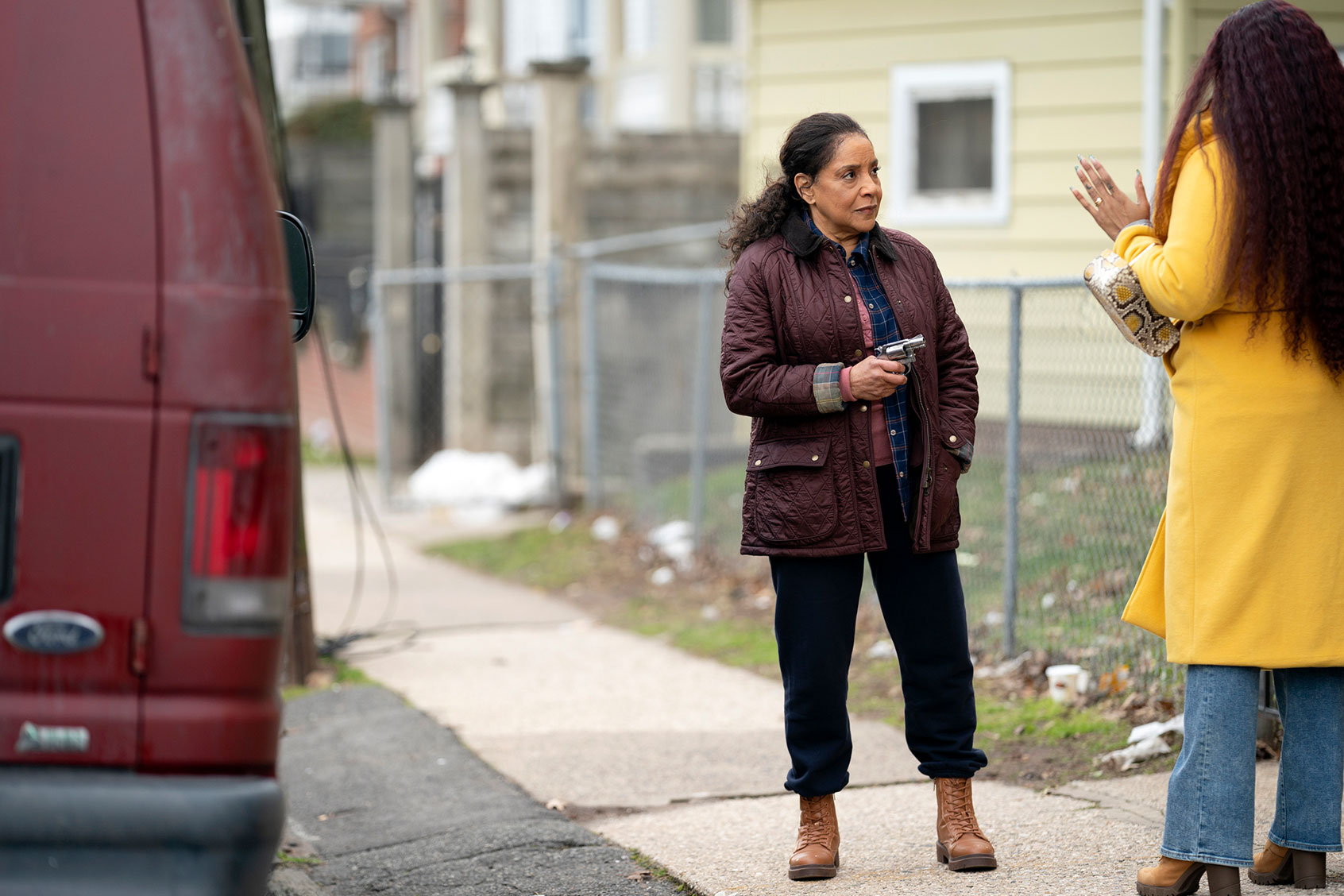
At work, they call her Captain Extra. At home, she marches into the headquarters of the neighborhood stick-up man Danger (Jon Chaffin) – another childhood friend – and threatens his pet.

Her closest friends Aja (DomiNque Perry) and Tea (Bryan Terrell Clark) are deeply concerned. Lamenting the death of her love life, Diarra decides the best way to jumpstart her new chapter is to swipe right on Tinder.

She matches with Chris (Shannon Wallace), a dream date who smooths over the uncomfortable start to their dinner by suggesting they skip right to the third date and the accompanying throwdown sex. They part with assurances that they’ll see each other again, which Diarra takes seriously. Not as hard as when he stops returning her texts, though.

Few forces are more formidable than a Black woman who’s been wronged – again, and for the millionth time – and decides that this time they’re not letting it slide. Diarra suffers from a severity of insomnia she says has “turned her into a white woman from a horror movie,” which has an array of connotations, most of them related to fragility.

Chris’ ghosting, however, sparks the opposite in Diarra, transforming her into a hybrid of a suspicious true crime addict and the Final Girl. She deserves answers, she decides – not for her, but for justice's sake. What if Chris is missing? Not only that, what if he’s actually Deonte Brooks, a boy who went missing almost 30 years ago and for whom nobody kept searching?

Popular murder mysteries speak to the parts of us yearning to decipher the complexity intrinsic to being human. The overlap in the Venn diagram between fictional cases and true crime stories contains curiosities that too many producers assume mainstream audiences don’t harbor concerning anybody who isn’t white.

Kenya Barris isn’t one of them. Through “Diarra From Detroit,” he and fellow executive producer Kilpatrick tap a creative well that is fed from multiple sources. Their star character may be a woman plummeting to an emotional rock bottom, and a bracingly funny one at that, but that doesn’t mean her instincts are off.

We need your help to stay independent

Diarra’s quest also slams her into obstacles Black folks accept as givens. While the world bends over backward to find missing white women and absolves well-to-do white men of suspicion, the police write off missing Black people like Deonte all the time. HBO aired a four-episode documentary about it called “Black and Missing” that deserved more public response than it received.

Both that series and this one touch on the reality that Black women in crisis typically aren’t believed by authorities or anyone else. Worse, they’re blamed for the crime, which is what happened to Deonte’s mother (played in the present day by Phylicia Rashad) – a stain that inspires the extralegal work she carries out decades after her child vanished.

If Deonte has a shot at being found, it’s because Diarra cares. And if Diarra can keep going that’s in no small part due to the people who believe in her – her friends, along with neighbors that outsiders would rather reduce to stereotypes and avoid instead of getting to know them. She wants to solve her mystery, as every private detective does. As she’s talking to her friends it also dawns on her that what she really wants is something Black women don’t often get from the folks who do them wrong: an apology.

Diarra From DetroitDiarra From Detroit (BET)“Diarra From Detroit” conveys a sense of place, community, and legitimate lightness infrequently (if ever) portrayed about Detroit, a city condemned by entertainment and media coverage as a tragic, violence-plagued lost cause. Kilpatrick steps into that fog to depict it as only someone who’s from a place like it knows, that regular folks who decide to care about other people are what hold economically blighted spots together.

Diarra, though, is more than that – someone knowable yet not conventionally categorizable, as Kilpatrick proves during a “single girls” get-together where every stereotype of a Strong Black Woman shows up.

She’s more the kind of woman who screams along to Eminem’s “Kill You” in her car because she likes to channel white male anger. “They say Black women are angry? . . . White men do anger and camping better than anyone. Money, power, respect, must be infuriating. Because they stay hot.”

Kilpatrick keeps the mystery light by weaving sidesplitting scenes and lines throughout each hour, never letting the scary moments overwhelm the absurdity of her mission.  

The typical comedy equation is tragedy plus time; “Diarra From Detroit” formulates an alternate calculation that joins crisis and unanswered questions. As Diarra gets closer to the truth of what happened with Chris, she ventures into greater peril.


Want a daily wrap-up of all the news and commentary Salon has to offer? Subscribe to our morning newsletter, Crash Course.


“Being a Black woman makes everything more difficult,” she says after her hunt nets a second dead body. “You can’t even take a trauma shower without getting your . . . hair wet.” But she has no choice but to keep getting out of bed each day, as she explains, since going through a meltdown isn’t enough of an excuse for Black women to take a day off work or slack off in other parts of her life.  

Traumas significant and tiny are part of just about every detective’s origin story, from Sherlock Holmes to Lyonne’s Charlie Gale. That doesn’t necessarily make them fascinating enough to stick with for eight episodes or more. It's all in how they carry it, and how that experience makes them better at unraveling the enigma of transgression.

“Diarra From Detroit” isn’t set on a cruise for the wealthy and connected, but in a once-vibrant industrial city that still has a vibe and a rich history only the people born and raised there understand.

And Diarra makes us care enough to hope she gets what she needs out of solving the case, whether that’s validation, commendation or that second date she’d pinned her heart on. We can relate, which is why we're staying on this detective's six.

New episodes of “Diarra From Detroit” stream on Thursdays on BET+.

A new report sheds light on the problems behind our imported shrimp

Thailand has long been the face of the shrimp industry’s troubled track record. A series of investigations between 2014 and 2015, including bombshell reporting from The Guardian and The Associated Press, revealed that slavery and other labor abuses were widespread in processing facilities and fishing operations that provided feed to shrimp farms, leading governments to issue warnings and many companies to end relationships with Thai suppliers. As the Thai industry’s reputation was ravaged by these allegations, and poor overall aquaculture practices put its shrimp stocks under constant threat of disease, the country made a pledge to clean up its human rights performance — and its shrimp farms.

Shrimp is by far the most popular seafood in the U.S., and the U.S. is the largest shrimp importer in the world; more than 90% of the shrimp we eat is farmed overseas. So when costs of Thai farmed seafood inevitably went up, the U.S. began looking elsewhere to satisfy its demand for cheap product. As Nathan Rickard, a lawyer for the Southern Shrimp Alliance, explained on a 2022 episode of “What You’re Eating,” the longstanding “Thai dominance” had in fact already been supplanted by imports from a somewhat unlikely country: India, previously a rather minor player. Its market share was only continuing to grow. “What’s our guarantee that the same thing that we were concerned about in Thailand isn’t happening with India?” he wondered.

Now, a new report may bring some answers. And as the authors contend, “India’s sudden competitiveness with countries known to use forced labor should have sounded alarm bells.”


Building a booming shrimp industry

This month, the Corporate Accountability Lab (CAL) released one of the first published investigations into the on-the-ground reality of the Indian shrimp industry. Between 2021 and 2024, Indian journalists and advocates conducted field visits in the east coast state of Andhra Pradesh, the center of the country’s shrimp production, to produce “Hidden Harvest” — interviewing more than 150 workers and people in nearby communities, as well as shrimp company executives and management, Indian government officials, local labor leaders and medical professionals familiar with the human toll of the industry. What they concluded: Shrimp farming in India has many of the same problems it does in Thailand, sometimes even involving the same companies. And the supply chains of some of the largest U.S. grocers and restaurant chains are implicated.

India’s huge shrimp industry, heavily dependent on the U.S. market, is a fairly recent development: Per the report, more than half of the peeled shrimp we’ll see today in the freezer aisle or on the appetizer menu was farmed in India, but fifteen years ago, that figure was less than 4%, a tenth of what was imported from Thailand at the time. Things began to change when, in 2009, a new non-native species (Litopenaeus vannamei, the popular “whiteleg” shrimp) was introduced to India and quickly adopted for aquaculture. Now the world’s largest shrimp exporter, India in many ways mirrors its former competitor — its industry falling into similar patterns, CAL argues, in the effort to keep prices artificially low.

As Rickard explained on FoodPrint’s podcast, “the way that the Thai industry kept down its labor costs is they started to contract out work to places called ‘peeling sheds.’” Producing the pristine, hand-peeled shrimp preferred by U.S. customers at a low price point was impossible without outsourcing to informal processing operations, often staffed by undocumented migrant workers from other countries in Southeast Asia. “That’s where a lot of the issues with forced and child labor came up with in that supply chain,” Rickard told us.

CAL reports that a similar system has emerged in India, with much of the deheading, deveining and peeling contracted out to small, often-unregistered facilities — where workers are provided little heat protection and safety gear and often work without official employment terms. But even at company processing plants, the work is dangerous. And peeling is not the only link in the supply chain that merits concern: “Hidden Harvest” looks at various segments of India’s shrimp industry, a source of income for more than 1.2 million households, including the hatcheries that supply “seed” (juvenile shrimp), the majority-smallholder farms where the shrimp is raised and the facilities where it is prepared and packed for export.


Workers share their stories

In CAL visits to various facilities, sources said they worked long hours, sometimes more than 12 per day, and were often paid insufficiently or infrequently, also reporting instances of sexual harassment and verbal and physical abuse. Injuries, including frostbite from handling frozen shrimp and skin and respiratory irritation from exposure to chemicals or contaminated water, were common. So was discrimination on the basis of caste, class and gender: Workers in the sector often come from already-vulnerable populations, including Dalits, Adivasis (India’s tribal peoples) and those from poor agricultural and fishing communities, many of them internal migrants with few job prospects in their home states. Children and young teenagers, mostly girls, were known to work in processing and packing instead of attending school. “I don’t know how much my pay is,” one girl, who had traveled from West Bengal looking for employment, told CAL. “The owner will not pay me directly but remit it to my parents.”

India has expansive laws against forced labor, but with little record-keeping and government oversight, it likely persists in the shrimp industry: Workers whose housing was tied to their employment reported living in overcrowded, under-maintained, heavily surveilled company housing with little freedom of movement. Many spoke anonymously due to fear of threats, intimidation or other forms of retaliation. CAL also found evidence of debt bondage, a form of forced labor that involves “recruitment fees,” often paid with a loan, with workers essentially indentured until their debts are settled. Some of these claims are corroborated by a formal whistleblower complaint from an employee of Indian shrimp company Choice Canning, who before resigning helped facilitate an undercover video investigation for the Outlaw Ocean Project.

The CAL connects some of these labor abuses to a predatory “agent” model wherein farmers, many caught in India’s growing agricultural debt crisis, transition into shrimp aquaculture and buy seed and supplies on credit with little guarantee that they will be able to compensate workers — or even have any revenue to speak of — after paying it off. “Until farmers consistently and reliably earn enough to pay their workers,” the report reads, “this industry will remain unsustainable and have a high risk of labor and environmental abuses.”

Modern aquaculture can bring with it serious environmental impacts, even when it is regulated more strictly. In India, construction of the ubiquitous coastal shrimp ponds has destroyed mangroves, crucial for biodiversity, carbon sequestration and storm protection, at a massive scale. In Andhra Pradesh, CAL researchers were informed that runoff from shrimp farms, containing salt, chemicals and toxic waste, was contaminating drinking water, impacting agriculture and contributing to algal blooms and declining fish populations along the coast, indirectly hurting local fishermen. Antibiotics, used extensively to prevent the diseases that arise easily on shrimp farms, were a particular concern, contaminating ecosystems and drinking water and contributing to increased antibiotic resistance. Though the FDA bans shrimp produced with antibiotics, the agency’s poor testing record has allowed much of it to enter the U.S. undetected: Antibiotics are regularly found in shrimp imports, but the proportion of products tested is around 0.1%. The European Union, by contrast, tests half.


Failing stopgaps and future solutions

The story here is not uncommon in our current global food system: A cheap product available in large volumes usually comes at a hidden cost, and when a company or country does face real consequences for its harmful practices, there tend to be others ready to “race to the bottom” and fill the void with little scrutiny. But “Hidden Harvest” also calls one proposed means of scrutiny — third-party certifications, which attempt to provide oversight where governments do not — into question.

Much of the Indian shrimp exported to the U.S. has been certified by major aquaculture monitoring agencies and bears one of two common labels for farmed seafood: Best Aquaculture Practices Certified, an initiative of the Global Seafood Alliance, or Farmed Responsibly ASC Certified from the Aquaculture Stewardship Council. Producers and facilities pay to be certified through private auditors, which monitor compliance with the certifying body’s worker welfare and environmental standards. But the prevalence of these labels on Indian shrimp, CAL suggests, indicates that current monitoring practices are ineffective and violations underreported. The report quotes an auditor who recounted what he’d learned in more than a decade in the role: “Nobody is working for the sake of betterment of workers … Everybody is here to make money.”

CAL contends that third-party labels, and the “social audits” that inform them, are no guarantee of ethical or sustainable production, and in fact can actively obscure problems that require attention. The report proposes that instead of relying on these certification schemes, major buyers of Indian shrimp — a list that includes Whole Foods, Costco, Walmart and Target, plus restaurant chains like Cheesecake Factory, Olive Garden and Red Lobster — should overhaul their procurement practices, ensure producers are hiring workers directly as employees and providing basic documentation like contracts and pay stubs and be willing to take on the associated costs. The most effective way to achieve this, the authors say, is to engage with worker-led organizations, taking on binding agreements that guarantee a living wage and creating real systems for addressing grievances.

Of course, governments also have a role to play. Some next steps proposed in the report are basic: India’s government should enforce existing labor laws, for example, and strengthen others, improving the ways it regulates and monitors this problematic sector. But CAL makes extensive recommendations for the U.S. government as well. In addition to eliminating its own purchases of shrimp produced with forced labor, the government should initiate trade investigations into the industry in India and fill loopholes in traceability mechanisms like the Seafood Import Monitoring Program. The report also demands the Department of Labor add Indian shrimp to its list of goods produced by child and forced labor, which currently identifies Bangladesh, Cambodia, Myanmar and, even today, Thailand as countries of concern.

This call for DOL action has been echoed by U.S. shrimpers and trade groups, including the Southern Shrimp Alliance. As Rickard told us back in 2022, “There are sources of supply that you can go to that don’t present these risks. And that’s, I think, what the focus now is from the industry, is making sure that people understand that these are not the only options — that it’s not something where we’re just racing to the bottom.”

Animal rights group releases “hidden-camera” footage that reveals cruelty in Kentucky poultry farms

On Monday, an animal rights group released footage from a “hidden-camera investigation,” alleging Kentucky poultry factory farms of cruel treatment of chickens. Footage from the investigation was released in opposition to a so-called anti-animal rights bill recently approved by the Kentucky legislature, the group said.

Mercy For Animals — a California-based nonprofit that seeks to “end industrial animal agriculture by constructing a just and sustainable food system” — published a video in which workers are seen kicking, stepping, throwing and stuffing chickens into cages for transport. In a separate video shared with the Kentucky Lantern, the group appears to show and locate the poultry houses, which they described as contract farms. The farms provide chickens to Pilgrim’s Pride, one of the largest chicken producers in the United States.

Mercy For Animals is protesting Senate Bill 16, which aims to criminalize the use of any recording equipment (drones, cameras, video recorders, audio recorders etc.) inside concentrated animal feeding operations (CAFOs) and commercial food processing and manufacturing plants without consent from the operation's owner. The bill would also criminalize the distribution of such footage at food processing plants or CAFOs. However, it does make exceptions for utility workers along with state and federal law enforcement and regulators.

Critics of the bill have blasted SB 16 as “dangerous legislation” that fails to penalize mass corporations for their cruel treatment of animals, workers and consumers.

“No more innocent lives lost”: José Andrés mourns World Central Kitchen team killed in Gaza strike

Chef José Andrés is “heartbroken and grieving” after seven World Central Kitchen aid workers were killed in an airstrike reportedly carried out by the Israel Defense Forces in Gaza early Tuesday morning. World Central Kitchen, the not-for-profit organization founded by the Spanish-American chef, provides fresh meals in response to humanitarian, climate and community crises, per its official website.

In a statement posted Monday on X (the platform formerly known as Twitter), Andrés wrote, “I am heartbroken and grieving for their families and friends and our whole WCK family. These are people…angels…I served alongside in Ukraine, Gaza, Turkey, Morocco, Bahamas, Indonesia. They are not faceless…they are not nameless.”

“The Israeli government needs to stop this indiscriminate killing,” his post continued. “It needs to stop restricting humanitarian aid, stop killing civilians and aid workers, and stop using food as a weapon. No more innocent lives lost. Peace starts with our shared humanity. It needs to start now.”

WCK said it was “aware of reports” that members of its team were killed “while working to support our humanitarian food delivery efforts in Gaza.” The group explained in a separate statement that its members were traveling in a “deconflicted zone” in two armored cars branded with the WCK logo and a soft skin vehicle when they were struck.

“This is not only an attack against WCK, this is an attack on humanitarian organizations showing up in the most dire of situations where food is being used as a weapon of war. This is unforgivable,” said World Central Kitchen CEO Erin Gore. The seven members killed were from Australia, Poland, United Kingdom, a dual citizen of the U.S. and Canada, and Palestine.

“Culinary activist” Lelani Lewis on how human injustice shapes culinary culture

Lelani Lewis’s “Code Noir” is so much more than just a cookbook. Full of stunningly colorful photos and amazing recipes, it also traces the plight of Afro-Caribbeans while simultaneously celebrating their culture, food and perseverance. “I would say that this book is equally a look at how food connects us rather than divides us,” Lewis said. 

That desire to explore the way what we eat links us to other people and places has been a guiding ethos through Lewis’ career as a self-described culinary activist. After growing up in South London with a father from Grenada and a mother from Ireland, Lewis — who has a background as a chef and food stylist — began hosting dinner parties and workshops, also titled “Code Noir,” as a way to explore resistance and remembrance through food.

“Code Noir” is the name of a manuscript distributed by King Louis XIV that regulated the life, death, purchase, religion and treatment of enslaved people by their masters in all French colonies.

“My main point of interest was Caribbean food because of my own heritage,” Lewis said. “Lost and homesick in a new country, Amsterdam, I sought refuge in comfort food, which was the cuisine of my father.  This pursuit, of not only the flavors but also why and how this food had came to be, was what brought me whilst researching, to the name Code Noir.” 

Code Noir by Lelani LewisCode Noir by Lelani Lewis (Courtesy of Tra Publishing)

She continued: “Caribbean history is entwined in this dark past of exploitation and oppression, mostly for the pursuit of a cash crop that is sugar.  It dawned on me that many of the foods we have consumed and still do, have major human and ecological costs and that we can not afford to consume without being conscious of what is on our plates.” 

Lewis says that she is “a dreamer first and foremost, and then incredibly proactive,” and the development of her book follows that line of thought. After the success of her Code Noir dinners, Lewis came up with a pitch for her cookbook, largely to no avail. Eventually, she worked with Chef Joris Bijdendijk — who was owner of the restaurants Rijks, inside of the Rijksmuseum, and Wils in Amsterdam — and he connected her with his publisher. 

“I knew he had a cookbook and very bravely or cheekily, I'll leave that assessment to you, said, 'I've always wanted my own cookbook,’” she said. “After having tasted my food, hearing my story and finally sending him the deck, he introduced me to his publisher — and the rest is history.” 


Want more great food writing and recipes? Subscribe to Salon Food's newsletter, The Bite.


Lewis described working through the book, a 256-page tome containing both classic Caribbean recipes and new creations, as a form of catharsis.“I think the two disparate identities and cultures, especially the two that I came from, knowing that they had faced horrendous oppression and discrimination, bellowed a fire in me to fight even more so for social justice and equity,” she said. 

She continued: “My dual identity and growing up in London exposed me to a plethora of flavors, tastes and cultures, which if anything grew my curiosity.” 

According to Lewis, the book represents “the beauty of cultures and ingredients coming together and making something magical,” and the dish that most epitomizes this from “Code Noir” are the Trini Doubles. The dish is made from fluffy bara — and fried bread — topped with channa curry, made with green seasoning and a unique Caribbean curry powder, cucumber chutney, tamarind sauce and maybe some hot pepper sauce (“If you need the heat,” Lewis added). 

 "This street food is a perfect marriage between Indian food and flavors imported from Indentured workers and Caribbean ingredients, which has become synonymous with only the Caribbean,” she said.

Lelani LewisLelani Lewis (Photo courtesy of Chantal Arnts)

Lewis adores green seasoning — "because Caribbean food can swing between incredibly easy dishes and real labors of love" — which she says is excellent for boosting flavors in soups, stews, casseroles, marinades and dipping sauces, claiming it's "so damn simple but such a flavor bomb that it blows people away." 

We need your help to stay independent

As far as her favorite dishes, she's partial to curry goat with rice and peas, coleslaw and fried plantain, which for her is "the epitome of home, one of the most comforting meals I make when I miss home and family." Lewis notes that although she doesn't like that "everyone associated Caribbean food with 'jerk,' it is a lovely marinade and cooking technique and also a great example of the marriage between two cultures creating something delicious." She's also fond of rice and peas as a "canon recipe," plus saltfish and ackee.

Lewis remarks that although certain ingredients might be trickier to source, practically every single one can be found in some capacity online, "but in the absence of that, you can always swap out ingredients.  For example, if you can't get achiote, you could use tomato puree with smoked paprika, just trying to get as close to the flavor profile as possible."

“My singular message in this book is to focus on the things that connect us rather than divide us and I couldn't think of something more universal than food,” Lewis said. “So although I have written a book about Caribbean food and culture, which started as a way for me to reconcile my identity and duality, it finished with me spreading this unequivocal message of unity through food." 

Plastic chemicals are inescapable — and they’re messing with our hormones

If you were to create a recipe for plastics, you’d need a very big cookbook. In addition to fossil fuel-based building blocks like ethylene and propylene, this ubiquitous material is made from a dizzying amalgam of more than 16,000 chemicals — colorants, flame retardants, stabilizers, lubricants, plasticizers, and other substances, many of whose exact functions, structures, and toxicity are poorly understood.

What is known presents many reasons for concern. Scientists know, for example, that at least 3,200 plastic chemicals pose risks to human health or the environment. They know that most of these compounds can leach into food and beverages, and that they cost the U.S. more than $900 billion in health expenses annually. Yet only 6 percent of plastic chemicals — which can account for up to 70 percent of a product’s weight — are subject to international regulations.

Over the past few months, a flurry of studies and reports have highlighted one group of substances as particularly problematic: “endocrine-disrupting chemicals,” or EDCs. These chemicals, released at every stage of the plastic life cycle, mimic hormones and interfere with the metabolic and reproductive systems. They were recently found in samples of plastic food packaging from around the world, and a study published last month linked them to 20 percent  the United States’ preterm births

The unchecked production, distribution, and disposal of plastics and other petrochemical-based products has led to “a perpetual cycle of human exposure to EDCs from contaminated air, food, drinking water, and soil,” Tracey Woodruff, a professor of reproductive sciences at the University of California, San Francisco, wrote in the New England Journal of Medicine earlier this month. Philip Landrigan, a public health physician and professor of epidemiology at Boston College, told Grist that the crisis has “quietly and insidiously gotten worse while all attention has been focused on the climate.”

"This is an international problem that is affecting our world and its future."

Although some policymakers have taken steps to protect people from EDCs — the European Commission, for example, in 2022 proposed stricter labeling regulations that would require companies to alert consumers of their hazards — many in the field believe the overarching response has been incommensurate with the scale of the crisis. Because so many plastics and petrochemical products are traded internationally, some endocrinologists and public health authorities believe a global approach is needed. 

“This is an international problem that is affecting our world and its future,” said Andrea Gore, a professor of pharmacology and toxicology at the University of Texas, Austin.

Gore and others are appealing to the negotiators of the U.N. global plastics treaty, who meet for their next round of talks next month in Ottawa, Canada. There is increasing interest among delegates for a treaty that not only protects the environment, but public health — a step that the international nature of the EDC problem makes clear must be taken.


The endocrine system is complex, involving a series of glands throughout the body that secrete chemical messengers called hormones. These molecules lock onto a cell’s receptors to induce some kind of response: perhaps the production of another hormone, or the correction of a nutrient imbalance. Endocrine hormones control a long list of necessary human functions like growth, metabolism, reproduction, lactation, and managing blood sugar —  any malfunction, let alone absence, of these processes can lead to health problems like infertility, diabetes, hypertension, and death.

EDCs tamper with the endocrine system, often by mimicking hormones to trigger the corresponding response, or by blocking them to prevent it from happening at all. Research has identified at least 1,000 of these substances in pesticides, inks, building materials, cosmetics, and plastic products, but the nonprofit Endocrine Society, whose members include physicians and scientists, calls this “only the tip of the iceberg” due to the enormous number of chemicals yet to be tested.

Some of the most common or familiar EDCs found in plastics include phthalates, used to make the material more flexible; bisphenol A, or BPA, used to make strong, clear products; and PFAS, a class of more than 14,000 chemicals used to make food containers, outdoor clothing, and other products oil- or water-repellent. Other EDCs of concern include organophosphate ethers, benzotriazoles, and PBDEs, all of which are used to make plastic products fire- and light-resistant. 

What makes this particularly worrisome is that humans can be exposed to endocrine-disrupting chemicals simply by touching plastic, inhaling microplastics within dust, and eating food or drinking water that has been in contact with plastic. According to one 2022 study, more than 1,000 chemicals — including many EDCs — commonly used in packaging like takeout containers can migrate into food. A separate study from 2021 found that more than 2,000 chemicals can leach from a single plastic product into water.

As noted in a report published last month by the Endocrine Society and the nonprofit International Pollutants Elimination Network, or IPEN, exposure to endocrine-disrupting substances can occur throughout the plastic life cycle. Fracking for oil and gas — the material’s main ingredients — uses more than 750 chemicals, many of which are known or suspected endocrine disruptors, and people living near these operations may have an elevated risk of developmental or reproductive problems. More EDCs are released during plastics manufacturing, sometimes in air and water emissions, other times on the backs of nurdles, tiny plastic pellets that can be shaped into larger products. These pebble-sized pieces often spill directly from factories or during transportation, and can release their chemicals once in the environment.

At the end of the plastic life cycle, incinerators and landfills can release PFAS, dioxins, PCBs, and other endocrine disruptors as air or soil pollution — some of which may contaminate nearby food supplies. Littered plastics tend to make their way into the ocean, where they break down into microplastics and leach some of those same EDCs, along with others like dibutyltin and mercury.

Those facing the greatest risk tend to be residents of low-income communities and people of color. “They’re more likely to be living in areas where there’s more pollution,” Gore said — like from nearby plastics manufacturing facilities or waste disposal sites. Plus, she added, low-income families often live without easy access to fresh produce and are more dependent on foods packaged in plastic. “We know people of lower socioeconomic status have disproportionate exposures.”


Reducing exposure to endocrine disruptors presents a challenge for several reasons. The biggest is the U.S. and other countries’ lax approach to chemical regulation, which doesn’t usually require that new compounds be tested for endocrine-disrupting properties or other safety concerns before they can enter production and get incorporated into products. “Right now we operate on the basis that all chemicals are innocent until proven guilty,” Landrigan told Grist.

Even when scientists agree that something is harmful, bureaucratic delays and industry lobbying often impede regulation. The Toxics Substances Control Act, or TSCA — the United States’ main chemical law — has for example only banned a handful substances in the nearly 50 years since it was passed, a period in which at least 100,000 new chemicals have entered the market, according to Landrigan. This is partly due to the unrealistic expectation that scientists draw a direct, causal link between a substance and specific health effects, which would require unethically exposing people to toxicants and observing the outcomes.

Another unfortunate side effect of that expectation is a phenomenon called “regrettable substitution,” where companies swap chemicals known to be harmful for lookalikes that haven’t been studied as extensively. Later research often reveals the substitute is just as toxic as the original, if not more so. This has occurred on a wide scale with EDCs such as PFAS, as well as bisphenols — although now that several countries have restricted BPA from plastic products like baby bottles, products labeled (often inaccurately) as free from that substance are now being manufactured with bisphenol S, despite research suggesting it also disrupts the endocrine system.

Some scientists accuse the chemical industry of “weaponizing uncertainty” to delay or kill regulation, a strategy they liken to Big Oil’s campaign to raise doubt about the reality of climate change. But for many EDCs in particular, they agree there is strong enough associative evidence of their harms — from cell and animal studies, as well as observations in people who have been exposed to the chemicals at work or as a result of an accident — to warrant bans and restrictions.

Scientists and public health advocates have been trying to reform chemical regulations for years now, but the U.N.’s global plastics treaty presents an opportunity to do so on an international level. “A global treaty can’t reform TSCA,” Landrigan said, “but it can set benchmarks telling countries that if they want to ship their products internationally, they have to conform to certain standards.”

One leading proposal for the treaty is that negotiators create a comprehensive inventory of the many chemicals used in plastic production, along with a list of “chemicals of concern” identifying which should be prioritized for phasing out. According to Sara Brosché, a science adviser for IPEN, this list should include classes of chemicals rather than individual ones. “EDCs would be one very clear category” to be phased out, she told Grist, along with carcinogens and so-called “persistent organic pollutants” that don’t break down naturally in the environment.

Scientists also support listing and phasing out “polymers of concern,” the types most likely to contain EDCs and other hazardous substances. Polyvinyl chloride, for example — frequently used in plastic water pipes — can expose people to endocrine disruptors including benzene, phthalates, and bisphenols.

So far, these ideas have only been suggested for inclusion in the treaty; negotiators don’t even have a first draft yet, and are still debating whether the primary goal should be to “end plastic pollution” or to “protect human health and the environment … by ending plastic pollution.” The existing text, a laundry list of nearly every suggestion made thus far, leaves plenty of room for countries to simply “minimize,” “manage,” or vaguely “regulate” hazardous plastic chemicals, rather than eliminate them altogether. The final draft is due by year’s end, though many expect an extension, with further negotiations continuing into 2025.

To Landrigan and many others, the most important thing is that the treaty include a global cap on plastic production, which could triple by 2060 to more than 1.2 billion metric tons annually if current trends continue. That’s the weight of more than 118,000 Eiffel Towers. “We see the current exponential increase in plastic production as simply not sustainable,” he said. “It will overwhelm the planet.” Less plastic will mean fewer opportunities for EDC exposure, he added. And that will surely save lives.

This article originally appeared in Grist at https://grist.org/science/plastic-chemicals-are-inescapable-and-theyre-messing-with-our-hormones/.

Grist is a nonprofit, independent media organization dedicated to telling stories of climate solutions and a just future. Learn more at Grist.org


“Why are they so afraid?”: Jon Stewart says Apple refused to let him interview FTC Chair Lina Khan

Jon Stewart was not shy on Monday about calling out his former employer, Apple, for prohibiting him from interviewing Federal Trade Commission Chair Lina Khan.

On the latest episode of "The Daily Show," Stewart focused on pressing topics like unregulated tech companies, artificial intelligence, monopolies and how they already have had a lasting and grave impact on the 2024 election and American society and politics.

Stewart began the episode with a segment on AI: starting with deepfake photos of both presidential candidates skewing people's realities, robo calls of President Joe Biden telling people not to vote during Super Tuesday, and even digitally altered photos of Donald Trump campaigning with Black and brown communities. 

To address concerns about unchecked tech monopolies, the "Daily Show" host invited Khan to sit in the hot seat and answer questions about the growing tech conglomerates in the country. Khan shared that the government feels that tech companies like Amazon, Facebook and Apple are violating antitrust laws and effectively wiping out other competition through mergers or are making their platforms harder to use for consumers so they can profit off of users and small businesses. 

Then Stewart addressed the elephant in the room for him — his AppleTV+ show "The Problem with John Stewart."

"I wanted to have you on a podcast and Apple asked us not to do it," Stewart said.

The show was canceled after two seasons due to Stewart and Apple executives parting ways over creative differences. Stewart and Apple did not agree on Stewart's zeal to cover topics like AI and China, the New York Times reported.


Want a daily wrap-up of all the news and commentary Salon has to offer? Subscribe to our morning newsletter, Crash Course.


"They wouldn't let us do even that dumb thing we just did in the first act on AI," Stewart continued. "Like, what is that sensitivity? Why are they so afraid to even have these conversations out in the public sphere?"

Khan answered Stewart's question, "I think it just shows one of the dangers of what happens when you concentrate so much power and so much decision-making in a small number of companies."

"Going back to the founding, there was a recognition that in the same way that you need the Constitution to create checks and balances in our political sphere, you also need antitrust laws and anti-monopoly laws to safeguard against a concentration of economic power because you don't want an autocrat of trade in the same way you don't want a monarch," she continued.

Stewart posed a question about the looming threat of tech companies controlling AI. 

"There's no inevitable outcome here," Khan said. "We are the decision makers. So we need to use the policy tools and levers that we have to make sure that the technologies are proceedings on a trajectory that benefits Americans and were not subjected to more of the risks and harms."

"The Daily Show" airs Monday through Thursday at 11 p.m. on Comedy Central and streams on Paramount+.

In the absence of American unity, we return to trust

When was the last time you pulled the elastic bands of a KN-95 mask behind your ears and felt its effect on your lungs as you took your next breath? Can’t think of it? Neither can I. There was a spike in COVID, flu and respiratory syncytial virus (RSV) in the U.S. in early January, causing major hospital chains in some states to reimpose mask mandates on everyone entering, but the increase has subsided. The latest national statistics for COVID from the Centers for Disease Control (CDC) have the disease down across the board.  During the third week in March, emergency room visits for COVID were down 21 percent; hospitalizations down 14 percent; and deaths were off 16.7 percent.

But I had to look on Google to find those statistics because the latest COVID stats aren’t in the news you see every day. It’s tempting to say that the disease isn’t a factor in our lives anymore, but with 1.2 million of us dead from COVID, the effects of the disease on families linger. Children are being born who will never know their grandparents because the disease took them. Widows and widowers miss spouses who died during the height of the pandemic. Companies have closed in every state in the Union because lockdowns shut them down permanently. The restaurant industry is still in recovery four years later.

When I moved to this small town in Northeast Pennsylvania two years ago, I put on a mask whenever I entered the local Walgreens and Key Foods supermarket. A few other fellow citizens still wore masks inside public places, most of them my age or close to it, but the rest of the world had already moved on.

I gave up masking sometime in the winter of 2022-2023. Both my wife and I had gotten the booster that came out in the fall of 2022, but I don’t remember thinking about it when I stopped putting on a mask. When it got cold enough to get out my heavy duty down jacket in December of last winter, I was surprised when I reached in my pockets for my gloves to pull out a KN-95 mask from the winter before. Had it really been that long since I’d even laid eyes on one?

It had. And as I recently pushed a cart through the new Market 32 supermarket in search of luxuriously large Honeycrisp apples, I asked myself why I wasn’t wearing a mask, and neither were any of the people around me, including employees who had contact with customers all day long. 

Without even thinking about it, we have come to trust each other.  

We need your help to stay independent

I don’t know how many of my fellow customers in the supermarket that day were vaccinated – CDC statistics tell me the vaccination rate for this county is 67 percent overall, with more than 80 percent for those over 65 – but when I had to look it up on the CDC website, I realized the number didn’t matter. The trust between us is deeper than vaccination statistics.  We are, without thinking about it, trusting one another to deal with disease responsibly and to stay home if we’re sick, reducing transmission of COVID in public places so the rest of us can shop without having to worry about it.

Then I realized the word “trust” hadn’t passed my lips in so long, I couldn’t recall the last time I said it. The political divisions in this country have us looking at each other as if from opposing camps. Donald Trump uses words like “enemy” and “evil” to describe Democrats, and we’re not much better, with phrases like “lunatic fringe” spilling from my lips and keyboard regularly. 

This county is part of rural, conservative Pennsylvania. Pickup trucks with loud mufflers go down Broad Street flying large Trump flags, and I pass people wearing MAGA hats on the street not daily, but often enough to take notice when I do. I saw a Trump flag on a pole bolted to the bed of a pickup the last time I parked the car in the Walmart lot. The person who owned that truck may have been one of those in line behind or in front of me at the cash register waiting to pay. But I had to conjure the memory to come up with it because I didn’t think about it at the time, even though the chances of the Trump flag-waver being vaccinated against COVID were probably slim to none.

I’m not sure what accounts for the unspoken trust I’m seeing and feeling around me. The end of mask mandates in public buildings and businesses passed some time ago, and we all noticed that, but we haven’t thought much about what replaced it. Sure, a reduction in COVID cases and hospitalizations and tragic stories in the news had something to do with it. If something isn’t in your face every day, you tend not to think about it. 

But COVID hasn’t gone away. My wife Tracy and I came down with it last August, as we did two years before during the same month. Friends of ours from the East End of Long Island put it on Facebook when they got sick recently, and a neighbor recently reported that she had tested positive and was staying home from a local political event.  So, it’s out there. If you’re vaccinated or have immunity from having contracted the disease before, it’s like having a bad cold or the flu for most people. It can be worse for others, but even so, we have come to accept that occasionally we’re going to come down with the disease, and we move on.

COVID isn’t a political issue anymore, or I wouldn’t have had to go looking on Google to find mention of it.  Out in public, we’re trusting each other to do what we and our friends have done: we stayed home for five days or until symptoms have passed, and then we went on with our lives. 

Think about it, the next time you walk into a supermarket or a pharmacy or a pizza joint. Those are your fellow citizens around you, and you can see their faces, and waiting in line to pick up your pizza, you’re not standing six feet away, not because the “social distancing” lines have faded or been painted over, but because you trust them. What a nice surprise.

“This is unforgivable”: Israeli airstrike kills 7 World Central Kitchen workers

World Central Kitchen said Tuesday that a targeted Israeli airstrike killed seven members of its aid team in Gaza as they left a warehouse in the city of Deir al-Balah, where they had just unloaded more than 100 tons of food set to be distributed to starving Palestinians.

The Washington, D.C.-based aid organization said the seven killed included a dual citizen of the U.S. and Canada as well as Australian, Polish, and British nationals and one Palestinian staffer later identified as Saif Abu Taha.

"This is not only an attack against WCK, this is an attack on humanitarian organizations showing up in the most dire of situations where food is being used as a weapon of war," Erin Gore, the group's CEO, said in a statement. "This is unforgivable."

WCK said its convoy of vehicles—including two armored cars branded with the group's logo—was hit by an Israeli strike while traveling in what was supposed to be a deconflicted zone. The group said it coordinated the convoy's movements with the Israel Defense Forces (IDF), leading WCK to conclude that the attack was not an accident.

"I am heartbroken and appalled that we—World Central Kitchen and the world—lost beautiful lives today because of a targeted attack by the IDF," Gore said Tuesday. "The love they had for feeding people, the determination they embodied to show that humanity rises above all, and the impact they made in countless lives will forever be remembered and cherished."

Photographs and video footage from the scene and its aftermath show utter carnage. Rescue teams that arrived at the scene and removed the WCK staffers' bodies from the wreckage displayed the passports of those killed, identifying Zomi Frankcom of Australia, Damian Sobol of Poland, and other victims of the Israeli strike.

The IDF pledged to carry out "an in-depth examination at the highest levels"—a promise that, given the Israeli military's record, is likely to prove empty. The Israeli military has repeatedly attacked aid workers with impunity in recent months, killing staffers of United Nations agencies, the International Red Cross and Red Crescent, Doctors Without Borders, and other organizations.

WCK is known for coordinating emergency food relief in disaster zones around the world. The group has collected and delivered hundreds of tons of food to Gaza in recent weeks as famine has spread across the enclave due to the Israeli government's blockade.

Following the deadly attack on its staffers, WCK said it would pause its operations in the region immediately.

"We will be making decisions about the future of our work soon," the group said in a statement.

Celebrity chef José Andrés, the group's founder, wrote in a social media post late Monday that he is "heartbroken and grieving for their families and friends and our whole WCK family."

"These are people…angels…I served alongside in Ukraine, Gaza, Turkey, Morocco, Bahamas, Indonesia," he wrote. "They are not faceless…they are not nameless. The Israeli government needs to stop this indiscriminate killing. It needs to stop restricting humanitarian aid, stop killing civilians and aid workers, and stop using food as a weapon. No more innocent lives lost. Peace starts with our shared humanity. It needs to start now."

Australian Prime Minister Anthony Albanese, who has been accused of abetting genocide in Gaza, confirmed that Australian citizen Zomi Frankcom was among those killed by the Israeli strike and demanded "full accountability."

"This is a tragedy that should never have occurred," Albanese told reporters, saying he had summoned the Israeli ambassador to Australia.

Trump’s net worth drops $1 billion after Truth Social stock plummets: report

Former President Donald Trump’s net worth fell by $1 billion after shares of Truth Social owner Trump Media & Technology Group fell Monday after reporting big losses and little revenue last year, according to CNN.

Shares of Trump Media fell 21% on Monday, though they are still up nearly 200% this year, according to the report.

The drop fell after the company in a regulatory filing said it lost $58 million in 2023, compared to a profit of $50.5 million in 2022. The company said it generated just $4.1 million in revenue, up from $1.5 million in 2022.

Trump owns 78.8 million shares in the new company. The stake is now worth $3.8 billion, down from about $6.3 billion just last week.

Despite the regulatory filing, Wall Street has valued the company by as much as $11 billion, though that valuation fell to about $8.8 billion on Monday.

“If your child had a lemonade stand it would make more money than this,” tech journalist Kara Swisher told CNN. “But if people are willing to pay for it, this is what people pay for. It’s inexplicable.”

“Sounds familiar”: Expert flags details on “king of subprime car loans” who helped Trump post bond

Former President Donald Trump on Monday posted a $175 million bond in his New York civil fraud case to appeal the judgment and stave off asset seizure, according to NBC News.

Trump sought to appeal the ruling, which found Trump liable for $454 million, but complained to an appellate court that he could not secure a big enough bond to appeal the judgment. The court last week reduced Trump’s bond to $175 million, though he is still on the hook for the full amount – plus interest ‑ if he loses his appeal.

The bond was underwritten by Knight Specialty Insurance Co., which is run by billionaire Don Hankey, who is No. 128 on the 2023 Forbes 400 list.

MSNBC legal analyst Lisa Rubin noted that Hankey is the so-called “king of subprime car loans.” Hankey is “best known in the business world for making high-risk, high-interest loans to car buyers with flawed credit histories,” according to Fortune.

Hankey is also “believed to be the largest shareholder in Axos Bank,” according to Rubin.

“If Axos sounds familiar, it's because it's the financial institution that refinanced Trump’s loans on Trump Tower and Doral in 2022.  Specifically, Axos has loaned Trump $100 million in his refinancing of Trump Tower and another $125 million for Doral,” she wrote.

Hankey told the Associated Press that both cash and bond were used as collateral for Trump’s appellate bond.

“This is what we do at Knight Insurance, and we’re happy to do this for anyone who needs a bond,” he said, adding that he has never met with Trump.