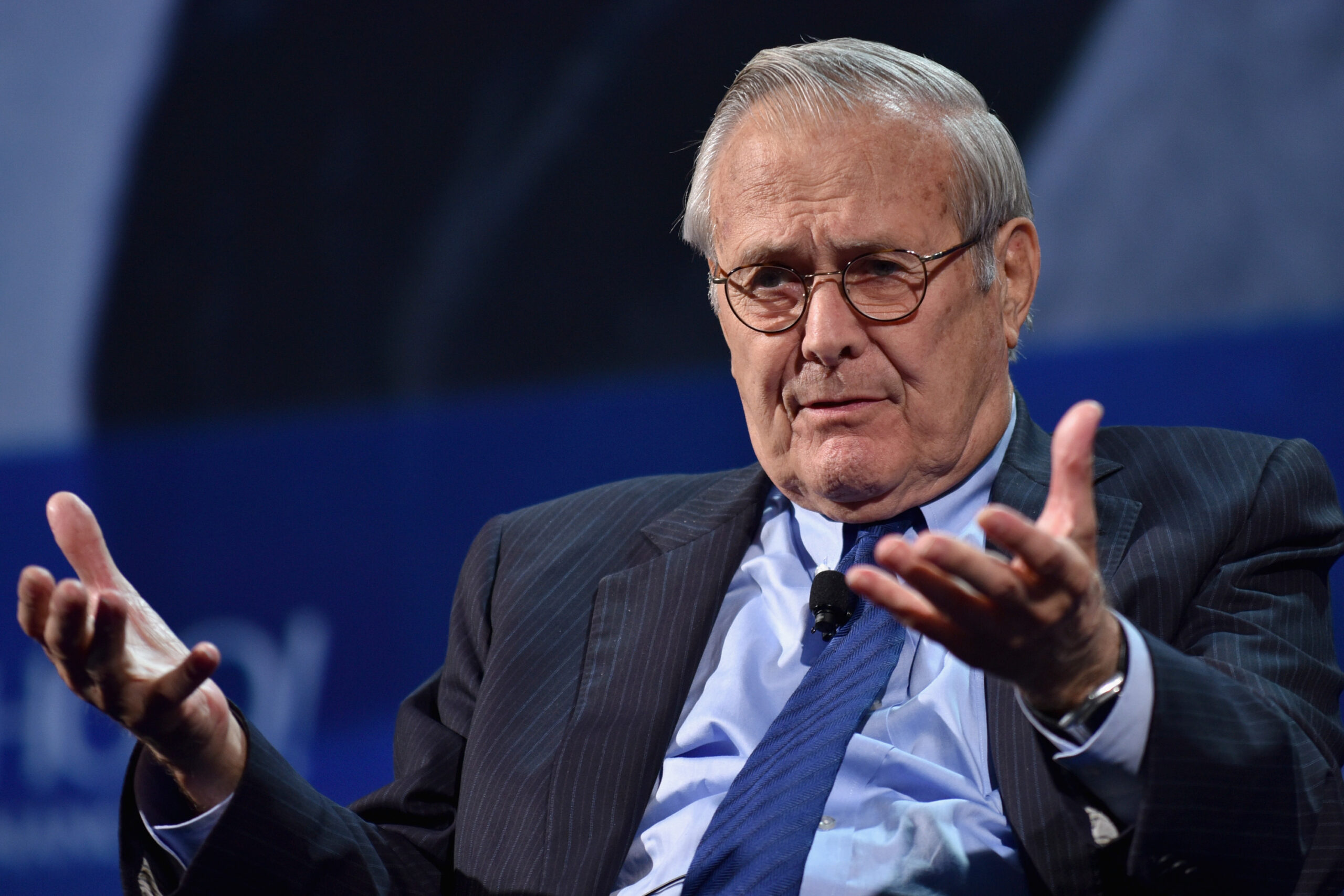
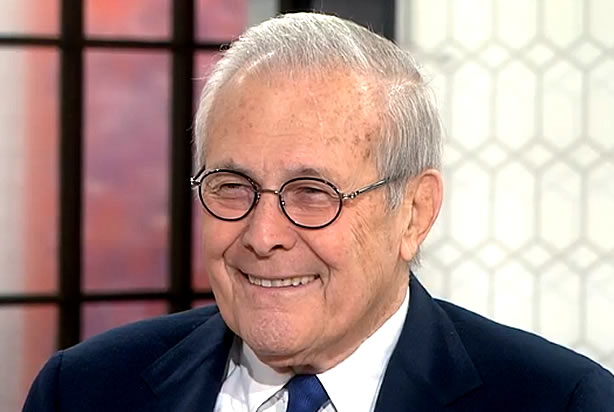
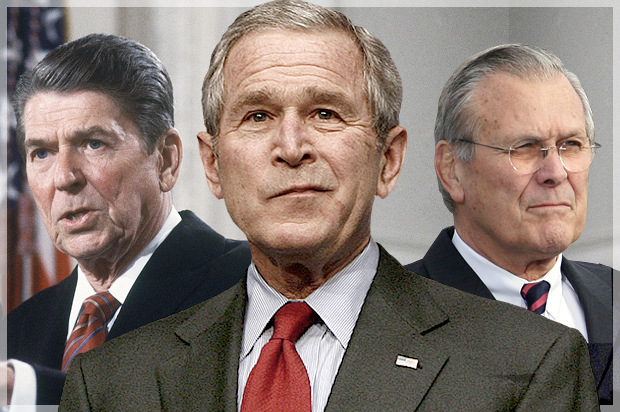
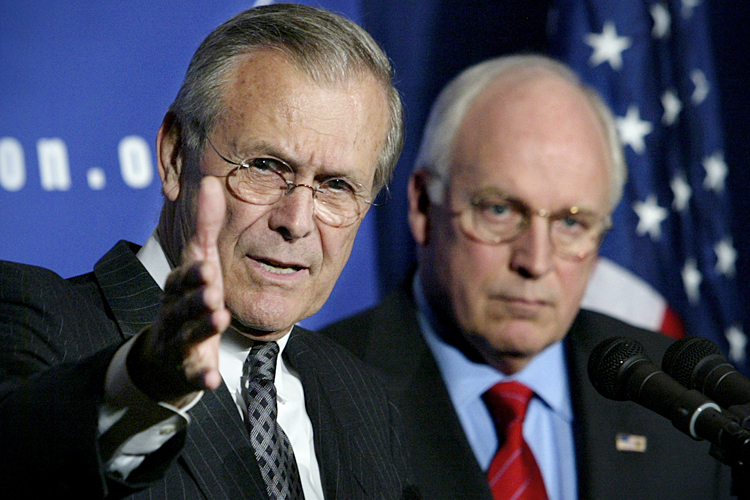
Donald Rumsfeld

No, Sarah Palin, Obama won’t release OBL photos

"Proof" won't silence the right-wing nut-jobs who make up Palin's base. Plus: Rummy flip-flops on torture!

  • more
    • All Share Services

No, Sarah Palin, Obama won't release OBL photosSarah Palin

President Obama is right not to release photographic “proof” that Osama bin Laden is dead. There’s absolutely no upside: The lunatic fringe will still doubt the evidence, and gruesome corpse photos run the risk of creating a backlash against bin Laden’s killing that doesn’t exist so far.

“We don’t trot this stuff out as trophies,” Obama told CBS’s Scott Pelley, in an interview to be aired on “60 Minutes” this Sunday. “We don’t need to spike the football. Given the graphic nature of the photo, it would create national security risk.”

Not surprisingly, one-time vice-presidential candidate and short-term Alaska Gov. Sarah Palin disagrees. She tweeted at about 2 pm ET:

Show photo as warning to others seeking America’s destruction. No pussy-footing around, no politicking, no drama;it’s part of the mission (sic)

Who does Palin think is “pussy-footing” around? The president? Navy SEALs? In what world does the quitter from Wasilla get to determine “it’s part of the mission”? No world we live in, thank God.

Releasing the photos won’t silence the right-wing fringe that makes up Palin’s base. Let’s all remember: If not for the successful bin Laden operation, we’d likely still be trying to swat down lunatic claims that the president’s long-form birth certificate was a forgery. Obama silenced those doubters (for now, anyway) by decisively changing the subject on Sunday. The ultra-right fringe that’s committed to believing the president is illegitimate — in every way; aided and abetted by Palin — can’t be satisfied by proof.

We still have people who don’t believe Flight 93 went down in Shanksville, Pa., on 9/11, and who say the twin towers came down due to an explosion, not the two planes flown like missiles into their upper floors. As Obama joked Saturday night, people still believe the 1969 moon landing was faked, and that Biggie and/or Tupac are still alive. At the same time, a graphic photo of a dead bin Laden immediately creates an image of martyrdom for his longtime followers — and maybe some new ones. People have argued that the U.S. showed proof of the death of Saddam Hussein and his sons, as well as other al-Qaida leaders and functionaries who’ve been killed. But the face of bin Laden is iconic, his creepy charisma part of his recruiting power. There’s no reason to hand his supporters a ready-made protest sign.

Of course, there are transparency reasons for eventually releasing the bin Laden photos and other photographic evidence of controversial U.S. operations that have resulted in casualties on our many foreign battlefields. And it’s possible that human rights groups will eventually succeed in making such photos public, including those of bin Laden. That’s a different argument. For now, under pressure by even some in his adminstration who think a photo might put to rest doubts that bin Laden is dead, Obama is making the right choice.

Meanwhile, this is funny: Donald Rumsfeld has flip-flopped on torture! Monday he told Newsmax (a site of no credibility, but Rumsfeld didn’t deny giving the interview):

 First of all, no one was waterboarded at Guantanamo Bay. That’s a myth that’s been perpetrated around the country by critics. The United States Department of Defense did not do waterboarding for interrogation purposes to anyone. It is true that some information that came from normal interrogation approaches at Guantanamo did lead to information that was beneficial in this instance. But it was not harsh treatment and it was not waterboarding.

But Monday night he told buddy Sean Hannity:

I’m told there was some confusion today on some programs…suggesting that I indicated that no one who was waterboarded at Guantanamo provided any information on this. That’s just not true. What I said was no one was waterboarded at Guantanamo by the U.S. military…Three people were waterboarded by the CIA…and then later brought to Guantanamo. In fact, as you point out, the information that came from those individuals was critically important.

Rumsfeld also agreed with Hannity that “if he [Obama] had had his way, and Democrats had their way, we wouldn’t have had this intelligence.” Stay classy, guys!

(An early version of this post conflated President Obama’s quotes with a commentator’s.)

On MSNBC’s Hardball today we discussed the president’s decision on the bin Laden photos:

Visit msnbc.com for breaking news, world news, and news about the economy

Joan Walsh

Joan Walsh is Salon's editor at large.

When George W. Bush killed bin Laden: An alternate history

Or: An exploration of Dick Cheney's recent daydreams

  • more
    • All Share Services

When George W. Bush killed bin Laden: An alternate historyThe White House said on October 29, 2003 that it had helped with the production of a "Mission Accomplished" banner as a backdrop for President George W. Bush's speech onboard the USS Abraham Lincoln to declare combat operations over in Iraq. This file photo shows Bush delivering a speech to crew aboard the aircraft carrier USS Abraham Lincoln, as the carrier steamed toward San Diego, California on May 1, 2003. REUTERS/Larry Downing/FILE KL/GN/GAC(Credit: © Larry Downing / Reuters)

President Bush announces the news to the nation on May 24, 2006, immediately following the East Coast airing of the finale of “American Idol.” He appears in military fatigues and, for some reason, spurs. Behind him, an oversize Osama bin Laden “Wanted” poster, with the word “LIQUIDATED” stamped on the terrorist mastermind’s face. The camera pulls back to reveal that the president’s East Room audience is in fact made up entirely of firefighters. The Marine band plays “Stars and Stripes Forever” as the president speaks, forcing Bush to address the room, and the nation, through a bullhorn.

“America has won the war on terror,” Bush shouts. “Tonight, I am proud to say, Osama bin Laden is in hell.” The president explains that the terrorist mastermind was “taken out” by American forces in Afghanistan, along with the entire senior leadership of al-Qaida. Crowds spontaneously gather in celebration outside the White House, with handmade signs (“THESE COLORS DON’T RUN,” “LET’S ROLL”) in plain view of cable news cameras set up beforehand according to a White House communications office suggestion. A professional-quality sound system blares Lee Greenwood. Then, fireworks.

Thrilling night-vision footage of a daring firefight in a labyrinthine cave is immediately provided to news channels. All of them air it, without noting that the video was edited by the Pentagon prior to release, and its contents unconfirmed.

In background briefings to national security journalists, the Pentagon credits the kill to one lone unnamed but slightly Schwarzeneggerian special forces officer acting on intelligence procured by one lone unnamed but remarkably Jack Bauer-like CIA officer who personally “interrogated” the al-Qaida courier until he revealed bin Laden’s whereabouts.

One senior administration official speaking on deep background reveals the courier was interrogated instead of monitored and trailed because of credible intelligence indicating an imminent attack — possibly biological or nuclear — on an unknown American landmark.

Files on bin Laden’s captured cellphone reveal him to have been in constant communication with al-Qaida in Iraq leader Abu Musab al-Zarqawi, according to a Pentagon source.

Editorial writers at most major U.S. newspaper proclaim a second moment of harmony to rival the first one directly after 9/11. Once again, there are no Republicans and Democrats, just Americans.

The following day, the president flies to New York where he gleefully models a profane anti-Osama T-shirt sold by a ground zero-area vendor. The photo makes the front page of the New York Post under the headline “LAST LAUGH.” Bush proclaims a “National Day of Celebration” and gives everyone the following Monday off from work.

The Guardian notes that British Ministry of Defense officials cannot confirm any details of the Pentagon’s story.

Newsweek magazine puts Donald Rumsfeld on the cover, naming him “Washington’s King of the Comeback.” (Time goes with a write-around feature on the American Commando.) To combat Rumsfeld’s sudden popular resurgence, Condoleezza Rice aide Jim Wilkinson instructs Washington Times editorial page editor Tony Blankley to ask Secretary Rice whether the death of bin Laden makes her more likely to mount a presidential run in 2008. Rice’s demurrals do nothing to end gleeful cable news speculation that she’ll run against Hillary (and win) in 2008. Chris Matthews can barely contain himself.

Mainstream journalists join a chorus of Republicans and right-wing commentators in jeering and mocking liberals casting doubt on the official story of bin Laden’s death. Those with reservations, based on actual evidence, about the official story are compared to Truthers by Richard Cohen, Joe Klein, Michelle Malkin, Andrew Sullivan, Mickey Kaus and just about everyone else.

A month later, a BBC investigation reveals that bin Laden’s death cannot be confirmed and the entire story as presented to the American media was most likely false. The American press, reluctant to “politicize” the death of bin Laden in the face of overwhelming national support for the president, is very cautious in reporting “new information” out of Afghanistan.

Well after the 2006 midterm elections, leaked memos prove that high-ranking U.S. military commanders warned the White House that the story that OBL had died in a U.S. raid was false and the rumors of his death elsewhere were still unconfirmable.

The next year, a book reveals that the crowd outside the White House the day of the announcement was made up mostly of off-duty Republican congressional aides, lobbyists and political consultants. (None of the firefighters present were from New York.)

In 2007, the Washington Post’s ombudsman and managing editor agree that printing the inaccurate story provided to them by administration officials was the right thing to do. “Each piece had multiple, credible sources,” the M.E. explains, naming none of them.

“We may never know the full truth about the ‘death’ of Osama bin Laden,” Time magazine writes shortly after a Senate committee investigation into the administration’s exaggerations and falsehoods is unable to issue a final report due to a partisan split. While “it seems certain that media accounts of the mission were distorted,” the liberal bloggers and foreign news outlets that exposed the distortions are almost certainly “guilty of exaggeration themselves,” with their claims that the Pentagon “manipulated information.”

President Bush wins a third term.

Continue Reading Close
Alex Pareene

Alex Pareene writes about politics for Salon and is the author of "The Rude Guide to Mitt." Email him at apareene@salon.com and follow him on Twitter @pareene

Rumsfeld attacks Bob Woodward — on Facebook!

Taking a page from Sarah Palin, the former defense secretary strikes back after Woodward blasts his book

  • more
    • All Share Services

Rumsfeld attacks Bob Woodward -- on Facebook!Former Defense Secretary Donald H. Rumsfeld addresses the Conservative Political Action Conference (CPAC) in Washington, Thursday, Feb. 10, 2011. (AP Photo/Alex Brandon)(Credit: Alex Brandon)

This morning Bob Woodward let loose with a fierce attack on Donald Rumsfeld’s “Known and Unknown,” the former defense secretary’s 832-page exercise in covering his own behind. Based on his own reporting, Woodward pinpoints Rumsfeld’s deceptions about his role in hustling us into war with Iraq. In a book filled with evasion and deception, Rumsfeld’s effort to shed blame for the war is breathtaking. I recently watched him pretend to NBC’s Andrea Mitchell that he was unfamiliar with the term “stove-pipe” — as in the notorious term “stove-pipe intelligence,” widely used to describe the way Rumsfeld’s Pentagon funneled only the information that bolstered its case against Iraq to other decision-makers, and kept different intelligence players in the dark about what others were doing. (Rachel Maddow’s staff later found that Rumsfeld had used the term himself.)

Rumsfeld’s memoir has come in for plenty of criticism, but Woodward, a writer and Beltway player known for deference to the powerful, eviscerates it. He calls “Known and Unknown” “one big clean-up job, a brazen effort to shift blame to others — including President Bush — distort history, ignore the record or simply avoid discussing matters that cannot be airbrushed away. It is a travesty, and I think the rewrite job won’t wash.”

By mid-afternoon, Rumsfeld had replied: Not in an Op-Ed, or a statement to reporters — but on his own Facebook page, à la Sarah Palin.

Mr. Woodward has demonstrated a regrettable tendency to put his storyline ahead of the facts….Woodward has been repeatedly accused of “tilting the facts,” “misleading remarks,” “disingenuous statements,” and placing “book sales above journalism.”

The well known story about Bob Woodward is that he practices what is derided as “access journalism,” whereby he favors those who provide him with information and gossip and leak against their colleagues. Those who refuse to play along, such as Donald Rumsfeld, then pay the price.

Snap!

Fairness requires that I give one point to Rumsfeld: Woodward is indeed notorious for “access journalism,” as well as coming down on the side of the likely winners in any story. In his first Bush book, “Bush at War,” the president and his Cabinet were depicted as decisive, disciplined and principled. By the final installment in the Bush trilogy, “State of Denial” — published when the Iraq war was going disastrously, Secretary of State Colin Powell had departed, and there was known (and unknown) infighting and finger-pointing around the White House — Woodward told a tale of dysfunction. But he told it well, and he marshaled his facts in Foreign Policy today to unravel Rumsfeld’s claims of distance from the Iraq debacle.

“The record shows that it was Rumsfeld stoking the Iraq fires — facts he has completely left out of his memoir,” Woodward reports. He turns to an account from his second book, “Plan of Attack,” in which Rumsfeld is captured as early as Sept. 11, 2001, musing about whether the U.S. “should hit S.H. [Saddam Hussein] at the same time” as Osama bin Laden, the attack’s mastermind. National Security Council notes show Rumsfeld raised the question again Sept. 12. When Woodward asked the defense secretary about it during a 2002 interview, he first “blew up,” denying that he’d suggested taking out the Iraq dictator. Later, in what seems to have been an off-the-record conversation, he confessed, but said he’d made the suggestion in the interest of making sure the NSC hadn’t “missed” anything. “It was a fair question,” he told Woodward. (It should be noted that Woodward left the exchange out of his next book, “Plan of Attack.”)

Rumsfeld also insists in his book that he wasn’t sure Bush had made the decision to go to war until he actually told the country March 19, 2003, but Woodward interviewed Rumsfeld in October 2003, and was told that Rumsfeld and Dick Cheney informed Saudi Prince Bandar Jan. 11 “you can count on this. In other words at some point we had had enough of a signal from the president that we were able to look a foreign dignitary in the eye and say you can take that to the bank this is going to happen.”

There’s been tension between Woodward and Rumsfeld since at least 2002, when the defense secretary questioned why Bush administration officials agreed to work with the Washington Post reporter, and criticized his work as marked by “a great many inadequacies.” There’s no doubt Rumsfeld is the villain of “State of Denial.”  I can still remember Woodward writing about the way Rumsfeld “snowflaked” internal memos with unsigned Post-it notes — granular and annoying for staff, but ultimately deniable for the boss — a symbol of the defense secretary’s buck-passing pettiness.

Rumsfeld’s Facebook note is a little bit like a snowflake: It’s short, he can take it down, he can edit it. He signed this one, but it has a certain kind of Post-it-like impermanence. Like Palin, Rumsfeld is known for holding grudges and settling scores, so it makes sense they’d both take to Facebook. But it makes them both look a little bit like vindictive high schoolers; I’d have to give this round to Woodward.


Continue Reading Close
Joan Walsh

Joan Walsh is Salon's editor at large.

Rumsfeld refuses to deny being a lizard person

Louis C.K. asks the tough questions as an ill-advised interview with the former defense secretary takes an odd turn

  • more
    • All Share Services

Rumsfeld refuses to deny being a lizard personDonald Rumsfeld and Louis C.K.

Donald Rumsfeld’s book tour is probably making him miserable. Here’s a guy with deep contempt for the press in general subjecting himself to impudent questioning of his decisions, and this doesn’t seem like a man who feels the need to justify his decisions. He even had to pretend to enjoy a discussion with Jon Stewart.

But, honestly, I don’t understand what led him to actually call in to “The Opie and Anthony Show.” I mean, there was some interesting, informative discussion of Rumsfeld’s history and politics and so on. I think. But all anyone will remember is that comedian Louis C.K. repeatedly asked Rumsfeld if he was a lizard person.

This is an edited version of the interview, as uploaded by Louis C.K.:

It is definitely worth a listen. Rumsfeld never once denies that he is a lizard person from outer space.

C.K. is referencing the theories of former sportscaster and internationally renowned conspiracy researcher David Icke, who has worked for years now to expose the shape-shifting reptilian Anunnaki gods from the constellation Draco. Disguised as humans, they secretly rule the world. For more, seek out Jon Ronson’s documentary about Icke, which is is available on YouTube. (Also you can just watch videos made by the people who believe these things.)

Continue Reading Close
Alex Pareene

Alex Pareene writes about politics for Salon and is the author of "The Rude Guide to Mitt." Email him at apareene@salon.com and follow him on Twitter @pareene

Jon Stewart interviews Donald Rumsfeld

Highlights include: Rumsfeld's feelings about safety, Rumsfeld's feelings about honesty, Rumsfeld's feelings

  • more
    • All Share Services

Jon Stewart interviews Donald Rumsfeld

Donald Rumsfeld appeared on the “The Daily Show With Jon Stewart” last night to plug his new memoir. While Stewart pressed for the inside scoops about the Iraq War and other unidentifiable skeletons in Rumsfeld’s closet, the former defense secretary kept his cool. If you were unsatisfied by the made-for-TV edit, here’s the interview in full.

Continue Reading Close

Adam Clark Estes blogs the news for Salon. Email him at ace@salon.com and follow him on Twitter @adamclarkestes

Rumsfeld claims Saddam tried to kill his daughters

But the Bush administration did nothing to protect the defense secretary's family

  • more
    • All Share Services

Rumsfeld claims Saddam tried to kill his daughters

Perhaps the single strangest moment in Donald Rumsfeld’s new memoir is an episode in October 2003 in which he is informed by CIA Director George Tenet that Saddam Hussein had, according to the book, put out a $60 million bounty on Rumsfeld’s adult daughters. This was in the wake of the killing of Uday and Qusay Hussein by American troops in July 2003. 

Here’s the passage from Rumsfeld’s “Known and Unknown”: 

After his sons were killed, there was an intelligence report that Saddam Hussein was paying $60 million for his agents to target the President’s two daughters and my two daughters for reprisal attacks. That threat report was brought up at an NSC meeting in October 2003. I acknowledged it, but went on with our discussion.

“You need to take this seriously,” Bush said. He had received word that pictures of his daughters had been found in Uday Hussein’s palace.

Tenet broke in, reinforcing the President’s concern. “You took out Saddam’s sons. They might well go after your daughters.” Needless to say, I was concerned about my family, but there was little I could do about it other than encourage them to take precautions.

Really? This isn’t a few guys talking in a bar. This is the defense secretary, the CIA director, and the president of the United States, with the full power of the federal government pretty much at their disposal. If there truly was a real threat against Rumsfeld’s daughters — and that’s an open question — wouldn’t the logical next step have been to get them a security detail?

Also important context: Saddam had already been in hiding for months by October 2003. He was captured by U.S. troops in a hole in the ground in December. So he was hardly at the height of his powers when this threat was reported. 

But here’s how Rumsfeld described the incident on ABC this week. (George Stephanopolous has since been uncritically pushing the “$60 million bounty” st0ry.) 

STEPHANOPOULOS: What did you think and what did you do when you heard that?

RUMSFELD:Well of course the president and his family had secret service protection. My family did not. And it was a somewhat awkward moment in the meeting. I believe George Tenet raised that, and said, you have to take it seriously, because we had killed Saddam Hussein’s sons. And one ought not to be surprised that that kind of activity was being generated in Iraq.

There was not much I could do. My children did not have protection.

STEPHANOPOULOS: What did you feel?

RUMSFELD: Concern. But I’m realistic. I mean, I was standing near President Ford when he was shot at. There are certain things that happen in life and there’s not much one can do about it . I made a comment like ‘Thank you’ or something and President Bush looked me in the eye and said ‘You better take this seriously,” he said. And of course I did take it seriously. But I was also realistic that there was not much one could do about that.

So there you have it. Rumsfeld responded to a threat against his daughters by waving it off as an “awkward moment” in a meeting, but not doing anything. President Bush responded by warning him to “take it seriously,” but also didn’t do anything. Bizarre.

A spokesman for Rumsfeld did not immediately respond to a request for elaboration on the story. Here is the ABC interview (relevant section starts at 8:15):

Continue Reading Close
Justin Elliott

Justin Elliott is a reporter for ProPublica. You can follow him on Twitter @ElliottJustin

Page 1 of 36 in Donald Rumsfeld