Sonia Sotomayor

Sonia Sotomayor, Supreme Court justice

The Senate votes 68-31 to confirm Sotomayor to the highest court in the land

  • more
    • All Share Services

Sonia Sotomayor, Supreme Court justice

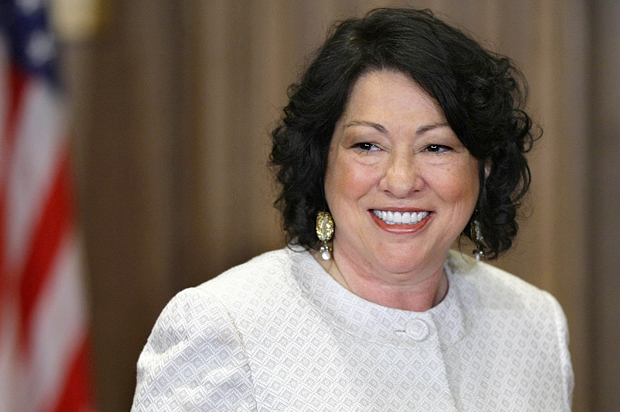
The Senate has just voted 68-31 to confirm Justice Sonia Sotomayor to fill retiring Justice David Souter’s seat on the Supreme Court.

59 members of the Senate’s Democratic caucus — 57 Democrats, plus independent Sens. Joe Lieberman and Bernie Sanders — voted in favor of Sotomayor. They were joined by nine of their Republican colleagues; 31 Republicans voted against confirmation. Sen. Ted Kennedy, D-Mass., who remains ill, was the lone non-voting member.

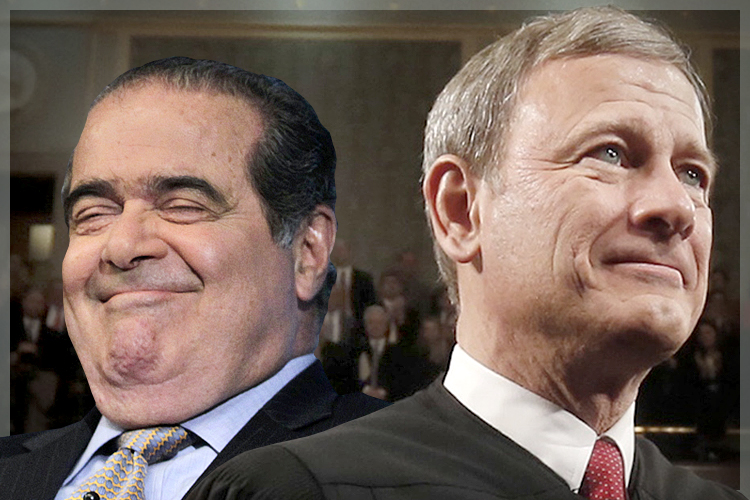
The split was more partisan than Supreme Court confirmations had been up until this decade, but the split fell right between the votes for former President George W. Bush’s two nominees. Chief Justice John Roberts was confirmed by a vote of 78-22. while the Senate voted 58-42 to approve Justice Samuel Alito; that was one of the closest votes this century, according to the Associated Press.

The Republicans voting for confirmation were Sens. Lamar Alexander, R-Tenn., Kit Bond, R-Mo., Susan Collins, R-Maine, Lindsey Graham, R-S.C., Judd Gregg, R-N.H., Richard Lugar, R-Ind., Mel Martinez, R-Fla., Olympia Snowe, R-Maine and George Voinovich, R-Ohio.

Sotomayor will be sworn in this coming Saturday, at 11 a.m. EDT. Roberts will administer the oath, and will hopefully get it right this time.

Alex Koppelman is a staff writer for Salon.

GOP Sens. Voinovich, Gregg will vote for Sotomayor

As the Senate nears a vote on the nominee, she gets more Republican support

  • more
    • All Share Services

The Senate is scheduled to vote on the nomination of Judge Sonia Sotomayor to the Supreme Court Thursday afternoon. When the vote does happen, there’ll be a fair amount of Republicans saying “aye.”

New Hampshire Sen. Judd Gregg announced Wednesday that he’ll vote to confirm Sotomayor; Ohio Sen. George Voinovich, who’d been the last uncommitted Republican, said Thursday that he’ll vote for her as well. That means there’ll be nine Republicans, in all, crossing party lines.

Sotomayor’s confirmation is, of course, assured. There is a lingering question about the margin of victory, though, as the votes of all 60 senators who caucus with the Democrats are not assured. Sen. Mark Begich, D-Alaska, for one, has been hesitating to say what he’ll do, and he could be spooked off by the NRA’s anti-Sotomayor stance and its promise to score the confirmation vote — that is, remind its members that people like Begich bucked the pro-gun group.

Update: Begich will reportedly vote for Sotomayor.

Continue Reading Close

Alex Koppelman is a staff writer for Salon.

Will Sotomayor add to SCOTUS’ pro-business supermajority?

The Chamber of Commerce endorses the judge, another sign she might not be so liberal in at least one area

  • more
    • All Share Services

When it comes to evaluating how a Supreme Court nominee will vote if confirmed, the country tends to apply a pretty simple rule: For Roe, or against?

I’m exaggerating, but only slightly. Though it’s common to speak of liberal and conservative wings of the Court, usually we’re just lining the justices up, left to right, based on where they stand on social issues. Abortion tends to be the foremost subject, or at least subtext, of a confirmation hearing. This time, as it happens, it was affirmative action, with a little bit of gun control thrown in.

What we tend to lose track of, in trying to figure out where Judge Sonia Sotomayor falls on the political spectrum is that the Supreme Court doesn’t only rule on social and cultural issues. Businesses, consumers and organized labor take their battles to the Nine all the time, and the much-noted five-to-four split on the Court doesn’t really apply to those cases. Justices we regularly refer to as liberals quite often end up in majorities with their conservative counterparts, ruling for the corporate party (usually, in these cases, the defendant).

So it seems noteworthy that the Chamber of Commerce today endorsed Sotomayor. The judge’s business rulings have received some examination in the press thus far, but the result is a bit ambiguous. One prominent ruling allowed a massive class-action suit to proceed against Visa and MasterCard. In 1999, she upheld a $1.25 million award to a victim of sex discrimination and retaliatory harassment. But she sided with Boeing in a lawsuit over the crash of TWA flight 800, and she’s voted both for and against Merrill Lynch in separate cases. She decided that a rule allow plaintiffs to sue the government also exposed government contractors to lawsuit, but ruled that the Environmental Protection Agency had overstepped in a cost-benefit analysis case centering on fish protection.

You can find legal analysts saying that “American business should shudder in its boots” at the prospect of a Justice Sotomayor. You can find legal analysts saying, “There’s nothing in her record that suggests she’s … hostile to business.” Mainly, the consensus seems to be that she can’t be pigeonholed, but probably won’t alter the court’s generally pro-business stance.

Continue Reading Close

Gabriel Winant is a graduate student in American history at Yale.

Nancy Drew, now and forever

The girl detective may have influenced Sonia Sotomayor, but her impact reaches a broader -- and younger -- audience

  • more
    • All Share Services

Perhaps the unlikeliest beneficiary of Sonia Sotomayor’s Supreme Court nomination has been a motherless Midwestern teenager. Nancy Drew, the fictional girl detective who’s pushing 80 but still doesn’t look a day over 16, has been riding a career boost following the revelation that Sotomayor was an avid fan. Ever since, other female achievers who owe a debt to Drew have come forward, including Ruth Bader Ginsburg and Sandra Day O’Connor. A New York Times story on Sunday featured such luminaries as Nancy Pelosi and crime writer Sarah Peretsky weighing in on the influence of the titian-haired sleuth. It’s all well and good to pay nostalgic boomer homage, but what’s been largely missing from the spate of Drewmania has been Nancy’s relevance to younger women. It’s not as if she stopped being important to girls somewhere around the early era of second-wave feminism.

Gen Xers like me (and Broadsheet contributor Amy Benfer, who’s also written on Nancy Drew) grew up on the ’70s-era incarnation of Nancy, supplemented by the addictively glamorous, wildly popular television series. In the ’80s Nancy evolved into a tween paperback heroine. Today, she’s still going strong, with a continuing series of traditional and graphic novels. She may drive a hybrid, and carry a cellphone, but she’s the same infinitely clever, down-to-earth girl other girls long to be.

She’s an icon to my 9-year-old daughter, who carries a small spiral “detective” notebook around in a purse emblazoned with a vintage Nancy Drew cover. When I asked her recently why she likes Nancy, she replied casually, “She’s smart. She follows her hunches. And she’s not superstitious, which is good.”

My child is in a demographic that’s relentlessly encouraged to “Diss and Make Up,” a generation hard-pressed for real or fictional role models who are neither pop stars nor top models. I’m of a generation still being advised on national television that no one’s going to want you if you don’t know how to “stand down and let a man be a man.”

Somewhere in America there’s a little girl who will one day sit on the United States Supreme Court. There’s a future CEO of a Fortune 500 company. And there are millions of others who are happy right now just knowing that your value doesn’t stem from being a vixen or a brat or a princess. For all of them, there’s a girl who brims with curiosity, who asks questions, who boldly and bravely pursues a life of adventure. She has a boyfriend, but she doesn’t live her life wondering how to mold herself to please him. She’s not a relic; she’s a revolutionary. She’s Sonia Sotomayor’s Nancy. She’s mine. And she’s my daughter’s.

Continue Reading Close
Mary Elizabeth Williams

Mary Elizabeth Williams is a staff writer for Salon and the author of "Gimme Shelter: My Three Years Searching for the American Dream." Follow her on Twitter: @embeedub.

What if they gave a culture war and no one came?

Frank Ricci, this week's poster boy for oppressed white males everywhere, declines to attack Sonia Sotomayor

  • more
    • All Share Services

The surest sign the White House isn’t worried at all about whether Sonia Sotomayor will win confirmation to the Supreme Court came on Thursday afternoon, a few hours after Sotomayor had finished enduring three days of mind-numbingly repetitive questions from the 19 members of the Senate Judiciary Committee.

All week, the major Republican line of attack against her has been a simple one: She’s racially biased, and she won’t judge fairly and impartially. To prove that, the GOP has relied on a handful of speeches and her ruling in one controversial case out of New Haven, Conn., which found the city had acted properly by throwing out the results of a promotion exam for firefighters over concern that minority candidates were disproportionately likely to fail it; the Supreme Court overturned Sotomayor’s ruling earlier this summer. And to make sure the point was driven home without any danger of subtlety, Republicans arranged for two of the firefighters to testify, calling them as witnesses in the Thursday afternoon portion of the hearing that dealt with Sotomayor’s record and qualifications.

Looking sharp in their dress blue uniforms, the firefighters, Frank Ricci and Ben Vargas, had a sympathetic story to tell; Republicans must have been praying the Democrats on the committee would attack the two of them in the course of defending Sotomayor. But the majority side didn’t take the bait — they knew they’d already won, so why bother? They made nice instead. “I personally want to thank you for being here,” Sen. Ben Cardin, of Maryland, told Ricci and Vargas. “You put a face on the issues … you have really added to today’s hearing by your personal stories.” With even Jeff Sessions, the leading Republican on the panel, conceding that the GOP won’t try to stop Sotomayor’s confirmation, there was no reason for administration officials to tell Democrats to play hardball with the witnesses.

Of course, that only underscored the extent to which their presence at the witness table was a cheap political stunt. Ricci and Vargas made up a panel with New York Mayor Mike Bloomberg, Manhattan District Attorney Robert Morgenthau, Arkansas Attorney General Dustin McDaniel and Leadership Conference on Civil Rights CEO Wade Henderson, as well as two other GOP witnesses, Peter Kirsanow — a member of the U.S. Equal Opportunity Commission — and Linda Chavez, an anti-affirmative action activist. The crowded panel made for a disjointed question-and-answer session (made worse because Bloomberg strolled in late, interrupting things), and it was immediately clear that Ricci and Vargas were mostly being used as props. Even the Republicans barely asked them any questions.

In the end, only one senator, Arlen Specter, the Pennsylvania Republican-turned-Democrat, even attempted to raise the one question that would have actually explained their presence. “Do you have any reason to think that Judge Sotomayor acted in anything other than good faith in trying to reach a fair decision in the case?” Specter asked Ricci.

Ricci — finally given the chance to stick it to the “wise Latina” judge who, in the GOP’s feverish imagination, at least, had tried to ruin his life — took a pass. “That’s beyond my legal expertise,” he said, without hesitating. “I am not an attorney or a legal scholar. I simply welcome an invitation by the United States Senate to come here today.” For the most part, Ricci didn’t try to make any sweeping claims about justice, or about race. Some of his opening statement sounded like it was meant for a different hearing, one on federal grants to local first responders: “The structures we respond to today are more dangerous, constructed with lightweight components that are prone to early collapse, and we face fires that can double in size every 30 to 60 seconds.”

But just because Ricci and Vargas didn’t get beaten up by Democrats at all didn’t mean they escaped the hearings unscathed. After a whole week of uncomfortable, resentment-ridden discussion of race in America, the GOP still had a little bit of awkwardness left. “I just want you to know if the country that we’re probably one generation removed to where no matter how hard you study, based on your last name or the color of your skin, you’d have no shot,” Sen. Lindsey Graham, a South Carolina Republican, told Ricci. “And we’re trying to find some balance … please don’t lose sight of the fact not so very long ago, the test was rigged a different way.”

That was a fair point, and a lot closer to a defense of affirmative action than anyone on the Democratic side offered Ricci. But then Graham turned to Vargas, who joined Ricci’s lawsuit even though he is, himself, Puerto Rican. Vargas had testified that he wanted to help prove that opportunity truly is equal; he had passed the New Haven promotion exam, even if some other minority applicants hadn’t, and he wanted to be dealt with as an individual, not a “racial statistic.” Graham, apparently, didn’t entirely see it that way.

“Mr. Vargas, you’re one generation removed from where your last name would have been [enough to deny him the job]. Do you understand that?” Graham asked. He pushed further, asking what happened when Vargas joined the lawsuit. “Did people call you an Uncle Tom? People thought you were disloyal to the Hispanic community?” Vargas answered yes, sounding a little uncomfortable, and Graham kept going. “Quite frankly, my friend, I think you’ve done a lot for American-Hispanic community,” Graham said. “My hat’s off to you.”

The rest of the panel offered pretty much exactly what you might expect. Chavez, who’s made a career out of insisting — against all available evidence — that America really is the colorblind paradise Republicans say they want, dredged up Sotomayor’s college thesis to build a case against her; it was the sort of stuff people threw against Michelle Obama during last year’s campaign. “It is clear from [Sotomayor's] record that she has drunk deep from the well of identity politics,” Chavez warned. “I know a lot about that well, and I can tell you that it is dark and poisonous.”

But as with Ricci and Vargas, almost no one took the bait. Any energy and drama that had been left in the hearing room were finally spent. By the time the hearing rolled past 6 p.m. Eastern, the crowd had dwindled, and there were hardly any reporters or members of the public left to listen to even less controversial GOP witnesses as they tried everything from guns to abortion to French law to fear of crime to ignite the culture wars again. This fight has been over since before it began; President Obama had stacked the deck too neatly. Four days of hearings demonstrated what everyone already knew about Sotomayor: She’s obviously qualified, she’s not remotely the radical activist the right says she is, and her appointment as the first Latina justice truly will make history. The only question left by the end of the day Thursday was exactly when the Senate would get around to making her confirmation official. 

Continue Reading Close

Mike Madden is Salon's Washington correspondent. A complete listing of his articles is here. Follow him on Twitter here.

Tom Coburn: third-rate Civil War buff

Sen. Coburn, doing some right-to-bear-arms bullying, makes a mess of history

  • more
    • All Share Services

If there’s one thing that our politicians could really use more of, it’s a sense of historical context. Remember that congressman who blamed President Roosevelt for the Great Depression, which preceded his presidency? Time to hit the books, politicians.

So maybe it seemed refreshing when Sen. Tom Coburn, R-Okla., started talking about the history of the 14th Amendment during the confirmation hearings for Judge Sonia Sotomayor. Well, maybe it would’ve been refreshing, if he hadn’t found a way to twist the amendment’s meaning. To the rest of us, the 14th Amendment is notable for its guarantee of equal protection under the law. For Coburn, it’s all about guns.

Coburn first brought the subject up on Wednesday, when he pointed out to Sotomayor that there is a historical connection between equal protection under the law, as guaranteed by the 14th Amendment, and the right to bear arms, as guaranteed by the Second. Here’s an excerpt from the transcript:

Southern states were taking away the right to bear arms by freedmen — recently freed slaves. And much of the discussion in the Congress was to restore that right of the Second Amendment through the 14th Amendment to restore an individual right that was guaranteed under the Constitution. So one of the purposes for the 14th Amendment, the reason — one of the reasons it came about is because those rights were being abridged in the Southern states post-Civil War.

You know those Civil War buff, amateur historians? Lacking the proper background, they think they can boil down a complicated time into a simple story to fit their argument. Like that guy who’s always bending your ear about how the Civil War wasn’t about slavery. “It was all about agriculture versus industry!” Turns out Oklahoma’s junior senator is one of these. Thursday, he brought the subject back up:

Do you not consider it ironic that the majority of the debate about the 14th Amendment in this country was about the taking of guns from freed slaves? Is that not ironic that we now have some kind of conflict that we’re going to say that the whole reason in the debate about the 14th Amendment originated from states taking away the rights of people’s fundamental right to defend themselves? Is that not an irony to you?

Here’s what’s happening: A panel on which Sotomayor served ruled in favor of a New York weapons ban, saying the Second Amendment doesn’t apply to the states. That ruling conformed with precedent: The courts have thus far said that, because of the 14th Amendment, much of the Bill of Rights now binds the states as well as the federal government — but they haven’t said that about the Second Amendment. Despite the fact that the decision in which Sotomayor participated was just following precedent, Republicans have used it to argue that she’s anti-gun, and in this case Coburn was arguing his own version of history to say that she and the courts are wrong.

Salon checked in with two preeminent historians of Reconstruction, Professor Eric Foner at Columbia, and Professor Garrett Epps at the University of Baltimore Law School. Both said the same thing: Coburn is misinterpreting the history. He didn’t make this idea up outright, but he’s exaggerated its significance, and confused its details.

Epps wrote in an email, “I’ve read the entire Congressional debate on this issue and it is an exaggeration to say that the right to bear [arms] ‘generated much of the 14th Amendment,’ or that ‘much of the discussion in Congress” concerned the right to bear arms.’” Foner makes the same point, saying guns were “hardly mentioned” in Congressional proceedings.

In fact, says Epps, the debate over the amendment revolved around the things you mainly already thought it did: Citizenship as birthright, the right to vote and the guarantee of First Amendment rights.

So that’s the first error. On top of that, though, Coburn seems confused about what the 14th Amendment actually does. What the 14th Amendment did do, which has confused Coburn, is forbid racially discriminatory legislation, including the “black codes” that kept guns out of the hands of black people, but not white people. It had nothing to do with keeping guns in the hands of everybody.

Writes Foner:

There are two different points being mixed up here. 1- If state law allows whites to own guns, can blacks be barred from owning guns? The 14th Amendment clearly prohibits such discrimination. That is a question of equality before the law. 2- Is there a constitutional bar to states regulating gun ownership on a nonracial basis? The Court has never said such a bar exists, although it may in the future.

Also, you have to love how “ironic” Coburn thinks this is. The only apparent reason for the irony the senator sees is that Sotomayor — who is clearly an enemy of guns in his imagination — is also a member of a racial minority.

Continue Reading Close

Gabriel Winant is a graduate student in American history at Yale.

Page 2 of 10 in Sonia Sotomayor