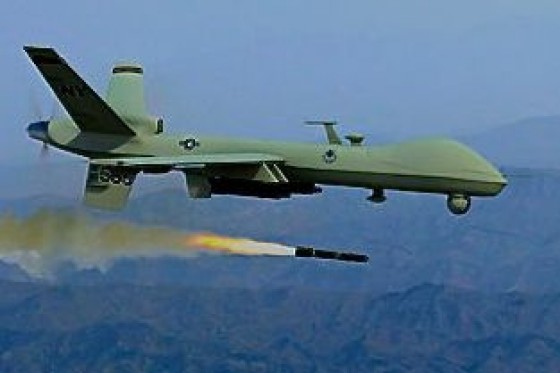
If in the year 2000 the U.S. president had told the American people that the government would soon begin using robot planes to track people, including U.S. citizens, all over the world, and would reserve to itself the right to kill them without trial, it is safe to say there would have been an enormous uproar. But that is exactly what is happening today, and nobody cares. The majority of Americans, including those who were opposed to the war in Iraq, have no problems with their government killing at will, so long as the killing is done in the name of “national security.”
How did this happen? In retrospect, the war in Afghanistan was the prime culprit. That endless, Sisyphean war was the thin end of the wedge. In that murky, shifting struggle, it was normal for the U.S. to arrogate to itself the right to kill the Taliban wherever they were in Afghanistan or Pakistan. Once that precedent was established, it was an small step to killing bad guys in Iraq, Somalia, Yemen and Libya. And so, by imperceptible steps we arrived at the place we are now, where 77 percent of liberals support President Obama’s vastly expanded killer drone campaign, where an American citizen can be remotely vaporized at the touch of a button and no one cares. The war on Afghanistan set the precedent that shaped the entire “war on terror” paradigm. The chimera of “safety from terrorism” led us by easy stages to begin waging dirty war across the globe — changing the definition of war, eroding moral and legal standards and greatly increasing the likelihood of ugly future consequences.
What makes this subject so tricky is that morally, legally and by any standard, the war on Afghanistan was completely justified. Recall the situation before we launched the invasion. 9/11 had just happened. The Taliban were in control of Afghanistan. They had aided and abetted Osama bin Laden, and refused to hand him over. This was an intolerable situation. As accomplices to mass murder, they could not be allowed to get away with their monstrous crimes. Moreover, if bin Laden remained at large he could plan another attack. Removing the Taliban was a matter of self-defense. We had to do everything possible to reduce the chances of another 9/11.
For all these reasons, I, like the vast majority of Americans, supported the war on Afghanistan. There did not seem to be any alternative. Were we really going to just sit there and let the Taliban remain in power? And once we toppled them, were we going to leave and let them return? What would have been the point of getting rid of them in the first place?
But if the war on Afghanistan was justified, that does not – in retrospect – mean it was wise.
It almost feels treasonous to raise doubts about the war. We have all been subjected to the red-white-and-blue “no price is too great to pay for national security” mantra for so long that we have forgotten that if trying to prevent a terrorist attack by launching a war results in more Americans being killed than would have been killed in the attack, the price obviously is too great. All we would have done in that case is trade more military lives for fewer civilian ones.
Of course, there is no way to ever know for certain whether the war in Afghanistan has cost more lives than it saved. (For what it’s worth, 1,896 U.S. troops have died in Afghanistan; almost 3,000 people died in the 9/11 attacks.) We don’t know if the war has saved any American lives. What we do know is that by every other measure, it has not been worth the cost.
Perform the following thought experiment. Imagine that 9/11 has not taken place. The corrupt and incompetent government of Afghanistan, a profoundly impoverished and backward nation with no tradition of democracy or civic institutions, riven by tribal loyalties and bearing the unpromising nickname “graveyard of empires,” has been locked for years in a bitter, bloody struggle with a radical Islamist group, the Taliban. The Taliban has strong support in southern Afghanistan and also has a safe haven in the tribal regions of neighboring Pakistan, another poverty-stricken, backward country whose government is almost equally corrupt and incompetent and whose intelligence service has deep ties to the Taliban. Other shadowy Islamist militants around the world are operating out of hidey-holes in various failed states and war-torn countries, trying to overthrow their governments and talking about attacking the U.S., but their capabilities are extremely limited.
Should the United States declare war on the Taliban and other militant Islamist groups around the world, send more than 100,000 troops to Afghanistan, spend more than $450 billion on the war ($113 billion this fiscal year alone), and launch hundreds of drone missile strikes against suspected militants in five different countries?
Anyone who said “yes” to that question would be a lunatic. Why on earth would the U.S. step into such an obvious quagmire? We would have everything to lose and almost nothing to gain.
Of course, that thought experiment included a huge counterfactual: In it, 9/11 never happened. But that omission only highlights the significance of the fact that today, most Americans no longer believe that the war in Afghanistan is worth fighting, even though everyone knows that our departure will dramatically increase the possibility of the Taliban taking power again. The connection between the Taliban and 9/11 no longer seems worth fighting a full-scale war over: Americans just want us to get out. The administration agrees: Defense Secretary Leon Panetta just announced that some U.S. combat troops will come home in 2013, a year earlier than originally planned.
Of course, the war on Afghanistan can’t be undone. I only raise the subject of whether it was worth fighting because that question is directly relevant to something we do still have control over: the endless global dirty war against alleged terrorists that George Bush started and Barack Obama has not just continued, but greatly expanded. If we’re willing to abandon Afghanistan to its fate, why do we insist on continuing the war on terror elsewhere? With the end of the official war finally coming into sight, it is essential that we begin a national discussion about whether we really want to continue the unofficial one forever.
It’s understandable why the dirty war has few critics. Drone attacks and special forces operations are cheap, out of sight, and involve low casualties (none, at least immediately, when drones are used). Politically, the dirty war inoculates Obama against GOP charges that he is “soft on terrorism:” not only is he continuing to prosecute a renamed version of Bush’s “war on terror,” he has significantly escalated it. And now that the dirty war has been launched, it is politically almost impossible to stop it: what president, Democratic or Republican (Ron Paul is the exception, but he is not going to win the election) would dare to stop blowing up alleged militants, knowing that if there was subsequently a successful terrorist attack, he or she would be held responsible?
Moreover, the dirty war has been tactically effective. It has killed significant numbers of top Taliban and Al-Qaida leaders, including bin Laden himself, and forced other radical jihadists underground, disrupting their command and control and generally making their lives difficult.
Finally, dirty war has a proven historical track record. Agents of the American OSS and the British SOE, fighting behind enemy lines, carried out major acts of sabotage and subversion, tied up Axis troops and provided invaluable support to resistance groups. (I should know: I wrote a book about the SOE.) Dirty war tactics helped win World War II.
So why stop using such an effective instrument?
The answer is simple: Because it is not effective. Far from making us safer, the permanent dirty war is endangering our national security. It may be tactically effective, but it is strategically disastrous. Unfortunately, there’s no way to prove this. But there are some compelling arguments for why it is true. And it would be a start if progressives and Democrats would at least start to question the wisdom of the U.S. playing God all over the world.
The first point to be made is that this isn’t World War II. We’re not fighting Hitler or Tojo, national leaders commanding huge armies and controlling vast amounts of territory and resources, but a bunch of ragged fanatics in caves. By treating these puny adversaries as if they were more formidable than they are, we’re squandering resources that would be better used trying to improve the lives of the people living in their countries. By employing the same tactics the terrorists use, we are descending to their level. In a fight against terrorism, which ultimately is a fight for hearts and minds, this is a losing proposition.
Second, dirty war is still war. By pursuing an endless war, we are opening a Pandora’s Box – for war, no matter how low-level, is always a Pandora’s Box. War is the ultimate generator of chaos. And chaos produces unexpected consequences –what spooks call “blowback.”
There are a number of reasons to fear blowback. The places we are fighting are murky and unpredictable. Their governments could fall as a result of anger over our dirty wars – a real possibility in Pakistan — and chaos within their borders can spill over into neighboring countries, destabilizing them as well. Nor are the players clear-cut. As the Iraq “surge” proved, which succeeded because we paid off Sunnis we considered “terrorists” yesterday to fight al-Qaida today, the line between good guys and bad guys is blurry. Some of the people we are blowing up are Salafi jihadis who want to destroy the Great Satan, but others are insurgents resentful of foreign troops, and still others are farmers in the wrong place at the wrong time. Every one of these people has survivors who may or may not vow to take revenge on us. And one thing we know is that the people involved have long memories. One of the reasons Iraqis were suspicious of their American occupiers’ idealistic pronouncements, as the late Anthony Shadid pointed out in his superb book about the Iraq war, is that the Iraqis remembered that when the British occupied Iraq in 1917, they uttered the same pretty phrases – and then remained in control of Iraq and its oil for decades.
Finally, there is the fact that our dirty war tactics are increasingly hard to distinguish from the terror attacks they are intended to forestall. (There is a bizarre and disturbing parallel between the destruction of the World Trade Center by planes that suddenly slammed into it, and the equally apocalyptic death from above that rains down upon the victims of drone strikes who are incinerated in their cars without ever even hearing the sound of the incoming missile. I am not equating the morality of the two attacks, only their shared spectacle, but many people in Middle East make no such distinction — and some will burn to replay the spectacle on American soil.) Obama’s extra-legal assassination of the radical cleric and American citizen Anwar Awlaki tacitly accepts the terrorist credo that might makes right and morality is simply a fig leaf covering naked power. This makes it impossible for America to take the high moral ground, and puts us on a slippery slope: if it’s OK to kill Awlaki today, why shouldn’t it be OK to kill some foreign scientist we deem dangerous to our national security tomorrow? By embracing the law of the jungle, we have opened the door to hell.
The question Donald Rumsfeld, of all people, asked about Iraq is still the central one: Is our dirty war creating more terrorists than it’s killing? And there is every reason to believe that it is.
It is tempting to see our new way of waging war as having no consequences. A functionary sitting in a mountain in Colorado pushes a button, blows up three people in a field in Pakistan, and then goes to the bathroom. Suppose the brothers of those three guys are mad at America – so what? They’re in Pakistan. What are they going to do? If they start to make trouble, we’ll blow them up too.
This complacent attitude towards the consequences of war has deep roots both in American history and contemporary culture. Because of geography and military strength, America never been subjected to the horrors of foreign invasion. (The War of 1812 doesn’t count.) Our virtual culture of video games and disembodied online interactions, in which “communities” can be composed of people who have never met and messy, all-too-human consequences can be avoided or erased with the touch of a mouse, turns war into an electronic game of whack-a-mole. And, of course, fewer and fewer Americans have ever served in the military or even seen a dead body.
All these factors make war weightless. For Americans, “fighting terrorists” on a permanent basis by blowing people up here and there across the globe is just something a responsible country does, the same way that a good dog owner remembers to give his pooch his flea medicine.
But war isn’t weightless. War means exploding bodies, and guts hanging out, and bloody scraps of flesh, and brains spattered on the ground. The people on the receiving ends of drone attacks are no more two-dimensional than the people in the World Trade Center. Their relatives and friends and acquaintances will not see them as pixels.
There are dark, primordial, psychological reasons why Americans support the dirty war. It is driven by the dream of perfect safety. Like all terrible traumas, 9/11 instilled in us an overpowering desire to protect ourselves. In an ambiguous and threatening world, the knowledge that we are fighting our enemies, that we are doing something, is reassuring. And it cannot be denied that remaining in a constant state of war may result in some short-term gains. Covert operations could kill someone up who might at some point launch a terrorist attack against us. And it could prop up governments that take our side against jihadis. But those successes are not only ephemeral, they set off chain reactions we cannot control. Endless war is much more likely to result in the slow, inexorable growth of hatred against us. Until we abandon the illusion that we can make ourselves completely safe, we will only succeed in making ourselves less so. As a great president said when facing an infinitely more dangerous adversary than we face today, “The only thing we have to fear is fear itself.”
Like frogs placed in slowly boiling water, we have been lulled into seeing our current situation, in which we arrogate to ourselves the right to kill without formally being at war, as normal. But it is not normal. It represents a radical break with the way we have made war throughout our entire history. After 9/11, George W. Bush rashly launched a “war on terror,” Barack Obama, in his folly, continued to prosecute it, and the American people accepted it. This permanent, undeclared war may appear innocuous, but it is a ticking bomb.
No one knows when that bomb will go off. The risk is not quantifiable. But that is precisely the point. War, no matter how small and sanitized, is the most unquantifiable thing in the world. We have, in effect, decided to play God, reaching down from our high-tech heaven to kill whoever we want, whenever we want, wherever we want. We have gotten away with it so far. But if we know anything from human history, it is that bad things happen to people who try to become God.
I was stunned and saddened to learn of the death of Anthony Shadid, the great New York Times reporter who covered the Middle East. Shadid was quite simply the best mainstream reporter working the most important foreign beat in the world. From his superb coverage of Iraq to his groundbreaking reporting on the Arab Spring, he set the journalistic standard. Shadid’s profound knowledge of the Arab world, his even-handedness, his historical sophistication, and above all his empathy for the ordinary people he wrote about, made him indispensable.
His death is not just a terrible loss to journalism: it is a loss to America. Even though the United States is at war with two Middle Eastern countries, and stands on the brink of war with a third, most Americans, including our politicians and many so-called “experts,” know almost nothing about it – which is one of the reasons we embarked upon the disastrous Iraq war. Like all great reporters, Shadid penetrated the darkness. He took us not just into streets and cafes, but into hearts and minds. He showed the impact of decisions made by politicians and generals in far-away lands on housewives and young girls and street vendors, on small human beings just trying to live decent lives. He was our eyes.
In his extraordinary 2005 book “Night Draws Near: Iraq’s People in the Shadow of America’s War,” Shadid wrote about one of those small people, a woman named Karima Salman, and her family. This is from my Salon review of the book:
“Karima, a desperately poor mother of eight, lived in a squalid, cockroach-infested apartment in Baghdad. The first story Shadid tells about her takes place before the war. Most of her family and friends had already fled Baghdad. She was exhausted, lonely, unable to pay the rent, faced with skyrocketing food prices. Her 21-year-old son, Ali, who had been working as a plumber, had been sent north days earlier to man an antiaircraft battery.
At their parting, movingly recounted by Shadid, Karima and Ali simply exchanged the basic phrases of Islam. “There is no God but God,” she told Ali as he boarded a bus. “Muhammad is the messenger of God,” Ali replied, completing the phrase. Her final words to him were prayers of farewell: “God be with you. God protect you.” As she recounted their parting, tears ran down her cheeks. “A mother’s heart rests on her son’s heart,’ she told Shadid. ‘Every hour, I cry for him.”
“Faith for Karima and her family was not a matter of religious zealotry,” Shadid writes. “It was not even piety, really. It gave their lives cadence … It spoke with clarity, offered simplicity, and served as a familiar refuge in troubled times.” As Karima sat with her five daughters on old mattresses on a tile floor and waited for the war to begin, ‘in her voice was the hopelessness that forced so many in the once-proud city to put their faith and future in God’s hands. ‘We only have God,’ she told me. ‘Thanks be to him’ … To Karima, the war that had begun was a play; on its grand stage, people were mere actors. ‘Life’s not good, it’s not bad,’ she told me, as we sipped the bitter coffee. ‘It’s just a play.’”
The fate of small people like Karima and her family, unknown, of no political consequence, is easy to forget as nations rush to war and powerful men plan and redraw maps. “Ordinary people are, as Karima recognized, only pawns on a giant board; if one or one thousand of them are swept off, no one notices.” It is one of the functions of journalism, perhaps the noblest, simply to bear witness to these forgotten ones.
Anthony Shadid bore that witness. He died at the age of 43 on the front lines of his profession, of an asthma attack while reporting inside violence-ravaged Syria. He joins the honored list of reporters who gave their lives to give the world the truth. Every journalist, and every American who cares not just the consequences of American wars, but about humanity, owes him a debt. His loss is incalculable.
Also in Salon, the story of Shadid’s last book: Anthony Shadid yearned for home.
Continue Reading
Close
Lin-sanity has broken out all over the world. The kid nobody in the NBA wanted, from an ethnic group about as associated with the NBA as bullfighters are with People for the Ethical Treatment of Animals, had just broken Shaquille O’Neal’s league record for the most points in his first five games as a starter. Adoring fans are holding up signs saying “To Lin-finity and beyond.” The Lin-ternet has broken under the strain of millions of tweets, many of them featuring even worse puns than “Lin-ternet.” Sports Illustrated put him on its cover.
And, of course, Asian-Americans are going wild.
I’m one of them. As a half-Japanese, half-white ex-jock, I’ve always followed and rooted for that tiny number of Asian-Americans who make it in any of my three favorite sports, the all-American Big Three of football, basketball and baseball. (There are lots of Asian baseball players, but not many Asian-Americans.) Half-Japanese players get even more points. The triumphs of Olympic speed skater Apolo Ohno had me feeling my half-breed oats. And when former Giants’ hurler Atlee Hammaker, a hapa like me, melted down in the 1987 playoffs, my inner mulatto got a lot more tragic.
There’s no great mystery why I root for Asian-American jocks. It’s the same reason any member of a minority group pulls for one of their own: racial pride and solidarity. There are so damn few of “us” in the big leagues (I’m an “us” with an asterisk) that when one makes it, it’s cause for celebration.
The first thing to note about Lin-mania is that America is basically just fine with it. The mainstream media features photos of Asian fans wearing Lin T-shirts and runs stories in which they are quoted as expressing racial pride. It is all deemed benign and heartwarming, a multicultural Cinderella story in which everyone wins. The Asian kid overcomes impossible odds and racial stereotypes – if white men can’t jump, Asian men are not even supposed to be able to hop – to make it in the NBA. Horatio Alger meets the Statue of Liberty in the land of the melting pot.
But race is such a minefield in American society, and honest conversation about it is so constrained by politically correct politeness, that even the Lin story makes people tongue-tied, as if they thought that admitting that yes, people root for players because of their race would cause the Ku Klux Klan to rise again.
Case in point: an ESPN panel’s reaction to boxer Floyd Mayweather’s now-notorious tweet in which he said, “Jeremy Lin is a good player but all the hype is because he’s Asian. Black players do what he does every night and don’t get the same praise.” The latter part of Mayweather’s comment, implying that black players are not praised the way Lin has been because of racism, is a total crock, another one of Mayweather’s heavy-handed attempts to provoke a race controversy. But his comment that the hype over Lin is because he’s Asian is clearly true. Not all the hype, but most of it – and the most interesting part of it – is precisely because Lin is Asian. Does anyone think SI would put Lin on the cover if he were black or white?
This is so obvious that it strains credulity to think that anyone would even try to dispute it. And yet when four panelists on ESPN’s First Take were asked to comment on Mayweather’s comments, only one of the four, Bomani Jones, was able to forthrightly acknowledge it. Absurdly, sports reporter Beto Duran actually denied that Lin’s race had anything to do with the hype, saying it was simply because “he’s balling.” Eventually, they all admitted that race played a role in the hype, but their reluctance to go there spoke volumes about how radioactive all discussions of race in sports continue to be.
And the Lin story is the most non-threatening possible race-in-sports story, one involving a societal minority group that is also so underrepresented in the NBA as to be positively exotic. If America has trouble admitting that it’s OK for Asians – or members of any other race, for that matter – to root for Jeremy Lin because he’s Asian, just imagine how it deals with the issue of white people rooting for athletes because they’re white. Even to suggest such a thing is considered way out of bounds.
But there’s nothing wrong with it. I’ve been doing it for years. And it’s completely racially innocent.
Just as the Asian part of me celebrates the unlikely success of Jeremy Lin, the white part of me celebrates the almost equally unlikely success of New England Patriot running back Danny Woodhead. Rooting for white players who break out of racial stereotypes is harmless. It does not mean rooting against black players or those of any other race. It’s fun. And I suspect a lot of other people do it, too.
I’m not talking about Rush Limbaugh and his followers, most of whom I suspect are bigots who are rooting against black players as much as they are rooting for white ones. (In a brilliant, half-crazy 2003 essay in the New York Review of Books, “The White Man Unburdened,” Norman Mailer argued that one of the reasons Americans supported Bush’s Iraq war was that so many reactionary white men needed to regain a masculinity threatened when their white sports stars were replaced by blacks.) I’m talking about people who are able to acknowledge the reality that white running backs and cornerbacks are almost as rare as Asian point guards, and are sufficiently free from racial uptightness or self-consciousness to root for them for precisely that reason.
I’ve never agreed with the quasi-official view, expressed in endless “diversity” seminars held by big corporations and piously promulgated in schools and universities, that everyone is to some degree a racist and needs to engage in constant Maoist “constructive self-criticism” to become more racially enlightened. That ortho-liberal view has always struck me as a sterile guilt-trip, a recipe for racial constipation that only breeds more racial animosity and misunderstanding. However, it does contain a grain of truth. Everyone is not a racist, but everyone is aware of race. Unfortunately, much of the time this awareness is lugubrious and heavy, both because of America’s long and painful history of racism and because we haven’t come up with any lighter ways of dealing with race. Sports offers one of those ways.
When I root for white NFL players like Danny Woodhead or retired New York Giants’ cornerback Jason Sehorn, or white 2004 Olympic 400-meter gold medalist Jeremy Wariner, I’m not rooting against black athletes. In fact, the very fact white running backs or cornerbacks or 400 runners are so rare is a testament to the sheer dominance of African-American athletes at those ultimate bad-ass positions. It just makes my white-boy self happy to have a few Caucasians in that Olympian company. It’s exactly the same attitude expressed by Charles Barkley when he says, “Steve Nash is one bad white boy.” Is acknowledging this really going to make Lester Maddox rise from the grave, baseball bat in hand?
I suspect that many of those white fans who do root for unlikely white stars are uneasy about acknowledging it for the same reason that they (rightfully) believe that only blacks can use the n-word. It’s the liberal racial double standard, which is predicated on the fact that racism, in particular bigotry against black people, is still very much alive. (Have you checked out the GOP primaries lately?) Charles Barkley is allowed to say “Steve Nash is one bad white boy,” but white people are not, because when they do, it could be construed as racism. White talk about race in America is governed by a priori semiotic censorship: Any statement that could be interpreted as racially suspect is ruled out.
This prior restraint on white speech makes sense in some areas. If someone goes around complaining that white people are all discriminated against and black people get all the breaks, and celebrates some white businessman for that reason, he’s either a fool, a racist or a demagogue. (See above comment about the GOP primaries.) But cheering for white running backs or cornerbacks is different. They aren’t discriminated against. It’s just that 99 percent of the time, they aren’t good enough to play the position. That’s a fact. And when they do make it, it’s fun to identify with them.
It would be stupid to make too big a deal out of this. It’s strictly lighthearted. It’s a holiday from racial politeness, a bit of benign tribalism. I don’t usually hold with tribalism, but we all have a little of it in us, and as long as it’s innocent, we might as well enjoy it from time to time. Besides, as someone who has covered three Olympics, I can attest that national tribalism trumps racial or ethnic tribalism. Every red-blooded American, of whatever race, watching the finals of the 4×100-meter relays at Sydney or Athens was for that moment an honorary black person.
And anyway, it’s all changing. When I saw Chinese hurdler Liu Xiang win the 110 meter hurdles in Athens, I knew that the world of sports would never be the same again. Races and ethnicities are mixing more and more, old athletic stereotypes are dying, and great athletes are popping up in the most unexpected places. Right now, the Jeremy Lin show has captured the world. Tomorrow, a black hockey player will challenge Wayne Gretzky as the Great One, or a heavyweight champion will come from Iceland. The infinite diversity of the human race is displayed in all its glory in sports, and there’s nothing wrong with appreciating every last part of it. Even if it means rooting for a bad white boy.
Continue Reading
Close
There has never been a more loudly Christian group of presidential candidates than this primary season’s GOP contenders. From the start, the campaign has been an exercise in Christian one-upmanship. Minnesota Rep. Michele Bachmann set the standard for religious fervor, boasting of setting her alarm clock at 5 a.m. so she could read the Bible and issuing born-again testimonials like “I radically abandoned myself to Jesus Christ.” Herman Cain said that he was inspired to run for president by the parable of the talents in Matthew 25. Rick Perry released a video in which he intoned, “I’m not ashamed to admit that I’m a Christian … As president, I’ll end Obama’s war on religion and I’ll fight against liberal attacks on our religious heritage.”
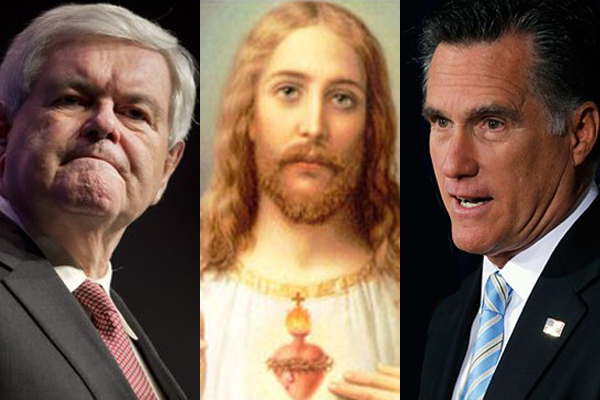
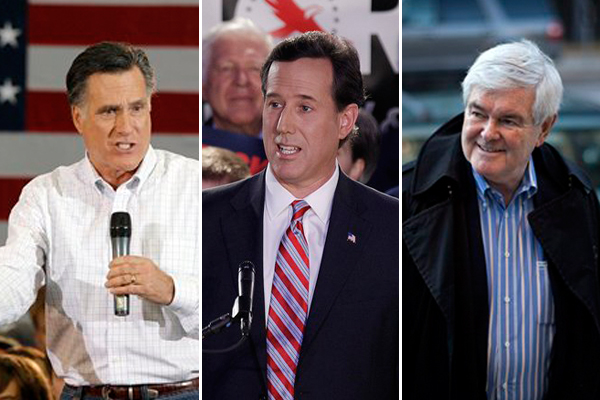
Bachmann, Cain and Perry are no longer sharing their spiritual rectitude with a national audience, but the remaining candidates continue to flaunt their Christianity. Newt Gingrich, who has noisily proclaimed that his conversion to Catholicism saved his soul, repeated Perry’s charge, accusing President Obama of launching a “war on religion” by requiring that church-owned hospitals and universities provide insurance that covers birth control. “It’s a fundamental assault on the right of freedom of religion,” Gingrich said. “On the very first day I’m inaugurated I will sign an executive order repealing every Obama attack on religion.”
Gingrich has framed the election as a battle for America’s soul, warning that if Obama is not defeated, the United States is in danger of becoming a “secular atheist country, potentially one dominated by radical Islamists.” Such apocalyptic warnings, combined with statements like “I can’t imagine being comfortable with an atheist in the presidency,” insinuate that Obama is a fake Christian – a widespread belief among the religious right. (That’s actually a comparatively moderate view: The hardcore see him as the Antichrist.)
Rick Santorum went even further, essentially calling for America to become a theocracy. At the Thanksgiving Family Forum last year, Santorum said, “Our civil wars have to comport with the higher law … That’s why as long as abortion is ‘legal,’ according to the Supreme Court, we will never have rest, because that does not comport with God’s law … As long as there is discordance between the two there will be agitation.”
The Republican strategy — loudly proclaiming one’s Christian faith, while attacking Obama as an agent of secular evil, if not actually Satan himself – is right out of the Fox News playbook. As the voice of the American far right, the ultimate undeclared super-duper-GOP-PAC, Fox News has embraced the cracked “birther” movement and generally done everything within its latitudinous definition of “fair and balanced” to portray Obama as a fake-Christian, foreign-born, America-hating Muslim. (Fox’s “War on Christmas” rants appear with such clockwork regularity at Christmastime that I use them as reminders to open my Advent Calendar.)
The only GOP candidate who has not openly pursued this strategy is the front-runner, Mitt Romney. Romney has avoided the subject because as a Mormon, his own Christian credentials are suspect. But as the ultimate political panderer and opportunist, he would play the Christian card if he could. Like all the GOP candidates, Romney has tried to paint Obama as an alien Other, elite, mysterious, malevolent – in a word, slightly satanic. And also like them, Romney presents his free-market, anti-government ideology as more “American,” and by implication more “Christian,” than Obama’s.
As someone who has spent many happy hours studying Christian theology, from Origen to Hans Kung, as well as modern scholarship about Jesus, I supposed I should be pleased by this eruption of holy fervor among the Republican candidates for the highest office in the land. But there’s just one little problem.
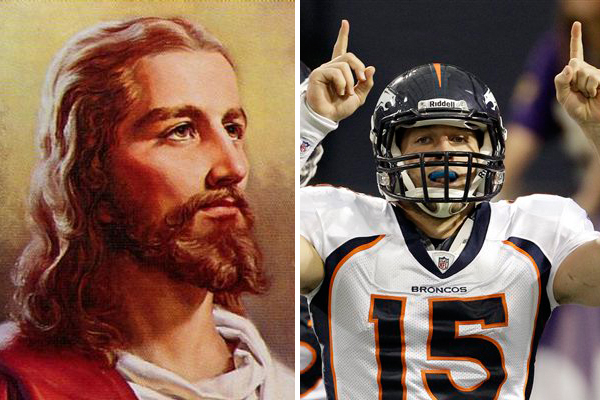
Jesus would have been appalled by the whole pack of them.
We do not know very much about the historical Jesus. But everything we know indicates that the carpenter from Galilee would not have been pleased to learn that this pack of coldhearted, sanctimonious, wealth-exalting politicians were claiming to be his followers.
I’m not saying that Jesus would have been a Democrat. Anyone who pretends to find support for specific political policies or ideologies in the Bible is delusional. Scholars cannot agree if Jesus was a social revolutionary, a tortured mystic, or something altogether different. Even what Jesus himself believed about the most essential aspects of what was to become “Christianity’ – a religion founded not by him, but by his disciple Paul of Tarsus — is unclear. As leading biblical scholar Bart Ehrman noted in “Jesus, Interrupted,” some of the most important Christian doctrines, including the divinity of Christ, the Trinity and the concept of heaven and hell, were not held by Jesus himself: They were added later, when the church transformed itself into a new religion rather than a Jewish sect.
Ehrman told me that the authors of the four Gospels portray Jesus in such contradictory ways that there is no intellectually honest way to reconcile them. Mark, for example, depicts Jesus as doubting and despairing on the way to the cross, while Luke portrays him as calm. Ehrman argues that such contradictory accounts can only be reconciled by creating, in effect, a bogus “fifth Gospel” that does not exist.
But having said all that, we still have the evidence of the Bible itself. And one does not need to believe in the infallibility of that document to see that the Jesus who is depicted in it was implacably opposed to authoritarianism, warmongering, contempt for the poor, exaltation of wealth, conformity, and sanctimoniousness – in short, everything the contemporary Republican Party stands for.
In an ugly culmination of the successful, race-baiting “Southern strategy” that has essentially driven the GOP for decades, the Republican candidates have vied with each other to demonize poor people, especially if they’re black. That’s why Gingrich has repeatedly attacked Obama as the “food stamp president,” and why Mitt Romney went out of his way to say “I’m not concerned about the very poor,” contrasting his stance with that of the Democrats, of whom he disparagingly said, “We will hear from the Democrat Party (about) the plight of the poor.” (As Gail Collins wrote in a hilarious column, “It is interesting to hear a candidate directly attacking the opposition for being concerned about the destitute.”)
We have no idea what position Jesus would have taken on progressive taxation or whether he would have supported the Dodd-Frank Act. But we do know that Jesus, unlike Gingrich and Romney, was concerned about the poor. In fact, he made it clear that concern for the poor was an absolutely essential principle of his faith.
This is not surprising. For Jesus himself was completely destitute, and he insisted that his companions be as well. As they traveled around Palestine, they ate whatever they were given and slept in whatever house would take them. If no shelter was offered them they slept outdoors. As he told his 12 disciples in Luke 9:3, “Take nothing for your journey, neither staff, nor bag, nor bread, neither money, neither have two coats apiece. And whatever house ye enter into, there abide, and from there depart. And whoever will not receive you, when ye go out of that city, shake off the very dust from your feet for a testimony against them.”
Romney’s statement that he was “not concerned about the very poor” is telling. For Jesus explicitly stated that he was concerned not just about the poor, but about the poorest, the lowest and most despised members of society. Jesus’ famous saying in the Beatitudes in Luke 6:20 is usually translated as “Blessed are the poor, for theirs is the kingdom of heaven.” But as biblical scholar John Dominic Crossan noted in “The Essential Jesus,” “Greek has two different words for ‘poor’ (penes) and ‘destitute’ (ptochos), so it should be ‘blessed are the destitute.’” Crossan argues that Jesus’ mission was revolutionary precisely because he proclaimed, against all tradition, that the Kingdom to come was not just for the respectable poor – the “deserving poor,” in Republican parlance – but for the destitute.
Jesus again makes this explicit in Luke 9:48: “And said unto them, Whosoever shall receive this child in my name receiveth me: and whosoever shall receive me receiveth him that sent me: for he that is least among you all, the same shall be great.”
Jesus demanded that his followers help the neediest. In Matthew 19:21 he says:, “If thou wilt be perfect, go and sell what thou hast, and give to the poor, and thou shalt have treasure in heaven.” But Jesus went further, warning that the mere possession of wealth, and the overvaluation of worldly possessions, stands in the path of salvation. From Matthew 19:24: “And again I say unto you, It is easier for a camel to go through the eye of a needle, than for a rich man to enter into the kingdom of heaven.”
But Jesus’ most explicit repudiation of the GOP’s ethos is found in Luke 16:19, in his famous story of Lazarus and the rich man.
There was a certain rich man, who was clothed in purple and fine linen, and fared sumptuously every day. And there was a certain beggar, named Lazarus, who was laid at his gate, full of sores, and desiring to be fed with the crumbs which fell from the rich man’s table; moreover, the dogs came and licked his sores. And it came to pass that the beggar died, and was carried by the angels into Abraham’s bosom; the rich man also died and was buried. And in hades he lifted up his eyes, being in torments, and seeth Abraham afar off, and Lazarus in his bosom. And he cried and said, Father Abraham, have mercy on me, and send Lazarus, that he may dip the tip of his finger in water, and cool my tongue; for I am tormented in this flame. But Abraham said, Son, remember that thou in thy lifetime receivedst thy good things, and likewise Lazarus evil things; but now he is comforted, and thou art tormented. And besides all this, between us and you there is a great gulf fixed, so that they who would pass from here to you cannot, neither can they pass to us, that would come from there.
The Republican candidates all claim to be devout Christians. But between the compassionate teachings of Jesus and their coldhearted, mean-spirited ideology, there is a great gulf.
Whether Gingrich and Romney’s callous attitude toward the least among us will hurt them with the 78 percent of Americans who claim to be Christians is uncertain. From the 1925 publication of “The Man Nobody Knows,” a bestseller that depicted Jesus as a successful businessman, there is a long tradition of smug, self-serving Christianity in this country, a Christianity easily compatible with the harshest and most uncharitable values and beliefs. But in their zeal to win over the most resentful, hate-filled members of their party, the Republican candidates run a greater risk. They are turning before our eyes into archetypal villains, bad guys out of our collective cultural memory bank.
And fittingly, the villain they are becoming is associated with Fox News’ favorite holiday, Christmas.
For some devout Americans, Christmas is a primarily religious occasion. But for most, it is a secular holiday, a time to make children happy, see friends, and eat and drink too much. However, it also carries, in its own modest way, a deeper meaning, even for those who are not religious at all. That meaning is imparted by our culture, but it taps into our desire to rise above ourselves. The bell-ringing Santas collecting for charity on street corners, the heartwarming movies like “It’s a Wonderful Life,” create a small but real sense that Christmas is, or should be, about regeneration, kindness, a new start — what St. Augustine called “The enchiridion of faith, love and hope.”
The most powerful expression of this humanistic and moral approach to Christmas is Charles Dickens’
“A Christmas Carol.” In the beginning of Dickens’ tale, the wealthy businessman Ebenezer Scrooge is approached by some fellow businessmen, collecting for charity.
Scrooge’s reply tolls like a great, black bell.
‘Are there no prisons?’
‘Plenty of prisons,’ said the gentleman, laying down the pen again.’And the Union workhouses,’ demanded Scrooge. ‘Are they still in operation?’
‘Both very busy, sir.’
‘Oh. I was afraid, from what you said at first, that something had occurred to stop them in their useful course,’ said Scrooge. ‘I’m very glad to hear it.”
… “I help to support the establishments I have mentioned — they cost enough; and those who are badly off must go there.’
‘Many can’t go there; and many would rather die.’
‘If they would rather die,’ said Scrooge, ‘they had better do it, and decrease the surplus population.”
It is one of the great indirect cries from the heart in all of literature.
“Are there no prisons?” may play well with the resentful Republican base. But Romney, or whoever runs against Obama, may discover that the American people are not going to vote for Scrooge.
Continue Reading
Close
Super Bowl 46 was a tale of two catches – one made, one dropped – that took place within the space of three plays. The catch he dropped will haunt New England Patriots flanker Wes Welker to the end of his days. The one that New York Giants’ wide receiver Mario Manningham caught led to the Giants’ fourth Vince Lombardi Trophy, and will be almost too painful for Patriots’ fans to ever watch. Four years after Giants’ receiver David Tyree’s legendary ball-on-helmet grab led to the Giants’ scintillating victory in Super Bowl 42, the Patriots just got fatally struck by Eli Manning lightning. Again.
It was a taut game, this 21-17 affair, airless and strange and beautiful to watch for purists, a game that lacked surface melodrama but in which the outcome hung on every snap. A baseball-type football game. A novelistic game, inexorable and fatalistic, the football equivalent of Edith Wharton’s “The House of Mirth,” in which any change in the late narrative would have meant a different ending – Lily Bart not dying in despair, Tom Brady riding off into the sunset with four rings. But the fates – it felt like that, anyway, but it was just players making plays – decreed otherwise. Manningham’s gorgeous snag of Manning’s perfectly thrown 38-yard pass on the left sideline, with only a nanosecond to get his feet down and secure possession of the ball as he was slammed out of bounds, will go down as one of the most memorable catches in Super Bowl history, up there with Steeler Lynn Swann’s balletic leap in 1979 and John Taylor’s winning grab in the 49ers’ last-second victory over the Bengals. For Giants’ fans, it will forever be Catch 2.
This was one of the hardest Super Bowls to predict that I can remember (I called it for the Patriots in a close one, but with consummate lack of confidence in my pick) and the actual game revealed why. These two teams are equal in a very odd way. Odd, because for anyone who watched these two teams play at the end of the regular season and then in the playoffs – I admit I saw the Giants play more than the Patriots — it was obvious that the Giants were a more well-rounded team and, just as important, were peaking at the right time. They had a better defense on every level, especially in the secondary and on the defensive line, and their offense was hot, with Manning – an elite quarterback in every way, and now with the two rings to prove it – throwing to a devastating trio of wideouts. Their running game was just OK, but good enough to keep the defense honest. And the Giants were both battle-tested and on a roll, having faced what were almost elimination games since week 12 of the season.
Facing this explosive offense was a flawed Patriots’ defense, its Achilles’ heel its secondary. That should have tipped the odds to the Giants. As announcer Al Michaels pointed out, although the line favored the Pats, most fans around the country seemed to think the Giants would win.
But the Patriots had an X-factor: Tom Brady. Manning is a great quarterback, but Brady is on a different level – he’s one of the greatest of all time. And this killer was running The Machine – an offensive juggernaut featuring an unguardable flanker, first-rate wide receivers and – the trump card – two tight ends, Rob Gronkowski and Aaron Hernandez, who had just completed the greatest season two teammates ever had. Plus, there was the Patriot mystique — their three Super Bowl victories and their brilliant coach Bill Belichick. For me, that made the game a coin toss, maybe slightly tipping to the Pats. But they would be hanging on for dear life all game long and have to win on a last-minute drive.
That’s pretty much how it played out. If the Pats had had a healthy Gronkowski, they’d probably have won this game. But they didn’t. And when the chips were down, Brady and the Patriots couldn’t get the job done – and Manning and the Giants did. It wasn’t the Patriots’ last drive – that never had more than about a 10 percent chance of success, Brady needing to go 80 yards to score a touchdown with only 57 seconds left and one timeout, a situation close to Hail Mary land. It was on the drive before that Brady and Welker could have put the Giants away, and didn’t.
At the start of the game, it looked like the Giants could move the ball almost at will. The Giants received, New England deferring, and they immediately smashed the ball down the Patriots’ throats. They had crisply moved almost 50 yards and were in field goal range when Manning was sacked – a premonition of things to come for the Giants, whose inability to score when on the Patriots’ side of the field almost killed them. But a great punt by Steve Weatherford – who had a superb day, repeatedly pinning the Patriots’ deep – forced Brady to start from his own six-yard-line.
Then something extremely unusual happened. Under heavy pressure in his end zone, but not early pressure – meaning his receivers were well downfield – Brady threw it away deep down the middle. It was pretty obviously a throw-away, but the refs almost never call grounding on deep balls over the middle, because it’s usually vaguely plausible that the quarterback and his receiver are not on the same page. I think maybe I’ve seen it called once, if that. But the refs put their hands over their heads – safety. 2-0 Giants. It was the worst possible start for Brady. And when the Giants immediately marched down the field and scored, Victor Cruz gathering in a 2-yard pass from Manning, the Pats looked a little overmatched. The Giants had run 14 plays to the Patriots’ one. It felt like Brady had to generate at least a field goal on this drive to keep the 9-0 game from getting out of hand.
Brady went to work, a surgeon, methodically carving up the Giants, hitting the quicksilver Welker and wideout Deion Branch and mixing in some effective runs by BenJarvus Green-Ellis. A tipped pass by Giants’ defensive end Jason Pierre-Paul stopped the drive at the 11 but Stephen Gostowski kicked a 28-yard field goal to make it 9-3.
Turning point 1 of what would be a tense succession of turning points, climaxes and pivotal struggles. New England had weathered the storm and was trailing only by six, despite having been physically mauled and having made a crucial error on their very first offensive play. From here to the end of the game, every possession, every down, was critical.
When linebacker-size Giants’ running back Brandon Jacobs ripped off an 11-yard gain through the center of the Pats’ defensive line, Big Blue appeared to be on the verge of bludgeoning the Patriots into early submission, as analyst Chris Collinsworth pointed out. (Collinsworth was good, as usual, although his flat assertion that Giants’ wideout Mario Manningham was to blame for an incomplete sideline bomb because he ran too close to the sideline was dubious – Manningham could have been reacting to an off-target Manning pass.) But a key holding penalty snuffed out a promising drive, and the Giants had to punt.
The next series was when Brady demonstrated his mastery. Starting at his own 4-yard line, he mixed passes to Welker, Hernandez and Gronkowski, along with some potent runs by tough, undersize back Danny Woodhead, and moved the Patriots all the way down the field, culminating in a sweet TD pass to Woodhead, whose quick right-left juke on a route of the backfield left a Giants linebacker looking for his jock. At the end of the first half, disconcertingly, the Patriots had the lead, 10-9.
There was one ominous sign for the Pats. Their all-world tight end Rob Gronkowski, playing on a severe ankle sprain, was running like a tight end from 1960 – very, very slowly. Brady’s most potent weapon, the guy with the hands like oven mitts, was little more than a decoy. This was huge. Still, the Giants could have been excused for feeling like they might have made a fatal error in not putting away the Pats when they had the chance.
And when Brady opened the second half by moving his team 79 yards down the field, finishing with a 12-yard strike to Hernandez, the momentum had completely reversed. Now it was Brady who looked like he was going to score on every drive, and the Giants, trailing 17-9, who absolutely needed to score.
And Manning delivered, leading them to a field goal for 17-12.
The Giants had weathered the storm. They forced Brady and the Pats to punt. And when they stormed back down the field and kicked another field goal for 17-15, it was anyone’s game.
Brady made a rare mistake: flushed from the pocket, he underthrew a long interception intended for Gronkowski. But it was as good as a punt, and the Giants were stymied when defensive back Moore made a great, perfectly timed hit on Manningham, forcing the Giants to punt again.
The two teams had traded punches. Now came the key drive. New England got the ball back with 9:24 left on their own 8-yard line. If Brady could lead them to a touchdown, the Giants would be down two scores with not a lot of time. Mixing runs and passes, he moved them beautifully down the field, burning huge clock.
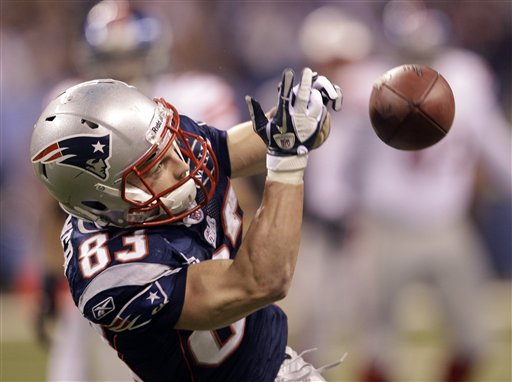
Then came the key play in the game – at least the one before Manningham’s heroics. There were less than five minutes left, secondand 11, ball on the Giants’ 44 yard line. Welker ran a 20-yardish pattern in the middle of the field, moving left to right. Brady threw it toward Welker’s right, meaning the everyman-size slot man had to leap slightly backward for the ball. It wasn’t an easy catch, but it’s one that’s almost automatic for Welker, who has some of the best hands in football. If he had caught it, deep in Giants’ territory and with the Giants having burned two timeouts, the game would probably be over. It would certainly be over if the Patriots could score a touchdown.
But he didn’t catch it. There was a shot of the Patriot players on the sideline screaming in disbelief after the ball went through Welker’s hands.
For the Patriots, it was 2008 all over again. Just before Tyree made his famous catch, Manning threw a sideline pattern that Patriots’ cornerback Asante Samuel timed perfectly. He leaped for the interception that would have ended the game – and the ball went through his fingers. Safety Rodney Harrison later said that Asante had the best hands of any defensive back in football, and when he didn’t make the catch, he knew this might not be the Patriots’ day. It felt exactly like that when Welker dropped the pass.
The Giants got the ball back at their own 12, 3:46 to go. And on the very first play, Manning threw an absolutely perfect pass to Manningham on a sideline go route. There were only inches to spare, but Manningham seized the ball out of midair, got possession instantly and got his feet down inbounds at midfield a fraction of a second before the free safety smashed him out of bounds. The 38-yard pass was the longest play of the game. Belichick was forced to challenge the ruling, which cost him a timeout that cost the Pats 45 seconds. That play was the backbreaker, but the Pats could still win if they could stop Manning and his playmakers. They couldn’t. Manning hit Hakeem Nicks, and the Giants quickly moved into field goal range and picked up a critical first down.
The Patriots, facing death by clock, allowed Ahmad Bradshaw to score. They got a break when Bradshaw failed to kneel down before crossing the goal line, but they were now facing extremely long odds with less than a minute left. Brady managed to move them to midfield, close enough to throw a Hail Mary on the last play of the game. Breathtakingly, Gronkowski almost gathered in the deflected pass – a fitting end to a great, well-played game between two evenly matched teams.
For the deserving, never-say-die Giants, their excellent coach Tom Coughlin and their cool quarterback Manning, who outplayed one of the game’s masters in the clutch and now owns one more ring than his more celebrated older brother, this victory moves them into elite company: the Giants are now tied with the Green Bay Packers with four Super Bowl wins, behind only Pittsburgh (six), San Francisco and Dallas (five each). For the Patriots, still stuck on three victories, it is the bitterest of defeats, not least because it is a déjà vu all over again. For fans, it was one of the better Super Bowls, one with its own unique, unrelenting, frustrating tension.
In cultural matters, i.e., the broadcast’s insanely expensive ads, a highly optimistic, genteely Dionysian and extremely sexualized view of reality prevailed. Viewers learned that Chevrolet Silverado trucks can make the Apocalypse go away, which is really cool! Also, if you buy one of those upgraded Fiat “Little Mice” whose tiny predecessors introduced thousands of postwar Italian men to impossible Kama Sutra positions, an outrageous babe will sexually torture you. Come to think of it, a similar babe, actually a whole bikini lineup of augmented babes, comes with every Kia. Also, the end of Prohibition was a really, really rockin’ national party, attended by the most clean-cut people in the most anodyne town imaginable, who at ad’s end are about to get shitfaced, but really politely and without any alteration of their consciousness.
Plus, the ads made it clear that all Americans must accept living “happily” in a David Foster Wallace dystopia in which everything, including the years, is sponsored. Detroit the city is now a wholly owned subsidiary of Chrysler. The automaker ran a deeply creepy “Motor City is firing again” ad that featured, among other sentimental and offensive inanities, an absurd attack on “partisans” waving generic signs. The whole weird spot, which never mentioned cars until the very end and seemed to go on forever, was narrated by Clint Eastwood, who should be profoundly ashamed. There was also a bizarre ad in which Budweiser and GE merged into a scary, mutually self-congratulating double-headed monstrosity for no apparent reason.
Enjoy tomorrow’s BudweiserTM Monday, everyone!
Continue Reading
Close
Just when it looked like the NFC and AFC championship games were going to last until the Super Bowl, two fatal blunders brought them to an abrupt close. The stunning conclusions to two of the most tense, evenly matched conference championship games in recent memory were a painful reminder that although football is a team game, one miscue by a single player can wipe out thousands of hours of collective blood, sweat and tears.
It will be a sad and lonely night for Baltimore Ravens’ kicker Billy Cundiff, whose shanked chip-shot 32-yarder gave the AFC championship to the New England Patriots. Kickers must have strong mental constitutions: in a sport where bonds between teammates are cemented in blood and pain, they are not always regarded as full-fledged comrades to begin with, and so when they screw up, it’s even harder for them to deal with. The mantra “short memory,” which defensive backs are constantly shouting at each other, applies in spades to kickers. Cundiff could use a tall glass of Milk of Amnesia.
It must have been an especially bitter defeat for the Ravens because they had played the Patriots to a standstill. In fact, they would have won the game had receiver Lee Evans been able to hold onto a pass in the end zone for another split-second, before New England backup defensive back Sterling Moore poked it out. On a night when Tom Brady had a subpar game – “I sucked pretty bad today,” he said – Baltimore had a golden opportunity to make it to the Super Bowl. The opportunity, for aging legends like Ray Lewis and Ed Reed, may never come again.
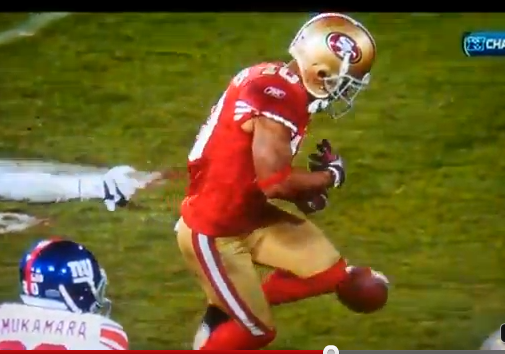
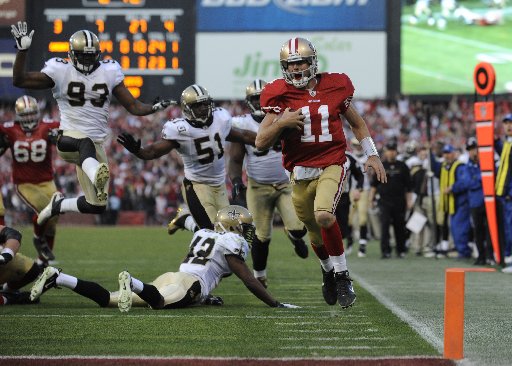
But the biggest goat horns belonged to San Francisco 49er return man Kyle Williams, who made not one but two critical mistakes that basically cost the 49ers the game. His first miscue took place midway through the fourth quarter, with the 49ers leading the New York Giants 14-10 and about to get the ball back. It was not only a game-changing play, it was one of the weirder instant replays I’ve ever seen.
As a Steve Weatherford punt landed in front of him and began bouncing toward him, Williams was torn between trying to field it, saving valuable yards of field position, and playing it safe by getting away from it. His indecision only lasted half a second, but it cost him and his team dearly. The ball ticked almost imperceptibly off his knee, and the Giants recovered it as he froze, desperately trying to look like he just happened to be walking by the bank when the vault exploded and a large wad of banknotes flew into his unwilling hands. The officiating crew on the field ruled that it was 49ers ball; the Giants challenged the call. The slow-motion replays were inconclusive, leading 49er fans like me to briefly hope that a saving cloud of epistemological murk had descended, a Nietzschean universe in which there were no facts, only interpretations. But then perspectivism was refuted: A regular-speed replay from a different angle clearly showed the ball touching his knee.
That was odd enough – normally the full-speed shots are more ambiguous, not less — but the really odd thing was Williams’ reaction. If he knew that the ball had touched him – which he may not have – did he really think he could get away with feigning innocence? The all-seeing eye of Sauron was going to find him out and shoot him down. His nothing-to-see-here, keep-moving reaction was understandable, but it somehow seemed like trying to hide under the bed when a drone has launched a missile at you.
That mishandled punt led to a Giants touchdown. And then, in overtime, Williams fumbled while returning another punt. The Giants recovered and kicked the winning field goal.
Williams’ 49er teammates all told him to keep his head up, that he hadn’t lost the game. Quarterback Alex Smith said that the real reason the 49ers lost was that they couldn’t convert on thirddown: They were an abysmal one for 13, and that one was a meaningless quasi-Hail Mary at the end of the first half that the Giants conceded. The solidarity Williams’ teammates showed was admirable, and in the great scheme of things they’re right that one player doesn’t lose a game. If the 49ers’ mediocre wide receivers had ever gotten open, if the 49ers’ coaches had stayed with what had been an effective rushing attack toward the end of the game instead of inexplicably deciding to pass on every down, if they had overcome their aversion to calling screens and swing passes, Williams’ boo-boos might not have mattered.
But those flaws are integral to the 49ers. All year long, they struggled to convert thirddowns and score in the red zone. Alex Smith has taken most of the blame for these failings, and he deserves some of it. But so do his receivers. And so do the 49er coaches, who have devised a highly creative running game but whose passing schemes are strikingly ineffective.
The 49ers lived all year on great defense – this year’s version is right up there with the great defenses in the glory years led by Ronnie Lott – and above all by not making mistakes. They tied an all-time NFL record for the lowest number of turnovers, with 10. But this means they have no margin for error. Until they put some electricity in their passing game, they have to play flawless football to beat a first-rate, well-rounded team like the Giants. And that isn’t going to happen every time.
I was bummed that Alex Smith’s redemption story did not have a Hollywood ending. Although he didn’t have a great game – the fact that his 97.6 quarterback rating was higher than Eli Manning’s 82.3 shows how little those ratings can mean – he played well enough this year to have convinced all but the most obdurate that he is not the 49ers’ problem.
Still, even taking into account how bad the 49ers’ receivers are compared to the Giants’ lethal trio of wideouts, the contrast between Manning and Smith in this game was striking.
Manning simply played at a higher level. Under heavy pressure in the second half, he managed to find open receivers time and again, whether on outlet patterns or downfield. His accuracy was remarkable for a game played in terrible weather. And even when he was being smashed to the ground, he kept his poise. No quarterback in the league is playing better than he is right now.
All four teams were remarkably closely matched; both games could have gone either way. But in the end the two best teams from each conference are going to the Super Bowl. And just as the matchup between the Giants and the 49ers became more intriguing after Alex Smith won last week’s legendary shoot-out with Drew Brees, so the matchup between the Patriots and the Giants has become a lot more interesting after the Patriots showed they could actually play defense against the Ravens. Defensive tackle Vince Wilfork had a monster game, and the Patriots’ secondary managed to hang in there against Anquan Boldin and Torrey Smith. Also, Brady is not going to lay an egg two games in a row.
It’s a case of the team with the mojo going against the team with the maestro. With considerable hesitation, I’m going with the maestro. Patriots 24, Giants 21.
A personal postmortem, now that my team has been eliminated. Defeat is bitter wormwood. I’d forgotten how bitter.
It has been many years since I’d really felt anything, good or bad, about the 49ers. The team sucked and I got used to being disappointed. The glory days felt like they took place in another lifetime – and in a way they did. I shut my expectations down. And my emotions.
Then this amazing season reawakened something. And when the 49ers pulled off that victory for the ages last week against the Saints, it all came back. I felt the delirious joy I, and the city, felt the first time, and every time, the 49ers won the Super Bowl. I remembered the shouts of joy echoing across rooftops on Nob Hill, and the old black man on the corner of Broadway and Columbus doing a funny little dance and saying to everyone who went by, “Who said Joe ain’t bad?” Like a woman who can only remember the joy of giving birth and has blocked out the excruciating pangs of labor, I conveniently forgot the agony of all the losses – Billy “White Shoes” Johnson’s last-second catch in Atlanta, the Don Beebe dagger, Roger Craig’s fumble against the Giants, the phantom pass-interference call against Eric Wright against the Redskins.
But when the 49ers walked off the field Sunday with their heads down, in front of a sad, silent crowd, 30 years’ worth of bad old memories came rushing back. As I drove through the empty streets, the city’s collective sorrow seemed almost tangible, like the weeping sky. It, and I, had gone from ecstasy to misery in one week. I wondered for a moment if it was worth it.
But I only wondered that for a moment. This had been a wondrous season, a gift. Yes, it ended in heartbreak. But I would rather feel heartbreak than nothing. In sports, as in life, it’s better to have loved and lost than never to have loved at all.
Continue Reading
Close