James K. Galbraith

What’s driving inequality?

Technology and education, says Timothy Noah. But unemployment and the rules governing wages may matter more.

  • more
    • All Share Services

What's driving inequality? (Credit: Salon)

Timothy Noah has written a graceful book on income inequality in America, based on his prize-winning 2011 series for Slate. And ”The Great Divergence” is well-timed: it emerges just as inequality is being transformed, via crisis and stress, from an academic backwater into a leading issue of the age.

More precisely Noah gives us a survey of the work of academic economists on this topic, and his book has the advantages and some limitations of that genre.  Among the advantages are a neutral  tone and a balanced treatment of many controversial questions. A limitation is that the surveyor brings nothing of his own to the table – neither critical perspective nor new information. This is a very good book about what other people think.

After preliminaries dealing with mobility, Noah, a staff writer at the New Republic, offers a short discussion of race, gender and family structure. He takes it as a given that civil rights, female liberation and changing marriage norms did not actively bring about income changes for the groups involved in those movements.  Instead, Noah accepts the prevalent view of economists that larger forces were at work and that minorities, women and families were affected by, but not principal actors in, the drama of rising inequality.

What were those forces? For Noah’s sources, the labor market is the primary scene of the action. Here wages are buffeted by the forces of demand and supply. On the demand side, the big forces include technology and trade; on the supply side, they are mainly education and immigration.

As Noah relates, the Harvard power couple Claudia Goldin and Lawrence Katz have argued that increasing wage inequalities are due mainly to “a race between technology and education.” In their view, technology raises inequality by increasing the demand for skill; education lowers it by increasing the supply.  Thus, rising inequality in the first and last decades of the last century was due to rapid technological change and lagging education, while the “Great Compression” in the middle of the century happened largely because education caught up.

This story is far more controversial than Noah lets on.  Quite apart from the fact that we do not have a good measure of technological change – so we cannot really say when it was fast and when it was slow –  the idea that technology favors the skilled worker is not obviously correct. Noah does not mention the dissenting views of (for instance) David Card of UC-Berkeley,  John DiNardo of the University of Michigan, or Robert Z. Lawrence of Harvard.  As for the effects of education, in a 1999 article in Research in Economic History, Thomas Ferguson and I examined American wages in fine detail from 1920 to 1948. We found that the fluctuation during those years could be explained entirely without reference to schooling.  Moreover, to state the obvious:

During World War II, the enormous rise in wages of the truly unskilled workers who toiled in agriculture and on the public roads owed nothing to any Roads Scholarships program. [It] was the effect, surely, of demand, spurred by record public deficits, and the absorption of some ten million men into uniformed government employment. And the result was an almost perfect inversion of Protestant ideology and conventional thinking about education and labor markets, for the prime beneficiaries certainly included many millions of workers who were functionally illiterate and possessed of the very  lowest educational credentials of all.

Economists sometimes strain at gnats while swallowing camels. Noah does credit the effect of the WWII wage controls in fashioning the postwar world, but he overlooks the fact that since those vast changes more than explain the great equalization of American wages that occurred, there is no need to appeal to high school graduation rates for a second cause.

In the 1990s, “skill-biased technological change” was a preferred mainstream explanation for rising wage inequality, while liberals tended to blame rising trade. Yet those making the case that trade was the culprit also had a hard time finding proof. The difficulty, according to Noah, was that America’s main trading partners were also high-wage countries. NAFTA helped make Mexico into a significant exception, and then along came China and India. The result was that in the 2000s, several prominent economists – including Paul Krugman and Alan Blinder – began to argue that off-shoring (including of services) had become a major threat to jobs and wages. How big a threat? Noah assigns just 12 to 13 percent of the Great Divergence to trade, but he does not say where this number comes from or what, exactly, it applies to.

Immigration also seems to have been small beer. The fact that a new labor supply doesn’t change wage rates was nicely demonstrated by David Card at the time of the 1980 Mariel boatlift, which deposited 125,000 low-skilled Cubans on Miami. As Noah writes: “Card observed no impact on wages at all … even  among low-skilled native-born workers” (emphasis in original).  Needless to say, some economists were still unpersuaded; the grip of theory is powerful on the mind.

Noah’s accounts of these studies is fair and lucid. The difficulty comes in making an assessment. The conclusion I’d draw (and in fact drew, many years ago) is that supply-and-demand is a poor model for explaining inequalities in pay. Wages are rigid! Some recognition of this does exist, and so political explanations – for example, the great shift in “norms and institutions” under Reagan – have attracted attention.  Noah devotes two chapters to them, one of which is on taxes and the other of which is on unions.

The Reagan-era cuts in income tax rates – up to and including the Tax Reform Act of 1986 – seemed like a big favor to the rich at the time. But Noah (following, as always, his economists) argues that they could not have caused the rise in income inequality, for they do not account for the rise in the pretax income shares of the very rich. In my view, this is too quick of an assessment: It overlooks the fact that lower tax rates induced corporate executives to take their compensation in private income as against perks. We should thus expect that it was a powerful force behind the CEO pay explosion that occurred at the same time.

The other problem is that the Tax Reform Act redefined adjusted gross income for top earners so as to increase what they reported. Thus, a significant part of the rise in pretax income inequality – the part the data show to have occurred in 1986-87 – are accounting changes. The twist here, is that removing this “data break” from the series somewhat lowers the measured increase in inequality that forms the core narrative of a “Great Divergence.”

The collapse of unions was no doubt important from any viewpoint,  but here one has a skein of contending causal forces.  How much should one credit the overtly political attack? And how much, perchance, was due to Paul Volcker’s war on inflation – a topic to which Noah devotes only a few words? It’s possible the principal force was not the destruction of unions as such but rather the destruction by monetary policy of jobs through the rise of interest rates and the dollar, which brought on the recession and the fall of the unions. And if that’s true, then outsourcing is also not an independent factor, but rather just another consequence.

In support of this view,  there is the fact that pay inequality in American manufacturing actually peaked in 1983 and fell back once interest rates dropped and the recession ended. This is easy to miss, partly because income-tax data reflect the changing structure of households, which continued through the 1980s.  Pay inequality did not rise again until the recession in 1989, and after 1994 it once again declined quite sharply. By 2000, inequalities in the structure of pay had fallen a lot, which helps account for the very low poverty rates, including for minorities, in those years.

What happened?  The answer jumps from a chart: Inequality in the structure of pay, measured as weekly earnings of the manufacturing workers, tracks the unemployment rate. It is a macroeconomic phenomenon, driven largely by the extra hours that low-paid workers are able to work in booms as well as by the short-time they suffer in slumps. It follows that the focus on supply-and-demand forces that are supposed to affect hourly wage rates – such as technology and education – is largely a waste of effort.  What matters is the state of the economy and the rules governing wages.

Meanwhile, if you do want to compress wages and earnings, it’s quite possible.  There is a proven method – a simple, direct, effective measure. Actually, there are two of them.  One is to pursue full employment. The other is to raise the minimum wage.  In his summary chapter on policies, Noah does talk about unions, but he doesn’t mention the minimum wage.

Inequality in incomes rose sharply in the late 1990s, a phenomenon Noah describes as the rise of the “really stinking rich.” And he rightly calls attention to the bankers and fund managers and other denizens of Wall Street. But in thinking about how these incomes rose as they did, a chart can again clarify matters. Clearly it’s another macroeconomic phenomenon, related in this case to the stock market. Pay follows unemployment; incomes followed the NASDAQ right up to the peak in 2000, and  beyond.

And as the data will show eventually, the Great Divergence in incomes ended (for now) with the tech bust. Since then the pattern has been down, up, down and up again –  both in the run-up to and in the wake of the Great Crisis. Which, interestingly, also gets no mention here.

In short, this is a valuable book. The beef I have with it is that, in surveying academic opinions, Noah reflects the views of the people he read and spoke with. And since they aren’t interested in macroeconomics, he isn’t either. That’s a loss.

The crisis in the eurozone

The continent is destroying the weak to protect the strong. But will that be enough?

  • more
    • All Share Services

The crisis in the eurozoneGerman Chancellor Angela Merkel and French President Nicolas Sarkozy. Center: A protester passes by a burning barricade during clashes in Athens. (Credit: AP)

The eurozone crisis is a bank crisis posing as a series of national debt crises and complicated by  reactionary economic ideas, a defective financial architecture and a toxic political environment, especially in Germany, in France, in Italy and in Greece.

Like our own, the European banking crisis is the product of over-lending to weak borrowers, including for housing in Spain, commercial real estate in Ireland and the public sector (partly for infrastructure) in Greece.  The European banks leveraged up to buy toxic American mortgages and when those collapsed they started dumping their weak sovereign bonds to buy strong ones, driving up yields and eventually forcing the whole European periphery into crisis. Greece was merely the first domino in the line.

In all such crises the banks’ first defense is to plead surprise – “no one could have known!” – and to blame their clients for recklessness and cheating.  This is true but it obscures the fact that the bankers pushed the loans very hard while the fees were fat.  The defense works better in Europe than in the U.S. because national boundaries separate creditors from debtors, binding the political leaders in German and France to their bankers and fostering a narrative of national-racism  (“lazy Greeks,” “feckless Italians”) whose equivalent in post-civil rights America has been largely suppressed.

Underpinning banker power in Creditor Europe is a Calvinist sensibility that has turned surpluses into a sign of virtue and deficits into a mark of vice, while fetishizing deregulation, privatization and market-driven adjustment. The North Europeans have forgotten that economic integration always concentrates industry (and even agriculture) in the richer regions.

As this process unfolds the Germans reap the rents and lecture their newly indebted customers to cut wages, sell off assets, and give up their pensions, schools, universities, healthcare  – much of which were second-rate to begin with. Recently the lectures have become orders, delivered by the IMF and ECB, demonstrating to Europe’s new debt peons  that they no longer live in democratic states.

The U.S. advantage

The eurozone’s architecture makes things worse in two major ways.  While the EU has long paid some compensation to its poorer regions, these structural funds were never adequate and are now blocked by unmeetable co-pay requirements.  And the zone lacks the inter-regional redistribution channels to households that the U.S. has developed in Social Security, Medicare, Medicaid, federal government payrolls and military contracting among other things.  Nor do German retirees settle in Greece or Portugal in large numbers as New Yorkers do in Florida or Michiganders in Texas.

Second, the ECB refuses to solve the crisis at a stroke, which it could do by buying up the weak countries’ bonds and refinancing them. The argument against this is called “moral hazard,” buttressed by old-fashioned inflation fears, but the real issue is that to do so would admit loss of control by creditors over the central bank.  Actions parallel to those taken by the Federal Reserve – nationalizing the entire commercial paper market, for instance – would repel the ECB, even though it does buy up sovereign bonds when it has to.  So instead the zone has gone about creating a gigantic toxic CDO called the European Financial Stability Fund, which may shortly be turned into an even more gigantic toxic CDS (like AIG, they will call it “insurance”).  This may defer panic at most for a little while.

Technical solutions exist.  The most-developed of these is the “Modest Proposal”  of Yanis Varoufakis and Stuart Holland, widely backed by older political leaders in Europe. It would  1) convert the first 60 percent of GDP of every eurozone country’s debt to a common European bond, issued by the ECB; 2) recapitalize and Europeanize the banking system, breaking the hammerlock of national banks on national politicians; and 3) fund a New Deal-like program of investment projects through the European Investment Bank.

Variant proposals include Kunibert Raffer’s call for a sovereign insolvency regime modeled on the U.S. municipal bankruptcy statute, Thomas Palley’s proposal for a new “government banker” and Jan Toporowski’s proposal for a tax on bank balance sheets to retire excess public debt.

These are the best ideas and none of them will happen. Europe’s political classes exist these days in a vise forged by desperate bankers and angry voters, no less in Germany and France than in Greece or Italy. Discourse is sealed off from fresh ideas and political survival depends on kicking cans down roads so that the fact that this is a banking crisis does not have to be faced.  The fate of the weak is at best incidental. Thus every meeting of finance ministers and prime ministers yields treacherous half-measures and legal evasions.

The latest example was the pretzel-logic that declared a 50 percent haircut on Greek debt to be “voluntary” so that it would not trigger default clauses on the CDS to which some American banks, in particular, might be exposed.  When Timothy Geithner warned the Europeans of potential “catastrophe” last month one may reasonably infer he had this risk – and not the minor effect on our already disastrous jobs picture – in mind.  But of course if the haircut can be declared voluntary, then CDS are not worth the storage space they occupy in bankers’ computers, and another prop to the rapidly failing market in sovereign debts falls to the ground.

Political fragility also explains the fury in France and Germany when George Papandreou [the calmest man in Europe, by the way, having been born and raised in Minnesota] sought to cut the knot of his rebellious ministers, irresponsible opposition and angry public by putting the latest austerity package to a vote. God help the bankers!  The move was fatal to Papandreou in short order, and Greece will now be turned over to a junta of creditors’ deputies if such can be found willing to take the job.  It won’t be anyone who wants to continue to live in Greece afterward.

Greece and Ireland are being destroyed. Portugal and Spain are in limbo, and the crisis shifts to Italy – truly too big to fail – which is being put into an IMF-dictated receivership as I write. Meanwhile France struggles to delay the (inevitable) downgrade of its AAA rating by cutting every social and investment program.

If there were an easy exit from the Euro, Greece would be gone already. But  Greece is not Argentina with soybeans and oil for the Chinese market, and legally exit from the Euro means leaving the European Union. It’s a choice only Germany can make.  For the others, the choice is between cancer and heart attack, barring a transformation in Northern Europe that not even Socialist victories in the next round of French and German elections would bring.

So the cauldrons bubble.  Debtor Europe is sliding toward social breakdown, financial panic and ultimately to emigration, once again, as the way out, for some.  Yet – and here is another difference with the United States – people there have not entirely forgotten how to fight back.  Marches, demonstrations, strikes and general strikes are on the rise.  We are at the point where political structures offer no hope, and the baton stands to pass, quite soon, to the hand of resistance.  It may not be capable of much – but we shall see.

Continue Reading Close

Why the Senate should reject the debt ceiling deal

It's a disaster: Time to call in the Constitution

  • more
    • All Share Services

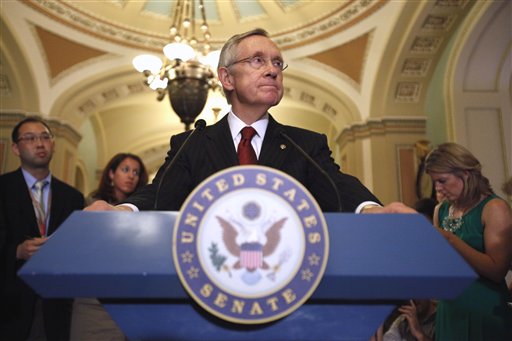
Why the Senate should reject the debt ceiling dealSenate Majority Leader Sen. Harry Reid of Nev. pauses during a news conference on Capitol Hill in Washington, Monday, Aug. 1, 2011, to talk about debt ceiling legislation. (AP Photo/Jacquelyn Martin)(Credit: AP)

This article originally appeared on New Deal 2.0.


The debt deal is bad economics, dishonest government, and surrender to blackmail. The alternative is not default, but government under the Constitution.

On the economics: by slowly choking off public services, public investment and regulation, the deal sets the economy on a path to strangulation. Every dollar cut from the budget, now or later, is a dollar less of private income. Less private income means less consumption, less private business investment, fewer jobs. Tax revenues will fall, and the deficits and debt will in the end not be reduced. The so-called “cloud of debt” will not lift. Contrary to the foolish claim made by the White House today, there is no magic by which “lifting a cloud of uncertainty” produces growth. There is no confidence fairy.

On dishonesty: the proposed cuts would reduce discretionary public spending as a share of GDP to what it was before the government had any major role in transportation, housing, education, safety, health, medical research or environmental protection. To where it was before the NIH or the CDC, before HUD, before the EPA, before OSHA, before the Department of Education. This is a false promise: those cuts cannot and will not be found. To promise them is to play to the gallery of the ignorant. To pretend that to make them would be good policy is to repudiate the entire past half-century. To make them would bring on a disaster, in many small and large ways, as the physical structures and legal and institutional protections built up over decades crumbled and fell apart.

On blackmail: This deal validates the making of real policy under the appearance of extreme threats. That process will not end here. And while Social Security, Medicare and Medicaid escaped in the first round, they are set up to fall in the second. The deal creates a new junta to force those cuts before the end of this year. The process is repellent, cruel, undemocratic, and designed to leave blood on the ground but not on anyone’s hands.

And the alternative? Is it economic disaster? No.

The alternative is not default. No crisis need ensue. The Constitution forbids default — not only on debt but also on pensions and on every public obligation of the United States. The Constitution is not a last resort; the 14th amendment is not obscure. It is the fundamental law, written in plain English. Debts, pensions and other obligations must be paid.

The true alternative is that the President will have to assert the authority he has so far ducked: his duty as President to defend the Constitution. He has that duty. He has that authority. He has the legal means to exercise that authority. If pushed to the last resort, he will have to do what the Constitution demands, and what he should have done from the beginning.

If the President cannot find the Constitution and the laws, then let the Democrats in the Senate show him where they are.

James K. Galbraith is the author of ‘The Predator State: How Conservatives Abandoned the Free Market and Why Liberals Should Too’. He teaches at The University of Texas at Austin.

Continue Reading Close

The catastrophic debt ceiling debate

An archaic, bad-faith law is being pressed to its absurd extreme -- and we're all going to pay the price

  • more
    • All Share Services

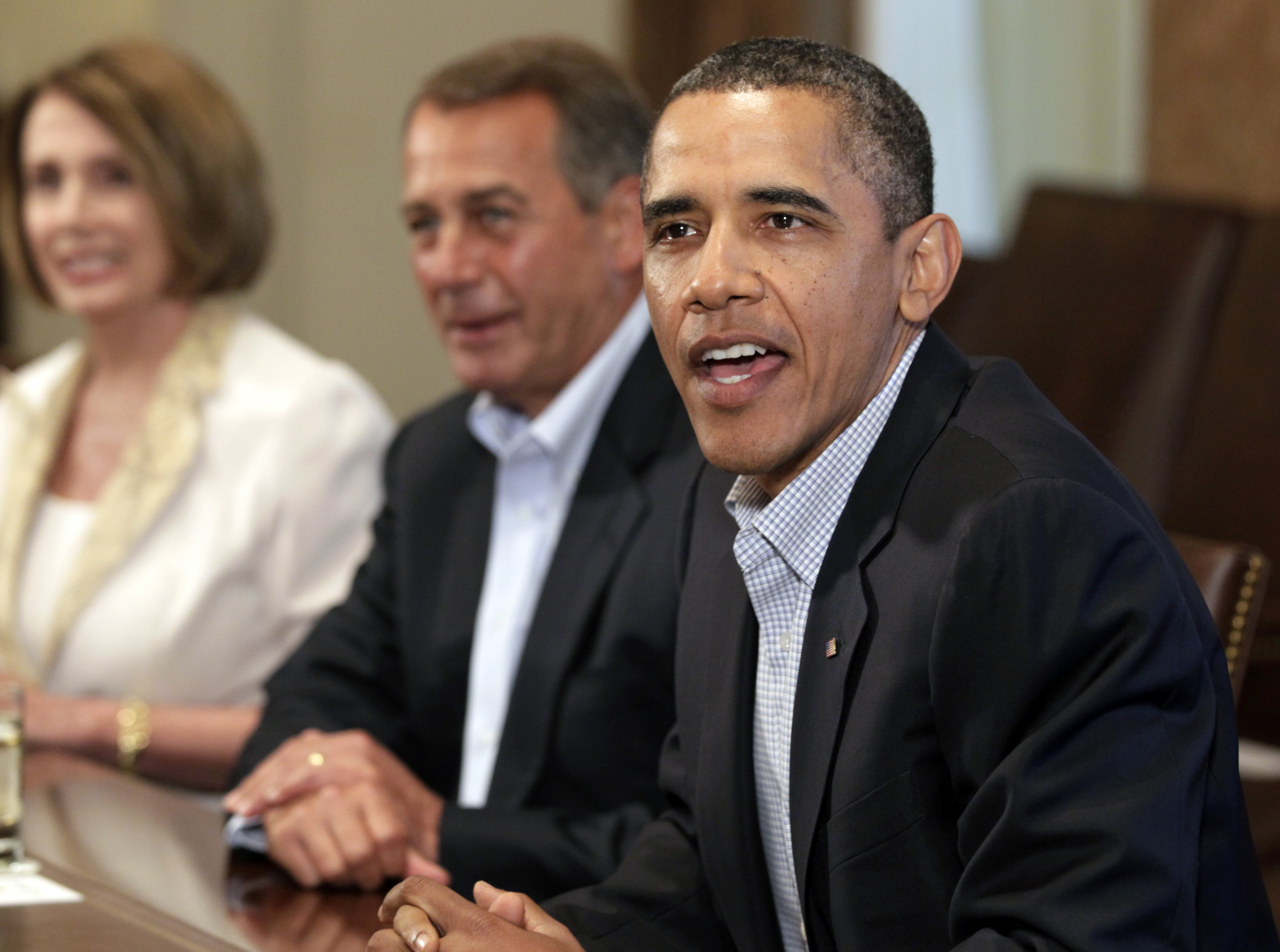
The catastrophic debt ceiling debatePresident Barack Obama meets with congressional leadership in the Cabinet Room of the White House,Sunday, July 10, 2011, in Washington, to discuss the debt House Democratic Leader Nancy Pelosi of Calif., left, and House Speaker John Boehner. (AP Photo/Carolyn Kaster)(Credit: Associated Press)

This was originally published at New Deal 2.0.

News reports hold that President Obama scored a political victory by agreeing to put Medicare and Social Security on the chopping block to achieve a “go-big” $4 trillion deficit reduction. Speaker Boehner had to concede that Republicans won’t vote for any package that includes tax increases — and the deal died. So the gambit worked and the President emerged with a solid image as the alpha deficit hawk.

To which one can only say: how nice for him.

We’re in a summer that only Salvador Dali could paint, a reality so twisted that one almost yearns for the simple verities of the War on Terror or even the invasion of Iraq. Then as now, to be serious one must be a “hawk.” (The dove is a weakling, a loser, and the owl for practical purposes does not exist.) So let’s review some of the strange and mysterious faces of this ugly, vicious bird.

The debt ceiling was first enacted in 1917. Why? The date tells all: we were about to enter the Great War. To fund that effort, the Wilson government needed to issue Liberty Bonds. This was controversial, and the debt ceiling was cover, passed to reassure the rubes that Congress would be “responsible” even while the country went to war. It was, from the beginning, an exercise in bad faith and has remained so every single second to the present day.

Today this bad-faith law is pressed to its absurd extreme, to force massive cuts in public programs as the price of not-reneging on the public debts of the United States. Never mind that to force default on the public obligations of the United States is plainly unconstitutional. Section 4 of the 14th amendment says in simple language that public debts, once duly authorized by law and including pensions, by the way, “shall not be questioned.” The purpose of this language was to foreclose, to put beyond politics, any possibility that the Union would renege on debts and pensions and bounties incurred to win the Civil War. But the application is very general and the courts have ruled that the principle extends to the present day.

What is going on in Congress at this moment already violates that mandate. It is an effort to subvert the authority of the government to meet and therefore to incur obligations of every possible stripe. It is an attack on the concept of government itself – as the “Tea Party” by its very name would no doubt agree. It therefore paints those deficit hawks who are using the debt ceiling to take budget hostages as enemies of the United States Constitution.

The President, though supposedly a constitutional expert and though sworn to “preserve, protect and defend” the Constitution, will not say this. Instead he appears to treat the Constitution as an optional matter, to which he will not resort, in the hope that by negotiating with the hostage- takers he can reach some reasonable outcome that will preserve everyone’s good name. (The great Harvard legal scholar Laurence Tribe recently argued that the President cannot defy the debt ceiling on his own. That’s a debatable point.) It is as though Lincoln in 1861 faced with the siege of Sumter had sat down with Confederate commissioners to see what could be worked out.

In Washington it appears that this assault on government has a large measure of elite and media support, if not on the crass details or vulgar personalities but because it could conceivably force the parties to do “what they should do anyway” — namely come to a long-term deficit and debt agreement. Such an agreement would cut spending, raise some taxes, put the projected debt-to-GDP ratio on a declining track, and solve the “government’s fiscal crisis.”

What fiscal crisis? The great unasked question in this summer of sound-and-fury is “why?” The United States has many problems at the moment: a high-and-stubborn unemployment rate, a foreclosure catastrophe, a slowing economy that has not recovered and will not recover from the Great Crisis, and the ongoing challenges of infrastructure, energy and climate change. Fiscal crisis? The entire thing is a figment, made up of wise-men’s warnings repeated endlessly and linked to the projections of technicians at the Congressional Budget Office and elsewhere.

The projections, as I’ve written here, are made up of two economically impossible arguments. One is that there will be a big economic rebound, restoring near-full employment by 2013 or so. We’re already off that track, as some of us warned from the beginning. Of course, a recovery would reduce the deficit even if nothing were done. But CBO then recreates the exploding debt by assumptions, which include steady growth and low inflation, but sharply higher health-care costs and much higher short-term interest rates. These lead the projected debt to compound skyward, soon surpassing all previous records in relation to GDP.

Is this possible? No it is not. The Federal Reserve would never raise the short-term interest rate as CBO projects, without a prior increase of inflation, which CBO assumes will not occur. If they did, the economy would collapse! And if they don’t, the debt does not compound out of control. I have presented these simple numbers here. For what it’s worth, if you believe the capital markets signal anything, they signal their disbelief in doomsday forecasts, in the long-term interest rate on US government bonds, every single day.

Is it possible that cutting government is, by some other path, the way to economic recovery?

There are many people who believe fervently in the resilience of the private sector and for whom government is just a burden. Some of those people are pure predators: resource magnates, media magnates, banking magnates. Others have blinded themselves to the role government actually plays in sustaining the advanced networks, human protections and social systems that make up our lives, and imagine that one can go back to the world of subsistence farming, church charity and credit from the corner store. But there were many fewer people in that world, they didn’t do what we do, and they didn’t live nearly so long.

In broad terms, today’s government does four major things:

1) it provides for the national defense.

2) it purchases goods and services from the private economy for a wide range of public purposes, most of them individually quite small-scale in relation to GDP.

3) it regulates a wide range of private-sector activity, for safety, health, environmental and other purposes, including financial stability — or so one should hope.

4) it administers Social Security, Medicare and Medicaid, as well as other pension and health benefit programs.

On what grounds are any of these functions too large? As an economist concerned with peace and security issues, I do believe we would be better off ending the wars in Iraq and Afghanistan quickly, that we could dispense with the real resource costs of many foreign bases, aircraft carrier groups, fighter aircraft and submarines and nuclear weapons left over from the Cold War. But these are security judgments, not broad economic ones. In other words, I would not cut a single dime of Pentagon spending that was actually necessary to defend the United States, in order supposedly to lower the interest rate on federal debt.

By the same reasoning, why should we cut transportation, or public health, or environmental protection, or scientific research, or bank inspectors or funds that support the public schools? One can argue these matters program by program — and one should. (I would happily cut ethanol subsidies and oil company tax breaks, for starters.) But there is no economic case for placing an overall limit, and it is obvious that the 500,000 public sector workers – including many teachers, police, fire and park rangers and librarians — who have lost their jobs since 2009 were doing good and useful things that are now missed. If sacking them had been good for the economy, we would be having a stronger recovery than we are.

Finally there are Social Security, Medicare and Medicaid. Unlike the military or the transportation program, Social Security is not a government purchasing program. It therefore takes nothing directly from the private sector. What it does, is provide insurance: it protects workers from poverty in old age, whether or not their families would otherwise be willing and able to support them. And it taxes all workers, whether or not they would otherwise be burdened with elderly parents, or survivors, or the disabled, to support. Along with Medicare and Medicaid, Social Security is a powerful protector of the entire working population – young and old. It redistributes purchasing power, in loose relation to past earnings, in a way that meets the basic needs of a large number of Americans who would otherwise, in many millions of cases, be destitute or medically bankrupt.

What economic purpose would cutting such programs serve? To do so would again redistribute incomes. Many of the future elderly would be much worse off, and of course many would die younger than they otherwise would. Survivors and the disabled would suffer as well. In return, what would the federal government and the country gain? A release of real resources to the private sector? Social Security does not take real resources from the private sector! Lower interest rates? The idea is absurd, and not just because interest rates are low today. The notion that cutting Social Security would help keep interest rates down is absurd because interest rates are set in a way that has no relationship at all to the scale of Social Security, Medicare or Medicaid.

This argument has nothing to do with the trope, oft-repeated and perfectly true, that the Social Security system does not contribute to the deficit. It would not matter if it did. The important question is: are benefits too high? Obviously not. How about payroll taxes – are they too low? There is no case for that either. One of the very few bright spots in recent policy was the decision to reduce payroll taxes on employees, temporarily, while leaving Social Security benefits alone.

If you wanted to build on that, the right steps would be to lower – not raise — the Social Security early retirement age, permitting for a few years older workers to exit the labor force permanently on better terms than are available to them today. This together with a lower age of access to Medicare would work quickly to rebalance the labor force, reducing unemployment and futile job search among older workers while increasing job openings for the young. It is the application of plain common sense. And unlike all the pressures to enact long-term cuts in these programs, it would help solve one of today’s important problems right away.

Instead of this, what do we have, from a President who claims to be a member of the Democratic Party? First, there is the claim that we face a fiscal crisis, which is a big untruth. Second, a concession in principle that we should deal with that crisis by enacting massive cuts in public services on one hand and in vital social insurance programs on the other. This is an arbitrary cruelty. Third, a refusal to stand on the strong ground of the Constitution, against those whose open and declared purpose is tear that document and the public credit to shreds.

In the Daily Beast on Sunday, Howard Kurtz wrote in optimistic terms of the prospects for a deficit bargain: “But away from the cameras, even sharp-tongued politicians recognize the imperative of avoiding the fate of Greece. It is a sign of the times that the Kabuki players of Washington may take a bow simply for averting catastrophe.”

Kurtz did not say that the big Kabuki here was his own notion that somehow the United States might face the fate of Greece — a small and overmatched member of a currency zone it cannot control. He did not say that the catastrophe he fears – a default on US government obligations — was entirely the product of treacherous politics, abetted by an irresolute President who seems not to grasp the danger of allowing the Constitution to fail.

And he did not say, that the deal he would applaud, with cuts to Social Security, Medicare, Medicaid and all the legitimate and necessary functions of government — would be for millions of Americans the catastrophe itself.

James K. Galbraith is a deficit owl. He is the author of “The Predator State: How Conservatives Abandoned the Free Market and Why Liberals Should Too.” He teaches at The University of Texas at Austin.

Continue Reading Close

What I learned from hanging out with deficit hawks

The Peter G. Peterson Foundation's "Fiscal Solutions Tour" came to my town, so I stopped by

  • more
    • All Share Services

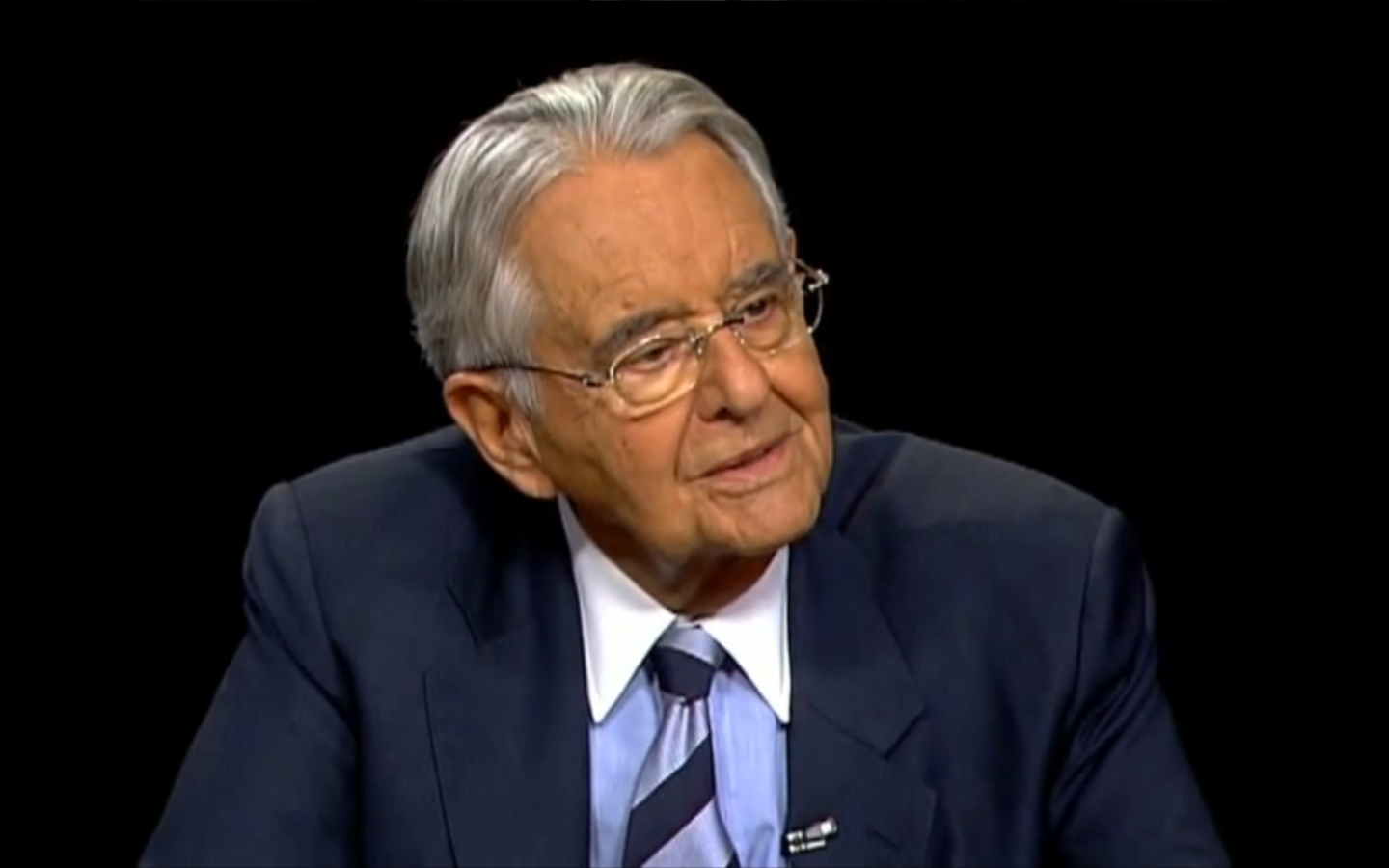
What I learned from hanging out with deficit hawksPeter G. Peterson

This originally appeared at New Deal 2.0

The Fiscal Solutions Tour is the latest Peter G. Peterson Foundation effort to rouse the public against deficits and the national debt — and in particular (though they manage to avoid saying so) to win support for measures that would impose drastic cuts on Social Security and Medicare. It features Robert Bixby of the Concord Coalition, former Comptroller General David Walker and the veteran economist Alice Rivlin, whose recent distinctions include serving on the Bowles-Simpson commission. They came to Austin on February 9 and (partly because Rivlin is an old friend) I went.

Mr. Bixby began by describing the public debt as “the defining issue of our time.” It is, he said, a question of “how big a debt we can have and what can we afford?” He did not explain why this is so. He did not, for instance, attempt to compare the debt to the financial crisis, to joblessness or foreclosures, nor to energy or climate change. Oddly none of those issues were actually mentioned by anyone, all evening long.

A notable feature of Bixby’s presentation were his charts. One of them showed clearly how the public deficit soared at the precise moment that the financial crisis struck in late 2008. The chart also shows how the Clinton surpluses had started to disappear in the recession of 2000. But Mr. Bixby seemed not to have noticed either event. Flashing this chart, he merely commented that “Congress took care” of the budget surplus. Still, the charts did show the facts — and in this respect they were the intellectual highpoint of the occasion.

A David Walker speech is always worth listening to with care, for Mr. Walker is a reliable and thorough enumerator of popular deficit-scare themes. Three of these in particular caught my attention on Friday.

To my surprise, Walker began on a disarming note: he acknowledged that the level of our national debt is not actually high. In relation to GDP, it is only a bit over half of what it was in 1946. And to give more credit, the number Walker used, 63 percent, refers to debt held by the public, which is the correct construct — not the 90+ percent figure for gross debt, commonly seen in press reports and in comparisons with other countries. The relevant number is today below where it was in the mid-1950s, and comparable to the early 1990s.

But Mr. Walker countered that fact with another, which I’d never heard mentioned before: in real terms he said — that is, after adjusting for inflation — per capita national debt is now twice what it was back then.

The problem is that real per capita national debt is a concept with no economic meaning or importance. (No government agency reports it, either.) Even in the private sector, debt levels matter only in relation to income and wealth: richer people can (and do) take on more debt. Real per capita national income is well over three times higher today than it was in 1946 — so how could it possibly matter that the “real per capita national debt” is twice as high?

Next, Mr. Walker made a comparison between the United States and Greece, with the implication being that this country might, some day soon, face that country’s interest costs. But of course this is nonsense. Greece is a small nation that has to borrow in a currency it cannot control. The United States is a large nation that pays up in a money it can print. There is no chance the markets will mistake the US for Greece, and of course they have not done so.

Finally, Mr. Walker warned that “foreign lenders… can’t dump their debt but can curb their appetite” for new U.S. Treasury bonds. This was an oblique reference to the yellow peril. The idea, when you think about it, is that the Chinese central bank will acquire dollars — which it does when China runs an export surplus — and then fail to convert them into Treasury bonds, thereby choosing, voluntarily, to hold dollars in cash, which earns no interest, instead of as Treasury bills, which do. Mr. Walker did not try to explain why this would appeal to the Chinese.

Walker closed by calling for action tied to an increase in the debt ceiling; specifically for a hard cap on the debt-to-GDP ratio with “enforcement mechanisms,” which could include pro rata cuts in Social Security and Medicare benefits and tax surcharges. He did not specify whether the cap should apply to gross federal debt or only to that part of the debt held by the public (a number which the Federal Reserve can change, any time it wants, by buying or selling public debt). When pressed, in the question period, he would not even say what he thought the cap should be.

I waited for Ms. Rivlin to add something sensible. But she did not. Apart from some platitudes — she favors “serious tax reform” and “restructuring Medicare” — her interesting contribution was to restate Mr. Walker’s comment about “foreign lenders,” who might say “we’re not going to lend you any more money.” That this would amount to saying “we’re not going to sell you any more goods” seems — from a question-and-answer and brief exchange afterward — genuinely not to have crossed her mind.

The Fiscal Solutions Tour comes with a nice brochure, and even (in my case) with a flash drive containing Mr. Bixby’s powerpoints. But does Mr. Peterson think he’s getting his money’s worth? The President, in his State of the Union, mostly ignored him. The Bowles-Simpson effort (which he paid for in part) and the closely allied Rivlin-Domenici plan are fading from view. And as the House Republicans forge their own course, demanding radical spending cuts right now — for political rather than economic reasons, which they don’t even bother to explain — the tired and shabby arguments of these old deficit-worriers hardly seem connected, any more, to the battles at hand.

James K. Galbraith is a Vice President of Americans for Democratic Action. He is General Editor of “Galbraith: The Affluent Society and Other Writings, 1952-1967,” just published by Library of America. He teaches at the University of Texas at Austin.

Continue Reading Close

Whose side is the White House on anyway?

The president should know that, as Lincoln told Congress in 1862, he "cannot escape history"

  • more
    • All Share Services

Whose side is the White House on anyway?U.S. President Barack Obama speaks to workers at Forsyth Technical Community College in Winston-Salem, North Carolina, December 6, 2010. REUTERS/Jim Young (UNITED STATES - Tags: POLITICS)(Credit: Reuters)

The text of this speech, which was delivered at the Americans for Democratic Action Education Fund’s Post-election Conference last month, originally appeared at new deal 2.0 and is republished with permission

I want to raise a hard question — a question on which Americans are divided. It seems to me, though, we will get nowhere unless we realize where we are, what has actually happened, and what the future most likely holds.

Recovery begins with realism and there is nothing to be gained by kidding ourselves. On the topics that I know most about, the administration is beyond being a disappointment. It’s beyond inept, unprepared, weak, and ineffective. Four and again two years ago, the people demanded change. As a candidate, the President promised change. In foreign policy and the core economic policies, he delivered continuity instead. That was true on Afghanistan and it was and is true in economic policy, especially in respect to the banks. What we got was George W. Bush’s policies without Bush’s toughness, without his in-your-face refusal to compromise prematurely. Without what he himself calls his understanding that you do not negotiate with yourself.

It’s a measure of where we are, I think, that at a meeting of Americans for Democratic Action, you find me comparing President Obama unfavorably to President George W. Bush.

In economic policy it was said earlier we have a lack of narrative. This afternoon, Gregory King asked why the people didn’t know that the Republican Party is uniformly and massively opposed to job programs, to state and local assistance, and to every legislative measure that might aid and promote economic recovery from the worst crisis and recession in modern times. Why is that that they didn’t know? Could it have anything to do with the fact that the White House didn’t tell them?

And why was that?

The president deprived himself of any chance to develop a narrative from the beginning by surrounding himself with holdover appointments from the Bush and even the Clinton administrations: Secretary Geithner, Chairman Bernanke, and, since we’re here at Harvard, I’ll call him by his highest title, President Summers. These men have no commitment to the base, no commitment to the Democratic Party as a whole, no particular commitment to Barack Obama, and none to the broad objective of national economic recovery that can be detected from their actions.

With this team the president also chose to cover up economic crime. Not only has the greatest wave of financial fraud in our history gone largely uninvestigated and unpunished, the government and this administration with its stress tests (which were fakes), its relaxation of accounting standards, which permitted banks to hold toxic assets on their books at far higher prices than any investor would pay, with its failure to make criminal referrals where these were clearly warranted, with its continuation in office — sometimes in acting capacities — of some of the leading non-regulators of the earlier era, has continued an ongoing active complicity in financial fraud. And the perpetrators, of course, prospered as never before: reporting profits that they would not have been able to report under honest accounting standards and converting taxpayer support into bonuses; while at the same time cutting back savagely on loans to businesses and individuals, and ramping up foreclosures, much of that accomplished with forged documents and perjured affidavits.

Could the president and his administration have done something? Yes, they could have. Where was the Federal Deposit Insurance Corporation? Why did they choose not to implement the law — the Prompt Corrective Action law — which requires the federal government to take into receivership financial institutions when there is a significant risk of large taxpayer losses to the insurance fund? Where were the FBI and the Department of Justice? Did the President do anything? No. Is he doing anything now? No. Why not? The most likely answer is that he did not want to. My understanding, in fact, is that there was one meeting where this issue was raised, and the president stated that his economic team had assured him they had the situation under control.

On the larger economic policy front, the White House gave away the game from the beginning. How? First by guessing at the scale of the disaster. When leading economic advisers (I believe, in fact, it was President Summers) announced that the unemployment rate would peak at 8%, they not only guessed wrong, but gave away the right to assign responsibility to the previous administration when things got worse. This was either elementary bad politics or deliberate self-sabotage. But it gets worse. The optimistic forecast helped to justify a weak program. Useful things were done, but not nearly enough to convey the impression of a forceful policy to the broader public. Then once the banks were taken care of and the stock market took off again, it seems clear that the team at the White House didn’t care anymore.

Again, could they have done differently? Of course. The president could have told the truth, which is that we faced a historic meltdown, a collapse of the core financial institutions of our economy, and that we had really no way of knowing how bad economic conditions might get or how long this would endure and that therefore the situation would require a full mobilization: all resources, all hands on deck, major departures of policy, no holding back, and the responsibility for trouble and failure falling plainly on those who would obstruct the course. None of the people he chose to advise him on economic policy was remotely capable of thinking in those terms.

We’ve learned from Vic Fingerhut and Mike Lux that the administration went down in public esteem when people realized it was working for the banks and not for them. Why did they think this? Why did they go from “blaming Bush and Wall Street to blaming Obama and Wall Street”? Because plainly they could see what was in front of their faces. Except in manner, President Bush never really pretended to be a President for ordinary folks; President Obama did. Bush was who he was; Obama held out, fostered, and promoted vast hopes, mobilizing the American population behind his leadership on that basis. And he disappointed those hopes — to use a very harsh word, one could say he has betrayed those hopes. How can one therefore blame the voters for acting as they have acted?

What happens next? Let’s again not kid ourselves, we have lost a great many seats in the House of Representatives and the House of Representatives isn’t coming back into a Democratic majority in the near future. Simply because of the balance of exposures — the larger numbers of Democratic Senators exposed to reelection in the next cycle, the greatest likelihood is that the Senate will also go Republican in two years time. President Obama has set his course. He has surrounded himself with the advisers of his choice and as he moves to replace President Summers we hear from the press that the priority is to “repair the rift with his investors on Wall Street.” What does that tell you? It tells me that he does not have President Clinton’s fighting and survival instincts. I’ve not heard one good reason all day to believe that we are going to see from this White House the fight that we want, that he could win in two years, or any reason we should be backing him now.

The Democratic Party has become too associated with Wall Street. This is a fact. It is a structural problem. It seems to me that we as progressives need — this is my personal position — we need to draw a line and decide that we would be better off with an under-funded, fighting progressive minority party than a party marked by obvious duplicity and constant losses on every policy front as a result of the reversals in our own leadership.

What is at stake in the long run? Two things, mainly, in my view. First, it seems to me that we as progressives need to make an honorable defense of the great legacies of the New Deal and Great Society — programs and institutions that brought America out of the Great Depression and bought us through the Second World War, brought us to our period of greatest prosperity, and the greatest advances in social justice. Social Security, Medicare, housing finance — the front-line right now is the foreclosure crisis, the crisis, I should say, of foreclosure fraud — the progressive tax code, anti-poverty policy, public investment, public safety, and human and civil rights. We are going to lose these battles– get used to it. But we need to make an honorable fight, to state clearly what our principles are and to lay down a record which is trustworthy for the future.

Beyond this, bold proposals are what we should be advancing now; even when they lose, they have their value. We can talk about job programs; we can talk about an infrastructure bank; we can talk about Juliet Schor’s idea of a four-day work week; we can talk about my idea of expanding Social Security and creating an early retirement option so that people who are older and unemployed or anxious to get out of the labor force can leave on comfortable terms, and so create job openings for younger people who, as we’ve heard today, are facing very long periods of extremely aggravating and frustrating unemployment; we can talk about establishing a systematic program of general revenue sharing to support state and local governments, we can talk about the financial restructuring we so desperately need and that we’ll have to have if we are going to have a country which has a viable private credit system and in which large financial power is not constantly dictating the terms of every political maneuver.

We are not going to get these things, but we should have a clearly defined program so that people know what they are. And then, frankly, as was said earlier today, said most elegantly by Jeff Madrick, in the long run we need to recognize that the fate of the entire country is at stake. Its governance can’t be entrusted indefinitely to incompetents, hacks, and lobbyists. Large countries can and do fail, they have done so in our own time. And the consequences are very grave: drastic declines in services, in living standards, in life expectancies, huge increases in social tension, in repression, and in violence. These are the consequences of following through with crackpot ideas such as those embodied in the Bowles-Simpson deficit commission, as Jeff Madrick again outlined, such notions as putting arbitrary limits on the scale of government, or arbitrary limits on the top tax rate affecting the wealthiest Americans.

This isn’t a parlor game. The outcome isn’t destined to be alright. It will not necessarily end in progress whatever happens. What we do, how we proceed, and how we effectively resist what is plainly about to happen, matters very greatly for the future of our country, of our children, and of another generation to come. We need to lose our fear, our hesitation, and our unwillingness to face the facts. If we thereby lose some of our hopes, let’s remember the dictum of William of Orange that “it is not necessary to hope in order to persevere.”

The president should know that, as Lincoln said to the Congress in the dark winter of 1862, he “cannot escape history.” And we are heading now into a very dark time, so let’s face it with eyes open. And if we must, let’s seek leadership that shares our values, fights for our principles, and deserves our trust.

James K. Galbraith is an economist and a professor at the Lyndon B. Johnson School of Public Affairs at the University of Texas at Austin

Continue Reading Close

Page 1 of 6 in James K. Galbraith