Teresa Cotsirilos

Standing up to the pro-Israel establishment

Q&A: Jeremy Ben-Ami, the founder of J Street, wants American Jews to give Israel some tough love

  • more
    • All Share Services

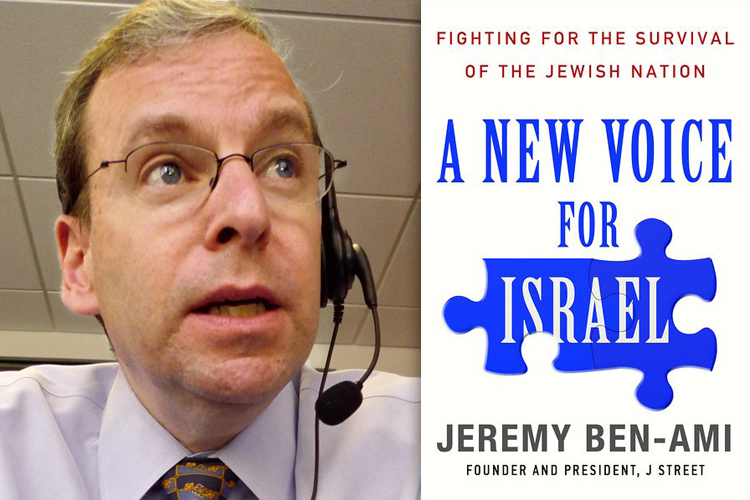
Standing up to the pro-Israel establishmentJeremy Ben-Ami

In the two years since Jeremy Ben-Ami founded J Street, which bills itself as a “pro-peace, pro-Israel” voice for a two-state solution to the Israeli/Palestinian dispute, his organization has been attacked as “morally deficient” and “appallingly naive” by critics in the American Jewish community and on the right end of the political spectrum. And in Israel, members of the Knesset have even formed a committee to determine whether J Street is “anti-Israel” and should be publicly condemned.

In his new book, “A New Voice for Israel: Fighting for the Survival of the Jewish Nation,” Ben-Ami confronts his critics and presents his case for what, exactly, has gone wrong in Jewish politics both here and in Israel. The fundamental problem, as he sees it, is that the existing pro-Israel establishment isn’t willing to apply the pressure needed to bring about an end to Israel’s dead end occupation of the West Bank and the creation of a viable, peaceful Palestinian state.

We caught up with Ben-Ami recently and discussed the challenges J Street has faced in trying to convince Jewish-Americans to think differently about a country they’ve been taught to support unconditionally.

You compare your own struggles as a minority voice in the Jewish community with those of your father, who was an active member of the Irgun, a right-wing Zionist military group, in the 1930s and ’40s. What parallels do you see?

I found the similarities in the way in which our experiences played out to be really shocking. [In both situations,] you have an establishment with a certain point of view, and you have a voice of dissent that wants to come into the conversation — and that voice of dissent is warning of impending disaster. And rather than dealing with the substance of the contentions that are being put on the table by the minority, the majority and the establishment tries to quash their voice and uses whatever tactics are at its disposal.

In my father’s case, [they tried] to wiretap their operations, and bring the U.S. government in to investigate them. It was amazing, the things that were done to shut them down, rather than allow them into the debate. And I just see that as extremely similar to the tactics that are being used against J Street, and that have been used for years against many groups over the last several decades that have talked about a need to approach the [Israeli-Palestinian] conflict with anything other than an “us vs. them” mentality. The funding threats are there — groups are told by donors, “you can’t host these speakers or I’m going to pull my funding from you.” [There are] the personal attacks, the lies and the smears and all of this crap that gets thrown at you, which has nothing to do with what [points] you’re actually raising. The ways in which an established power base tries to shut down voices of dissent was just extraordinarily parallel [to my father's experience]. It’s the same exact dynamic.

I recently watched a video of your 2009 debate with Alan Dershowitz, and was struck that you didn’t appear to actually disagree on the policy subjects that you discussed.

The biggest difference on a substantive level is this: AIPAC is what I call … a passive supporter of a two-state solution. We [at J Street] say we’re pro-Israel, pro-peace and the other side goes nuts because they say, “we’re pro-peace too.” And of course they are. [Laughs] There really are very few pro-war people, and there are only really a handful of people who would publicly admit that they don’t support a two-state solution at this point. The question is whether or not you view the need for a two-state solution as such an existential necessity that you actually have to actively promote it and pursue it. And that I think is the fundamental fork in the road.

AIPAC’s [mentality is], “Look, Israel’s doing just fine. We should continue supporting it.” And we are sounding the alarm bell. We are shouting as loudly as we can, “You are heading off a cliff!” That’s a huge difference. And you know, AIPAC and J Street could agree on 80 percent of policy, but this is the issue. It is the defining issue, and that’s what separates us. We want to see Israel survive, and unless active changes are made, Israel is not going to be able to exist as a Jewish and a democratic homeland within a couple generations.

So why do certain Jewish-American organizations find you so threatening? The reaction does appear to be overblown, as an outsider.

[Laughs] Well, it looks overblown to an insider too.

[laughs] OK, let’s just say it’s overblown.

Right, exactly. I always say there are two factors that always really go into the antagonism. One factor is ideological, and the other is institutional. On the ideological front, 20 percent of American Jewry and maybe 20-30 percent of Israeli Jews are really right-wing — really hate Arabs, don’t believe the Palestinians exist as a people, think this is all some plot to push Israel into the sea. So they are just ideologically opposed to what we stand for in terms of policy. They are obviously very prominent in Israel … you know, people who think we are so wrong that what we are doing is leading to the destruction of the state of Israel. Just like I believe that they are so wrong that they are leading to the destruction of the state of Israel.

There’s a second piece of this, though, that is institutional, and it’s those process-oriented arguments that are a bit opaque to the casual observer. The very concept that the Jewish community in the United States doesn’t need to speak with one voice is really disturbing to a lot of people — particularly those from an older generation. You know, the mind-set that we’re just a small minority in this country and really can’t risk our political power … It’s not good for the Jews to split the community into two voices, it’s not good to diffuse our power and to have a congressman or senator or policymaker confused as to what the Jews think; if we’re sending mixed messages, we’re going to lower their commitment to Israel and it’s going to be bad for Israel in the long run.

And there is a piece of [the institutional argument] too that’s not as nice — this is about power. For two generations, one institution has had the power, one set of voices has had the power, and here comes the competition. And what do monopolies do? They try to destroy the competition. You add all of that together and you get a pretty venomous mix.

Is the conversation within the Jewish-American community beginning to change? I would imagine that younger generations of Jews are more receptive to it.

I don’t like to over-generalize. There are more orthodox young people than orthodox old people, so if you just look at age, younger American Jews are actually slightly more conservative and right-wing on Israel than older Jews. It’s totally counterintuitive, right? And young liberals don’t like to hear it … So you have to segment out the non-orthodox younger Jews — and that segment is very different. They don’t get many of the basic premises on which this whole issue [of Israel] has been constructed and built over the last two generations. They don’t get the idea of being a powerless minority, and needing to speak with one voice in order to conserve your power — they only know Jews as an extremely well-integrated and pretty powerful part of American society. The concept that we need to be careful and not let other people see our disagreement makes no sense to younger people. And I do think that some of the emotional understanding about the need for a homeland for the Jewish people is harder for younger people to grasp. The visceral defensiveness that comes in among 60-year-olds, 70-year-olds, [Jewish people] my age even, that we really need to protect and defend this little country — that instinct just isn’t quite as natural for people 20, 30 and 40.

What about the Arab Spring? Has that affected the conversation in a significant way?

There are two conflicting effects, I think. One is the natural circle-the-wagons defensive reflex reaction that people have in situations where there is instability and uncertainty. The outcome of all of this is unclear. Will these new governments still want to pursue peace with Israel? What happens if you sign a peace agreement with the King of Jordan and he’s thrown out? That sense of insecurity reinforces the instinct to be conservative and say, “Well, in the end we can only look to ourselves.”

The other thing that happens, though, is I think there’s a real resonance with the values that a lot of the sparks that led to this were based on notions of democracy, freedom from oppression — and all of that really resonates with Jews, particularly in the United States. So I think on one hand you have a lot of hope in part of the community, and then you have a lot of fear. And those two reactions are kind of at war with each other — within individuals, and within society.

Are libertarians misunderstood?

A conversation with Reason editors Nick Gillespie and Matt Welch: "I don't think either of us are anarchists..."

  • more
    • All Share Services

Nick Gillespie and Matt Welch, the editors of the leading libertarian publication Reason, see hope in their fellow Americans’ increasing disenchantment with the political system. In their new book “Declaration of Independents: How Libertarian Politics Can Fix What’s Wrong With America,” they note that independents now account for the largest bloc of voters in the country and urge more defections from the two major parties. Only by dismantling this hierarchical system of power, they maintain, can we achieve real deregulation of government-run services, which will lead to increased consumer choice and a more thoroughly democratized society.

Say what you will about libertarian arguments, but they’re always fun to discuss. So we sat down with Gillespie and Welch earlier this week and talked about their philosophy over a sushi lunch:

Your book urges the American public to embrace an unregulated market free of government control. But you also include a quote from Julian Assange, a self-described libertarian, stating that “a free market ends up as a monopoly unless you force it to be free.” So basically, some external body has to exist to ensure the freedom of a market — doesn’t that imply that free markets are inextricable from some form of government control?

Matt Welch: I think a lot of people, when they want to initiate a discussion about or with crazy libertarians, hold them to a standard that other people don’t.

And crazy libertarians are… you guys?

MW: [Laughs] Oh yeah. They wanna go immediately, “What is the logical conclusion of this philosophy? Would you have the state build roads? And you wouldn’t even have a fire department, and that kind of stuff!” That logical question isn’t given to progressive or conservative groups — they’ve been around longer, and there’s also an explicitly or self-consciously philosophical bent to libertarianism.

We don’t really spend a lot of time talking about “libertopia” around here. It tends to be kind of practical-minded — like, if we’re going to spend the same amount of money on education, just as a starting point, how about we spend it this way?

So you’re not advocating for zero governmental regulation or control?

Nick Gillespie: I don’t think either of us are anarchists — it’s not a question of that. We’d like to define libertarian less as a noun and more as an adjective. So it’s like, [you're libertarian if] in any given situation, you’re moving towards a kind of individual regulation.

Politics is built upon — and it has to be, and this is why we’re not anarchists — areas of common concern where you need to forge a national, state-level or citywide consensus.

What are those areas?

NG: Things like national defense. To a certain degree, I would say school funding — I mean, I would rather have the state out of education, but it’s not gonna happen anytime soon. Certain types of air pollution regulations. Frederick Hayek is one of our big intellectual heroes, and his book “Constitutional Liberty” just takes for granted that there’s going to be some social welfare state provided by the government. You could argue that it doesn’t have to be, but look — we assume that it is. The idea is that you squeeze down those areas where there really does need to be a [governing] consensus to the smallest degree possible — because when you have that, you definitely have clear winners and losers: 51 percent of people get to make the other 49 percent eat shit, basically. You still have to make a case for why what you’re doing is worth purchasing if you’re a businessman, but it’s not a win-lose proposition. It’s much more about persuasion and voluntary cooperation than forcing people to do one thing or another.

Just more broadly speaking, you can see in places such as the Internet, which is relatively unregulated, how markets in general and voluntary associations — and a kind of libertarian world — would work. It creates a lot of value. It sends out huge amounts of information. It creates reputation and branding. That becomes more important than regulation by people with guns.

In your book, you talk a lot about using market principles to deconstruct the duopoly of America’s two-party system. Can you expand upon that?

NG: Well, we’re always going to have two major parties. We’re not saying, “OK, we’re gonna have 50 different parties.” But the two main parties have lost huge amounts of market share.

MW: I mean, Republicans in many ways created the Tea Party by being hugely big government and routing the limited-government side [of their party] for more than 15 years. Democrats are going to be flirting with this. Obama is persecuting medical marijuana shops and spending more money on drug war enforcement than his predecessors did, being lousy on civil liberties in general, lousy about Guantánamo, lousy about starting wars.

And you don’t think Obama’s policies are responding to the needs of the time?

MW: No, and he’s taking all those liberal votes for granted.

NG: Parties can benefit, we think, if they decentralize decision making to the lowest level possible. So like with schools, with K-12 education, giving students and parents choice is a huge selling point — the satisfaction rates of people who choose their schools versus people who get assigned them, I mean, they’re not even close. And if you keep doing that in a variety of different issues, what you have to do is you have to give up your ability to dictate.

And for political activists, if you wanna be successful, you have to realize that these parties are not going to be able to make people do what they want, and that you’re much better off going after specific issues and creating kind of ephemeral, ad hoc syndicates that push certain issues. We know this group that’s pushing school choice, and it includes people like Dick Morris, the toe-sucking fetishist and Republican presidential advisor, and Joe Trippi, who was Howard Dean’s campaign manager. So it’s a broad coalition of people who have nothing really in common. Besides sucking toes, which I’m sure Trippi is into as well.

The underlying argument in your book is that deregulation leads to a decentralization of services, which in turn leads to a democratization of services and increased freedom for everyone involved. But I can think of situations in which the deregulation of a system would not lead to the decentralization of power — like in any situation in which a monopoly is formed. And I can think of examples when even if an industry did decentralize, it wouldn’t lead to the democratization of services — like any situation in which you had asymmetric information flow between the producer and consumer.

NG: Right. Can you name an example? I mean, you said you had examples.

Well, you guys wrote your book in the shadow of the Great Recession, but the book never actually addresses how the recession happened in the first place. And critics of libertarianism often cite the different actors in the subprime mortgage crisis, arguing that they took advantage of an unregulated system to consolidate power, and took advantage of a lack of understanding amongst consumers to sell them products that they didn’t fully understand.

MW: It’s a big question, so I’ll just take on little bits of it. One is the notion that the financial crisis was caused by deregulation… The central libertarian argument about what to do in the wake of a financial crisis is let the people who made these terrible decisions go bankrupt. And when appropriate — and do it early and often — send the motherfuckers to jail, you know?

If they did something illegal. But one of the problems is that if the system’s been deregulated, then it’s not illegal.

NG: But fraud is always illegal.

MW: Yeah, fraud has never been deregulated.

NG: When you talk about — OK, think about it this way. If mortgage companies knew that they were on the hook for the mortgages they underwrote, they would be very careful in who they lent money to… What happened was that every mortgage originator basically knew that they would get $500 to $2,000 in fees for simply originating loans, and then when they sold them they didn’t sell them to simply derivative companies — they sold them to Fannie Mae and Freddie Mac. Because the government told these guys to buy every loan that they could get. They kept pushing banks and said, “We’re going to regulate you to extend credit to more and more people who might not meet the gold standard credit regulations.” … In fact, the housing collapse tracks with a libertarian understanding in that it’s caused by government interventions in the private sector.

Regulatory bodies, if you look closely, are never put in to restrain business. They’re called in by big business in order to freeze the market at a certain place in time … And look at this in terms of the financial banks and investment banks in the country. Going in there were six major banks that had something like 60 percent of the market. Now there are four that have like 70 percent of the market. So in fact, all of this regulation, all of this government-supported intervention to fix things, led to a high concentration in this market.

MW: You can’t keep monopolies anymore unless you give consumers what they want, or if your [market control is] set in stone by the government. It’s easy to fall into the trap of thinking we’re going to be under the thumb of corporations with a capital C, but those corporations are desperate to sell you crap. And you don’t like it, or you suddenly have choice, that’s it, they’re screwed.

Stephen Metcalf recently published an article in Slate arguing that libertarianism essentially excuses and enables selfishness. What’s your response to that?

NG: I mean, I don’t think you’re going to walk away from this interview and think, “God, those motherfuckers only think about getting more for themselves.” I’m a libertarian because I believe that a free enterprise system and the political system that goes along with that opens up opportunities. And if you look at the actual rules that are in place that are supposedly socially progressive, most of the time they don’t help poor people. Things even like minimum wage laws — the rate of unemployment among teenage black males has only gone up since the minimum wage laws were jacked up in the late ’50s and was indexed for inflation, because the more people come into the market with fewer skills, the [more the] deck is stacked against them, and you get priced out at the beginning … Maybe I’m wrong, but I know precisely why I’m a libertarian, and it’s precisely because it promotes social and economic mobility.

MW: I’m greatly influenced by living in Central Europe between ages 22 to 29 in the early ’90s, beginning less than a year before communism collapsed. And for me, free trade and immigration are the quickest way I can think of for poor people to get rich … It’s not some weird accident that in China and India in the past two decades we’ve seen more than half a billion people pulled out of poverty. And it is because they went in directions of market reforms … The opportunities just got better for everybody, and that’s what jazzes me up in the morning. And if a rich asshole makes a mistake, he should go bankrupt. My motivation is exactly the opposite of what Steven Metcalf thinks. To the extent that he thinks.

Continue Reading Close

The woman who started the Civil War

Q&A: Historian David Reynolds discusses Harriet Beecher Stowe's famous novel and the controversy that won't die

  • more
    • All Share Services

The woman who started the Civil WarHarriet Beecher Stowe

When Harriet Beecher Stowe published “Uncle Tom’s Cabin” in 1852, the American slave trade was a thriving institution. The courts condoned it and, as Southerners were quick to claim, so did the Constitution and the Bible. Twelve American presidents had been slave owners, and the abolitionist movement was fragmented and marginal.

But Stowe, a seminal figure in American liberalism, had a knack for making radical concepts palatable to the general public, and her novel became one of the first genuine pop culture phenomena in American history. Within 10 years of its publication, the United States devolved into civil war. And as historian David S. Reynolds argues in “Mightier Than the Sword,” a new book that explores Stowe’s life and the global impact of her work, it was “Uncle Tom’s Cabin” that catalyzed  the conflict.

We spoke with Reynolds recently and discussed the enduring significance of “Uncle Tom’s Cabin,” modern criticism of its use of racial stereotypes, and Stowe’s own place in history. 

Why was “Uncle Tom’s Cabin” so popular?

I’m fascinated by the impact it had. It far outsold any previous American novels, and it was an international sensation. And it was dealing with a very unpopular theme, which was anti-slavery … [Abolitionist] William Lloyd Garrison was once dragged through the streets of Boston by an angry mob — this was a very unpopular movement. People wanted to let slavery alone.

But what Harriet Beecher Stowe did was bring [abolitionism] together [with] all these different strands of popular culture — from religious and temperance writings, to women’s writing and domestic literature, to adventure fiction and sensational fiction. She’d never written a novel [before], she’d only written short stories for magazines. But she brought all these elements together and did it in such a passionate, human way.

She said that God wrote the book. She felt that it came through her in a series of visions; she was a very religious person. I think it’s just a very moving book, even to this day. Actually, when I taught it — I don’t usually cry over books myself, but when I taught it last fall, I realized just how much sincere personal anguish over slavery went into it, and it actually made me cry.

How did writing your own book change your perceptions of “Uncle Tom’s Cabin”? It doesn’t sound like you cried the first time you read it.

No, no … I read Stowe’s letters, before she wrote the book. She lost her beloved son Charley to cholera, and [wrote that], “When I lost my son at such an early age, I instantly thought of all the slave mothers in the South, who are losing children daily because they’re being sold.” She had known many African-Americans personally, in her household and also while living in Ohio, where she participated in the Underground Railroad. So she had this very deep sympathy for slaves, and I could no longer really read her book in a distanced way — I really felt the emotions, because I knew exactly what had gone into it. She suffered from a variety of illnesses, and they [the Beecher Stowe household] struggled just to stay above the poverty line. I just saw all these challenges that she had, and [how] they mingled with the suffering that she saw in the slaves, and it moved me.

 I was struck by what a pivotal figure Stowe really was. In your book, she comes off as a mother of American liberalism.

Yes, in a way she is. She tries to domesticate radical thought — and this was one reason she was so popular. She tries to appeal to common, everyday feelings of human devotion. These elements can seem sentimental, but they’re also universal … And it was so popular throughout the world that ["Uncle Tom's Cabin"] was actually used for different kinds of causes. It was one of the forces behind the emancipation of the serfs in Russia in 1861, and it was Lenin’s favorite childhood book — he said that it gave him “a charge to last an entire lifetime.”

It was the first American book published in China, translated into Chinese. And then it became immensely popular as well through the many plays and adaptations of the novel. It was one of the earliest forms of mass entertainment, in North America and throughout the world — sometimes, frankly, distorting the [book's message]. It was in the plays, sometimes, that there was a distortion and a stereotypical use of the Uncle Tom figure.

Modern critics fault “Uncle Tom’s Cabin” for its simplistic writing style and use of racial stereotypes. 

For a long time it was a popular novel among critics — it was christened the Great American Novel in 1868. Tolstoy loved the novel. Henry James loved the novel. But during the Jim Crow period, particularly during the 1930s when literary criticism in the academy became very conservative, they looked for different things in literature. They didn’t want to see social statement or political statement, they wanted to see ambiguity and complexity. Also, they didn’t particularly pay attention to literature by popular women writers, so ["Uncle Tom's Cabin"] was kind of dismissed as being sentimental, simplistic. But then in the 1970s and ’80s, with the rise of cultural studies and feminist criticism, a lot of critics realized its immense cultural power, [and] realized that a lot of the characters are more complicated than some of the stereotypes would suggest.

I mean, traditionally, most modern readers see it as kind of an old-fashioned and sentimental book, and we think of the Uncle Tom character as being sort of a sellout and a weak, spineless creature. In the book, though, Tom actually reads very strong — he’s in his 40s, he’s muscular, he has three children. He’s a very compassionate man and Christian man, and he believes in nonresistance. I think the whole record of what happens to the novel [and its reputation] over time really impressed me, because a lot of the people who were once called Uncle Toms — Martin Luther King Jr., Rosa Parks — were the victors in the end. In a way, Uncle Tom won. [They were] true to this very firm, nonviolent [form of] protest.

That’s a pretty provocative claim. Isn’t there some validity to the more modern, critical reading of Uncle Tom’s character?

The trouble is that you can’t apply today’s views on [the time in which] the book appeared. In the South, Harriet Beecher Stowe was [considered] a demonic, satanic lover of African-Americans — they threw her book in the fire, they imprisoned people who owned it. It was far, far too radical and progressive throughout much of the South. So we can’t just call her a limousine liberal or something like that.

Now, there were some militant blacks like James Baldwin, Richard Wright and others who, with the rise of the “New Negro Movement” and the Harlem Renaissance, wanted a more militant voice. And so they used the Uncle Tom stereotype in a negative way. But at the same time we should recognize people like Langston Hughes, who was a great defender of the novel, and he saw how progressive it really was. Alex Haley saw the progressiveness of it. So there is a progressive element [to the book] that certain African-Americans, even in the 20th century, have admired.

Do you think that there’s anything that progressives today can learn from Stowe’s approach to enacting social change?

“Uncle Tom’s Cabin” is a prime example of how [cultural events] can work in an ultimately good way. It galvanized anti-slavery passions in the North, and it also made the South come to its own defense of slavery. So it galvanized those passions, and brought about the war that was very necessary to end slavery.

We live in a much more complicated age. I think that probably ["Uncle Tom's Cabin"] will never be approached in its power. But I still do believe that if somehow political writers could learn how to integrate some of their political views into characters, into characters that we care about in a deep way the way she did, they still could have an effect. I really believe that.

Continue Reading Close

Is racism on the way out?

Ellis Cose believes it's fading as a phenomenon. We talk with him about his new book, "The End of Anger"

  • more
    • All Share Services

Is racism on the way out?Ellis Cose

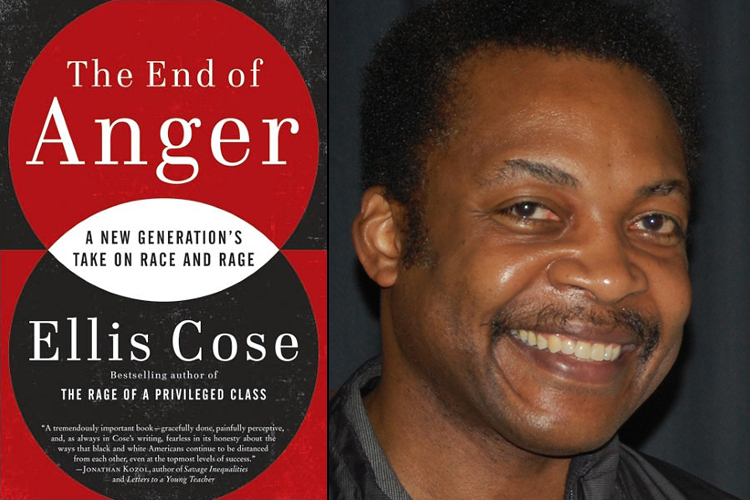
When veteran journalist Ellis Cose wrote “The Rage of a Privileged Class” in 1993, his editor was so shocked by his thesis — that black middle-class professionals were deeply frustrated by enduring discrimination in the workplace and remained unable to achieve the same level of success as their white colleagues — that he pulled him aside to ask if it was really true. Published just a year after the L.A. riots, that book struck a responsive chord with the black community and was received to wide acclaim.

Now, nearly two decades later, Cose is revisiting the black middle class in his new book, “The End of Anger,” and finds that much has changed. He describes an emerging generation of optimistic young black professionals, but notes that their attitudes are complicated by white anger, racism and divisions within the black community. We spoke with him last week.

How has the black community changed since you wrote “The Rage of a Privileged Class”?

There is a hugely different sense of hope and optimism now; I think that’s the biggest change that you see from back then … Not too long after “Rage” came out, we started to have these sort of unprecedented breakthroughs. We got people like Dick Parsons, who was head of Time Warner. You got people like Franklin Raines, who — even though he had a fall from grace — was head of Fannie Mae. All of a sudden, what had seemed impossible became plausible. And of course, it was all topped off with the election of Obama. Which was sort of the defining moment of the end of an era, if you will.

Two things have changed. One, there has been enough time for a new generation to come online. And two, there’ve just been general changes in society. So you have those two phenomena interacting with one another. You have a set of younger people who just didn’t go through what that older set of folks went through.

What struck me is just the very different take they had. Not on whether discrimination existed. They all agree that life is different for an African-American than it is for a white American. But what is different is the significance of that discrimination in terms of their life possibilities. The younger folks are just much more likely to believe that they can personally overcome it because there are ways to get around it that their parents didn’t have, and that their grandparents could not even imagine.

In your research for “End of Anger,” you conducted surveys among black Harvard Business School alumni, and graduates of the educational program A Better Chance. You write that the majority of these professionals earn at least $100,000 a year — but that the average black household in the U.S. earns $35,000. Why did you choose to focus on a group of people who aren’t statistically representative of the average black experience?

Because part of the question was not just what are blacks, in general, thinking — though I do deal with that in the general surveys. It was the question I sort of started in “Rage of a Privileged Class,” which is what is possible for the best-prepared, best-situated people from a group? Because if ultimate success is not possible for them, it’s not possible for anybody. And if it is possible for them, then at least it moves the ball forward in terms of what one can aspire to.

Recent studies have described a growing division in the black community along class lines — Eugene Robinson’s book “Disintegration” comes to mind. Is that something you’ve noticed too?

I think that it’s inevitable. We should remember, though, that the idea of a united black community that shared perceptions across the board has always been a bit of a falsehood, but it’s also been driven by the fact that blacks were all in the same boat. No one was going to make it out of the ghetto, so you had a forced unity, and a forced commonality of viewpoints. Now you have one set of folks, who, because they were fortunate enough to get very good credentials, can aspire to anything a white guy can aspire to. So it’s inevitable that our outlook on the world’s a little different than that of somebody who’s still stuck in the poor, very segregated black community.

But one of the interesting things is that even among that most privileged group, they’re not saying that race no longer matters. Even the most privileged folk are aware that they are subject to being treated quite differently on the basis of race. If there’s anything close to a universal experience among African-Americans, it’s being treated with suspicion in a store, or being approached by a cop for no good reason — they all shared this. I don’t think that there is going to be a loss of a coherent black identity, but I do think it’s gotten a lot more complicated, because people perceive their options in wildly different ways than they did before.

How do you reconcile this increased optimism in the black community with the intense expressions of resentment that Barack Obama’s presidency has brought out from many white voters?

I think it’s part and parcel of the same thing. Because there has been this very obvious progress, there is a very boisterous minority that is upset about it, and of course they’re going to make their voices heard. I mean clearly, as all the research data shows, the hardcore sort of Tea Partyers tend to be older. They tend to be conservative. They’re not very comfortable with where this country’s going now. Who would expect them to be? It’s not because they’re stupid. It’s because they’re stuck in a very old paradigm.

But while Obama very much identifies as black, I also get the sense that the American public takes quite a bit of solace in the fact that he has a white mom.

Right, and he obviously plays that up. He put her front and center in his campaign. I mean, when I interviewed him before he announced [his candidacy], he realizes people see different things in him, and he thinks that’s fine.

He’s managed to make it so that no matter what someone projects onto him, he can both accommodate it and refute it at the same time.

Exactly. And he’s also a very rational man. He knows that he’s an African-American, so there’s no point in pretending that he perceives himself in some other way. He acknowledges that.

Do you think Obama could’ve been elected if he’d more clearly identified with the black community, or been descended from a long line of black Americans?

Certainly he wouldn’t have gotten more of the white vote if he’d identified more strongly with the black community. [Obama] certainly was aware that the black community’s very forgiving of people whom they perceive as trying to advance the race, to use an old phrase in some way. So he didn’t have to open a bill for the black community.

To the extent he identifies as black, the white community gets nervous. I think it’s just that simple, and he realizes this. It’s very elementary stuff.

I want to talk to you about the last paragraphs of your book. You include a section called “A Harvard MBA Guide to Success” in the appendix, and Rule 10 is: “Never talk about race (or gender) if you can avoid it, other than to declare that race (or gender) does not matter.”

One of the things I found interesting, but not surprising, was that when I did the survey of the 200 Harvard MBAs, during the follow-up interviews I said, “Well, do you want to be identified or not [in the book].” The vast majority said no, we don’t want to be identified. And when we asked why, a lot of them were saying, well, we don’t want to be identified with anything having to do with race.

The larger message that they were transmitting was that they realized that they saw racial dynamics very, very differently from their white colleagues. And that to the extent they flag that for their white colleagues, they would be perceived in ways that they did not want to be perceived — as people who had racial grievances, as people who were too sensitive about racial slights, as people who were maybe racist themselves. Sophisticated African-Americans recognize that they just didn’t want to be associated with the work, or with thoughts that suggested that they thought some white folks are bigots.

There were examples of a successful multiracial society in your book, but some of the interviews you included suggested that we haven’t approached a successful multicultural society yet. Would you agree with that assessment?

I think that many people are uncomfortable with cultures they perceive as different from their own, and that’s always going to be the case. I think part of why many white Americans have become a lot more comfortable with blacks is that they’ve convinced themselves that blacks aren’t all that different — at least certain blacks aren’t all that different [laughs]. And so they can get their heads around that. And that, combined with the fact that it’s no longer cool to be a racist anymore, sort of drives things in a certain direction.

But I think it takes a more open mind than a lot of people have, than most people have, to ever accept in any serious way a multicultural perspective.

Do you think there will ever be a point where this is something we discuss openly?

I think we will for generations, and maybe forever, be dealing with the impact of racism. But racism as a phenomenon itself is fading. So, yeah, I think we’re going to reach a point where we can talk about “the old days” — you know, same way we can talk about the Confederacy now, and how all these misbegotten Southerners were fighting for slavery.

But sure, I think we’ll reach a point where we can talk about it, at some point. I don’t think we’ll reach a point where we can talk about it and deal with it when it’s still a problem.

Continue Reading Close

Where will the birthers strike next?

President Obama released his long-form, but "birther bills" are still alive in state houses across the country

  • more
    • All Share Services

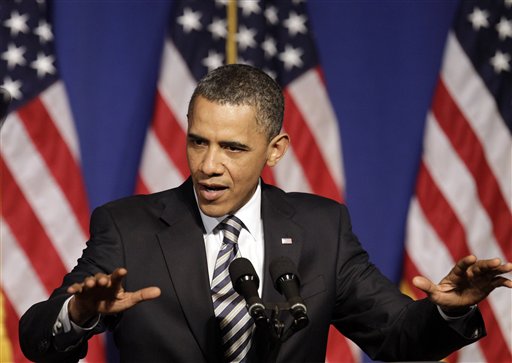
Where will the birthers strike next?President Barack Obama gestures as he speaks at a Democratic party fundraiser, the third of three such events he attended in one night, in New York, Wednesday, April 27, 2011. (AP Photo/Kathy Willens)(Credit: AP)

President Obama’s disclosure of his long-form birth certificate this week has yet to deter many birthers — including the ones elected to public office.

Less than 24 hours after the president’s press conference on Wednesday, for instance, Oklahoma’s House of Representatives passed a bill requiring presidential candidates to provide proof of identity and U.S. citizenship in order to appear on the state’s ballot. In all, about a dozen similar bills have been introduced in legislatures across the country. (In Arizona, a birther bill actually passed earlier this month, only to be vetoted by Gov. Jan Brewer.) Some of the proposed laws have some interesting twists — including one that would declare any voter who cast a ballot for an ineligible candidate guilty of a crime.

Here are a look at the five most notable birther bills that are still pending:

Oklahoma

SB 91 requires all candidates running for federal office to submit an “original birth certificate” to the Oklahoma Election Board. It passed the House in a landslide yesterday and will now be sent to the Oklahoma Senate for a procedural vote. The Oklahoma House and Senate both entertain a large Republican majority, and the bill is expected to pass. Oklahoma state legislators assume that Gov. Mary Fallin will sign the bill into law. We emailed Fallin’s office asking for a comment and received a reply stating that she has not made any public comment on the issue.

Louisiana

State Rep. Alan Seabaugh and state Sen. A.G. Crowe jointly proposed HB 561 several weeks ago, which also requires candidates to prove U.S. citizenship before appearing on a state ballot. Both lawmakers stated yesterday that they were pleased that Obama had released his long-form birth certificate, but that they would press forward with the bill in an effort to close loopholes in existing Louisiana law. The bill was publicly endorsed by Gov. Bobby Jindal last week. “It’s not part of our package,” his press secretary said in a statement, “but if the Legislature passes it, we’ll sign it.”

Missouri

At first glance, HB 121 appears to be a standard update of Missouri election procedure, but provision 8 of the bill would require presidential and vice-presidential nominees to submit proof of citizenship to Missouri’s secretary of state. State Rep. Lyle Rowland, who sponsored the bill, claims that the provision is intended to keep illegal immigrants from taking over the White House, just in case “something were to happen where one of them became popular with the people.” According to Rowland’s office, the bill has made it out of committee and is scheduled to be debated on the House floor. The specific date has yet to be determined.

Texas

Authored by Tea Party favorite Leo Berman last November, HB 295 would require presidential candidates to show their birth certificates to the Texas secretary of state. Unlike his many of his counterparts, Berman is an out and proud birther — in an interview yesterday, he claimed that he found Obama’s long-form birth certificate unconvincing and suspected it may be a hoax. The bill is currently stuck in committee. We contacted Gov. Rick Perry to see if he would support such a bill but did not hear back from his office.

Nebraska

Sponsored by State Rep. Mark Christiansen, LB 654 might be the most radical birther bill in the country. If enacted into law, the bill would not only require presidential and vice-presidential candidates to submit original copies of their long-form birth certificates to Nebraska’s secretary of state — but would also require candidates to prove that their parents obtained U.S. citizenship prior to his or her birth. Nominees would then have to sign a sworn affidavit to that effect and additionally swear that they were not born dual citizens. Nebraskans who vote for a candidate that has not met these criteria would be guilty of a class IV felony. According to Christiansen’s office, the bill is currently stuck in committee and will most likely stay there, at least through the end of the year.

Continue Reading Close

Revisiting the murder of Dr. George Tiller

Author Stephen Singular on the "unexplained, blind" rage that led to a tragedy two years ago

  • more
    • All Share Services

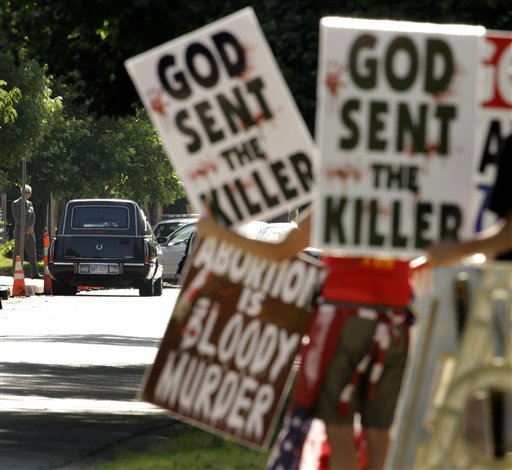
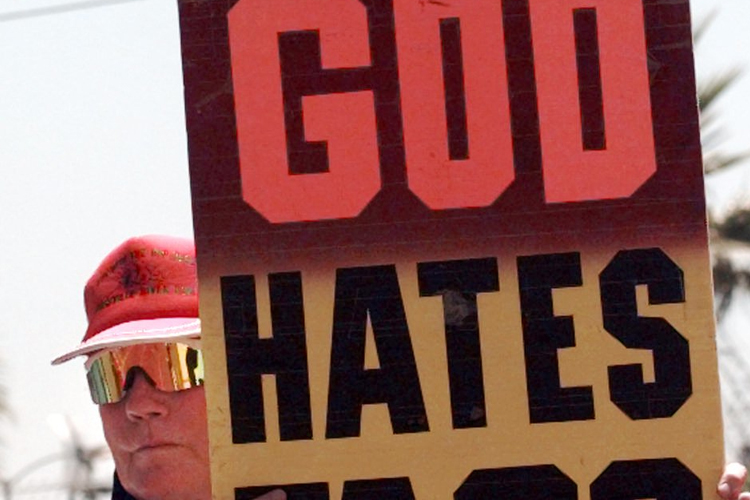
Revisiting the murder of Dr. George TillerFILE - In this June 6, 2009 file photo, protesters from Rev. Fred Phelps' Westboro Baptist Church demonstrate during funeral services for Dr. George Tiller at College Hill United Methodist Church in Wichita, Kan. In an 8-1 ruling, the U.S. Supreme Court ruled the group's protests were protected by the First Amendment. The father of a Marine killed in Iraq sued after they picketed his son's 2006 funeral service.(AP Photo/Charlie Riedel, File)(Credit: AP)

It’s been almost two years since George Tiller, who was one of the country’s few providers of later-term abortions, was gunned down in his church in Wichita, Kan. His brutal murder was followed by a heated national debate over who and what was responsible for it. Tiller’s killer, Scott Roeder, was a diagnosed schizophrenic who appears to have acted alone. But anti-abortion activists and several prominent commentators — most notably Fox News host Bill O’Reilly — had spent years issuing heated attacks on Tiller for his work. Did their emotionally charged rhetoric — O’Reilly would ridicule the doctor as “Tiller the baby killer” — create a climate conducive to Roeder’s action?

In his new book, The Wichita Divide: The Murder of Dr. George Tiller and the Battle Over Abortion,” crime journalist Stephen Singular explores these issues — and concludes that Tiller’s murder can only be understood within the context of right-wing extremism that has  become increasingly mainstream. We caught up with him earlier this week:

You’ve been reporting on right-wing extremist activity since 1987, when you looked into the 1984 murder of talk radio host Alan Berg. How has it changed in the past 25 years?

You know, when I wrote about Alan Berg, I was writing about some very marginalized people. These were a bunch of white guys without jobs, and no money and no prospects and nothing going on; some had been to prison.

Now, [when we talk about the persecution of George Tiller,] we’re talking about the attorney general of the state of Kansas. Now we’re talking about some of the most successful figures in the American media — we’re talking about multimillionaires who get paid to demonize people on national television, who get paid millions and millions of dollars to tell people [that] Tiller['s] the Baby Killer, who get paid to deny all the complexities we’re talking about, it’s not just. It’s an entire society that’s said, “Hey, we’re going to reward this kind of behavior.”

And that filters down. It affects everything. It’s an emotional atmosphere, and it not only affects the general culture — think about the people who are at risk in that culture, emotionally, psychologically. [People] who are on edge, like [Dr. Tiller's murderer] Scott Roeder, [who was] diagnosed with schizophrenia as a teenager. Or the man who killed Alan Berg, Bruce Pierce, [who was] clearly mentally unstable. This stuff filters down. And then when the blood hits the wall, and the bullets fly, everyone stands back and says, “Well we never intended that. We were just talking.”

You talk a lot about Bill O’Reilly, who demonized Dr. Tiller on his show. Do you consider commentators like O’Reilly to be responsible for the way someone like Roeder might perceive their statements?

I mean, he’s absolutely responsible for what he says, but I don’t think he’s held to any accountability whatsoever. What does he know about the medical complications that women face when they’re pregnant and they have a severe problem? What does he know about chromosomal deficiencies? About blood diseases? Has he ever been in an operating room in his life? Does he know anything about this? No. So why should he be in a position of authority to comment on it in any degree of seriousness whatsoever?

I’m not telling him what he can’t say. I’m saying that [there's a] total lack of self-awareness that the consequences of it matter… And [that] maybe, if you’re going to demonize somebody over and over and over again in the highest levels of the American media, that something unfortunate could come out of that. And then when that something unfortunate happens, where’s the sense of … you know, maybe I was wrong?

As I was reading your book, the extent to which Kansas politicians demonized Tiller surprised me. You write that Attorney General Phill Kline even investigated Dr. Tiller’s clinic under false pretenses — and may have leaked medical documents to O’Reilly.

I’ve never seen anything like it in my life … I just kept thinking, no, they didn’t do that. They didn’t take private women’s medical files — [and] the judge had said, “you cannot show these to anybody, you cannot do this” — and sneak around [with them] in plastic containers, and put them in cars and apartments, and then allegedly give them to O’Reilly. “You can’t show this to anybody.” Well let’s just show this to O’Reilly, and then broadcast it to 3.5 million people!

And again, where are the consequences? … [Kline] had a partial ethics hearing in February, and then it was delayed again. It’s coming back in the summer. Nobody knows what will happen.

In what other ways was the murder of Dr. Tiller more than just an isolated, violent incident?

What has struck me is that in the last three or four months you’ve had this incredibly assault — I mean, on the fringe, a guy kills Tiller, making it harder for some people to get abortions. But in the mainstream, the Republicans have made this one of their main thrusts. Last year there were 600 new pieces of legislation introduced to limit abortion [out of] 34,000. Out of all of the members [of Congress], 45 members are strongly anti-abortion.

And the strangest thing about it to me is that if you just look at this year, we’ve had just one huge event after another of world importance — Egypt’s revolution, the tsunami, ongoing economic difficulties that could collapse at any moment — and this is the focus. This is what the Unites States Congress is focused on — killing Planned Parenthood … It’s a monumental distraction from what’s properly the business of government.

You interviewed several of  Tiller’s peers — including his good friend, late-term abortion provider Dr. Warren Hern. Was there something they all seemed to have in common?

Guts. Just guts. I mean they put their lives on the line. You know, we’re sitting in Dr. Hern’s office, and it’s like a fortress. Bars on the windows. Bullet-proof glass. Protesters out front. Tiller’s just been shot, and he’s [Hern] just said, “Well, I can’t drive to work anymore because they’ll shoot me.” And then he says, “You wanna walk over there and go to lunch?” [Laughs] And I’m like, “maybe we should order in!”

What do you think motivates them?

Well, some people will just fight back. In Hern’s case, I had enormous admiration for him. His political courage. His moral courage. His spiritual courage.

I think that, as in so many of these wedge issues, it’s an abstraction when you oppose [abortion] … There was an anecdote in there, towards the end of the book, about this couple from the South. They had been anti-abortion protesters, this woman and her friends, and they had stood in front of places and protested. And then she got pregnant and [suffered from medical complications]. So she looked to her friends for compassion, and her friends are like, this is Satanic or something, to do this. Then she came to [Dr. Tiller's clinic in] Wichita, and the compassion was there.

And it wasn’t strictly religious based, but they prayed together. They said, “we can do a memorial service for your child, afterwards.” And I thought it was very moving. Tiller would do whatever he could to serve his patients.

Continue Reading Close

Page 1 of 3 in Teresa Cotsirilos