Spring Offer: Get 1 Year, Save 58%

A plan to mine lithium could eradicate a Nevada flower. Is extinction just the cost of green energy?

Botanist Jerry Tiehm, the curator of herbarium at the University of Nevada Reno, discovered the plant that now bears his name more than 40 years ago. It was early in his career, and Tiehm was driving through a remote central Nevada canyon while collecting samples to study. He was unaware at the time that it was an unknown species until a different expert informed him that the yellow, white and green plant was something altogether new. Indigenous to a tiny patch of land no larger than 10 acres in area, the new plant was named Tiehm's buckwheat after its discoverer.

"The pit walls will eventually subside and as the result in some number of years after the pit is built, the buckwheat will end up falling into the pit."

More than four decades later, and Tiehm's buckwheat is at the center of a historic lawsuit with millions of dollars at stake. Amidst of all of this furious debate, Tiehm is a mere bystander.

"I am not involved with this controversy," Jerry Tiehm said. "I simply discovered the plant and it was named in my honor."

The controversy involves lithium, a key component of the batteries in electric cars and our always-online gadgets. As climate change continues to worsen because of humans burning fossil fuels, environmentalists of all stripes are turning to electric vehicles as a potential way to reduce the release of carbon dioxide.

Yet the tiny town of Tonopah contains the only legal lithium mine in the United States, meaning that Americans who wish to capitalize on this potential green technology have only one place where they can do so. President Biden accelerated the lithium boom when he signed the Inflation Reduction Act in 2022, since one provision of the bill requires that all batteries for any new electric vehicles be sourced in either the United States or one of its pre-selected allies to qualify for a tax credit. The Department of Energy has even awarded billions of dollars in grants to upstart lithium companies.

Yet not everyone is happy about the prospect of resource-intensive lithium mining occurring in the Tiehm's buckwheat's neighborhood. Last week the Bureau of Land Management (BLM) officially closed public comments on a new environmental impact survey for the proposed Rhyolite Ridge Lithium-Boron mine after thousands of people commented. In addition to ordinary citizens, experts like Claremont Graduate University research assistant professor of botany Naomi Fraga describe potential lithium mines in dire language.

"We know that the proposed mine would destroy 22% of the habitat deemed essential for the species survival," Fraga said. "Further the line will create a large open pit that is 200 acres large and 960 feet deep. This pit is just feet from buckwheat plants." Fraga added that the Australia-based mining company Ioneer says the mine would be 44 feet away from the plants but that she believes based on the spatial files it would only be roughly 15 feet away.

"The pit walls will eventually subside and as a result, in some number of years after the pit is built the buckwheat will end up falling into the pit," said Fraga. "Further the mine will create the conditions for non-native plant species to invade the habitat and it will create dust that will impact the plant."

Patrick Donnelly is the Great Basin director at the Center for Biological Diversity. The non-profit conservationist group has worked for over five years to protect the Tiehm's buckwheat from open pit mines like the lithium facility proposed by Ioneer. If constructed, the open pit would require thousands of acres for rock dumps, tailings piles, a tailings dam and a sulfuric acid processing plant.

"Tiehm's buckwheat lives on just 10 acres and would be surrounded by this devastating development," said Donnelly. Given that the Tiehm's buckwheat was listed as protected under the Endangered Species Act, more than 100 scientists felt confident submitting a public letter to the BLM urging them to honor the plant's special status by stopping the mine.

"The mine plan would directly destroy 22% of the plant's protected critical habitat, whole irreparably degrading the other 78% with massive amounts of dust, acid mist and other pollution, pollinator disruption, and the high likelihood of eventual pit wall collapse leading to the total destruction of the plant," Donnelly said.


Want more health and science stories in your inbox? Subscribe to Salon's weekly newsletter Lab Notes.


"Ioneer is confident in our ability to quadruple the nation’s supply of lithium while protecting Tiehm’s buckwheat."

Chad Yeftich, Ioneer's vice president of corporate development and external affairs, emphatically disagrees with these assessments.

"Ioneer is confident in our ability to quadruple the nation’s supply of lithium while protecting Tiehm’s buckwheat," said Yeftich. He pointed out that in 2022 the company submitted a revised plan to the BLM with the purpose of eliminating direct impacts and minimizing indirect impacts to the rare plant from the mine. The BLM released a draft Environmental Impact Statement in April to reflect Ioneer's proposed changes, including those for protecting the buckwheat.

"Rhyolite Ridge is a better project having gone through the federal permitting process and engaging with the community, and we are pleased the U.S. government recognizes that yearslong work and has advanced our project past the public comment period, which closed on June 3," said Yeftich. He added that the company is voluntarily dedicating time and resources "to the successful propagation and growth of Tiehm's buckwheat at Rhyolite Ridge. We have taken significant voluntary measures to ensure the plant and its habitat are protected, including investing $2.5 million in conservation efforts and committing an additional $1 million annually for its ongoing protection."

Additionally, Ioneer has performed research at their company's Tiehm’s Buckwheat Conservation Center. The researchers claim to have learned that the plant can grow in many types of soil, including some potting mixes available at hardware stores. While conducting this research, they created a seed bank has collected 8,000 seeds, with their greenhouse yielding another 3,000 seeds.

"After another successful harvest of seeds from site – regulated by a BLM permit – we hope to grow even more," said Yeftich. "Working with U.S. Fish and Wildlife, we will plant buckwheat plants grown from seedlings at our greenhouse at Rhyolite Ridge."

Perhaps most notably, Ioneer characterized their mining expedition as a blow for planet Earth, not against it. Pointing to the Intergovernmental Panel on Climate Change's report that climate change is the greatest threat to biodiversity in the world, Yeftich said that "the rapid transition from fossil fuels cannot happen without access to critical minerals like lithium needed to decarbonize the transportation sector. When operational, Rhyolite Ridge will quadruple our nation’s lithium supply, creating a unique and important source to support domestic battery supply chains."

By contrast, Fraga is skeptical that a lithium mine which could endanger Tiehm's buckwheat is necessary to fight climate change.

We need your help to stay independent

"Not all places containing [lithium] should be subject to mining, as they may contain features that are important to culture, biodiversity and the environment overall," Fraga said. "Rhyolite Ridge is one such place as it contains all of these things, including a spring that is sacred to tribal communities." Although Fraga is concerned about both climate change and the biodiversity crisis, she draws a line at this plant in particular.

"Tiehm's buckwheat represents a unique form of life on this planet," Fraga continued. "I value all life, including Tiehm's buckwheat. I feel strongly that that we need to transition away from fossil fuels, but it should not come at the cost of species extinction."

Donnelly said that the proposed mine is more than just environmentally dangerous; he also says that it is illegal.

"The proposed Rhyolite Ridge Mine clearly violates the Endangered Species Act," Donnelly explained. "The Act is the most successful conservation law in the world at preventing extinction, and we don't aim to see it undermined by a shady Australian mining company looking to turn a quick buck by driving species extinct. We will be fighting this mine in court, to halt the extinction crisis, save Tiehm's buckwheat, and defend the integrity of the Endangered Species Act."

He added, "Lithium is part of our clean energy transition but it can't come at the cost of extinction. There are over 99 proposed lithium projects in Nevada, many of which do not have endangered species present. There's no legitimate reason to develop this disaster of a mine, and we aim to stop it."

Largest evangelical group in the US condemns IVF in vote, gearing up campaign battle

On Wednesday, the Southern Baptist Convention — a denomination with nearly 13 million members — voted to condemn the use of in-vitro fertilization. This marks the first time one of the largest conservative religious organizations in the country has officially formed a position on the reproductive care process.

The nearly 10,000 delegates at the group’s annual meeting voted to affirm a “right to life of every human being, including those in an embryonic stage,” going so far as to include language to advocate for government regulation on IVF, per the New York Times.

The vote wasn’t without dissent. While delegates from across the country shared their firsthand positive experiences with the treatment, the group ultimately voted in favor of the language, which marks a turning point in the largest evangelical body’s position. Evangelical groups, especially the SBC, are amongst the most powerful voices in conservative politics.

Author and religious right expert Annika Brockschmidt blasted the move, warning that it’s merely one of many attacks on reproductive rights and sexual freedom.

“Christian Nationalists [are] coming for abortion rights, gender affirming care, IVF. We were right. Contraception and no-fault divorce are next on their chopping block,” she wrote on X.

Democratic lawmakers took the vote as a sign that the GOP intends to trample IVF rights in the future, after an Alabama Supreme Court ruling effectively ended the practice on the grounds of “extrauterine” personhood.

“They have already come after reproductive freedom. They are coming after contraception. They are coming after IVF. They will not stop,” Hawaii Democratic Senator Brian Schatz wrote in a post on X.

Democrats are expected to hold a floor vote on a bill to preserve the right to IVF at a nationwide level on Thursday.

President Joe Biden has been vocal in his support of IVF and his opponent, Donald Trump, previously championed the right to the procedure in a Truth Social post. Whether the Southern Baptist position will influence his own is unclear, but he used a speech at the Danbury Institute earlier this week, which coincided with the conference, to urge Baptists not to vote for Democrats.

Trump embraces Bitcoin in bizarre post to Truth Social

Donald Trump vocalized his support for Bitcoin — and for bringing mining operations for the digital currency to the United States — in a Truth Social post, weeks after championing the crime-linked coin at the Libertarian National Convention, to boos.

The post, put up minutes before midnight Eastern time on Tuesday, reads “VOTE FOR TRUMP! Bitcoin mining may be our last line of defense against a CBDC,” or a central bank digital currency, a digital form of currency that a bank like the Federal Reserve could hypothetically implement. 

Though he rallied against the niche potential currency, Trump also demonstrated his lack of digital fluency in the post, arguing that making, or mining, all Bitcoin in the United States will “help us be ENERGY DOMINANT.” Bitcoin mining is among the most energy-intensive computer processes, and there is no link between energy production and the invented currency.

Cryptocurrencies like Bitcoin, which reached an all-time value high this March, have grown significantly in popularity over the past several years, but it's unlikely that Trump’s attempt to court the crypto-bro vote will be a decisive factor in the election, with a 2023 Pew poll finding that the vast majority of Americans reject the currency as a safe and reliable store of value.

Trump also attacked "Biden’s hatred of Bitcoin," claiming that he was helping foreign powers by not embracing the inherently worthless tokens. 

While the Biden administration has been mostly quiet on the issue of Bitcoin, and the Biden campaign reportedly even considered accepting the digital commodity in donations, Democrats in the Senate advanced a bill through the intelligence select committee which would place more scrutiny on cryptocurrency transactions, worrying some traders.

The highly-volatile digital coins have been linked to numerous illicit activities, including drug and human trafficking, scams, and terrorism. The coins’ use of a blockchain, which anonymizes the exchange process, makes them ideal for crime. Cryptocurrency exchange boss Sam Bankman-Fried landed 25 years in prison after defrauding customers and investors to the tune of nearly $10 billion. 

House Republicans hold AG Merrick Garland in contempt

Republicans in the House of Representatives voted on Wednesday to hold Attorney General Merrick Garland in contempt of Congress, after their attempts to pressure the Department of Justice head to release audio clips with President Joe Biden.

The audio clips, of which a transcript has been widely available for months, come from conversations between Biden and the now-resigned special counsel Robert Hur. Republicans argue the clips would demonstrate Biden showed signs of memory lapses and age, while critics point to potential ulterior political motivations.

Ken Buck, a former Republican congressman, called the move a “political stunt” in an interview with CNN last month, adding, “They released the transcript. They have the information. They’re just looking for something for political purposes.” 

House Republicans, who hold a narrow grasp on the chamber, have launched a number of partisan attacks on the Biden administration after weeks of chaos brought the chamber to a stand-still last year.

Garland, in a statement, said that it was “deeply disappointing that this House of Representatives has turned a serious congressional authority into a partisan weapon.”

The charge now heads to the Garland-led DOJ, where its expected to stall out.

The weaponization of one of the House of Representatives’ only judicial powers comes amidst an escalation of Republicans’ attacks on the Biden Administration through the chamber. In February, GOP congresspeople faced scrutiny for their hyper-partisan attempt to impeach Homeland Security secretary Alejandro Mayorkas for what they called a border crisis.

“House Republicans will be remembered by history for trampling on the Constitution for political gain rather than working to solve the serious challenges at our border," DHS spokeswoman Mia Ehrenberg said at the time.

Steve Bannon asks the court for a break as he ramps up anti-democratic rhetoric

Steve Bannon, once the chief strategist for Donald Trump’s presidential administration, is asking a federal appeals court to let him stay out of prison as he appeals his 4-month sentence and guilty verdict in contempt of Congress for violating a House subpoena.

The sentence, slated to begin on July 1, comes after Bannon’s refusal to answer to Congress over his role in the January 6 attacks on the electoral vote count certification of Joe Biden. The sentence, originally stayed by Trump-appointed D.C. District Court justice Carl Nichols, was put back on schedule by a three-justice panel of the D.C Circuit Court of Appeals. 

Bannon’s team begged the circuit appeals court in a Tuesday motion to reconsider, citing his intent to “vigorously pursue his remaining appeals” as cause for release in the 36-page filing

Bannon, who could take an appeal all the way up the judicial ladder, isn’t the first Trump official to face a contempt of Congress order. Peter Navarro, a former trade advisor, failed in April to convince the Supreme Court he should be free during his appeal on his own failure to respond to a subpoena in the January 6 investigation.

The last-ditch move to buck accountability comes as Bannon has ramped up his far-right, anti-democratic rhetoric ahead of the 2024 presidential election.

Bannon, the architect behind Trump-era policies like the unconstitutional “Muslim ban” on immigrants from several middle-eastern countries and attempts to add a citizenship question to the U.S. Census, continues to spew election misinformation and far-right dogma.

The most recent target is the press, with Bannon rallying against journalists and promising that a second Trump administration would come after them.

“The media should understand too, every text message, every email, every lie you told is going to be exposed and yes, you're going to be held accountable,” Bannon said on his War Room podcast, explaining plans to use the national security apparatus to come after critics and opponents of the Trump administration.

Giuliani lawyers argue “possible” 9/11 cancer should keep him out of bankruptcy woes

In a hearing on former New York City mayor Rudy Giuliani’s 2023 bankruptcy — and whether a third-party financial overseer would be necessary after he allegedly hid assets and blew past spending limits set by a Manhattan court — lawyers argued he was “possibly” suffering from lung cancer stemming from 9/11.

Per his attorneys in a Monday court filing, Giuliani “is suffering from possible 9/11 lung disease and his future earning capacity is limited both by his age and future health,” according to Newsweek

Giuliani, who led the country’s largest city in the wake of the September 11th terrorist attacks, spent much of the subsequent weeks on site at Ground Zero coordinating rescue and clean-up efforts, a task that earned him the title of “America’s Mayor” and a 79% percent approval rating 6 weeks after the attack.

Giuliani’s reputation has taken a hit since, becoming closely tied to far-right movements and election conspiracy theories and falling into financial and legal trouble.

Beyond potential health complications, Giuliani’s earning capacity may be limited due to threats to his Bar standing in multiple municipalities due to his role in the Trump campaign’s attempts to overturn the 2020 Presidential election. The advisor to Donald Trump also faces a felony indictment in Arizona, served to him at his 80th birthday party last month.

9/11 first responders and those present in the wake of the attack are subject to significant health risks. Lung cancer, asthma, post-traumatic stress disorder, and other diseases are tied to ground zero exposure, with new research from Stony Brook University suggesting a link between 9/11 responders and higher incidence of dementia. The study focused on responders who, like Giuliani, were present at the rubble without personal protective equipment, and found a ninefold increase in dementia incidence.

Food has a climate problem: Nitrous oxide emissions are accelerating with growing demand

Food's role in climate change has emerged as one of the defining challenges of our time. The journey of a steak, fruit or salad from the vast expanses of agricultural lands to the plates on our tables leaves a significant footprint on the environment.

At the heart of this challenge is the prodigious use of fertilizers and a growing global population's increasing demand for meat.

As earth, climate and atmospheric scientists, we track global greenhouse gas emissions and just published the most comprehensive assessment yet of a powerful greenhouse gas from food production: nitrous oxide, or N₂O.

After carbon dioxide and methane, N₂O is the most consequential greenhouse gas humans are releasing into the atmosphere. While there is less N₂O than carbon dioxide in the atmosphere, it is 300 times more powerful at warming the planet, and it remains in the atmosphere, holding in heat, for over a century. Today, atmospheric N₂O levels are about 25% higher than before the Industrial Revolution, and they're still rising at an accelerating rate.

            A chart with a line of data points going back nearly 200 years shows atmospheric N2O levels were fairly steady until the 1800s, when they began to rise quickly and continue to do so

N₂O's atmospheric concentration was fairly steady until the 1800s, when it began rising quickly. Measured in Antarctic ice cores (green) and through modern measurements (red). BoM/CSIRO/AAD


We found that, globally, fertilizers and the management of livestock manure are leading the increase in N₂O emissions and its rapid accumulation in the atmosphere. This is more than a climate problem. N₂O also depletes the ozone layer, which protects humans from harmful solar radiation. And nitrogen runoff from fields pollutes waterways, increasing harmful algal blooms and creating oxygen-depleted dead zones.

The growth of N₂O emissions is alarming, but people today have the knowledge and many of the technologies needed to reverse the trend.


Where do N₂O emissions come from?

Prior to the Industrial Revolution, natural sources of N₂O from microbes living in forest soils and in the oceans were roughly equal to natural sinks that consumed N₂O in the air, so N₂O atmospheric concentrations were relatively constant.

However, the human population and its demand for food have grown rapidly, throwing that natural equilibrium out of whack.

We found that human activities alone have increased N₂O emissions by 40% over the past four decades, with agriculture contributing approximately 74% to the total anthropogenic N₂O emissions.

The biggest human sources of N₂O are agriculture, industry and the burning of forests or agriculture waste.

            Global N2O budget illustration shows emissions sources

Annual N₂O emissions sources and change over the decade of 2010-2019. Measured in millions of metric tons. Global Carbon Project, CC BY
                    

Nitrogen fertilizers, widely used in agriculture, are one of the biggest contributors. Fertilizers are responsible for 70% of total agricultural N₂O emissions globally. Animal manure from intensive animal farming contributes around 30%. A smaller source but one that is rapidly growing is aquaculture, such as fish farming, particularly in China where it has increased twenty-fivefold in the past 40 years.

In addition to farming, industrial processes such as production of nylon, explosives and fertilizers, and the combustion of fossil fuels also contribute to N₂O emissions, but to a lesser extent than agriculture.


N₂O emissions by country

Emissions vary greatly country to country for a number of social, economic, agricultural and political reasons.

Emerging economies, such as China and India, have had strong increasing N₂O trends over the past four decades as they boosted agricultural productivity to meet their growing populations' food demand.

China is the largest producer and user of chemical fertilizers. Its Action Plan for Zero Growth in Fertilizer Use by 2020, issued in 2015, has helped cut those N₂O emissions. However, its industrial N₂O emissions have continued to rise.

In Brazil and Indonesia, cutting down and burning forests to make room for crops and livestock, coupled with increasingly intensive farming practices, has exacerbated nitrogen losses from natural sources and amplified greenhouse gas emissions.

Africa has opportunities to increase food production without increasing nitrogen fertilization. However, Northern African countries more than tripled their emissions growth in the past two decades, primarily due to a substantial growth in the livestock population in Africa.

A few regions, however, have been able to curtail some of their N₂O emissions with more sustainable practices.


The European Union, Japan and South Korea have all successfully reduced anthropogenic N₂O emissions over the past 40 years, although they remain major emitters on a global scale; reductions have largely come from the chemical industry in the 1990s. Their nitrogen use in agriculture has also become more efficient; however, they still have work to do. Their emissions from direct fertilizer and manure application have declined only slightly and have recently leveled out.

In the U.S., agricultural emissions continue to creep up, while industrial emissions have declined slightly, leaving overall emissions rather flat.


How to reduce N₂O emissions

Addressing the challenge of reducing N₂O emissions requires a combination of policy interventions, technological innovation and individual actions. For example:

  • Policies can encourage farmers to adopt nitrogen-efficient practices, optimize fertilizer use and reduce N₂O emissions and other forms of nitrogen pollution through a variety of incentive programs.

  • Precision agriculture techniques, including the use of remote sensing and satellite GPS-guided equipment, can help farmers vary the rate of fertilizer applied to optimize nutrient management and minimize nitrogen losses, thereby reducing N₂O emissions.

  • The development and adoption of nitrogen-efficient fertilizers, such as controlled-release formulations and nitrification inhibitors, also offer promising ways to reduce nitrogen runoff and curb N₂O emissions from agricultural soils.

  • Similarly, innovations in livestock management, such as dietary supplements and improved waste management practices, can reduce the amount of N₂O from cattle.

  • Industries, particularly production of nylon and fertilizers, can install existing, affordable technologies to abate nearly all of their N₂O emissions. That's an easy win for implementation and the climate. Most of the world has already done so, leaving China and the U.S. responsible for most of the remaining industrial emissions of N₂O.

  • Consumers can also make plant-based foods a larger fraction of their diets. You don't need to become vegan unless you want to, but reducing the frequency and portion sizes of meat and dairy consumption can be healthy for both you and the environment. Eco-friendly practices like composting food wastes and reducing fertilizer use on lawns also help.

Overall, a holistic approach combining policy, technology and individual actions is needed to address N₂O emissions and combat climate change. With governments, industries and citizens all working toward a sustainable future, these strategies can help ensure food security and environmental sustainability for future generations.


Hanqin Tian, Director and Institute Professor, Center for Earth System Science and Global Sustainability, Schiller Institute for Integrated Science and Society, Boston College; Eric Davidson, Professor, University of Maryland, Baltimore; Pep Canadell, Chief Research Scientist, CSIRO Environment; Executive Director, Global Carbon Project, CSIRO, and Rona Louise Thompson, Senior Scientist, Norwegian Institute for Air Research


This article is republished from The Conversation under a Creative Commons license. Read the original article.
Kevin Spacey admits to flying with Epstein, Bill Clinton and a group of “young girls”

Kevin Spacey during a recent sit down with British conservative media personality Piers Morgan admitted to having previously flown with Jeffrey Epstein, the disgraced financier, convicted sex offender and accused human sex trafficker. 

Speaking on "Piers Morgan Uncensored," the actor — who formerly faced a slew of sexual assault charges by numerous men — stated that he traveled with the late Epstein, former President Bill Clinton and a group of "young girls" on the Lolita Express, a nickname for Epstein's private jet. Spacey told Morgan that he met Epstein after Clinton asked him to join them on an AIDS-related humanitarian trip to Africa, claiming, “I didn’t know [Epstein]. I have never spent any time with him. I was with the Clinton Foundation people, that’s who I was with.

“I have since learned who he is and I have since been able to go back and find out that the airplane that we flew on for this humanitarian mission was owned by Jeffrey Epstein," Spacey said. 

“I didn’t want to be around this guy because I felt he put the president at risk on that trip to South Africa, because there were these young girls,” he added. “We were like, ‘Who is this guy?’”


Xylitol, a common sugar substitute, found to be associate with “cardiovascular risk,” per new study

According to a new study published in the European Heart Journal, researchers found that xylitol, an incredibly popular and commonly used sugar substitute, is "associated with incident MACE (major adverse cardiovascular event) risk."

The study found "xylitol both enhanced platelet reactivity and thrombosis potential in vivo," and noted that in interventional studies, "consumption of a xylitol-sweetened drink markedly raised plasma levels and enhanced multiple functional measures of platelet responsiveness in all subjects."

Xylitol, a sugar alcohol which is used in everything from drinks and candies to toothpaste, "may be linked to nearly twice the risk of heart attacks, stroke and death in people who consume the highest levels of the sweetener," according to Sandee LaMotte with CNN. Dr. Stanley Hazan, the senior study author and director of the Center for Cardiovascular Diagnostics and Prevention at the Cleveland Clinic Lerner Research Institute, told CNN that the researchers "gave healthy volunteers a typical drink with xylitol to see how high the [glucose] levels would get and they went up 1,000-fold." He contrasted this with "real" sugar itself, which raises glucose levels about "10 or 20%."

 “Humankind has not experienced levels of xylitol this high except within the last couple of decades when we began ingesting completely contrived and sugar-substituted processed foods," Hazan added. 

LaMotte notes that in the past, erythritol was also found to cause blood clots. Both erythritol and xylitol are commonly found in keto, paleo and reduced-sugar products, often along with stevia, monkfruit extract, and other non-sugar derivatives and alternatives. 


Alito attacks ProPublica over Pultizer-winning ethics coverage: “They don’t like our decisions”

A new audio recording reveals Supreme Court justice Samuel Alito bashing ProPublica, a nonprofit news organization, for its coverage of him and other justices receiving undisclosed gifts from billionaires who have had cases before the court. According to the conservative justice, the outlet is not engaged in legitimate journalism about public officials but going after the court because "they don't like our decisions."

The recording was made by liberal documentary maker Lauren Windsor, who attended a $500 dinner hosted by the Supreme Court Historical Society on June 3. Posing as a religious conservative, she secretly recorded Alito making several dubious remarks in conversation with her; earlier in the week, she shared another recording from the same event in which Alito suggests that compromise with the left is not possible and that the era of political polarization can only end with one side "winning."

In the ProPublica-bashing tape, Windsor and her colleague, Ally Sammarco, approach Alito, flattering him as an "American hero" and asking him why he thought the Supreme Court "is being so attacked and being so targeted by the media these days?”

Alito was generous with his time.

“They don’t like our decisions, and they don’t like how they anticipate we may decide some cases that are coming up. That’s the beginning of the end of it,” he said. “There are groups that are very well-funded by ideological groups that have spearheaded these attacks. That’s what it is.”

Asked to elaborate, Alito brought up ProPublica, whose coverage of Justice Clarence Thomas forced him to finally admit that a luxury vacation in Bali was paid for by a major Republican donor.

“ProPublica gets a lot of money, and they have spent a fortune investigating Clarence Thomas, for example. You know, everything he’s ever done in his entire life,” Alito said. “And they’ve done some of that to me, too. They look for any little thing they can find, and they try to make something out of it.”

ProPublica's series of investigative reports, titled "Friends of the Court" and published in 2023, cast fresh scrutiny on the apparent lack of standards when it comes to some Supreme Court justices accepting gifts without reporting them. The series earned the outlet a Pulitzer Prize last month.

Joey Chestnut “banned” from Nathan’s hot dog-eating contest in a beef over vegan meat

Joey Chestnut, the 16-time champion of the Nathan's Fourth of July hot dog-eating contest, is not going to be competing in this year's festivities. Chestnut took to Twitter/X and wrote "I was gutted to learn from the media that after 19 years [I'm] banned from the Nathan's July 4th Hot Dog Eating Contest. I love competing in that event, I love celebrating America with my fans all over this great country on the 4th and I have been training to defend my title." 

He continued: "I love you and appreciate you.  Rest assured that you’ll see me eat again soon!! STAY HUNGRY!"

According to a report from ABC News, the decision comes after Chestnut chose to represent Impossible Foods, a major supplier of vegan hot dogs and other products, as well as a top competitor of Nathan's.

"We are devastated to learn that Joey Chestnut has chosen to represent a rival brand that sells plant-based hot dogs rather than competing in the 2024 Nathan’s Famous Fourth of July Hot Dog Eating Contest," said Major League Eating, the organization that oversees professional competitive eating events, in a statement. They further wrote that Nathan's  "has long required eaters not to endorse a rival brand if they are going to compete in the country's most famous eating contest."

If Chestnut drops his Impossible Foods endorsement, he would be allowed back in the contest. Independance Day is only a few weeks away, so he'll be making a decision either way very soon. Chestnut's record stands with 76 hot dogs eaten in 10 minutes. 

Paul Ryan says Trump puts himself “above the Constitution,” calls him “unfit for office”

Former Republican House speaker Paul Ryan said he will not be voting for Donald Trump in the upcoming election, slamming his character in a Fox News interview on Tuesday.

When Fox News host Neil Cavuto asked Ryan, who voted for Trump in 2016, what “put him off,” Ryan said it is a “contribution of things” but namely Trump’s lack of moral principles.

“I think it really is just character at the end of the day, and the fact that if you’re willing to put yourself above the Constitution ― an oath you swear when you take federal office, whether as president or a member of Congress, you swear an oath to the Constitution ― and you’re willing to suborn it to yourself, I think that makes you unfit for office,” Ryan told Cavuto.

It’s not the first time Ryan has made his contempt for Trump known. He called Trump a “populist, authoritarian narcissist,” who thinks in an “authoritarian way,” in an interview last year. Having served as a speaker of the House for two years of Trump’s term, Ryan began openly criticizing the former president after he left office. “Did I think he was going to improve and grow in the job? Yeah. He didn’t," Ryan told The New York Times Magazine in 2023.

In the Fox News interview on Tuesday, Ryan, who is a Fox Corporation board member, also criticized Trump’s negative impact on the GOP.

 “He’s cost us a lot of seats,” Ryan said. “He cost us the Senate twice. He cost us the House because he is nominating, he is pushing through the primaries people who cannot win general elections but who pledge fealty to him.”

Ryan made it clear he does not support President Joe Biden either, whose policies he called “terrible." He sympathized with American voters who he said have been given two “terrible choices” for the upcoming November election.

“In a country with 350 million people, this is the choice we have?” Ryan said. “I, like the majority of Americans, wish we had a different choice.”

“The Acolyte” follows the Thread to tell a tragic Jedi story from the witches’ perspective

Star Wars” spirituality revolves around dichotomies – good and evil, light and the Dark Side, the Jedi and the Sith. Some characters exist on the spectrum, but we mainly learn about the ones who align with the holy knights of this mythos.

With “Star Wars: The Acolyte” series creator Leslye Headland uses a standard vengeance tale to expand the audience’s view of one of the more irksome designations in George Lucas’ expanded canon: witches.

Primarily explored in official “Star Wars” novels and comic books, witches are the “magic users” in a mythology where magic is presented as an extension of The Force. Predictably, most of its wielders are women — evil, evil women known as the Nightsisters, Dathomir witches who ally with the Dark side, as seen in “Ahsoka,” and through Asajj Ventress’ arc in “The Clone Wars.” 

But the galaxy is full of beings from cultures that aren’t monolithic, as Headland reminds us by introducing another coven, the one that twin sisters Mae and Osha (Amandla Stenberg) come from.

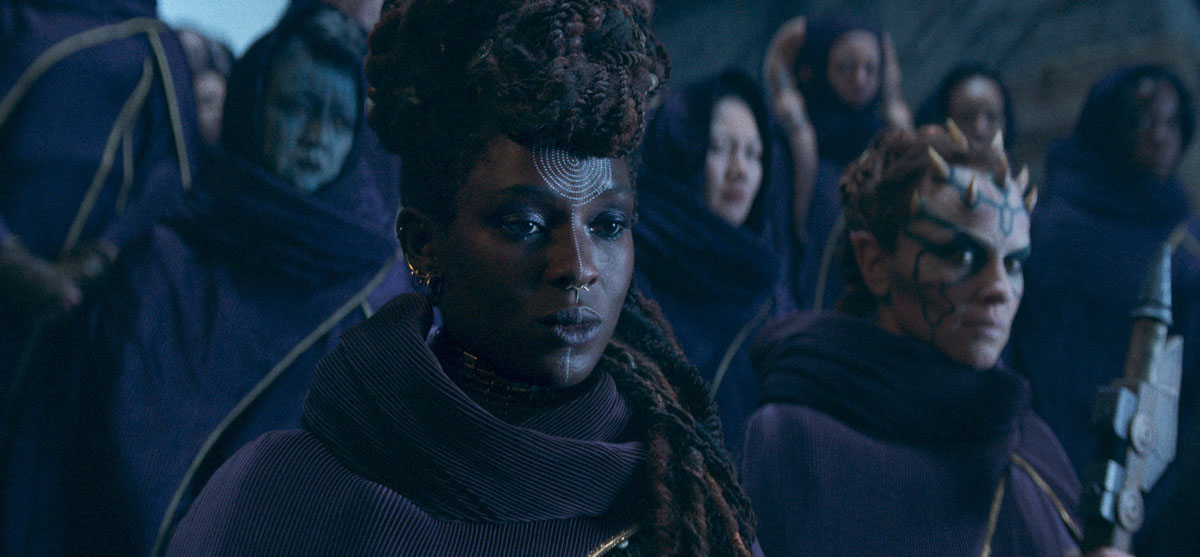
These witches, led by Mother Aniseya (Jodie Turner-Smith) made their home on the planet Brendok, a place beyond the High Republic’s jurisdiction. That’s a vital detail to understanding the severity of the sin for which Mae has decided four Jedi must pay for their lives, a vendetta that began with her murder of Carrie-Anne Moss’ Master Indara.

"Destiny," the third episode, written by Jasmyne Flournoy and Eileen Shim flashes back 16 years to the incident that made Mae an assassin and briefly set Osha on the path to mastering the Jedi arts. Understanding the enormity of what happened means seeing what was lost.

Osha and Mae’s backstory shows how similar the core of coven’s faith is to that of the Jedi save for different terminologies – to them, the Force is known as the Thread – and practices. “The galaxy is not a place that welcomes women like us, witches who have the abilities we do,” Aniseya tells her children. 

Those abilities, as we come to find out, are expansive.  Osha and Mae don't have a father. Their other parent Mother Koril (Margarita Levieva) carried them, and hints in passing that the Jedi would frown upon the circumstances of their conception.

“The twins are not normal children,” Koril warns Aniseya, but we already know that. One hundred years after these events, another pair of twins will save the Republic from the Empire that presumably rises from the seeds of whatever is being planted in this era.

Star Wars: The AcolyteStar Wars: The Acolyte (Lucasfilm Ltd. / Disney+)
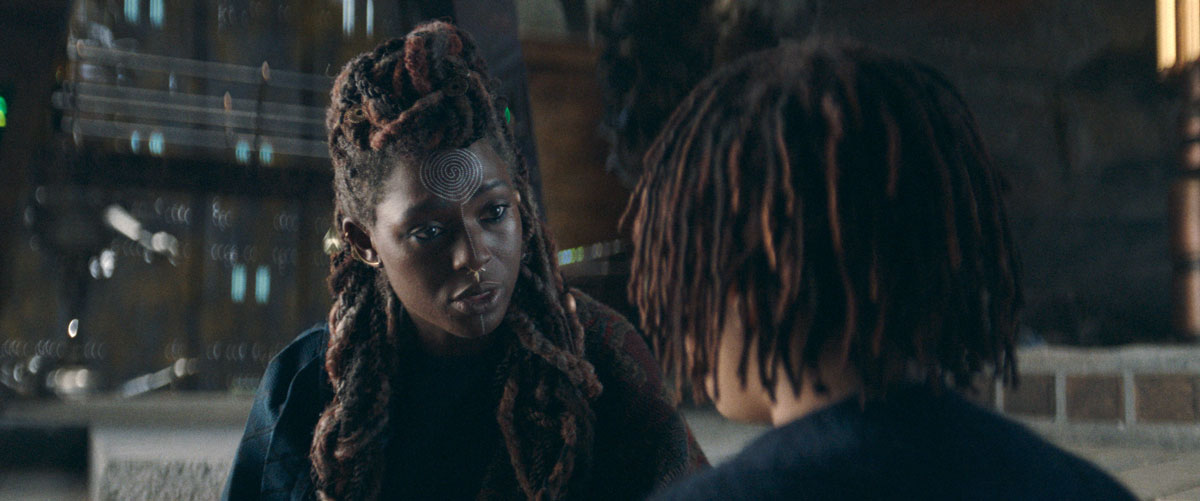
In the High Republic age, since this coven is considered to be dark and unnatural, Osha and Mae would be viewed that way too. But the audience only sees a loving group that protects their youngest – the only children in their group — and spoils them with sweets called spice creams. (Not much imagination goes into inventing creative terms for the smallest accouterments in “Star Wars,” alas.)

Anyone who despises encountering feminist themes in their “Star Wars” stories already hates “The Acolyte.” But "Destiny" contains deep links to the discourse, some alluding to widely critiqued elements of modern goddess worship in white feminism. Calling the witches' power source The Thread may be inspired by the Muses or by the myth of Arachne, in which a skilled weaver defeats Athena, who responds by transforming her into a spider.

(Left out of this rudimentary description is that Arachne is from an outsider culture, and her winning tapestry depicted all the times male gods forced themselves on human women. Arachne was right. But she didn’t represent the Olympian patriarchy and therefore had to be punished.)

“The galaxy is not a place that welcomes women like us."

The coven’s cloistered stronghold is a peaceful place where Mae and Osha's elders try to keep them hidden in the hours leading up to a ceremony called the Ascension. This is the coven’s version of a confirmation ceremony, only in addition to officially taking their faith, Osha and Mae agree to inherit their mother’s power.

Mae is enthusiastic to undergo this rite of passage. Osha has doubts, especially once she learns that four Jedi are searching for the twins – Indara, Sol (Lee Jung-jae), Torbin (Dean-Charles Chapman) and a Wookiee named Kelnacca (Joonas Suotamo).

Star Wars: The AcolyteStar Wars: The Acolyte (Lucasfilm Ltd. / Disney+)
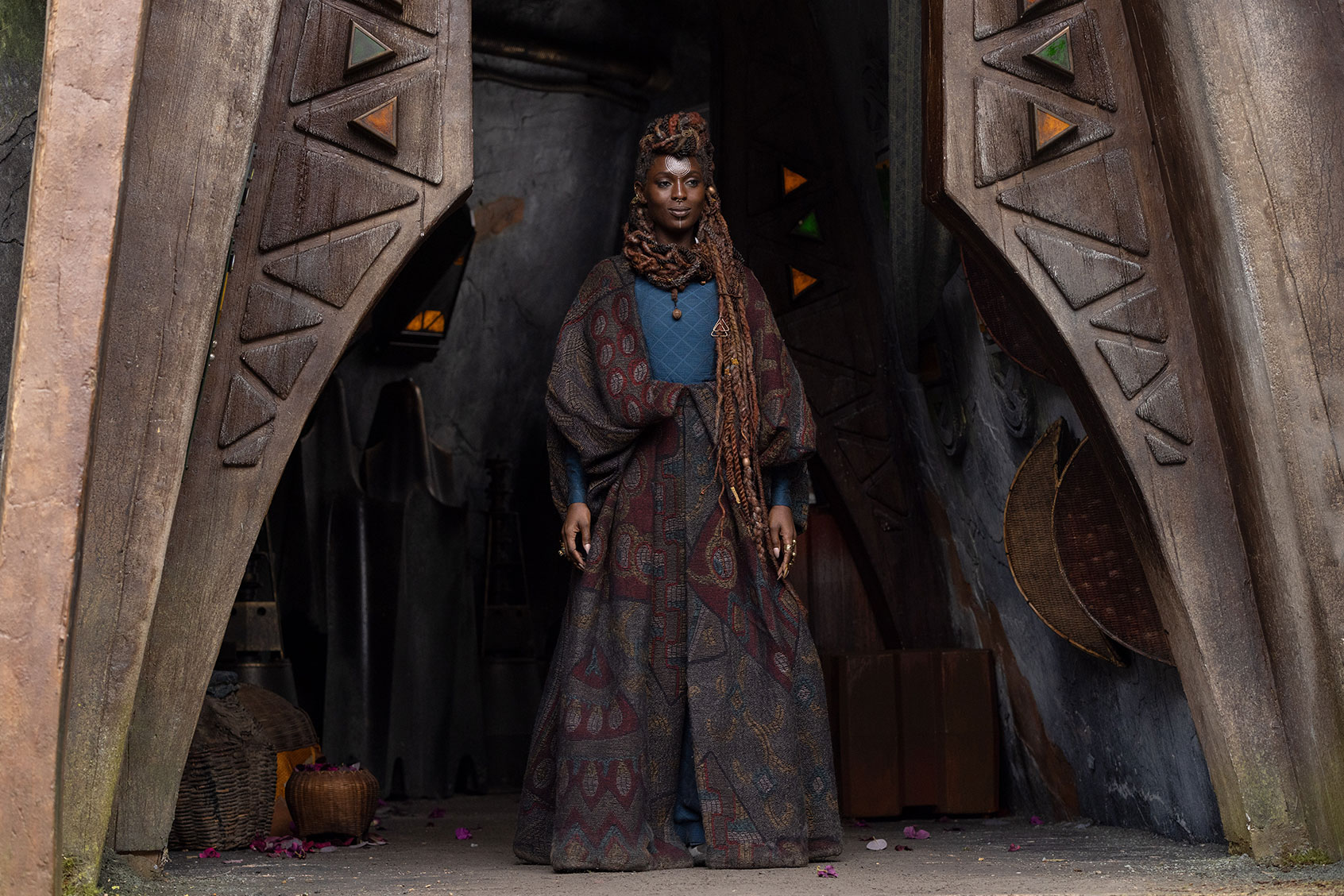
Osha has internalized the dominant messaging about the Jedi, which is they’re the arbiters of goodness in the universe while witches are evil. Jedi law prohibits the training of Force-wielding children by any other than their Order, making Osha question whether the culture in which she’s been raised is wrong.

Many interpretations of “Star Wars” spirituality cite Christianity and Buddhism as Lucas’ main influences in creating the Force. But in 1999 Lucas told journalist Bill Moyers (who was also an ordained minister) that he included the Force in “Star Wars” “to try to awaken a certain kind of spirituality in young people – more a belief in God than a belief in any particular religious system. I wanted to make it so that young people would begin to ask questions about the mystery.” 

We need your help to stay independent

Later in that Time magazine interview, Lucas said, “I didn’t want to invent a religion. I wanted to try to explain in a different way the religions that have already existed. I wanted to express it all.”

At the time, he may not have imagined how Headland, through Flournoy and Shim’s script, would interpret that.

Star Wars: The AcolyteStar Wars: The Acolyte (Lucasfilm Ltd. / Disney+)

The family Mae and Osha were born into comprises women from many races and worlds who look to Aniseya, a Black woman, for leadership and guidance.

Anyone who despises encountering feminist themes in their “Star Wars” stories already hates “The Acolyte.” But this episode contains deep links to the discourse.

Casting Turner-Smith in this role nods toward matrilineal societies that existed for centuries on the African continent, among the Americas’ Indigenous peoples and in Asian societies. Explorers’ interactions with these cultures fueled Europe’s so-called “civilizing missions” to correct what they viewed as upside-down societal structures.

When Aniseya establishes the terms of the coven’s conflict with the Jedi by explaining that it isn’t about which side is good and which is bad, but that “this is about power and who is allowed to use it,” the “Acolyte” writers paint the Jedi as a colonizing force.  

Only in recent “Star Wars” films and TV shows have other systems come into play, like the Way of the Mandalore or even the concept of being Force-sensitive. But the witches on Brendok exist outside the Republic’s political system and therefore ostensibly beyond the jurisdiction of its spiritual warrior class.

Presumably, Lucasfilm only allows its writers to take their sociopolitical parables point; we can’t leave the audience thinking that the Jedi might not be the good guys all the time, merely that mistakes were made.


Want a daily wrap-up of all the news and commentary Salon has to offer? Subscribe to our morning newsletter, Crash Course.


Thus, the fire obliquely referenced in previous episodes that was presumed to have killed Mae and the rest of the coven is shown as having been started by . . . Mae. Before that, Aniseya reluctantly gives Osha's choice her blessing, absolving Indara, Sol and the rest of any kidnapping charges. (Ventress, as “Clone Wars” viewers know, was not so lucky.)

The Jedi were trying to do what they thought to be the right thing, which is often the first defense among those who overreach and end up hurting people. “The Acolyte” also allows Sol and Torbin, at least, to show enough wisdom and humility to know they’ve done wrong and try to atone in some way.

That pushes them into the moral range between the certainties or one or the other, which is the best part of the most provocative spiritual and narrative journeys. This show may end up falling short, but with "Destiny" it fulfills a guiding objective of its universe’s creator by inviting viewers to question a dogma long ago accepted as righteous.

New episodes of "Star Wars: The Acolyte" stream Tuesdays at 9 p.m. ET/ 6 p.m. PT on Disney+.

General Mills sued by its Black workers over race-based discrimination from “white supremacists”

General Mills — the multinational manufacturer of several notable cereal brands — has been sued by eight Black employees who say they faced race-based discrimination at the hands of white managers in one of the company’s Georgia-based plants.

The class-action complaint was filed in the U.S. District Court for the Northern District of Georgia on June 2. The plaintiffs include Gary Davis, Joe Davis, Devahn Jefferson, Keith McClinton, Donald Outlaw, E.J. Rivers and Naaman Smith, who filed individually and on behalf of all other workers who were under similar circumstances at the manufacturing plant located in Covington, Ga. The plaintiffs are current and former employees of General Mills who either work, or have worked, at the plant during the last four years. 

In the federal lawsuit, the plaintiffs allege that General Mills and its managers violated the Civil Rights Act of 1866 along with the Georgia and Federal RICO Acts. The suit states that both the company and its managers favor white employees over Black employees, explaining that the former are awarded more promotional opportunities while the latter face more disciplinary actions.

The plaintiffs claim that the plant itself is controlled by a group of “male white supremacists operating in management and HR,” who collectively refer to themselves as the “Good Ole Boys.”

“The ‘Good Ole Boys’ believe that history and symbols that have been co-opted or misappropriated by the Ku Klux Klan and other white supremacist hate groups are useful to keep Black people ‘in their place’ and discourage Black people from speaking or taking action against the disparate treatment of Black employees at the Covington facility,” the lawsuit states.

The suit continues, saying that since the plant opened in 1988, certain policies and systems have been implemented to benefit white employees and threaten Black employees. It goes on to list more than 20 pages of instances, which prove that the managers “embraced a racially hostile work environment perpetuated by white supremacists who deny black employees,” the plaintiffs allege.

In one incident, the plaintiffs took issue with a mural of Stone Mountain — the largest Confederate monument in the world — which was commissioned by the Good Ole Boys and featured General Mills characters as Confederate generals. The monument touted three mascots, including Cocoa Puffs’ Sonny the Cuckoo Bird as Jefferson Davis, Cinnamon Toast Crunch’s Chef Wendell as Robert E. Lee, and the Cheerios honey bee as Stonewall Jackson, according to the lawsuit.

“The Confederate Mural was approximately twelve feet tall and more than twenty feet wide and was displayed from approximately 2005 until 2021 at the East Plant, just outside of a production area where Black employees were required to pass every day,” per the plaintiffs.


Want more great food writing and recipes? Subscribe to Salon Food's newsletter, The Bite.


In another incident, plaintiff Keith McClinton says that in 2006 he found the letters “KKK” written on his personal lunchbox. After reporting the incident, management reportedly asked McClinton to provide a handwriting sample to prove it wasn’t him who wrote those letters.

The lawsuit mentions a separate incident that took place in 1993 where a noose was left at a plaintiff’s desk. The same plaintiff says that just one year later, he was told by a white employee to “go back to Africa.”

The eight plaintiffs say the “egregious incidents of racism” have been ignored by the human resources departments, both locally and on the corporate level, for 20 years. They claim HR also informs the plant’s white managers about the complaints and which Black employees made the complaints.

The plaintiffs are currently seeking a jury trial in hopes of acquiring a “declaratory judgment that the systemic pattern and practice of racially hostile and discriminatory employment practices” caused “catastrophic harm” to the plant’s Black employees. They are also asking for financial losses in the form of “threefold the damages they sustained plus the cost of this lawsuit” and attorney’s fees.

Charleston chef becomes first West Virginian to take home a James Beard Award

The annual James Beard Awards — hailed as the biggest night for all things food and drink — took place Monday at the Lyric Opera of Chicago. This year’s showcase celebrated culinary achievements spanning across cuisines and a myriad of acclaimed chefs, restaurateurs, bartenders and other industry professionals.

Chefs Marcus Samuelsson, Nyesha Arrington, Richard Blais, Tim Flores and Genie Kwon presented the regional awards, which spotlighted chefs in different parts of the nation. Paul Smith, chef at 1010 Bridge in Charleston, West Virginia, and winner of Best Chef: Southeast, made history by becoming the first West Virginian to take home a James Beard Award. “Two words that have never been mentioned here before: West Virginia,” Smith said during his acceptance speech.

Lord Maynard Llera won the Best Chef: California award for his Los Angeles-based restaurant Kuya Lord, focused on Southern Tagalog Region cuisine. David Standridge won Best Chef: Northeast for his sustainable seafood spot The Shipwright's Daughter located in Mystic, Connecticut. Harley Peet secured the Best Chef: Mid-Atlantic award for Bas Rouge located in Easton, Maryland. And “Top Chef” alum Gregory Gourdet took home the Best Chef: Northwest and Pacific award for his Haitian-inspired culinary haven kaan, located in Portland, Oregon. “Access to food is a basic human right and should never be used as a tool of war against innocent people,” Gourdet said.

Additionally, Hajime Sato became the first sushi chef to win Best Chef: Great Lakes for his restaurant Sozai in Clawson, Michigan.  

The Best New Restaurant award went to Dakar NOLA of New Orleans, whose chef Serigne Mbaye tearfully praised his team while on stage. Mbaye was named “Chef of the Year” by Eater NOLA in 2021. In 2022 and 2023, he was nominated for a James Beard award.

The biggest award of the night — the Outstanding Chef award — was given to Michael Rafidi, chef of Washington D.C.’s Albi. Rafidi dedicated his award to “Palestine and to all the Palestinian people out there, whether it’s here or in Palestine or all over the world.”

Donald Trump admits he still has a gun, despite felony convictions

Donald Trump, recently convicted on 34 felony charges related to falsifying business records, admitted to New York officials that he had not surrendered a gun he possesses in Florida but that was registered in New York, according to CNN. It is a federal crime for someone convicted of a felony to possess a firearm or ammunition.

An official who was briefed on the pre-sentencing meeting told CNN that Trump admitted to still possessing one of the three fireams listed on his New York City permit to carry concealed weapons. Two of the three pistols he was licensed to carry were handed over to police in March 2023, after his gun license was suspended in light of his arrest by the Manhattan District Attorney's office. The third gun was "lawfully moved to Florida," presumably to his estate at Mar-a-Lago in Palm Beach, where Trump was for the remotely-conducted hearing.

Palm Beach police told CNN that they were not told of any gun that Trump might have, and none were turned over to them since his conviction in May. The New York City Police Department has now notified police in Florida and asked them to take appropriate action.

Trump, who promised the National Rifle Association to reverse President Joe Biden's gun control measures, has long bragged about his guns and what he would do with them. After the deadly 2016 terrorist attacks in Paris, Trump told a French magazine that "I always carry a weapon on me" and that if he was there, he would have opened fire on the assailants.

For just $35, you can send your child to Chick-fil-A’s eyebrow-raising summer camp in Louisiana

Chick-fil-A has caused quite a stir after one of the chain's Louisiana locations announced the launch of its summer camp for children. The Chick-fil-A restaurant in Hammond invited parents to sign their kids up to cosplay as a Chick-fil-A employee. The camp, which will take place between July 22 to July 24, will teach attendees how to take orders, bag orders and work as a host, per a Facebook post about the camp. Attendees will also learn customer service skills and make their own Ice Dream cone or cup.

News of the camp first went public on June 6 and since then, several commenters have been sharing their two-cents on the kid-focused initiative. Many expressed sheer confusion and shock while others accused the Hammond Chick-fil-A of shamelessly utilizing child labor.“So, you are charging kids to be trained for minimum wage jobs?” wrote one user. Another warned the restaurant, “Take this down before you end up as national news for all the wrong reasons. Or rather, keep it up so we can laugh at you when you do.”

“Wait. You're wanting parents to *check notes* pay you to use their young children as laborers. But they get a free meal, snack and shirt that will give you free advertising?” a separate user asked. 

A few folks applauded Chick-fil-A, saying the camp is actually helpful in teaching children valuable work skills. “I’ll go against the grain here. Kudos to you, Chick-Fil-A Hammond. It’s nice to see an offer to teach young children about work ethic and responsibility, while having a little fun at the same time. I’ll ask my daughter if she’s interested in attending,” wrote one user.

The summer camp includes three sessions that each last from 9:00 a.m. to 12:00 p.m. The cost is $35 per child and will include a kids meal, T-shirt, name tag, and snack. At this time, all sessions for the camp are sold out.

For Republicans, raw milk is the new masking

Ever vigilant about stoking fears among their constituents regarding the threat of governmental overreach, Republican leaders, as a form of political strategy, frequently crow about all the things liberals allegedly want to take away from working Americans. The White House is coming for their guns, they say, or perhaps their gas stoves — or even pints of raw milk that have potentially been contaminated with bird flu. 

In early December, Sonoma County, California, declared an agricultural disaster when two poultry farms had to kill their entire flocks to try to stop “highly pathogenic avian influenza” — or bird flu — from spreading. This particular strain of bird flu, H5N1, had first been reported in the United States in early 2022 and since then, tens of millions of turkey and chickens at commercial farms have since been killed to try to suppress the outbreak. 

While the transmission of bird flu to other mammals is rare, it is occurring currently. 

As of June 9, ten states, including North Carolina, Ohio, Michigan and Texas, have reported outbreaks among dairy cattle and an estimated 85 dairy herds nationwide have been infected; however, there isn’t a federal requirement for dairy farms to test their herds outside interstate movements of milking cows, so many farmers are opting out. This opened the door for human exposure and as of now, there have been three documented cases of H5N1 in humans. As Kay Russo, a dairy-poultry veterinarian, wrote for Scientific American on Tuesday, one of the cases presented with respiratory issues, which means there’s potential for human-to-human spread through coughing. 

“With the virus crossing species barriers, the specter of human exposure and emergence of a human-adapted strain is rapidly intensifying,” Russo, along with co-authors Michelle Kromm and Carol Cardona, continued. “This outbreak in dairy cows has the potential to spiral into a human epidemic or even a catastrophic pandemic — the signals of which we may already be seeing.” 

Many experts, including Dr. Scott Roberts, a Yale New Haven Hospital Infectious Disease specialist and assistant professor in infectious diseases at Yale School of Medicine, believe the milk available at supermarkets is largely safe to drink because the pasteurization process it undergoes would kill any lingering traces of infection. Conversely, the Centers for Disease Control and Prevention (CDC) warn that consuming raw, unpasteurized milk could come with big health risks. 

"There is concern that consumption of unpasteurized milk and products made from unpasteurized milk contaminated with HPAI A(H5N1) virus could transmit HPAI A(H5N1) virus to people; however, the risk of human infection is unknown at this time," the agency writes

We need your help to stay independent

However, in recent weeks, as the number of bird flu cases have climbed, so have sales of raw milk. This is because numerous Republican public figures have decried what they perceive to be attempts from the government and “Big Milk” to infringe on their right to consume the beverage, regardless of whether it contributes to the human-to-human spread of bird flu. It’s an attitude that closely mimics the party’s approach to the COVID-19 pandemic and the ways in which their members refused to participate in even basic public health and safety measures. 

Essentially, for Republicans, it seems like avoiding raw milk is the new masking — and they’re just not going to do it in order to prove a point. 

For instance, in April, Infowars host Owen Shroyer called the Food and Drug Administration a “gangster mafia” who wanted to “make raw milk illegal.” 

“So, now that more people are going to local farms and farmers markets and consuming raw milk, this angers the FDA,” Shroyer said. “This angers Big Milk. Say, ‘No, you need to pasteurize milk, it’s a lot less healthy for you.’ See, eventually, they’ll just make it illegal. They’ll just make raw milk illegal. That’s what this is all about.” 

That same month, as Media Matters reported, right-wing media outlet TheBlaze published an article titled “Blaze News Investigates: The truth about raw milk the government doesn't want you to know: ‘Close to a perfect food,’” which told readers that “the so-called ‘experts’ are not telling you the full story” and that “unfortunately, the potential benefits of raw dairy are a secret to most Americans.” 

Now, the conservative youth organization Turning Point USA is selling a plain white t-shirt emblazoned with a line illustration of a dairy cow. The caption reads: “got raw milk?” 

"See, eventually, they’ll just make it illegal. They’ll just make raw milk illegal. That’s what this is all about."

However, raw milk hasn’t just been drafted into the culture wars; it is the subject of several new policies under consideration, notably a bill in Louisiana which would legalize the sale of raw milk in the state. HB467, which is set to become law, “passed unanimously in the House to a chorus of mooing lawmakers last month,” reported NOLA.com, though the bill was watered down in the Senate after the Louisiana Department of Health estimated it would take roughly $900,000 a year and seven employees to regulate raw milk for human consumption.

“Eventually, legislators agreed raw milk could be sold, but only with labels that say "not for human consumption" and warn of the potential for ‘harmful bacteria,’” the report continued. “Lawmakers acknowledged that the label likely would not prevent people from drinking it, which is legal.” 

"I don't care what you do with it after you get it," said Sen. Stewart Cathey, R-Monroe, during a Senate Agriculture meeting. 

“So rude of you”: Republican snaps after Democratic lawmaker reminds him that a jury convicted Trump

Rep. Ralph Norman, R-S.C., snapped at a Democratic colleague Tuesday after being interrupted during a meeting of the the House Rules Committee.

“Listening to these smokescreens that my friends on the other side of the aisle are saying, they bring up the trial of Donald Trump, convicted felon. Really? By a judge that is a known anti-Trumper?" Norman said before Rep. Jerrold Nadler, D-N.Y., interrupted him.

“A jury, a jury, not by a judge,” Nadler corrected.

“Mr. Nadler, I’ve got the floor!” Norman shouted. “If you gonna interrupt  Mr. Chairman, calm him down when he interrupts. It’s my time and I’ll let you respond, but I’m tired of this. You talk over everybody. It’s so rude of you!"

After Trump was found guilty on 34 counts of falsying of business records last month, Democrats have been quick to remind everyone that Trump is, in their words, a "convicted felon."

Republicans, however, have criticized the judge who oversaw Trump’s trial for donating a total of $35 to the Democratic Party in 2020, including $15 to the Biden-Harris campaign.

In the meeting, Norman brought up Hunter Biden, who was found guilty of three felony counts on Tuesday and faces up to 25 years in prison for lying about his drug addiction when he purchased a firearm. Norman said it was “strange” Biden was prosecuted for those charges but not some of Biden’s business dealings; despite months of investigations, Republicans have failed to uncover any evidence of criminality.

“I’m tired of these smokescreens, you’re talking about miscarriage of justice, it really is,” Norman said.

In the same meeting, Rep. Jim McGovern, D-Mass., slammed Republicans for similar accusations, namely that Democrats have “weaponized” the justice system after Trump’s felony convictions. Some Republicans have gone so far as to claim Biden orchestrated his son’s guilty verdict to create an “equal illusion of justice,” MSNBC reported.

“That is how you think when you’re in a cult,” McGovern said of the GOP conspiracy theories. He also contrasted Republican leaders’ reaction to Trump’s conviction with Biden’s reaction to his son’s conviction; the president has said he accepts the outcome of his son’s trial and “will continue to respect the judicial process.” 

“It’s a great reminder that one political party remains committed to the rule of law and the other doesn’t,” McGovern said.

“It appears to be a payoff”: Expert says Kushner’s Saudi cash an “egregious” national security worry

Based on his prior experience and demonstrated abilities, Jared Kushner never should have landed a job in the White House. Before joining the Trump administration, Kushner was best known as his father’s son — a real estate mogul and disbarred attorney who gifted his child control over the family’s portfolio after being convicted of multiple felonies — whose greatest accomplishment was purchasing a New York City skyscraper for $1.8 billion just months before the housing market crashed, slashing the property's value in half.

To be fair, Kushner made the best of his time in public service and appears to have turned it all around. Although he did not achieve peace in Israel and Palestine, Kushner was able to establish strategically important friendships with future benefactors in the Persian Gulf, a region he visited no fewer than 10 times on the taxpayer’s dime. A day before the January 6 insurrection, he was in Saudi Arabia for an event marking the restoration of relations between the kingdom and its rival, Qatar.

Out of office two weeks later, Kushner started up an investment firm, Affinity Partners, that quickly attracted big-time investors from the Middle East, despite the 43-year-old owner’s lack of experience running such an operation and a Google-able record of botching his only major investment decision.

As The New York Times reported in April, Kushner’s investment fund, valued at $3 billion, “is financed almost entirely from overseas investors with whom he worked when he served as a senior adviser in the Trump White House.”

Some two-thirds of that money has come from Saudi Arabia’s state-run Public Investment Fund, whose own advisers deemed Kushner’s fund “unsatisfactory in all aspects” only to be overruled by a board that includes Crown Prince Mohammed bin Salman, the man who ordered the killing of U.S.-Saudi journalist Jamal Khashoggi when Trump was in office and who Kushner today describes as a “visionary leader.” The other third? Much of it reportedly comes from other sovereign wealth funds run by the likes of Qatar and the United Arab Emirates.

That arrangement — Kusner receiving billions of dollars from friends he made as a government employee — has attracted scrutiny from Democrats and watchdog groups, who suspect that Charles Kushner’s son (turned Ivanka Trump’s husband) might be doing so well for reasons that are not entirely above board.

In a letter sent Wednesday, Senate Finance Chairman Ron Wyden, D-Ore., demanded that Kushner and company answer questions about their relations with foreign powers and suggested that what he knows so far points to their investments being part of an influence operation.

“Mr. Kushner’s limited track record as an investor, including his nonexistent experience in private equity or hedge funds, raise questions regarding the investment strategy behind the seeding investments and lucrative compensation that Affinity received from the Saudi PIF and other sovereign wealth funds,” Wyden wrote in the letter, addressed to Affinity Partners’ chief financial officer, Lauren Key. In addition to the investments themselves, Kushner’s firm charges a 2% fee to manage the states’ assets, generating at least $80 million from the Saudis alone.

It all adds up to “an appearance that Affinity’s investors are motivated not by commercial interests of seeking a return on investment,” Wyden wrote, “but rather by strategic considerations of foreign nationals seeking to funnel money to U.S. individuals with personal connections to former President Trump.”

We need your help to stay independent

Since being awarded billions by governments he worked with — Kushner arranged it so Trump’s first state visit was to Saudi Arabia — the former president’s son-in-law has used at least some of the money to pursue projects that Trump himself was interested in. Earlier this year, Kushner scored a major real estate deal in Belgrade, Serbia, under which Affinity Partners will have the exclusive rights to build a luxury compound on the site of a former army headquarters that was bombed by NATO in 1999. Trump had wanted to build a hotel on the same site, where Kushner has agreed to finance a memorial on behalf of the pro-Russia Serbian government that will mark the NATO campaign, which came as Belgrade’s forces were committing war crimes in neighboring Kosovo.

Virginia Canter, former chief ethics counsel for the Treasury Department and now an attorney with the watchdog group Citizens for Responsibility and Ethics in Washington, said an investigation of Kushner is not just “long overdue” but “vital for our national security.”

“It’s pretty apparent that he made and was involved in decisions that were unusually favorable to the Saudis and then he turned around, within weeks of leaving the White House, and was engaging in negotiations with them to obtain a $2 billion investment,” Canter told Salon. “It just raises all kinds of national security concerns for a former government official at that level – a former White House official — who never qualified, legitimately, for a security clearance.”


Want a daily wrap-up of all the news and commentary Salon has to offer? Subscribe to our morning newsletter, Crash Course.


Even before he left office, there were concerns about Kushner’s ties to sketchy interests. He was indeed denied a security clearance, The New York Times reported, after officials “raised questions about this and his family’s real estate business’s ties to foreign governments and investors”; he only obtained one after his father-in-law intervened. While in government, and following the murder of Khashoggi inside of Saudi Arabia’s Turkish embassy, Kushner, by then on a first-name basis with the Saudi leader who ordered the killing, “became the prince’s most important defender in side the White House,” per the Times.

“Every action he took seemed driven by what was going to come after he left office,” Canter said, noting that Kushner’s Trump-ordered security clearance granted him access to valuable, top-secret information. While he’s not the first former government official who has sought to cash in, Kushner is one of the few to completely disregard the traditional cooling off period (the other: former Trump Treasury Secretary Steven Mnuchin, whose investment firm is also backed by Riyadh).

“It’s one of the most egregious situations I’ve ever seen in decades of working in the federal government as an ethics official,” Canter said. “It appears to be a payoff as much as a potential investment,” she said, and also something of a purchase: buying Trump’s continued support for the Saudi government, which has also paid the former president millions of dollars to host its Liv Golf events. By enriching Kushner, and consequently Trump’s daughter, Ivanka, the Saudis have increased the potential cost, personally, for ever breaking with them politically.

“That,” Canter said, “may be a way of keeping Trump, in or out of office, on the Saudi side.”

Rachel Maddow: Trump’s speeches aren’t just “incoherent” — they’re “pornographically violent”

MSNBC's Rachel Maddow on Tuesday took Donald Trump to task over his often inflammatory speeches after a strange tangent during his Las Vegas rally over the weekend.

During an interview with Nicolle Wallace on MSNBC's "Deadline: White House," Maddow said that while she feels the network should not carry the former president's speeches live, "it is worth knowing what he's saying."

"And it's worth conveying that when it's something dangerous, when it's something new, when it's something newsmaking — and indeed when it is nonsense," she added.

Speaking about Trump's odd comments at a recent rally in Las Vegas in which he hypothesized whether it would be worse to be electrocuted or bit by a shark — a seeming effort to criticize electric vehicles — Maddow said, "it was complete gibberish," adding that "it's not the first time he has done it."

"Like, where are the Las Vegas sharks?" the MSNBC host asked, commenting on the fact that the area is entirely landlocked. "Are they freshwater sharks? Are they in the fountains in Las Vegas?"

"The shark-boat thing, to me, I think it has two points of resonance," said Maddow. "And one of them is, what the heck is he talking about? This is weird. This doesn't make any sense. He's really, really, frequently incoherent. And when he's not incoherent, he's speaking in terms that are like pornographically violent when he is trying to rile up his audience. I mean, he speaks in ways that I think would be shocking to a lot of Republican people if they could stand to listen to him longer than they do and if news organizations could responsibly broadcast more."

On “Top Chef,” a frontrunner emerges as the numbers dwindle

Well, as a Savannah fan, it certainly goes without saying that I’m a happy camper after that episode! A Savannah clean sweep? I don't think "Top Chef: Wisconsin" could get any better — unless she pulls out the big win in the finale, of course.

Overall, I thought that was such a perfectly edited episode, with highs and lows, humor and drama, such thorough run-throughs of each dish and all of the subtleties of the cookery, along with flashbacks galore — and perhaps even some foreshadowing for the final two episodes of the season?

I also loved the focus on the chefs, the in-depth nature of the edit and all of the flavors across the board and the excitement to wrap up the time in Wisconsin as the final four travel to Curacao for the finale.

Featuring a "show us your growth" elimination challenge and a tried-and-true "Top Chef" classic with a blindfolded taste test component in the Quick Fire, this episode fired on all cylinders.

Here are the rest of my takeaways. The finale is just around the corner!

01
 
There was a very quick moment in the "previously on 'Top Chef'" segment that I didn't even recall and found interesting to include: It showed a moment of Dan and Danny at judges' table and Dan leans in and says "it's getting real familiar up here." That was definitely included for a reason and I'm very curious to find out if that has positive or negative connotation leading into the final episodes of the season.
02
 

According to "The Dish with Kish" — a digital after-show hosted by Kirsten, found on Peacock or YouTube — Manny had the highest-ever score in the blindfolded taste test, with 23/26 correct. Amazing! I've always wanted to do one. I liked how the challenge was in alphabetical order, from anchovy to za'atar (including vadouvan and umeboshi, which always makes me think of "Top Model" season 3). 


I laughed at the editing of the taste test more than I have while watching this show in a minute. I also got a kick out of that seemingly inexplicable inclusion of Manny's brushing his tongue in the very beginning of the episode, but it obviously made more sense with the context of his win and Danny's confessional joking about the tongue scraper. 


I loved Manny's quote: "I like to think that my taste buds are where they need to be, maybe that's one of the reasons I'm in the Top 5." Well put!

03
 

It was so cool to see Savannah win (yet another) Quick Fire, and with only nine ingredients, as she was tied for the least amount of correct guesses in the taste test. I loved the fry on her pork, which reminded me of her fry in Restaurant Wars, as well as the inclusion of cheddar in the "faux" Caesar. Three QF wins in a row!


Laura's mussels escabeche also sounded terrific; I'm a sucker for a good escabeche. And how superb does a watermelon A1 sauce sound? 


I'm still sort of amazed over Dan's Quick Fire dish — was there really shell in it? It's pretty wild to serve that at top 5. I also found the dynamic really interesting: There's such convivial, jovial chatter and tone, but also a tepid acknowledgment that that was by far his worst dish yet. Which, this season more than any, could really hinder your chances at judges' table. It's an interesting dichotomy.


There was a moment when Tom nonchalantly asked Dan to "tell us everything wrong with your dish." 


"We know you can cook," he said. "But you'd never know it today." 


That was probably one of the more scathing things I've ever heard him say on this show. Speaking of,  this episode had some really damning comments in general, from "all I'm eating is smoke" to "[this dish] is suffering from an identity crisis." 

04
 
I adored the prompt of the final challenge in Wisconsin, basically encompassing all of your growth in the competition into a single dish. Like I previously mentioned, I love the momentum, the gravitas, the excitement of those final challenges in the last few episodes. They're always such a pleasure to watch. This one was also super cool because the prompt had no hard-and-fast parameters whatsoever, which allowed for some really terrific dishes, like Savannah's and Laura's.
 
I also liked seeing the recurring characters, if you will, from Danny's soba-cha tea and Dan's walleye to fantastic guest judge Chef Elena Terry. It was also really cool seeing some open feedback and opinions from the judges overall — about topics like Laura's return, Savannah's Quick Fire and Manny's week one puzzle — instead of those being strictly limited to the dishes themselves.

We need your help to stay independent

05
 

Unfortunately, Manny wasn't able to parlay his success in the blind taste test to the Quick Fire itself, or to the elimination challenge, either, ultimately seeing him eliminated him in fifth place. I am such a fan of his and I'm certain he'll be incredibly successful in the future. Would also love to see the Kevin/Manny pair back on another season sometime down the road! 


There were so many references to Dan's lemongrass and turmeric paste (when he originally wanted fresh lemongrass) that I wondered if that might be the ingredient that takes him out of the competition — but it was no match for Manny's raw fish. I actually didn't think that the Quick Fire even had to be discussed whatsoever at judges' table because I figured Manny’s fish would’ve been a clear-cut reason for a "pack your knives and go," but I guess Dan’s over-smoked dish must’ve been objectionable enough to warrant QF discussion. 


I also liked how succinctly Kristen summed up Dan's dish in the elimination challenge, comparing his "Restaurant Wars" walleye iteration to this one and saying that it was "less successful, so the growth isn't there" — which, of course, is the whole point of the challenge. 

06
 

In both the Quick Fire and the elimination challenge, for some reason, I thought Savannah would come up short and Laura would take the win, both times — and I was wrong, both times. 


I loved the quick shot, again, of Savannah in her mirror, as well as her referencing back to that first challenge when she was tasked with making a roast chicken for Tom (complete with an avgolemono sauce, which was one of the standout components of the premiere episode for me). Her pave dish was mind-boggling and I am going to attempt it myself one of these days. The quote "I love a potato pave and I love it even more now that Savannah told us why and how she made it" made clear just how much she impressed that table of chefs and judges. Pretty exciting! She really is "cleaning up," as they say. 


The whole narrative of the "pave = Savannah" was fantastic and she delivered it so well, describing how growth takes time, how the pave needs finesse, how the potato itself already contains everything it needs to become a pave, but just needs "time and pressure." She sold the story so well, so eloquently and it seemed like she cinched the win in that moment, for both of dish and her "speech" — and that sentiment didn't really seem to abate as the entire rest fo the crew presented their dishes. This episode really was a win-win-win for her. 


With these dual wins in this episode, Savannah also joins a select group of "Top Chef" alum who’ve had back-to-back (QF and elim.) wins in a single episode ‘cycle’ — only 10% of competitors ever on this show have accomplished that feat. 


If she does indeed pull off the win, I'd argue that Savannah gifted the editors with one heck of a quote with that pave speech. 


Want more great food writing and recipes? Subscribe to Salon Food's newsletter, The Bite.


07
 

There’s such an effortlessness to Savannah — sort of feels like the editing tries to lean into “oh no! Will the pave work?” but there’s never actually any payoff because she is too capable for that. She just calmly and consistently performs well and then has pretty measured celebrations. I’m fascinated by her entire arc. 


In my recap for episode one, I wrote “Savannah is my dark horse for no reason other than the fact that I always tend to root for under-edited female competitors on reality shows and because she made an avgolemono sauce." Would you look at that! I should become a betting man. 


Such an endgame, late-season domination like this hasn’t been seen ever? The only comparable person I can think of, actually, is Carla, who had a slightly similar trajectory, starting very slow and quiet before emerging as a serious contender and wildly lovable fan favorite as the season continued before unfortunately winding up in third place. I can only hope that that is not the case for Savannah! Other slightly similar trajectories on this show are perhaps Steph Cmar, maybe Melissa from her first season or even Casey Thompson from back in season three. 


At the end of the episode, she called herself "the one to beat."


"I'm realizing it and think other people are, too," she said. I couldn't agree more. 

08

I loved Laura's talking about how she primarily works with Eastern Mediterranean flavors but in this dish, she leaned into Mexican flavors, with guajillo and lamb barbacoa, but also using those flavors in manti, which is usually considered either Turkish or Armenian. Again, her dishes stun: both the aforementioned escabeche and those perfect little manti, She’s so talented, so inventive, so imaginative!


I have an obsession with frizzled onions, so the idea of a burnt onion and cherry sauce sounds utterly magnificent to me. Combine that with a rich, deeply reduced chicken jus and a layered, tightly-compressed potato pave? It doesn't get much better than that.


Also, Manny's gussied-up Saltines sounded so good! I'd love to try those. He'd mentioned snapper a la veracruzana multiple times so I'm glad he got a chance to make it. It was also lovely hearing him describe the experience as "the highlight of [his] life" and listening to Paul Bartolotta telling him to "never forget the pozole," yet another reference to his winning week one dish. I feel like that could be the title of his memoir or cookbook sometime down the road, actually? It has a real ring to it.

09
 
How funny were Tom's facial expressions throughout this entire episode? His reaction to both Dan's Quick Fire dish and to to Danny's use of the word "subtle" as he presented his elimination challenge dish cracked me up — as did that moment with the credit card at Ristorante Bartolotta.
10
 
With the conclusion of this episode, the cheftestants’ time in Wisconsin is over. Our final four are on their way to Curacao. 
 
Savannah and Danny are tied at five wins each, while Dan has two and Laura has two (actually, three overall if we're counting Last Chance Kitchen). Also, one of Danny's wins was in conjunction with Rasika, and she technically won that challenge on her own, so not sure if that counts? In that case, then, Savannah takes the lead. 
 
I’m always a little iffy on the break before the finale — Savannah has had such forward momentum for the past few episodes and I hope that that time at home doesn’t dull that shine and throw her off going into the finale. I'm admittedly a little anxious that she might stumble at the end here. Conversely, Dan seemed quite tired and that time off might be just what he needs to rejuvenate him going into the final challenges.
11
 
What is Kristen so moved by in the next episode? I could be wrong, but my hunch is it has to do with either Laura or Savannah and it’s something very, very positive. I’m really looking forward to that. I always found it so compelling whenever Padma would get emotional at judges’ table. 

Hunter Biden juror says the prosecution was a “waste of taxpayer dollars”

The day after closing arguments in Hunter Biden's felony gun trial wrapped up on Monday, 12 Delaware jurors delivered their verdict: guilty on all three counts, making him the first child of a sitting U.S. president to be convicted of a crime. President Joe Biden has said that he would not pardon his son.

Although the jury needed less than 24 hours to convict, some jurors said afterwards that they felt bad doing so and that the prosecution case seemed aimed "as much to embarrass as it was to convict," in the words of USA Today.

“Honestly, it was heart-wrenching,” Juror 10 told the publication.

Of all the moments in a trial closely bound to Hunter Biden's mental health issues, Juror 10 said that the testimony by his daughter, Naomi — describing how her father's drug use spiraled after the death of his brother, Beau Biden  was the "saddest part of all." The juror recalled being uncomfortable with prosecutors cross-examining Naomi with questions about her father's text messages in an effort to undercut her testimony about his sobriety.

"Naomi probably just wants her dad to be like he was before his brother died," said another juror, identified by USA Today as from the New Castle area. That juror said that she "wasn't a fan of the prosecution," in large part because aspects of their case, such as highlighting a trove of evidence of drug addiction that far predated the gun purchase, seemed unnecessary even if they were trying to get a point across.

“In my opinion, this was a waste of taxpayer dollars,” she said. The juror added that she "didn't want to find him guilty" because the evidence showed "he needed help," but she ultimately voted to convict based on the application of relevant criminal law.

Juror 10, who felt that Hunter Biden knew himself as someone addicted to drugs when he bought the gun, also made his decision based on the facts of the case. “If you are an addict, you are an addict,” he said. “I know personally from people that I know that were drug addicts and alcoholics, this is something that sticks with you for the rest of your life.”

Hunter Biden, who says he has been sober since 2019, faces up to 25 years in prison, though first-time offenders rarely receive the maximum sentence. He will find out within 120 days, according to Judge Maryellen Norieka.

“I don’t think anyone who is a non-violent drug addict should be in prison. Just fine him,” the New Castle-area juror said. “We know he did something wrong. He needs help if he hasn’t gotten it yet.”

Why Republicans are left disappointed by Hunter Biden’s conviction

President Joe Biden's son Hunter was found guilty in federal court of failing to properly fill out a form to buy a gun that he had in his possession for 11 days and never fired. Fair enough. What he did was against the law and a jury of his peers found him guilty. The case was solid. Biden was a drug addict back in 2018 at the time of his crime and he should have admitted it on that form. But people in the midst of an addiction crisis make bad decisions and often get on the wrong side of the law.

Hunter Biden's response to the verdict was to say that he was more grateful for the support of his family, friends and community than he was disappointed in the verdict. And he added, "recovery is a gift from God and I am blessed to receive that gift one day at a time." Joe Biden reiterated that he loves his son and always will and that he is proud of his recovery. He also said that he respects the outcome of the case and the judicial system. Both Bidens were restrained and solemn in the face of a serious legal outcome which, until recently, was simply expected from a president and his family. 

Some Democrats and legal observers wondered about the prosecutorial discretion in bringing the case which is very seldom done in circumstances like this,(as did a couple of the jurors) but across the board, they all respected the verdict and the judicial system. Nobody threatened anyone or vowed to take vengeance on them. Nobody accused the prosecutors, the judge or the jurors of being corrupt. Nobody said the proceedings were rigged. 

Well, actually, a lot of people said it was rigged — but they were all Republicans who simply couldn't take "guilty" for an answer. You can understand why. They've been sobbing and whining and rending their garments for weeks now over Donald Trump's guilty verdict in his Manhattan hush-money trial insisting that the Biden Justice Department (DOJ) had implemented a two-tiered system of justice to target Republicans, specifically Trump. And here you have that same DOJ prosecuting the president's only living son over a crime that Republicans insist is a violation of the Second Amendment. In fact, if it had been anyone else, much less the son of a GOP president, the NRA would have been holding vigils outside the courthouse. If Republicans still required logic and consistency to persuade their voters this whole thing would have been terribly confusing for them. Lucky for them, all they need is lies and demagoguery. 

We need your help to stay independent

It's pretty obvious that talking points were prepared in advance considering the uniformity of most of the commentary. The main complaint was that the trial was orchestrated as a "distraction" from the real crimes of the "Biden Crime Family" and the nefarious deeds of the "Big Guy", President Biden. The same phrases were repeated by one Republican after another. The responses were not quite as hysterical as the ones we were subjected to in the wake of the Trump conviction but they came close. Former Trump administration official Stephen Miller slammed the verdict and the DOJ as "Biden’s election protection racket," a sentiment echoed by Republicans in Congress 

Trump himself has not made a comment as of late Tuesday night (although he did fire off one of his rambling, disjointed attacks on the Manhattan district attorney and remonstrated against his own conviction. ) But his campaign put out a statement immediately after the verdict:

"This trial has been nothing more than a distraction from the real crimes of the Biden Crime Family, which has raked in tens of millions of dollars from China, Russia and Ukraine. Crooked Joe Biden’s reign over the Biden Family Criminal Empire is all coming to an end on November 5th, and never again will a Biden sell government access for personal profit. As for Hunter, we wish him well in his recovery and legal affairs."

Minutes later they sent a corrected version striking that last sentence. We don't know who may have been upset by that small gesture of human decency but it's not hard to guess. 


Want a daily wrap-up of all the news and commentary Salon has to offer? Subscribe to our morning newsletter, Crash Course.


The fact is that President Biden could have replaced the prosecutor in the case, David Weiss, when he took office as he did all the other U.S. Attorneys and as is customary at the beginning of any new administration. He could have ordered the case be withdrawn or he could have pre-emptively pardoned his son. He did not do any of that so as to avoid any appearance of conflict and to allow the Justice Department to maintain its independence as it has been tasked to do for the past half-century. He didn't do it out of respect for the rule of law, something that the Republicans under Trump have completely abandoned, not that they ever had a surfeit of it to begin with. 

Taking a page from their leader's political manual, right-wing media and GOP officials at every level have adopted a manic, overwrought posture that's verging on demented. Obviously, it's hard for them to rationalize this guilty verdict in light of their recent frenzied insistence that Biden is rigging the judicial system to take down Trump but you'd think they would have at least tried to maintain a tiny bit of dignity. But then, they've completely abandoned any pretense of that as well, haven't they?

According to the New York Times, the Trump campaign is disappointed in the guilty verdict because they thought it was going to be a fundraising bonanza for them if Hunter Biden was acquitted. Even their loyal followers aren't likely to open their wallets over an alleged two-tiered system that just convicted the president's beloved son on federal gun charges. How disappointing for them.

Having convinced themselves that Joe Biden is a basket case, they were doubtless even more disappointed that he didn't break down as they expected him to do. Immediately after the verdict was reached, Biden gave a scheduled speech before gun safety advocates (a coincidence since they couldn't know the verdict would come down at the same time.) He was composed, professional and strong despite the fact that he was talking about the pain of losing loved ones and had to emotionally grapple with the fact that his troubled son was facing even more challenges to his sobriety, something that any parent dreads. 

All the Republicans got was this hug:

Normal people find that to be a sign of love and empathy. The MAGA cult sees it as a sign of weakness. They are wrong.