Arab Spring
Two stupid lies the right spread this week
No, there's no new pro-necrophilia law in Egypt, and the EPA isn't "crucifying" all oil companies
The (now updated) Daily Mail story that launched the necrophilia myth (Credit: Daily Mail) Did you hear about the new law in Egypt that the Muslim Brotherhood supported that allowed people to have sex with dead women? It was on all the blogs yesterday. “Hard to come up with a more apt image of the Arab Spring than an aroused Islamist rogering a corpse,” wrote Mark Steyn. It’s hard to come up with a more apt image of the state of contemporary Islamophobia than Mark Steyn furiously pondering the image of “an aroused Islamist rogering a corpse.”
So, it’s not a real thing. There’s no such law or even any evidence that anyone proposed said law, and even if someone had proposed such a law, there is not even a remote possibility that the Egyptian Parliament would consider it. It’s total bullshit. It’s the Daily Mail overhyping a story Al-Arabiya took from a newspaper opinion column written by a dedicated Hosni Mubarak supporter.
The Christian Science Monitor’s Dan Murphy explained as much yesterday, but the people who highlight specious stories like this don’t actually care about “accuracy”; they are just engaged in a propaganda campaign designed to tar all Muslims as violent radical pervert monsters who are slowly taking over the West.
That is actually not the case, and anyone who’s ever met a Muslim could probably tell you!
It’s important to remember that the structure of the Muslim clergy is, by and large, like that of a number of Protestant Christian sects. Anyone can put out a shingle and declare themselves a preacher. The ones to pay attention to are the ones with large followings, or attachment to major institutions of Islamic learning. The preacher in Morocco is like the preacher in Florida who spent so much time and energy publicizing the burning of Qurans.
This seems like a really staggeringly obvious point — there are mainstream Muslim clerics and nutty fringe ones, just like in Mormonism and Judaism and all forms of Christianity! — but the Islamophobia industry has spent years trying to make sure that Americans by and large don’t understand this.
Number 2: That Obama EPA person said they were going to “crucify” the oil industry. This is a much bigger story (though it is still limited almost entirely to the conservative press) because it was first spread by an actual senator: James Inhofe, the Senate’s worst pilot and best friend of oil and gas. And then it was on Fox, obviously.
And it has now become a regular talking point, that Obama’s EPA is “crucifying” oil companies. (Which is bad because oil companies give us our precious life-giving oil!)
Of course the guy, an administrator named Al Armendariz, was specifically talking about going after companies that broke the law. The idea is that the EPA would punish companies that violated the law, because that is the EPA’s whole deal. (Some people think there shouldn’t be any environmental laws and no EPA, but instead of making that argument, they are instead making the untrue claim, based on words taken out of context, that Obama’s EPA is unfairly punishing all oil companies for no reason.)
It is also sort of weird that everyone thinks it’s a political winner to say Obama is being too tough on oil companies when no one likes oil companies, but what do I know.
Alex Pareene writes about politics for Salon and is the author of "The Rude Guide to Mitt." Email him at apareene@salon.com and follow him on Twitter @pareene More Alex Pareene.
Neocons’ new lie
You thought they were gone, but now they're popping up to claim that Iraq inspired the Arab Spring
Dick Cheney, left, and Elliott Abrams (Credit: AP/Pablo Martinez Monsivais) The rulebook for conservative punditry is straightforward. Push for a policy. When it turns into a disaster, defend it. When the defense becomes untenable, ignore it. Finally, when something unrelated but positive occurs, take credit for it.
The newest conservative myth is that the upheavals in the Middle East — called the Arab Spring but occurring too in non-Arab countries like Iran — are a result of the Iraq War. The “freedom” that George W. Bush brought to Iraq had a domino effect on other countries in the region, the argument goes. Neocon Robert Kagan told Salon recently that “there were repeated free elections in Iraq and that undoubtedly had some effect on how neighboring people views their government.” Said Kagan: “I think Egyptians said. ‘If the Iraqis can have elections, why can’t we have elections?’”
Continue Reading CloseJordan Michael Smith writes about U.S. foreign policy for Salon. He has written for the New York Times, Boston Globe and Washington Post. More Jordan Michael Smith.
Meet the Assads
Before violence erupted in Syria, Bashar al-Assad and his fashionable wife, Asma, were sometime media darlings VIDEO
Asma al-Assad (Credit: Reuters/Khaled al-Hariri) Though the news out of Syria has been almost uniformly awful recently — fighting spreading to Damascus and Aleppo, rumors of Russian “anti-terror” troops in the country supporting President Bashar al-Assad, accusations of human rights abuses by some anti-government forces — we have been treated to a fascinating glimpse into the private world of an embattled dictator, thanks to the leak of thousands of Bashar al-Assad’s personal emails. The trove has proved to be perversely comic, with female aides sending the strongman little love notes and at least one unsubstantiated underwear picture. The emails also offer insight into the life of Assad’s wife, Asma, who has continued buying — or attempting to buy — expensive luxury goods while her husband struggles to maintain control of his country. They’re both international pariahs now (except in Moscow), but not long ago, self-pitying Bashar and his fashionable wife, Asma, were two of the Western celebrity media’s favorite autocrats.
Continue Reading Close
Alex Pareene writes about politics for Salon and is the author of "The Rude Guide to Mitt." Email him at apareene@salon.com and follow him on Twitter @pareene More Alex Pareene.
When I was captured by Gadhafi’s forces
After the Libyan rebels we were embedded with came under fire, we became hostages of the regime VIDEO
Libyan rebels head towards the front line outside the eastern town of Brega, Libya Friday, April 1, 2011 (Credit: AP) There is a single main highway along which lies every major city between the rebel stronghold of Benghazi in the east and the capital Tripoli in the west. It snakes along the coast and passes through Ajdabiya, Brega, Sirte and Misrata, cities made world famous by months of back and forth, and deadly, conflict.

The four of us were riding in the back of a blazing red minibus at the beginning of April, approaching the strategic oil town of Brega, where the worst fighting of the conflict had been taking place. Our driver was a teenage boy, like his friend in the passenger’s seat. The so-called front in this war was always changing. But we had already passed the last rebel checkpoint and we knew whatever front existed was beginning to reveal itself.
The Syrian Army’s campaign of terror
When we returned to the site of a protest, the military had already been there -- and committed mass murder
A Syrian forces tank moves along a road during clashes with the Syrian army defectors, in the Rastan area in Homs province, central Syria, on Monday Jan. 30, 2012. (Credit: AP) SAQBA, Syria — When a team of foreign journalists entered the eastern Damascus suburb of Saqba last Friday, they were greeted by a sight that did not bode well for the Syrian regime.
Rebel fighters from the so-called Free Syrian Army were protecting about 5,000 demonstrators calling for the fall of President Bashar al-Assad. One was hoisted onto the shoulders of the protesters. Victory, it seemed, was approaching. Several other neighborhoods nearby saw rebels set up checkpoints and essentially take control.
The devastating crackdown on Egypt’s revolution
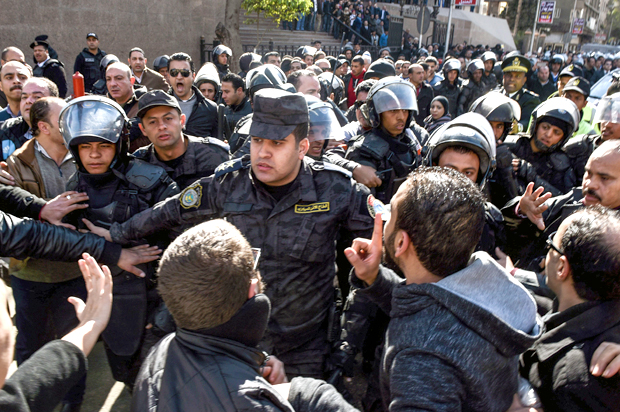
Since Mubarak was deposed, over 12,000 civilians have been tried by shadowy military tribunals
Om Ahmed demonstrates for the release of her son and his friend on July 1, 2011. Both were sentenced to five years in prison in a military trial for breaking curfew. (Credit: Mona Seif/Courtesy) CAIRO — Before the pro-democracy movement’s demonstrations swelled the streets of this city and ousted President Hosni Mubarak, Amr El-Beheiry was a 32-year-old factory worker who hailed from Nile Delta and was proud of his large and very close family.
El-Beheiry struggled like most Egyptians, but his family says he kept a simple dream of being able to afford an apartment and to save enough to finance a modest wedding. He minded his own business.
Continue Reading ClosePage 1 of 6 in Arab Spring