La La Land

The twisted mind behind “La La Land”

The star of Showtime's stunt comedy show explains why he's not Sasha Baron Cohen -- or a sociopath

  • more
    • All Share Services

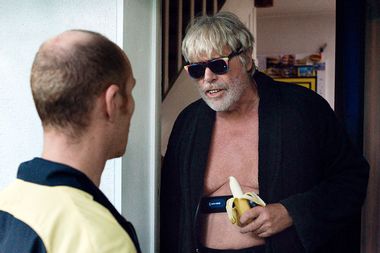
The twisted mind behind Marc Wootton as Brendan in "La La Land."

Marc Wootton is not a sociopath. He’s a very nice guy who simply doesn’t like psychics or racist Minutemen or narcissistic aspiring actors all that much, hence some of the more notorious scenes in his new Showtime comedy, “La La Land” (11 p.m. Mondays), now nearing the end of its six-episode run. Even so, when you watch one of Wootton’s alter egos torment his chosen victims with the relish more typically found among house cats and vengeful jihadis, you will wonder about him.

In order to answer our own looming questions about Wootton, we spoke to him over the phone from London, which he says is quite dark and rainy, but there aren’t really men in black trenchcoats lurking around every corner, anxious to slit your throat. We don’t picture that anymore, though; thanks to Marc Wootton and Sasha Baron Cohen, these days we’re pretty sure that London is filled with men in fake teeth and bad wigs, anxious to make us look like ignorant Americans!

If you wanted to explain to someone what the difference is between you and Sasha Baron Cohen, what would you say?

I don’t know. I’m a massive fan of Sasha’s work. We’ve worked with some of the same writers. In America inevitably there’s going to be bigger comparisons drawn, because … I don’t know, how should I answer that?

Well, the aim is a little different.

I’m kind of exploring character and it feels like the characters are going on a real journey. If you’re comparing it to Ali G in the USA, those are interviews. And “La La Land,” hopefully, feels like more of a slice of real life, because I’m massively intrigued by people. So I’d hope that these would feel like less sort of crowbarring jokes into a scene, and more letting scenes unfold. I would hope there’s an equal measure of comedy and drama, because inevitably with conflict there’s going to always be drama.

You seem to go into these things so armed with ways of handling people and confusing them. It’s so much more elaborate than just being alarming and weird.

You know, I’m spending quite a lot of hours with those people. That’s another difference between Sasha and me that he tends to go into a situation and leave quite swiftly. I spend time getting under people’s skin and letting the characters breathe in the real world. So sharing that journey out to those mountains [in the episode where Wootton's documentary filmmaker alter ego, Brendan Allen, films a couple of rock climbers] was a good few hours. Sat in a car, chewing the fat, talking.

That’s exhausting! Isn’t it hard to stay in character for that long?

No, it’s great fun. Because you’re getting paid at the end of the day to play and when we’re little people, playing is just the best thing ever, isn’t it? And then as we get older, we forget about playing.

How do you choose your victims? How do you find the right people to interact with your characters?

It’s really difficult. There’s no way you can do it without a group. I kind of create the characters first, with the writing team in London. Then we went out and we played around with a few of them. There were several characters, and we sort of refined it down to three. Although, Gary [Garner, an aspiring actor that Wootton plays on the show] was a bit of a last-minute swap-out because there was another character called Robin that we thought we were gonna do, and then when I went and actually started being Robin in the real world — he was kind of like a man-child and he had these really weird shorts and this suit, a little bit too tight, and everything was a little bit weird. And I had a bowl haircut, like a a child’s hair. So I wandered about as that character without cameras — this is where Wootton’s therapy comes in — I’m just wandering around the streets of L.A., you know, going to into Nordstrom’s and hanging out downtown and just seeing what the vibe’s like. You have to do this with all the characters, just to make sure that your hair’s believable and people are buying the teeth and the turns of phrase. Because if you can’t operate like that, then there’s no hope when you get two cameras and suddenly the whole crew and, you know, questions could get asked. So Robin failed at that test driving.

So people didn’t buy him?

No, people bought him, actually, and were really a bit freaked out by him and thought he was a bit mentally ill. Although, I love a challenge, and if we do any more of these, I’d love to bring that character to life again, because he’s really sort of close to my heart. He’s based on one of my nieces … and a bit of Daniel Johnston. Do you know [of] Daniel Johnston (the songwriter and artist)?

Yes, and people’s reactions to him were always pretty interesting, if you saw that documentary on him, “The Devil and Daniel Johnston.” People were either a little stunned by him or they took him under their wing.

He’s got that thing going on. And he’s a bit special, if you know what I mean.

The character Gary Garner is pretty great, too, because people seem to really want to help him understand Hollywood and the business, God knows why.

We took some of that innocence, and I think Gary’s pretty charming, even though he’s a complete douche, he’s got that charming edge. As Ruta Lee [a real-life actress who agrees to mentor Gary] sort of points out quite nicely — she’s gorgeous, isn’t she, Ruta? — I love the way she puts Gary into his place and reacts to him in the way that she does.

You want a character who’s going to bring that out in people, their nurturing sides and their disgust.

Yeah, I love that. I think that’s really important, and I really hope that people get that we don’t just want to hit people over the head with a comedy hammer or run into a park and shout at an old lady. It’s kind of about meeting people and letting them call me out as an idiot. Because we could obviously edit it to make people look bad. But I’m hoping that people fall in love with Ruta. She almost echoes what the audience is thinking and what they would perhaps say to such a ridiculous person as Gary.

The assistant Gary hires is great that way, too, the way she warns Gary about watching out for people who might take advantage of him.

Yeah, she’s great isn’t she? I felt awful repeating her comments [as Gary Garner] about [how one guy was wearing a] cheap watch. Those are the times when you’re in character, but you’re thinking, “God, I feel bad.” But then she just went for me, that stuff by the lift, “You are never going to make it!” I really thought she was just spectacular.

People are the interesting thing. When you meet strong characters like that, they’re inspiring. And I think, going back to your original question, how do we come up with all those people? It’s really difficult. It’s not me, it’s a lot of clever heads sitting around and going, “OK, what would work with this?” So we pick a few people out who we actually want to undermine. So some people like psychics I’ve got a bit of an issue with, and, therefore I’d like to think that we’ve perhaps undermined some of them and perhaps been a little mean to the right sorts of people. And then there are other people like Ruta who go on a different place on the board, and they’re people that it’s not about going there and upsetting them, it’s about them putting my character in his place. 

Now where do the climbers fall on the scale of people you want to screw with and people you want to enjoy?

Oh, god. I don’t want to screw with the climbing community! I know the climbing community are probably going to hate me, but, if it’s any consolation to them, I spent quite a few hours, which we couldn’t show because we had to turn off all our cameras, being heavily grilled by park rangers. It was awful, we were penned in, and we got our comeuppance for being naughty. At the very end of the day, once police had turned up, because there becomes a point as well when police have got you and you’ve got your ID and it’s Brendan’s [one of his fictional characters'] ID and you’ve got Brendan’s phone, and you think, Hold on, we’re not filming anymore, do I just stop and go, “It’s me, I’m called Marc Wootton, and I’m from London”? It’s really awkward. And obviously that got to a point where there were charges being pressed and really an inflamed situation, and then I do have to come clean and say, “I’m really sorry I’ve wasted a lot of people’s time here.”

So are the climbers standing there listening to this?

Yeah, because everyone’s being arrested at that point, so you’ve got someone saying, “That guy tried to murder us!” and you’ve got me going, “No, I’m just trying to make a film,” and blah blah blah. This one park ranger was a bit angry because, I think it was the end of his day and I think he was probably looking forward to going home and having some food with his family, bless his heart, and my camera crew is standing there, some older guys, grown-ups, and this park ranger is going, “You should be ashamed of yourselves!”

What happened when the climbers found out that you weren’t really Brendan?

I think they were really relieved. I did give them a handshake at the end of the day.

Did they think it was funny?

I think they did because they were in a situation that they were wound up by and fearful of, and then there’s the release of the realization.

And it’s not just people you encounter who aren’t in on the joke — Kiki, Chico the driver, Ruta Lee are all real people who don’t know this is fake. Did you tell them afterward, or are they just going to find out when it’s on the air?

There’s a real mixture of people being clever enough work it out for themselves, and other people who don’t question anything. It’s kind of up to the field producer [what to tell people]. Sometimes the penny drops for some people as we’re leaving, because suddenly there’s a bit of time and reflection, and then some people guess and other people are told.

The person you torture the most would have to be the border patrol volunteer that Brendan Allen films for hours. You keep telling him “We have to start over! We have to do another take!” because Brendan wants it to be one continuous shot.

Yeah, he’s protecting your wonderful country’s borders.

Did you ever feel sorry for him? He keeps agreeing to do 50, 60 takes. Did you ever feel guilty?

Well, no. I know that on camera he comes across as a lot nicer, because you only have the benefit of seeing him on our show, and he’s actually been really carefully researched. You could well have a different opinion of him if you looked at the way he talks and treats and speaks to anyone who isn’t American in his eyes. Because I’d read all of the material on him, I was very aware of who I was dealing with. There is a point on take 60 where you’re thinking, “Does this guy deserve it?” But he is quite a militant fellow. He is a figure that we wanted to poke fun at.

I did wonder if there was a sociopath behind this show, honestly, because so many scenes end with confrontations and tears. I felt a little sorry for some of the psychics in particular, because they all get so fearful and uncomfortable around Shirley.

Well, it’s for Showtime, and obviously we’re creating it for Showtime’s audience. Hopefully it takes a bit of thought to work out. I know what you’re saying. I suppose, if you feel sorry for those people who are professing to speak to the dead. I don’t know, there’s nothing I can do about that.

Hey, there’s a clear place for the sociopath on television. Some of the most entertaining people I’ve known were borderline sociopaths.

There’s a big moral dilemma because the people making the show are obviously executive producers, researchers, they’re all sensible folk who have a conscience, I suppose. Obviously sometimes there will be the odd person who gets upset or angry.

But they also signed something saying they’re fine with being filmed.

Yes, you’re picking people who are auditioning for that type of thing. I wouldn’t be able to get out of bed and look at myself if we just grabbed some folk off the street and put them through this grueling day of madness.

The show itself is about aspiration. You have these three aspiring characters, and really, every single person who’s on camera is in their own way aspiring, too, or they wouldn’t be on camera. That’s why L.A. is the perfect place for this show.

People find out that my mum’s passed away and I’ve got an inheritance, and one of those producers says to me that for $300 he could get me on IMDB. There are these really weird low-feeders, and as you say, L.A. is such an interesting place, because there are so many people feeding off others, and there’s a whole little economic system that exists that’s just quite scary, that hopefully we touch on. I hope that people laugh and think and argue and so on. I would love to chat longer but I have to go and… well, work with autistic kids now.

Nice try.

No, really, I know that sounds like a joke, but Wednesdays I work with autistic children! It’s true, actually! 

Heather Havrilesky is Salon's TV critic and author of the rabbit blog. Her memoir, "Disaster Preparedness," published in 2010.

What to Watch: “La La Land”

Monday night's episode of Marc Wootton's hilarious Showtime comedy will make you laugh until you hate yourself

  • more
    • All Share Services

What to Watch:

If you’ve ever had an urge to push your rock-climbing buddy off the nearest cliff, then this very special murder-themed episode of Showtime’s “La La Land” (11 p.m. Mondays) is just for you. Previewed in exquisite detail here, the second episode of Marc Wootton’s stunning “Borat”-like comedy show is so deliciously evil that you simply cannot miss it, from the moment when an unwitting producer gives aspiring filmmaker Brendan Allen’s plan to catch “blood splattering on the lens” a thumbs up to the deeply uncomfortable denouement, in which local park rangers arrive at the scene.

For a taste of the madness, here’s a snippet of Allen from last week’s episode:

Heather Havrilesky is Salon's TV critic and author of the rabbit blog. Her memoir, "Disaster Preparedness," published in 2010.

“La La Land”: Move over, Borat!

Marc Wootton's dark, elaborately planned stunt comedy will make you laugh until it hurts

  • more
    • All Share Services

Marc Wootton in "La La Land"

Over the last 50 years, the American dream has shifted from the tangible realm of grassy front lawns and modest bungalows to something far more aspirational and evanescent, the notion that we might transcend the slog of ordinary life with some hazy blend of creative self-involvement and champagne at Sundance. The unspoken promise of a million social networking tools is that, with the right connections, we could all live like Steven Spielberg, briefly delivering a few choice words of wisdom about — what else? — the contents of our glorious heads, before returning home to our immaculate, spacious, shining palaces on the hill.

Back in reality, creative professionals of every stripe are pegged with the word “aspiring” well past their prime. Told again and again that every step forward requires the kindness of strangers, they reach self-consciously through the Internets toward strangers (who are, themselves, perpetually “aspiring”) whose best advice is that they must continue to reach out, without shame, to more strangers, and hope for more kindness. At the end of this yellow brick road, even success feels like it was cobbled together from a series of favors and failures. “How did you manage it?” kind strangers will ask you, but really, they’re just about to ask for a favor themselves.

Meanwhile, an angelic choir of suited, earpiece-adorned agents and lawyers and executives chime in with a rousing chorus of “It’s a big world after all!”

Dream-ah! You’re nothing but a dream-ah!

The American dream is just that, now: a dream. There’s only one way to ascend to that precious realm of catered cocktails by a sparkling blue pool floating above an endless maze of smoggy auto body shops and El Pollo Locos: by using your powers of imagination.

Recognizing this odd moment in our history when creative success is something gaseous that depends on just the right conditions, then evaporates in seconds, comedian Marc Wootton, a more complicated, more perverse and arguably just as brilliant version of Sacha Baron Cohen, lands in Los Angeles armed with three tenacious alter egos poised to grab the zeitgeist by its skinny throat and choke the life out of it: Gary Garner, an aspiring actor/confused meathead with an unfortunate penchant for tedious anecdotes; Brendan Allen, an aspiring documentary filmmaker determined to bend inconvenient facts to his will to suit his narrative; and Shirley Ghostman, a psychic in a white suit who, when things go south, resorts to snapping in people’s faces in order to put them in a trance. In Showtime’s “La La Land” (premieres 11 p.m. Monday, Jan. 25) Wootton’s three characters arrive in the promised land determined to make it, no matter what.

Along the way, Wootton’s alter egos encounter a steady lineup of real human beings who tolerate their obnoxious, semi-repugnant behaviors for as long as they humanly can, presumably because they themselves are striving, the cameras are rolling, and to do otherwise might be unseemly. Just as Cohen uses Ali G, Bruno and Borat’s awkwardness and “foreigner” status as a means of forcing random strangers into a state of extreme kindness, Wootton presents three characters who are made to draw out the peculiar mix of entertainment professionals, semi-professionals and miscellaneous secretly aspiring types who reside in L.A. and uniformly seem to clamor for a chance to join in the madness in front of any functioning camera.

With Wootton, though, the fun only lasts so long before things get very, very dark. Clad in an awful combination of lime-green too-small polo shirt, gray too-small Members Only jacket, and perpetually in-place Bluetooth earpiece, Wootton becomes actor Gary Garner, a guy who moves through the world with the graceless, lumbering, guffawing charms of a confused donkey. Wootton’s meaty face and beady little eyes and the bizarre red crew cut and awful teeth he wears really work for him in this role, particularly when Gary offers to demonstrate his fine acting chops, which mostly consist of making a deliriously funny face best described as a rhesus monkey being shocked by a high-voltage current.

Even the ass-kissing bystanders of Los Angeles are horrified on the spot by Gary, but that doesn’t stop them from begrudgingly playing along, starting with the former starlet Ruta Lee, that irrepressible variety of aging diva that floats through her photograph-and-memorabilia-cluttered house with a white feather boa around her shoulders, happy to wax philosophic on the business. Los Angeles is filled with women like Ruta, of course, but that doesn’t make her any less charming, particularly when she’s brusquely cutting Gary off mid-sentence and leveling with him, “You’re a baby when it comes to this business!” And, “Your little facacta ideas don’t mean anything!”

It’s hard not to wonder how Wootton’s producers found Lee or how she reacted when she discovered he was playing make-believe with her. In some ways, in fact, “La La Land” can feel, as Baron Cohen’s show sometimes did, like a really smart version of “Punk’d” without the big reveal at the end. On the other hand, Wootton doesn’t need a big reveal for him to have you on the floor, doubled over in pain, weeping into your carpet over the exquisite absurdity of what he pulls off with total strangers. Wootton dips as far into darkness as even Baron Cohen, but instead of merely relying on cursing and butt thongs to create comic gold, Wootton crafts a well-thought-out narrative and puts a few props in place before he meets his real-life characters.

Take Brendan Allen, who at first appears to be the least interesting of Wootton’s three alter egos. Nothing can quite match the absurdity of this scene, in which Brendan explains to producer Jeff Schubert his intention to create a “Touching the Void”-style documentary about two climbers.

Brendan: Two guys, climbing buddies, they go up kind of an icy mountain, one of them takes a tumble. I’m close enough to get the cracks in the bones, the blood splattering on the lens, and they have to live off their own piss for a week.

Schubert: So this is scripted, right?

Brendan: No, actually …

Schubert: So you would have to randomly wait and see someone die?

Brendan: Well, not necessarily die, because I think it would be nice if there were a nice upbeat ending, where maybe they get found at the last minute.

Schubert: But how would they be in this much peril, and it be on camera …

Brendan: I’m gonna film it.

Schubert: But, for the audience’s sake, you know, you’re going on this documentary to film these two guys climbing, oh by the way, one of them just happened to …

Brendan: Yes, it’ll look like an accident. It needs to look like an accident, otherwise I’m going to be in a lot of legal shit, because they’ll say, “He tampered with the ropes!”

Schubert: Right, it’ll look like an accident. Boom, this is what just happened to happen, and boom, and then you’re filming it … (pause) That could work. Absolutely.

Before you can catch your breath from that stunning glimpse of Hollywood depravity, Brendan finds two climbers who are game to be filmed on one of their climbing trips, and they all set off for the day. Brendan explains, as they’re driving in the car, that he likes to do his narration live. So, as the cameras roll, he murmurs ominously into the microphone, “There was nothing about the day that seemed out of the ordinary. Everything seemed perfectly fine. You could say eerily fine.” One of the climbers, Bob, looks disturbed by this, but says nothing.

When they arrive at the climbing site, Brendan starts to anger the other climber, Tony, with his attempts to mold reality to fit his predetermined narrative.

Brendan: And would you say, your relationship with Bob, he’s kind of guided you, he’s helped you in a fatherly way?

Tony: Uh, I don’t see it that way.

Brendan: He’s like a father figure.

Tony: No, he’s not. You’re wrong. This guy is seven or eight years older than me. We’re almost the same age!

A few minutes later, things break down entirely and Tony storms off, at which point Brendan goes to Bob and tells him, “Can you calm him down? Talk to him as a dad to a son.” And later: “He’s your son, speak to him!”

After that, Brendan tries to patch things up with Bob by showing him his storyboards: “Look. You meet at the climbing store. You go climb. Look, if you just call him back, we can get this.”

“But what’s this? Let’s take a look,” Bob asks after catching a glimpse of a storyboard in which one of the climbers is depicted falling on his back and spurting blood, then drinking a bottle that has an arrow pointing to it that says “Own piss.”

“No!” Allen says, covering that frame with his hand. “It just ends … we can end with you climbing.”

If I’m going into a lot of detail here, it’s because this second episode of “La La Land,” featuring Brendan Allen and the climbers, may be the single funniest thing I’ve seen on TV in the past year. For Wootton to take one of the world’s most odious and repugnant archetypes — the self-important documentary filmmaker — and then capture the insanity as we watch him force reality to fit his story arc?

It’s just too rich. And as clear as it is that, unlike Borat or Bruno, Brendan Allen is the guy you’re supposed to really loathe in this picture, once the park rangers arrive and it looks like Brendan and his camera lady (Kiki, an exotic dancer who isn’t in on the joke but appears willing to cut the climbers’ ropes for the sake of Brendan’s documentary) might end up in jail, it’s hard not to wonder if Marc Wootton himself isn’t some kind of evil provocateur, if not an outright sociopath.

I spoke with Wootton on the phone in order to find out (the interview will appear after readers have had a chance to see a few episodes of the show) and, well, he seems like a very nice guy, actually. Also, as good as he is at pulling people in, stringing them along, engaging them and, in some cases, tormenting them until they can’t take it anymore, he does seem to aim his worst stunts at people, from volunteer border patrol to so-called psychics to proselytizing actors, who truly deserve to be grilled as the cameras roll. And where in the world but L.A. can you find such a delicious assortment of industry types who cry out for some uncomfortable but ultimately harmless hazing?

Most of all, “La La Land” captures the jackassery inherent to striving. None of us are above it, after all. When Gary Garner grits his gigantic teeth and looms awkwardly by the bar at a networking party or Shirley Ghostman makes queasily bad small talk at a casting call for psychics, we laugh out loud, but we recall that humbling moment where we reached for our business cards with wobbly hands, or tapped out our latest thin-veiled self-promotional drivel on Twitter. We’re a nation of strivers whose secret dreams amount to a nowhere land of smoke and mirrors, a steady succession of favors and failures, pointless aspiration without end, Amen. Or, as Garner puts it, “I’m Gary Garner, the best actor in the world, ever. Bish bash bosh!” 

Continue Reading Close

Heather Havrilesky is Salon's TV critic and author of the rabbit blog. Her memoir, "Disaster Preparedness," published in 2010.