Twilight
Majoring in Potterology
Are books like J.K. Rowling's popular series and Stephenie Meyer's "Twilight" fit subjects for serious scholarship?
(Credit: Shutterstock/Salon) Last week in Scotland, 60 scholars gathered over two days for the U.K.’s first scholarly conference on the Harry Potter series. The Guardian newspaper quoted John Mullan, a professor of English at University College London, questioning the wisdom of organizing such an event. Concluding that the host college, the University of St. Andrews, was primarily after “publicity,” Mullan suggested the attendees would be better off forgetting kids’ books and cultivating their gravitas. “They should be reading Milton and ‘Tristram Shandy,’” he told the Guardian. “That’s what they’re paid to do.”
The criticism brought to mind a lengthy discussion on Reddit last year, inspired by an anecdote from a bookstore clerk who sold copies of all four “Twilight” novels to a sheepish professor. The professor’s explanation: “Every time I reference low forms of literature, I always use ‘Twilight’ as the example. Today a student asked if I’ve actually read them, and I had to say no. They demanded that I do.”
What should literary academics study? To judge by the Reddit comments, many people believe that academia’s job is to ordain great literature and pass on its exalted benefits to students. As for bad literature, the more calumny that can be heaped on it and those who love it, the better! Much of the discussion devolved into knee-jerk “Twilight” bashing by users as unfamiliar with the books as that sheepish professor. (Many of them give the impression of cherishing equally bad taste, albeit for forms of pop culture that are much less girly.) Extravagant evocations of steaming piles of bodily waste abounded.
Nevertheless, a few readers agreed with the professor’s students: If you’re going to knock something, then set a good example by knowing what you’re talking about. You don’t want to give students the idea that it’s OK to opine on a book they haven’t read, for crying out loud. And, toward the end, a few informed participants even stepped in to speak out on behalf of the study of not-very-good books — provided those books are a cultural phenomenon, which “Twilight” most certainly is. “Something doesn’t have to be high-brow literature to be a worthwhile material for study,” wrote one. “That’s not to say it’s a ‘great book’, but for academic literature, whether or not something is ‘great’ is sort of beside the point.” “I think a lot of people assume English Ph.D.’s just go around saying ‘This book is good, this book is bad,’ all day,” wrote another. “That is an incredibly misguided understanding of the study of literature.”
It is. However, Mullan’s argument isn’t that the Harry Potter series is bad (he says his kids love the books), only that it isn’t serious enough to reward scholarly attention. “Harry Potter is for children,” he said, “not for grown-ups.” True, the Harry Potter books are technically “for” kids, but by now everybody knows that adults read them, too (including adults without children), and that some people who first read them as kids have since grown up and yet still regard them as important books. Can the Harry Potter novels, as novels, be detached from the momentous role they played culturally, socially and in the world of book publishing? Does it even make sense to try?
“Twilight,” which I suspect will have an even greater impact on America’s book culture because of the fan networks it has inspired, is doubly damned as unserious because it’s not only “for children” (that is, teenagers), but it’s also a romance, surely the most reflexively disdained of all literary genres. Throughout the early 19th century, all novels were seen in more or less this light: as fanciful stories read by silly women seeking escape from sterner truths, women all too prone to absorbing dangerously misguided notions of life and love. (For the record, I tend to agree with the later opinion, but that doesn’t mean I think “Wuthering Heights” beneath scholar interest.) As recently as the 1930s, it was controversial for any novel at all to be assigned to students at Oxford. Novels were regarded as recreational reading, not matter for significant study.
In the late 20th century, however, the field of cultural studies, a discipline springing out of poststructuralist theory, seized upon everything from Madonna to “Buffy, the Vampire Slayer” as fodder for academic work. Often, through some tortuously elaborate theoretical rationale, the fun stuff of pop entertainment could be cast as “subversive” or even revolutionary, tantamount to a form of political activism, which was something of an ivory-tower fetish at the time. That’s not to say that Madonna and Buffy didn’t have their subversive elements, but unlike actual political activity, those elements could be easily ignored by audience members who didn’t care to hear about them. Pop culture is funny that way.
Cultural studies has since fallen out of fashion a bit, and it doesn’t seem to have left much of an impression on the public, who at best dismissed it as fad. (Maybe they were right about that.) Still, there’s much to be said for smart people paying real attention to the stories that captivate huge numbers of people. First, there’s the simple question of why? Why was a boarding school series about wizards in training exactly what every kid wanted to read in the late 1990s? Why do so many girls and women like vampire romances?
Then there’s how. Was it just chance that elevated Stephenie Meyer’s vampire romance above the rest of the genre, or was there something particularly effective in how she executed it? What role has the Internet played in fostering fandoms that not only persuade more people to read a book, but perhaps influence their opinion of it as well? If anything, an obviously “bad” book presents an even more fascinating puzzle to solve. Sometimes the answer is historical. The fictional techniques Dan Brown utilizes in “The Da Vinci Code” are so basic and formulaic they can be found in about a zillion other thrillers, but his bestseller’s tale of power, secrets, conspiracy and religion clearly spoke to a lot of discontented readers in the Bush years.
It’s also worth asking whether critics of the Harry Potter conference would object to a conference on “Alice in Wonderland” or “The Adventures of Tom Sawyer,” both books written explicitly for children. Somehow, the passage of a century or more makes them seem weightier, just as it has turned the ladies’ entertainments of Jane Austen’s time into the literature of today. Who’s to say the same won’t happen to J.K. Rowling’s creation, or even to Meyers? If so, there won’t be any lack of contemporary sources to explain how we saw them, the way we argued over the quality of their prose and the examples they set for young men and women. But as for how they’ll look to those readers, sitting down to study whichever “classics” will survive and be read 100 or more years in the future? That is anybody’s guess, and anybody should be entitled to take a shot at it.
Further reading
The Guardian newspaper on the U.K.’s first academic conference on Harry Potter
A Canadian bookseller sells “Twilight” novels to a sheepish professor
Reddit discusses whether college professors should read “Twilight.”
Laura Miller is a senior writer for Salon. She is the author of "The Magician's Book: A Skeptic's Adventures in Narnia" and has a Web site, magiciansbook.com. More Laura Miller.
Why is Hollywood still terrified of abortion?
Forty years after Roe, abortion's so traumatic in films that it leads to suicide -- and teens deliver half-vampires
Kristen Stewart in "The Twilight Saga: Breaking Dawn - Part 1" Of course Bella would keep Edward’s baby. Dammit, she loves her sparkly vampire husband. She doesn’t care about the concerns of her family and friends, their pleas that she consider the risks of carrying a hellspawn to term. Like Julia Roberts’ saintly, ill-fated Shelby in “Steel Magnolias,” who pursues a pregnancy because she “would rather have 30 minutes of wonderful than a lifetime of nothing special” (and subsequently dies for it), Bella knows it’s her body, her choice. And a “Twilight” franchise dreamed up by a nice Mormon lady isn’t going to include a scene of newlywed, saved-herself-for-the-wedding night Bella trotting down to Planned Parenthood for a quickie D&C. No, her devotion to life is so great that it extends to life that isn’t even quite human.
Continue Reading Close
Mary Elizabeth Williams is a staff writer for Salon and the author of "Gimme Shelter: My Three Years Searching for the American Dream." Follow her on Twitter: @embeedub. More Mary Elizabeth Williams.
“Breaking Dawn Part 1″: Bella Swan, demon mama or Christ figure?
In a gory, porny penultimate chapter, all the sexual perversity of "Twilight" comes bubbling through the cracks
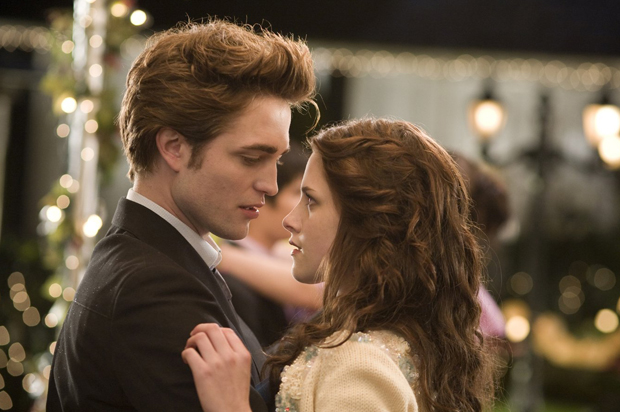
Robert Pattinson and Kristen Stewart in "Breaking Dawn" “How badly are you hurt?” murmurs studly but ethereal vampire Edward Cullen (Robert Pattinson) to his human bride, née Bella Swan (Kristen Stewart), on the morning after their wedding night. No no no no — it’s not what you’re thinking. Edward’s superhuman and indeed inhuman strength has left Bella’s arms and torso covered with bruises (and, infamously, has shattered the headboard above their bed). Devotee of the union of Eros and Thanatos that she is, Bella digs it, and wants more. Being a man, albeit an undead one, Edward has second thoughts about the whole thing now that he’s gotten what he came for, and spends the rest of their honeymoon on a Brazilian tropical island shying away from Bella, or playing chess with her. Which is a metaphor for, you know, sex or war or something. Or maybe not a metaphor at all but just chess, played by two people who self-evidently don’t know how to play, with a strangely large and silly set of chessmen.
Continue Reading Close“Abduction”: Taylor Lautner's chest gets a movie
Team Jacob obsessives may love it, but this fourth-rate "Bourne"-style thriller does the Twi-hunk no favors
Taylor Lautner in "Abduction" Writing a review of “Abduction,” the new thriller designed as a star vehicle for “Twilight” hunk Taylor Lautner, is pretty much a free-fire zone. Lautner’s fan base — which I would presume to be young and female and interested in viewing his hairless and monumental chest — isn’t super-likely to read reviews before rushing out to see the movie. On the other hand, if you’re here reading this, the likelihood that you’re actually going to pay to watch “Abduction” is exceptionally low. So I can pretty much make up any damn thing without fear of contradiction: The sequence where aliens destroy the earth was pretty cool, but the B&D sex scene between Lautner and Sigourney Weaver was somewhat disturbing. Unless it was the other way around.
Continue Reading CloseThe emasculation of the modern vampire?
Would Don Draper really be a better vampire than the men of "True Blood" and "Twilight"? Madness
For bloodsuckers, does manliness matter? Screenwriter Brian McGreevy did a guest stint on Vulture today with a diatribe on the emasculation of vampires in modern media, specifically in “True Blood” and “Twilight.” “True Blood,” at least, began with McGreevy’s ideal sexy/dangerous vampire — if not in Bill Compton, than in Eric Northman. Of course, now that Eric has lost his memory and Bill is playing at being a prissy little king, it’s totally reasonable for McGreevy to assert that these characters “have taken the Romantic vampire and cut off his balls, leaving a pallid emo pansy with the gaseous pretentiousness of a perfume commercial. We are now left with the Castrati vampire.”
Continue Reading CloseDrew Grant is a staff writer for Salon. Follow her on Twitter at @videodrew. More Drew Grant.
Today’s must-see viral videos
Jay Leno loses his crowd, "Glee" knights itself into memehood, and we learn the true meaning of Independence Day
1. “Independence Day” on Independence Day
While most of us spent July 4th blowing up fireworks to celebrate our emancipation from the Brits, comedian Sean Kleier made us remember the true meaning of Independence Day by reciting Bill Pullman’s speech from the movie all over New York City.
Continue Reading Close
Drew Grant is a staff writer for Salon. Follow her on Twitter at @videodrew. More Drew Grant.
Page 1 of 7 in Twilight