


Edward McClelland

The other side of segregation

Working with the Census in Chicago, I saw the hope in a city divided along racial lines: The opportunity to blend

The old Pole lived in a one-room basement apartment. A water pipe ran below the ceiling, and a black-and-white TV played on a table beside the twin bed. Although he spoke no English, he recognized the emblem on my black satchel: United States Census Bureau. Inviting me inside, he set a State ID next to his dinner plate, so I could write down his name and age. 

“Mariusz don’t know English,” said Jose, the building manager, “but he’s a really good plumber.”

When Jose and Mariusz’s five-story apartment was built in 1923, the proud developers gave it a Knickerbocker name: the Van Dorn. Now, the Van Dorn was a hive of tiny studios that overheated whenever the oven was dialed to 425. All day, I hauled my satchel up and down the stairwells, deepening the grooves in the steps. My job was to visit every address that hadn’t mailed back a census form, which was most of them.

On the first floor, I met a South African, a Native American and a woman from Mexico. The Census Bureau didn’t ask about citizenship, but it asked for ethnicity, and most people identified themselves by their home countries. In a single building, I found eight nationalities, and every shading of humanity from John O’Groats to the Equator. This week, the Census Bureau ranked Chicago the third most segregated metropolitan area in the U.S., but working the Rogers Park neighborhood, in the upper-right hand corner of the city, I went around the world.

Chicago’s famed racial segregation goes back nearly a century. When blacks arrived here from Mississippi and Alabama to build weapons for the World War I doughboys, they were forced to live in a narrow strip of land known as the Black Belt. The ghetto finally burst open in the 1950s and ’60s, consuming most of the South and West sides, despite Mayor Richard J. Daley’s efforts to hold back the tide by crowding blacks into housing projects and walling off their neighborhoods with highways. The city is roughly a third white, a third black and a third Hispanic, but most Chicagoans live in neighborhoods no more diverse than Ireland, Nigeria or Mexico. In some places, you can drive under a viaduct and see the world turn a different color. Chicago’s greatest monument to segregation is a 12-foot-tall berm that carries the Burlington Northern Railroad through the Southwest Side. It separates Lawndale, a once-Jewish neighborhood that “turned” in the 1950s, from Little Village, an old Eastern European neighborhood that is now Hispanic. The Poles and Ukrainians established the tracks as a racial barrier, especially after Lawndale went up in flames following Martin Luther King Jr.’s assassination. The custom has persisted with the new residents: South of the tracks, it’s 97 percent Hispanic; on the other side of the tracks, it’s 89 percent black.

In other places, the segregation is less obvious. In a two-mile stretch between the North Side and the West Side, the average household income drops $100,000. But no whites ever travel those two miles, except to buy heroin.

Chicago’s index of dissimilarity — the percentage of the population that would have to move in order to achieve perfect integration — is 75.2. The most segregated cities are all in the industrial North, which have similar histories of black migration. The racial attitudes and immigrant fears of the 20th century made it impossible for Chicago to grow up as an integrated city. Given the times, segregation wasn’t even all bad: Inside the Black Belt, African-Americans elected their own congressman before any other community in the country. That led to black senators, and a black president. And Daley’s strict racial boundaries prevented whites from abandoning the city entirely, as they did in Detroit.

But here’s the other side of segregation: It provides the population to create integrated neighborhoods, which doesn’t exist in Bozeman, Mont., or Burlington, Vt., or other monochromatic cities that didn’t make that Top 10 list. The tag “segregated city” is misleading because within those cities are streets where whites, blacks, Hispanics and Asians mix as nowhere else in the world. In this century, integration is not only possible, it’s inevitable, and it’s happening most dramatically in the cities with the longest history of segregation. The traditional ethnic enclaves may just be necessary way stations toward the multi-ethnic community where I knocked on doors last spring.

I’d always wanted to be a census enumerator. I had a friend who did it in 1990, and it sounded like my kind of job. You set your own hours. You didn’t have a boss watching all day. You got a badge that allowed you to peek inside strangers’ apartments. Plus, your work became part of American history. Enumerators worked their own neighborhoods. I knew, just from living here 13 years, that Rogers Park was like the Epcot Center with more authentic West Indian restaurants. But now I was part of a crew collecting the numbers. As many as we could get. Outside a building with yellow grass and empty Cheetos bags in the courtyard, I was blocked by a gate with a broken intercom. This was on a low-income street known colloquially as the Juneway Jungle or, even more colloquially, “The Jungle.” I called the management company number bolted to the brick wall.

“This is the Census Bureau. I need someone to let me in your building.”

“We don’t have time to send anyone over,” an irritated woman with a European accent said. “Why don’t you just mail people a form?”

“We did that. We’re trying to find the people who didn’t send their forms back.”

“WELL, HAS IT OCCURRED TO YOU THEY MIGHT NOT WANT TO PARTICIPATE?” she snapped.

“Ma’am,” I said, “this is the Census. We have to count everyone. It’s in the Constitution.”

I envied rural and suburban enumerators, who didn’t have to talk their way into high-rises. They also didn’t look out of place wearing a tie. (“This ain’t a good day to be sellin’ insurance!” someone had shouted, as I walked to my addresses. I flipped my satchel to show I was “the census man.”) Three minutes later, I followed a tenant into the courtyard. It was the government’s good fortune that the locks on the exterior doors were broken, too, so I could pester everyone in the building right on their doorsteps. That beat an intercom. It’s easy to get information out of people when you wave a federal ID in their faces. As a young newspaper reporter, I’d developed the abrasive nosiness required to interview a murder victim’s mother. Now, I was using that skill for a noble purpose: preventing Texas from stealing more Midwestern congressional seats.

Census Tract 101, Chicago, Ill., came in with a population of 4,854 — 49 percent black, 31 percent white, 13 percent Hispanic and 3 percent multiracial. My census tract was not even the most integrated corner of Rogers Park. That would be Tract 205, which is a ridiculously balanced 26 percent white, 19 percent black, 25 percent Hispanic and 27 percent Asian. It’s bordered by the Indo-Pak-Jewish strip of Devon Avenue, where a billboard for Taco Bell shrimp tacos rises across the street from Tel Aviv Kosher Bakery. Which is near Casey’s Corner tavern. Which is near a halal meat market that reeks of urine voided by terrified chickens and rabbits.

Devon Avenue is the most all-American street I know, but it certainly doesn’t look like all of America, or all of Chicago. So how did it happen?

One of the elders at my Presbyterian Church has been a member for 49 years, since Rogers Park was 99 percent white.

“When I joined, we had 500 members,” she told me last Sunday. “They were mostly Anglo-Saxon, upper-middle income. But over the years, the neighborhood changed.”

Rogers Park was always an immigrant neighborhood, but in the first half of the 20th century, most immigrants came from Europe. In the 1960s and ’70s, Rogers Park was colonized by newcomers from Eastern Europe, Mexico, the Caribbean and South Asia, as well as hippies and lower-class blacks, all looking for cheap apartments. They crowded into buildings like the Van Dorn, as the old-line WASPs, Germans, Luxembourgers and Jews moved to the suburbs. A series of geographic and demographic quirks has preserved Rogers Park’s diversity. It’s one of the few Chicago neighborhoods with lakefront property, and white people love to live near the water.

My landlord, who devoted his life to sailing, bought a building overlooking Lake Michigan in 1962, when Rogers Park was in its all-white prime. He installed a telescope in the living room, so he could watch sailboats and ore freighters, and never thought of moving.

“I look out at that lake every day,” he once said to me. “It gets into your spirit.”

 There’s also a colony of Orthodox Jews, who stay in the city so they can walk to shul.

But Rogers Park is a long, wearying train ride from downtown, which means the inland blocks remain affordable to everyone, even as the rest of the North Side has gentrified. (I washed up here after a more centrally located residence was converted to “luxury apartments.”)

Our street, which is part of the same census tract as the Van Dorn and the Juneway Jungle, is mostly white. So even where there’s integration, there’s segregation. But our street is also the home of a world-famous African-American athlete whose name you would recognize, if I could reveal it without breaking my census-taker’s oath. And the couple living downstairs from me is interracial. So even where there’s segregation, there’s integration.

In most parts of town, Chicago deserves its reputation as the third-most segregated city in America. But in some places, it’s more complicated.

Can an electric car save the American dream?

The Chevy Volt is cramped, overpriced -- and the best thing an American motor company has done in years

The first time I saw the Volt, Chevrolet’s new hybrid electric car, it was only a battery.

It was November 2008, the month that General Motors begged the government for a bailout. I was in a sterile testing room at the GM Tech Center, in Warren, Mich. Andrew Farah, the Volt’s chief engineer, handed me a lithium-ion battery, in a plastic sleeve. We both had the same hopes for that flat, rectangular fuel cell. That it was, at last, the technology that would end General Motors’ decades of decline.

An hour’s drive north of Warren, in Flint, is an abandoned GM auto plant called Buick City. In the 1970s, Buick City employed 28,000 autoworkers. Today, it’s America’s biggest brownfield, anchoring a neighborhood that also features a boarded-up tavern, a defunct United Auto Workers hall and an out-of-business party store. The land around Buick City is so worthless that a patriotic couple bought several corner lots, for $200 apiece, and built a memorial to American soldiers killed on 9/11.

Buick City and so many other factories are industrial waste sites because General Motors hasn’t had an original idea since it put a V-8 engine in the Oldsmobile. In the 1970s, when the Arab Oil Embargo began a small-car craze, Honda was already building the Civic. Toyota was building the Corolla. GM responded with — the Chevette. Named one of the 50 Worst Cars of All Time by Time magazine, the Chevette turned an entire generation of Americans onto Japanese cars. It was the first car I ever owned. My mechanic diagnosed the hole under the pedals as “Chevette Floor Cancer.” He pounded a sheet of tin over the opening, but my shoes still got wet whenever I drove through a puddle.

And then, in the 2000s, there was GM Chairman Robert Lutz’s reaction to the Prius: “Hybrids are an interesting curiosity and we will do some, but do they make sense at $1.50 a gallon? No, they do not.” They do make sense at $4 a gallon, but Toyota dominates the market now.

That’s why I was so excited about the Volt. Like any Michigander who grew up seeing “Assholes Buy Jap Cars” spray-painted on overpasses, I’ve been conditioned to root for the home team. Now, for once in my life, stodgy old Papa Jimmy was going to be first at something. As Toyota was the hybrid company, Chevy would be the electric company.

“I want that brand right here on top of my forehead,” Farah said, pointing at the space above his safety glasses.

Farah worked on GM’s first, failed attempt: the EV1, subject of the documentary “Who Killed the Electric Car?” Its problem: the battery weighed 1,200 pounds. To wring 40 miles out of a single charge, the EV1 was a two-seater, with no trunk.

“You had to build the car around the battery,” he said.

The lithium-ion battery pack weighs a third of that. The Volt is an “extended-range” vehicle. Once the charge runs down, a gasoline engine takes over. But it doesn’t power a drive train, as on a traditional vehicle. It powers the electrical system that runs the car.

The energy required to drive 40 miles on battery power is equivalent to “well under a gallon” of gasoline, Farah told me, because running an electrical system is 50 percent more efficient than running a drive train. Fueling the Volt costs 2 cents a mile. At $4 a gallon, a gasoline-powered car costs 13 cents a mile.

On electric power, the Volt emits no exhaust. Drawing electricity from a coal-powered grid may produce more greenhouse gases than a gasoline-powered car. But coal produces only half America’s energy, and that percentage is declining as utilities switch to cleaner fuels. The Volt can draw power “from the wind, from the sun,” Farah said. “You don’t have to burn fossil fuels.” As a plug-in hybrid, the Volt would be a compromise between the Prius, which has a 4-cylinder gasoline engine, and the all-electric Nissan Leaf.

The Volt is finally out this year. It was named 2011 Motor Trend Car of the Year. When I heard that the Volt rides were the No. 1 attraction at last month’s Chicago Auto Show, I was more excited than the moment I first laid eyes on the Top Thrill Dragster at Cedar Point. I’d been waiting years to sit inside the salvation of the American auto industry.

When I got to the Auto Show, little pod-shaped cars were circling a go-kart-sized track, landscaped with real grass and real shrubs. The foliage would die indoors, but from lack of sunlight, not air pollution. When a Volt finally stopped, I climbed into the passenger seat. My first reaction?

“Wow, this is even more cramped than my old Dodge Neon.” The engine was silent, but I couldn’t tell whether that was because we were only going five miles an hour.

“How much is this going to cost?” I asked the driver.

“They start at $41,000,” he said, “although there is a $7,500 tax credit for buying an electric car.”

I looked at the back seat. Two American-sized people could squeeze in there. The driver tried to focus my attention on a computer screen displaying the remaining charge.

“Are they ever going to make a bigger version?” I asked.

“There’s going to be a family-sized SUV, eventually.”

Eventually. I stepped outside and watched the silent rodeo of cars. The Volt is a $20,000 car, for twice the money. Even if I could afford to replace my Ford Focus hatchback with a Volt, I wouldn’t do it. It’s too small for my cross-country skis and my camping equipment.

Then I got an e-mail from a retired Chevy dealer named Chuck Frank. He forwarded me an article from Automotive & Assembly Practice, which predicted that “plug-in hybrid electric vehicles and battery-only electric vehicles could account for 16 percent of overall new-car sales in New York, 9 percent in Paris and 5 percent in Shanghai by 2015.”

“Are you buying a Volt?” I e-mailed back.

“I have one on order and a Leaf as well,” he wrote. “I drove one recently and liked it.”

Frank is the Volt’s target customer: a well-to-do environmentalist. As a boy, Frank wanted to be a forest ranger. Instead, he inherited the world’s largest Chevrolet dealership from his father. But Frank’s love of the outdoors and his wife’s struggles with asthma led him to join the Sierra Club, and he became the group’s inside connection to the auto industry. As a Chevy dealer, he could talk to executives who wouldn’t take an environmentalist’s phone calls. For years, Frank lobbied GM to build an electric car. In 2005, frustrated that he couldn’t offer his customers an alternative to the Prius, he approached Chairman Rick Wagoner at a cocktail reception.

“Why isn’t GM doing anything about a hybrid?” Frank inquired.

“Hybrids don’t make sense to the public,” Wagoner told him. “Economically, they don’t make sense.”

Three months later, GM announced plans for the Volt.

Frank doesn’t care that the Volt is cramped and overpriced. He has bigger Chevys in his garage, and he sold enough Corvettes to understand that when it comes to choosing a car, practicality is less important than looking badass. Otherwise, everyone would be driving an Aveo.

“I want to be one of the early adapters,” Frank said. “I’m trying to get the first one that comes into Chicago, because I want to reinforce my environmental credentials.”

But there aren’t enough Sierra Club members to make the Volt a mass-market car yet. My other problem with the Volt: I live in an apartment building, so I have no place to plug it in at night.

“They’re not going to make money on the Volt right away,” Frank said. “One of the things I said to Wagoner was the value of what they’re doing was what Toyota did with the Prius. It’s not about profitability per se. It’s about image. What I’m hearing is that it’s bringing people into the showrooms. They need to do this to re-establish themselves as a high-tech company.”

Consumer Reports dismissed the Volt as “an expensive way to be green.” NASCAR driver Dale Earnhardt Jr. called the Volt a “good product,” but said the “technology isn’t there yet really to provide the consumer with something that can go a little further [in mileage] … But as the technology gets better, batteries and such things like that get safer to where they can be more heavily charged and the mileage can be a little bit longer.”

But Volt owner Matt Stehouwer wanted an electric car so badly he ordered one from a dealership in New York, one of seven states where the Volt is currently sold, and drove it home to DeWitt, Mich. After three weeks, he reports on his blog, voltfansite.com, he’s driven 627 miles on 4.2 gallons of gas. Stehouwer’s only complaint: His employer told him he was “stealing electricity” by charging the car at work.

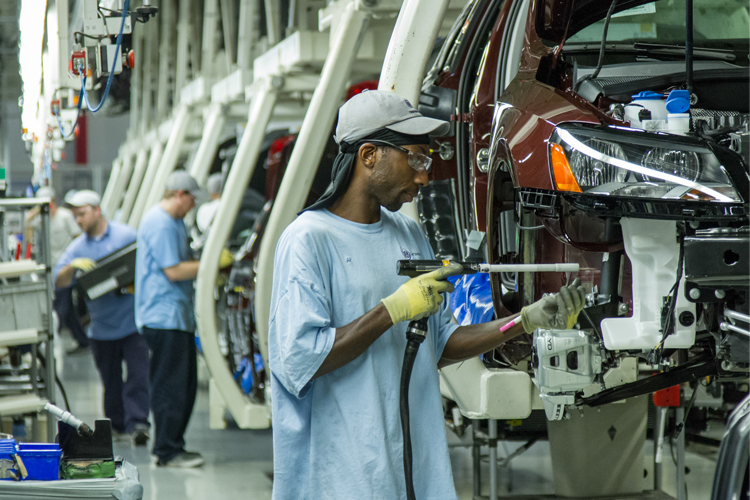
General Motors just announced it earned $4.7 billion last year, its first profit since 2004. It’s not because of the Volt, obviously, but the Volt is another sign that GM has finally learned to do business like a 21st century auto company. It’s too late to save Flint, but the Volt is coming off the assembly line in the Detroit suburb of Hamtramck.

Even though the Volt is a tiny, expensive toy, GM did the right thing by rushing it into showrooms before guys like me are ready to buy one. Eventually, lithium-ion batteries will be cheaper. Eventually, apartment buildings will install charging stations. Eventually, gas will cost $5 a gallon. When all that happens, a lot us will buy electric cars. I want to own a Volt someday. GM hopes that brand on its forehead is big enough to make you to want one of its electric cars, too.

Continue Reading Close

How Borders lost its soul

The store went from a true alternative to a big-box bore. Now, it's the independent shops who come out the winners

Customers walk into a Borders Books & Music store, which is on the closing list, in Ann Arbor, Mich., Wednesday, Feb. 16, 2011. Borders, which helped pioneer superstores that put countless mom-and-pop bookshops out of business, filed for bankruptcy protection Wednesday, sunk by crushing debt and sluggishness in adapting to a rapidly changing industry. (AP Photo/Carlos Osorio)(Credit: Carlos Osorio)

When I was a teenager, there were two off-campus bookstores that shaped my reading life. The first was Jocundry’s, in East Lansing, Mich., which I discovered when I was in high school. I could always go there for a copy of Michael Moore’s alternative newspaper, the Michigan Voice, or a book by George Bernard Shaw or Friedrich Nietzsche, two authors I liked to be seen reading. A bearded Michigan State University historian was always sitting inside the front door of Jocundry’s with his dog, reading The New York Times.

The second was Borders, the chain bookseller that declared bankruptcy on Wednesday. As a freshman at the University of Michigan in Ann Arbor, I was awed by the sight of the original Borders, on State Street. Never in my 18 years had I seen two stories of books. I spent nearly as much time reading at Borders as I spent reading in class while my professors lectured. There was nothing to do at Borders but read. In the mid-1980s, a coffee shop was still a diner that served pancakes until 11 a.m.

A decade later, as Borders spread nationwide, I was as excited as a Starbucks drinker from Seattle. In those years, on the cusp of the World Wide Web, I was living in a small industrial city in Central Illinois. Its only literary outlets were a newsstand, whose owner constantly reminded me he wasn’t running a library, and a Waldenbooks at the Hickory Point Mall. When I wanted a book of short stories by V.S. Pritchett, I ordered it through a clerk, and waited two weeks. But with Borders invading shopping malls in Erie and Wichita and Normal, everyone in America could have the same instant access to V.S. Pritchett that I’d enjoyed in Ann Arbor.

Unfortunately, the ascendancy of the mega-bookstores ended up destroying Jocundry’s, and its dog-friendly atmosphere. Barnes & Noble took over an empty supermarket a few miles from Michigan State’s campus. Jocundry’s moved into a bigger space to compete with B&N’s inventory. The expense ruined them. Jocundry’s closed in 2001. Soon after, Barnes & Noble moved into downtown East Lansing, claiming its independent rival’s turf.

And so it went in the era of 25,000-square-foot mediasauruses, as Borders and Virgin and 16-screen multiplexes barreled into malls and booming suburbs and cloistered Manhattan neighborhoods. The demise of Jocundry’s was the first incident that soured me on big box bookstores. The second was publishing a book myself. When I tried to schedule a signing at my neighborhood Borders, I experienced the difference between a bookseller and a corporation that sells books. As a first-time author, I quickly learned that Borders was not going to let me read when it could get Dennis Rodman or Rudy Giuliani instead. The store manager told me to fax a request to the regional events coordinator. I did so, emphasizing that I’d been shopping at Borders before Dan Brown had ever heard of the store. Borders never called back.

When I published my most recent book, “Young Mr. Obama: Chicago and the Making of a Black President,” I did the first signing at 57th Street Books, in Chicago’s Hyde Park neighborhood, near the University of Chicago. It was the obvious location, because it’s the president’s favorite bookstore. How did I arrange an event there? I called the manager, Jack Cella, and said, “Jack, I just wrote a book about Obama and I want to do a book signing.” 

About 10 years ago, Borders opened a store in Hyde Park, less than a mile from 57th Street Books. It’s on this week’s extinction list. So it turns out that after all the Op-Ed fretting about neighborhoods being swallowed by commercial behemoths, there are neighborhoods where an independent bookstore served the local market better than Borders.

“Initially, they certainly were a competitor,” 57th Street manager Jack Cella said, when I called him on Thursday. “Going back a ways, Borders used to run really good bookstores. It’s been awhile. The one in Hyde Park never understood what the neighborhood was about. It’s university. It’s African-American.”

Borders, the store whose independent spirit once made it so much more exciting than the Waldenbooks at the mall, turned into the generic fluorescent bookstore it once aimed to replace. The tables are heaped with blockbusters by Keith Richards and Stephen Colbert. Those escalators, those cash registers, those fidgety coffee lines — it’s not the relaxing hangout it was in 1985. With its one-size-fits-America model, Borders never had the flexibility to file books under “Gender Studies” or “Marxism,” popular sections in 57th Street’s sister store, the Seminary Co-op, a series of underground caverns packed to the ceilings with esoteric academic titles.

Borders ended up caught between the variety of the Internet and the intimacy of the independents. Its outlets could never stock as many books as Amazon. Nor could they duplicate the native flavor of the corner bookstores, with their local author readings and folk music nights.

So bookstores like 57th Street will outlive the local Borders because they’ve made themselves community institutions. Nearly every serious reader in Hyde Park owns a $30 share in the store, good for a 10 percent discount. (President Obama has been a member since 1986.)

“I think people are naturally inclined to support a neighborhood-focused bookseller, and one they have a stake in,” Cella said. “Our customers are very devoted, and they’re not at all shy about offering suggestions.”

Thirty years ago, a customer suggested to Cella that Islam was too big a faith to be hidden in Comparative Religions. So Islam got its own section.

Of course, 57th Street’s neighborhood has been home to 85 Nobel Prize winners, including Saul Bellow and J.M. Coetzee. In communities with lesser literary traditions, Borders is the only store in town.

“I think, in a lot of ways, independents are in the same boat as these chain stores,” Cella said. “We’re trying to give people a reason to shop locally rather than online. I don’t really feel good about Borders [closing], because in a lot of places, they were an important part of community life. They were meeting grounds. I don’t think Borders’ closing is necessarily going to help independents, but people are looking for alternatives.”

Even with Borders disappearing, the independents will still have to face competition from the Kindle, the Nook and the iPad, not to mention Amazon. But as paper books become a niche product, niche retailers will be the best place to buy and sell them. Book lovers will always want a place to gather and hear recommendations from a bookseller who knows their reading habits, and their community. Borders belonged to an era when book retailing was a big enough business to monopolize. Now that there’s no money in it anymore, we may have to go back to shopping for books in stores that let dogs wander through the stacks, and don’t even serve coffee.

Continue Reading Close

When mom comes out

I blamed gay culture for breaking up my parents' marriage. Now I realize there's an upside to having two mothers

If you want to find out what this country will look like when gay marriage is legalized, visit my mom’s house — or, more accurately, my moms’ house, the home my mother shares with her partner, Gretchen. Once you get there, visit the kitchen around half past 11 in the morning, looking for a snack.

“Do you want lunch?” my mom will ask.

“This isn’t like your place,” Gretchen will join in. “We’ve got food here.”

“I’ve got some whole grain bread I think you’ll like.”

“We’ve got lentil soup.”

This is not the kind of marriage traditionalists are trying to defend, with one partner in the kitchen and the other in the living room, hiding behind a month-old New Yorker magazine, trying to keep a low profile around the house. This is twice as much mothering as anyone was meant to endure. In one week there, I gained 3 pounds.

When you have two moms, you do get twice as much food, but you also get twice as much … advice. After I finished my whole grain bread and my lentil soup, I mentioned to Mom and Gretchen that I’d be driving to New York City soon.

“You know,” Gretchen said, “if you’re going on a long trip, you should get your oil changed every 3,000 miles.”

“I’ve read that,” I said.

“It’s really good for the car.”

“Is your boss paying for this?” Mom wanted to know.

“Yeah, my boss is paying.”

“There’s not a lot of parking in New York,” Gretchen said.

“I’ll be staying in Brooklyn,” I said.

“Be sure to save your receipts!” Mom reminded me.

It’s taken me a long time to appreciate having two moms, or at least to find it amusing. Twenty years ago, when Mom graduated from attending New Age est seminars to spending her weekends at Womyn’s Music Festivals in the North Woods, I blamed “the lesbian movement” for breaking up my parents’ marriage.

“They have a recruitment campaign,” I insisted to a friend. “That’s what their man-hating philosophy is all about: Men are horrible, and women are better off with other women.”

When Gretchen moved in, I resented her. (Although, to be fair, I wasn’t very warm toward my father’s new wife, either.)

“Gretchen’s a Spanish teacher,” Mom said, one of the first times we met. “Say something to her in Spanish.”

“Sale mi casa,” I blurted. “No quiero en mi casa.”

Gretchen slammed the door, and didn’t come home for hours, while my monolingual mother looked baffled. Even though I told her I didn’t want her in my house, Gretchen tried to be nice, selling me her old Ford pickup truck for $1,000. But having two moms presented me with a problem similar to coming out: Whom could I tell about the new domestic arrangement at my boyhood home? Having a lesbian mother was harder to accept than a gay child — or so I told myself. My relationship with my mom was based on the fact that she’d once done something heterosexual with my dad. Living with a lesbian couple felt like a reflection on my own masculinity; my mom had a girlfriend, but I didn’t. Just brand an “L” on my forehead, OK? When a friend told me an unfamiliar female voice had answered the phone, I said, “Oh, she’s just a boarder,” so hurriedly as to leave no doubt that she was not just a boarder. I stopped inviting company over altogether.

When I became a Christian, it wasn’t to demonstrate my disapproval of Mom and Gretchen, but Mom seemed to take it that way. I made her attend my baptism anyway.

“You’re joining this cult,” she complained.

“The Presbyterian church is not a cult.”

Mom sat in a front pew, arms folded staunchly over her bosom.

“Your mom seems tough,” a fellow parishioner told me after the service. He was gay, so I knew exactly what he was getting at. “Who was that woman with her?”

“That’s my aunt,” I said.

“Your mom’s sister?”

“Yeah.”

Lying was futile. When a mother of three joins the other team, that’s pretty juicy neighborhood gossip. It was impossible to keep my secret, especially because Mom made no effort to keep it. After a year or so, Gretchen was no longer my aunt. No one had believed that anyway, since Mom and Gretchen look nothing like sisters.

In some ways, Mom and Gretchen reinforce each other’s traits and prejudices, instead of balancing each other out, as a man and a woman might. During the ’90s, they planned their Wednesday nights around “The Nanny.”

“Oh, we love ‘The Nanny’!” Mom enthused. That wasn’t something you’d hear a lot of straight couples say.

On the other hand, they weren’t very friendly to the black Muslim family who moved in next door — not because they thought Muslims are terrorists, but because they thought Muslims are sexist.

“You should see how they treat their women,” said my mother, the lesbian Archie Bunker. “They even make the 7-year-old daughter wear a head covering.”

After two decades, I’ve learned to do more than accept having two moms — I’ve learned to enjoy how their differences add variety to my life. If I want to hang out with a couple of straight parents, I can go over to my dad’s house. Who needs two sets? My niece digs it, too. “I have two grandpas and four grandmas,” I’ve heard her say. My appreciation has as much to do with the maturation of their relationship as the maturation of my own attitude. At one time, there was only room for one personality in any relationship involving Mom, and that was Mom’s. Over the years, Mom has mellowed, giving Gretchen an opportunity to elbow her way in. It’s been one of her retirement projects, since she quit teaching. Gretchen and I now accept each other enough that she’s comfortable assuming co-mothering duties. When I was rushing out of the house to a 2 o’clock appointment, she slowed me down to ask whether I’d eaten lunch.

“Not yet.”

Before I could move another step, the refrigerator door was open.

“You want honey mustard or mayonnaise on your turkey sandwich?”

I scarfed the sandwich in my car, on the way to the meeting. After it was over, I called Mom on my cellphone, to let her know I was on my way out of town.

“Gretchen told me she had to make you a sandwich,” Mom said. “You know, you need to schedule time in your day to eat.”

Edward McClelland will be discussing his book “Young Mr. Obama: Chicago and the Making of a Black President” at Busboys & Poets, 2021 14th St., Washington, D.C., this Wednesday at 6:30 p.m.

Continue Reading Close

Can Dems hold Obama’s old Senate seat?

In Illinois, a former federal prosecutor and a banker battle over who's the best face of 2010 reform.

President Obama, left, and Sen. Roland Burris, D-Ill.

Illinois has a special place it sends honest politicians — the reformers, the independents, the Eliot Ness wannabees. Paul Simon was exiled there for a dozen years. So was Barack Obama, although he got out as fast as he could. It’s called the United States Senate, and it’s located in Washington, D.C., 800 miles from Springfield. When the goody-goodys are that far away, they can’t keep an eye on the shady business in the state capital. Being a senator is not as lucrative as being governor, but the title looks good on your tombstone.  

David Hoffman is hoping to become the next Prairie State busybody to win a six-year timeout in Washington. He has the perfect résumé. A 42-year-old former federal prosecutor and Chicago inspector general, Hoffman made a name for himself with a blistering investigation into Mayor Richard M. Daley’s billion-dollar deal to sell the city’s parking meters to a private firm. He even served on the oxymoronic Illinois Reform Commission, a do-gooder panel convened to clean up the state after Rod Blagojevich decided Obama’s vacant Senate seat was a “fucking golden” opportunity to make some money. And, of course, Hoffman has received the endorsement of every nosy newspaper in Illinois, from the Chicago Tribune  on down to the Springfield State Journal-Register

Hoffman is running in what may be this year’s most-watched Senate election. Obama’s old seat is on the ballot, and losing it would be an enormous embarrassment to the White House, far worse than Scott Brown’s victory in Massachusetts last week. In the Feb. 2 Democratic primary, Hoffman is battling State Treasurer Alexi Giannoulias, a 33-year-old banking heir, and Chicago Urban League president Cheryle Robinson Jackson, a former press secretary to Blagojevich. The winner will take on U.S. Rep. Mark Kirk, a suburban moderate who will be the Republicans’ strongest Senate nominee in decades. 

“This election for this Senate seat is going to be watched all around the country, because it’s our president’s Senate seat, because it relates to our latest corruption scandal, our second straight governor charged with corruption for, among other things, trying to sell this seat,” Hoffman told a small State of the Union watching party in the Chicago suburb of Elmhurst. 

While many observers consider Hoffman the Democrats’ best chance to hold onto Obama’s seat, he’s trailing in polls. On Monday, the Chicago Tribune reported that Giannoulias held a 15-point lead. 

That was the good news for Giannoulias this week. On Wednesday, the bad news came down. Broadway Bank, which is owned by Giannoulias’ family, entered into a consent order with federal regulators.  The bank, which is holding millions of dollars in delinquent real estate loans, was ordered to replenish its cash reserves — out of the Giannoulias family’s pockets, if necessary. 

The FDIC also ordered the family to stop paying itself dividends without regulators’ permission. In 2007 and 2008, the Giannouliases took $70 million out of the bank. Alexi himself received $2.5 million. 

Giannoulias called a press conference to discuss the bank’s troubles, but refused to reveal whether he had approved any of the bad loans. 

“If I’m fortunate enough to make it out of the primary, we can have that conversation,” he told reporters. 

“That conversation” is what some Democrats are worried about. If Giannoulias wins, they expect Republicans to spend the next nine months running grainy, black-and-white ads on Broadway Bank’s problems. 

At a wake last week, I ran into a prominent Chicago Democrat who had endorsed Giannoulias. 

“Alexi looks unbeatable in the primary,” he said, when the talk turned to politics. 

“But can he beat Mark Kirk?” I asked. 

The man grimaced and shook his head. “I don’t know,” he said. 

Kirk, the likely Republican nominee, has survived a decade in a North Shore congressional district that voted for Al Gore, John Kerry and Obama. He’s exactly the kind of moderate Republican who wins in Illinois, although he has been moving to the right as he seeks the GOP nomination. Kirk voted for the cap-and-trade legislation (but now says he’d vote against it as a senator), and stopped an Indiana oil refinery from releasing more sludge into Lake Michigan. He opposed the Iraq surge, and had a nearly perfect abortion rights record until he voted for the Stupak Amendment. 

“It’s a problem,” said Carol Davis, a suburban township chairwoman. “Kirk is not a teabagging maniac.”

When Alexi Giannoulias ran for treasurer, in 2006, then-Sen. Barack Obama gave him a big man-hug in a TV ad. They were basketball buddies — Giannoulias played professionally in Greece — and Giannoulias raised money for Obama in the Greek community. But after Giannoulias announced for Senate last year, the president’s inner circle spent the summer desperately searching for another candidate. First, Obama invited Attorney General Lisa Madigan to the White House. When Madigan said no, Chief of Staff Rahm Emanuel tried his arm-twisting tactics on Cook County Sheriff Tom Dart. Dart also declined. 

The 2010 Senate election will take place at the same time as former Gov. Rod Blagojevich’s corruption trial, and Democrats fear Giannoulias can’t stand up to a Republican attack on ethics. From 2002 to 2006, Giannoulias was chief loan officer at Broadway Bank. As the Chicago Sun-Times reported, the bank loaned $10 million to an alleged Russian Mafia member who has pleaded guilty to federal money-laundering charges. The bank has also foreclosed on $12.9 million worth of properties owned by two men who have variously been convicted of bookmaking and pimping. And Broadway Bank loaned $1 million to Tony Rezko, a name Obama never wants to hear again. 

In an interview with Salon, Giannoulias deflected the question of whether Republicans would make Broadway Bank an issue. 

“We need to talk about jobs,” Giannoulias said. “We need to talk about turning this economy around. As I travel the state, that’s all that folks are talking about. When their family members are losing their jobs, and their neighbors are losing their homes, they want to hear how you can help turn things around.” 

Giannoulias does have a strong record on jobs. As treasurer, he threatened to pull state business from Wells Fargo if it sold bankrupt Hartmarx — the president’s suit maker — to a bidder that would liquidate the company. Hartmarx employs 4,000 Americans

But in year when Illinoisans are feeling burned by political corruption, “I think Hoffman would be a stronger candidate against Kirk,” said Chicago political consultant Don Rose. “He’s unassailable on ethics, and he’s associated with reform, and he’d have the money in a general election.”

Hoffman, who has so far raised $2.5 million, only began airing TV ads in Chicago on Monday. Illinois moved its primary to early February in 2008, to help Obama on Super Tuesday. With only a month to campaign after New Year’s, there’s little time for an unknown candidate to make an impression. 

“Obviously, everyone’s very concerned around the country now as Democrats about whether we’re going to lose this seat and other seats around the country for the same reason as Massachusetts,” Hoffman told Salon. “I think it’s going to be twice as difficult in Illinois, because not only do you have the same dynamic that results in anger from people toward the party that’s in power, but here, you lay on top of that anger at the corruption scandals that produced so much cynicism and frustration. When people see the governor trying to sell this Senate seat, it makes them very angry. If we’re really serious about keeping the seat as Democrats, we really need a nominee who doesn’t allow Rezko or Blagojevich or any of these other problem players to be brought in.” 

Besides money, Hoffman has several other disadvantages. He does not come off well on television. He’s short and slight, with a high-pitched voice and baggy suits that make him resemble a high school debater. During a televised debate this month, Hoffman attacked Giannoulias for his alleged mismanagement of Bright Start, a college investment fund that lost $150 million last year. It was a cheap shot, since almost all states’ investments lost money in 2008 and 2009, and Hoffman came off as more tattletale than corruption-buster. 

Giannoulias has far more institutional support. Hoffman’s State of the Union party took place in a living room, with 20 people in attendance. Giannoulias has been endorsed by half the Democrats in the state Legislature, half the Chicago City Council, and most of the big unions. This Saturday, the Teamsters are throwing him a get out the vote rally in Chicago. 

Both Hoffman and Jackson have been gaining in the polls, but the calendar is running out. On Wednesday, a Rasmussen poll showed Giannoulias at 31 percent, Hoffman at 23 percent, and Jackson at 13 percent, with 9 percent favoring another candidate and 24 percent undecided. (Jackson’s best hope is to repeat Carol Moseley-Braun’s feat of sneaking in between two catfighting white guys.)

Another poll this week showed Giannoulias with a 42-34 lead over Kirk in a general election matchup. Giannoulias is using that to counter the electability issue, but can that lead stand up to months of negative ads? 

Giannoulias says he plans to attack Kirk as a D.C. insider who voted for “some of the worst budgets in this country’s history, the Bush/Kirk budgets that have caused the most severe economic recession since the Great Depression.” 

It could be, as a legendary Springfield creature once put it, that “ethics comes next to athlete’s feet when it comes to tripping the public’s trigger. Only the media cares about ethics.” Or it could be that Illinoisans will rally around any Democratic nominee, to avoid embarrassing their president. The GOP is hoping for neither. Kirk, who has no serious primary opposition, has been keeping a low profile and saving his money. Republicans eager to snatch Obama’s seat will be pouring millions of dollars into Illinois, Don Rose predicts. 

“Kirk is going to have a faucet,” Rose said. “There’ll be enough money to totally pound Giannoulias, day in and day out.”

Edward McClelland is the author of “Young Mr. Obama: Chicago and the Making of a Black President,” to be published in October by Bloomsbury. 

Continue Reading Close

“Get your pit bull on!”

Palin fans left their hunting camps and donned tea party gear to greet sister Sarah from Alaska and jeer the media

Sarah Palin signs copies of her new book 'Going Rogue' at her book signing in Grand Rapids, Michigan November 18, 2009. REUTERS/Rebecca Cook (UNITED STATES POLITICS MEDIA)(Credit: Reuters)

Sarah Palin fans began gathering late Monday night for a book signing that wouldn’t begin until 6 o’clock Tuesday evening. The signing fell during Michigan’s two most sacred weeks — firearm deer season. So Ken Bellhorn left his hunting camp at 1 a.m., and showed up at the Barnes & Noble in Woodland Mall still dressed in an orange camo jacket, a John Deere T-shirt, and hunting boots. He got there early enough to claim one of the 940 wristbands that guaranteed him an autographed copy. 

“I already shot a small buck, but this’ll be a bigger trophy,” said Bellhorn, who was laid off last year from his job at a plastics firm that supplies the auto industry, and has spent some of his free time attending tea party rallies. “I think when Reagan was in office, he saved us from ourselves, and I think she’s got the character and the morals to do the same thing.” 

Sarah Palin seemed to have an affinity with Greater Grand Rapids that she may not find anywhere else on her 31-city tour. West Michigan fits both sides of the Palin persona — the antiabortion creationist and the moose-skinning hockey mom. It’s a northern exclave of the Bible Belt, with one of the highest churchgoing rates in the nation. But unlike the rest of the Bible Belt, it’s a place of deep snowfalls, ice rinks and bars with more Ski-Doos than pickups parked outside on a January night. 

(In “Going Rogue,” Palin thanks a Grand Rapids family for hosting her son Track during a hockey tournament.) 

“There’s a bond of northern women,” said Jacquelyn Krug, a mother of five from Battle Creek. “She knows how to hack a winter.” 

Krug was waiting outside the store when the Going Rogue Express — an enormous blue bus with a photo of Palin standing in front of a mountain landscape — began circling the parking lot, to chants of “Sarah! Sarah!” 

Palin stepped out, holding her infant son, Trig. She stepped onto a stage surrounded by red velvet ropes, then handed the baby off to an aide. 

“Thank you so much for showin’ up!” she crooned. “First stop on the tour. There’s just somethin’ about Michigan. I couldn’t wait to get back to Michigan. Alaska and Michigan have so much in common, with the huntin’ and the fishin’ and the hockey moms and just the hardworking patriotic Americans who are here. This is the heart of industry in our country, and I would like to see for this heart of industry for you all to just see a revitalization of your economy, and to be able to see really some remarkable things happen in this part of our land, and I anticipate that good things are going to happen here.” 

“Palin power! 2012!” someone shouted. 

“Tell the truth, Andrea Mitchell!” someone else cried — a challenge to the NBC reporter who was broadcasting from the store. 

After Palin went inside, people took turns posing for photos next to the bus, as though it were Mount Rushmore on wheels. Tomas Ojeda, a former Marine from Grand Rapids, held an American flag and a copy of “Going Rogue.” He opened the cover of his book to show off a pencil sketch of a pit bull, drawn by his daughter. 

“I yelled, ‘Get your pit bull on’ when I saw her,” he explained. 

In her short speech, Palin had promised that buyers of “Going Rogue” could “read my own words — unfiltered.” If there were two common sentiments in the thousand-person line inside the mall, they were: resentment of the news media for its unfair treatment of Palin, and eagerness to use the news media to air that resentment. 

Doug Till of Kalamazoo was wearing a T-shirt that identified him as a member of the Southwest Michigan Tea Party Patriots. I told him I was from Salon. 

“The enemy!” he said jovially. Then he talked to me for 10 minutes, breaking off only to run to the other side of the rope line and engage a reporter for an Alaska newspaper. 

“We’re here because we want to show support for Sarah Palin, because we want to show her words,” Till said. “She’s Middle America. She’s our values. When they’re attacking her, they’re attacking us. If they would have interrogated Barack Obama and Joe Biden as much as they did Palin, the election would have been a lot closer.” 

Till was glad to see Palin in Michigan, a state that had been “abandoned” by the Republican establishment. And he was glad the national cable channels had followed her here. 

“I wonder if MSNBC and CNN will listen to us now,” he said. 

Palin sat in front of a blue screen on the second floor, scrawling “Sarah” in book after book, while country music blasted from a speaker. (The “Going Rogue” soundtrack: “Independence Day,” by Martina McBride; “These Are My People,” by Rodney Atkins; “How Do You Like Me Now?” by Toby Keith; and, natch, “Shuttin’ Detroit Down,” by John Rich.) 

Jacquelyn Krug’s daughter, Annalisa, got into line without a wristband, because she was wearing her Air Force ROTC uniform. 

“I can’t wait for you to commission me in the Air Force when you’re president,” Annalisa Krug told Palin. “You inspired me to join the Air Force.” 

“It’s such an honor to hear you say that, and that you’ve committed to serving our country,” Palin replied, sounding both pleased and taken aback. 

Randy Cotton of Kentwood walked down the escalator carrying two copies of “Going Rogue.” The night before, he had attended a Mike Huckabee book signing at a store just down 28th Street. It was nothing like the Palinageddon that hit Barnes & Noble on Tuesday. 

“This crowd was definitely by far bigger in size,” Cotton said. “I spoke to people yesterday who didn’t know Huckabee was going to be there until they came in to buy the book.” 

The last time Grand Rapids saw a line this long, it was for another Republican, though not one Palin has to worry about facing in 2012. When Gerald Ford’s casket was brought home, Grand Rapidians waited five hours in the cold to pay their respects. (Ford is buried at his museum, a pretty colorful memorial to a pretty colorless guy, with a Pet Rock, a glitter ball, and other mementos from the disco era that defined his presidency.) Ford belonged to a different Republican epoch: He was pro-choice, pro-ERA, and named Nelson Rockefeller his vice-president. He was the last representative of the moderate, Midwestern Republicanism that was upended by Ronald Reagan, in whose footsteps Palin is trying to follow. 

Grand Rapids proper still enjoys the middle of the road. The city narrowly voted for Obama last year. But the surrounding region may be Palin country. West Michigan is, by far, the most conservative part of the state. It was settled by Dutch Calvinists, members of one of the country’s most Republican ethnic groups. (Amsterdam may be so libertine because all the religious folks moved to Michigan.) A Republican has to do well in West Michigan to carry the state. But a Republican too closely identified with the area usually loses. Detroiters think West Michigan is sanctimonious. As a result, it has never produced a governor. 

That, in a nutshell, is the problem Palin faces with America. On the back of the Going Rogue Express is a list of her book tour stops. Like Grand Rapids, most are medium-size cities in what Palin considers the “real America.” She’ll be signing books in Sioux Falls, S.D., Roanoke, Va., and Birmingham, Ala. She won’t be signing books in New York, Chicago — or Detroit. Those are capitals of the fake America. But the fake America elected Obama. The fake America has more votes than the real America, and it’s turned off by candidates who cloak themselves in small-town values, while insisting those values are superior to big-city ways. 

Palin puts on a terrific political show. Her book signings are worth the $28.99. Only Barack Obama inspires as much fervor among his followers. Except for a few nuts like a Yankee Bubba in the “Jesus Beat the Devil With an Ugly Stick” T-shirt, Palin’s disciples are earnest and patriotic. But she’ll likely stay a genre superstar, like the country musicians she plays at her rallies. She can sell libraries full of books that way, and she can even start a political movement, but she probably can’t cross over to the White House.

Palin fan Doug Till hopes media doubters are wrong about that. He had two objectives for his encounter with Palin: He wanted to ask her to attend a fundraiser for his tea party organization. And he wanted to show her a framed photo of his 8-year-old granddaughter sitting astride a bear she had shot in the Upper Peninsula. 

Spotting Till’s tea party shirt, Palin said, “You’re doing a great job. Keep it up.” And though he wasn’t allowed to bring the photo to the signing table, Palin had been told the story of Kailey’s bear hunt. 

“Oh, you’re my hero,” Palin said, shaking the girl’s hand. 

“You rock,” Kailey responded. “I want to be just like you.” 

Continue Reading Close

Page 1 of 7 in Edward McClelland

www.salon.com/writer/edward_mcclelland/index.html