Edward McClelland

Russ Feingold is not from the real world

The maverick senator, subject of a new biography, is the latest embodiment of a long and unique Wisconsin tradition.

  • more
    • All Share Services

Russ Feingold is not from the real world

The year: 2002.

The setting: a closed-door strategy session in the Senate’s LBJ Room.

The antagonists: Sens. Hillary Clinton and Russell Feingold.

The issue: Feingold’s recently signed campaign finance reform bill. Clinton, whose husband’s leasing of the Lincoln Bedroom had helped inspire the new law, was accompanied by an attorney. The attorney’s job: Look for loopholes, loopholes that would allow the Democrats to keep raking in soft money — unregulated, unlimited contributions to the party coffers. When Feingold objected, Clinton scolded him like Empress Livia dressing down a courtier.

“You’re not living in the real world,” she shouted.

“Senator,” Feingold responded coolly, “I do live in the real world, and I’m doing just fine in it.”

As a matter of fact, Clinton was right. Feingold does not live in the real world. He lives in Middleton, Wis., the Madison suburb that was just named the best place to live in America by Money magazine. And he represents a state whose residents seem to appreciate it when their senators don’t spend gross sums of money to win their votes. William Proxmire, who was famous for exposing foolish government spending with his “Golden Fleece Awards,” ran his last two campaigns for less than $200 apiece — much of it spent on postage for returning unwanted contributions. Feingold won his first Senate primary after his wealthy opponents eviscerated each other with negative ads.

The upper Midwest — specifically Wisconsin and its sister state, Minnesota — has long seen itself as the conscience of America. Both states have a tradition of clean government and social reform, imported by German and Scandinavian immigrants. And both elect senators who, depending on your point of view, are either champions of progress or annoying liberal pains in the ass. Minnesota gave us Hubert Humphrey, Eugene McCarthy and Paul Wellstone. Wisconsin produced Gaylord Nelson, the founder of Earth Day, and Robert M. La Follette, one of the leading figures of the early 20th century progressive movement. La Follette steamed into Washington with a platform he called the Wisconsin Idea. Its planks included direct election of senators, state control of railroads, workmen’s compensation, primary elections and a graduated income tax. Those were long-haired ideas in 1906, but thanks to Wisconsin, we now take them for granted.

La Follette was resented by his colleagues for “calling the roll” — reading embarrassing votes to a senator’s constituents — and for casting one of six votes against World War I. Yet in 1957, the Senate named this virtuous crusader one of the five greatest solons in its history. La Follette is also Feingold’s idol, we learn in “Feingold: A New Democratic Party,” a scrupulously admiring but shallow biography. Author Sanford D. Horwitt spent five years following Feingold to North Woods town meetings and interviewing family members, teachers, debate coaches and political allies. Horwitt, who grew up in Milwaukee, began this project as a Feingold booster, and can’t seem to comprehend why anyone would dislike or disagree with the senator. Feingold’s controversial style must have made him some enemies, but you won’t find them interviewed here. Particularly in the chapters on Feingold’s boyhood in Janesville, Horwitt makes young Rusty sound like another Wisconsin character from the 1950s — Richie Cunningham of “Happy Days.” Rusty loved his mother’s lemon meringue pie, and H-O-R-S-E in the driveway with his brother. In high school, where he was this “skinny dude everybody liked,” he cruised the strip in Camaros and Chevelles, stopping for late-night burgers at the Oasis.

As a young man, Feingold accumulated a clean-cut résumé — state championship debater, straight-A student at the University of Wisconsin, Rhodes scholar, Harvard Law, elected to the state Senate at 29 — but nonetheless, he likes to claim, “I’m a renegade by nature.” Growing up, Feingold was schooled in the La Follette legacy by his father, a small-town lawyer who once ran for district attorney on the Wisconsin Progressive Party ticket. “Fighting Bob” had been a Republican, but the Feingolds migrated to the Democratic Party after Wisconsin elected Joseph McCarthy to the Senate.

In Feingold’s first Senate campaign in 1992, he was a renegade. Outspent by his primary opponents, he ran ads comparing his ranch house with his rivals’ mansions and vacation homes. Against incumbent Republican Sen. Robert Kasten in the general election, he cheekily claimed he’d been endorsed by Elvis. The Almanac of American Politics called the ads “cutie-pie liberalism,” comparing them to Paul Wellstone’s stunt of driving a green bus across Minnesota two years earlier. Feingold won easily. As Horwitt puts it, Feingold’s campaign was in the tradition of La Follette’s “progressives, who “mostly thought of themselves as perpetual underdogs against the big-money interests.”

Once Feingold got to the U.S. Senate, he prohibited his staff from allowing lobbyists to pay for lunch, or even from taking refreshments at Capitol Hill receptions. For that, he was treated like Frank Serpico on the NYPD. Sen. John Breaux of Louisiana wondered if Wisconsinites ever had “a little fun.”

“Oh, we do,” Feingold assured him. “But we pay for it.”

Milwaukee will never be as much of a party town as New Orleans, even if bowling is your favorite sport. Feingold’s first stab at reform was a gift ban, aimed at stopping senators from accepting free junkets and tickets to black-tie balls. These were cherished perks, so it took Feingold two years to push a bill through Congress that capped gifts at $50.

Feingold’s party could tolerate his financial temperance as long as it was a personal habit. But in 1998, it almost cost him reelection. That year, Feingold made a pledge to spend no more than $1 per voter, a total of $3.8 million. He also refused to raise soft money and asked the national Democratic Party not to run ads on his behalf. Feingold’s opponent made no such promises. The National Republican Senatorial Committee ran an ad calling Feingold “slippery” for supporting “wasteful government programs” while presenting himself as a budget hawk. The senator’s 19-point lead shriveled to a two-point deficit. Panicked Washington Democrats produced attack ads. Feingold denounced them — “I called [Senate Minority Leader Tom] Daschle and I called up [Democratic Senatorial Campaign Committee chairman Bob] Kerrey and I said, ‘Get those things off!’” — but they ran for five days. Feingold won, by 35,000 votes. Did the negative ads make the difference? Feingold was too pure to walk the low road, but his seat may have been saved because someone else got down in the mud for him. The author doesn’t ask that question. Instead, he writes, “On election night … Feingold’s big gamble was vindicated.” Once again, Horwitt’s reverence robs his subject of depth.

Feingold can get away with such goody-goody politics because his base expects no less. If liberals everywhere were as wholesome as their upper Midwestern kin, Republicans couldn’t scare anyone with the “L-word.” In Madison, which has sent a lesbian to Congress, and in Milwaukee, which has had three socialist mayors, liberals aren’t angry, or decadent, or elitist. They form peace groups at the Lutheran church and volunteer at the nature center. Their cars are rusty, and they need new Rockport walking shoes. They donate to public radio. (The upper Midwest is the heartland of public radio, producing two of its most popular programs, “A Prairie Home Companion” and “Whad’Ya Know?”) They are, yes, a little hurt that the United States is solving its problems with violence. Wisconsin, after all, abolished the death penalty in 1853. Up north, the rural contingent cherishes its hunting rifles (as does Feingold, a gun-rights supporter), but it also struggles through the winter on unemployment, and carries ancestral memories of labor struggles in logging camps and mines. On a county-by-county map of the 2004 election, the western shores of Lake Superior are one of the broadest patches of blue in the nation.

Wisconsinites are an independent lot. They’re notorious ticket splitters. Although Wisconsin hasn’t voted Republican for president since Ronald Reagan, the Democrat never wins in a walk. Wisconsin loves a maverick, too. That helps explain why it sent La Follette and McCarthy to the Senate. (The other reason: Germans. They’re fans of clean government, but they also fear Russians.)

Immediately after Feingold’s reelection, President Clinton was impeached. Once the case reached the Senate, Democrats moved to dismiss it. Feingold was the only member of his party to vote no. Back home, Democratic regulars were livid. But the Madison Capital Times, whose editorial page makes alternative weeklies sound moderate, praised its state’s latest party-bucking senator. “Is it reasonable to despise this partisan impeachment process and yet to admire Feingold?” the paper asked. “We think so.”

Later, Feingold was just as tough on George W. Bush. And just as lonely. While his Democratic colleagues worried about looking soft on terrorism, he was the only senator to vote against the Patriot Act. When the president was caught wiretapping American citizens without court approval, Feingold proposed a censure motion. No one would cosponsor it. (On Sunday, Feingold went on “Meet the Press” and again asked Congress to censure the president, this time for his conduct of the Iraq war.)

When Feingold went looking for allies in his campaign against soft money, however, he found the perfect partner in Sen. John McCain. McCain also models himself after a Progressive-era hero, Theodore Roosevelt. On fiscal issues, they have more in common with each other than with members of their own parties. A hundred years ago, both would have been Bull Moose Republicans.

“McCain’s and Feingold’s independence distinguished them in the Senate,” Horwitt writes. “Neither played the earmark game and the inevitable vote-trading that it required — and, therefore, they were free from much of the pressure to conform to party leadership.”

The pair first introduced their campaign finance reform bill in 1996. The bill finally passed in 2002, after McCain made it a centerpiece of his presidential campaign and Democrats took over the Senate. President Bush signed it, but perhaps he knew, even then, that there was another way to veto McCain-Feingold. “This is the highlight of my professional life,” Feingold exulted. “It won’t completely end the primacy of money, but it’s a big step in the right direction.”

McCain-Feingold didn’t end the primacy of money at all. The 2004 presidential campaign was the most expensive ever. Over $600 million was spent on advertising, more than three times as much as in 2000. The candidates hit up individual donors harder than ever, while “section 527″ groups, such as Moveon.org and Swift Boat Veterans for Truth, appeared to collect cash that once would have flowed into party treasuries.

That same year, Feingold was elected to a third term, racking up the most votes in Wisconsin history. Like La Follette, he’d become a Cheesehead idol. Unlike La Follette, he’s finding it tougher to spread Wisconsin values to the rest of the nation — Hillary Clinton’s “real world.” Just this year, Bush achieved a belated line-item veto when his two Supreme Court appointees helped strike down a McCain-Feingold provision that banned attack ads in the months before an election.

It’s likely that Horwitt set out on this project — and timed its release — with the expectation that Feingold would now be a declared candidate for president. Feingold did visit New Hampshire and Iowa, where Democrats treated him as “a heroic figure” for opposing the Patriot Act. He was also “a favorite candidate of liberal, antiwar bloggers.” But just after the 2006 midterm elections, Feingold declared himself a noncandidate. He had just split up with his second wife, and advisors warned him that the Democratic establishment, fearful of an independent progressive, would use all its weight to squash his campaign.

“He had discovered that he didn’t have the burning desire to run this time,” Horwitt writes. “And he had no interest in merely using a presidential campaign as a platform for his ideas, or to increase his stature. He could use the Senate for that, especially now that his party was in the majority.”

Maybe Feingold realized that his “last honest man” role is better suited for a senator. La Follette ran for president. He won 17 percent of the popular vote but carried only Wisconsin. The real world will never be like Wisconsin. But let’s hope Wisconsin never joins the real world, either. It’s nice to know there’s a state where the greediest candidate doesn’t win every election. What’s more, the Senate can always use a pain in the ass. Thanks to Wisconsin, it usually gets one.

Bob Novak is not one of the popular kids

The prickly right-wing columnist, covert-agent outer and all-around "Prince of Darkness" explains how he rose to the top of D.C.'s journalistic heap.

  • more
    • All Share Services

In his half-century as a Washington news hawk, Robert Novak has been an AP deskman, a political columnist, an author, a convention-circuit speaker, a “Meet the Press” panelist, and a cable TV pundit. According to his new memoir, “The Prince of Darkness: 50 Years Reporting in Washington,” there’s only one item missing from his D.C. insider’s résumé: He wasn’t invited to enough Georgetown parties.

Shortly after launching his 30-year journalistic partnership with Rowland Evans, a polished Main Line patrician, Novak attended “a lovely al fresco sit down dinner party” at the home of Washington Post publisher Katharine Graham.

“But the invitations soon ceased,” he writes, because “I was not a dinner table raconteur … I had a grim-visaged demeanor that led a friend to label me ‘The Prince of Darkness’ — not because I was then a hard conservative but because of my unsmiling pessimism about the prospects for America and Western civilization.”

And now, at the end of his career, after igniting a scandal by publishing the identity of CIA agent Valerie Plame, the Prince of Darkness is lamenting his supposed friendlessness in the two worlds where he once reigned: the conservative movement, and the news business.

It is an audacious conceit for a veteran D.C. insider to cast himself as an outsider, but that’s what Bob Novak does for more than 600 pages in his new autobiography. “I am not a person who is easy for other people to like,” he writes, but it’s a boast, not a confession. “No stirrer-up of strife,” he sniffs, “is ever very popular.”

In reality, the Prince of Darkness is the past president of the Gridiron Club, journalistic Washington’s version of Skull and Bones, has a certain sulfurous charm, and has long had plenty of what pass for “friends” in the corridors of power, even if those friends think he’s an “asshole.”

Novak’s dyspeptic persona is familiar to anyone who watched his humorless, abrasive appearances on “The McLaughlin Group,” “The Capital Gang” or “Crossfire.” His critics labeled him a brooding outsider — unattractive, unrefined, insecure about hailing from Joliet, Ill., a run-down industrial city near Chicago — who took a reflexively contrarian stance against the liberalism in style among his Washington press corps peers. That was how Timothy Crouse portrayed him in “The Boys on the Bus,” his famed study of the reporters following the Nixon-McGovern presidential campaign:

“Novak was standing off to himself. He was short and squat, with swarthy skin, dark gray hair, a slightly rumpled suit, and an apparently permanent scowl … Some of the other reporters pointed him out and whispered about him almost as if he were a cop come to shush up a good party.

“‘There’s a real tight coil of bitterness in the guy,’ said a magazine writer. ‘So much of what he writes and talks about in private tends to reinforce one impression: he’s against anything fashionable, anything slick — and liberalism is slick in the circles he travels in. Maybe that’s why he’s down on it.’”

If that were true, it would place Novak in the same company as nerdy right-wing intellectuals like Karl Rove, Newt Gingrich, Samuel Alito and Kenneth Starr — homely, brainy Debate Club types who embraced conservatism as a form of revenge against the swinging ’60s liberals. But Novak is both older and more genuinely conservative than any of those men. Novak’s father, the superintendent of a gas production plant, taught him to despise the New Deal for “meddling with the system” that had allowed a son of poor Jewish immigrants to scratch his way into the middle class.

At the University of Illinois, Novak wrote his freshman English paper on Thomas Dewey’s inevitable election as president, and got a strong taste of social rejection when he lost an election for sports editor of the campus paper. He seemed to relish it. (“At my own fraternity house, there was private rejoicing … that I got what I deserved for my arrogance. The younger members detested me.”)

At Illinois, Novak also began a long political journey — from the center-right to the far right. Naively, he writes, he supported Dwight D. Eisenhower for president, when the true conservative was Ohio Sen. Robert Taft, a fighter for small government and low taxes. “I was on the wrong side,” Novak concludes. The rest of his book is the story of how he spent a career chronicling — and promoting — the rise of his beloved conservative movement, and how that career finally foundered due to the very event that ended the right wing’s national dominance: the war in Iraq.

A genuine stub-pencil, spiral-notebook reporter, Novak got his start with the Associated Press, covering the state legislatures in Nebraska and Indiana. The comer was soon called up to Washington, and in 1962, at age 31, he got his big break when Rowland Evans of the New York Herald-Tribune asked him to partner up in a six-day-a-week political column that would always contain “exclusive information not previously published — whether a scoop or a tidbit.”

Much was made of their Mutt-and-Jeff act — posh Evans, gathering news at society parties; bulldog Novak, with a telephone pressed to his ear — and they became masters of background quotes from “senior administration officials.”

Soon, Evans & Novak was the most influential political dope sheet in Washington, and politicians dealt with Novak whether they liked him or not. He was off on a garrulous round of scotch and steak meetings with congressmen and cabinet secretaries. They often dined at Sans Souci, a French restaurant also favored by old Washington hands Art Buchwald and Edward Bennett Williams. Novak was finally on the inside. He made enemies of Lyndon Johnson, Richard Nixon, Edmund Muskie, Gerald Ford, Jimmy Carter and George H.W. Bush, but he outlasted them, becoming a D.C. institution.

(Novak still has some scoops in him. In early 1972, he quoted an anonymous Democratic senator saying George McGovern’s presidential campaign was doomed because the candidate favored “amnesty, abortion and legalization of pot.” Thomas Eagleton — who later in 1972 was briefly McGovern’s running mate — died in March, so in this book, Novak can finally reveal him as the source.)

As the country moved right, Novak moved with it. The “news” in his columns was often GOP talking points, anonymously sourced. He became increasingly devoted to Ronald Reagan and supply-side economics. One reason: The kid from Joliet was getting rich. Novak is scrupulous about revealing his income and the costs of his lunches at Sans Souci. Helpfully, he converts every figure into 2007 dollars, so the modern reader can appreciate how well he was doing.

Novak also became more religious. Raised as a non-observant Jew, he had considered himself agnostic until discovering Whittaker Chambers’ “Witness,” which challenged readers to choose between God and communism. At that time, he was a young Army officer, facing deployment to Korea, “praying that I would perform bravely and I would survive.” Many years later, he was introduced to Father C. John McCloskey, “a politically and theologically conservative Opus Dei priest,” who gradually guided him toward baptism. (For someone supposedly so unpopular, his conversion ceremony at a Washington church in 1998 was lousy with political and media celebrities.)

As a reporter, Novak admits a fatal weakness for the scoop. In the past it had led him to rely on information peddled by the likes of Robert Hanssen, the FBI agent and Opus Dei member who turned out to be a Soviet mole. Four years ago, it was one of Novak’s cherished senior administration officials who lured him into the biggest fiasco of his career: the Plame affair.

On July 8, 2003, Novak was unexpectedly granted an interview with Deputy Secretary of State Richard Armitage. Two days before, Novak had encountered war critic Joseph Wilson in the green room of “Meet the Press” (his first impression: “What an asshole”), and heard Wilson assert that Bush was wrong when he claimed that Iraq had sought uranium from Niger. When Novak met with Armitage, he asked, “Why would the CIA send Joseph Wilson, not an expert in nuclear proliferation and with no intelligence experience, on the mission to Niger?”

“Well,” Armitage replied, “you know his wife works at the CIA, and she suggested he be sent to Niger.”

Novak looked up Wilson’s wife in Who’s Who, and printed her name in his column. The Plame affair occupies the first and final chapters of “The Prince of Darkness.” As he recalls the fallout, some of his old outsider’s bitterness resurfaces. Suddenly, Novak was besieged by enemies on the right and the left. Once again, nobody liked Bob Novak.

At the outset of the Bush administration, Novak had gold-plated access, especially to Karl Rove. But his opposition to the Iraq war and his criticism of Israel — the latter a career-long theme of his column — soured the relationship, until troublemaker Novak was disinvited from Bush’s luncheons for conservative journalists. In the chapter “Attacking Iraq and Attacking Novak,” he broods over a National Review attack by David Frum, a former Bush speechwriter who scorned him as an “unpatriotic conservative.”

At the same time, Novak claims, his journalistic colleagues gave him no support when special prosecutor Patrick Fitzgerald pressured him to reveal the sources of the Plame leak. (They did laugh, however, when he mocked the leak furor onstage in a skit at the Gridiron Club’s annual dinner in 2004.)

“The reason was that in my case my sources were officials in the hated Bush administration who had given me information concerning a vocal critic of that administration,” he writes. “The blood of ideological solidarity was stronger than the water of journalistic togetherness.”

In the end, Novak ‘fessed to Fitz, reasoning that the special prosecutor already knew the source of the leaks, and that a legal fight might result in a Supreme Court decision eroding reporter-source confidentiality.

That wasn’t the end of Novak’s troubles. During the 2004 presidential campaign, CNN’s “Crossfire” booked Jon Stewart, host of Comedy Central’s “The Daily Show.” Stewart pleaded for “civilized discourse” and called the hosts “partisan hacks.” Novak wasn’t on that broadcast — he was in the hospital, recovering from a hip replacement — but he’s convinced he was the target of Stewart’s rant. He describes the comedian as a “left-wing ideologue” out to get President Bush, “Crossfire in general and me in particular because of the CIA leak case.”

Novak had been with CNN since its inception in 1980, but within a year, he was off the air. “Crossfire” was canceled, and when Novak appeared on its replacement, “Strategy Session,” he blew up at co-host James Carville. During an argument about Florida Senate candidate Katherine Harris, Carville accused Novak of sucking up to the Wall Street Journal.

“Two-and-one-half years of coping with Carville’s ad hominem attacks welled up in me. ‘Well, I think that’s bullshit,’ I said. ‘And I hate that. Just let it go.’ I removed my microphone and stalked off the set.” (He left, conveniently, before host Ed Henry could ask him on-air about the Plame leak.)

Novak is now a commentator for Fox News — where, he notes, he doesn’t have to debate left-wingers — and he still has his syndicated column. At 76, Novak still wants to stir up strife. He stirred up plenty when he named Valerie Plame, but it really did cost him something. About $625,000 in salary from CNN, as he notes, meaning that he no longer earns nearly as much money as the $1.2 million he cleared in 2004. And there’s the $160,000 in legal fees. He remains, however, flush in the real currency of his trade. He still has sources inside the White House, still eats breakfast with Republican senators in the Senate Dining Room, and can still read his Chicago-based column in the Washington Post. He has no plans to retire.

Continue Reading Close

The legend of Rahm

Was Rahm Emanuel the reason the Democrats took back the House in the 2006 election? A Chicago reporter makes the case.

  • more
    • All Share Services

The legend of Rahm

Election Night 2002 was a gloomy watch for Democrats. Their party, led by a pair of innocuous Midwestern Main Streeters, Richard Gephardt and Thomas Daschle, lost control of the Senate and lost seats in the House, sinking to its lowest ebb since the Roaring ’20s. Smug right-wing pundits predicted the Democrats were on their way to joining the Whigs in the ashcan of American political parties.

It was a different story in Illinois. The Democrats won everything. They took the governorship for the first time in 30 years. They captured the state Senate. This despite running a ticket made up of ward bosses’ children and in-laws. I remember sitting on my couch in Chicago and thinking, “If the Democrats want to turn it around, they need to take some lessons from the machine around here. Chicago Democrats have no scruples. They treat political offices as feudal inheritances. They shake down contributors like a corrupt pope selling indulgences. They’re sleazy, they’re arrogant but they WIN.”

That night, on the northwest side, Rahm Emanuel was elected to Congress. A former Clinton whiz kid who’d gotten his start as a fundraiser for Mayor Richard M. Daley, Emanuel was connected — in the three years after leaving the White House (where he’d helped push through NAFTA), he earned $16 million putting together Wall Street mergers. He was also zealously partisan. He had once owned a consulting business devoted to finding skeletons in Republican closets. At a Clinton victory dinner in Little Rock in 1992, Emanuel celebrated by reciting a hoped-for necrology of Democrats who had “fucked” the president-elect. After every name, he stabbed a steak knife into a table and screamed, “Dead man!”

It’s hard to imagine Tom Daschle carrying on like that. His strongest epithet was “I’m very disappointed.” As it turned out, Emanuel was just the kind of shameless asshole the Democrats needed to win back power. As head of the Democratic Congressional Campaign Committee, he raised millions of dollars by browbeating donors and candidates with cellphone calls that invariably ended, “Fuck you. I love you.” Emanuel was so effective that not only did his party win back Congress, he was able to get a Chicago Tribune reporter to write a book giving him most of the credit. Naftali Bendavid, the Tribune’s deputy Washington bureau chief, was given “insider access” to Emanuel’s operation, expecting to write a newspaper article. When the Democrats triumphed, he expanded it into “The Thumpin’: How Rahm Emanuel and the Democrats Learned to Be Ruthless and Ended the Republican Revolution.” It’s a 218-page celebration of Rahm, as interesting for its look at how he has built his political persona as how he managed the Democrats’ campaign. Emanuel comes off as one of the most colorful, driven and profane Washington characters since Lyndon Johnson. “The Jewish LBJ,” political scientist Larry Sabato calls him, not only for his ambition but also for his reputation as an amoral political animal focused only on power.

Freed from the constraints of his stuffy newspaper, Bendavid is able to ratchet up the parental guidance rating from G to R, which is essential to any well-rounded profile of Emanuel. As they said about Buddy Hackett in Vegas, Emanuel works blue. “Fuck” is one of the most versatile words in English, but he seems to have discovered new grammatical and linguistic uses for it. Washington is “Fucknutsville.” A Republican congressman is a “knucklefuck.” As with his liberal politics, he seems to have inherited his gift for invective from his mother, who is quoted as playfully calling him a “little shithead.” The Emanuels — who hail from the upper-middle-class suburb of Wilmette — are an intense, competitive family. Emanuel’s father and brother are surgeons, another brother is a Hollywood agent who inspired the Ari Gold character on “Entourage.” Too tightly wound to stop at politics, Emanuel also races in triathlons.

In early 2005, Democratic leader Nancy Pelosi asked Emanuel to head the party’s congressional campaign, attracted by his fundraising skills and his reputation as “tireless, aggressive and pushy.” Emanuel’s first job was recruiting candidates. Believing that Congress would be won or lost in a handful of swing districts, he sought out moderate and conservative Democrats. It was more important that they shared their hometown’s values than the values of the national party. In the Blue Ridge Mountains of North Carolina, he found Heath Shuler, a former Washington Redskins quarterback who cut ads about his devotion to family, church and prayer. In southern Indiana, it was Brad Ellsworth, an antiabortion, anti-gun control sheriff.

Maybe because Emanuel is a wealthy suburban kid who studied ballet at Sarah Lawrence College, he was sensitive to the Democrats’ image as an effeminate party. “Emanuel … delighted in finding candidates who fit the manly mold — military veterans, police officers, pilots,” Bendavid writes. Many liberal bloggers, meanwhile, saw Emanuel as a triangulating sellout, an unprincipled hack making a reflexive, outdated and misguided rush for the center. They were committed to winning too, but they also wanted to draw a sharp distinction between Democrats and Republicans. Livid at Emanuel’s statement that the party would take a position on Iraq “at the right time,” they “lashed out at the DCCC for representing a muddle-headed centrism that would never rescue the Democrats or reignite the sweeping populism the country badly needed,” Bendavid writes.

Blogger David Sirota spoke for an Internet wing that felt Emanuel “seemed to think that having no ideology, no convictions, is a winning formula … Even if you do win under that scenario … you have created an extremely tenuous majority.” (Even after the election, the Nation’s Web site insisted that many Democrats had won “despite the Illinois congressman,” and the party would have captured more seats with an antiwar, anti-free trade platform.)

Bendavid may write for the Tribune, but he seems more familiar with Washington campaign headquarters than Chicago ward offices. If he’d worked a local beat, he could have provided a little more insight into how Emanuel’s Chicago background, and not necessarily his years as a Clintonian triangulator, had shaped his politics. In Illinois, politics is not about ideology. Politics is about winning elections so you can give jobs to your family and contracts to your friends. Practical to the core, Illinoisans hate extremists who want to gum up the government with arguments over immigration or the Ten Commandments. The religious right is regularly trounced in Republican primaries, and the activist left is confined to a few neighborhoods of shabby three-flats on the Chicago lakefront. The state’s last Republican governor, George Ryan, won by running to the left of his Democratic opponent on gay rights and abortion. In an environment like that, you learn to look for the center.

The netroots also mistrusted Emanuel because of his clash with Democratic National Committee chairman Howard Dean, a lefty-blog favorite. Dean was spending the DNC’s cash on his “50-state strategy” to build up the party in Republican enclaves like Wyoming and Idaho. It was a long-term plan that even he admitted might not come to fruition for several presidential elections (though after the election bloggers would point to a blue wave in state legislatures as an early sign of success). As Emanuel saw it, he had to win now, and that meant pouring money into districts where Democrats were competitive.

Emanuel had witnessed this struggle in Illinois, too: it was the party regulars versus the goo-goos. Emanuel, the Daley protégé, is a regular who believes money and a disciplined organization win elections. He seemed to see Dean as a goo-goo, a good-government reformer with a base of liberal idealists who are more educated and individualistic than your average Democratic machine foot soldier, but less reliable when you need someone to hand out palm cards on Election Day. The machine has been paving over goo-goos since the 19th century. As a beery alderman once put it, “Chicago ain’t ready for reform.”

When Emanuel and Sen. Charles Schumer of New York met with Dean to ask him to shift money to congressional races, Emanuel mocked the former Vermont governor as a political lightweight from a tiny, rural, homogenous state. “No disrespect, but some of us are arrogant enough, we come from Chicago, we think we know what it means to knock on a door,” Bendavid quotes Emanuel as telling Dean. Emanuel “slammed his hand on the table,” then continued his tirade: “Look, Chuck comes from Brooklyn. I come from Chicago. It ain’t Burlington, Vermont. Now, we understand that Burlington knows a lot about grassroots politics and we know nothing. I know your field plan — it doesn’t exist. I’ve gone around the country with these races. I’ve seen your people. There’s no plan, Howard.”

According to Bendavid, Emanuel left the room vowing not to be seen with Dean if the Democrats lost on Election Day. When Dean eventually offered $20,000 a race, Emanuel told him to fuck off. (Not literally — although it’s plausible.) Eventually, Dean ponied up a $12 million nationwide get-out-the-vote drive.

In other respects, though, Emanuel did have a 50-state strategy. He wanted to nationalize the election in the same way the Republicans had in 1994, with their Contract with America. Emanuel’s message: “The Republicans were entrenched, tired, incompetent, corrupt.” When his opponents did everything they could to validate his charge, Emanuel looked as much like history’s darling as its maker. Bendavid acknowledges that his subject “was not responsible for the major factors behind the Republican rout. He had not affected the course of the Iraq war, persuaded the Republicans to botch the Hurricane Katrina recovery, or created the GOP corruption scandals. Emanuel’s job had been to position the Democrats so that if a political tidal wave did emerge, the party would reap the benefit.”

On the other hand, no politician can be faulted for being in the right place at the right time. When Emanuel took the job, he never expected to win, but he knew a president’s party usually loses seats in the sixth year of his term, and he figured if he could pick up 10 or 12, he’d be rewarded with a leadership position, a step toward his goal of becoming speaker of the House. (He is now chairman of the Democratic Caucus, the fourth-ranking post in the House.) If he makes it, C-SPAN may have to institute a seven-second delay. On Election Night, 10 minutes after CNN called the House for the Democrats, Emanuel climbed up on a table in DCCC headquarters and addressed his cheering, victory-starved staff, celebrating the party’s biggest win since 1992. He wanted to wrap up the campaign with a message for the Republicans.

“Since my kids are gone, I can say it,” he shouted. “They can go fuck themselves!”

Continue Reading Close

How Obama learned to be a natural

Today he drips with charisma and inspires fawning admiration from all quarters. But Obama began his journey as a smug young man with little political future.

  • more
    • All Share Services

How Obama learned to be a natural

When reporters go one on one with Barack Obama, they end up writing things they’ll regret in the morning papers. It’s a phenomenon called “drinking the Obama juice.” One besotted scribe called him “tall, fresh and elegant.” And the august Atlantic Monthly mooned about Obama’s “charisma, intelligence and ambition, tempered by a self-deprecating wit,” titling its article “The Natural.”

OK, Obama is tall (6 feet 2 inches), intelligent (Harvard Law, two bestselling books), and damn, he’s ambitious (running for president after two years in Congress). But he’s no natural.

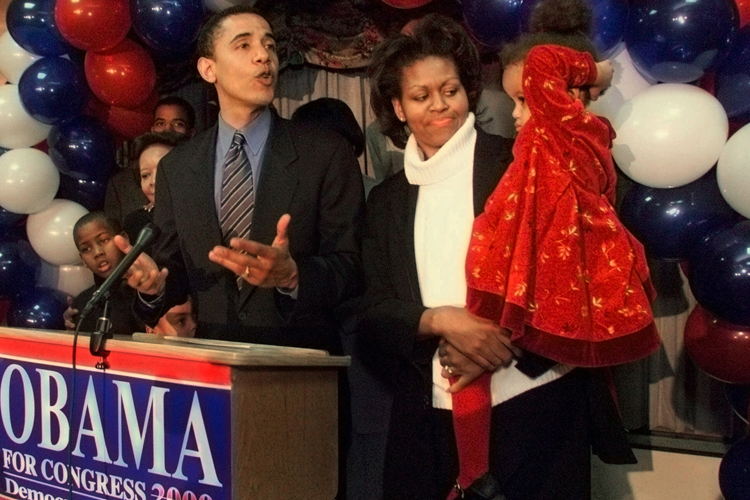
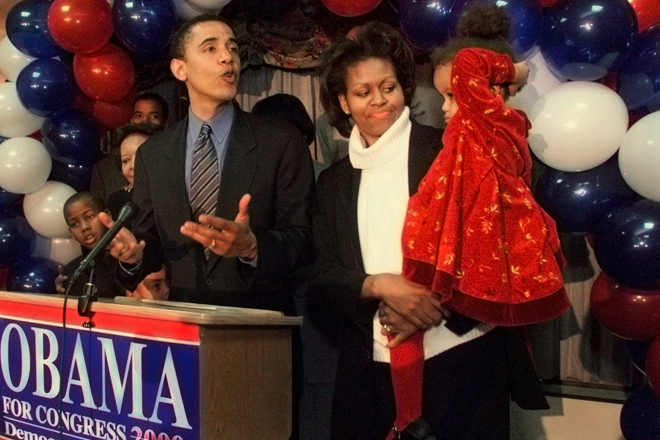
As a correspondent for the Chicago Reader, I covered Obama’s 2000 campaign to unseat Bobby Rush, the ex-Black Panther who’s been a Democratic congressman from Chicago’s South Side since 1993. It’s the only election Obama has ever lost. As even one of his admirers put it, “He was a stiff.” You think John Kerry looked wooden and condescending on the campaign trail? You should have seen this kid Obama. He was the elitist Ivy League Democrat to top them all. Only after losing that race, in humiliating fashion, did he develop the voice, the style, the track record and the agenda that have made him a celebrity senator, and a Next President.

I got my first sight of Obama early that winter, at a church in the South Side’s Bronzeville neighborhood. It was a Saturday afternoon — as a greenhorn challenger, Obama wasn’t getting the Sunday pulpit invitations — and maybe a dozen people were scattered in the worn pews. Obama was a mere two-term state senator, and this was half a decade before “-mania” was added to his name. Weak December light strained through the stained glass. Obama wore a suit and tie — he hadn’t yet pioneered high-fashioned, open-necked campaign casual — and, posing uncomfortably before the baptismal, tried to relax the crowd with self-deprecating wit.

“The first thing people ask me is, ‘How did you get that name, Obama,’ although they don’t always pronounce it right. Some people say ‘Alabama,’ some people say ‘Yo Mama.’ I got my name from Kenya, which is where my father’s from, and I got my accent from Kansas, which is where my mother’s from.”

At the time, Obama was teaching constitutional law at the University of Chicago, and this was the sort of awkward, beginning-of-the-semester joke you hear from a professor trying too hard to prove a sense of humor. If anyone caught that Obama was trying to connect himself both to the birthplace of civil rights and a time-honored black party joke, they didn’t laugh or nod. He went on to give a speech attacking Rush as “reactive.” Afterwards, when I polled his listeners, one told me Obama represented a new generation of black leadership, which is the wrong way to sell yourself in a primary election dominated by senior citizens. Another was a hip-hop poet. He handed me a business card with a photo of himself wearing clown makeup.

Every account of that campaign points out that Obama was tagged as “not black enough” for the South Side. State Sen. Donne Trotter, the third wheel in the primary, told me then, with a sneer, that “Barack is viewed in part to be the white man in blackface in our community.” Black nationalists grumbled about an “Obama project,” led by the candidate’s political godfather, former Clinton White House counsel Abner Mikva. But no one appreciates how hard the man tried to earn his ghetto pass. At a rally for South Side teachers, held in a dim, tiny nightclub called Honeysuckle’s, Obama lashed out at the critics who were calling him too bright and too white.

“When Congressman Rush and his allies attack me for going to Harvard and teaching at the University of Chicago, they’re sending a signal to black kids that if you’re well-educated, somehow you’re not ‘keeping it real.’”

The air quotes hung over the silent gathering.

Wherever Obama went, he talked like a poli-sci thesis. Here’s how he bragged on himself back then, as I reported in the Reader: “My experience of being able to walk into a public housing development and turn around and walk into a corporate boardroom and communicate effectively in either venue means I’m more likely to build the kinds of coalitions and craft the sort of message that appeals to a broad range of people.”

Obama just couldn’t — or wouldn’t — loosen up. The dignified demeanor that had won him a state Senate seat in the university community of Hyde Park did not translate to the district’s inner-city precincts. His internal rhythm was set to “Pomp and Circumstance.” “Arrogant,” scoffed a South Side radio host. Even his body language signaled he was slumming. During a debate with Trotter, in the dank basement of a park field house, he sat with his lanky legs crossed, chin cocked at a heroic angle. He wasn’t even trying to conceal his impatience with a mere state Senate peer, or with this grungy necessity of campaigning. Trotter, who embodied bourgeois black Chicago, from his bow ties to his soul food lunches to the smooth jazz oozing from the speakers of his Jeep, hunched over his microphone, taking digs at his increasing irritated rival. When he finally needled Obama for failing to pass a child-support bill, the calm dissolved.

“Senator, that’s a distortion!” Obama snapped. His baritone went full fathom five, but he never unbent from his patrician pose.

Obama may have been testy because he did have a reputation as an ineffectual legislator — for many of the same reasons he was tanking as a campaigner. Some of his colleagues saw him as a self-righteous goo-goo who thought he was too cool for the chamber and who disdained the hard work of digging up votes.

“Barack is a very intelligent man,” Rich Miller, publisher of Capitol Fax, a statehouse news service, told me in 2000. “He hasn’t had a lot of success here, and it could be because he places himself above everybody. He likes people to know he went to Harvard.”

Obama had been a golden boy for so long: embraced by the Ivy League, profiled in the New York Times, published by Times Books. At 38, it gnawed at him that others his age were already moving up the political ladder. U.S. Sen. Peter Fitzgerald, whose seat Obama now holds, was only a year older. But for the first time in Obama’s life, his ambitions were blocked. The world was pushing back. His impatience showed in condescension to his surroundings.

Back in 2000, when I interviewed Obama in his cubicle-size office at a downtown law firm, he started the meeting by checking his watch. Then he dissed his congressional district, half-joking that he was more committed to the South Side than his opponents, because, number one, he’d moved there from Hawaii, and number two, he could have been raking it in on Wall Street.

“I really have to want to live here,” he said. “I’m like a salmon swimming upstream on the South Side of Chicago. At every juncture of my life, I could have taken the path of least resistance but much higher pay. Being the president of the Harvard Law Review is a big deal. The typical path for someone like myself is to clerk for the Supreme Court, and then basically you have your pick of any law firm in the country.”

Didn’t the people appreciate the sacrifices he’d made? To grind out a voter registration drive when he could have been earning $200K a year at a white-shoe firm? They didn’t. On Primary Day, Obama received 31 percent of the vote. He didn’t lose because he was “too white.” He lost because he was a presumptuous young man challenging a popular incumbent. If anything, his whiteness spared him a bigger beating. He ran strongly in Beverly, an enclave of Irish cops who had never forgiven Rush for his Black Panther past.

Trotter, who is plenty black, got 7 percent. In fact, Obama may be lucky he didn’t win. It’s harder to get to the U.S. Senate — or the cover of Men’s Vogue, or the drawing rooms of Manhattan donors — from a black-majority district.

Obama returned to Springfield a loser. The week of his defeat, he sat down to his regular poker game at the home of state Sen. Terry Link, a fellow Democrat from the Chicago suburbs. The same words were on the lips of every pol at that table: I told you so. Obama didn’t need to hear it. He knew he’d blundered.

“He made a lot of mistakes, and he learned,” Link says now. “He forgot who he was. That he’s Barack. He tried to sell to a crowd who wasn’t buying.”

Around that time, Obama also had a soul-searching drink with Miller, the Capitol Fax publisher. He was upset about the way Miller had characterized him, but “he took that criticism the right way,” Miller remembers six years later, “and he could have taken it the wrong way.”

“A lot of politicians, they know that they’re smart,” Miller says. “They know that they’re capable. It messes with their minds. Politics is not a game of qualifications. It’s a game of winning. That congressional campaign really showed that to him.”

On the state Senate floor, Miller saw a more focused, more collegial Obama, who began to take his work — and his fellow legislators — seriously. Using his experience in constitutional law, he passed legislation to curtail racially motivated traffic stops and to require police to videotape murder confessions. He sponsored legislation that added 20,000 children to the state’s health insurance program.

“I just can’t emphasize enough how much this guy became respected, and how transformative it was,” Miller says. “By 2004, he just had this aura about him.”

Even black legislators, who had resented Obama in his early years, were won over. He earned the respect of Trotter, who watched his fellow senator mature from a résumé in search of an office to an effective legislator. Trotter was so impressed, he now sits on Obama’s presidential exploratory committee.

“I wouldn’t say losing humbled him,” Trotter says, swatting away a term used by many of his white colleagues. “Barack is a competitor, and being a competitor, you don’t like to lose. When he came back, he really immersed himself in the process. He learned he had to get an agenda, to get issues he felt passionately about. He also learned some of those ‘get-along’ qualities you need to get a bill passed. He has proven himself to me that he can take advice. He’s not a one-man operation.”

I’d thought Obama had campaigned like an ass, but I expected him to run for the U.S. Senate. And I expected him to win. His white upbringing would appeal to suburbanites, while South Siders might figure that Obama was as black a senator as they were going to get, after the Carol Moseley Braun debacle. His braininess, his haughtiness, his sense of entitlement — they could only be pluses in a Senate campaign. They don’t call that place Ego Mountain for nothing.

In 2004, I went down to his Michigan Avenue campaign office to interview him for the Reader. His press secretary had already scolded me for the “negative” quotes in my last article. I was expecting another preening, insecure performance. But Obama charmed me right away. He did it to dozens of reporters that year. “Good to see you again,” he intoned, casually, gliding across the room like Fred Astaire playing Abe Lincoln. He had doffed his suit coat for shirtsleeves.

We went into his office, where, sitting under a giant photo of Muhammad Ali knocking out Sonny Liston, Obama tried out some lines he would use at the Democratic National Convention.

“There is a tradition of politics that says we are all connected,” he said. “If there is a child on the South Side who cannot read, it makes a difference in my life, even if it’s not my child. If there’s an Arab-American family who’s being rounded up by John Ashcroft without benefit of due process, that threatens my civil liberties. Black folks, white folks, gay, straight, Asian — the reason we can share this space is that we have a mutual regard. That’s what this country’s about: e pluribus unum. Out of many, one.”

That was the mission statement of 21st-century Obama. As a black candidate, he’d been too inhibited, too embarrassed, to force out phrases like “our community.” Finally, he was comfortable in his own skin, now that he’d accepted that the skin was half-white. Obama wasn’t born to be a voice of black empowerment, like Rush or Jesse Jackson. It’s not just a racial thing. It’s generational, too. Confrontational ’60s-style politics are not his bag. But as a multicultural politician, trying to find the unified theory of ethnic politics, he was rolling like Tiger Woods at the Masters. The aloofness was gone as well. Very intently, he laid out his plan for a federal Children’s Health Insurance Program.

“I think it’d be a good opportunity to lay the groundwork toward expanding health care to all the uninsured,” he said.

Obama was no longer selling himself. Now, he had a legislative goal and a strategy for making it happen. Or maybe, because he knew I was one of his skeptics, he was selling me on the idea that he wasn’t selling himself. In the words of an old police reporter, Obama makes grease look gritty. Just as he was looking two moves ahead, politically, I’m sure he was two moves ahead of my expectations. It was working. I was impressed that he finally believed in something. He was a big-government liberal, no weaseling about it.

“How would you have voted on the Iraq war resolution?” I asked.

“I would have voted no.” And then, with a simplicity that his old self might have thought simple-minded, he said, “I’m not opposed to all wars. I’m opposed to dumb wars.”

Then I asked him about his race against Bobby Rush.

“I got a good spanking,” he said, evenly. “I think that was youthful impatience on my part. I knew I was going to lose on Election Day. I was standing outside a polling place, and old ladies kept coming up to me and saying, ‘You seem like a nice young man, but Bobby hasn’t done anything wrong.’”

Later, when I called his office for follow-up questions, Obama jumped on the line and drilled me with more details of his healthcare plan. He also repeated his “E Pluribus Unum” speech, tweaking a few words. He was proud of that one.

A few weeks after that, I heard him speak at a North Side organic restaurant known for its liberal politics. The Heartland Café had welcomed Harold Washington during his run for mayor, and now it welcomed this new South Side phenom. Obama climbed up on the bandstand and filled that dining room with the same energy he’d project across the Fleet Center: “If there is a child on the South Side who cannot read … If there is an Arab-American family who’s being rounded up by John Ashcroft!” I was startled. The pedantic lecturer had been retired. Now, Obama was a fight announcer, a preacher and a motivational speaker, all on the same platform. Full of conviction, he drove his words into our ears like a carpenter pounding nails. The white folks loved him because he was liberal. The black folks loved him because, as one said to me, “We need someone who can reach beyond the race. He can go to Washington and talk their language.”

That wasn’t the Obama I’d known. But it was the Obama America came to know. I was sold. I voted for him twice that year. That July, the Democrats made him the keynote speaker at their convention. It was partly a defensive move against a rumored candidacy by ex-Chicago Bears coach Mike Ditka. Obama delivered a maiden speech to rival that of Hubert Humphrey in 1948, or William Jennings Bryan in 1896.

Terry Link believes that losing that congressional race liberated Obama to be the real Obama — the bright young charmer Link had met as a fellow freshman in Springfield.

“When he ran for the Senate, he was so comfortable,” Link says. “It’s like speaking from your heart, against speaking from notes. I thought, ‘This is the one I knew. It’s Barack again.’” Trotter saw a different dynamic: “He grew up around whites, so he’s very comfortable in those venues. That was obvious when he went over to [the South Side Irish enclave of] Beverly. His comfort zone was in those circles. That is who he is. This is the face of his grandparents.”

So what do you make of a campaigner whose persona changed so drastically in four years? That he’s finally learned to be himself, or that he’s putting on an act? He’s doing both. All great politicians are also great performers. Obama has been called the Democrats’ Ronald Reagan because he has the personality to sell the public on programs it might reject on their merits. (In Reagan’s case, it was supply-side economics. In Obama’s, it would be national healthcare.) They’re alike in another way. Reagan was a washed-up thesp, doing Vegas and General Electric ads, until he was cast as governor of California, then president. Obama has also grown into the character he was born to play: the great uniter who can bring together old and young, black and white, Democrat and Republican. So far, he’s playing it brilliantly. Even his comic timing has improved — he’s got his new audiences laughing at the same old Alabama/Yo Mama joke. And Bobby Rush has backed him for president.

Some of us, though, are still trying to figure out how he got to be Elvis, Lord Byron and Bobby Kennedy, all in the same dark suit.

“Charisma is in the eye of the beholder,” says Donne Trotter. Much as he admires Obama, he’s not going to drink The Juice over a community organizer from his old neighborhood. “I can’t define him as being this charismatic guy. He’s no Svengali or Jim Jones. Certainly, he has learned, though. He’s a very fast learner.”

This story has been corrected since it was originally posted.

Continue Reading Close

Page 7 of 7 in Edward McClelland