Eric Talmadge
Millions look skyward as eclipse crosses Asia, US
An annular solar eclipse is seen in the sky over Yokohama near Tokyo Monday, May 21, 2012. The annular solar eclipse, in which the moon passes in front of the sun leaving only a golden ring around its edges, was visible to wide areas across the continent Monday morning. (AP Photo/Koji Sasahara)(Credit: AP) ALBUQUERQUE, N.M. (AP) — Millions in Asia and the western United States watched as a rare “ring of fire” eclipse crossed their skies.
The annular eclipse, in which the moon passes in front of the sun leaving only a golden ring around its edges, was visible to wide areas across Asia early Monday. It then moved across the Pacific and was also seen in parts of the western United States Sunday afternoon.
Viewing parties were held in Reno, Nev., Oakland, Calif., and elsewhere. In some parts of the U.S., special camera filters for taking photographs have been sold out for weeks in anticipation of the big event.
People from Colorado, Oklahoma and as far away as Canada traveled to Albuquerque to enjoy one of the best vantage points.
Members of the crowd smiled and cheered and children yelled with excitement as the moon crossed the sun and the blazing halo of light began to form. Eventually, the moon centered and covered 96 percent of the sun.
“That’s got to be the prettiest thing I’ve ever seen,” said Brent Veltri of Salida, Colo.
Albuquerque city officials had urged residents to go to organized events or watch one of the many live webcasts to avoid damaging their eyes.
The eclipse cannot be viewed with the naked eye or even sunglasses. And solar glasses, which make the sun look like a huge orange disc, are a rare commodity in communities along the eclipse’s path.
In Japan, “eclipse tours” were arranged at schools and parks, on pleasure boats and even private airplanes. Similar events were held in China and Taiwan as well, with skywatchers warned to protect their eyes.
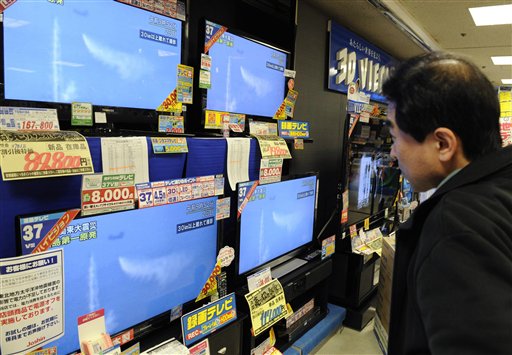
The eclipse was broadcast live on TV in Tokyo, where such an eclipse hasn’t been visible since 1839. Japanese TV crews watched from the top of Mount Fuji and even staked out a zoo south of Tokyo to capture the reaction of the chimpanzees — who didn’t seem to notice.
A light rain fell on Tokyo as the eclipse began, but the clouds thinned as it reached its peak, providing near perfect conditions.
“It was a very mysterious sight,” said Kaori Sasaki, who joined a crowd in downtown Tokyo to watch event. “I’ve never seen anything like it.”
At the Taipei Astronomical Museum in Taiwan, the spectacle emerged from dark clouds for only about 30 seconds. But the view was nearly perfect against Manila’s orange skies.
“It’s amazing. We do this for the awe (and) it has not disappointed. I am awed, literally floored,” said astronomical hobbyist Garry Andreassen, whose long camera lenses were lined up with those of about 10 other gazers in a downtown Manila park.
Hong Kong skywatchers weren’t so lucky.
Several hundred people gathered along the Kowloon waterfront on Hong Kong’s famed Victoria Harbor, most of them students or commuters on their way to work. The eclipse was already underway as the sun began to rise, but heavy clouds obstructed the view.
The eclipse followed a narrow 8,500-mile path for 3 1/2 hours. The ring phenomenon lasted about five minutes, depending on location. People outside the narrow band for prime viewing saw a partial eclipse.
“Ring of Fire” eclipses are not as dramatic as a total eclipse, when the disk of the sun is entirely blocked by the moon. The moon is too far from Earth and appears too small in the sky to blot out the sun completely.
Doctors and education officials have warned of eye injuries from improper viewing. Before the event started, Japan’s Education Minister Hirofumi Hirano demonstrated how to use eclipse glasses in a televised news conference.
Police also cautioned against traffic accidents — warning drivers to keep their eyes on the road.
___
Tallmadge reported from Tokyo. Associated Press writers Mari Yamaguchi in Tokyo, Wally Santana in Taipei, Hrvoje Hranjski in Manila and Kelvin Chan in Hong Kong contributed to this report.
N. Korean nuclear weapons: How real is the threat?
FILE - In this April 18, 2012 file satellite image provided by GeoEye appears to show a train of mining carts, at the lower center of the frame, and other preparations underway at North Korea's Punggye-ri nuclear test site but no indication of when a detonation might take place, according to analysis by the U.S.-Korea Institute at Johns Hopkins School of Advanced International Studies. If getting international attention is North Korea's goal, then there is nothing quite like detonating a nuclear device to make your adversaries sit up and take notice. But experts say North Korea probably has a long way to go before it will be able to actually deploy a nuclear weapon. (AP Photo/GeoEye, File)(Credit: AP) TOKYO (AP) — If getting international attention is North Korea’s goal, then there is nothing quite like detonating a nuclear device to make your adversaries sit up and take notice. But experts say North Korea probably has a long way to go before it will be able to actually deploy a nuclear weapon.
While North Korea is adept at getting political mileage out of showy military displays, Pyongyang’s attempts to show off its strength are, just as often, reminders of its weaknesses — and a nuclear test would likely fit that pattern.
Continue Reading CloseWhat to watch for in North Korea rocket launch
SEOUL, South Korea (AP) — The five-day window for North Korea’s rocket launch opened Thursday, meaning liftoff could come any morning between now and Monday, weather and technology permitting. The U.S. and others have condemned the launch as a test of missile technology. North Korea claims it is merely seeking to put a satellite in orbit. Experts say it is probably a mix of both, since the technologies are nearly identical. Here are some things to watch for once the countdown begins.
GETTING INTO ORBIT
Continue Reading CloseIs North Korea serious about its race to space?
SEOUL, South Korea (AP) — North Korea says its first venture into space came 14 years ago, when the “Bright Shining Star 1″ satellite roared into orbit and began broadcasting odes to the nation’s founder.
North Korea’s newest rocket is now on the launch pad, ready to sing Kim Il Sung’s praises once again. The only glitch: Its claims of successful satellite launches don’t hold much water. Foreign tracking agencies have never picked them up.
Some experts believe North Korea is interested in getting a satellite into orbit at some point, but they say it doesn’t appear to have the know-how yet. Doubts have been raised over whether the satellite is even intended to work or is merely a cover story for a missile test.
NKorea rocket launch draws more worry than Iran’s
FILE - In this Feb. 3, 2010 file photo, the models of Iranian-built satellites, Navid, left, Tolo, center, and Mesbah-2, are seen, in Tehran, Iran. In February, 2012, Iran successfully launched a Navid satellite into orbit with a missile launch-vehicle called the Safir. Amid the celebrations of the 1979 Islamic Revolution, the Iranian rocket roared off a military launch pad and placed the 110-pound Earth observation satellite into orbit. (AP Photo/File)(Credit: AP) TOKYO (AP) — Just two months ago, amid celebrations of the 1979 Islamic Revolution, an Iranian rocket roared off a military launch pad and placed a 110-pound Earth observation satellite into orbit. The U.S. State Department grumbled about possible missile applications, but that was pretty much it.
Now it’s North Korea’s turn. As it prepares to launch a rocket to celebrate the 100th anniversary of the birthday of its founder, it too is telling the world that its goal is to get a satellite into orbit. It is even promising to give international observers front-row seats at its newly built launch facility — just like Iran did in February.
Continue Reading CloseNKorea launch an intel oppportunity for US, allies
TOKYO (AP) — As the U.S. and its allies decry North Korea’s planned rocket launch, they’re also rushing to capitalize on the rare opportunity it presents to assess the secretive nation’s ability to strike beyond its shores.
If North Korea goes ahead with the launch, expected to take place sometime between April 12-16, the United States, Japan and South Korea will have more military assets on hand than ever to track the rocket and — if necessary — shoot it out of the sky.
Behind the scenes, they will be analyzing everything from where the rocket’s booster stages fall to the shape of its nose cone. The information they gather could deeply impact regional defense planning and future arms talks.
Continue Reading ClosePage 1 of 6 in Eric Talmadge