Frank Browning

Abortion war hits Britain

U.S.-style protests and Breitbart-like tactics have given the British anti-abortion movement new life

  • more
    • All Share Services

Abortion war hits BritainAn activist stands outside a branch of the British Pregnancy Advisory Service, a clinic which offers abortions, in central London. (Credit: Reuters/Andrew Winning)

Anti-abortion protests might seem as American as apple pie, but don’t be fooled. Activists from Texas have just laid siege to Britain, the country the Daily Mail has called the “the abortion capital of Europe.”  And their American-style demonstrations outside the headquarters of the British Pregnancy Advisory Service recently led the group to warn that the new anti-abortion climate could spook future doctors from entering women’s health.

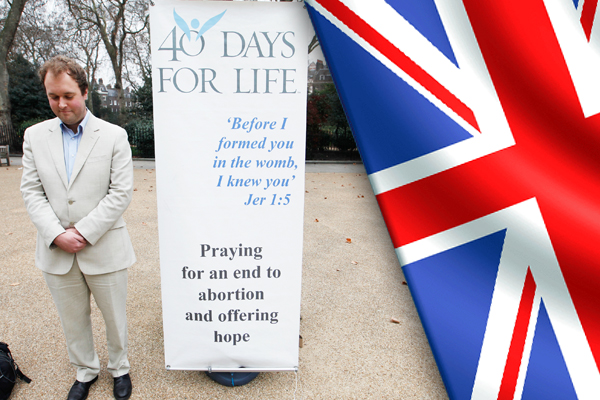
At the root of these protests is the devoutly Christian “40 Days for Life,” a Virginia-based organization that has been working hard to export American-style anti-abortion protests to other countries. The group had its start in 1998 when Planned Parenthood announced plans to build a clinic in College Station, the home of Texas A&M. According to the official history, a pharmaceutical salesman and religious Catholic named David Bereit rallied 60 churches of different denominations and thousands of people and “dramatically reduced abortions in the region.”

Bereit then organized the first 40 Days for Life campaign in 2004 on the A&M campus, where he recruited his chief lieutenant, a media savvy young man called Shawn Carney. Now global, 40 Days has been organizing English Catholics, Protestants, Evangelicals, and others since September 2010. Their most recent effort came during the 40 days of Lent, when they ran continuing “prayer vigils” outside the BPAS headquarters on Bedford Square in the historic Bloomsbury section of Central London. The protesters also staged similar vigils at the corporate Calthorpe Abortion Clinic in Birmingham, the Marie Stopes Clinic in Manchester, and the Wistons Clinic in Brighton, where they worked with Abort67, an offshoot of America’s highly controversial and virulently graphic Center for Bioethical Reform.

The English protests were all part of a campaign throughout the United States and around the world that 40 Days call “the largest and longest coordinated pro-life mobilization in history.” The list of 251 participating cities over the past  four-and-a-half years stretches from Sydney and Buenos Aires to Warsaw, Madrid, and Dublin. Both Bereit and Carney visited London to help inspire this year’s protests and guide them in the direction of made-in-America demonstrations. The vigils involve praying, fasting, bearing witness, and reaching out to the community to end abortion. England’s Catholic hierarchy supported the protesters, with Bishop Alan Hopes attending an evening prayer vigil last Friday.

Bereit told the Catholic World Report the protests are meant to be completely “non-confrontational.” Many of the pregnant women, their supporters, and the staff at the clinics saw a different reality. “We are very supportive of people’s right to protest,” Clare Murphy of BPAS told the Guardian’s Sarah Ditum. “But what we saw in Bedford Square was beyond the pale… . They hang around by the door and encircle women.” The protesters, said BPAS CEO Ann Furedi, “should really think carefully about whether what they are doing is really Christian.”

The protests aren’t the only American-style anti-abortion action that Britain has recently seen. In February, the conservative Daily Telegraph took a page from Andrew Breitbart and James O’Keefe and sent pregnant women with undercover journalists and hidden video cameras into four abortion clinics around England. They then published videos of doctors agreeing to abortions where the mother said she wanted to terminate the pregnancy because she did not want to have a girl.

Tory Health Secretary Andrew Lansley responded to the videos by ordering unannounced inspections of some 250 abortion-providers. These were to be conducted by the government’s much criticized Care Quality Commission, whose director had just been forced to resign after a series of major cock-ups. Well before the commission finished its investigation, the Telegraph reported that more than 50 of the clinics were “not in compliance.” Secretary Lansley, already under fire for his controversial efforts to privatize and otherwise reform the National Health Service, said he was “shocked” and “appalled,” and called in the police and medical authorities, who banned some of the doctors in the videos from performing abortions.

Together with the 40-Day protests, the government inspections left the abortion-providers feeling “under siege,” as BPAS said in its statement. They feared that the newly heated atmosphere and government “witch-hunts” could deter a new generation of doctors from providing abortion services, especially for the more difficult later term cases. “Abortion is a vital yet stigmatized area of women’s healthcare which few doctors train in,” a spokesman for BPAS told the Guardian. “The current politicization of abortion provision is likely to make it even harder to recruit a future generation of abortion doctors who are prepared to provide the care that a third of women will need in the course of their lifetimes.”

Does Obama’s baritone give him an edge?

A powerful voice is a "god-given sound," says opera's Lotfi Mansouri. Obama's baritone seems to have that magic. Clinton's higher-pitched voice, not so much.

  • more
    • All Share Services

Does Obama's baritone give him an edge?

What is it about Barack Obama‘s baritone?

Aside from the symbolism of finding a new hero who might displace the shame and fear that has poisoned American public life since Martin Luther King’s murder in 1968, there is something in the very essence of Obama’s voice — its tone, its timbre, its resonance — that has struck deep chords among Americans and foreigners in this year’s campaign season. Not since King’s “I Have a Dream” speech in 1963 has a black American moved so many other Americans, white or black. And once the matter of voice was raised for Obama, a not always flattering parallel immediately arose concerning the voice of the first real female candidate in U.S. history: Hillary Clinton.

Eager to probe deeper into the chords of the candidates, I called two of the world’s specialists on what moves us as listeners to others’ voices, Lotfi Mansouri and Rick Harrell, who have coached singers at the San Francisco Opera and the San Francisco Conservatory opera program.

Says Lotfi, “The fact is that the basic timbre is a god-given sound. Through technique and vocal study and all that, you can learn to control it and develop it, but you cannot manufacture timbre artificially.” Adds Rick Harrell, “The old saying is the eye is the window of the soul. Well I would say the voice is the window into the heart. People, whether they be actors or politicians, can be slick and manipulative and pretend to be genuine or heartfelt. However, the sound of the voice or the sound of a baby’s cry or the sound of someone saying, ‘Please! I can do what’s best for our country.’ It comes across at a very gut level more so than at an intellectual level.”

When it happens that something within us shivers or tingles at the words of a great and moving voice — Martin Luther King Jr. for my generation, Winston Churchill and Franklin Roosevelt for my parents, or even perhaps for some others Benito Mussolini — it is because there is something that leaps forth from the very anatomy of the speaker, revealing the innate grain that vibrates with a receptive grain of our own. It is not about goodness or morality or truth-telling and is little affected by coaching or practice.

The late French semiotician Roland Barthes touched on this vocal magic in a famous essay called “The Grain of the Voice.” He cites the power of a Russian church cantor’s chant: “something … is directly in the cantor’s body, brought to your ears in one and the same movement from deep down in the cavities, the muscles, the membranes, the cartilages … as though a single skin lined the inner flesh of the performer and the music he sings.” Barthes goes on: “The ‘grain’ is … the materiality of the body speaking its mother tongue.” Like the variable grain of an oak or a walnut, it reveals, if we let ourselves hear it, the integral character of the person before us.

Mansouri and Harrell also wanted to talk about another iconic American voice — that of Frank Sinatra. By no account did Sinatra possess a great singing voice. To the contrary, it was by most musical assessments decidedly mediocre. And yet, when Sinatra sang, it was as though he filled all the inner and outer dimensions of our experience. “Take ‘One for My Baby,’” Lotfi said to illustrate. “He didn’t just sing the words; you got the whole atmosphere inside and around the words and you were enveloped by it.” Like the great Ella Fitzgerald, whom he studied, Sinatra employed all the technique he could muster: tone, phrasing, inflection, the single note prolonged beyond endurance. Yet all of that would have been as nothing had the story he was telling in his songs not also been the elemental, physical story of his own life. The mediocrity of his lightweight baritone disappeared and we became travelers on the pulsars generated by the anatomy of his voice box in a separate universe of his making.

Can we say that Barack Obama achieves something similar when he speaks his chant for change? That is apparently what is happening for tens of millions of Americans, not to mention the cheering galleries across Europe and around the world who want it to be so.

But set against that resonant Obama grain there is what appears to be a counter-grain of what is all too often labeled Hillary the Shrill, including all the gendered codes buried beneath the word “shrill.”

Natasha Williams, a longtime friend from Ukraine, who directs the Balagula Theatre in Lexington, Ky., says simply that it is jarring to hear a lineup of self-important, deeper-voiced males followed by a higher-pitched female. We are conditioned, she says, to look for authority in the male voice — even though she finds the Republican heir-apparent John McCain squeaky and the now withdrawn John Edwards tweaky. Hillary’s problem arises, Natasha says, “when she gets excited and it comes across as angry and that upsets voters more than if she were an angry man. It’s connected to the fact that when the mother is upset in a house, kids feel insecure. It’s not like that with the father because the mother stands in between the kids and the father. But when mother loses it, then it’s really scary because the whole sense of security goes tumbling down.”

That’s one interpretation. Lynn Meyer, who’s done everything from political consulting to selling Florida real estate to writing a detective novel, has a different take on how men hear women’s voices. “There are two voices that don’t seem very threatening [to men]. One is the little girl voice — either Valley girl or Jackie Kennedy’s little tiny whisper. The other is Lauren Bacall’s [she lowers her own deep and gravelly] very sexy voice. Anything between these two, women have to be very careful they don’t sound like what I call ‘the voice of civilization.’ That’s the voice who told you to eat your spinach, take your elbows off the table, asked you where’s your homework. It’s a voice that sounds like a bit of mother, then schoolteacher, and finally nagging wife.”

Sound like that and you’re dead in the water. That is too often Hillary’s problem when she gets excited, Lynn says. “Every time she changes her register, people use that awful, sexist word ‘shrill’ and that’s really code for the voice of the scold.”

I put that proposition to Rick Harrell, the San Francisco Opera coach, who agreed that shrill is death to any public performer: “We wouldn’t want our hectoring mother speaking to us from the White House for the next four years.” Harrell’s Opera colleague Lotfi Mansouri broke in, “It’s a preconception. A cultural preconception.”

One of those apparent cultural preconceptions afoot in the current political fray is a rather odd preoccupation with the baritone quality of Barack Obama’s voice, an insight pointed out by my radio colleague Brenda Wilson, a woman raised in Virginia who often speaks in grave stentorian stanzas. “Type in the phrase ‘Obama’s voice’ on Google and see what you get,” she advised one day.

I did so as I was listening on the transatlantic phone line. “OK,” I said, still clueless. “There are a lot of listings.”

“More than just a lot, Frankie-boy,” she answered. “How many do you see?”

“Yeah, there are a lot. A whole lot. Sixty-some thousand. But what’s that prove?” I persisted. “Everybody knows he’s a great speaker.”

“Yes,” she said, the schoolmarm slipping into her instructions. “Now, type in ‘Obama’s baritone.’ What do you see?”

“Whoa!” I answered. “Two hundred and sixty-nine thousand results!”

“Um-hm,” she murmured.

I waited.

“That’s all,” she said. “Isn’t it curious that the hot candidate gets to be described as a baritone? I mean, really, what’s so good about baritones?” I took the question back to Rick Harrell.

“When you hear commercials, whether on the radio or voice-overs on television, when they’re saying, ‘Trust me, buy this,’ or ‘Trust me, go here, go there,’ as often as not it is a baritone voice. If they want to get you excited and stimulated, then they’ll go for a higher-pitched sound.”

Probing further into the hidden presumptions and preconceptions of the baritone, I came back to an old reference from Freud’s student Theodor Reik, who proposed that the true baritone is an evocation of the ancient shofar, the ram’s horn that came from Abraham’s sacrificial sheep but was also the instrument Moses used to call the wandering tribes together at Sinai to hear the thundering words of God. Retreaded into 20th century neo-Freudianism the shofar/baritone becomes the vocal embodiment of phallic authority.

Hear my horn, hear my authority. It’s not a great leap to hear the multiple meanings of the horn.

Freudians, we know, can find something phallic in just about anything that speaks, breathes or moves. But such interpretations of the power of the baritone long antedate Freud or even the children of Abraham. Last summer Harvard anthropologist Coren Apicella took herself and some tape recorders to visit the Hazda people of Tanzania, who live pretty much as their ancestors did several millennia ago. Apicella wanted to know what voice had to do with seduction, fertility and reproduction. To get at the question she invited a clutch of Hazda men into her Land Rover and asked each one to say, “Ujambo,” or “Hello,” in Swahili. Then she played her recordings for a group of Hazda women and asked them to rate the voices.

Hands down, the women chose the baritone “Ujambos” over the higher-pitched ones. “Why there’s this relationship we’re not entirely sure yet. It could be that these men have greater access to mates. And so maybe these men that have deeper voices have higher levels of testosterone, maybe they’re better hunters and they’re able to bring more food home to their wives,” Apicella told NPR reporter Sean Bowditch. As it happens, when Apicella reversed the gender recording, the Hazda men seemed to prefer women with higher voices.

When it comes to the public arena, however, baritone is still the winning vocal register — as Obama’s string of primary victories, even among blue-collar white men, would suggest. It all comes back to how the baritone “is the voice one tends to associate with authority,” as opera coach Rick Harrell says, to get people to buy stuff or take certain medicines or, where candidates are concerned, to “trust … [that they] know what’s good for the country.”

Continue Reading Close

Mad cow madness

Hysteria over infected cattle has overtaken France -- and the rest of Europe may not be far behind.

  • more
    • All Share Services

Mad cow madness

I recently stopped in at my favorite neighborhood bistro, where it’s hard to spend more than 20 bucks on a brilliant meal, and Pascal gave me the bad news: If I wanted the ris de veau, this would be the last week. The guillotine of state was falling on this most prized of French delicacies.

Ris de veau, or sweetbreads, come from the thymus gland of a young cow or bull and are among the truly wondrous delights of old country cooking. Sweet. Succulent. Creamy. They harbor the texture of freshly plucked mushrooms but are as rich as liquid gold.

But ask for them here, right now, and most people will wonder if you’ve been bitten by a mad cow. Mad cows are everywhere, or at least on every newspaper front page, magazine cover and television news broadcast. And they are quickly herding their way across the continent as new cases of BSE, or bovine spongiform encephalopathy, have shown up in recent weeks in the slaughterhouses of Germany and Spain.

In an emergency session held earlier this week, European Union agricultural ministers met in Brussels, Belgium, and voted to ban the use of recycled animal parts — thought to be a major source of mad cow infection — as feed for livestock for at least six months. They also voted to eliminate all cows more than 30 months old from the food chain unless they are tested and proven to be free of the disease, a decision that could lead to the destruction of 2 million head of cattle. The cost of these precautionary steps is estimated to be in the billions of dollars

French cattle farmers, and the beef industry as a whole, are reeling at that prospect. Mad cow disease, or vache folle, has terrified France in the past month, producing a generalized panic that makes the AIDS anxiety of the 1980s look like a bad flu epidemic.

Beef sales are reported to be down 50 percent in some areas and prices have fallen through the butcher’s floor now that more than 100 slaughtered cows have been found to have BSE — an unfailingly fatal corrosion of the brain that transforms the animal into an angry, staggering beast until it eventually dies of wasting and neurological failure. Its human form, Creutzfeldt-Jakob disease, has much the same effect on people. Faced with market collapse, slaughterhouses are sending Ferdinand and Elsie back to their pastures.

Sturdy farmers in their rubber boots and brown casquettes — the very emblem of all that was good, true and honorable in the French patrimony, the backbone of the struggle against Big Mac globalism — risk becoming veritable bjtes noires at the dinner table. How could it happen, when just a year ago the French were still holding out against importing British beef, where widespread mad cow fears first popped up nearly a decade ago and where thousands upon thousands of cattle were destroyed to stop the spread of the disease?

French herds, the French public was told, were safe because they had been isolated from the feed and breeding stock of British beef. Remember, too, that for centuries the two countries have sneered at each other with gustatory hyperbole: The French referred to their rivals as “les rosbifs” (translation: They’re dull and fat) while the Brits dubbed those across the channel “les grenouilles” (slimy and effete).

“Les rosbifs” simply could not be trusted around food. The inventors of industrialization had allowed technology to run away with the butcher shop, producing not only Dolly, the world’s first fully cloned sheep, but — even worse — a roast beef production line in which taste and food safety had been sacrificed to corporate profit.

In France, the hearthstone of modern haute cuisine, the natives assured themselves that no such gambles had been taken. The French system for inspecting, testing and labeling meat has long been far more advanced, with each side of beef indicating its geographic point of origin. The use of bone meal in feed, which in Britain was suspected as a possible vector of the disease, had been banned for French cattle. And just to drive home the point of French food superiority, poster-boy eco-farmer Joseph Bove led demonstrations against that most globalized symbol of corporate grub, Le Big Mac.

Then came the bad news.

Meat inspectors last year found two cases of vaches folles in random checks of slaughterhouses. Then five. Then seven. By the end of November, 131 mad cow carcasses had been identified. The beast — or microbe, or really neither, but rather a strange form of infectious protein called a prion — had arrived, and could be infiltrating every butcher shop, every charcuterie, my God, every neighborhood bistro, or worse, maman’s Sunday afternoon table.

Silent. Invisible. Invincible.

How could it be? From within that maelstrom of fear, panic was born.

Even as the annual summer retreat emptied the French populace into beachside oblivion, scientific reports from Britain suggested that far more people may have been infected there with BSE during the 1980s than anyone previously knew, since it may take up to 20 or 30 years for Creutzfeldt-Jakob disease to appear. By the end of October, even as the number of French cases rose dramatically, the British commission appointed by Prime Minister Tony Blair three years ago to investigate the epidemic published a scathing assessment: Scientists, government inspectors, health officials, the meat industry, everyone had mumbled, stumbled, dissembled, denied and delayed action until a serious health problem had developed.

On top of all this, French television showed a devastating British documentary in which a young girl woke up one morning sobbing uncontrollably. Her agony continued inexplicably for another six months until neurologists diagnosed her as having the dreaded Creutzfeldt-Jakob disease. No one knew how she could have gotten it, except perhaps through jars of processed hamburger she had eaten as a baby.

On Nov. 6, Le Figaro, the French daily newspaper, published a similarly horrific account of a French adolescent dying from Creutzfeldt-Jakob, his parents guilt-stricken over what they must have fed their son. Add to that a report in the muckraking Le Canard Enchaine in which the French agriculture minister acknowledged that, well, actually, not all cattle feed is absolutely free of animal meal — just nearly free, no more than .03 percent. The meal, after all, was still approved for feeding pigs and poultry, and it was not possible to scour processing equipment of every gram of the stuff when preparing cattle feed.

And shortly thereafter came the edict — no more ris de veau, just as a few years earlier cervelles au beurre noire (brains sauteed in black butter) had been banned. Brains were understandable: After all, it’s the brain that the prion destroys. But ris de veau? Some — mostly not French — people are squeamish about organ meats, but there seemed no particular evidence that prions lodge themselves in the thymus any more than they do in the muscle tissue that makes a steak. Even so, with prices dropping, beef became the food of poor men.

Oddly, the Belgians, the Italians, the Germans, the Swedes and the Swiss have exhibited nothing comparable to the terror that has swept France. Not that anyone is free of worry; a nastier, scarier death is hard to imagine. But in other countries it has not taken on the flavor of a national panic, pushing everybody but Al Gore and George W. Bush off the front pages. Here it borders on the hysteric.

Nowhere else in Europe does food hold such symbolic power over the national sense of self. Not even in slow-food Italy, where micro-regionalism is even more powerful than in France, does the memory of the abandoned farm village hold such a grip over the moral imagination. France may owe its prosperity to prowess in the aerospace, transportation and communication industries, but its character is rooted in the wistful longing for the village — no matter that almost no one wants to spend more than a weekend there.

Now even the dream of the village and its “happy” farmers has been spoiled, and by whom? By the forces of industry, foreign and domestic makers of commercial feed, and by scientists — the corrupt descendants of the revered Louis Pasteur, Marie Curie and Denis Diderot — who cannot or will not tell us where this new killer lives and where it comes from.

Perhaps worst of all, these revelations fall in the wake of the medical scandal that tainted the previous regime, which approved the distribution of HIV-infected blood products and then lied shamelessly to protect itself. A lying government, confused scientists, corporate chicanery, fallen farmers and collapsed cultural pride: Little wonder the crisis of faith grows darker daily, replacing the tractable and clichéd indigestion known as “crise de fois” with what the rest of the European press has come to call “le psychose vache folle.”

Continue Reading Close

“Lives of the Psychics” and “The Second Creation”

One book tries to pass off psychic hooey as science, and the other reveals the creativity at the heart of great biology research.

  • more
    • All Share Services

It is hard to know which is the greater scandal: that Syracuse University awarded a full professorship to Fred Frohock or that the esteemed University of Chicago Press elected to publish his “Lives of the Psychics: The Shared Worlds of Science and Mysticism,” a singularly banal, mush-minded assemblage of psychogibberish.

Let’s start at the very beginning: the title. Evoking every Roman Catholic schoolchild’s religious training, it prepares us for stories of extraordinary souls who, even if they are not saints, should mesmerize us with the grandeur of their experiences. Moreover, the subtitle leads us, C.S. Lewis-style, to expect an engagement or, at the very least, a rapprochement between the methods of science and the insights of faith. And what do we discover on Page 1 of the preface?

Frohock’s daughter Christina has a nightmare. She is watching television and sees a plane crash that has taken her daddy, days before he is to fly away to a foreign country. Fact: The plane on which he had flown to Madrid did later crash. Lesson: Behold the psychic insight of little children into the unknown.

One wonders: Has Frohock ever joined other parents at play groups, particularly parents who fly frequently? It would seem not, for if he had he might have heard a dozen, several score, possibly several hundred if he circulated a bit, stories about small children suffering separation anxiety at a parent’s departure, stories in which the children slip into terrors about their parents’ disappearance and demise, their nightmares stitched together from television footage of airplane crashes.

Is it disturbing to have held one’s sobbing child and then to have been on a plane that we know has crashed? Certainly. Is it disturbing to look in the rearview mirror on a busy freeway and see a car spin out of control behind us? Surely so. There but for the grace of God … If we live long enough, not one of us in the modern world will fail to have such a moment. But most of us, fortunately, do not spittle out tomes about these random events and claim them as proof of a second psychic reality. We recognize, as children of Einstein and Bohr, or as high school students of introductory quantum theory and particle physics, that uncertainty pervades the universe, that random clustering of matter and action punctuate existence and that the human mind is eternally hungry to assert its own meaning over events that seem to be beyond our control. Perhaps most to the point, those of us who possess faith know as well that it has not come to us through the recounted anecdotes of magicians and “healers” whose stories are the common currency of the National Star and “Lives of the Psychics.”

Not that Frohock’s topics are uninteresting. His long chapter on ESP and the ability of study subjects to divine information posted on blind test cards gives his paragraphs the shadow of scientific evaluation. Indeed, as he notes, military investigators both in the United States and in the former Soviet Union conducted extensive research on such phenomena. One of the most productive of these exercises brought together a panel of psychics to describe Russian military installations, and, Frohock tells us, the psychics produced “useful information roughly 10 to 15 percent of the time.”

Intriguing. His source? One Richard Broughton, director of something called the Rhine Research Center. The Rhine Center was a descendant of a parapsychology lab that was once housed at Duke University and was directed by the grandfather of anti-behavioral, anti-cognitive psychology, J.B. Rhine. Once Rhine retired, the lab was put out to pasture. Broughton might be a very reliable source, yet it seems strange that Frohock’s report on military research includes no data or response or commentary from anyone in the military. Stranger still when we come to know that Broughton — the source — has no interest any longer in verifiable, empirical method. Indeed, he abjures any participation in conventional methods of scientific verification, as in: Trust us, we have special access to the other realm of knowing.

What is most exasperating about Frohock’s method is his pose of dispassionate inquiry. In Chapter 4 — “Intuitive Science” — he casts the metaphysical, intuitive psychics against the deep skeptics. Fair enough. Intuition, he says, often leads us to press on beyond the apparent empirical evidence. In such manner, we are told, did Copernicus finally establish that the Earth revolves around the sun, displacing the Ptolemaic system, which had the sun spinning around the Earth. Oops! Copernicus as intuitive psychic? Hardly. It was the evidence available to Copernicus, based on astronomical observation and data, that led him to demonstrate the flaws of the old explanation.

Worse still, Frohock moves to claim one of the great geniuses of 20th century medical science, Dr. Judah Folkman. Early in his career Folkman suspected that cancerous tumors induce the body to build new blood vessels to feed the tumorous mass, a process now known as “angiogenesis.” For decades, established cancer researchers doubted the thesis, and Folkman was unable to demonstrate sufficient evidence for his hypothesis. “Like many movements in science,” Frohock writes, “Folkman’s work initially encountered replication problems: In November 1998 officials at the National Cancer Institute announced that their scientists had been unable to reproduce the results of the experiments. Folkman counseled patience. Then, in February 1999, scientists at the institute announced that they had finally confirmed some of Folkman’s experiments. Plans were put in place to begin testing the drugs on people.”

Demonstrating … what? In Frohock’s mind, here is proof positive that “intuitive science” — allegedly Folkman’s lifelong “intuition” that tumors require angiogenitive blood vessels — had trumped Cartesian reasoning. One can only guess at the apoplectic response Folkman, a brilliant man of empirical science, might have at the confusion between persistence based on data and psychic faith. Still more egregious is the use Frohock makes of Folkman when as his next case he cites one of the notable quacks of modern medicine, Charles Gant, who would ditch nearly all of modern Western medicine for something he calls the “toximolecular economy” of the contemporary world. To cite only one Gant-ism, we need not bother with providing insulin for Type 1 childhood diabetes when a better nutritional scheme will reestablish the body’s internal harmonies and solve the problem. Through a return to such “natural” harmonies, Gant, and his booster, Frohock, assert, we will recover access to the great healing forces that have been given to psychics, spiritualists and touch healers.

One could go on and on and on: Frohock confuses Newtonian physics and general field theory when he tries to explain how wood is converted to smoke (no, Frohock, burning wood is not simply converted to smoke but to smoke, ash and a number of gases), misrepresents basic brain research on strokes and Alzheimer’s disease, gets lost in confused quantum theory while trying to “explain” out-of-body experiences.

Saddest of all is that this book and others of its ilk pretend to wrestle with a genuine conundrum of contemporary life: the place of mystery in the secular world. Scientists, priests and commuters — all of us are surrounded by levels of mystery, uncertainty and inexplicable phenomena unimagined either by Thomas Aquinas or by Denis Diderot. The question that Frohock seems incapable of posing is how to understand faith, which is the defining base of certainty, in a material universe where science has defined uncertainty as the norm. Rather than take on a handful of the most compellingly faithful or psychic figures, examine their lives and experiences intensely and question and contextualize their stories, he has simply packed his pages with dozens of uncritical anecdotes.

By contrast, Ian Wilmut in “The Second Creation: Dolly and the Age of Biological Control,” one of the most valuable books of the current season, defines the practice of science as clearly as it has ever been stated: “Science is, after all, an attempt to explore the unknown.”

Wilmut and Keith Campbell, his collaborator at the Roslin Institute in Scotland, were the creators of Dolly, the bioengineered sheep. Working with science writer Colin Tudge, Wilmut and Campbell have written a careful, accessible history not only of Dolly but of the last quarter century of bioengineering. Though they never shy from using necessary technical terminology, they walk the reader clearly through the genetic intricacies of basic reproductive biology, explaining precisely how it is that sperm and egg unite, what the pitfalls were both in humans and in animals for developing the first in vitro fertilization and how it was that geneticists finally managed to develop multiple-cell embryos that could be divided and cloned.

The story is itself intriguing, a scientific detective tale marked by false starts and dead ends. It is also the very antithesis of the sort of book Fred Frohock chose to write: It’s steady, detailed and forthright about ongoing and to-date irresolvable mysteries of biology. Moreover, in a straightforward scientific narrative, the authors of “Dolly” confront the persistent conundrum Frohock skirts in “Lives of the Psychics”: Are there “essences” that exist beyond the realm of science, which, God given or nature made, are unknowable, unalterable by the techniques of Cartesian inquiry? For in creating a cloned mammal, science has walked into one of the great debates of 19th century ideas, the notion of “vitalism” vs. “mechanics.”

If we mammals are merely biomechanisms, whose parts and processes can with time and technique eventually be known, then should we not eventually be able to possess the key to the creation of life? If on the other hand, as the “vitalists” insisted, we are driven by some special force that is not knowable “by the standard laws of physics and chemistry,” then we must acknowledge the power of an unknowable realm. Dolly and the birth of her progeny have clearly answered the easy question: We now possess the technology to fabricate life, to create a mammalian clone. That does not mean that we have destroyed the soul, that we have eliminated mystery from existence or that all healing can be easily explained by mechanistic medical procedure. Rather, in the way that only great books can, the authors of “The Second Creation” have taken us so far into the frontiers of science that they have revealed whole galaxies of mystery that the thoughtful, creative mind must now explore.

Continue Reading Close

“What's Love Got To Do with It? A Critical Look at American Charity” by David Wagner

An argument that American charity lines the pockets of the well-heeled while it screws the poor.

  • more
    • All Share Services

Just as I was finishing David Wagner’s tightly argued essay on the history of American charity, out came a poll that seemed to confirm everything the sociologist was saying: Religion and its do-gooder stepchild, volunteerism, have all but smothered real political engagement in America.

The pollsters, who based their findings on a sampling of 800 college students, cited as typical the response of two undergraduates, a 24-year-old music student at UCLA who sings in hospitals and convalescent homes but eschews political action because it’s “a time issue,” and a 19-year-old Boston University lad who dismisses “the whole field of politics” because “it doesn’t interest me much to get involved in such a hypocritical situation.” Yet they found a high degree of what both they and the students identified as “civic-mindedness.”


Wagner’s central argument is that Americans’ increasing disengagement from political activity, or more specifically our failure to address fundamental social and economic inequality through the political system the way that the European social democracies have, has direct links to the individualistic Protestantism in which American charity has its origins.

Wagner’s history is hardly path-breaking. David Rothman in “The Invention of the Asylum,” Frances Fox Piven and Richard Cloward in “Regulating the Poor” and those great theorists of Protestantism and the rise of capitalism R.H. Tawney and Max Weber have all articulated his central argument. But Wagner’s concise and vivid chronicle of the rise of paternalistic American charity is a valuable handbook for anyone who wants to challenge the duplicitous nostrums that the vapid stars of both political parties have lately offered up on everything from welfare to the widening class gap to the impoverishment of public education to the more and more degraded public-health system.

Today, as in the earliest days of the colonies, the first concern of the charities is to distinguish between the deserving and the undeserving poor. Even the Quakers, whom we all too readily vest with selfless generosity, sought not so much to relieve suffering as to establish moral friendship through home visits in which one of the Friends would assess an unfortunate woman’s “character, her situation, her habits and mode of life, her wants, and the best means of affording relief, so that assistance may not be extended to the vicious, and idle, when it is due only to the honest and industrious suffering under sickness and misfortune.”

Nor is the distinction between the worthy and the unworthy everything: Equally vital to the charitable tradition, to the intent of almsgiving, is the elevation of the giver. In Christianity it has always been so, as theological historian Boniface Ramsey observes: “They exist [the poor] for the sake of the rich, to offer them opportunities for beneficence or to test them.” Or in the language of St. Eligius: “God could have made all men rich, but He wanted there to be poor people in this world, that the rich might be able to redeem their sins.”

Mere theo-twaddle, you say? Consider the Rockefellers. Or Carnegie. Or Ford. Or for that matter, Gates. The liberal position is that the great global foundations these men founded represent a sort of intergenerational payback. Wagner doesn’t dismiss the good works performed by the gilded children of the great malefactors (medicine, parks, libraries, concert halls — all noble), but he points out the two salient facts behind such platinum gift-giving: The families secure for themselves, without really working, ruling social status for generations to follow; and, more important, they give their largess away at direct cost to you and me, the taxpayers, for by having their accountants secret half their wealth in tax-exempt foundations, they cleverly preserve the rest from the tax bite — and the redistribution — that affects the rest of us.

Nor do the modern secular recipients of charitable largess escape Wagner’s eye. With the general collapse of the political left in America, the activism of the ’60s and ’70s took refuge in an entirely new sector of the charity world: the nonprofit. What began as a method to help the poor and the disenfranchised win food, housing and jobs or to draw attention to middle-class social concerns (environment and education) that the corporate order ignores has metamorphosed into an enormous career and service division of the economy constantly begging for government grants, with (for example) YMCAs — once devoted to providing exercise and succor for the poor — now getting taxpayers’ money to run spas for the well-heeled.

Who benefits? Wagner calculates that in 1992 the nonprofit sector received a total tax subsidy of more than $220 billion — that’s money from you and me — for its operations. The amount was roughly double the level of all federal spending on the poor and the unemployed.

The usual response is that public bureaucracies steal or waste our money for themselves and inculcate dependence. Yet could they be any less efficient than the squishy matrix of guilt and self-promotion that is our charity system? Do we genuinely believe that our latter-day Protestant paternalist approach has provided Americans with better health care, sounder housing and more reliable education than the French and the Germans and the Swedes and the Norwegians and the Dutch and the Danes and the Italians and the Spanish and even the Brits and the Irish have had the political will to erect? Do you really think that the Christian impulse has been good for the poor? Or for your grandmother? Or for your baby? If you do, go ask a French mother how much she spent on child delivery at her local hospital or what it cost to treat her father’s tumors, and then take a look at Wagner’s work.

Continue Reading Close

A bittersweet saga in Sicily

An innocent visit to an "ancient" village fertility fest reveals a multilayered history of feuding families, conniving communists and failing farms.

  • more
    • All Share Services

A bittersweet saga in Sicily

Oct. 9, 1999

Monte Alburchia, Sicily:

Our object was plain enough: to wind our way into these most superstitious and least touristed of mountain towns, the homeland of the Sicilian banditry that had helped give rise to the Mafia, to witness what had been described as a pagan harvest and fertility festival whose roots could be traced to Roman times, or possibly earlier.

Claudio, a Neapolitan architect friend of more than mildly pagan impulses, had been telling me about these simple festivals — most of them Catholic underlain with obvious pagan elements — since I first met him in Naples six years earlier. He had once taken me on a walk through the back streets of old Naples, where shrines to those suffering in the heat of purgatory mark nearly every block. “No Neapolitan really believes he will go to hell,” Claudio had said, his voice twinkling, “so we suppose those people who have had some troubles will stay warm a while in purgatorio until the spirit world releases them.” Although he called himself an atheist, he confessed that he had always been captivated by the icons and rituals dedicated to invisible spirits and other worlds — which is why he often found himself drawn into ecstatic religious processions and ancient festivals. I knew immediately we were kindred spirits.

Our plan was to meet in Palermo and drive up into the Madonie range, through exquisite towns with names like Polizzi Generosa and Petralia Sottana and Castellana where hotels and restaurants hardly existed, over roads that 50 years ago were barely paved and often were in fact simply ditched and graded wagon trails, to an impossible shale mountain covered by a honeycomb of rock houses and alleyways called Gangi.

The festival was called La Sagra della Spiga and was dedicated to the great mother goddess of grain and fecundity, Cerere — Ceres to us, or to the Greeks, Demeter. Of all the local town festivals we had found in newspapers and on the Internet — some dedicated to a local bread or a particular olive, one celebrating the annual tuna slaughter at Trapani, as well as the famous Catholic feast days where often shoeless men walk across the scorching summer pavement bearing enormous, heavy monuments to the Virgin — only this festa in Gangi was directly dedicated to the pagan gods of ancient Rome. And more, the advance program for the festa was a toney four-color, 6-by-8-inch, three-panel brochure, accompanied by a slick, heavy-stock photo magazine celebrating the town’s architectural, archaeological and artistic heritage, including tantalizing essays from prominent university scholars — all plainly produced with promotional lire sent from Rome. Dazzling and magical.

Turning the mountain bend that grants first sight of Gangi is equally bewitching, but as you rest there at roadside studying this solitary, thousand-foot hill town, there is also something strange, unsettling, about the place. The closer you come to Gangi, the stranger that feeling becomes.

To drive up the front of Gangi, through the web of cobbled walls and streets, promises almost certain failure. Rising and falling with the terrain, the medieval passages become stairways or else grow so narrow that even a Fiat 500 would drop its axle over the outer edge if it advanced another yard, leaving the hapless driver to back up over the dusty stones to the second or third previous division point in this interconnected dreamway that only those born to it can navigate with confidence. To ascend the front of Gangi it is better to walk. Hoof yourself up past the ancient Norman tower and the Capucine monastery and the criss-crossing stairs that replicate the stations of the cross, to the 17th century palace of the Bongiorno noblemen that is now home to the town council, where, panting and parched and wet with sweat, you find yourself unsure whether the stone silence that surrounds you is a measure of the town’s tranquility or its suspicion of almost anyone whose great-great-great-grandparents were not born there.

There lies the conundrum of Gangi and scores of remote jewel towns like it, for as suspicious as the eyes behind the curtains are, this is at the same time as warm and generous as any place could be. Only after you step into the cafe bar and talk to Cicio, home from his studies in Palermo, do you begin to understand that both your gut reactions have been correct, that — as an old friend of Sicilian parentage put it to me — everyone in Sicily exists on parallel planes.

Maria Rita is Gangi’s official publicist. She, her parents, her grandparents, their grandparents, everyone for more than 200 years had grown up in Gangi. They were, in a phrase, “tutti Gangitani.” Though she and her husband live outside the town, she works, part-time, inside the Bongiorno palace, blithely showing off eight rooms full of 18th century ceiling frescoes and trompe l’oeil paintings on mostly classical themes completed for the last of a set of grand academies located in Gangi, this one the Academy of the Industrious! At the peak of its baroque power, Gangi was indisputably industrious. The elegance of its masonry alone, on slopes that make San Francisco seem flat, marks the town as an architectural and engineering wonder. Inside the churches and palaces rest thousands of tons of luminous inlaid marble, totems to the powerful who ruled here.

Now, of course, all that remains is the marble, the architecture and the art. The power, the commerce, the academies — the energy — are all gone. That absence settled over Maria Rita, like a faded veil.

“Yes, the Sagra della Spiga, well, it’s a wonderful festival, yes, but really, personally, I don’t care so much about that,” she started. “It’s very nice, I’m sure you will enjoy it, but the really important thing here, the thing that has been too much forgotten, the thing that is so important to the history of Gangi, is at the mountain. There!”

She gestured firmly with her right arm, through one of the baroque windows, out across the rolling plowed fields, to a broken peak a few miles away.

“Monte Alburchia.” She paused a beat. “It is on Monte Alburchia where my uncle first uncovered the ruins, yes, so many things, little things of course, like plates, and pots, amphoras, candle-holders and, of course, the little statues carved to Cerere.”

Her uncle had been a local teacher and something of an amateur archaeologist. The first ruins had been noted by one of the Bongiorno nobles, in 1761, who found ceramic fragments, coins, a few oil lamps and cremation tombs that clearly dated to early Greeks and Romans. Her uncle had been the first to pick up the trail in the desperate years after World War II, when almost no one in Gangi had any money. Despite a brief flurry of interest, the town fathers had relegated the ancient artifacts to a locked warehouse. Now, of course, she told us, smiling, we could see them in the civic museum.

If her resentment was only barely detectable, it became clearer the more she began to talk about her children and the life that was so plainly disappearing all around her in this failing farm town. They would of course have to go away, to Palermo or to Catania, “or even to Italy,” she said — reminding me that Sicilians still see Rome as a ruler, only slightly more congenial than the Arabs and the Normans and the Spaniards who ruled them in earlier centuries. “No, nothing anymore is really they way I remember it when I would go in the summer to my grandfather’s farm. The smell of the hay after a rain, I can’t catch that smell anymore. Or, if I can say this, the color of the shit the cows make is somehow different, and even its smell is different. I suppose it’s from what they feed the cows now. And the smell of the milk and its texture. Now it’s not so thick, even on the farm, as I remember it because it doesn’t give so much cream.”

Sentiment for lives gone by, for the memories of childhood in the disappearing village life of farm communities, is universal — it even led the French some years ago to try to preserve village culture by regulating the numbers of supermarkets that could be opened. In Gangi, the layers of fantasy and remembrance seem richer, deeper and darker: our fantasies as foreign visitors (informed at least in part by Francis Coppola and Robert DeNiro) about what lies inside this utterly improbable rock of a Sicilian town, where secret and forgotten passageways are said to be carved deep beneath the surface; the Gangitani fantasies that somehow the old and superficially tranquil life of a farming town will miraculously survive the megalithic machine of global agriculture; the fantastical memory-faith in the mysterious powers that we each silently imagine might still emanate from a distant mountain where artifacts of the great fertility goddess can still be recovered; and, finally, the fearful fantasy that should tourism, or agriturismo, actually come to Gangi in time to save it, that Maria Rita’s life and the lives of all her friends would gradually turn into a sepia-toned movie life, that her own words would be snatched away as its script, or as Claudio put it, Gangi would become a sort of rustic Venetian museo vivante in the mountains.

“No! No e come Venezia!” she answered. Yes, people had to leave Gangi, but then they would come back. Always, they come back, and some day, her children, after they had grown up, they would come back, too.

One of her 6-year-old twin sons was standing beside her as she spoke.
“So, yes, you could say that all of this life is kind of like a film. The things that I have known in Gangi, the tranquil place where I could play and ride my bike when I was a little girl, the aromas of the farm, and the way we lived then, even if it was a little hard: These things I can only tell my boys about, but they will never smell the atmosphere that I did. I can take this one” — and she patted her son on the shoulder — “out to our little piece of land, and he can sit on a mule for a few minutes, but of course it’s not at all the same. The experiences you have lived are only that. They are what you have lived. After that, it’s over.”

As to the Sagra della Spiga , the pagan festival honoring Cerere that had lured us to Gangi, it was a splendid festa , certainly, she said, but the true festival is the week before. “That is the Christian harvest festival, the Festa della Burgesi , when the farmers bring in offerings of grain to Chiese Madre (the central church) in thanks to God. It is much older and much more important.”

We thanked Maria Rita and promised to stop back the next day to pick up some archaeological materials she was preparing. Politely, she asked where we were staying.

“Gangivecchio, the old converted convent …”

“Oh, yes,” she answered, her smile and her voice hardening by half a note. “I’m sure you will be very comfortable over there.” Then she added, “Well, if you really want to know about the origins of the Sagra della Spiga , I suppose you need to talk to Constantino Muschara. The communist. He invented it.”

Gangivecchio is behind Gangi. Literally “Old Gangi,” Gangivecchio is a converted abbey of the 14th century, now a restaurant and inn. It is the nearest thing to a Tuscan estate you could find in Sicily: a crumbling courtyard, russet-colored plaster walls, fig and lemon trees, giving on to long, tree-covered, sun-dappled walkways and a friendly, elderly, wild boar lounging in his own pen. After the Benedictines gave it up, the abbey and its lands went to the Bongiornos (their town palace became the town hall) who affixed their noble seal to the entry arch, and then it went to another aristocratic family, the Tornabenes.

Giovana Tornabene, blond, 50ish and free of either obvious wrinkles or make-up, carries the presence of a duchess. Her younger brother, Paolo, quieter, the front half of his hair missing, his jeans almost too baggy for Italian hips, avoids attention. Wanda Tornabene, their mother, rules. Together, they converted what was left of a once enormous feudal estate into an inn and restaurant. “I always say,” Giovana opened our conversation, “that to live in a house like this is to have your feet in the past and your head in the future.”

As is so often the case in southern Italy, and in many poor territories, it fell to the women “to save the goat” — a Sicilian idiom for saving the farm. After the war, while the peasants were literally starving, even the landed aristocrats were in trouble. Wanda had come from Tuscany to marry Sr. Tornabene and was for the most part scandalized by the conditions of the peasants living on the estate — many of whom huddled in shacks with the sheep to stay warm in winter. From her husband’s point of view, theirs was the lot that fate had dealt them, and indeed his steadily declining fortunes he took as equally fateful. The Tornabenes lived by selling their patrimony. By 1978 the original 1,600 acres had shrunk to 140 acres, and the family had begun selling off its heirloom furniture. Wanda, famous among the gentry for her spectacular Sicilian dinners, followed the advice of a visiting priest who urged her to convert the old abbey into a restaurant and country inn.

Her husband was aghast.

“Are you crazy? How can we ask people to pay to come into our home? My ancestors will turn over in their graves.”

Tougher and more resilient than her noble husband, Wanda answered, “If we don’t do this, they will turn over for other reasons.”

Giovana, who at the time was studying classics and archaeology in London, recounts the story often and even included it in the memoir/cookbook she wrote in English with her mother, “La Cucina Siciliana di Gangivecchio.” The book, which won the 1998 James Beard award, has not been translated into Italian and is unavailable in Sicily.

Dinners at Gangivecchio are famous throughout Italy, so much that Prince Charles and a small entourage even came for lunch one day. The restaurant has been written up in the food section of the New York Times. Few of the diners, however, seem to come from Gangi. Giovana spoke about the ongoing spiral into which the Gangitani have fallen one evening after dinner.

“We are a little bit sad here in Gangi, it is true,” she began. “Although I think dissatisfied is a better word. For the farmers it’s terrible. The government says to plant olives, so everyone does, but there is no support. Now this is the second year we have been in a drought. You can talk to any of the little farmers around here. No one believes he can survive — only the big company farms down below Catania.”

“That’s a bit like what Maria Rita said, whose grandfather used to own a big farm …”

“No, no, he was not a farm owner,” Giovana corrected me. “He was what we call a soprasanta, a kind of hired boss. Those people were the worst ones. They held the fate of all the peasants in their hands.”

Her voice, still elegant in English, was rising.

“They were the mafia, a kind of mafia. They controlled everything. They decided who could work and who could not. Well, and that means who could eat and who could not.”

She reclaimed her temper.

“All these aristocrats with their enormous land, acres and acres, you cannot imagine, and everyone so poor, after the war, they were … lost. It is a sad story, truly sad, but it’s our history.”

Later, about midnight, we drove into town. It had been tomblike the previous noon, but now it was aflame with music and dance. Great circles of contra dancers spun and twirled and snaked along a wide straight paved street at the top of the town. Some 70, some 40, some 17, these were not tourists from France or England, or even from Palermo. They were country people with burnished faces dressed for a country party, such as you might find at a county fair Kansas or Indiana, save for the characteristically green Siclian eyes flashing beneath thick forests of black hair.

That night had been the reenactment of the marriage ritual, a ritual that a young woman named Tiziana explained still existed as recently as 40 years ago. The code was this: A young man who wanted to marry a girl would leave a small log outside the main door to her parents’ house. If in the morning, she picked the log up, it meant that she — and most importantly her family — accepted his marriage bid. If when he returned that night the log was still at the door, it meant that he had been rejected.

“It all went very well,” Tiziana said, “if everyone knew what was going on and agreed. But sometimes there could be confusion or mischief. Once, a girl’s family who wanted her to be married to a rich boy, placed the log out themselves, then told people that it was the rich boy who had given it. It didn’t matter that he swore he hadn’t put the log in front of their door. The girl’s mother swore she had seen the boy, so it looked like he would have to marry her. It seems a lot like folklore and very old-fashioned, but really it’s how things were still done here just a few years ago.”

Tiziana and her boyfriend, Giuseppe, both of whom could have been Calvin Klein models, were deeply involved in the Sagra and its folkloric fanfare. Both were students at the University of Palermo, she in biology, he in agricultural technology, and they both knew that except for summer visits from school, neither of them would likely ever live in Gangi again, unless it was as retirees to a town that had turned genuine local festas like these into some form of agriturismo the way the Tuscans have. When we cited the example of Gangivecchio as a possible model, Tiziana’s face colored even more sharply than Maria Rita’s.

“We Gangitani aren’t so welcome out there.” Real spite fired her words. “I remember when some friends and I went to see the abbey once. We just wanted to see this historic site that’s supposed to be where Gangi was started. They screamed at us to get out. Anyway, it’s too expensive for anybody here to go there to eat.” Then she brightened. There was dancing and fun to be had, and Giuseppe was holding her hand, and these costumes and steps and rhythms and smells she cared about more than dwelling on the latest chapter of an ancient grudge between the peasants and the nobles.

- – - – - – - – - – - -

Constantino Muschera, the communist — really the head of the farmers union, which had a historic connection to the now-defunct Communist Party — lives a few hundred yards down the street from the piazza at the Biongorno Palace. He is 62, unmarried, and lives with sister, Maria, a friendly but ill-fortuned soul with a bristly goatee, large eyes, a number of moles and sparse hair, best cast as one of the three sisters at the opening of “Macbeth.” She took us across the street to the union office which, even on a Saturday afternoon, was bustling.

Constantino had heard we were in town. Even at festival season Gangi doesn’t host many tall, angular Anglo-Saxons accompanied by rangy Neapolitans with bedroom eyes — and even fewer asking nosy questions. Constantino’s manner and appearance were as disarming as his sister was disturbing. He seemed unable not to smile.

“Of course, the Christian festival is the most important one,” he agreed with Maria Rita. “But you see, back then — 35 years ago — we were a group of students when we invented the corterdo di Cerere, the pagan procession of the old gods. You know, there were these archaeological things that had been found, and we decided it wold be a good story to tell. But really, it was just an invention, something we thought might be good for the farmers.”

And the priests? The Church? Had they said nothing about a pagan procession? At that time, after all, the Christian Democrats were, as we now know, both a mouthpiece for the church and very nearly an arm of the Mafia.

Another smile.

“There was no political purpose?”

“Perhaps. Perhaps you are right that it was this way. Perhaps we just wanted to give the people an example of something outside of Christianity. Give people the idea that perhaps it wasn’t right to have all the politics and cultural events be tied so closely with Christianity, because, you know, for the common people all politics then was connected with religion, and we wanted to offer, perhaps, a different example.” As we talked other union workers were busy at two of the three computer terminals, and the stream of visitors all nodded warmly, and respectfully, to the silver-haired union leader.

“OK, but do the common people, the farmers and mechanics, really feel connected to those old gods, Pan and Bacchus and Cerere, the fertility divinities? Do you think ordinary Gangitani think about the ancient temple of Cerere and whether the ruins at Monte Alburchia are from that temple?”

His answer was elusive. “It depends. If you’re over 50 …” Maria wandered in, calling to him, distracted, and he quieted her.

“For those of us over 50, we all know there is a kind of mystery out there that surrounds Monte Alburchia. For the younger ones, I don’t know. But we know that Monte Alburchia is a magic mountain. In two ways. There’s the archaeological aspect, whether the pieces that have been dug up show that it was the site of the ancient fertility temple, whether the mythical Cretan town of Engyna, which the Romans wrote about, was there, and if it was why the Greeks should have come here so deep into the mountains, so far from the sea.

“And there are popular mysteries, too, like the legend that every seven years there is a midnight market of ghosts and phantoms where one time a poor farmer came and bought a basket of oranges, only to discover they were cast of gold. And the necropolis. All these mysteries still remain on the mountain, and so people of a certain age anyway are maybe even a little bit scared of the mountain.”

It wasn’t an answer, exactly. Surely the promotional information we had found on the Internet about a town that retained a celebration of its ancient pagan roots was more fanciful than true. Gangi was far from some anachronistic corpuscle of pagan fertility worship. Except for the parents of the schoolchildren dressed up as one of the gods or the wood nymphs, it was likely that few people could tell us anything about the old divinities. On the other hand, most of the exquisite churches of Gangi, like most churches in Italy, are locked, empty, awaiting restoration money from Rome — which, if it ever arrives, will convert those once sacred temples into highlights for the Michelin Guide. Farmers who wait on grace from either Cerere or Mother Mary (the images of the two divinities are nearly interchangeable) will be hauling empty wagons.

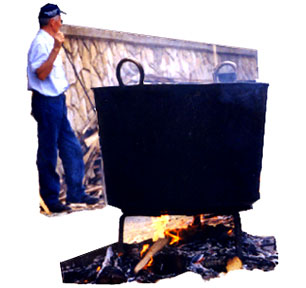
Tomorrow, Sunday, would be the great procession, the capping point of the festa. Friday night farmers had brought in huge, black kettles into which they would pour soaked grain — eight different grains from their farms — to be cooked over open flames into a porridge. By Saturday the town was beginning to buzz. A few kids and some people in their 20s were trying out the old folkloric costumes — black wool pants, dark leather vest, white shirts, red kerchiefs for the boys; long, white, blousy dresses and short waistcoats for the girls. Sunday morning would arrive with cows and draft horses and intricately carved carts covered in brilliant colors with painted faces and armored bodies, serpents, animals, ancient and medieval, a dream storm of Sicilian images.

Late on Sunday afternoon — two hours late — the divine procession would begin: a somewhat porky Bacchus bearing plastic grapes, a skinny Pan proud of his first scraggly goatee, a flock of pretty wood nymphs in gold satin, two groups of Tarantella dancers who not only knew the old steps well but betrayed none of the embarrassed self-consciousness that would shadow American teenagers at a square dance, and, finally, Cerere, the mother goddess of fertility, a buxom high school beauty queen carrying a white spear and seated on a wooden sled drawn by ornery oxen. All with horns and drums and flutes and plaintive concertinas.

The young would pile themselves on the wall against the upper side of the hill. Their parents and grandparents would crowd the sidewalk and the low wall across the street, the fertile valley several hundred feet below. If there were any other tourists present, they would be well disguised: This event was still a festival locally made and locally loved, even if it carried the color of a high school history pageant.

All that would come later, but now it was time to visit Monte Alburchia. The sun was falling, the 95-degree August heat breaking. On our way we passed a shepherd, a youngish man herding his flock up the road. We pulled over to ask directions, and the driver behind us lay on his horn, forcing his SUV through the bell-clanging sheep. The conversation lingered. Once he had had his own small place and his own sheep; he had made some cheese, the shepherd said in thick Sicilian. But that was over. Now you had to have a big building. Pasteurization equipment. Millions of lire. So he was working for another farmer, tending his sheep, through probably he wouldn’t be doing even that too much longer.

And the legends of the mountain, we asked.

He knew of them. He shrugged his shoulders. He had been there once. We would have no trouble climbing to the top.

- – - – - – - – - – - -

Hollow, vertical squares are about all you can see on the trail to the top these days, though still no formal, modern archaeological excavation has yet been carried out.

Claudio and I sat there for quite a while, perhaps an hour, listening to the wind, catching the occasional patter of a far off diesel tractor. The entire humped hill of Gangi lay directly before us.

“You know,” Claudio said, “it would be easy for us to say that it is all a fraud. Even at the museum, they don’t seem to believe that there was ever a real temple to Cerere here. But there was something. Something that was lost, probably destroyed in the earthquake that shook away half this mountain. And now for the last 700 years there has been something again, another town that had been rich and powerful, and like the one before it, may be disappearing from sort of economic earthquake. Surely it’s still a Christian town, though with most of the churches closed …”

He stopped for a moment.

“You know, when you’re a writer, writing a play or a novel, you’re always looking for suggestion. In the air and the earth all around you. This Sagra della Spiga is an invention, but don’t you think that when Constantino and his student friends were inventing it, they were, maybe without really knowing it, going through the same kind of procedure you go through when you invent a new story? They were drawing from the spirit of this place, from old divinities as well as new ones, from their old memories and legends, from the archaeology of this mountain, and from the fantasies they need to make sense of their lives.

“You could say it’s kitsch. OK. But you could also say it’s a kind of artistic performance. And you know, I think at last that it’s fantastic! So simple, but so fantastic!”

Continue Reading Close

Page 2 of 3 in Frank Browning