Virginia Vitzthum
Looking for Mr. Other Half
I want my soul mate to be my lover, best friend and intellectual equal. Why is that asking too much?
“What if your soul mate isn’t the person you have sex with?” my friend Jim wondered recently. “What if it’s your sister or your best friend or some teacher who really inspires you?”
Impossible, I argued. The soul mate package comes fully loaded: sexual, emotional, intellectual, spiritual, sense of humor. You never need anything translated because you completely get each other. And you know immediately because you’ve found your missing half, as in Aristophanes’ speech in Plato’s Symposium.
“Have you had that?”
“Sure,” I said. “I mean, not for that long, and the guy turned out to be crazy, but for a few months there …” I trailed off. I realized I had no idea why “soul mate” had outlasted the other myths I’d retired from my personal cosmology, like unconditional love and no work relationships and the man who maintains all his initial enthusiasm for cunnilingus.
It was time to reexamine the soul mate concept. I needed a break from my translation problem anyway; I was sick of parsing the cute bartender’s parting words from the week before. I had initially interpreted the English phrase “I’ll call you,” which accompanied the exchange of phone numbers and bodily fluids, as “I’ll call you,” instead of the actual intended meaning of “I won’t call you.” My friends patiently listened to me discuss the phantom call. They also reminded me of the number of fish in the sea, that I’m a great catch and, gently, that sleeping with bartenders might not be the best soul mate procurement strategy.
God bless them, they knew right when to shift from “Don’t worry, he’ll call” to “OK, he is a jerk.” I listened to them because they’re usually right. These are the same friends who remember my birthday, bring me food when I’m sick, edit drafts of what I’m writing, let me sulk, tell the truth. My friends are smart and kind, a combination that seems elusive among my bachelor cohorts. As I pondered Jim’s question, I realized my (male and female) friends are closer to soul mates than the men I’ve been romantically involved with.
I’m used to blaming myself (“It’s not you, it’s me”) for being single, but perhaps it’s not due to my pathology or my independence or a preference I haven’t figured out yet. Maybe it’s because romance is a terrible foundation for a relationship. Where friendship stabilizes and supports, romance keeps you off balance, wary, mean and defensive. What could be more perverse than donning a hard mask of unattainability to look for the one we can really open up to? When we’re courting, we hoard our compliments, enthusiasm, disclosures — especially women, with our cultural imperative of “mystery.” Yet freely sharing that kind of thing is how you make friends.
This would all make more sense if sex weren’t so mutually fun. Stirring such a wonderful extra into the mix should sweeten a relationship, so why does it more often breed antagonism? Why does dating and, to a certain extent, all romantic love feel like a war? The question has stumped human beings for centuries, and the best answer is still probably a poem or a song or a Gallic shrug.
Nevertheless, I undertook an unscientific survey to see what my wonderful friends, married and single, make of the friendship/romance/soul mate conundrum.
Several single gals compared dating to a job interview — it’s impossible not to resent the power that person across the table wields. Elena, who has been married for 15 years, says long-term intimacy just rounds out that resentment. “Once you’ve gained trust, bared all, built something, there are inevitably these impossibly high expectations,” she wrote in an e-mail. Marriage also disappoints because of “the baggage of watching your parents’ marriage, all the crap we’re fed about love and romance, and all those weird power issues that get attached to sexual and emotional fidelity.” When I asked her, as I asked all the married people, “What’s the glue that holds you and your spouse together?” she replied, “Children and real estate.” She was having a bad day.
Other answers to the “glue” question in my e-interview included: “Humor. Enjoy each other’s company”; “Faith, respect and children”; “I know she’ll listen when I want to talk about something; I can drop my protective shield around her”; “kindness and acceptance”; “genuinely respect and like each other and have open and honest communication”; “intellectual compatibility (we rant about the same things) … and we fight fair.”
A recently divorced friend offered his ideal: “never-in-doubt devotion and passion commonly associated with love and the honesty and support commonly associated with friendships.”
The responses above, except for Elena’s, are all things “commonly associated with friendships.” Nobody wrote “passion,” “romance” or “sex.” The people who stay married are simply lucky to remain — or become — friends once the hormones chill out. My unmarried survey respondents seem to understand the friendship basis of a good marriage even as they (we) hold out for chemistry and thunderbolts and soul mates.
Nathan, 28 and married, wrote, “It’s a truism that single people find the complacency of married people off-putting. What’s not so well known is that married people often find the desperation and neuroticism of singles really rather sad.” Ouch!
Some of my single friends, however, are starting to build lives around their actual, rather than their fantasy, connections. Deb lived with her boyfriend Jack for five years and when they broke up, she moved in with Alice. She got a lot happier. “Jack was really moody. At the time I thought all the drama must be the passion and excitement of love. But it was really just tension from trying to anticipate his moods,” said Deb, who’s 36. Living with Alice is so much more harmonious, she added, that the two of them have discussed making it permanent rather than shacking up with any more men.
Julie, a 37-year-old graphic artist, recently had a pregnancy scare during the seventh month of sleeping with a man she knows she won’t marry. Her first non-abortion thought was to break up with the man and rent a big house with two girlfriends. Unlike the man, she says, the two women are financially stable and love children. Furthermore, “I know my friends are committed to me; they’re not going to decide they don’t want to know me in six months.”
Gay and single Frank, 34, said his friends feel like family: He spends holidays with them and is godfather to several babies. Frank said making friends feels “more organic than dating. If you wait to find a perfect lover to establish a close bond, you’re going to be pretty lonely.”
The response that resonated most with me, however, was that of Chris, a 39-year-old, attractive, never-married man. He e-mailed:
No, I don’t consciously think of my friend group as a family/lover substitute. But over the years there seems to be an incremental, de facto substitution of friends for lovers in my life. It’s kind of worrisome. As I and my friends mature, and as our relationships mature, it all becomes more comfortable, supportive, etc. I’m slowly developing a fuller, more satisfying life as a singleton, and so there’s less urgency about finding a mate. Once I was constantly driven by the mating desire, but now work and friends and goofing around and my “hobbies” can make weeks go by without my doing anything about the romance thing. And I really don’t think it’s that I’m any less horny or obsessed with it. I’m just adapting more and more. Or here’s an even more troubling thought: Perhaps my growing comfort in life makes me less and less willing to take risks — to put myself on the line sexually or emotionally, to pursue someone, to take a leap. Or one final possibility: Dating, especially the initial dance of it, requires ways of being that interest me less and less.
“Yes! Exactly!” I thought when I read this. “This guy is speaking all my fears and conjectures.” Sort of like — a soul mate.
A yenta-minded reader might be wondering at this point, “So what are you two crazy middle-aged kids waiting for?” To them I submit the short dating history of “Chris” and Virginia, which will not do much to dispel Nathan’s diagnosis of our tribe’s “neuroticism” as “rather sad.” Chris and I were set up by a friend, had a giddy, mind-melding e-mail correspondence and then went on an awkward, but not terrible, date with a strange undercurrent (I thought) of hostility. That night, Chris went home and e-mailed me that he liked me and found me attractive but his sense was we’d do better as friends, and maybe I’d like to meet this writer friend of his.
I, meanwhile, stopped off for a nightcap and went home with the cute bartender.
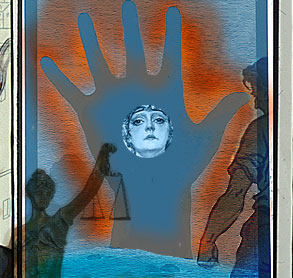
Escape from hell
After months of editing S/M porn and being harassed, Juan has a "bottoming epiphany." Second of two parts.
Sexual harassment is like jazz — complex and hard to explain. You feel it before you understand everything that’s going on. What may have started as chivalry or even affection curdles into torture. The goal isn’t seduction but rather making the subordinate squirm.
As the only heterosexual male at RMP (for Rolf’s Media Plaything, a fictitious name), an S/M video production studio, Juan fit in where women often do in male-dominated workplaces — he was more object of desire than one of the guys. At the same time, his technological prowess made him indispensable, and the combination brought out the worst in his co-workers and his boss, Rolf — all gay men. “Because the porn people couldn’t be bothered with technology,” he explains, “I had to be exposed to everything. They treated me like a tool; they’d talk about anal sex in front of me just to make me uncomfortable, like they were trying to crack me.”
Continue Reading CloseJuan in hell
A computer geek becomes the whipping boy for a gay S/M porn producer. First of two parts.
This is not a morality tale about pornography. Yes, Juan was disturbed by some of the S/M scenes that he edited, digitized and put onto CD-ROM. Yes, his personal life fell apart when he brought the S/M home to his girlfriend, who didn’t want to be tied up. And two years later, he still has nightmares about his boss — an elderly Austrian Sufi and gay S/M master who terrorized Juan and the rest of his young employees.
But Juan says the problem wasn’t porn; it was management beating up on labor. The teasing he got as the only straight guy fits the “hostile environment” definition of sexual harassment, and Juan also endured the needy contempt that suits everywhere heap on the math whizzes in tech support. When he tries to explain why he stayed so long in an abusive work situation in the late ’90s, when techno-nerds ruled the earth, Juan shrugs. “I don’t know, I guess I’m a submissive.”
Continue Reading CloseKind of a drag
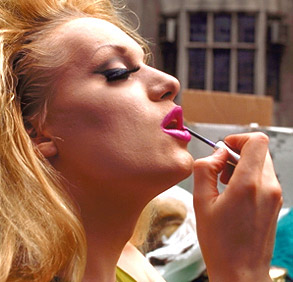
A young man turns himself into a beautiful woman, but the transformation is only skin-deep.
What do men who dress like women want? Some heterosexual cross-dressers say that slipping into breast forms and heels allows them access to a gentler side of themselves, permission to touch each other and — murkiest of all — a chance to be the object of desire. Even if they end up looking more like Mrs. Doubtfire than RuPaul, never go out in public and aren’t gay, there’s still something thrilling about the possibility of inciting male lust — the kind of lust that shapes the world. Though gay drag queens dress mockingly, they’re also making themselves sex objects for a population they don’t have sex with — straight men.
Continue Reading CloseA Christmas miracle
For a man alone for the holidays, a Christmas trick is the gift that keeps on giving.
It was two nights after Christmas, three years ago, when Joe received his first visitation from a sex professional. The dark stranger came east to Joe’s apartment, where a one-hour massage appointment stretched into four hours of more than shiatsu. Alejandro gave of himself generously that night — not freely, of course, but four hours for $150 is a great markdown, even for right after Christmas.
Despite the bargain price, Joe says the night never felt cheap. “It was the purest, least complicated, least guilt-ridden sex I’d had in so long … I don’t feel like I exploited him at all. He was willingly participating and he enjoyed it and he profited from it. I’m not naive enough to think I was his ideal partner, but I liked that he enjoyed it.” (With male prostitutes, the client doesn’t have to wonder if he really came.) To Joe’s surprise, paying for sex exorcised some of his gay-hating Catholic school demons — and they’ve stayed away. “It really is a Christmas miracle,” Joe exclaims breathily.
Continue Reading CloseBetter loving through imagery
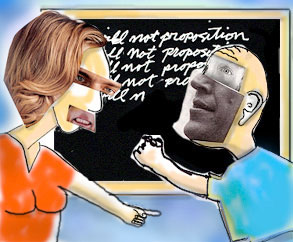
A pair of video artists try to turn the TV into a love machine with a nonpornographic video designed to steer your gaze toward your partner.
Rather than waste millions on Super Bowl Sunday, Willy Mal kicked off the Exoptic Fields ad campaign in the August-September issue of the Utne Reader. “The video to end all videos,” blared the tiny ad, will “lure your eyes away from the screen by design.” Packaged like a bottle of pills, the tape is indicated “for the relief of TV and Internet addiction. Warning: May intensify off-screen sensations.”
Since the ad appeared, Willy Mal (the name he’s using for this project) has sold 100 copies of the Exoptic Fields tape. He decided to aim the second “deflective” video at something more compelling than turning off the television: sex. He enlisted video artist Benton-C Bainbridge to produce a video to pull viewers’ eyes toward the bodies in the room. The result is the 45-minute “Blind Heat.” Bainbridge and Mal chose the length because it was 10 times the national average for coitus, according to a stat they read somewhere.
Continue Reading ClosePage 2 of 10 in Virginia Vitzthum