Spring Offer: Get 1 Year, Save 58%

Trump loses fight to lift gag order in his hush-money case, remains barred from bashing prosecutors

Donald Trump’s efforts to lift his gag order — and say just about whatever he'd like in regard to his hush-money trail — remain in vain. A panel of appeals judges on Thursday denied the former president’s attempt to rid himself of the remaining limitations imposed by Judge Juan Merchan’s gag order, Politico reported

A five-judge panel wrote in a three-page decision that Trump’s “contention that the conclusion of trial constitutes a change in circumstances warranting termination of the remaining Restraining Order provision is unavailing.”

In late June, Merchan, who presided over Trump’s Manhattan criminal trial that found him guilty on 34 felony counts, lifted some of restrictions imposed by the gag order, allowing the Republican presidential nominee to publicly comment on witnesses and jurors involved in his trial. But he left a few constraints, barring Trump from communicating about prosecutors and others in the district attorney's office, for example.

The panel ultimately agreed with Merchan and decided that filings by Manhattan District Attorney Alvin Bragg’s office “demonstrate that threats received by District Attorney staff after the jury verdict continued to pose a significant and imminent threat.”

The judges also noted that since Trump is yet to be sentenced — that's now set for Sep. 18 — providing Merchan good reason to keep a tight rein on the former president’s comments.

Simone Biles and the “twisties”: How the mind affects physical performance

On July 30, the U.S. women's gymnastics snagged a gold medal in the team final of the Olympics. For gymnast Simone Biles, the win not only marked yet another Olympic medal — she has earned nine such medals and 30 World Championship medals, making her the most decorated gymnast in history — it also served as the perfect ending for her so-called “redemption tour” after suffering from the "twisties."

According to Cleveland Clinic, the twisties are defined as “a mental block that creates a dangerous disconnect between mind and body while gymnasts are airborne.” As one can imagine, it can be very dangerous; Biles has previously described the condition as getting “lost” in the air. The mental health condition led Biles to withdraw from multiple events during the Tokyo 2020 Olympics.

“I knew from that very moment it wasn’t like one time and done. You can feel it in your head,” Biles said in the Netflix documentary “Simone Biles Rising.” Biles made the decision to prioritize her mental health. A case of the “twisties” has been compared to the so-called “yips,” which can happen in baseball and golf and was famously depicted in the Apple TV+ show "Ted Lasso." The Mayo Clinic describes it as “a type of focal dystonia, a condition that causes involuntary muscle contractions during a specific task.”

“Some athletes become so anxious and self-focused — overthinking to the point of distraction — that their ability to perform a skill, such as putting, is impaired,” the Mayo Clinic states. 

For professional, Olympic-level, athletes, it’s hard to imagine that after hours of training, and being one of the best in their sport in the world, a mental block can have such an effect on performance. But experts tell Salon it’s a testament to the power of the mind in sports. Jamie Shapiro, a certified mental performance consultant and professor of sport and performance psychology at the University of Denver, told Salon that athletes frequently give percentages of how much of their sport is mental and how much of it is physical. When it comes to high-pressure events like the Olympics, the mental arguably outweighs the physical. 

“I consider those high-pressure moments to be extremely mental,” Shapiro said. “Whereas training, I would say, could be more physical than mental, but the mental piece always plays a part.” 

"Stressors can bring on changes in our physiology."

In gymnastics, gymnasts rely on spotting — meaning focusing on a space to orientate their positioning — to land twists and master balance. 

“We call it the kinesthetic sense, if someone's spotting the wall or the floor or the ceiling, as they're twisting, they get an idea of where they are,” Shapiro said, adding that a gymnast might be looking for the floor as they're about to land. “But when you have the twisties, that kinesthetic awareness, that sense of where your body is in space, is what’s off.”

Shapiro said there are some theories as to why this happens, but it mostly remains a mystery and varies from person to person. 


Want more health and science stories in your inbox? Subscribe to Salon's weekly newsletter Lab Notes.


“Sometimes an athlete can't pinpoint a cause,” Shapiro said. “Other times, an athlete could think back to say that there was some sort of stressful event or accumulation of stressful events that may have led to that mental block or the twisties.” 

In "Simone Biles: Rising," Biles referred to her twisties at Tokyo as a "trauma response" to the abuse she endured by former team doctor, Larry Nassar, and its subsequent fallout. 

Stephany Coakley, the senior associate athletic director for Mental Health Wellness and Performance at Temple and certified mental performance consultant, told Salon the twisties are usually caused by a stressful event. 

“Stressors can bring on changes in our physiology,” Coakley said. 

"You have to know yourself and then set boundaries."

Psychologist Dr. Carla Manly, who has had athletes as clients in her private practice, told Salon the twisties can worsen because of anxiety. When athletes are in “flow” and have a strong “mind-body connection,” they tend to do their best, Manly said. But in the case of the twisties, one mistake can easily cascade. 

“Maybe you make another mistake, and now it becomes sort of a self-fulfilling prophecy, and then you lose that confidence in your mental capacities and your physical capacities,” Manly said. “Now you're in a fear-based loop where you're focused not on the success, but on avoiding the failure.” 

Avoidance is often a popular go-to coping strategy. 

“That's what you saw from Simone a few years ago — she took out her twisting elements because she couldn't get that sense of awareness with her twisting back again,” Shapiro said. “With other gymnasts with mental blocks of tumbling backward, for instance, they do only front tumbling.” 

We need your help to stay independent

Some people can get over the twisties, Shapiro said, but some never do. Clearly, Biles did. However, it didn’t happen overnight. Biles said she had to retrain and go to therapy.

For those who aren’t gymnasts or Olympic athletes, a case of the twisties might still feel relatable. Coakley said there is certainly something for everyone to learn from Biles raising awareness about gymnast-specific mental block. 

“The first thing to learn is you have to know yourself,” Coakley said. “[Biles] knew that if she were to continue, she was going to hurt herself. You have to know yourself and then set boundaries.”

While stepping back might have been the hardest route for Biles to take, it’s the reason she was able to have her comeback. 

“She was able to stop and take care of herself and set boundaries,” Coakley said.

Truth Social keeps shedding users, which might “portend trouble” for Trump in November

Former President Donald Trump’s social media platform, Truth Social, experienced its third straight month of audience decline in June, The Guardian reported, its user base dropping by 38% since last year.

“The diminishing audience levels for Truth Social suggest a rejection of the harsh rhetoric expressed by the ex-president and his political allies that is one of the hallmarks of the two-year-old platform,” Howard Polskin, a conservative media analyst, told the publication.

The decline of Truth Social could reflect diminished interest in Trump's brand of politics. In February 2022, his site had 3.26 unique users; as of June 2024, that number is now just a little over 2.11 million, according to Polskin, who monitors conservative media for his website, The Righting.

“If this softness persists, it might portend trouble for Mr. Trump at the ballot box in November," Polskin told The Guardian.

Trump launched his social media site after he was banned from Facebook and Twitter, now called X, following the Jan. 6 insurrection. Both sites have since lifted their bans.

The parent company of Truth Social, Trump Media & Technology, experienced a momentary increase in its stock price of $46 per share after the attempted assassination of the former president. However, this leap in price was short lived, the stock dropping to about $29 per share Wednesday, The New Republic reported.

Earlier this year, the parent company reported a $327.6 million loss in the first quarter of 2024 and revenue of less than $771,000.


The chaos of choice: how do people pick their food products?

Every family needs groceries, and most people regularly venture to the supermarket to gather supplies. If researchers can help shoppers make healthier choices, we can improve the obesity problem in a simple yet effective way. But until recently, nobody really understood what motivated people to choose certain products – we knew what they bought, but not why. We've therefore investigated shoppers' choice strategies, hoping to use this information to help people choose healthier.

Imagine you are in your favorite supermarket. As you stand in front of the shelf of cereals, you may be overwhelmed by the numerous alternatives: some products tell you they are "fat-free", others that they are "all-natural", and the supermarket's house brand is next to the top brand that you usually pick. Do you know what you would choose? More importantly: do you know why you would make that particular choice?

Until recently, nobody knew what motivated shopping decisions like this. That's why, at the University of Antwerp, we performed a study where we repeatedly let people choose between two products and analyzed their decisions. We discovered that there are three types of shoppers:

  • The first group consistently chooses the healthiest product available.

  • The second always chooses their favorite brand.

  • The third poses a problem, unfortunately – they purposefully pick the least-healthy product option.

Does healthy = bad tasting?

The third group's decisions might seem strange, but their reasoning is based on the intuition that "healthy things can't be tasty". The consequences of this mentality require urgent attention, particularly as the European Union is currently in the midst of a fierce debate on whether a nutritional label should be made mandatory across all of Europe. If a significant proportion of shoppers believe that healthy products taste bad, the putting a healthiness-grade on the package will likely lead to them choosing unhealthier options. It is therefore clear that we must learn more about this group and figure out how we can effectively reach them before we implement a label that may be detrimental to their health.


The Nutri-Score label and how it works

Our main interest in our research was the effect of a new label called Nutri-Score. It was developed to help us with shopping choices, and it is now in the running to become the official European label. It cannot tell you anything about the price of a product, but at least you know what you're paying for: it informs you about the healthiness of that food.

Though it may sound like a marketing scam, Nutri-Score was in fact developed by scientists. It took them four years of cooperating, designing, calculating, testing, and refining to come to this label, which still undergoes regular evaluations and updates. In contrast to the empty claims on many food packages, and misleading commercials and product names, the Nutri-Score doesn't lie. There is no "healthwashing" for the sake of selling a product.

The Nutri-Score label assigns grades based on relative product healthiness. The best Nutri-Score grade is an A and the worst grade is E.


Let's go shopping!

This rigorousness and objectivity of Nutri-Score may come as a surprise, particularly if you've seen certain newspaper articles with sensational headlines saying the label implies "fries are better for your health than salmon". These stories were the unfortunate result of intentionally sensationist reporting, and also a basic misunderstanding of how the label works. The Nutri-Score is designed to compare alternatives within a product category. The easiest way to demonstrate this is through a shopping example.

So, let's go on a hypothetical shopping trip! Step one: you need to decide what you want to eat. Importantly, this step comes before looking at any label. Are you eating breakfast or dinner, for example? Meat or vegetarian? Once you have decided on the broad category, you can start using the Nutri-Score to your advantage. Let's say you want to buy breakfast food, and you are in the mood for strawberry yogurt. On the supermarket shelf, there is this one cup that is full-fat yogurt with a lot of added sugar. Next to that, there is a similar strawberry yogurt but with no fat or added sugar.

Before the Nutri-Score, you'd have to turn over each yogurt and find your way through the jungle of numbers and terms on the back of each package. Now, you can see at a glance that the Nutri-Score of the first yogurt is 'grade C' and the second is 'grade A'. The choice is still yours, but at least now you can easily make an informed decision. This is what the Nutri-score was created for: assessing comparable options within a food category. Comparing the Nutri-score of yogurt and salmon probably isn't relevant, because you're unlikely to replace your breakfast yogurt with a salmon steak.


Some advice for the three groups of shoppers

If you are part of the first group of shoppers and want to make healthier choices, I have good news for you: the Nutri-Score is not a marketing scam and can be a very effective tool if you use it within a product category. Before looking at the label, pick what kind of food you want to eat and then compare the alternatives with the Nutri-Score. And keep up the good work!

If you're in the second group and tend to pick your favorite top brand no matter what, I want you to pause for a moment and consider the following: the inferior quality of house brands is history; some house brands these days are even produced in the exact same factories as their "competitor" top brands. So what are you actually paying for? The answer is usually just the brand name and the commercials on television. If you want to know what is healthier, let the Nutri-Score guide your choices!

If you are one of the people in group three who believes healthier food is less tasty, I want to challenge you to a blind taste test. Research has shown that this long-held belief isn't always true, but don't take our word for it: try it yourself! If you truly don't care about eating healthy, then at least let your taste buds decide. Because if you simply take the least healthy option, you might be worse off in terms of both health and enjoyment.

We all make shopping choices based on our personal priorities, but also based on what we think we know about the products. Unfortunately, marketing, preexisting beliefs, and "intuitions" – as reasonable as they may seem – have potential to lead us astray. As researchers, we are working hard to provide everyone with easy-to-interpret information about the food on supermarket shelves, so that every shopper can make an informed decision about the food they are buying – and hopefully improve their health while they're at it!


Elke Godden, Human Health Engineer and Doctorandus Applied Economic Sciences, University of Antwerp


This article is republished from The Conversation under a Creative Commons license. Read the original article.

Schools launched anti-obesity policies. Experts say they failed

Among Lexie Manion’s memories of her junior year of high school in New Jersey was the experience of being regularly hassled by a school nurse who was trying to weigh her.

The nurse, Manion recalled, was trying to get Manion’s weight on file — a common practice at schools across the United States, which aim to use the data to improve student health. But for Manion, who had an eating disorder, the experience was deeply distressing. The thought of getting on a scale in school — of someone other than her doctor handling this sensitive measurement — terrified Manion. It also triggered her eating disorder: She began to restrict her food intake more intensely to lose weight before the school nurse put her on a scale.

“I was worried about her knowing my weight and I was worried the whole school would somehow know the number if she weighed me,” Manion, now 29, wrote in an email to Undark. “I became very anxious and would avoid the scale and her gaze every time she inquired.”

The policy at Manion’s school was part of a national effort to combat childhood obesity by collecting — and often sharing — data on students’ weight. Starting in 2003, one study found, 29 states enacted policies encouraging or requiring school districts to weigh students, or to go further and screen their students for body-mass index, or BMI, a common tool for categorizing a person’s weight. By the policy’s peak extent, in the 2010s, millions of students each year were receiving so-called “BMI report cards” in the mail — and some students even saw their weight status appear on actual report cards, alongside their grades. Policymakers hoped that by telling students and their families about a child’s weight category, the reports would prompt them to make healthier choices and lose weight, reducing childhood obesity one student at a time.

But even as the practice was becoming more common, research was already suggesting that BMI screenings have no impact on students’ weight and can even cause harm. Today, many experts say, the evidence is clear that school BMI screenings do little to improve student health. Research has also linked the policy to higher rates of body image dissatisfaction, increases in weight-based bullying and, as in Manion’s experience, triggering or worsening eating disorders. In response, some states, including California, have stopped requiring screenings.

"I was worried about her knowing my weight and I was worried the whole school would somehow know the number if she weighed me"

Nevertheless, BMI screening or similar policies that mandate or encourage weight-tracking remain on the books in at least 16 states, according to Undark’s review of state legislative codes. Among them are Tennessee, West Virginia, Arkansas, and New York.

“To focus efforts on just measuring the increasing waistline of America is a Band-Aid,” said Kristine Madsen, a pediatrician and public health nutrition researcher at the University of California, Berkeley, who conducted one of the largest studies of school BMI screenings to date. “It doesn’t even touch the underlying problem, and it’s ineffective.”


Arkansas was the first state in the nation to mandate screening and reporting, back in 2003. Then, in 2005, the Institute of Medicine at the National Academy of Sciences, or NAS, released a 434-page report, “Preventing Childhood Obesity: Health in the Balance,” that urged more states to adopt the practice. “It is important for parents to have information about their child’s BMI and other weight-status and physical fitness measures, just as they need information about other health or academic matters,” the NAS group wrote.

The group was responding to what they described as a childhood-obesity epidemic. At the time, around one-third of U.S. children were classed as overweight, obese, or severely obese. Childhood obesity is linked to a range of poor health outcomes, including high blood pressure, asthma, and heart disease.

More states moved to implement BMI screening. By 2010, just five years after the NAS’s recommendation was published, 29 states were widely conducting some form of body assessment on their students, according to an academic survey of state education departments.

By the policy’s peak extent, in the 2010s, millions of students each year were receiving so-called “BMI report cards” in the mail — and sometimes on actual report cards, alongside their grades.

Those policies typically offered little guidance on how the weigh-ins should be conducted. According to one study, about half of screenings were done during gym class, often in front of other students. The gym teacher or school nurse would measure each student’s height and weight and submit them to the school, which, in many cases, would pass the data along to state health authorities for population-level tracking.

Baked into that model from the start, some experts say, were problems. Foremost among them was the reliance on BMI in many policies.

The metric, first proposed in 1832, was popularized after research in the 1970s, which only involved men and was not representative of the ethnic and racial diversity of the United States, supported its use. BMI also doesn’t consider factors like muscle mass. “This was intended to describe large groups of people; it was not intended to be an individual litmus test for health,” said Leah Graves, a registered dietitian who specializes in treating eating disorders. Graves and others question whether BMI necessarily offers families useful information about students’ overall health.

The policies soon ran into another problem: There wasn’t much evidence that they worked.

Not long after the NAS recommendation was released, scientists began publishing studies on school weigh-ins. In 2009, for instance, two pediatrics experts published a review of the existing research, finding that there was no impact on students’ weight. Parents, they wrote, didn’t seem to be learning much from BMI report cards, and there didn’t seem to be any increase in healthy behaviors at home.

In 2014, Madsen, the Berkeley researcher, and several colleagues launched a randomized clinical trial. The researchers took nearly 29,000 students in California public elementary and middle schools and split them into three groups. One group didn’t get screened at all. The second was screened, but they never found out the results. A third group received screenings, and their caregivers were sent BMI report cards. The researchers followed the group from 2014 to 2017 to track changes in weight and adverse outcomes.

The team’s results, published in 2021, showed that neither the screening nor reporting had an impact on weight change over the years. Additionally, the two groups that were screened reported more weight dissatisfaction and peer weight talk than the group with no screenings.

Madsen’s research has also found that the experience can be upsetting for students. In one 2022 survey of more than 11,000 students in California, her team found that 49 percent were weighed by gym teachers, as opposed to just 28 percent who were weighed by school nurses; the students were more likely to feel less comfortable being weighed by a teacher than a nurse, and that they felt they lacked privacy while being weighed.

Other research has documented the potential for long-term harms from that experience. The negative effects of adolescents perceiving themselves as overweight can last for years into adulthood, long after the screenings have ended, according to one 2023 survey. While the study didn’t specifically ask about BMI screening, it linked perceived overweight status to increased self-starvation, binging, purging, and overexercising, as well as the development of eating disorders.


Not every expert is convinced that BMI screening for the sake of data collection is necessarily harmful. Researchers and school professionals say it’s the way these screenings are conducted that can cause problems. As a result, some professional organizations and government agencies have issued guidelines intended to improve the experience.

The Centers for Disease Control and Prevention, which has no formal position on BMI screenings, has a public set of 10 safeguards schools can implement to address concerns about screenings. The list includes recommendations like measuring students’ height and weight in a private place, having nurses take the measurements instead of teachers, and asking for parental consent before measuring students.

But a 2019 CDC survey of more than 200 schools found that its safeguards had not been widely implemented. Only 3 percent of the schools had at least four of the safeguards in place, and 19 percent had no safeguards at all.

The two groups that were screened reported more weight dissatisfaction and peer weight talk than the group with no screenings.

“These safeguards came out kind of pragmatically, recognizing that there’s not enough evidence at that point to say whether or not BMI measuring schools is definitively harmful or helpful, but schools are doing it,” said CDC school health researcher Sarah Sliwa. “So, if they’re doing it, what are some steps they can take to try to minimize those harms and increase the likelihood that data are collected in a way that’s transparent and useful?”

As the school staff members who are most often asked to weigh students, physical educators also have developed standards regarding body measurement in schools.

The Society of Health and Physical Educators, or SHAPE America, a professional organization, has a formal statement on fitness testing — which can include BMI screenings among other assessments — that states the organization finds the testing valuable only when integrated appropriately into the curriculum, and when the results aren’t used to grade students. SHAPE America recommends that schools first teach students about the fitness testing and why it’s done, as well as prepare them for the process and set personalized goals based on the outcome of the testing. But the organization does not have an official recommendation on whether to conduct BMI screenings.

“There’s a lot of body stigma, and we have other data points that we can use without having students feel that they’re being judged,” said SHAPE America president Cara Grant.

The American School Health Association, an organization of school nurses and other health professionals, also does not have an official position on BMI screenings, said former president Kayce Solari Williams.

In order to effectively realize the CDC guidelines, Sliwa said, schools need to implement safeguards or best practices. Because of a lack of the funding and staffing, though, they often fail to do so.


Some states have responded to the research showing harms from BMI screenings. In 2013, Massachusetts struck BMI reporting from its schools, but maintained a screening requirement. Illinois made BMI screening optional for its students in 2015. California eliminated screening and reporting requirements from its annual fitness testing. In New York, schools still screen for BMI, but they are no longer required to send BMI report cards home.

Other states have not made changes. In Georgia, screening and reporting are required by law. West Virginia, which has some of the highest levels of childhood obesity in the country, state law requires the collection of BMI data to be reported to the Department of Education, the governor, the state Board of Education, the Healthy Lifestyles Coalition, and the Legislative Oversight Commission on Health and Human Resources Accountability.

“There’s a lot of body stigma, and we have other data points that we can use without having students feel that they’re being judged.”

In New Jersey, where Manion attended high school, BMI screening is not mandated, but it’s allowed on a district-by-district basis. The state does require weight measurement, however.

“What’s the value?” asked Madsen, the Berkeley researcher. She questions whether the policies are a good use of school resources. “The entire point of sending them home is actually to support families and in creating healthier lifestyles,” she said. “But they’re not.”


Amanda Salazar is a freelance journalist from Brooklyn, New York, covering science and politics. She’s written for over 15 publications and has a master’s in science reporting.

This article was originally published on Undark. Read the original article.

Why “Real Housewife” Melissa Gorga believes “all good meals start with olive oil, garlic and onion”

After being a "Real Housewife" for nearly 15 years, Melissa Gorga is well acquainted with what it means to be "On Display."

Italian-American culture, food and heritage is an enormous component of the New Jersey franchise (along with NJ lore, humor and hot spots), one of the longest-running Housewives shows still airing on Bravo. Gorga is no stranger to that, growing up in a Italian-American household, being exposed to the aroma of sauce cooking on the stove throughout the week, embracing the best that the cherished fare has to offer.

Gorga, who also runs a clothing boutique and is a mom, podcaster and published author, has many opinions on all things food, so I was able to chat with her about jarred sauces and Rao's Homemade, top summertime meal go-tos, trips to Italy, her favorite moments on the show and much more. She also shared her brand new chicken parm. recipe with us, so stay tuned for that. And be sure to watch Melissa on the "Real Housewives of New Jersey" season 14 finale, this Sunday on Bravo.

The following interview has been lightly edited for clarity and length.

Hi Melissa! Just wanted to note really quickly: I'm a fellow New Jersey resident, I worked in Franklin Lakes for a decade, I’ve watched the show since the beginning, so thanks for taking the time to chat today.

Oh wow, that's so cool, okay, great!

To start off, I'd love to hear about the collaboration with Rao's: How it came to be, filming the custom content spot created by NBCUniversal’s Creative Partnerships team with [your husband] Joe, What that's all been like?

So, I feel like working with Rao's Homemade is obviously . . . growing up as an Italian. all we did was make homemade sauce our whole lives, I felt like I feel like we're like bred to do it, right? Like from the time we're little girls, we just see our mothers and our grandmothers making the homemade sauce in the kitchen. So I was never big on buying anything in the jar. And once I had tried the Rao’s Homemade, I honestly couldn't believe it — especially the marinara sauce, which is my favorite. I couldn't believe how similar it was and how homemade it really was. And it just saves so much time, especially on dishes where I want to add some, like, fresh sauce to it. I always go for the Rao’s Homemade when I'm doing that.

A lot of times, we'll make a big pot of sauce. And then I use it throughout the week on my chicken or on whatever it might be that I'm cooking. Sometimes I just put red sauce on potatoes. So I put it on everything, we just put it on everything. So it's awesome to have that and the fact that it's homemade and tastes good. Their pasta is amazing. So sometimes we'll just like — especially in the summer, I don't want to, like, turn the stove on, right? I want to barbecue. We’ll make pizzas outside and I'll use their sauce on the pizza as opposed to going, and like, slaving and making, like, a big — going over the stove and, like, making a big pot of sauce so it’s, like, much better just to use the jar, so that’ what we do and it’s great. So I'm happy to collaborate with them. And there is a fun spot coming out — the commercial spot that I have not seen yet that I cannot wait to see.

That’s great! Cool, that’s actually what my second question was going to be about, too. I'm half Italian and I know  especially, obviously in our area — sometimes using jarred or canned sauces can be blasphemous. I wanted to talk about that because I know that Rao’s has such a great reputation for their sauces, so I think it’s interesting to hear just how you use those. 

Yeah! It’s really, really good. We make chicken cutlets a lot in this house to find something else to do with the chicken cutlery, put it in the pan sauce on top of a whole other meal for a whole other night and it feels completely different.

I also wanted to ask because I made the recipe and chicken parm. is my go-to  it's like my ultimate comfort food  so obviously I loved that. But what I thought was really neat was the prosciutto on top which I haven't seen anywhere and I'd like to think I've looked at and made a lot of chicken parms. So I wanted to ask how that came to be? Is that normally how you make your chicken parm and what led to that addition?

You know what, they love prosciutto in this house, everyone loves it. So I just thought about putting a little twist on it. That was my own little, like, take on like doing something different. I think I have one child that, like, pulls it off? But everyone pretty much loves it. It adds a little bit more flavor, a little bit like that salty feel. And it's just good! It makes it my own, right? It makes it like something different and my family got used to it, so they love that now.

Totally — I really like also how you had said in the recipe to serve it with spaghetti and also sauteed spinach, which I thought added a different level of nutrition and flavor and color, which is really smart as well. 

I love sautéed broccoli rabe, I love sautéed spinach, these are all of my [favorites]: I love greens. I can eat greens all day long. I eat lettuce. I should have been a rabbit because I love greens. I can eat them all day. 

But yeah, I always try to put a little vegetable on the side. That's important to me. Besides the fact that I love them, I just feel like it's good to just have it there. Sometimes in the place of a potato or something, I'll put the vegetable

Earlier, you had mentioned watching your mom cook and watching your nonna cook and growing up with that. I was curious about what your mom was serving you and your sisters growing up? And if you feel like it's similar to what you're serving the kids now? 

Very similar, very similar: My mom was a big, like, we're going to eat steak with a side of a baked potato and a salad — or we were eating pasta. Like, we were big like Italian eaters. So chicken cutlets were huge growing up, and I think that's why it's huge for me now. We make them constantly in this house and my kids get annoyed if like a week goes by and we haven’t had chicken cutlets.

I feel the same way!

I pile it up. You have to see. They're like, the stack is this high and they're in plastic bags everywhere. I'm like "nobody bother me, there's a full refrigerator.” There's actually a going joke with, like, you know some of the people that work with me because of it. “What are you doing: Making chicken cutlets?” I'm like “yes, I am, actually”. 

So, you know, it's just good to have them around, especially with Rao’s Homemade and do different things with it. I'll even make a salad and then cut up the chicken cutlets. And put them on top, especially in the summer. 


Want more great food writing and recipes? Subscribe to Salon Food's newsletter, The Bite.


That's a great idea. Aside from the recipe, the chicken parm, what are some of the other lighter Italian and Italian American dishes that you tend to make most in the summertime?

Definitely salad. We're big salad eaters. And we do put protein in the salad. What else do we do in the summer? You know . . . I do a lot of the outdoor pizza oven and we'll make pizza. So that's easy and great to believe it or not, it's 1-2-3. We also use the sauce for that as well, the marinara sauce. What else do we make in the summer all the time? I feel like we're big grillers. Like I'll throw a grilled chicken — I’ll marinate, you know what’s a great marinade?  I'll throw grilled chicken, like chicken breast, in Italian dressing.

Yes! I was going to mention that. How funny

Yes! Like, just Italian dressing — marinade, put in on the grill, delicious! So easy 

We need your help to stay independent

This is a side question I just thought of: Did you or your family ever do “meatball salad like,” meatballs and sauce on top of salad with Italian dressing? My father used to eat it all the time  and it is so delicious. 

It's so good. That's my sister's thing! That's her thing. She loves that — it was her go-to. I used to always think she was weird when we were growing up because she would always spoon red sauce all over her salad. She would also take a meatball and pop it on her salad. So like, That's my sister — it was her go-to. 

It’s so good! That's so funny. That's great. It's delicious. I know you also went on a trip recently  I think it was to Paris and Italy — and I was curious about, if you could pinpoint, what was the most memorable meal or dish you had there? It could be from the French side, too! But I figured it might be from the Italian side.

You know, I took my kids for the first time to Rome, the first time in Italy and we went to Paris for a couple nights, too, but to me, there's no place like Italy. I don't know if it's because they’re my people, I don't know what it is, but like, it's just the way they greet you, it’s the food, it's just, it's amazing, you know?

I'm actually taking them back to the Amalfi coast in a couple of weeks and I'm so excited for them to actually eat in southern Italy because the food is more how I cook, how there nonna cooks and what they're used to. So they loved the food in Rome, obviously, but I just can't wait for them to taste Nonna’s food when we go to the Amalfi coast because that's where they were from and they cook so similar. And it'll be their first time so I'm excited for them. 

Listen, our favorite dish is so simple. It is garlic and oil. It's like an aglio oglio sauce. Yeah, with like, spaghetti with little red pepper flakes. When they make that in Italy, like it's just the best thing you've ever had. It's amazing.

That’s one of my dad’s favorite dishes, too! Too funny — for people unfamiliar with the differences in regional Italian cooking, how would you pinpoint the difference between what you might get in Rome versus what you might get in southern Italy or on the Amalfi Coast?

I feel like the food there — I was very surprised. There was a lot of fish in Rome, like on the menus full of fish, a lot of fish. And I was like, wow, I didn't think, because you would think the Amalfi Coast over there would have the fish — you’re on the water — but there was not a lot of fish on the menu. So that was that was very like, shocking to me. That's strange. Fish based city. I didn't ever knew that. And they said it is like that's a fact. And there's a reason for it. Something with the fishermen back in the day, like I don't know what it was. Yeah, I was shocked how much more fish our choices are in Rome. to Southern Italy. 

That is very interesting. And your family is from Southern Italy, right? 

Yes, well, my mother's Sicilian. So yes, I've never been to Sicily. But my dad was from Southern Italy — Naples

Great. That's so cool. I wanted to ask what you think or what you could pinpoint is the main cooking tips or cooking takeaways that you've instilled in Antonia before sending her off to school? I don't know if she's doing much too cooking at college, of course, but I was curious about that in general — and how you’re you're passing on the lessons from your family and all when it comes to cooking in that Italian American way

It's funny, my kids grew up eating great food and you can tell because they're picky and they know when something doesn't taste good, and it's actually very annoying, but it's also good because I like that, you know, they're going to know what they want with their husbands and with their wives, right? 

So listen, she knows that the key to everything is onion, garlic and olive oil, and she knows that we start all good meals with that, right? So they're pretty good. I taught them to not burn things — the only things that really make themselves all the time are eggs, honestly. So I taught them to, like, keep the fire low. I'm, like, when you burn something right off the bat, it ‘s done. So I think I instilled that in their heads, like, start low, cook it low, stay low. Nothing bad can ever happen if you do that. So I feel like they've gotten that one point in their head so they should be good from there. And they know how to boil water! So there’s that.

Fantastic! Also, back to chicken cutlets, do you always do oven-bake? Do you saute? Do you deep fry? What is your usual approach?

I fry them. I fry my chicken cutlets. Yes, I fry them in the olive oil. And I like the Italian bread crumbs. The seasoned ones I think are the best, seasoned Italian bread crumbs. Yeah. But no, I do fry chicken cutlets.

Great. And you said normally you go for a thin slice or was that more so for grilled? 

No, thin — I like them so thin and I love to bang them out, get them as thin as possible without breaking. I hate when there's like a big thick one. I don't like that. I end up cutting it in half. Yeah, I prefer thin. 

You had mentioned that the marinara was your favorite Rao’s sauce. Were there any of the other variations or flavors in the Rao’s line that you're partial to? Or is the marinara your go to?

I love your arrabiata. I love spice, I love spicy. There's a vodka sauce that’s great, also. But those are definitely all of my go-tos.

I wanted to congratulate you on this success of Envy. Obviously, we just saw another great fashion show on the episode that just aired. And I went to the Montclair location years ago. I got something from my mom for her birthday. So I wanted to ask what you see for the future of Envy and what you'd like to see it become. 

That’s so funny! Oh, thank you. You know, I'm always in shock over how big Envy has become. And I was just like a girl with three kids, you know, three small, little kids and it wasn't easy, like, I was a stay at home mom, really. And to think about how I created this business that’s just mine — that makes me happy. And it has done so well. I just opened a second location in Huntington, New York. So to have one on Long Island and to have one in New Jersey. I would love to open more locations possibly in South Jersey, I'm looking into Nashville, which I think would be awesome. 

So the goal is to just keep going with it and creating more and more and I am so surprised whenever I see that it just gets bigger and bigger every year. The numbers go up and customers are plentiful and people will buy an outfit and I have a lot of like customers that are not just fans. They love what I'm picking. I'm their go to when they want an outfit. And that makes me happy. That makes me smile. They don't come just once. They are like repeat Envy shoppers, which I love.

That's so cool. When did the original Montclair location open? What year was that?

So I opened in 2015. It’s been open since 2015. It’s a long time. 

Yeah, it's going to be the 10-year anniversary. 

Yeah, before you know it! Yes it is. I didn’t even think of that. I have to throw a huge fashion show for that. 

No doubt! Lastly, I wanted to ask about Housewives — looking back on your tenure on the show, is there a standalone, standout, favorite moment ever on the show that is most impactful for you? Like you said, it’s been nearly 15 years of your life in general, so that might be a challenge question, but I was wondering. 

Yeah, I mean, there's so many moments and so many fun times that I've had: so many of the girls trips that I went on that were amazing. For me, I'll never forget performing “On Display” at Beat Stock, which is like a huge radio performance to-do, kind of like a Z100’s Jingle Ball, at the time, like a summer concert. 

And I'll never forget the rush that I had on that stage and watching my sisters cry in the front row. And just everyone be so proud that I did that performance. I'll always remember — that was like a great day that was and even when I watch it, I still giggle that like I did it. I still get all about it. But that was definitely a favorite for me.

That's so cool. And it is a top-tier song. So good!

Thank you!

So good meeting you, Melissa! Thank you again

Take care!

Biden administration secures prisoner swap with Russia, freeing Evan Gershkovich and others

Wall Street Journal reporter Evan Gershkovich, former US Marine Paul Whelan, and Russian-American radio journalist Alsu Kurmasheva will be released from Russia in a prisoner exchange that was announced Thursday, according to senior officials in the Biden administration, CBS News reported.

Gershkovich and Whelan were imprisoned on espionage charges that were broadly seen as fabricated. Kurmasheva was detained on charges of ostensibly spreading false information about the Russian army.

The Wall Street Journal reporter was taken into Russian custody while on assignment in Yekaterinburg in March 2023 and sentenced to 16 years in prison by a Russian court in July following a rushed trial that the U.S. denounced as a “scam.”

Whelan was arrested during his travels in Russia to attend a friend’s wedding in December 2018 and sentenced to 16 years in prison in 2020. 

Vladimir Kara-Murza is also a part of the agreement, according to a European official, Bloomberg reported. Kara-Murza, an activist with a dual Russian-British citizenship has been a campaigner against President Vladimir Putin for quite some time. She was given a record 25-year prison sentence on treason and other charges for criticizing Russia’s invasion of Ukraine, in April 2023.

It is not yet clear what prisoners the U.S. has offered to hand over to Russia as part of the deal. However, CNN reported that three Russian nationals serving federal prison sentences were transferred to the custody of the U.S. Marshals Service in apparent preparation for a swap.

U.S. National Security Advisor Jake Sullivan, speaking last month at the Aspen Security Forum, said that the Biden administration was “determined” to make a deal with Russia happen, CBS News reported. 

"I will consider it one of the most important things between now and the end of the year, and especially now at the end of the month, for us to try to get something done where we can get him home," Sullivan said, referring to Gerkshovich

In May, Donald Trump — who enjoys warm relations with the Russian president — claimed that Gershkovich would only be released if he won the 2024 election. The GOP candidate made his assertion in a late-night Truth Social post, writing: "Vladimir Putin, President of Russia, will do that for me, but not for anyone else."

COVID is widespread in Virginia wildlife, study finds

While COVID cases are going up in humans lately, animals have to worry about the virus too — and sick wildlife pose a threat to humans, because they can spread pathogens back and forth, giving them the opportunity to evolve new, more infectious mutations. A number of species can be infected with COVID-19, from deer and mink to dogs and rats.

A recent study finds that almost half of the species examined in Virginia were either previously or are currently infected with SARS-CoV-2, the virus responsible for COVID-19. The authors suspect the animals were originally infected by humans.

Published in the journal Nature Communications, the paper includes findings from Virginia Tech researchers who performed 789 nasal and oral swabs and 126 blood samples on 23 species of animals, from Eastern cottontail rabbits and raccoons to opossums and groundhogs. The study was carried out in the Washington DC metropolitan area from May 2022 to September 2023. Six of the species showed signs of current SARS-CoV-2 infection, while another five had antibodies indicating previous SARS-CoV-2 infections. Importantly, the scientists observed previously unreported viral mutations in the common SARS-CoV-2 strains similar to markers in the Omicron variant widely circulating among humans at that time. This suggests widespread human-to-animal transmission.

"The virus can jump from humans to wildlife when we are in contact with them, like a hitchhiker switching rides to a new, more suitable host," co-senior author Dr. Carla Finkielstein said in a Virginia Tech press release. "The virus aims to infect more humans, but vaccinations protect many humans. So, the virus turns to animals, adapting and mutating to thrive in the new hosts."

So far, there is no evidence that animals have spread the virus back to humans, though it is still possible. In the meantime, the researchers say there is no need to fear interactions with wildlife.

Trump and allies double down with racist attack on Harris, claiming confusion over biracial identity

Donald Trump and his Republican allies are doubling down on his attack line that Kamala Harris isn't truly Black or doesn't belong to Black America, a claim that elicited gasps at the National Association of Black Journalists panel that the former president attended on Wednesday.

"I didn’t know she was Black until a number of years ago when she happened to turn Black and now she wants to be known as Black. So I don’t know, is she Indian or is she Black?” Trump said of Harris, whose father is a Black man from Jamaica and whose mother is Indian-American.

After the panel, Trump led a boisterous rally in Harrisburg, Pennsylvania, where a large screen projected a Business Insider headline from 2017 reading: "Kamala Harris becomes first Indian-American U.S. Senator," with the seeming implication that the mixed-race vice president could not claim more than one identity. Alina Habba, an Arab-American woman who is a senior advisor to Trump, then declared in a speech that, "Unlike you, Kamala, I know who my roots are, I know where I come from."

Contrary to accusations that she ever downplayed her Black heritage, Harris has in fact talked about growing up in a Black-majority neighborhood in Oakland, California, singing in a children's choir in an African-American church and attending Howard University, a historically black college where she joined Alpha Kappa Alpha, a Black sorority.

In 2020, the Trump campaign itself sought to rebut charges of racial bias by noting the the former president had previously backed Harris when she was California's attorney general, a spokesperson stating that "Kamala Harris is a Black woman and he donated to her campaign, so I hope we can squash this racism argument now."

As Trump rallied supporters in Harrisburg on Wednesday night, Harris herself took the stage at the Black sorority Sigma Gamma Rho’s 60th International Biennial Bouléin in Houston, Texas, to clap back at her rival.

“This afternoon, Donald Trump spoke at the annual meeting of the National Association of Black Journalists, and it was the same old show: the divisiveness and the disrespect," Harris said. "And let me just say, the American people deserve better. The American people deserve a leader who tells the truth, a  leader who does not respond with hostility and anger when confronted with the facts. We deserve a leader who understands that our differences do not divide us – they are an essential source of our strength.”

Some pro-Trump accounts, including the far-right activist Laura Loomer, have also circulated what they claim to be Harris' birth certificate on social media, pointing out that her father identified as "Jamaican" rather than "Black," even though he, like most other Jamaicans, descended from enslaved Africans. One common refrain in those circles is that Harris is descended from a white slave-owner, which other users have pointed out reflects the fact that those slave-owners were often serial rapists.

We need your help to stay independent

The right-wing attacks on Harris' race, evocative of a long history in which white America has constructed racial categories and decided who belongs in them, appear designed to characterize Harris as a phony and pit racial groups against each other. On his website, Truth Social, Trump followed his Wednesday afternoon comments with a post highlighting Harris' 2020 appearance on a cooking show hosted by Indian-American comedian Mindy Kaling in which the two discussed their South Asian heritage.

But even some Republicans appear concerned that such incendiary attacks will backfire.

"I ain't getting involved in that. Let him talk about what he wants to talk about. I'm talking about how bad our country is in shape right now because of her," said Sen. Tommy Tuberville, R-Al., who like many other members of his party have declined to explicitly criticize their nominee.

Sen. Josh Hawley, R-Mo., tried to pin the blame both sides, saying that it is "not a great idea for either of the parties to be playing racial identity politics."

GOP leaders were already worried that accusations of Harris being a "DEI hire" would alienate the party from Black voters; while Trump relentlessly blamed Democrats for mishandling the American economy throughout Joe Biden's presidency, the emergence of Harris as the presumptive nominee has drawn out a different kind of impulse from him and the right.

Kamala Harris turns the GOP into the gang that couldn’t shoot straight

In celebration of his 100th birthday (On August 2, coincidentally the same day my wife and I went on our first date), I recently found myself channeling my inner James Baldwin.

“Why would I want to be accepted by this world culture?” Baldwin famously asked in 1964. I, like him, disapprove of our politics, inherent racism and misogyny and I remember, “Where all human connections are distrusted, the human being is very quickly lost.”: 

And thus, there we are at the nexus of 2024 politics: Two extremes of our major political parties sometimes hate the same people and also hate each other because the extremists don’t hate the same people for the same reasons. Human beings are quickly consumed by the hate – particularly that which is generated on social media. Some of us are unable to decipher fact from fiction and have taken to shouting at each other behind anonymous handles. Of course, some of us are just, as George Carlin once famously said, either stupid, full of shit or f**king nuts. Sometimes they are all three.

That brings us to Donald Trump. In what passes for wisdom in that void between his ears, Trump found himself visiting the National Black Journalists Association’s gathering in Chicago Wednesday where he offered his keen insight on the current presidential race. Trump falsely claimed in an interview with three Black women reporters that Vice President Kamala Harris “happened to turn Black” a few years ago, saying that “all of a sudden, she made a turn” in her identity.

You can imagine how well that went over. Of course, Trump began the interview with the reporters at the NABJ by insulting co-moderator Rachel Scott of ABC News because the event was delayed about 30 minutes for technical reasons. For those of us who covered the Trump presidency for any length of time, that was not only hypocritical but hilarious. We routinely used to bet on just how late Trump or any of his staff would be at any event it hosted. After a while we automatically assumed that when the Trump administration announced a set time for an event we would have at least 45 minutes after that announced time before the event actually occurred. 

After the NABJ debacle, April Ryan, a dear friend and experienced reporter, tweeted, “Trump came into our home a Black Press advocacy convention and insulted us in our face. What is worse he was invited to do this by NABJ leadership. Shame!”

Then again, maybe it was a stroke of genius to invite him — just to watch him make a complete ass of himself on stage. 

Meanwhile, the GOP vice presidential candidate, JD “The Human Shape Shifter” Vance, was adhering to his barefoot and pregnant theme for American women on the homestead and his “childless cat ladies” dig that sounds more like he’s insulting Lindsey Graham than anyone else I know.

Harris hasn’t even picked a running mate yet and there are even Republicans who are telling me, “As long as they aren’t drooling or actively engaged in cannibalism I’ll consider voting for that ticket.” You almost wonder if the best Harris campaign strategy is to just play videos of Donald Trump and JD Vance making fools of themselves during the next three months. You know it’s coming.

What a difference 10 days makes on the campaign trail. Simply naming Harris as the Democratic candidate for president instead of incumbent President Joe Biden has caused the Republicans to engage in a circular firing squad that’s more reminiscent of the Democratic Party than the GOP. Suddenly the MAGA party looks like the gang that couldn’t shoot straight.

That has prompted a response from Democrats about the MAGA party’s weird behavior, to which I personally take exception because I’ve enjoyed the moniker of “weird” for a lifetime. I’ve even seen signs that say things like “Keep the Bronx Weird” or some other locale. I’ve always considered it cool to be weird. But, then again, as Mary Trump said on Tuesday, “There’s weird and then there’s MAGA weird.”

No one wants to be MAGA weird. It ain’t cool. We also don’t want to get lost laughing or dismissing the weirdness and forget the true danger of what we’re dealing with either; the destruction of our democracy.

Besides, they’re not just weird. MAGA politicians are Creepy Corporate Criminal Politicians. That’s right, just start calling them the CCCP and see how they like that. I’d love to see Harris and the Democrats start saying they have to “Drain the Swamp!” of this slimy pestilence. Trump and his ilk are nothing but bottom-feeding swamp and sewer rats.

But, chaos in a blender rules in this country. Rational thought has apparently left the building – and probably did so right after Elvis did. 

As Baldwin reminded us; “Love has never been a popular movement. And no one's ever wanted, really, to be free. The world is held together, really it is held together, by the love and the passion of a very few people.”

We need your help to stay independent

The path ahead in the election will illuminate this difference unlike any presidential race in my lifetime. Trump seems comfortable on the same rocky road he’s left skid marks on for his lifetime; flying by the seat of his pants engaging those who feel left out and sidelined by promising a reign of terror and never having to vote again.

Comedian Hal Sparks, of the “Sexy Liberal” comedy tour, said on my “Just Ask the Question” podcast recently that he won’t give into Trump’s pleas of victimhood, anger and despair and that Trump “always screws up.” Others have said Trump always manages to step on his manhood, no matter how small it may be, but I leave that for the reader to decide which is more accurate. 

For me, I am the pragmatist trying to figure out how Harris can convert the Democratic Party’s newfound energy and verve into votes in those swing states which may be the deciding factor in the fall election – and I naively cling to hope that as Baldwin pointed out, hate isn’t the answer. All I’m sure of is that it’s going to take more than calling Trump weird.

Harris tells us she knows how. At a Tuesday speaking event in Atlanta at the Georgia State Convocation Center, the vice president said she would bring her experience as a prosecutor, district attorney and attorney general of California to bear in the race. “In those roles I took on perpetrators of all kinds, predators who abused women, fraudsters who ripped off consumers, cheaters who broke the rules for their own gain so hear me when I say, I know Donald Trump’s type.”
 

But I’m not sure Harris reaches across the aisle with the same rhetoric Trump used to divide us.

She said she’d been dealing with people like Trump her whole life. Afterward, the crowd chanted “Lock Him Up!” I didn’t like that when Trump used it and I like it less that some Democrats have begun to use it – though Trump, as a convicted felon, certainly deserves to sit in a cell, dressed in orange with nothing more than three hots and a cot for the remainder of his natural life. But I’m not sure Harris reaches across the aisle with the same rhetoric Trump used to divide us. His own words have always been best used against him. I questioned him six weeks before the 2020 election and he was unwilling to concede to a peaceful transfer of power unless he won. His own words in that case were used to bring criminal charges against him. 

Now, in embracing right-wing Christians Trump tells them to get out and vote and they’ll never have to vote again. As Maya Angelou told us, when someone tells you who they are, believe them. Trump told us six weeks before the last election and he’s telling us 12 weeks before this election who he is: He won’t accept defeat and he is willing to erase your right to vote. That might just reach a few undecided voters. 

The Supreme Court has already sided with him, giving him cover for any action they believe is an “official action” of the executive. They’ve destroyed Democracy and Trump is ready, willing and able to step in and exploit that for his own purposes, and after he passes, his minions will fight over the best way to screw the rest of us while exerting their power over us.


Want a daily wrap-up of all the news and commentary Salon has to offer? Subscribe to our morning newsletter, Crash Course.


Meanwhile, those “marvelous” evangelical Christians supporting Trump admit his weaknesses but claim God can use anybody in his grand plan. On this point, we may agree.  The question remains how does God use Trump? Maybe he isn’t the second coming, but a test to see if we’ll fall for a fool – or in their words – the antichrist.

Just a thought to consider. And while we’re considering thoughts, if we still can, we should be thinking about how Trump continues to manipulate the issues, particularly immigration. He fought against bipartisan legislation to deal with the problem – just so he could run against Joe Biden for being weak on immigration – though Biden took executive action that has effectively lowered the number of illegal detainees in the country during the last year.

But, now, Trump faces Harris. When it comes to immigration, Harris used her prosecutorial background and tried to flip the script on  Trump. “I was the attorney general of a border state. In that job I walked underground tunnels on that border” she told the Atlanta audience Wednesday. ” I went after drug cartels, human traffickers …  I prosecuted them in case after case and I won. Donald Trump on the other hand talked a big game about securing our border but he’s not walking the talk. . . he’s not walking it like he talks it.”

Harris noted Trump “tanked” the bipartisan deal on border funding “because he thought it would help him win the election. Which goes to show Donald Trump doesn’t care about your security, he only cares about himself.”

The key for Harris is sticking the landing among those who are still, for who knows what reason, on the fence about a race that shouldn’t even be close. When a Republican leader concedes that their running mate choice is weaker than expected and they fear that Harris could “Nominate a turnip as Vice President and do better than we did,” you know there’s a Grateful Dead song in there somewhere; “Trouble ahead and trouble behind.”

So, giving into despair isn’t an option, and as Baldwin told us, we must find the things we have in common that bind us all together – as we move forward. 

“Otherwise, of course, you can despair. Walk down the street of any city, any afternoon, and look around you. What you've got to remember is what you're looking at is also you. Everyone you're looking at is also you. You could be that person. You could be that monster, you could be that cop. And you have to decide, in yourself, not to be,” he said.

We will decide, definitively, in November in which path we walk.

The dark truth behind Donald Trump’s hatred of Kamala Harris’ laugh

"Don't laugh. Just don't laugh. Don't laugh under any circumstances."

In a recent interview with Laura Ingraham of Fox News, Donald Trump did not mince words about how he wishes Vice President Kamala Harris would behave. The Democratic nominee for president is known for her easy and boisterous laugh, which contrasts with the unlaughing Trump or his forever stern-faced wife, Melania Trump. As many political analysts have pointed out, Republicans aren't doing themselves any favors by freaking out over the fact that Harris has a sense of humor. The ongoing GOP outrage that Harris sometimes expresses joy only reinforces the Democratic accusations that Trump and his allies are "weird." Laughing when something's funny is normal. Coming unglued because other people laugh is not. 

And yet, Republicans keep shaming Harris for laughing, no matter how weird and joyless that makes them seem. The main reason for this poor choice appears to be that Trump is downright obsessed. The GOP is a Trump cult now. Republicans cannot help but reflect and parrot the fixations of their leader, no matter how much it unnerves the un-weird. Trump is not a fan of women laughing, which is no doubt one reason his wife rarely even cracks a smile. 

The depths of Trump's loathing for female merriment were exposed during his two civil trials for sexual assault and defamation of journalist E. Jean Carroll, who he attacked in a department store dressing room in the '90s. As Carroll testified, she ran into Trump randomly that day and, as a lark, indulged his request to go shopping with him. During their outing, Carroll teased Trump with jokes about how he should try on lingerie. It appears that her laughing, which would be light-hearted fun to normal men, instead infuriated Trump so much that he responded with a violent assault. 


Want more Amanda Marcotte on politics? Subscribe to her newsletter Standing Room Only.


During the first trial, in which Carroll won $5 million in damages, the issue of her laughter didn't come up too much. But in the second trial, there were reports that Trump pushed his lawyer, Joe Tacopina, into going much harder after Carroll on the stand. Tacopina ended up dwelling at length over Carroll's description of her own jokes as if he expected the jury to share his client's outrage that a woman would laugh. The tactic backfired. Carroll won over $83 million in that trial. The judge in the case repeatedly emphasized in court filings that, even though Trump was technically found liable for sexual assault, "Trump 'raped' her as many people commonly understand the word 'rape.'"

I suspect what sets off misogynists like Trump is the way a woman's laughter reminds them that women are autonomous human beings, who have full interior lives.

Feminists have long argued that rape is a crime of power, not of sexual incontinence. The story of Trump's assault of Carroll illustrates this idea perfectly. In her telling, they were having a good time, right up until she told a harmless joke that angered him. At that point, he attacked her so viciously that, as she told the jury, she was too traumatized to be with a man sexually ever again. 

On social media, the liberal reaction to Trump's lame "Laffin' Kamala Harris" nickname has been to repeat the famous saying: "Men are afraid that women will laugh at them. Women are afraid that men will kill them." (This is often falsely attributed to novelist Margaret Atwood, who would never be so coy as to use the word "kill" instead of "rape.") As the Carroll assault demonstrates, Trump is indeed apprehensive women are laughing at him. But I'd argue that this isn't merely about his legendary narcissism. Most of the popular clips of Harris laughing have nothing to do with him or with any men at all. For instance, the goofy "coconut tree" video showcases Harris chuckling over the memory of her mother teasing her as a child. 

I suspect what sets off misogynists like Trump is the way a woman's laughter reminds them that women are autonomous human beings, who have full interior lives. For such men, they prefer to imagine women as appendages of men, who have no motivations outside of pleasing and serving men. A woman who laughs at a man's jokes is acceptable. You don't see Trump getting mad at the MAGA women who laugh at the faux-stand-up routine that he does at his rallies. But a woman who laughs out of genuine joy aggravates misogynists. 

We see this not just in the way that Trump and his allies hate Harris for laughing, they also detest her for dancing. The first attack ad released by the Trump campaign is ostensibly about immigration, but it's also just as much about stirring up outrage that the vice president dares to dance. Within a mere 30 seconds, the ad shows the same clip twice of Harris shaking a tailfeather while wearing a colorful shirt, which is contrasted with a photo of Trump scowling. "Failed. Weak. Dangerously Liberal," the ad intones, which seems like quite the overreaction to a middle-aged woman getting her groove on. 

It's all reminiscent of a similar Republican tantrum in 2019 when they discovered that Rep. Alexandria Ocasio-Cortez, D-N.Y., once danced in a video in college. Right-wing outrage over the video, which showed her getting down to a song by Phoenix with her college friends, quickly spread online. It just as quickly backfired, when Ocasio-Cortez tweeted, "I hear the GOP thinks women dancing are scandalous. Wait till they find out Congresswomen dance too!"

The hostility to dancing is typical of right-wing rhetoric on Harris. On Fox News, Jesse Watters complained that Harris appeals to "wine moms" and characterized her interviews as "ditsy sit-downs with fan girls" to "talk about date nights." The idea that women might relax with a glass of wine or talk about fun stuff with friends seems banal to most people, but misogynists come unglued. It's the same thing behind their bizarre hatred of cats, or at least of women who have cats. Owning a pet is something a woman does for herself, not for men. As feminist philosopher Kate Manne pointed out in a recent interview with Salon, these men are furious that a woman is "looking anywhere else other than a man's eyes. It's that simple. How dare you avert your gaze from men to appreciate others, including cats."

Sexist petulance is so childish and self-centered that it's easy to laugh at, but as Carroll's experience shows, that level of male entitlement can get dangerous quickly. Men who feel threatened by a woman can and often do lash out violently.

The good news is that Carroll is expected to return to court — and to the news cycle — in September. As the New Republic reported this week, a federal appeals court set September 6 for oral arguments in Trump's appeal of Carroll's legal victory. Trump's team was hoping to have the hearing after the election. Instead, the case will be back in the news, and people will once again be reminded of how Trump used sexual violence to tell a woman, "Don't laugh under any circumstances."

The NABJ welcomed Trump to insult them and spread lies about Kamala Harris

The National Association of Black Journalists has a long history of inviting presidential candidates to speak, ABC News’ Rachel Scott reminded those present on Wednesday to witness Donald Trump wreak havoc at its annual conference in Chicago. Former Presidents George W. Bush, Barack Obama and Bill Clinton have attended past conventions, she said, and the organization is also in talks to host an event with Trump's opponent Vice President Kamala Harris in September.

“As journalists, we use opportunities like these both to inform our reporting, but also to help voters understand the choices that they face in a consequential and historic election year,” Scott explained. All that sounds reasonable, if this were a normal election and Trump was a normal candidate.

But once Trump joined Scott and her fellow moderators Harris Faulkner of Fox News and Semafor’s Kadia Goba onstage he proved yet again, as if we needed reminding, that he is not.  

“I want to start by addressing the elephant in the room, sir,” Scott began after thanking Trump for being there and giving what was supposed to be an hour of his time, but turned out to be around 37 minutes, after starting more than an hour late.

“A lot of people did not think it was appropriate for you to be here today,” she continued, citing Trump’s birther smears against Nikki Haley and former President Barack Obama; his telling four American Democratic Congresswomen of color “to go back to where they came from,” and his describing Black district attorneys as animals and calling them rabid. She brought up his dinner with Nick Fuentes, a white supremacist, at Mar-a-Lago.

“So my question, sir, now that you are asking Black supporters to vote for you, is why should Black voters trust you after you have used language like that?” Scott asked.

Predictably, Trump answered in a way that made it obvious he wasn't there to win over Black voters. “Well, first of all, I don't think I've ever been asked a question in such a horrible manner, a first question,” he said. “You don't even say, ‘Hello. How are you?’ Are you with ABC? Because I think they're a fake news network, a terrible network. And I think it's disgraceful. I came here in good spirit.”

Since this is about journalists and their obligation to the public; since this specific scenario places Black journalists in a physical gathering devoted to “sensitizing all media to the importance of fairness in the workplace for Black journalists,” as TheGrio’s Michael Harriot, an NABJ member, points out in his column about the mess; let me clarify what I mean by “normal.”

A normal candidate would endeavor to answer a reporter's questions about things they're on record as saying. This also assumes they’ll pivot from a question’s wording to discuss their platform, along with massaging the truth to suit their agenda and even making mistakes.

A normal candidate would not attack a mainstream news organization as “fake news” or call a reporter “rude” for asking a reasonable question about inflammatory statements he’s made about Black people — specifically Black journalists.

To that point, a normal candidate would expect questions about his record of calling Black journalists “losers” and their questions “stupid” and “racist” when appearing before a room of their peers, and maybe endeavor to explain himself.

There is no excuse for those statements, but that’s not what I mean. As I said, Trump's answers ultimately didn’t matter because none of them were for the Black audience, either in that room, or watching PBS' livestream. Trump is not a normal candidate trying to sell himself to the American people. Everything he did on that NABJ stage was bloody meat for his base.

Trump lied and prevaricated from start to finish, banging out his old hits with a special spice for his audience. He was the "best president for the Black population" since Abraham Lincoln, he said. The Jan. 6 insurrectionists were treated unfairly. Immigrants are "invading" us from the southern border and taking Black jobs. "What is a Black job, sir?" asked Goba.

"A Black job is anybody that has a job. That's what it is," Trump babbled.

Donald Trump; National Association of Black Journalists annual conventionFormer US President and 2024 Republican presidential nominee Donald Trump (L) answers questions during the National Association of Black Journalists annual convention in Chicago, Illinois, on July 31, 2024. (KAMIL KRZACZYNSKI/AFP via Getty Images)Then he tossed a whopper about Harris that was racist to a hysterical degree. “She was always of Indian heritage, and she was only promoting Indian heritage. I didn't know she was Black until a number of years ago, when she happened to turn Black. And now she wants to be known as Black. So I don't know, is she Indian or is she Black?
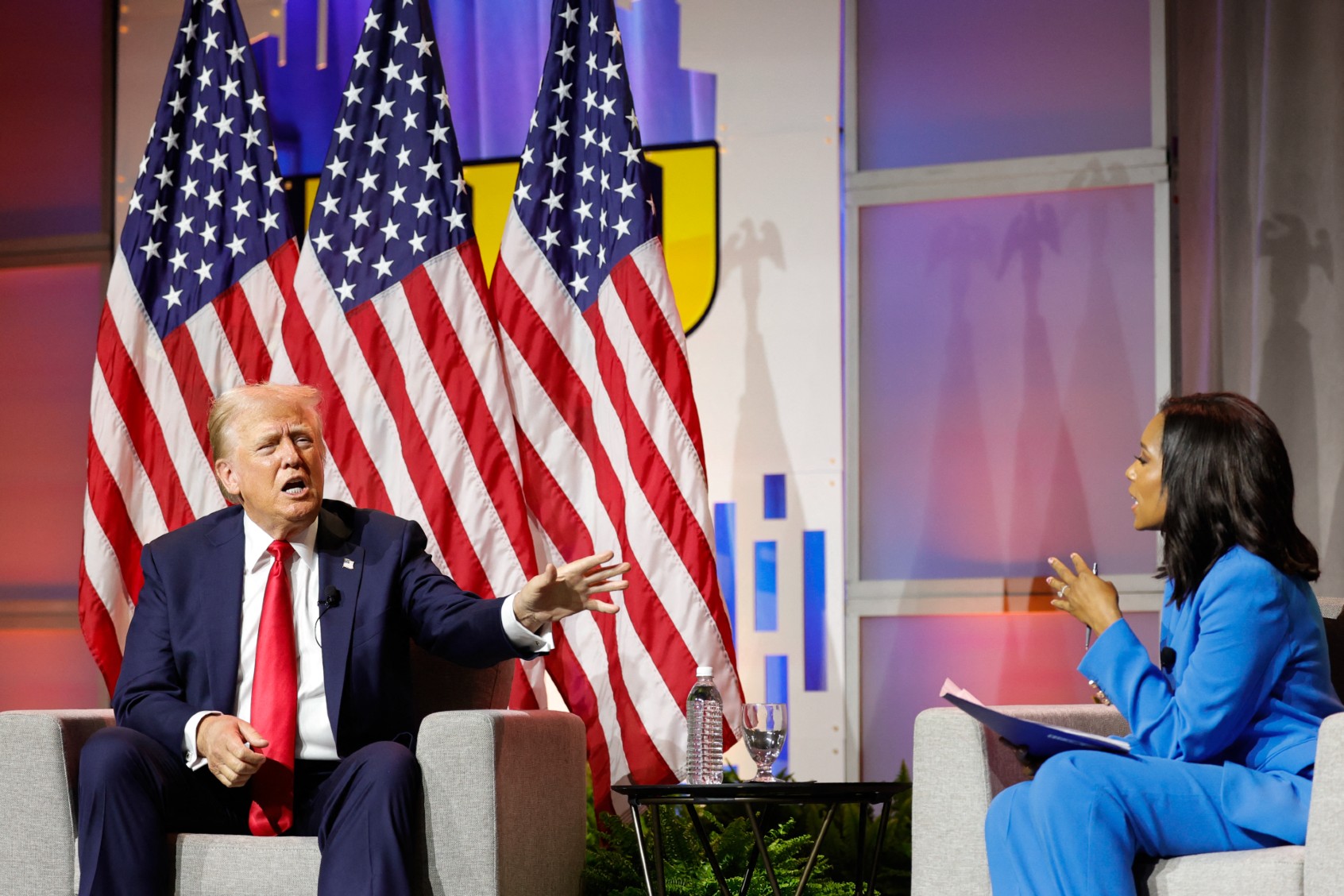
Wednesday’s bleak comedy served only Trump, doing a disservice to the NABJ, and to Harris.

“. . . I respect either one, but she obviously doesn't,” Trump continued, “because she was Indian all the way, and then all of a sudden, she made a turn and she went . . . she became a Black person.”

Harris’ mother was a biologist who emigrated from India. Her father is a Black emeritus professor of economics who came to the United States from Jamaica. She's also an alumnus of Howard University, one of the top HBCUs Trump is keen on taking sole credit for supporting. Do you even need to ask if there were fact-checkers in the room? No. There were not.

NABJ instead directed the audience to PolitiFact’s live blog which could neither keep up with the lies nor refute Trump’s assertion that the event was late because NABJ couldn’t get its audio setup together. That wasn’t what organizers told a few media reporters, who said Trump’s people kept them in a stand-off by demanding that NABJ not do live fact-checking. No matter, since Trump's falsehoods are already circulating.

Scott and Goba did a fine job of pushing back at the most ridiculous lies, generally comporting themselves and the profession well. Colleagues on X and other social media outlets said as much within their echo chambers.

Faulkner, teasing her one-on-one with Trump conducted aside from this appearance, set him up for a few tee-ball base hits with, “What is your message today?” and “What's your plan for the Black community when it comes to money?” and “Why did you choose JD Vance?”

But even his nonsensible marshmallow responses to her didn’t matter. Wednesday’s bleak comedy served only Trump, doing a disservice to the NABJ, and to Harris, the first Black and South Asian woman to top a major party's presidential ticket. Amplifying the organization’s self-injury was its announcement on Tuesday that it denied Harris’ offer to appear virtually this week since her campaign schedule wouldn’t allow her to be there in person.

We need your help to stay independent

Trump used this to his advantage, claiming he was lured to the conference under false pretenses: “I was told my opponent, whether it was Biden or Kamala, I was told my opponent was going to be here,” he alleged. What he’s describing sounds like a debate, which, to my knowledge, NABJ does not do during election years.

Former U.S. President and 2024 Republican presidential nominee Donald Trump answers questions as moderator and journalist Rachel Scott (R) looks on during the National Association of Black Journalists annual convention in Chicago, Illinois, on July 31, 2024. (KAMIL KRZACZYNSKI/AFP via Getty Images)Regardless, accepting NABJ's invitation enables Trump to brush aside suspicions that he’s afraid to debate Harris, citing his verbal attacks on two other Black women, Scott and Goba as proof he's up for the challenge. Trump has a long history of slandering Black women journalists, regularly insulting White House correspondents April Ryan and Yamiche Alcindor and former CNN anchor Don Lemon when Trump was in office, as well as encouraging attacks on Jemele Hill and Tiffany Cross. Those are just the names I can recall off the top of my head.

So what is to be gained by the NABJ bringing him onto its turf to make a live show of disparaging two more?

Trump is the latest in a series of controversial political figures that NABJ has platformed over the years. His announcement stirred up social media reminders of the time the organization hosted his surrogate Omarosa Manigault Newman in 2017, who was mainly just disagreeable.

My memory rewound much farther to one of the first conventions I attended in 1996. That year’s political firebrand was remembered afterward for calling the assembled reporters “slave writers, slave media people." Most of those in the room were right to feel insulted. But Nation of Islam leader Louis Farrakhan was not running for office. He was fresh off organizing the Million Man March in 1995 and stood accused of making some truly bigoted and antisemitic statements. 

He still is. The Southern Policy Law Center lists a collection of sourced antisemitic statements on its page designating him as an extremist. He also has a complicated legacy and reputation among Black folks, as Henry Louis Gates, Jr. describes in his reported essay in The New Yorker: “This is a man whose political identity is constituted by antagonism to the self-image of America. To moderate his stance of unyielding opposition would be to destroy the edifice he has spent his life constructing.”

The NABJ had a sense of what it was getting into with him too. Now, contemplate what it welcomed into its midst Wednesday as you take in what else Farrakhan said to its members in Nashville 28 years ago.

When you have the right and the privilege to feed the human mind, then to feed the human mind lies mixed with truth, skewing the truth, hiding the truth, manipulating the truth for this one's benefit and to that one's degradation, is not my idea of protecting democracy and the fundamentals of a democracy.

Which is pretty much what NABJ allowed enabled Trump to do this week.


Want a daily wrap-up of all the news and commentary Salon has to offer? Subscribe to our morning newsletter, Crash Course.


On Wednesday Ryan spoke for many when she lamented on X, “Trump came into our home, a Black Press advocacy convention, and insulted us in our face. What is worse, he was invited to do this by NABJ leadership.”

The offense didn't stop once Trump left the stage well short of his promised hour. Soon after he posted on Truth Social: “The questions were Rude and Nasty, often in the form of a statement, but we CRUSHED IT!”

His campaign’s senior adviser Lynne Patton released a statement that says in part, “You would think that the media would have learned something from their repeat episodes of fake outrage ever since President Trump first came down the escalator in 2015, but some just refuse to ‘get it.’”

Patton’s right, but not for the reasons she thinks. Harris’ entry into the presidential race was guaranteed to generate racism and misogyny from Trump and his minions, but the easiest way to spread that poison is to legitimize him in mainstream forums.

Headlines describing what he said about Harris amplified those slurs and other lies he dropped on Wednesday, which only energizes his base and its worst actors. These are the same mistakes media watchdogs warned fellow journalists to refrain from making after handing Trump billions in free promotion in 2016 and flirting with a repeat performance of that in 2020.

To see it recur via an organization dedicated to supporting Black journalists and journalism is infuriating. Still, I never would have guessed I would be invoking another politically consequential and controversial guest's three-decades old warning in response to this organization's terrible judgment.

At least Farrakhan said something worth remembering, and true — a call to refuse framing damaging acts as business as usual, by saying, "This is what we've always done." That means NABJ and the Fourth Estate; that means anybody interested in defending democracy. Disbelieve those observations at your peril. They will stand up to a fact-check.

Check out the full "PBS News Hour" stream of the conversation. (Fast-forward to 1:10 if you want to skip the hold music and blank stage):

Cult expert Steve Hassan: “The silencing of critics” is crucial to Trump’s “authoritarian control”

Donald Trump is a puzzle that the mainstream news media and responsible political class and many others outside of the MAGAverse and larger right-wing disinformation propaganda echo chamber still cannot solve even after nine years of (ostensibly) trying to. At this point, their failure to understand Donald Trump and his right-wing authoritarian fake populist appeal is a choice.

There have been many moments that, per conventional wisdom, should have doomed Donald Trump and his political and personal future. Yet, Donald Trump through skill, a preternatural instinct for survival, devious intelligence, and lots of luck and help continues to endure if not prosper.

Following an assassination attempt in Pennsylvania, instead of cowering in fear Trump defiantly raised a fist and told his followers to “Fight, fight, fight!” In the aftermath of that horrible act of political violence, he has only become more popular and powerful among his MAGA followers. Their belief in and adoration of Trump is now so powerful that they now view him as a type of martyr and prophet-warrior who has been blessed by their “god” as a tool of destiny. As seen at the Republican National Convention in Milwaukee, Donald Trump’s control of the Republican Party is now absolute. Today’s Republican Party and “conservative” movement are now fully MAGAfied.

Ultimately, the mainstream media, responsible political class, and other elites are unable to understand the Age of Trump and the larger democracy crisis because they are using the wrong framework and set of assumptions about politics and political behavior (specifically the importance of identity, emotions, and storytelling).

By comparison, Steven Hassan possesses a deep understanding Donald Trump’s power and control over the MAGA people and the larger Republican Party. He has been warning for at least eight years that Donald Trump is not a normal politician, but instead the leader of an extremely dangerous authoritarian personality cult. Hassan’s conclusion is not hyperbole or “partisanship”. It is based on the pattern of facts and the collective psychology and behavior that Donald Trump and his MAGA people have exhibited during the last nine years and beyond.  

Steven Hassan is one the world's foremost experts on mind control and cults. Hassan was once a senior member of the Unification Church, better known as the "Moonies." He is now founder and director of the Freedom of Mind Resource Center and has written several bestselling books, including "Combating Cult Mind Control" and "The Cult of Trump."

In this conversation, Hassan explains the roots of Donald Trump and his MAGA movement’s cult-like power and appeal and why it will continue to endure if not grow. He also explains how Donald Trump and his propagandists will use the failed assassination attempt to maintain and expand the corrupt ex-president and now convicted felon’s control over his followers. Ultimately, Hassan warns that Donald Trump and his MAGA movement’s power will be very difficult to break because Trumpism is part of a much larger project, one that has been decades in the making by the Republicans and the larger right-wing and other malign actors to end America’s multiracial pluralistic democracy.

You have been warning about the power of Donald Trump and what you describe as his MAGA cult since the beginning of this crisis back in 2016 and 2015. How are you making sense of this all?

We're in a lot of trouble. Trump did a great amount of damage to the country when he was in power. The judges he appointed are still there. The other institutions Trump and MAGA have captured are still working on his behalf. The global antidemocracy alliance, centered on Vladimir Putin, is still supporting Trump and wants to see him return to power. Trumpism is not something out of the blue. This has been a process taking place over decades. There are so many right-wing extremists all over this country, on the state and local level, in Christian fundamentalist churches and organizations, think tanks, universities, etc. etc. who are advancing the authoritarian cause.

We all have an unconscious bias when we're trying to understand human behavior, to look at the individual's disposition instead of the social influence in the context. This is well-documented in social psychology. Outsiders look at cults like the MAGA movement and conclude that its members are stupid and dumb and gullible. That is not the case. Most of them are just vulnerable and are under the undue influence of an antisocial leader and his influencers across the right-wing echo chamber.

We need your help to stay independent

America has many millions of these vulnerable people. Some of them have gotten swept up in Trumpism and the MAGA movement. Others become white supremacists or join the Christian Right and its most extreme elements.

We also cannot underestimate the power of algorithms and big data to manipulate people and encourage the worst emotions and behavior. There is lots of research showing how sleep deprivation is widespread in this society. Many Americans and people in other countries are just overwhelmed and overloaded with inputs that stimulate their emotions in bad ways. When we are overstimulated with fear, anger, and disgust and other negative emotions the frontal cortex goes offline. You age regress and look for a strong father or mother figure or other authoritarian leader to tell you what to do. Thus, Donald Trump and other populist authoritarians have risen to power all over the world.

When you saw the image of Trump, bloodied and rising from the ground and pumping his fist while saying "fight, fight, fight!" after the assassination attempt on Saturday, how did you make sense of it? 

Trump has been playing the victim for years. It is central to his propaganda strategy and cult leader power. The picture of him after he was shot has all those elements amplified to the extreme. Eric Hoffer famously said that “Usually the strength of a mass movement is proportionate to the vividness and tangibility of its devil.” Trump's been telling his followers that I am going to take vengeance and revenge for you. It looks like they, the Left, are attacking me. But they are really attacking you. I am going to stand up for you! The image of him after the assassination attempt is visible tangible proof to his MAGA people of his commitment to them. Trump, like other authoritarians and cult leaders, is always looking for an angle to make money. It doesn't wouldn't surprise me at all if Trump were to auction off his bloody suit and other clothing.

What do we know about the psychology at work when the cult leader's life is threatened or otherwise imperiled? How do the followers respond?

The leader will almost always be made stronger by surviving the danger. Facts will not persuade the Trump followers to leave him. Their attachment to Trump is deeply emotional. Seeing Trump's life threatened has bonded the followers to him much more.

The interviews with the MAGA people at the rally were very revealing and telling — and just confirm what others have been observing about the MAGA movement and those gatherings as a place of community and meaning-making and for some, family. Beyond the accounts of the horrible act of violence they saw, the MAGA people were telling reporters how much they love Trump and have seen him speak many times. They have this almost religious devotion and love for him. One woman basically said seeing Donald Trump speak the first time a few years ago and watching his plane fly overhead was one of the most moving moments in her life. To those outside of the MAGAverse and TrumpWorld, this seems absurd.

There is an overlap between Christian religious cult churches and organizations and Trump's movement. Most notably, New Apostolic Reformation (NAR) groups and charismatic Catholics who believe in prophets and apostles who speak directly to God: speak in tongues, do faith healings and cast out demons to prove it. Members of those groups were prominently involved on Jan. 6. Their leaders believe that Trump won the 2020 election—which of course is not true. The members of these Christian extremist groups will not question their leaders because they view them as divine and messengers from God. Thus, the support for Trump and religious ideation of him by the followers. The emotion of awe is a powerful motivational emotion. We see it with celebrities, billionaires, and other famous people who the public responds to and wants to be like. The passion and idolization for Trump are contagious among his followers and can expand to bring in others. The MAGA movement is based on this.

At the Republican Convention in Milwaukee, there were people wearing bandages on their ears like Donald Trump. It is right out of a textbook on mass psychology.

That is predictable behavior among personality cults and other mind control and undue influence groups. The followers identify with the leader who was harmed. Pretending to be bloodied and injured is a form of shared identity and loyalty. Trump's being injured and presenting himself as almost immortal is part of his attempt to present himself as a hero and force of destiny who overcomes all kinds of trials and tribulations to conquer and achieve victory. That is the narrative that Trump and his propagandists are trying to push — and it seems to be working.

Trump and his propagandists are using the failed assassination as a weapon to silence critics and other truth-tellers. That is a standard move by fascists and other authoritarians, literally textbook as Ruth Ben-Ghiat and others have highlighted. The mainstream news media is, of course, enabling and participating in this silencing of critics and truth-tellers with the lie that "both sides" are equally responsible for political violence in this country as part of its normalization of Trumpism. The Democrats seem cowed too.

The silencing of critics is an example of authoritarian control. Information control has several basic elements such as deception, overt lying, withholding vital information and/or distorting it. Authoritarian control also involves telling members to not talk to ex-members or critics. Only believing in the propaganda and information that is approved by the leader and the cult organization. We are seeing that play out in front of us with Trump and the MAGA movement. The attempt on Trump's life has just amplified and spread it. There are too many powerful people in too many different positions of influence in America and around the world for the MAGA movement and Trumpism to collapse. The antidemocracy movement is too widespread now for it to just dissipate quickly. It will take lots of work to do that.

How would you respond to those people who will say that you should not describe the MAGA movement as a cult and/or Donald Trump as a cult leader? And to do so, especially at this moment, is not polite or nice. You should tone it down and be more “responsible” because you, and people like you, are part of the problem in this country with all these troubles and how high the political temperature has risen.

I would tell them that the MAGA movement is in fact an authoritarian cult. It is dangerous, destructive, anti-human rights, anti-woman, racist and white supremacist, antigay and has many other antisocial values and beliefs. The Trump authoritarian personality and the larger antidemocracy movement are very dangerous. People tried to stop these evil forces in the 1930s and 1940s. We can learn from them and rise to the challenge today. It is the very definition of being responsible to tell the truth about these dangers.

Donald Trump and his agents across MAGA and the larger neofascist movement have made it very clear that their "enemies" and critics and anyone else who opposes them will be severely punished, including being put in prison and worse, when/if they take power in 2025. Enemies lists have already been made. This is a documented fact. Given your book "The Cult of Trump" you are likely on one of those lists. Are you afraid? Is that going to change your behavior?

I believe in standing up against such evil I have been confronting danger since I was deprogrammed from the Moonies 48 years ago. I will not be silenced nor flee. I have always stood my ground against cults. Some of them are very powerful with billions of dollars. I will not surrender the truth or be intimidated into silence. I have had my life threatened by these powerful cults for many years. But I'm not going to stop talking. I want to live my life looking in the mirror knowing that I am doing the right thing. I will not just follow the crowd out of fear like too many other people have done in dark times. We need to be brave. I want people to know we are the majority, and they are the minority. If we believe Trump and MAGA will win, then we give up our collective resources and power. We are stronger together.

Pete Davidson enters rehab facility, amid mental health battle

Comedian and actor Pete Davidson has checked into a wellness facility, focusing on treating his mental health. 

Per People Magazine, the comedian checked into the facility sometime before Wednesday, following a string of dozens of projects, including film appearances, comedy shows, and other engagements in the last year.

The “Bodies, Bodies, Bodies” actor had reportedly been focusing on his sobriety before the decision to enter a treatment program.

"Pete will often check himself into rehab to work on these issues. His friends and family have been supportive during this time,” a source told People.

The “Saturday Night Live” alum has long struggled with substance abuse and mental health challenges, checking himself into a mental health facility in June of last year to manage his PTSD and borderline personality disorder.

Davidson, who touted his “post-rehab glow” in a September 2023 comedy special, has been vocal about his efforts to manage his mental health and substance challenges in the public eye, opening up about daily ketamine use and joking that the “seventh time’s the charm” in the set.

Davidson previously outlined his PTSD stemming from his father Scott Davidson’s death during the 9/11 attacks, explaining that he faced abandonment issues for years.

The comedian, who left "SNL" in 2022 amid reports that he felt threatened in a “cutthroat” work environment, starred in two seasons of Peacock’s “Bupkis,” a fictionalized account of his own life, and an autobiographical comedy film, “The King of Staten Island.”

Trump grasps for attack angles on Harris at first PA rally since shooting

Former President Donald Trump took the stage in Harrisburg, Pennsylvania on Wednesday, his first appearance in the state since the shooting at his Butler rally on July 13. 

Trump, whose disastrous performance at the National Association of Black Journalists conference earlier on Wednesday included him accusing Vice President Kamala Harris of lying about her race, scrambled for new attacks against his opponent, as she surges in national and swing state polls.

Trump opened the rally with a dig at Harris’ star-studded Atlanta rally, which pulled ten thousand attendees, and featured a performance from rapper Megan Thee Stallion.

“We didn't need anybody to get the people here. We didn't need a star,” Trump said. “We didn't need some entertainer.”

Trump, who earlier claimed Harris, a biracial woman, wasn't Black but instead recently adopted the identity, accused her of "trying to out brand a new southern accent" in her Atlanta remarks, before leading the crowd in boos against the press present at the rally, suggesting he couldn't get away with the same.

The former president, who hasn't yet launched substantive policy criticism of Harris, also complained about the difficulty of starting his campaign anew, admitting that his attacks on President Joe Biden had expired.

“The hard part is that 3, 4 weeks ago, I was talking about Biden: ‘He’s incompetent, he’s a horrible president, he’s the worst president in the history of the country.’ But now I say, ‘she’s the worst vice president,’” Trump said, acknowledging the adaptation before claiming he “didn’t even know her name” two weeks ago.

Almost seeming to miss Biden's presence in the race, Trump claimed his former opponent is “Not old. You know, 81 is not old.”

Trump also expressed frustration at the comparison between “prosecutor vs. felon” from the Harris campaign, adding that Harris “wasn’t tough on crime, she’s only tough on guys like me.” 

Trump, who also launched confusing attacks on electric vehicles, despite reaping millions in campaign contributions from Tesla CEO Elon Musk, backed out of debates against Harris earlier this week and fired off multiple Truth Social posts fuming about her absence at the National Association of Black Journalists Convention on Wednesday.

Sheriff expresses remorse but refuses to resign after Sonya Massey killing

Sangamon County Sheriff Jack Campbell dismissed calls for his resignation after a deputy he hired in the department killed an unarmed Black woman in her home while responding to her 911 call.

Campbell spoke at a “community healing and listening session” in an Illinois church on Monday, acknowledging responsibility for the killing, which was caught on body cam video, but stopping short of promising personal accountability.

"I'm going to say something right now I've never said in my career before: we failed," Campbell said, per ABC News. "We did not do our jobs. We failed Sonya. We failed Sonya’s family and friends. We failed the community. I stand here today before you with arms wide open to ask for forgiveness.”

Massey, who was killed by Sangamon County Deputy Sean Grayson on July 6, was complying with Grayson’s request to remove a pot of boiling water from the stove when he shot her three times. 

Grayson, who was charged with first-degree murder, aggravated battery with a firearm, and official misconduct, has pleaded not guilty after being dropped by the department’s local police union.

“Sonya Massey – I speak her name and I'll never forget it,” Campbell said, but he explained to community members that his resignation, he believed, wouldn’t do any good.

Calls for Campbell’s resignation during a Chicago rally came from civil rights attorney Ben Crump, who is representing Massey’s family. Reverand Al Sharpton and other community members are also pushing for him to step down. 

“When I heard and saw the video, I was as outraged as I was when I saw the video of George Floyd,” Sharpton said in a Tuesday speech. “It is the negligence of this government’s response to all of these killings that created the climate that led to Sonya.”

Grayson, who worked for at least five law enforcement agencies in the years leading up to his employment in Sangamon County, was dismissed from the US Army for serious misconduct before he was hired.

Secret Service apprehends individual after security incident involving Harris’ stepdaughter

A man was arrested Tuesday for tampering with a license plate obstruction device on U.S. Secret Service detail vehicles assigned to Vice President Kamala Harris’ stepdaughter, Ella Emhoff.

The incident took place in the Tribeca neighborhood of New York City, where 45-year-old Harry Heymann attempted to dismantle the devices on two Secret Service vehicles as Second Gentleman Doug Emhoff’s daughter had lunch at Bubby’s, a nearby restaurant.

Video obtained by TMZ and later shared by AP News showed Emhoff being ushered into a black SUV and a man being led away in handcuffs.

Heymann, reportedly a member of an activist group in New York City that combats devices that obscure license plates from toll and traffic cameras, was attempting to remove an illegal license plate cover from two Secret Service vehicles, per transit newspaper Streetsblog. He was reportedly unaware that the cars belonged to the Secret Service.

“On Tuesday afternoon, an individual approached two United States Secret Service vehicles parked in lower Manhattan and, without provocation, caused damage to the rear license plate area of both,” USSS spokesperson James Byrne said in a statement, per CNN.

Heymann has previously been vocal about his opposition to plate obscuring maneuvers, tweeting earlier this month about the NYPD’s lack of action on so-called “ghost cars.”

Emhoff, who previously dipped her toe into the race to blast vice presidential nominee JD Vance for referring to her stepmother as a “childless cat lady,” was not harmed during the incident.

The arrest comes amid turmoil inside the Secret Service, after a failed assassination attempt on former President Donald Trump earlier this month sparked a siege from Congressional Republicans against the department, resulting in the resignation of Director Kimberly Cheatle.

Trump doubles down on “rude and nasty” label for Black journalists, after tense NABJ interview

Former President Donald Trump is complaining that Black reporters were “rude and nasty” to him, after a tense exchange at the National Association of Black Journalists Conference in Chicago on Wednesday.

Trump, who called ABC News correspondent Rachel Scott “very rude” for asking “nasty” questions, held the line in his long tradition of attacking reporters, especially women and journalists of color, throughout the 37-minute Q&A.

“I don’t think I’ve ever been asked a question so . . . in such a horrible manner,” Trump said after Scott asked him why Black voters should back him given his past use of racially charged language.

In a post to Truth Social, Trump doubled down and slammed reporters at the gathering of Black journalists for questions that dug into his repeated attacks on Black Americans, Vice President Harris’s racial identity, and his associations with white supremacists.

“The questions were Rude and Nasty, often in the form of a statement, but we CRUSHED IT!” the former President wrote in the post to Truth Social.

Scott faced a barrage of attacks aimed at her, ABC News, and the event organizers themselves, who Trump claimed “invited [him] under false pretense” and delayed his appearance.

Trump, who faced scrutiny from reporters over his support of blanket police immunity, denied an opportunity to walk back such a proposal, even as reporters asked whether the Illinois police deputy who killed Sonya Massey — charged with murder — should receive such immunity.

“I don’t know the exact case, but I saw something and it didn’t look good to me, with the water,” Trump said, offering that it would “depend” whether the sheriff who shot and killed Massey should receive legal protections.

In a statement, a spokesperson for Trump blasted “certain hostile members of the media” present at the NABJ conference, adding that asking critical questions of the president “will be their undoing in 2024.”

Chef Shirley Chung, “Top Chef” fan favorite and top competitor, diagnosed with stage 4 tongue cancer

Shirley Chung — a fan-favorite "Top Chef" competitor who tied for third place in season 11 and was the runner-up in season 14, known for her delicious food and permanently sunny disposition — has been diagnosed with stage 4 tongue cancer.

In an incredibly candid and vulnerable post shared on Instagram along with videos of her shaving her head alongside family and friends, Chung wrote: “Since last year December, I had a series of dental issues, I bit my tongue severely; I fractured my tooth and had to extract it and get an implant . . . we thought it was because I am a heavy teeth grinder. And I was too busy to see a EMT specialist."

Chung continues, writing "The end of May, ulcers erupted in my mouth and my oral surgeon discovered a hidden tumor under my tongue. A few days later, I was diagnosed, stage 4 tongue cancer, as cancer cells also spread into my lymph nodes.” 

Chung added that, drawing on her experience as a chef for so many years, she was very calm because she is used to thriving under pressure. After hearing the news, was "extremely focused on getting all the tests and scans as fast as possible." However, her doctor informed her that the top recommended option for someone with her prognosis was the complete removal of her tongue. Chung wrote that she broke down crying, "trying to put thoughts together and ask questions but physically couldn't." 


Want more great food writing and recipes? Subscribe to Salon Food's newsletter, The Bite.


She credits her husband with informing her of a "unicorn case" at the University of Chicago, where a patient — who also happened to be a chef — was cured with radiation and chemo, leaving the tongue intact. "Higher survival rate, or keep my tongue? I chose to keep my tongue," Chung wrote. "I am a fighter, I am a chef, I can be unicorn too."

According to Chung, she has been doing chemo for six week (with "many more to go"), adding that, "my tumor is shrinking, my speech is much better and I can eat most normal food now."

We need your help to stay independent

"I am learning to lean on others, to let go, to be more vulnerable," she continued. "It took me 2 weeks of contemplating to decide to tell my parents about my cancer, only my close circle of friends and my sister have known until now. I am learning, I can be strong 98% of the time, it’s ok to be not ok." 

In addition to the seasons in which she competed, Chung also appeared on "Top Chef: Amateurs" and "Top Chef: Family Style."

As Lauren Huff at EW reports, "The news of Chung's diagnosis coincides with the news that she is shutting down her Los Angeles restaurant, Ms. Chi Cafe, to focus on her recovery. The restaurant will continue operations through Sunday, August 4." 

Luna’s ark: Scientists call for backup seed vaults on Moon

As terrestrial bio-vaults face rising threats from climate change and war, scientists are calling for the creation of a new vault on the surface of the Moon where living cells and seed samples could be stored as an emergency backup to preserve Earth's biodiversity. As reported by the Guardian Wednesday, an international team of experts now say we no longer have enough time to protect the thousands of species at risk of extinction from climate change — and urgent action is needed to preserve DNA samples of plants and animals for future repopulation efforts.  

The proposed lunar biorepository, described in the journal BioScience, would be similar to the widely known Svalbard seed vault in the Arctic Circle, where global samples for primary food crops are stored. The lead author of the lunar vault proposal — Dr. Mary Hagedorn of the Smithsonian’s national zoo and conservation biology institute — pointed to recent flooding incidents threatening the Svalbard Global Seed Vault, a Norwegian seed bank, and to the 2022 destruction of Ukraine's seed bank. 

“If there had not been people there, flooding could have damaged the biorepository….the idea of having a really secure, passive biorepository for safeguarding Earth’s biodiversity seems like a really good idea,” Hagedorn told the Guardian. "We know how to do this and can do this and will do this, but it may take decades to finally achieve."

The team say the Moon is an appealing location for a backup bio-vault due to its natural features, including deep craters near polar regions which never see sunlight and frigid conditions that readily reach the -196 degrees Celsius needed for long-term biological sample preservation. 

Simone Biles claps back at former teammate MyKayla Skinner for criticizing gold medal team

The uncontested G.O.A.T. of American women's gymnastics, Simone Biles, has seemingly responded to an unsavory remark made by a former Team USA teammate of hers. 

“Besides Simone, I feel like the talent and the depth just isn’t like what it used to be,” her former teammate, MyKayla Skinner said in a YouTube video posted after the team selection. Skinner, who earned a silver medal on the vault at the Tokyo Olympics, said in the since-deleted video. “A lot of girls don’t work as hard. The girls just don’t have the work ethic.”

Biles seemed to clap back at the time with a post shared to social platform Threads, writing, "Not everyone needs a mic and a platform." 

Following the women's all-around gold medal victory at the Paris Olympics on Tuesday, Biles took to her Instagram account to share images of the squad — including herself, Jordan Chiles, Suni Lee, Jade Carey and Hezly Rivera — celebrating their win, which earned Biles' her eighth gold medal and the title of most-decorated American Olympics gymnast of all time. "Lack of talent, lazy, olympic champions," Biles captioned her post, an ostensible reference to comments made by Skinner.

https://www.instagram.com/p/C-ESNIFIQ8l/

While Skinner initially defended her remarks, she later apologized in a statement shared to X/Twitter after receiving an adverse public response. “It was not my intention to offend of disrespect any of the athletes or to take away from their hard work,” she wrote. “I take full responsibility for what I said and I deeply apologize.”

The latest development in the simmering tension between the two athletes came on Wednesday, when Biles claimed that Skinner had blocked her Instagram account. "Oop I’ve been blocked," Biles tweeted, along with several emojis. Chiles separately posted an image on her Instagram story of someone holding what appears to be Biles phone clicked into Skinner's account, which is inaccessible. "When she blocks Simone," Chiles captioned the post. 


Stephen Richer, a Republican who actually defended election integrity in Arizona, loses primary race

A GOP official known for his persistent defense of free and fair elections lost his primary election in Arizona on Tuesday, NBC News reported.

Incumbent Stephen Richer lost his re-election bid for Maricopa County recorder to State Rep. Justin Heap, a right-wing challenger who called Maricopa County elections a “laughing stock,” according to the Arizona Mirror. 

Heap won 42.4% of the vote and Richer won 35.9%, the Associated Press reported.

As the county’s recorder, Richer was in charge of voter registration and mail-in voting. Since he came into office in 2021, Richer has pushed back on misinformation about Arizona’s voting process, despite facing threats of violence

When asked how confident he was in the results of the 2020 and 2022 election at the GOP Maricopa County Recorder Debate last month, Richer said he was “very, very confident.”

“See all the post-election assessments. See the court cases. If you're running for recorder and can't give a plain answer to this question, then you either haven't done your homework or you're a coward. Either is disqualifying,” Richer said.

At the same debate, Heap said it was “abundantly clear” that “voters are disenfranchised and have lost trust in our elections.” He vowed to restore that trust. Heap was endorsed by U.S. Senate candidate Kari Lake, a fervent election denier.

Many fear Richer’s ousting is a loss to fair elections.

“Maricopa County recorder Stephen Richer just lost his Republican primary — a major blow to how the Arizona county's elections will likely be administered,” MSNBC executive producer Kyle Griffin wrote on X.

“Richer did his job and he did it consistent with the law. That he got primaried out like this is ridiculous,” wrote legal expert Bradley Mosses on Threads. 

There is no guarantee the Maricopa County seat will remain Republican in the upcoming election. Before Richer was elected in 2020, the seat belonged to Democrat Adrian Fontes.

Heap will face Democrat Tim Stringham in November’s general election.

“He is alone”: Experts say “extreme” ruling shows John Roberts has “lost his authority” over SCOTUS

The behind-the-scenes machinations behind the Supreme Court’s sweeping presidential immunity decision reveals that Chief Justice John Roberts has “lost his authority” and ability to broker compromises on the thorniest and most impactful issues, a legal expert says.

The Supreme Court this summer ruled 6-3 that presidents have "absolute immunity from criminal prosecution" for acts that fall within the "exercise of his core constitutional powers he took when in office." Presidents, according to the ruling, have "at least presumptive" immunity from other official acts, and no immunity for unofficial acts.

The Supreme Court’s sweeping immunity decision has thrown a wrench into legal cases concerning Trump: a New York judge delayed sentencing for Trump’s 34 felony convictions of falsifying business records. And, the Supreme Court’s decision tasked U.S. District Judge Tanya Chutkan with weighing which acts are official and unofficial.

A CNN report by journalist Joan Biskupic revealed that Roberts “made no serious effort to entice the three liberal justices for even a modicum of the cross-ideological agreement that distinguished such presidential-powers cases in the past.”

Pace Law School Professor Bennett Gershman said Roberts has found himself alone, and found the task of finding compromises among far right-wing, conservative and liberal justices on the court “virtually impossible.”.

“Roberts finally has realized that his power of persuasion over the fiercely radical Justices Thomas, Alito, and Gorsuch, the conservatives Kavanaugh and Barrett, and the staunch liberal team of Sotomayor, Kagan, and Jackon, is at an end,” Gershman said. “He is alone all by himself, and he knows it.”

According to Gallup, public approval of the Supreme Court reached 43% in July 2024. That's down from 58% in July 2020, and 61% in September 2009.

Gershman said that Roberts is aware that the court’s “public reputation and perception of legitimacy is the lowest in history.”

“Despite his earlier claim that ‘there are no Trump Justices,’ he knows the truth; that five of his colleagues are indeed ‘Trump Justices’ and there’s nothing Roberts can do about it,” Gershman said.

Gershman called Roberts’ immunity decision “bold and extreme” and reflective of his realization that “his only choice was to supplicate” pro-Trump justices.

“To be sure, he’ll continue to assign to himself the big cases,” Gershman said. 

But, he added: “He knows he has lost his authority and his Court and is all by himself.”

CNN's report, which cited sources familiar with the negotiations, also points out that Roberts has a long history of finding unanimity on contentious cases – including hashing out compromises in 2020 Trump document cases.

Boston University School of Law professor Jed Shugerman told Salon that particularly in the most recent Supreme Court term, Roberts has veered from institutionalism.

"There’s plenty in Trump v. U.S. and this term to know that Roberts has abandoned a chief’s justice institutional role," Shugerman said.

Shugerman said that the "Roberts opinion itself was so extreme and manufactured without historical evidence, without the commitment to originalism and without precedent, that it’s hard to imagine how that opinion could have ever been in any form something that the three moderate liberals might have found any common ground in."

We need your help to stay independent

Shugerman pointed out that Roberts failed to get Justice Amy Coney Barrett on board with the entirety of the opinion.

Barrett concurred in part with Justice Sonia Sotomayor's dissent, which argued that excluding "any mention" of an official act associated with a bribe "would hamstring the prosecution.'"

Roberts said a prosecutor pursuing a bribe charge could point to public record to show the president performed the official act and admit evidence of what the president "allegedly demanded, received, accepted, or agreed to receive or accept."

But Roberts said admitting testimony or private records concerning a bribe would invite the jury to "second-guess" the president's motivations for official acts — which he argues would "'seriously cripple'" a president's exercise of official duties.

Shugerman said that Roberts' footnote response to Barrett is part of his overall "incoherent" opinion.

Shugerman also criticized the court's March ruling in Trump v. Anderson, which reversed the Colorado Supreme Court decision excluding Trump from the 2024 GOP primary ballot based on Section 3 of the 14th Amendment.

He said the ruling also "reflected a lack of institutional mindset and disregard for consensus."

"Really, it just invented reason to reach a reasonable result," he said.


Want a daily wrap-up of all the news and commentary Salon has to offer? Subscribe to our morning newsletter, Crash Course.


Shugerman said even though the conclusion may reflect common sense, its reasoning lacked solid historical grounding.

"There's growing consensus among originalists among all different stripes that the Roberts Court conservatives are not serious about methods and not serious about originalism," Shugerman said. "There's a growing number of originalists who are saying so out loud. It’s important to recognize how the Roberts court is not truly textualist or sincerely originalist. But it's abundantly clear it’s driven by conservatism, traditionalism and partisan ideology."

The CNN report found that far-right justices are heartened by Roberts, who at times has taken more centrist positions relative to other justices.

Georgia State University College of Law professor Eric Segall noted that Roberts has taken stances against affirmative action, abortion rights, voting rights and the Medicaid expansion portion of the Affordable Care Act. 

The immunity decision stemmed from Trump’s charges for trying to overturn the 2020 election. 

A D.C. federal grand jury indicted Trump on four charges in August 2023 accusing the former president of conspiring to thwart his 2020 electoral defeat and the peaceful transfer of power to President Joe Biden.

The Supreme Court's ruling said deciding whether Trump's alleged fake electors scheme "requires a close analysis of the indictment’s extensive and interrelated allegations."

CNN said that Roberts avoided references to the chaos and violence of a mob’s Jan. 6 march on the Capitol as he “found new immunity vested in the Constitution for a former president.”

Last December, U.S. District Judge Tanya Chutkan rejected Trump’s motion to dismiss the charges on grounds of absolute presidential immunity, which he argues completely shields him from prosecution for any actions taken while in office.

"There was broad understanding among the justices that they would need to decide the matter themselves, and only after the usual appellate court hearing," sources told CNN, adding that “Roberts believed that he could assert the large and lasting significance of the case and steer attention away from Trump.”

The Supreme Court's public information office did not respond to Salon's request for comment from Roberts.

“She’s gonna win”: Joe Rogan believes that Kamala Harris’ is favored over Trump

Joe Rogan shared on a recent episode of "The Joe Rogan Experience" podcast that he has more faith in presumptive Democratic nominee Vice President Kamala Harris to win the upcoming presidential election than he does former president Donald Trump. 

Speaking to author and podcaster Mike Malice, Rogan said, “She’s gonna win."

“I feel like we are in this very bizarre time where people are giving into the bulls**t in a way that I never suspected people would before,” Rogan stated when Malice disagreed, going as far as to say that Hillary Clinton could beat Trump in a hypothetical race. “They just want no Trump, no matter what, and they’re willing to gaslight themselves — and by the way, I think Hillary could win.”

Rogan also argued that the assassination attempt against Trump — what could have been the linchpin in securing the strength of the MAGA campaign — has instead become "memory-holed." “Everybody forever was like, Kamala Harris is the worst vice president,” Rogan added. “She’s the least popular vice president of all time, and then in a moment, a moment in time, all of a sudden she’s our solution. She’s our hero. Everybody’s with her. All these social media posts about her. Try Googling a negative story on her, you won’t find one.”

“You really think she’s going to win?” Malice pressed.

“I’m saying it because she could," Rogan said. "I’m not saying it because I think she’s going to and I’m not saying it because I want her to. I’m just being honest. I could see her winning,”