Spring Offer: Get 1 Year, Save 58%

“Authoritarian bullying”: Journalist arrested at Texas campus protest faces felony charge

A photojournalist who was violently arrested while covering a pro-Palestine student protest at the University of Texas at Austin last week is reportedly being charged with felony assault on an officer, a charge that press freedom advocates condemned as an obvious attempt to intimidate reporters.

Citing court documents, a local NBC affiliate reported Monday that FOX 7 journalist Carlos Sanchez "faces a charge of assault on a peace officer, a second-degree felony."

"The affidavit said Sanchez lunged toward a Texas Highway Patrol officer, who was on campus assisting the university's police department during its response to the protest, striking him with his camera," according to KXAN. Sanchez was initially taken into custody on criminal trespass charges, which were later dropped.

Videos of Sanchez's arrest and the chaotic moments preceding it went viral on social media last week, with the footage showing Texas state troopers hurling the journalist to the ground with his camera after he appeared to collide with the back of an officer as police attempted to move a group of demonstrators.

Sanchez denied intentionally hitting an officer. The Freedom of the Press Foundation (FPF) said in a statement Monday that "contrary to the police affidavit in support of the arrest, video of the incident does not show Sanchez intentionally hitting an officer with his camera, and there is no reason why a FOX 7 journalist, who was there to cover the protests, not participate in them, would strike an officer."

FPF said Texas authorities should drop the assault charge immediately.

Seth Stern, FPF's director of advocacy, said in a statement late Monday that "violently arresting journalists and then charging them with felonies is unacceptable, authoritarian bullying."

"It's doubly bad when police were there to shut down free speech in the first place," said Stern. "Even after law enforcement assaults of journalists covering protests in 2020 resulted in millions in settlement payments, many officers clearly haven't learned their lesson. As even the U.S. Department of Justice has acknowledged, protests are newsworthy, and journalists need to be allowed to cover them and their aftermath, even when protestors are dispersed."

"It's important to keep in mind that none of this would have happened if American universities weren't inviting militarized police forces onto campuses to break up student protests," Stern added. "The police response to the protests—against journalists and students alike—has been far more violent than the protests ever were."

Sanchez's arrest drew swift condemnation from press freedom organizations including the Committee to Protect Journalists, which said last week that it was "very concerned by the violent arrest of a FOX 7 Austin journalist who was simply doing his job and covering matters of public interest."

Ashanti Blaize, president of the Society of Professional Journalists, said the felony charge against Sanchez is "intimidation and retaliation" by Texas authorities, who violently arrested student protesters again on Monday at the University of Texas at Austin campus.

"There will undoubtedly be a chilling effect on journalists who will cover this developing story, not just in Austin, but across TX," Blaize wrote on social media. "The public has a right to know what's happening on the ground, which means journos must be allowed to do their First Amendment-protected jobs without fear of law enforcement interference or threats of arrest and detainment."

Sourdough under the microscope reveals microbes cultivated over generations

Sourdough is the oldest kind of leavened bread in recorded history, and people have been eating it for thousands of years. The components of creating a sourdough starter are very simple – flour and water. Mixing them produces a live culture where yeast and bacteria ferment the sugars in flour, making byproducts that give sourdough its characteristic taste and smell. They are also what make it rise in the absence of other leavening agents.

My sourdough starter, affectionately deemed the "Fosters" starter, was passed down to me by my grandparents, who received it from my grandmother's college roommate. It has followed me throughout my academic career across the country, from undergrad in New Mexico to graduate school in Pennsylvania to postdoctoral work in Washington.

Currently, it resides in the Midwest, where I work at The Ohio State University as a senior research associate, collaborating with researchers to characterize samples in a wide variety of fields ranging from food science to material science.

As part of one of the microscopy courses I instruct at the university, I decided to take a closer look at the microbial community in my family's sourdough starter with the microscope I use in my day-to-day research.

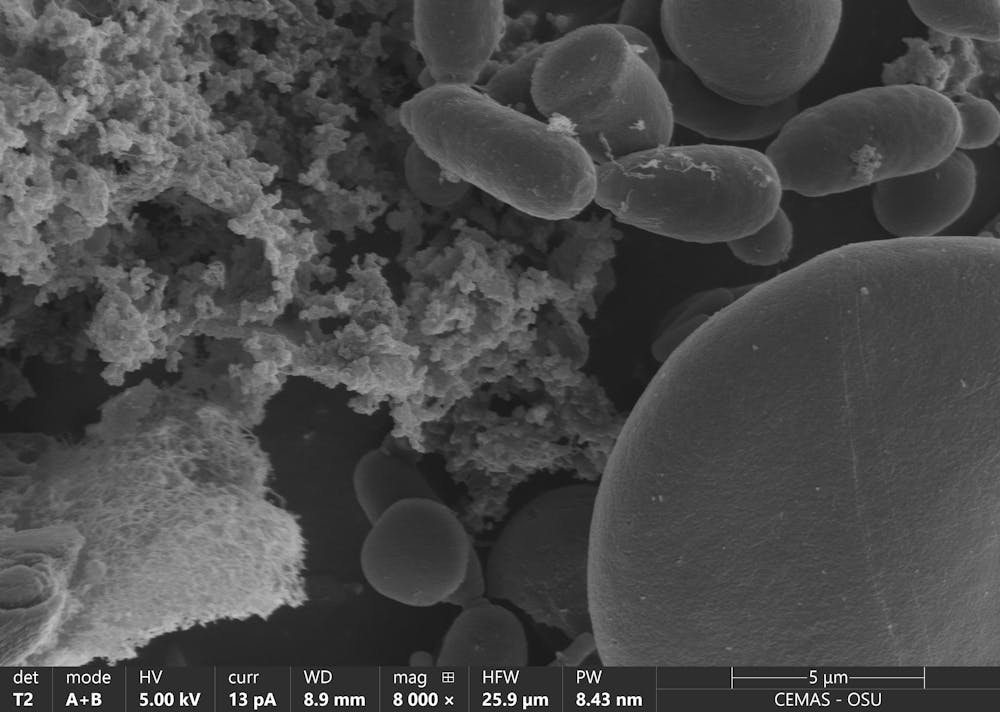
            Microscopy image of rod-shaped bacteria, elongated and spherical yeast, and globular starch grains

 Each sourdough starter has a unique mix of microbes. Daniel Veghte, CC BY-SA


Scanning electron microscopes

Scanning electron microscopy, or SEM, is a powerful tool that can image the surface of samples at the nanometer scale. For comparison, a human hair is between 10 to 150 micrometers, and SEM can observe features that are 10,000 times smaller.

Since SEM uses electrons instead of light for imaging, there are limitations to what can be imaged in the microscope. Samples must be electrically conductive and able to withstand the very low pressures in a vacuum. Low-pressure environments are generally unfavorable for microbes, since these conditions will cause the water in cells to evaporate, deforming their structure.

To prepare samples for SEM analysis, researchers use a method called critical point drying that carefully dries the sample to reduce unwanted artifacts and preserve fine details. The sample is then coated with a thin layer of iridium metal to make it conductive.

            Round metal disk on a platform surrounded by a large cylindrical device

Scanning electron microscopes can image samples at the nanoscale level. Daniel Veghte, CC BY-SA


Exploring a sourdough starter

Since sourdough starters are created from wild yeast and bacteria in the flour, it creates a favorable environment for many types of microbes to flourish. There can be more than 20 different species of yeast and 50 different species of bacteria in a sourdough starter. The most robust become the dominant species.

You can visually observe the microbial complexity of sourdough starter by imaging the different components that vary in size and morphology, including yeast and bacteria. However, a full understanding of all the diversity present in the starter would require a complete gene sequencing.

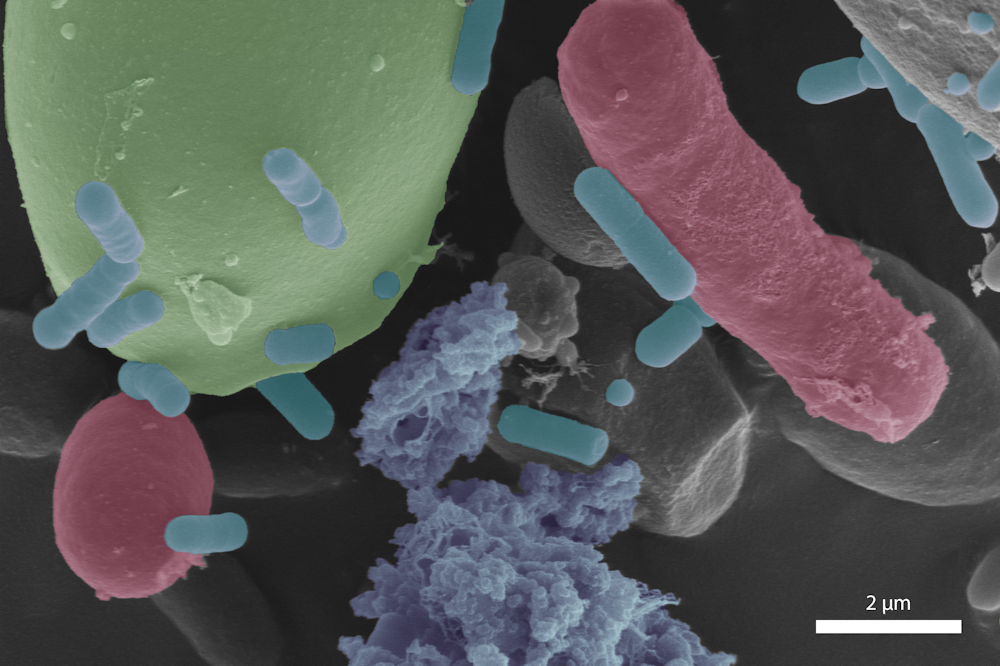
The main component that gives the starter texture are starch grains from the flour. These grains, colored green in the image, are identifiable as relatively large globular structures approximately 8 micrometers in diameter.

            Microscopy image of rod-shaped bacteria, elongated and spherical yeast, and globular starch grains

A false-colored scanning electron microscope image of a sourdough starter shows starch grains (green), yeast (red) and bacteria (blue). Daniel Veghte, CC BY-SA


Giving rise to the starter is the yeast, colored red. As the yeast grows, it ferments sugars from the starch grains and releases carbon dioxide bubbles and alcohol as byproducts that make the dough rise. Yeast generally falls in the range of 2 to 10 micrometers in size and are round to elongated in shape. There are two distinct yeast types visible in this image, one that is nearly round, at the bottom left, and another that is elongated, at the top right.

Bacteria, colored blue, metabolize sugars and release byproducts such as lactic acid and acetic acid. These byproducts act as a preservative and are what give the starter its distinctive sour smell and taste. In this image, bacteria have pill-like shapes that are approximately 2 micrometers in size.

Now, the next time you eat sourdough bread or sourdough waffles – try them, they're delicious! – you can visualize the rich array of microorganisms that give each piece its distinctive flavor.


Daniel Veghte, Senior Research Associate Engineer, The Ohio State University


This article is republished from The Conversation under a Creative Commons license. Read the original article.

“The truth is incriminating”: Prosecutors get direct messages from former Trump lawyer Ken Chesebro

The Michigan prosecutors investigating efforts to subvert the 2020 election recently obtained hundreds of messages from pro-Trump lawyer Kenneth Chesebro's online accounts, CNN reported Tuesday, including direct messages from an account he had been using anonymously on X. Chesebro played in instrumental role in promoting the "fake electors" scheme in 2020, under which Trump partisans were to pose as their state's legitimate delegation to the Electoral College. 

Prosecutors had issued warrants to Google and X requesting the messages. Michigan Attorney General Dana Nessell last year charged 16 people in connection with the fake-elector scheme, although Chesebro himself is not one of them.

The documents obtained by Michigan prosecutors show that Chesebro unsuccessfully tried to convince several pro-Trump figures into going to Washington, DC to watch his “fake electors” strategy unfold on January 6, 2021. 

Chesebro offered to pay for the individuals he reached out to, including their airfare and lodging at Trump’s DC hotel. Individuals like former Milwaukee County Sheriff David Clarke, and his wife, along with the founder of conspiracy website Gateway Pundit, Jim Hoft. There are no current records that show they accepted his offers. 

The direct messages also exposed Chesebro's relentless outreach to conservative pundits and right-wing figures after Trump lost the 2020 election. He would push them to publicly promote his theories for how to subvert the Electoral College process. 

He appeared to provide Hoft unsolicited advice on how to frame Gateway Pundit’s coverage of the January 6 certification proceedings in Congress. “It would help to publicize that if Pence claims the power to resolve disputes about the electoral votes on Jan. 6, he’d simply be doing what Jefferson did,” read Chesebro’s message to Hoft on December 27, 2020 on X.

Chesebro denied the existence of his secret X account when he met with Nessel’s investigators in December. In fact, he used the accountto send 160 messages between 2014 and 2021, according to the files that X provided investigators.

Legal observers said the messages show the true gravity of the fake-elector plot.

"The content of Chesebro's DMs shows (once again) he pursued the false electors-Pence scheme loooooong after litigation was exhausted," Law Professor at NYU, Ryan Goodman posted on X. "Recall Chesebro also told prosecutors his plan was contingent on litigation succeeding. A false statement. The truth is incriminating."

The trouble with Trump polls

Up and down and around and around and up and down we go, and where we’ll stop nobody knows!  That’s not me talking; it’s not even a carnival barker. It’s the polling this year on the presidential race. Let’s leave aside for the moment that there are six months until Election Day, and as the pundits echo every time a new poll is released, a lot can happen.

For example:

An American military “adviser” to the Ukrainian army — we have an unknown number over there that nobody talks about — could be captured by the Russian army or kidnapped by Russian sympathizers within Ukraine and hauled off to Moscow and slammed into Lubyanka as a spy. I’ll give you three guesses how much of a cluster that would generate.

Russia could make a deep incursion through Ukrainian lines and threaten Kyiv, putting pressure on NATO nations, including the U.S., to get involved to save Ukraine from being overrun by Putin’s army.

In Israel, a deal brokered by Biden and Secretary of State Antony Blinken could achieve the return of all hostages held by Hamas in Gaza, an end to hostilities and a massive U.N. aid effort overseen jointly by the U.S. and Israel to feed, house and provide medical care to Gaza refugees, as well as to start negotiations for a Palestinian state.

Biden could shut down the border with Mexico and suspend all applications for amnesty, taking the border issue off the table as a scream-generator for Donald Trump at his rallies.

Trump could be found guilty at the Stormy Daniels payoff trial in New York and be sentenced to a suspended prison term pending appeal.

The Supreme Court, in a narrow 5-4 vote in June, could create a firestorm by declaring Trump has immunity from prosecution for official acts while in office, scrambling his indictments in Washington, D.C., and Florida and delaying both trials until new charges could be sorted out in both cases — but certainly beyond election day in November.

Either Biden or Trump could suffer a campaign-ending health event, throwing the whole election into a spiral of panic and doubt.

If one or more of these scenarios comes to pass, we’ll gaze back on the polling of late April as if it were a rain shower that threatened and then blew over. Take the Times/Siena polls of March and April. You remember the panic of the March 2 poll showing Trump ahead of Biden by 48 to 43 percent among registered voters, don’t you? Then, on April 13, Biden recovered with Times/Siena result that was basically dead even: Trump 46, Biden 45. What happened to improve Biden’s numbers? Who knows? Last Sunday, a CNN poll had Trump leading by 49 to 43 percent, and this time CNN had a theory, finding “most Americans saying that, looking back, Trump’s term as president was a success, while a broad majority says Biden’s has so far been a failure.”

Throw old gravel-guts Robert F. Kennedy Jr. into the mix, and the polling stays just as screwed up. Last week, a Marist College poll showed Biden leading Trump, 51 to 48 in a head-to-head election. But when you add Kennedy, Green Party Putin stand-in Jill Stein, and egomaniacal independent Cornel West into the mix, Biden’s lead over Trump jumps to five points. That was last Monday.

Seven days later, it’s oops: In a Harvard CAPS-Harris three-way-race poll released on Monday, Trump leads Biden by 44 to 38 percent, with 12 percent voting to send their kids to school sick by supporting Kennedy and 5 percent with no clue what they want. The Harvard poll also asked why people want Trump over Biden and found that it's “based on the simplest of reasons — America thinks Donald Trump did a better job as president and so are willing to vote him back into office.” Can’t forget to poll for the “duh” vote, because with the internet, everybody is entitled to their own opinion and their own facts, right?

We need your help to stay independent

We could throw some typical punditology in there, that Democrats and the Biden campaign “have to do a better job” reminding voters of Trump’s disastrous handling of COVID — over a million dead, remember, folks? — and his equally disastrous economy. But why bother? Some poll is going to find that RFK Jr. is either surging or falling, Biden is going to bounce up three points, Trump will be caught drooling on his tie in court and he’ll go down a few. Or maybe not. There could be a "nappers' rights" vote out there we haven’t heard from yet.

The trouble with polling in the current political environment is that the pollsters don’t want to admit that the American public has no bottom. There’s no opinion too far out that a significant percentage can’t be found to proudly espouse it. I saw a video of interviews done at a Trump rally recently, and it went downhill from the Comet Pizza joint basement pedophile ring right into the JFK Jr. rapture zone. 

Polling outfits aren’t admitting to themselves or to us that their results are permanently skewed by Fox News and what we might call the Bannon Industrial Complex online. What we need — and we need it right now, today — is a poll that explores the edges of the “thinking” of the American electorate. Pew or Marist or one of those outfits should sit down and come up with a list of questions that might reveal the real answer behind the Trump-Biden results they’re getting. How many believe the moon landing was faked? Raise your hands! How about a poll question on the whole pedophiles-are-running-the-world thing, or a question probing the reaches of the American opinion on who controls “international banking.” 

I’ll give you two guesses what the numbers would be on that one.

“Sending a message”: Judge threatens Trump with “incarceratory punishment” for violating gag order

Former President Donald Trump got out of Tuesday's contempt hearing with just a $9,000 fine for what Judge Juan Merchan ruled were violations of his gag order, but the Republican criminal defendant was also warned that he could spend time behind bars if he doesn't start behaving.

Trump, on trial over allegations he falsified business records to cover up pre-election hush payments, has repeatedly defied the gag order in his Manhattan case, posting Truth Social attacks on witnesses including Michael Cohen and Stormy Daniels. At a hearing earlier this month, his lawyer, Todd Blanche, tried to argue that such attacks were merely political speech, a claim that prompted the judge to tell him he was "losing all credibility" with the court.

At Tuesday morning's hearing, Judge Merchan found that Trump had violated his gag order no fewer than nine times, fining him $1,000 for each violation, the maximum allowed under law, NBC News reported. But the judge also said he's keeping open the possibility of a harsher punishment down the line, aware that monetary damages might not mean a whole lot to a wealth defendant.

According to Merchan, "if necessary and appropriate under the circumstances," Trump could be slapped with "an incarceratory punishment."

However, while reiterating the court's prohibition on attacking witnesses and jurors, generally, CNN legal analyst Karen Friedman Agnifilo said the judge did say Trump is allowed to defend himself if he is attacked first. "So he's almost sending a message in here as well, saying, 'Look, if it turns out that other people are using this gag order as a way to attack you, you can attack back,'" she commented.

“Continually losing”: Experts say Trump’s pressure on lawyer to be aggressive is badly backfiring

If Donald Trump believed he was likely to emerge victorious from the first ever criminal case involving a former president, chances are he would not be attacking his judge, his judge’s daughter or the jurors that will decide his fate. But perhaps all the Truth Social rage-posting is just for public consumption, the all-hours missives signaling his disdain for the process and a courtroom that’s too damn cold.

Well, probably not: If Trump were confident that he remains above the law, he would not also be privately raging against his own lawyer. As The New York Times reported Tuesday, the former president has been doing so since just about the start of his hush-money trial, suggesting he’s none too confident about the verdict expected in May.

Todd Blanche, the lawyer in question, quit his previous firm to represent the 77-year-old Republican. And he has at times seemed to behave just as the former president would like, refusing to back down in the face of case law and a plain reading of Judge Juan Merchan’s gag order, asserting at a contempt hearing this month that there’s nothing wrong with posting broadsides against witnesses.

But being the swaggering attorney that Trump seems to want – Blanche has also insisted that the loser of the 2020 election continue to be referred to as “President Trump” — has also made him lose face, his client watching as Judge Merchan told Blanche he was “losing all credibility” with the court. Trump was also there Tuesday morning to see that Blanche’s credibility-straining defense didn’t stop him from being found in contempt.

According to the Times, in recent weeks “the former president has complained repeatedly about him,” complaining that he “has not been following his instructions closely, and has been insufficiently aggressive.”

It doesn’t help that Blanche has sought to tamp down on Trump’s own misbehavior. In the trial’s first week, NBC News reported that Trump was “openly flouting” a courtroom prohibition on using his phone. “Blanche just told him to stop and Trump tucked the phone in his pocket while looking annoyed.”

Observers have noted that Blanche has enjoyed a reduced role as the trial has gone on. Last week, it was one of Trump’s other attorneys, Emil Bove, who led the cross-examination of former National Enquirer publisher David Pecker. That itself isn’t necessarily unusual – Trump has a small team of lawyers, and Blanche remains a big, visible part of it – but The Guardian’s Hugo Lowell commented that the timing is noticeable, coming not just after a contempt hearing that went badly but an opening statement that was riddled with sustained objections.

We need your help to stay independent

“That wasn’t a great look in front of Trump,” Lowell said in an appearance on MSNBC. Since the contempt hearing, “Blanche has taken a backseat,” he noted, possibly of Blanche’s own choosing. “I wonder if part of that is because he wants to reduce the visibility that he has in front of the judge and continually losing things in front of the judge, in front of Trump,” he said.

Lowell contrasted that with Trump’s classified documents case in Florida, where Blanche is also representing him. There, he said, Trump and Blanche “are always laughing and joking and passing notes,” a commentary, perhaps, on how that case, before the Trump-appointed Judge Aileen Cannon, is proceeding more to the former president’s liking.

The problem for Blanche is that Trump wants a Roy Cohn, referring to his former attorney who also represented mob bosses, but does not respect anyone who could actually serve that role, according to Harry Litman, a former federal prosecutor. "Even when a mob boss is under indictment and goes to see his Roy Cohn, Roy Cohn says, ’Shut up and listen to me now. I know what needs to happen,'" Litman told MSNBC. "They can’t do that with Trump.”

The question going forward is whether Blanche, himself a former federal prosecutor, focuses on pleasing his client in the near term – by indulging his rage with courtroom diatribes of his own, for example – or seeks, whatever the odds against him, to control Trump's outbursts and focus on making a good impression before jurors, at the possible cost of looking weak before the one man who may or may not pay his legal bills.

Ty Cobb, a lawyer who worked for the Trump White House, previously told Reuters that it’s not easy to represent the former president. He urged Blanche to remain aware of legal ethics – other Trump attorneys, like John Eastman and Rudy Giuliani, have been disciplined for running afoul of them – and to avoid falling prey to Trump’s “base desires.”

“The real challenge for him,” Cobb said, “is how to do this without losing his dignity and reputation.”

Pro-Palestine protesters take over campus building at Columbia University

After weeks of protests on Columbia University’s campus, including walk outs and encampments, tensions escalated early Tuesday morning after protesters took over a building on campus.

The building, Hamilton Hall, was occupied by about three dozen protestors shortly after demonstrators marched around the Columbia campus to chants of “Free Palestine.” Hours earlier, university administrators had begun to suspend students who refused to leave a protest encampment.

In a statement, the student group "Columbia University Apartheid Divest" said that Hamilton Hall, which has a history of student protest, had been taken over by an “autonomous group” of  “Columbia community members.” The organization said the protesters plan to stay in the building until the university stops investing in companies that do business in Israel.

These protests have garnered international attention, only growing after police crackdowns. Republicans have opted to further exacerbate the situation, demanding that drastic measures be taken by Columbia University and even urging President Joe Biden to deploy the National Guard.

Columbia administrators have closed the school's campus to all but students who live in its seven dorms and employees who provide essential services. The only open entry point to the campus as of Tuesday morning is the gate at 116th and Amsterdam Avenue. Meanwhile, news reporters seem to outnumber students outside Columbia’s gates, The New York Times reported.

Texas GOP and UT-Austin leaders shift from championing free speech to policing protester intentions

Sign up for The Brief, The Texas Tribune’s daily newsletter that keeps readers up to speed on the most essential Texas news.


Four years ago, as Texas Republicans worried that conservative voices were being silenced at universities, Gov. Greg Abbott signed a bill that enshrined new free speech protections on campuses.

“Some colleges are banning free speech on college campuses. Well, no more because I'm about to sign a law that protects free speech on college campuses in Texas,” Abbott said in 2019.

And six months ago, during a celebration of Free Speech Week, University of Texas at Austin administrators touted the school’s expansive protections for free speech on campus — including speech that was anti-war or considered hate speech.

[Dozens more arrested at UT-Austin as police use pepper spray, flash bangs to break up protests]

“Hate speech is not a category of speech the government can restrict,” Amanda Cochran-McCall, the university’s vice president for legal affairs, said at a school-affiliated Free Speech Week in October. “Imagine if the government at the whim of a political party could just decide at any time what constitutes hate speech, and then just start arresting people for engaging in it.”

But since last week, Abbott has deployed the Department of Public Safety to help crack down on separate protests at the University of Texas at Austin that he vociferously disagreed with. Campus leaders have defended their orders to students to disperse or face criminal trespassing charges.

As state troopers pushed students to the ground with black batons, Abbott cheered the arrests.

“Students joining in hate-filled, antisemitic protests at any public college or university in Texas should be expelled,” he said Wednesday on social media platform X.

In Texas and across the country, pro-Palestinian demonstrations in response to the Israel-Hamas war have put state and university leaders’ prior free speech commitments to the test. UT-Austin’s heavy-handed response to the protests — and the state GOP leaders’ support of the arrests — are a stark contrast to their vigorous celebration and defense of protected speech in previous years.

“The big irony here is that the political right has been for years and years and years criticizing campuses for not enabling enough free speech,” said Kevin McClure, a professor of higher education at the University of North Carolina Wilmington. “And now they are vociferously arguing in favor of repressing students’ free speech rights.”

[Here’s what the law says about protesting on Texas college campuses]

UT-Austin officials have said they had reason to believe that protest organizers planned to take over school spaces, like pro-Palestinian demonstrators have done at other campuses across the country. But free speech advocates wonder whether those fears were enough to crack down on protesters, raising questions about when speech is protected in Texas universities — and who gets to enjoy those protections.

“What we're seeing here is this hypocrisy of big double standards saying we love free speech, not this speech,” said Alex Morey, the director of campus rights advocacy at the Foundation for Individual Rights and Expression.

Rules and protections

Tensions at the UT-Austin campus come five years after Texas Republicans banded together around a new law to boost free speech protections at Texas universities.

The law established all common outdoor areas at public universities as traditional public forums, allowing anyone — not just students — to exercise free speech there. It also prevented universities from considering “any anticipated controversy related to the event” when approving guest speakers on campus.

“Students might be surprised to know that free speech also includes other things, though, things like the right not to speak or the right to wear an item in protest of war or to use strong — even offensive words and phrases — to convey political messages,” Cochran-McCall said at last year’s Free Speech Week.

On the morning after last week’s campus arrests, UT-Austin staff taped “NOTICE” flyers in front of the school’s tower with a notably different tone. Instead of highlighting what was permitted, the flyers detailed the university’s litany of limitations for protests: no masks, no disguises, no encampments, no loud sounds that interfere with learning and no blocking entrances.

Texas universities have the right to create “reasonable time, place and manner” restrictions on free speech activities. When those rules are violated, universities can discipline students, said Steven McGuire, who specializes in campus freedoms at the American Council of Trustees and Alumni.

Free speech also loses First Amendment protections when it amounts to discriminatory harassment or true threats that incite imminent violence or destruction of public property.

Last week’s protest showed no signs of violence before police got involved. Authorities interrupted the students’ march within an hour, forming a barricade at the front of the crowd with their bikes. The officers used loudspeakers to warn students to disperse or face criminal trespassing charges. In total, 57 protesters were arrested. The Travis County attorney’s office dropped all criminal trespass charges against Wednesday’s protesters because they did not find probable cause. DPS is pursuing felony assault charges against one journalist who was covering last week's protest.

On Monday, law enforcement officers made dozens of arrests again, this time after about 60 protesters formed encampments. Officers used pepper spray and flash-bang explosives to dispel the crowd of demonstrators.

Free speech experts say the university is within its rights to order the arrests of protesters who set up encampments, but they question whether last week’s protest, where authorities got involved early and before any major disruptions, crossed any lines.

UT-Austin President Jay Hartzell’s explanation of the university’s response and the police crackdown last week seemed at odds with the protections the university has previously touted.

In his email to the community last week, Hartzell said he had “credible indications” that the organizers of Wednesday’s protest were “trying to follow the pattern we see elsewhere, using the apparatus of free speech and expression to severely disrupt a campus for a long period.”

Across the state and around the country, pro-Palestinian demonstrations have erupted on college campuses. At Columbia University, administrators called New York Police Department to empty a campus encampment of pro-Palestinian demonstrators, which resulted in the arrest of more than 100 people.

[Campuses across Texas had pro-Palestinian demonstrations. Why did only UT-Austin crack down?]

In an April 25 email obtained by The Texas Tribune — addressed to fundraising staff who would be getting questions from donors about the university’s response — administrators described the intel they had. They mentioned social media postings that used identical language compared to protest organizers at Columbia University and other schools, as well as a concern that a non-UT affiliated group known as the Students for Justice in Palestine had a role in organizing the walkout.

Ahead of last week’s demonstration, organizers never indicated in public communications that they intended to stay past the university’s 10 p.m. curfew, incite violence or start encampments. Instead, in an Instagram post, organizers spoke of teach-ins on the South Lawn, an art workshop and a pizza break, according to an Instagram post from the organizing group.

[Faculty petition to hold no-confidence vote in UT-Austin president after protest response]

Though it’s standard for a few officers to be present to manage a sizable peaceful protest like the Wednesday walkout, free speech experts condemned the phalanx of law enforcement that descended on the campus when there was no indication of violence.

Preventing unlawful assembly, as DPS described the governor’s instructions, is a slippery slope that can lead to preventing assembly altogether, free speech experts said.

“Students that are demonstrating and doing so peacefully being arrested so quickly for trespassing does set up a dangerous precedent,” McClure said.

In explaining why law enforcement was called, UT-Austin spokesperson Brian Davis on Wednesday said student protesters had violated their “no masks” rule for demonstrations.

But Savannah Kumar, an attorney with ACLU of Texas, questioned whether a rule prohibiting face masks is enough to trump free speech protections. Immunocompromised students may have reasons to wear face masks. And rules should not dissuade or discourage people from exercising free speech, she said.

McClure said he expects legal challenges will follow the law enforcement response to Wednesday’s protest.

The question of hate speech

Abbott’s criticism of the protest came weeks after he issued an executive order requiring schools to revise their free speech policies to punish what he described as “the sharp rise in antisemitic speech and acts on university campuses.” He singled out groups like Palestine Solidarity Committee, which organized last week’s protest, as potential violators. He did not give examples of how the group may have engaged in antisemitic speech.

Pro-Palestinian demonstrators have faced similar accusations elsewhere. Earlier this month at Columbia University, protesters drew condemnation after some Jewish students reported feeling unsafe and harassed. Some protesters who appeared to be unaffiliated with the university verbally attacked Jewish students with antisemitic remarks, The New York Times reported. President Joe Biden denounced antisemitism on campuses amid the protests, calling it “reprehensible and dangerous.”

But while Texas’ political leaders have linked pro-Palestinian views with antisemitism, a peaceful pro-Palestinian demonstration shouldn’t be considered discriminatory harrassment, Morey said.

“Someone peacefully protesting and saying, ‘From the river to the sea,’ is not going to be severe, pervasive [or] objectively offensive, such that Jewish students who are offended by that speech are going to be unable to go to class,” Morey said. “It's not going to hit discriminatory harassment, just because Governor Abbott calls it hate speech or calls it antisemitic. ”

“From the river to the sea” is a common chant at pro-Palestinian demonstrations, alluding to the stretch of land from the Jordan River on the eastern flank of Israel and the occupied West Bank to the Mediterranean sea to the west. Pro-Palestinian activists say it’s a call for peace and equality in the Middle East. The American Jewish Committee has described it as an antisemitic “call-to-arms.

“There is of course nothing antisemitic about advocating for Palestinians to have their own state,” the AJC says on its website. “However, calling for the elimination of the Jewish state, praising Hamas or other entities who call for Israel’s destruction, or suggesting that the Jews alone do not have the right to self-determination, is antisemitic.”

Former U.S. Rep. Justin Amash, a Republican from Michigan, last week also commented on how Abbott’s comments about arresting students for hate speech violated their constitutional rights to freedom of speech.

“If he’s arresting them for other reasons, then he should say so,” Amash said. “If he’s arresting them for their speech, then he’s violating the law, and his actions threaten everyone in the state, including everyone he claims to be protecting.”

Morey, of the Foundation for Individual Rights and Expression, said Abbott had engaged in clear "viewpoint discrimination” on Wednesday when he ordered state troopers to get involved in the UT-Austin protest.

“This was shocking. We have never seen anything quite like this where a governor is saying I'm going to preempt protests based on these views,” Morey said. “It sure seems like he is taking real liberties with the letter of the law because he personally, and maybe other folks that are affiliated with him in Texas government, find that speech objectionable.”


Reporters Will Melhado and Pooja Salhotra contributed to this story.

The Texas Tribune partners with Open Campus on higher education coverage.

Disclosure: New York Times and University of Texas at Austin have been financial supporters of The Texas Tribune, a nonprofit, nonpartisan news organization that is funded in part by donations from members, foundations and corporate sponsors. Financial supporters play no role in the Tribune's journalism. Find a complete list of them here.


Tickets are on sale now for the 2024 Texas Tribune Festival, happening in downtown Austin Sept. 5-7. Get your TribFest tickets before May 1 and save big!

This article originally appeared in The Texas Tribune at https://www.texastribune.org/2024/04/29/ut-austin-pro-palestinian-demonstrations-free-speech/.

The Texas Tribune is a member-supported, nonpartisan newsroom informing and engaging Texans on state politics and policy. Learn more at texastribune.org.

Outside Donald Trump’s N.Y. trial, “Line Dudes” wait all night

In the pre-dawn hours before opening statements in the People of the State of New York vs. Donald Trump, Robert Samuel was standing in line outside 100 Centre Street, the county criminal courts building in Lower Manhattan.

Samuel was holding a place in line for one or another of the credentialed journalists seeking access to the courtroom and overflow room. He was one of 22 men working Trump's hush-money trial that day for the niche company he founded 12 years ago, Same Ole Line Dudes.

As the historic Trump proceeding enters its third week, Samuel is starting to accept orders for seats reserved for the general public, who must form a separate line outside the courthouse.

This business model came to Samuel after he lost his job with AT&T for chronically showing up late, he said. Having sold iPhones, he knew that devotees would eagerly queue outside the Apple Store overnight to purchase the latest models on release day. In September 2012, someone paid him $100 to wait in line for the iPhone 5. He sold two additional spots in line that night and ended up with enough cash to buy a new smartphone for himself.

"I have the box still, as a memento,” he said.

Samuel, who is 48, stands 6-foot-5 and makes an imposing figure in line. Last Monday morning, with temperatures in the low 40s, he and his fellow Line Dudes were wearing black wool hats with the company logo embroidered in bright yellow.

“It grew from me doing it by myself, and then when I realized that there was a demand, I started pulling in the people closest to me, my friends and family,” Samuel said. “New York is this rich, fertile ground — things to see, things to do, things to buy, experience, taste.” 

Line Dudes has held spaces for Brooklyn pizza, ramen burgers, rainbow bagels and cronut pastries, PlayStation games and sample sales at fashion houses.

“Sometimes I succumb to going in and purchasing for myself, which is a bad habit," Samuel said.

He has stood in line for ticket-holding fans at Beyoncé, Taylor Swift and Harry Styles concerts, hoping to grab general admission spots closest to the stage. 

“The K-pop fans love us,” he said.


Want a daily wrap-up of all the news and commentary Salon has to offer? Subscribe to our morning newsletter, Crash Course.


Samuel has also been hired to secure seats for Broadway shows at the TKTS booth in Times Square or at theater box offices, waiting in line for rush tickets or last-minute cancellations. Sometimes that has yielded the perk of an extra ticket.

“I saw 'Hamilton' 11 times,” Samuel said. "Six of those times with the original cast."

He also got to see the 2019 Shakespeare in the Park production of "Much Ado About Nothing" — those tickets are free, but handed out either by lottery or to folks who wait in line. “One of the benefits of doing this is that it exposes me to stuff that wouldn't be on my radar,” Samuel said. “It always amazes me when people hire us to wait for free things.”

Line Dudes has previous experience with high-profile trials in Manhattan — for example the 2021 trial of Ghislaine Maxwell, convicted for her role in Jeffrey Epstein’s sex-trafficking ring, last fall's trial of cryptocurrency fraudster Sam Bankman-Fried, and E. Jean Carroll’s two civil suits against Trump for sexual assault and defamation.

Samuel said his company had "built up a good rapport with media agencies. We're the go-to when they don't want their reporters standing in line.”

Trump trials have definitely been good for business. With courtroom and overflow room space sharply limited, Samuel charges media organizations $50 an hour, twice his regular rate, to hold a place for the current hush-money trial line. That line begins forming shortly after midnight for days the court is in session. 

“This is such a high-profile type of assignment," Samuel said. "You run the risk of, you know, coming in contact with protesters and supporters, so we charge a premium."

Trump trials have definitely been good for Line Dudes' business. With courtroom and overflow room space limited, Samuel charges media organizations $50 an hour, twice his regular rate.

During the long hours before dawn, his employees try to get some rest in folding chairs. “You get paid for going to sleep,” Samuel said. “It's mostly men that work with me. It's ‘line dudes,’ not to be sexist. It wasn't done like that intentionally. We do have women that do this as well.”

Spending the night on the streets of New York involves some risk. “We had a gun exposed to us once in the line for a Justin Timberlake release,” Samuel said. “We have a general policy that we don't get confrontational. When people skip [the line], we try to hold our ground as much as reasonably possible without letting it escalate.”

There isn't much need for line-holding calls when new iPhone models are released, Samuel said. “Everything is mostly online and pre-order. So we lost. That was our Christmas.”

But the business has expanded nonetheless. Line Dudes has started taking bookings in Washington, D.C., as well. “We go only for Trump," Samuel said. "We've only branched out as a result of his trials. So I guess I can say thank you for that.”

Kristi Noem doubled down on dog-killing to win over MAGA — now her story is backfiring in her face

Squint hard enough and perhaps one can see how Gov. Kristi Noem, R-S.D., thought it was a winning political move to brag about murdering a puppy. It's the same trolling strategy used by MAGA Republicans like Donald Trump, Rep. Marjorie Taylor Greene of Georgia and Sen. Ted Cruz of Texas: Say something extremely evil, stupid, or both. Draw the inevitable liberal outrage or mockery. Play the victim, claiming that it's more proof the "elites" hate the common sense working folk of MAGA. Then sit back and watch the dollars and followers roll in. 

For Noem, however, her tale of shooting her dog Cricket is not working out quite as planned. Sure, she got the predictable outrage and disgust from Democrats. But she also seems to have alienated the very Trump supporters she was trying to impress with her bloodthirsty tale. Fox News let their displeasure be known by doing a round-up story of conservative social media influencers denouncing Noem, often with quite harsh language. "Did she just intentionally end her career?" asked trollish podcaster Tim Poole. Other high-profile right-wingers blasted Noem as an "Absolute Psycho" and called for her to be "criminally charged for animal abuse." Even the notorious right-wing troll Catturd — who has 2.4 million Twitter followers because he acts as vile as his name suggests — drew a line at killing your child's beloved pet. 

Noem, however, still seems to think she can win over Republican voters by doubling and tripling down on her tale of executing a 14-month-old Wirehaired Pointer because it got confused and killed some chickens, instead of the pheasants she was training it to hunt. On Friday, she bragged about "the media gasping" at her "politically INcorrect" dog murder while hawking her new book. By Sunday she seemed to grasp that even Republicans were grossed out. She released a longer statement, trying to recast her choice as "hard and painful," claiming, "I have never passed on my responsibilities to anyone else to handle." 

This, too, is unlikely to work, for one simple reason: Noem forgot the first rule of fascist Fight Club – you never show your true face to outsiders.


Want more Amanda Marcotte on politics? Subscribe to her newsletter Standing Room Only.


Noem was right that her story perfectly illustrates the sadistic ethos of the MAGA movement. Killing a dog for being inconvenient follows the same logic as forcing women to give birth or shooting Black Lives Matter protesters or setting up concentration camps to imprison refugees from Central America. (All policy ideas Trump has proposed or enacted.) In every case, the MAGA view is straightforward: absolute submission from those deemed "lesser" than you, or maximum punishment. 

A reminder to the rest of MAGA: Always pretend your malice serves a higher cause. 

Where Noem failed, however, is in saying the quiet part out loud. Most fascists, including Trump, understand that you don't just come out and say that you embrace violence against those who can't fight back. Instead, the MAGA trick is to reframe your intended victims as a threat, so you can pretend your cruelty is self-defense. The scared migrants fleeing political violence are recast as "invaders" coming to rape and murder Americans. The teen rape victim is reimagined as a murderous trollop who loves to kill babies. LGBTQ people who want rights are accused of being "groomers." Protesters being beaten up by police are accused of being dangerous "thugs." And so on. 

Trump, of course, is all about this victim-posturing to justify violence. His rallies have morphed into near-religious celebrations of political violence, complete with celebrating the January 6 insurrectionists as heroes. But Trump always makes sure to frame this violence as self-protection. As Charles Homan of the New York Times Magazine detailed over the weekend, Trump's speeches are stuffed full of warnings about the "radical left" — a group he claims includes President Joe Biden and all Democrats — who "lie and steal and cheat on elections and will do anything possible — they’ll do anything, whether legally or illegally, to destroy America."

This is the classic fascist two-step: Project your own ugly urges onto your intended victims, and redefine your unprovoked violence as "security." It goes back to the Nazis, at least, who never admitted they targeted Jews because they were a small and relatively defenseless minority. Instead, Nazis spread propaganda claiming Jews were engaged in a sprawling conspiracy to destroy German civilization. The Holocaust was rationalized as safeguarding Germany, instead of what it actually was, a genocide. 

Noem isn't totally unaware of how this is supposed to work. She does try to paint her dog, the victim, as "dangerous to anyone she came in contact with." But she fails at demonizing the dead dog. First, she recounts how her kids asked about the dog, suggesting they were not, in fact, afraid of their pet. She then admits that she saw the dog as "less than worthless" and "untrainable," suggesting her real motive was annoyance instead of fear. 

But it's unlikely she could ever put a positive spin on dog murder. It's one thing for right-wing propagandists to paint migrants or LGBTQ people or college professors or leftist protesters as a menace. Their audience has little contact with those people, making it a lot easier to make up stories about how dangerous they are. But dogs? Most people, regardless of party, are quite familiar with dogs. Quite a few have dogs as pets. Most people like dogs, seeing them as sweet animals who just want to please their masters. Most people know that the dog probably only followed her murderer to the gravel pit because, as is the canine habit, she trusted her owner. 

There are definitely some MAGA men who are defending Noem. Unsurprisingly, they come from the small subset of MAGA world that is sick of their community's own victim-tripping and want to move towards a bolder, less apologetic sadism. But while it's more honest to own their desire to crush those who are smaller or more vulnerable for the sheer perverse glee of it, most fascists know it's politically smarter to at least front like you're not a straight-up sociopath.

It was always unlikely that Trump was going to pick Noem for his running mate — he's too misogynist to allow a woman to be in line for the presidency — but even though he no doubt privately thought this was an awesome story, Trump has a sense when someone (other than himself, that is) is just too weird to sell to the public at large. So this likely ends Noem's chances. And it functions as a reminder to the rest of MAGA: Always pretend your malice serves a higher cause.


“Pecker was a partner in crime”: DA “couldn’t have asked for a better narrative” to open Trump trial

Donald Trump is a political pugilist, a very dirty fighter who will do anything to win. In a recent fundraising email, he emphasized that personality trait, telling his MAGA people, “I have always loved you. That’s why I take every single punch to the face and get right back up.” But in the first of his four historic criminal trials, Trump, has, to this point, been on the ropes. He is, so far, being pummeled by the prosecution in Manhattan's hush-money case. 

The first prosecution witness in the trial was David Pecker, the former publisher of the National Enquirer. Pecker testified last week that he knowingly participated in a plot with Donald Trump to conceal the ex-president’s affair with Stormy Daniels (as well as former Playboy model Karen McDougal) from the American people during the 2016 election. Per the prosecution’s argument, this was more than just keeping a secret about a womanizer and noted playboy’s dalliances: It constituted a type of contribution to Trump’s election campaign and deprived the American people of information that may have influenced the outcome of the presidential election.

If Pecker’s testimony is a preview of what is to come in the hush-money trial, matters are only going to become much more difficult for defendant Trump in the days and weeks ahead.

Judge Merchan has also been trying to keep Donald Trump on the ropes by limiting his combative, threatening, and disrespectful behavior. This week Judge Merchan will likely be announcing further restrictions on Trump’s speech and behavior.

Donald Trump may be in trouble now, but it would be a grave error to underestimate his ability to win this first criminal trial (as well as the three upcoming ones) and the 2024 election. As former Republican political consultant Stuart Stevens warned in a recent essay at the New York Times, Trump will most certainly find a way to present these historic criminal trials as an example of “persecution” and a “witch hunt” by the corrupt ex-president’s supposed enemies. Such a narrative will likely mobilize Trump’s MAGA followers and others who distrust “the system.” And even more worrisome for the future of American democracy, early 2024 election polls continue to show that Trump and President Biden are basically tied. To this point, Donald Trump’s criminal peril has not substantially hurt him in the polls.

In an attempt to make better sense of the second week of Donald Trump’s hush-money trial, its implications for the 2024 Election and the larger democracy crisis, and what may happen next, I recently spoke with a range of experts.

Steven Beschloss is a journalist and author of several books, including "The Gunman and His Mother." His website is America, America.

So many pundits were convinced this is not an important trial. Now it could be the only trial before the election, if the Trump-inclined, feet-dragging Supreme Court has its way. Polls suggest that two-thirds of the public think the trial is somewhat or very serious, which makes the impact of a possible victory by the state more significant than many imagined. I’d like to think exposing Trump’s fraudulent strongman persona is one important outcome. His inability to stay awake, his flatulence, and his deflation amid the daily grind of a weeks-long criminal proceeding may not move a single cult member, but it just might change the minds of a sliver of remaining moderate Republicans and currently indifferent Democrats.

"Exposing Trump’s fraudulent strongman persona is one important outcome."

More importantly — as long as the media stops minimizing the trial as a hush-money case and begins more precisely identifying it as an illegal campaign coverup — the mounting evidence of Trump’s falsification of records to deny the voting public awareness of his involvement with Stormy Daniels and Karen McDougal should remind fence-sitting voters of the constant corruption and criminality. So should his continued attacks that violate the gag order, especially if Judge Merchan decides to genuinely hold Trump in contempt. Add to this the disgusting but unsurprising scale of his real role in producing fake news to trash his rivals — and it just might carve off a few more who had normalized Trump’s attacks on our free press.

To be sure, I’m crossing my fingers that this jury will reach a truthful conclusion — giving our country at least one opportunity before the election to look squarely at this man who’s determined to destroy our democracy and regain power by any means necessary.

Matthew Dallek teaches at George Washington University and is the author of “Birchers: How the John Birch Society Radicalized the American Right.”

I’m not a lawyer, but I am impressed by the tabloid nature of David Pecker’s testimony. I wouldn’t have expected it to be tame, but the methodical exposure of the inner workings of “catch and kill” is fascinating and important. That those seeking elective office can conspire with a tabloid publisher to bury stories about themselves and trumpet negative stories about their foes – the baldness of the conspiracy as Pecker describes it – is memorable. Further, Pecker’s testimony shows what those paying attention knew all along: Trump wanted to bury the Stormy Daniels and Karen McDougal stories not to protect his family but to protect his campaign. None of this will hurt him with his “base,” but I struggle to see how this trial helps him with any voter who isn’t sure who to vote for.

The prosecutors seem to be hitting it out of the park. They are painting a riveting picture of a Trump campaign plot to bury negative stories and cover up the payments to Stormy Daniels. It’s hard for me at this point to see the case hinging solely on the credibility of Michael Cohen, and I’m surprised by the thoroughness of the prosecutors’ case so far.

Looking ahead, I’m interested in the ability of the prosecutors to hammer home the idea that the case is ultimately about “election interference.” Can they demonstrate that Trump’s hush-money payments had consequences far beyond Trump’s family life – and affected the presidential campaign itself? I had read so many legal experts saying this was a “meh” case – it wasn’t the right one to bring – but that doesn't seem right. So I’ll be curious to see if it remains, as it has so far, a bigger, more impactful narrative than much punditry implied when charges were announced.

Gregg Barak is an emeritus professor of criminology and criminal justice at Eastern Michigan University and author of "Media, Process, and the Social Construction of Crime" and "Criminology on Trump.” His new book is "Indicting the 45th President: Boss Trump, the GOP, and What We can Do About the Threat to American Democracy."

Unfortunately, I am not “seeing” anything nor is anyone else except for the persons in the courthouse. The fact that it is not being publicly televised is a disservice to the American people who deserve the right to know who the real Donald Trump is. And not only to appreciate his character as a human being but also as a means for each of us to reflect on our own character as human beings. From the lens of a “legal geek” who not only wrote extensively about and did a KOOL FM radio wrap-up twice weekly in Ann Arbor for the nine-month duration of another criminal trial that caught the world’s attention — OJ Simpson — this cannot possibly have the same kind of utility or value as when people tuned in daily to watch on television live or re-broadcast every evening. 

We need your help to stay independent

As for the two trials, there are some similarities of less importance than the dissimilarities that are legalistically quite distinguishing. Both trials involve famous and scandalous defendants, each with plenty of supporters and both with competent legal representation. Each of these criminal trials has a sexual dimension. Besides the scrutiny of the defendants’ personas, both defenses also have their alleged components of prosecutorial prejudice and law enforcement corruption.

Otherwise, the two criminal trials are very different legalistically. OJ’s trial was a garden variety street crime, or a “who done it” double murder. It was simply attempting to prove beyond a reasonable doubt that OJ murdered his ex-wife and her lover. Trump’s white-collar crime is of a different nature altogether. To put it most simply, the question here is not whether or not Trump did what he is accused of doing. Rather, it is about whether what the former president did was to get elected in 2016, and if that is really a crime. 

It is unfolding as I hoped it would and I suspect the trial to be over in less than a month from now. So, in terms of the first week inclusive of the opening statements, the direct, cross-examination, and redirect of the state’s first witness David Pecker it is going swimmingly. I would have been worried had this not been the case. Then again, District Attorney Bragg would not have indicted Trump in the first place unless he had a very strong case. This is not to say that the defense won't raise reasonable doubt in the minds of one or two jurors. 

All and all, the people of New York couldn't have asked for a better narrative than the one we have heard from Pecker. He set the table for the other witnesses to follow and the evidence to come. After Pecker the second witness was a former administrative assistant for 34 years, Rhona Graff, who was on and off the stand with nothing of legal substance to share in less than one hour. She was there primarily as the gatekeeper, recordkeeper and communications person between Trump and pretty much anyone including Stormy Daniels and Karen McDougal.  She was Trump’s texter and emailer and telephoner.

With respect to the witnesses and evidence that will be introduced going forward, the prosecution’s case will simply become one of having its witnesses getting up on the stand and saying yep, yep, and yep to what the prosecutors are asking them and filling in the pieces of how they fit into Trump and Pecker’s fraudulent scheme to corrupt the election.

If it is not obvious, Pecker is not an ordinary witness in this criminal trial like Stormy Daniels or Hope Hicks, or even Michael Cohen. He was Trump’s principal co-conspirator, who only avoided criminal prosecution by cutting a deal to tell the whole truth and nothing but the truth about his illegal contractual arrangement with Trump to save his own skin. This fact has been emphasized by Trump’s lawyers to the jury who understand Pecker was a partner in crime. Nevertheless, Pecker came across as truthful during cross-examination and there were no “gotcha” moments, and no more opportunities to alter his story.


Want a daily wrap-up of all the news and commentary Salon has to offer? Subscribe to our morning newsletter, Crash Course.


I think among my favorite lines from Pecker’s testimony were: “I felt that Donald Trump was my mentor” and “I still consider him a friend.” As a criminologist and a professor, I am thinking that Trump was probably a very good mentor in lawlessness, corruption, and fraud. As for the friendship between Trump and Pecker, I am thinking “thick as thieves” and what more does he know and is not telling us?

I can’t imagine any of the upcoming testimony getting any more significant – perhaps sexier — than what Pecker has already laid out and testified to. For the most part, the rest of the prosecution’s case will pretty much be nothing more than corroboration of their narrative of the crime.

However, we have not yet heard from the defense. Ordinarily, this is where reasonable doubt is manufactured. But while Trump is generally very good at manufacturing something out of nothing, this will not be the case in a court of law. Trump will want the jury to conclude that what he and the tabloid publisher did was “no big thing.” Many people do the same thing. True enough — but not for the purposes of interfering in a presidential election and then covering it up. Todd Blanche’s closing statement, like his opening statement, will want the jurors to conclude that trying to influence the outcome of a presidential election is “just democracy in action.” Good luck with that one.

Finally, as this case goes forward like any other criminal case, I will be looking to see how well prosecutor Matthew Colangelo connects the dots, makes the case and proves, as alleged in his opening statement, that Trump committed “election fraud, pure and simple” and “orchestrated a criminal scheme to corrupt the 2016 presidential election.” Trump then, prosecutors allege, “covered up” his “criminal conspiracy by lying” about it in his New York business records. Look for the prosecution to earn a grade of A.

As for the defense, when neither the facts nor laws are on your side, nonsense doesn’t go very far with a jury — unlike with Trump’s supporters.

Darrin Bell is a Pulitzer Prize-winning editorial cartoonist, creator of the syndicated comic strip Candorville, and author of the graphic novel “The Talk." He is also a contributing cartoonist for the New Yorker.

The Stormy Daniels affair may be the only trial we’ll see before the election. While the porn star hush-money election interference case may be the least important of the major cases against Trump, it’s also the sleaziest and the most pathetic. And maybe that makes it the most appropriate one to go to trial. It’s good to remind ourselves that this sadistic, racist, autocrat-loving, wannabe fascist dictator-for-a-day*, is a tacky, reckless hedonist whose vices make him beholden to others, and whose desperation to save face leads him to commit crimes.

This isn’t a distraction from the Georgia case or the January 6 case or the classified documents case. A conviction here makes convictions in those cases more likely. This sordid hush-money case should remind future juries that the man whose fate they’re considering is a selfish, desperate, and vulgar liar who surrounds himself with people who are just as duplicitous as he is.

Dr. Lance Dodes is a retired assistant clinical professor of psychiatry at Harvard Medical School and a training and supervising analyst emeritus at the Boston Psychoanalytic Society and Institute.

Donald Trump’s claims of absolute immunity for his actions on the basis that this is “for the good of the country” are no more than another sign of malignant narcissism. Claiming that he is acting on behalf of others while actually seeking to benefit himself, and that he is above the same law that applies to others, are not just lies to the public but also portrayals of himself as superior to ordinary people. This self-view is even more clearly shown in his claims that he is being persecuted (by the legal system) “for you”, intentionally describing himself as like Jesus Christ. Selling bibles with his own label is a further effort to link himself to God, attempting to convince people of his grandiosity while at the same time taking their money for his benefit.

In this sense, Mr. Trump’s trial is a test to see if he can be required to live as an equal to others, rather than superior to the rest of humanity.

How squirrels cope with stress: New study may offer climate lessons for humans

Squirrels are found nearly everywhere, and their apparently playful demeanor makes it easy not to notice that their lives can be difficult. That rambunctious behavior we observe both in city parks and in wilderness is because squirrels must spend most of their time either searching for food and — perhaps more importantly — striving not to become food themselves. 

As if that weren't enough, a recent study from the journal Proceedings of the Royal Society B reveals that human activity, particularly climate change and habitat destruction, is making squirrels' lives significantly harder.

Scientists studied 1,144 wild North American red squirrels in the Canadian province of Yukon, creating a weighted early-life adversity index that analyzed six different negative events that squirrels might experience in youth and comparing that to their adult lifespans. They found that greater trauma in a squirrel's early life predicted shorter lifespans in both males and females. In one study, this negative effect was offset by naturally occurring food booms in a squirrel's second year of life, but subsequent experiments did not replicate that pattern. This suggests that the damaging consequences of early life trauma can sometimes be overcome or balanced out by subsequent success — in squirrel terms, and likely in human terms too — but that there's no surefire way to accomplish that.

"We know from studies on other animals, including humans, that difficult experiences during early development can have lasting consequences for individual health and survival," said Lauren Petrullo, lead author of the paper and a professor at the University of Arizona's Department of Ecology and Environmental Biology. Petrullo added that the new study "extends this understanding in two main ways." First, by demonstrating that different types of early-life experiences — such as food deprivation, increased temperatures or an abundance of predators — impact the squirrels in various ways, with some taking more of a toll on their lifespan than others. Secondly, even though squirrels' lives can be hindered by bad early-life conditions, these effects do not have to be permanent.

"If their future environment is really, really good," and if they experience the aforementioned "food boom," Petrullo said, "that essentially cancels out those negative effects of a harsh developmental environment." That finding "is particularly noteworthy," she added, "because we currently do not understand why some individuals seem to be very sensitive and vulnerable to early-life challenges" while others are much less so. "Our findings show that those kinds of differences can actually be explained in part by differences in the quality of an individual's future environment — which I think is an optimistic way to think about early-life struggles."


Want more health and science stories in your inbox? Subscribe to Salon's weekly newsletter Lab Notes.

Yet one adverse environmental condition faced by squirrels and all other species on our planet is unlikely to improve, at least not until humans figure out how to limit and reduce emissions of greenhouse gases: climate change.

Many of the "strongest forms of early-life adversity for young red squirrels" in the study population, said Petrullo, "were environmental factors like the availability of food and the abundance of predators," which are both "heavily influenced by climate change." As temperatures continue to warm, she suggested, "We might expect to see changes to how long squirrels can live."


"We know from studies on other animals, including humans, that difficult experiences during early development can have lasting consequences for individual health and survival."

Climate change isn't the only human activity making life tough for squirrels. Habitat destruction, often through the removal of woodlands for housing developments, is another important stress factor. 

The trees that produce food for red squirrels are subject to greater insect infestation as temperatures rise, Petrullo said. "Human encroachment into areas that squirrels call home can also push them outside the landscapes with which they have evolved, and these things can influence ecosystems in a cascading way, exacerbating the amount of adversity a squirrel experiences during early development, which can reduce lifespan."

Squirrel species are plentiful and face no threat of extinction, unlike many other species harmed by human activity. That may provide its own set of lessons, Petrullo suggests. Because squirrels have to cope with so many simultaneous challenges, just like humans, they may offer important insights into human survival as we face the climate crisis and numerous other stress factors.

"We have the unique opportunity to try and figure out how other animals have evolved to cope with hard environments," said Petrullo. "Uncovering these strategies can help lead us to an understanding of how humans may be able to rise above early-life challenges, too."

Britney Spears gets “final piece of freedom,” settles with her father after conservatorship saga

Britney Spears has settled with her father, Jamie Spears, in the drawn-out legal battle that followed the cessation of the singer's nearly 14-year conservatorship in 2021.

The settlement amount was undisclosed, per the New York Times and CNN. Jamie Spears in 2021 petitioned to the court that his legal fees should be paid by his daughter's estate — which USA Today reported was worth $60 million — "to ensure the Conservatorship can be wound up quickly and efficiently to allow Britney to take control of her life as she and Jamie desire."

Britney Spears' attorney, Mathew S. Rosengart, said in a statement to USA Today on Monday, "Britney Spears won when her father was suspended as conservator and she obtained her freedom and her civil rights and liberties were restored."

He added, "She now has obtained her final piece of freedom as she instructed, as she no longer will need to be entangled with the court or the court system in this matter."

A lawyer for Jamie Spears, Alex M. Weingarten, said that the pop icon's father is "thrilled all this is over."

"Jamie loves his daughter very much and worked tirelessly to protect her," he said. "He wants the best for Britney, nothing less."

Jerry Seinfeld: Movies are dead and TV comedy is in jeopardy due to “extreme left and P.C. crap”

Jerry Seinfeld seems to be sharing quite a few opinions about the state of entertainment these days.

Speaking to the New Yorker about his forthcoming directorial debut, "Unfrosted," the comedian spoke about what he sees as the impending end of television comedy, asserting that people no longer turn to the TV for laughs as they once did.

“Nothing really affects comedy. People always need it. They need it so badly and they don’t get it,” Seinfeld said. “It used to be, you would go home at the end of the day, most people would go, ‘Oh, “Cheers” is on. Oh, “MASH” is on. Oh, “Mary Tyler Moore” is on. “All in the Family” is on.’ You just expected, ‘There’ll be some funny stuff we can watch on TV tonight.’ Well, guess what — where is it? This is the result of the extreme left and P.C. crap, and people worrying so much about offending other people.”

The co-creator and star of long-running NBC sitcom, "Seinfeld," continued by arguing that comedy lovers are “now going to see stand-up comics because we are not policed by anyone."

"The audience polices us. We know when we’re off track," he said. "We know instantly and we adjust to it instantly. But when you write a script and it goes into four or five different hands, committees, groups — ’Here’s our thought about this joke.’ Well, that’s the end of your comedy.”

“We did an episode of the [‘Seinfeld’] in the '90s where Kramer decides to start a business of having homeless people pull rickshaws because, as he says, ‘They’re outside anyway,'” Seinfeld continued. “Do you think I could get that episode on the air today? . . . We would write a different joke with Kramer and the rickshaw today. We wouldn’t do that joke. We’d come up with another joke. They move the gates like in the slalom. Culture — the gates are moving. Your job is to be agile and clever enough that, wherever they put the gates, I’m going to make the gate.”

Seinfeld's latest remarks build off other hot takes of late. In a recent interview with GQ magazine ahead of the "Unfrosted" premiere, he claimed that "the movie business is over."

Slated to hit Netflix in May, the big-budget comedy chronicles the fictional creation of Pop-Tarts toaster pastries vis-à-vis warring competition between major cereal companies, Kellogg's and Post. 

In a discussion about jumping into moviemaking later in his career, Seinfeld said, “It was totally new to me. I thought I had done some cool stuff, but it was nothing like the way these people work,” Seinfeld said. “They’re so dead serious! They don’t have any idea that the movie business is over. They have no idea.

“Film doesn’t occupy the pinnacle in the social, cultural hierarchy that it did for most of our lives," he expounded. "When a movie came out, if it was good, we all went to see it. We all discussed it. We quoted lines and scenes we liked. Now we’re walking through a fire hose of water, just trying to see.

“Depression? Malaise? I would say confusion. Disorientation replaced the movie business,” he answered. “Everyone I know in show business, every day, is going, ‘What’s going on? How do you do this? What are we supposed to do now?'

“I’ve done enough stuff that I have my own thing, which is more valuable than it’s ever been,” Seinfeld said of his professional trajectory. “Stand-up is like you’re a cabinetmaker, and everybody needs a guy who’s good with wood. . . . There’s trees everywhere, but to make a nice table, it’s not so easy. So, the metaphor is that if you have good craft and craftsmanship, you’re kind of impervious to the whims of the industry.

“Audiences are now flocking to stand-up because it’s something you can’t fake,” he said. “It’s like platform diving. You could say you’re a platform diver, but in two seconds we can see if you are or you aren’t. That’s what people like about stand-up. They can trust it. Everything else is fake.”

"Unfrosted" premieres May 3 on Netflix.


“I got burnt out”: Giada De Laurentiis said her decision to leave Food Network was not an easy one

Giada De Laurentiis is opening up about why she left the Food Network after serving as a popular television host for more than two decades. In a new interview on Rebecca Minkoff’s podcast “Superwomen,” De Laurentiis revealed what encouraged her to exit the network and focus on her lifestyle brand, Giadzy.

“I would switch gears without knowing it every seven years. So I did ‘Everyday Italian’ for seven years. Then I got pregnant, and I was like ‘OK I can’t do that show anymore. I got to do a reincarnation of the show because I’m now pregnant. I’m a different person,’” De Laurentiis said. She continued, saying she “was lucky enough to be at a period of time” at Food Network where she had control over her own projects. “The landscape hadn’t really been fully discovered yet, and so I think they were just more open to the talent,” she said of the network.

De Laurentiis ultimately decided to part ways with the Food Network after spending years working on several projects. The decision, she said, was not an easy one to make: “I just decided that at a certain point, and it took awhile for me to make this decision because I was very fearful of leaving Food Network. Because when you’re a big fish in that pond and then you get out, who knows what’s going to happen next. But I really started to become interested in the entrepreneurial journey and I realized I couldn’t do both.”

It was about two and half years ago when De Laurentiis decided to “make the jump” and focus on Giadzy. “I’ll still do TV. I have a deal with Amazon, so I still do a little bit of that, but it’s definitely not the schedule I used to keep,” she explained.

When asked if she misses the Food Network, De Laurentiis said she doesn’t: “I think it’s because I got burnt out. I really worked so hard for so long, I got burnt out. I need excitement. I get bored, and if I’m getting bored, my viewers are getting bored.”

How marketing classes can rescue ‘ugly produce’ from becoming food waste

At a time of rising food costs and growing food insecurity, a large percentage of food grown for consumption never reaches our tables.

Indeed, some estimates suggest that approximately 40% of fruits and vegetables never even leave farms. Much of it gets rejected by wholesalers and retailers based on irregularities in weight, size or shape.

This desire for cosmetically appealing food also extends to consumers, as we often prefer picture-perfect produce. Unsurprisingly, this wanton waste takes a significant environmental toll, with an estimated 8-10% of global greenhouse gas emissions tied to unconsumed food.


Showing ugly produce some love

Some companies have taken strides to counter food waste. A prominent example in the United States is Misfits Market, which launched in 2018.

By buying misshapen and ugly produce and reselling it at discount prices in subscription boxes, Misfits Market has grown into a billion-dollar business.

Closer to home, Loblaw Companies' "naturally imperfect" line offers visually unappealing produce at lower prices, while newcomers such as Montréal-based Food Hero are developing apps to reduce a different but persistent form of waste by helping customers find deals on food approaching its best-by date.

Despite such encouraging efforts, there's still a lot of work to do on changing attitudes and behaviors to alleviate waste. This has become an important academic issue, and is increasingly being tackled by those of us in marketing, a field that has perpetuated this cycle of waste.

In a recent study, we introduced our RESCUER framework designed to expose students to food waste and to generate behavioral changes. We developed it over three years through research assignments undertaken by students in our classes at Carleton University. We used 90 reflective essay assignments alongside 63 sets of surveys (administered pre- and post-assignment) to develop the framework.


Steps towards change

RESCUER stands for the steps in the process of learning, action and change undertaken by students, and combines passive and active modes of learning.

We first engaged students with resources — "passive" forms of learning through lectures and curated readings on food waste, irregularly shaped produce and sustainable practices.

Next, students engaged in an experiential learning exercise that had them actively planning, shopping for and preparing a salad with food waste issues in mind, before writing reflective journals about their experiences. Journaling allows students to articulate their feelings, thoughts and values, leads them to examine and challenge pre-conceived assumptions, practices and policies, and encourages them to be more alert when shopping for and preparing food.

We next accounted for the social influences of family, friends and peers on sustainability-minded behaviours.

Throughout the process, students developed a greater cognizance of food waste, and these issues became more readily and consistently resonant when shopping. The process also resulted in underlying problem-salience — the spontaneous evocation of the food waste problem in consumers' minds as soon as they need to buy or prepare food.

Finally, we identified factors that expedite learning and adoption processes, such as the availability of recycling and composting facilities at home and access to retailers that support sustainable practices and provide price discounts.


Student comments

The results? Well, students emerged with a much deeper understanding of food waste and an increase in responsible attitudes and behaviors. This increase in responsibility is evident in the comments from students about RESCUER, including:

"I am cognizant of the negative effects that food abnormalities have on the environment due to food waste issues. On that account, I will surely change some of my habits to match my perceived identity. Seeing myself as, and wanting to be more of, a pro-environmental person, I want my actions regarding food waste to match this desired self-identity."

The students' newfound awareness also translated into more responsible consumption behaviours. They started choosing imperfect produce, as one student reported:

"I bought abnormal carrots and green onions and even considered some oddly shaped bell peppers in my purchase decisions."

They also became less picky about expiration dates, according to another student who was conscious of preventing waste:

"Completing this assignment has increased my awareness to ensure to take the foods on the shelves that are approaching their best-before date as opposed to selecting the freshest option each time."

Another responsible action is in how students spread what they have learned, as one noted:

"I am certainly going to share what I have learned from the readings with friends and family."

These qualitative findings are further validated by our survey results. A comparative analysis was conducted before and after the framework's implementation. It revealed that students' awareness, understanding and actions related to sustainability were all improved after having completed the exercise.


Educators can change attitudes

Overall, we've seen our RESCUER framework cultivate a shift towards responsible consumption, and it also situates marketing education within a sustainability narrative.

Ours is an example of how educators can play a crucial role in changing attitudes and actions, and in equipping future professionals with tools to tackle the challenges of sustainability.

Conversations about what sustainability entails, how it can be encouraged and its integration into education is more relevant than ever as we strive for ways to work towards a more sustainable future.


Narmin Tartila Banu, PhD Candidate, Marketing, Carleton University; Aron Darmody, Associate Professor of Marketing, Carleton University, and Leighann C. Neilson, Associate Professor, Marketing, Carleton University


This article is republished from The Conversation under a Creative Commons license. Read the original article.

Far-right OAN “apologizes” to Michael Cohen after falsely claiming he had affair with Stormy Daniels

Michael Cohen didn't have an affair with Stormy Daniels, after all.

One America News, a far-right cable network, had been spreading a false story about former President Donald Trump's ex-fixer, claiming it was he, not his old boss, who had a sexual relationship with an adult film star. The story came as Cohen is preparing to testify against Trump at his Manhattan criminal trial, which is centered on Trump's own alleged tryst with Daniels.

OAN retracted the claim this week after facing the threat of legal action, according to the New York Times.

OAN first "reported" Cohen's supposed liaison with Daniels on March 27, claiming that the network got a tip-off from a whistleblower connected to Michael Avenatti, a former attorney for Daniels who is now in jail for extortion. According to the alleged source, Cohen's affair with Daniels had been going strong since 2006. 

Cohen said in a statement that the story’s premise was “beyond absurd” and “just plain stupid," adding that he first met Daniels in 2021, when he hosted her on his podcast.

Rather than face a lawsuit, OAN agreed to take down all mentions of the story from its website and social media. Cohen's lawyers did not demand monetary damages.

“This retraction is part of a settlement reached with Michael Cohen,” the statement said. “OAN apologizes to Mr. Cohen for any harm the publication may have caused him.”

Cohen was represented by Justin Nelson, who also represented Dominion Voting Systems in its defamation lawsuit against Fox News, and Danya Perry, Cohen's longtime lawyer. “OAN’s retraction represents a victory for accountability," Nelson said. "This retraction is not about money. It is about protecting the truth.”

In the lead-up to the trial and his testimony, Cohen has been a favorite target of attacks from right-wing figures and Trump himself, despite the latter now being subject to a gag order that bars him from talking about witnesses. Judge Juan Merchan, overseeing Trump's Manhattan trial, is currently considering whether or not to hold Trump in contempt for violating the gag order with his attack on Cohen and other witnesses.

“Conspiracy of disinformation”: Hunter Biden plans to sue Fox News over false bribery allegations

Hunter Biden intends to sue Fox News over its airing of bribery allegations against him that are rooted in claims from a discredited Russian agent, NBC News reported Monday.

President Joe Biden's son has been a fixture at the right-wing media outlet, where on-air personalities have regaled viewers with tales of Hunter's past drug addiction and forays with sex workers. It has also aired claims, from Republican lawmakers and others, that Hunter's business dealings in Ukraine — where he sat on the board of a state oil company — benefited his father.

The arrest of an FBI informant appeared to show that the corruption claims against Hunter Biden are rooted in Russian disinformation. In February, special counsel David Weiss, who has been investigating Biden and charged him with gun and tax crimes, revealed in a charging document that the informant, Alexander Smirnov, had "admitted that officials associated with Russian intelligence were involved in passing a story about [Hunter Biden]."

Republican lawmakers who are seeking to impeach President Biden had earlier latched on to those claims, with Sen. Chuck Grassley, R-Iowa, and Rep. James Comer, R-Ky., characterizing them as "highly credible" disclosures from an FBI "whistleblower." That came after Republicans pushed the FBI to make available an internal document detailing Smirnov's unverified allegations.

Mark Geragos, a lawyer for Hunter Biden, said Republicans' reliance on Smirnov — and Fox News' amplification of their false claims — demands corrective action.

“For the last five years, Fox News has relentlessly attacked Hunter Biden and made him a caricature in order to boost ratings and for its financial gain," Geragos said in a statement. "The recent indictment of FBI informant Smirnov has exposed the conspiracy of disinformation that has been fueled by Fox, enabled by their paid agents and monetized by the Fox enterprise. We plan on holding them accountable.”

Former Trump aide Peter Navarro will remain in prison after Supreme Court rejects bid for freedom

For a second time, the Supreme Court has rejected former Trump White House advisor Peter Navarro’s request to get out of prison while he appeals a conviction for contempt of Congress, CNN reported Monday. The former director of the White House National Trade Council reported to federal prison after Chief Justice John G. Roberts denied Navarro’s first attempt to avoid incarceration.

Navarro, 74, has been serving a four-month sentence in an 80-person facility for older inmates at the Federal Correctional Institute in Miami. He had defied a congressional subpoena to testify about the Jan. 6 attack on the U.S. Capitol by Trump supporters, and was subsequently found guilty of two counts of criminal contempt of Congress. The prison sentence and a $9,500 fine were passed down by a federal judge in Washington, D.C.

Members of the House January 6 Committee had sought documents and testimony from Navarro, who was involved in Trump’s bid to delay the official certification of Joe Biden’s victory. Navarro argued that he was entitled to executive privilege, but Roberts ruled that even if true, the federal appeals courts decided that it was not enough to shield him from a congressional subpoena.

Navarro reported to prison in mid-March. Earlier this month filed another emergency request with Associate Justice Neil Gorsuch, who referred the case before the full court. Though his lawyers argued that a hold on Navarro's prison term was warranted because their client wasn’t a flight risk and was raising substantial legal questions, the second attempt also met with failure. Two lower courts turned down similar appeals.

Navarro is the first former White House official to go to prison on charges of contempt, but he may soon find company. Steve Bannon, the right-wing activist who helped lift Trump to the White House, was also found guilty of two charges of contempt of Congress and given a four-month sentence. But he has so far avoided prison, as the judge put his term on hold while Bannon appeals his conviction.

Oprah Winfrey’s most romantic gesture is making “hot water cornbread” for her partner Stedman Graham

In a December cover story for People, Oprah Winfrey revealed that she expresses her love for her longtime partner Stedman Graham by whipping up an old-school Southern recipe for hot water cornbread.  

“The most romantic thing I do is make hot water cornbread,” Winfrey told People. The dish, which is thought to have been originated by indigenous Americans before becoming a a longtime staple in Black-American and Southern cooking, is typically made with cornmeal, salt, fat (like butter or lard) and — of course — boiling water, hence the name.

Winfrey’s homemade rendition, however, is even simpler: It only calls for cornmeal, water and oil.

“Mothers around the world feed their children on it and all you do is add the hot water to the meal and you make these little flat cakes and you fry them in a pan,” said the entertainment mogul, who recently co-produced the 2023 film adaptation of the stage musical “The Color Purple” and hosted her own primetime television program, “An Oprah Special: Shame, Blame and the Weight Loss Revolution.”

Winfrey added that Graham is an adventurous foodie who enjoys eating octopus “seared [or] sautéed with okra and greens” for breakfast. Her cornbread recipe, however, remains his absolute favorite dish. “Every time I do it, it’s like the most romantic thing I’ve ever done,” Winfrey said.

As for Graham’s most romantic gesture, Winfrey said it’s also small, yet meaningful. “The most romantic thing he does for me at this point is going to the corner every Sunday and getting The New York Times and bringing it in to me,” she shared.

TikTok users claim freezing bread can make it healthier – here’s what the science actually says

Several recent TikToks have claimed that freezing bread actually makes it healthier. Some of these mention there's research which backs up the claims. But is this food tip as good as social media influencers suggest?

The science behind it is actually sound, albeit a little confusing. But the actual health effects are not nearly as significant as they've been made out to be.

When bread is cooked, it transforms the moist, bubble-filled dough into a soft fluffy loaf. The heat of the oven, combined with the water in the dough, causes the starch in the flour to expand and gelatinise. The same thing happens when flour is added to a sauce and cooked until it thickens.

These gelatinised starches are easier to digest, making the glucose (sugars) that these starches contain easier for our cells to get hold of. This is true of many freshly cooked starchy foods, particularly those low in fibre or made from finely milled flours — such as white bread or potatoes.

Some evidence suggests that this kind of rapidly available glucose might increase insulin levels just after eating. Although insulin is important as it helps our cells use glucose for energy (or store it for energy later), too much insulin could cause you to feel hungrier and possibly even gain weight.

But when foods containing these gelatinised starches are cooled, the expanded starches shrink back down, becoming what's known as a resistant starch. These collapsed starches are harder for the enzymes in our digestive tract to break down — which means its also harder for our cells to get hold of the sugar these starches contain. This means resistant starches are less likely to cause a blood sugar and insulin "spike" after eating them.

The degree to which resistant starch is able to form depends on the baking temperature of the bread and whether it's then refrigerated or frozen. The rate of contraction is nearly twice in the freezer as it is in the refrigerator, meaning that more resistant starch will be formed.

Plus, freezing bread traps the water in — keeping it fresher and softer than if you stored it in the fridge, where water will be lost causing the bread to go hard.


Should you freeze your bread?

A study on ten healthy people looked at the effect of freezing white bread then toasting it. They compared store-bought loaves with homemade bread.

For samples of homemade bread, freezing and thawing the bread reduced how much it spiked blood sugar by 31% over two hours. Interestingly, toasting fresh bread also lowered the rise in glucose by 25%.

This effect was even greater when the homemade bread was frozen, thawed, then toasted — reducing the blood sugar response by 39%. This effect could potentially help with hunger, as glucose and insulin levels will not rise as high after eating the frozen bread.

But when commercial, store-bought white bread was used, freezing before toasting did not improve the body's blood sugar response. This could reflect the different ways in which commercial bread is made compared to homemade bread. The ingredients used or the way the loaf is cooked then cooled may reduce the effect of freezing on the formation of resistant starch. The evidence is not completely clear.

Other, more recent research, has also shown similar results. So, although some of the studies are small, the effect that freezing bread has seems consistent, and thoroughly investigated in the lab.

But it's worth noting that these effects only exist for a couple of hours after eating the bread. So while freezing your bread before eating it may help lower blood sugar levels at one meal (and have a small effect on the next meal too), the long-term effects on appetite, weight gain or risk of certain diseases (such as type 2 diabetes) is not known — and is likely to be very small.

Resistant starch can be found in many other cooked and chilled starchy foods such as potatoes, pasta and some (but not all) types of rice. Basmati rice in particular seems to form more resistant starch than fluffier types of rice (such as arborio rice).

As well as being harder to breakdown than freshly cooked starch, resistant starch provides nutrients to the microbes living in our colon. This helps maintain a healthy balance of bacteria in our gut. These bacteria then release chemicals onto the cells lining the colon which help us to maintain a healthy metabolism.

Resistant starch has also been shown to help insulin work better by increasing insulin sensitivity somewhat. This can help our bodies use blood sugar more efficiently, which is linked to better health, as they can be used more effectively as a fuel by our muscles.

The benefits of resistant starch may even extend to other aspects of our metabolism, as it may also help lower cholesterol. This effect is thought to be caused by the short-chain fatty acids the gut bacteria produce when they ferment resistant starches. Lower cholesterol levels may mean lower risk of heart disease.

While these changes may seem quite dramatic they are short term, so their effects on our long-term health is more modest. But that doesn't mean you shouldn't still freeze your bread. Putting a loaf of bread in the freezer can reduce food waste with the added bonus of some health benefits — even if small.

Duane Mellor, Lead for Evidence-Based Medicine and Nutrition, Aston Medical School, Aston University

This article is republished from The Conversation under a Creative Commons license. Read the original article.

French actor Gérard Depardieu to face criminal trial over sexual assault claims

Prosecutors announced Monday that French actor Gérard Depardieu will be tried in October for the alleged 2021 sexual assault of two women that reportedly took place on a film set, according to the Associated Press.

CNN reported earlier on Monday that the actor had been detained for questioning in Paris in connection to the claims. 

Known for his roles in films such as "Life of Pi," "Green Card" and "The Man in the Iron Mask," Depardieu has previously faced investigations for alleged sexual assault, which he has been accused of by more than a dozen women. He and his attorneys have long denied wrongdoing, however. "Never, ever have I abused a woman," he wrote in an open letter published last year, per the BBC. 

As noted by USA Today, the actor's fraught standing has created sharp divisions in France over the country's handling of sexual misconduct cases. Though Depardieu has weathered criticism, he has still maintained key allies, such as French President Emmanuel Macron. "He's an immense actor, a genius of his art," Macron said last year, per USA Today. "He makes France proud."

Dulé Hill on the “powerful” value of artists and why “The West Wing” “still rings true today”

Actor Dulé Hill's big break was in 1999 on Aaron Sorkin's "The West Wing," where he played Charlie Young, the personal aide to President Jed Bartlet, played by Martin Sheen. The show inspired a generation of political hopefuls and helped shape modern politics. For Hill, the award-winning show launched a 25-year multifaceted career in TV, films and Broadway.

Hill was an artist long before "The West Wing" came along. He started tap dancing at three years old and was cast in the national tour of the Broadway show, "The Tap Dance Kid," with fellow tap dancing great Savion Glover. I talked to Hill on "Salon Talks" about his ability to transform into different characters. He shared, “I don't really have a step-by-step plan. It's really a spiritual thing, an emotional thing." He continued, “I say, ‘Who is this dude? Why is this person the way they are?’” Hill continued, “That's really the first question I ask."

Hill's latest project, "The Express Way with Dulé Hill" on PBS, taps into those early creative roots and aims to shine a light on the localized power of art. Over the course of the series, Hill meets artists from all walks of life across America. Hill stops in San Francisco, Chicago, Texas and Appalachia. “When you take the time to travel the vast lands of this country," Hill explained, "You realize we're all pretty much seeking after the same thing. We want to be seen. We want to add value to the world around us.” 

Much like Hill's experiences as a young dancer, many of the artists featured in the show are happiest when they are lost in their art. The idea of going big or making it is not often the goal. “You get caught up in the celebrity of it and the magnitude of it.” Hill said, talking about Hollywood. “But the people that I met were trying to affect where they are right there like, 'I'm passionate about this. This is my square. This is my circle of influence, and I'm trying to give all of myself to influence my circle.'"

Watch my "Salon Talks" episode with Dulé Hill here or read a Q&A of our conversation below to hear more about "The Express Way with Dulé Hill," the colorful way he balances family life as a working artist, his transition from actor to host and learn why his love story with his wife actor Jazmyn Simon is so special.

The following conversation has been lightly edited for clarity and length.

I love “The Express Way with Dulé Hill.” I learned a lot. How did it come about?

The show came about because Chris Howard and Josh Jacobs, who are two exec producers on the show, came to my wife, Jazmyn Simon and I with this nugget of an idea of: how does dance affect culture? 

I'm a tap dancer, so they knew I was passionate about dance. Then thankfully we were able to connect with Danny Lee and the team over at Calico. Danny had a magnificent idea of expanding the lens beyond dance to include all forms of expression, all forms of art. That's when we realized we had something special, that, if we can take an expressway throughout the country, meeting people who are using their art, their gifts, their creative forms of expression to make the world a better place, to empower their communities and to find their voice, then maybe there might be an interesting and inspiring story to be told.

You've done theater, you've done film, you've done television. What is it like making the shift to host?

That was different. I believe on life's journey, you got to always stay open to something new. I think if you keep just doing what's familiar to you, then it can get redundant. To me, you're not living to the fullest at that point. The idea of stepping into hosting was a new challenge and a new genre that I had not experienced before. 

I'm not really somebody who likes to get up and talk in front of people, but I am somebody who's always interested in people. As I went on this journey, that's the thing that I really enjoyed was connecting with people along the way and hearing their story. I think oftentimes in life and especially in this country, we don't lean in and listen to each other enough. I want to tell you so much about me, but I don't want to sit back and lean in and listen to you. When you take the time to do that, you actually learn so much if you're curious about people. 

Not with looking at them with the judgment in your eyes, but really if you're just listening, it's like, "I want to know about you." That along this journey was the thing that I really enjoyed the most. 

"I'm not really somebody who likes to get up and talk in front of people, but I am somebody who's always interested in people."

Going on “The Express Way,” it was really just listening to people's stories, and the stories throughout this country are so powerful. You would think, OK, being in California, they don't really have anything that connects them to Appalachia, or Appalachia doesn't have anything that connects them to Chicago. Chicago definitely doesn't have anything that connects themselves to Texas. 

But when you take the time to travel the vast lands of this country and you get a chance to hear about the vast stories and the diverse journeys that we go on, you realize we're all pretty much seeking after the same thing. We want to be seen. We want to add value to the world around us. We want to know that our existence means something. That we're not just here by happenchance, and we want to know that we're powerful. There's a gift that's inside of us. There's something that's always burning inside of us. I think when we realize that if we honor that and we share that we can actually make this world a better place, we can make our communities a better place. We can make each other better just by doing that.

We have so much in common, but we're taught to act like we're so different. We're sold these ideas that we're different, and I think you made the world smaller with this.

That's what I got to say I love that about the show. Because even myself, we were filming in Knox County [and] Hazard County in Pennsylvania. For myself, you would think there's nothing here for me that's going to . . . for me. I'm not going to be welcome here. There's nothing that I can learn from this place, but it touched me so much. 

Then when you realize that if you get away from the macro and you lean in, it's like, "No. No. No, me and you can connect right here. I get you and you get me, and actually understand you and like you a lot. I can connect to your passion and connect to your struggles." I think we need to do that more often. For example, going to Chicago, I would think that, yeah, I would understand this, but then I realized I understood them both, and you're very similar. Maybe if we can keep talking more as a nation as a whole, starting with individuals and then in our communities and then the nation as a whole, then maybe we can bridge this gap that's been going on for so long.

Being from East Baltimore, I would never think directly about what's happening Appalachia, but when you talk about addiction and pain and families who don't want to see their family members suffer, I understand that. I think you bring it all together because you're highlighting the transformative power of art. Do you remember the first time you put a pair of tap shoes on?

I don't know if I remember the first time, but I remember early on when I had to do my first little performance at my dance school in Jersey. I went to Marie Wildey's School of Dance in East Orange, New Jersey. It was time to dance in front of I guess the class and the parents and everything, and I didn't want to do it. I was about three years old. I went to the dance teacher's office, Marie Wildey, and I hid under the table. I was back there. I was like, "I'm not doing it." I remember my mom and I called her Aunt Marie had to bribe me with a Blow Pop. You giving a kid some sweets, he going to do anything.

Just you saying "Blow Pop" makes my teeth hurt.

I remember going out there doing a tap, tap, step. Then I remember at a young age performing at North Symphony Hall for the dance recital. I do remember when I got a chance to work with Harold Nicholas of the Nicholas Brothers and Hinton Battle and seeing what they were doing. I remember that inspiration that came to me of, wow, I didn't realize that this dance had such a vast history and it can reach those levels. When I was about 10 years old on the national tour of "The Tap Dance Kid," we did a night where we watched all of the Nicholas Brothers' old films.

I'm sitting right there next to Harold, and he's telling me about the history of it and this and that. It blew my mind that here goes Harold, who I know as Harold, and he's on this screen doing these magnificent feats of artistry. To realize that we can do that. Really, this is a Black man who looks like me who did that. Then Gregory, I met Gregory Hines during that time and realized that's a Black man who looks like me who can do all this. "White Nights" was coming out and everything like that. Seeing Hinton Battle who's a Black man, who looks like me — that started to allow me to believe that, understand that I can do that too.

You performed with Savion Glover. He made it look so cool.

He always makes it look cool. It's funny because Savion and I pretty much started together in “The Tap Dance Kid,” but seeing what he does with his feet, it truly amazes me. Every time I get a chance to see him dance, I'm always like, "You are just on another level of genius." I think I'm a good tap dancer, I would not consider myself a great tap dancer, but Savion is a phenomenally wonderful tap dancer. He's a tap master. Dormeshia Sumbry[-Edwards] and Jason Samuels Smith too.

If you battled another tap dancer, how would you do?

I mean, I'mma cut you a little bit. I don't know if I'm going to win. If it's like Jared Grimes and me, Jared Grimes is probably going to get me. Ayodele Casel, she's probably going to get me. Michelle Dorrance is probably going to get me, but I'm going to slice you a little bit.

You mentioned tap dancing having a strong Black legacy. Are the kids still tapping?

Yeah. It's not as popular as it was in terms of pop culture, but if you go throughout the country and go throughout the world, it's spreading so far and wide. I'm really amazed at how much dance is out there and how much tap is living and thriving. These young cats are good too. What they can do with their feet really blows me away.

As an actor, you’ve been working consistently since you were young. What did you learn from the artists in the show and what do you think aspiring artists will take away from the show?

Well, here's the thing, on this show, I'm actually not really talking to folks who are looking to go to some other height. I think the people on the show, they're passionate about what they're doing. For me, it actually reminded me of why I'm an artist in the first place because as you get into television and film, you get caught up in the celebrity of it and the magnitude of it. But the people that I met were trying to affect where they are right there like, "I'm passionate about this. This is my square. This is my circle of influence, and I'm trying to give all of myself to influence my circle. I'm not trying to be over there and be George Clooney or Denzel or even James Brown to somebody. I'm trying to do this.”

There was some artists out there who obviously would . . . Wherever it goes it goes. But the majority of the people who I met were just trying to express themselves and influence, I guess, their community.

The reward should be in the art. Maybe it's the dirty little capitalist inside of me that's always thinking like, "You got to eat."

I feel you though. Again, for me it was a lovely reminder of why you're an artist. Because I get caught up in it too. It's like doing the things that are splashy and out there and going to have the farthest reach, but I appreciated I guess that recalibration to be like, "Why do you do what you do?" 

"I think in show business, you have to approach it like jazz. There's no definitives. You have to be malleable."

People who are aspiring, I think that what they would take from the show is that you have to be passionate about what you do. If you're not passionate about it, it doesn't matter. That is the driving force beyond anything. Being passionate in your pursuit of what you want to accomplish, that's what's going to be the wind in your sails. That's what's going to propel you forward.

Where do you want to go next? Is Season 2 even in the conversation yet?

There is that conversation happening. The country is so vast. I think we can go anywhere. I think you can flip the pages of the map of the country and put your fingers here and say let's go there. You’re going to find a dynamic artist who is using their gift to create space. I would love to be able to go down to New Orleans just because of the history there. I would love to be able to go to Alaska to see what's going on there. I'd love to be able to go to Hawaii. I would love to be able to go to say the Dakotas somewhere. There's so many stories to be told. If we could go into any of those places, I would be thrilled.

Something I did not know is that there’s an intense spoken word community in the Dakotas.

In Season 2, if you see us in Dakota getting down with some spoken word artists out there, then you will know where it started from because that's the thing you wouldn't normally think of that. That's what I love about the show is taking these things that you wouldn't normally think go together. You wouldn't normally think a senior citizen's burlesque group in Chinatown. You'd be like, “What?" You wouldn't think about a deaf dancer like Shaheem Sanchez.

He was fire.

You wouldn't think about a blind painter down in Texas. You wouldn't think about recovering drug addicts making stringed instruments in Appalachia. Then these instruments are making the music of the region. You'd be like . . .  You know my man, Bassel Almadani up there in Chicago. He's a first-generation Syrian-American and he plays funk and soul. He used that music to highlight the plight of the Syrian people and the tragedies that are going on there.

I love the dichotomy of things where say, this doesn't go with this.

When it comes to your artistry and craft, in “Ballers,” you play a hard-nosed football coach, which seems like he would never be in a situation to meet a guy like Gus from “Psych” or Alex Williams on “Suits.” Some of these characters are bossy while remaining ambitious or what could even be considered cutthroat. Where do you meet your characters? What do you do artistically to transform into these people?

That's a good question. A lot of times I just walk around with the idea of who this person is. I don't really have a step-by-step plan. It's really a spiritual thing, an emotional thing. I say, "Who is this dude? Why is this person the way they are?" That's really the first question I ask, "Why are they the way that they are? Why is Gus the way that he is? Why is Alex Williams the way that he is? Why is Larry Seifert the way that he is?" 

Once I started tapping into that, I can understand him a little bit. I played a character in this movie “Slight” years ago. I had to understand why is he like that? Because it goes back to leaning in and listening because if I understand why you are the way that you are then I can understand you. Once I can say for a character, once I can understand why I am the way that I am and I can understand me, then I can play him in any scenario because I understand the lens in which he looks through life.

It seems like there are some deeper conversations that are happening with the writers to get those backstories, perhaps.

There's definitely deeper conversations. Trying to do research on my own in terms of general manager stories, say for “Ballers.” Knowing some of the histories of different general managers. Knowing some of the stats out there. How many Black general managers are out there? Knowing some of that history because that will inform a lot.

That seemed like a fun show to work on.

It was a fun show. I love the show because I met my wife on the show, Jazmyn Simon. She played Julie Greane on the show. She was married to Omar Benson Miller.

I didn't know you guys actually met on that show.

A funny thing about that, we met on the pilot. I don't believe in coincidences, but I am always in awe of how pieces come together to make something happen. She was doing the pilot. She was only supposed to be there for a couple of days filming her stuff in the beginning and then go back to LA. She got there. The days went long, so they had to push her stuff to near the end of the pilot. She was there for two weeks and wasn't doing anything. 

"I don't believe in coincidences, but I am always in awe of how pieces come together to make something happen."

I was doing a show on Broadway at the time, and I only had one day off of work a week, which is Monday. I flew down Sunday, I was going to work this Monday on the pilot and then fly back to go hit “After Midnight.”

Jazmyn was so tired of just hanging around in the hotel room, not knowing anybody down there in Miami that she called production and said, "Can somebody pick me up to bring me to set so I can have lunch with the cast? Because I'm really getting cabin fever here." She came, she sat down. Of course I knew Omar Benson Miller already. She knew Omar. She came and sat down. I was like, "Wow. You're Jazmyn. Yeah." We have a mutual friend in Saladin Patterson. Then I took a picture of her to send to Saladin to be like, "Look who I met." He was like, "She's a nice girl. Stay away from her." [Laughs]

If she had done her work at the beginning and went back to LA, I never would've met her because we didn't have any scenes together. We knew each other at a distance for those first six months, then we were friends for a year before we started dating. If I was in Miami or in LA or New York or vice versa, we would go out and we would have dinner, we would talk. From the time I met her to a year and a half later we started dating, and then the rest is history. Our son Levi, I call him a true “Ballers” baby because without all these things happening, I don't know if you come into existence.

Wow.

It's truly amazing.

When I met my wife, I met her at a ridiculous nightclub. It's called Medusa now. It was called Mirage back then. Funny thing about it is one of the first things we did when we really started kicking it was we watched “Ballers.”

Dig it, man. I hear that.

I'm happy I had HBO.

You see what I'm saying? “Ballers” bringing people together.

You and your wife both act, how do you guys handle the family, work, life balance?

I think in show business, you have to approach it like jazz. There's no definitives. You have to be malleable. With jazz, there's certain structures, but then there's a lot of room . . . Depending on what you feel in the moment, that's where you go. I think that's how we approach our life. We have our structure. We have our home. But if you get a job next week, then we'll make it work. If I get a job next week, we'll make it work. We’re both passionate artists. We both want to create space. We both want to use our art to just affect the world, so when the opportunities come that can work, we make it work. Simple as that.

It takes optimism.

You have to because otherwise you can look at the complications of everything and say, "That can't happen. I can't." The last two seasons when I was doing with “The Wonder Years,” our daughter, Kennedy, was in the senior year of high school. Levi was just starting to go to preschool. How do you make it work? Well, for me, it was like, "OK. I can make this work, but I need to be able to get on a plane every Friday." For her, it's a give and take too because I'm going to do this. Obviously that's going to be more responsibility on her during the week, but that's what teamwork is.

That's what it's about.

I know that I couldn't do what I do without her and vice versa. I think we collaborate very well. We're always willing to lean in and support each other along the way, and I think that's what you have to keep doing.

Last thing I wanted to ask you is about your big breakout role as Charlie on “West Wing,” playing opposite Martin Sheen. You were putting in work before that, but so many people met you on “West Wing.” Our country has flipped in so many different ways politically since that show aired. What do you think of that role and its influence on politics and culture now just looking back?

With “The West Wing” as a whole, I always say I wish it didn't resonate so much today. Unfortunately, it does. I wish that we could look at “The West Wing” and say and feel that it is very archaic and the themes are so yesterday, but unfortunately it doesn't. It still rings true today, which also tells me we have not moved that much forward. I think that is not a good thing for our country. I think we need to challenge ourselves to go further and expand and grow. 

I feel the character and the show as a whole allowed people to take a different perspective of government and how

"Martin, especially, showed me through action how to approach this business, to never lose my humanity."

things move. To realize that these are, one, just people. They're people who are like you and me. They're just passionate about our country, and they're really just trying to make the best choices. At least that's what it should be. That's what “The West Wing” at least inspired inside of us. I think it helped inspire hope for our nation to set a bar of what we could be. I think obviously we've not hit that over quite some time. I think hopefully one day we will, but I was truly honored to be a part of the show. 

Working with that cast and Martin especially. Martin, especially, showed me through action how to approach this business, to never lose my humanity, to always see the value in everyone that I come across. This business can really allow you to turn everything inwards and “it's all about me.” Martin is the exact opposite of that. He's, at least from the time I've met him, always been that. That has been very inspirational for me over the course of my career.

Front-of-package labels: A new era of transparency in the food industry?

Even in supermarkets with the most kaleidoscopic array of items — dozens of cereals, a wall of jams in glass jars, a parade of soup cans — there’s relatively little variation in how those foods are packaged. On the front of a can or box is the main label, containing the product name and maybe some zesty marketing copy, while nutrition information is organized in a standardized panel on the back. However, this hasn’t always been the case. 

Food labeling saw its start in the United States in the early 20th century with the Pure Food and Drug Act of 1906, which largely focused on requiring food producers to label their products with accurate ingredients as a way to prevent the sale of adulterated or misbranded food and drugs. In the ensuing decades, standards became stricter; by 1940, federal regulations required food labels to include the name and address of the manufacturer and distributor, in addition to an accurate statement of the ingredients. 

Then, the Nutrition Labeling and Education Act of 1990 (NLEA) was passed, which mandated the inclusion of the standardized Nutrition Facts panel now found on the back of most packaged foods, which provides information about key nutrients like protein, fat, carbohydrates, sugars and cholesterol. 

At the time, experts suggested this measure would provide customers a clearer picture of what they were putting in both their shopping carts and their bodies. “As consumers shop for healthier food, they encounter confusion and frustration,” said Dr. Louis W. Sullivan, then Secretary of the U.S. Department of Health and Human Services. “The grocery store has become a Tower of Babel and consumers need to be linguists, scientists and mind readers to understand the many labels they see.” 

Now, over three decades later, there’s a significant push, and a current bill that’s been introduced, to change nutrition labels once again, this time moving them to the front of the package — a proposition that is gaining traction among public health advocates and lawmakers, while experiencing some pushback from food manufacturers. 

In 2022, the Center for Science in the Public Interest, along with the Association of SNAP Nutrition Education Administrators and the Association of State Public Health Nutritionists, filed a regulatory petition with the FDA, asking the agency to “use its authority to establish a simple, standardized, evidence-based, and mandatory front-of-package labeling system for all packaged foods sold in the United States.” 

We need your help to stay independent

CSPI additionally recommended interpretive front-of-package nutrition labels, which can reportedly further assist customers in making decisions about the foods they are consuming. Similar initiatives have been successfully implemented in other countries; for instance, the United Kingdom has adopted the “Traffic Light” system, which uses red, amber and green color-coding to indicate the calorie, fat, sugar and salt content of different food products at a glance. 

This petition has prompted the FDA to assess different labeling options, which are still under consideration, and in the meantime, lawmakers have entered the fray. 

In late December, U.S. Representative Jan Schakowsky and U.S. Senator Richard Blumenthal introduced The Transparency, Readability, Understandability, Truth, and Helpfulness (TRUTH) in Labeling Act, which also called for interpretive front-of-package labels for foods and beverages sold in the United States. 

“Food companies have led the American people astray for too long. If consumers could see how much sodium, sugar, and saturated fat is in their food, they might think twice about what they are purchasing,” Schakowsky said in a statement. “I am proud to introduce the TRUTH in Labeling Act with Senator Blumenthal. Our bill will create a consumer-friendly nutrition labeling system on the front of food packages. A poor diet is one of the leading causes of preventable disease in the U.S. We must do all we can to create transparency in food labeling and empower consumers to make informed dietary decisions.”

"Standard in many other countries, front-of-package labels help consumers have accurate, interpretive information about the food they buy."

Blumenthal said in a statement that the TRUTH in Labeling Act ensures foods with “high levels of concerning nutrients” are apparent to customers. 

“Standard in many other countries, front-of-package labels help consumers have accurate, interpretive information about the food they buy,” he said. “With prominently displayed salt, sugar, and saturated fat content, consumers will be able to make healthy choices for themselves and their families.”

In an April op-ed for Agri-Pulse, Nancy Brown, the CEO of the American Heart Association, commended the pushes towards front-of-package labels. 

“Millions of families face real barriers to healthy, affordable foods and beverages,” she wrote. “While it won’t solve all of these challenges, front-of-pack labeling would make it easier and faster for all consumers to make healthier choices, regardless of their income level or neighborhood. An interpretive design that is rooted in science, responsive to consumer needs, easy to understand, and required to appear on all packaged food products would be a potential game-changer for equitable health and could transform the landscape of products we see on shelves.” 

As Brown pointed out in her commentary, some members of the food industry, including the Consumer Brands Association and FMI – The Food Industry Association, have pushed back on specific aspects of  the movement, citing specific concerns about the objectivity of the interpretive labels. 

"The CPG industry is aligned with the goal of enhancing product transparency and aiding consumers in making informed choices," Sarah Gallo, the vice president of product policy at Consumer Brands Association, told Salon in a statement provided via email. "Contrary to the perception that the industry opposes front-of-pack labeling, it has been actively engaged in initiatives to improve nutritional information accessibility for over a decade."

Gallo references Facts Up Front, a voluntary program that presents key nutritional information on the front of packaging, facilitating quick assessment by consumers. Additionally, the industry has introduced SmartLabel, allowing consumers to access detailed nutritional information via QR codes.
 
"The FDA is currently considering schemes with arbitrary scales and symbols that could cause confusion among consumers and discourage products that contribute to healthy dietary patterns," Gallo said. "The agency should continue its existing collaboration with food and beverage manufacturers and retailers to explore data-driven labels that reinforce important nutrient information, including calories, nutrients to encourage and nutrients to limit."

However, a 2023 national survey found that 75% of U.S. consumers, across multiple demographics, support mandatory front-of-pack labeling — something the government will have to keep in mind as the  TRUTH in Labeling Act, which since its introduction has been referred to the House Subcommittee on Health, is winding its way through the legislative considerations.

UPDATE: This story has been updated to include a statement from the Consumer Brands Association.