Spring Sale: Get 1 Year, Save 58%

“Severance” star Tramell Tillman demystifies Mr. Milchick, the enigmatic “othered” middle manager

Severance” presents Lumon middle manager Seth Milchick as an enigma. The first season makes it seem like he lives in the office since we never see him at home. Only in recent episodes have details about his life beyond the Severed floor been shown, but not many.  

In the second season premiere, the writers shoot down one theory that dominated message board threads in Season 1, establishing that he is “un-severed” – meaning that unlike his direct reports in Macrodata Refinement, including Mark S. (Adam Scott), Helly R. (Britt Lower), Dylan G. (Zach Cherry) and Irving B. (John Turturro), his consciousness hasn’t been surgically divided between work and off-hours.

We’ve seen him ride his motorcycle through the company town named for Lumon’s founder Kier Eagan. Milchick also knows a few people outside of work well enough to let them call him by his first name, Seth. His team addresses him only as Mr. Milchick.

Tillman shared that after getting the role, he noticed nothing in the scripts specifically leaned into Milchick’s Blackness.

That formality is reflected in his manner of speech, too. Whenever simpler terminology would suffice, Milchick chooses every florid alternative, as when he expresses gratitude for his recent promotion: “I would like to thank the board humbly for my recent betterment.”

But Tramell Tillman’s initial take on Milchick drilled to a deeper level. In a recent Zoom conversation, Tillman shared that after getting the role, he noticed nothing in the scripts specifically leaned into Milchick’s Blackness. (The audition call described him as “African American, 20s to 50s, and an enthusiastic company man.”)  So he posed some questions to series creator Dan Erickson and executive producers Ben Stiller and Mark Friedman.

“This character is specifically Black, but is he aware that he is Black? And what is our relationship to race in this world of this show?” Tillman recalled asking them. “How are we attending to that in the town of Kier which turns out to be racially diverse — is this a hodgepodge of different cultures and we don't speak about it, or are we identifying it?”

SeveranceTramell Tillman in "Severance" (Apple TV+)
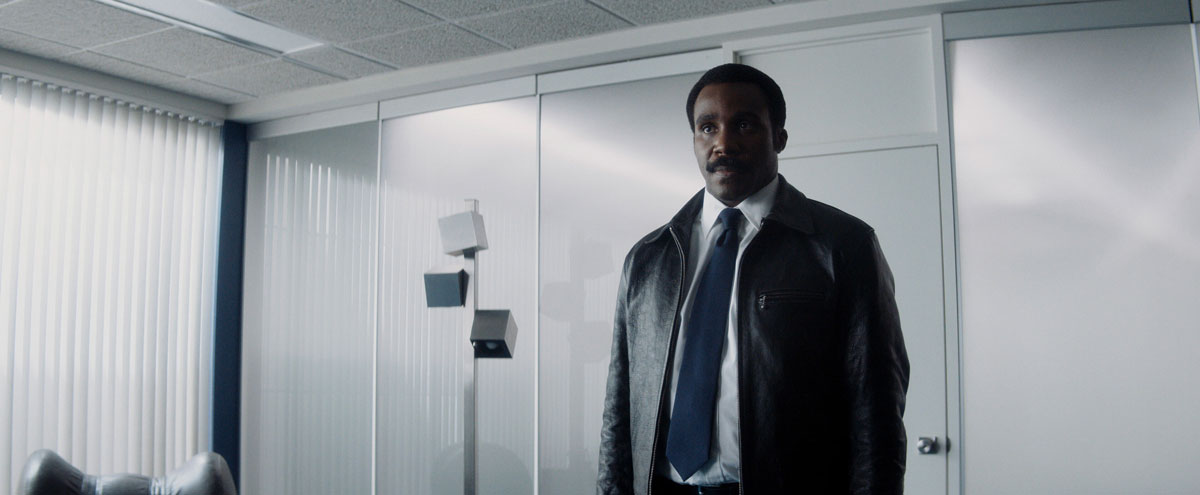
Erickson and the writers begin to address those questions with a disconcerting scene in the third episode, “Who Is Alive?” It starts when a frustrated Milchick is ambushed by the company’s public relations representative Natalie (Sydney Cole Alexander), who turns up in his office unannounced with the invisible Lumon board silently listening in.

Like Milchick, Natalie is another non-white employee in a workplace where few of her coworkers look like her. But where Milchick’s manner is purposefully careful, Natalie is mechanical and unerring. She conveys her positivity with a smile as sparkly and sharp as cut crystal.

The board is “jubilant at your ascendance,” Natalie tells Milchick, “and wants you to feel appreciated.” To Lumon’s bosses, this means connecting Milchick to the company’s history. “To that end, please accept from the board these inclusively re-canonicalized paintings intended to help you see yourself in Kier, our founder.”

Witnessing what happens next could trigger sympathetic dissociation. Milchick opens the box, removes the vellum covering the first painting, and is confronted with a version of Kier Eagan’s portrait — in blackface. His complexion is painted dark brown and his hairline and mustache are redrawn to resemble Milchick’s. The eyes, however, remain a piercing, hauntingly unnatural shade of blue.

The sublimated horror on Milchick’s face is entirely honest since the camera captures the first time the actor saw those portraits too. At least Tillman had an inkling they were coming. “What I appreciate is that they asked me how I felt about it,” Tillman said.

His face provides the answer. Tillman’s left eye twitches as Milchick whispers, “Oh…oh my,” and the aghast, slight uptick of one eyebrow says what his mouth can’t when Natalie chirps, “The board wishes to express that I, Natalie, received this same gift upon receipt of my current position — and found it extremely moving.”

“I’m grateful,” he responds in a near whisper. “It’s meaningful to see myself . . . reflected in . . .” Milchick can’t find the words but it doesn’t matter — the board hangs up on him before he can finish, letting us know how much he’s worth to his superiors.

“One thing that was really important for me was to be sure that we did not ignore the ramifications of the racial element that this character is enduring in this moment, and whether or not we fully addressed it and put a bow on it in this season was less important,” the actor added. “But what was really clear is that I didn't want to brush it away.”

“Severance,” for all its surrealist scenery, reflects a version of American corporate life that isn’t too far removed from what the show portrays. Each company’s culture has uniquely weird habits and reflexive traditions. Most workers run down their days repeating the same tasks without thinking too much about their job’s meaning, focusing instead on productivity out of fear or in pursuit of incentives.

Mr. Milchick is another familiar type — the striving middle manager fluent in emotionally neutral corporate speak, eager to demonstrate his worth and perilously reliant on his boss’ validation. To Tillman, the portraits signal that all of Milchick’s efforts to prove he’s Lumon leadership material will never be enough.

“These pictures are the board’s way of trying to accept me and embrace me and include me in their history and work on tolerance, if you will,” he pointed out, “but it's also them being willing to take history and, in a way, whitewash it so that it's totally accepting and, ‘This is totally fine.’”

“So in a way,” he continued, “they decrease the value of who Kier is in order to make me feel accepted, but do so in a way that makes me feel even more isolated: ‘We see you and we want you to be a part of history, but we see you as Black.’”

We need your help to stay independent

Shortly before Donald Trump signed an executive order eliminating diversity, equity and inclusion programs in federal government, companies including Meta, Walmart, Amazon and McDonalds rolled back their DEI initiatives, with Target recently joining their retreat. The administration and its right-wing media supporters paint diversity as a cultural ill, with Trump even ridiculously blaming DEI for last week’s tragic plane crash in Washington D.C.

Notably other corporations, including Nike and Costco, have loudly stated their intent to maintain their DEI-focused programs, citing the ways that focusing on diversity is good for business. Which it is.

“Severance” uses Milchick to depict another interpretation of corporate diversity that has played out for decades and rarely been portrayed as unsparingly as it is here, which is the tacit demand to assimilate in ways that can equal erasure.

“This the first time we are witnessing a character in this world who happens to not be white, that is being othered. And we're watching it in real-time,” Tillman observed, citing that Natalie has also been othered but seems to have embraced that. She allows the board to verbalize her supposed personal reaction to the same paintings.  

“We have to perform in a certain way, and how she feels about it is unclear at the moment,” the actor said.

SeveranceTramell Tillman in "Severance" (Apple TV+)

“Severance” is the second show to cast Tillman as a series regular; his first was in 2018’s short-lived “Dietland.” Between the Apple TV+ drama’s popularity and the way his performance gets under your skin, Tillman has also gotten a lot busier. Later this year he’ll appear in “Mission: Impossible – The Final Reckoning” in an undisclosed role.

Asked whether we’ll see him jump off any skyscrapers, he would only say, “I cannot confirm nor deny.” But he did offer that the work environments were more similar than we might assume.

“There's a meticulousness that both directors have, and there's a passion that both directors have as well,” he said, adding that stepping away from the second season of “Severance” once it wrapped to jump into working with director Christopher McQuarrie, Tom Cruise and the rest of the cast, “felt like I was at home.”

“For me, it was important, if they had not decided on the structure of care when it came to race, that I played a character that was very much aware of his Blackness and his journey to assimilate, his journey to fit into this world embodied by people that do not look like him."

It had to be more fulfilling than the cubicle anxieties Tillman used to contend with. Before he joined “Severance” he worked in nonprofit management. “The job entailed keeping a lot of balls in the air, you know, feeling as if I was an octopus, having to please many people, having to answer to many more people, and having to keep an eye on office camaraderie,” he remembered.

That sounds a lot like Milchick’s workload. We’ve seen him launch morale-boosting dance breaks, greet returning employees with bountiful balloon clusters, and organize fruit deliveries as well as interfacing with the higher-ups. In the new season, he oversees “kindness reforms” in response to the Microdata Refinement team’s Overtime Contingency debacle, during which the workers on the Severed floor found a way to awaken their “innie” consciousness outside the office, where their “outies” live separated from work.

Milchick also appears to be in many places at once, leading to some online speculation that he could be a clone. It’s nothing that sexy, as far we can tell. He’s simply saddled with an array of menial tasks in addition to his management duties. Some of us can relate.


Want a daily wrap-up of all the news and commentary Salon has to offer? Subscribe to our morning newsletter, Crash Course.


Watching Tillman in “Severance” might be a different experience for people of color who work in corporate America, especially Black and brown folks. Many know what it’s like to be Milchick – to do everything better than right, to maintain composure in the face of insult, only to one day realize that nothing you do will ever get you the corner office.  

Tillman said the character’s expansion sparked a dialogue about what it was like to work in a predominantly white corporate structure and the ways that required him to deal with microaggressions.

He also raised the topic of code-switching. “For me, it was important, if they had not decided on the structure of care when it came to race, that I play a character that was very much aware of his Blackness and his journey to assimilate, his journey to fit into this world embodied by people that do not look like him,” he said.

How Milchick styles his hair, how he speaks how he dresses – “Everything was about him fitting in,” Tillman explained.

He also acknowledges that there’s still plenty left up for discussion regarding Milchick, revealing that he’s read the social media comments calling him evil or speculating about his motivations.

“I've never been interested in pity, and I never wanted to play a character where audiences are led to feel sorry for [him]. That's not interesting to me,” the actor said. ”What I am hoping is that audiences will maybe see themselves in Milchick. I hope that there's a humanity that they witness unfold in him.”

And, true to form, Tillman expresses hope that his character’s arc leads them to ask questions about their lives, such as: How do I participate in a failing system?

What do I allow in my life? What do I ignore?

Is my joy being tampered with?

And, he finishes, Do I find worth in my work?  “My hope is that audiences will continue to find ways to implicate themselves within Milchick,” he said, “and see that, you know, we're kind of more alike than we think.”

New episodes of "Severance" stream Fridays on Apple TV+.

“Dangerous rollback”: Trump Department of Education reverses Biden-era Title IX rules

President Donald Trump’s Department of Education announced the repeal of Title IX guidances protecting students from discrimination or harassment based on sexual orientation and gender identity on Friday.

In a letter from Craig Trainor, the Acting Assistant Secretary for Civil Rights at the DOE, the Trump administration struck Biden-era protections for LGBTQ+ students and restored 2020 rules that lengthened complaints by mandating hearings and cross-examinations in investigations. 

Victims’ rights advocates said at the time that rules in Trump's first term made it harder to report incidents or seek justice, a sentiment some echoed on Friday.

“This dangerous rollback changes Title IX from a law that protects women, girls, and LGBTQ students into one that shields schools enabling harm,” Sheila Katz, CEO of the National Council of Jewish Women, said on X.

Trainor added in his letter that a Trump executive order against “gender ideology” was “fatal to the 2024 Title IX Rule,” claiming the department had to follow the president’s legal interpretation of sex.

“The president’s interpretation of the law governs because he alone controls and supervises subordinate officers who exercise discretionary executive power on his behalf,” Trainor wrote.

Title IX lawyer Melissa Carleton told The Chronicle of Higher Education that the claim was “an exceptionally broad assertion of power [that] doesn’t have any real legal bearing on Title IX.” Still, Carleton said, schools were “basically going in a time machine” to the days before the Biden rule changes.

The change comes after a federal judge ruled against the Biden-era policy tweaks earlier this month, barring nationwide enforcement of the protections.

Still, not all states are ready to comply with the rollback. California Superintendent Tony Thurmond said the state’s students would be protected as federal regulations “devolved.”

“California law is unaffected by recent changes to federal policy and continues to provide safeguards against discrimination and harassment based on gender, gender expression, gender identity, and sexual orientation,” he wrote in a statement.

Trump’s immigration plans will hurt for farm workers and consumers alike, mass deportation or not

A highly visible ICE raid in Bakersfield, California earlier this month ruffled local immigrant communities and caused some farm workers to stay home in the fourth most productive agricultural county in the U.S. While nearly all undocumented workers went back to work within days, barring those who faced detainment or deportation, the highly-visible targeting of an agricultural powerhouse sent ripples through the nation.

President Donald Trump’s promise to deport millions of undocumented Americans would not only rip apart families, but target the population largely responsible for growing the nation’s food. Though Trump’s nominee to lead the Department of Agriculture, Brooke Rollins, called food supply issues stemming from mass removals a “hypothetical” during her confirmation hearing, supply chain experts say the impacts are a certainty if mass deportations proceed.

Carolyn Dimitri, a professor at New York University and food policy economist, says farm workers without documented status are the backbone of the industry. 

“Our food system is so heavily dependent upon undocumented workers that there's no way that this [mass removals] cannot have an impact on farm profits and the flow of product to the market, Dimitri told Salon.
 

Beyond the half of farm workers estimated to be undocumented, hundreds of thousands more round out other roles within the food supply chain: meat and poultry packing, processing and other labor-intensive, difficult-to-automate jobs. In a tight labor market — with unemployment hovering at around 4% — filling the millions of positions could be next to impossible.

Dimitri says potential staffing shortages could trigger the kinds of price jumps and supply shocks that Americans witnessed during the COVID-19 lockdowns. 

“If it's a high production state, like California, for example, and the farm workers stopped going, then I think that that would be a pretty quick impact,” Dimitri said, adding that prices could surge in mere weeks or months if undocumented people either stayed home or faced removal. 

David Ortega, an agricultural economist and researcher of food supply chains at Michigan State University, says the chaos of mass deportations could play a role in surging food costs, too.

After years of grocery price pressure, “we really need a period of stability. And the issue here is that some of the proposals, the proposed policies of the Trump administration are creating a lot more uncertainty for the food industry, which just leads to increased costs in operations. Farmers are sort of scrambling to obtain… to have a reliable workforce in place for their operations,” Ortega said. 

But major farm owners understand the undocumented labor population is essential, and they’re making contingencies for mass deportations by looking for ways to keep non-U.S.-born laborers inside the country.

Undocumented workers aren’t going to be replaced by American-born laborers, or even automation any time soon, experts told Salon. 

“These are individuals that perform essential, very labor-intensive activities like planting and harvesting,” Ortega told Salon. “They are filling very critical roles that maybe US or workers are either unwilling or unable to perform.” 

We need your help to stay independent

United Farm Workers Director of Communications Antonio De Loera-Brust told Salon that undocumented farm workers, despite a moment of fear and uncertainty, are forced to go back to work despite initial reports they were staying home.

“I don't see a very easy solution to this by looking at the domestic workforce,” Ortega said. Farm owners need immigrant workers, who account for over 70% of the agriculture labor force.

President Trump’s plans for mass removals, coupled with impending tariffs on Mexico, Canada and other American trading partners and the rapid spread of bird flu, could send grocery prices spiraling, but it’s more likely that farm owners lean on an even less protected class of workers.

Experts told Politico earlier this month that they expect the Trump administration to solve its deportation-fueled labor crisis by “expanding the existing H-2 visa program” and bring in temporary foreign-born workers who are “more vulnerable to abuse than many of the undocumented workers.”

Instead of advocating against mass deportations, farm owners are “going to Congress and asking for more H-2A workers and to pay them less… they want to replace one kind of cheap, vulnerable, undocumented labor force with an even cheaper, even more vulnerable, excluded-from-citizenship workforce,” De Loera-Brust told Salon.

H2-A visa holders may be spared from the looming threat of deportation, but they have even fewer rights than undocumented workers to address hostile working conditions. First, as De Loera-Brust puts it, they are “owned by their visa.” Since a particular farm sponsors workers, they can’t freely move between employers. 

Secondly, since a federal judge shut down a Biden-era rule giving H2-A workers more legal organizing rights last year, it’s even more of a challenge for H2-A holders to fight the rampant wage theft, harassment, and brutal conditions that plague farm work.

Defense Dept. evicts NBC, NPR, NYT from Pentagon offices to make way for Breitbart, OANN

The Department of Defense has ordered several major news outlets to vacate their press offices inside the Pentagon to make room for upstart conservative publications and networks.

In a memo shared Friday, the New York Times, NBC News, Politico and NPR were told to leave their long-held offices in the so-called "Correspondents' Corridor" by Acting Assistant Secretary of Defense John Ullyot.

The move is billed as a way to "broaden access" to newer media organizations who have never held office space within the Pentagon. However, a look at the chosen incoming tenants shows the Pentagon favoring conservative outlets that offer friendly coverage of President Donald Trump and his administration. 

After the aforementioned outlets are ousted on February 14, the Pentagon plans to hand over their offices to the New York Post, Breitbart News and One America News Network. The Huffington Post, taking the place of Politico, is the only incoming outlet not overwhelmingly conservative in its news coverage.

The Defense Department clarified that they are not revoking any press credentials, even as they showed the legacy outlets the door.

"The outlets that vacate the spaces that are loaned to them by the Secretary will remain as full members of the Pentagon Press Corps," Ullyot wrote. "They will continue to enjoy the same media access to the Pentagon and will be able to attend and cover briefings."

In a statement to Salon, NPR stressed its commitment to covering the Trump administration and asked the Pentagon to turn over more office space to the media.

"NPR will continue to report with vigor and integrity on the transformation this Administration has promised to deliver," they shared. "NPR urges the Pentagon to expand the offices available to press within the building so that all outlets covering the Pentagon receive equal access."

A representative for the New York Times called the eviction a "concerning development."

"The Department of Defense has the largest discretionary budget in the government, millions of Americans in uniform under its direction and control of a vast arsenal funded by taxpayers. The Times is committed to covering the Pentagon fully and fairly," they shared. "Steps designed to impede access are clearly not in the public interest."

Giving the New York Times and NPR the boot is one small part of Trump's long-raging war against outlets that cover him unfavorably. Trump has repeatedly called journalists the "enemy of the people" and his actions make it clear that he considers the press his personal adversary. Trump sued ABC and CBS over their coverage leading up to the 2024 election, with the former network agreeing to settle with the president. Trump's $10 billion lawsuit against the network behind "60 Minutes" is still ongoing, though there are indications that parent company Paramount is also looking to settle

CNN appeared to be obeying in advance when news leaked of moving popular anchor Jim Acosta to the network's graveyard shift. Acosta publicly feuded with Trump during his first term and had his press credentials revoked and reinstated by the president. CNN declined to comment on "speculation" at the time and Acosta made his own exit, telling viewers not to "bow down to a tyrant."

Escaping winter’s rut: How solo adventures help foster community, even when it’s freezing outside

Every day it’s become clearer to me that there’s no ignoring how brutally cruel this winter has been across the country. It’s battered and bruised us with unprecedented snow and subzero temperatures across the Midwest, the South and the Northeast.

It’s only natural that when we are forced to stay indoors, we sink a bit deeper into our couches. Don’t worry – you’re not the only one with the perpetual imprint on their used Ikea couch. My brother’s Criterion Channel subscription hasn’t had a moment’s rest since the beginning of winter – I’ve watched nearly the entirety of the streamer’s Nicole Kidman collection. Despite Kidman’s soaring performance, I hated “Eyes Wide Shut” – mostly because of Tom Cruise – no offense, Stanley Kubrick.

This season brings a distinct feeling that pulls me away from the wild, relentless energy of New York City. My alarm blares its generic Apple chime, and I keep hitting snooze—only to wake up groggy, drained, and unmotivated to make the most of the dwindling daylight. Some call it seasonal affective disorder. I call it winter in New York City.

Even my daily step count has significantly decreased as I fear voyaging into the crisp, windy air that feels exactly like the “Spongebob” episode where Squidward and Spongebob have to deliver a last-minute pizza order in a chaotic sandstorm. My default seems to be crawling into myself and hibernating with warm, soft-baked Pillsbury chocolate chip cookies with a glass of oat milk. My roommate says this is one of my most childlike qualities and of course, I object.

While I enjoy my time alone, a lingering sense of emptiness remains—a craving for connection rather than sinking into comfort and complacency. This winter feels like the coldest of my adult life, but I refuse to let it slip away in a haze of seasonal depression and excessive screentime.

Breaking out of my seasonal rut feels even harder when my social media feeds are flooded with fresh executive orders from our new president—many of them harming the most vulnerable. The outrage that follows is just as exhausting.

As a lifelong East Coaster battling seasonal depression each winter, I craved ways to find joy and spontaneity in the cold, all while building community—even when exploring solo. 

Rather than dwell in that misery, I remind myself that the solution is in my hands. I didn’t set New Year’s resolutions, but I’ve committed to being more spontaneous, easing the anxiety that thrives on rigid planning. Your 20s are unpredictable, so I’m learning to embrace the chaos.

As a lifelong East Coaster battling seasonal depression each winter, I craved ways to find joy and spontaneity in the cold, all while building community—even when exploring solo. And if I managed to yank myself out of hibernation and force myself to find what I was missing, anyone could. 

Several months ago, I impulsively bought a ticket to one of my favorite indie artists, Dhruv. It was only $35 — which is almost unheard of with Ticketmaster price gouging. When the day finally swung around, I began to question if it was the right move to go alone and if I was really ready to brave the cold. But I pushed through the doubt and made my way on the train to my first-ever solo concert in the East Village at Irving Plaza. 

Dhruv took about an hour to appear on stage, but when the 25-year-old queer British artist finally did, the crowd was ready for the stormy journey of his album, "Private Blizzard." Surrounded by thousands of young, diverse fans, we united in singing hits like “Double Take” and “Moonlight.” I had a few brief exchanges with concertgoers about our favorite songs, but I appreciated the quiet solitude in the shared experience—alone, yet part of something larger.

After the Dhruv concert, I headed to a TimeLeft dinner in the Lower East Side after seeing an Instagram ad promising I’d “meet five new people over dinner.” Skeptical at first—like I always am about these New York City trends—I took a personality test that matched me with others who shared similar interests. To my surprise, it was a great experience.

Sitting at an Italian restaurant, I struck up a conversation with two solo travelers: a woman from Colombia and a man from South Korea who’d just gone through a breakup. The others were newcomers to the city or locals eager to expand their circle. We quickly bonded over movies, shows and music, checking if we all passed each other’s vibe check.

We need your help to stay independent

It turns out we all passed the vibe check, so we moved on to a cocktail bar nearby. On the way, we debated the differences between South Korean and American politics, though we mostly laughed at the absurdity of yet another Trump presidency. By the time we reached the bar, I felt surprisingly comfortable with these strangers—something I rarely feel after just a few hours of meeting new people.

Maybe it’s because I was being accepted for the rawest version of myself: loud, artistic, sometimes judgmental, but always warm and open to new people and experiences. Who knew that dining with strangers could be so rewarding?

Next, I’m off on a solo trip to Mexico City, meeting my older brother and some of his friends. I feel both liberated and terrified. During the day, I’ll roam neighborhoods like Condesa, Roma, and Centro—who knows, maybe I’ll earn the title of "Nardos in Mexico City." But one thing’s for sure: I’ll be soaking up the warmth of the Mexican sun, trading the frigid NYC winter for the desert heat.

How economics wrecked the world — and how we can escape from “Ricardo’s Dream”

Economists sometimes present their discipline as the queen of the social sciences, a claim staked primarily on a superificial resemblance to physics: It has universal laws! Expressed in numbers! But that confidence can go horribly wrong.

The global financial crisis of 2008 and ensuing Great Recession should have been a wakeup call, but in the interveneing years, to many have gone back to sleep. And the world of finance is hardly unique. Economics is supposed to be a science whose models tell us how to maximize general welfare — meaning the welfare of the many, not the few at the top. But in case after case, whether in dealing with the climate crisis, economic inequality or international trade — economists’ answers don’t deliver as promised. 

Something has seriously and fundamentally wrong in this so-called science, and “Ricardo’s Dream,” the new book by English writer and researcher Nat Dyer, a fellow of the Schumacher Institute and the Royal Academy of Arts, helps us understand why. Dyer's subtitle sums things up nicely: “How Economists Forgot the Real World and Led Us Astray.” But to be clear, he doesn't argue that all economists forgot the real world, and thereby seeks to point toward a more promising future.

If you studied any college-level economics, you probably remember David Ricardo’s name. He was the other founder of classic economic theory, after Adam Smith, and his “comparative advantage” model, derived from studying 18th-century trade between England and Portugal, is among the most consequential in economic history. To a large degree, it has provided the underlying rationale for the last 60 years or so of corporate globalization. But as Dyer shows, Ricardo's model was abstracted from a single historical example, and avoided discussing the importance of naval power, gold and the slave trade, all of which were part of any fuller understanding of international trade relations at the time. In other words, Ricardo's model barely even tried to describe economic relations in the real world, and was closer to ideological fantasy than to science. 

In the first third of the book, Dyer examines Ricardo's model and its relationship to historical reality in rich narrartive detail, from the diplomatic intrigues behind the Methuen Treaty of 1703 to the ghastly realities of the Brazilian gold rush, supported by the slave trade, which allowed Portugal to balance the books by sending vast quantities of gold to the Royal Mint. The second part of the book explores how Ricardo’s deductive model-based approach to economics was first challenged and eventually displaced, only to return with a vengeance much more recently, as he explores in the book’s third section.

"Ricardo's Dream" draws directly on the writings of its principal subject and other important figures in economic history, to make clear that concerns about the discipline's disconnection from reality have been raised repeatedly within the field. I spoke with Dyer by Zoom to discuss the book's main themes, but there's so much rich narrative detail and bountiful perception to "Ricardo's Dream" that one conversation can't do it justice.

This transcript has been edited for clarity and length.

In your introduction, you write that your book "is about the most consequential attempt to create a kind of physics of society: economics" and that it "investigates the dark side of this intellectual trend." More specifically, you write that Ricardo gave us "two influential intellectual traditions": his theory of comparative advantage, which shapes our thinking about international trade, and the broader tradition of "creating simple, abstract, numerical models to explain the social world." You also discuss how, even if Ricardo didn't articulate it this way, he was the origin of the concept of "homo economicus," or economic man. How do these three strands relate to one another, and why are they so important?

I would say that the issue of simple, abstract models is the overall strand, and it's what Ricardo has mainly been criticized for. Joseph Schumpeter called it the "Ricardian vice." But as I explain, we've been led by economists in the last 40 years who saw it not as a vice but a virtue, and that has got us into so much trouble. I would say the other two — the international trade and the economic man — they're both versions of that simplistic model, but they're very different in a way. 

The international trade issue has been well recognized and was repeated time and time again in the 1990s and 2000s by, as I talk about in the book, Paul Krugman, Greg Mankiw and others. What I say is, here's the fairytale version of England and Portugal and win-win, and then here's the real version. He forgot colonialism and he forgot the gold and he forgot the slavery. That's the real history. So part of that is a very well-known story. 

"What I do is say, here's [Ricardo's] fairytale version of England and Portugal and win-win, and then here's the real version. He forgot colonialism and he forgot the gold and he forgot the slavery. That's the real history."

On "homo economicus," I think Daniel Kahneman called it the most influential theory in social science. It's very well-known, even though it's a bit more geeky. But it's not very well known that it comes back to Ricardo. People who have studied it usually say, it goes back to John Stuart Mill, but Mill learned directly from Ricardo.

Ricardo was this great stockbroker, very cool under pressure, great at doing calculations, very knowledgeable, and he essentially projected out onto the world: “Whoa, what if everyone was an amazing stockbroker like me?” Because there's a parallel between Ricardo as a stockbroker and the idea of "homo economicus." That has been mentioned by a few people in the history of economics, and was well understood about 100 years ago, but we’ve kind of ignored that.

But it seems to me a nice way of telling the story of how crazy this "homo economicus" idea is. Because even behavioral economics sometimes sees it as rational and scientific, and any deviation from it needs to be explained as some weird paradox. I'm saying, no, no, let's back up. We've got the real world, where people are very complex, and then you've got this wild imaginative leap that makes things much simpler. But essentially you're basing your entire argument on "if" rather than "is," and that's bound to get you in a lot of trouble.

Ricardo's original model of comparative advantage involved two countries and two commodities, cotton and wine. But it was abstracted from actual history. So what did his model say, and how did it compare with actual history? 

Economic historians will say Ricardo's model is not like a modern model, it was more like a proto-model. Essentially it said, OK, two countries, two commodities: England and Portugal, trading cloth and wine. There were four numbers that Ricardo gave, measuring how productive each country was at each commodity. In the model, Portugal was better at producing both things than England. But still, if you crunch the numbers it works out that it's in both countries' interests to exchange what they're least worst at. So even though England, in the model, is worse at producing both cloth and wine, it makes sense for them to exchange. And it leads to this theory that essentially became part of the self-image of what it means to be an economist: Trade lifts all boats, trade is win-win. So that's the model. 

"The thing that drives me crazy, or at least makes me very annoyed, is that the unrealistic fairytale is called science, and the [more realistic version] is ignored. That's what I'm trying to expose."

The historical reality is that for about a hundred years before Ricardo wrote, Portugal was a very important trading partner of England. Adam Smith, who inspired Ricardo, writes about this, and Smith was much more realistic. There was a booming trade in cloth and wine, and it was essentially part of a military alliance between England and Portugal, which needed the power of the Royal Navy to protect itself against France and Spain. Portugal never exported enough wine to make up for the cloth that it imported from England, so it made up the difference with Brazilian gold. Portugal colonized Brazil at the time and there was a massive gold rush: Nothing like it had been seen before and nothing like it would be seen again until 1849 in San Francisco. Two-thirds of that gold ended up in London, where Isaac Newton among other people, benefited from it.  

That gold helped to supercharge the transatlantic slave trade at the time. Brazil topped the list for the number of enslaved Africans. So instead of this win-win model, you have a more realistic story of exploitation and colonialism. I think there are many parallels with today. This fairytale version has been used to say, oh, trade benefits everyone. But there's a more realistic version. And the thing that drives me crazy, or at least makes me very annoyed, is that the unrealistic fairytale is called science, and the other one is ignored. That's what I'm trying to expose in the book. 

So the more complete model would involve four nations, or at least four entities, and four commodities — one of those being enslaved human beings. What's to be learned by contrasting this more complete model with Ricardo's original?  

I have a map which tries to set it in a different context. Every element of it was bound up with the Atlantic economy and the slave trade. Even the cloth that was exported from England to Portugal, in some years up to 85% of it was re-exported to the African coast, to be exchanged for men, women and children purchased for the slave trade. So it's a radically different picture that emerges, and that essentially shows that power matters, military might matters. It shows a massive difference between what some economists would call the "core countries" in the north and the periphery. 

It's not news that there's exploitation in the world. What is news is that the canonical example that has been used time and again for why trade benefits everyone basically missed out the whole lower half of the picture, whereby millions of people were either displaced or exploited for the benefit of a few. 

You write that Ricardo "took the England–Portugal story from Adam Smith" but that the two men "drew radically different lessons." How did Smith see it differently?

Reading Smith in the original, I have a much more positive view of him. He is seen as this neoliberal, laissez-faire, "invisible hand" theorist, but that’s a caricature of the real Adam Smith. He was much more interested in poor people flourishing and issues of power and empire. Smith essentially used the alliance between England and Portugal to show trade deals were a bad idea. Smith said the Methuen Treaty in 1703, which essentially codified the exchange between England and Portugal, was a bad deal, because Portuguese wine was less good and probably more expensive than French wine. He essentially wanted freer trade by allowing the British to buy cheaper French wine, but at least he acknowledged that gold from Portugal was one of the benefits for England, and that gold came from Brazil. 

So he had a much more realistic point of view. He also thought that these free trade deals would essentially be corrupted by the people who make the deal, which he called the mercantile system. He thought it would benefit a few and disadvantage the many. I want to update Smith's critique and say that's actually similar to what we seen with many free-trade agreements in the last 20 to 30 years. The people in the room — often the corporations and the business lobbies — have benefited, whether from increasing patent rights or from investor-state disputes settlements, shadow courts, things like that. You can see that critique in Adam Smith. 

In time Ricardo's dominance was challenged and overturned by William Whewell and Richard Jones, who had a very different understanding of science, captured by Francis Bacon's analogy of the ant, the spider and the bee. What was meant by that, and how did they begin to challenge Ricardo's understanding of science? 

"Adam Smith is seen as this neoliberal, laissez-faire, 'invisible hand' theorist, but that’s a caricature. He was much more interested in poor people flourishing and issues of power and empire."

This is another story that's been largely buried in the history of economics, the fact that the person who coined the term "scientist," as well as other terms like "physicist" and "consilience," William Whewell, was actually a huge critic of the great classical economist David Ricardo. He thought Ricardo had taken the science of political economy off on the wrong track and was going to damage the standing of all science and all people of expertise. This is the contrast between how Whewell and Jones saw deduction and induction, and, as you say, that is explained through Francis Bacon's analogy.

So essentially, the spider spins webs from itself. They thought Ricardo was like this, spinning out theories without any real content of the external world within those theories. They might have an impact on the external world, but they don't have much external world in them. The ant is like the researcher who is interested in minute facts in small areas. He collects them but doesn't bring it all together. The bee is the fusion of both: It goes out to the flower and collects the pollen, but transforms that with its own thoughts and its own processes and comes up with something new. 

So Whewell and Jones challenged Ricardo. Jones did it by showing that Ricardo had made these universal rules that he said were as certain as the principle of gravitation. Jones said no, these might correspond to just 1% of what's happening in the world, but you actually ignored the other 99%.

This was to do with rents, right? About the actual way that rents work, versus Ricardo's theory of them. 

Yes. Ricardo's theory of rents is really interesting. I describe Ricardo punching up against the landlord class, because he was this merchant, this stockbroker. But he also punched down on the working class, he's got a very multifaceted legacy. He influenced Karl Marx, and he also influenced very capitalist thinkers. His theory of rents was part of his punching up against the landlord class. It has continued to be quite interesting for critics of capitalism today when they think, oh, maybe financial markets are not generating profit, they're generating rents, which means they’re just extracting money rather than doing anything productive. 

But what Jones and Whewell showed was that, specifically related to agricultural land, Ricardo had crafted a huge generalization that didn't map onto the reality of the situation. He focused on the landlord-tenant relationship within a capitalist economy, but there were many relationships that weren't based on market transactions, that were based on culture or more feudal relationships. And Ricardo's laws broke down in that situation. 

The story of Ricardo's waning influence is complicated and fascinating. I could ask tons of questions about it, but what would you pick out as the most significant factor in undermining his influence? 

I think that was a general reckoning at the end of the 1800s. For a start, the term "Industrial Revolution" was coined. People knew this thing had happened, but there wasn't a name for it. There was a general reckoning with some of the darker sides of what had happened within the Industrial Revolution, and an increasing awareness that you needed government intervention — whether that be with progressive taxation, with pensions, with recognizing unions, with anti-monopoly laws like the Sherman Act in the U.S. in 1890. So there was a general recognition that essentially laissez-faire didn't work by itself, and that people demanded more. That wasn't an environment in which Ricardo's theories would thrive.


Want a daily wrap-up of all the news and commentary Salon has to offer? Subscribe to our morning newsletter, Crash Course.


There was also a tilt toward economic thinkers who were interested less in the physics of society and more in studying real history and institutions and power. That was a massive trend. In the U.S. — there's a great book about this, "Social Thought in America: The Revolt Against Formalism" — that included pragmatic thinkers like John Dewey, William James, Louis Brandeis and others, who basically said these abstractions and general laws don't capture the essence of the situation. I think it was that a complex of factors. The reason I wanted to tell that story is because it gives us hope today that the current economic orthodoxy can go the way of classical political economy. 

Within a year of each other, Joseph Schumpeter coined the term "Ricardian vice," which you mentioned earlier, and Milton Friedman launched his campaign to revive it as a cardinal virtue. You write, "It would prove almost impossible, with Friedman’s method, for empirical evidence to throw out a theory: it led to a mantra that it takes a model to beat a model." What enabled Friedman to turn Ricardian vice back into a virtue? 

"There was a general reckoning with the darker sides of the Industrial Revolution, and an increasing awareness that you needed government intervention — progressive taxation, pensions, recognizing unions, anti-monopoly laws."

Friedman was an exceptionally talented polemicist, but he also struck the moments right. He was sort of in the wilderness, but when economic orthodoxy faltered in the 1970s, his style of economics came in. He wasn't alone. He was was working with a group of people who were trying to raise the standard of economics to what some called the "Newton stage," in other words to be more scientific. But as I say in the book, this was criticized time and time again by major figures who went on to win the Nobel Prize. Herbert Simon said, "If you go down this path you're basing all of economics on the principle of unreality." That's another line I've never seen quoted anywhere. 

Yet Friedman's argument did win out. I think it allowed young economists and theoreticians coming through the system to make a huge splash and to make their mark — and not have to read the old authors. There was this feeling, with new computer technology coming through, that those guys in the past didn't know what they were doing. I think it was hubris, essentially: Now we have this cutting-edge equipment and we can see into the future. There was a lot of demand from politicians and the media for this kind of stuff, and I think Friedman's methodology of not worrying about the assumptions helped lots of different models blossom in economics. 

You have chapters devoted to explaining how Friedman's revival of Ricardo's vision has misled us in three major areas — in finance, in "free trade" and in environmental economics. Could you pick one of those and sketch out what the central problem is?

I'll pick finance, because it's so incredibly powerful and pervasive in our world. Essentially, the study of finance was taken over by theoretical economists, from about the 1960s onward, who were armed with a whole load of highly abstract theories and models, the capstone of which is the "efficient markets" hypothesis, which says that prices are always right, essentially. It allowed finance to shrug off old concerns about its association with gambling and about causing instability. It helped to give an aura of scientific legitimacy to the activities of Wall Street firms and traders. 

"The study of finance was taken over by theoretical economists … armed with highly abstract theories and models … which helped to give an aura of scientific legitimacy to the activities of Wall Street firms and traders."

But what the model missed — I use the analogy sometimes that a model is like a spotlight in the theater, and the spotlight picked out elements about the price being right, but it missed the power and politics. That's actually what some people said, including Simon Johnson, who recently won the Nobel Prize in economics. After the 2008 financial crisis, he said that what we'd just witnessed was a quiet coup, that the power of Wall Street firms had grown so hugely due to the back-and-forth between Washington and Wall Street, and that had been facilitated by these abstract theoretical economists. Also, the abstract theoretical economists have — I use the term "theory-induced blindness," which comes from Daniel Kahneman. They have blinded many people, too many elites, to the downsides of letting financial markets rip. 

In the chapter "New Hope," you describe ways in which economists are developing new approaches. Thomas Piketty and his colleagues work on economic inequality, Alan Krueger and David Card work on minimum wage, Kahneman works on behavioral economics. There's the work, mostly of non-economists, on monopoly power, the New Brandeis movement. Their diversity of approaches, under the umbrella term of "heterodox economics," has been seen as a weakness, because their work can't come together into a coherent whole to challenge orthodox economics. But your book stands that on its head, viewing that diversity as a strength, not a weakness. 

To be honest, I haven't seen it in exactly those terms, but you raise an important point. Even some heterodox economists themselves have not wanted to be associated with it, and I don't actually love the term. I'm not an academic myself, and I generally think that economics scares people and jargon just shields what's actually happening. So one thing I've tried to do in my book is to write as plainly as I can, and to use vivid analogies. But I think your point is valid. We shouldn't expect there to be one theory that explains everything, because the world is multifaceted. Perhaps we should see this range of approaches as a positive strength. 

I guess it comes back to the ant, the spider and the bee, in that the ant just gathering things and not seeing how they fit together is itself a weakness. It's like the Golden Mean of Aristotle, you don't want one extreme or the other. So while we need to escape from this theoretical fantasy world — even if the fantasies are highly quantitative, they're still fantasies — I don't think we should go all the way to a completely incoherent picture of the world. But clearly, we need to have more tolerance for a less unified picture. Having said that, I do try and draw some general ideas for how we can understand things.

That's what I was going to ask next. What do you see as hopeful ways forward? 

I am really interested in approaches that look at the world as it really is and ask really tough questions about it. One thing I see is that mainstream economists have created great-looking answers at the cost of changing the question, essentially by asking much simpler and less interesting questions. I wanted to stick to the really difficult questions, even if the answers are a bit messier, because that's more interesting and more useful. Otherwise you just get the illusion of certainty and the illusion of precision. 

I didn't have space to include all the different approaches that I liked in the conclusion. I try to update Adam Smith's mercantile system, calling it a corporate system, to explain how the global system that we have inherited is one where corporations have outsized benefits and have twisted both international law but also economic logic itself to benefit themselves. I think that's really important. 

"I wanted to stick to the really difficult questions, even if the answers are a bit messier, because that's more interesting and more useful. Otherwise you just get the illusion of certainty and the illusion of precision."

I'm a big fan of a global political economic thinker called Susan Strange. She has a view that there are four structures in the world: finance, production, security and knowledge. In the '70s, she said that the world was changing hugely and the economists didn't understand it, because they ignore power and politics, but the political people are obsessed with nuclear weapons and security, and kind of ignore financial markets and economics. We need to bring these two together. So we need to recapture the realm of political economy, but not the political economy that Ricardo envisioned. 

Finally, what's the most important question I didn't ask? And what's the answer?

You could have asked something more personal. You know, why should we listen to you? You don't have a PhD in economics.  Essentially the story of how I came to this book is that I used to investigate corruption in mining and oil deals in Africa and I saw how so many of them were linked to offshore companies, and to the goings-on of companies listed in Toronto and London and elsewhere. I was interested in digging away at what Mary Midgley calls the philosophical plumbing, the conceptual pipes that are underneath our civilization's feet.

I drew on my academic background in history and international political economy, international politics, and I've tried to do a very close reading of economic thinkers themselves, to show that the critique that I raise, of economics built on unreality or economists forgetting the real world, isn't something that's coming from the outside. It's an argument that's been woven through the history of economics for the last 200 years. Almost from when Ricardo first came out with his theory, people have been making this critique. But unfortunately, if you read a textbook or most histories of economics, that history would be completely sidelined. Economics is too important to be left just to the economists. If we're serious about caring about democracy, people need to understand more about how the economic system works, and become less fearful and more confident talking about it. I hope my book can contribute to that.

“I’m in disbelief that this is actually happening”: GOP election denial hits North Carolina voters

About three weeks after last November's election, Spring Dawson-McClure received an unassuming postcard from the North Carolina GOP informing her that her ballot "may be affected" by the party's litigation. The notice, blank on one side, featured a QR code that directed her to the state Republican Party's website, where she found her name on a list of voters declared ineligible because their voter registration applications did not have required identification information.

She was annoyed, the 48-year-old Hillsborough resident told Salon, first by having to take time to verify with the Orange County board of elections that her voter registration was, in fact, complete and then with the idea her vote had been challenged at all. The North Carolina native said she has voted in 19 of the state's elections since 2012 and never had any problems before this election cycle.

The challenge came after Appellate Judge Jefferson Griffin, a Republican, sought to challenge his electoral defeat, twice confirmed with recounts, to incumbent Supreme Court Justice Allison Riggs in the state's Supreme Court race. Griffin trails Riggs, a Democrat, by just 734 votes out of some 5.5 million cast. He sued the North Carolina Board of Elections in the state Supreme Court in December after it rejected his election protests, asking the court to force the board to toss out tens of thousands of ballots he alleges are invalid under state law.

As Dawson-McClure learned more about Griffin's escalating election protests and their movement through state and federal court, she said she grew angry — then scared. 

"Once I understood that women and people of color are disproportionately represented on the list, as it bounced back and forth from one court to the next, [I got] angry. I'm frustrated. I'm in disbelief that this is actually happening these days," she recalled in a phone interview.

Dawson-McClure is one of more than 65,000 North Carolina voters who have had their votes swept up and called into question in the legal contention over the state's hot-button Supreme Court race. As Griffin's challenge drags on in court, North Carolina voters told Salon they fear their votes will be thrown out — and what that means for democracy in a state where it's already eroded.   

"I just feel incredibly heavy about the state of our democracy, and it feels like a very real possibility that we will no longer have free and fair elections in North Carolina," said Dawson-McClure, who matched her registration with her Social Security number earlier this month. An Orange County election board staff member told her they suspected that process initially failed because her last name is now hyphenated.

The broad scope of Griffin's protest means that a number of North Carolinians have had their votes contested — or at least know someone who has — Riggs' parents included. While military service members stationed overseas have had their votes directly challenged by Griffin's protest of absentee ballots, the Raleigh News & Observer reported that women and people of color are also disproportionately represented on the list of alleged ineligible voters.

In his complaint, Griffin accused the North Carolina Board of Elections of erroneously counting more than 65,000 votes that he claims are invalid for three different reasons. Some 60,000 of those votes, he claims, came from voters who did not provide driver's license information or the last four digits of their Social Security numbers on their voter registration applications; in some cases voters were not asked to provide that information.

Around 5,500 contested votes are absentee ballots from voters overseas registered to vote in four Democrat-leaning counties, who Griffin alleged failed to include photo identification with their absentee ballots. In a brief filed Wednesday, Griffin identified a crop of just over 500 votes he says came from voters who never physically resided in the state, which includes children of military service members stationed overseas who were last eligible to vote in North Carolina. The part of the state law that covers those voters' right to cast a ballot in North Carolina elections, he argues, violates the state constitution. 

In a brief filed Wednesday, Griffin argued that throwing out the overseas votes alone would win hand him the race. But such a move, Riggs and other critics have previously argued, would unfairly disenfranchise uniformed service members.

"It’s just fundamentally unfair to try to change the voting rules after the fact," said former U.S. Army Secretary Louis Caldera.

"The petition is really eye-opening, and basically says that winning a partisan election is apparently so important that the candidate who was behind after all the votes were counted would be willing to deny the fundamental right to vote of our nation’s finest — men and women in uniform serving overseas who are prepared to die to defend our country and their immediate family members — in order to make up his deficit in the vote count," said Louis Caldera, former U.S. secretary of the army during the Clinton administration.

Organizations representing military voters have told Caldera that their clients are "deeply frustrated" their votes have been retroactively contested when they lawfully cast ballots under North Carolina's election rules, which the North Carolina Rules Review Commission unanimously approved last March. Part of that frustration, he added, stems from the fact they can't be present themselves to "fight for their votes to be counted" precisely because they're serving the country overseas. 

"It’s just fundamentally unfair to try to change the voting rules after the fact. These voters followed the rules that they were told they had to comply with to have their votes counted," Caldera said in a statement. "It’s particularly egregious to target the votes of many overseas military voters, but only in four of the state's 100 counties, for clearly partisan reasons. That kind of gamesmanship is what breeds cynicism about our electoral process."

The state Elections Board rejected Griffin's claims in December,  which prompted him to file suit in the North Carolina Supreme Court. 

The state Supreme Court dismissed his petition last week in a surprise ruling but maintained the pause it put on election certification earlier this month. It sent the case back to the Wake County Superior Court, which will begin hearing the case on Feb. 7. 

Still, the North Carolina Supreme Court's dismissal didn't deal Griffin much of a blow. Three of the five GOP justices on the bench appeared to signal an embrace of his arguments against counting thousands of votes in concurring opinions, offering a glimpse into their possible approaches if and when the challenge returns to the state's highest court.

Neither the Griffin campaign nor a spokesperson for the North Carolina GOP responded to a request for comment. Griffin has previously said that he can't comment on his legal challenge, citing judicial ethics. 

We need your help to stay independent

Copland Rudolph, an Asheville resident who's voted in 14 elections since 2012, told Salon that she first learned of her inclusion on a North Carolina GOP list of allegedly ineligible voters just 10 days after voting early in October. A friend who works with the nonpartisan watchdog Protect Democracy saw her name on the list and alerted her. The challenge to her vote came while she and her community worked to recover from the devastating hurricane that struck the state in September, adding another layer of difficulty to an already tumultuous time.

"I thought, 'This is western North Carolina recovering from a hurricane. Clearly, they're not going to try to throw away thousands of votes in Buncombe County. I mean, we voted in record numbers despite all that we were dealing with here,'" the 57-year-old recalled thinking after the election. She soon became furious that a politician would be "so tone deaf" as to challenge their votes instead of helping the community recover, she said.

Griffin's electoral challenge followed the Republican National Committee and North Carolina GOP trying in August — and later failing — to have 225,000 North Carolinians purged from the voter rolls over incomplete registrations in state court. A federal court dismissed the claim in October.

Rudolph said her vote was included in that cohort of alleged ineligible voters the RNC identified, despite learning later that her voter registration application included her Social Security number. She suspects that the database the GOP used to generate the list flagged her application as incomplete because she goes by her middle name rather than her first name, Susan. 

"When these kinds of things happen, it reinforces some people's belief [that] 'my vote doesn't matter,'" said Copland Rudolph

"What is exhausting and infuriating is that someone who wants to show up as a public servant, allegedly, could then, in his own actions, create such unnecessary chaos for his own self-needs," she said. "I mean, it's even more reasons why the majority of North Carolinians didn't vote for him."

Rudolph joined Dawson-McClure, four other North Carolina women and the League of Women Voters of North Carolina earlier this month in filing an amicus brief to the district court that considered the North Carolina Board of Election's request to move the case to federal court, opposing Griffin's election protests and request for a pause on election certification. The district court ultimately ruled to remand the case back to the state Supreme Court. Following an appeal of that decision, the Fourth Circuit Court of Appeals is now deciding whether to bring it back to federal court. 

While Dawson-McClure said she's hopeful the courts will decide to count North Carolinians' votes — she also worries about the state Supreme Court making a decision about its own membership should Griffin's petition return to the court. 

"I would not have said this a couple of months ago, but I don't have confidence in our judges, based on what I'm hearing in North Carolina," she said, adding: "It just feels clear at this point that they're not impartial, that they're not holding the state and federal Constitution at the heart of their decision making. It seems incredibly political."

Rudolph felt similarly. She argued that Griffin's election challenge is part of a "coordinated, concentrated effort to strip people of their voting rights," ultimately designed to "escalate" and "unfold" in other parts of the country. 

"When these kinds of things happen, it reinforces some people's belief [that] 'my vote doesn't matter,' and we know that it matters," she added. "This contest was decided by less than 800 people. Votes matter. It really, really matters, and it's worth fighting for."

Money disorders can be a sign of a broken system

If you hoard money or tend to cycle into compulsive buying when bored or stressed, you might've been labeled as someone who has a money disorder. Made popular by financial psychologists Brad Klontz and Ted Klontz, a money disorder is defined as "problematic, ongoing money behaviors and beliefs that can damage one's financial health." 

Common money disorders include pathological gambling, overspending and compulsive shopping, financial dependence, financial enabling, unreasonable risk taking, underspending and compulsive hoarding, financial enmeshment, financial rejection and even workaholism. 

While it can be helpful to identify someone as having what's commonly known as a money disorder, Trauma of Money, a psychoeducational platform that provides certification in trauma-sensitive approaches to money, offers the following critique: The idea of financial disorders places too much shame and responsibility on the individual. 

Another way of looking at it: Money disorders are someone's response to stressful circumstances. One might be dysregulated and operating in a constant flight-or-fight or freeze mode. It comes from a place of scarcity, and Trauma of Money reframes the traditional notion of a money disorder as a money disruption. 

Further, the main issue with money disruptions, according to Trauma of Money, is that they can pathologize the individual versus seeing the external factors that can cause them to behave in maladaptive ways with their finances. 

We need your help to stay independent

Placing all the responsibility and shame on the individual doesn't pull back the lens and see that there are situational systemic issues at play that can be a result of a broken system. 

Because of systemic inequality and oppression, according to research from the Brookings Institute, more than one-third of families in the U.S. — and one half of families of color — don't have enough resources to cover basic necessities. To make things worse, low-income families have to pay more for essentials. As a result, inflation can hit those financially stretched the hardest. 

"When you don't have a lot of money, life can be very complex, and there's a lot of things you're dealing with," said DJ Jack, a financial planner at Abundo Wealth. "Family, job, and general stress. So when they're putting it off, they're trying to put out more pressing fires." 

How systemic inequity connects to money disorders 

One way inequality and oppression can significantly influence someone’s money disorders is by fostering avoidance of the financial system altogether, said Uziel Gomez, a certified financial planner and founder of Los Angeles-based Primeros Financial. Sometimes these beliefs are passed onto the next generation. 

Avoidance of the financial system can mean you might reject products and services that can ultimately help you. It can also lead to mental fatigue from having to make more decisions based on the inconvenience and added stress that comes with not using, say, a bank account or credit card.

"They may pass down the belief that financial institutions aren’t trustworthy or designed to help people like them"

For example, consider someone who experiences discrimination at a bank or financial institution due to a lack of representation, cultural misunderstandings or language barriers. "This negative experience often discourages them from returning, leaving them unbanked," Gomez said. "As a result, they may pass down the belief that financial institutions aren’t trustworthy or designed to help people like them." 

Further, if you grew up in this environment you're more likely to inherit this mistrust and also avoid financial institutions. "This cycle perpetuates generational unbanked households, forcing individuals to rely on quick-check cashing services that charge exorbitant fees — an outcome driven by systemic barriers without a clear understanding of where it all began," Uziel said. These fees can create more financial stress. 

Another example is predatory lending. "Predatory lenders often target low-income households, exploiting the financial literacy gaps that exist in these communities or preying on the urgent needs of individuals facing financial crises," Gomez said. 

Many borrowers don’t fully understand the high fees and interest rates tied to these loans, but they proceed out of necessity — usually to cover emergencies. "Over time, these loans often lead to overwhelming debt due to the steep interest rates, leaving borrowers feeling trapped and disillusioned," he said. "This negative experience can cause them to avoid all forms of credit moving forward, passing on the belief to their children that credit is dangerous and should be avoided at all costs." 

As Uziel explains, systemic barriers and lack of access to resources can create a cycle of financial mistrust and avoidance, perpetuating harmful money beliefs and behaviors from one generation to the next. "These deeply ingrained experiences shape financial behaviors in ways that are hard to unravel without education, support and systemic change," he said. 

In turn, these financial beliefs, behaviors and patterns can lead to feelings of pervasive hopelessness, Jack said. "When people feel hopeless, they throw away all concepts of the future, because the future won't be brighter than it is today," he said. "And if they feel they're never going to be able to get out of a situation, they think they might as well live for the moment." 

The link between self-soothing, scarcity and shame 

"Money disruptions are often born out of some form of a survival mechanism," said Sylvie Scowcroft, a certified financial planner and principal advisor at The Financial Grove. "So whatever you are surviving can affect which type of money disorder you have."

"Money disruptions are often born out of some form of a survival mechanism"

According to Trauma of Money, money disruptions are a type of expression or result of trying to meet a basic need. This can include a sense of belonging, autonomy, safety, purpose, connection and self-expression. And when you are self-soothing, it might stem from scarcity of time, energy or resources. 

When one is operating under scarcity, it can reduce cognitive capacity, which impacts intelligence and how we process information. Plus, it can reduce our executive function, which impairs our impulse control, organization and decision-making skills. 

Operating within a scarcity mindset means you are operating at a lower capacity, which impairs  your ability to make the best decisions. This is due to higher levels of stress and mental fatigue from constantly worrying and making decisions and trade-offs about your money to cover the essentials. 

"Often, the people who are living with the most scarce resources have to make higher quality decisions, but they're in a worse position to do so," Scowcroft said.

She offers the following example: You're packing for a trip, and you only have a tiny suitcase but a lot of stuff. You spend so much time and energy trying to think about all the trade-offs, so it's a more mentally taxing packing experience. Then, while you're on the trip, you spend a lot of time wishing you had this other thing you weren't able to bring. But if you had the resources to have a bigger suitcase, you wouldn't have any of that mental load.

The money disorder and shame cycle 

Unfortunately, shame about money can lead to coping mechanisms, which also can feed into the shame. For example, take overspending, said Scowcroft. When you feel shame about money, you often spend money to soothe those ill feelings. And to reduce some form of pain, there's an action you take over and over again. But it can lead to credit card debt, which also leads you down a shame spiral — and leaves you feeling worse. 

This doesn't mean someone on a shopping spree is "bad with money." Because they're in survival mode and operating in a scarcity mindset, they aren't equipped to make the best decisions about their money, both in the short and long term. They might be self-soothing because they are stressed, and retail shopping feels like a release. 

For example, imagine the person who hates their job and is overworked. To make themselves feel better, they might engage in retail therapy, Jack said. 

Unfortunately, this might be a maladaptive coping mechanism and can compound the problem. They might be more prone to racking up credit card debt — which means they'll need to work longer hours and feel trapped at their despised job. 

"It's really hard to think about the future when the present feels terrible," Jack said. "You're just trying to find immediate relief. But these are short-term solutions that cause long-term problems." 

A path toward financial healing 

So what can be done to decrease money disruptions, help individuals be free from these shackling feelings of shame and improve their overall financial wellness? 

Ideally, systemic shifts can help support people in their struggle of not having enough. For example, universal basic income (or a greater number of UBI pilot programs), creating higher-income opportunities for those without college degrees, decreasing overdraft and late fees and giving people access to small-dollar amount loans can be starting-off points. 

At the individual level, you can start by looking at the emotional and behavioral patterns that have shaped one's financial decisions, Gomez said.

"Many money disorders stem from past experiences or ingrained beliefs, so reflecting on your money story is a crucial first step," he said. "By exploring your earliest money memories, current financial challenges and future goals, you can gain clarity on how these patterns developed and identify areas for growth and change." 

And because shame and scarcity can be very isolating, Scowcroft recommends seeking community. For instance, consider joining a support group, such as Debtors Anonymous, or talking to trusted friends about your money shame and struggles. 

"If you're in a really bad debt spiral and only blame yourself, it would be a lot harder to get out of that spiral if you thought it was simply because you were bad with money," she said. "But if you were to expand a bit and give credit to all the other factors that were causing that shame, it might be easier to break the spiral." 

If you're in a good place to do so, consider working with a financial professional, such as a coach, counselor, therapist or adviser. As Jack explains, a professional can help you create an actionable, step-by-step plan. In turn, it can help pull you from a dark place of hopelessness to one of empowerment. 

If you don't have the wherewithal, see if your work offers free financial counseling sessions. You can also do a search on the Foundation for Financial Planning, which has a directory of non-profits that work with professionals that offer pro bono financial planning. 

"Placing blame or shaming an individual won’t help them overcome the challenges they’re facing," Gomez said. "For someone to take meaningful action and work through an issue, they first need to recognize that the problem exists — which often requires exploring the root causes."

Small jet crashes near Northeast Philadelphia mall in second air disaster this week

A small jet crashed near Northeast Philadelphia's Roosevelt Mall on Friday night, the second such aviation disaster this week.

The jet was an air ambulance traveling between Northeast Philadelphia Airport and Missouri's Springfield-Branson National Airport in Missouri. It crashed shortly after takeoff. 

The Learjet 55 was carrying six people at the time of the crash, four crew members and two passengers. The plane was operated by Jet Rescue Air Ambulance, a company which is licensed in Florida.

“Our immediate concern is for the patient’s family, our personnel, their families and other victims that may have been hurt on the ground,” Jet Rescue shared in a statement.

Videos of the wreck, including several that appeared to capture the moment of impact, were shared widely on social media immediately after the crash. Philadelphia Mayor Cherelle Parker asked for "prayers for any and everyone who may be affected" and asked residents not to pick up pieces of the plane's wreckage.

“If you see debris, call 911,"  she said in a press conference. Don’t touch anything.”

Parker added that the total number of casualties is unknown, noting that “several dwellings and vehicles were impacted.”

Pennsylvania Gov. Josh Shapiro said he was offering "all Commonwealth resources" to deal with the crash in a post to X.

The crash in Philadelphia comes just two days after an American Airlines flight collided with a Black Hawk helicopter in the skies above Washington, D.C. 67 people were killed in one of the deadliest U.S. air disasters in decades.

Reports claimed that the air traffic control tower at Ronald Reagan Washington National Airport was understaffed at the time of the crash but President Donald Trump rushed to blame the incident on diversity initiatives. Aviation safety expert Anthony Brickhouse told Salon he was "embarrassed" by the president's actions.

“As air safety investigators, we are trained to focus on data and evidence, and the NTSB and the FAA are literally just starting their investigation. It is way too early to assign blame and accidents should never be made political," Brickhouse said. "We just lost 67 people, and it's important that we let the investigators do their jobs and figure out what happened. There's a time and a place for politics; today is not it.”

Dozens of prosecutors who handled Jan. 6 cases fired by DOJ

The administration of President Donald Trump continued its revenge tour on Friday, axing two dozen prosecutors who worked on Jan. 6 cases.

The Department of Justice fired the Washington, D.C.-based prosecutors on the orders of Acting Deputy Attorney General Emil Bove, per the Associated Press. The move comes shortly after Trump issued pardons to more than 1,500 people charged for allegedly taking part in the Jan. 6 riots at the U.S. Capitol.

The Washington Post reported that the prosecutors were hired on as full-time staff in the Washington office after their special office to handle Jan. 6 prosecutions was disbanded. The layoff amounts to about one out of every 12 prosecutors in the D.C. office.

“I will not tolerate subversive personnel actions by the previous Administration at any U.S. Attorney’s Office,” Bove wrote in the memo ordering their termination, per Politico. “Too much is at stake. In light of the foregoing, the appropriate course is to terminate these employees.”

The layoff follows reports that the Department of Justice is considering a similar purge at the FBI. Per a report from CNN, the DOJ has drawn up a list of agents and others who were involved in investigating Trump's classified documents and election interference cases with an eye toward their ouster. 

Earlier this week, DOJ officials who worked with former Special Counsel Jack Smith on those cases were fired. Those terminations were carried out under acting attorney general James R. McHenry III, a "Stop the Steal" organizer and Trump ally. 

“Setting the bureau up for failure”: Trump reportedly plots purge of FBI agents who investigated him

The early days of Donald Trump's second term have been marked by rapid-fire attempts to shrink the federal government to a size small enough to be drowned in a golden bathtub. While blanket attempts to purge federal employees have been widely reported, it's clear that the first convicted felon prez is paying close attention to the payroll of the FBI.

Trump's administration has placed pressure on FBI executives to resign, with a particular focus on ousting the appointees of former FBI Director Christopher Wray. The ex-bureau chief was at the helm while the FBI investigated Trump over his actions during the Jan. 6 riots at the U.S. Capitol, painting a target on his back for Trump's second term. While Wray resigned before he could be booted from the position, reports indicate Trump wasn't satisfied with just the top man's walking papers. 

CNN shared that Trump's administration is looking to purge other career law enforcement officials who may have had a hand in the Jan. 6 investigations. According to their report, leaders at the Department of Justice have been drawing up lists of agents and supervisors of people who might have crossed Trump. 

The FBI Agents Association called the possibility "outrageous" in a statement.

“If true, these outrageous actions by acting officials are fundamentally at odds with the law enforcement objectives outlined by President Trump and his support for FBI Agents,” they wrote. “Dismissing potentially hundreds of Agents would severely weaken the Bureau’s ability to protect the country from national security and criminal threats and will ultimately risk setting up the Bureau and its new leadership for failure.”

Trump denied any plans to fire FBI agents when asked about it on Friday. 

“No, but we have some very bad people there," he said, per the Washington Post. "I wasn’t involved in that. But if they want to fire some people, it is fine with me.”

State Department employees ordered to remove pronouns from their email signatures in internal memo

Employees of the U.S. Department of State were asked to remove any preferred pronouns from email signatures on Friday, a leaked internal memo revealed.

The message from the State Department's Under Secretary for Management Tibor Nagy said the move was made to comply with President Donald Trump's recent executive order attacking the rights of transgender people.

“The Department of State is reviewing all agency programs, contracts and grants that promote or incubate gender ideology,” Nagy wrote to employees of the State Department. “All employees are required to remove any gender identifying pronouns from email signature blocks by 5pm today.”

The memo was shared online by independent journalist Ken Klippenstein. ABC News reported that similar memos went out to employees at the Departments of Transportation and Energy as well as the CDC. 

Trump's executive order labeled itself as a broadside against "gender ideology," calling the idea that people born male could identify as women "false." The order required agencies to "remove all statements, policies, regulations, forms, communications, or other internal and external messages that promote or otherwise inculcate gender ideology, and shall cease issuing such statements, policies, regulations, forms, communications or other messages."

Speaking with Salon earlier this month, the ACLU's Ian Thompson called Trump's efforts an attempt to eradicate trans people in the United States.

"All of this is part and parcel of the same overall effort: this anti-trans extremism among many on the right that is really coming from a desire to force transgender people out of our communities, out of our schools — out of public life entirely," Thompson shared.

Stock market drops immediately after White House announces looming tariffs on Canada, Mexico

Donald Trump's promised tariffs on Canada and Mexico won't go into effect until Saturday, but they're already having a noticeable effect on the U.S. economy. 

All three of the most popular stock indices fell in the wake of White House Press Secretary Karoline Leavitt's announcement of the 25% tariffs on imported goods on Friday. Per CNBC, the overall market index fell by half a percent. The Dow Jones Industrial Average has tumbled by more than 300 points as of this writing.

Trump-friendly Fox News noted the sell-off immediately after the news conference.

"There was a bit of a market reaction," anchor Sandra Smith said. "Not a huge sell-off but there was certainly a reaction to that."

Trump campaigned on levying tariffs against Canada, Mexico and China, the United States' three largest trade partners. China is subject to a much-less steep 10% tariff starting at midnight tonight. Leavitt said that the tariffs are a punishment doled out on the country's North American neighbors for allowing undocumented immigrants and fentanyl to cross the border. 

"The president will be implementing tomorrow a 25% tariff on Mexico, 25% tariffs on Canada, and a 10% tariff on China for the illegal fentanyl that they have sourced and allowed to distribute into our country, which has killed tens of millions of Americans," she said.

Leavitt called the tariffs "promises made and promises kept by the president" while blowing off reporters' concerns that the sudden tax could cause economic shocks. ABC News' Selina Wang asked Leavitt directly if the Trump administration would consider repealing the tariffs if they caused prices to rise dramatically. The press secretary accused the media of having a myopic view of Trump's economic plans.

"That’s a hypothetical question and the president is intent on ensuring that he effectively implements tariffs while cutting inflation and costs for the American people," she said. "The media has this way of looking at everything in a microscope rather than the whole government economic approach that this president is taking. He will effectively implement tariffs."

Watch Leavitt's briefing below: 

“I wouldn’t trust that newspaper”: Author accuses Los Angeles Times of “distorting” RFK Jr. critique

The billionaire-owned Los Angeles Times has been accused of making significant changes to the body and headline of an op-ed on the American health care system without informing the author, morphing what was meant to be a critique into a quasi-endorsement of Robert F. Kennedy Jr.

Political anthropologist and social psychiatrist Eric Reinhart penned the op-ed, initially titled “RFK Jr’s Wrecking Ball Won’t Fix Public Health." When it was published on Wednesday, he noticed the headline had been changed. The new version? “Trump’s healthcare disruption could pay off — if he pushes real reform.”

Along with the headline tweak, editors cut out much of Reinhart’s framing, which was critical of Kennedy, including his charge that Kennedy, “via his egomaniacal disregard for scientific evidence, seeks to use law itself to inflict preventable death on those millions,” per his initial draft of the piece.

The final version of Reinhart's piece opens with a photo of Kennedy. After it was published, the Times' billionaire owner, Patrick Soon-Shiong, shared it on X as if it were an endorsement, tagging Kennedy and commenting on the prospects of health care reform: "He is our best chance of doing so."

Speaking to Salon, Reinhart said he has asked the paper to change the headline but has not heard back. 

In a statement to Salon, Hillary Manning, a spokesperson for the Times, suggested the edits to Reinhart's piece weren't out of the ordinary.

"Our editors in Opinion work with op-ed contributors to edit pieces for length, clarity and accuracy, among other things. No op-ed pieces are published, as edited, without the permission of the author. That includes the op-ed written by Eric Reinhart," Manning said.

But Reinhart denies ever agreeing to what was ultimately published. It’s not unusual for editors to make tweaks or headline changes to a piece without author feedback, Reinhart noted, but changing the meaning of a submission goes well beyond a typical edit.

“You trust in that process that the editors that you're working with are not going to screw you over, that they are going to do their best to be faithful to the key arguments of your piece,” he told Salon. “You don't make last-minute cuts, without the author's explicit approval, that are going to change the fundamental interpretation.”

Reinhart acknowledged that he implicitly gave editors clearance to make edits but, responding to the Times' statement, said he “expected basic journalistic integrity in that process that would not open a wide door for distortion of what the editors knew very well to be my intended arguments and effects in relation to the pressing political question of the day: RFK Jr.’s nomination to a position I believe he would use to inflict massive harm on U.S. and global public health.”

In his case, Reinhart believes the final piece, coupled with the photo of Kennedy it ran alongside, could be misconstrued as supportive of the anti-vaccine activist and his bid to lead the Department of Health and Human Services.

“I wanted to make very clear, if this is running during the RFK hearings, that I absolutely do not support RFK. RFK does not represent any of the goals that I articulate in the piece, and he is incredibly dangerous,” Reinhart told Salon.

We need your help to stay independent

Soon-Shiong previously stepped in to kill an editorial board endorsement of Vice President Kamala Harris before the November election. But Reinhart argued that the changes to his piece are a more egregious affront to journalistic standards.

“If somebody kills my piece at the last minute for their own political ideology, that's frustrating … but I can live with that,” Reinhart said. “But somebody distorting or encouraging audiences to view your writing in a distorted manner in a way that's contrary to the clear intent of your submission, that's an entirely different matter.”

It’s not clear that Soon-Shiong himself pushed for the changes, but Reinhart said his influence over the publication is cause for concern either way.

“It's symptomatic of a growing problem across our American media landscape. It's increasingly controlled by people like Elon Musk, Jeff Bezos, Pat, other corporate interests and billionaires who are not shy about using their power and their wealth to manipulate public discourse,” he told Salon.

Reinhart said advice to other writers is to consider a publication's conflicts of interest — and erosion of editorial independence — before pitching.

“If you are a freelance writer, or a writer of any kind, and you are working with the LA Times on something in which their owner has known vested interests, I wouldn't trust that newspaper,” he said.

“Infamous and disgraceful”: Pritzker says pardoned Jan. 6 rioters can’t get state jobs in Illinois

Illinois Gov. JB Pritzker can’t keep January 6 rioters off the streets, but he can keep them out of state office buildings, he says.

On Thursday, Pritzker directed the state official responsible for staffing to include “any participation in the January 6 insurrection” as reason to bar an applicant from all state state jobs. The move, he said, is aimed at “protecting public safety," according to a letter obtained by NBC News.

“Our State workforce must reflect the values of Illinois and demonstrate honesty, integrity, and loyalty to serving the taxpayers. No one who attempts to overthrow a government should serve in government,” the governor said.

The decision comes after President Donald Trump pardoned around 1,500 rioters, including scores of violent offenders, including those convicted of assaulting police officers and engaging in seditious conspiracy. Experts say the pardons could also lead to an uptick in political violence; a handful of pardoned Jan. 6 convicts have already ended up back behind bars.

Though pardons do not expunge felony convictions automatically, Trump’s order would have made it possible for any of the at least 50 Illinoisans convicted of partaking in the riot to apply for state jobs.

Illinois is one of the few states that grants protections to job applicants with felony convictions. But Pritzker directed officials to classify J6ers’ actions as “infamous and disgraceful conduct,” barring them from government employment.

Pritzker previously blasted the pardons, stating that the rioters were “not political prisoners, heroes, or martyrs” but rather “assaulted law enforcement right before our eyes and put our democracy in peril."

Karla Sofía Gascón apologizes for resurfaced post calling George Floyd a “swindler”

"Emilia Pérez" star, Karla Sofía Gascón, has issued an apology in the wake of considerable backlash surrounding the actress' resurfaced social media posts in which she condemned Islam and called the late George Floyd "a drug addict" and a "swindler."

In a statement via Netflix, Gascón writes, "I want to acknowledge the conversation around my past social media posts that have caused hurt. As someone in a marginalized community, I know this suffering all too well and I am deeply sorry to those I have caused pain. All my life I have fought for a better world. I believe light will always triumph over darkness.”

The Spanish actress recently became the first transgender person nominated for an Oscar, with the crime musical, "Emilia Pérez," snagging 13 nominations at the Academy Awards. The film has been on a winning streak after it took home the award for Best Musical or Comedy at the Golden Globes earlier in January.

Gascón has been mired in controversy since early Thursday after journalist Sarah Hagi unearthed Gascón's old tweets from 2016 to 2021. Gascón's posts have since been wiped but Hagi's thread, which has been viewed three million times, highlights numerous posts from the actress berating Muslims for their faith, language and culture, claiming the faith should be banned.

In one of Gascón's posts from 2020, she wrote, “I’m sorry, Is it just my impression or is there more Muslims in Spain? Every time I go to pick up my daughter from school there are more women with their hair covered and their skirts down to their heels. Next year instead of English we’ll have to teach Arabic."

During the 2020 Black Lives Matter movement, Gascón wrote, “I really think that very few people ever cared about George Floyd, a drug addict swindler, but his death has served to once again demonstrate that there are people who still consider black people to be monkeys without rights and consider policemen to be assassins. They’re all wrong.”

In a post from 2021, Gascón criticized the Oscars for awarding “Nomadland” Best Picture. 

“More and more the #Oscars are looking like a ceremony for independent and protest films, I didn’t know if I was watching an Afro-Korean festival, a Black Lives Matter demonstration or the 8M,” Gascón wrote. “Apart from that, an ugly, ugly gala.”

After Gascón's apology on Thursday, the actress issued another statement to explain her decision to deactivate her X account, stating she believes "there is something very dark" behind what she views as an attempt to "sink" her chance at an Oscar.

Gascón writes, “I’m sorry, but I can no longer allow this campaign of hate and misinformation to affect me and my family, so at their request I am closing my account on X.”

“I have been threatened with death, insulted, abused and harassed to the point of exhaustion," she writes.

The actress explains, “I have defended each and every one of the minorities in this world and supported any event against racism, freedom of religion or homophobia, in the same way that I have criticized the hypocrisy that underlies them, because the first thing I am self-critical of is myself."

The Best Actress race encountered earlier controversy involving Gascón when she claimed in a Brazilian interview that fellow Best Actress nominee, “I’m Still Here” star Fernanda Torres, allegedly used online tactics to smear her and "Emilia Pérez."

“What I don’t like are social media teams — people who work with these people — trying to diminish our work, like me and my movie, because that doesn’t lead anywhere,” Gascón said. “You don’t need to tear down someone’s work to highlight another’s. I have never, at any point, said anything bad about Fernanda Torres or her movie. However, there are people working with Fernanda Torres tearing me and ‘Emilia Pérez’ down. That speaks more about their movie than mine.”

Gascón clarified to Variety that her comments were not “directly associated” with Torres, but were aimed at “toxicity and violent hate speech on social media.”

Democrats want Trump to reveal who he’s giving security clearances to without background checks

In the flurry of President Donald Trump’s first two weeks in office, the new administration ordered that an unknown number of people be granted immediate access to top secret classified information. Democrats and other critics are now demanding that the White House disclose the list and details of the people Trump allowed to skip background checks and gain access to the country's most sensitive secrets.

On Jan. 20, Trump ordered White House Counsel David Warrington to provide the White House Security Office a list of personnel to grant immediate Top Secret (TS) and Sensitive Compartmentalized Information (SCI) clearances, proclaiming it “necessary to perform the duties of the office to which they have been hired." That list, he added, could expand "as necessary."

That's an alarming way to go about protecting the nation's secrets, according to Rep. Gerry Connolly, D-Va., ranking member of the House Oversight Committee. In a letter sent Thursday to Warrington and the White House Counsel’s office, Connolly is demanding a list of who exactly the administration is giving clearance to and all records related to what if any background investigations were carried out.

Specifically, with respect to those granted fast-tracked clearances, Connolly is asking for any records of “foreign contacts, conflicts of interest, history of financial impropriety, or have attempted the violent overthrow of the U.S. government."

In the letter, Connolly cites the Trump administration’s historic “disdain for the security clearance process,” noting Trump’s decision to give his son-in-law, Jared Kushner, a security clearance despite myriad concerns from the CIA. He also notes Trump's decision to give 25 individuals security clearance despite “concerns about ties to foreign influence, conflicts of interest, questionable or criminal conduct, financial problems, or drug abuse.”

The letter also includes accounts of past embarrassments for the Trump White House, such as when Trump fired Michael Flynn, a former general, “after news reports revealed that he had lied to then-Vice President Mike Pence about conversations Flynn had with the Russian Ambassador.”

“Then-Oversight Chairman Elijah E. Cummings revealed that Flynn had also lied on his security clearance renewal forms about receiving trips from Russian firms and forcing Flynn to invoke his fifth amendment right against self-incrimination to avoid disclosing further wrongdoing,” the letter reads.

Connolly also recounts how Trump “had to fire a personal assistant because he failed to gain a security clearance because of his financial troubles and gambling habit that exposed him to blackmail and coercion.”

“The White House only discovered the issue when then-Chief of Staff John Kelly implemented a more stringent security clearance policy after discovering ‘a couple of spreadsheets worth of people’ working at the White House on interim clearances and at least 35 people who inappropriately held top secret clearances,” Connolly wrote.

We need your help to stay independent

While Trump used the backlog of background investigations as justification for his order, Connolly noted that there are already provisions for fast tracking background inventions and even beginning background investigations before the presidential election in the name of a speedy transition.

“However, the Trump-Vance Transition Team’s decision to forego requiring nominees to submit to FBI background checks thus delaying further investigations,” Connolly notes. “A backlog is not a license to compromise our national security now that the Trump Administration is in place.”

A spokesperson for Trump did not immediately respond to a request for comment.

Some have questioned whether Trump will be granting a full security clearance to billionaire Elon Musk, who currently enjoys a TS clearance but not an SCI. Musk has also been given access to swaths of government data despite despite his connection with Russian President Vladimir Putin and other foreign entanglements.

While The Guardian reported last December that Musk would not receive a security clearance due to some of those entanglements and his reported drug use, Musk's closeness to the president and the potential risks it poses has led to lingering concerns that he will be provided access to top-secret information.

Bradley Moss, an attorney who specializes on national security issues, told Salon that Trump has “made clear that he has no intention of complying with the security clearance vetting process wherever and whenever he deems it a bureaucratic annoyance.”

“His January 20, 2025, order made clear his intention to grant interim security clearances encompassing some of our nation’s most closely guarded secrets to a yet-to-be-identified group of individuals without any vetting beyond President Trump’s personal assessment,” Moss said. 

While Moss noted that the Constitution “arguably” grants Trump the authority to bypass background checks, doing so “is a serious risk to national security in that it potentially exposes classified secrets to individuals with all manner of disqualifying personal or professional backgrounds.”

“The security clearance vetting process exists for that very reason, to identify potential risks, determine if they can be mitigated, and if not place the individual into the administrative appeals process by which they can make their case for their eligibility. Tossing the process aside on a whim is foolish, risky, and a national security crisis just waiting to happen,” Moss said.

“Companion” exudes exactly the kind of self-important arrogance it desperately tries to parody

The massive success of Netflix’s futuristic thriller series “Black Mirror” has left burgeoning filmmakers and storytellers fighting to get their work made using a double-edged sword. On one hand, the show has widened the public’s eyes and sharpened their focus on matters of technocratic domination, which is essential for art and media as we move further into the post-digital age. (How that collective fear didn’t stop Elon Musk from becoming a right-hand man-child to the president, I’ll never quite understand.) On the other, its popularity has resulted in a deluge of screenplays that mimic the series’ distinct brand of terror, hoping that viewers will respond to that “Black Mirror” flavor, even if it’s been watered-down to a faint, sour-tasting suggestion.

“Companion” is a rough draft of a movie about objectification, a lazy first pass that hopes its audience will mistake the insinuation of progressivism for the actual philosophy.

This onslaught of ignorant “Black Mirror” copycats has reached such cultural saturation that even saying the phenomenon sounds like a plotline from the show feels obnoxiously trite. But what other word than “dystopia” is there for a world where smart techno-thrillers have been all but erased to make way for bland regurgitations of better movies? The latest of these witless reiterations is writer-director Drew Hancock’s debut feature “Companion,” a movie with a decently clever premise that’s squandered right out of the gate, both by the film’s marketing and the movie itself. An early teaser trailer indicated that “Companion” could be a fun, freaky good time, while a more recent spate of promotion revealed the film’s central plot point that its initial marketing took care to keep under wraps. With that key narrative element out in the open, the movie’s beats are all too easy to predict, diffusing what little humor there was left to garner from its meager amount of twists. 

But even going in blind couldn’t save a movie like “Companion,” which has been so clearly inspired by recent films of a similar ilk that its attempt at a thesis statement shrinks from banal to downright offensive. The movie cobbles together the capitalist perversions of “Fresh,” the mechanics of “Ex Machina,” the futuristic chauvinism of “Don’t Worry Darling” and the self-satisfied showboating of “Barbarian” into a smug Frankenstein’s monster of movies that were, aside from the first two, not much better than “Companion” to begin with. Its comedic elements are bafflingly one-note and conventional, but worst of all, they’re devoid of any perspective or insightful commentary, despite Hancock’s many attempts to send up the poison of masculinity throughout the film. Instead, “Companion” is content with being a rough draft of a movie about objectification, a lazy first pass that hopes its audience will mistake the insinuation of progressivism for the actual philosophy.

If you’re worried about spoilers in this review, don’t be: “Companion” serves up almost all of its twists on a silver platter right at the beginning. (Others have already endured a spoiler sneak attack while watching the trailer play before other theatrical releases.) We meet Iris (Sophie Thatcher), who is meandering through a grocery store dressed in a 1960s Priscilla Presley babydoll look. She seems almost out of place with the modernity of her surroundings, but that’s of no concern to Josh (Jack Quaid), who is mesmerized by Iris over a display of produce. After their meet cute, the two get to talking and hit it off, quickly falling into the patterns of your typical loving relationship. However, this relationship is anything but ordinary, as we soon find out when Josh and Iris head out of town for a group trip with two fellow couples: Kat (Megan Suri) and her boyfriend Sergey (Rupert Friend), and Eli (Harvey Guillén) and his boyfriend Patrick (Lukas Gage). 

CompanionLukas Gage as Patrick, Harvey Guillén as Eli, and Jack Quaid as Josh in "Companion” (Courtesy of Warner Bros. Pictures)But already, things seem out of order. The honeymoon phase of Iris and Josh’s relationship feels rushed, culminating in this abrupt couples getaway that pops up out of nowhere. Barreling into the film’s central action does set up a later reveal, but it also provides Hancock with an excuse to hurry toward the first twist so fast that audiences won’t be able to keep their wits about them. If Hancock spent more time fleshing out his characters, perhaps the rapidly paced events of the movie’s first act wouldn’t cause such whiplash. But, suddenly, there’s Iris, in a fight for her life against Sergey, who is attempting to sexually assault her not far from everyone else’s view. Iris stabs a nearby knife into Sergey’s neck in self-defense and runs back to the swanky, shared house to tell everyone what happened.

The ensuing panic confuses both the viewer and Iris, until Josh delivers a voice command that shuts Iris’ programming down. Yes, Iris is a robot — more specifically a sex robot, though she doesn't realize her own mechanical identity. She was purchased as the key part of a loony conspiracy thought up by Josh and Kat to have Sergey killed in a way that wouldn’t implicate either of them, so the clandestine lovebirds could make off with his dough. The fact that Josh could have sex with Iris in the meantime was just a gross bonus. 

Maybe this reveal would feel meaningful if it didn’t come at the film's outset, or if the audience was allotted enough time to believe that Josh might be a genuinely good guy before the rug is pulled from under them. Unfortunately, “Companion” treats those simple requests like luxury perks, opting to deliver its decent concept in the cheapest possible package. Josh and Kat are mere sketches of villains, driven by nothing but baseless greed that Hancock never bothers to dig into. They’re like Boris and Natasha, if Boris and Natasha had gay sidekicks whose equally unsurprising side plot would’ve made a more thorny and altogether insightful critique of contemporary social politics.

Once Iris wakes up tied to a chair, you can begin mapping out what will occur from there on out — escape, struggle, another escape, more struggling as the body count rises — save for one or two fortuitous bits that earn a few chuckles. (A scene where Iris alters her language settings in a sticky situation is the best in the entire film.) Viewers are left to spend the remainder of the movie wondering how Iris’ certain revenge could be remotely satisfying when she’s battling against such rudimentary archetypes. Depicting the casually abusive, chauvinist male pig we’ve seen countless times before isn’t unique enough to warrant inflicting audiences with more run-of-the-mill sequences of abject violence against women, or even robots who look like women. The total lack of subtext makes the film frustrating to watch, even if we know Josh will get his comeuppance. Seeing an evil man get exactly what he deserves may provide some fleeting wish fulfillment, but that inevitable scene where Iris takes back her power doesn’t make “Companion” an inherently feminist text.

But for its throng of faults, the movie does sport a critical saving grace that keeps it from being completely unwatchable: its achingly human star. Sophie Thatcher has the artistic skillset to keep “Companion” from being an outright catastrophe, and it’s her alone who makes the film interesting enough to keep on with it. She’s convincing for both the 10 minutes viewers think Iris is human and the 80 minutes they know she’s a robot. Watching her rise above such a flat and uninspired script with total conviction is a major testament to her ability and deserves to be lauded. 

Seeing an evil man get what he deserves may provide fleeting wish fulfillment, but that doesn't make “Companion” an inherently feminist text.

Yet, how fitting that Iris has a titanium spine, given that Thatcher has been carrying all of her recent projects on her back. “Companion” is only the latest in a slew of material undeserving of Thatcher’s talents. She ably went toe to toe with Hugh Grant just a few months ago in the religious horror flick “Heretic,” and in just a couple of weeks, she’ll return for the third season of Showtime’s “Yellowjackets,” where she established herself as MVP long before the show went off the rails in its second installment. Some might say that Thatcher is paying her dues in Hollywood, juggling all sorts of material as she works toward a proper breakthrough. While that might be true, she’s already proven to be more than a contending scream queen, a fact that “Companion” confirms once more. Thatcher can play funny, sweet and completely scorching — and jump between them at will. She’s the film’s sole draw, but Thatcher's expertise can’t save it from short-circuiting in the end.

Hancock throws out broad questions about autonomy, pleasure and choice that Thatcher would be ably capable of grappling with onscreen, but “Companion” doesn’t care to begin answering them. Instead, the film is content with falling back on goofy, predictable gags and brief action setpieces too tepid to be true crowdpleasers. “Companion” is confident, but with so little to back it up, that confidence comes off as arrogance, making the film feel ironically steeped in the pernicious masculine tone it’s trying to lampoon. 

It's doubly unsettling to see a film so cocksure at the start of Donald Trump's second term, when we must be extra cautious of movies that have all the buzzy language of political statements, but fall apart when you try to unravel them. Though it's a case of bad timing, “Companion” is hollow in the same way. It's a movie that waves its hands and makes big, peacocking gestures as though it’s saying something, despite not having much more to say than, “Guys still suck.” Walk outside and turn your body slowly in a complete circle and you’ll be able to deduce the same conclusion without paying the price of admission.

Apps can be weaponized to criminalize those seeking abortion care. Under Trump, it could get worse

For those seeking access to reproductive care, one's digital footprint could be dangerous. As previous cases have shown, digital communications can become evidence used in prosecutions against people seeking abortions. For example, when Meta turned over chats between a mother and daughter, or when a man used text messages to file a wrongful death lawsuit against three women he alleged helped his ex-wife terminate a pregnancy, reproductive rights advocates have been ringing alarm bells about digital abortion surveillance for years.

But now, in a second Trump term post-Roe, the stakes are higher. This week, the Center for American Progress released a report detailing ways in which social media apps and consumer data could be weaponized to criminalize people seeking, providing and supporting abortion care. Researchers are calling on the public and policymakers to take action to protect private reproductive health information online.

“Many authors of and contributors to Project 2025, the far right’s authoritarian playbook for the presidential administration, are being proposed as potential candidates for positions in the Trump administration — a clear sign of an orchestrated effort to criminalize abortion care and surveil people pursuing reproductive health care,” the report states. “As part of those efforts, major tech companies could be weaponized as conduits to track and prosecute pregnant people seeking abortion care and their providers.”

In the report, the researchers raise concerns about the limitations of the Health Insurance Portability and Accountability Act (HIPAA). While it establishes federal standards to protect the privacy and security of individuals’ health information, it doesn’t cover apps that track users’ fitness goals, menstruation and mental health. It could also not protect an app where a patient is messaging a healthcare provider. 

"Major tech companies could be weaponized as conduits to track and prosecute pregnant people seeking abortion care and their providers."

“This also means that sensitive health information provided to these apps by individuals is potentially vulnerable to unauthorized access and misuse, not only by the app itself but also by third parties such as data brokers, advertisers or even law enforcement,” the report states. 

Researchers also bring attention to big tech’s business model and how it “facilitates mass surveillance of users seeking reproductive health care.” For example, people are frequently forced to consent to companies having permission to collecting and use their data, or they’re denied access to the platform. Following the overturn of Roe v. Wade with the Supreme Court's Dobbs decision, the reproductive care landscape lacks federal abortion protections, putting patients' lives at stake.

“The collection of sensitive health data exposes users to the risk of significant privacy invasion and criminalization,” the researchers warn.


Want more health and science stories in your inbox? Subscribe to Salon's weekly newsletter Lab Notes.


There is also the concern that without federal privacy protections, the federal government can purchase data on individuals from so-called “data brokers” — companies like Google, Meta and TikTok that scoop up and sell the data we generate online. “Federal agencies exploiting the data broker loophole are then able to purchase this sensitive information without a warrant and may use it as a surveillance tool,” the report warns. 

Obtaining peoples’ search histories and location tracking on apps is also possible. Researchers brought up the case of Latice Fisher, a woman in Mississippi, who was charged with second-degree murder after she experienced a stillbirth at home — before Roe was overturned. 

We need your help to stay independent

“Police searched her phone and found she had previously searched for medication abortion,” the researchers stated. “Though the case was later dismissed, it shows how private search data can be weaponized to suggest intent to terminate a pregnancy and subject women to criminalization.”

Statewide shield laws, which say that courts and agencies won't cooperate if a state with an abortion ban tries to prosecute people traveling, will become increasingly important over the next four years. 

“These laws help prevent the use of digital surveillance to prosecute people who travel to access care and health care professionals who provide it,” the report emphasized. “These protections are particularly important in preventing the misuse of sensitive data — such as search histories, location tracking, or data from period-tracking and women’s health-related apps — that could otherwise be weaponized to prosecute individuals for accessing care across state lines.”

CBS News’ parent company may settle Trump’s “60 Minutes” lawsuit

Another media giant is nearly ready to toss in the towel against President Donald Trump.

CBS News parent company Paramount is in settlement talks with Trump over a suit that some have called a frivolous attempt to chill coverage negative to Trump, The New York Times reports. 

The $10 billion lawsuit stems from allegations that CBS edited a “60 Minutes” interview with Vice President Kamala Harris to make her look better than Trump, who refused to sit for a similar interview. In his last sit-down with the program in 2020, the president walked off the set in the middle of a contentious interview.

Employees and execs at CBS News aren’t happy with the settlement talks, independent journalist Oliver Darcy reported. Wendy McMahon, head of CBS News, and Bill Owens, the top producer at “60 Minutes,” have expressed disapproval over a settlement.

Trump’s team is the clear underdog in the suit, experts say. Lawfare editor Roger Parloff dismissed it as “frivolous” earlier this month.

“Hard to see CBS settling this suit if not for fear of abuses of power by Trump Adm regulators placing Trump’s personal interests above those of the public,” Parloff said.

Last month, the broadcaster sought to move the case from the historically conservative Northern District of Texas court to the Southern District of New York, the venue in which Paramount and CBS News operate. Trump’s legal team has not yet responded to that request.

But per the Times, Paramount executives want a clean slate with the Trump administration as the company finalizes a merger with Skydance, for which it will need a rubber stamp from Trump’s Federal Communications Commission.

Paramount wouldn’t be the first media company to pay Trump off to preserve future White House relationships. ABC News settled a suit they were likely to win for $15 million late last year, and Meta settled a suit brought when they banned Trump’s accounts after Jan. 6 for $25 million this week.

A “patriot economy”? Trump Media expands into fintech

Trump Media, the company that runs Donald Trump's social media platform Truth Social, is expanding into financial services that include fintech and crypto. 

On Wednesday, the publicly traded company announced Truth.Fi, which will cater to “American patriots." It expects to offer financial products and services, including its own investment vehicles, later this year. 

Trump Media plans to put up to $250 million in the venture, with brokerage firm Charles Schwab keeping custody of the funds. Samantha Schwab, a granddaughter of the firm's founder, recently became deputy chief of staff at the U.S. Department of the Treasury, CNBC reported.

Truth.Fi's funds could be allocated to separately managed accounts, customized exchange-traded funds, bitcoin and other cryptocurrency, according to a news release. Its products would focus on “American growth, manufacturing, and energy companies as well as investments that strengthen the Patriot Economy,” according to the release.

Shares of Trump Media jumped 6.8% following the announcement, CNBC reported. Trump, who owns over 50% of the company, moved his $4 billion in shares in December to a revocable trust controlled by his son Donald Trump Jr. 

Trump Media also has a web streaming service, Truth+, that started last October. Truth Social, created in 2021 after Trump was banned from Twitter, has 6.3 million active users.

“Truth.Fi is a natural expansion of the Truth Social movement: We began by creating a free-speech social media platform, added an ultra-fast TV streaming service, and now we’re moving into investment products and decentralized finance,” said Devin Nunes, who resigned from Congress to become CEO of Trump Media in 2022. “Developing American First investment vehicles is another step toward our goal of creating a robust ecosystem through which American patriots can protect themselves from the ever-present threat of cancellation, censorship, debanking, and privacy violations committed by Big Tech and woke corporations.”

If approved by regulators, Truth.Fi would mark Trump’s first foray into fintech and the first time a sitting president has started a financial company that invests and holds assets, the Wall Street Journal reported.

“They are posing massive challenges for financial regulators to do their job,” said Robert Weissman, co-president of consumer advocacy group Public Citizen. “There is every reason to expect [regulators] are not going to enforce the law against the Trump family business.”

Conservatives, crypto claim debanking

It's not clear how Truth.Fi's financial products will differ from those offered by traditional banks, which Trump views as unfair to conservatives. The crypto community, courted by Trump during his campaign last year, also has complained of debanking. 

“I hope you start opening your bank to conservatives because many conservatives complain that the banks are not allowing them to do business within the bank, and that included a place called Bank of America,” Trump told the CEOs of Bank of America and JPMorgan Chase at last week's World Economic Forum, according to CNBC.

Bank of America said it "would never close accounts for political reasons," Business Insider reported.

U.S. Senate hearings on debanking are scheduled to begin next week. Nathan McCauley, CEO of Anchorage Digital, Evan Hafer, founder of Black Rifle Coffee Company and Stephen Gannon, partner at Davis Wright Tremaine LLP, are expected to appear in front of the Senate Banking Committee. Sen. Tim Scott, a Republican from South Carolina who chairs the committee, said the hearings are "the first step in our efforts to hold bad actors accountable." 

“In some sense all of this feels like a callback from the prior Trump administration, where the president and his allies would accuse his opposition of doing this very thing they were setting out to do,” Mark Hays, a senior policy analyst at Americans for Financial Reform, told Salon. “In this case, they are accusing the prior administration's regulators of 'politicized' approaches to banking regulation — just as the president, his family and his allies launch businesses built explicitly around very politicized brands.”

Mixing business with presidency

Truth.Fi is the latest Trump-related business venture to raise conflict of interest concerns.

As president, Trump has appointed leaders of federal agencies who are expected to take a less aggressive approach to crypto. Last week he issued an executive order to govern digital assets, further aligning himself with an industry he and his family are invested in.

A few days before his inauguration, he and First Lady Melania Trump launched their own memecoins. The highly volatile digital currencies generated billions of dollars for the president, at least on paper, and prompted criticism from some in the crypto community who viewed them as a gimmick. 

Trump and his sons are promoters of World Liberty Financial, a crypto trading business they started last fall with Steve Witkoff, a co-chair of Trump's inaugural committee and Middle East envoy. The Trumps are not owners or employees of the platform but can receive revenues from it.

In mid-November, the Financial Times reported that Trump Media was in talks to buy Bakkt, a crypto trading firm previously led by Kelly Loeffler, another co-chair of his inaugural committee.

Trump's 2024 financial disclosures show he owned as much as $5 million worth of the crypto token ethereum, a crypto token that has surged in value since the election, according to The New York Times.

The Trump Organization, run by Eric Trump, backed away from numerous foreign deals after Trump won the 2016 election but has signaled it won't do the same in his second term. 

The company is planning several developments in the Middle East as a part of a global expansion, according to its website, including residential, hotel and golf projects in Oman, residential developments in Saudi Arabia and a hotel project in Dubai.

Musk pushes out top Treasury official over effort to access US government payment system: report

Tesla CEO Elon Musk and his pro-austerity Department of Government Efficiency tried to access key systems responsible for paying out the federal government’s salaries and bills, pushing a high-ranking career civil servant to quit the Treasury Department.

According to The Washington Post, David Lebryk, the current deputy secretary of the Treasury Department, is expected to leave the agency after decades of nonpolitical service.

Sources told the Post that Lebryk pushed back on attempts by Musk surrogates to access the nation’s system for doling out paychecks, Social Security and Medicare benefits, tax refunds and federal contracts. 

The Bureau of the Fiscal Service, which administers the payment systems, says it disbursed $5.4 trillion across 1.3 billion payments in fiscal year 2023. It’s unclear what Musk’s office wanted to accomplish by gaining access to the system, but it represents an escalation in his attempt to take hold of the federal government.

Though the legality of Musk’s efforts to access the systems is unclear, President Donald Trump’s day-one executive order authorizing the DOGE scheme instructed federal agencies to give the X owner’s group “full and prompt access to all unclassified agency records, software systems, and IT systems.”

Earlier this week, Trump’s heads of the budget and personnel management offices made what critics say are drastic and even illegal attempts to shave down the bureaucracy.

On Monday, Matthew Vaeth, acting head of the Office of Management and Budget, sent a memo freezing nearly all federal grants and loans and paralyzing essential services like Medicaid. The White House later rescinded that order after a judge blocked it.

A pro-Israel group says it gave the Trump administration a list of students to deport

President Donald Trump signed an executive order Wednesday to punish protesters who supported Palestine and called for an end to Israel's military onslaught in Gaza, including the potential deportation of non-citizen students and university staff. The escalation comes with the assistance of Betar, a far-right group whose stated mission is to "defend Zionism with clarity and courage," which told Salon it has compiled a list of foreign students and teachers that it believes should be expelled from the country — and shared it with the Trump administration.

According to Trump's executive order, federal authorities are now charged with identifying all civil and criminal actions within their respective jurisdictions "that might be used to curb or combat anti-Semitism." This includes working with university administrators to monitor activities "by alien students and staff" and, "if warranted," taking action "to remove such aliens."

"To all the resident aliens who joined in the pro-jihadist protests, we put you on notice: come 2025, we will find you, and we will deport you. I will also quickly cancel the student visas of all Hamas sympathizers on college campuses, which have been infested with radicalism like never before," Trump said in a "fact sheet" distributed by the White House.

Even before Trump's victory last November, Betar had been using AI facial recognition technology and tip-offs to ascertain anti-Zionist protesters' identities, hoping that authorities would eventually vet and use the information to deport "despicable, egregious people who openly support Hamas and other terrorist organizations," spokesperson Daniel Levy said in a statement to Salon. According to Levy, such people "pose an immediate and present danger to this country."

"The Zionist community in America has had enough, and while we vowed many months ago to build lists and have them deported, we are pleased that this will now begin," Levy said. "We have already submitted names of hundreds of terror supporters to the Trump administration who proudly support terror and don’t belong in this country as they are here on visas."

A spokesperson for the Trump administration did not immediately respond to a request for comment.

Levy said Betar has supplied copies of its list to Secretary of State Marco Rubio, White House homeland security advisor Stephen Miller, attorney general nominee Pam Bondi, UN ambassador nominee Elise Stefanik, and other confirmed or incoming members of the Trump administration. Betar's U.S. executive director, Ross Glick, has also made multiple trips to Capitol Hill both before and after the election, meeting not just with pro-Israel Republicans but also Democrats like Sen. John Fetterman, D-Penn.

According to Glick, people who engage in "respectful" dialogue should have nothing to fear, as his group is only submitting the names of those who are "fomenting hatred against Israel" such as by participating in "pro-jihadi protests," saying that "Zionists don't deserve to live" or calling for a global "intifada." In the case of professors and PhD candidates, deportable offenses include teaching "alternate history" that is "aligned with negative propaganda," Glick said, including Israeli historian Ilan Pappe's book "The Ethnic Cleansing of Palestine."

Betar, however, has an expansive view of what constitutes support for terror, with their definition including those attending a vigil for Hind Rajab, a five-year-old girl killed by Israeli forces, and who advocate for a single, secular democratic state encompassing both Israel and the Palestinian territories.

"When they say 'one-state solution,' it's not for the benefit of the truth or for the benefit of the Jews. They want the six million Jews wiped out," Glick said, referring to the number of Jews killed during the Holocaust. "Their position, if you listen to them, is go back to Europe. Go to the ovens, go back to Brooklyn. That's what we're facing. That's the underlying meaning of all of these messages."

Among the people the group has "recommended for deportation" are faculty and students from Columbia University, the University of Michigan and the University of California, Los Angeles, where The Daily Bruin, UCLA's campus paper, reported that Betar incited vigilante violence against student protesters.

“We demand police remove these thugs now and if not we will be forced to organize groups of Jews to do so,” the group said in the statement at the time.

We need your help to stay independent

While Betar and supporters of protest crackdowns often raise the specter of rampant antisemitism and sympathy for terrorist groups, pro-Palestine activists say that such claims are typically pretenses used to silence legitimate criticism of Israel and its policies. Jewish pro-Palestine activists in particular have disavowed attempts to conflate their religion and identity with support for the state of Israel.

"Betar attacks all who express support for Palestinian freedom or even sympathy with Palestinians who have endured unimaginable violence at the hands of the Israeli military," Stefanie Fox, executive director of Jewish Voice for Peace, told Salon. "They make common cause with neo-fascist militant and antisemitic groups like the Proud Boys. Betar endangers many communities including Jewish communities who oppose their violent supremacist ideology."

Fox likewise said that "Trump and his cronies do not care about Jewish safety," arguing that his executive order is more "a campaign against all those who are brave enough to challenge their power" rather than a genuine attempt to protect American Jews.

In addition to groups like Betar, the Trump administration may be able to count on the cooperation of universities, who throughout 2024 took actions to suspend or expel pro-Palestine protesters. In May, The Nation reported that Yale University and its police department used an array of surveillance tools to track down and reprimand student protesters, including those who apparently had not violated any university policies and procedures.

Critics accuse the Trump administration and its allies of trying to use state power to quash free speech.

"The First Amendment protects everyone in the United States, including foreign citizens studying at American universities," Carrie DeCell, senior staff attorney and legislative advisor at the Knight First Amendment Institute, told Salon. "Government lawyers have already considered at length whether proposals to remove people from the country based on their political speech are constitutional, and their answer is almost certainly no. They’re right: Deporting non-citizens on the basis of their political speech would be unconstitutional.”

Trump has long promised that he would target pro-Palestine activists as part of his mass deportation plan, telling a group of pro-Israel donors last spring that he would "set that movement back 25 or 30 years." Last week, he proposed to "just clean out" the entire Gaza Strip of Palestinians by scattering them across different countries, an idea Betar was quick to support.

Now that Trump is making good on his promise, activist groups are taking measures to protect students, staff and other protesters from deportation and other forms of punishment, starting with demands for university administrators to pledge non-cooperation with federal authorities. The effort to silence disfavored speech won't stop at college campuses, the groups warn.

"The [executive order] also goes far beyond campuses and is making the way for an authoritarian crackdown on all aspects of civil society," Fox said. "Every single federal and local elected official must make it their business to reject these orders and the far-right assault on democracy they represent."


Trump’s underlings inadvertently undermine his return

The Trump "Rolling Thunder" operation, as former presidential adviser Steve Bannon calls it, has been in full effect in the week and a half since Donald Trump was restored to the presidency. Day after day, one atrocity after another has been perpetrated on the American people as Trump and his henchmen take a wrecking ball to the federal government. Do they know what they're doing or are they just throwing everything at the wall to see what sticks?

Over the course of these 10 tumultuous days Trump has pardoned or commuted the sentences of all the Jan. 6 rioters and his Justice Department has closed any pending cases. Various agencies have fired and demoted personnel, some of which can only be seen as acts of retribution, such as the firing of career prosecutors who worked on the Jack Smith Special Counsel cases and the dismissal of almost all the Inspectors General.

Much of what he's done so far has focused on rescinding civil rights policies and imposing new discriminatory ones. He even rescinded an executive order that goes back to the mid-60s signed by Lyndon Johnson mandating non-discrimination by government contractors. His big donors no doubt applauded his chutzpah in just outright declaring that there is no longer any need to ever hire another woman or racial or ethnic minority. Money well spent.

And then there is his draconian immigration agenda, which is off to a fast start. He started by declaring that the government would no longer recognize birthright citizenship despite its being in the 14th Amendment of the Constitution. That one has been stayed by a federal court and will wind up in the Supreme Court where Trump says he expects to win.

But that was just for starters. He declared a National Emergency at the border, re-assigned all federal law enforcement to serve as immigration officers and Wednesday announced that they will build his first migrant concentration camp at Guantanamo. It will be big enough to hold at least 30,000 prisoners indefinitely.

He's reversing every climate change policy of the past decade and is turning America's health system into a giant dumpster fire. And yes, in a paroxysm of pettiness, he renamed Mt. Denali to Mt McKinley and the Gulf Of Mexico to the Gulf of America. He also had the official Pentagon pictures of generals and others he hates removed. (Don't be surprised to see Biden, Clinton and Obama's portraits removed, too.)

I don't think he cares much what they do but he's got to remember that it all blows back on him when they screw up.

Then there is the impending trade war with Mexico and Canada, which he plans to announce on Feb. 1, and his declaration that Gaza should be ethnically cleansed of Palestinians. (He's said in the past, licking his chops, that it has some very nice beachfront real estate.) He blamed "DEI" for the tragic plane crash in DC on Wednesday night, the first in decades, and when asked for evidence, called his depraved racism "common sense." 

When you see just a few of the items laid out like that it truly does seem like an unstoppable juggernaut. But a couple of things happened this week that changed the zeitgeist.

Until the last couple of days, the opposition has seemed to be paralyzed, trying to get its bearings under the onslaught. (There's not really any excuse for that since all of this was telegraphed for months by Project 2025 and Trump's own rhetoric but it is what it is.) When the Office of Management and Budget put out a memo on Monday night ordering a “temporary pause” on all federal government grants and loans, people woke up. The memo was an embarrassment. It went on about Marxism and transgenderism and the non-existent Green New Deal, as to be expected — all the memos and orders from the new administration sound like they were written by right-wing social media troll-bots. What was shocking about it was that it actually caused a firestorm that Republicans couldn't ignore.

The next day websites went down and people all over the country were calling their representatives demanding to know what was up. Senators reportedly "hit the ceiling." And rather than just telling everyone to shut their traps and deal with it as they've been saying for months to anyone who questions their odious policies, the White House backed off.

We need your help to stay independent

According to the Atlantic's Ashley Parker, they claim the memo wasn't vetted by Trump's deputy Chief of Staff for Policy Stephen Miller, as it should have been, so went out without his ok. (If that isn't a CYA, I don't know what is. ) The order ended up in court with a judge issuing a stay prompting them to "rescind" it. Press Secretary Karolyn Leavitt then went out and made it clear they really didn't mean it:

That understandably did not impress the judge, who issued a restraining order saying that Leavitt's comments about the memo versus the order were "a distinction without a difference."

It was a blunder and a big one considering how important this "impoundment" gambit is to the Project 2025 architects who are running the program to destroy the federal workforce. These were said to be the meticulous planners who knew what they were doing and it ended up waking up the press and the opposition and even alarming some Republicans. And if Stephen Miller is running away from it, you can bet that there's friction between them and the White House already.


Want a daily wrap-up of all the news and commentary Salon has to offer? Subscribe to our morning newsletter, Crash Course.


The other big blunder came from co-president Elon Musk, who apparently unilaterally copied and pasted the "buyout" memo he sent to Twitter employees and sent it to the entire 2.3 million federal workforce offering them a bogus "inducement to resign" that was so vague it could mean almost anything, causing yet another wake-up call/firestorm.

According to the Washington Post, Musk has taken over the Office of Personnel Management, the independent agency that runs the human resources department for the federal government and staffed it with a bunch of Silicon Valley cronies with a mandate to start gutting the federal government immediately. If that process goes as well as it did when he bought Twitter and purged the company of most of its employees, the American people are not going to be amused. It wasn't good. Seeing as many of the people he promised severance pay never got it and are suing him, Democrats like Virginia Senator Tim Kaine are right to be urging their federal employee constituents not to accept his "offer."

It's one thing if Musk is actually running the government while Trump is just holding press conferences and ceremonially signing orders but it's another if he's screwing up, as he clearly did with this buyout email. It's possible that he got a Trump thumbs up on his way out to play another round of golf one afternoon but according to the Post, none of the senior officials in the White House or the career staff at the OPM knew about it.

Trump has empowered people like Musk and Vought (even though he's still working on the outside not having been confirmed yet) and they are running their own shows. I don't think he cares much what they do but he's got to remember that it all blows back on him when they screw up. And they are screwing up bigly.

Whether that means he's ready to cut anyone loose remains to be seen. But it's certainly proved one thing: We were told that this was a different caliber of people than the first term and they would come in knowing exactly how to efficiently work all the levers of power to enact the MAGA agenda. Well, it turns out that they are just as incompetent as the man they work for. They can still do a ton of damage just by throwing all this stuff against the wall. But a well-oiled, systematic, authoritarian machine they aren't. I'm not sure that's any better but it's good to know what we're dealing with.