Spring Sale: Get 1 Year, Save 58%

As much as he’d like you to think he did, Trump did not win the Nobel Peace Prize

In the final days of his presidency, Trump has resorted to desperate social media theatrics to maintain some level of relevance.

And on Monday, Dec. 28, the lame-duck president went a step further by tweeting a bizarre campaign-style video for the election he lost two months ago. One element about the video focused on a glaring falsehood that has led to even more criticism of Trump and his team.

The video, according to New York Magazine, featured “the Nobel Peace Prize Photoshopped in front of a clip of the White House ceremony for the Abraham Accords, in which Bahrain and the United Arab Emirates agreed to normalize relations with Israel.”

“A video President Trump tweeted today features the Nobel Peace Prize superimposed over photographs of him with the prime minister of Israel, and the foreign ministers of Bahrain and the United Arab Emirates,” NPR journalist David Gura tweeted, adding, “A REMINDER: The president has not been awarded the Nobel Peace Prize.”

The latest campaign video follows a string of other videos Trump has shared highlighting misinformation and conspiracy theories. From falsehoods about the presidential election to other damaging claims and conspiracy theories, Trump continues to wreak havoc despite the Electoral College affirming President-elect Joe Biden’s win earlier this month.

Regardless of Trump’s continued efforts to hold on to presidential power, Biden’s inauguration is scheduled for Jan. 20.

Biographer Michael D’Antonio on the most “subversive and traitorous federal official” in history

More than 400,000 Americans will soon be dead from the coronavirus pandemic, which by some standards could make 2020 the “deadliest year in U.S. history,” with a 15% increase in fatalities from 2019.

Public health experts have concluded that the actual number of people killed in the U.S. by the coronavirus is probably much higher. Many more Americans will have shortened lifespans from complications caused either directly by the virus or indirectly by the conditions of the pandemic.

The final year of Donald Trump’s presidency has had such a negative impact that U.S. birthrates are predicted to decrease in 2021.

Unless immediate relief is offered millions of Americans may face eviction. More than 10 million Americans are now at least $5,000 behind in rent payments. There are long lines for free food and other essentials in cities and towns across the country, and all regions of America are experiencing near-record levels of unemployment and underemployment.

The country’s already threadbare social safety net is about to collapse: In the midst of the holiday season, millions of Americans may not receive their unemployment benefits — perhaps even for several weeks — because of Trump’s unconscionable delay in signing the coronavirus relief bill.  

By comparison, the very richest individuals and corporations have become even wealthier and more powerful during the pandemic, while average Americans (as well as many small businesses) face financial ruin and deprivation.

Trump has been at his Florida resort since before Christmas, playing golf, sabotaging relief efforts and waging a last-ditch campaign to overturn the results of the 2020 election. Such behavior should not come as a surprise: Many of the country’s leading mental health experts have repeatedly warned that Trump is an apparent sociopath or psychopath who does not care if the American people live or die.

Ultimately, it appears that Trump is punishing the American people for voting him out of office.

He has even punished his own party by refusing to sign the coronavirus relief bill until Sunday evening. This delay did not reflect any care or concern for the American people — his demand for larger relief checks is clearly a political stunt — but rather an act of revenge against the Republican Party for failing to publicly support his coup attempt with more enthusiasm and vigor.

At the Guardian, former labor secretary and public policy expert Robert Reich explains the implications of Trump’s anti-social and fascistic behavior :

Most of the 74,222,957 Americans who voted to re-elect Donald Trump — 46.8% of the votes cast in the 2020 presidential election — don’t hold Trump accountable for what he’s done to America.

Their acceptance of Trump’s behavior will be his vilest legacy…. The appalling reality is that Trump may get away with it. And in getting away with it he will have changed and degraded the norms governing American presidents. The giant windows he’s broken are invitations to a future president to break even more. Nothing will correct this unless or until an overwhelming majority of Americans recognize and condemn what has occurred.

Trumpism has left the United States in a condition where it is a morally and ethically undead country, shambling on by instinct and compulsion with no real direction or vision. President-elect Joe Biden will have to be a type of political sorcerer or exorcist to somehow heal America. Such a task is likely too great for any one person or presidential administration. A society-wide reconstruction project will be necessary.

Fintan O’Toole describes the broken state of America in Trump’s last days in a new essay for the Irish Times:

The power of his instinct was that he knew how to tap into a hatred of government that has been barely below the surface of American culture since before the foundation of the US.

That instinct proved sufficiently well attuned that he got nearly 75 million votes in November, even while his malign incompetence was killing his own people. He got those votes, moreover, having made it abundantly clear that he would never accept the result of the election unless he won. They were votes for open autocracy.

This is his legacy: he has successfully led a vast number of voters along the path from hatred of government to contempt for rational deliberation to the inevitable endpoint: disdain for the electoral process itself.

In this end is his new beginning. Stripped of direct power, he will face enormous legal and financial jeopardy. He will have every reason to keep drawing on his greatest asset: his ability to unleash the demons that have always haunted the American experiment — racism, nativism, fear of “the government.”

Trump has unfinished business. A republic he wants to destroy still stands. It is, for him, not goodbye but hasta la vista. Instead of waving him off, those who want to rebuild American democracy will have to put a stake through his heart.

As the clock counts down to Inauguration Day, what will Donald Trump do next in his criminal rampage of political revenge and destruction? In search of an answer to this question, I recently spoke with Michael D’Antonio, the Pulitzer Prize-winning author of the 2016 biography “The Truth About Trump.” His forthcoming book (co-written with Peter Eisner) is “High Crimes: The Corruption, Impunity, and Impeachment of Donald Trump.”

D’Antonio is also a frequent commentator on CNN. His essays and other writing have appeared in the New York Times Magazine, the Washington Post, the Los Angeles Times and Esquire.

In our conversation, D’Antonio warned that Trump will do anything to stay in power and will accept any help, legal or otherwise, that he believes might enable his ongoing coup attempt to succeed. He also discussed why — with a few notable exceptions — the mainstream news media normalized Trump’s presidency for years and refused to warn the public about the dangers presented by Trump and his incipient fascist regime.

Finally, Michael D’Antonio predicted that once Trump is finally deposed on Jan. 20, he will continue to be a looming, menacing presence in American life — perhaps by creating his own TV network and opening a theme park-style temple for his tens of millions of followers.

Donald Trump’s coup attempt is ongoing. He recently met with his cabal in the Oval Office where they discussed using the military to overturn the results of the 2020 presidential election. Why is this not the lead story at every news outlet in the country?

What Trump is doing is disgusting. The media’s response to what is happening is puzzling. I suspect that the press is on the fence about when to pull the plug on paying attention to him. I do believe that the mainstream press went through a time period where it eventually decided that it had to confront Donald Trump for who and what he really is. In a way, they did cross the Rubicon, so to speak, and started describing him as a liar, and also tried to document what he was really up to.

I think the American press has also communicated that Trump is attempting to subvert the country’s democracy and that he has attacked our democratic institutions. The major struggle has been between Trump — who is attempting to overturn an election, and through what is essentially a coup stay in power — and a court system that has so far stopped his coup attempt. But it is not time to take our eyes off the ball yet.

This is a very dangerous period where Trump is not only trying to continue to overturn the election but is also making a great effort to hinder Joe Biden as he comes into office and attempts to restore some sort of normalcy to the country and the presidency. Trump is doing things that no other president has done. I do not believe that we have had a more subversive and traitorous federal official in our history — and certainly since the Civil War. For the American press to ease up and place the scandal of Trump’s meeting in the Oval Office, where martial law other parts of a coup plot were discussed, anywhere but on the front page is a mistake.

I’ve had lots of conversations with people in the mainstream press. They are trying to figure out what is the responsible thing to do in the public interest. But I must ask: Has the American news media served the public interest in the preceding four years?

If what Donald Trump and his agents are doing to subvert democracy were taking place in another country the narrative from the mainstream news media would be totally different.

Yes, if we were watching these events in another country there would be warnings of a coup. The United States ambassador might be raising alarms. The world community might be threatening sanctions. It may be that we are all so eager to put Trump and all that he has done to the country behind us that we are moving too quickly to do so.

There are so many examples of how the mainstream news media has failed in its responsibilities to hold Donald Trump accountable by speaking truth to power about his fascism, his racism and his violent assaults on the country’s democratic norms and values. One of the greatest failings has been a refusal to describe Trumpism as a type of political cult. That framework might have helped people understand Trump’s enduring power.

Many journalists are isolated. If you are a person who has never attended a Pentecostal church service, or has never known people who were in a cult, or has not tried to understand right-wing Christian evangelicals and the lifestyle that many of those people live, then you are not going to be able to recognize what Donald Trump has been doing. His campaign events and rallies are more like a religious crusade.

For most journalists, this is beyond their experience. It may well be that the separation of the journalistic community from the community of the faithful in conservative evangelical communities perhaps explains the anger felt by the evangelicals. They know that the mainstream press either doesn’t get them or doesn’t care to get them and may even look down on them. Therefore, when Trump says, “They hate you” and says that the press is “the enemy of the people,” he has a ready and receptive audience.

The journalistic imagination of the mainstream media is very limited. Another example is the way they continue to be surprised by Trump’s evil and cruelty and other aberrant behavior. Trump has been behaving this way for years in his public life. Why the perpetual surprise? Why do so many public voices keep asking questions about Trump and his movement to which they should already know the answers?

There is a great deal of fear in newsrooms of giving mental health professionals much leeway when discussing someone like Donald Trump. Part of this is a long tradition of hiding behind sourcing, the idea that you always have to have a source make the observation because a journalist is somehow not allowed to do such things.

That is a holdover from the ideal of a certain kind of fairness that came with an assumption that people are operating from some basis of goodwill. There was not any corner of the mainstream media that was prepared to deal with a person as malevolent as Trump, who was not operating out of any commitment to the country or to the oath of office. The press was paralyzed by the enormity of Trump’s malevolence. Reporters kept waiting for the moment when they could say, “Oh, see, he is capable of something better. We were right not to declare him depraved.” The mainstream news media waited so long for such a moment that now their judgment has become irrelevant.

It was so utterly apparent to anyone who bypassed the news and just watched Trump on television that he was fascistic, that he’s a racist, that he’s perfectly comfortable fomenting violence if he believes it’s in his own interest to do so. Trump broke the minds of the national press. Trump and his behavior exceeded their imaginations. Even when there were mental health experts sounding the alarm from the very beginning about Donald Trump, such as Dr. Bandy Lee and others, the mainstream news media couldn’t hear it. 

With three weeks or so left until Biden is inaugurated, many journalists and other members of the chattering class are now speaking out against Trump, finally labeling him as a fascist and a white supremacist and a political criminal. But many of these same voices spent the last four years downplaying the threat of Trumpism and saying that those of us sounding the alarm about the danger he represented were exaggerating or hysterical. Now they want to be on the record to protect themselves from history’s judgment. Am I being unfair?

There is an element of that. It may even be subconscious. I do believe it is unfair to say that nobody was speaking out about how dangerous Trump is. On the evening news programs, especially, there have been voices calling attention to Trump’s harm and great danger. Impeachment spurred many journalists to start speaking out more boldly. Right now, there are journalists making their case against Trump and mourning about the fact that fascism found fertile ground here in this country. But yes, some in the press are making sure that they are on record before the end of Trump’s term.

Many journalists were frozen by the shock of Donald Trump and his attacks on democracy and other unprecedented behavior. And it kept getting worse. But that is another amazing element to this saga, which is that while so many people were assuming there would be a moment when Trump would hit bottom and bounce up to a higher level and come closer to the norm, it just never happened.

I can’t tell you how many times I spoke to editors who said, “This must be as low as he can get. Time to publish that piece saying Trump has finally hit the bottom.” But if you have never been abused yourself — I mean really abused by somebody powerful — you may not understand what is happening. You might not even know that people like Donald Trump exist and that there will be no bottom, no “bouncing up” to normal.

The dominant narrative about Trump’s coup attempt is that it has “failed” and he is “incompetent” so there is no real danger. How can we better explain to the American people how dangerous Donald Trump really is, even at this late stage of his presidency?

If Donald Trump could be a military dictator, he would eagerly assume that role. For me, the best way of explaining Trump is that he does not share common reference points for what life is really about. Love is not one of his reference points. Service to others is not one of his reference points. Joy, as you understand it, is not understood by him. All he knows is the pursuit of power through dominance over others. Trump will achieve that dominance through whatever means are necessary. If it is violence, then Trump will use it. If it’s the law, he’ll use it. If it’s mere persuasion, that’s fine too.

And because Trump wants to conserve his energy, he will use the least powerful means first and hope that serves his goals. But again, Donald Trump is not the kind of human being most people are used to dealing with. The individuals who do know how to deal with and control people like Donald Trump are in law enforcement, perhaps in the national security establishment and in the mental health field, because Donald Trump is closer to a psychopathic mob boss than anything else.

Let’s be even more direct for purposes of clarification. If someone came to Donald Trump, be it a hostile foreign country, a criminal organization, military generals or other powerful forces, and they told him that they have a plan to keep him in power indefinitely, would he say yes or no?

Trump would say yes in a heartbeat. Anyone who arrived in the Oval Office with a plan for keeping him there would get a long hearing. Other people in the White House would have to keep such ideas from becoming actions. Donald Trump becomes desperate quickly.

Even though he has so much money and power he still somehow sees life as a constant battle for survival. That Trump thinks about life in such a way does not compute for most people, because they do not understand that Trump is disturbed. Once you accept how Trump thinks and lives, then you realize, “Well, if a guy with his resources and no human values thinks of life as a desperate fight for survival, God help the person he deems a threat.”

Why was Donald Trump not impeached by the Republicans? They have gotten their panoply of horrible policies enacted by his administration. Why not impeach him and move on?

Donald Trump was not impeached because the Republican senators fear him and the members of his cult. What is quite interesting is that I do not believe that a single United States senator was in the cult, or is in the cult now. But they do fear Trump’s cult. Therefore, the Republicans will continue to pay attention to what Trump says because he is such an effective demagogue. Donald Trump is going to continue to go around the country with his crusades. He will be holding rallies in the states of senators who disagreed with him. If there is a primary challenger, that person will make the pilgrimage to see the Dear Leader Donald Trump. Trump will then give them his endorsement.

Trump is a genius at escaping accountability. He is also a genius at setting the scene for whatever drama is about to take place. His entire life has been devoted to convincing people to be afraid of him, as well as convincing people to see in him something of themselves. When he campaigned in 2016, Trump persuaded those who voted for him that he was one of them. He showed the members of the Senate, who were Republicans, why they should be afraid of him.

Once Trump is removed from office, what do you think he does next? Elsewhere you have suggested that he may actually have his own TV network and theme park.

I believe that if Donald Trump does not have his own TV network, he will have something close to it. His children will have media outlets of some sort as well. I also believe that there will be a Trump headquarters in South Florida, and it will become a destination location for members of his cult and people who will feel compelled to go to TrumpWorld every year. They will visit the Trump presidential library and stay in a hotel that looks like the White House where every bedroom is a Lincoln Bedroom. 

Visitors will maybe catch a glimpse of one of the Trumps in the TV studio. There will probably be tours of the Trump Leadership PAC offices. There will be a theater in TrumpWorld as well. There may even be a small stadium. TrumpWorld will be some combination of a presidential library, Dollywood and Scientology’s gold base, and Trump will rule over it all. It will be very lucrative for him.

There is a narrative out there that naively suggests that Donald Trump will be tried and convicted for his crimes and then be put in jail. Your response?

I do not believe that Donald Trump will be put in prison. I also doubt that he will be criminally charged. I think there will be a deal involving a lot of money that has already been put in the bank. Trump’s followers have already donated it. I doubt there is anything to prevent him from using that PAC money to keep himself out of prison.

I do think that some Trump entities will disappear. There may be a fire sale on the golf courses. Someone may buy the licensing deals for the hotels and change the name. They may lose some of their assets. But in the end Donald Trump is not going to jail. Moreover, none of Trump’s inner circle are going to prison either. He was not convicted after being impeached because he understands the weaknesses of the Republican senators.

In the end, Donald Trump will likely not go to prison because he understands the American tradition that stands in the way of putting a former president in prison. America has a sense of itself which will not allow a former president to be imprisoned. Like so many sociopathic people, Trump takes advantage of the decency of others, who cannot bring themselves to deal with him in the way that he deserves.

Why are Republicans suing Mike Pence? Here’s what the vice president can — and can’t — do on Jan. 6

Vice President Mike Pence has come under heavy pressure from President Trump to back an unconstitutional scheme to overturn his election defeat in a joint session of Congress next week. According to multiple reports, advisers have repeatedly had to explain to the president that the vice president’s role is merely ceremonial.

Trump has lost every legal challenge after failing to show evidence of widespread fraud or irregularities and is now “laser-focused” on Jan. 6, when Pence will preside over a joint session of Congress to formally count the electoral votes, as his “last stand for overturning the electoral outcome,” multiple administration officials told The New York Times’ Maggie Haberman. Trump has demanded tat Pence “act” to stop the ratification of the Electoral College, which cast 306 votes for Biden and 232 for Trump earlier this month, according to CNN.

Sources told CNN that Trump has been “confused” about why Pence cannot overturn the results on Jan. 6 even as “Pence and White House aides have tried to explain to him that his role is more of a formality and he cannot unilaterally reject the Electoral College votes.” Trump has raged at Pence and top White House officials in recent days as they have pushed back on his doomed scheme and would view Pence carrying out his constitutional duty and validating the election result as “the ultimate betrayal,” according to Axios’ Jonathan Swan.

This pressure arguably puts Pence in a bind, since legally he cannot do anything to affect the result. The vice president reportedly plans to flee Washington for his first overseas trip since the coronavirus pandemic began right after the session.

“Pence’s constitutional role is to ‘open’ the certificates. That’s it,” said Harry Litman, a former Justice Department official and constitutional law expert at UCLA. “Not to certify. Not even technically to count. He has no way even to purport to change the count. It’d be like saying the Oscar presenters get to decide who wins best picture.”

“The idea that Pence is going to overturn the election in January is pure fantasy-land nonsense,” Justin Levitt, an election law expert at Loyola Marymount University, told Vice News.

The 12th Amendment of the Constitution requires each state to submit its Electoral College results to the president of the Senate, who is the vice president. The Electoral Count Act of 1877, which was passed after several states tried to send rival sets of electoral ballots to be considered by Congress in the 1876 election, lays out the rules governing objections to the results.

“Objections to individual state returns must be made in writing by at least one Member each of the Senate and House of Representatives. If an objection meets these requirements, the joint session recesses and the two houses separate and debate the question in their respective chambers for a maximum of two hours,” according to the Congressional Research Service. “The two houses then vote separately to accept or reject the objection. They then reassemble in joint session, and announce the results of their respective votes. An objection to a state’s electoral vote must be approved by both houses in order for any contested votes to be excluded.”

The vice president does not have a role to play in the objection process except to “preserve order” at the session.

“This authority may be interpreted as encompassing the authority to decide questions of order, but the statute is not explicit on this point,” according to the CRS.

“Nothing in either the text of the Constitution or the Electoral Count Act gives the vice president any substantive powers,” legal experts Neal Katyal and John Monsky wrote in a New York Times op-ed.

Moreover, the law applies to dueling slates of electors approved by state legislatures. Alhough Republicans staged alternative meetings in states where Trump has disputed the results, and appointed what they deemed alternate slates of electors, these have not been authorized by any state legislature or secretary of state. In other words, they are effectively fake electors.

None of this has stopped Trump loyalists from engaging in fanfic scenarios. White House adviser Stephen Miller bragged about the phony electors on Fox News earlier this month, claiming that “an alternate slate of electors in the contested states is going to vote and we’re going to send those results up to Congress.”

Pence and Trump recently met with a group of congressional Republicans to discuss a plan by Rep. Mo Brooks, R-Ala., who plans to try to challenge the Electoral College results from at least six contested states. Several House Republicans have said they plan to join Brooks in challenging the results in Arizona, Pennsylvania, Nevada, Georgia, Wisconsin and perhaps other states. Brooks would need a senator to join the effort in order to lodge a written challenge. No senator has firmly stated that he or she will join the effort, although Sens. Ron Johnson of Wisconsin and Rand Paul of Kentucky, as well as Sen.-elect Tommy Tuberville of Alabama (who will take office on Jan. 3), have signaled that they are open to the idea.

But even if lawmakers lodge a challenge, federal law only allows for a two-hour debate on whether to disqualify a state’s votes. The lawmakers also plan to give a lengthy series of five-minute speeches that could delay the vote for several more hours. But in the end a majority of both chambers of Congress, including the Democratic-led House, would have to vote to disqualify a state’s results, and that appears impossible. Democrats have decried the effort while numerous moderate Republicans have similarly rejected the plan. Senate Majority Leader Mitch McConnell has urged Republican senators not to join the effort. Sen. John Thune of South Dakota, the No. 2 Republican in the Senate, predicted that the effort would go “down like a shot dog.”

A similar scenario played out in 2005 when a group of Democrats led by Ohio Rep. Stephanie Tubbs Jones and California Sen. Barbara Boxer filed an objection to Ohio’s results after alleging “numerous, serious election irregularities.” The challenge was roundly defeated by a 267-31 vote by the House and a 74-1 vote in the Senate, effectively just delaying the certification for several hours.

“The Jan. 6 meeting is going to confirm that regardless of how many objections get filed and who signs on, they are not going to affect the outcome of the process,” Edward Foley, a constitutional law expert at Ohio State University, told The New York Times.

Republicans evidently realize that their effort violates the law. So a group of Trump loyalists actually filed a lawsuit against Pence on Monday, arguing that the Electoral Count Act unconstitutionally prevents him from exercising full authority over which votes to count, and asking a judge to throw out the existing rules in order to allow Pence to handpick the president.

“Under the Twelfth Amendment, Defendant Pence alone has the exclusive authority and sole discretion to open and permit the counting of the electoral votes for a given state, and where there are competing slates of electors, or where there is objection to any single slate of electors, to determine which electors’ votes, or whether none, shall be counted,” says the suit, which was filed by Rep. Louie Gohmert, R-Texas, Arizona Republican Party chair Kelli Ward, and a group of would-be Arizona electors.

Legal experts have roundly dismissed the lawsuit.

“If the Twelfth Amendment somehow gave the vice president the power to unilaterally throw out electoral votes for the other guy in favor of their own party (and even themselves), one might think that one of them would’ve noticed by now,” wrote Steve Vladeck, a professor at the University of Texas at Austin School of Law.

“Bottom line: There is no secret legal maneuver left to stop a Biden presidency. Pence & McConnell understand these rules & are in an awkward political position of their own sad making,” tweeted Jed Shugerman, a professor at the Fordham University School of Law. “Any drama before or on Jan 6 will be merely a pathetic show of Trump loyalty/cowardice.”

Though Trump’s legal efforts and attempt to subvert the Electoral College results were doomed to fail from the beginning, his false claims about voter fraud and irregularities have swayed many Republican voters, who have contributed more than $170 million to an effort that his team claims funds his election challenges — but largely just flows money into his personal PAC.

Rep. Adam Kinzinger, R-Ill., ripped Trump and his Republican supporters over the weekend, describing the entire effort as a “grifting scam.”

“All that is being done is certain members of Congress, the president, and ‘thought leaders’ on Twitter are getting retweets, getting followers, and raising money on this scam,” he told CNN. “It is a scam and it is going to disappoint the people that believe this election was stolen, that think this is an opportunity to change it.”

Biden’s pick for intelligence chief, Avril Haines, is tainted by drones and torture

Even before President-elect Joe Biden sets foot in the White House, the Senate Intelligence Committee may start hearings on his nomination of Avril Haines as director of national intelligence. 

Barack Obama’s top lawyer on the National Security Council from 2010 to 2013, and then CIA deputy director from 2013 to 2015, Haines is the proverbial wolf in sheep’s clothing. She is the affable assassin who, according to Newsweek, would be summoned in the middle of the night to decide if a citizen of any country, including our own, should be incinerated in a U.S. drone strike in a distant land in the greater Middle East. Haines also played a key role in covering up the U.S. torture program, known euphemistically as “enhanced interrogation techniques,” which included repeated wate boarding, sexual humiliation, sleep deprivation, dousing naked prisoners with ice cold water and rectal rehydration. 

For these reasons, among others, the activist groups CODEPINK, Progressive Democrats of America, World Beyond War and Roots Action have launched a campaign calling on the Senate to reject her confirmation. 

These same groups ran successful campaigns to dissuade Biden from choosing two other warmongering candidates for critical foreign policy positions: China hawk Michèle Flournoy as Secretary of Defense and torture apologist Michael Morell as CIA director. By hosting calling parties to Senators, launching petitions and publishing open letters from Democratic delegates, feminists — including Alice Walker, Jane Fonda and Gloria Steinem — and Guantánamo torture survivors, activists helped derail candidates who were once considered shoo-ins for Biden’s cabinet. 

Now activists are launching a similar challenge against Avril Haines. 

In 2015, when Haines was CIA deputy director, CIA agents illegally hacked the computers of the Senate Intelligence Committee to thwart its investigation into the spy agency’s detention and interrogation program. Haines overruled the CIA’s own inspector general in failing to discipline the CIA agents who violated the U.S. Constitution’s separation of powers. According to former CIA whistleblower John Kiriakou, she not only shielded the hackers from accountability but even awarded them the Career Intelligence Medal.

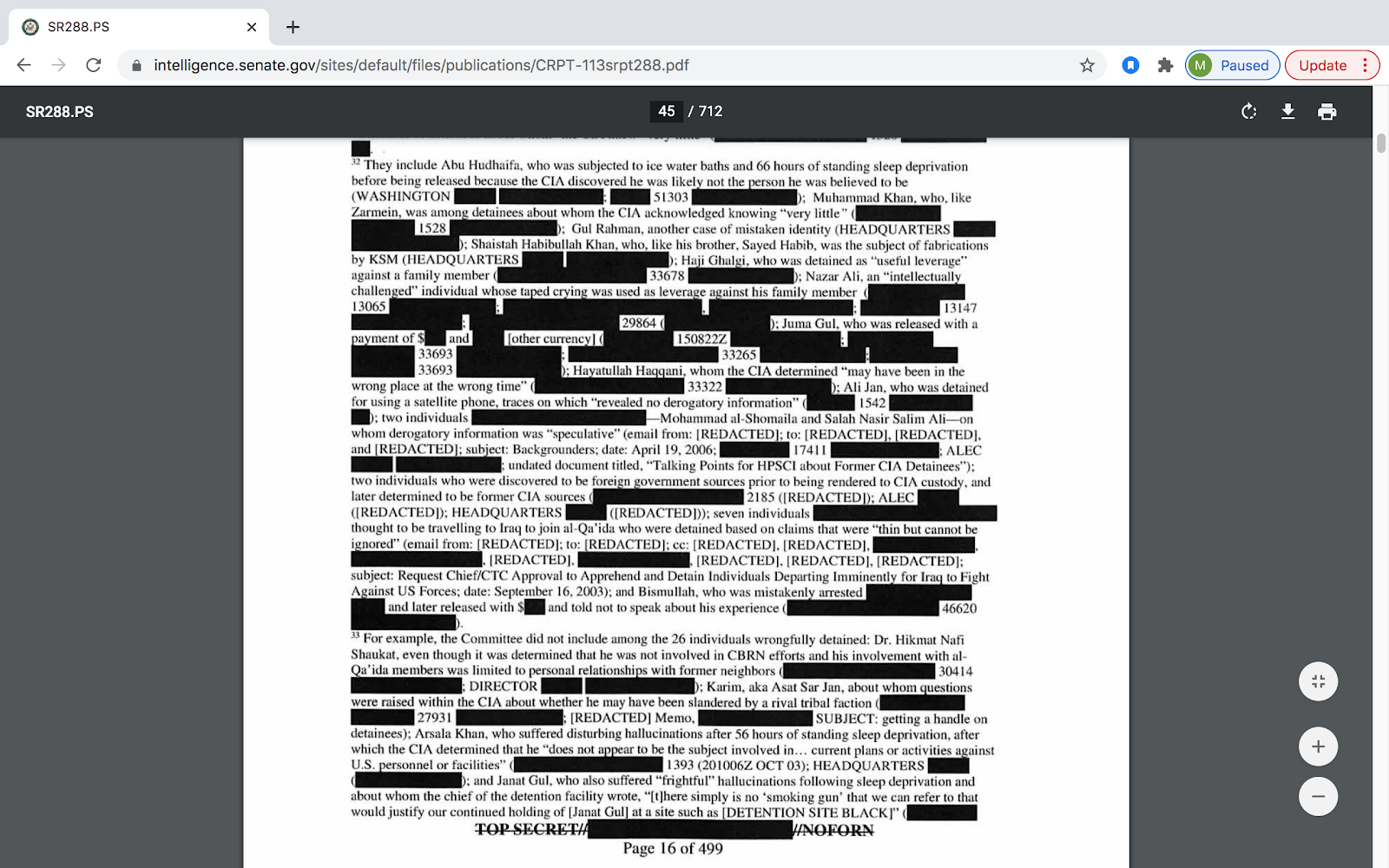
And there’s more. When the exhaustive 6,000-page Senate Intelligence Committee report on torture was finally complete, after five years of investigation and research, Haines took charge of redacting it to deny the public’s right to know its full details, reducing the document to a 500-page, black-ink-smeared summary. 

Page 45 of the redacted Senate Intelligence Committee report on CIA torture.

This censorship went beyond merely “protecting sources and methods”; it avoided CIA embarrassment, while ensuring her own career advancement.

Moreover, Haines supported torture apologist Gina Haspel as Trump’s CIA director. Haspel ran a secret black site prison in Thailand where torture was regularly inflicted on detainees. Haspel also drafted the memo ordering the destruction of almost 100 videotapes documenting CIA torture.

As David Segal of Demand Progress told CNN, “Haines has an unfortunate record of repeatedly covering up for torture and torturers. Her push for maximalist redactions of the torture report, her refusal to discipline the CIA personnel who hacked the Senate and her vociferous support for Gina Haspel — which was even touted by the Trump White House as Democrats stood in nearly unanimous opposition to the then-nominee to lead the CIA — should be interrogated during the confirmation process.”

This sentiment was echoed by former Sen. Mark Udall, D-Colo., who was a member of the Intelligence Committee when it finished the torture report. “If our country is going to turn the page on the dark chapter of our history that was the CIA’s torture program, we need to stop nominating and confirming individuals who led this terrible program and helped cover it up,” he said.

Another reason Haines’ nomination should be rejected is her support for the proliferation of killer drones. There has been a concerted effort by former Obama colleagues to paint Haines as a voice of restraint who tried to pro­tect­ civil­ians. But according to former CIA whistleblower Kiarikou, Haines regularly approved the drone bombings that killed not only suspected terrorists but entire families, including children, who died as collateral damage.”It was Avril that decided whether it was legal to incinerate someone from the sky,” said Kiriakou.

When human rights groups denounced Obama’s rash use of extrajudicial killings, including the assumption that all military-age males in a given strike zone were “enemy combatants” and therefore legitimate targets, Haines was enlisted to co-author a new “pres­i­den­tial pol­i­cy guid­ance” to tighten the regulations. But this new “guidance,” issued on May 22, 2013, continued to blur the line between civilians and combatants, nor­mal­izing tar­get­ed assas­si­na­tions and effectively repudiating the “presumption of innocence” that has been the bedrock principle of civilian law for more than 800 years. 

The drone playbook, “PROCEDURES FOR APPROVING DIRECT ACTION AGAINST TERRORIST TARGETS LOCATED OUTSIDE THE UNITED STATES AND AREAS OF ACTIVE HOSTILITIES,” says on page 1 that any “direct action must be conducted lawfully and taken against lawful targets,” yet the guidelines never reference international or domestic laws that define when extrajudicial killings outside an active war zone are permitted. 

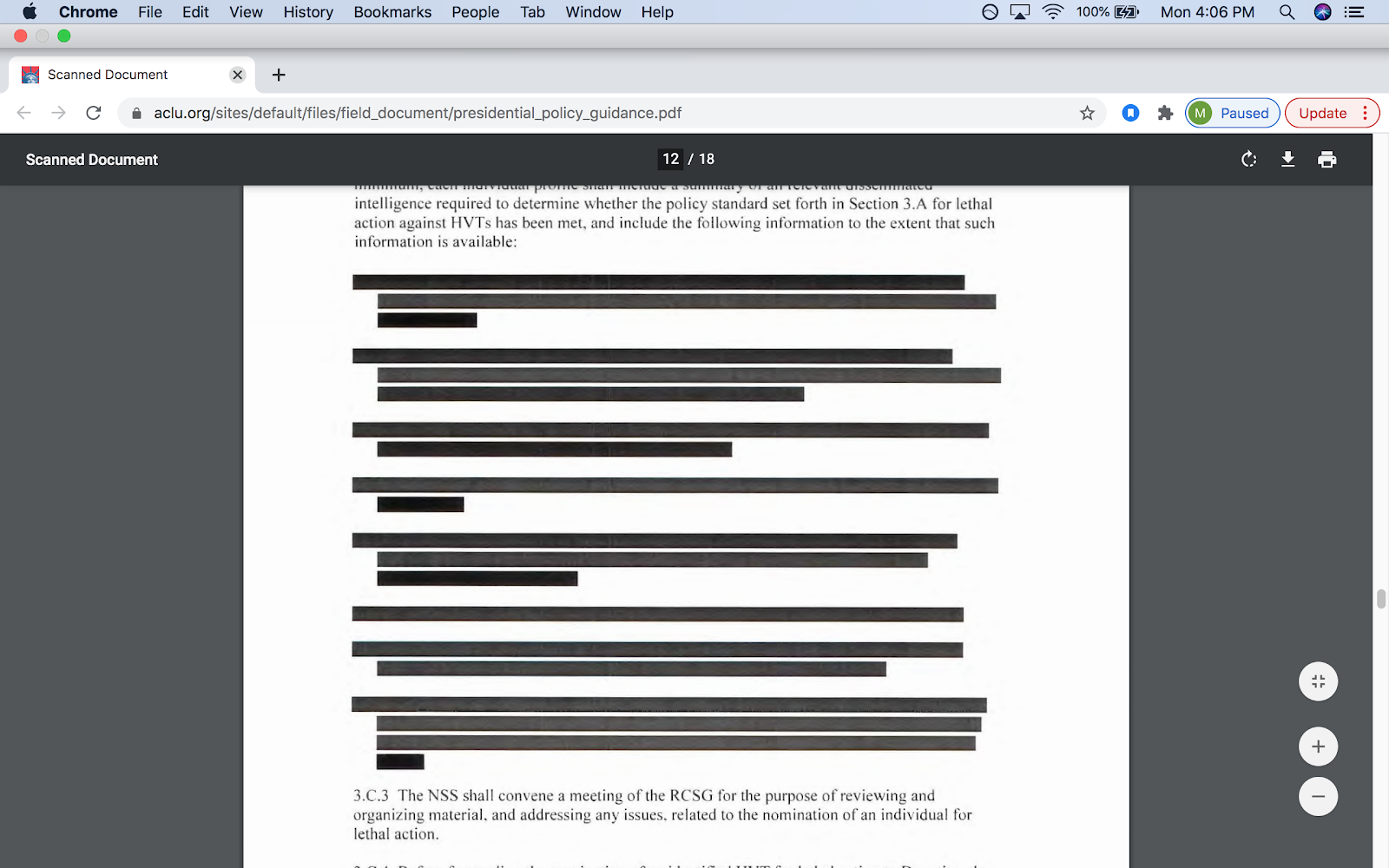
On page 4, the guidelines for drone strikes allow for lethal action against those who are not “high value targets,” without explaining the criteria the CIA would use to identify someone as an imminent threat to the security of the United States. On page 12, the co-authors, Haines among them, redacted the minimum profile requirements for an individual “nominated” for lethal action. The very term “nominated” suggests an effort to sugarcoat targeted assassination, as though the bombing target were being recommended for a presidential Cabinet position. 

t

Page 12 of Haines’ guidelines for extrajudicial killings. Required generic profile entries for individuals “nominated” for lethal action are redacted. 

Moreover, the guidelines themselves were often totally disregarded. The policy states, for example, that the U.S. “prioritizes, as a matter of policy, the capture of terrorist suspects as a preferred option over lethal action” and that lethal action should be taken “only when capture of an individual is not feasible.” But the Obama administration did nothing of the sort. Under George W. Bush, at least 780 terrorist suspects were captured and thrown into the U.S.-run gulag in Guantánamo. Haines’ guidelines prohibited transfer to Guantánamo, so instead suspects were simply incinerated.  

The guidelines required “near certainty that non-combatants will not be killed or injured,” but this requirement was routinely violated, as documented by the Bureau of Investigative Journalism.

Haines’ policy guidance also states that the U.S. would respect other states’ sovereignty, only undertaking lethal action when other governments “cannot or will not” address a threat to the U.S. This, too, became simply empty words on paper. The U.S. barely even consulted with the governments in whose territory it was dropping bombs and, in the case of Pakistan, openly defied the government. In December 2013, the National Assembly of Pakistan unanimously approved a resolution against U.S. drone strikes in Pakistan, calling them a violation of “the charter of the United Nations, international laws and humanitarian norms.” Pakistan’s former Prime Minister Nawaz Sharif stated: “The use of drones is not only a continual violation of our territorial integrity but also detrimental to our resolve and efforts at eliminating terrorism from our country.” But the U.S. ignored the pleas of Pakistan’s elected government.

The proliferation of drone killings under Obama, from Yemen to Somalia, also violated U.S. law, which gives Congress the sole authority to authorize military conflict. Obama’s legal team, which included Haines, circumvented the law by insisting that these military interventions fell under the 2001 Authorization for the Use of Military Force (AUMF), the law Congress passed to target Afghanistan in the wake of the 9/11 attacks. This specious argument provided fodder for the out-of-control misuse of that 2001 AUMF which, according to the Congressional Research Service, has been relied on to justify U.S. military action at least 41 times in 19 countries. 

In addition, the guidelines don’t even require the CIA and other agencies participating in the drone program to notify the president — the commander in chief of all U.S. forces — as to who is to be killed in a drone strike, except when a targeted individual is a U.S. citizen or when the agencies in charge cannot agree on the target.

There are many other reasons to reject Haines. She advocates intensifying crippling economic sanctions on North Korea that undermine a negotiated peace, and “regime change” — hypothetically engineered by a U.S. ally — that could leave a collapsed North Korea vulnerable to terrorist theft of its nuclear material. She was a consultant at WestExec Advisors, a firm that exploits government connections to help companies secure plum Pentagon contracts. She was a consultant with Palantir, a data-mining company that facilitated Trump’s mass deportations of immigrants.

But Haines’ record on torture and drones, alone, should be enough for senators to reject her nomination. The unassuming spy — who got her start at the White House as a legal adviser in the Bush State Department in 2003, the year the U.S. invaded Iraq — might look and sound more like your favorite college professor than someone who enabled murder by remote control or wielded a thick black pen to cover up CIA torture. But a clear examination of her past should convince the Senate that Haines is unfit for high office in an administration that promises to restore transparency, integrity and respect for international law.  

Democracy headache: More than 70 percent of Trump voters distrust the best-run election in years

Angela Clark-Smith, a lawyer, started learning about the intricacies of observing elections when she was a member of the same sorority as Vice President-elect Kamala Harris. In 2020, three decades later, she was deployed by the Georgia Democratic Party to observe the presidential election and, most recently, the processing of returned absentee ballots in its Senate runoffs.

“There’s a process. It is very straightforward,” Clark-Smith said during a break at an early voting center in an Atlanta suburb, where she praised poll workers and the process of verifying signatures on ballot envelopes and flagging problems for follow-up with voters. “Watching it was like watching a work of art.”

Elections in Georgia are better run than those in many blue states. But as the state has become a national battleground following Joe Biden’s narrow win there and during Senate runoffs that could return control of Congress to the Democrats, the artful process that Clark-Smith has seen and praised has become a “circus,” she says.

Clark-Smith witnessed the turmoil that is tearing apart American democracy: where partisans do not understand the process; do not know what they are seeing as they view election administration up close for the first time; and are part of a tidal wave—nearly three-fourths of Republicans, according to an NPR poll conducted in early December—who don’t trust that the 2020 election results are accurate.

“It went from a really dignified process to feeling it was like a circus,” Clark-Smith said, referring to the Republican observers who came to watch the initial processing of the runoff’s absentee ballots. “You had people who were jumping on tables and making accusations. There was this one man who said, ‘We should count this vote!’ And I’m like, ‘Sir. It’s a write-in vote for Mike Pence. He’s not on the ballot! Relax… Sit down… Come on!”

A Deepening Democracy Crisis

American politics and elections have always had dark sides: Suspicions versus inquiries. Fictions versus facts. Conspiracies versus realities. Yet the darker impulses seem to be worsening. In every close presidential election since 2000, growing numbers of partisan activists and voters whose side lost are angrier.

The 2020 election stands apart because the president has been leading this truculence by making false claims to rally his base, raise hundreds of millions of dollars and dangle extremist courses to stay in power, such as recently floating a declaration of martial law. Trump’s anti-democratic antics and sowing of wide distrust of electoral institutions are in a class by themselves. No foreign power has made as persistent an attack on American democracy.

There are other differences between 2020 and recent presidential elections that roiled voters. In 2000 and 2004, and then in 2016, voting rights reformers called out structural deficiencies—not fantasies. It was a real problem that all-electronic voting systems meant that ballots could not be recounted. It was a valid concern that central counting nodes could be tweaked by local election officials or their contractors to tilt outcomes, or theoretically infiltrated by computer hackers.

By 2020, some of these top criticisms had been addressed. Russian interference in 2016’s presidential election was an unanticipated impetus to replace or shore up voting systems. Reformers’ demands, such as using paper ballots and better vote count audits, were adopted. Other demands, mostly from progressives who could not accept that Republicans had again won, fell on deaf ears. Those demands, such as abandoning electronics in voting systems, have been seized by Trump backers.

What is more ironic from an election administration perspective, however, is that 2020’s general election has been one of the best-run elections in years. The same can be said of the early voting for Georgia’s Senate runoffs, which culminate in a January 5 election. The positive outlook on the 2020 elections is supported by facts, which Trump and his supporters ignore as they make baseless claims to the contrary.

No election is flawless. That’s especially true of presidential contests, such as this fall’s election where 158.2 million people cast ballots in a national exercise staffed by 900,000-plus citizen poll workers. There are always poll worker errors, uncounted votes and some people voting illegally. Most lapses are due to human error and do not affect the outcomes in major races. Those issues were seen in isolated instances in presidential battlegrounds this fall. Yet consider the objective measures about the larger contours of the 2020 general election.

Record numbers of voters participated—even in a pandemic. Automatic and online voter registration has never been as widespread. Voters had more options to cast ballots than ever: by mail, voting early or on Election Day. Never before have as many voters cast mailed-out ballots or voted early. Almost everyone cast paper ballots. More vote counts were double-checked by audits and recounts than ever. The counting process was widely streamed online and has never been as public. Georgia’s presidential ballots were counted three times each using a different methodology—including an unprecedented manual count. Each count reaffirmed that Biden won. This catalog of election administration achievements is remarkable.

But it is also indisputable that these facts barely matter in some important circles. More than a few Americans, possibly tens of millions (if recent polls accurately represent the rest of the nation’s 74 million Trump voters), will wince when Biden puts his hand on the Bible on January 20 to be sworn in. Some voters still expect that Trump will serve a second term. How these Trump supporters will react in the short and long run is not a trifle. Their response will impact what follows every major election, which are the lessons learned and the reform agendas for states and Congress.

When Mobs Are Swayed

When multitudes believe that elections cannot be trusted, democracy is in trouble. Those believers in 2020 include scores of Republican members of Congress, state attorneys general and legislators, all who signed onto pro-Trump lawsuits seeking to overturn the popular vote in their state—or more outrageously, in other states. Those lawsuits were filled with fabrications, shoddy analyses and lies that were overwhelmingly rejected by dozens of state and federal judges. Some of these same assertions have been recurring in GOP-led lawsuits targeting Georgia’s runoffs. They are being rejected there as well. But these narratives have not disappeared from the court of public opinion, especially in right-wing media, whose audiences grow in response to baiting and fanning their fears and fantasies.

Many constitutional scholars believe that the country was lucky that Trump’s lawyers overplayed their post-election cards. Had the 2020 election hinged on a single state, legal experts believe that the country could now be in a constitutional crisis. They doubt that a single state’s laws and top officials could have withstood this White House’s pressure to select—not elect—Trump as its Electoral College winner. Some Republicans in Congress, nonetheless, are still expected to challenge ratification of Biden’s Electoral College victory on January 6. But a continuing Democratic majority in the House ensures that Biden will be sworn in as the next president on January 20.

The incompetence of Trump’s legal team and its allies is one thing. Their power-hungry guile and ongoing effort to subvert the electoral process is another. And the willingness of more than 70 percent of Republicans to distrust the results, according to NPR’s poll, is most disturbing of all.

Polls are imperfect snapshots of a slice of voters in any given moment. One can hope that the Trump team’s ongoing failures to win election lawsuits will sink in and shrink the numbers who distrust 2020’s results. But they probably will not, because these court defeats address false claims, not deeper feelings.

For example, in Georgia, the Republican lawsuits targeting the Senate runoffs have tried to disqualify hundreds of thousands of voters. The lawsuits cite a government database to posit that these voters are no longer state residents—rendering them ineligible to vote. But that database, the post office’s national change of address file, was never intended to track voters. It mostly lists heads of households and addresses, not every person living at an address and every voter. Judges and county election boards have been rejecting the illegal voter claims. One result has been that the early voting turnout in the Senate runoffs has rivaled the general election. Accommodating high voter turnout is a sign of a well-run election.

But there’s a disconnect. On one hand, those attacking the process in Georgia and disparaging the presidential results say that the electoral sky is falling. But quieter multitudes have found that it has been easier to vote in 2020, even during the pandemic. This is because there were more voting options in 2020: in person or via a mailed-out ballot, early or on Election Day. (Georgia Secretary of State Brad Raffensperger, a rare Republican who has stood up to Trump, said on December 23 that local officials are “overwhelmed” and called on the state’s GOP-led legislature to reinstate the requirement that Georgia voters need an excuse to get a mailed-out ballot. Democrats won’t be pleased if that proposal gains traction in 2021.)

Normally, in years when the presidency changes party, the period between early November’s Election Day and late January’s Inauguration Day is a time when experts seek to influence a new administration. In the election fold, however, some of the biggest players have been notably quiet. Some privately say that the attacks by Trump and his allies are still a big and unfolding crisis—a bonfire that won’t disappear until he leaves office. The harms being unleashed, at least among the voters who backed Trump, may take years to undo.

Nonetheless, there has been some talk among elections experts since November 3 about what to do next in Congress and state capitals. Many of these experts from different disciplines have suggestions on how to fine-tune the voting process. Constitutional scholars say that holes in 19th-century law must be filled so that another president cannot overrule a popular vote and have state legislatures select him for a second term. Voting rights lawyers want to ward off efforts to shrink voting options, such as Raffensperger’s move to reel in Georgia’s absentee ballot program. Those talks are happening as Trump and his allies keep attacking the electoral process. But the full damage Trump has done to America’s elections has yet to emerge.

Way Beyond Seeds of Doubt

Why do so many people believe elections are stolen if their presidential candidate loses? There’s no one answer. From an election reform perspective, the fact that the intricacies of election administration are not readily apparent—or self-evident to untrained observers—does not help. But when so many partisans have a predisposed view that ranges from suspicious, to paranoid, or even conspiratorial, it is clear that something deeper is going on to trigger these assumptions and impulses.

Brené Brown, one of America’s best-known trauma experts, recently said in a New York Times podcast that the most aggressive Trump campaign t-shirts—those saying, “Fuck your feelings”—are overly defensive and are a reflection of people who are struggling rather than embracing some high-minded cause. Apart from how that emotional dynamic unfolds politically, it means that election officials and expertsseeking to improve America’s elections are facing hurdles that cannot be cleared solely by emphasizing facts, instituting best practices, and producing better evidence of vote counts. If the mistrust of elections is as deep as polls suggest, one must ask what solutions can address the underlying triggers, so elections are not collateral damage in a wider societal or cultural schism.

American elections are not perfect. In the 21st century, they are privatized as never before. They are overly complex, meaning that impassioned citizens who race to election centers to observe cannot readily grasp what they are seeing. The many stages of the process, from the starting line of voter registration to the finish line of certifying the vote count, take years to learn, appreciate and unwind. These steps and stages are not sufficiently self-evident, which fans conspiracies.

One might like to think that there is a silent majority of Americans who have figured out how to ignore the noise and vote in a pandemic—even in numbers that have not been seen before. One can look to Georgia and see such turnout in its presidential election and in the early voting in the Senate runoffs. One might hope that there were more Republicans, such as Georgia’s secretary of state and governor, who said “no” to Trump’s demand that they select him as their state’s Electoral College slate winner—ignoring the results of the 5 million votes cast by Georgians.

But elections will always be about power. There is usually more than one reason why political leaders do anything. Raffensperger might be saying that he wants to end no-excuse absentee voting in Georgia because county officials cannot handle the extra workload. That policy, should it be enacted before the 2022 governor’s race, could undermine turnout. That impact may help a fellow GOP incumbent, Gov. Brian Kemp, who will be seeking reelection.

Is that an unduly cynical take? Perhaps. Or perhaps it shows why elections can become mirrors of societal distrust. Even if the process met challenges in 2020 and empowered record numbers of Americans to vote, some of the candidates seeking high office were less honest and less straightforward than the electoral process was. In 2020, the democratic process, if viewed apart from some candidates, might be better than ever. But American elections cannot be divorced from the candidates, especially not in the Trump era.

When America faces a leader with totalitarian impulses who thinks he can will his way into another term, it is also facing its greatest democratic crisis in decades. The passage of time always heals wounds, including political wounds. But what can be done to revive public trust in elections in the meantime is not just an open-ended question. Democracy’s fragile skin has been stretched as never before, when tens of millions of voters say that they don’t trust the results from the best-run election in years.

This article was produced by Voting Booth, a project of the Independent Media Institute.

Don Corleone with an unlimited “get out of jail” card

The 41 pardons Donald Trump granted last week drew a lot of attention, but few seemed to notice the message Trump sent by not pardoning some.

Trump’s choices made clear he is a crime boss.

Four Blackwater mercenaries who, working for Trump ally Erik Prince murdered Iraqi civilians, were pardoned. But there was no pardon for Jeremy Ridgeway, the soldier-for-hire who pleaded guilty to manslaughter, testified against the others and was sentenced to a year and a day in federal prison.

Roger Stone, dirty trickster confidant; former General Michael Flynn, national security adviser who was on the Kremlin payroll; and 2016 campaign manager Paul Manafort were pardoned. But Trump didn’t pardon Manafort deputy Rick Gates, who turned state’s evidence and confessed.

Earlier, Trump pardoned Rod Blagojevich, the former Illinois governor convicted of trying to sell a Senate seat. But there was no pardon for lawyer Michael Cohen, Trump’s longtime fixer who confessed to committing felonies at the direction of unindicted co-conspirator “Individual 1,” identified in federal court as Trump.

In true mobster fashion, Trump once referred to Cohen as a “rat” for confessing. He praised Manafort for not “flipping” to testify against him.

The names of those pardoned, and sometimes the names of those not pardoned, have appeared in news reports and opinion columns, but there was no connecting the dots to show the pattern and its meaning. The pattern reveals a  crystal  clear message to lawyers for those considering ratting out Trump or  already working with authorities to rein in the Trump crime family:

The boss takes care of friends and allies if they lie for the boss or keep silent, but does nothing for those who cooperate with law enforcement.

Given Trump’s many attacks on the FBI and other law enforcement, this should surprise no one, especially journalists. Yet my fellow journalists didn’t point this out.

Missing the story

How is it that none of our major news organizations figured this out? Hint: They rely too much on the official version of events, official announcements, and access instead of thinking and exercising reportorial authority. They are afraid they will be seen as biased or tendentious.

If Trump declared the sun rises in the West, many news organizations would avoid reporting that as false, crazy, or nonsense. Some would focus on how the sun only appears to rise, never mind that it appears to rise in the East.

The pardons issued so far raise grave questions about the future of our democracy. The actions have received less comment than outrage over the brazen abuse of the pardon power, especially as part of a scheme to obstruct justice.

Think about what will happen if someone as lawless as Trump ever again becomes president. Imagine a president with much more skill, smarts, and vigor, and one with better lawyers. A future president could use the pardon power to protect elaborate criminal schemes, to subvert the Bill of Rights, to frame political opponents, and even direct political murders so long as they were committed in federal jurisdictions. The presidential pardon, remember, applies only to federal crimes.

Trump behaved last week exactly as any crime boss would act if he could exercise the powers of the American presidency:

Show mercy to criminals, especially criminals who have aided your crimes or whose supporters may be useful to you in the future, but do nothing for those who did the right thing once they were caught and helped bring others to justice.

Trump helps cocaine trafficker buddy

This is exactly what Trump, as a private citizen, did in a series of extraordinary favors for a major international cocaine and marijuana trafficker with whom he had extensive, close business ties.

In that case, Trump sought mercy for three-time felon Joseph Weichselbaum. The trafficker managed and piloted Trump’s helicopter in the 1980s, supplied Trump with a fleet of helicopters to ferry high rollers to Atlantic City, and rented a luxury Manhattan apartment from Trump under a lease that obscured rent costs.

In a 1986 letter to the sentencing judge, Trump called Weichselbaum “a credit to the community.” Trump wrote Weichselbaum should serve no prison time for a long-running scheme in which 20-year sentences went to the mules—people who drove cars and vans loaded with drugs from Miami to Cincinnati.

Carefully read, Trump’s letter was really directed not at the judge, but at Weichselbaum.

Trump’s clear message to his buddy: Don’t rat me out and I’ll take care of you.

Cocaine trafficker Weichselbaum spent just 18 months in a Manhattan prison. He paid only a token sum on his $30,000 federal fine because he said he was broke. Yet, he moved from prison to a $2.4 million double apartment at Trump Tower. The Trump Organization also gave him a new job—as Trump’s helicopter consultant.

Now is the time to demand that Congress act to protect us from a future lawless president so the pardon power cannot be a balm to criminal pals and an ax to eviscerate our liberties and our control of our government.

How Georgia voters can transform America’s future

Vermeshia Slay burns up the phone lines these days, encouraging Georgia voters to join the burgeoning grassroots movement to transform America’s future.

After delivering a crucial victory for Joe Biden in November, Slay and millions of other change-hungry Georgia voters set their sights on something even bigger.

They want to help the new administration put America on the path to health and shared prosperity.

By electing Reverend Raphael Warnock and Jon Ossoff in the state’s January 5, 2021, runoff elections for the U.S. Senate, Georgians will lock in congressional support for Biden’s agenda to defeat COVID-19 and build an economy that works for everyone.

Moving America forward matters so much to Slay, an American Red Cross laboratory worker and unit chair of United Steelworkers (USW) Local 254, that the longtime voter threw herself into campaigning for the first time.

Slay operates a one-person phone bank from her suburban Atlanta living room, urging one registered voter after another to join the surge of Georgians pushing their state—and the country—in a fresh direction. She wants voters to make sure they grasp the importance of electing Warnock and Ossoff and giving Democrats a Senate majority in January 2021.

Many of those on the other end of the line tell her, “We’re with you.”

More than a million Georgians requested mail-in ballots for the runoffs, and hundreds of thousands lined up the week before Christmas for the start of early balloting—more signs that the voters who turned out in record numbers for Biden want a further hand in charting America’s future.

“It’s a lot of people coming together and standing up for what’s right,” Slay said, noting that young votersBlack womensuburbanites and beleaguered health care workers, among many other groups, coalesced into a movement for change.

Their goals include social justice, economic equality, affordable health care and an end to a pandemic that’s wiped out far too many lives and jobs.

“I think everybody is about fed up,” declared Slay, who saw her own hours at the Red Cross temporarily reduced when COVID-19 affected blood collection efforts this past spring. The experience gave her a firsthand look at the financial challenges many of her neighbors faced even before the health crisis struck.

She knows Warnock, who grew up poor in a very large family, and Ossoff, an investigative journalist who rooted out crimes like sexual slavery and human trafficking, will help push through a long-overdue, robust stimulus package to help Americans battling to survive the recession.

Since May, the House twice passed the Health and Economic Recovery Omnibus Emergency Solutions (HEROES) Act to support millions of laid-off workers and jump-start the economy.

Americans demanded the Senate pass the HEROES Act as well. However, Senate Majority Leader Mitch McConnell, who cares more about protecting the corporations that recklessly exposed workers to COVID-19 than he does helping destitute families, refused for months even to consider the bill.

Rather than demand the Senate take up the legislation and address a spiraling crisis devastating many of their own communities, Georgia’s incumbent senators stood idly by and were McConnell’s silent partners in hanging the American people out to dry. Adding insult to injury, these super-rich incumbents profited from highly lucrative stock trades while their constituents struggled to put food on the table and protect their families from the virus.

“It seems like they’re all about keeping the rich, rich,” Slay observed.

While Americans right now need federal unemployment benefits and protection from eviction to endure the pandemic, Slay and other forward-looking voters remain fixed on a much broader agenda that will ensure a brighter, more equitable future for all Americans.

Over the past 40 years, pay for CEOs skyrocketed while workers’ wages stagnated. Long before the recession, rampant income inequalityleft millions of Americans struggling to afford health care and pay regular household bills, let alone prepare for retirement.

The pandemic compounded families’ financial struggles, forcing many to burn through the meager savings they did have.

That’s why voters like Slay can’t wait to help put Biden’s Build Back Better plan into motion. The campaign will restore America’s manufacturing base and overhaul the nation’s infrastructure, creating millions of family-sustaining jobs that rebuild the middle class and spread prosperity to communities across the U.S.

“Ordinary people will have better opportunities,” observed Slay, a single mother who struggled at times to raise two sons and an orphaned nephew. “They want increases in pay. They want their health benefits. They can’t afford to lose anything else.”

Georgia’s new coalition of voters also champions an increase in the $7.25-an-hour federal minimum wage, which traps millions in poverty. And they want to crack down on corporations that take huge tax breaks for plants and mills but pay workers abysmal wages.

“We’ve got to stop corporations from exploiting our people,” said Darryl Ford, president of USW Local 254, noting Kumho Tire in Macon, Georgia, received huge government handouts and then unsuccessfully fought workers who decided to join the USW to achieve decent payand safe working conditions.

“The spotlight is on Georgia,” said Ford, noting Warnock and Ossoff will help Biden level the playing field for ordinary Americans. “We have the ball. It’s fourth down. If we vote, change can come.”

When energized Georgia voters overcame Republicans’ long history of voter suppression to sweep Biden to victory in November, it was exactly the outcome that Slay expected.

Now, she said, she’s pouring her heart and soul into the runoffs because she’s convinced that the wave started in Georgia will spread around the country.

“It makes me feel like I’m making a change,” she said.

Trump goes back to the Supreme Court over his election loss

President Donald Trump’s campaign has filed a second suit to the U.S. Supreme Court using a false report from pro-Trump conspiracy theory website The Epoch Times.

According to the lawsuit, there were alternative slates of electors chosen in swing states. While there were certainly alternative electors chosen, they weren’t chosen by anyone official. They were chose by Trump’s allies.

“While Republicans in Georgia, Pennsylvania, Wisconsin, Nevada and Michigan followed the White House’s lead, making or discussing moves to form their own competing slates of pro-Trump electors, it was a theatrical effort with no legal pathway. Electoral College slates are tied to the winner of the popular vote in each state, and all five of those states have certified their results in favor of President-elect Joseph R. Biden Jr.” the report explained.

You can see Trump’s lawsuit here.

All the space exploration missions to look forward to in 2021

Most of us will remember 2020 primarily as the year of the great pandemic, but let’s not forget how space exploration and astronomy had good years considering the circumstances. NASA astronauts blasted into space in May as part of SpaceX’s Crew Dragon capsule. New research revealed there might be more water on the moon than previously believed. Scientists debated whether or not Venus is harboring life in its clouds after discovering phosphine. Betelgeuse continued to dim, raising suspicions that it might soon go nova. Researchers noticed an excitingly odd series of radio signals.

While 2021 won’t magically reset our reality, there is a lot to look forward to next year, especially in the realm of space news. Even if you aren’t a space enthusiast, it’s amazing what experiencing a little wonder and awe can do for your mindset. It helps put into perspective our place in the world and reminds us that we are part of something bigger; learning about our universe is a great way to tap into that. If you’re feeling like there’s nothing to look forward to next year, consider adding one of these missions to your list.

NASA to launch Q-PACE

Originally planned to be launched earlier this month, the CubeSat Particle Aggregation and Collision Experiment (Q-PACE) is now scheduled to take off from the Mojave Air and Space Port on January 15, 2021. Q-PACE is a 3U CubeSat, a type of small, modular spacecraft, designed for studying the collision and aggregation of small particles in a chamber as part of a three-year microgravity experiment. The objective of the mission is to develop a database of small-particle interactions in microgravity at low velocity. This information will help researchers better understand the process of early coagulation which led to planet formations.

“The Q-PACE mission will last up to three years, providing the opportunity to study adhesion and fragmentation events that happen only rarely, such as near-simultaneous collision of three or more particles,” NASA explains about the mission. “The mission will proceed over several phases with the introduction of different types of particles into the ETC, beginning with large solid spherical particles, and finishing with aggregates of micron-sized dust and chondrules.”

Mars2020 will finally get to work

2021 will be the beginning of a new chapter in the field of Martian discoveries. Over the summer, the mission Mars2020 launched into space. But come February 18, 2021, the Perseverance rover will finally land on Mars’ Jezero Crater. Its mission is expected to last 687 Earth days, or one Martian year.

According to NASA, the primary science objectives of Mars 2020 are “to identify past environments capable of supporting microbial life, seeking signs of possible past microbial life, collecting core rock and regolith samples and caching them on the surface for future missions, and testing oxygen production from the martian atmosphere.”

One of the most exciting parts of the mission is that the collected samples will be returned to Earth. Sample return missions are extremely uncommon due to their expense; notably, there has never been a sample return mission from another planet. 

“Returning samples of Mars to Earth has been a goal of planetary scientists since the early days of the space age, and the successful completion of this MSR [Mars Sample Return] key decision point is an important next step in transforming this goal into reality,” said Thomas Zurbuchen, associate administrator for science at NASA Headquarters. “MSR is a complex campaign, and it encapsulates the very essence of pioneering space exploration – pushing the boundaries of what’s capable and, in so doing, furthering our understanding of our place in the universe.”

As part of the Mars2020 mission, NASA will also deploy the Ingenuity helicopter from the rover to study the Martian atmosphere. This will help NASA study how to produce oxygen from Mars’ carbon dioxide atmosphere, an important step for the future of human exploration on Mars.

The Parker Solar Probe will make two more Venus flybys

The car-size probe, which launched in 2018, is scheduled to make its fourth and fifth Venus flybys, in February and October, respectively, in 2021. The two flybys are part of a longer journey to arrive at its closest proximity to the sun in 2025.

As Salon previously explained, these flybys are unique as they are leveraging the gravity of Venus to slow the probe down for its arrival in a close orbit around the sun. The probe will do seven flybys over seven years.

“Though it sounds bizarre, the laws of physics allow for any two objects with mass to exchange their momentum in a manner that speeds one up while slowing the other down,” Salon’s Keith Spencer explained previously. “This method that is frequently used to send spacecraft to distant reaches of the solar system without using as much fuel to speed up as they would have otherwise.”

James Webb Space Telescope launch

On October 31, 2021, the nearly $9 billion James Webb Space Telescope — the successor to the Hubble Telescope — will launch from a port near Kourou, French Guiana. Its mission is to observe the first galaxies that formed in the early universe, in addition to see stars forming planetary systems. According to NASA, it will be the leading observatory of the 2020s and help thousands of astronomers worldwide.

“[James Webb] will study how the first stars were very different from the stars around us today, because there were no metals that make up the stars of today,” said Massimo Stiavelli, Mission Head, Space Telescope Science Institute, in an interview with NasaSpaceflight.com. “Stars had to make those.  [James Webb] is the only telescope designed to study those early epochs.”

The Lunar Polar Hydrogen Mapper will map water on the moon

Scientists previously suspected that water existed in the shadowy, cold parts of the moon — such as its poles, where it would stay frozen — but a pair of studies published in 2020 confirmed that there is a large amount of water on its sunlit regions, too. The Lunar Polar Hydrogen Mapper (LunaH-Map) will further our knowledge of water on the moon by orbiting the moon with the objective of determining the amount of water ice exists in the permanently shadowed lunar polar craters. It will do this by using a miniaturized neutron spectrometer to count epithermal neutrons. The shoebox-sized spacecraft will launch no later than November 2021.

Correction: A previous version of this article stated “687 Earth days, or one Earth year.” 687 Earth days is one Martian year. 

Voter suppression efforts ramp up ahead of Georgia runoffs: Poll closures hurt Black, Latino voters

Voting rights groups are warning that early voting site closures in Georgia are limiting Black and Latino turnout in the state’s two highly-anticipated Senate runoff elections even as a federal judge on Monday ordered two counties to reverse a decision purging more than 4,000 voters from the rolls.

Election officials in Hall County, which is located about an hour northeast of Atlanta and includes Gainesville, have opened four early voting sites, down from eight locations in the November election. The county is home to more than 200,000 people, nearly 40% of whom are Latino or Black. Multiple advocacy groups said that the closures were centered in areas with large Black and Latino populations, HuffPost reported. 

“This is what voter suppression looks like,” Tania Unzueta, the political director of the Latino voting rights group MiJente Support Committee, said during a conference call with reporters. “This is one example of what we don’t want to happen, particularly in an important runoff.”

The groups echoed former gubernatorial candidate Stacey Abrams, who called out the county over its poll closures last week. “In Hall County, there’s a very large Hispanic population that’s being disenfranchised because they’ve cut the number of early voting locations. We’re fighting hard to restore them,” Abrams said.

It was Abrams’ sister, U.S. District Judge Leslie Abrams Gardner, who ruled that two other Georgia counties improperly moved to remove a tranche of voters’ names from their rosters without proving that the voters had actually given up Georgia residences. 

“Republicans do not know how to win without voter suppression as one of their tools,” Stacey Abrams told CNN after her sister’s ruling. 

“Voter suppression is their modus operandi,” Abrams, the founder of the nonpartisan voter access-group Fair Fight, explained. “It is not a partisan effort; it is a people effort. We will stay hard at work through Fair Fight … in Georgia and around the country to defend the right to vote and to defend access to the right to vote.”

Republican Sens. David Perdue and Kelly Loeffler are facing challenges from Democrats Jon Ossoff and Rev. Dr. Raphael Warnock, respectively. The races will determine which party controls the Senate next term.

Nearly 1.9 million voters have already cast ballots in the election, almost half of all the early votes cast in the general election, according to The Associated Press. But Michael Pernick, an attorney for the NAACP Legal Defense Fund’s voting rights project in Georgia, said turnout in Hall County was just 13% as of Tuesday, well below the statewide numbers and the county’s early turnout rate in the November election, according to HuffPost. Some voters have shown up to the wrong locations after using them to vote in November, according to WXIA-TV.

County officials said that their turnout models showed that the additional early voting locations were not needed, according to the groups, but Pernick argued that “the reason Hall County’s turnout is lower in the runoff is because Hall County cut early voting locations.”

“We know this because turnout is up in almost every other county in the state, but not in Hall,” he added. “This isn’t theoretical or hypothetical.”

Civil rights groups previously sounded the alarm over early polling site closures in Cobb County, prompting officials to agree to open two more voting sites. The NAACP, American Civil Liberties Union, and other groups called on Hall County officials to add at least two more locations in a letter last week.

“We are especially concerned that these closures harm Hall County’s Latino and Black voters because many of the locations are in Latino and Black communities,” the letter said, noting that voters in a Latino community that lost an early voting site would now have to travel more than seven miles to a location that is not served by public transit.

“This community, they’re enthusiastic to vote,” Elton Garcia of the Georgia Latino rights group GALEO, said according to HuffPost. “But this closure of early voting sites adds another barrier.”

Jerry Gonzalez, the group’s CEO, said that the county has refused their request and also declined to offer bilingual voting guides or Spanish interpreters.

“Hall County has consistently chosen to make things more difficult,” he said. “Every opportunity the county has had to expand access to voters, the county has chosen not to do that.”

President Donald Trump carried the county with more than 70% of the vote in November but the groups argued their requests weren’t partisan.

“We care about Latino voters, whether they’re Democratic or Republican,” Miranda Galindo, an attorney for the voting rights group LatinoJustice PRLDEF, said according to the report. “This is about voter suppression of an entire community of minority voters in Hall County.”

The groups previously focused on Cobb County, where more than 40% of the roughly 750,000 residents are Black or Latino. President-elect Joe Biden carried the county by about 14 percentage points. County officials opened just five early voting sites, down from 11 in the November election. The advocacy groups argued that many of the closures were in heavily Black and Latino areas.

County officials said they did not have enough trained staff to maintain more early voting locations but the advocates argued that the closures had resulted in diminished turnout.

“During the first couple of days of early voting, the data has shown that the harm to voters remains severe, Cobb County has had extremely long lines — in some cases as long as two hours. At the same time, the overall turnout in Cobb has gone down,” Pernick told NBC News last week, even as turnout surged in other counties.

After the county agreed to add two more early voting locations by December 28, the groups sent another letter to county officials arguing that data showing long lines to kick off early voting means that the “steps taken by the County were insufficient and the decision not to keep more advance voting locations open is making it more difficult and less safe for Cobb County voters.”

The data, the letter said, shows that voters regularly experienced two-hour wait times, “significantly longer than in other major metro counties,” while the number of votes cast at the available voting sites had increased by as much as 50%. Despite the long lines, the groups said, the county’s turnout rate was just half of that in nearby Fulton and DeKalb counties.

Two other voting rights groups, The New Georgia Project and Democracy Docket, filed lawsuits against four other counties for failing to provide enough early voting locations last week.

The lawsuit argued that Bibb, Clarke, Houston, and Paulding counties were not offering early voting on Saturdays, as required under state law. Election officials argued that the law only requires weekend voting in primary and general elections, not runoffs.

“With control of the U.S. Senate hanging in the balance,” Democracy Docket said in a statement, “Republicans are already making a concerted effort to suppress the vote in Georgia.”

“Maternal hostility” may predict whether one mistreats their adult romantic partners

A new study suggests that there is a close connection between people who dehumanize their partners in romantic relationships and whether their mothers treated them with hostility as children. Unusual for an academic journal article, the paper has gone viral due to many readers relating to its conclusions and seeing connections in their own lives.

Researchers from the University of Minnesota and the Australian Deakin University School of Psychology defined dehumanization as “the perception or treatment of another person as lacking qualities considered to be uniquely or essentially human.”

They write that dehumanization usually entails two types of behavior: denying a human being’s uniqueness “such as intelligence, self-control, civility, competency, social refinement, and maturity” or denying a person’s human nature, including their ability to feel emotions

Relying on data from the Minnesota Longitudinal Study of Risk and Adaptation, the authors found that there is a direct correlation between experiencing maternal insensitivity or “hostility” at an early age, and dehumanizing romantic partners later in life.

“Maternal sensitivity reflects a mother’s ability to detect and accurately interpret her infant’s signals and respond to them in a prompt, appropriate manner, thereby meeting the child’s physical and socioemotional needs,” the authors explain. Children who do not receive enough maternal sensitivity may feel that they have been denied the validity of their ability to experience emotions, they write.

“Maternal hostility reflects a mother’s expressions of anger and hostility toward her child, which can entail a lack of regard or the expression of rejection,” they write. “From a dehumanization perspective, hostility conveys that a person is perceived or treated by another as if they are foolish, irrational, or flawed, which reflects the denial of human qualities such as intelligence and rationality.”

The authors focused on mother-child relationships “because it reflects a person’s early life experiences with their primary caregiver.” This is important because “child–caregiver relationships early in life that are characterized by greater hostility, neglect, and abuse tend to have negative downstream effects in the form of poorer romantic relationship functioning in adulthood.”

A number of Reddit users responded to the study, opening up about their own experiences with difficult parents.

One pseudonymous user, who described having an “authoritarian father,” said that they are married to a wife who is a counselor and has helped rein in their own authoritarian instincts. “Every once in a while it instinctively comes out of me when dealing with our kids, particularly my son,” the user writes. “But I’m at least self aware enough now to catch myself when it goes there and reel it back in. Definitely something I have to make an effort to actively manage.”

Another Reddit user recalled, “As an adult in a relationship, whenever my partner gets into a broody [mood], I instinctively retreated into a shell just like my dad did, out of the fear that whatever caused them to get angry was something I did.” The user added that usually they discovered they had done nothing wrong, but that this is a trait they picked up from their parents.

“My wife came from an abusive household and it’s been very important to us that we identify the problems and break the cycle when it comes to our own relationship and when raising our daughter,” a third Reddit user recalled. “I think an important part that is going unsaid is mutual respect. If you and your partner, child or family member have respect for each other it makes communication and constructive development so much easier.”

Best of 2020: Road trip to Powder Keg City — and the collapse of Seattle’s autonomous zone

Day 1: Powder Keg City 6/22/2020

“We fought a good fight,” a man yelled into a megaphone at the end of a conciliatory speech. A group of roughly 25 people sat on their knees listening on the edge of the occupied zone in Capitol Hill, Seattle’s formerly cool, currently hip neighborhood.

Had we just driven 21 hours, from Southern California to Seattle’s autonomous zone, for nothing? 

Across the street was Cal Anderson Park. A congregation of people stood in the middle of its fenced field. Perhaps they had a different take.

“That day I learned something so divine and so incredible,” an activist named David Lewis spoke into the megaphone, “that a seemingly random group of human beings, all founded together with the same vision, with the same drive, of simply justice for the death of George Floyd, and beyond that the passion that Black lives truly do matter, could unite and create something beautiful.”

Around the edge of the field, occupiers packed up their tents. A man named Dragon pleaded, “Why are you leaving?” He was almost in tears. “Stay!” he cried. 

The megaphone was handed off to a lanky man in slippers named Karim.

“I want you to know that you are standing in a war zone. Whether it’s a park, a street, or up the street, you have witnessed people disenfranchised your entire existence, and the moment that they stand up, they got a foot on they fucking necks for everything they’ve been through.”

Seattle Mayor Jenny Durkan had announced that police would disband the occupation “in the near future”, and most likely that night. It was clear that a line was drawn within the zone. Stay and fight, or leave in peace. The group we saw upon arriving, and those packing up their tents, had chosen the latter. The meeting ended with a call to defend the precinct from the imminent raid. 

As the crowd marched up to the police station, we ran back to the car. This was it. We stripped down in the street and geared up for the worst — two pairs of overlapping jeans, a sweatshirt, and a $5 pair of safety goggles.

Back at the precinct, a disorganized mass of delinquents, rebels, anarchists and activists writhed and argued amongst each other. Different alleged organizers roared defense strategies into megaphones. 

“Any white people willing to lay down [on the road in front of the precinct] please come over here,” one of them yelled. 

Another woman stood atop a repurposed police barricade giving a speech. Sirens sounded around the perimeter of the occupation.

Within minutes of arriving at the precinct, an hour after setting foot within the occupation, we stood locking arms with other protesters, creating a human chain around the precinct — our purest intentions of objective coverage out the window. The almighty they had been replaced with we

We didn’t know much. The problem with a scene like this is that most news outlets don’t want to touch it. It leaves you scrolling through endless Twitter threads — a landfill of he-said-she-said, rumors and trolls. 

What we had pieced together during our journey up the West Coast was that, concurrent with uprisings across the country in the wake of George Floyd’s murder, Seattle’s East Police Precinct had become a zone of daily protest. On June 8, the city had abandoned the precinct. 

Around the police station, a six-block police-free zone, guarded by heavily armed activists, anarchists, leftists and the like, was formed. A community grew out of this spontaneous takeover, as various activists set up a coordinated network of services — a food coop, a medic tent, an art department, a security team. Indigenous artists painted and Black musicians performed. Teach-ins and movie nights were held. The Capitol Hill Autonomous Zone (CHAZ) was born.

Tense hours passed, and as police did not show up, we milled around the zone, wading between ski-masked men, eavesdropping on conversations, trying to figure out what was happening. Groups of people ran every which way. A living organism composed of other living organisms, tentacles extending and connecting to form a network so far obscured to the casual observer that it was nearly impossible to tell it was connected at all. A hive mind of uncertainty. 

We introduced ourselves to Rick, an older gentleman with two pistols strapped to his body, a can of mace in his back pocket, black slacks, leather loafers and a sweat-stained tank top under an unbuttoned white shirt loosely concealing the firearms. 

We walked quickly from one side of the street to the other and back, as he briefed us on what was going on. “The organizers are behind the scenes,” he said, preferring to stay underground and strategize. 

“The police are not stupid,” Rick warned, “This is their house, and they’ll take it.” Rick had publicly proposed retreating from the precinct, but continuing to hold the streets. Nobody listened. “Majority rules, and it’s time for me to step back,” Rick chuckled, leaning against a barricade, coffee in hand. 

Across the street at the food coop, a man named Kwan bagged nuts. He asked if we were Youtubers or vloggers. We were writers, we explained, masking our wounded pride with amusement. He told us that when the precinct was abandoned, a power vacuum was created, leaving a number of groups within the area competing for control — who would dictate the narrative, negotiate with city officials, strategize, mobilize the protesters? A recent contentious decision had been the renaming of CHAZ as CHOP, for Capitol Hill Organized Protest.

A brass orchestra assembled behind us, kicking into a blaring version of Pete Seeger’sSolidarity Forever.”

Against the backdrop of the boarded-up police station, a legless man rolled past. “We’re in Powder Keg City,” he shouted.

Kwan described CHOP as different from other protests in Seattle’s past. While focused on police violence against the Black community, the central goal of defunding Seattle’s police and funding impoverished communities expanded toward all members of the working class. 

The muted clap of a fist to a face and the subsequent crack of head to asphalt rang out. “Solidarity Forever” ground to a halt. Rick stood over a limp body, bald head glistening in the streetlights. “No violence! No violence!” he screamed.

A man had attempted to light a gasoline soaked umbrella on fire, and in doing so had broken an unwritten rule of CHOP: No fires. Fires create panic, fires distract, fires signal destruction. For this transgression, Rick had crushed the man’s jaw. Justice was swift and brutal.

A crowd formed, hurling insults at Rick. “He was lighting a fire!” Rick asserted in defense. As witnesses backed him up, the argument was settled. After all, the man had been attempting to light a fire.

In our sleep-deprived minds, we tried to make sense of what we were witnessing. This wasn’t the street fair that Seattle mayor Jenny Durkan had described, nor the anarchist Shangri-La we had envisioned. It was something darker, more hopeful, angry and violent. Think Occupy Wall Street with a “Pulp Fiction” adrenaline needle shot straight into the heart of an open-carry state. 

Day 2: A beautiful day for a psy-op 6/23/2020

We recognized familiar faces from the night before as we approached the precinct. David Lewis stood tepidly on the corner. A few feet away, Rick reclined in a lawn chair. 

A shooting had occurred within the occupation while we slept. The fourth in four days. 

Caught up in the madness of the night before, we hadn’t fully explored the occupied area. Leaving the police station, we walked down East Pine Street and onto Cal Anderson Field. Lining the edges of the turf were 20 or so tents. Extending off the field, the turf turned to grass, and around 50 more tents spread through the wooded area. A long-haired man who looked like he had been birthed from a Luna bar stirred some mulch.

We sat down on a bench to drink coffee. Two men shadow-boxed in the middle of a drained fountain. One of them, tanned with thick leathery skin, wore a cowboy hat and no shirt, cigarette dangling from his mouth. 

As we watched the men spar, a kid in his early 20s walked up to us. “Can I get a smoke?” he asked. We handed him a cigarette and lighter.  

Within a minute, another man approached. “Any chance I can get a cig?” 

“Sure thing.” We chatted with him for a few minutes, before he made up an excuse to leave. 

Both men seemed to have no political affiliation with the camp. It dawned on us that many whom we had mistaken for anarchists and protesters the night before were in fact a contingent of unhoused people, a large portion of whom had been living in the park well before the inception of CHOP.

While some resented the unhoused residents, blaming them for violence and crime, most welcomed them as comrades within the occupation. Free food and services provided by the food coop and other tents were enthusiastically provided to anyone within the zone.

As we took in the scene, a man darted by, pulling something from his satchel. Screams. To our right, someone dressed in black snapped a radio from their belt. 

“Hatchet… Man with hatchet!”

The man swung the weapon in circles above his head, emitting a pulsating cry: “Eight, seven, six, five …” Before he hit zero, the CHOP security team swarmed in, disarming him. 

Later that night, we caught word of an important meeting at Cal Anderson Field. Walking over, we heard a man named Malcolm speak to a group of 40 people sitting on the synthetic grass. A car with body-armored men hanging off the windows circled the group. Someone ran screaming through the field. We moved in closer to listen. 

“CHOP is moving.” We scribbled in our notebooks attentively. “CHOP is moving forward. CHOP is moving to … the Space Needle.” 

A deafening silence engulfed the crowd as people processed what we considered the worst idea we’d heard in a long time. 

“Hell no, I’m not going anywhere,” one lady yelled, and as others joined in, the meeting devolved. We recognized David Lewis, a man who had spoken the night before, and went over to hear what he had to say. 

“The problem is capitalism,” a gap-toothed shirtless man, angry red nipples standing in stark contrast to a pasty chest, said to David. He went on, “We have enough people here to occupy all of the vacant apartments in Capitol Hill.”

“To what end?” David asked. 

“To abolish capitalism,” the man fired back.

“Listen, I’m here because of police violence against the Black community,” David replied with restraint. 

Interjecting and aiming a question at David, we asked, “Why is moving to the Space Needle a better strategy than staying here?”

“It’s not,” he replied. 

As we finished talking, a tall slender man in his late 20s, prickly beard poking out from his face mask, pulled us aside. 

“You know David Lewis is an informant?” he told us.  

“How do you know this?” we asked.

“Trust me, it’s just known,” he said ominously, in a way that deterred us from asking additional questions.

It didn’t make any sense. David Lewis, just a day earlier, had pleaded for people to stay — to defy the mayor’s orders. “I will stand with you all these days, if you stand with me,” he had said. 

We began to piece together what was going on. In recent days, paranoia had begun oozing through the camp. Rumors spread that 17 women had disappeared, and many suspected that the far-right Proud Boys, or gangs involved in human trafficking, might be responsible. 

It was true that Proud Boys had beaten a man on the outskirts of CHOP, but the nomadic nature of many residents made it impossible to verify if anyone had actually gone missing.

Four days earlier, a group of teenagers had discovered the chopped-up remains of a body stuffed into a suitcase on the bank of a nearby river. Warnings sounded within the camp: “There’s a new serial killer in Seattle, y’all.”

As for political organization, whispers that even previously trusted leaders were undercovers or informants became commonplace. 

Earlier in the day, a man in a beret had sat on the field joking on a megaphone. “It’s a beautiful day for a psy-op, ladies and gentlemen!” 

It was clear that morale had shifted: Daily meetings had turned into yelling matches between political factions. After midnight, the camp became an uncontrollable zone, leading the CHOP security team to dissolve out of fear for their own safety. 

Whether or not the rumors were true, they, along with the verifiable tensions and the physical threats, had been accepted into the camp’s psyche. CHOP was a skeleton of what it had been just the night before — most tents, including the food coop, were suddenly gone. The movement was collapsing. Cannibalizing itself. 

Just after midnight, we walked over to the precinct. Rick was recounting an incident from the previous night. Hearing shouts from a tent, he went over to investigate. A man was attempting to assault a woman in Cal Anderson Park. Rick took out his gun and fired two shots into the air. The man fled. 

“Gangs have guns, police have guns,” he said. “If I’m not armed, I’m going to lose every time.”

Instinctively, we felt for the Swiss Army knives in our pockets. A 1.5-inch blade. Maybe Rick was right. Or maybe we just needed some sleep.

Day 3: Reformation 6/24/2020

We gathered for the daily meeting at the center of Cal Anderson Field.

A number of prominent activists in the camp formed a line to speak. David Lewis was among them. One by one, the speakers advocated a renewed focus on the original goals of the occupation — cut funding for the city police budget, redistribute those funds into the community, ensure amnesty for protesters. 

To negotiate with the city, control over the precinct was the strongest leverage CHOP had. Instead of occupying the seven-acre expanse of the park, leaving the camp vulnerable to a police raid and other violence, they advocated consolidating around the precinct.

Since arriving, we had witnessed three groups battle for control over the mainstream narrative and ground strategy of the occupation. One was an anarchist contingent, looking for an experiment in a police-free society. Another was a Black Lives Matter movement-focused group, critical of CHOP’s occupational nature, but using the zone as a rallying point to stage marches. Thirdly, there was an Occupy contingent, whose main focus was holding the precinct hostage until their demands were met. 

As the occupiers presented, the crowd listened with an energy we had not seen before. They had a clear set of demands, and a clear strategy of how to meet them. People sat on a set of bleachers, chatting excitedly. It seemed this group was taking control.

After the meeting finished, the People’s Assembly, an anarchist remnant of CHAZ, commenced. Three separate circles were formed: long-term planning, short-term planning and a “vibe check” circle. For some unjustifiable reason, we joined the vibe check circle. 

Sitting opposite us was a man in his early 20s with a thick mustache and curly hair held back by a red bandana. He looked like a well-rested David Crosby. The man explained that CHOP’s goals were too small. We needed to think bigger than Seattle, bigger than Earth … we needed to change the universe.

Fearing that staying in the vibe check circle any longer would trick us into attending some sort of Rainbow Gathering, one of us left to join the short-term strategy circle. 

A man held the megaphone. He had a buzzcut, a camo bandana and oversized brownish-orange aviator shades. His black hooded sweatshirt displayed an AK-47-wielding militant — a memorial to a fallen revolutionary. 

“I can teach you how not to die,” he said. 

He was ex-military, he said, and spoke of the need to reform our security force. He would offer training he had learned when deployed overseas. 

As he spoke, a group of organizers from the BLM movement marched up to us. A young black woman led a chant: “This looks like a bureaucracy.” The crowd echoed in sing-songy antagonism. “Enough talk,” they demanded. They were marching two miles to Seattle’s Western precinct. With the People’s Assembly wrapping up, we joined them.

Day 4: The revolution will be comfortable 6/25/2020

On the morning of the fourth day, we walked into camp around 11 a.m. Shouts could be heard as we approached, and on the corner of the precinct, four people sat in lawn chairs holding their faces. A lady poured milk into one man’s eyes. Down the street, a giant of a man, strode around the camp screaming. 

Behind him, Rick was in hot pursuit. 

“Don’t mace him!” a woman yelled. More cries for nonviolence were shouted into the morning air. 

Rick maced him. 

We took a seat on a concrete barricade. A man with Karl Marx tattooed on his tricep served vegan breakfast burritos. More tents had appeared since the night before. People were coming back. 

The four men gripping their faces had been collateral damage from when Rick had maced the giant 10 minutes before this most recent instance. Among them was Karim, whom we had heard speak the first night. He was in good spirits and we got to chatting.

“The revolution will not be televised, but it will be comfortable,” he said, gesturing to the newly arranged living room on the sidewalk under the precinct. “I like all this shit, so I made it happen,” he said with a handsome smile. 

A few hours later, the giant, along with Karim and a number of others, were sitting around having beers in their makeshift lounge. 

We made a trip to the store and came back with an 18-case of Rainier and a box of smokes. We joined the group. 

Wizard, an “almost full empath,” said he grew mushrooms that could decompose plastics. An EMT kid looking to start a hardcore band chatted up a man in an ICP shirt. Karim joked about the five pillars of society. One of them was yogurt. 

Nobody checked Instagram for their latest cultural homework assignment or book recommendation. Copies of “White Fragility” were replaced with dime bags and cushions. We sat there in front of a police precinct, held hostage until SPD’s ungodly budget was reallocated to communities in need. There was a bag of weed on the table and a case of beers. An act of insurrection. An act of solidarity. 

Outro: Eggs Benedict in San Francisco 6/26/2020

We took Interstate 5 south out of Washington, through Oregon and all the way to San Francisco, where we stopped for the night at a friend’s apartment. There was not a soul in the Haight-Ashbury. People in masks went about their days as we ate eggs Benedict and drank coffee at an outdoor café. 

“I think the almond milk in the latte is bad.”

“Oh shit. Send it back.”

A day’s drive north, a war raged. Here, there was no sign of the revolution. 

We drank and laughed like mad men at the absurdity.

A week before, we had left home expecting to witness a feudal struggle of serfs against kings. We wanted to write a Homeric war song, but instead of facing us in an epic clash, the forces of power lobbed rotting carcasses over the walls and waited for sickness and starvation to run their course. They thought people would tire, put down their weapons and go back to their daily lives. They were wrong. 

If you only read internet news stories, CHOP might have seemed like a hyper-violent test case validating the police state. But shootings happen every day in Seattle, a testament to communities with no economic mobility, left to fight among themselves over the scraps. When they happen in a zone occupied by protesters, they make the news.

In regular Seattle, in the regular United States, the howling giant we saw get maced would have been shot instead. A hammer sees a nail.

CHOP was an imperfect system set up spontaneously in a number of days, but while we were there, we saw people feed each other and support each other. There was no monetary gain for those who cooked or the medics who stayed up all night on patrol. People traveled from all over the country to build a different world, a kinder world. In CHOP, at least for a few days, they did. 

Little house of maybe: “American Masters” on fact, fiction and the life of Laura Ingalls Wilder

In March, the World Health Organization declared the novel coronavirus a global pandemic; by April, scores of Americans had taken up what can best be described as “urban homesteading” activities: baking bread, tending to gardens, raising chicks, cross stitching and quilting. This dovetailed with, or perhaps inspired, a noticeable cultural uptick in “Little House on the Prairie” content. 

The New York Times’ Brooks Barnes came out as a “Bonnethead” in his piece, “Comfort Viewing: 3 Reasons I Love ‘Little House on the Prairie.'” People began forming “Little House” group texts. Alison Arngrim, who played mean girl Nellie Olsen in the 1974 TV series, hosted virtual readings of the books for fans via Facebook Live, while reporter Liam Stack tweeted, “I have done so much baking and stock-making and homespun cooking during the pandemic, it is like Little House on the Prairie. If the little house on the prairie was located down the block from a strip club and up four flights of stairs from a Yemeni bodega.” 

There’s something about those books, as well as the long-running series that starred Melissa Gilbert as Laura Ingalls Wilder, that has deeply appealed to people during a time of isolation and social distanced. Perhaps it’s something about the idea of our forebears doing, out of necessity, the activities we’d chosen to keep ourselves occupied in moments of boredom. Perhaps it’s something deeper. 

Barnes likened it to one of his grandmother’s quilts. 

“Some scratchy spots,” he wrote. “But comforting and familiar and one of the first things I reach for when I’m feeling extra vulnerable, as has been the case lately in quarantine. It helps put the problems of today into perspective. ‘We’ve come through worse,’ Ma says wisely when anything bad happens. I trust her.” 

In light of that, PBS’ new 90-minute documentary “American Masters — Laura Ingalls Wilder: Prairie to Page” comes at an ideal time. The series — which has previously turned its lens on Charlie Chaplin, Andy Warhol, Billie Holliday and Leonard Bernstein — takes viewers through the lives and legacies of artists and writers whose work has had an indelible impact on American culture. 

Wilder is a particularly interesting subject precisely because her life seems to be so well-known. Generations of American children have been introduced to the “Little House” books at school, and the series basically mythologized Wilder and her experiences. What director Mary McDonagh Murphy does so well in this documentary is to establish the difference between Laura Ingalls Wilder the literary character and Laura Ingalls Wilder the woman. 

Wilder was born in 1867 in Pepin County, Wisconsin, in what she would later call the “Little House in the Big Woods.” Her father, Charles Ingalls (probably better known as Pa), decided to move his family — which at that time included his wife, Caroline, and his eldest daughter, Mary — westward for a better life. 

That decision established the Ingalls family as pioneers, and Wilder was eventually recognized as a voice who could bring color to a pivotal time in our country’s history. The documentary presents a quote from a speech she gave before her death in 1957. 

“I realized that I had seen and lived it all, all the successive phases of the frontier,” she said. “First, the frontiersman, then the pioneer, the farmers and the towns. Then I understood, in my life, I represented a whole period of American history.” 

Wilder didn’t necessarily intend to become a writer, though she did hold onto scraps of poetry and essays from her school years. She was encouraged by her daughter, journalist Rose Wilder Lane, to compile her childhood memories into a collection as a way to earn some extra money. As the documentary reveals (though this has been known for some time), Lane likely co-authored, or at least edited, Wilder’s work, which helped it get picked up by publisher HarperCollins. 

Initially, the book was formatted as a memoir — titled “Pioneer Girl” and finally published in that form in 2014 — but publishers asked that she rework it into her series of children’s books, starting with “Little House in the Big Woods.” 

A note from her publisher at the time read, “The more details you can include about the everyday life of the pioneers, such as the making of bullets, what they eat and wear, etc., the more vivid an appeal it will make to children’s imaginations.” 

And that it did. Even today, I can recall details about Wilder and her siblings churning butter, Pa playing his fiddle, and the family blowing up a pig’s bladder to play with it like a ball. It’s seared into my consciousness along with passages from books like “The Wind in the Willows” and “Anne of Green Gables.” 

So are the tales of the family’s sojourn westward in covered wagons through grassy fields. In the books, the Ingalls’ journey is almost presented as a straight shot from Pepin County to De Smet, South Dakota, with a couple of detours along the way, but real life was much more complicated. “American Masters” enlists the help of historians and archivists like Caroline Fraser and Marta McDowell, as well as novelists like Linda Sue Park and Roxane Gay, to fill in those gaps. 

In the books, Pa Ingalls describes his desire to strike out from Wisconsin as almost a compulsion. “My wandering foot gets to itching,” he’d say. In reality, Ingalls was — like many Americans at the time — compelled to move due to the Homestead Act of 1862, which stated that “any current or future citizen, with a mere ten dollars, could claim a homestead of up to 160 acres of government land, and ‘improve’ the land by putting it to use as a family plot.” 

There was a promise of a better life for families who would make the difficult trek, but by 1875, the Ingalls family was struggling in ways that weren’t fully presented in the book series. You may remember the horrifying line from “On the Banks of Plum Creek,” where Laura describes a horde of locusts: “The cloud was hailing grasshoppers. The cloud was grasshoppers.” 

That was a real thing that happened, called the Rocky Mountain Locust Invasion. The bugs decimated fields and impoverished many farmers. While Wilder describes the events, she doesn’t talk about how bad it got for Charles Ingalls. He eventually had to sign a pauper’s oath, a sworn statement declaring he was essentially destitute, in order to gain resources to feed his family. 

Ingalls struggled to maintain a living. The family hopped from town to town, sometimes under the cover of darkness, to escape debt. The family finally settled in South Dakota, where Charles became a civic leader. 

This rush to settle the American West also served as a catalyst for the U.S.-Dakota War of 1862. The United States government had violated numerous treaties with the Dakota people, and combined with late annuity payments by federal “Indian agents,” that led to increasing hunger and hardship among the Native population. Media coverage at the time incited fear of “massacres” and headlines tallied up the number of “white deaths.” 

Wisconsin was on the border of most of the conflict, and it’s clear from both the books and archival materials that the Ingalls family’s views of Native Americans mirrored those of most white Americans at the time. It’s a mix of fear and fascination, underpinned by the belief that Native Americans were less than human. 

In the books, Pa says of wanting to move westward that he wanted to be where “there were no people, only Indians lived there.” Wilder eventually apologized publicly for that statement and amended the line to, “There were no settlers, only Indians lived there.”

But as Kate Beane, a Minnesota historian and a member of the Flandreau Santee Sioux tribe, says in the documentary: “Why are we ‘only’? What does that mean for us? And what message does this give our children?” 

Throughout “American Masters — Laura Ingalls Wilder,” director Mary McDonagh Murphy makes an obvious, and much needed, point to approach the series and Wilder’s life with nuance. Wilder was a product of her time and while her books remain well-loved, as writer Roxane Gay says, “they have to be taught in the proper context and not revisionist context.” 

There’s a lot to be learned from the books about the harsh realities of pioneer life, as well as the joys of life in a tight-knit family. There are things that even appear aspirational for readers today, like the loving relationship between Laura and her husband, Almanzo, and the threads of self-sufficiency and resilience that run through the text. 

But with that, “American Masters” asserts, readers must grapple with the depictions of Native Americans as “savages” and Wilder’s fetishization of their “freedom.” It means having tough conversations with students about why Pa Ingalls donned blackface and performed in a minstrel show. It means poking holes in the myth that the American West was empty and that the land belonged to no one. 

Wilder was once quoted as saying, “All I have told is the truth, but not the whole truth.” 

McDonagh Murphy quietly urges longtime lovers of the books to help young readers establish the line between biography and fiction. In doing so, the books remain part of a cultural retelling of an exciting time in American history — even though they don’t tell the full story. 

“American Masters — Laura Ingalls Wilder: Prairie to Page” debuts on PBS nationwide Tuesday, Dec. 29 at 8 p.m. EST.

The Trump administration spent millions on border wall contracts to build on land it doesn’t own

LA GRULLA, Texas — The federal government said it needed Ociel Mendoza’s land on the outskirts of this tiny Texas town — and it couldn’t wait any longer.

Each additional day of delay was costing the government $15,000 as contractors waited to begin construction on the border fence slated to go through Mendoza’s ranch, the Department of Justice argued in court filings. By Nov. 24, the tab for the delay had reached nearly $1.6 million, the land acquisition manager for U.S. Customs and Border Protection said in an affidavit.

More than a year earlier, CBP had awarded a contract then worth $33 million to a New Mexico-based company to build 4 miles of fencing in Starr County. The county is one of the top targets of President Donald Trump’s administration for a border wall and a place agents have called the most volatile stretch in the nation. Construction was slated to begin in November 2019, the agency announced.

There was one problem: The government had awarded the contract before obtaining the land it needed, including Mendoza’s. This September, after more than a year without getting that land, CBP had to suspend the contract to Southwest Valley Constructors, accruing “substantial” charges along the way, according to court documents.

Ociel Mendoza at his ranch in La Grulla. The U.S. government has requested to take possession of Mendoza's land under the Declaration of Taking Act. In order to build the border wall, the ranch's gate and the fence will have to be moved,

Ociel Mendoza, 60, at his ranch in La Grulla. A judge recently granted the government possession of part of Mendoza’s land under the Declaration of Taking Act. In order to build the border wall, the ranch’s front gate and the fence will have to be moved back. Credit: Verónica G. Cárdenas for The Texas Tribune/ProPublica

An investigation by ProPublica and The Texas Tribune has found that the government’s strategy of awarding contracts before acquiring titles to the land in Texas has led to millions of dollars in costs for delays, according to calculations based on statements made by CBP officials in court filings. On at least two dozen occasions, the agency has used the argument, often successfully, to convince even dubious federal judges to immediately seize land from property owners fighting their eminent domain cases.

The situation could become even more complicated if President-elect Joe Biden makes good on his promise to stop border wall construction.

Mendoza, an entrepreneur, said the government’s latest offer, which he said was about $136,000, fell short of the $200,000 he was seeking. The ranch is especially personal. It’s a piece of land he vowed to own after he crossed the border illegally over the property as a teen more than 40 years ago.

“It represents a dream to me,” said Mendoza, who became a permanent resident in the 1980s. “The American dream.”

Since 2017, the federal government has awarded at least a dozen contracts in South Texas worth more than $2 billion prior to obtaining all the land it needed for the projects. The agreements are to build 146 miles of border wall and install nearly three dozen gates.

But very little construction has been completed. Out of the 110 miles the administration planned to build in the Rio Grande Valley, where most of the land is privately owned, 15 miles had been finished as of mid-December.

The Army Corps of Engineers generally requires land to be acquired prior to awarding contracts, but the policy allows exceptions if approved by high-level officials, said Grace Geiger, an agency spokeswoman.

While posing greater risks for the government, she said the practice doesn’t have to lead to greater costs as, depending on the situation, the government may still be able to acquire the land before the contractor needs to enter the site.

Contract experts say the practice violates principles of sound procurement.

“It sounds like a formula for waste, or worse, to make the construction contract first and only acquire the land months or years later,” said Charles Tiefer, a University of Baltimore contracting expert.

A border patrol vehicle on the banks of the Rio Grande near Villarreal's land in Rio Grande City.

A Border Patrol vehicle in Rio Grande City, Texas. Credit: Verónica G. Cárdenas for The Texas Tribune/ProPublica

Austin Evers, the executive director of American Oversight and a senior counsel for the State Department during President Barack Obama’s second term, said the practice should be investigated by federal watchdogs.

“The government is arguing that it has to seize these lands right now because it is being penalized under the contract it already signed,” Evers said. “In plain English, what that means is that American taxpayers are seeing their money thrown away for no purpose because the government signed the contract before it could execute the project.”

Federal judges hearing CBP’s eminent domain cases in South Texas also have expressed frustration with the government’s legal argument for immediate possession in Starr County. In recent weeks, a segment of border fencing has quietly gone up in a remote area near Mendoza’s ranch.

While the government gets the title to the property as soon as it files what’s called a “declaration of taking” and deposits the amount it deems reasonable with the court, it can’t begin construction until a judge approves an order to possess the land. U.S. District Judge Micaela Alvarez, a George W. Bush appointee, blasted government attorneys’ request to take immediate possession of Mendoza’s ranch, arguing that the agency has had the funds to acquire private land in Starr County for nearly two years.

“The United States’ delay until November 2020 to file its motion for possession is not within the Court’s control … and (does) not create an emergency for this court,” she wrote Dec. 17. “The Court has repeatedly expressed its dissatisfaction with the United States’ requests for expedited relief. The United States is not entitled to expedited relief, and should cease requesting such relief without good cause.”

However, Alvarez said that under the Declaration of Taking Act, she had little option but to grant the government’s request to take possession of Mendoza’s land, noting that Mendoza had not responded in time and that the government had filed the correct documentation and deposited what it estimated it would pay for the land seizure.

Even as government attorneys continue to cite the growing costs of delays to judges, the agency has downplayed the issue outside the courtroom.

“CBP will not know if there are any associated delay costs due to real estate until the end of the contract, as the Contractor may be able to make up any potential delays incurred,” CBP spokesman Matthew Dyman told ProPublica and the Tribune on Friday. Dyman declined to clarify the statement, citing the ongoing litigation.

CBP also insists that awarding contracts without first obtaining land is efficient.

“Once the border wall system design is approved by the Government, and sufficient real estate is acquired by the Government, construction activities can begin,” wrote Roger Maier, a spokesman for CBP.

The government has been here before. A decade ago, CBP learned that building in this part of the border would be especially challenging, between acquiring the land — which in some cases took more than two years — and flooding concerns. Under the Bush and Obama administrations, several border wall fence projects, also awarded before the government obtained the land, died because the agency couldn’t get them built before funding dried up.

The Trump administration’s legal efforts have only intensified, with nearly 40 new eminent domain lawsuits filed in the Southern District of Texas since Election Day.

All of which leaves the incoming Biden administration and hundreds of Texas landowners in a web of title and compensation disputes, multimillion-dollar contracts and a string of unfinished — and disconnected — projects all along the Rio Grande.

Biden has said he will cease wall construction and drop all the lawsuits on day one. His transition team didn’t respond to a request for comment as to how exactly the administration would go about canceling existing contracts nor what it would do with land it now owns as part of the eminent domain push. Biden could save up to $2.6 billion if he halts construction, according to Army Corps of Engineers documents reviewed by The Washington Post.

This will not be the first time Biden confronts this issue. Last time he was in the White House, the Obama-Biden administration allowed the lawsuits and contracts to proceed. By the end of their first term, 54 new miles of border fence had been built in South Texas.

Starr County

One of CBP’s toughest fights over eminent domain centers on Starr County, a poor, mostly rural county where family properties date back to original Spanish land grants issued 250 years ago, well before the Rio Grande served as an international boundary.

For more than a decade, residents and county officials have resisted the agency’s push to build a border wall in Starr County, which the government has said in court filings is the No. 1 county for narcotics seizures across the entire southern border of the United States.

Starr and neighboring Hidalgo and Cameron counties are part of the agency’s Rio Grande Valley sector, which accounts for 40% of immigrant arrests and 43% of the marijuana seizures along the southwest border.

Under the Trump administration, Starr has become one of the agency’s top priorities for the border wall. Hidalgo and Cameron counties already have about 60 miles of border fencing, built upon concrete levee systems.

But Starr County, which lacks a levee system, had no wall before the Trump administration first proposed building there in 2017. Three years later, CBP has awarded contracts for 55 miles, but only about 5 miles have been built, mostly on U.S. Fish and Wildlife refuge land in remote corners of the county.

As it was a decade ago, the government’s effort is once again mired in complicated eminent domain legal battles that have so far prevented construction on the remaining miles.

Of 70 condemnation cases filed by the government since September in South Texas, 53 are in Starr County, where the government has only accelerated legal action since Election Day (25 lawsuits have been filed in this county since Nov. 3).

In one case filed at the end of November, the government is seeking to seize a triangle of land smaller than 2 acres in the county. Despite the tract’s small size, there are more than 30 individuals with possible ownership rights, scattered across Texas and as far away as Washington state, according to court records.

Lawyers say that as land has passed through the generations, many partitions have not been documented properly in official records, resulting in a thicket of potential land ownership that the government has struggled to unravel.

“The title issues in Starr County seem to be far more complicated and difficult than what we’ve seen in the other border counties,” said Roy Brandys, an Austin-based eminent domain attorney who represents border residents in these cases. “On several of the cases we’ve been working on in Starr County, one of the reasons they have not progressed even faster is because the government and frankly, we as the landowners’ representatives, are trying to work out the title issues before they move forward.”

According to a recent Government Accountability Office report, title issues in Starr have slowed construction timelines considerably. “Some counties in South Texas, such as Starr County, do not have the infrastructure or funding to maintain recordkeeping systems,” the report says.

But where the federal government sees as a maze of legal hurdles, local officials see a reflection of the region’s heritage.

“For many, the land has been in their families for generations,” said Joel Villarreal, mayor of the Starr County seat of Rio Grande City. “We have a large number of residents that own land and they are proud of that heritage to own land. They speak of it as something to be cherished, the idea of having land.”

Fight over land

On a recent morning, Mendoza, 60, stood in front of his ranch as orange survey markers fluttered in the wind around him.

At regular intervals, he has built steps into his own mesh and metal tube fencing, allowing would-be border crossers to climb over. He said Border Patrol agents have asked him why he built them. “I tell them for one, I was undocumented when I came here,” he explained. “And two, so they don’t break down my fence!”

Mendoza has placed approximately 300 ladders on his 400 acre ranch so that people that are crossing the border don't damage his fence.

Mendoza says that he built approximately 300 ladders into the fence surrounding his 400-acre ranch so that people crossing the border illegally can pass through more easily — and so he can avoid damage to his fence. Credit: Verónica G. Cárdenas for The Texas Tribune/ProPublica

The ranch holds a special place in the heart of Mendoza, who owns several businesses and properties in Starr County. In 1979, he crossed the border as an undocumented immigrant, passing through the same piece of property on his way to a new life in Houston. Thirty years later he bought the ranch when it came up for sale, and he is loath to lose it.

If the wall comes through the front of his ranch as proposed, Mendoza said he would have to move the fence and an expensive front gate, as well as the corral for the 40 or so cattle he raises on the land. Worse, he said, the wall would render the ranch virtually worthless by placing it almost entirely behind the barrier.

“It won’t have any value afterwards” he said. “Anything could happen on the other side of the wall. I won’t be protected inside there.”

The government first made Mendoza an offer to buy his land in April, according to court documents. Five months later, federal prosecutors sued to take part of his ranch, depositing about $93,000 with the court as a “just compensation.”

The government claimed in Mendoza’s case that the cost of suspending work was about $15,000 per day. In other cases, the government contended that delays have added as much as $100,000 per day, depending on the size of the contract, according to a review by ProPublica and the Tribune. The expenses came from what officials called de- and re-mobilization and from having equipment and crew on standby beyond the date construction was scheduled to begin.

Excerpt from the government’s motion for immediate possession in Mendoza’s case.

In four Rio Grande Valley projects alone, where the government has detailed the costs of delays in court filings, the total is nearly $9 million, as of the date the court granted the order for immediate possession, which is when work can begin.

Despite not having been able to break ground in 18 months, the original $33 million contract to Southwest Valley Constructors is now worth $42 million thanks to contract options the government has exercised. An earlier review of federal spending data by ProPublica and the Tribune found modifications to contracts have increased the price of the border wall by billions, costing about five times more per mile than it did under previous administrations.

Francis Rooney, a Republican U.S. representative from Florida and longtime real estate developer, called the practice “ridiculous.” From a contractor point of view, he said, there’s the risk of inflation and rises in labor or material costs, for instance, as work on those sites is delayed.

“That sounds a little reckless to me, but I’m not surprised given some of what this administration has done,” he said, in reference to Trump declaring a national emergency and using military funding to accelerate border wall building.

Construction of the border wall close to Mendoza's ranch near La Grulla on Dec. 17, 2020.

Construction of the border wall close to Mendoza’s ranch near La Grulla. Credit: Verónica G. Cárdenas for The Texas Tribune/ProPublica

ProPublica and the Tribune reached out to the companies with contracts in the Rio Grande Valley awarded under the practice. Most didn’t respond and Kiewit Infrastructure West, an affiliate of Southwest Valley Constructors, referred questions to the Army Corps of Engineers.

Raini Bruni, another spokeswoman with the Corps, said border wall contracts are written in a way that puts much of the risk on the contractor, who can request compensation in cases where there’s a delay or suspension, approved on a case-by-case basis.

But beyond the risk to the government and contractors, the practice can lead to a loss of protections to landowners, experts said.

Due process is at the heart of the government’s power to take private property, said Evers of the nonpartisan watchdog American Oversight. But it is being ignored by rushing things through based on emergencies of the administration’s own creation, he added, “which runs counter to basic American values.”

Beyond the fight over the value of his land, Mendoza doesn’t believe the wall will achieve its goal. “The people won’t stop,” he said. “It wouldn’t have stopped me, I would have jumped over.”

“They use the legal system as a threat”

About 20 miles upriver from Mendoza, the Muñiz family is also fighting the government’s attempt to seize its land in a case that shows the pressure government agents have put on local landowners, especially in the final months of 2020.

On Sept. 1, the government sued Noelia Muñiz and offered to pay $5,500 for about an acre of land. According to court documents, she felt harassed by constant phone calls that she said were taking a toll on her health.

“They call every day, they threaten that if you don’t show your face they will take you to court,” said her brother Noe Muñiz Jr., 63, outside their home. “They use the legal system as a threat. … It’s very stressful for her.”

Usually the government first tries to settle with landowners but sues when they can’t reach an agreement or it’s unclear who owns the land.

Ruben Solís in front of his house in La Grulla on Dec. 17, 2020.

Ruben Solís, who lives in La Grulla, opposes construction of the border wall. Credit: Verónica G. Cárdenas for The Texas Tribune/ProPublica

Since the beginning of the Trump administration, the government has filed 193 lawsuits — three-fourths just in the past year — asking Texas landowners to relinquish, temporarily or permanently, more than 5,800 acres, according to information provided by the Texas Civil Rights Project and court documents.

Noe Muñiz Jr. said the family has been going through the process without an attorney because it can’t afford to pay one. “We have no support at all,” he said. “If you want support it takes money and no one has money. … I’m pretty sure they wouldn’t do this in a place where the majority of people are white. Here you have Mexican people and they are poor, so come on.”

In a normal condemnation case there would be safeguards in place such as environmental reviews, hydrology reports prior to starting the project, said Brandys, who has represented border residents under the current and previous administrations.

But due to what he calls the politicization of border wall construction, the U.S. attorney and those building the wall are under significant pressure from Washington to get as much done as possible. All of which can significantly impact the landowners, he said, adding, “Unfortunately in some of those situations you won’t know until the wall is built and the projects are up and we see what the effects are.”

The Department of Homeland Security has a record of abusing the eminent domain process to build border barriers.

In 2017, a ProPublica-Tribune investigation found DHS had cut unfair real estate deals, secretly waived legal safeguards for property owners and ultimately abused the government’s power to take land from private citizens. In some cases, the DOJ bungled hundreds of condemnation cases, taking property without knowing the identity of the owners and condemning land without researching facts as basic as property lines.

Under the George W. Bush administration, the federal government filed more than 360 eminent domain lawsuits along the U.S.-Mexico border as part of an effort to build up to 700 miles of fencing by December 2008. Along the Rio Grande, the agency built 50 miles in disconnected strips and seized a total of 564 acres for which it paid $18.2 million, ProPublica and the Tribune reported.

There are still 20 cases pending in South Texas from that era, involving about 440 owners, according to the DOJ.

While lawyers and residents say some things have improved, such as the government providing more details about the property it is trying to take, the pressure on landowners has not eased.

Daniel Villarreal on his property on the Rio Grande in Rio Grande City.. Villarreal says that he sold a portion of his land for the construction of the border wall because he felt pressured to do so and now that Biden won the election he is regretting it.

Daniel Villarreal, 56, at his property in Rio Grande City. Villarreal says that he sold a portion of his land for the construction of the border wall because government workers said they were going to take it anyway. Credit: Verónica G. Cárdenas for The Texas Tribune/ProPublica

Daniel Villarreal, a 56-year-old bail bondsman in Rio Grande City, said government negotiators told him earlier this year he either had to accept their offer or they would take it anyway.

But following Biden’s victory, he is starting to feel pangs of regret about selling about an acre of his riverfront property to the government.

He didn’t want to say how much he agreed to but said it’s not life-changing money. “They say they gave me market value, but how long is that going to last? A year or two?” he said. “And then what you’re left with is a monument to a man I don’t even like.”

The wall would also cut Villarreal off from the beauty of the river’s edge, a fear echoed by other property owners.

Growing up, Noe Muñiz said he and his siblings swam daily in the river. As he grew older, the river offered respite after a long day of working in cantaloupe and onion fields. He still fishes there but worries that after a wall is built, the river would become too dangerous to visit inside the no man’s land that would be created south of the barrier.

Even though the Muñiz family will likely lose the battle to keep its land, it is trying to get what it considers just compensation, he said, and holding onto hope that Biden will cancel the wall contract in the area. “You can’t give up on the land. It’s not the government’s land,” he said. “It’s hard to let go.”

Trump is fuming at Melania, demanding her renovations at Mar-a-Lago be removed immediately: report

According to a source speaking to CNN, President Trump was upset with renovations at his Mar-a-Lago resort in Florida — many of which were overseen by his wife, Melania.

“He was not happy with it,” the source said, adding that the renovations didn’t appeal to the aesthetic that Trump prefers. Trump was reportedly so upset with the additions, which consisted of white marble and an abundance of dark wood, that he demanded they be removed immediately — which they were.

According to CNN, Trump’s displeasure with the renovations may be due to a larger souring of his mood over developments coinciding with the waning days of his presidency.

“If the kick-off to his last Florida sojourn as President was rough, the days that followed would be much of the same, with Trump appearing ‘moody,’ according to the source at the club, spending more time than usual behind closed doors and not mingling and conversing as much as he normally does with club members and senior White House staff, many of whom have in the last few years joined him there,” CNN reports.

Read the full report over at CNN.com.


In 2020, TV and film still couldn’t get abortion right

According to decades of research, abortion is an incredibly common and safe medical procedure.

But if you learned about abortion only from movies and TV, that’s not the story you’d see. For the last eight years, we’ve been studying onscreen depictions of abortion. We’ve found that Hollywood tends to dramatically exaggerate the medical risks associated with abortion while downplaying real barriers to access.

Aside from a few exceptions, 2020’s onscreen content continued to reflect patterns we’d identified in previous years.

Missing from the narratives

Overall, we tracked 31 television storylines and 13 movie plot lines about abortion in 2020. They include titles like the American release of the French film “Portrait of a Lady on Fire“; HBO’s “Unpregnant” and “Never Rarely Sometimes Always“; Hulu’s “Little Fires Everywhere” and “Mrs. America“; and the independent film “Saint Frances.”

Thirty-one of them featured a character having or disclosing an abortion. This is more than we’ve seen in previous years. In the past, more characters changed their minds, had miscarriages or didn’t even consider having an abortion when faced with an unplanned pregnancy.

Other patterns, however, remained remarkably consistent. As in previous years, 74% of this year’s abortion plot lines featured white characters. No characters were parenting at the time of their abortion, and the majority of them faced few, if any, legislative, financial or logistical barriers to accessing an abortion.

This is inconsistent with what we know about real-life people who get abortions. For example, in the U.S., abortion patients are most often people of color. After seeing an increase in characters of color obtaining abortion onscreen in 2019, we had hoped that this trend might continue. In fact, the number and proportion decreased.

Similarly, the majority of U.S. abortion patients are parenting at the time of their abortions and cite their need to care for their children as a reason for an abortion. Yet, only one character who got an abortion on television in 2020 was raising a child.

Finally, despite the nearly insurmountable barriers many face to getting an abortion, only five plot lines portrayed characters struggling to access abortion care.

We did not, for example, see characters have to repeatedly reschedule appointments because they could not take days off of work or school or could not find child care. Nor did we see characters grapple with the devastating effects of the Hyde Amendment, a provision that denies the use of federal funds for paying for abortions. It essentially denies coverage of abortion for people who receive health insurance through the government — many of whom are already struggling to make ends meet.

These are just a few of the many onerous obstacles that the majority of U.S. abortion patients face in the United States. Yet they remain virtually absent onscreen.

The outliers

Still, there was some content that made strides.

In “Unpregnant” and “Never Rarely Sometimes Always,” barriers to access were central to the plots. Each starred white, teenage girls who road-trip with a friend to abortion clinics in states that don’t have laws mandating parental consent. The films go to great lengths to portray the logistical and financial hurdles to accessing care, and the emotional fortitude and social support needed to make it possible.

And although characters of color had their abortion stories told less frequently than in 2019, the few that did were notable: The film “The Surrogate” tells the story of a young Black woman acting as a gestational carrier for a gay couple. An episode of “Vida” portrays Emma, a queer Latina, having a medication abortion and learning that her sister has had one, too. In “I May Destroy You,” Arabella, a young Black writer, divulges a past abortion to her therapist, who’s trying to help her heal from a sexual assault.

While not revolutionary in and of themselves, taken together, these particular plot lines suggest how abortion and other reproductive experiences can be subtly or overtly affected by race and class, narratives that are rarely explored onscreen.

Entertainment media have the power to shape what people know and how they feel about social and medical issues. While the taboo of telling abortion stories on film and TV has long been broken — the first film featuring an abortion premiered in 1916, and the first television plot line aired in 1962 — we’re still waiting for an onscreen world that reflects the realities of abortion in American life.

Stephanie Herold, Data Analyst, University of California, San Francisco and Gretchen Sisson, Research Sociologist, University of California, San Francisco

This article is republished from The Conversation under a Creative Commons license. Read the original article.

Searching for ethical sugar

Americans sure love sugar; we each eat an average of 6 cups of the stuff a week, for a total of 152 pounds a year. When we think of the granules and syrups we or manufacturers purposefully add to our foods (not the fructose, glucose, and lactose that occur naturally in fruits, vegetables and dairy), it’s usually in terms of their effects on our bodies: The calories they add to our diets. The holes they bore in our teeth. Their contribution to diabetes and heart disease. Even, on the plus side, the small pains sweetness can soothe away in the very young.

Rarely, though, do we consider sugar’s implications on planetary health, or the wellbeing of the farmers and other workers responsible for getting it to us. This in spite of the fact some challenges in its production are similar to those for crops like cocoa, bananas, palm oil that grab headlines for destroying habitat, contaminating soil and water, supplying poverty-level wages, and relying on trafficked and enslaved labor.

Unlike these other crops, though, sugar — the stand-alone product, as well as the ingredient — is lacking in traceability. Want to know where the sugar in your jar or your jam or your juice came from? “That requires consumers to do their own investigations, which is a luxury only for the most affluent,” says Alex Bjork, a senior director in private sector engagement for World Wildlife Fund (WWF), which is part of an international consortium, called Bonsucro, that certifies sustainable sugarcane. Even for those willing to take research into their own hands, there’s not much consumers can learn about the source of their sugar, unless a company wishes it to be so.

Sugar grown outside the US

The US’s Country of Origin Labeling law (COOL) requires retailers to include information on where fruits and vegetables, fish, certain nuts, and some cuts of meat originated. But COOL doesn’t apply to sugar, even though about 30 percent of our supply is imported from Central and South America, Asia, Africa, and the Caribbean, according to industry group Sugar Association.

Even sugar that claims it was made in the USA may not have been grown within our borders; rather, it may have been imported in the form of raw cane sugar and merely refined here. “That lack of [full] traceability, along with the fact that sugar is often embedded with other ingredients, makes it hard for consumers to connect” social and environmental issues with it, says Fairtrade America COO Bryan Lew.

Thanks to this knowledge vacuum, you might never realize that the sugar you’re eating came from Brazil, for example, where some large-scale operations may clear-cut forest to make way for sugarcane plantations, displacing both indigenous people and wildlife. Or that it originated in US preferential trade partner regions like the Dominican Republic, where, Bjork says, clearcutting’s not an issue because “A lot of conversion happened there centuries ago” — but labor and human rights violations, like slavery, still exist.

This dearth of knowing “continues to put sugar farmers at risk for worse working conditions,” says Lew, because consumers might be unaware that these issues exist in the first place, let alone understand the need to advocate for ethical sugar.

US-grown sugar

Sugar that originates in the US — 70 percent of what we consume — is derived mostly from “Roundup Ready” GMO sugar beets, which are grown on large-scale, highly mechanized commodity operations in the Upper Midwest and on the West Coast. A slightly smaller amount (45 percent) comes from sugarcane plantations in Florida, Louisiana and, to a lesser degree, Texas. Most American-grown sugar turns up as an ingredient in commodity foods (cookies, cereals, soda, yogurt), as opposed to bags and boxes of granulated sugar. And a minuscule amount of US-grown sugar qualifies as USDA Organic; it’s mostly grown in Central and South America. A presentation to the USDA by producer Wholesome Sweeteners put consumption of organic sugar in 2019 at 1 percent of “caloric sweetener consumption, with demand growing and outpacing supply.

There’s little molecular difference between the sugars, although a SFGate story by Miriam Morgan, updated in 2019, found that beet and cane behaved differently in recipes — with cane sugar considered by testers to be “superior” to beet. According to the piece, we grow more beets, in part because they’re cheaper to process, requiring one pass in the refinery instead of two.

The Sugar Association touts the sustainability of each crop, crediting GMO beets with lower herbicide use, decreased tillage, and other “advancements” in greenhouse gas emissions reductions; and sugarcane with fixing carbon in the soil, since it doesn’t necessarily require annual planting. The group also points out that by-products from both crops have numerous applications, from livestock feed to fuel.

Across the board, though, growing practices are still a far cry from truly impact-free. To get the sugar industry closer, Bjork says initiatives like crop rotations for conventional sugarcane would help fix nitrogen in the soil, build soil health, and further limit the need for agricultural chemicals. (Organically grown sugar, on the other hand, results in fewer carbon emissions and higher carbon sequestration levels, in addition to better soil-enhancing farming methods.)

Bjork says sugarcane is a “thirsty” crop, and one that also contributes to chemical and sediment runoff into waterways. “Water quality is the number one issue with US sugarcane, and anything that could be done to manage chemical use is really important,” he says.  Sugarcane fields and other agricultural operations have been implicated in red tide and algal blooms in Florida’s Everglades, for example, resulting in an “ecological disaster” that sickens sea turtles and leads to mass die-offs of fish, dolphins, birds, and endangered manatees, according to the Florida Fish & Wildlife Conservation Commission.

Although the practice of setting fire to sugarcane fields after harvesting has been largely phased out — the leftover material, known as “trash,” can improve soil health if well-managed — it’s still being practiced in some regions of Florida. As recently as this past September, the Miami Herald’s Gilda di Carli reported on sugarcane fields set ablaze next door to an elementary school, resulting in the release of toxic and climate-impacting black carbon, particulate matter pollution and asthma flareups in majority-Black Palm Beach County.

When it comes to labor issues, US beet and sugarcane farms are both heavily mechanized, which means they largely don’t rely on manual harvesting. That makes them “less risky from a labor standpoint,” says Bjork. There’s also not much expansion of crop fields into natural areas anymore — that happened decades ago — making land use for cane and beet pretty much static.

But that doesn’t mean all is rosy for US sugar workers. Vanity Fair’s Marie Brenner wrote an exposé in 2011 on the Fanjul family, which owns Florida Crystals. The piece implicates the company in large-scale wage-theft from its mostly Jamaican laborers, some of whom said they’d been treated as “slaves.” (Some of the Florida fields set alight were also owned by Florida Crystals.) The powerful family’s potential human rights violations, here and abroad, are known to the State Department, which has sought improved conditions for workers; according to Al Jazeera, though, their “lucrative relationships” with various politicians helps them avoid penalty.

Finding ethical sugar on the shelves

Where does this leave consumers hoping to support ethical practices with their sugar-buying dollars? Labels can help a bit. Lew says he’s starting to see craft soda makers proclaiming their use of cane sugar, which differentiates them from beverage makers that use high fructose corn syrup or beet sugar and the problems that come with the highly processed sweetener and GMOs.

Bjork advises scanning products to see if a brand mentions sourcing on its packaging: “Does it talk about origins, or what it’s doing with farmers to reduce impacts and support livelihoods?”

The Fairtrade label means that you’ll be eating sugar and sugar-containing products that are non-GMO — again, for the moment, that means cane sugar, although Bjork notes that GMO sugarcane will likely hit the market in force in the next five years. It also means you’re supporting smallholder farmers who are paid fair wages and are not allowed to employ forced or child laborers. Fairtrade products are also mandated to improve soil fertility and water quality, reduce greenhouse gas emissions, and take measures to protect biodiversity. Another positive for sustainability, says Lew, is that some farmers are growing sugarcane outside a monoculture system, in conjunction with shade-providing cocoa and bananas.

Companies like Tony’s Chocolonely and Ben & Jerry’s manufacture products containing not only Fairtrade sugar, but Fairtrade cocoa, bananas, vanilla, coffee, almonds, and other ingredients, as well.

There are a number of organic bag sugar brands on the market: from Kirkland, Wholesome, even Florida Crystals. But even though soil health benefits here, laborers don’t necessarily, since the USDA organic standard does not include standards for workers. To that end, both Trader Joe’s and Tate and Lyle offer Fairtrade third-party-certified organic sugar that provides assurances of fair working conditions. For sugar-containing products, USDA Organic allows for four different labels, indicating if 100, 95, at least 70, and less than 70 percent of ingredients used are organic.

You won’t find evidence of Bonsucro certification on consumer-facing labels. Instead, the organization compels very large corporations like Coca-Cola and Unilever to purchase traceable cane sugar produced in accordance with seven standards that touch on fair labor and improved sustainability and biodiversity, and to incorporate it along their supply chains. “We’re focused on global platforms to try to set expectations and standards for sourcing that can send strong market signals and drive change,” says Bjork.

Neither Fairtrade nor Bonsucro work with any US-based sugar producers, although Bjork says there are some mills that could easily qualify for Bonsucro if the certification could gain traction among large-scale producers here. Will it? That’s anyone’s guess.

“Right now it’s a race to bottom for price, and people in many sectors are producing sugar in cheapest way possible,” says Lew. “If this were easy to fix, we would have been there a long time ago.”

Biden confirms his transition team’s been hit with “obstruction” from Trump’s White House, Pentagon

President-elect Joe Biden said on Monday that his transition team has “encountered obstruction” from the Trump administration, warning that the lack of cooperation by national security agencies could result in “confusion” that “adversaries may try to exploit.”

“Right now, we just aren’t getting all the information that we need from the outgoing administration in key national security areas,” Biden said Monday after a transition team briefing. “It’s nothing short, in my view, of irresponsibility.”

Biden said that his advisers have “encountered roadblocks” from political appointees at the Pentagon and the White House Office of Management and Budget despite his team receiving “exemplary cooperation from the career staff” at some agencies.

“Right now, as our nation is in a period of transition, we need to make sure that nothing is lost in the handoff between administrations,” Biden said. “My team needs a clear picture of our force posture around the world and our operations to deter our enemies. We need full visibility into the budget planning underway at the Defense Department and other agencies in order to avoid any window of confusion or catch-up that our adversaries may try to exploit.”

Acting Defense Secretary Christopher Miller disputed Biden’s remarks, arguing that the Pentagon has made more officials and documents available than “initially requested by Biden’s transition team.”

“Our DOD political and career officials have been working with the utmost professionalism to support transition activities in a compressed time schedule and they will continue to do so in a transparent and collegial manner that upholds the finest traditions of the Department,” he said in a statement. “The American people expect nothing less and that is what I remain committed to.”

Miller said that the Pentagon will “continue to schedule interviews” with senior leaders for early January and “coordinate any urgent Operation Warp Speed or COVID-related requests” over the holidays.

Biden’s transition team faced an unprecedented delay from General Services Administration head Emily Murphy, a Trump appointee who blocked the transition team’s work for weeks after Biden was projected to win the election. Murphy finally signed the necessary paperwork ahead of Thanksgiving but Biden’s transition team said earlier this month that Miller had ordered officials not to cooperate.

Miller denied that the Defense Department “canceled or declined any interview” and cited a “mutually-agreed upon holiday” break for a delay in meetings.

“Let me be clear: there was no mutually agreed-upon holiday break,” Yohannes Abraham, Biden’s transition director, told reporters in response to Miller’s denial. “In fact, we think it’s important that briefings and other engagements continue during this period as there’s no time to spare, and that’s particularly true in the aftermath of ascertainment delay.”

Multiple senior administration officials told Axios that Miller “ordered a Pentagon-wide halt to cooperation” with Biden’s team, “shocking” Pentagon leaders.

A Biden transition official told Politico that the Defense Department has continued to “deny and delay” meetings and that “no progress” had been made since the public clash.

“As the President-elect alluded to, no Department is more pivotal to our national security than the Department of Defense, and an unwillingness to work together could have consequences well beyond January 20th,” the official said.

Miller was picked by Trump to head up the Pentagon after the abrupt ouster of Defense Secretary Mark Esper. Trump purged many of the Defense Department’s leaders following the election and named Kash Patel, a former top aide to Rep. Devin Nunes, R-Calif., who led efforts to discredit the Trump-Russia investigation, as Miller’s chief of staff.

Biden last week slammed Trump for seeking to downplay the latest Russia-linked hack of government agencies.

“The Defense Department won’t even brief us on many things,” he said.

Biden on Monday warned that many national security agencies have “incurred enormous damage” under Trump.

“Many of them have been hollowed out — in personnel, capacity and in morale,” he said.

Biden said that he had already spoken to a long list of foreign leaders and aims to repair the relationships torpedoed by Trump’s foreign policy.

“Right now, there’s an enormous vacuum,” Biden said. “We’re going to have to regain the trust and confidence of a world that has begun to find ways to work around us or work without us.”

Calling COVID-19 crisis a “wake-up call,” WHO experts warn next pandemic could be even worse

The Covid-19 pandemic has officially infected more than 80 million people and killed at least 1.7 million across the globe, and the daily death toll remains high in the U.S. and other major nations.

But even in the face of such staggering figures, experts with the World Health Organization are warning that the “next pandemic may be more severe” if the international community does not learn from the ongoing coronavirus crisis and prepare accordingly.

“This pandemic has been very severe… it has affected every corner of this planet. But this is not necessarily the big one,” Dr. Mike Ryan, head of the WHO Emergencies Program, told the press during a year-end briefing Monday. “This is a wake-up call. We are learning, now, how to do things better: science, logistics, training, and governance, how to communicate better. But the planet is fragile.”

“We live in an increasingly complex global society” Ryan added. “These threats will continue. If there is one thing we need to take from this pandemic, with all of the tragedy and loss, is we need to get our act together. We need to honor those we’ve lost by getting better at what we do every day.”

Ryan’s remarks came as nations across the globe continued rolling out and administering Covid-19 vaccines in massive inoculation campaigns that have sparked fears of “vaccine apartheid” as rich countries swallow up much of the existing supply of doses. According to an analysis released earlier this month by the People’s Vaccine Alliance (PVA), 90% of the populations of nearly 70 poor countries will likely not be vaccinated in 2021 due to vaccine “hoarding” by wealthy nations.

During Monday’s briefing, WHO Director-General Dr. Tedros Adhanom Ghebreyesus called the development of safe and effective vaccines an “incredible scientific achievement” but added that the United Nations agency “will not rest until those in need everywhere have access to the new vaccines and are protected.”

Even as effective vaccines begin to be put to use, Professor David Heymann—chair of the WHO’s strategic and technical advisory group for infectious hazards—cautioned Monday that Covid-19 could “become endemic” and “continue to mutate as it reproduces in human cells, especially in areas of more intense admission.”

At least one new Covid-19 variant that appears to be more transmissible—but not necessarily more deadly—was recently detected in the United Kingdom and has since been found in more than a dozen other nations. Experts say the existing vaccines should be effective against the new variant.

While the variant has not officially been detected in the U.S., Health and Human Services Assistant Secretary Brett Giroir said Monday that the strain is “likely” present in the country, which has the highest Covid-19 death toll in the world.

Heymann predicted that the “likely scenario is the virus will become another endemic virus that will remain somewhat of a threat, but a very low-level threat in the context of an effective global vaccination program.”

“Fortunately,” Heymann added, “we have tools to save lives, and these in combination with good public health will permit us to learn to live with Covid-19.”

Why I’m adding pickled shiso to — well, everything

Living in the pastoral Hudson Valley, I have room to grow things. This year’s garden flourished, and within it, my second season growing red shiso, an herb in the mint family with a floral aroma. In Japanese cooking, red shiso is known best for its rich hue that stains umeboshi, or pickled plums.

It self-seeds freely in my garden and so as a result, I have a lot of it. Not one to waste, I have used it in all manner of things over the growing season: leaves added to ceviche, chopped into grain dishes, piled generously onto salads, as an aromatic in making pickles; paired with pork, chicken, ribs, and more. Then arrived the end of warm days.

The chill set in quite quickly. I had so much of the stuff and I needed to find a way to savor the last of my harvest.

If I’ve scored wild mushrooms while out on a bike ride, or if the radishes at the market looked especially cheery that day, or if I’m just managing the glut of tomatoes my kitchen garden produced, there is always something I don’t want to have spoil that could live another life, if only I made time to preserve it. After some reading to investigate how to capture red shiso’s best qualities, I landed on pickled shiso. After all, since it’s traditionally used in pickled preparations, it was all but guaranteed to work well with a puckery bite.

Rather than create a traditional brine, I took inspiration from shiso’s presence in Japanese cuisine and used shoyu as the base. (This technique is also similar to the traditional Korean banchan, kkaennip-jangajji, which comprises Korean perilla leaves steeped in a spicy soy-based brine.) The shoyu performs double duty: It is salty but also earthy, adding more depth to the shiso than the leaves relay on their own.

In many pickle recipes, I use chili peppers and garlic, so they’re natural aromatic additions. In this preparation with the delicate leaves they are minced. When I create a brine I often add a small amount of sugar to balance the saltiness. Here I chose maple syrup — also earthy — and its mellow sweetness makes a great complement.

A nice thing about this method is that once you’ve layered the leaves with the aromatic marinade — the longest part of the process here — the condiment is ready to eat after just a day or two. I’ve been adding it to nearly everything. Punchy, savory, nuanced. I managed to use as much of the bounty before the weather turned and give them purpose, a special satisfaction indeed!

The tricky thing is, now that I’ve made pickled shiso a couple times, I wish I’d known about it sooner. Pickled shiso is now part of my permanent repertoire, and I cannot wait to see its beautiful leaves unfold next year and get to work bottling the season.

***

Recipe: Quinoa Bowl With Jammy Eggs & Pickled Shiso

Prep time: 5 minutes

Cook time: 25 minutes

Serves: 2

Ingredients:

Quinoa bowl

  • 1 cup white, red, or tricolor quinoa
  • 1 cup mushroom or vegetable stock
  • 1 tablespoon extra-virgin olive oil, divided
  • 2 large eggs
  • 1 bunch spinach, washed well, ends trimmed, leaves torn if large
  • 2 radishes, scrubbed and stems trimmed
  • 1/4 cup chopped flat-leaf parsley
  • 1 piece pickled shiso (recipe below), for garnish
  • 1 pinch freshly cracked black pepper, plus more to taste
  • 1 pinch flaky sea salt, plus more to taste

Pickled shiso

  • 1 1/2 cups red shiso leaves, mixture of small and medium
  • 2 tablespoons Japanese shoyu or tamari
  • 1 1/2 teaspoons maple syrup
  • 1 clove garlic, finely grated on a Microplane
  • 2 thin scallions, white and light green parts only, minced
  • 1 red jalapeño, minced (about 1 tablespoon)

Directions:

Quinoa bowl

  1. Place quinoa in a fine mesh sieve and rinse under cold running water for a few seconds. Tap sieve into a saucepan, thwacking quinoa into it.
  2. Add 3/4 cup water, the stock, and 1 tablespoon olive oil, and bring mixture to a boil. Lower heat to simmer, place the lid on, and cook until all liquid is absorbed and quinoa is fluffy, 15 to 20 minutes. Remove quinoa from heat, leaving the lid on. You will have extra for another use.
  3. In a small saucepan, add enough water to cover eggs by 1/2-inch (do not add the eggs yet). Bring water to a boil then carefully lower in refrigerator-cold eggs. Bring water back to a rapid boil for 30 seconds to set the whites, then lower to simmer for 5 minutes. Transfer cooked eggs to an ice bath until they are cool to the touch, then peel and set aside. This step, short of peeling the eggs, can be done up to three days in advance.
  4. Drizzle remaining olive oil in a large cast iron skillet set over medium heat. When the pan is hot, oil will shimmer. Swirl to coat, add spinach, and season with salt. Allow to cook undisturbed for 2 to 3 minutes. 
  5. While the spinach cooks, slice the radishes very thinly with a knife or using a mandoline. 
  6. Use tongs to turn spinach, moving any leaves which have already wilted out of the way of those that haven’t. Stir occasionally until all leaves have collapsed and become bright green. Remove pan from heat. 
  7. Divide half or so of the quinoa between shallow bowls. Nestle in spinach, followed by an egg cut in half, onto each pile. Arrange radishes and sprinkle parsley on top. Lift pickled shiso leaves using the tines of a fork and add some, along with a little of the marinade, to frame the eggs and quinoa. Once you taste the dish you’ll strike a balance for how much is ideal: forkfuls punctuated by the bright, punchy flavors. Season with flake salt and cracked pepper to taste and eat at once.

Pickled shiso

  1. Whisk together all pickling ingredients except for the shiso in a small bowl until syrup dissolves and mixture is uniform.
  2. In a wide mouth half-pint jar, make a single layer of leaves laid flat, followed by a spoonful of the marinade, spread to coat the surface. Repeat like so layering leaves, followed by a spoonful of the punchy sauce – using the labor as meditation – until all leaves are stacked inside the jar. Pour any remaining marinade on top, lightly press the surface to compress, and seal the jar. Chill in the refrigerator for at least 24 hours before using.

More than 2,900 health care workers died this year — and the government barely kept track

More than 2,900 U.S. health care workers have died in the COVID-19 pandemic since March, a far higher number than that reported by the government, according to a new analysis by KHN and The Guardian.

Fatalities from the coronavirus have skewed young, with the majority of victims under age 60 in the cases for which there is age data. People of color have been disproportionately affected, accounting for about 65% of deaths in cases in which there is race and ethnicity data. After conducting interviews with relatives and friends of around 300 victims, KHN and The Guardian learned that one-third of the fatalities involved concerns over inadequate personal protective equipment.

Many of the deaths — about 680 — occurred in New York and New Jersey, which were hit hard early in the pandemic. Significant numbers also died in Southern and Western states in the ensuing months.

The findings are part of “Lost on the Frontline,” a nine-month data and investigative project by KHN and The Guardian to track every health care worker who dies of COVID-19.

One of those lost, Vincent DeJesus, 39, told his brother Neil that he’d be in deep trouble if he spent much time with a COVID-positive patient while wearing the surgical mask provided to him by the Las Vegas hospital where he worked. DeJesus died on Aug. 15.

Another fatality was Sue Williams-Ward, a 68-year-old home health aide who earned $13 an hour in Indianapolis, and bathed, dressed and fed clients without wearing any PPE, her husband said. She was intubated for six weeks before she died May 2.

“Lost on the Frontline” is prompting new government action to explore the root cause of health care worker deaths and take steps to track them better. Officials at the Department of Health and Human Services recently asked the National Academy of Sciences for a “rapid expert consultation” on why so many health care workers are dying in the U.S., citing the count of fallen workers by The Guardian and KHN.

“The question is, where are they becoming infected?” asked Michael Osterholm, a member of President-elect Joe Biden’s COVID-19 advisory team and director of the Center for Infectious Disease Research and Policy at the University of Minnesota. “That is clearly a critical issue we need to answer and we don’t have that.”

The Dec. 10 report by the national academies suggests a new federal tracking system and specially trained contact tracers who would take PPE policies and availability into consideration.

Doing so would add critical knowledge that could inform generations to come and give meaning to the lives lost.

“Those [health care workers] are people who walked into places of work every day because they cared about patients, putting food on the table for families, and every single one of those lives matter,” said Sue Anne Bell, a University of Michigan assistant professor of nursing and co-author of the national academies report.

The recommendations come at a fraught moment for health care workers, as some are getting the COVID-19 vaccine while others are fighting for their lives amid the highest levels of infection the nation has seen.

The toll continues to mount. In Indianapolis, for example, 41-year-old nurse practitioner Kindra Irons died Dec. 1. She saw seven or eight home health patients per week while wearing full PPE, including an N95 mask and a face shield, according to her husband, Marcus Irons.

The virus destroyed her lungs so badly that six weeks on the most aggressive life support equipment, ECMO, couldn’t save her, he said.

Marcus Irons said he is now struggling financially to support their two youngest children, ages 12 and 15. “Nobody should have to go through what we’re going through,” he said.

In Massachusetts, 43-year-old Mike “Flynnie” Flynn oversaw transportation and laundry services at North Shore Medical Center, a hospital in Salem, Massachusetts. He and his wife were also raising young children, ages 8, 10 and 11.

Flynn, who shone at father-daughter dances, fell ill in late November and died Dec. 8. He had a heart attack at home on the couch, according to his father, Paul Flynn. A hospital spokesperson said he had full access to PPE and free testing on-site.

Since the first months of the pandemic, more than 70 reporters at The Guardian and KHN have scrutinized numerous governmental and public data sources, interviewed the bereaved and spoken with health care experts to build a count.

The total number includes fatalities identified by labor unions, obituaries and news outlets and in online postings by the bereaved, as well as by relatives of the deceased. The previous total announced by The Guardian and KHN was approximately 1,450 health care worker deaths. The new number reflects the inclusion of data reported by nursing homes and health facilities to the federal and state governments. These deaths include the facility names but not worker names. Reporters cross-checked each record to ensure fatalities did not appear in the database twice.

The tally has been widely cited by other media as well as by members of Congress.

Rep. Norma Torres (D-Calif.) referenced the data citing the need for a pending bill that would provide compensation to the families of health care workers who died or sustained long-term disabilities from COVID-19.

Sen. Ron Wyden (D-Ore.) mentioned the tally in a Senate Finance Committee hearing about the medical supply chain. “The fact is,” he said, “the shortages of PPE have put our doctors and nurses and caregivers in grave danger.”

This story is part of “Lost on the Frontline,” an ongoing project from The Guardian and Kaiser Health News that aims to document the lives of health care workers in the U.S. who die from COVID-19, and to investigate why so many are victims of the disease. If you have a colleague or loved one we should include, please share their story.

Kaiser Health News (KHN) is a national health policy news service. It is an editorially independent program of the Henry J. Kaiser Family Foundation which is not affiliated with Kaiser Permanente.

Are the Trumpers headed for history’s dumpster? Don’t count on it

Now, even as they find themselves voting against Donald Trump’s ballyhooed call to send $2,000 to desperate Americans, most congressional Republicans, from Louie Gohmert and Jim Jordan to Mitch McConnell, David Perdue and Kelly Loeffler, are finally suffering the Trumpian contempt and public humiliation that executive-branch saps such as Jeff Sessions and Bill Barr suffered as they set themselves up for and squirmed under Trump’s all-devouring narcissism.

And so another raft of Trumpsters — this time including a majority of Republican lawmakers — is thrown into history’s dumpster. Or so we might wish.

But let’s not set ourselves up for embarrassment. It’s not yet clear that Trump’s millions of diehard believers are learning anything from watching politician after politician bite the dust.

Even in the unlikely event that Democrats win control of the Senate by defeating Perdue and Loeffler in Georgia’s Jan. 5 Senate runoffs, potential victors Jon Ossoff and/or Raphael Warnock will inherit, along with Joe Biden, a mess even more dreadful than the awful one that George W. Bush’s Republicans bequeathed to Barack Obama and Biden in 2009.

And, once again, Democrats will have to survive a tsunami of unrepentant, unending poison and unquenchable rage.

We can anticipate this because it’s happened so often in American history that we, no less than the congressional Republicans, would be setting ourselves up for shock and despair if we didn’t take steps to counter it.

Too many Americans who voted for Trump and who crave easy answers and scapegoats for their distress are following the New England Puritans who hunted witches; the masses of desperately poor who swooned in revival rallies and Great Awakenings across the 18th and 19th centuries, prompting the satirist H.L. Mencken to lampoon preachers who dammed brooks by baptizing the faithful; and the lynch mobs and Klansmen and believers who followed such demagogues as Louisiana Gov. Huey Long and Sen. Joe McCarthy.  

The journal Democracy has just posted my essay warning that it’s happening again. (Salon posted my similar warning in greater detail four years ago, when Trump was rampaging through the Republican primaries and demolishing both parties’ establishments.) Many others have issued similar warnings: Chris Lehmann’s “The Money Cult nails more Protestant theologians and preachers than I like to acknowledge as “court poets” of the vulturous capitalism that has deluded Americans throughout our history.

Trump’s demagoguery, I write in Democracy, has “enlarged and exploited a social and moral vacuum that was already swallowing faith in the republic and a corporate-capitalist economy that has driven countless little stabs of heartbreak and self-doubt into our lives”:

These forces have been dissolving our freedoms for decades now, not out of malevolence but out of  mindless, routinized greed. Trump has focused free-floating, inchoate rage against these material and cultural assaults into a syndrome that substitutes Authority for democracy by feigning populist indignation and by scapegoating women and people of color. His true believers’ growing violence won’t recede or be reversed even if it’s set back. … 

[S]omething like Trumpism will outlast him because the fabric of liberal-democratic and civic republican norms and institutions was weakened long before his presidency: Leaders who weakened citizens’ trust in public initiatives and assets were market-fundamentalist economists such as Milton Friedman, James Buchanan (both of whom died before Trump even ran for President), and Arthur Laffer, who advised Trump’s 2016 campaign; businessmen who’ve long meddled in politics, such as the brothers Charles and David Koch and private-equity baron Stephen Schwarzman; and media moguls such as Rupert Murdoch and demagogues Rush Limbaugh and Tucker Carlson.

What differentiates Trumpism from the mass delusions I’ve mentioned is that we longer have even the ghost of an establishment that, for all its flaws, was credible enough to enough Americans — as, for instance, Franklin D. Roosevelt was — to buy off, deflect and sometimes educate enough stampeding witch-hunters, creationists, race rioters and rabid anti-Communists to give democracy another chance. Even conservative Republicans such as John McCain sometimes accomplished that. Where are they now? 

This time, they — and liberal Democrats — have let torrents of casino-like financing and consumer bamboozling, which seem harmless and anodyne but are in fact unprecedentedly powerful and intimately intrusive, turn millions of potentially thoughtful citizens into impulse-buyers who demand to be lied to because they’re desperate for easy answers. And so we find today’s congressional Republicans, locked in a blind, swooning embrace of delusions about how wealth is created and about how it escapes from the working people who actually create it.

Mitch McConnell blocks Bernie Sanders’ attempt to vote on $2,000 stimulus checks

Sen. Bernie Sanders, I-Vt., on Monday vowed to filibuster a Senate vote to override President Donald Trump’s veto of the annual defense bill after Senate Majority Leader Mitch McConnell, R-Ky., blocked a vote on $2,000 stimulus payments.

The Kentucky Republican first objected when Senate Minority Leader Chuck Schumer, D- N.Y., called for the Senate to vote on both the defense bill veto override and the $2,000 payments. McConnell then again objected when Sanders asked for a vote on the direct cash payments after the Senate’s planned override of President Trump’s veto of a must-pass defense policy bill on Wednesday. 

The House voted 275-134 on Monday to increase the $600 payments in the $900 billion coronavirus relief bill to $2,000. Nearly every Democrat supported the measure but 130 of 174 Republicans voted in opposition despite Trump’s demand to increase the payments. The House also voted 322-87 to override Trump’s veto of the $740 billion National Defense Authorization Act. Trump rejected the defense spending bill last week because it included a measure to remove Confederate names from military bases and did not include an entirely unrelated repeal of Section 230, a federal law that shields social media companies from liability for content posted on their platforms.

The two votes marked significant defeats for Trump at the hands of his own party. Most Republicans opposed the president’s demand for higher payments and the NDAA vote marked the first time the House overrode his veto, with ample Republican support. The Senate appears poised to override his veto as well but Sanders vowed to filibuster the move unless McConnell allows a vote on the $2,000 payments.

“McConnell wants to vote to override Trump’s veto of the $740 billion defense funding bill and then head home for the New Year. I’m going to object until we get a vote on legislation to provide a $2,000 direct payment to the working class,” Sanders said in a statement. “Let me be clear: If Senator McConnell doesn’t agree to an up or down vote to provide the working people of our country a $2,000 direct payment, Congress will not be going home for New Year’s Eve. Let’s do our job.”

Sen. Ed Markey, D-Mass., said he would join Sanders in blocking the veto override to “get the American people the help they need.”

Trump shared a tweet about Sanders’ plan on Tuesday and endorsed the Democratic-backed bill.

“Give the people $2000, not $600,” he tweeted. “They have suffered enough!”

Trump, who was absent through nine months of negotiations, previously threatened to reject the $900 billion relief bill, calling the $600 payments a “disgrace” even though they were pushed by Treasury Secretary Steven Mnuchin. He ultimately signed the bill on Sunday, though the delay cost millions of unemployed workers a week’s worth of critical aid

While the senators cannot prevent the veto override, they could delay the vote until January 1.

“We can force the Senate to stay in session until the New Year,” Warren Gunnels, a top Sanders aide, said on Twitter. “This is no bluff.”

A source close to Sanders told Politico that the Senate races in Georgia “were a factor in his decision” as the move could keep Sens. David Perdue, R-Ga., and Kelly Loeffler, R-Ga., off the campaign trail ahead of their January 5 runoffs. The two Republicans came out in support of the increased payments on Tuesday after spending months opposing the second round of relief. 

“The American people are desperate, and the Senate has got to do its job before leaving town,” Sanders told the outlet. “It would be unconscionable, especially after the House did the right thing, for the Senate to simply leave Washington without voting on this.”

Sanders noted that a recent poll showed that 78% of voters, including 73% of Republicans, support $2,000 stimulus payments.

“Every Senate Democrat is for this much-needed increase in emergency financial relief, which can be approved tomorrow if no Republican blocks it – there is no good reason for Senate Republicans to stand in the way,” Schumer added in a statement. “Leader McConnell ought to make sure Senate Republicans do not stand in the way of helping to meet the needs of American workers and families who are crying out for help.”

 McConnell has not said whether he would bring the bill to the floor but he did say on Tuesday that he will work Trump’s wish list into a new bill. It’s doubtful that the standalone bill for $2,000 checks would garner the 13 Republican votes it needs to pass the Senate after the vast majority of the House GOP voted against it. Sen. Roy Blunt, R-Mo., a member of McConnell’s leadership team, previously said that it was unlikely the Senate would reopen a bill it already passed and predicted last week that the bill for increased cash payments has no chance of passing the Republican-controlled Senate and likely would not even come to a vote.

Sen. Marco Rubio, R-Fla., said on Monday that he would support the $2,000 payments and Sen. Lindsey Graham, R-S.C., said it was a “reasonable demand.” Sen. Josh Hawley, R-Mo., who joined Sanders to push a bill that would increase the payments to $1,200, has not said how he would vote. Sen. Pat Toomey, R-Pa., said he would oppose the bill and Sen. Ron Johnson, R-Wis., who blocked the Sanders-Hawley bill, is likely to vote against the increase as well.

“Essentially what they believe is the economy will fix itself,” House Majority Leader Steny Hoyer, D-Md., said Monday.

“Republicans have a choice: vote for this legislation or vote to deny the American people the bigger paychecks this need,” said House Speaker Nancy Pelosi, D-Calif. “To reject this would be in denial of the economic challenges that people are facing and it would deny them, again, the relief they need.”

Ted Cruz defends push to help his wealthy political donors get pandemic relief money

Sen. Ted Cruz (R-Texas) is doubling down on his efforts to secure pandemic relief funding for big oil and gas companies.

According to Dallas News, the Republican senator took to Twitter on Sunday, Dec. 27, in response to a Wall Street Journal report highlighting the conflict of interest between Cruz and Texas billionaires Dan and Farris Wilks.

The publication reported that the Texas billionaires, who happen to be strong supporters of Cruz, received a staggering $35 million in coronavirus relief funding. Around the same time they received the funding, they also invested a substantial amount of money into a number of other energy companies. However, Cruz tweeted to defend his actions.

“This tweet is misleading. I didn’t “weigh-in” on behalf of any specific company, Cruz tweeted. “I sent a public letter to the Fed arguing that the ENTIRE oil & gas industry shouldn’t be wrongfully excluded from emergency loans. I’m proud to defend jobs in Texas.”

He added, “It wasn’t in secret; I sent out a press release on it: https://tinyurl.com/y9ln7wl7 My job is to fight for 29 million Texans, and when the Fed agreed with my public letter, it helped save over 300,000 energy jobs in Texas.”

A spokesperson for the Texas senator also released a statement to The Wall Street Journal saying “that the senator spoke to some 40 oil and gas firms, including the Wilks brothers’, about what kind of coronavirus assistance they needed. Those conversations caused Cruz to ask the Fed to tweak the lending program’s rules to address industry concerns.”

Cruz’s spokeswoman Lauren Bianchi also told the publication that he “worked to ensure small and medium-sized businesses directly harmed by the economic impacts of this pandemic had access to emergency liquidity.”