Help keep Salon independent

“Ooh, someone has a crush”: Daily Show pokes Trump for calling Harris “beautiful” like Melania

"Daily Show" host Desi Lydic on Tuesday recapped Donald Trump's free-wheeling X livestream with tech billionaire supporter Elon Musk, jesting about the former president's comments on Vice President Kamala Harris' appearance and surmising that he might have a "crush" on his presumptive opponent in the presidential election. 

Lydic called out several aspects of Trump's conversation with Musk, which drew significant media attention for his rambling style and seeming slurring of his words.

“What is happening in his mouth?" Lydic asked, before jesting: "I know the guy’s big on slurs, but this is next level.”

Scheduled to begin at 8 p.m. Eastern time, the chat was delayed more than 40 minutes as a result of technical difficulties that Musk claimed without evidence was due to a denial-of-service cyberattack from Democratic partisans. Lydic played a clip of Republican National Committee co-chair Lara Trump claiming that "deep state" interference sat at the heart of the tech issues. 

“If there’s a deep state trying to silence Donald Trump: you suck at your job, OK?” Lydic said. “Because he is the opposite of silent. There is no one more unsilent than Donald Trump right now.”

Turning and pointing at the camera, she added, “Hey, deep state, look at me. Look at me. Do better.”

Regarding his promise to get rid of the Department of Education, Lydic joked, “He wants to close the Department of Education? Think this through Trump: Without schools, where are you going to ban books from?"

"It’s weird he’s even talking about sending teachers to the gulag. Trump has more popular policies, like his proposal to end taxes on tips, which is so popular that Kamala Harris now says that she supports it, and Trump is not happy about that,” Lydic added, before airing a clip of the ex-president whining the Harris had copied his idea.

“Look, to be fair, Kamala did copy Trump’s no tax on tips idea, which would make it the first time in history that a woman got credit for repeating a man’s idea,” the host quipped. “We did it, girl.”

“She didn’t stop there. Kamala also completely ripped off his idea to lead in the polls by three points against a rapidly deteriorating candidate,” Lydic continued, referring to widespread Democratic concerns over President Joe Biden's age before he elected to withdraw from the race. “That was his thing.”

We need your help to stay independent

Lydic then played audio of Trump speaking about Harris' recent TIME magazine cover, which features a sketch drawing of her likeness. 

https://www.instagram.com/p/C-kUYVfRuuV/?hl=en

"She looks like the most beautiful actress ever to live," Trump said to Musk. "It was a drawing. And actually, she looked very much like a great first lady, Melania. But of course, she’s a beautiful woman. So we’ll leave it at that.”

“Ooh, someone has a crush,” Lydic said in response. 

“Where did this come from?” she asked. “Did he have a sex dream about Kamala that he just can’t shake and now everything feels different?”

“He can’t focus on anything," Lydic claimed. "He’s just going through TIME magazine looking for a centerfold. I think we finally found the one thing Trump is incapable of lying about. If he thinks someone is hot, he’ll say they’re hot. He’ll lie about winning an election, but he has deep respect for the sanctity of bangability. That’s noble.”

“Why can’t we do that here?”: JD Vance’s “strange” family politics are a reality in Orban’s Hungary

From saying the country was run by “childless cat ladies,” to suggesting women should stay in abusive marriages, to arguing that parents should get more votes than people who don’t have kids, Ohio Sen. JD Vance’s “strange” view of the American family has turned heads and raised eyebrows among voters.

“Let’s give votes to all children in this country, but let’s give control over those votes to the parents of those children. When you go to the polls in this country as a parent, you should have more power – you should have more of an ability to speak your voice in our democratic republic – than people who don’t have kids,” Vance said in a 2021 speech.

According to Vance, parenthood should equal power, those who have children entitled to more influence over the direction of the country than those who do not.

“Let’s face the consequences and the reality: If you don’t have as much of an investment in the future of this country, maybe you shouldn’t get nearly the same voice,” he said in the speech. “If you don’t have children, you don’t have any “skin in the game.”

Vance is not alone in his seemingly niche views on family. Across the Atlantic, his vision for families has been playing out over the last 14 years.

In Hungary, right-wing Prime Minister Viktor Orban has cracked down on immigration, demonized LGBTQ+ people and used the power of the state to encourage young people to get married and have kids, all in the name of protecting a population he deems “at-risk”: the white, Christian family.

To Orban, the biggest threat to Hungary’s homogenous population is simple: low birth-rates and high immigration.

“We [Hungarians] are not a mixed race … and we do not want to become a mixed race,” Orban said in a 2022 speech. He added that countries where European and non-European people “are no longer nations: they are nothing more than a conglomeration of peoples.”

When Orban’s party first came to power in 2010, birth rates were at an all-time low. Since then, he has pushed a variety of incentives and policies to get people to have more children.

Women who have four or more children don’t have to pay taxes. Young couples are offered interest-free loans that are canceled once they have three children. First-time home buyers with kids get an extra €35,000 (around $38,000). There are also government-owned fertility clinics across Hungary. According to reporting from Politico Europe, the Hungarian government spends around 5% of its national GDP to try and boost birth rates.

“Why can’t we do that here? Why can’t we actually promote family formation here in our country?” Vance asked in a speech in 2021, referring to Hungary’s family policies. “Why can’t we give resources to parents who tell us the only reason they’re not having kids is because they can’t afford it?”

We need your help to stay independent

The Hungarian autocrat’s desire to preserve a homogenous population is popular not just with Vance, but among much of the New Right, a reactionary movement favored by some American elites that emphasizes national sovereignty and pairs opposition to abortion and immigration with skepticism of democratic institutions.

In recent years, Orban has invited a number of conservative thinkers and politicians to Budapest to learn about the Hungarian government and its policies. The Danube Institute, a think tank financed by the Hungarian government that “encourages the transmission” of conservative ideas between Europe and the “English-speaking world,” has invited a number of far-right conservatives to visit Budapest, a city Orban hopes can become the “intellectual home of 21st century conservatism.” The Danube Institute has ties to The Heritage Foundation, the organization responsible for Project 2025.

In April, conservatives from across the U.S. and Europe gathered in Budapest for the third annual Conservative Political Action Conference, where Orban publicly declared his support for Trump’s re-election.

“Make America great again, make Europe great again!” Orban told the crowd.

These connections are no coincidence. Orban’s government has spent billions of taxpayer dollars to lobby in the U.S. and make Hungary a more significant player on the conservative world stage, Zsuzsanna Szelényi, a former member of Hungarian parliament and director of the CEU Democracy Institute, said in an interview with Salon.

Over the last 14 years, Orban has built a government that exists within democratic institutions — the country has elections and a political opposition while being part of the European Union — but which uses that facade to undermine democracy itself, Szelényi explained.

Through the changing of election laws, skewed taxation and regulation and control of the media and messaging in schools in schools, Orban has built what he boasts is an “illiberal democracy,” Szelényi said.

“This is a system which looks like democracy because all the institutions are there, but basically just to maintain that the leading party stays in power,” said Szelény, author of the book, “Tainted Democracy: Viktor Orbán and the Subversion of Hungary.”

On the surface, Hungary’s family policies may simply seem like a way to increase birth-rates. But these financial incentives and policies are just one of the ways in which Orban has manipulated state resources in service of building an illiberal state and pushing a specific ideology Szelényi explained.

Orban has used tax dollars, his control of the media and perversion of the education system to push an ethnocentric, nativist ideology, she explained.

As Hungary is a country of just 10 million and has a fairly homogenous population, it’s easy for right-wing politicians to push a “threat to Hungarianness” and a “fear of the other,” Szelenyi explained.

Hungary has some of the strictest immigration policies in the European Union. Despite pressure from the EU to accept more migrants and asylum seekers, Orban’s government has reiterated that immigration is an attack on the country’s sovereignty. In his 14 years as prime minister, Orban has repeatedly pushed rhetoric related to the “Great Replacement” theory, a far-right, white nationalist conspiracy theory that argues Western elites are conspiring to replace white Americans and Europeans with non-white people.


Want a daily wrap-up of all the news and commentary Salon has to offer? Subscribe to our morning newsletter, Crash Course.


“I think there are many people who would like to see the end of Christian Europe,” Orban said in a 2018 interview. “They believe that if they replace its cultural subsoil, if they bring in millions of people from new ethnic groups which are not rooted in Christian culture, then they will transform Europe according to their conception.”

Pushing family values is a positive, digestible cloak for Orban’s nativist ideology, Szelenyi said. Family marks the  “renewal of society,” and that helps Orban link family policy to the “issue of constant demographic threat and  decline that Hungary has been witnessing for more than 50 years,” she explained.

“He basically says that we don’t need foreigners, we have to make our own kids,” Szelenyi said.

Like Orban, Vance has warned of today’s American society becoming increasingly anti-family and anti-children. In an interview with right-wing podcast host Megyn Kelly, Vance criticized the country’s low birth rate and the “childless left” for believing it could “replace American children with immigrants.”

“But if your society is not having enough children to replace itself that is a profoundly dangerous and destabilizing thing. You look across history — that’s a real problem,” he said.

Vance has also echoed warnings of the Great Replacement theory. In 2022 Vance told Fox News that Democrats were planning an “immigrant invasion” to replace American voters in the next election. He’s pushed for anti-immigration policies and support for mothers to stay home to raise children instead of returning to work. Vance’s economic populism is designed to support job creation for “normal” men in middle America so families can more easily survive on a single income – the father works and the mother stays at home.

The Republican vice presidential candidate’s admiration for Orban is not just ideological, but structural too. In September, Vance praised Orban’s control of the education system, where he has banned critical race and gender theory.

It’s clear that Vance would justify almost any means, even undemocratic ones, to secure his vision for the U.S. “Fire every single midlevel bureaucrat, every civil servant in the administrative state, replace them with our people,” Vance said in a 2021 podcast interview.

For both Orban and Vance, family is to be at the center of a larger vision, more dangerous ideology.

“It’s really beyond the family story,” Szelenyi said. “It’s not even a conservative, but a traditionalist and autocratic worldview.  Family represents a larger society and within this ethnocentrist, nativist view it really serves this ideology that looks at the multicultural society and the globalist elite as its enemy.”

“Somewhat different and strange”: Trump admits he sounded weird on livestream with Elon Musk

Elon Musk advertised a conversation with Donald Trump as an exciting convergence of two powerful stars, but technical issues and the former president's meandering, at times incoherent performance ensured that the interview would instead provide two-hours' worth of fodder for the Kamala Harris campaign. After a broadside of mockery on social media, including descriptions of his "slurring," Trump is now blaming the setup for what he acknowledged was his "strange" voice.

“Unfortunately, because of the complexity of modern day equipment, and cellphone technology, my voice was, in certain areas, somewhat different and strange,” Trump wrote on Truth Social. “Therefore, we have put out an actual, and perfect, recording of the conversation. ENJOY!!!”

Trump's X account shared an updated version of the interview, posted by Musk and described as having "higher quality" audio. The livestream was also marred by a 40-minute delay, with Musk blaming a distributed denial-of-service (DDos) cyber-attack and agreeing with an X user who suggested that the "Dems" were behind it; X employees later told The Verge that no such attack took place.

If the audio quality improved in the second recording, it retained Musk's adoring tone and Trump's many remarkable statements, including the former president suggesting that rising sea levels caused by climate change would give him more "oceanfront property" and comparing the "beautiful" Harris (whose name he routinely mispronounced) to his wife, Melania. Trump also said he would get rid of the Department of Education and congratulated Musk for firing striking workers.

It's a change in tone from two years ago, when Trump called Musk a “bulls***t artist” at a 2022 rally and mocked him for “asking me for help on all of his many subsidized projects” during a White House meeting. “I could have said, ‘drop to your knees and beg,’ and he would have done it,” Trump wrote on Truth Social.

News outlets pass on “hacked” Trump documents, citing potential foreign election interference

Hours after President Joe Biden ended his re-election bid, an anonymous individual known only as "Robert" sent at least three major news outlets a trove of confidential leaked documents from Donald Trump's campaign. But upon receiving nuggets like the campaign's report vetting Sen. JD Vance, R-Ohio, as Trump's running mate, Politico, The New York Times and the Washington Post declined to publish any of the details.

It was the Trump campaign that first went public about the potential hack on Sunday, saying that Iranian agents were behind it but providing no evidence to back that claim. Afterwards, the news outlets published articles that focused on the alleged hacking that was potentially connected to the leak, which they described in only the broadest terms.

Those editorial decisions are a marked departure from their approach to the Russian government's hacking and leaking of emails to and from Hillary Clinton's 2016 campaign manager, John Podesta, the oft-mundane contents of which received extensive coverage.

“This episode probably reflects that news organizations aren’t going to snap at any hack that comes in and is marked as ‘exclusive’ or ‘inside dope’ and publish it for the sake of publishing,” Matt Murray, executive editor of the Post, wrote in an article published by the newspaper. Instead, “all of the news organizations in this case took a deep breath and paused, and thought about who was likely to be leaking the documents, what the motives of the hacker might have been, and whether this was truly newsworthy or not.”

On July 22, Politico began receiving emails from an AOL email address that contained the internal communications from a senior Trump campaign official, a partial vetting report on running mate contender Sen. Marco Rubio, R-Fla., and the 271-page Vance dossier, which contained a list of what the vetting team considered to be his electoral vulnerabilities. The Times and the Post reported shortly afterwards that they had received similar missives.

Politico and the Post said that two people had independently confirmed the authenticity of the documents. But none of the outlets appear to know who "Robert" is, with Politico saying that when asked about his identity, they responded: “I suggest you don’t be curious about where I got them from.”

The Trump campaign's announcement blaming the Iranians came a day after Microsoft reported that Iranian intelligence was trying to compromise the email account of a senior advisor to a presidential campaign, without specifying which campaign. Otherwise, there has been no confirmation yet from any major tech or cybersecurity company that the Iranians hacked the Trump campaign. The FBI is currently investigating the matter.

The Times told the Associated Press that it would not discuss why it did not reveal more details of the leak. Politico spokesperson Brad Dayspring said editors weighed “the questions surrounding the origins of the documents and how they came to our attention were more newsworthy than the material that was in those documents.”

Steven Cheung, a Trump campaign spokesperson, said over the weekend that "any media or news outlet reprinting documents or internal communications are doing the bidding of America's enemies."

It's a different tone from the Trump campaign's gloating in 2016, when the GOP nominee professed to "love Wikileaks" for exposing the Clinton campaign's emails and urged the Russian government to release more.

“The Holdovers” star Dominic Sessa set to star as the late chef Anthony Bourdain in “Tony” biopic

Dominic Sessa, whose breakout role in “The Holdovers” garnered much attention at last year’s awards season, is slated to star as the late chef Anthony Bourdain in the upcoming eponymous biopic, “Tony.” 

A24 is currently in negotiations to acquire the film from production company Star Thrower Entertainment, several unnamed sources told Deadline. Star Thrower previously produced the biographical sports drama “King Richard,” which centers on the father and coach of famed tennis players Venus and Serena Williams. The film earned a Best Picture Oscar nomination and secured a Lead Actor win for star Will Smith.

As for “Tony,” the film’s premise still remains a mystery. It’s not clear what period of Bourdain’s life the upcoming feature will focus on, Variety said.    

Bourdain — who was best known for hosting several travel and food shows, including “No Reservations” and “Parts Unknown” — died by suicide in 2018.

In 2021, Bourdain’s life and career were spotlighted in the documentary “Roadrunner.” The film, which premiered at the Tribeca Film Festival, also featured interviews with Momofuku founder David Chang and French chef Éric Ripert, along with members of the production crew from “Parts Unknown.” Shortly after its release, the film found itself at the center of controversy after Neville revealed in an interview that he used artificial intelligence to emulate Bourdain’s voice reciting quotes that he had written.

Tim and Trevor White of Star Thrower and Matt Miller will produce “Tony,” alongside director Matt Johnson. The film’s script is written by Lou Howe and Todd Bartels. Emily Rose will executive produce.

GOP women beg Trump to tone down attacks as his campaign pushes racist Kamala Harris meme

It used to be that you had to go to the dark recesses of the web to find white supremacist memes about immigrants of color poisoning the blood of the nation. In 2024, those memes are now distributed by one of the two major political parties in the United States, using a platform owned by the world’s richest man.

“Import the third world. Become the third world,” Donald Trump’s official campaign account posted on X, billionaire Elon Musk’s more racist version of Twitter. The post was accompanied by side-by-side images, one of an idyllic suburban home hanging an American flag, the other (“Your neighborhood under Kamala”) a group of largely Black men.

Very fine people these immigrants are not, according to the Republican Party’s candidate for president. Elect Vice President Kamala Harris, whose biracial background is both confounding and upsetting to the Trump-Vance ticket, and the message is clear: White folks might see people of color — Black men, even — in their very own neighborhood.

It’s nothing new for the 78-year-old Trump, a man who was sued by the Department of Justice more than 50 years ago for allegedly refusing to rent apartments to Black people (the case was settled with a promise not to discriminate in the future). It is, in fact, a replay of his 2020 strategy, when — falling behind in the polls, then as now — he warned that radical leftist Joe Biden would “destroy our suburbs,” his campaign bolstering that claim with an ad showing an elderly white woman facing a home invasion.

As it turns out, crime has dramatically fallen under President Biden, following a record spike in homicides under Trump, and our tracts of precious single-family housing are still there, not yet destroyed by sensible, mixed-use development with decent public transit. If the “woke left” is indeed “waging a full scale war on the suburbs,” as the Trump campaign asserts on its website, their military outposts must be disguised as a Panera Bread.

That this is nothing new for Trump is a commentary on the fact that, pushing 80 and visibly declining: This is is who the guy is — he cannot change; there will be no pivot.

Not all Republican voters are white, of course, nor are they all out-and-out racists. Putting aside questions of complicity, the fact is that millions of Americans are content to put their head in the sand and convince themselves that vote for the GOP in 2024 is a vote for lower taxes, if nothing else. Turn off the TV and don’t look at your phone and you might just be able to convince yourself that the guy from “The Apprentice” is just a competent businessman who will “fix” an economy that remains the envy of the world.

But Trump makes it hard to ignore him; that in turn makes it hard for other Republicans to explain away his and his campaign’s obvious racism, which has its appeal to a large section of his base but in turn makes it harder to win over, say, a majority of suburban white women still mad about losing their reproductive freedom.

We need your help to stay independent

“I think what they want is someone who’s going to care about them,” Nikki Haley, Trump’s former ambassador to the United Nations, said Tuesday on Fox News. “They want someone who’s focused. They want someone who’s going to talk about the status of education right now in this country … They want someone to talk about home ownership and how hard it is to own a home.”

Haley, who has pledged to vote for Trump despite previously calling him “unhinged,” “diminished” and “not qualified to be the president of the United States,” is unlikely to now believe there is a softer, kinder version of Trump who can resist playing the race card; she is more likely to be running for 2028. But she’s not alone in wishing, publicly, that Trump would be something that he’s not.

“The winning formula for [former] President Trump is very plain to see: It’s fewer insults, more insights and that policy contrast,” ex-adviser Kellyanne Conway said this week on Fox Business.

“The problem I have with Kamala Harris is not her heritage, it is her judgment,” Sen. Lindsey Graham, R-S.C., chimed in recently. “I would encourage [former] President Trump to prosecute the case against Kamala Harris’ bad judgment.”

Whether in denial of just feigning it, the impact of such entreaties is likely to be the same. Trump may know, on some level, that his best chance to win is to continue lying about the economy — he’s set to do so in a speech in North Carolina — but he absolutely, and demonstrably, cannot change. He is too old for that. Republicans who aren’t on board with that can either recognize their own bad judgment and quit the party, now completely dominated by its MAGA faction, or embrace what it has become.

Trump’s sinister plot to avoid another Jan. 6

Donald Trump and the MAGA movement’s coup attempt on Jan. 6 never stopped.

On that day, American democracy was saved by the bravery of the Capitol police and other law enforcement who battled against Trump’s MAGA assault force. It was also saved by the quick thinking of the Senate aides who secured the Electoral College ballots. Vice President Mike Pence, for his part, did the minimum of properly certifying the results of the 2020 election. But Donald Trump and the neofascist movement’s plans to end America’s multiracial democracy were not deterred by what they saw as a temporary defeat on Jan 6.

Why should they be?

Trump, the members of the Republican Party and larger “conservative” movement and right-wing at its highest levels in Congress, on the Supreme Court, interest groups, think tanks, the donors and financiers, and others who organized, aided, and abetted the Jan. 6 coup attempt and the larger plot against democracy have not faced serious consequences for their apparent crimes and wrongdoing. Moreover, the right-wing extremist justices on the Supreme Court have now made Trump and his Republican successors into de facto kings who are above the law and now have the “right” to kill their enemies (and any other Americans) with impunity. Donald Trump’s three remaining criminal trials and the felony conviction in the Manhattan election interference hush-money case are also likely to be voided.

The guardrails and institutions protecting American democracy from a corrupt and fascist-authoritarian president and political party that has captured the country’s institutions would prove little protection for the people.

Hundreds of MAGA foot soldiers who participated in the lethal terrorist attack on the Capitol on Jan. 6 have been put on trial and sentenced. A recent Supreme Court decision has made it likely that many of them will have their charges reduced if not thrown out on a legal technicality. Trump has promised to pardon the Jan. 6 MAGA insurrectionists (a group he has valorized as “heroes” and like they are holy warriors) when/if he takes power in 2025. Historical precedent strongly suggests that the Jan. 6 MAGA insurrectionists will then become Dictator Trump and his regime’s enforcers.

Ultimately, as historians and other experts on fascism and authoritarianism have pointed out, a coup where the participants are not severely punished is just practice for the next attempt. Donald Trump’s second attempt to become “president” has proven their warning correct. As compared to the relative amateurs who orchestrated his 2016 campaign, Trump has now surrounded himself with real political professionals who share his goal of ending America’s multiracial democracy as seen with Project 2025, Agenda 47, and other plans.

The planning, recruitment, and organizing to achieve a blitzkrieg on American democracy from within is taking place right now. With the appointment of JD Vance as his vice-presidential nominee, Trump has cemented his connection to the most extreme antidemocratic elements in the neofascist movement. 

So what is the likelihood that Donald Trump and the MAGA Republicans and their forces will succeed in their attempts to end American democracy if he and they take power in 2025?

A new series of simulations by pro-democracy organizations suggests it is quite high. Writing at the New Republic, David Rothkopf shares his first-hand experience and what he learned:

This May and June, leaders from Washington’s policy, political, legal, and national security communities got together to imagine what for many of us remains almost unthinkable: how the United States might change in the wake of a Donald Trump victory in November. The centerpiece of the effort, known as the Democracy Futures Project, was a series of five nonpartisan simulation exercises that envisioned different ways Trump and his administration might dismantle key elements of our democracy.

If there was one core conclusion from the simulations, which brought together nearly 200 experts, it was this: We had better do everything in our power to get out the vote for Kamala Harris and the Democrats in November, because there is currently no effective Plan B on the horizon if Trump returns to the White House.

Rothkopf details how the pro-democracy opposition was wholly unsuccessful in stopping Donald Trump and his regime most extreme assaults on democracy and the basic rights and freedom of the American people:

Each role-play exercise consisted of several rounds, in which the players representing the Trump team would begin by announcing their goals and the steps they intended to take to implement those goals—from rounding up millions of undocumented citizens to imprisoning their political enemies, from ordering active-duty military troops into American cities to replacing all civil servants who refused to follow their orders. Following those initial moves, players representing the pro-democracy “opposition” would respond, trying to stop or influence Trump’s efforts by combating them in the courts or the media, or through state or local legislation. Players were asked to respond as they believed those in their roles would behave in real life.

The experience wasn’t reassuring. In none of the simulations was the pro-democracy opposition able to successfully reverse the overall thrust of the Trump team’s efforts, and on the whole, democratic norms and institutions rapidly disintegrated. Defenders of democracy had some isolated successes in the courts, Congress, or at the state level, and in some cases Team Trump had to settle for less ambitious versions of their initial plans. Market reactions and decisions by foreign actors (both allies and adversaries) had some impact on the actions of the new administration. But in each exercise, the basic rights and prerogatives of Americans were systematically stripped away, and the institutions of the U.S. government gradually ceased to resemble what they have been in the past.

Indeed, one of the more disturbing conclusions of these political gaming exercises was that it is very hard to stop a ruthless president committed to stripping away people’s basic freedoms, especially if he or she is abetted by a compliant Supreme Court or a supine Congress. By installing loyalists throughout the government, firing or marginalizing those who might resist change, taking advantage of the immunity granted by the Supreme Court, and acting through executive orders and presidential emergency powers, a president not bound by norms or law can launch a concerted assault on the rule of law in this country—and such an assault would be very difficult for even a dedicated, motivated opposition to counter.

We need your help to stay independent

The conclusion reached by the Democracy Futures Project is not an isolated one. There have been other such simulations, not widely covered or discussed by the mainstream American news media that have reached a similar if not identical conclusion. The guardrails and institutions protecting American democracy from a corrupt and fascist-authoritarian president and political party that has captured the country’s institutions would prove little protection for the people.

Barton Gellman, senior adviser at the Brennan Center for Justice, also participated in Democracy Futures Project simulations. In a recent article in the Washington Post, he shared what could potentially happen if Donald Trump and his regime were, for example, to follow through on their plans for mass deportations of Black and brown “illegal aliens” and other “undesirables” as part of a larger concentration camp system.

In two of our five games, Red overwhelmed Blue with an “everything, everywhere” battle plan on many fronts at once.

One Red administration featured the firing of inspectors general, senior federal workers, special counsel Jack Smith and several generals. The IRS formed a task force to revoke the tax-exempt status of universities and think tanks that “spread misinformation” about the 2020 election. The Education Department mandated that states withhold federal funding from schools that taught “critical race theory.” The Labor Department prepared rules to ban diversity, equity and inclusion policies in public companies. The FBI and Justice Department opened criminal investigations of Joe Biden, his family and members of the former House committee investigating the Jan. 6, 2021, attack on the U.S. Capitol. All “Jan. 6 patriots” secured pardons. The Justice Department held that the Impoundment Control Act was unconstitutional, and the president refused to spend appropriated funds for programs he disliked.

In that game, Blue and its allies struggled to respond. Career prosecutors who pushed back against spurious criminal charges, for example, were fired or chose to resign. The Red attorney general found willing replacements.

In another game, which focused on Red’s mass expulsion of migrants, including American-born children of undocumented parents, Blue expended the bulk of its energy on lawsuits that moved too slowly to match the pace of events on the ground.

This should terrify anyone who understands the historical lessons of such a plan—especially from the likes of Donald Trump, a man who has repeatedly channeled Adolf Hitler and has promised to “cleanse” the blood of the nation from human "vermin."

Attorney Marc Elias, founder of Democracy Docket, has been warning about how the Trumpists and the other enemies of American and global democracy have continued with their plans beyond Jan. 6 by placing their agents in key positions on the county and state level across the country’s election infrastructure. In a new essay, Elias details how "Over the course of the last year, Republicans have become bolder in their plans to subvert the election results in 2024":

They now speak more openly about the need to control the certification process. They litigate more aggressively to be able to subvert election results. They enact new laws and rules explicitly for this purpose.

But it’s worse this election than previous ones because this year, the GOP is far more organized. They might have tried to subvert the results in a handful of places in 2020 and 2022, but this year, they will try to subvert them all, setting the stage now for what’s to come in November. 

With fewer than 100 days until the election, Republicans are building an election subversion war machine.

They have sacrificed traditional get out the vote activity to fund and recruit for their massive voter suppression program. They have a constellation of well-funded legal groups supplanting these efforts with unlimited money and grassroots volunteers. They are sending their lawyers into courthouses around the country to lay the groundwork for their anti-democratic plans.

In a conversation with MSNBC’s Rachel Maddow on Monday, Elias elaborated:

When Republicans couldn't achieve what they wanted to at the county level, they went to the state level.  When they couldn't do that, they launched a fake elector scheme, which was just another way of undermining accurate certification of elections. When they couldn't do that, they launched a series of frivolous lawsuits and finally, they attempted to block what on January 6? The certification of the election. So this has been on their radar screen for some time, and it will be on their radar screen for sure in 2024….

I had never seen it before 2020. The idea of tinkering with the certification at the local level was just out of bounds. That is part of the pageantry of democracy — it is what makes us great as a country … but as Donald Trump proved, the loyalty to his crimes and misdeeds is stronger than peoples' instinct for self-preservation."

Images of the American military deployed in the streets against the American people as part of Trump regime’s coup are not the stuff of speculative fiction or the recent film "Civil War." They are very real. On several occasions while “president”, Donald Trump wanted to unleash the US military against protesters and his other “enemies.” He was only stopped by the senior military leaders who refused to comply with such demands.


Want a daily wrap-up of all the news and commentary Salon has to offer? Subscribe to our morning newsletter, Crash Course.


In a very important op-ed essay at the LA Times, ML Cavanaugh, who is co-founder of the Modern War Institute at West Point and a U.S. Army officer (now retired) with 25 years of service, explains why Donald Trump is an existential danger to the country who is unfit to be commander in chief and that he must not be elected in November.

Over time a bargain solidified. America permitted a professional military, not loyal to a party or a president, but to all the people through an oath to uphold the Constitution. The country even granted a certain amount of autonomy in strategic matters. In exchange, the military would remain nonpartisan. It would work to earn the nation’s trust and subordinate itself to civilian leadership. Military leaders engage in an “unequal dialogue” with their civilian superiors, in scholar Eliot Cohen’s phrase. This preserves the best military advice possible while staying deferential to America’s civilian leaders. There is, of course, occasional friction between presidents and generals — well worth it to maintain this pillar of national defense.

Trump wanted to destroy that pillar. Given a second term, he probably would. In its place he would enforce a subservience that would end the ability of America’s military to provide its best (or much of any) advice on peace and war. Trump would deploy the military as a political prop in service of his own brand, as he already tried to do. And he would reshape the military and the national security apparatus so that Trumpists would rise and others would not. His second term would be staffed by those prepared to “rigorously review all general and flag officer promotions” based on pro-Trump partisan qualifications, as described in the Project 2025 playbook.

This very same mistake was an enormous Nazi failure: Hitler broke the German generals, and so his decisions went unchecked and included some of the worst strategic moves in the history of warfare.

The immediate threat of a modern commander in chief who favors the Nazi approach would be the inappropriate use of military force on America’s streets (and perhaps even at polling places). The longer threat for this kind of recklessness is unknowable but foreseeable: eroding remaining trust in the military, eviscerating the civilian-military balance, ending America’s centuries-long success story.

Donald Trump and the MAGA Republicans and the larger neofascist movement’s inevitable victory is far from guaranteed. Still, pro-democracy Americans need to be organized en masse as part of a larger project of corporeal politics that will involve massive non-violent protests, nationwide strikes, and other disruptions to the country’s day-to-day routine if Trump and the MAGA Republicans take power in 2025. Pro-democracy civil society organizations must focus their attention on the ongoing coup and widespread right-wing attacks on American democracy and leverage their particular resources and networks to stop it.

The American mainstream news media, for the most part, continues to normalize Donald Trump, the MAGA Republicans and movement, and the larger neofascist project. As an institution, they have been extremely resistant to consistently practicing real pro-democracy journalism. Viewers, listeners, readers, and especially subscribers need to embark upon a public pressure and boycotting campaign if the mainstream news media—and especially the elite agenda-setting news media such as the New York Times and Washington Post—continue with their Trump-MAGA enabling agenda.

And of course, the American people need to vote in very large numbers not just to defeat Donald Trump and the MAGA Republicans on the margins, but to send a message that their antidemocratic politics and American neofascism has been rejected—and will continue to be. The Republican Party has been fully MAGAfied and needs to be torn down and rebuilt (or outright replaced) in a way that is consistent with basic democratic principles such as respect for the rule of law and civil society.

In his essay at the New Republic, Rothkopf gives these marching orders to his fellow pro-democracy Americans:

The Democracy Future Project’s exercises can’t tell us whether the descent into authoritarianism will be fast or slow if Trump wins. Most likely, it will involve a combination of highly visible steps and subtler, possibly even more dangerous changes far from view. But the exercises make it clear that should Trump win in November, there is every reason to expect the worst. And that’s why there is also every reason to prepare for the worst case. If those who care about democracy start coordinating now to shore up democracy’s defenses, we’ll have a fighting chance of slowing or preventing Trump’s most egregious plans should he regain the White House.

On Jan. 6, 2021, Trump’s coup was stopped. It is not common for what experts describe as “autocratic capture” to be derailed while in process. The American people were very lucky. In the end, the best way to stop Dictator Trump and his successors is to never allow them back in the White House again. On Election Day, the American people must make that historic choice.

Exercising to lose weight? Here’s why the results may backfire

Obesity afflicts many people, with a study published earlier this year in the medical journal The Lancet showing that more than 1 billion people — or roughly one out of eight people alive today — struggles with the condition. Along with the social stigma associated with being “fat,” obesity comes with a heightened risk for a wide range of health issues including heart attacks, diabetes, strokes, fatty liver diseases, metabolic disorders, sleep apnea and various types of cancer.

Conventional wisdom dictates that, for these people to lose weight, they need to eat better and exercise more. Yet a recent study in the journal Medicine & Science in Sports & Exercise found that at least part of this equation doesn't help as much as conventional wisdom would suggest. In fact, this research found people who vigorously exercise usually experience a drop in body temperature and non-exercise physical activity (NEPA). As a result, they wind up gaining weight.

“Exercise has many beneficial effects on the body and mind, but weight loss is often less effective than expected,” study co-author Dr. Takashi Matsui, who teaches at the University of Tsukuba’s Institute of Health and Sport Sciences, told Salon. “This is assumed to be due to a decrease in post-exercise physical activity and heat production, which may be maintained or reduced by total daily energy expenditure. However, it was not known under what conditions and through what physiological mechanisms the post-exercise decrease in physical activity occurs.”

In their new study, Matsui and his team examined the effects of post-exercise physical activity to determine whether exercise leads to weight loss. Importantly, they were able to control for factors like genetics and environmental and social factors.

“The results revealed for the first time that a single bout of not-so-moderate, strenuous exercise leads to a decrease in physical activity and body temperature, which in turn leads to an increase in body weight,” Matsui said. “We also learned for the first time that part of the mechanism is a disruption of the circadian rhythm of corticosterone, the stress hormone that produces our well-rounded lives.”

"Exercise has many beneficial effects on the body and mind, but weight loss is often less effective than expected"

Unfortunately for those who try to lose weight, Matsui observed that they often strenuously work out in a desire "reap the benefits of exercise" and "lose weight through exercise." Because of these misleading cultural drives, “sudden intense exercise may have the opposite effect of people's desire to benefit from exercise and to exercise and lose weight. Additionally, although different from this study, strenuous exercise is also known to carry risks of injury and weakening of the immune system.”

Dr. Nicole Avena, an assistant professor of neuroscience at Mount Sinai Medical School and visiting professor of health psychology at Princeton University, was not involved in the study. Speaking with Salon, Avena praised the researcher’s conclusions, although she emphasized that exercise is still healthy and should therefore be encouraged.

“Intentional exercise is great for our cardiovascular, muscular and hormonal health overall,” Avena said. “Currently, the recommendation stands at 30 minutes of moderate physical activity per day to see benefits like these. With regular exercise you can expect less mood swings, more energy and better sleep — which may not be known to some!”

This does not mean that Avena does not see downsides to exercising, at least when it is done excessively.


Want more health and science stories in your inbox? Subscribe to Salon's weekly newsletter Lab Notes.


“Overexercising can be problematic — and cause health issues including malnutrition, fatigue and injury,” Avena said. “Sticking with moderate intensity should not cause any of the unwanted side effects when paired with proper nutrition.”

Matsui also presented a balanced view of exercise. He described its "many beneficial effects on the body and mind,” urging readers to instead do it in moderation so that they do not burn out.

“The ‘tiredness’ and ‘hopelessness’ that accompany these phenomena may prevent us from doing the really important"moderate exercise habitually,” Matsui said. “This can be understood as a defensive reaction as animals.”

If a human in the wild was attacked and had to fight to escape with their life, he or she would then respond like most other animals — hunkering down and resting so they can recover.

We need your help to stay independent

"It is easy to imagine that these behaviors and physiological responses helped preserve the individual and the species, i.e., the baton of life,” Matsui said. “However, this response can be counterproductive in modern society. What we have learned in this study is that it is not caused solely by a psychological’"tiredness,’ but is accompanied by a disturbance in a distinct physiological response: the circadian rhythm of the stress response.”

As a result, Matsui suggests that people struggling with obesity focus not on losing weight, but on developing a regimen of regular moderate amounts of exercise.

“Make exercise a habit by performing moderate exercise that you want to continue the next day,” Matsui said. “What is really important, of course, is consistency.”

For her part, Avena hopes that studies like this one will get people to start thinking of exercise not in terms of beating obesity, which often isn’t possible, but rather simply so they can lead happier and healthier lives.

“I think it's important to emphasize the health benefits of exercise outside of weight,” Avena said. “Exercise is good for our mental, physical and emotional wellbeing!”

The big question touching a nerve this election: “Can my husband find out who I am voting for?”

"Can my husband find out who I am voting for in the Presidential Election?"

Olivia Dreizen Howell, the founder of a website to help women get back on their feet after a breakup or divorce, tweeted last week, "We've been getting this question a lot," so she followed up with some facts. As the Washington Post confirmed with experts, the answer is simple: "No; it will be public record that you voted, but not how you filled out your ballot."

It's a useful reminder that secret ballots remain secret, even from nosy spouses. But that doesn't explain why the original tweet from Howell went viral, racking up over 8.5 million views and 14,000 retweets. As the comments under the post suggest, most people were envisioning a specific scenario: Thousands, perhaps millions of women, saddled with Donald Trump-voting jerks for husbands, who yearn to give their vote to Vice President Kamala Harris this November. "I think 'secret voting' by MAGA partners is a more widespread issue than most people think," one woman replied. Another man wrote, "As a poll worker, I have had to deal with husbands and fathers who want to join their wives or daughters in the voting booth to 'make sure they vote the right way.'" 

Outside of anecdotes, it's hard to know how common it is for men to control the votes of wives or other women in their families. Exit polling data shows a 12-point gap between how married and unmarried women voted in 2020, but a smaller seven-point gap between how married and unmarried men voted. Still, the differences aren't all up to men forcing their wives to vote for the candidate of their choice. Some are due to age and other demographic differences between married and unmarried people. There's also a whole range of ways men exert power over women that fall short of outright abuse. Educating the public about their secret ballot rights is good, but don't expect it to have a measurable impact on the 2024 outcome. 


Want more Amanda Marcotte on politics? Subscribe to her newsletter Standing Room Only.


The image of a downtrodden wife rebelling against her MAGA husband by voting for Harris resonates for symbolic reasons. Harris has only been the Democratic nominee for a few weeks, yet this election feels more shaped by questions of gender and power than any in the nation's history. The GOP ticket is led by a sexual predator who a jury found "'raped' [journalist E. Jean Carroll] as many people commonly understand the word 'rape,'" the judge in the case wrote. His running mate, Sen. JD Vance of Ohio, has called for a national abortion banwrote the forward to a book that denounced contraception for making pregnancy "seem like an optional and not natural result of having sex," and repeatedly called women who haven't given birth "sociopathic" and "childless cat ladies." 

"There is a virulent male sense of grievance in the world fueled by conservative politics" and many women who "experience it firsthand" decide not to put up with it.

Meanwhile, the Democratic ticket is led by a woman who chose "Freedom" by Beyoncé as her campaign song, and has dispensed with the mealy-mouthed language about abortion rights to declare she stands for "the freedom of a woman to make decisions about her own body." Her running mate, Gov. Tim Walz of Minnesota, her running mate, has decried "weird" MAGA Republicans of the "he-man woman haters’ club." 

As Lyz Lenz, author of "This American Ex-Wife: How I Ended My Marriage and Started My Life," explained to Salon, "Voting is personal, especially because Republicans want to pass laws that control your personal life … And this is hitting us in our homes and our relationships."

Lenz said she "ended my marriage after the 2016 election" because "I watched someone who said he loved me vote for someone who had been credibly accused of rape and who spoke about women like they were trash." She implored women who disagree with MAGA husbands to ask themselves, "Why am I married to someone who doesn't respect my choices?"

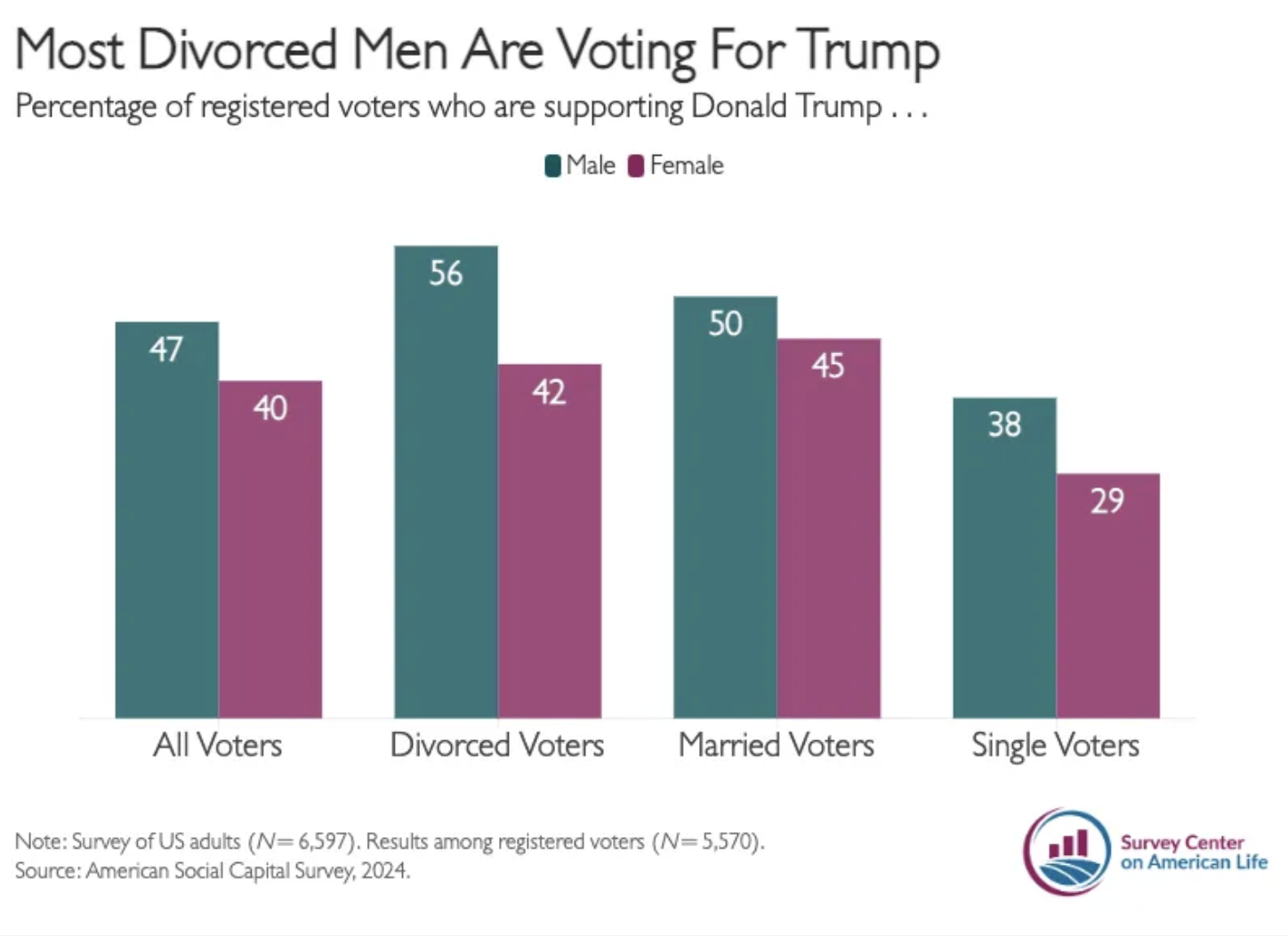
There are intriguing signs suggesting that many women are asking that question and coming to the same conclusion as Lenz. As I wrote about last month, pollster Daniel Cox found that the biggest voting gap is not between never-married men and women, much less married couples. It's between divorced men and women. Divorced men are 14 points more likely to vote for Trump than their female counterparts. In contrast, single men prefer Trump by 9 points over single women, and married men are only 5 points Trumpier than married women. 

Cox, who is conservative, offers a convoluted analysis pointed towards his wish more people would marry and stay married. The simpler explanation is the one Lenz offers: "There is a virulent male sense of grievance in the world fueled by conservative politics" and many women who "experience it firsthand" decide not to put up with it. More data is needed, but it may be less that men become more Republican after divorce and more that Republican men are more likely to run their wives off in the first place. 

There's no doubt that the Trump campaign and the larger MAGA movement are increasingly pushing a message of bringing women to men's heel by force. Trump and Vance know that abortion bans are unpopular, so they're busy trying to conceal their anti-choice radicalism with mealy-mouthed claims that they want to "leave it to the states." Yet Vance, who has denounced no-fault divorce laws and describes it merely as "inconvenient" to force rape victims to give birth, keeps giving the game away. Close Trump ally Charlie Kirk, who is allegedly organizing the voter turnout effort, declared that birth control "screws up women's brains." Lt. Gov. Mark Robinson, who Trump endorsed in North Carolina's gubernatorial race, declared women should be "led by men," and said, "I absolutely want to go back to the America where women couldn’t vote."

We need your help to stay independent

Zack Beauchamp of Vox calls the MAGA agenda the "neopatriarchy." Rep. Alexandria Ocasio-Cortez, D-N.Y., simply called it the "incel platform." After the Supreme Court ended abortion rights in 2022 with the Dobbs decision, the mask fully came off. The days of treacly language about "pro-life" policies have given way to yelling about how "childless cat ladies" must be stopped. But of course, the only way to "stop" childlessness is by forcing childbirth. 

Truthfully, I doubt many women want to vote for Harris and hide it from their husbands. Voting behavior, marriage, and identity don't work like that. People tend to be married to people they agree with politically. Even when women do become more Republican to conform to a husband's expectations, they often do so more to reduce cognitive dissonance and not because they feel forced. As Lenz experienced, if a couple does disagree, the questions of gender and dignity are so personal that the relationship often falls apart for reasons beyond just partisan affiliation. 

Still, the picture of a wife thumbing her nose at her MAGA husband by voting for Harris is arresting. It reflects a larger sense among liberal women that they're standing up for themselves and their freedom in the face of men who want to take it all away. In reality, most of us don't have these MAGA men in our beds or our kitchens. But we're still stuck with them, as neighbors and fellow citizens who, like an abusive husband, are looking for whatever power they can to wield over us. One important step in wresting back control of ourselves: the voting booth. 

Elon Musk’s master class on billionaire bribes: How some corporations threaten democracy

California Assembly Bill 1955 was sitting on Gov. Gavin Newsom’s desk, waiting for his signature, when he got a call from Elon Musk. The bill would prevent schools from requiring parental notification for a child to change their gender identity, and Musk warned Newsom that, if he signed it, it would “force families and companies to leave California to protect their children.” 

Newsom signed it into law anyway and, true to Musk’s prophecy, two companies will leave California – his companies,  X and SpaceX. This is an increasingly common tactic for Musk and other billionaire CEOs; threaten lawmakers who oppose your preferred policy with consequences – such as moving company headquarters – even when that policy has nothing to do with your company’s mission. And then hope that lawmakers care more about jobs and tax revenue than the democratically preferred legislation. While the threats didn’t work for Musk this time, they are an unfortunately effective tactic. In 2020, Musk threatened to move his Tesla headquarters unless Alameda County rescinded pandemic “lockdowns” and reopened his factories. A few days after that threat, the county submitted to his demand and Tesla reopened. A year later, Musk still moved Tesla’s headquarters to Texas.

There’s something clearly wrong about a single billionaire holding a state hostage like this, and yet we continue to tolerate and even encourage it. Like the filibuster, both parties are willing to keep this tool around in case democracy is not going their way. Liberals have used this tactic extensively to protect LGBT rights in conservative states. In 2016, for instance, Salesforce’s CEO Marc Benioff threatened to disinvest from Georgia and Indiana to kill bills that would have allowed businesses to deny service to LGBT customers, and PayPal canceled plans to build offices in North Carolina to pressure the state to rescind the “bathroom bill,” which it soon did. Now, as conservative states push through increasingly restrictive abortion laws, it will be tempting to again enlist corporations in the fight. But if we’re going to protect fundamental rights without violating democratic norms, we have to understand the line between good corporate citizenship and undemocratic threats. 

We need your help to stay independent

It's not always easy to find that line. There is, for instance, nothing wrong with companies informing legislators when a proposed law would make it hard to compete or require them to lay off workers. Those consequences are relevant to evaluating the law, so companies should make sure lawmakers are aware of them. The problem is that companies will always say they’re forced to lay off workers, cancel expansion plans, and so on. But very often these are not consequences of the law— they are just choices that companies are willing to make to influence policy. Meta, for instance, recently pressured California into postponing a bill that would have required social media companies to pay news organizations a fee to link to their content. Meta – a company that made $39 billion in profits last year – told legislators that it couldn’t possibly pay that fee and it would instead be “forced to remove news from Facebook and Instagram.” As Meta well knows, removing news links from social media would have undermined the entire point of the bill, so it was understandably tabled. 

This difference – between being forced into consequences and choosing them – is the line between offering democratic reasons and making an undemocratic threat. At its best, democracy is about the exchange of reasons: You tell me how a minimum wage increase is going to require companies to reduce their workforce, and I tell you how the increased wages contribute to workers’ well-being. But if it turns out that you’re not telling me what will happen after the wage increase, but what you’re choosing to do if an increase is passed, then it goes from a reason to a threat. 

Reasons are at the heart of democracy; threats are its antithesis. Reasons are exchanged between equal citizens who have no power over each other but the power of persuasion. Threats are only possible when someone has significantly unequal power – enough power to artificially attach stakes to one side and swing a debate. Elsewhere, Vishnu Sridharan and I have called this the difference between offering “natural” and “created” reasons. In a well-functioning democracy, no one should have the power to create reasons because they can turn every social issue into an economic one. Gender ID laws become less about how much we value children’s privacy or parental rights and more about how much we value jobs and tax revenue. 


Want a daily wrap-up of all the news and commentary Salon has to offer? Subscribe to our morning newsletter, Crash Course.


Of course, companies will always say that social and economic issues are connected. Musk said that families who disagreed with California’s social policies would have to leave the state, which would make it impossible for him to staff his companies. If that were true, then he wouldn’t be creating an economic reason to oppose a social policy; the social policy would have natural economic consequence and force him to move out. So, how do we tell if Musk would actually have to move or if he’s just using his power to get California to do what he wants? How do we tell if it’s a natural or created reason? There’s no formula, but there’s a simple test we can use. Would Musk have told legislators he had to move out of California if he didn’t personally oppose the gender ID law? In other words, if Musk was a strong advocate for gender choice, would he have reluctantly admitted to lawmakers that his company couldn’t operate under progressive social policies? Probably not. 

We should keep this test in mind in the fight against restrictive abortion laws across the country. In states with few legislative allies, it’s tempting to ask or even demand that local CEOs threaten to divest from those states unless the abortion laws are repealed. Some of those CEOs could justly say that they can’t attract employees to a state without reproductive rights. But others will just be the liberal analogs of Elon Musk, where personal views are driving corporate policy. If we enlist those CEOs, we should know that we’re sacrificing democracy for justice. 

Some will say that’s okay – that the ends justify the means. Others will worry about unilaterally disarming if the other side continues to benefit from these threats. But we should keep in mind that the most common use of these tactics benefits neither liberals nor conservatives; it benefits corporations.

Amazon bribed states with the promise of a new headquarters in exchange for all the tax concessions it wanted. Apple and Google threatened to cancel investments in any state that tried to regulate their “app stores.” We can’t stop companies from making these threats any more than we can stop Clarence Thomas from boarding another yacht. But we can decide that corporate threats and bribes are not an acceptable part of our democratic process. We can tell activists to stop demanding them, states to stop competing for them, and CEOs to stop bragging about them. Companies will continue using every weapon they have, but we can at least stop inviting them to the fight.

Some Trump Cabinet officials pushed back on extreme demands. Experts say that won’t happen next time

Former President Donald Trump is highly unlikely to again run the risk of appointing relatively moderate, established officials who may push back against him to his Cabinet if he wins a second term, experts told Salon.

Trump's former Secretary of Defense James Mattis has said he "had no choice but to leave" when he issued a 2018 resignation letter that defended NATO, criticized Russia and China's authoritarianism and said allies should be treated with respect.

In 2019, Trump ousted his third national security adviser John Bolton, who had tried to restrain Trump's approach to Iran, North Korea and Afghanistan.

In a fall 2020 tweet, Trump fired subsequent Defense Secretary Mark Esper, who has said Trump wanted to "shoot" unarmed people protesting the police killing of George Floyd.

Trump in his second term will put loyalty first, predicted Bowdoin College government professor Andrew Rudalevige.

"There's definitely an organized effort to try to make sure that they have identified loyalists who would serve in a new administration," Rudalevige told Salon, later adding: "I think in a second term, the idea is to make sure that they will carry out the orders that the president has in mind without going through the trouble of firing everyone who resists."

The presence of more moderate Republicans in Trump's Cabinet didn't prevent a mob of thousands of people storming the Capitol on January 6, or the fumbled handling of the onset of the COVID-19 pandemic, or Trump withdrawing from key international agreements.

But experts told Salon that the likely lack of any moderate presence on Trump's potential second Cabinet means he could face little to no internal resistance as his team rolls out his sweeping vision — including for the "largest deportation operation in American history."

Trump touted his appointment of four-star Marine general Mattis, whom he referred to as: "my General."

"In some cases, he picked folks for different agencies, maybe based on reputation, or wanting to get praise for being viewed as picking somebody who was particularly good or competent for a position," Vanderbilt University political science professor John Dearborn said.

But at least half-way through Trump's term, Dearborn said Trump and his close advisers realized that such officials "were not going to just do everything that the president wanted automatically."

Dartmouth College sociology professor John Campbell said the MAGA wing's take-over of the Republican Party makes it further unlikely that Trump will appoint any moderates.

Moderate Republicans are a "dying breed," he told Salon.

"To the extent that a moderate wing of the Republican Party was able to moderate some of the things he tried to do the first time around, that wing of the party is pretty much gone," Campbell said. "A lot of the people he appointed the first time thought the guy didn't know what he was doing and quit."

Former homeland security and counterterrorism advisor Olivia Troye said that during her time in the Trump administration, she grew disturbed by a glaring lack of interest in questions about legality and consequences.

"I was in those conversations, and there were times when people like General Mattis and others had to weigh in and say: 'This is what that's going to do. It's going to create great damage,'" Troye told Salon.

We need your help to stay independent

TURNING TO HIS FIRST CABINET

With three months to go until the November election, Trump can count on the loyalty of at least half of his former Cabinet-level officials.

A Washington Post review of 42 Trump Cabinet-level officials found two dozen said they still support the former president — or about 56%.

Of the remaining officials, three — former Vice President Mike Pence, Esper and Bolton — have gone on record opposing Trump. The remaining 15 former cabinet-ranking members — including Mattis — have yet to take a public stance.

Another former Cabinet member, Kelly Craft, co-hosted a Trump fundraiser in May, according to the Lexington Herald Leader.

The lack of stated support from a sizable minority of his cabinet may be a departure from previous presidents such as Obama — but Trump can still count on sizable support from a party that's embraced him, as well as lower-level administration members.

“President Trump has unified and strengthened the Republican Party more than ever before and is supported by nearly every single GOP leader and elected official, including most of his former cabinet and staff," Karoline Leavitt, Trump campaign national press secretary, told The Washington Post in a statement.

Trump has support from at least four former acting officials, including former acting Attorney General Matthew Whitaker and former national security officials including acting Director of National Intelligence Ric Grenell.


Want a daily wrap-up of all the news and commentary Salon has to offer? Subscribe to our morning newsletter, Crash Course.


Meanwhile, at least four Cabinet members — former Secretary of State Mike Pompeo, former Treasury Secretary Steven Mnuchin, former Small Business Administration head Linda McMahon and former EPA chief Andrew Wheeler — have publicly said they'd welcome serving again in a second Trump administration.

At least a dozen former Trump cabinet members, administration officials and aides are reportedly in the running for a potential second Trump term, according to reporting by news outlets including Axios and The Associated Press. Those officials include former senior policy adviser Stephen Miller, Project 2025 architect Russ Vought, former national security official and House staffer Kash Patel and former White House Presidential Personnel Office director John McEntee.

Trump himself has already suggested former cabinet members and acting officials could serve in his second term: including former acting Defense Secretary Christopher Miller for Pentagon chief.

Other potential picks include vice-presidential hopefuls, primary challenges and Congressional allies such as Sen. Marco Rubio, R-Fla.; Sen. Tim Scott, R-S.C.; North Dakota Gov. Doug Burgum; Sen. Tom Cotton, R-Ark.; and former House Speaker Kevin McCarthy, R-Calif.

Trump could also reward allies who traveled to his Manhattan criminal trial in May to voice support for him: including New York U.S. Rep. Nicole Malliotakis and former GOP presidential candidate Vivek Ramaswamy. Speaker of the House Mike Johnson also traveled to Manhattan — a move that signals Trump could count on loyalty from the GOP-led House.

Ivanka Trump and Jared Kusher have taken a back seat in Trump's 2024 campaign — Kushner has said he won't join a second Trump administration.

Trump's sons Eric and Donald Jr. are helping vet candidates for ideology and loyalty, according to Axios. At an RNC event in Milwaukee, Trump Jr. said he urged his dad to pick JD Vance as VP. He also said he wants a "veto" over Trump administration picks.

The CDC’s new IUD guidance is progress for female pain

America's health care system is inherently sexist, especially when it comes to pain. Research has shown that female patients are consistently prescribed less pain-relieving medication than male patients. Female patients who have chronic pain conditions are also more likely to be misdiagnosed with mental health conditions

When women started to speak out on TikTok, documenting their real-life experiences of getting an intrauterine device (IUD) inserted, so many felt it validated their pain. In some of the videos posted on TikTok, women describe the pain as “horrible” and “awful.” Another said she was told she’d feel a “pinch,” a common description of the process, but instead what she received was “trauma,” as she was crying during the insertion.

Researchers at Duke University analyzed the top 100 TikTok videos with the hashtag #IUD and found that when users shared details of their experiences, most of them focused on the pain. The pain has been validated is some scientific research, too. A 2014 study of 109 IUD recipients found that 78 percent of the study’s participants reported pain ranging from moderate to severe upon insertion. The following year, a study found that doctors tend to underestimate the pain patients experience during the procedure.

Last week, the Centers for Disease Control and Prevention (CDC) issued recommendations for clinicians on how to help manage the pain that women might experience. According to the guidelines, the topical anesthetic lidocaine “might be useful for reducing patient pain” when injected as a local anesthetic or applied topically as a numbing gel, cream or spray. The issuance is not only seen as a win for reproductive health — as fear and anxiety of pain has been a barrier for some women to get IUDs in the first place — but also as a moment when public health finally took women’s experiences seriously. 

"Barriers to IUD use include patient concerns about anticipated pain with placement and provider concerns about ease of placement."

“Pain with UD insertion has not traditionally been addressed as its own separate, important talking point with patients,” Dr. Eve Espey, chair of ACOG’s Contraceptive Equity Expert Work Group, told Salon. “The concerns expressed through social media have helped us understand the importance of having that conversation.”

Notably, in the guidance, the CDC suggests that healthcare providers use the new directives to support “person-centered contraceptive counseling” and “remove unnecessary medical barriers to accessing and using contraception.”

“Barriers to IUD use include patient concerns about anticipated pain with placement and provider concerns about ease of placement,” the CDC states. “When considering patient pain, it is important to recognize that the experience of pain is individualized and might be influenced by previous experiences including trauma and mental health conditions, such as depression or anxiety.”


Want more health and science stories in your inbox? Subscribe to Salon's weekly newsletter Lab Notes.


When asked if the public commentary via media and social media influenced the CDC to issue this new guidance, Antoinette Nguyen, MD, a medical officer in CDC's Division of Reproductive Health, told Salon via email “no.”

“CDC revises its contraceptive guidance periodically after review of the scientific evidence and gathering input from national experts,” Nguyen said. “CDC first published guidance on this topic in 2016, and since that time, evidence has been published indicating the need to update some recommendations.”

However, the CDC made it’s update based on “listening sessions with patient representatives.” In 2016, Nguyen said, the CDC first developed a recommendation on the provision of medications for IUD placement. In this recommendation, the CDC stated that paracervical block with lidocaine might reduce patient pain. However, misoprostol was not recommended for routine use for IUD placement — though it might be useful in certain circumstances, such as after a recent failed placement. In the new update, “CDC retained both of those recommendations and added a new recommendation that topical lidocaine might also be useful for reducing patient pain.” 

“The update adds more information about the importance of engaging patients in a person-centered discussion on pain management prior to IUD placement,” Nguyen said. “The goal of these recommendations is to remove unnecessary medical barriers to accessing and using contraception.”

While IUD insertion is considered a minor procedure that can be completed within a few minutes, it has several complex steps. First, a physician will do a pelvic exam to assess the size and position of the uterus. Then, a speculum is used to identify the cervix. Using a tenaculum, a scissor-like surgical tool, the physician steadies the cervix. Then, using a separate instrument, the physician pushes past the opening of the cervix and measures the length of the uterine cavity. When it’s time to position the IUD, an inserter tube is used. Finally, the doctor trims the strings and removes the speculum. 

“The parts that hurt for some patients — just placing the speculum is uncomfortable — placing the tenaculum is the first part that's not just pressure that can sometimes feel sharp,” Espey told Salon. “And then when we pass an instrument through that internal cervical opening, that's typically the other part of the procedure that's uncomfortable.” 

We need your help to stay independent

Espey said the CDC’s latest guidelines are a “great advance,” especially the recommendation to physicians to have a conversation about pain management with the patient. While the CDC doesn’t credit the public outcry about pain as the lead motivation behind their update in guidance, Espey said the change reflects a bigger moment of progress in medicine, reflecting an "overall trend towards more patient-centered care,” she said. “I've been doing this now for 35 years, and the transformation has been slow, but revolutionary, and really moving from a much more provider-centered view of patient care to a much more patient-centered view of patient care.”

It also, Espey said, reflects the medical community taking women’s experiences more seriously.

“It’s about women's experiences in general, of the many aspects of medical care,” she said. “Pain is a great place to start.”

“Remarkable”: Despite GOP fear-mongering, experts say new crime data shows US “safest” in decades

Violent crime in the nation's major cities plummeted in the first six months of 2024 as the early COVID-era crime surge subsides, new data suggests. While the drop in violent crime warrants acknowledgement, experts also say it underscores the need for states and the federal government to remain invested in violence prevention efforts.

An Axios analysis of preliminary data from the Major Cities Chiefs Association found that violent crime, which includes homicides, robberies, aggravated assault and rape, has dropped overall by 6 percent in 69 major cities between the first six months of 2024 and the same period in 2023. The MCCA data is one of five sets on violent crime in the U.S. to have recently been released, with each — though with slightly varied estimates — indicating a sharp decline in violent crime that rivals pre-pandemic levels, experts said. 

"This builds on news that we have about crime in 2023. If you look back further, you can see that this is a continuation of a downtrend that began a couple of years ago," said Ames Grawert, senior counsel for the Justice program at NYU Law's Brennan Center for Justice. "So it's not just that we're looking at a single year of decline so far in 2024, but it's that this is basically showing a continuation of a downtrend in violent crime nationally to the point that we might be in the process of reversing, or close to fully reversing, some of the increases we saw during the COVID-19 pandemic."

Fifty-four of the 69 cities included in the MCCA data set saw drops in violent crime in the first half of the year, per the Axios review, with some communities seeing more than a 25 percent decline. Columbus, Ohio, saw the nation's largest dip at 41 percent so far, while Omaha, Nebraska, followed with a 30 percent decrease.

Miami, Fla., and Washington, D.C. both had 29 percent declines in violent crime, and Austin, Texas and New Orleans, saw 28 percent and 26 percent decreases respectively.

While the FBI Uniform Crime report points to a similarly significant drop in overall violent crime for the first quarter of the year — showing a 15.2 percent decrease between January and March 2024 compared to the same period in 2023 — other preliminary data sets from NORC at the University of Chicago, AHDatalytics and the Council of Criminal Justice released this summer released data instead outlining percentage decreases specific to different types of violent crime.

John Roman, a senior fellow at NORC, told Salon that most criminologists home in on the homicide numbers to determine crime rates because local and state jurisdictions' reports of homicides are far more consistent and robust than with other types of violent crime.

That focus is in part because of changes in the way cities report crime to the FBI that took effect in 2021, he explained, noting that cities report data voluntarily. Violent crime reporting compliance was at 95 percent before the FBI began requiring incident-level data, but dropped to less than 60 percent afterward, he said. While the percentage of compliance has risen back into the 80s, Roman said homicide data is more reliable.

The MCCA data found that the number of homicides in the 69 reported cities dropped by more than 17 percent between the first six months of this year and the same period of 2023. Boston, Mass., saw a massive 78 percent drop in homicides, while Philadelphia experienced a 42 percent decrease in homicides.

The homicide numbers from the other organizations followed a similar arc, with NORC reporting a 23 percent decrease in the homicide rate, AHDatalytics recording a 17.7 percent drop, and the CCJ noting a 13 percent decline.

"It's a remarkable thing. The homicide rates from each of these groups shows a rate that is below the pre-pandemic levels — that are below 2019 — and they're approaching the lowest levels we've seen since 1960," Roman said. "That would suggest that, if you are under 50, you may well be living in the safest America you've ever lived in."

Should that downtrend hold through the rest of the year, he added, it will amount to the "largest decline in violence that America has seen since we started tracking it."

We need your help to stay independent

Violent crime in the U.S. rose just 5 percent between 2019 and 2020, but the nation's murder rate jumped 30 percent, marking its largest single-year increase since agencies began tracking the data. Still, the murder rate in 2020, which was 6.8 murders per 100,000 people, was far smaller than rates seen in during the last significant spike in the 1990s, which peaked at 9.8 in 1991, Grawert said. 

The exact reasons why crime skyrocketed with the onset of the pandemic are still unclear but researchers have a few prevailing theories, he said, one of the most accepted of which associates the uptick with the social and economic upheaval of early COVID-era isolation.

Courts and government offices shutting down alongside a decrease in police staffing, widespread job loss and the rollback of social supports and community programs, like community violence interrupters (CVI), teachers and counselors, in the face of restrictions on in-person contact created an opportunity for violence to spike that crested in 2020 and 2021, Roman said. 

The 2020 murder of George Floyd and the resulting social unrest likely also compounded with those other factors, attributing to the associations with an increase in violent crime in most U.S. cities, added Alex Piquero, a professor of sociology at the University of Miami.

"When you put all of that together, you have basically an M80 firecracker," said Piquero, who is also former director of the Bureau of Justice Statistics. Four years later, as the nation recovers from the detriment of the early pandemic era, those resources to curb crime have started to return. 

"Cops are back staffing. They're back doing the kind of work they're doing. CVI is back on the street. Kids are back in school. Prevention services are back," he said. All of the infrastructure "we know helps reduce crime and delinquency" that had been "basically turned off at the spout are now turned back on."

Massive investments that the federal government made in state and local governments in 2022 and 2023 also gave those initiatives a boost, allowing for an "effective social safety net" to rebound by way of increasing the number of government workers, investments in anti-violence programs and violence reduction programs, and support for people after exiting COVID isolation, Roman said. 

President Joe Biden, in a statement to Axios, lauded the American Rescue Plan's police and gun violence legislation assistance in light of the MCCA preliminary data's release.

"Americans are safer today than when Vice President Harris and I took office," Biden told Axios in a statement, adding: "I will continue to urge Congress to fund 100,000 additional police officers and crime prevention and community violence intervention programs, and make commonsense gun safety reforms such as a ban on assault weapons."


Want a daily wrap-up of all the news and commentary Salon has to offer? Subscribe to our morning newsletter, Crash Course.


Because violent crime appears to be on a downtrend toward pre-pandemic levels, which saw a 2018 and 2019 murder rate of 5.2 per 100,000 people, according to the FBI Uniform Crime Reporting Program's 2022 estimations, Piquero argued local, state and federal efforts to prevent and reduce crime are more important now than before. 

Now is the time to "make sure that we continue doing and providing those services because crime, public safety is not just a short-term, today thing," he said. "It's also a next year thing, it's also a 10 years from now thing. We have to always think about the 15-year-old right now who might put a gun in his or her hands tonight. We got to think about a 10-year-old kid who might be seeing an older brother or sister doing that, and then the five-year-old kid who, in 10 years, might be doing that."

"The question about why crime rose in 2020 is really important," Grawert added. "But I think it may be the even more important question is, 'Why did it come back down and what can we learn from it?'"

In a contentious election year, in which violent crime — and the lack thereof — has become a major talking point for candidates, the preliminary data also swats away one of former President Donald Trump and his allies favored attack lines attaching the issue to Democrats. At the same time, it offers Vice President and Democratic presidential nominee Kamala Harris a welcome rebuttal to such claims. 

Piquero and Grawert warned that Americans should avoid getting wrapped up in the partisan back-and-forth over the violent crime, instead paying attention to policies intended to address it and their impacts while fact-checking the politicians playing to fears around the numbers. 

"I hope people walk away saying, 'This is a lot more complicated than I thought, so we need to think about complicated, serious solutions, not rhetoric, not demagoguery, but what can we really do backed by evidence, backed by research, backed by solid policy thinking to reduce crime and violence," Grawert said. The plunge in violent crime "really shows a need for thoughtful work on crime and public safety, which are extremely important subjects, rather than rhetoric." 

Roman said that Americans should also take away from the decline is that focused investment in combatting violence and boosting the health and welfare of the public dramatically reducing violent crime incidence shows the nation has control over the issue — and that the legal system doesn't have to be involved to wrangle it. 

"It doesn't necessarily have to be about police and courts, doesn't have to be about locking people up," he said. "It can be about supporting people and giving them alternatives to committing violent acts."

"Crime is under our control," Roman added, noting that the government funding for a number of those violence prevention and reduction initiatives will soon run dry. "We do have the ability to move that dial, and it's a question of whether we're willing to do it or not that remains to be seen." 

McDonald’s space-themed, spinoff chain has officially opened its newest restaurant in San Antonio

CosMc’s, a new small-format, beverage-led restaurant concept from McDonald's, has officially opened its fourth storefront in San Antonio, Texas.

To celebrate, CosMc’s hosted an official grand opening on Aug. 10 and Aug. 11 from 10 a.m. until 4 p.m. local time, inviting patrons to try free samples of menu items and receive exclusive merch for the first 100 customers each day.

CosMc’s San Antonio restaurant is the first with “an outdoor patio with eye-catching elements that come alive at dusk,” McDonald's said in a press release, per ABC News. The new location also features a CosMc's drive-thru, kiosks, counter service, walk-up and in-app ordering available to customers. For additional discounts and perks, customers can join CosMc’s Club, the concept’s new loyalty program in which members can score a free welcome drink for signing up alongside a free birthday gift and points with their purchases.

The new restaurant location comes after CosMc’s opened its first location in Bolingbrook, Illinois, as part of a limited test run. Other locations include Arlington, Texas; Dallas, Texas and Watauga, Texas. Six additional locations are slated to open across the Dallas and San Antonio metro areas in the coming months, McDonald’s said.

“CosMc’s seamlessly blends brand-new, otherworldly beverage creations with a small lineup of food, including a select few McDonald’s favorites — all designed to boost your mood into the stratosphere, if only for a few moments,” the company said in a December 2023 press release.

McDonald’s fans can look forward to trying a new CosMc’s menu item: the Sprite Moonsplash. The drink combines Sprite with citrus and sweet vanilla flavors and is served with dried blueberries and a lemon wheel over ice. Other available offerings include the Sour Cherry Energy Burst, Churro Cold Brew Frappé and Popping Pear Slush.

UAW files federal labor charges against Elon Musk and Donald Trump over strike-breaking comments

The United Auto Workers announced Tuesday that the union has filed federal labor charges against Donald Trump and X CEO Elon Musk, citing their pubic conversation Monday in which the former president argued that striking employees should be fired.

“They go on strike, I won’t mention the name of the company, but they go on strike and you say,’ That’s OK, you’re all gone. You’re all gone. So, every one of you is gone,’” Trump said to Musk. The conversation was broadcast on X to over a million listeners. 

Threatening to fire workers who go on strike is illegal under the National Labor Relations Act, the UAW noted Tuesday. The union has lodged complaints against both men with the National Labor Relations Board.

“Donald Trump will always side against workers standing up for themselves, and he will always side with billionaires like Elon Musk, who is contributing $45 million a month to a Super PAC to get him elected,” UAW President Shawn Fain said in a statement. "Both Trump and Musk want working class people to sit down and shut up, and they laugh about it openly. It’s disgusting, illegal, and totally predictable from these two clowns.”

Trump’s Republican Party has recently tried to rebrand as a “working man’s” party, claiming the GOP is  “pro-labor’ and “pro-union.”

"We need a leader who's not in the pocket of big business but answers to the working man, union and non-union alike,” Trump running mate Sen. JD Vance, R-Ohio, said at the Republican National Convention.

Despite this attempt to rebrand, however, Trump’s record in office is markedly anti-labor. He weakened federal labor regulations, refused to increase the federal minimum wage and appointed members to the NLRB who opposed union organizing drives.

Bowen Yang reveals “terrible” SNL host who made his co-workers cry

"Saturday Night Live" writer and cast member Bowen Yang has sounded the alarm over a male host for the sketch-comedy show who reportedly once made "multiple cast members" cry during a table read. 

“This man who – this person, this host made multiple cast members cry on Wednesday during the, before the table-read, because he hated the ideas,” Yang said during an interview for "Watch What Happens Live," after being asked by host Andy Cohen to divulge the "worst behavior" he'd ever witnessed from a host. Yang also referred to the incident as "terrible." Yang, who joined the show as a writer in 2018 ahead of its 45th season, kept the identity of the individual anonymous.

Yang, who is the first cast member of Asian American descent on "SNL," has received four Emmy nominations since coming on the show, with three of those in the category for outstanding supporting actor in a comedy series. 

Arizona pro-choice campaigners celebrate “huge win” as abortion rights measure makes November ballot

Arizona voters will get to decide if they want to add the right to an abortion to the state constitution in November, CBS News reported.

The deputy communications officer for the Arizona Secretary of State’s office confirmed Monday that it certified 577,971 valid signatures that were turned in by a coalition of reproductive rights organizations, dubbed Arizona for Abortion Access. The coalition includes the American Civil Liberties Union of Arizona and Planned Parenthood Advocates of Arizona. 

The number of signatures collected far surpassed the required number of just under 384,000; it is the most signatures validated for a citizen initiative in state history. Asa result, it will put the key issue of major reproductive rights measures directly before voters in a swing state that President Joe Biden won in 2020 by a little over 10,000 votes, NBC News reported.   

"This is a huge win for Arizona voters who will now get to vote YES on restoring and protecting the right to access abortion care, free from political interference, once and for all," campaign manager Cheryl Bruce said in a statement provided to NBC News.

Currently, Arizona law bans abortions after 15 weeks and requires an ultrasound before an abortion is done, as well as parental consent for minors. Should the proposed amendment come into effect, abortions would be permitted until a fetus could survive outside the womb, which is typically around 24 weeks. The amendment would still provide exceptions to save the mother’s life or to otherwise protect her physical or mental health.

Reproductive rights questions are also scheduled to go before voters in Colorado, Florida, Maryland, Missouri, Nevada, New York, and South Dakota this year, potentially boosting the chances of Democrats who blame former President Donald Trump for state abortion passes imposed following the 2022 overturning of Roe v. Wade.

The stripping of Jordan Chiles’ bronze – what’s next?

On Monday, the Court of Arbitration for Sport (CAS) voided a petition by USA Gymnastics to see Paris Olympian Jordan Chiles keep the bronze medal she was been awarded in the floor event. The decision follows a ruling by the International Olympic Committee (IOC) that the medal would be reallocated to Ana Bărbosu of Romania. 

According to The NYT's Athletic, over the weekend the ruled ruled that an inquiry submitted on Chiles' behalf by her coach, Cecile Landi — which saw her score, initially a 13.666, enough to slot her into the third place position — was submitted four seconds after the designated one-minute inquiry window had already shuttered. USA Gymnastics, however, had attempted to fight the ruling on Sunday, claiming that it had video evidence that Landi had made the inquiry only 47 seconds after Chiles' score had been posted. 

On Monday, USA Gymnastics released the following statement, per The Athletic: “USA Gymnastics was notified by the Court of Arbitration for Sport (CAS) on Monday that their rules do not allow for an arbitral award to be reconsidered even when conclusive new evidence is presented. We are deeply disappointed by the notification and will continue to pursue every possible avenue and appeal process, including to the Swiss Federal Tribunal, to ensure the just scoring, placement, and medal award for Jordan.”

CAS in a separate statement said, “If new evidence (i.e. objectively unknown at the time of the CAS hearing) appears after the issuance of the CAS decision, it would be possible to ask the Swiss Federal Tribunal to order that the case be reopened. The CAS would also reopen the case spontaneously if all parties agree.”

At the time of the original Romanian appeal, the country had requested that instead of taking away Chiles' bronze to award additional bronzes to Bărbosu and another Romanian gymnast, Sabrina Maneca-Voinea, who was docked for stepping out of bounds when replays showed that she hadn't, NBC News reports. Her score without that penalty would have easily qualified her for third place. Dual medals have been awarded before, in the 2002 Salt Lake City Olympics.

However, with the IOC demanding Chiles return the medal and calling for a "reallocation ceremony" to award Barbosu, it appears that this decision has been made.

In a show of solidarity, rapper Flavor Flav — who, along with Snoop Dogg, acted as a Paris Olympics patron — got Chiles a custom bronze clock to assuage the pain of being stripped of her medal. "I gots yo back @jordanchiles," Flavor Falv wrote in an Instagram post showing the bauble.

https://www.instagram.com/reel/C-l-5sUJWiU/?utm_source=ig_embed&ig_rid=964d7a6e-405d-49da-bb4b-4ac64cf591c7

Breaking made Olympics history, but sent a mixed message thanks to an Aussie b-girl’s audacity

Eddie the Eagle. The Jamaican bobsledding team. Great underdog stories are part of the Olympics’ fabric, giving TV audiences supplemental heroes to cheer on. The most famous of these contenders have the hearts of champions if not the skills — although some, like the 1980 U.S. men’s ice hockey team, which was mainly comprised of amateurs, make history by pulling off miracles.

Rachael Gunn was never going to do that. The 36-year-old college professor said as much after she was eliminated from the Paris Games’ breaking competition that left viewers alternately befuddled, delighted and enraged due to its confident awkwardness.

Gunn, who represented Australia in the b-girls competition under the moniker Raygun, was knocked out in the round-robin competition without scoring a single point. Worse, she was totally fine with that.

“I was never going to beat these girls on what they do best, the dynamic and the power moves, so I wanted to move differently, be artistic and creative, because how many chances do you get in a lifetime to do that on an international stage?” Gunn told reporters after the fact.

Maybe not so many. Or perhaps a lot more.  

In her battles, Gunn busted moves like “the kangaroo” and “happy doggo rolling on a lawn,” carrying herself like a combination of Chris Lilley’s “Summer Heights High” character Mr. G and Sacha Baron Cohen’s Ali G.

While other competitors wore their favorite streetwear, Gunn wore her country’s official tracksuit, which made her look like she was ready to either a) sell you some John Deere mowers; or b) assemble a Subway footlong to your specifications.

Raygun; Paris OlympicsRaygun competes during the Breaking B-Girls Round Robin Group B battle between Logistx and Raygun on Day 14 of the Olympic Games Paris 2024 at La Concorde on August 9, 2024 in Paris, France. (Harry Langer/DeFodi Images via Getty Images)Days later her value as Internet gold is holding strong, as people try to make sense of what she was thinking, how she made it into a global competition purported to feature the best of the best athletes, and what on Earth she was doing. Was it uniqueness? A heroic expression of dancing like nobody’s watching? A jaw-dropping example of cultural appropriation?
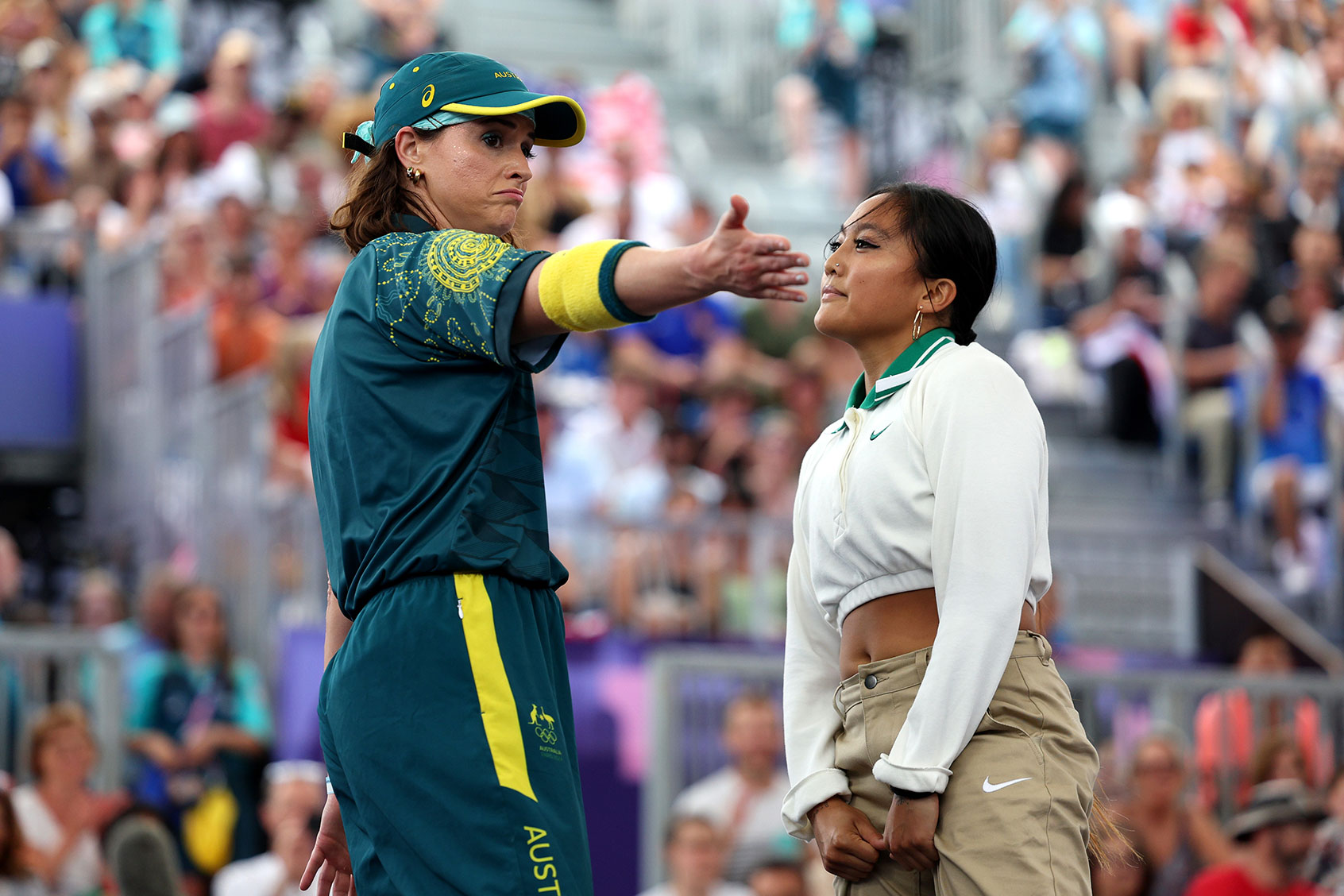
Yes. To all of it.

Gunn’s presence in the Olympics' first and possibly only breaking competition didn’t set off any alerts leading up to its debut, scheduled near the end of the 2024 Summer Games to maximize hype.

Most viewers know breaking as “breakdancing,” although calling it that will, at the very least, date you.  Since the ‘90s b-boys and b-girls have competed in an assortment of international competitions, the most publicly promoted being the Red Bull BC One.  

Bringing it to the Olympics was a play to attract younger viewers to the games, inspired by its popularity during the 2018 Summer Youth Olympics in Buenos Aires. Its combination of wide familiarity and relative novelty generated excitement among what the NBC commentators gamely called a “more seasoned” viewership as well.

But there were always some doubts as to whether breaking belonged on the Olympics stage although it qualifies as a dance sport.

Gunn carried herself like a blend of Chris Lilley’s “Summer Heights High” character Mr. G and Sacha Baron Cohen’s Ali G.

Breaking is also part of a subculture defined by authenticity although, as the multicultural vibrancy of the competitors showed, that term is a moving target.

Enter Gunn, who has a PhD in Cultural Studies and lectures at Macquarie University in Sydney. Gunn’s doctoral thesis, titled “Deterritorializing Gender in Sydney’s Breakdancing Scene: a B-girl’s Experience of B-boying,” examines breaking from the lens of gender dynamics. At 355 pages long, one cannot accuse her of failing to think about her subject.

It’s the doing part that has made her either an object of mockery or a hero to the movement challenged. Or, as Dr. Stacey Patton sums up Gunn’s performance in a scathing NewsOne column, a party to “modern-day minstrelsy.”

A potential to generate anger was always lurking in the background of the International Olympic Committee’s decision to add breaking to its program. Some are irked by the standardization of competitive breaking: Dancers strive to defy gravity and capture the music’s spirit in spur-of-the-moment sculptures carved from their muscles, bones and imagination.

Olympics judges, however, were asked to score competitors on creativity, personality, technique, diversity, musicality and vocabulary.

And in the view of the Olympics’ chief breaking judge Martin Gilian, aka MGbility, Gunn represented Australia by “bringing something new to the table. “[S]he got inspired by her surroundings, which in this case, for example, was a kangaroo,” he told reporters, going on to add, “She was trying to be original and bring something new to the table. From our perspective, that was nothing really shocking.”

We need your help to stay independent

Except, maybe, to people who haven’t followed breaking for years and were shocked at seeing Lithuania’s Dominika “Nicka” Banevic, a small, skinny white girl, bound out wearing a durag like Tupac or LL Cool J.

Stylistic appropriation fades into a lesser sin if the person engaging in it shows reverence and understanding of the marginalized culture they’re drawing from. And Banevic, who won the silver medal, took time to acknowledge the original b-boys and b-girls after her win.

“Big respect for the OGs and the pioneers that invented all those moves. Without them, it wouldn’t be possible,” she said. “Without them, breaking wouldn’t be where it is today. So I’m grateful for them.”

Gunn did not, and this separates her from those other underdogs mentioned above.

B-Girl Raygun; Logistx; Paris OlympicsB-Girl Raygun of Team Australia and Logistx of Team United States react during the B-Girls Round Robin – Group B on day fourteen of the Olympic Games Paris 2024 at Place de la Concorde on August 09, 2024 in Paris, France. (Elsa/Getty Images)Michael David Edwards, with his giant glasses, did not look like the typical champion ski jumper. Bobsledding is not big in Jamaica. While all share the commonality of being unconventional competitors in a space where they’re considered to be a rarity, bobsledding and ski jumping originated as European sports.

Breaking is different.  Like the music and the rest of the culture, hip-hop’s original movement form was born in New York and created in the late ‘70s by poor Black and brown kids living in the Bronx, who established its main cultural currency to be skillfulness and respect.

Pop culture’s industries swiped music and fashion and left the dance form to Madison Avenue. Self-appointed mainstream ambassadors like Dena Rizzo, who was lampooned in a “Bob’s Burgers” episode, killed its mainstream popularity for good.

Breaking proliferated nevertheless, with crews popping up in countries around the world, including Australia. Like hip-hop, breaking is represented by a prismatic range of cultures, each of which has evolved the form and lends its own flavors.


Want a daily wrap-up of all the news and commentary Salon has to offer? Subscribe to our morning newsletter, Crash Course.


However, in a sport that began as physicalized rebelliousness by poor Black and Puerto Rican boys and girls in reaction to a government that had economically abandoned them, a white Australian woman proudly and mediocrely moving to her own beat was destined to get cooked on the searing barbie that is Black Twitter.  

If we’re being honest, some of that smoke could be a matter of coming to terms with knowing the Americans weren’t favored to medal in a dance sport created in the U.S.A. (Team USA did eke out a bronze, thanks to b-boy Victor Montalvo.)

Among the b-girls, the gold went to Japan’s Ami Yuasa, with China’s Liu Qingyi earning the bronze.

B-Girl Ami; Paris OlympicsGold medalist B-Girl Ami of Team Japan competes in her victory over B-Girl Nicka of Team Lithuania in the Breaking B-Girls Gold medal battle on day fourteen of the Olympic Games Paris 2024 at Place de la Concorde on August 09, 2024 in Paris, France. (Elsa/Getty Images)

It is also telling that many more people are talking about Gunn than 21-year-old Manizha Talash, an Afghan refugee who stepped into a battle wearing a cape that read “Free Afghan Women,” knowing that would get her disqualified. (IOC forbids athletes from making political statements during competition.)

But that may have been Talash’s biggest moment to use an international platform to send a message to the world. Before the Paris Olympics opened, it was already determined that breaking would not return in Los Angeles’ 2028 summer games. It may not come back after that one, either. That makes every Paris b-boy and b-girl battle in this Olympics historic including, for better or worse, Gunn’s overnight notoriety.

With the games headed to Hollywood, it wouldn’t be surprising to see this discourse return as a movie, a la “Cool Runnings” and “Eddie the Eagle.” Less clear is who would want to see this dark comedy repeated. But like Gunn’s moment at the heart of that Place de la Concorde arena, that might surprise us.

Donald Trump flew to campaign events in Jeffrey Epstein’s old plane

Former President Donald Trump flew on a Gulfstream jet previously owned by deceased sex offender Jeffrey Epstein, traveling from Montana to Wyoming to Colorado for campaign events, The New York Times reported

The Gulfstream jet used by Trump is not the plane known as the “Lolita Express,” which Epstein reportedly used to traffic young girls to and from his private island. 

Trump’s go-to plane, informally known as “Trump Force One,” experienced mechanical issues while traveling to a rally in Bozeman, Mont., on Friday. His team called Private Jet Services Group for a replacement, which ended up being Epstein’s former Gulfstream jet. 

Trump’s campaign told The Miami Herald it was unaware the jet was previously owned by Epstein. 

“The campaign had no awareness that the charter plane had been owned by Mr. Epstein. We heard about the former owner through the media,” a spokeswoman said.

The plane is now owned by a California-based charter jet company, Threshold Aviation Group, The Herald reported.

Epstein was arrested in 2019 for sex trafficking minors, some of whom were as young as 14. He died by suicide in his prison cell just a month after he was arrested.

The former president and Epstein ran in the same social circles for many years and were often photographed together in the late 90s. 

Trump’s name is also mentioned in Epstein-related court documents released earlier this year, though he has since tried to distance himself.


As fall nears, Dunkin’ launches a boozy, non-dairy PSL canned cocktail to celebrate an iconic flavor

There's a slight chill creeping into the air, signaling the return of everyone's favorite seasonal flavor — yes, it's true, pumpkin spice is on the way. And Dunkin' is celebrating the season with a special new offering.

In a press release, Dunkin' announced the arrival of Dunkin' Spiked, "a buzz-worthy twist on a quintessential fall classic and Dunkin's highly anticipated seasonal offering: the Pumpkin Spice Latte." The product will be sold in "grocery and package store across 27 states" and is a "rich, creamy and deliciously decadent drink with the perfect balance of sweet pumpkin, vanilla and fall spice flavors" in a "ready-to-drink format, allowing consumers to party with the taste of fall all season long."

“As one of our most highly anticipated seasonal offerings, Pumpkin Spice Latte has become a staple amid everyone’s favorite cozy season," Brian Gilbert, Vice President of Retail Business Development, said. "Recognizing this, we knew we had an opportunity to create something special with an adult twist on the beloved beverage."

The Dunkin' Spiced PSL has 6% ABV and is "crafted with real coffee, pumpkin spice flavor and a non-dairy creamer that is both vegan and lactose-intolerant friendly." You can check www.dunkinspiked.com if you're looking to find a store nearby with the product in stock. The line originally launched in the Northeast to great acclaim last August and the PSL flavor is the latest addition.


Costco rolls out new regulation to prevent non-members from entering its warehouse stores

Last year, Costco representatives told CNBC that they would soon be cracking down on membership-sharing, primarily by being more stringent on their photo and membership ID-checking. As part of the change, the company would require customers to present membership cards with a photo, or along with a photo ID, at self-checkout registers. Now, a little over a year later, Costco is alerting customers to another rule change.

A statement on its website says: "Over the coming months, membership scanning devices will be used at the entrance door of your local warehouse. Once deployed, prior to entering, all members must scan their physical or digital membership card by placing the barcode or QR Code against the scanne. Guests must also be accompanied by a valid member for entry."

Though some warehouse locations have already operated with a similar policy for years — just with Costco attendants doing the scanning — his change will ensure that every single person must scan in prior to entrance, though some shoppers will still be admitted if accompanying someone else with a membership ID. 

"Additionally, if your membership card does not have a photo, please be prepared to show your valid photo ID," the statement continued. 

The current rate for a Costco memberships is $60 per year, but other memberships, with differing benefits and access, are offered at higher prices. 

Photo of JD Vance dressed as a woman causes a stir online

A recently surfaced photo of Sen. JD Vance, R-Ohio, dressed as a woman is causing a stir online, with quick to note the clash with his current anti-LGBTQ+ rhetoric.

The photo, which shows Vance in a blonde wig and dress, was first posted online Sunday by podcast host Matt Bernstein. The source of the photo was Yale assistant professor Travis Whitfall, though it was taken by one of his classmates. 

“It’s from a group chat of Vance’s fellow classmates and is from a friend of a friend. I believe it was grabbed from Facebook and was taken at a Halloween party,” Whitfall told The Daily Beast.

A spokesperson for Vance did not deny the photo’s authenticity to The Daily Beast, but they offered no further comment.

The photo, one of two that have now been posted online, quickly trended with the hashtag "#SofaLoren," a reference to the popular joke that Vance had sex with a couch.

Vance has a long history of support for anti-LGBTQ+ policies, prompting many to point out the Ohio Senator’s hypocrisy. 

“There’s nothing wrong with dressing as a woman. There’s everything wrong with dressing as a woman and then taking the weird as fuck stance that drag performance, and by proxy LGBT people are deviants who deserve their rights limited,” one user wrote on X

When running for the U.S. Senate in 2022, Vance said he would have voted against he “Respect for Marriage Act,” which protects same-sex marriage from future Supreme Court decisions. He also introduced the “Protect Children’s Innocence Act,” which aims to criminalize gender-affirming medical care for minors.

RFK Jr. kicked off New York ballot after judge says he lied about his residency

A judge ruled Monday that independent candidate Robert Kennedy Jr. falsely claimed New York residency on his nominating petition, disqualifying him from appearing on the state's general election ballot, Axios reported.

The ruling by Judge Christina Ryba, which may still be appealed, could spur  a ripple of legal challenges to Kennedy’s ballot access in other states. The ruling is expected to be appealed by the Aug. 15 deadline

In her decision, Judge Ryba wrote that Kennedy, who currently resides in California, claimed a Westchester, New York address as his “place of residence." She concluded that the independent candidate had no intention of returning to the state but rather used the address for political gain, CBS News reported. 

"The overwhelming credible evidence introduced at trial established that Kennedy's connections with the [New York] address existed only on paper and were maintained for the sole purpose of maintaining his voter registration and political standing in the State of New York," Ryba wrote.

The ruling comes after Kennedy testified in court last week that he considered New York his home since his childhood and planned to return, claiming he only temporarily moved to California in 2014, as he explained it, to live with his wife. He is currently renting a room from a woman, Barbara Moss, in her home in New York City, according to CBS News.

Moss, who owns her home, testified that Kennedy paid her $500 a month for a room, adding that he has only spent one night at the residence since she first received a rental payment from him in May.