Spring Sale: Get 1 Year, Save 58%

New York lawmakers propose new legislation aimed at having Chick-Fil-A open seven days a week

A New York lawmaker has introduced a bill that would require restaurants within rest stops on the Thruway and the Port Authority of New York and New Jersey to be open seven days a week. The latest legislation specifically targets nine Chick-fil-A restaurants that all operate inside New York travel plazas.

Chick-Fil-A, the largest fast-food chain specializing in chicken sandwiches, is famously closed on Sundays “to allow Operators and their team members to enjoy a day of rest, be with their families and loved ones, and worship if they choose,” per company policy. Chick-Fil-A has followed this policy since it opened its first restaurant in 1946.  

A representative for Assemblyman Tony Simone, who proposed the bill, said the lawmaker believes “Chick-Fil-A could easily serve their customers better if their restaurants were open seven days a week.”

“The bill addresses the need for any restaurant that serves travelers to be open seven days a week,” the representative told Business Insider in an email. “When it comes to travel areas, like rest stops, bus stations, and airports, people are often traveling on Sundays, and so it doesn't make any sense for one of the few restaurants available at these locations to be closed on one of the busiest travel days of the week.”

Why more than 60 Indigenous nations oppose the Line 5 oil pipeline

The Line 5 oil pipeline that snakes through Wisconsin and Michigan won a key permit this month: pending federal studies and approvals, Canada-based Enbridge Energy will build a new section of pipeline and tunnel underneath the Great Lakes despite widespread Indigenous opposition. You may not have heard of Line 5, but over the next few years, the controversy surrounding the 645-mile pipeline is expected to intensify. 

The 70-year-old pipeline stretches from Superior, Wisconsin, through Michigan to Sarnia, Ontario, transporting up to 540,000 gallons of oil and natural gas liquids per day. It’s part of a network of more than 3,000 miles of pipelines that the company operates throughout the U.S. and Canada, including the Line 3 pipeline in Minnesota where hundreds of opponents were arrested or cited in 2021 for protesting construction, including citizens and members of the Red Lake Band of Chippewa Indians and White Earth Band of Ojibwe. 

Now, Enbridge Energy, with the support of the Canadian government, is seeking approvals to build a new $500 million conduit to replace an underwater section of Line 5 in the Straits of Mackinac, while facing lawsuits backed by dozens of Indigenous nations as well as the state of Michigan.

A key concern is the aging pipeline’s risk to the Great Lakes, which represent more than a fifth of the world’s fresh surface water. Environmental concerns are so great that three years ago, Michigan Governor Gretchen Whitmer ordered Enbridge’s dual pipelines that run for 4 miles at the bottom of the Straits of Mackinac to cease operations. 

“The state is revoking the easement for violation of the public trust doctrine, given the unreasonable risk that continued operation of the dual pipelines poses to the Great Lakes,” the governor’s office said at the time. 

A Wisconsin judge ruled that the company must shut down the portion of its pipeline that trespasses on the reservation by 2026.

The move came just a year after the Bad River Band tribal nation filed a lawsuit against Enbridge regarding another, separate section of Line 5 in Wisconsin located across 12 miles of the Bad River reservation. The pipeline had been installed in 1953 and, at the time, had received easements to do so from the Bureau of Indian Affairs.

But the easements expired, and in a court filing, the tribal nation said the company “has continued to operate the pipeline as if it has an indefinite entitlement to do so,” despite federal law that bans the renewal of expired right-of-way permits on Indian land and would require Enbridge to obtain new permits and approvals from the Band. 

The Bad River won a key victory last summer when a Wisconsin judge ruled that the company must shut down the portion of its pipeline that trespasses on the reservation by 2026. 

Enbridge has resisted calls to cease Line 5 operations. Instead, the company contends that it has the right to continue operating there, citing a 1992 agreement with the Band, and is planning to reroute the pipeline while appealing the Wisconsin judge’s decision. The company also argues that building a new pipeline 100 feet below the lake bed through the Straits of Mackinac will virtually eliminate the chance of a spill.

“Line 5 poses little risk to natural and cultural resources, nor does it endanger the way of life of Indigenous communities,” company spokesperson Ryan Duffy said. “Line 5 is operated safely and placing the line in a tunnel well below the lake bed at the Straits of Mackinac will only serve to make a safe pipeline safer.”

To that end, Enbridge successfully appeared before the Michigan Public Service Commission, the state’s top energy regulator, this month and got permission to build a new concrete tunnel beneath the channel connecting Lake Michigan and Lake Huron. The commission cited the need for the light crude oil and natural gas liquids that the pipeline transports, and said other alternatives like driving, trucking or hauling by barge or rail would increase the risk of a spill. 

The commission’s approval contradicts Governor Whitmer’s efforts to shut down the pipeline. In the wake of the permit, the governor’s office told reporters the state commission is “independent.” Both of the governor’s appointees on the board voted in favor of the permit. 

The approval doesn’t mean that the project will proceed, but it is encouraging for the company as it seeks federal clearance. The U.S. Army Corps of Engineers is in the process of putting together a draft environmental impact statement for the project. That document isn’t expected to be published until spring 2025. 

In the meantime, Line 5 has gotten lots of support from the government of Canada, where Enbridge Energy is based. The government has repeatedly invoked a 1977 energy treaty between the U.S. and Canada to defend the pipeline.

That’s frustrating to Indigenous peoples who have seen their treaty rights repeatedly violated. 

“What we’re simply trying to continue to preserve and protect is an Indigenous way of life, which is the same thing our ancestors tried to preserve and protect when they first entered into those treaty negotiations,” said Whitney Gravelle, chairperson of the Bay Mills Indian Community, one of numerous tribal nations opposing Line 5. 

The Straits are also the site of Anishinaabe creation stories, the waters from which the Great Turtle emerged to create Turtle Island, what is currently called North America. Gravelle said that maintaining clean lakes where Indigenous people can fish is about more than just the right to fish. It’s about the continuation of culture.

“It’s about being able to learn from your parents and your elders about what fishing means to your people, whether it be in ceremony or in tradition or in oral storytelling, and then understanding the role that that fish plays in your community,” she said.  

Last summer, José Francisco Calí Tzay, United Nations special rapporteur on the rights of Indigenous Peoples, called for suspending the pipeline’s operations “until the free, prior, and informed consent of the Indigenous Peoples affected is secured.” Free, prior, and informed consent is a right guaranteed to Indigenous Peoples under international law that says governments must consult Indigenous nations in good faith to obtain their consent before undertaking projects that affect their land and resources — consent that Bad River, for instance, has refused to give.

“Canada is advocating for the pipeline to continue operations, following the decision of a Parliamentary Committee that did not hear testimony from the affected Indigenous Peoples,” Calí Tzay wrote, adding the country’s support for the pipeline contradicts its international commitments to mitigate climate change in addition to the risk of a “catastrophic spill.”

Part of what makes Line 5 such a flashpoint is the importance of the Great Lakes and Enbridge’s spotty environmental record. As the Guardian reported last month, the Great Lakes “stretch out beyond horizons, collectively covering an area as large as the U.K. and providing drinking water for a third of all Canadians and one in 10 Americans.” 

In 2010, two separate pipelines run by Enbridge ruptured, spilling more than a million gallons of oil between them into rivers in Michigan and Illinois. The Environmental Protection Agency found that Enbridge was at fault not only for failing to upkeep the pipeline but also for restarting the pipeline after alarms went off without checking whether it failed. The company eventually reached a $177 million settlement with federal regulators over the disaster.

A 2017 National Wildlife Federation analysis found that Line 5 has leaked more than a million gallons on 29 separate occasions. The company said just five of these instances were outside of Enbridge facilities, and that no spills have occurred in the Straits of Mackinac or on the Bad River Reservation. Still, the section of the pipeline on the floor of the Straits of Mackinac has been dented by boat anchors dropped in the lakes, including from Enbridge-contracted vessels.

Despite Indigenous peoples’ concerns, Line 5 continues to gain momentum, in part because of the amount of energy it supplies to the U.S. and Canada and the countries’ continued dependence on fossil fuels. While the international community agreed to curb fossil fuels this month at COP28, there’s no agreed-upon timeline for actually doing so, and the consumer demand for affordable energy remains high, especially in light of inflation driving the prices of food and housing.

Meanwhile, more than 60 tribal nations, including every federally recognized tribe in Michigan, have said the pipeline poses “an unacceptable risk of an oil spill into the Great Lakes.” 

“The Straits of Mackinac are a sacred wellspring of life and culture for tribal nations in Michigan and beyond,” the nations wrote in an amicus brief supporting a lawsuit challenging the pipeline.

To Gravelle from the Bay Mills Indian Community, the issue is deeply personal and goes beyond maintaining access to clean water and the ability to fish safely. Fishing is deeply intertwined with her peoples’ culture. When a baby is born, their first meal is fish, and when her people hold traditional ceremonies, they serve fish. 

“Our traditions and who we are as a people are all wrapped up into what we do with fish,” Gravelle said. “Our relationship with the land and water is more important than any commercial value that could ever be realized from an oil pipeline.”

This article originally appeared in Grist at https://grist.org/indigenous/why-more-than-60-indigenous-nations-oppose-the-line-5-oil-pipeline/.

Grist is a nonprofit, independent media organization dedicated to telling stories of climate solutions and a just future. Learn more at Grist.org


Newly unearthed video shows Mike Johnson and his daughter attending “purity ball” in 2015

Years before Mike Johnson would become second in line for president, a German TV news outlet profiled him and his then-teenage daughter preparing for and then attending a purity ball. "This looks like a wedding," a news reporter says in German in a 2015 n-tv news segment unearthed by ABC News. "But they are not bride and groom — but rather father and … daughter," the reporter adds, referring to Johnson and his then-13-year-old daughter, Hannah. The news segment examined purity balls and the purity movement among conservative Christians with the Johnson family as the lens, highlighting Johnson and his daughter at the ball with other pairs and showing Johnson's daughter vowing and signing a pledge to live a life of purity.

The controversial formal dance event gained notoriety in the early 2000s but remained popular among some conservative Christians. Purity balls typically saw fathers and their teenage daughters dressed up for a night of dinner and dancing that ends with the daughter signing a pledge to her father to abstain from dating and remain sexually abstinent until marriage. The news segment features interviews with Johnson's daughter, now in her 20s, vowing to her father "to make a commitment to God, myself, my family, my friends, my future husband, and my future children … to a lifetime of purity, including sexual purity," with shots of Johnson nodding in agreement interlaced.

In one brief interview clip, Johnson's wife, Christian counselor Kelly Johnson, told the German news outlet, "We don't talk to her about contraception. Sex before marriage is simply out of the question." Mike Johnson's participation in the 2015 news story provides another example of the previously almost-unknown lawmaker's staunchly conservative and religious views, which have informed his political career and ascent in Congress. 

Rudy Giuliani peddles shady supplements as judge raises concerns about his finances

As a federal judge ordered Rudy Giuliani to immediately hand over the $148 million he owes to the two Georgia election workers he defamed, the former Trump lawyer peddled unapproved supplements he said could be used as Christmas ornaments and to help him "fight the traitors," The Daily Beast reports. In a 13-page decision Wednesday, Judge Beryl Howell ruled in favor of ex-election workers Ruby Freeman and Shaye Moss, who had requested the court waive the required 30-day wait before seeking enforcement of their judgment, noting that Giuliani may attempt to "conceal his assets" if given more time based on “ample record in this case of Giuliani’s efforts to conceal or hide his assets.”

With his financial woes taking an expedited turn, the former New York City mayor held his live-streamed program, "America's Mayor Live," Wednesday to defend his former boss. “We’re into fascist territory now,” Giuliani declared, referencing his mounting legal troubles and the Colorado Supreme Court's decision to bar Trump from the state's 2024 ballot over his role on Jan. 6. Giuliani punctuated his series of right-wing, pro-Trump rants with promotions for Balance of Nature supplements, of which the Food and Drug Administration has released several warnings over “the company’s claims that its products could be used to diagnose, cure, mitigate, treat, or prevent diseases such as cancer, heart disease, cirrhosis, diabetes, asthma, and COVID-19.”

Giuliani encouraged his viewers to take the supplements every day and suggested they use the empty bottles as Christmas tree decorations, showing one he rigged with a wire hook for hanging. “This one’s going on the tree now," he said. "I’m going to have two on my tree!” He added that the supplements are "wonderful as a stocking stuffer" and that all purchases "help me fight the traitors."

Christmas in the “fear hole”

He's as blind as he can be
Just sees what he wants to see
Nowhere man, can you see me at all

– John Lennon/Paul McCartney

Moments after I got the news that the Colorado Supreme Court kicked Donald Trump off the ballot in that state, I read the transcript of the decision.

Part of the justification for disqualifying Trump was because of what he said in a press briefing more than six weeks before the election. “When asked at a September 23, 2020 press briefing whether he would commit to a peaceful transfer of power after the election, President Trump refused to do so,” the court wrote.

Some of Trump’s current paid supporters, destined to end up with lumps of coal in their stockings this Christmas, denied that this happened, and accused the court of misinterpreting what he said. I know differently. I was there. I asked the question. The court was right in its reference, and also left out the part where Trump told me that if you stop counting the votes there wouldn’t be a transfer of power at all.

I’m pretty sure that will also lead to a few lumps of coal in Trump’s stocking, but it turns out some folks out there think I am wrong. Maggie Haberman and others who have covered Trump believe his people are actually energized by the decision. Sure, he’s going to grift off of it. Everything that happens to him is used to raise money, so ten minutes didn’t go by before he was sending out emails asking his loyal supporters to dig deeper into their pockets, and send him a Christmas present of money rather than spending it on their loved ones. But energized by the decision? I think Trump is terrified.

A few minutes later I got a call from a source who told me that kicking Trump off the ballot will have consequences.

“It’ll make him a martyr,” I was told, “further radicalizing the electorate and risking violence.” 

There are plenty of reasons to believe that is true. President Biden this week, in a speech he made in Bethesda, MD, reminded people that Trump is on a “revenge” and “retribution” tour and promises to be a dictator for a day – a dictator who also recently said the blood of immigrants is poisoning our nation. 

“Just this weekend, Trump said, and I quote, ‘Our country is not a great country anymore.’ I simply don't believe that, and I don't think any of you do” Biden said.

Then this source I had on the phone said I should meet up with a friend of his who had a “high placed” job and could offer other options in dealing with Trump. So, I took the call.

The guy started off telling me, “Money runs everything. It runs politics, entertainment and sports.” I couldn’t disagree, but I wondered what it had to do with Trump and the decision in Colorado.

“Well, the big guy’s had it. I’m giving you the scoop,” he told me. I had no idea what he meant, but as he explained it there is going to be a reckoning come Christmas.

I looked around. Was I being punked?

“Look, it’s a big commercial racket,” this guy told me. And when I asked to what he was referring he said, “Christmas. It’s run by a big eastern syndicate, you know.”

People quoting “A Charlie Brown Christmas” makes me laugh. Then I asked the voice on the phone what he meant. “This is the deal; this year the Big Guy is going to flip the script and instead of delivering presents, he’s going to throw certain people into the ‘fear hole’ for Christmas.” In other words, their Christmas present will be facing their greatest fear.

Wait. What? Rick and Morty? Actually, probably Albert Brooks in “Defending Your Life” with the Game show “Face Your Fear.” But, I digress.

“Who’s “The Big Guy?” God?” I asked. 

The Dude does not abide by cryptic sources.

“No. Not some fictional being in the sky who sees and knows all and needs your money and fealty,” I was told.

“Who then?” I asked.

“You know. Wears red. Rather rotund. Has a naughty and nice list.”

The guy sounded like a raving conspiracy lunatic, but according to him the fat man in a red suit is pissed. And this is what he has in store for Trump and a few others; 

Trump is getting thrown into the fear hole where he will be a poor illegal immigrant trying to cross the Rio Grande to get a job, while suffering a debilitating skin rash that causes his hair to fallout and his skin to peel. He won’t be able to get medical care, but he’ll be put to work picking fruit for a large American produce company for less than minimum wage. He’ll find out that America is great again without him – in fact because he’s not around. 

Okay. I’m in. “What else you got?” I asked.

Matt Gaetz? Much the same, but he’s also going to be a young teenage girl trying to fight off Matt Gaetz while being sold by Jeff Epstein to a rich oilman from the Middle East.

Jim Jordan?  He’ll have to face his fears as a young boy being abused by his wrestling coach who can’t get anyone to listen to him. Epstein will also sell him to a rich oil magnate.

That may sound rather pedestrian, but I liked the plan for George Santos. The Big Guy, I’m told already took care of him. However, whoever puts him on television or interviews him will be forced to work as a court stenographer in a country where they don’t know the language, and every time they get their facts wrong – they’ll be flogged. In fact, that’s the fate of most reporters who refuse to try and get their facts straight.

Really?

We need your help to stay independent

Well, some of them, I was told, will be forced to work as barkers in cheap carnivals, which is actually a step up, but all of them will work for minimum wage and those who play “access journalism” are going to have to labor as fluffers for “OnlyFans” stars.

The more I spoke with this source, the more serious I understood Father Christmas is going to get with people this year. “No kidding,” I was told. “The Big Guy has had enough.”

Lindsay Graham? Apparently he’ll be a homeless orphan who’s thrown into jail for a murder he didn’t commit, but cannot get anyone to believe him. He will live out his days being cuddled by a guy who looks like Shrek and goes by the name Ben Dover.

That’s pretty harsh. But the source on the phone said there were others who will suffer worse fates. 

Donald Trump Jr? “Well, he’s already so fearful the Big Guy says the only way to take care of him is to make him penniless and cuckolded by a 350 lb. wife who has herpes.”

Apparently the Big Guy isn’t happy with Democrats or Republicans. I was told certain Democrats fear being canceled for saying something that isn’t “woke” enough to pass the muster, so they’ll be canceled for saying something completely innocuous. “They’ll spend their lives trying to redeem themselves for something they didn’t do,” I was told. 

And the far right? “Well, they love to say that social spending is socialism and communism, so a lot of those guys will be living during Stalin’s rule in the Soviet Union,” I was told.

Greg Abbott?

Well the Big Guy thought long and hard about him and Ken Paxton – the smug Texas Attorney General who went after Kate Cox, a mother who needed to end a pregnancy because of a fatal threat to her and the unborn fetus. The Big Guy thought of staking Abbot to a tree, naked, and doused in honey – then releasing bears and bees on him. And he thought of turning Paxton into a teenage girl rape victim whose pregnancy threatens both her life and the life of her unborn child. But, in the end he decided they should share the same fate; they’ll be an LBGTQ homeless minority couple hounded by the KKK while both live with an incurable, debilitating disease that causes rashes and boils.

How about Christian Nationalists? After all, Christian theology is not only opposed to the scientific spirit; it is opposed to every other form of rational thinking. It has, at all times and everywhere, been the steady defender of bad governments, bad laws, bad social theories, and bad institutions. It was, for centuries an apologist for slavery as it was an apologist for the divine right of kings. (Apologies to H.L. Mencken)


Want a daily wrap-up of all the news and commentary Salon has to offer? Subscribe to our morning newsletter, Crash Course.


So, what’s their “fear hole”? 

Obviously, I was told that it is the fictional fiery pit of Hell. “They have already told us their greatest fear,” my source explained. “The Big Guy will just give it to them.”

“What about the Pope?” I asked. 

“Frank? The Big Guy likes him,” I was told. “He’s a Jesuit – That’s the Vince Lombardi wing of the Catholic faith. Very Progressive. He gets a pass.” 

We ended our conversation and the guy on the other end of the phone told me that “this conversation never happened.” And if I ever said it did, I should be on the lookout for some very short people dressed in red, white and green, carrying candy canes, smiles, and tinsel that can be used to cut through iron bars. 

I thought it was all on background, so I won’t give up a name, but I’m running a risk of being thrown in my own fear hole this Christmas by even telling anyone about this.

I’ll take the risk. I know my greatest fear and I face it every day; people confuse fiction for facts, don’t read, are incapable of critical thinking, have no sense of humor and dwell within their own humorless information silos where they only converse with those who think exactly as they do and condemn anyone who thinks differently.

I fear it will never change. 

Happy Holidays.

“Not a serious argument”: Legal experts call out Trump hypocrisy in “bulls**t” Supreme Court filing

Former President Donald Trump’s lawyers, who have repeatedly sought to delay his D.C. election subversion trial, on Wednesday asked the Supreme Court to hold off on reviewing special counsel Jack Smith’s appeal of Trump’s rejected immunity claim.

Trump’s lawyers appealed a ruling from U.S. District Judge Tanya Chutkan denying his claim that he has presidential immunity from prosecution in the election subversion case. But Smith, who has sought to maintain the pre-trial timeline to avoid a delay, asked the Supreme Court to take up the case, arguing it is "of imperative public importance" for the high court to decide on the question as quickly as possible.

The Supreme Court last week agreed to take up Smith’s request. But Trump’s lawyers on Wednesday asked the court to hold off on considering it until the appeals court reviews the matter — which could delay proceedings by weeks.

"In 234 years of American history, no president ever faced criminal prosecution for his official acts. Until 19 days ago, no court had ever addressed whether immunity from such prosecution exists," Trump's legal team wrote in a filing. "To this day, no appellate court has addressed it. The question stands among the most complex, intricate, and momentous issues that this Court will be called on to decide."

Trump’s lawyers accused Smith of pushing the Supreme Court to "rush to decide the issues with reckless abandon."

The legal team argued that Smith lacked standing to appeal the matter because Chutkan ruled in his favor. And they reiterated their argument that Trump’s speech and advocacy as president were protected by the First Amendment.

"An erroneous denial of a claim of presidential immunity from criminal prosecution for official acts warrants this Court's review — in due course," attorneys John Sauer, John Lauro and Todd Blanche wrote. "Yet importance does not automatically necessitate speed."

Chutkan rejected Trump’s presidential immunity argument, writing that the “position does not confer a lifelong 'get-out-of-jail-free' pass.”

We need your help to stay independent

Trump’s lawyers in their filing doubled down on their argument anyway, claiming that a president can only be prosecuted in impeachment proceedings by Congress.

"The Constitution opens the door to such prosecutions, but requires a strong political consensus — i.e., the participation of the political branches, including a supermajority of the U.S. Senate, the Republic's traditional 'cooling saucer' — before such a drastic action can be taken," they wrote.

University of Texas Law Prof. Lee Kovarsky pushed back on Trump’s argument that Smith lacks standing to appeal because he won the earlier ruling.

“This is not a serious argument. The Court can hear appeals from winners if there's a sufficiently strong policy reason,” he tweeted. “The standing argument is a touch more complicated, but it's not essentializing too much to say that it's bulls**t,” he added, explaining that Trump’s lawyers are conflating his case with cases about “whether 3rd parties without standing AT THE OUTSET OF LITIGATION can appeal when the primary party won't.”


Want a daily wrap-up of all the news and commentary Salon has to offer? Subscribe to our morning newsletter, Crash Course.


Other legal experts called out Trump’s hypocrisy in urging the court to slow down his case.

“COMPARE: Trump’s filing in Supreme Court today (seeking to slow down the DC criminal case) TO his upcoming filing appealing the Colorado decision, where he will seek alacrity,” tweeted former Mueller prosecutor Andrew Weissmann, referring to the Tuesday ruling barring Trump from the primary ballot in Colorado.

“It would be easier for former President Trump to argue against cert. before judgment here if his Justice Department hadn't asked #SCOTUS to likewise leapfrog courts of appeals on 10 different occasions (in five of which the justices acquiesced),” added Steve Vladeck, a Supreme Court expert at the University of Texas Law School.

Mike Johnson owes “the secretive networks that form the backbone of the American Right” big time

On Tuesday, the Colorado Supreme Court ruled that Donald Trump is disqualified from the presidency and should therefore be removed from the ballot in that state because of his role in the Jan. 6 coup attempt, which is an act of insurrection as determined by the United States Constitution. This ruling will be used by Trump and his White Christian followers and other cultists as more evidence that Trump is a divine figure who is being "persecuted" by his enemies in the "secular world" and "deep state."

Trumpism, like other forms of fascism and authoritarianism (and today’s version of conservatism more broadly), is a type of religious politics where the Great Leader is viewed as a type of divine figure on Earth who commands a historic movement that is a force of destiny. Much to the consternation of rational outsiders, there are no appeals or interventions based on fact, reason, and empirical reality that can effectively counter such magical and delusional thinking. Trump instinctively knows and understands this to be true. Moreover, because of his demonstrated fabulism and apparent megalomania the idea that he is a tool of “god” is self-evident to him. Fulfilling that role, Trump announced at a rally several weeks ago that he is basically the Chosen One and a type of prophetic figure and emissary of God and Jesus – which means that Trump’s plans to be a dictator are blessed by supernatural beings who are going to intervene on his behalf.

Trump’s statements are carefully calibrated to his audience. Public opinion polls and other research show that White Christians do in fact view the ex-president and dictator in waiting as a type of prophetic figure and tool for their God. In that role, Trump will be a weapon to impose a Christofascist plutocracy on the American people.

In all, Trump and the American neofascist movement, anchored by the Christian Right, is an existential threat to the country’s multiracial pluralistic democracy and society. This danger has been greatly increased by how the Christian Right, as the result of decades of careful movement-building and strategizing, now has key figures in great positions of power throughout the United States government and across society. Speaker of the House Mike Johnson is one such leader.

As has been widely documented, Johnson is a Christian Nationalist (which in practice means a White Christian supremacist) who holds such odious and cruel beliefs as gays and lesbians and transgender people are some type of abomination that should be removed from American life, women are the de facto chattel and property of their husbands and should not have control over their own bodies, birth control and abortion should be illegal, and that White Christianity should be the official religion of the United States and only “Christians” should be allowed to hold public office.

"Mike Johnson is a product of a certain kind of Christian nationalism — White Christian nationalism."

In an attempt to better understand Speaker Mike Johnson and his relationship to the (White) Christian Nationalist movement and how those malign forces are central to the Age of Trump and the country’s escalating democracy crisis, I recently spoke with Bradley B. Onishi, president of the Institute for Religion, Media, and Civic Engagement and the Founder of Axis Mundi Media. In 2023 he published, “Preparing for War: The Extremist History of White Christian Nationalism." He is also a faculty member in Religion and Philosophy at the University of San Francisco.

Onishi’s commentary essay (with Matthew Taylor), “The Key to Mike Johnson’s Christian Extremism Hangs Outside His Office,” was recently featured in Rolling Stone.

This is the first of a two-part conversation.

Who is Mike Johnson? What does he represent?

Mike Johnson is a Christian nationalist whose career has been aided and contoured by influential right-wing organizations. He is a lifelong culture warrior – a true believer in the retrograde worldview he professes. Johnson slots firmly within the more hardline evangelical wing of the Republican coalition. He holds extreme positions on abortion, thinks that America is in crisis because 25% of young people identify as queer, defends young earth creationism, traces school massacres to the sexual revolution of the 1960s, and questions whether church and state should be separate.

If we think about his predecessor, Kevin McCarthy, that is certainly a guy who professed a Christian faith.  But it is one part of his identity. In my mind, Kevin McCarthy wakes up in the morning thinking about what Kevin McCarthy is going to get that day, how he's going to achieve more power, more success. And he's going to do that by going to church, by talking about Christian values, by talking about his family as living out what might be deemed a Christian life. But ultimately it comes down to Kevin McCarthy.  

Mike Johnson is a different political animal.  When Mike Johnson wakes up in the morning. My guess is that he's thinking, how can I advance the mission of God on earth?  How can I make God's vision for the country a reality? And so yes, he does want to be in a place of power. Yes. He does want to be in a place of influence. But he's a true believer in the sense that he seems to do those things based on a desire to live out to implement and create a Christian nation. In a way that for some of his fellow Republicans and fellow Christians in Congress or other places of leadership are merely part of an identity puzzle, where for him, that is the whole ballgame. 

How does Speaker of the House Mike Johnson's ascent fit into the White Christian political and social project?

All of the sociological studies tell us that white Christian nationalists, like Mike Johnson, see the United States as in decline. For them, returning to a time when the country was in obedience to God is the key to national renewal. When asked about what that time would be, they often point to the 1950s. So, the 1950s represent a time of American renaissance. And everything afterward represents American decline. Well, the sixties are what gave us the civil rights movement. The Voting Rights Act, immigration reform. Queer liberation movements. Women's liberation movements. I could go on and on and on.  

White Christian nationalists want to return to a social order where all those voices, all those people who clamored and protested and marched for representation and rights in the sixties and beyond, go back to a time of Jim Crow, back to a time of patriarchal marriages, back to a time when interracial marriage was outlawed in many places: when women were financially restrained by prejudice; when redlining was ubiquitous; when there had been no Black president. Back to a time when white Christians had control of the social order and everyone else knew their place.  

We need your help to stay independent

Mike Johnson is a product of a certain kind of Christian nationalism — White Christian nationalism. And his understanding of the United States is in decline since the sixties fits perfectly into what the sociological data tells us about the narrative that these folks tell about our country.

What are Johnson’s loyalties? What do we know about his politics and vision?

Mike Johnson comes from a background where his loyalties are to creating a country and a world dominated by God. This is why I think of him as a true believer. Now in practical terms, that means that his political life has been shaped by the institutions and the organizations who adopted that mission.  

For Mike Johnson, that means participating in networks like the Council for National Policy; hanging around with the Koch brothers; speaking at events, such as the National Association of Christian Lawmakers; and looking up to Tony Perkins of the Family Research Council. 

These are the people that made his career. Because these are the people who share his values, he has always looked up to them and wanted to be one of them. For Johnson to now be speaker of the House feels as if it is the apotheosis of his political career and aspirations. His loyalties are to those right-wing organizations and networks and funders not only because they have made him the politician he is today, but because in his mind they are the ones trying to create and live out the Christian worldview that he so militantly professes.

What is Johnson’s relationship to Donald Trump, MAGA, and the neofascist movement?

Mike Johnson was at the arrow’s tip of congresspeople working to overturn the 2020 election for Trump. He claimed that the vote count in Georgia was rigged and that Democrats had changed the rules late in the game to ensure Trump lost. He collected signatures for a brief supporting a Texas lawsuit alleging, without evidence, irregularities in election results and then played a central part in trying to prevent Biden’s win from being certified.  Johnson also touted Trump’s conspiracy theories about election fraud, even saying, “You know the allegations about these voting machines, some of them being rigged with this software by Dominion, there’s a lot of merit to that.” To this day he is reticent to admit that Joe Biden won the election. 

Does this make Johnson a fascist? No. However, he does have troubling connections to a Christian movement that was the spearhead of mobilizing Trump supporters on January 6th. 

What is Johnson’s relationship to the institutions and other centers of power and influence (and affluence) on the Christian Right?

As Anne Nelson has reported at length, Johnson entered the pipeline of the Council for National Policy as a young lawyer where his mentors were Tony Perkins of the Family Research Council, Paul Pressler, architect of the conservative resurgence in the Southern Baptist Convention, and Morton Blackwell, co-founder of the Council for National Policy and founder of the Leadership Institute, among many others. He described himself as the “bag man” for these figures. Johnson is not someone whose faith is useful as part of a political persona; his Christianity is not one dynamic of his identity; it does not fit alongside a profile of, say, a former military vet or successful businessman-turned-politician. Johnson’s entrance into politics was made possible by his participation in the foundational structures of White Christian nationalism in the United States — from the churches he preaches in to the secretive networks that form the backbone of the American Right. 

You recently had a very important article on Johnson and Christian nationalism appear at Rolling Stone. There you focused on the Christian Nationalist flag that Johnson displays outside of his D.C. Congressional office and what that reveals about the new Speaker’s politics and beliefs. Can you elaborate?

The flag is called the Appeal to Heaven flag. And it's a very simple design. It's white with an evergreen tree in the center.  And at the top, it says, “An appeal to heaven.” This flag was used in the Revolutionary War as a banner. It was commissioned by George Washington. It's still used as a Naval flag in Massachusetts. The idea of the appeal to heaven goes back to the philosopher John Locke. However, despite that history, the flag has been reappropriated over the last 10 years. It now symbolizes a certain brand of militant Christianity based on spiritual warfare.  

The man who made it popular is named Dutch Sheets. And he's not nearly as recognized as people like Jerry Falwell or Tony Perkins or others on the religious right. But he is very influential. His books have sold more than a million copies. He has millions of followers in his ministry. 

In 2013 sheets was given this flag and he started to think about it as a symbol for spiritual warfare. He wanted to see Christians taking part in American politics and society in a way that would result in a revolution. He published a book called “An Appeal to Heaven.” And he's been using this symbol over the last 10 years to create the urgency for this Christian revolution in the United States.  

When Trump was not reelected and Biden was proclaimed the winner, Sheets went into a full mobilization of his followers, his millions of followers, to reinstate Trump as president. 


Want a daily wrap-up of all the news and commentary Salon has to offer? Subscribe to our morning newsletter, Crash Course.


If you look closely at January 6 the Appeal to Heaven Flag is right there. There are dozens and maybe hundreds of them alongside the other flags and symbols. In other words, the Appeal to Heaven flag, while it may have historical significance going back to the Revolutionary War is now a symbol of the desire for Christian revolution based on spiritual warfare. As we show in the Rolling Stone article, Mike Johnson has direct ties to Sheets and his spiritual warfare apostles. Johnson does not admire Sheets’ theology from afar. He is an active participant in this Christin movement. It's troubling that Mike Johnson, who surely knows what the flag symbolizes today, flies it outside of his office. 

What was the reaction like to your Rolling Stone piece?

In some sense, it was positive. Bill Maher did a short segment on a recent show, and other media figures and leaders have taken notice of just how extreme Johnson is as a person and politician. I am glad these issues are reaching more mainstream channels. However, I also received more hate mail than ever before in my career. Many of the messages claimed that the Appeal to Heaven Flag can’t be a symbol of militant Christianity because of its history going back to George Washington and John Locke. The appeal to history is of course a fallacy. But it’s amazing how many Christians will wish you and your family a slow death when you criticize one of their symbols, you know? 

Flags are just fabric and colors. A flag’s power comes from symbolism and the community and values it represents. What is that world for Johnson and the other people who honor the Appeal to Heaven flag?

 The flag represents a lot of things, but one of the things that I'll highlight is the idea of a Seven Mountains Mandate. Dutch Sheets and the apostles and prophets that he aligns with often talk about how human life is divided into seven domains: religion, family, government, education, arts, and entertainment, media, and business. The mandate is a call by God for his followers to take dominion over all of these domains in earthly society. In other words, the idea behind the Seven Mountains mandate is that Christians would enable God to have dominion over every aspect of human life; or they would enable God to dominate earth in every possible way. In one video Sheets talks about overtaking and occupying earth in the name of God. 

When I think about Mike Johnson, what this means is that he adheres to something like this mandate. When Johnson advocates for the overturning of the election, and the reinstating of Donald Trump as president, I see a person who wants a figure, in this case Trump, at the top of the government mountain to be in charge in order to dominate for God.  When I think of those rioters on January 6 flying the Appeal to Heaven flag, I think of people who are trying, once again, to dominate earthly society for God. The world of this flag is a world in which Christians are the heads of every part of earthly life. This is not a theological vision based on pluralism or negotiation or dialogue. It's not about interfaith communication. It's not about a multi-religious society. It's about Christian supremacy.

The Supreme Court should resist taking the easy way out

In yet another almost unimaginable moment in America’s troubled recent history, the Colorado Supreme Court ruled on Tuesday that former Pres. Donald Trump is barred from being on the Republican primary ballot in that state. The court found that Trump engaged in insurrection and, as a result, is not eligible to again serve as president of the United States.

Trump has already indicated that he plans to appeal Colorado’s decision to disqualify him to the United States Supreme Court. When the court hears the case it will be presented with an opportunity to weigh in on the question of Donald Trump’s responsibility for the events of January 6, 2021 and whether the Constitution means what it says in Section 3 of the 14th Amendment.

Not since the court put its thumb on the electoral scale in its 2000 Bush v Gore decision has there been a case that would do more to thrust the court into the raging fires of political controversy in this deeply divided nation. As he has on many other occasions, Chief Justice John Roberts may respond to that possibility by invoking so-called “judicial minimalism.” He may try to rally a majority of his colleagues to make a decision that avoids a definitive resolution of the Trump case on the merits. Following his lead, they may be tempted to find some narrow or technical ground on which to decide the appeal from the Colorado decision and avoid facing head-on this most divisive of cases and controversies.

They should resist the temptation. 

This country needs a clear resolution of the question of whether Donald Trump is indeed eligible to hold office under the Constitution. Without it, a shadow will continue to hang over the 2024 election. But such a decision would be a risky one for the court, whether it comes out for or against Trump. 

Before looking more at that risk, let me say a bit more about judicial minimalism.When Roberts was nominated, law Prof. Cass Sunstein dubbed hima conservative “minimalist” in contrast to what he called conservative “fundamentalism.” “Fundamentalist conservatives,” Sunstein argued, “do not believe in small steps. They think that in the last 50 years, constitutional law has gone badly, even wildly, wrong. They want to reorient it in major ways…. In many areas, … fundamentalists welcome a highly activist role for the federal courts….”

Judicial fundamentalists, like Justices Samuel Alito and Clarence Thomas, “hold their views in complete good faith. But it is impossible to ignore the fact that there is great overlap between their constitutional vision and the politics of the extreme right-wing of the Republican Party.”  

This might incline the conservative majority on the court to come down clearly on Trump’s side in the Colorado case.

In contrast, minimalists, Sunstein noted, “insist that social change should occur through the democratic process, not through the judiciary…. On principle, they prefer narrow decisions and small steps, nudges not earthquakes. When confronted by contentious issues, minimalists focus on details and particulars, and are prepared to rule in ways that run contrary to their politics.” 

Sunstein said at the time that Roberts prefers to avoid “sweeping pronouncements and bold strokes, and instead pays close attention to the legal material at hand.” Throughout his career on the bench, Roberts has been an institutionalist, eager, whenever possible, to decide cases on the narrowest possible grounds and to avoid, where possible, making decisions that would damage  the Supreme Court’s legitimacy.. 

A minimalist opinion in the Trump disqualification case might say that the case raises a non-justiciable political question, or focus on the fact that Congress has never passed implementation legislation for the disqualification provision of the 14th Amendment and that without it Trump cannot be disqualified, or that the January 6 did not meet the legal standard for qualifying as an insurrection. 

We need your help to stay independent

This approach may be particularly tempting in a case that poses the kind of legitimacy risks that the Trump case poses for the high court. 

If it were to rule against Trump and say he cannot serve as president, his supporters would regard the court’s decision as the latest underhanded effort to derail his return to the White House. We get a glimpse of that reaction in the Trump campaign’s initial response to the Colorado Supreme Court decision.

"Unsurprisingly,” the campaign said, “the all-Democrat appointed Colorado Supreme Court has ruled against President Trump, supporting a Soros-funded, left-wing group’s scheme to interfere in an election on behalf of Crooked Joe Biden by removing President Trump’s name from the ballot and eliminating the rights of Colorado voters to vote for the candidate of their choice.”

“Democrat Party leaders,” the statement went on, “are in a state of paranoia over the growing, dominant lead President Trump has amassed in the polls. They have lost faith in the failed Biden presidency and are now doing everything they can to stop the American voters from throwing them out of office next November. The Colorado Supreme Court issued a completely flawed decision tonight…. We have full confidence that the U.S. Supreme Court will quickly rule in our favor and finally put an end to these unAmerican lawsuits.”

Law professor and frequent Fox News contributor Jonathan Turley echoed that sentiment in an op-ed posted on The Messenger. “For many voters… the opinion will only reinforce Trump’s claims that Democrats are engaged in ‘lawfare’ to achieve in the courts but they cannot achieve in the polls. Because of that the opinion could not come at a worse moment. Trump is surging in the polls, and many Democrats are now openly saying they fear Pres. Biden is about to be beaten in 2024…. For those voters, the Colorado ruling looks like a case of Biden being on the ropes when the referee just called the bout in his favor.”


Want a daily wrap-up of all the news and commentary Salon has to offer? Subscribe to our morning newsletter, Crash Course.


“Even if as expected,” Turley observed, “these justices are reversed by the United States Supreme Court, many Americans will not forget what they will consider to be an effort to take away their vote.”

Ty Cobb, a former lawyer in the Trump Administration, said that the Colorado disqualification decision “vindicates” Trump’s “insistence that this is a political conspiracy to interfere with the election and that … he’s the target and people shouldn’t tolerate that in America.”

Even Republican presidential candidate, and vocal Trump critic, Chris Christie argues that the former president should not be “prevented from being President of the United States, by any court. I think he should be prevented from being the President of the United States by the voters of this country.”

On the other hand, if the court, led by the justices who Trump appointed, were to rule in his favor Democrats and never-Trumpers would go ballistic. They are already arguing that Justice Thomas should recuse himself from the case and would accuse the court of partisanship and betraying the rule of law.

Still, as divisive as a ruling on the merits may be, at the end of the day America needs the Supreme Court to say whether Donald Trump engaged in an insurrection — and if that disqualifies him from again serving as president.

The Endangered Species Act is 50 years old — and without it humanity may go extinct, scholar says

The Endangered Species Act celebrates its 50th birthday in December 2023, and there is good reason for environmentalists to cheer its legacy. Later described by the Supreme Court as "the most comprehensive legislation for the preservation of endangered species enacted by any nation," the Endangered Species Act (ESA) has helped protect iconic animals like humpback whales, sea otters, whooping cranes and West Indian manatees. Because some animals face different threats based on their biology and environment, the ESA is divided into tiers for determining their existential risks — polar bears, for example, are "threatened."

Without the ESA public declarations about various animals being "endangered" or "at risk" would be meaningless gestures. It's one thing to say "save the whales" and another to actually do it. The only reason the United States government has any power to protect wildlife from human depredation is because of the act.

"They passed the act, but what they failed to do is provide the money it needed to bring species in crisis out of crisis and into a recovery mode."

Yet the subsequent half-century has hardly been a triumph for the law. For every success story like that of the bald eagle or the black-footed ferret, the Endangered Species Act also has countless failures. In his new two-volume book "The Codex of the Endangered Species Act," conservation attorney and environmental historian Lowell E. Baier reviews the history of the law and its far-ranging consequences. While the second volume is a collection of essays from other scholars about the Endangered Species Act, the first volume — which is co-written by Baier himself with the help of Christopher E. Segal — explores both how the Endangered Species Act was passed and how it has been implemented over the years.

The problem is simple: Unless there is constant public pressure to protect threatened wildlife, the Endangered Species Act will not be implemented. In speaking with Salon about his book, Baier reviewed the successes and the inadequacies of the Endangered Species Act, as well as the stark contrast between American politics in the era when the law was passed and American politics in 2023.

This interview has been mildly edited for length and clarity.

Why is it so hard to get species on the endangered species list? 

"The federal government made an ethical and moral decision — and they said that when they named it, an ethical and moral decision — to save all species, because the rate of extinction was becoming very visible."

There is a process dictated by law which says that the US Fish and Wildlife Service and the National Marine Fisheries Service (which deals with aquatic mammals) has to go through a five-point checklist before they can qualify anything to get to determine whether or not is it is a species in crisis. And the biggest part of that is what they call a "biological opinion" or a "biological analysis" that can take up to one or two years to perform. And that's what slows it down. 

Can you list a few examples of threatened and endangered species that have received extraordinary conservation efforts in human interventions due to the Endangered Species Act, and as a result are on a path toward recovery? 

The most notable one is the bald eagle, which was headed for extinction because of the DDT [an insecticide known as dichlorodiphenyltrichloroethane] that was being used universally in the country, which caused the eggshells of the eagle to be very thin. When the eagles sat on those in the nest, they crushed the eggs.

The next would be the black-footed ferret, my favorite. The black-footed ferret was thought to be extinct. And then they discovered a small population in North Dakota, and they watched those for a short period of time, and they went extinct. And about five or six years later, over in Wyoming, a population was discovered. And from that population, they captured a number of them and put them into a breeding facility to propagate more species. That operation was moved out of Wyoming and the jurisdiction of Wyoming into the federal government facility down in Colorado.

There was a 2023 study which found that 73 genera of animals have become extinct since 1500 AD, vanishing at a rate 35 times higher than that which prevailed over the previous million years — so fast that it would've taken 18,000 years for the same event to have naturally occurred had human intervention not existed. Do you feel the Endangered Species Act provides the government with enough tools to stave off this so-called "mutilating of the tree of life," at least in the United States?

It does in concept. The problem is that the federal government has not funded it properly. In 1973, they made an ethical and moral decision — and they said that when they named it, an ethical and moral decision — to save all species, because the rate of extinction was becoming very visible back then. And so they passed the act, but what they failed to do is provide the money it needed to bring species in crisis out of crisis and into a recovery mode. And it's been a problem ever since. They underestimated it 50 years ago, and they failed to take action ever since, notwithstanding the repeated pleas of both the Department of Interiors' U.S. Fish and Wildlife Service and the states to give them more money.

That is what the RAWA, or Recovering America's Wildlife Act, is all about. It has been pending in Congress now for a while and needs money to be effective.

Why is it so difficult to prove extinction — that is proving a negative? And what can we do to make sure that animals really are extinct?

Well, what we can do to make sure they're extinct is surveillance. Fish and Wildlife Service officers and agents throughout the country do that, as do many, many non-profit organizations. They continually use their field people and their volunteers to determine, for example, whether the ivory-billed woodpecker is still viable. It was supposedly extinct about 10 or 15 or 20 years ago, but then occasionally there have been reported sightings of it, and the like. It's because animals move all the time. People aren't there to record them and observe them. And so that's why it's so hard to determine if something is extinct. And that's what our field biologists do as well. 


Want more health and science stories in your inbox? Subscribe to Salon's weekly newsletter Lab Notes.


"All the best [environmental bills] fell under Nixon's watch"

So what policies do you believe ordinary citizens should support if they want to help protect biodiversity, a cause that often feels hopeless? You mentioned supporting the RAWA Act. Is there anything else along those lines that you might recommend?

Supporting the RAWA, or Recovering America's Wildlife Act. Promoting with Congress other funding mechanisms. For example, Bruce Westerman (R-AR), who is chair of the Natural Resources Committee in the House of Representatives, is now considering a companion bill that would put additional monies into the program. It all comes down to money and proper funding, and to continue to support the act.

Since 1995, there have been 608 bills introduced in the House or in the Senate that would either repeal or dumb down and really neutralize the effect of the Endangered Species Act. The American people can help by letting their representatives know that they support the Endangered Species Act, and it should not be weakened in any way or repealed. That's the best thing they could do, that plus funding.

Which politicians tend to be in favor of it and which tend to be opposed to it? How can Americans educate themselves about this?

Good question. I hate to make a broad statement, but the Democratic Party tends to support the Endangered Species Act and other conservation issues and statutes more than the Republicans. The Republicans have always been, it seems, a party of business, big business especially, and the for-profit incentives that drive much of it and of the American economy. That's a broad brush statement, but that happens to be the fact. 

It's interesting you you say that because I have a question here about the president who signed the ESA into law, Richard Nixon, who was a Republican. And in addition to signing the Endangered Species Act, he also created the Environmental Protection Agency, amended the Clean Air Act and Clean Water Act, created the White House Council on Environmental Quality and the National Oceanic and Atmospheric Administration. In your book you describe him as someone who would support popular causes like environmental protection "to promote his own reelection and not due to personal devotion or interest in the issue." Yet wouldn't you argue that Nixon, at least by modern standards, would be a great environmentalist president?

Yes, he probably signed more environmental bills than any other president. And the sixties and seventies particularly were an outstanding period of time that promoted 68 great environmental bills, as well as consumer protection bills. And many of those were during Nixon's era. And by modern standards, as you have observed, all the best ones fell under Nixon's watch.

You were employed with President George Bush Sr. in 1989 and helped draft his own policies in terms of conservation. What experiences did you have during that process in the late 1980s, direct experiences in the field and in the wilderness, that helped inspire you during your work?

Well, it really started long before that. I was a kid that was raised on a farm out in the Midwest, and living in nature was very much part of my upbringing. We had no electricity in our house. We were on a party line for 13 other families and farms. We didn't have running water, just an outdoor privy in the back, and the like. And many times my brother and I would have to go out and hunt for our dinner — rabbits, pheasants, squirrels and other food that we could find. And so I was really very much a part of the natural world back then. It just stayed with me. The old farmers talk about the dirt under their fingernails. It never goes away, I'm afraid. That's true. As it relates to my work with and involvement with the natural world, it is from the ground up.

"The American people can help by letting their representatives know that they support the Endangered Species Act, and it should not be weakened in any way or repealed."

Constituencies of senators and congressmen can sometimes be very loud in their demands. And in the sixties and the seventies, as an example, they were the ones that advocated for far better protections than the law permitted. It really starts from the ground up. Unfortunately, the Congress today and their staffs are out of touch with what many of in in America want, especially the conservation community. They're just blind to their demands until they become quite vocal.

Why do you think that has changed? 

When I was a page boy in the US House of Representatives here in 1956, I worked for the majority leader of the House of Representatives. He was a Republican, Rep. Charles Halleck from Indiana. He had been the majority leader. And just as I got there, the election changed, and Mr. Sam [Chairman Sam Rayburn] went into the chair and it became a Democratic house. So Charles Halleck at that point became the Minority Leader. 

In my capacity as a page, I was his shadow. Wherever he went, I was to follow. He was generally on the floor, and he would signal me to come over and deliver notes or whatever. We didn't have blackberries and iPhones and so forth back then. And he had a bipartisan approach to any new legislation that the House was considering. Mr. Sam had an office right down the hall. They were below the Rotunda of the Capitol. It was kind of a private area where the leaders of Congress had their own private little offices. Halleck had one and about 75 yards down the hall from where Mr. Sam had an office, and they worked things out. 

Those congressmen, you didn't come in that door without a problem or an issue, and you only went in when invited. But once you got in there, it was clear that the rule was you did not leave without resolving the problem or the issue. You had to stay and you had to resolve the issue and talk it out. And yes, they got heated with each other and they would pound the table and so forth, but not like upstairs in the house. That all changed after Halleck and Rayburn left office.

We need your help to stay independent

The jet airplanes had come in Congress and used to sit five days a week. Now they sit there Tuesday, Wednesday and Thursday. The [legislators] used to be given two tickets, one to come to Washington and one to leave Washington, when they were elected. Today, they get 52 tickets home and 52 tickets back. 

Back then, the congressman and the senators didn't go home on weekends. They stayed here, they played golf together, they played cards, they recreated together. The kids would go to the same schools, participate in the same sports and so forth. It was a community. They really worked collaboratively in a very, very non-partisan way back when I was physically observing this.

When the jet airplanes came in and the cameras went into the gallery upstairs, congressmen would be making speeches when nobody was in the room, except they'd be making it to the cameras and to the galleries so they could get it on their public record, and have those reprinted in the congressional record, and they'd use that back home to make their constituents feel as though they really had importance in Washington. It is purely political, and it all changed after that and became partisan, somewhere around the time when the cameras came in and Congress only met three days a week, and they've gotten tickets to go and come, etc. It's a totally different time today than it was back then.

Constitutional law scholar explains why the 14th Amendment bars Trump from office

In 2024, former President Donald Trump will face some of his greatest challenges: criminal court cases, primary opponents and constitutional challenges to his eligibility to hold the office of president again. The Colorado Supreme Court has pushed that latter piece to the forefront, ruling on Dec. 19, 2023, that Trump cannot appear on Colorado’s 2024 presidential ballot because of his involvement in the Jan. 6, 2021, insurrection.

The reason is the 14th Amendment to the Constitution, ratified in 1868, three years after the Civil War ended. Section 3 of that amendment wrote into the Constitution the principle President Abraham Lincoln set out just three months after the first shots were fired in the Civil War. On July 4, 1861, he spoke to Congress, declaring that “when ballots have fairly, and constitutionally, decided, there can be no successful appeal back to bullets.”

The text of Section 3 of the 14th Amendment states, in full:

“No person shall be a Senator or Representative in Congress, or elector of President and Vice-President, or hold any office, civil or military, under the United States, or under any State, who, having previously taken an oath, as a member of Congress, or as an officer of the United States, or as a member of any State legislature, or as an executive or judicial officer of any State, to support the Constitution of the United States, shall have engaged in insurrection or rebellion against the same, or given aid or comfort to the enemies thereof. But Congress may by a vote of two-thirds of each House, remove such disability.”

To me as a scholar of constitutional law, each sentence and sentence fragment captures the commitment made by the nation in the wake of the Civil War to govern by constitutional politics. People seeking political and constitutional changes must play by the rules set out in the Constitution. In a democracy, people cannot substitute force, violence or intimidation for persuasion, coalition building and voting.

The power of the ballot

The first words of Section 3 describe various offices that people can only hold if they satisfy the constitutional rules for election or appointment. The Republicans who wrote the amendment repeatedly declared that Section 3 covered all offices established by the Constitution. That included the presidency, a point many participants in framing, ratifying and implementation debates over constitutional disqualification made explicitly, as documented in the records of debate in the 39th Congress, which wrote and passed the amendment.

Senators, representatives and presidential electors are spelled out because some doubt existed when the amendment was debated in 1866 as to whether they were officers of the United States, although they were frequently referred to as such in the course of congressional debates.

No one can hold any of the offices enumerated in Section 3 without the power of the ballot. They can only hold office if they are voted into it – or nominated and confirmed by people who have been voted into office. No office mentioned in the first clause of Section 3 may be achieved by force, violence or intimidation.

A required oath

The next words in Section 3 describe the oath “to support [the] Constitution” that Article 6 of the Constitution requires all office holders in the United States to take.

The people who wrote Section 3 insisted during congressional debates that anyone who took an oath of office, including the president, were subject to Section 3’s rules. The presidential oath’s wording is slightly different from that of other federal officers, but everyone in the federal government swears to uphold the Constitution before being allowed to take office.

These oaths bind officeholders to follow all the rules in the Constitution. The only legitimate government officers are those who hold their offices under the constitutional rules. Lawmakers must follow the Constitution’s rules for making laws. Officeholders can only recognize laws that were made by following the rules – and they must recognize all such laws as legitimate.

This provision of the amendment ensures that their oaths of office obligate officials to govern by voting rather than violence.

Defining disqualification

Section 3 then says people can be disqualified from holding office if they “engaged in insurrection or rebellion.” Legal authorities from the American Revolution to the post-Civil War Reconstruction understood an insurrection to have occurred when two or more people resisted a federal law by force or violence for a public, or civic, purpose.

Shay’s Rebellion, the Whiskey Insurrection, Burr’s Rebellion, John Brown’s Raid and other events were insurrections, even when the goal was not overturning the government.

What these events had in common was that people were trying to prevent the enforcement of laws that were consequences of persuasion, coalition building and voting. Or they were trying to create new laws by force, violence and intimidation.

These words in the amendment declare that those who turn to bullets when ballots fail to provide their desired result cannot be trusted as democratic officials. When applied specifically to the events on Jan. 6, 2021, the amendment declares that those who turn to violence when voting goes against them cannot hold office in a democratic nation.

A chance at clemency

The last sentence of Section 3 announces that forgiveness is possible. It says “Congress may by a vote of two-thirds of each House, remove such disability” – the ineligibility of individuals or categories of people to hold office because of having participated in an insurrection or rebellion.

For instance, Congress might remove the restriction on office-holding based on evidence that the insurrectionist was genuinely contrite. It did so for repentant former Confederate General James Longstreet .

Or Congress might conclude in retrospect that violence was appropriate, such as against particularly unjust laws. Given their powerful anti-slavery commitments and abolitionist roots, I believe that Republicans in the House and Senate in the late 1850s would almost certainly have allowed people who violently resisted the fugitive slave laws to hold office again. This provision of the amendment says that bullets may substitute for ballots and violence for voting only in very unusual circumstances.

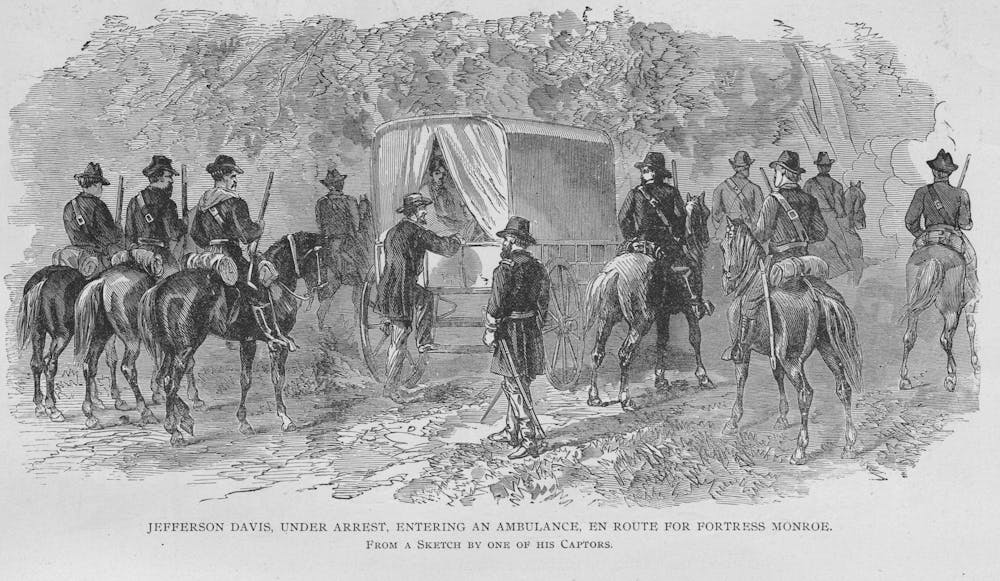
A depiction of the arrest of Jefferson Davis.

After fleeing Union forces, Confederate president Jefferson Davis, at center climbing into the carriage, was arrested on May 10, 1865. Buyenlarge/Getty Images

A clear conclusion

Taken as a whole, the structure of Section 3 leads to the conclusion that Donald Trump is one of those past or present government officials who by violating his oath of allegiance to the constitutional rules has forfeited his right to present and future office.

Trump’s supporters say the president is neither an “officer under the United States” nor an “officer of the United States” as specified in Section 3. Therefore, they say, he is exempt from its provisions.

But in fact, both common sense and history demonstrate that Trump was an officer, an officer of the United States and an officer under the United States for constitutional purposes. Most people, even lawyers and constitutional scholars like me, do not distinguish between those specific phrases in ordinary discourse. The people who framed and ratified Section 3 saw no distinction. Exhaustive research by Trump supporters has yet to produce a single assertion to the contrary that was made in the immediate aftermath of the Civil War. Yet scholars John Vlahoplus and Gerard Magliocca are daily producing newspaper and other reports asserting that presidents are covered by Section 3.

Significant numbers of Republicans and Democrats in the House and Senate agreed that Donald Trump violated his oath of office immediately before, during and immediately after the events of Jan. 6, 2021. Most Republican senators who voted against his conviction did so on the grounds that they did not have the power to convict a president who was no longer in office. Most of them did not dispute that Trump participated in an insurrection. A judge in Colorado also found that Trump “engaged in insurrection,” which was the basis for the state’s Supreme Court ruling barring him from the ballot.

Constitutional democracy is rule by law. Those who have demonstrated their rejection of rule by law may not apply, no matter their popularity. Jefferson Davis participated in an insurrection against the United States in 1861. He was not eligible to become president of the U.S. four years later, or to hold any other state or federal office ever again. If Davis was barred from office, then the conclusion must be that Trump is too – as a man who participated in an insurrection against the United States in 2021.


Mark A. Graber, University System of Maryland Regents Professor of Law, University of Maryland

This article is republished from The Conversation under a Creative Commons license. Read the original article.

As Jonathan Majors is convicted for assault, his well-crafted soft Black masculinity sours

Jonathan Majors was shaping up to be one of Hollywood's most sought-after leading men.

The Yale-trained actor known for always carrying around an artisanal cup to show "nobody can fill you up, nobody can pour you out. You do that yourself" was primed to take over the industry. 

His breakout performances in films like the critically lauded "The Last Black Man in San Francisco" and Michael B. Jordan's "Creed III" shot him right into the stratosphere. He was even nominated for an Emmy for his performance in the now-canceled HBO show "Lovecraft Country." Most of all, the star was prepping to become the next mega-villain in Marvel's potential next box office smash, "Avengers: Kang Dynasty" after debuting in "Loki"  and being featured in the flop "Ant-man and the Wasp: Quantumania."

However, things took a detour for Majors when he was arrested earlier this year after police responded to a 911 call after an altercation between Majors and a woman whom he had allegedly assaulted. Majors was arrested and charged with four counts of assault against his ex-partner Grace Jabbari. 

Majors doesn't pretend to be a serious actor — he is.

The actor and his legal defense kept the same stance — Majors was innocent. His legal team urged the charges were false and they were "confident that he will be fully exonerated." But that didn't stop his management team, several movies and organizations the actor worked with from dropping him. After a 10-day trial that ended on Monday, Majors was found guilty of reckless assault in the third degree and harassment. Almost immediately, Marvel fired the future face of their franchise. Also, Disney has postponed Majors' new independent film "Magazine Dreams," originally scheduled for release on Dec. 4, indefinitely.

The last few years had been a whirlwind. Majors went from the height of his career to facing up to a year in jail for assaulting his ex-partner (sentencing takes place in early February). It's a huge loss for the actor who had built a reputation on perfecting his craft and defying expectations for his gender – in direct opposition to the image that emerged from the trial. But if reports can be believed, even his carefully crafted image had cracks. Here's a look at the Jonathan Majors that came up in Hollywood, and the clues that may have indicated it would all come crashing down.

Jonathan Majors' artistic persona: a man dedicated to his craft 

Throughout Majors' career, the actor has chosen roles that show his professional training and range. There's the quiet playwright in his breakout "The Last Black Man in San Francisco" or the Korean war veteran navigating a Jim Crow America in "Lovecraft Country," or even the charismatic, ever-transforming multiverse supervillain in the MCU.

Majors doesn't pretend to be a serious actor — he is. He is a man of the craft, earning degrees from the University of North Carolina School of the Arts and Yale University.

In a profile with Ebony, the actor shared that his acting process is intense: "But if you’ve not done the work, then you just become a lesser father, a lesser actor, a lesser partner. I just become lesser. And the work allows me to start acting; it’s my occupation and my vocation. I take it extremely seriously."

It's clear that Majors' craft and process have been crucial to his preparation for his roles, but this extreme dedication may have foreshadowed a dark side as well. Classmates at Yale reportedly had issues with his behavior and process. According to a Rolling Stone exposé, Majors' alleged abusive behavior began in acting class, with several anonymous sources shared experiences they saw of the actor. “His behavior was very problematic for his class,” a Yale alum said. “A lot of people felt in physical danger around him and certainly in mentally precarious positions because of him.”

Following an alleged altercation that Majors was involved in during class caused Yale administration to send an email to remind students about "rehearsal etiquette and violence." One of his classmates said that Majors hit him while they were play fighting during rehearsal, and when the student later confronted Majors, he was said to shrug it off. 

“He can be very charismatic and really gentleman-like and sweet, but then he could also be really cold, scary, and violent . . . He was someone who would use his physicality to intimidate,” the person said.

Some sources shared with Rolling Stone that the actor was also aggressive on set during the filming of "Magazine Dreams." Two production members claimed that the actor pushed a person and physically intimidated another while screaming at them, leading to a complaint to producers. Majors' attorney said the actor “vehemently denies Rolling Stone’s false allegations that he physically, verbally, or emotionally abused anyone," including past romantic partners and classmates at Yale.

Jonathan Majors' soft Black masculinity 

The actor's ability to become an overnight powerhouse lies in his ability to play into a different kind of masculinity that we didn't see in many leading men in Hollywood — let alone Black leading men in the industry. Majors once said in an interview that "nothing is a monolith — not Blackness, not maleness, not comic book villains."

This version of masculinity can be described as the anti-hypermasculine man. It is a man who rejects traditional gender roles and sexism but also embraces empathy, vulnerability and emotions. But soft masculinity is rarely afforded to Black men and is also challenged in the Black community. Research shows that harmful and inaccurate stereotypes of Black men usually depict images of violence, toxic masculinity and criminality. These stereotypes find their way into discriminatory policies and fuel racial bias and prejudice towards Black men — which is why Major's rise was exciting and compelling. Through his work, especially roles like "Lovecraft Country," he redefined what it was to be a leading Black man in this seemingly post-racial era of Hollywood. 

This seemingly hopeless romantic who wears his heart and emotions on his sleeve was not the one who was heard in court.

Majors even publicly questioned the traditional forms of masculinity people were projecting onto him as he received criticism for a pink-infused Ebony photoshoot some members of Black Twitter had issues with. He said in response: "I'll just be curious. Tell me what masculinity is. I wouldn't want to walk up on me in the street, but it's bigger than— It's love. It's like there's awareness and then there's acknowledgment of ignorance. A big part of it is kindness, use of power, gentleness. These are masculine characteristics. It's quite unmasculine to try to emasculate another man."

Not only did Majors embrace a different form of masculinity but also claimed in an interview with The Cut that he “falls in love every day” and would “cry probably a few times a week.” His favorite romantic movies are "The Notebook," "Love Jones," "Blue Valentine" and "Love & Basketball."

But this seemingly hopeless romantic who wears his heart and emotions on his sleeve was not the one who was heard in court. While Majors did not testify, a recording was played in which he can be heard berating his partner for going out, telling her regardless of his "temper, my s**t . . . all that said, I am a great man. A great man. I am doing great things, not just for me, but for my culture and for the world. That is actually the position I'm in."

We need your help to stay independent

While Majors was performing his soft masculinity for the public and himself, behind closed doors he was allegedly threatening to kill himself when his partner considered going to the hospital for one of her injuries. This is just one of many incidents where Majors used his emotional state against his former partner. 

Ultimately, because our understanding of masculinity has changed as people embrace new and quite honestly healthier versions of it, it is pertinent to acknowledge that this progressive new form can also be weaponized by people like Majors. In Majors' case, it was used to hide under true, violent and horrific forms of masculinity and exploit his artistic career and process as a way to aid in covering the violence.

“Underwhelming”: Biden admin tosses token protection to old-growth forests

A coalition of more than 120 environmental groups applauded what it called "an important first step" Tuesday, when the U.S. Forest Service announced a more conservation-friendly proposal for its management of 128 national forests and grasslands. In a April 2021 executive order, President Joe Biden told the US Forest Service to start inventorying and protecting the 150-year-old "old-growth" forests which face logging threats. More than two and a half years later, the Forest Service is now finally proposing a change to its management policy of the ancient trees — a move that only comes after critics accused the Forest Service last June of dragging its feet on behalf of the logging industry, as first reported by The Huffington Post. Citing disastrous threats to the forests, the Forest Service proposal would mark the first nationwide amendment in the agency's 118-year history and restrict logging on 25 million acres of old-growth timber. But "mature" forests — those just shy of 150 years — are still vulnerable to destruction. 

“The FS has squandered the opportunity to respond meaningfully to [Biden’s executive order] by limiting the scope to old growth only, with no provisions — none — for mature trees and forests,” Jim Furnish, former Forest Service deputy chief, told HuffPost. “This small step forward is certainly better than nothing, but a far cry from the big leap needed to respond to our climate change crises. The FS logged and liquidated most of the old growth with tragic consequences and has an obligation to not only protect what remains but restore millions of acres by allowing mature forests to grow. This proposal fails entirely in that regard.”

Along with the Climate Forests Campaign coalition, support for the proposal came from the Sierra Club which called the proposal "a meaningful step towards averting climate catastrophe" and "safeguarding vulnerable ecosystems." Meanwhile, US companies are producing more oil than any country in history and is set to produce a global record of 13.3 million barrels per day by the end of the year, after President Joe Biden urged them to pump more last year and then approved a controversial Alaskan drilling project this March. The new oil production flood is outpacing the record of 13.1 million daily gallons, set by companies under former President Donald Trump in 2020. The new surge in production also comes as part of a new drilling technique that consumes vast amounts of water. The Forest Service's proposal now awaits finalization by President Joe Biden. 

Amid a year of record-breaking climate disaster, the U.S. broke its record on oil production

As the year 2023 comes to a close, scientists repeatedly draw attention to the numerous climate change records that were broken over the previous 12 months. There were new records set in global surface temperature, ocean heat content and ice melt — and humans everywhere felt the consequences. Our species just survived the hottest summer on record, complete with deadly heatwavesintensified wildfires and worsened floods and flood-related events. Yet amidst the ecological havoc, the United States was busy smashing a different record: Oil production.

Last month, the United States' weekly oil production surpassed a record set shortly before the COVID-19 pandemic injected chaos into the world economy — and with it, at least temporarily, the demand for petroleum. In fact, the U.S. is now producing more oil than any other nation in history. According to the US Energy Information Administration, weekly US oil production in November 2023 averaged to 13.2 million barrels per day. This record-breaking was anticipated by Forbes' senior contributor Robert Rapier, who wrote earlier this month that the United States had set a new annual oil production record on December 15. (The chart currently only goes to December 8.) He also speculated that — as a conservative estimate — the United States might end 2023 having produced as many as "4.70 billion barrels. That would be nearly 5% above the previous record, or 210 million barrels above that 2019 level."

There are stark potential ecological consequences to all of this oil production. According to Dr. Michael Mann, a professor of earth and environmental science at the University of Pennsylvania, all of the extreme weather is a "new abnormal" that humans must aim to stave off. "The impacts of climate change are upon us in the form of unprecedented, dangerous extreme weather events. It will only get worse and worse as long as we continue to burn fossil fuels and generate carbon pollution," Mann told Salon in July.

Alyssa Milano had Shannen Doherty fired from “Charmed,” claims Holly Marie Combs

Holly Marie Combs has spilled the beans on why she thinks her “Charmed” co-star Shannen Doherty hastily exited the series after its third season. On the latest episode of Doherty’s podcast “Let’s Be Clear,” Combs recalled meeting with show producer Jonathan Levin, who she said was forced to pick between Doherty and co-star Alyssa Milano to stay on the hit WB show.

“He said, you know, ‘We're basically in a position where it's one or the other. We were told [by Alyssa] that it's [Shannen] or me, and Alyssa has threatened to sue us for a hostile workplace environment’ — which because she went to the therapist or the mediator or the corporate mediator, whatever the heck his title is, she built a case for herself where she was documenting every time she felt uncomfortable on set and for whatever reason. Whereas you and I refused to speak to him. So that's where the deck was stacked,” Combs said.

Doherty’s character Prue Halliwell was ultimately killed off in theSseason 3 finale, which aired in 2001. Rose McGowan later joined the cast as Paige Matthews.

Combs continued, saying she couldn’t remember any “brawls” or “harsh words exchanged” between her, Milano and Doherty on the set of the show: “I lived a year after that sort of replaying everything in my brain and really trying to find those moments. I don't ever remember being mean to her on set.

“As you get older, you accept that a situation happened. Acceptance and moving on with your life does not equate to forgiveness,” Combs said. “You just learn a lesson and look at somebody differently and move on.”

“Other states may follow”: Expert says Colorado ruling could have “devastating impact” on Trump bid

The Colorado Supreme Court on Tuesday ruled that former President Donald Trump is disqualified from holding office again under the U.S. Constitution’s insurrection clause and removed him from the state’s 2024 presidential primary ballot.

At least 35 cases have been filed across the country trying to disqualify Trump under Section 3 of the 14th Amendment of the U.S. Constitution, which bars anyone engaged in "insurrection or rebellion" from holding federal office.

While most of these efforts have largely been unsuccessful, Colorado’s top court made history becoming the first state to hold the former president accountable for his efforts in trying to overturn the 2020 election.

“​The state court ruling sets a historic precedent which other states may follow,” Bennett Gershman, a former New York prosecutor and law professor at Pace University, told Salon. “It is a landmark ruling. I can’t think of an application of this provision in modern times.”

The ruling could have a “devastating impact” on the former president’s “quest” for the nomination and election if other states follow Colorado's lead, Gershman said.

A lower court judge ruled last month that Trump engaged in an insurrection by inciting a riot at the Capitol, but stopped short of disqualifying him, asserting that Section 3 does not apply to presidents.

The state's Supreme Court upheld the trial judge's conclusion that Trump engaged in insurrection and also affirmed the decision that Trump's January 6 speech at the Ellipse was not protected by the First Amendment. 

But they didn’t agree with the lower court’s ruling that the framers of the amendment, concerned about the return of former confederates to power, would prohibit them from low-level offices, but not the highest position in the country.

“President Trump asks us to hold that Section 3 disqualifies every oathbreaking insurrectionist except the most powerful one and that it bars oath-breakers from virtually every office, both state and federal, except the highest one in the land,” the court wrote in its 4-3 decision. “Both results are inconsistent with the plain language and history of Section 3.”

However, the justices asserted that they did not reach these conclusions “lightly” and remain “mindful of the magnitude and weight” of the questions now before them. “We are likewise mindful of our solemn duty to apply the law, without fear or favor, and without being swayed by public reaction to the decisions that the law mandates we reach.”

Noah Bookbinder, president of the watchdog group Citizens for Responsibility and Ethics in Washington, which brought the suit in Colorado on behalf of Republican and unaffiliated voters seeking to disqualify Trump, praised Tuesday’s ruling.

“The court’s decision is not only historic and justified, but is necessary to protect the future of democracy in our country,” Bookbinder said. “Our Constitution clearly states that those who violate their oath by attacking our democracy are barred from serving in government.”

While the decision removed Trump from the Republican primary ballot in Colorado, the justices paused their ruling so the former president could appeal to the US Supreme Court, which his campaign said it intended to do. If the appeal isn't settled quickly, it could preserve Trump’s spot on the state's GOP primary ballot in March.

We need your help to stay independent

The former president’s campaign spokesperson Steven Cheung criticized the Colorado Supreme Court's decision as politically motivated, blaming the justices appointed by Democrats.

“The Colorado Supreme Court issued a completely flawed decision tonight and we will swiftly file an appeal to the United States Supreme Court and a concurrent request for a stay of this deeply undemocratic decision,” Cheung said in a statement. 

It remains unclear how the Supreme Court will rule, given its conservative majority, including three justices appointed by Trump. 

But, some Republicans quickly rallied behind Trump soon after the decision came, condemning the ruling for allegedly infringing on voters’ rights to select their leaders.

“Democrats are so afraid that President Trump will win on Nov 5th 2024 that they are illegally attempting to take him off the ballot,” Elise Stefanik, R-N.Y., wrote on X, formerly Twitter. 

Republican presidential candidate Vivek Ramaswamy shared a video on social media, vowing to withdraw from the Colorado GOP primary ballot unless Trump is allowed to remain on the ballot as well.


Want a daily wrap-up of all the news and commentary Salon has to offer? Subscribe to our morning newsletter, Crash Course.


“I demand that Ron DeSantis, Chris Christie, and Nikki Haley do the same immediately – or else they are tacitly endorsing this illegal maneuver which will have disastrous consequences for our country,” Ramaswamy said. 

Similarly, Florida Governor Ron DeSantis, who is also campaigning for the Republican nomination, blasted the latest ruling.

“The Left invokes ‘democracy’ to justify its use of power, even if it means abusing judicial power to remove a candidate from the ballot based on spurious legal grounds,” DeSantis wrote on X. “SCOTUS should reverse.”

Trump, who in recent months has used his legal troubles as an opportunity to raise money pushing claims that democrats are conspiring against him, took to Truth Social once again, asking for donations. 

“Breaking news: Colorado just removed me from the ballot! Chip in now,” he posted on the platform, The Guardian reported

If "many other states" remove Trump from the ballot, his chances of being nominated “fall significantly,” Gershman explained. 

“The big question now is whether the Supreme Court will agree to review the ruling or perhaps wait to see if other states follow Colorado,” Gershman said.

Here’s why “Jeopardy!” reportedly decided to fire Mayim Bialik as host

Mayim Bialik has been dropped as “Jeopardy!” host after she and Ken Jennings were named permanent joint hosts of the show back in 2022. On Friday, Bialik announced that Sony had informed her that she would no longer be hosting the syndicated version of the famed game show:

“I am incredibly honored to have been nominated for a primetime Emmy for hosting this year and I am deeply grateful for the opportunity to have been a part of the ‘Jeopardy!’ family,” she said. “For all of you who have supported me through this incredible journey and to the fans, contestants, writers. staff and crew of America's Favorite Quiz Show, thank you.”

"Jeopardy!" later released a statement on its official Instagram account, clarifying that Bialik had made the announcement herself.

“We made the decision to have one host for the syndicated show next season to maintain continuity for our viewers, and Ken Jennings will be the sole host for syndicated ‘Jeopardy!,’ the statement continued. “We are truly grateful for all of Mayim's contributions to ‘Jeopardy!,’ and we hope to continue to work with her on primetime specials.”

Prior to her official departure, Bialik stepped away from her hosting duties, both on “Jeopardy!” and “Celebrity Jeopardy!,” to stand in solidarity with striking Hollywood writers and actors amid the summer. In the wake of Bialik’s recent announcement, fans have accused “Jeopardy!” of antisemitism. Bialik has publicly spoken out in support of Israel amid the nation’s ongoing conflict with Palestine.

Santa over students: Why Republicans’ rejection of plant-based milk in schools is racially biased

Last Wednesday, as Congress faced looming deadlines to pass several major legislative priorities, including a government funding bill, before breaking for the holidays, Republican Congresswoman Virginia Foxx of North Carolina decided to divert attention to the respective difficulty of Santa Claus’ upcoming annual trek. “Hoisting heavy sacks of gifts up and down the chimney is no easy task,” Foxx declared, before suggesting that Santa Claus needs whole milk, as opposed to soy or oat or skim, in order “to travel the whole globe in one night.” 

She continued: “We want only the most nutritional option for Santa. Whole milk is the unsung hero of his Christmas journey.” 

This dairy-centered diversion wasn’t just a holiday-themed filibuster. For several years now, House Republicans have, with increasing intensity, fought for the reintroduction of whole milk — as opposed to skim or low-fat — to the National School Lunch program as current laws dictate that schools must offer milk that is fat-free or low-fat, and may only offer flavored milk if it is fat-free. This has been the case since 2012 when then-First Lady Michelle Obama moved to only permit low-fat milk variations.

Earlier this year, Rep. Glenn Thompson (R-Pa.) introduced the Whole Milk for Healthy Kids Act, which would reverse those Obama-era requirements, and which was ultimately passed by the House following Foxx’s comments. It now heads to the Senate. 

However, running parallel to House Republicans’ desire to reintroduce whole milk to school lunch has been a simultaneous push to prevent plant-based alternatives from being introduced to the cafeteria. To that end, last week the House Rules Committee rejected an amendment proposed by House Democrats from California, South Carolina and Louisiana to offer kids a nutritionally equivalent, plant-based milk option upon request. It’s a decision that is both ironic considering that the Whole Milk for Healthy Kids Act has been touted as a bill aimed at increasing choice for students, as well as one that is racially biased because, as Rep. Troy A. Carter, D-La., put it in a 2022 letter to Agriculture Secretary Tom Vilsack, the rates of lactose intolerance in people of color “are startlingly high.” 

“65 percent of Latino students, 75 percent of Black students, and 90 percent of Asian students [are] unable to digest dairy milk without detrimental effects,” Carter wrote. 

According to Boston Children’s Hospital, lactase is an enzyme that is normally produced in the small intestine, where it breaks down lactose into a form that can be absorbed by the blood. A lack of lactase, or “lactose intolerance,” can cause uncomfortable symptoms in some people, including nausea, cramps, bloating, gas and diarrhea occurring 30 minutes to two hours — so, not exactly peak physical condition for concentrating in school. 

We need your help to stay independent

“This issue hit me hard both as a parent of two Black boys, and as a congressman of a majority-minority district in the south,” Carter told the Washington Post in 2022. “We know our nation’s public schools and health-care systems have deeply flawed histories — and, in some cases, current realities — of inequitable resource distribution and treatment of students and people of color. While this push to offer nondairy, nutritionally equivalent alternatives to our kids there at lunch counters may seem like a small fight, this is another one of those inequities facing communities of color that we can and therefore must take action to fix.”

Though an estimated 30,000,000 to 50,000,000 Americans are lactose intolerant, the condition is least common among individuals with a Northern European heritage — and that “lactose persistence” is something that white nationalists have long clung to as proof of being genetically superior to other races. 

This was the case in the early 20th century when milk advertisements, which positioned the drink as a nutritionally “perfect beverage,” would contrast healthy-looking light-skinned models with sickly looking darker-skinned models. As sociologist Melanie DuPuis has written, “By declaring milk perfect, white northern Europeans announced their own perfection.” 

Fast-forward to 2017 the hashtag #MilkTwitter went viral after a group of white nationalists descended on an anti-Trump rally following the former president’s inauguration armed with plastic gallons and cartons of milk, from which they would take the occasional swig between hurling racist epithets and touting their own “lactose persistence.” 

"While this push to offer nondairy, nutritionally equivalent alternatives to our kids there at lunch counters may seem like a small fight, this is another one of those inequities facing communities of color."

“An ice-cold glass of pure racism,” one attendee remarked to the camera after taking a drink from his carton. Let’s just say that it’s not a coincidence that milk makes an appearance in both “Inglourious Basterds” and “Get Out,” consumed, respectively, by a Nazi and a racist bodysnatcher. 

Does this line of thinking qualify the Whole Milk for Healthy Kids Act as white nationalist propaganda? Of course not. However, it’s important context to consider when politicians declare whole dairy milk the perfect beverage because it raises the question: Perfect for whom? Currently, according to 2022 numbers from the USDA, 29% of the cartons of dairy milk served in American public schools are thrown in the garbage — unopened

In speaking with the Washington Post last year, Rep. Carter said that continuing to force dairy on children who physically can’t consume it is unconscionable. 

“For many of these kids, school meals may be the only food available to them that day,” he said. Children cannot learn if they feel sick or hungry, and yet we know that millions of children, especially children of color, experience negative symptoms after ingesting the dairy that our current school lunch program requires be placed on every student’s lunch tray.”

Federal judge orders unsealing of documents naming over 150 Jeffrey Epstein associates

A federal judge in New York has ordered a mass unsealing of court documents in early 2024 that will release to the public the names of scores of Jeffrey Epstein's associates. The documents are part of a settled 2017 lawsuit claiming Epstein's ex-beau Ghislaine Maxwell facilitated the sexual abuse of Virginia Giuffre, the settlement terms of which were not disclosed. According to ABC News, Judge Loretta Preska slated the document release for Jan. 1, providing anyone who objects to their documents becoming public time to object.

Anyone who did not successfully work to have their name excluded from the civil case could see their name released to the public upon the documents' unsealing, including Epstein's victims, co-conspirators and innocent associates. Certain minor victims' names will stay redacted. Preska's decision notes, however, that because some of the included individuals have done media interviews their names should not remain private. Some names belong to individuals who were simply included in depositions, email or legal documents, while others belong to people who have already been publicly associated with Epstein.

Though the documents may not clarify why a certain individual became associated with Giuffre's lawsuit, more than 150 people are expected to be identified between the hundreds of files that may expose more about Epstein's sex trafficking of women and girls in New York, New Mexico, the U.S. Virgin Islands and other locations. Maxwell is currently serving 20 years in prison after she was convicted of sex trafficking and procuring girls for Epstein, who died by suicide in 2019 in a Manhattan jail while awaiting trial on federal sex trafficking charges. 

Thirteen tons of TGI Friday’s boneless chicken bites have been recalled due to plastic contamination

Approximately 26,550 pounds of TGI Friday's boneless chicken bites have been recalled due to possible contamination with “clear, hard plastic,” the U.S. Department of Agriculture's Food Safety and Inspection Service announced in a Friday notice.

Simmons Prepared Foods Inc. issued the recall on its 15-ounce cartons of Honey BBQ flavor chicken bites that were produced on Oct. 3. The products contain lot code KL3K03 and “Best By Date” of 12/26/2024.

“The problem was discovered when the firm notified FSIS that it had received consumer complaints reporting that clear, hard plastic was found under the breading of the boneless chicken bites,” the recall specified. 

At this time, there have been no confirmed reports of injury or illness from consumption of the aforementioned chicken bites. The USDA urged anyone who is concerned about possible injury or illness to contact a healthcare provider.

Consumers who recently purchased the boneless chicken bites are advised to not consume them. The products should either be thrown away or returned to the place of purchase.

Trump has extended Truth Social meltdown after Colorado Supreme Court bans him from ballot

Former President Donald Trump posted or reposted more than 25 "truths" on his social media platform Truth Social after the Colorado Supreme Court on Tuesday evening disqualified him from appearing on the state's primary ballot under the U.S. insurrection clause. "We do not reach these conclusions lightly,” the court wrote in a 4-3 decision. “We are mindful of the magnitude and weight of the questions now before us. We are likewise mindful of our solemn duty to apply the law, without fear or favor, and without being swayed by public reaction to the decisions that the law mandates we reach." Trump in a post on Wednesday lamented that it was "A SAD DAY IN AMERICA!!!"

"BIDEN SHOULD DROP ALL OF THESE FAKE POLITICAL INDICTMENTS AGAINST ME, BOTH CRIMINAL & CIVIL," Trump raged. "EVERY CASE I AM FIGHTING IS THE WORK OF THE DOJ & WHITE HOUSE. NO SUCH THING HAS EVER HAPPENED IN OUR COUNTRY BEFORE. BANANA REPUBLIC??? ELECTION INTERFERENCE!!!" In a separate post, the former president simply stated, "WHAT A SHAME FOR OUR COUNTRY!!!" Trump on Tuesday was in Waterloo, Iowa for a campaign event. Shortly after his speech concluded, he began posting a flurry of video clips and quotes related to his thoughts about the Colorado decision. Mediaite reported that he quoted Fox News host Laura Ingraham, writing, "Tonight, America is seeing the ultimate—in ELECTION INTERFERENCE.” One quoted video clip read, “They don’t want the voters to decide this…there is obviously this deep fear of Donald Trump potentially winning the White House back…” Another, from conservative commentator Greg Jarrett, said, “This is ELECTION RIGGING…This is an effort, make no mistake, to deprive American voters of their right to make the decision as to who should be president. It is anti-democratic. It’s the equivalent of rigging the ballot box.” Trump also pulled a quote from far-right journalist Charlie Hurt, who was quoted to have said, "Democrats in Colorado are so afraid of allowing American voters to vote and pick the next president they are willing to do extra-judicial things, in order to thwart the people’s choice from being on the ballot. To them, preserving democracy requires destroying democracy.”

"ELECTION INTERFERENCE!," Trump wrote above a clip of Fox commentator Jesse Watters. “This country is a powder keg and this court is just throwing matches at it," Trump posted, quoting right-leaning attorney Jonathan Turley. "…For people that say they are trying to protect democracy, this is hands down the most anti-democratic opinion I’ve seen in my lifetime.”

Judge orders Trump ally Scott Perry to turn over “incendiary” evidence to Jack Smith

Rep. Scott Perry, R-Pa., must disclose to federal prosecutors more than 1,600 text messages, emails and other communications related to the investigation into Donald Trump and his allies' attempts to overturn the 2020 election, a federal judge ruled Tuesday. Chief U.S. District Judge James Boasberg found that the majority of the messages between Perry and other members of Congress, members of the Trump administration and allies outside of the government could not be concealed from prosecutors by the representative's constitutional protections as a member of Congress, Politico reports

Instead, Boasberg concluded all 1,659 exchanges were not protected under the Constitution's "speech or debate" clause, which disallows prosecutors and courts from looking into official Congressional business, because they were hardly connected to Perry's legislative role. An inadvertently disclosed court document obtained by Politico last month exposed key parts of the messages, including conversations with Trump's alleged co-conspirators in the bid to subvert the election, which showed Perry as a go-between for Trump and his allies. The earlier release showed that the messages should "include some very incendiary texts," tweeted former U.S. Attorney Harry Litman. The texts "may shed light on his involvement in Trump's plan to use DOJ to push the big lie," agreed former U.S. Attorney Joyce Vance.

An attorney for Perry told the outlet he has not yet decided whether he will appeal the judge's ruling. The FBI seized Perry's phone in August 2022 in connection to its probe of former Justice Department official Jeffrey Clark, a key Trump ally in the effort to thwart the transfer of power. Boasberg's order backs a decision made almost a year ago by U.S. District Judge Beryl Howell, who found that Perry was required to share with prosecutors 2,055 communications he had attempted to hide, with only about 200 actually shielded. Howell ruled that Perry's “informal” attempts to investigate election fraud were not protected by the "speech or debate" clause because he was not authorized by any House committee to conduct the probe. 

Trump acknowledges Hitler comparisons — as he doubles down on rhetoric despite GOP pushback

Former President Donald Trump pushed back on comparisons to Adolf Hitler as he denied that he ever read "Mein Kampf" while doubling down on his claims that immigrants are "poisoning the blood of our country."

“They’re destroying the blood of our country. That’s what they’re doing — they’re destroying our country,” Trump said Tuesday at an event in Waterloo, Iowa, echoing his comments over the weekend that drew comparisons to fascists. 

“I never read ‘Mein Kampf’” Trump told the Iowa audience. “They said Hitler said that — in a much different way. No, they’re coming from all over the world — people all over the world. We have no idea — they could be healthy, they could be very unhealthy, they could bring in disease that’s going to catch on in our country. But they do bring in crime. … They’re destroying the blood of the country, they’re destroying the fabric of our country, and we’re going to have to get them out.”

The comments came amid mounting backlash over his earlier comments. Even some Republicans on Tuesday condemned the former president's rhetoric.

“I thought that was horrible, that those comments are — just have no place, particularly from a former president,” Sen. Susan Collins, R-Maine, told reporters, according to NBC News. “So they’re deplorable.”

Senate Minority Leader Mitch McConnell, R-Ky., seemed to articulate a personal gripe with Trump's controversial speech — McConnell's wife and former secretary of transportation, Elaine Chao, immigrated to the U.S. from Taiwan as a child. "It strikes me that it didn’t bother him when he appointed Elaine Chao secretary of transportation," McConnell said. 

"I think that that rhetoric is very inappropriate, but this administration’s policies are feeding right into it. And so I disagree with that. I think we should celebrate our diversity," said Sen. Tim Rounds, R-S.D. “But unfortunately, that type of rhetoric is what happens when you don’t have a border policy that works. And it just simply feeds that type of poor, unacceptable rhetoric."

"He’s disgusting, and what he’s doing is dog-whistling to Americans who feel absolutely under stress and strain from the economy and from the conflicts around the world, and he's dog-whistling it to blame it on people from areas that don’t look like us," said GOP presidential candidate and former New Jersey governor Chris Christie. 

We need your help to stay independent

Still, some Republican Trump allies have sought to defend the comments.

"We’re talking about language. I could care less what language people use as long as we get it right," Sen. Lindsey Graham, R-S.C., said during a recent appearance on NBC. 

When CNN's Abby Phillip pointed out the insidious nature of what was said to Rep. Nicole Malliotakis, R-N.Y., Malliotakis replied, "I don’t think that’s what he was saying."

“When he said they are poisoning, I think he was talking with the Democratic policies. I think he was talking about open border policy," the GOP lawmaker continued, going so far as to argue that Trump can't be anti-immigrant, as "some people are trying to make" him seem, because he has both married and employed them in the past. 

Florida Gov. Ron DeSantis, in a clip shared on Monday by Fox News, said, "I don't know what this means with the blood stuff. I know people are trying to draw historical allusions. I don't know if that's what he meant."


Want a daily wrap-up of all the news and commentary Salon has to offer? Subscribe to our morning newsletter, Crash Course.


The Biden administration swiftly denounced Trump's words, drawing comparisons to Hitler, who used similar "blood poisoning" language in his "Mein Kampf" manifesto, per NBC News. Over the weekend, Biden campaign spokesperson Ammar Moussa said that Trump "channeled his role models as he parroted Adolf Hitler, praised Kim Jong Un, and quoted Vladimir Putin while running for president on a promise to rule as a dictator and threaten American democracy.”

The New York Times reported that in one chapter of "Mein Kampf," Hitler wrote, “All the great civilizations of the past became decadent because the originally creative race died out, as a result of contamination of the blood.” In another section, he draws a connection between “the poison which has invaded the national body” with an “influx of foreign blood.”

Trump in his Tuesday speech also touted the unfounded claim that leaders of unspecified countries were sending occupants of prisons and mental health institutions to the U.S.

Steven Cheung, a Trump campaign spokesperson, seemed to rebuff allegations of Republican criticism of Trump over his recent remarks, asserting that the former president "has by far the most Senate endorsements in this race, people who are fighters and want to Make America Great Again."

Texas lieutenant governor threatens to ban Biden from ballot as revenge for Colorado Trump ruling

Texas Lt. Gov. Dan Patrick on Tuesday threatened to cut President Joe Biden from his state's ballot in retaliation to a Colorado Supreme Court ruling that axed former President Donald Trump from that state's 2024 presidential race for his conduct on Jan. 6. Patrick expressed the view on Fox News, offering a justification for the potentially unprecedented action to host Laura Ingraham as a response to Biden's border policies, according to The Daily Beast. The only factor holding him back, Patrick explained, was that Texans "believe in democracy."

“Seeing what happened in Colorado makes me think—except we believe in democracy in Texas—maybe we should take Joe Biden off the ballot in Texas for allowing eight million people to cross the border since he’s been president disrupting our state,” Patrick said. The lieutenant governor's comment followed shortly after the Colorado Supreme Court decided to boot Trump from the state's ballot for engaging in an insurrection by participating in the Jan. 6 Capitol riot, an action that, per the 14th Amendment, would make him ineligible for the presidency.

The court said that despite knowing he had incited an insurrection by voicing calls to arms, Trump “then stood back and let the fighting happen, despite having the ability and authority to stop it (with his words or by calling in the military), thereby confirming that this violence was what he intended.” Trump and his campaign immediately bemoaned the ruling, asserting they would file an appeal. “We have full confidence that the U.S. Supreme Court will quickly rule in our favor and finally put an end to these unAmerican lawsuits,” Trump campaign spokesperson Steven Cheung said in a statement.

“I have been skeptical… now I’m completely sold”: Legal experts on Trump Colorado ballot ruling

The Colorado Supreme Court on Tuesday declared former President Donald Trump ineligible to appear on the state’s primary ballot under the U.S. Constitution’s insurrection clause.

“A majority of the court holds that Trump is disqualified from holding the office of president under Section 3 of the 14th Amendment,” the court wrote in a 4-3 decision.

“We do not reach these conclusions lightly,” the majority opinion read. “We are mindful of the magnitude and weight of the questions now before us. We are likewise mindful of our solemn duty to apply the law, without fear or favor, and without being swayed by public reaction to the decisions that the law mandates we reach.”

A lower court judge previously found that Trump engaged in insurrection but agreed with his lawyers’ arguments that Section 3 does not apply to the president. The state Supreme Court majority disagreed.

“President Trump asks us to hold that Section 3 disqualifies every oathbreaking insurrectionist except the most powerful one and that it bars oath-breakers from virtually every office, both state and federal, except the highest one in the land,” the majority opinion wrote. “Both results are inconsistent with the plain language and history of Section 3.”

One of the dissenting judges argued that Trump shouldn’t be disqualified unless he has been convicted of insurrection. Another raised due process concerns and argued that only Congress could enforce the ban.

Conservative attorney George Conway told MSNBC that he had been “skeptical” until seeing how “weak” the dissents were in the case — even as he acknowledged that the U.S. Supreme Court may overturn the ruling anyway.

“I have been a little skeptical of this theory until last night," Conway said. "Now I'm completely sold. I was sold by the dissents. I have been skeptical of this theory not because I found anything that [legal experts] said was wrong…I just thought, well, it's a little too good to be true. I really do want to see Donald Trump beaten at the polls, so I have been a little skeptical.

"Then I read the dissents," he added. "They are so unbelievably weak that I'm now convinced there really isn't an argument against what the Supreme Court did."

Conway argued that Section 3 does not mention requiring a conviction and none of the dissenting judges disagreed with the finding that Trump engaged in insurrection.

"It's strong evidence," he said. "You don't see the dissents challenging those findings at all, and in fact, there's no basis to challenge the findings. When you go to the majority opinion and read the 30 or 40 pages on what happened on Jan. 6 and what Donald Trump did before and during Jan. 6, there's no dispute. We saw it on television, and we know what happened. He engaged in an insurrection. He wanted this to happen, and not only that, there's another provision that talks about giving aid and comfort to enemies of the Constitution. He did that, he was an enemy of the Constitution. If this decision gets overturned, it's not going to be on the basis of the factual findings."

Retired conservative federal Judge J. Michael Luttig called the ruling a “masterful judicial opinion of constitutional law” that “will stand the test of the time.”

Former acting Solicitor General Neal Katyal argued that the ruling “follows pretty much directly from the text of the Constitution. So you know, someone like Donald Trump who claims to be a strict textualist when it comes to the Constitution has been hoisted on his own petard.”

Katyal predicted that the Supreme Court may vote to uphold the ruling, noting that the court ruled against his post-2020 election challenges and executive privilege claims.

“So, you know, I think that a fair-minded reading of this provision really compels this result,” he told MSNBC, adding that the Colorado Supreme Court “took pains to say, you know – this is just a quote from the opinion – ‘we’re mindful in our solemn duty to apply the law without fear or favor, and without being swayed by public reaction to the decisions that the law mandates we reach.’ And I think that the United States Supreme Court would apply that same standard. Trump will be disqualified from the ballot.”

We need your help to stay independent

Temidayo Aganda-Williams, a former House Jan. 6 committee investigator and attorney, told CNN that the Supreme Court “will have to look seriously at this and I think this will be tough to overrule.”

But the Supreme Court “may take some off-ramps here,” he added, noting that they may look at whether the plaintiffs in the case may lack standing or whether the state court lacks jurisdiction.

"I think what the American people are owed an opinion that goes to the heart and the merits of the case, which is, one, whether the former president engaged in insurrection against the Constitution,” he said. "I think that's what the court has to answer here."

Still, many legal experts expect the Supreme Court to reject the Colorado court ruling.

“I think this case will be handled quickly, I think it could be 9-0 in the Supreme Court for Trump,” former Trump White House lawyer Ty Cobb said in an interview on CNN. “I do believe it could be 9-0 because I think the law is clear,” he added.

“The real key issue in this case is — is Trump an officer in the United States in the context in which that term is used in the Article Three of the 14th Amendment,” he explained. “And in 2010, Chief Justice Roberts explained in free enterprise that people don’t vote for officers of the United States.”


Want a daily wrap-up of all the news and commentary Salon has to offer? Subscribe to our morning newsletter, Crash Course.


New York University Law Prof. Melissa Murray said the Colorado opinion was “meticulous” and “important” but leaves the U.S. Supreme Court multiple questions to decide.

"I think one question here is whether or not the Colorado state court had jurisdiction to take this up, and that will be something the court will attend to,” she told MSNBC. “The question of whether or not Section 3 of the 14th amendment is self-executing, or whether it requires some kind of congressional action, like a statute providing a cause of action, is also another issue that the court could decide this on. And the due process issue. There are a number of off-ramps here.

“But, if the Supreme Court takes up the substantive question, determines that the text of Section 3 makes clear it applies to Donald Trump, and that Donald Trump was engaged in an insurrection on January 6th, this is going to set off a domino effect that literally will go throughout the country as more and more states line up to decide whether or not they will disqualify,” she added. “Remember, election law is a creature of state law. The states get to decide the procedures and the mechanisms for their own election — even federal election — and so each state can come to its own conclusion. And so, if the court decides this in a way that goes against Donald Trump, we may find ourselves with a patchwork of ballots on election night in 2024."