Spring Sale: Get 1 Year, Save 58%

“The Twilight Saga” has more to give, even after 15 years

When discussing any of the five films that comprise "The Twilight Saga" — which I find myself doing with unbothered regularity — my go-to phrasing for encapsulating their general vibe is "delightfully unhinged." I've yet to think of a better way to describe a narrative arc that starts with a girl holding a tiny cactus and ends with her as a red-eyed vampire, settled in the misty town of Forks, Washington with her centenarian husband and their rapidly aging half-vampire daughter, Renesmee. 

When the first film in the series hit theaters back in 2008, I was 31 years old, which you'd think would put me well past their intended demographic, but what's been made very clear to me after making my way through the 12 hours of bonus content included in the newly released 15th anniversary SteelBook Collection is that these adaptations of Stephenie Meyer's fantasy romance novels resonate far beyond the young adult audience she had in mind when she wrote the first one in just three months' time, never expecting it to be published, much less become the phenomenon it did, and continues to be after all these years.

In the five bonus feature discs included in the new collection — along with 4K Ultra HD™ + Blu-ray™ + Digital copies of the films — there's extensive footage of fans of all ages from promotional events and special screenings held all around the world over the past two and a half decades, breathlessly praising the films and the books that they're based on. A good percentage of the fans shown are shrieking young girls in tears for Edward (Robert Pattinson) and Jacob (Taylor Lautner) reasons, but there's a surprising amount of mom-aged and grandma-aged ladies, as well as a healthy representation of "Twiguys." In one moment in the "Twilight Fanomenon" featurette included with "Eclipse," a man is asked what drew him to the films, and he says that his wife likes them and he likes his wife, so he wants to be part of what she does. Romance paving the way for more romance? There's a lesson there. 

The Twilight Saga box set"The Twilight Saga" 15th anniversary SteelBook Edition box set (Lionsgate)
As I sit here sipping iced coffee out of my insulated "Twilight" cup, purchased on sale at Hot Topic recently because it features a photo of my favorite character from the series (TEAM JACOB!) along with my favorite quote: "Bella, where the hell have you been, loca?" I find it exciting that, having believed I'd learned everything there was to know about this franchise, there's still more to discover. Without these bonus features, I would have never known that Stephenie Meyer listened to Linkin Park albums on a loop while writing "Twilight" ("Meteora" and "Hybrid Theory," specifically.) Or that Kristen Stewart — much as she's tried to distance herself from her character, Bella Swan — signed up for the project that would take over years of her life because she didn’t want the character to be depicted as "too vulnerable or too doe-eyed," saying she didn't feel like that would be a good thing to promote.


Want a daily wrap-up of all the news and commentary Salon has to offer? Subscribe to our morning newsletter, Crash Course.


In "A Conversation with Stephenie Meyer," included with "Twilight," she reveals that she only took one writing class prior to penning the first book in her beyond popular series, and that was only because it was a requirement to graduate with a degree in English. To hear her describe what led to her sitting down to write what would go on to earn her hundreds of millions of dollars, it all started from a dream she had about a vampire and a girl having a conversation in a meadow. Breaking standard tropes by not giving her vampire characters fangs or needing to sleep during the day, she says it was more fun not to follow rules that had been set before she entered into the vampy/wolfie genre. Throughout all of the bonus features that show bloopers or behind the scenes footage, Meyer is often visible on set, watching the process closely to make sure the four different directors for the five films (Bill Condon directed "Breaking Dawn" 1 & 2) didn't stray too far outside of what she created in her mind. According to her, they exceeded her expectations.

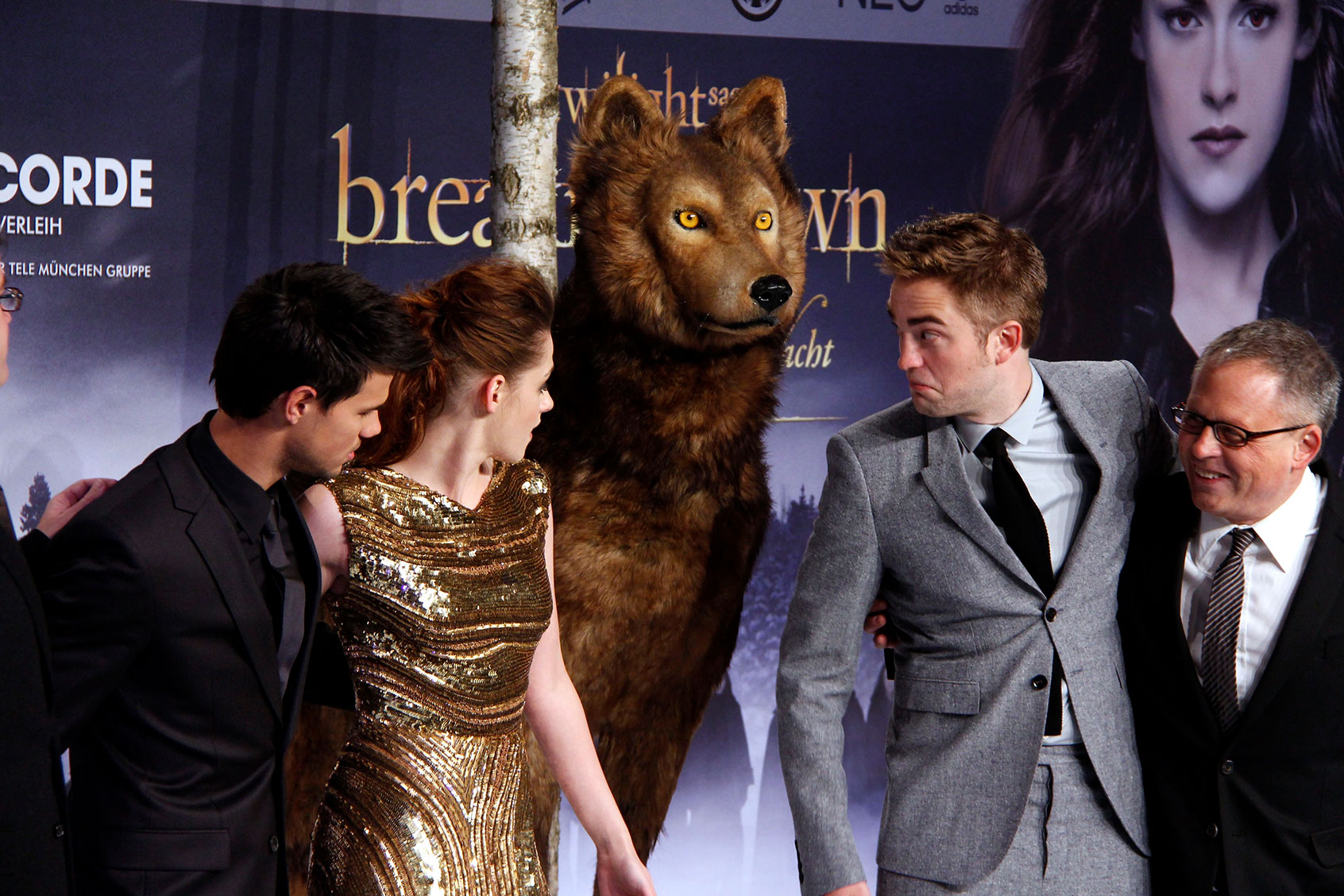
Twilight; Taylor Lautner; Kristen Stewart; Robert Pattinson; Bill CondonActors Taylor Lautner, Kristen Stewart, Robert Pattinson and director Bill Condon attend the 'The Twilight Saga: Breaking Dawn Part 2' Germany premiere at Cinestar on November 16, 2012 in Berlin, Germany. (Anita Bugge/WireImage/Getty Images)Throughout these extras, many of which I'd never seen before, it's cool to watch each of the main actors literally grow into their roles. In one interview in the set, Meyer mentions that a kid she knew when she was 14 who was a Navajo Indian was the inspiration for Jacob Black, the series' hunky lovesick werewolf. But he didn't start out very hunky. In a cast retrospective included with "Eclipse," Taylor Lautner says that he hit the gym immediately after filming was completed for "Twilight," working out for an hour and a half in the morning, and for that same amount of time again at night, eventually gaining 30 pounds of muscle by the time the second film, "New Moon," started up. In the fandom, his character gets poo-pooed quite a bit by those who favor the "cooler," more sophisticated Edward, but a few deleted scenes and extended scenes from the set showcase why those people are wrong. I'll just say that again for emphasis. THEY'RE WRONG. In one extended scene included in the "New Moon" features, Jacob, in his continued efforts to woo Bella away from Edward, compares himself to the sun, saying that it's always there, even when you can't see it, and that he'll always be there for Bella. He'll never go away. God. I'm practically crying just writing that down. What did Edward ever do that was that romantic? From my perspective, he just constantly bragged about being able to easily kill his girlfriend while making a face that looked like he had to poop real bad. This perspective is vindicated in all of the bloopers and cast interviews where Pattinson is messing up his lines or being a goof, receiving countless eye rolls from Stewart, whom he dated for several years in real life. Stewart would later come out as queer and announced her engagement to screenwriter Dylan Meyer in 2021. I'm smiling at this. This makes me smile. Turns out that Stewart wasn't Team Jacob or Team Edward. 

Although the bonus features in this new set kept me occupied for days, and re-reminded me just how fun it is to have "The Twilight Saga" be an active and current part of my life, I secretly hope they held some back. I can always sit down and rewatch Michael Sheen describe his character Aro as a Venus flytrap with an unhinged quality, mirrored by his own devilish grin and flashing eyes. Or the too-brief outtakes with "Chuckesmee," the hellish looking animatronic they ditched in favor of CGI for the baby Renesmee scenes in "Breaking Dawn." But it's equally fun to fantasize about there being even more to discover in the future. I'm a pleasure-delayer. Just like Edward. Gross.

Food allergies might exacerbate cardiovascular illness, new research finds

For most, allergies are assumed to be somewhat separate from other health aspects, such as cardiovascular health. According to a new study, though, this isn't the case  — and the way in which food allergies may impact cardiovascular health should be much more strongly considered.

The new research, published in the Journal of Allergy and Clinical Immunology, "challenges the current paradigm that sensitization without overt allergy is benign." As detailed in a press release, the study "suggests sensitivity to common food allergens such as dairy and peanuts could be an important and previously unappreciated cause of heart disease," as well as the fact that "that increased risk could equal  — or exceed  — the risks posed by smoking, as well as diabetes and rheumatoid arthritis," stunningly enough. The UVA Health scientists behind the research drew a connection between "those sensitive to cow's milk," but other allergens also proved to pose an issue. "The findings do not conclusively prove that food antibodies are causing the increased risk, but the work builds on prior studies connecting allergic inflammation and heart disease."

About 15% of adults have allergies to cow's milk, peanuts and other foods  — and there are some who have no symptoms and therefore are totally unaware of their allergies and antibodies. “What we looked at here was the presence of IgE antibodies to food that were detected in blood samples,” Dr. Jeffrey Wilson, the study's lead author, said in the release.

The team reviewed data collected from over 5,300 participants and found that "285 had died from cardiovascular causes." In addition to the aforementioned dairy and peanut allergens, shrimp sensitization was another component recognized as a "significant risk factor for cardiovascular death."

Donald Trump allegedly hung up on Kim Kardashian when she sought his help, new book says

Former President Donald Trump allegedly hung up on Kim Kardashian when she called asking for his help with a clemency case, ABC News' Jonathan Karl wrote in his upcoming book.

Kardashian famously met with Trump in the Oval Office in 2018 to petition for the pardoning of Alice Marie Johnson, who was serving a life sentence for a first-time, non-violent drug offense. After the request for clemency was granted, Kardashian reportedly pushed for more similar cases. Trump was willing to comply, only if Kardashian helped boost his celebrity connections: 

"A source familiar with the conversations tells me Trump listened to her requests and demanded a straight-up quid pro quo. He would grant the commutations, he told Kardashian, if she leveraged her celebrity connections to get football stars who were friends of hers to come visit him at the White House,” Karl wrote in his book “Tired of Winning,” out Tuesday. An excerpt was published by Axios on Monday.

Kardashian tried fulfilling Trump’s request but all the football players she approached refused to meet with him. 

Karl also wrote that Kardashian reached out to Trump’s Mar-a-Lago team months after he left the White House in hopes of attaining a high-profile endorsement for another clemency plea, but he wasn’t open to helping this time:

"Hell no, the former president told her. He wouldn't do it. 'You voted for Biden and now you come asking me for a favor?' Trump told her . . . After a few more choice words, the line went dead. Trump had hung up on her."

Expert: Trump aide Dan Scavino may face “superseding indictment” after Jenna Ellis spills the beans

Legal experts speculated that longtime Trump aide Dan Scavino may be in hot water after former Trump lawyer Jenna Ellis implicated him to prosecutors in Fulton County, Ga. 

Prosecutors in Fulton County may seek to force Trump's former deputy chief of staff and long-term social media aide Dan Scavino, who ascended to the role from being a golfing caddy at Trump's golf course, to disclose confidential conversations or directives as part of their criminal investigation into the former president and 18 co-defendants' alleged efforts to overturn the 2020 election results in the state. 

"It may very well be that there's a superseding indictment with his name on it so that he will be an indicted defendant, but we will see," Glenn Kirschner, a former federal prosecutor, said of Scavino during an appearance on MSNBC's "TheReidOut."

"We're not completely beyond the subpoena phase of these cases because prosecutors, even after they return initial indictments, can continue to use the grand jury — continue to use the subpoena power to investigate others who have not yet been charged," Kirschner added.

"But it really does feel like both in Georgia and in D.C., at least, with respect to the first Donald Trump criminal trial, we are in the chute and moving toward trial, and the grand jury investigation piece and the opportunity to use subpoenas is sort of in the rear-view mirror at this point," he continued.

Ellis, who gave "proffer" testimony to the district attorney's office, excerpts of which were shared with the press, told prosecutors that Scavino told her of Trump's plan to remain in the White House despite losing the election and subsequent legal challenges. Ellis, along with former Trump lawyer Sidney Powell, Trump-aligned attorney Kenneth Chesebro and bail bondsman Scott Hall, struck plea deals with Fulton County District Attorney Fani Willis. 

"The boss is not going to leave under any circumstances," Scavino told Ellis at the time, according to her testimony. “We are just going to stay in power.”

“I said to him, 'Well, it doesn't quite work that way, you realize,'" she said in the video clip.

In a statement to MSNBC, Trump's lead counsel in the Georgia case, Steve Sadow, called the "purported private conversation" that Ellis recounted "absolutely meaningless."

Kirschner told host Joy Reid, however, that whether the chat was public or private isn't important. Rather, what matters is whether there's criminality involved.

"It doesn't matter if it was a private conversation or not," Kirschner said. "There is no sort of privacy exception to introducing at trial this kind of sharply incriminating information.

We need your help to stay independent

"I think the challenge becomes: Who did Donald Trump say this to? And do prosecutors in Georgia or federally, [special counsel] Jack Smith, have this statement in admissible form," Kirschner continued. "It's being attributed to Dan Scavino. Did Dan Scavino hear it out of Trump say it out of his own mouth? If so, it's a statement of a party opponent, and it's admissible.

"But somebody saying Dan Scavino told me that the president said this, that's hearsay; it's inadmissible," he added, noting the remaining questions to be answered are where is Scavino involved in the investigations and has he divulged that information to prosecutors.

Other legal experts also debated the extent to which prosecutors could use Ellis' proffer testimony against Scavino.

"If you are tempted to dismiss Jenna Ellis’s testimony about Dan Scavino on grounds that he is not an alleged defendant or co-conspirator in Fulton County, remember Scavino apparently testified to a grand jury in one or more of Jack Smith’s investigations before either indictment came down," MSNBC legal analyst Lisa Rubin wrote on X, formerly Twitter.


Want a daily wrap-up of all the news and commentary Salon has to offer? Subscribe to our morning newsletter, Crash Course.


Ellis' recounting of her conversation with Scavino is "solid evidence for prosecutors," New York University law professor Ryan Goodman tweeted, outlining in a thread why the Dec. 11, 2020 conversation, which occurred after the Supreme Court rejected a lawsuit challenging the election results in key swing-states.

"It is also after that Supreme Court loss on Dec. 11 that Trump Campaign lawyers bowed out of the false electors scheme. They knew the legal avenues were now closed," Goodman added.

He also addressed the question of whether Ellis' recounting is hearsay, highlighting federal rule of evidence 801 that says, "A statement that meets the following conditions is not hearsay: …The statement is offered against an opposing party and … was made by the party’s coconspirator during and in furtherance of the conspiracy."

Conservative attorney George Conway, however, argued that it is unclear that Ellis' statement about Scavino's comments can be admitted as evidence against Trump. But if "it were established that he was a coconspirator," he added, "then Scavino's statement could be admitted for the truth of what he says" Trump said and can only then be used to establish the former president's intent.  in order for rule 801 to come into play and make Ellis' statement non-hearsay, Conway later reiterated, "Scavino has to be shown to be a conspirator."

“This is an actual incitement”: Legal experts alarmed after Trump pushes “citizen’s arrest”

Former President Donald Trump on Tuesday reposted a Truth Social post calling for a "citizen's arrest" of New York Attorney General Letitia James and Judge Arthur Engoron, who is overseeing his fraud trial. Trump shared a post by a user describing his "fantasy": "I WOULD LIKE TO SEE LITITIA JAMES AND JUDGE ENGORON PLACED UNDER CITIZENS ARREST FOR BLATANT ELECTION INTERFERENCE AND HARASSMENT."

Legal experts expressed alarm over the post. "Sometimes he says incendiary things that his followers act on, as in 'will be wild.' This is an actual incitement to break the law and it greatly endangers the judge and AG," tweeted former U.S. Attorney Harry Litman. George Washington University Law Prof. Jonathan Turley, who frequently defends Trump in the media, also warned: "Just in case anyone is taking such a statement as more than a fantasy, there is no basis for a citizen’s arrest and such an effort to physically hold either the judge or the attorney general would most certainly constitute a criminal act."

New York state Sen. Mike Gianaris, a Democrat who previously pushed to change the law, argued that the statute allowing for a citizen's arrest should be eliminated. "Citizen's Arrest is bonkers to begin with, and it shouldn't be used by aspirational despots to go after perceived enemies. We must get rid of it once and for all," he wrote.

“It was damning”: Brian Stelter excavates Fox News’ culture, the Big Lie and Tucker Carlson’s exit

Brian Stelter thought he was finished writing about Fox News after he published “Hoax: Donald Trump, Fox News, and the Dangerous Distortion of Truth,” in August 2020.

That was before Fox News amplified Trump's unsubstantiated claims of election fraud in the wake of his loss to Joe Biden in the 2020 presidential election, smearing Dominion Voting Systems and fellow voting technology company Smartmatic in the process.  

Once Dominion filed its now legendary summary judgment briefs, releasing an array of embarrassing emails, texts and snippets of discovery testimony as pre-trial appetizers, the former chief media correspondent for CNN Worldwide knew there was much more to be written. 

“The thing about court filings is that they are public, yes, but they are not easy to find. They are not easy to digest,” Stelter told Salon in recent interviews. That may contradict the impression given by the selective bombshells highlighted within Dominion’s nearly 200-page filing, which was made public in February of this year.

But Stelter correctly wagered that the "best of the best information," which served as the research backbone for his latest essential read, “Network of Lies: The Epic Saga of Fox News, Donald Trump, and the Battle for American Democracy” (Nov.14), would provide insight into how Fox News operates.

"I think the text messages between Tucker Carlson, Sean Hannity and Laura Ingraham are very funny."

On his computer is a giant two-gigabyte file containing a wealth of material such as emails and texts from the likes of Tucker Carlson, Sean Hannity, Laura Ingraham, and Rupert and Lachlan Murdoch, along with documented conversations featuring highly influential behind-the-scenes players like Fox News CEO Suzanne Scott and a galaxy of series producers.

If one were to assign a page count to the unredacted material Stelter sifted through, the number would be well into the thousands. (Many more redacted documents exist, he said.) But it was all out of order, “like a bunch of papers just scattered around an office,” he explained. “I felt like I could put it all in context, I can put it in chronological order and I could make these public filings actually public.”

The result provides an unprecedented level of insight into the Fox News culture that allowed The Big Lie to flourish. Combined with interviews with dozens of sources, third-party measured data and transcripts of other publicly available speeches and depositions, the book confirms many theories about Fox’s operations and answers one of the biggest lingering questions of 2023: Why did Fox News fire Tucker Carlson?

In our conversation we discussed his findings on what – or rather, who — drives Fox’s “news” coverage, Rupert Murdoch’s abdication of responsibility in allowing his hosts to promote false claims about election fraud, and Fox Business Network anchor Maria Bartiromo’s key role in fertilizing The Big Lie.

The following transcript combines a Zoom interview and a follow-up phone conversation with Stelter conducted on the same day, and has been edited for length and clarity.

There are times when we, as journalists, are reading over notes and transcripts and just laugh out loud at some of the content we encounter. And I realize that you, having written “Hoax,” probably came across some real doozies for that. But how did this compare? You write a lot of humor into "Network of Lies." Was there anything that shocked to you to the point that you had to laugh or just had a very visceral reaction?

I think the text messages between Tucker Carlson, Sean Hannity and Laura Ingraham are very funny. These are three multimillionaire right wing media stars who it turns out text like a bunch of kids and talk like a bunch of kids. The same is true for Rupert Murdoch, the way that he uses exclamation points. I definitely had moments that reminded me of Us Weekly's old line, “Stars — they're just like us!"  Because these MAGA media stars act a lot like the rest of us in private.

Well, maybe not the rest of us. They act so immature, they act so selfish, they act so narcissistic, but you see that coming through in a way that definitely was entertaining. 

But I think there's a whole range of emotions when it comes to this story. I couldn't help but think about how exposed these people felt by having their emails and texts published in front of the world. Two pages of my own messages were included in the Dominion documents, the ones that were unredacted. And it was uncomfortable having two pages of my interactions with a source included in the Dominion document dump.

So I wondered how it felt for Fox producers, who were caught up in this. There's that emotion.

The predominant emotion, though, was disappointment and borderline anger. These people in many cases knew better and were trying to sell an audience on something that they themselves didn't believe.

This is a good way to segue into the Tucker Carlson of it all, because this is someone who might have known better, but ultimately, for reasons you spell out very clearly, decided that it was better to secure power, legacy and money. And I think that people will be surprised to learn that the reasons for his firing are strangely enough, pretty much an Occam's Razor situation, in that he really was so awful behind the scenes that management decided it was better to get rid of him. Was that the conclusion that you expected after speaking with sources and combing through all the documents?

Right. Well first, I would say when I researched and reported “Hoax,” my 2020 book about Fox and Trump, I relied on anonymous sources who said things like, “We don't believe this stuff. We just tell viewers to believe it, and the ratings and the profits are the priority.” You know, “We're obsessed with the ratings. We're scared of losing our audience.” Those comments were almost all anonymous.

But now, thanks to the Dominion litigation, all those comments are on the record from various Fox individuals. That's why I felt compelled to write the book. It was as if the anonymous sourcing claims from “Hoax” were now on the record and needed to be shared more widely.

And that's true with Tucker saying that he hated this voter fraud narrative, but he knew his viewers wanted and maybe needed to hear about it. He needed to find ways to appease his audience — or at least he felt he needed to find ways to appease his audience.

When it comes to his cancellation, maybe people tried too hard to figure it out. What I mean by that is, Carlson's allies have pushed various conspiracy theories about why he was canned. And they've been able to do that because Fox never explained why he was canceled. So in that information vacuum, various conspiracy theories have festered.

But as I spoke with people for this book, I heard at least a dozen very clear reasons why Lachlan was no longer willing to tolerate Tucker Carlson. And I concluded that it wasn't just one thing, it was everything.

I have been lucky enough not to have a breakup as bad as this one. But whenever you hear about a really excruciatingly bad breakup in someone's personal life, it's not just one thing. It's 20 things. And yes, maybe there was a final indignity. Maybe there was a final affair. Maybe there was a final betrayal. But the person who does the dumping can spend an hour telling you all the other reasons why it needed to happen. It needed to be done.

"We lack a shared reality in the United States because tens of millions of people are subscribing to Fox’s mirror world."

And that is the Tucker Carlson story. Lachlan Murdoch had so many reasons. There were so many examples of bad behavior, so many scandals. And ultimately, he was hurting the bottom line, because his hour was not nearly as profitable for Fox as it could have been. So again, the money becomes the driving story.

You also mention something in the book that I think people will comprehend but may be shocking nevertheless, which is that Fox really is just letting the audience drive the narrative as opposed to serving the audience by giving them information. Now, to anybody who watches Fox, that's pretty apparent. However, to hear it confirmed by voices from within Fox is pretty damning.

It is damning, and I think it's important for all of us to reckon with. We lack a shared reality in the United States because tens of millions of people are subscribing to Fox’s mirror world. And that mirror world is basically being generated by the audience. It's uncanny . . . it is in one way simplistic, but I do find it confusing to explain because producers wake up and have to program shows. But at Fox, the audience is in control because the producers and hosts are afraid of repelling the audience, afraid of turning the audience off.

I say this as someone who worked in television news for nearly a decade: I never felt those pressures anywhere near the degree that Fox producers feel these pressures. This is unique. It's not that it doesn't happen elsewhere. It's not that “Good Morning America” never thinks about ratings. Of course the producers at “Good Morning America” care about ratings. But they are not programming the show the way that Fox is programming the show: to keep viewers hooked, to keep viewers addicted. And I think partly through the Dominion documents, partly through reporting, partly through observing, there's a lot more awareness of that than there was three or four or five years ago.

I find it fascinating in a way – although I guess it shouldn't be – that it took a civil suit filing to expose all of this about this media empire that otherwise probably would have remained secret. Was that surprising for you?

I learned an enormous amount about Fox through these documents. The network, I don’t I want to say it's shrouded in secrecy, but Fox’s operations are shrouded in secrecy. Let me back up a bit and try this from a different way: The average viewer knows very little about how the news is made, or in the case of Fox, knows very little about how the propaganda is made. What are the relationships between hosts and producers? How do they pick segments? What do they talk about during and after the show? How influential are the ratings? These basic concepts are largely out of reach.

Hosts like Sean Hannity never give interviews to anyone except perceived friends. The executives, like Rupert Murdoch, never submit to questioning. They don't talk about how they do what they do. They don't talk about the consequences of their actions. There's almost no accountability there. There's scrutiny, but there's almost no accountability. The court system is providing this unique form of accountability for The Big Lie. And not just for The Big Lie.

As a media reporter, I've never had a window opened into a media company like this. Just set aside Fox for a minute, set aside the propaganda machine of the network. It is unprecedented to have this inside view. So, you know, there are moments of like, “Aha!” as well as moments of “Ha, ha!” I don't know if that makes sense on the page written down.

It does.

"Maria Bartiromo's continued employment at Fox News is, to me, the biggest mystery of Fox News in the year 2023."

But you know, I find some of the very basic conversations also really revealing. Like Tucker Carlson chatting with one of his producers during the show and him hearing about the social media feedback from the viewers who want to be lied to. They want to be told about fraud that didn't happen. There's a lot of that. And those are the messages that didn't really get attention at the time. There's a lot of those messages that I think provide context and color to what went down in November of 2020.

We need your help to stay independent

There's this notion that The Big Lie began shortly after midnight on election night [in 2020] when Trump declared without proof that there had been massive fraud. But then it was picked up not long after that by [Fox Business anchor] Maria Bartiromo, and that's when Dominion was first mentioned on the air, with words taken directly from an email from a woman named Marlene Bourne. Was that in the Dominion filing?

So this email from Marlene Bourne, this random woman in Minnesota who alleges a vast conspiracy, this email was found by Dominion during the discovery process. It’s very clearly a kooky email, several pages long, full of conspiracy theories and ideas. And the woman admits herself that some of the ideas are quote, “wackadoodle.” She sent this email to Sidney Powell, who was going to be Maria Bartiromo’s guest [on the Nov. 8, 2020 episode of "Sunday Morning Futures"]. Maria Bartiromo also sent it on to Eric Trump, so it reached the Trump family. And this random email became the predicate for the Dominion smear on live TV.

Two things were extraordinary about this. One, Dominion went searching through Fox’s servers looking for all the mentions of Dominion before the smear started. And this email was the only email the Dominions lawyers found.

It was not as if there was some other reliably sourced or vetted information about Dominion. No, it was just one looney tunes email. And of course, that strengthened Dominion’s case because finding that there was only this one single solitary random weird email showed that Fox did no due diligence or fact checking.

Second, and this is the part that I am the most astonished by — Maria Bartiromo seems to read the email out loud on TV almost word for word. I went back and watched the tape. She looks down. She's looking at something off camera as she’s saying these words. Look . . . I was an anchor on cable news for nearly a decade. I was far from perfect. But I knew the rules. I knew the journalistic norms. I knew the difference between a vetted piece of information and a random meme from an email. The idea that some woman's random fantasy about Dominion stealing the election could be read out loud on live TV to millions of people is really damning. And the Dominion lawyers believed it was damning also.

The crazy thing about this is, we saw Lou Dobbs face consequences for his part in all this. Jeanine Pirro faced consequences. Maria Bartiromo is still on Fox Business. Does that seem odd to you?

"The problem with the center right in the United States right now is that there's nothing center about it."

Maria Bartiromo's continued employment at Fox News is, to me, the biggest mystery of Fox News in the year 2023. I have tried to get to the bottom of it and I have been unable. It is a little bit frustrating to finish a book and still feel like there's a piece you don't understand, and Maria is the piece I don't understand. Lou Dobbs was removed very quickly. Jeanine Pirro was, as I describe in the book, demoted. Didn't really seem like it but she was she was. . . . Maria Bartiromo was the only person who has seemed untouchable through all of this, and I don't know why. And I don't have sources who know why. I have come to the conclusion that there is some really interesting reason why she remains in Fox's employ, and I hope one day we find out what it is. Mark me down as baffled.

You talk in the book about Rupert Murdoch's abdication of responsibility. There was a quote that came out of all the Dominion coverage — and I'm going to butcher it — but he said something to be effect of, “At Fox it isn't about red and blue, it's about green.” It was a kind of confirmation of the multibillionaire’s mindset, that they are above politics as long as the money keeps flowing in. But you assert that he has abdicated his responsibility as the head of a major media company.

Yes. I would just make a note that the red and blue and green comment was actually Dominion’s lawyer, who said those words to Rupert, and the Rupert said, “Yes.” And it annoys me because it was the one thing that I think Dominion really misstated in the initial summary judgment filing. But then you realize he's saying, “Yes,” that he agrees with that sentiment. It's just as ugly that Rupert agrees with that sentiment.

I do try to invoke ethics and morality in this book, even though some might say that those words don't belong in a conversation about Fox. Because Rupert Murdoch has children, he has grandchildren – he hopefully wants to leave the world a better place than he found it. And in 2020, he did abdicate his responsibility as the head of the major media company.

The head of a major media company, in my view, should not meddle with real news reporting, but they absolutely must intervene when lies are being spread on the air. And that’s the distinction that we should make very clear. I've worked at the New York Times. I've worked with CNN. For a while CNN was owned by AT&T. I interacted directly with the CEO of AT&T, and in my experience he never meddled with our with our truthful news coverage.

But if CNN hosts in November 2020 had been on the air claiming that Trump won an election he lost – a very damaging claim that led to an insurrection – I would hope that management would have intervened. I guess I'm trying to make the case that a media owner has a responsibility to intervene when clear, provable, traceable damage is being done. And, you know, maybe that's naive of me. Maybe I should expect less of Rupert Murdoch.

No, I don't think it's naive from an ethical perspective at all. If anything, my view is cynical. I expect someone who is so above it all, who isn’t even taking the view from 50,000 feet up but from space, just to look down and say, “Oh, well, if the money's coming in . . .”

I think that is what happened.


Want a daily wrap-up of all the news and commentary Salon has to offer? Subscribe to our morning newsletter, Crash Course.


As you know, things are being rebuilt at Fox News. The primetime slot is recovering in the ratings with Jesse Watters in Tucker’s old slot. He is nowhere nearly as vitriolic as Tucker Carlson but is still saying plenty of horrendous things.  What are your insights on that?

Toward the end of the book, I quote an insider saying that Lachlan Murdoch is, “minimizing headaches and maximizing profits.” And I think that explains what we've seen on Fox News this year. Tucker Carlson was a headache. Yes, he was popular, but he was also incredibly polarizing. And there were dozens of reasons to cancel the show. So he's minimizing those headaches and he's maximizing profits. He is tripling and quadrupling down on opinion programming over news. 

. . . Jesse Watters was the way to stabilize the time slot, have fewer headaches, but still give the viewers what they want. Jesse doesn't even claim to be a journalist. It's conservative rage bait entertainment. He is controversial for many reasons, but he's not controversial in the way that Carlson was. Jesse Watters, for example, would not produce a false flag documentary about Jan. 6. So this might sound crazy, but I think in Lachlan Murdoch's mind, he is making the network more center right, which many people would disagree with. But I think in his mind, he's pulling it from the far right extreme of Tucker Carlson to the center right.

Without abandoning the racism, sexism, transphobia, homophobia . . .

Well, the problem with the center right in the United States right now is that there's nothing center about it. But I think in his head, that's what he's doing, which, frankly, for Fox News, is probably a winning business calculation.

After Rupert announced he was stepping down, there were all these theories about what would happen. Of course, and this is so ghoulish, but it's true — nothing substantial will happen until he dies. That was one of the lingering questions that I wanted to ask you about. What are your thoughts about what happens then?

So, you know, Rupert Murdoch is 92, not getting any younger. He is officially becoming chairman emeritus this week. Anyone who tells you what's going to happen to Fox Corp. in the future is bluffing. No one knows, including the family members, including the kids. It is a fascinating mystery. The James Murdoch of it all is something I tried to get into in the book. But James Murdoch doesn't talk about his plans for Fox News. He doesn't share his vision with the public. . . . I think we can say one thing pretty confidently, and that is that James Murdoch thinks what is airing right now on Fox News is poison and would like to change the content, would like to change the programming.

James would not turn Fox News into MSNBC. But I think he sees a space for a more reality based, actually center right network. Maybe a network that values journalism a lot more than the current network does. Maybe a network that has more newscasts and fewer propaganda hours. So those are the intentions. Whether he can execute and when are all so unknown, to the point that we might be talking about this a decade from now. Rupert Murdoch's mother lived to be 103.

Oh my God. Without wishing ill on any human being on that front, that is . . . something to contemplate.

But in the meantime, as I was saying, he never submits to questioning. Rupert Murdoch will probably live the rest of his life without confronting these monsters he's helped create. He doesn't feel the consequences. His sleep is uninterrupted. One of the only ways that he will feel the consequences is through these lawsuits. And maybe Smartmatic will fail; we shall see. Maybe the shareholder lawsuits against Fox will also fail. But at least we're seeing one form of potential accountability.

Yeah, and it's taking a green form, which apparently is what Rupert listens to.

“Network of Lies: The Epic Saga of Fox News, Donald Trump, and the Battle for American Democracy” is out now.


Trump’s Truth Social has lost $23 million this year: report

Former President Donald Trump's Truth Social platform lost $23 million in the first half of 2023, according to a Securities and Exchange Commission (SEC) filing reported on by Reuters. The SEC documents were filed Monday by Digital World Acquisition Corp., the SPAC that plans to merge with Trump’s business. Reuters previously reported that the company had lost $73 million since its launch but later corrected its report.

“With its losses mounting, Trump Media is also burning through cash, ending June with $2.4 million in cash, down from $19 million a year earlier . . .” Aimee Picchi wrote for MoneyWatch. “The company reported an operating loss of $23.3 million in 2022, although it recorded a $50.5 million net profit after a change in value tied to its convertible notes.”

The disclosure also contained a warning from the company's accountants, who said they had “substantial doubt about the company's ability to continue as a going concern.” It’s possible that Trump Media's pending deal with DWAC could provide the funding the merged company needs to make good on its obligations and help drive growth, MoneyWatch noted. Trump Media is negotiating its debts with lenders, and the filing warned that management had concerns about its ability to pay for the company's liabilities and meet its obligations to lenders, according to the report.

CORRECTION: A previous version of this article erroneously stated that Truth Social had lost $73 million. The story has been updated.

“Peak gaslighting”: Legal scholars shred Supreme Court’s spin on new “unenforceable” ethics code

The Supreme Court on Monday adopted an ethics code following a slew of bombshell discoveries about lavish gifts, real estate deals, and other allegations of ethics violations. 

The 14-page document detailed rules that are not technically new; however, a statement shared by the nine justices said that “the absence of a code has led in recent years to the misunderstanding that the justices of this court, unlike all other jurists in this country, regard themselves as unrestricted by any ethics rules." 

"The undersigned justices are promulgating this Code of Conduct to set out succinctly and gather in one place the ethics rules and principles that guide the conduct of the Members of the Court," the statement added.

As the New York Times reported, the code does not specifically underscore prohibitions on gifts, travel, or property deals. It does, however, indicate that the justices should not engage in practices or situations that “detract from the dignity of the justice’s office,” “interfere with the performance of the justice’s official duties,” “reflect adversely on the justice’s impartiality” or “lead to frequent disqualification.” The code adds that the justices should "uphold the integrity and independence of the judiciary" and "avoid impropriety and the appearance of impropriety in all activities."

The notion of a congressionally-imposed ethics code has been met with opposition from justices in the past. Justice Samuel Alito in an interview with the Wall Street Journal this summer argued that "Congress lacks the power to impose a code of ethics on the Supreme Court." The statement came shortly after Democrats "pushed Supreme Court ethics legislation through a Senate committee, though the bill's prospects in the full Senate are dim,” as noted by the Associated Press. 

Alito, along with Justice Clarence Thomas, has in the past been accused of corruption. A ProPublica report released in June recounted how Alito accepted a gift of a fancy fishing trip to Alaska from right-wing billionaire Paul Singer. The 2008 trip included a seat on a private jet, valued at $100,000, accommodations at a fancy hotel, $1,000 bottles of wine and "multicourse meals of Alaskan king crab legs or Kobe filet." 

“I know this is a controversial view, but I'm willing to say it,” Alito added in the WSJ interview. “No provision in the Constitution gives them the authority to regulate the Supreme Court—period."

"Congress did not create the Supreme Court," he continued, while also touching on accusations leveled at his own judicial ethics. "I marvel at all the nonsense that has been written about me in the last year. The traditional idea about how judges and justices should behave is they should be mute. But that's just not happening, and so at a certain point I've said to myself, nobody else is going to do this, so I have to defend myself." 

As noted by Common Dreams, some watchdog organizations have regarded the newly installed ethics code with a fair amount of scrutiny. The Revolving Door Project, a group based out of Washington, D.C., called the code a "toothless PR student" in a statement shared to X/Twitter, on Monday.

"Today's so-called Supreme Court 'Code of Conduct' comes with no enforcement mechanism," wrote Revolving Door Executive Director Jeff Hauser. "This unenforceable public relations document serves absolutely no purpose other than to permit the media to revert to pretending that our unaccountable and unethical Supreme Court retains legitimacy."

Hauser in the statement hit out at Justice Thomas specifically, writing, "Beyond not being enforceable, this document reeks of a cover-up for, among others, Justice Clarence Thomas. This list of weak ethics-adjacent aphorisms is prefaced by a statement from the Justices that they have 'largely' been complying with the loose norms they set forth today. Yet Thomas' conduct, in particular, has long been at odds with any pretense to any remotely serious standard of ethics."

We need your help to stay independent

Legislators and legal experts likewise interrogated perceived holes in the code's construction. 

"The question is enforcement," argued Sen. Sheldon Whitehouse, D-R.I. "Where do you file a complaint; who reviews it; how does fact finding occur; who compares what happened to what’s allowed?  That’s where the rubber hits the road."

Sherrilyn Ifill, former president and director-counsel of the NAACP Legal Defense and Educational Fund, said that the court's statement stated that the code was created only because people "misunderstand" their practice is "peak gaslighting."

"It’s also the kind of small & begrudging statement that reveals how agonizing this was for some members of the Court. Which means they felt compelled, forced to do something they didn’t want to do. Those members wanted to be clear that in their view, THIS IS NOT NECESSARY. And yet the creation of the Code proves they know IT IS," she wrote. 


Want a daily wrap-up of all the news and commentary Salon has to offer? Subscribe to our morning newsletter, Crash Course.


"A Code of Conduct with no meaningful enforcement mechanism is a mere gesture," tweeted Anthony Michael Kries, an assistant professor of law at Georgia State University. 

NYU Law Professor Rachel Barkow agreed: "Without any kind of enforcement mechanism, this has all the heft of a set of New Year's resolutions."

Steve Vladeck, a federal courts expert at the University of Texas School of Law, argued that the issue has "never been" the court's failure to enact a formal ethics code.

"[I]t's the extent to which there is no means by which we can have any confidence that *whatever* rules apply to the justices are actually being followed. Today doesn't move *that* needle at all," he wrote. "I think it's a positive sign that the justices adopted at least *some* rules today (and a sign that the Court *is* reactive to public pressure, as I think it ought to be). But even the most rigorous ethics rules aren't worth that much if there's no incentive to comply with them."

Ex-Mueller prosecutor: Ripped-up note may “absolutely” be key evidence that proves Trump’s intent

Former federal prosecutor Andrew Weissmann, who served on special counsel Bob Mueller's team, told MSNBC on Monday that a ripped-up note that was reconstructed and made part of the House Jan. 6 committee's investigation "absolutely" shows former President Donald Trump's intent after the 2020 election. Trump aide Jonny McEntee wrote the note after the then-U.S. Army secretary and then-U.S. Army chief of staff declared in a December 2020 statement that the military could not determine the outcome of a U.S. election. “[Acting Defense Secretary] Chris Miller spoke to both of them and anticipates no more statements coming out. (If another happens, he will fire them)," reads the note, which is also included in ABC News journalist Jonathan Karl's new book, “Tired of Winning: Donald Trump and the End of the Grand Old Party.” 

Weissmann told MSNBC that the note "absolutely" demonstrates Trump's intent for the military, which he noted is "incredibly" law-abiding. "As much of you think of it as a military organization with a hierarchy, they are also trained that they do not violate the Constitution," Weissman continued. "And when there’s an invalid order, they know that they cannot follow it because the Constitution comes first.” The NYU law professor then expressed concern that Trump has now learned "the levers of power," which he'll know how to use if he wins a second term. “I remember when he first started a friend … said this was malevolence matched by incompetence so they weren’t really effective,” Weissmann recalled. “The Muslim ban is a perfect example where it took them so many tries to get it ‘right’ so it could pass muster.” 

“That’s game over”: Legal experts say new Jenna Ellis revelation is beyond “devastating” for Trump

Former Trump lawyer Jenna Ellis told prosecutors in Fulton County, Ga., that a senior aide to the former president told her he was “not going to leave” the White House even after losing numerous legal challenges.

Ellis in a video of a confidential proffer session with prosecutors obtained by ABC News and The Washington Post said that Trump aide Dan Scavino told her “the boss” would refuse to leave the White House even though she told him that their cause was “essentially over.”

"And he said to me, in a kind of excited tone, 'Well, we don't care, and we're not going to leave,'" Ellis recalled. "And I said, 'What do you mean?' And he said 'Well, the boss', meaning President Trump — and everyone understood 'the boss,' that's what we all called him — he said, 'The boss is not going to leave under any circumstances. We are just going to stay in power.'"

Ellis added: "And I said to him, 'Well, it doesn't quite work that way, you realize?' and he said, 'We don't care.'"

Ellis also told prosecutors that Scavino’s statement "indicated to me that he was serious and that was in furtherance of something that he had discussed with the boss."

New York University Law Prof. Ryan Goodman, a former special counsel for the Pentagon, told CNN that Ellis’ revelation could be key evidence in the Fulton case as well as Trump’s federal election subversion case in D.C.

"She's adding something that's golden evidence for prosecutors both in Georgia and in DC, which is, they don't have to prove this but if they can show that Trump knew he lost and was still trying to hold on to power, that's it,” he said. “That's game over. And that's exactly what she says is the context of the conversation."

Gwen Keyes, a former DeKalb County, Ga., district attorney, told MSNBC that Ellis’ testimony may be key to the Fulton case.

"That is a key element of every one of the crimes that is listed in the indictment," she said. "That being that the defendants knew that they were perpetrating a lie, and so this goes right to the heart of that."

Former acting Solicitor General Neal Katyal, who was also on the segment, pointed out that the conversation between Ellis and Scavino took place after the safe harbor deadline to resolve state disputes, after state electors met to cast their vote and after the Supreme Court rejected Trump’s legal challenge.

"You might remember, that Jenna Ellis testified before the Jan. 6 Committee, that at a holiday party, Donald Trump said to Mark Meadows, his chief of staff, 'I don't want people to know that we lost. It's embarrassing, figure it out. We need to figure it out.' So, all of this together paints a really damaging picture for Donald Trump,” he said.

Fellow former TrumpWorld attorney Sidney Powell told prosecutors in her proffer session that she knew nothing about election law when she sought to challenge Trump’s loss.

"Did I know anything about election law? No. But I understand fraud from having been a prosecutor for 10 years, and knew generally what the fraud suit should be if the evidence showed what I thought it showed,” she told prosecutors.

Though Trump has denied that Powell was ever his attorney, Powell described being in close contact with him and said he frequently called her for updates on the legal efforts, even after his campaign publicly distanced from her.

"He always wanted to know where things were in terms of finding fraud that would change the results of the election,” she said.

We need your help to stay independent

Powell also confirmed reporting that Trump was “willing to appoint me a special counsel” to investigate fraud and seize voting machines, though the effort fell through.

"I called Mark Meadows the next morning just to run it to ground, and said, 'Hey, when can I come pick up my badge and my key?'" Powell said. "He essentially laughed — I mean he said, you know, 'It's not going to happen.'"

Powell said she was present when multiple advisers told Trump that he lost and prosecutors questioned why the president followed her advice instead of the others.

"Because I didn't think he had lost," Powell replied, later adding: "I saw an avenue pursuant to which, if I was right, he would remain president."


Want a daily wrap-up of all the news and commentary Salon has to offer? Subscribe to our morning newsletter, Crash Course.


National security attorney Bradley Moss said the revelations from Ellis and Powell were “devastating.”

“Trump never had any intention of complying with the election results. He was told repeatedly in the presence of a convicted co-defendant that he had lost. He ignored it and conspired with his lawyers to overthrow the election anyway,” he tweeted.

“Devastating is an understatement,” agreed former U.S. Attorney Harry Litman, adding: “The series of revelations from the video interviews of the Defendants to pleaded guilty in Fulton County really serves to validate Willis’s strategy of charging broadly then giving pleas. The testimony is just overwhelming.”

Trump attorney Steve Sadow in a statement to ABC News called the “purported private conversation” described by Ellis “absolutely meaningless.”

"The only salient fact to this nonsense line of inquiry is that President Trump left the White House on January 20, 2021, and returned to Mar-a-Lago in Palm Beach, Florida," Sadow said. "If this is the type of bogus, ridiculous 'evidence' DA Willis intends to rely upon, it is one more reason that this political, travesty of a case must be dismissed."

A time of 45 wars

It was just over a month ago that Hamas terrorists broke through the Gaza border with Israel and massacred 1,200 Israeli citizens, the vast majority of them civilians.  The news, like lava flowing from a volcano, consumes dead bodies; it consumes mass graves; it consumes whole cities that lie in ruins after months of constant bombardment.  The inexorable movement of the news is forever away from the volcano of what has happened. 

Since Oct. 7, the news has moved on from the villages, kibbutzim and military outposts in Israel where all those people were killed, some of them burned beyond recognition.  Others were children murdered in front of their parents; some were parents murdered in full view of their children, before they, too, were murdered or taken hostage.

Now the news gives us daily totals of the civilian casualties within Gaza.  The total number of casualties stands today at 11,000, including just over 4,000 children.  The burning viscous flow of the news will cover that number one day soon, just as it has covered the number of civilians dead and dying in Ukraine, which as of September of this year, 18 months since the start of Russia’s invasion,  is 9,614, according to the Office of the United Nations High Commissioner for Human Rights (OHCHR).  Other outlets put the number much higher.  Ukraine’s leading war crimes prosecutor, Yuriy Belousov, told The Independent earlier this year, “There could be 100,000 civilians killed across Ukraine, whose bodies will have to be found and identified once occupied territory is liberated.”

He could be right.  Do you remember the name, Bucha?  It is a Ukrainian village near Kyiv.  In April of 2022, shortly after Russian forces were driven back from the area around Kyiv, evidence of a massacre was discovered by Ukrainian soldiers.  According to the Ukrainian government, 458 bodies were found in Bucha after the Russians left the town, including nine bodies of children.  According to OHCHR, March of 2022 was the deadliest month for civilians in Ukraine, with 4,168 killed and 3001 injured.

How about the town of Izium?  In September of 2022, several mass graves were discovered in the forest near Izium.  According to Ukrainian authorities, graves containing at least 440 bodies were discovered at one site near Izium.  A few days later, Ukrainian President Volodymyr Zelenskyy announced that two more mass graves had been discovered containing “hundreds of people.”  Zelenskyy later told the press that as many as 1,000 Ukrainians may have been massacred by Russian soldiers in Izium before Ukraine re-took the town in its September 2022 offensive.

Do you remember the Russian airstrike on Mariupol that hit a maternity hospital?  I wrote about it at the time, but I had to look it up to remember that it happened on the 9th of March in 2022. Four people were killed, 16 were wounded, and one pregnant woman suffered a stillbirth after being carried bleeding from the maternity ward where she was about to give birth.  How about the attack on the theater in Mariupol a few days later?  According to the Associated Press, as many as 600 civilians may have died in the theater where about a thousand civilians had gathered to shelter from the bombing of Mariupol, thinking that the Russians could not possibly deliberately target a civilian theater. The AP later established that about 200 people survived the airstrike by escaping the theater through the main entrance and one side entrance.  The rear of the theater was completely crushed in the airstrike.

In August of this year, the New York Times reported that the Pentagon believes the total number of Ukrainian and Russian soldiers killed or wounded in Ukraine had reached 500,000.  Russia’s army suffered 120,000 deaths, with somewhere between 170,000 and 180,000 wounded.  Ukraine lost 70,000 soldiers and between 100,000 and 120,000 are wounded.  In the battle for Bakhmut alone, the Pentagon estimates there were more than 100,000 Russian casualties, with more than 20,000 soldiers from the Wagner Group alone. Ukraine has not announced its losses, but they are estimated to be similar to Russia’s.

Between the 1st and 27th of August of this year, there were 712 civilian casualties in Ukraine, including 147 killed and 565 injured, according to OHCHR.  Those numbers include at least one child dead and nine wounded.  From September 1 to 10, the latest period for which numbers are available, there were 292 civilian casualties in Ukraine, with 55 killed and 237 wounded.

The war in Ukraine has settled into what military experts call a stalemate, with fighting between Russians and Ukrainians along a 600-mile front line.  On Nov. 2, Ukraine’s top military commander admitted as much, telling The Economist, “Just like in the First World War we have reached the level of technology that puts us into a stalemate,” Gen. Valery Zaluzhny said. “There will most likely be no deep and beautiful breakthrough.”  Zaluzhny didn’t come right out and say it, but he seemed to blame the sporadic nature of Western military support for Ukraine’s inability to break through Russia’s defenses. “We need to ride the power embedded in new technologies,” Zaluzhny told The Economist.

It has taken the better part of two years for Ukraine to acknowledge the limitations of the support it has received from the United States and other NATO countries.  For example, it took almost a year for the U.S. to supply Ukraine with top-of-the-line 155 mm howitzers and HIMARS ground-to-ground rockets from the Pentagon’s arsenal.  Only last month did the Pentagon admit that it had delivered what it called “a small number” of U.S. ATACMS-guided missiles to Ukraine, which had been requesting the longer-range missiles for months.  Even when the U.S. did deliver the ATACMS missiles, however, it supplied Ukraine with the version that has a range of 100 miles, rather than the longer-range model that can reach out with pinpoint accuracy to 180 miles.  It was the same way with tanks and other heavy military hardware.  Only after Germany and Great Britain delivered their Leopard and Challenger II tanks to Ukraine did the U.S. begin to send its Abrams M-1 battle tank, and even then, the U.S. sent older models of the Abrams with old technology target acquisition and aiming systems.

Ukraine has been supplied with “enough weapons to keep fighting but not to win,” Sasha Dovzhyk, editor of the London Ukrainian Review, wrote in the New York Times on Monday.  She told of a friend of hers who acts as a “fixer” for Western journalists in Ukraine, helping to arrange their trips to Ukraine and, subsequently, their visits to the front lines.  Dovzhyk’s friend was arranging a trip for Western journalists to an area of fighting in Eastern Ukraine when on Oct. 7, the trip was suddenly canceled, and the journalists suddenly made arrangements to travel to the Middle East to cover Israel’s war with Hamas instead.  “The journalists will be back in no time once we liberate any significant patch of land,” said the Ukrainian fixer. 

“Liberate another significant patch of occupied territories and discover another mass grave,” Dovzhyk added.

I am guilty myself of the tendency to look away from wars when the fighting slows down or the atrocities stop piling up.  The horrific massacre of Israeli civilians by Hamas on Oct. 7 had everyone’s attention for a week or so, and then came the alleged Israeli rocket strike on the Al-Ahli hospital in Gaza, which turned out not to be one of Israel’s rockets at all.  Now all the talk is of Israel’s ground forces having surrounded Gaza City and confronting the dilemma of what they will do with other Gazan hospitals which Israel has said are being used as Hamas command centers and weapons stores.

No matter what Israel decides, the civilian body count will go up.  It’s the only thing you can count on in war – the tragic deaths of the people who did not start the war but are only trying to live through it.  The blood of innocents has been flowing on battlefields since before Alexander’s time, and it will be flowing in Ukraine long after Israel has completed its mission to rid itself of Hamas in Gaza.  The Geneva Academy reports that “more than 45 armed conflicts are currently taking place throughout the Middle East and North Africa.”

Forty-five wars.

It’s no wonder the lava flow of the news does not stop.  There is too much tragedy and death to cover.  Wars, large and small, righteous or unjustifiable, keep being written not the disappearing ink of the news, but in blood.

Do more people really have ADHD or are we misdiagnosing ourselves?

Growing up as a child with attention deficit hyperactivity disorder (ADHD), I painfully remember the stigma associated with the condition. For every adult who offered understanding and accommodations, there were others who insisted I was using my ADHD diagnosis as an "excuse" for laziness or that I simply needed to "buck up." In some respects, though, I was actually lucky; in eras before my own people with ADHD were accused of being outright bad people.

""We live in a distracting world — devices yelling at us all the time, showing images, giving validation. You have to have nerves of steel to not get pulled in a million directions."

Yet when I reached out to experts for this article, I repeatedly heard the same observation — that the pendulum may have actually swung too far in the other direction. These mental health professionals shared the observation that because ADHD is a "trending" condition, people may inaccurately self-diagnose as ADHD when they in fact have something else.

"There may once have been a stigma, but now I see just the opposite," Dr. Jessica January Behr, a licensed psychologist who practices in New York City, told Salon by email. "It seems that people are more accepting of ADHD as a diagnosis than most others conditions and will identify with the diagnosis whether or not they have been formally assessed and diagnosed by a professional." (Behr also added that "many people often seek ADHD assessment to ascertain academic or work accommodations.")

There have been increased prevalence of ADHD over the years, but some experts question whether this is due to increased recognition or overdiagnosis. Behr described ADHD as "trending" but added that this "doesn't mean that everyone actually meets criteria, or that everyone who does requires medication or intervention." Even though self-diagnosing as ADHD can be comforting because it can validate a person's personal challenges or demystify certain behaviors, that does not always mean ADHD is the actual clinical answer to a person's mental health struggles.

Dr. Ramani Durvasula, a licensed clinical psychologist and professor of psychology, also expressed concern about people self-diagnosing. While there is still a stigma surrounding ADHD, Durvasula told Salon that the disorder "may carry less stigma than other issues that also need to be considered, such as depression or anxiety or even personality issues."

There are underlying conditions such as learning issues and reading impairments which are distinct from ADHD but may appear to an untrained eye as being that condition. At the same time, Durvasula is compassionate about why people who display ADHD-like symptoms may prefer to self-diagnose rather than receive a formal diagnosis.

"I think with any neurodivergence or mental health issue, there is a fear that others won't believe it and will just say 'buck up,' and that also can raise anxiety and perhaps keep people from getting evaluated," Durvasula said. "And keep in mind, it ain't cheap to get formally evaluated for ADHD either."

The symptoms that Durvasula said are most likely to indicate ADHD include distractibility, such as losing track of a conversation; chronically forgetting where to put important property, like keys; losing one's train of thought; forgetting important details that cause problems in relationships; struggling to sit still, fidgeting or otherwise moving their body; being easily bored and distracted; procrastinating and struggling with time management and completing tasks.


Want more health and science stories in your inbox? Subscribe to Salon's weekly newsletter Lab Notes.


"There are many ways people can cope once they recognize that these things occur and realize they can do something about them."

In addition to paying attention to the potential symptoms of ADHD, people who think they may have the condition should also rule out any factors in their lives that could lead to a misdiagnosis, according to Dr. Catherine Lord, the George Tarjan Distinguished Professor of Psychiatry and Education at UCLA's Semel Institute of Neuroscience and Human Behavior.

"For a new diagnosis of ADHD, the first thing someone probably needs to do is to ask if anything has changed in their lives," Lord said, such as whether their job has given them greater demands or whether their symptoms might be caused by anxiety or depression.

"You want to try to rule out other possibilities than ADHD," Lord advised, adding that "usually ADHD doesn’t suddenly appear in adulthood, but it may be that demands have changed or past-coping strategies can’t work (e.g., can’t get as much exercise, or miss an understanding group of friends)." Like Durvasula, Lord identified common ADHD traits as including trouble with concentrating and carrying out tasks, difficulty with organization and regularly losing or forgetting important items like keys or glasses. Lord also said that people with ADHD may struggle with impulsive actions and speech.

"There are many ways people can cope once they recognize that these things occur and realize they can do something about them," Lord told Salon, suggesting that people who have difficulty paying attention can start by "breaking tasks into small components, using technology or schedules to make sure they have enough time or to remember where things are (where they parked?) and making sure they meet mini-deadlines." If you struggle with impulse control, you can learn "to wait before you do something impulsive such as firing off an angry text." A person with ADHD-like symptoms can also focus on training themselves to listen — and, if a doctor advises it, to take medication.

We need your help to stay independent

Behr also suggested that people who have to manage ADHD symptoms can work "on emotion regulation skills typically taught under the [dialectical behavioral therapy] framework can be helpful as well as building executive functioning skills that focus on working memory, mental flexibility and impulse control. Both of these skills can be done with a trained therapist in individual or group therapy, or alternatively with a coach or even on your own."

Durvasula observed that because there are so many possible reasons why someone may struggle with paying attention, it is imperative not to throw out a diagnosis until "all pathways are considered for inattention."

"We live in a distracting world — devices yelling at us all the time, showing images, giving validation," Durvasula wrote. "You have to have nerves of steel to not get pulled in a million directions. That is why we do look at these disruptions in trains of thought, disorganization, time management struggles, and also look at whether other people are noticing these difficulties before we consider ADHD as a 'diagnostic' issue. With so may coaches and self-help sites out there, there is a concern that people may miss other things happening to them and calling their inattention ADHD, or vice versa may miss the opportunity to recognize how ADHD is causing frank issues in their life and pursue treatment and intervention."

Plastic’s life-cycle costs overwhelmingly fall on poor countries

As plastic production has skyrocketed over the past several decades, wealthy countries have benefited enormously — from increasingly lightweight, affordable products, for example. The full social and environmental costs of this plastic boom, however, have been disproportionately offloaded onto poorer people in the developing world.

According to an analysis published last week by the nonprofit World Wide Fund for Nature, or WWF, the costs of plastic across its life cycle — from production to disposal — are at least eight times higher for low- and middle-income countries than they are for high-income countries. In places like Brazil, Ethiopia, Fiji, and India, governments’ limited capacity to control or regulate plastic production has led to growing health risks from petrochemical plants’ toxic air emissions and chemical spills. Meanwhile, a pileup of discarded plastic threatens to overwhelm these countries’ waste management infrastructure, causing widespread land and water pollution.

“Our take, make, waste plastics system is designed in a way that unfairly impacts our planet’s most vulnerable and disadvantaged countries,” Alice Ruhweza, senior director of policy, influence, and engagement for WWF International, said in a statement

As a third round of negotiations over a global plastics treaty begin this week in Nairobi, Kenya, WWF is hopeful that delegates will rally around policies to reduce plastic production and fund waste management in the developing world. “Business as usual could be a death sentence,” Ruhweza added.

Although environmental groups have long noted plastic’s outsize impact on developing countries, WWF’s report is one of the first to attempt to quantify that inequity. It takes into account the market price of virgin plastic, waste management costs paid directly by governments, and the costs created by the greenhouse gases emitted during the plastic production process — all of which are relatively easy to put a dollar value to. 

“Business as usual could be a death sentence.”

Most of the cost disparity, however, comes from the end of the life cycle, when plastic is “mismanaged” — in other words, polluted into the environment. Mismanagement costs low- and middle-income countries at least $149 per kilogram of virgin plastic, compared to just $17 per kilogram for wealthier nations. This is because developing countries often lack the infrastructure to properly manage the mountain of trash that they generate domestically or import from elsewhere. They simply don’t have the means to prevent it from escaping into the environment and damaging ecosystems.

That $149 value represents only the most significant quantifiable impact of the plastic life cycle: the cost that poorer countries incur when plastic damages the marine environment. Diminished “ecosystem services” — the contributions that healthy ecosystems make to human well-being and the economy — could include impaired fisheries, for example, or the loss of natural water purification. 

It’s more difficult to ascribe a monetary value to plastic’s other impacts — like on human health — but that doesn’t make them any less concerning. One study cited by WWF estimates that plastic pollution causes up to 1 million deaths each year in low- and middle-income countries, for a variety of reasons including the release of toxic chemicals from discarded plastic in large dump sites. Another study finds that these same countries account for 93 percent of all reported deaths that are directly linked to plastic production.

According to WWF, these inequities are baked into a global plastics system that deprives low- and middle-income countries of decision-making power. Although nearly two-thirds of the world’s plastic is produced outside of North America and Europe, plastic production and design considerations — which could make plastic more easily recyclable or less toxic — are typically controlled by multinational companies headquartered in wealthy countries. Meanwhile, the world lacks common regulations to hold plastic-producing countries and companies financially responsible for the life-cycle impacts of their plastic products.

Low- and middle-income countries have an “inability to say what products are being made in the first place, but we’re asking them to have the infrastructure to manage the waste,” said Erin Simon, WWF’s vice president of plastic waste and business.

These same countries account for 93 percent of all reported deaths that are directly linked to plastic production.

As countries haggle over the global plastics treaty this week, Simon said the agreement should include legally binding obligations for countries to reduce their plastic production and eventually eliminate “all harmful plastic products.” Her organization is also calling for globally harmonized product design requirements that make reuse and recycling easier, and for rich countries and the private sector to help finance the treaty’s implementation in low- and middle-income countries.

Other groups would like the treaty to crack down on chemical additives used in plastic products, and to ban controversial waste management technologies like chemical recycling. Many organizations have also pushed for a just transition for waste pickers, the 20 million workers — mostly in the Global South — who make their living by collecting trash from streets, dumps, and landfills and selling it to recyclers.

The talks are scheduled to go until Sunday, at which point delegates hope to deliver a mandate to the international negotiating committee’s secretariat instructing it to complete a first draft of the treaty. A final draft is scheduled to be completed by the end of next year.

This article originally appeared in Grist at https://grist.org/equity/plastics-life-cycle-costs-overwhelmingly-fall-on-poor-countries/.

Grist is a nonprofit, independent media organization dedicated to telling stories of climate solutions and a just future. Learn more at Grist.org

The suicide of a gender non-conforming GOP mayor reveals the incoherence of the right’s culture wars

For most Americans, viral internet memes are mostly harmless ways to waste time: Trendy TikTok dances, goofy cat videos and Instagram thirst traps. For MAGA nation, however, the hottest online trend of the past couple of years has been digging up images of random queer people, splashing them all over the internet, and inviting the deplorables to threaten them. Libs of TikTok is a Twitter account dedicated to revealing the identities of gender non-conforming people, so that they can be abused by strangers, for no other reason than who they are. The account has 2.6 million followers, but its reach goes way beyond that because the names and pictures of people blasted by Libs of TikTok are then often amplified by right-wing media outlets like Fox News. 

"[T]he content it surfaces shows a direct correlation with the recent push in legislation and rhetoric directly targeting the LGBTQ+ community," Taylor Lorenz of the Washington Post wrote last year of Libs of TikTok. As USA Today reported earlier this month, there have been "dozens of bomb threats, death threats and other harassment after Libs of TikTok’s posts since February 2022." In November 2022, a Colorado gay bar was attacked by a shooter who appeared motivated by the rising tide of vitriol towards LGBTQ people. Five were killed and dozens injured. While Chaya Raichik, who runs the account, claims she doesn't want violence, no one really believes that. After all, she celebrated the story about the violence she inspires. 


Want more Amanda Marcotte on politics? Subscribe to her newsletter Standing Room Only.


With targeted harassment of random queer people being the favorite pastime of MAGA nation, it's not surprising that a right-wing website thought the very conservative residents of one Alabama town would welcome the outing of their mayor. On November 1, 1819 News — an Alabama outlet run by Breitbart writer Jeff Poor — published an article exposing the cross-dressing and sexual fantasies of F.L. "Bubba" Copeland, who was both mayor and a local Baptist minister. 

Copeland's death is a horrible tragedy. His is also the latest in a line of lives destroyed by the GOP's anti-LGBTQ campaign.

"The secret life of Smiths Station Mayor and Baptist pastor F.L. ‘Bubba’ Copeland as a ‘transgender curvy girl’: ‘It’s a hobby I do to relieve stress,’” the headline read. The site shared photos of Copeland in women's clothing, as well as screenshots from the anonymous social media accounts where Copeland expressed this side of himself. (Salon is using male pronouns for Copeland, as he identified publicly as male, and referred to his female identity as a "cosplay." People who cross-dress are not necessarily transgender or gay, but they often face anti-LGBTQ biases.) Copeland consented on an interview with 1819 News, confirming that the accounts were his, but insisted it was a "hobby" and "fantasy." 

Two days later, Copeland killed himself. 

If 1819 News thought the very Republican residents of Smiths Station would be grateful that they had outed their Republican mayor, however, they had another thing coming. By all accounts, many people in the town are furious. "Members of this church have been steadfast in their love and concern of their pastor," David White, a congregant at First Baptist, said during Sunday's service

"We lost a good man in a very senseless and tragic way," Larry DiChiara, the former school superintendent, told the Guardian. On his Facebook page, the comments are mostly an outpouring of grief and love for Copeland. It's the same story in a post by crime reporter Colin Scroggins: kind words for Copeland, anger at 1819 News. There were some ugly comments, for sure, but even many people who expressed discomfort over Copeland's private life argued that it should have remained private. 

And then there was a subcategory of comment: The people insisting there's no conflict between outrage over what happened to Copeland and being MAGA. "I voted for TRUMP. I lean far right & what happened to this man is despicable," one woman wrote angrily. There was much talk of Christian forgiveness, all to smooth over the cognitive dissonance. 

It's frustrating because Copeland's death is obviously tied to the MAGA movement and the rising tide of hate against LGBTQ people. Hate crimes against LGBTQ people, especially trans people, have risen dramatically in the past few years. There's also been a surge of intimidation and threats against LGBTQ people, from harassment of drag shows to, of course, the direct and personalized abuse aimed at anyone that Libs of TikTok targets. 

On a recent episode of the "A Bit Fruity" podcast, host Matt Bernstein invited victims of the Libs of TikTok account to speak about their experiences. The stories are chilling: Schools facing down multiple bomb threats. People driven out of their jobs. Teachers asked by kids if anti-gay terrorists will kill them. But whenever people confront Raichik over the damage done by Libs of TikTok, she always denies responsibility. Instead, she claims, she's just sharing facts: This person is queer, this person looks feminine, this person does drag on the side. 


Want more Amanda Marcotte on politics? Subscribe to her newsletter Standing Room Only.


Unsurprising, then, the 1819 News staff is using the same excuse for their "reporting" on Copeland. As the Daily Beast reports, 1819 News CEO Bryan Dawson insists all they did was "tell the truth." And Poor insisted that the people of "the First Baptist Church of Phenix City had a right to know what their worship leader was doing." As with Libs of TikTok, these excuses are disingenuous. In both cases, the "facts" are presented in a maximally salacious manner that hatefully implies queer people are perverts and predators. 

But there's every reason to believe that most, if not all, of the Trump voters who are angry over Copeland's death will not learn a damn thing from it. Insert whatever "leopards eating people's faces" jokes that you want. It really is remarkable, how much Republican voters believe their partisan identity is a shield that will protect them from the degradations Trump and his allies wish to inflict on the nation. There's a reason that Libs of TikTok has that name and not something more accurate like, "Let's Hate Queer People." Raichik is trying to soothe her audience into believing that they're not bigots, that this is about the "libs" and not the queers. Except that they are targeting people for being queer, and often have no idea if they're even Democratic voters. 

Trump himself is good at playing this game. He's taken to calling for mass genocide, such as in a speech last weekend in which he promised to "root out" the "vermin within the confines of our country." But even though part of Trump's program is explicitly about setting up concentration camps for immigrants of color, because he defined those "vermin" as "communists, Marxists, fascists and the radical left thugs," that allowed him to pretend he was just talking about Democrats (which is what all those code-words mean), and not about race, ethnicity or sexual and gender minorities. Sure enough, he got headlines like the one at the Washington Post that read, "Trump calls political enemies ‘vermin,’ echoing dictators Hitler, Mussolini." Good on them for calling out the fascism, but that framing still allows naysayers to claim it's all just overheated partisan rhetoric, rather than genocide talk. 

Copeland's outing and the defenses of it are proof of this. He was a Republican, and it did not protect him. The fascist agenda is never just about eliminating political opponents, though that's bad enough. It's always about "purifying" the nation. That invariably opens the door to intra-party purges, justified as self-defense against potential traitors. Right now, state Republican parties are being torn apart as MAGA loyalists attempt to purge anyone suspected of having pro-democracy sympathies. Former Speaker of the House Kevin McCarthy was ousted despite backing the far-right agenda, out of suspicions his heart wasn't MAGA enough. Many of the people Trump openly threatens to imprison are fellow Republicans, vilified for disagreeing publicly with his lies. Oh yeah, and there was the attempt to murder Trump's vice president, Mike Pence. 

The outing of Copeland follows the same logic. The management at 1819 News is arguing "we did what we had to do," and painting Copeland as a danger to the community. The people who actually knew him, however, seem to vehemently disagree. Yet MAGA nation, through Libs of TikTok and the "groomer" rhetoric, has positioned all queerness as a cancer that must be eradicated. Under that dehumanizing logic, there's no pleading "but this one guy is OK." 

That's the thing about the dehumanizing rhetoric of fascism: It has no limits. The scope of who will no longer be counted as a human being and must be "rooted out" always keeps expanding. Copeland's death was a tragedy, but only the latest in a list of lives destroyed by the GOP's anti-LGBTQ campaign. Too many people can't see, or refuse to understand, how and why this country is careening towards disaster. 

Trump’s public plan for revenge hands Democrats “the greatest opportunity for a positive outcome”

There is frustration among Democrats and others who support President Joe Biden that the polls are increasingly showing how his many public policy successes are not being rewarded. In addition, it appears that Biden’s chances for victory in 2024 are being undermined by growing support for third party candidates and a loss of support among key Democratic Party constituencies.

As seen last week, Donald Trump is escalating his public threats and promises to become America’s first dictator with Hitler-like language and plans to put the country’s “internal enemies” and “vermin” (which here means President Biden and other leading Democrats, special counsel Jack Smith, Attorney General Merrick Garland, journalists and reporters, non-white migrants and immigrants, Muslims, and anyone else who believes in the rule of law and democracy) in prison or worse. On this latest example of Trump’s evil and deployment of stochastic terrorism, Mike Tomasky writes at the New Republic:

His use—twice; once on social media, and then repeated in a speech—of the word “vermin” to describe his political enemies cannot be an accident. That’s an unusual word choice. It’s not a smear that one just grabs out of the air. And it appears in history chiefly in one context, and one context only….

This is straight-up Nazi talk, in a way he’s never done quite before. To announce that the real enemy is domestic and then to speak of that enemy in subhuman terms is Fascism 101. Especially that particular word….

No, Trump’s rats are a much broader category, and in that sense an even more dangerous one—he means whoever manages to offend him while exercising their constitutionally guaranteed right to register dissent and to criticize him.

And no, he’s not going to be throwing anybody in a gas chamber. But that’s a pretty low bar for un-American behavior; that is, fascism was not so bad until it started exterminating people? The Nazis did a lot of things from 1933 to 1941 (when the Final Solution commenced) that would shock Americans today, and Trump and his followers are capable of every one of them:

Shutting down critical voices in the press; banning books, and even burning some, just to drive the point home; banning opposition organizations or even parties; making political arrests of opponents without telling them the charges; purging university faculties; doing the same with the civil service… If you doubt that President Trump and the Republican Party are capable of all these things and several more, you need to read some history pronto.

The sum effect of these seemingly never-ending and simultaneous crises is an American people who are uncertain, discontent, and feeling weathered. And in a type of tragic feedback loop, it is these negative feelings that are fueling Trump and the Republican fascists and other malign right-wing actors who will only make matters worse if they take power in 2025. One must never forget that fascism is pain; Trump and the Republican fascists and the larger “conservative” movement are expert political sadists.

In an attempt to make better a sense of our collective emotions and how to (perhaps) orient ourselves in this time of great troubles and challenges, and where we are in the Age of Trump and what comes next, I asked a range of experts for their thoughts and suggestions.

These answers have been lightly edited for clarity and length.

Jonathan M. Metzl is the Frederick B. Rentschler II Professor of Sociology and Psychiatry and the director of the Department of Medicine, Health, and Society, at Vanderbilt University. The award-winning author of “Dying of Whiteness”. His forthcoming book is “What We’ve Become: Living and Dying in a Country of Arms.”

I feel completely upside down to be honest. There have been some real moments of despair about alliances made and sustained over the course of a long time. But I am very hopeful that we are coming back together. It’s just such an urgent moment. But these past weeks have not been easy for many reasons. I am terrified. I think repeatedly about Jason Stanley’s work, suggesting that a divided opposition is one of the key opening points for the rise of fascism. I believe we’re going to need to come back together in common cause but part of that involves first, seeing how we are all being pulled apart right now, and who that serves.

I thought we were at the end. But perhaps we’re closer to the beginning. I am imagining someone in year three of the hundred years war from many years ago turning to his neighbor and saying, can you believe we’ve put up with three years of this crap? It just feels like an incredibly violent moment right now in so many ways and in so many places. With little reward for empathy, peace, or resolution. So, the stakes of everything feel incredibly high and the institutions that usually protect us feel incredibly embattled and in peril.

Jill Lawrence is an opinion writer and the author of "The Art of the Political Deal: How Congress Beat the Odds and Broke Through Gridlock."

A friend long involved in politics told me the other day that while walking his dog, he became overwhelmed by the crush of terrible events—in particular, the Middle East crisis that he feared was dividing Democrats to the point of ensuring another Donald Trump presidency. But then he came upon two fathers teaching their young sons how to hold a bat and swing at a baseball, and he teared up and thought, maybe this is the way. Maybe moments like these should be the focus. And I have to admit, even as a political journalist steeped in America’s traumas over many years, this pileup has me looking for escape. In addition to my usual retreat into mysteries and crime novels, I’m also trying to find upbeat topics to write about. And there are some, such as my belated recognition of Taylor Swift as a force for good, and a moment that crystallized the idea that Joe Biden is trying to build for a future he (and I) won’t be here to see.

The crises are always percolating and occasionally exploding into the foreground, of course. Not to be fatalistic, but it seems like each and every one of them—Israel-Hamas, Ukraine-Russia, the violence, threats and polarization of our politics, the latest mass shooting by someone who never should have had a gun much less an assault rifle, and Trump looming over it all—starkly illuminates the failings of our system. It is not, as many have said and other nations have shown in real time, what our Founders or anyone else would invent today. And yet we don’t change it, feel powerless to change it, structurally or even legislatively. And so there’s minority domination in many arenas, and a break-glass tool like impeachment—which should have definitively ended the Trump era of American politics—is now reduced to a partisan weapon of vengeance.

We need your help to stay independent

In terms of the Trump saga, we are finally in the chapter of courts, judges and juries, hoping they will hold him accountable when all else has failed. But there’s no guarantee there will be legal reckonings. Right now, the most definitive statement you can make about Trump is that his grip on the Republican Party has never been stronger. He’s crushing his GOP primary challengers by a combined average of nearly 46 percentage points. He’s raising money off his legal martyrdom. And he just installed his pick as House speaker. A Trump cutout, an architect and purveyor of the Big Lie that Trump won the 2020 election, is running the U.S. House.

My greatest fear is that 2023 and 2024 will show to the world that the United States cannot get its act together. That it is an unreliable ally, both in war and in the global economy. That it can’t be trusted to deliver without drama, angst and brinksmanship, if it delivers at all. That a lot of people in America and all over the world will be hurt by the inability of too many in one of our major political parties to understand the meaning of the words “urgency” and “compromise” and “greater good” and “get it done”

As far as hope, believe it or not, I found some in “The American Buffalo,” Ken Burns’ new documentary. It is at core a brutal tale of American cruelty, greed, racism, opportunism and plain stupidity, as you’d expect. Yet it is sprinkled with the occasional pang of guilt and, ultimately, the realization by flawed people that an enormous mistake had been made. It took near extinction to galvanize Americans and the U.S. government, but it happened, and the buffalo still roam. My hope is that our democracy can right itself before one minute to midnight.

Nate Powell is a graphic novelist and the first cartoonist to win the National Book Award. Powell has also won four Eisner Awards.His forthcoming graphic novel, Fall Through, will be released in February 2024, followed by a comic adaptation of James Loewen’s influential "Lies My Teacher Told Me" in June.

I’m currently able to stay informed and aware from day-to-day by making careful, consistent choices about how much media I consume and interact with. Most importantly, I’m almost entirely jettisoned from Twitter, which has been immensely helpful in staying better oriented and mentally healthy. My professional need to hype two upcoming books does require me to engage with social media regularly, but I feel I’ve been able to escape the poisonous cycles of perceived pressure to produce extra noise on these platforms. I listen and read, and try to stay more attuned to local, in-person events and actions. We’re going to look back in horror at the ways in which the last decade of social media rewired our minds to accept as normal a virtually impossible level of personal bandwidth as round-the-clock participants. We are their products, not their users.

Generally, I get the sense that many of us simply memory-holed most of the important and difficult learning experiences of the past 9 years or so. People choose to fall back into easy ruts (accepting false binaries; not following through with their own fact checking; retweeting and amplifying misinformation, fascists, and bad actors; forgetting what the pandemic taught us about the necessity of considering more vulnerable community members when we share public space, or even to err on the side of caution and compassion when we don’t know what someone else is experiencing).

However, I am encouraged both by the clear sense that most people are simply less rattled by the noise, and that people under 35 have grown to develop more resilient bullshit detectors. I do not hold a sense of doom or inevitability about our major crisis of democracy as we move into 2024—but its counterweight is that I know that these outcomes are truly up in the air, and acknowledging that we simply cannot read magical signs to determine democracy’s survival is crucial.

In reality, I think it’s always the middle of this saga—a rolling, evolving middle with constantly moving chapter markers. I don’t think we’ll reach something resembling an end point until Trump dies, and even then, it’s merely one end point of many which will distract lots of people from the strengthened legacies of consequence-free grifting, exploitation, and weakened societal and institutional defenses against billionaires and fascists.

What gives me the most hope is that people everywhere have established it’s very possible to stay focused on resisting fear, false divisions, and misinformation to protect what we have left—and that I’ve been able to kind of write off those whom I know will never develop the empathy and critical thinking skills necessary to suddenly see these crises for what they are, or that there is no final victory to be won. Protecting the unfulfilled promise of multiracial democracy must simply become an enlarged factor in how we each spend our lives in the coming decades.

I’m most filled with fear at the clear understanding that many white Americans across multiple demographic lines are absolutely uninterested in understanding the imminent, present dangers facing us all— in understanding that yes, our fates are all interconnected here—and the death-cult resignation of many who fall back on their fading lifespans, their illusory heaven, the lie that any of us may individually be exempt from the coming decades’ impact.

Steven Beschloss is a journalist and author of several books, including "The Gunman and His Mother." His website is America, America.

This is a time of not only multiple crises, but also particular peril. This concerns the intensifying climate of violence and rise in hate crimes, as well as the expansion of voices on the left who are willing to abandon Joe Biden because of their resentment toward his commitment to Israel and its survival. The intensity of their pro-Palestinian—and in some cases, pro-Hamas—anger has led to their insistence that there is no way they will vote for him next year. This comes at a moment when Donald Trump is surrounded by networks of acolytes energetically working to institutionalize autocracy. Their goal: To expand his ability to pursue retribution without legal pushback if he were to regain the White House.

If the dangers facing democracy appeared to be the dominant issue that Democrats would coalesce around before, this most recent shift away from Biden is troubling. That said, I believe the anti-democratic effort to empower the disgraced ex-president with ultimate freedom and surround him with lawyers ready to manipulate the law and the Justice Department doesn’t depend on Trump’s election.

With him or without him, there’s a growing number of operatives on the right seeking to pursue this fascistic direction in any case. The structure, psyche and commitment is evolving to end democracy even if Trump keels over or ends up in the slammer. The ascendance to House speaker of Christian nationalist Mike Johnson—with his self-professed belief in “18th Century values”—only increases the likelihood that a GOP majority would help accelerate this downward spiral. Ironically, these dangers also represent the greatest opportunity for a positive outcome. The Republicans are not pretending to be other than what they are. They are proud of their extremist agenda, and they have made it crystal clear to anyone paying attention to what is at stake.

As I see it, Americans have a year to sort out what kind of country, what kind of society, they want. The 2024 election will determine whether they are ready to toss away the American experiment, usher in autocracy and government fueled by violence and bigotry—or they will choose for a government committed to making lives better.

“Terrible strategy”: Legal experts skewer Trump lawyers’ plot to invoke “nuclear option” at trial

Donald Trump's lawyers have indicated that they will be filing for a mistrial in the former president’s New York civil fraud case as the trial enters its second phase with one court observer characterizing the move to The Daily Beast as the "nuclear option."

Throughout the trial, Trump has pushed claims about Judge Arthur Engoron and his law clerk Allison Greenfield being biased and motivated by politics. But on Friday, the former president received outside help to support his narrative when Rep. Elise Stefanik, R-N.Y., filed an ethics complaint with a state court commission citing “inappropriate bias and judicial intemperance.” Stefanik accused Engoron of “weaponized lawfare” against Trump and called on him to recuse himself.

However, since Stefanik's ethics complaint contains “broad allegations” of political bias without “any factual basis,” the ethics complaint will likely be ignored in the trial, Gregory Germain, Syracuse University law professor, told Salon

“Unless there are some facts showing a serious ethical violation (which seems very unlikely), it will have no impact on the trial,” Germain said. “Judge Engoron's alleged statement that Trump is a ‘bad guy,’ after reviewing the evidence for summary judgment, does not show judicial bias. There would have to be some evidence that Judge Engoron held that view before hearing the evidence.”

Trump, who is facing a $250 million lawsuit from New York Attorney General Letitia James over more than a decade of alleged fraud, is at risk of jeopardizing his business empire. At stake is the possibility that Engoron could order a receiver to dissolve the entire company to satisfy millions in fines and ban Trump and his adult children from engaging in business activities within the state of New York. 

The three-month court battle could end with Trump’s lawyers filing a motion to declare a mistrial, the Beast reported. While his legal team has hinted at this ploy, nothing has been filed yet. 

Attorney Alina Habba told Fox News on Sunday that "we'll be filing papers to address all of those issues… soon, very soon."

Habba added that the problem with filing motions is that the judge will be left to decide whether he will recuse himself or not. 

“It’s a bench trial,” she continued. “We have one judge. And it’s the same judge that issued the gag order that has to make those determinations. So, at this point, I don’t have any reason to believe he shouldn’t after what we have learned, if it’s true.”

Last month, Engoron imposed a gag order, prohibiting Trump and other parties from publicly discussing members of his staff after Trump baselessly accused his clerk of being the "girlfriend" of Senate Majority Leader Chuck Schumer. Subsequently, Engoron fined Trump $15,000 for breaching the gag order.

The ex-president has displayed a combative demeanor since the moment he took the stand, turning the courtroom into political theater by attacking the judge and the attorney general who brought the case against him. But employing campaign-style rhetoric in the courtroom might be detrimental to his case.

We need your help to stay independent

“Trump's strategy of attacking the judge because the judge is ruling against him (as he does in almost every case brought against him) is a terrible strategy,” Germain said. “I would be shocked if these allegations have any impact at all on the trial or on an appellate court.”

The purpose of Trump’s allegations is “entirely political,” since he is hoping to obtain public support, he added. However, Trump does have an argument that James’ action was political since this is not the kind of case an attorney general “normally” brings and would not have been brought against an unknown real estate developer.  

“There needs to be an innocent victim or potential innocent victims for the AG to take action,” Germain continued. “So there is some resonance to his arguments about being targeted for political reasons. But there is also no question that he grossly overvalued his properties.  Whether that constitutes fraud (where there was no reasonable reliance and harm) is a legitimate legal question for appeal. But the courts will base their decisions on evidence and the law, and not on allegations and dissatisfaction with the results of the trial.”


Want a daily wrap-up of all the news and commentary Salon has to offer? Subscribe to our morning newsletter, Crash Course.


If Trump’s team does indeed file a motion for a mistrial, it is likely that the court will deny the motion, Laurie Levenson, a law professor at Loyola Marymount University, told Salon.

“The court has not been sympathetic to Trump’s arguments so far and it has made clear that he, and his lawyers, have acted inappropriately throughout the trial,” Levenson said. “The defense may be filing this motion more for the court of public opinion and the court of appeal, than for the trial court.”

A California civil rights attorney V. James DeSimone told Salon that Trump’s team has not presented any facts or evidence to prove they have been treated unfairly in court. Judge Engoron admonishing Trump while on the stand was not motivated by bias but by Trump’s own misconduct on the witness stand. 

If a judge’s clerk passing several notes to him during the trial last week is grounds for a mistrial, no trial would ever be decided by a jury, he added. 

“Trump’s attorneys are somehow claiming the contents of those notes, which they do not know, equates to influencing the judge,” DeSimone said. “It’s an oddball and hopeless approach, but probably plays well to Trump’s followers who need regular stoking to continue believing he is a victim."

Jacob Elordi vs. Austin Butler: Battle of the Elvises

The Elvis Presley resurgence shows no sign of dying quite yet. From Disney channel veteran Austin Butler's campy performance in Baz Luhrmann's "Elvis" to Gen Z's favorite "Euphoria" villain Jacob Elordi's menacing, charismatic take on the relationship between Elvis and Priscilla in Sofia Coppola's "Priscilla" — both performances are incredibly different. At least one of the heartthrobs has played your favorite Elvis.

The movies "Elvis" and "Priscilla" serve different needs, audiences and stories. "Elvis" singularly tells the romanticized biography of Elvis Presley through the lens of his manager Colonel Tom Parker (Tom Hanks). It is a weird, visually engaging take on the story of the boy from Mississippi who transforms into The King. In contrast, "Priscilla" tells the story of his only wife and longtime lover Priscilla. It documents the 14-year-long phases of their occasionally romantic but most times grooming, tumultuous relationship.

Again, the contrast between the movies poses the question: Which Elvis is better? Is it Elordi for his charisma as Priscilla's dominating long-time lover or Butler's commitment to embodying Elvis in every way possible from the hair, voice, movement and singing? Let's take a look at how the two transformed into the King of Rock and Roll.

The classic Elvis look

When it comes to aesthetics, Luhrmann's vision for Elvis was crystal clear and effective. The uber-specific glittery Elvis residency costumes and dark charcoal makeup transformed the blond former Disney channel and Nickelodeon star into what was an eerie-looking Elvis. Butler played Elvis from his this teenagehood to his last years of life, going through many different prosthetic changes. Designer Mark Coulier said, "Austin Butler’s wearing a chin piece all the way through the movie right from the beginning, and then we added cheekpieces and a jawline for when he is in Vegas." Butler nails the physicality of Elvis in these outlandish one-piece outfits, and this is where he shines. The resemblance is uncanny.

Whereas Elordi's Elvis only really exists in the time frame of his relationship with Priscilla. He's in his 20s in "Priscilla" and it shows. He looks like a heartthrob in most of his scenes with his jet-black hair slicked back in his classic '60s movie star look. In this era of Elvis, Elordi shines. But when the film jumps towards the end of Priscilla, and he ages, Elordi who now has the longer Elvis sideburns and grown-out shag, no longer really looks like Elvis which is very different from the pitch-perfect image that Coppola crafted in Elordi's young, rockstar image at the beginning of the film. So in this round of Battle of the Elvises — to me, Butler wins solely due to the emphasis on his looks throughout the decades and just the dedication to shaping Butler to be Elvis.

The infamous voice

The most contentious part about playing Elvis is nailing his deeply specific Mississippi southern drawl. Famously, Butler's voice inexplicably shifted from his more nasally California vocal fry to a deep-toned sensual southern accent. The actor was endlessly trolled, with netizens wondering why on earth Butler still sounded like Elvis years after production. Which then raised the question if he was putting on an accent to continue to stay in the conversation as awards season and campaigning continued. The actor spent two years with a vocal coach to perfect Elvis' speaking and singing voice. Yes, that's actually him singing in the movie.

Butler told People: "I don't think I sound like him still, but I guess I must because I hear it a lot." He shared in GQ that he lost himself in the role. "And I definitely had that when I finished Elvis – not knowing who I was."

But with Elordi, the voice seemed to come naturally because he said he was "lucky to kind of be in his register anyway." He said in an interview with GQ that he stayed in the voice the entire time he was on set. But most importantly, the real-life Priscilla approved. “She said I got the voice right,” Elordi said, “which was everything I needed to get.” 

In the case of the iconic Elvis voice, when it comes to his speaking voice, I vote that ultimately Elordi's drawl felt like the right tone and cadence. Whereas at points in the film, Butler's just felt a little cartoonish. But his singing voice was an incredibly strong point.

Overall performance

If we take a look at overall performance, Butler swept the awards circuit with a plethora of nominations, a Golden Globe win for best actor and critical praise. His performance is hands down the best part of the strange film that mostly focuses on his manager the Colonel instead of its main character Elvis. As I watched the nearly three-hour film, there were points where I almost fell asleep but when Butler found his way back onto the screen my attention immediately came back. His strongest points were scenes of Elvis performing on stage in many different phases of his life from adolescence to adulthood. Butler embodied the soul of Elvis' musical gifts and his electric live performances. A standout scene for me was when Butler's Elvis was rehearsing his residency set. In that scene, it depicted the talent that lived in Elvis and the talent that currently lives in Butler.

But to me, nothing beats the stellar and surprising performance from Elordi. No offense to Butler's performance but Elordi's take on Elvis is subtle and lived in compared to the Method acting Butler clearly used to inhabit Elvis for what felt like years — I mean that voice followed us everywhere. In contrast, the Australian Elordi tricks his audience into almost falling in love with the wickedly charming and abusive Elvis. His chemistry with co-star Cailee Spaeny seals the deal as they travel through the growing pains of Elvis and Priscilla's toxic love affair. Elordi's magic lies in his ability to convince the audience and lure us into a sense of security that Elvis is a good guy until he spits vitriol at Priscilla or throws a chair toward her head. Elordi was almost too good in this role. It concerned me how easily he was able to slip in and out of the complexities of a man like Elvis. So ultimately, for me, in Battle of the Elvises, Elordi edges Butler out.


John Oliver slams Rep. Brian Mast for his “disgusting” claims against Palestinians

John Oliver flamed the Republican Rep. Brian Mast for his incendiary House floor speech earlier this month where he questioned the legitimacy of innocent Palestinian civilians in the ongoing Israel-Palestine war.

Rep. Mast said, "There’s not this far stretch to say there are very few innocent Palestinians," and “I don’t think we would so lightly throw around the term ‘innocent Nazi civilians’ during World War II.”

Oliver strongly disagreed: "That is not only disgusting, it’s also evidently the sort of thing that you’re allowed to get away with saying on the House floor with zero repercussions . . . But just so we're clear, there are absolutely innocent Palestinian civilians. In the same way, there are Floridians who aren’t brain-dead bigots with a penis for a head. A region’s worst does not represent them."

According to the Gaza Health Ministry, more than 11,100 Palestinians have been killed and the number continues to grow as the bombing of hospitals and schools continues. Many of the deaths are children and women who have been killed in retaliation after Hamas killed at least 1,200 Israelis and took 200 hostages back to Gaza on Oct. 7.

During Oliver's Sunday evening episode, "There are a thousand different reasons why this is hard to talk about, but it does feel important to at least try.”


Forty-six million Americans are drinking “forever chemicals” in their tap water, report finds

The Environmental Protection Agency (EPA) announced on Thursday that so-called "forever chemicals" exist at unsafe levels in the drinking water of roughly 46 million Americans. Specifically, the toxic chemicals known as PFAS (per-and polyfluoroalkyl substances) were present in one out of four public drinking water systems in quantities at or above the agency's minimum reporting levels.

PFAS are known as "forever chemicals" because of their indestructible nature. They are used in thousands of common household products, particularly those that are meant to be waterproofed or stain-resistant. PFAS have also been linked to a wide range of health conditions, including liver and fertility issues. The most recent results raise questions about the need for better monitoring and further investigation of PFAS in the water supply. Indeed, as the EPA pointed out in its statement on the findings, it only includes results received as of Oct. 5, 2023 and represents "approximately 15% of the total results that EPA expects to receive until completion of data reporting in 2026."

This is not the first report to raise awareness about PFAS in drinking water. An April study in the journal Science of the Total Environment found that more than two-thirds of the water samples (30 out of 44) from communities in 16 states contained PFAS. Moreover, all of those contaminated samples had at least one PFAS that would not be detected with the EPA's existing monitoring standards. A map with the locations of PFAS in drinking water from the EPA study can be found here.

100 State Department employees sign internal memo accusing Biden of spreading Gaza “misinformation”

Axios obtained a copy of an internal five-page State Department memo accusing President Joe Biden's administration of "spreading misinformation" pertaining to the Israel-Hamas war. Organized by a junior diplomat, the memo accuses Israel of committing "war crimes" in Gaza and encourages senior U.S. officials to advocate for a ceasefire. The outlet reported that 100 State Department and USAID employees signed off on the memo, which did not offer a specific example for the alleged "misinformation" contained within Biden's speech on Oct 10, three days after the "atrocities committed by Hamas on October 7th." 

"We strongly recommend that the (U.S. government) advocate for the release of hostages by both Hamas and (Israel)," the memo stated, also claiming that  "thousands" of Palestinians are being held in Israel. Axios reported that the memo largely hones in on Israeli Prime Minister Benjamin Netanyahu's counterattack on Hamas in Gaza, which the memo alleges included cutting off all electricity, curbing aid, and carrying out airstrike sieges. "All constitute war crimes and/or crimes against humanity under international law," the memo states. "Yet we have failed to reassess our posture towards Israel. We doubled down on our unwavering military assistance to the (Israeli government) without clear or actionable redlines."

"Members of the White House and (the National Security Council) displayed a clear disregard for the lives of Palestinians, a documented unwillingness to de-escalate, and, even prior to October 7, a reckless lack of strategic foresight," the memo continued. A State Department spokesperson spoke openly about the department's "dissent channel," which has remained in operation since the Vietnam War. The spokesperson said the department is "proud there is an established procedure for employees to articulate policy disagreements directly to the attention of senior department leaders without fear of retribution. We understand — we expect, we appreciate — that different people working in this department have different beliefs about what United States policy should be." Though dissent memos are meant to remain confined to the building, Axios noted that they are leaked to the media on occasion. 

NY AG walks out amid “frustrations” that judge let Don Jr. turn testimony into “infomercial”

New York Attorney General Letitia James' band of attorneys appeared to grow frustrated with Donald Trump Jr.'s meandering testimony in his civil business fraud trial, according to The New York Times. "The attorney general’s lawyers have often appeared frustrated during this trial, but this morning’s session may take the cake," wrote the Times' Kate Christobek, who was reporting from the courthouse. "Several have, at times, cradled their heads in their hands, or sat back with their arms crossed." Christobek noted that Engoron previously told attorneys that "I don't want a retrial of this case" and "I don't want to be reversed."

"After AG's office again objects to testimony about the history of the Trump Org, Judge Engoron says, 'Objection’s overruled, let him go ahead and talk about how great the Trump Organization is,'" tweeted Politico reporter Erica Orden. James herself, who has been present for the Trump family's testimony, walked out in the middle of Trump Jr.'s testimony, according to The Times' Jonah Bromwich, who noted it was "one of the few times I can remember her leaving while a member of the Trump family was testifying."

Though "AG's lawyers appear frustrated that Engoron has let Jr. go on in these self-serving infomercials that aren't responsive or relevant and have other evidentiary problems," tweeted former U.S. Attorney Harry Litman, "Engoron doesn't want to create any issue and no real harm in permitting him to gas on." Though Litman conceded that today's testimony proceedings are "a little strange, because this is the exact direct testimony you would give to sell the story to a jury," he added that Trump's team has "already lost the sale to Judge Engoron, and it can’t really help on appeal. Basically, he’s selling to the American public."

Are restaurant dining rooms getting louder (again)?

Recently, I met a friend for coffee at Four Letter Word, a self-consciously trendy cafe in Chicago’s Logan Square. I ordered a cappuccino while J-pop metal (which I usually love) blared at an alarming decibel. We leaned on a standing table near a quivering, potted norfolk pine; my companion shouted the highlights of her trip to Ireland while I downed my $6 drink without so much as glancing at its foam art adornment. We promptly fled to another coffee shop — which played prescriptively gentle jazz — where we “soothed” our nerves over another round of caffeinated beverages.  

I expect the occasional aural pummeling at a trendy restaurant, especially in this post-gourmet era of fine food with dressed-down vibes. In fact, the clamor almost suits a certain raucous restaurant genre featuring extra martinis that taste like caprese salads and new American cookery that gut-punches us with flavor and decadence via mouth-watering citric acid, umami-rich MSG, meat on meat and cheese on cream — like fancy fare for high people. But that doesn’t necessarily make it enjoyable.

Restaurants and cafes exist mainly to rejuvenate. We go out to consume something tasty we didn’t have to make while engaging in pleasurable, sometimes illuminating conversation. Some restaurants do provide a kind of theater, but there comes a point where dining out leaves the realm of enjoyable, entertaining accessory and enters that of mild punishment (that we paid for). Not to mention the hearing loss risks to staff pulling eight-hour shifts in a workplace that routinely exceeds decibels in the upper 80s — the equivalent of a power lawn mower. 

I pondered this in August while dining at Warlord, one of the city’s hottest restaurants — where two friends and I ate thrillingly elemental dry-cured proteins cooked on an open hearth to a thumping soundtrack of dark synth and rock that rattled our very bones. We bellowed our approval of the oil-oozing, hearth-seared mackerel with pepper mash; a server screamed a wine recommendation that would highlight the magnetic funk of the angel hair with sweet crab in funky XO sauce for reasons I couldn’t hear. It was certainly memorable, but not all that fun. 


Want more great food writing and recipes? Subscribe to Salon Food's newsletter, The Bite.


At one point, I spotted two people making out in a booth. Did the carnal food or high-octane drinks bring it out of them? I wondered. Or was it simply an overflow of exultation that they couldn’t audibly express? 

A more raucous clientele?

Indeed, there’s a shared sentiment among several restaurant and bar owners I’ve interviewed since Covid that patrons have lost all sense of decorum when dining out — much in the way people seemingly prefer to conduct all calls on speakerphone and watch Bravo TV without headphones while on public transit nowadays. 

“When restrictions loosened a bit, and we were able to resume service, there was and still remains somewhat of this feeling like people have been unleashed,” said Richard Boccato, owner of Dutch Kills cocktail bar in Long Island City (where the music plays at a reasonable volume), in a recent interview. 

Perhaps restaurants are just meeting the public where we’re at, via sensory overload on our plates and in our ears; or else they’re trying to drown us out altogether. 

Turns out, when it comes to restaurant noise, we’ve been here before. Restaurants purportedly started getting unbearably loud in the late 1990s, when Mario Batali, the disgraced former owner and chef of Babbo, decided to blast the adrenaline-pumping music he and kitchen staff listened to into the dining room. Momofuku’s David Chang and others followed suit until a New York restaurant’s success almost seemed to hinge on the din of its dining room, as "New York" magazine features writer Adam Platt noted in a 2013 Grubstreet piece

We need your help to stay independent

Complaints that New York restaurants had gotten too loud hit a fever pitch that summer, when "Eater" critic Robert Sietsema also penned a plea for restaurants to turn down the noise. Sietsema was known to wield one but two noise-level apps whenever he went to eat around that time. In 2017 a man named Greg Scott created an app called SoundPrint that’s essentially Yelp for noise levels. 

Shifting restaurant design trends starting in the early 2000s are partly to blame here. Open kitchens increased overall ambient noise, as did modern décor, which tended toward high, exposed ceilings, bare wood and stone surfaces and a noticeable lack of soft, noise-absorbing accents like curtains, upholstery and carpet. Bar areas have swelled to accommodate more profitable drinking — which likewise comes with more, ahem, boisterous storytelling. 

A bustling, noisy restaurant often feels better to some extent — like the space itself is alive. But I can’t help but think about the socially isolating part of this equation, too. Hard-of-hearing folks talk about retreating from conversations they can’t follow, particularly if they’re not comfortable sharing about their hearing loss. For those with a hidden disability or some measure of social anxiety due to the prolonged seclusion of the pandemic or other reasons, an unbearably loud environment might compound the already disquieting prospect of venturing out.  

When I visited Detroit in September, a few friends and I popped into Ladder 4, a wine bar in a refurbished firehouse with soaring ceilings and a penchant for blaring music (which made this year’s "New York Times" 50 best restaurants list, by the way). Clearly the place to be, it was packed to the gills 30 minutes after opening, so we opted for lounge seating, which was spaced so far apart we had no hope of chatting at a reasonable volume. 

After shouting fruitlessly into the cacophony for a few minutes, I retreated into my chair with my orange wine and wondered how soon was too soon to ask for the check. The space had commandeered our reunion and that’s not what I’d come out for. 

The real story of grooming that “Priscilla” leaves out

The world owes Priscilla Presley an apology. For the past 64 years, we’ve done little to truly reckon with the fact that she was only 14 when she met a 24-year-old Elvis Presley. That information has been widely known and yet largely glossed over. Where protections should have been put in place, the world celebrated the superstar. Sofia Coppola’s “Priscilla” doesn’t let that slide as easily. The movie, as well as Priscilla’s memoir “Elvis and Me,” on which the film is based, reveals that the so-called legend was not just the King of Rock ‘n’ Roll, more like the King of Grooming and Getting Away with It. 

This makes it all the more curious that Coppola still chooses to empathize with him. When asked about “taking down” Elivs, Coppola told Rolling Stone, “I never want to, like, take someone down and disrespect them. I think it’s sympathetic to see his struggles and the human side.” And sympathize she did, so much so that she omitted a lot about Elvis’ grooming nature.  

One of the first big screen revelations to dare to usurp Elvis’ reputation, the movie begins with Elvis (Jacob Elordi) and Priscilla (Cailee Spaeny) meeting in 1959 in Germany. What follows is roughly two hours of textbook grooming. He dictates how she dresses, how tall her hair is, how her makeup looks. Then, he isolates her from her family and controls how much money she has. He makes him the center of her world ("If I call you I need you to be there,” he tells her as justification for ordering her to stay home and not work.) If she resists, he threatens to leave (or, more accurately, force her to go back home). If she still opposes him, he resorts to violence. The movie follows this cycle  — he tells her what to do; she bears the brunt of his erratic behavior; ultimately forgives him; repeat — until it's interrupted at the very end.

Yes, the movie shows Elvis is a creep. “Ninth grade? You’re just a baby,” he tells Priscilla when they first meet. Shortly after, she's trailed by whispers of “She’s so young” as she moves into his inner circle. Stating how young she is explicitly in the film is progress but it’s not enough, still attempting to shield him from the full consequences of his actions. Perhaps that’s why even the film’s co-stars are led to believe that “‘Priscilla’ is about true love.” Come again?

Coppola protects Elvis with glaring omissions. The movie is framed as if Priscilla is the only underage girl he had an interest in: She’s not like the other girls; she’s special! It’s true love! In reality, he had a revolving door of teenage girls. Before Priscilla there was another 14-year-old, Frances Forbes, whmo he dated at 22. He had a system to keep a steady stream of minors at the ready. An Amazon documentary, “Elvis's Women,” details how the legend's friends, who dub themselves the Memphis Mafia, would go down to a horde of fans and pick out young girls for the singer and bring them to him. This behavior continued even when he was with Priscilla, like Kathy Tatum who was 16 years old when she messed around with Elvis in 1969 when the King had just recently become a father. 

While some may argue this would not be in the movie because it was seen through Priscilla’s point of view, it's likely she was aware or at least suspicious. Throughout her memoir, she often finds clues to his predatory behavior. In Chapter 36, she describes how she “opened the mailbox to check the mail and found a number of letters from girls who had obviously been to the house.” Later, she admits seeing him with other girls at parties: “His bantering with some of the other girls at his house made me think that he might be intimately familiar with them.” Aside from a few suspicions with Elvis’ film co-stars, Coppola carefully edits this out.

In real life, his relationship with underage girls was so rampant, he often had his own slogan: 14 will get you 20, indicating the time spent in prison if he was caught. Joel Williamson in his book “Elvis Presley: A Southern Life” notes how Elvis, while on tour, would find 14-year-old girls to have pillow fights with, tickle, wrestle and kiss. Author of numerous books dedicated to Elvis, Alanna Nash says, “In this day and age, he'd be sharing a cell with R. Kelly.” Again, the extent of his crimes is not apparent in the movie.

PriscillaJacob Elordi and Cailee Spaeny in "Priscilla" (A24)

This is especially made clear when the movie departs from what Priscilla recounts in her memoir of what happened on her initial trip to Vegas with Elvis. The movie shows him leaping onto her while in bed and restraining her arms. He says, “I’ll show you how a real man makes love to his woman,” but then eventually backs off and leaves the room, giving the impression that nothing further happened. The memoir reads differently. She writes, “He grabbed me and forcefully made love to me. It was uncomfortable and unlike any other time he’d ever made love to me before.”

The film is also adamant that Elvis was “proper” — or, at least, as proper as one can be while dating a minor — in his sexual relations with Priscilla. In real life the couple maintained they did not consummate the relationship until marriage, and the movie panders to this. But just because they didn’t have penetrative sex until marriage doesn’t mean they didn’t still engage in sexual acts, something noted in the memoir yet the movie glosses over. In describing their time together when she was 17 , Priscilla wrote, “Fearful of not pleasing him — of destroying my image as his little girl — I resigned myself to the long wait. Instead of consummating our love in the usual way, he began teaching me other means of pleasing him. We had a strong connection, much of it sexual.” And yes, he did refer to her as his “little girl.” 

The sanitization of Elvis’ abusive, predatory and pedophilic behavior is likely the result of the inner politics at play behind the film. Priscilla, who was heavily involved with the movie, doesn’t describe their relationship as one of grooming even now. In a recent interview with Piers Morgan, she says, “I don't know about grooming me, I didn't take it as that. I never heard the word, I mean obviously it's all new now but he loved to take me to beautiful stores to buy me an outfit.” Part of an abuser's strategies is how they manipulate others to believe their abuse is an act of love. While Priscilla’s feelings are her own, it’s clear Coppola allows Elvis’ manipulation of them to extend into the film, too. 

For Coppola, the director known for perfecting the female gaze, to give Elvis the sympathetic cut is more than disappointing — it’s tiring. Women are often taught to protect men. We see this in pop culture history, like in 2022, when Kelly Rowland accepted an award and defended Chris Brown who also has a long history of domestic abuse, most famously against Rihanna. Even Lisa Marie Presley, Elvis and Priscilla’s late daughter, fought to protect her father by condemning the movie’s script and its “contemptuous” depiction of him. 


Want a daily wrap-up of all the news and commentary Salon has to offer? Subscribe to our morning newsletter, Crash Course.


Women giving men the benefit of the doubt is a tale as old as time, something girls are programmed into doing from an early age. As a Pew Research Study confirms, women are pressured and expected to be kind and empathetic both in the household and outside of it. Women are socialized to protect men, protect the family, and as Caterina Bulgarella writes in Forbes, it comes at the sacrifice of their own safety: “The care-giving expectations of women sheds light on why the #MeToo movement has never earned high marks of approval. If exposing the sexual misconduct of men risks ruining their reputations, and if women, who are responsible for protecting the feelings of their families, are the ones imposing this new climate of accountability, then we have all the ingredients for an extraordinary role violation.”

The instinct to protect men at all costs has been passed down for generations. It’s so ingrained that the King, from 50 years beyond the grave, doesn’t have to tell us to bow — we already do.

“Exactly how dictators speak”: Alarm as Trump spox vows that critics’ “existence will be crushed”

In denying comparisons of former President Donald Trump to fascist dictators Hitler and Mussolini for his Veteran's Day comments dubbing his political opponents "vermin," spokesman Steven Cheung told The Washington Post that “those who try to make that ridiculous assertion are clearly snowflakes grasping for anything because they are suffering from Trump Derangement Syndrome and their entire existence will be crushed when President Trump returns to the White House.” Cheung also later clarified that he meant to say their “sad, miserable existence" instead of their “entire existence.”

But legal experts and historians warned that the vehement denial only provides more evidence to support the validity of their assertions. "Well that's something to look forward to!" New York University historian Ruth Ben Ghiat joked on X/Twitter. "Also, 'their entire existence will be crushed' is exactly how dictators speak," she added. "In denying that Trump sounds like a Nazi, his spokesman sounds a lot like .. Goebbels," Bill Grueskin, a Columbia Journalism School professor, tweeted, referring to the Nazi Party's chief propagandist Joseph Goebbels.

Other experts continued to mock Cheung for his statement. "To be filed under: If you say I am a dictator, I will crush you like a dictator," former FBI general counsel Andrew Weissman said. "Dictator’s spokesman making clear what the dictator will do," Joe Walsh, a former U.S. Representative for Illinois and Republican 2020 presidential candidate, tweeted. "Good God. So what to do about the fact that tens of millions of American voters – including nearly every Republican member of the House and Senate will commit to vote for this?" civil rights attorney Sherrilyn Iffil added. "THAT should be the focus."