




Jeff Biggers

How Arizona wrote the GOP’s immigration platform

As the border gets more secure, Gov. Jan Brewer gets more agitated

  • more
    • All Share Services

How Arizona wrote the GOP's immigration platformArizona Governor Jan Brewer (Credit: Kevin Lamarque / Reuters)

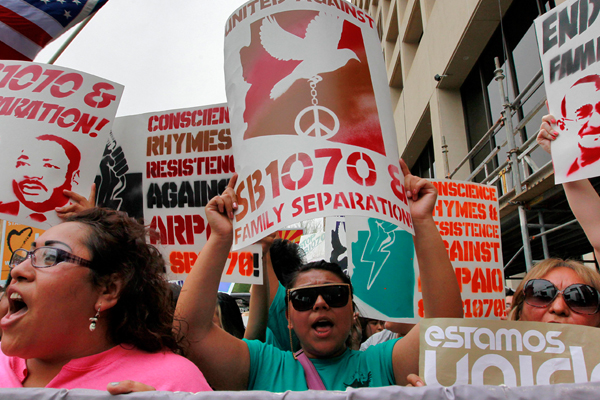
Arizona Gov. Jan Brewer may have recently decided against moving the state’s Republican primary to January, but that didn’t stop her own campaign to bring Arizona back to the center of the hotly charged national debate on immigration and border security.

Kicking off her book tour with a sneak preview in Alabama last Friday, in homage to that state’s controversial crackdown on immigrant schoolchildren and workers, Brewer set out the two main themes of her impassioned new book, “Scorpions for Breakfast: My Fight Against Special Interests, Liberal Media, and Cynical Politics to Secure America’s Borders.” She said, ”We are under siege. And we have been totally disrespected by the federal government.”

Brewer makes it clear from the first line that it is not really “we,” as in the collective Arizona populace, but she who has been unfairly treated by the “liberal” media and President Obama, in particular, in the aftermath of Arizona’s defiant legislative act. She so identities herself with the state that she writes at one point, “Kind of like me.  Kind of like Arizona.” The substantial portion of the state that is not like Brewer is what torments her.

In the witching hours before she signed the controversial immigration bill in the spring of 2010, with protesters outside her office and a nation divided over immigration policy, Brewer sets the scene as a drama of her own victimization: ”The best comparison I could think of was: This must be what it’s like to be waterboarded.”

Brewer’s “Scorpions” weaves a complex tale of her persecution and backroom White House drama, settles personal scores from earlier reported gaffes, and floats some enduring appeals to probability throughout the thinly stretched 223 pages.

The book also lays down the Republican Party’s message on immigration in 2012. In a full throttle attack on President Obama’s “backdoor amnesty” policy, Brewer hopes to issue a wake-up call to the nation and frame immigration politics as the linchpin in a larger Democrat and union plot to “pander” to the growing Latino electorate in the upcoming 2012 elections, especially in key Western states. Based on the GOP presidential debates so far, no Republican contender dares to disagree with her.

“President Obama’s administration had done nothing — nothing — to work with us to secure the border,” she exclaims.

Notwithstanding Brewer’s reliance on constitutional scholar Sarah Palin for her understanding of the 10th Amendment, “Scorpions” fails to make the case for Arizona’s states’ right claim over federal immigration issues.

Instead, Brewer thrives on evoking Arizona’s right-wing leadership under fire, a theme shared by other memoirs coming out of the embattled state. In his 2008 ghost-written “Joe’s Law: America’s Toughest Sheriff Takes On Illegal Immigration, Drugs, and Everything Else That Threatens America,”  Maricopa County Sheriff Joe Arpaio begins with a tale of a borderland plot to assassinate him. (Arpaio later admitted under oath that he had not read all of his own autobiography.)

In “Scorpions for Breakfast,” reportedly written with the help of ghostwriter Jessica Gavora (who also penned Palin’s memoir), Brewer wants readers to know she lives on the Arizona front lines: “I was involved in a war with deeper and more entrenched set of political interests than I had realized.”

Brewer argues that the Obama administration has intentionally allowed an immigration crisis to spiral out of control on the U.S.-Mexico border.  When President Felipe Calderon from Mexico addressed a joint session of Congress and criticized Arizona for SB 1070, Brewer could not believe that a foreign leader was actually allowed to criticize the United States of America.

“I had to wonder where our country was going under Obama,” she writes. “It started to dawn on me that this president and his liberal allies in Congress don’t really understand what America is all about and what our fundamental principles are.”  Feeling as if Arizona has been victimized in a campaign of recrimination and blame, Brewer writes again, “It was then that I knew that we were in a war.”

Throughout the book, in fact, the Arizona governor constantly reminds readers that her state “didn’t cause this crisis,” but acted only when the federal government refused to do its job.  “And what did we get for our effort?” she asks. “We were demonized and called racists.  We were sued and treated like subjects instead of citizens … We were slapped down like wayward children.”

Brewer’s war is not limited to the U.S.-Mexico border in Arizona, where an “invasion” of “drug dealers, human smugglers, generic criminals, and the sheer volume of people pouring over our unsecured border” has given her state no other option but to “lead when their representatives in Washington failed to do so.”  Her “war” is with President Obama. And for the governor of Arizona, it gets personal.

Attempting to speak with the president during his commencement address at Arizona State University in Tempe, only weeks after signing SB 1070, Brewer claims Obama “blew me off.”  Finally, at a long-awaited meeting at the Oval Office, Brewer writes, “He proceeded to lecture me about everything he was doing to promote ‘comprehensive immigration reform,’ which was code for encouraging more illegal immigration by letting those already in the country illegally jump the line.”

Brewer’s account of Obama’s remark ignores the fact that the Obama administration has deported record numbers of immigrants — more than his Republican predecessor — and ramped up Border Patrol and border security funds to unprecedented levels. Instead, Brewer had an epiphany: “He’s treating me like the cop he had over for a beer after he had badmouthed the Cambridge police, I thought.”

 This level of self-obsession and victimization overrides the discussion of virtually every policy decision and event in Brewer’s eyes.  Take her rendition of the legislative process leading up to the signing of SB 1070 in one of the biggest media-covered events in recent memory for the state.  A Tucson station even broke into the “One Life to Live” soap opera to cover the press conference.
 ”I steeled myself and whispered, ‘Jesus, hold my hand.  I’m going to do this for the people of Arizona,’” she recounts. “If it affects my reelection and political reputation, it doesn’t matter.  This isn’t about Jan Brewer’s political future.  It’s about Arizona’s future.”

In truth, Brewer’s political future was in doubt before that tragic event.  On March 23, 2010, she received the bad news that she lagged far behind Republican state Treasurer Dean Martin in the latest Rasmussen Reports poll, as well as her potential Democratic opponent. More important, the poll noted that 85 percent of Arizona voters were concerned about drug-related violence in Mexico “spilling over into the United State.” Four days later, beloved rancher Robert Krentz was murdered on his borderland property in southern Arizona.  Within a month, the heightened media attention and outrage over the murder would undeniably help state Sen. Russell Pearce shuttle his long-sought SB 1070 bill through the Legislature.  When Brewer signed the bill, her poll ratings soared and swept her back into office.

The extraordinary impact of Krentz’s unsolved murder, of course, continues to this day; Brewer dedicates a chapter to it and mentions Krentz’s name more than 30 times throughout the book, while referring only once to Pearce, the Tea Party leader and author of SB 1070, who boasted on election night:  ”I think, out of fairness, the governor would have to admit that if it wasn’t for 1070, she wouldn’t be elected.”

As she casually admits near the beginning of “Scorpions,” the waves of undocumented immigrants arriving in the state has plummeted in recent years, due to recession. Brewer omits altogether the fact that crime rates in Arizona are also at their lowest since her arrival in 1970.  A week after she signed the bill into law, the Arizona Republic reported that Robert Krentz was “the only American murdered by a suspected illegal immigrant in at least a decade” in the worst smuggling route on the U.S.-Mexico border.

Brewer’s attempts to explain the social costs of immigration account for some of the book’s most curious and unfounded arguments.  Take this leap, without a shred of evidence, on the link between undocumented laborers and welfare:

“But the unfortunate fact is that most illegal aliens are also unskilled and uneducated.  Unskilled workers have higher unemployment rates and lower earnings.  Many rely on government programs to help support them and their families.  Either that or they rely on government jobs — if they can get them.  In either case, they are more dependent on government than either legal immigrants or the native-born.”

An extensive study by the Center for American Progress last spring found that “undocumented immigrants don’t simply ‘fill’ jobs; they create jobs. Through the work they perform, the money they spend, and the taxes they pay, undocumented immigrants sustain the jobs of many other workers in the U.S. economy, immigrants and native-born alike.” Were undocumented immigrants to “suddenly vanish” from SB 1070’s “attrition through enforcement,” the study estimated that Arizona’s economy would shrink by $48.8 billion.

On a similar argument over the criminality of immigrants — Brewer made headlines last year when she claimed the majority of undocumented migrants were drug mules — Brewer uses the same logical fallacy:

“… the Border Patrol estimates that it apprehends only one in four illegal border crosses … And for every illegal immigrant who’s a criminal and who gets arrested crossing the border — a gang member, a drug dealer, even a child molester — three are missed and find their way into neighborhoods in other states all across America.”

That’s Brewer’s interpretation of the math, unsupported by law enforcement officials.  According to FBI Uniform Crime Reports and police agencies, crime rates along the Arizona border have been “flat” for the past decade. “This is a media-created event,” one sheriff  told the Arizona Republic a week after Brewer signed SB 1070. “I hear politicians on TV saying the border has gotten worse. Well, the fact of the matter is that the border has never been more secure.”

Where she came from

There are some illuminating insights on Brewer’s life in the memoir.  In what she describes as her “lightbulb moment,” Brewer traces her political career back as a “young wife and mother” at a school board meeting in Glendale, Ariz., in the early 1980s, when she asks her husband about the people in the front of the room.  (The Brewers, contrary to the book jacket, were California transplants in the 1970s, not “lifelong Arizona residents.”)

“And he said, ‘Well, they’re the school board,’ So I said, ‘How did they get there?’ He answered, ‘They were elected by the people in the school district.’  And I said, ‘Well, I could do at least as good a job as they are, if not better.”

Skipping any school board race, Brewer decided to make the leap straight to the state Legislature.  Brewer writes that she hand-addressed her campaign announcements from “my beach house in Rocky Point, Mexico.” In the state Legislature, Brewer picks up the nickname “Janbo” for her effort to halt a “monument to Vietnam war protests.” She is proudest of campaign to require labels for “obscene” lyrics on record albums. As secretary of state, Brewer advanced to her position as governor when former Gov. Janet Napolitano was appointed in 2009 to head the Department of Homeland Security,.

Despite all of the name-calling and the humiliating fallout to SB 1070, “Scorpions” does succeed in showing how Brewer has remained resilient and even more convinced that a post-SB 1070 Arizona “won’t be intimidated, and we won’t back down.”  As Brewer notes, “As I write, I have almost 500,000 friends on Facebook, and every day I take time to read the comments people leave on my wall.”

So bring on the scorpions.

In the 19th century, the Romneys fled the law

The forefathers of the Republican contender did what he condemns today: Sought sanctuary across the border

  • more
    • All Share Services

In the 19th century, the Romneys fled the law

In an attempt to blunt the surging presidential candidacy of Texas Gov. Rick Perry, Mitt Romney recently embraced two hot-button immigration issues in an appeal to Tea Party followers: He called for an end to so-called sanctuary cities harboring undocumented aliens, and he insisted that the next president “must do a better job of securing its borders, and as president, I will.”

Yet, Romney’s hard-line rhetoric overshadows a family secret: Few have benefited more from porous borders and “sanctuary” cities on either side of the border than the Romney family.

Last week, in fact, both Perry and Romney put in well-covered calls to Maricopa County Sheriff Joe Arpaio for advice on the immigration issue. In the 19th century, Arpaio would have been taking a close look at the Romney’s familial flouting of Arizona law.

Romney’s ancestral legacy of polygamy, of course, is hardly news. The Washington Post did a feature story last month on Romney’s sizable family community in northern Mexico, and the role of his great-grandfather Miles Park Romney, “who came to the Chihuahua desert in 1885 seeking refuge from U.S. anti-polygamy laws.”

But the Post didn’t quite tell the full story. Nor do two chapters in Romney’s 2004 memoir, “Turnaround: Crisis, Leadership, and the Olympic Games.” In the book, Romney recounts his version of his great-grandfather’s removal to Mexico:

“… Miles Junior was asked to move again, this time to build a settlement in St. Johns, Arizona. To every request, Romneys were obedient. And leaving behind all that they had worked to establish, they yet again pitched themselves against the arid terrain, the cactus, the alkali, quicksand, and rattlesnakes. They built schools and libraries. Miles Junior was the founder of a theatrical society on the frontier. He dug irrigation ditches and plowed up the desert soil.

Eventually Miles was called upon to settle in northern Mexico, where his son, my grandfather Gaskell, would wed and my father George would be born …”

Romney concludes the story of his great-grandfather, who died in Mexico in 1904: “Despite emigrating, my great-grandfather never lost his love of country.”

In truth, while Romney’s great-grandfather may have never lost his love of the United States, he didn’t leave Arizona on good terms. Or even legal ones.

In the 1880s, the Mormons of Arizona didn’t just face increasing persecution for their polygamous ways. They also confronted resentment over their aggressive land deals and encroaching settlements. Five Mormons, including William Flake, (the great-great-grandfather of Republican Senate candidate and Rep. Jeff Flake of Arizona), were convicted of unlawful “cohabitation” in 1884 and sent to prison. In a related land claims dispute involving Miles P. Romney, Mormon leader David Udall (the great-grandfather of U.S. Sens. Tom Udall, D-N.M., and Mark Udall, D-Colo., was sent to prison in Detroit on perjury charges.

Miles Romney took a different course. Faced with the same perjury charges over his land claim in St. Johns, Ariz., in the spring of 1885, Miles Romney went on the lam and forfeited over $2,000 in bond, according to Dave Udall’s diary. A local newspaper account said Romney’s flight left his community “in the lurch,” and scholars agree.

“Fearing he would be prosecuted for polygamy, as well as for the earlier charge of perjury regarding his land claim, Romney skipped bond and fled to Mexico,” wrote Mormon historians JoAnn Blair and Richard Jensen in the Journal of the Southwest in 1977.

In other words, the candidates’ forefathers fled to Mexico for sanctuary, the very behavior that Romney is denouncing among Mexicans and others who come to the United States. Running for president in 2007 Romney called out New York, San Francisco and other cities for passing sanctuary policies.

“Sanctuary cities become magnets that encourage illegal immigration and undermine secure borders,” he declared.

In his memoir, Romney skims over his family’s lawless behavior and picks up the story from the border, seen through the eyes of one of Miles P. Romney’s “plural” wives:

“When she arrived at the border of Mexico, she was asked to pay an entry toll. Having no money, she was forced to leave behind the iron stove that she had carried across the wilderness as collateral.

Theirs was a life of toil and sacrifice, of course, of complete devotion to a cause. They were persecuted for their religious beliefs but they went forward undaunted.”

Two decade later, Romney’s ancestors returned. Having sided with Mexican dictator Porfirio Diaz, the Romney clan fled their homes and ranches in 1912 when the Mexican Revolution came to town. Along with thousands of Mormons they took advantage of the porous borders to find refuge in sanctuary cities, such as in Texas, Ohio, New Mexico and Arizona. They also received more than $20,000 allocated by the U.S. government for aid and relocation efforts.

“He had an abiding loyalty to America,” Romney concludes, “and a deep interest in politics. These were the same values and commitments that animated my grandfather and my father and my mother. They were the same values that were passed along to me.”

Now his values include supporting Arizona’s SB 1070, which seeks to supersede federal immigration law by making it a crime to be in the state without proper residency documents and requiring police to verify immigration status in a case of reasonable suspicion. With key provisions of the law struck down twice by federal courts, Gov. Jan Brewer recently filed an appeal before the U.S. Supreme Court.

In the spring of 2010, Romney was the first Republican contender to speak in support of SB 1070, which would punish immigrants from Mexico for doing what his ancestors did. The former Massachusetts governor’s statement was guarded, yet unmistakably in favor of the state’s mandates on police enforcement of immigration status. Romney declared: “Arizona’s new immigration enforcement law is the direct result of Washington’s failure to secure the border and to protect the lives and liberties of our citizens.”

To be sure, he added, “It is my hope that the law will be implemented with care and caution, not to single out individuals based upon their ethnicity.”

In New Hampshire last week, Romney doubled down on his new hard-line position, even while contradicting his support for Arizona’s states’ rights push.  “As you know, I opposed sanctuary cities as the governor of my state,” Romney said. “And the idea that a city would determine that it’s not going to follow the U.S. law is unacceptable and immigration law is federal law.”

Immigration law is federal law? As Romney challenges Perry on immigration he might want to keep that little nugget — like his family history — a secret in Arizona, as well.

Continue Reading Close

The disturbing copy-and-paste habits of Russell Pearce

Exclusive: Arizona's infamous state senator regularly employs the words of extremists

  • more
    • All Share Services

The disturbing copy-and-paste habits of Russell PearceArizona state Sen. Russell Pearce

As President Obama and congressional leaders wrangled over the debt ceiling last Saturday evening, Russell Pearce, Arizona’s controversial state Senate president, turned to Facebook to express his own personal outrage.

“Folks,” he wrote, “if there was ever an argument for NO to raising the debt limit and YES to stop the reckless socialist spending in this Gangster Government in DC. Watch this video.”

The video showed an “Elaborate Welfare Housing Project” built for “illegal immigrants” and funded through alleged “refugee pay.”

Just one problem: The five-month-old viral video — which was created by a far-right gadfly from Tacoma, Wash. — had already been thoroughly debunked by the Tacoma News Tribune. By Sunday morning, Pearce had deleted the post from his Facebook site.

But this was hardly the first time that Pearce, whose ultraconservative immigration views have won him national attention and who will face a historic recall election in his Arizona district on Nov. 8, associates himself with the work of a fringe character.

For several years, media outlets in Arizona and at the national level have explored links between Pearce and extremist groups, and in 2006 he was caught circulating a Holocaust-denying article from a West Virginia-based white supremacist group. In issuing an apology, Pearce claimed to not have known about the National Alliance’s views.

But a new examination of Pearce’s website and public statements reveals that the self-proclaimed architect of Arizona’s “papers please” immigration law has regularly borrowed significant portions of text from the writings of hard-line white nationalists, fringe anti-immigrant activists, and others whose views far fall outside the mainstream and presented them as his own.

Pearce, for instance, seems particularly fond of the right-wing American Constitution Party, which champions “sovereign” states’ rights and opposes immigration. (Former Rep. Tom Tancredo, who is now chairing a national group that supports Pearce in the recall campaign, ran as the party’s gubernatorial nominee in Colorado last year.)

In an Aug. 31, 2010, press release that chastised the Obama administration for including Arizona’s SB 1070 law in a United Nations report on Human Rights, Pearce borrowed whole paragraphs from an essay that had been written in 2009 by Tim Baldwin, a prominent Constitution Party activist (and the son of Chuck Baldwin, who previously ran for president under the party’s banner). Here is one of the passages that Pearce appears to have lifted without attribution:

Particular to the United States, the U.S. Constitution was voluntarily formed as a compact by existing sovereign states with existing state constitutions. Despite the deceptive proposition that the States were created by Congress, the States existed prior to and independent of any Congress, as confirmed by the Treaty of Paris in 1783 (which, by the way, was not overturned by any subsequent legal action of the states). The states authority is not delegated; it is inherent authority and has inherent responsibility to its citizens. “The State governments, by their original constitutions, are invested with complete sovereignty.” Alexander Hamilton, FP 31. And, “Each State, in ratifying the constitution, is considered as a sovereign body, independent of all others, and only to be bound by its own voluntary act.” James Madison, FP 39.

Pearce has done the same thing on his personal website. Under the tab for his three main constitutional issues — “Birth Right,” “14th Amendment,” “Supreme Court Decisions” — he borrows wholesale from the writings of Fred Elbel, an anti-immigrant extremist who has been linked to various white supremacist organizations. In a section on the “Original intent of the 14th Amendment, Pearce has reprinted a passage from Elbel’s own site without any acknowledgment (save for an HTML link over a few of the words). Here’s how it looks on Pearce’s site:


And on Elbel’s:

According to a Southern Poverty Law Center report in 2007, Elbel

“is, in effect, the house webmaster for the anti-immigration movement, having designed the websites of nativist groups including SUSPS (a group that now goes by its acronym only and which specifically aims to change Sierra Club population policy), Protect Arizona Now, the Colorado Alliance for Immigration Reform and several others (Protect Arizona now and the Colorado Alliance have had in their leadership a self-described ‘white separatist’ named Virginia Abernethy, a prominent member of the CCC and onetime close friend of Elbel.”

The SPLC added:

Elbel displayed his temperament during the debate over the Sierra Club’s future in 2004, when he wrote an E-mail that read: “Damned right. I hate ’em all — negroes, wasps, spics, eskimos, jews, honkies, krauts, ruskies, ethopans, pakis, hunkies, pollocks and marxists; there are way too many of them.” Elbel’s Defend Colorado Now, an anti-immigration group based in Lakewood, Colo., has received nearly $50,000 from Tanton’s U.S. Inc.

Pearce does the same thing in a section on “Supreme Court decisions”:


Here’s that same passage from Elbel’s site:

In the “Birth Right Citizenship” section, Pearce gives Elbel a break and instead lifts from a 2005 Phyllis Schlafly essay. Here’s Pearce:


And here’s Schlafly:


Pearce’s copy-and-paste habits apparently extend to more mainstream figures too. In the “Dear Fellow Patriots” letter on his homepage, Pearce uses an uncredited quote from “The Heart of Leadership,” a motivational tome by Robert Staub:

Leadership, practiced at its best, is the art and science of calling to the hearts and minds of others. It is engaging others in an enterprise of sound strategic focus, where they can experience a sense of ownership, of making a difference, of being valued and adding value.


That quote was also incorporated into the official biography used to promote Pearce’s appearance at an upcoming conference: 


Pearce did not respond to efforts for comment on this story.

He is the first Arizona legislator ever to face a recall election. Calls for his ouster have come from both sides of the aisle, and a fellow Republican, Jerry Lewis, has already launched his campaign to oppose Pearce in the November vote. Pearce has characterized supporters of the recall campaign as “union thugs” and “far-left anarchists,” while one of his most prominent defenders, former Rep. J.D. Hayworth, branded them “socialist thugs who carry swastikas.”

But as his copy-and-paste habits show, it’s probably Pearce who needs to explain the company he keeps.

Continue Reading Close

Blowing away King Coal

Can a scrawny young wind-power activist topple the biggest, dirtiest industry in West Virginia?

  • more
    • All Share Services

On Jan. 16, as Barack Obama visited a wind turbine factory in Ohio, Rory McIlmoil snaked along a muddy mountain road in West Virginia on a similar mission. He was headed up Coal River Mountain, the last mountain left untouched in a historic range ravaged by strip mining.

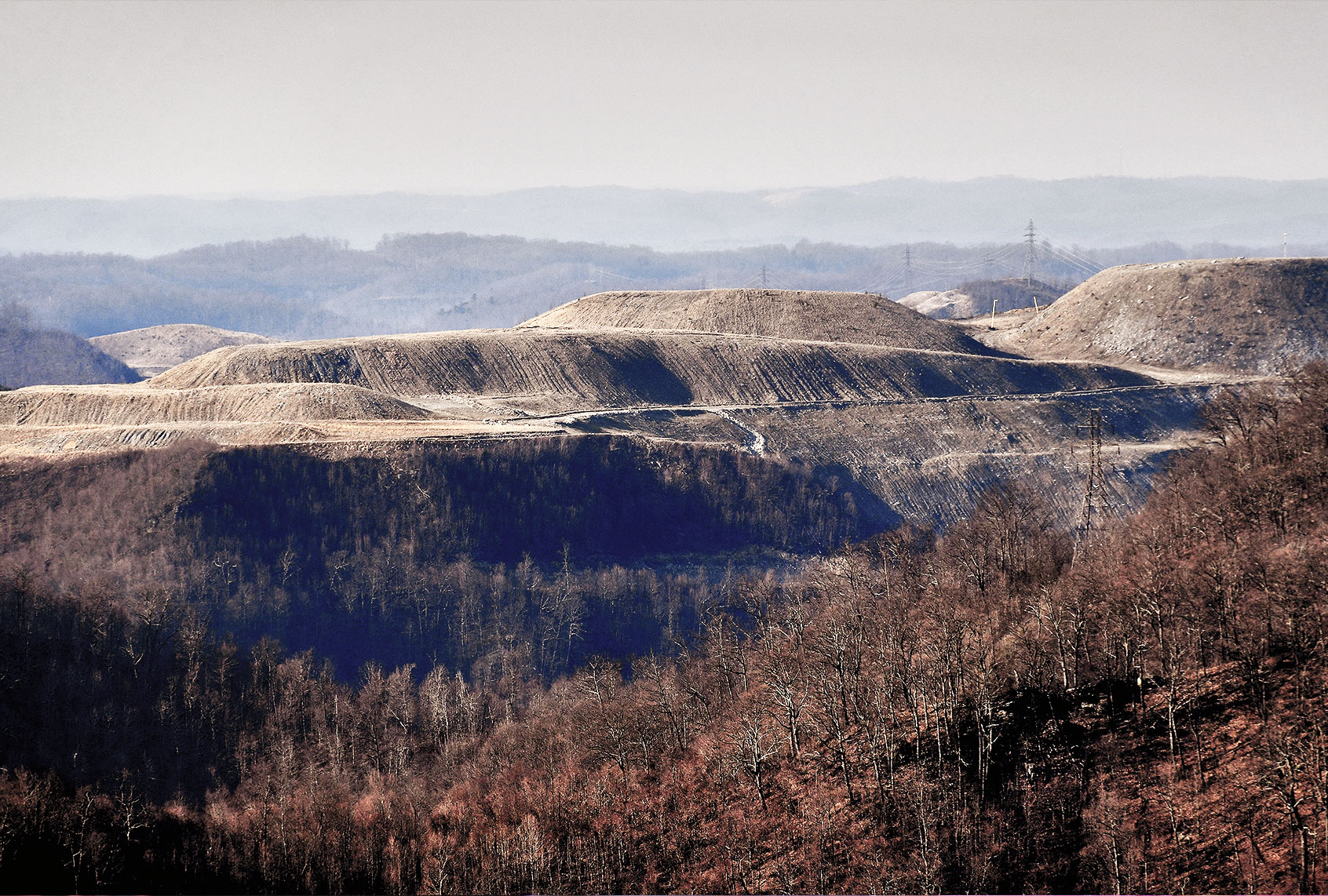
On a ridge, the 28-year-old activist brought his four-wheeler to a skid. He couldn’t believe what he saw. Bulldozers had begun clearing the site for the first phase of a mountaintop removal operation, a radical strip-mining process that would clear-cut 6,600 acres of hardwood trees, detonate thousands of tons of explosives and topple the mountain range into the valley. A 100-foot swath of forest just below the ridge lay like an open wound.

For McIlmoil, this should have been ground zero in Obama’s green recovery plan. Not a future wasteland.

Just last spring, McIlmoil had climbed this same ridge, looked out over a breathtaking quilt of lush forests, and envisioned an industrial wind farm. With boundless enthusiasm for alternative energy, he soon began to draft a proposal. As the year wore on, he showed, here in the deep heart of coal country, that a row of whirling wind turbines could produce enough megawatts to serve the entire region, provide hundreds of clean energy jobs and generate significantly more tax revenues than the mountaintop removal operation.

With his ruddy good looks and the deep cracker barrel voice of a young Johnny Cash, McIlmoil emerged as a champion of clean energy and green jobs in West Virginia, and around the country. Joining forces with the Coal River Mountain Watch, a tenacious group of coal mining families and environmentalists, he helped launch the Coal River Wind Project as a breakthrough initiative to transcend the century-old stranglehold by the state’s politically powerful coal industry.

“The benefits of economic diversification, new safe jobs and reducing CO2 emissions are important,” McIlmoil says. “But for most residents, if a wind farm is what it takes to save their mountain, then they’re all for it.”

After witnessing 470 mountains in central Appalachia get blown to bits by strip mining, the Coal River wind proponents were drawing a line in the sand. The verdict was in on mountaintop removal, which had been launched in 1970 as a quick and dirty option to cheaply procure coal. Thirty-eight years and a million and a half acres of destroyed hardwood forests later, mountaintop removal had run its course in the region with appalling effects. It had not only destroyed the natural heritage, it had ripped out the roots of the Appalachian culture and depopulated the historic mountain communities in the process.

Over 1,200 miles of waterways had been sullied and jammed with mining fill. Blasting and coal dust had made life unbearable for anyone in the strip-mined areas. Wells had been busted and polluted with toxic waste. Given the mechanization of aboveground mountaintop removal, and its shakedown of a diversified economy, coal mining jobs had plummeted as poverty rates rose in strip-mining areas.

In December, West Virginians saw what happened at a Tennessee power plant. A restraining wall burst and a billion gallons of coal ash poured out of a pond and deluged 400 acres of land in 6 feet of sludge. The proposed mountaintop removal site on Coal River Mountain rested beside a 6 billion-gallon toxic coal waste sludge dam above underground mines. If the proposed blasting took place, a fracture along the sludge lake could be catastrophic for the communities downstream.

The residents asked: Why should Coal River Mountain be the last mountain to die for a mistake?

In West Virginia, turning around the 200-year-old colossus King Coal is tantamount to blasphemy for many. Second only to the state of Wyoming, West Virginia produced 158 million tons of coal in 2007 and generated $338 million in severance taxes. In a nation that still depends on coal for more than 50 percent of our electricity, West Virginia plays a key role in keeping on the lights. The Marfork Coal Co., a subsidiary of the Virginia-based Massey Energy, the largest coal company in West Virginia and fourth largest in the nation, remains a major force in the state’s economy and politics.

“When you look into the climate implications of coal, you realize that Rory and the Coal River group are at the forefront of an important struggle,” says filmmaker Adams Wood, who has been following the events at Coal River Mountain for a documentary, “On Coal River.” “He is taking on an enormously powerful industry and doing it with extremely limited resources and mostly on-the-job training.”

McIlmoil’s scrawny frame begs a David comparison to the coal companies’ Goliath. He grew up in suburban Atlanta and Charlotte, N.C., raised by a single mother, with the dream of playing professional baseball. During his freshman year in college, an eye-opening trip to Mount St. Helens shifted his studies to earth and environmental science. After a post-college stint in Ecuador, studying environmental issues in indigenous mountain communities, McIlmoil moved to Washington, D.C., to study at American University. One day, after hearing a bluegrass jam about the effects of mountaintop removal in Appalachia, he was done for. He never looked back, throwing himself into the nitty-gritty of coal mining analysis.

“The more I learn about the state and coal economy, and the people living in the communities around the mountain, the harder I work,” McIlmoil says. “Without a strong legal and political push to upset the status quo, the whole area is doomed to destruction and contamination.”

While writing his master’s thesis on the impacts of mountaintop removal, McIlmoil jumped at the opportunity for an internship at the North Carolina-based Appalachian Voices, an environmental organization that dealt with mountaintop removal. Soon he began imagining how wind energy could replace coal fields. According to J.W. Randolph, the Washington legislative aide for Appalachian Voices, McIlmoil’s timing was impeccable, as the anti-mountaintop removal movement was growing.

“What the movement needed was someone who could speak to the future beyond the coal status quo,” Randolph writes in an e-mail. “Legislators, investors and those who work on strip-mines wanted to know what’s next. Rory provided that much needed voice that can explain, in excruciating detail, how much benefit we could bring to our region from wind power and alternative energy. He can show people our new Appalachian future and back it up with data three miles long.”

Within months of landing at the Coal River Mountain Watch office in Whitesville, W.V., whose mission is to “stop the destruction of our communities and environment by mountaintop removal mining, ” McIlmoil’s sleep-deprived passion for wind energy became famous. Hunched over permit maps and satellite imagery for hours, he meticulously traced the outlines of old strip and mountaintop removal mines on the computer, and analyzed wind farm models. He slept a few nights of the weeks on the couch at the Coal River Mountain Watch office.

“His technical knowledge fits like hands folded in prayer with our local knowledge of the mountains and strip mining,” declares Julia Bonds, co-director of Coal River Mountain Watch, whose longtime advocacy for social justice in the coal fields was recognized with a Goldman Environmental Prize in 2003.

McIlmoil quickly found a partner and co-director of the wind project in Lorelei Scarbro, a coal miner’s widow and grandmother whose back fence literally demarcated the front lines of the impending mountaintop removal site. Hired as a community organizer for Coal River Mountain Watch in the fall of 2007, Scarbro has seen hundreds of well-meaning young activists trundle through the area. In her eyes, what McIlmoil lacked in the department of mountain heritage, he made up for in his willingness to listen and understand the local residents in rural Appalachia.

“What we need most are people to stand beside us, not in front of us or behind us,” Scarbro says. “My husband, who spent 35 years as an underground union coal miner and died of black lung in 1999, is buried in the family cemetery next door. There is no price you can put on the memories we have here. We have a sense of place here that many people don’t know and can’t begin to understand. There are many Appalachians who know this sense of place.”

McIlmoil has experienced those Appalachians firsthand. “Everybody should know the people living around Coal River Mountain,” he says. “They’re good, beautiful people, and they have a greater connection to the mountain and their history than I could ever hope to have.”

By working with other energy analysts and mining experts, including Appalachian Voices director Matt Wasson and Alliance for Appalachia coordinator Dana Kuhnline, McIlmoil, Scarbro and the Coal River Mountain Watch team member Matt Noerpel drew up a virtual plan for a wind farm on Coal River Mountain. As McIlmoil envisioned it, the wind potential on Coal River Mountain blew away the short-lived economic benefits of the proposed mountaintop removal sites. In fact, coal mining provides only 11 to 13 percent of the economic activity in West Virginia. And the state can use all the economy activity it can get. Forbes recently ranked West Virginia 50th among the best states to do business.

On less than 100 cleared acres across the same mountain range, McIlmoil concluded that the wind farm would create 200 local jobs during construction, and 50 permanent jobs during the life of the wind farm. In the process, it would provide 440MW of electricity, or enough energy for 150,000 homes, and allow for sustainable forestry and mountain tourism projects. The plan also called for a limited amount of underground coal mining.

After the launch of the Coal River Wind Web site and its virtual plan for the valley in April 2008, McIlmoil and Scarbro, along with Noerpel and other members of the Coal River Mountain Watch, spent the next six months going to battle in the community for their plan.

At the wind partners’ first local presentation in the Marsh Fork area, only five people showed up. Undaunted, the two held meetings there for several weeks, and began to note that crowds kept getting bigger and more welcoming. On the third meeting, McIlmoil realized the wind plan had taken root in the community when a Massey coal miner listened quietly to the presentation, left the meeting, and then halfway from home, turned back and asked for materials to pass around.

For filmmaker Catherine Pancake, at work on a study chronicling the rise of clean energy, the Coal River Wind Project emerged as a bellwether for renewable energy. “They are showing what happens when citizens with a viable green energy plan come into brutal contact with a multibillion-dollar industry,” she says. “Rory and Lorelei are effectively killing the popular and bogus ‘jobs vs. the environment’ argument used ad infinitum in local and state politics.”

Despite the positive receptions by several county and state agencies and public officials, McIlmoil soon learned that the vicelike grip of the coal industry locked down any governmental or legislative support for the wind farm. Marfork Coal Co. simply had no intention of halting its demolition plans on Cold River Mountain. With 19 Appalachian mining operations valued at $2.6 billion in 2008, parent company Massey had demonstrated a merciless coveting for coal at any expense.

In a haunting parallel to the Tennessee coal ash disaster, a Massey subsidiary in eastern Kentucky had been responsible for the largest coal slurry spill in 2000, leaking over 300 million gallons of toxic sludge into the area’s waterways and aquifers. Massey’s political connections in the Bush administration, however, resulted in a slap-on-the-wrist fine and the firing of one of the industry’s veteran whistle-blowers.

Not that Massey altered its policies. By 2008, it had been forced to pay $20 million in penalties for dumping toxic mine waste into the region’s waterways; before the year was out, Massey shelled out a record $4.2 million for civil and criminal fines in the death of two coal miners in West Virginia.

So far the coal giant’s public comments on the new competition have been relatively innocuous. In a statement e-mailed to the media, Massey spokesman Jeff Gillenwater declared that his company “supports many forms of energy, including wind energy.” Although Massey was perplexed, Gillenwater added, “by the Coal River Mountain Watch’s focus on this particular site, to the exclusion of any other.”

In the dog days of summer, McIlmoil and Scarbro kept the pressure on. After receiving a grant from the Sierra Club for an in-depth economic study of the wind proposal, McIlmoil and Scarbro made their first presentation to representatives of Gov. Joe Manchin’s office. The polite indifference from the pro-coal governor’s office didn’t surprise them, so they launched a national campaign.

Overwhelmed with supportive calls, national media attention and an online petition calling for the halt of the proposed strip mine and the creation of the wind farm, which topped 10,000 signatures, the Coal River wind advocates received the Building Economic Alternatives Award from Co-op America (now Green America), a nonprofit group devoted to sustainability.

There was no celebration. Days earlier, McIlmoil and Scarbro had read in the local Beckley Register-Herald of Massey’s intention to begin blasting on the first area of the strip mine. The company had taken out a classified ad in the newspaper to alert the community. The activists concern at the bold move by Massey turned to outrage when they discovered the coal company lacked certain blasting permits and state-agency approval of the mining plan revision.

Drawing from their growing support across the country, McIlmoil and Scarbro managed to flood Gov. Manchin’s and state agency offices with thousands of e-mails and phone calls, resulting in a suspension of any blasting. All eyes were now on the governor to reconsider the economic ramifications of mountaintop removal, and form a commission for renewable energy sources, such as the Coal River wind proposal. It didn’t happen. “It would be inappropriate for the governor to interfere in the regulatory process,” Manchin’s communications director, Lara Ramsburg, said in an e-mail statement to the Charleston Gazette.

On Nov. 20, at the same time Obama announced a forthcoming economic recovery package and clean energy job programs, the West Virginia Department of Environmental Protection, with the approval of Manchin, granted Massey the surface mining permit revision for the initial part of their proposed mountaintop removal of Coal River Mountain.

As a further blow to coal field citizens against mountaintop removal, the Environmental Protection Agency passed an 11th hour ruling in early December that did away with a 25-year tradition to regulate the dumping of coal mining waste into waterways. The ruling effectively cleared the way for Massey, like all other coal companies, to accelerate their assault on the Appalachian Mountains.

“Once the demolition begins,” Scarbro declared at a local hearing, “it will be very difficult to stop it, and once the mountain is removed, it won’t grow back. The potential for wind energy and good jobs will be gone forever, along with our renewable water and forest resources.”

Disheartened but not stymied by the news, the Coal River wind advocates released the results of a four-month economic study by W.V.-based Downstream Strategies. According to the report, the first of its kind in coal country, the proposed wind farm on Coal River Mountain, consisting of 164 wind turbines and generating 328 megawatts of electricity, would provide over $1.74 million in annual property taxes to Raleigh County. By comparison, the coal severance taxes related to the mountaintop removal mining would provide the county with only $36,000 per year. More so, it noted that the coal reserves in the area would only last 17 years at best, compared to the eternal supply of wind.

Today, Coal River Mountain Watch members await a legal challenge to the permit revision at the Surface Mine Board, with a hearing scheduled for Feb. 10. Outside the bounds of West Virginia, their hopes rest with the reversal and enforcement of the EPA’s recent stream buffer ruling by the Obama administration, which regulates the strip mining impact on streams, or the passing of federal legislation for a Clean Water Protection Act, effectively banning mountaintop removal methods to dump mining waste into waterways.

In support of Coal River Mountain residents, who are staging a protest this week against the coal companies, James Hansen, head of NASA’s Goddard Institute for Space Studies, and the nation’s foremost expert on climate change, declared: “President Obama, please look at Coal River Mountain. Your strongest supporters are counting on you to stop this madness.”

“When I first came here,” says McIlmoil, “I was all about just beating Massey and driving a wind turbine into the heart of their territory. But now there are hands and hearts, lives and histories, all holding onto that turbine, and I dream of a day when one of the community folks gets to hit the ‘On’ switch that turns on the first turbine.”

How seriously the nation appreciates the vanguard role of clean energy advocates like McIlmoil will, ultimately, decide whether Coal River Mountain will be the first mountain to resist mountaintop removal in Appalachia. Or the 471st mountain to be eliminated from American maps.

Continue Reading Close

In coal blood

The tragedy unfolding in Utah says mountains about America's abuse of coal miners, the land they work -- and our government's craven energy policy.

  • more
    • All Share Services

In coal blood

Six coal miners have been trapped in a collapsed shaft in the Crandall Canyon coal mine in Utah since a week ago Monday. Four days after that accident, three construction workers in southwestern Indiana fell to their death in a coal mine air shaft. As the round-the-clock news coverage of the coal mining tragedy in Utah unfolds with an enduring if dwindling hope, intercut with the disquieting persona of Robert E. Murray, the CEO of Murray Energy and co-owner of the Crandall Canyon mine who has held regular press conferences, our nation has been reminded that a crisis is never a crisis in the public’s eye until it is validated by disaster.

No one knows this better than the coal miners and the community in Sago, W.Va., where 12 miners lost their lives in January 2006. They were some of the recent ones, joining the legions of nameless and otherwise forgotten coal miners and mining communities across the country, which have lost so many of their own over the decades.

In the fall of 1950, my lanky grandfather bent his back like a sapling and crawled into the conveyor train that would transport him to the lower bedrock of coal in a southern Illinois mine. One blast didn’t go off in the late morning. My grandfather fixed the lamp on his helmet, took a wheeze of air cankered by coal dust and sulfur, spat out a black gob of phlegm, and then approached the pack of explosives to see if it was a dud. The blast went off. A wall of coal encased him, masking his face in black.

The doctor couldn’t understand how my grandfather had survived the explosion. The miner considered it an act of God. The doctor threw up his hands and sent the miner back home. Blue lesions dotted his face, as if he had been branded by coal for life. Black lung had already robbed his breath. Pieces of coal remained embedded in his forehead and cheeks, and there was coal in his blood now.

My grandfather was lucky. A year later, at the New Orient Coal Mine in West Frankfort, Ill., just up the road, 119 miners died in an explosion when an electric spark triggered a pocket of methane gas. That mining accident prompted the Federal Coal Mine Safety Act of 1952, which called for annual inspections in underground coal mines, and charged the Bureau of Mines to issue citations and imminent-danger withdrawal orders. According to the U.S. Department of Labor Mine Safety and Health Administration Web site, the act also “authorized the assessment of civil penalties against mine operators for noncompliance with withdrawal orders or for refusing to give inspectors access to mine property.”

But half a century later, the legacy of those coal miners in southern Illinois is all but forgotten. According to a recent report in Forbes, a subsidiary of the Murray-owned mine in Utah — the American Coal Co. — owns the Galatia mine in southern Illinois (less than 20 miles from where my grandfather nearly lost his life), and has received 869 citations for violations at the mine so far this year. Digging deeper into the Mine Safety and Health Administration records, Robert Gehrke of the Salt Lake Tribune reported last week that Murray’s mine in Galatia had racked up 2,787 violations since 2005. More than 660 of the violations ranked as substantial enough to possibly “result in an injury or illness of a reasonably serious nature.” American Coal Co. has said that it is addressing some of the violations, although it is currently appealing some fines and citations.

Half a century after my grandfather’s mining accident, our nation still without a credible renewable energy policy, the mining goes on. More than 104,000 people have died in our nation’s coal mines over the last century, and hundreds of thousands of miners have died from black lung disease.

This is the great paradox today: In an age of global warming and greater energy and safety awareness, we are also witnessing the great coal revival. Nearly 50 percent of our electricity still comes from coal — the very energy that runs our computers on which we read this story, or our televisions on which we watch the latest reports of cameras snaking down into the mine in Utah in search of survivors. And as our dependency on foreign oil has spilled into the politics of global warfare, dirty coal has been repackaged as “clean coal” by the current Bush administration, which has championed the growth of coal-based power. The administration has done so with an alliance of congressional supporters on both sides of the aisle. There appears to be no real commitment at this point toward renewable or non-fossil-fuel sources of energy.

The abuse of coal miners has always gone hand in hand with the abuse of the land and environment; my grandfather’s own dirt farm in the southern Illinois hills was strip-mined a quarter century after his death. (In fact, the first commercial strip-mining in Illinois began more than a century and a half ago.) Coal mining has destroyed more than 475 mountains, a million acres of hardwood forests, and a thousand miles of waterways through strip-mining. The devastating process of mountaintop removal in Appalachia (West Virginia, Kentucky and parts of Tennessee) — literally, toppling mountain ridges into valleys and waterways with massive machinery to procure the coal — has eroded swaths of land, leaving parts of the region vulnerable to water contamination and massive floods. Moreover, the nation’s power plants, 618 of which are coal-fired, contribute a substantial quantity of our nation’s carbon dioxide, sulfur dioxide and mercury emissions.

Here is the raw truth: The great coal revival of today should be seen for what it really is — a great coal crisis, both aboveground and below. Neither workplace safety nor mountaintop removal should be taken casually until the next disaster strikes.

Coal mining is emblematic of our nation’s failed energy policy. The drama unfolding in Utah is one of its latest reckonings; coal miners and their communities continue to pay the highest personal price. Until the Bush White House, Congress and our coal-dependent citizenry make genuine steps toward shifting our energy policy to renewable sources that not only sustain our energy demands but also our local economic needs, it is nothing short of a crime to deny our coal mining communities the best possible protection from accidents and the repercussions of strip-mining.

As a nation, even after the television coverage shifts to some new disaster, we must hold fast to the fate of the coal miners and their families in Utah. We must strive to make sure that mining does not go on, business as usual, in coal blood.

Continue Reading Close

Page 2 of 2 in Jeff Biggers