Spring Sale: Get 1 Year, Save 58%

Scoot over oat milk — there’s a new kid in town

In recent years, more and more nondairy milks have popped up on shelves and in local coffee shops. There are stalwarts like soy (the most popular), almond, and coconut, followed by more niche nut milks such as macadamia and hazelnut.

Then oat milk entered the arena, upping the game for milk-alternative connoisseurs. Oat milk has a creamy consistency, like cow’s milk, convincing even some of the naysayers.

But there’s a new contender now: potato milk.

Wait, did you say potato milk? Yes, that’s right. Several weeks ago, DUG, a vegan-friendly plant-based drink company, introduced potato milk in three new varieties: Original for your cereal, Barista for your hot drinks, and Unsweetened without any added sugar.

DUG wasn’t even the first potato milk company: In October 2015, Veggemo launched a milk alternative made with a combination of peas, cassava, and potato in Canada with mixed reviews for its creamy but bitter taste. They are no longer in business.

There’s a catch, though. Right now, you can’t buy potato milk in the U.S. DUG is a Swedish company, and although they have plans to launch in China and expand across Europe, for now, potato milk is only available to ship online through Amazon to the U.K.

Wait, wait, what? Do you mean to say you got me all hyped, but I can’t buy my new and already most beloved vegan milk?

Don’t despair. You can get crafty and make potato milk at home. Making potato milk is easy.

All you need is five ingredients and a blender to become your own potato milk master. First, boil a peeled potato until soft (but not until it falls apart) in 3 cups of hot water with a pinch of salt. Using a slotted spoon or mesh strainer, take out the potatoes but reserve the water the potatoes cooked in. Add enough warm water to equal 4 cups of water. If you want flavorings, now’s the time: You could add a couple drops of vanilla extract, a handful of almond slices, or a small amount of sweetener to the water. Add the boiled potatoes and the reserved potato water to a blender and blend on high for approximately 5 minutes. Then strain the potato mixture through cheesecloth, reserving the liquid that will be your potato milk. Refrigerate for up to a few days and use like you would any other milk alternative. Use potato milk in cereal, coffee drinks, and smoothies — wherever you’d use your vegan beverage.

This method also works with sweet potatoes, if you want a slightly sweeter version. Will potayto-potahto milk become oat milk’s greatest nemesis? Perhaps. Change is in the air.

Welcome, welcome to the new kid in Vegan Town.

Mike Lindell moves the “reinstatement” goalposts again — now Trump will be back by Thanksgiving

Pillow executive turned 2020 election truther Mike Lindell has revised his prediction, yet again, as to when the U.S. Supreme Court will hear his undisclosed legal argument that the 2020 election should be overturned.

As a refresher, for those who might not have been paying painstaking attention to the MyPillow CEO’s every move, Lindell originally predicted that the high court would overturn the election and return Donald Trump to the White House by August. But of course that dream did not come to fruition, mostly because Lindell has presented no actual evidence but also because the Supreme Court has no authority to do any such thing. (The court can rule on the constitutionality of laws passed by Congress when they come under legal challenge, but it has no power to undo or revisit congressional actions.) That prompted Lindell to move the goalposts and claim that Trump’s second coming would occur by year’s end. 

On Tuesday, however, Lindell made an excited announcement that his mysterious legal team has fast-tracked internal research, claiming that its thus-far-imaginary Supreme Court case is now ahead of schedule. 

“This is the big announcement, everyone,” Lindell proudly told Steve Bannon on the latter’s “War Room: Pandemic” podcast. “I made a promise to this country that with all the evidence I have that we would get it to the Supreme Court, and I predicted they would vote 9-0 to look at the evidence.”

He then asserted that before Thanksgiving, which falls on Nov. 25 this year, the court will have heard his case. 

“Originally, I had hoped for August and September. I asked all the lawyers just yesterday,” Lindell said. “We are taking this case to the Supreme Court before Thanksgiving. Now maybe Fox [News] will report that today.” That aside was a reference to the pillow king’s feud with Fox News, which has generally ignored his recent claims and refused to cover his August “cyber symposium” in South Dakota. 

“This evidence is 100% non-subjective evidence,” Lindell continued, “and that the Supreme Court, they’re going to vote 9-nothing to take it in. We will have this before the Supreme Court before Thanksgiving. That’s my promise to the people of this country. We’re all in this together. We worked very hard on this!”

Late on Tuesday night, Lindell redoubled his Turkey Day promise. “I talked to all the lawyers today,” he said on his Frank Speech website. “One hundred percent we are getting this before the Supreme Court before Thanksgiving. That is locked in stone, everybody.” He went on to claim that the case will be the “most important case to our freedom in history.” 

Lindell has not released or filed any documents intended to support such a hypothetical case, nor has he explained what legal mechanism he believes might allow the Supreme Court to take action on his unfocused claims of election fraud. Lawsuits do not go directly to the Supreme Court without working their way through the federal court system first. No suit aiming to overturn the 2020 election currently exists, and it’s not clear who the plaintiff would be, or what standing they might have to make such grandiose claims. 

In the wake of Lindell’s failed South Dakota “cyber symposium,” Salon reports have revealed that Lindell has paid at least $3 million to “cyber experts” who provided him with no real evidence of widespread voter fraud.

Lindell and his lawyers, who are listed in ongoing litigation involving Dominion Voting Systems and one of its former executives, didn’t return Salon’s request for comment. 

Watch Lindell’s bold prediction below, via YouTube

Does the California recall prove that Trumpism is on the run? Not so fast

The overwhelming failure in the recall of California Gov. Gavin Newsom should send a powerful message to those Republicans who think their future lies with Donald Trump and Trumpism. It doesn’t.

By any measure, the vote to retain Newsom was a landslide. Almost 64% of voters cast ballots against recalling Newsom.

That’s better than the record margin by which Newsom won in 2018. He won that race with just under 62% of the vote. It also equals the share of California votes for Joe Biden against Trump in 2020.

The recall vote is a clear repudiation of the Trumpian tactic of trying to disrupt and delegitimize government when anyone but a Trumper wins the popular vote. Havoc will continue, but it can be defeated — always  if enough sensible Americans cast ballots.

Trumpism isn’t dead, not yet. But it’s not attracting new adherents, either. That’s because all it offers is anger, the lethal rejection of medical science and cultish devotion to a deeply disturbed con artist who just makes stuff up, like his very recent delusional claim of being rescued on 9/11 by two firefighters.

Trumpism is not an ideology, just political masturbation.

And no one in America is more captured by self-love than Donald Trump.

General elections, especially when the presidency is on the ballot, draw far more voters than special elections. That’s why the Republican Party has long relied on the latter to put its people in office. The GOP simply does better at turning out the vote than the Democrats, or at least it did until 2020.

In spring, it looked as if Newsom could become the third governor in American history to be recalled because rank-and-file Democrats weren’t paying attention. Neither were independents, whose numbers equal those of Republicans in California.

Newsom had loaded himself up with political baggage in the way he handled the worst of the COVID pandemic. His public health emergency order last fall imposed mask and indoor activities limits that infuriated not just the freedumb crowd but some struggling small business owners.

In an act of maddening arrogance and political stupidity, the governor enjoyed dinner in a Napa Valley French restaurant without a mask. He violated other COVID protocols as well. And he got photographed.

“Do as I say and not as I do” has ended the careers of more than a few politicians, yet Newsom is coming out of the recall much stronger than ever.

Newsom got lucky, but that stroke of political luck contains a valuable lesson for defeating Trumpism.

The leading candidate to succeed Newsom if the recall worked was Larry Elder, a deranged Trumper radio talk show host. Elder made clear that the recall was a referendum on Trumpism, a novice political move that professional Democrats exploited fully.

Under California’s century-old populist recall rules, a small minority can force an election. Then, if 50% plus one voter favor recall, the new governor is whomever gets the most votes the same day. That could, literally, be someone who earns less than 10% of the vote. Elder polled at about 18%, but won 45% of the vote in a field of almost 50 gubernatorial wannabes. Still, he secured far fewer votes than the number of votes favoring recall.

Let us hope the populist California recall, initiative and referendum rules will get modernized to make putting items on the ballot harder.

There is a lesson in what happened between June and Sept. 14.

Elder is a longtime fixture in the Los Angeles radio market, a robust marketplace of music, news, ideas and nonsense.

A true-red Trumper, Elder spouts crazy, illogical, half-baked, fact-free, absurd and downright offensive ideas, sometimes contradicting himself just like his hero does.

After Elder complained that the Los Angeles Times never reviewed his books, the paper obliged. The devastating result was an object lesson in being careful what you wish for because it may come true. Wrote reviewer David L. Ulin after reading four of Elder’s seven books:

Elder is not a writer but a brand. As such, he is always on brand, regardless of the issue: the economy, the unhoused, law enforcement, immigration rights. His columns represent not so much a voice in conversation as a series of diatribes. When it comes to public policy, Elder offers neither subtlety nor nuance, not least because that isn’t what his audience wants.

Facts are to Elder just as they are to Trump: They don’t matter. Like Trump, Elder creates his own reality.

That goes over well among the American Taliban and their uncouth cousins, the American Yahoos. California is not poor Alabama or Mississippi or home to COVID-iocy leaders as in Texas and Florida.

California, where I grew up and lived for 36 years, is rich. It would boast Earth’s fifth-biggest economy if it were a nation because of education and science.

Be it growing strawberries year-round, making movies or splicing genes, California’s economy is science-driven. Trumpism rejects science as it preys on the minds of people who didn’t pay attention in high school and couldn’t explain the function of RNA if their lives depended on it. Among Trumpers, it’s OK, indeed more than OK, to be ignorant.

Elder promotes some wildly crazy ideas. He proposed reparations for slave owners because their “property” was taken away by Abraham Lincoln. He also said he would have voted against the 1964 Civil Rights Act.

By the way, Elder is Black.

On the day before the recall vote ended, Elder posted on his website assertions that the recall vote results were fraudulent and statistical analysis proved that.

That’s a remarkable claim to make before any vote results are known and before the election ends. But it’s consistent with the Trumpist practice of just making stuff up. The week before the election, Trump said the election was rigged for Newsom. He reiterated that on Election Day.

Elder’s campaign also made clear that he intended to govern California in pure Trumpian style, by tweet rather than substance. That also alarmed voters in a state whose economy is heavily based on science.

Most Californians had never heard of Elder before the recall. When Democratic strategists started to get out the word about what a crazy loon Elder is, Democrats, independents and those Republicans not infected with Trumpism began mailing in their ballots in large numbers.

The lesson: Who votes is all that matters in elections.

Trumpers are a slowly dwindling minority. As a class, they don’t understand how the world works, don’t embrace logic, think they are smarter than the scientists they denounce, embrace stupidity and incompetence (see Dunning-Krueger Effect) and are easily taken in by slogans rather than substance. Many are as close-minded as the Taliban.

Those people love Trump because he freed the inner racism of the Republican Party, which has always been there. Witness its opposition to civil rights and voting rights. Trump told his followers that it was OK to use racial slurs and that violently attacking those you disagree with meant you were “fine people.”

The insurmountable problem for Republicans — unless they steal elections is that white supremacy continues to slowly fade despite its vicious public displays during the brief Trump era. That’s because humans evolved toward cooperation, not Trump’s Hobbesian notions of brutal power abused to make life nasty, brutish and short for the many.

The lesson about building a better America is that to defeat Trumpism its opponents must make sure they get out the story of who Trumper candidates are and what they believe. Letting them hide behind slogans is a terrible strategy.

But most of all, people must vote. All that matters is turning out the vote. Period. Elections are won by those who cast ballots.

That’s the whole point of the GOP proposing and in many states enacting laws to suppress the votes of people not in line with either what’s left of traditional Republicanism or politically flaccid Trumpism.

America is home to far more good, decent and caring people than losers drawn to Trump.

Vote. Be an owner of our government, not a renter or, worst of all, a squatter.

Mary Trump explains why she thinks Don Jr. is the dumbest of the former president’s children

Mary Trump spoke to John Aravosis and Cliff Schecter promoting her latest book about the collective trauma Americans have faced over the years from the Trump administration.

In the early part of the conversation, Trump explains some information about the upbringing of former president Donald Trump’s children and how her uncle carried on some of the mistakes Fred Trump made with him.

Fred Trump’s eldest and namesake, Freddy Trump, was supposed to take over the business and build it bigger and better. But he was so disenchanted with what he had to deal with that he left and decided to do what he loved, flying. That was what ultimately turned Donald into the new Trump heir.

Like his father, Donald also skipped over his namesake and elevated Ivanka to be the more important part of the business. This was, in part, because Don Jr. is the least intelligent of the Trump children, Mary Trump explained.

“Just in terms of the situation into which he was born, he shares that with my dad,” she explained. “You know, the oldest son of a ‘powerful person’ — well, I think Donald is the weakest person on the planet but he’s been propped up so much. So, clearly, though he certainly did not deserve it, he had a lot of influence, had a lot of money, which was my grandfather’s money, so I think Donnie was born with the same expectation that my father was born with, which was, you’re the oldest son. You carry the name … and you must follow in the footsteps and surpass what your father has accomplished, and you have to do it exactly according to his preferences.”

She explained that for her father, Freddy Jr., it was really difficult for him to live up to the expectations that his father had for him.


Want a daily wrap-up of all the news and commentary Salon has to offer? Subscribe to our morning newsletter, Crash Course.


“Donnie is weak in a different way,” she continued. “He had no intention of striking out on his own. He had no intention of doing anything but sucking up and toeing the line, and the problem is — one of the problems is — and who knows how this happens — but kind of the same problem that happened to him happened to my dad. My grandfather, for whatever reason, didn’t like my father and saw something in his sibling Donald, and the only thing that’s weird is that Donald did the same thing but with Ivanka.”

She explained that their grandfather would never have considered any of his daughters as a successor for his business.

“But Donald had this thing for Ivanka really early on and Donnie was left in the dust,” she said, “and yet, he still tries, doesn’t he? I think he’s like many people in my family. He has no core. He has no ideology.”

She explained that Donnie will out-misogynist anyone, out-racist anyone and shoot as many animals as possible just to get “whatever passes for affection in my family.” So he does a lot of what his father does, she said, loving people because they love him. The reason, she said, is because neither of them really know or understand what love is.

“He’ll behave to get whatever love keeps coming in,” Dr. Trump continued. “For Donnie it’s more of a way to get his father’s attention, which he never will. And Donnie is a deeply unintelligent person. I’ve been asked this — who’s the stupidest one and it’s him.”

Schecter recalled being at Penn at the same time as Don Jr. and recalled Trump slapping Jr. across the face in front of the whole hall. There were stories about Donald Jr. fighting back against Trump when it was discovered he was cheating on his mother Ivana. But Mary Trump said that she believes it was more transactional and that Donnie ultimately just fell in line.

Mary Trump went on to reveal that her uncle was always kissing on Ivanka and she was always sitting on his lap while he doted over her.

See the conversation below:

Michael Flynn: The ‘Deep State’ is plotting to spike your salad dressing with the COVID vaccine

Michael Flynn, the former National Security Adviser to the Trump administration who has embraced the QAnon conspiracy theory and advocated the violent military overthrow of the United States, has a new conspiracy theory: the Deep State is going to vaccinate your salad dressing.

Flynn, who was fired, prosecuted, and ultimately pardoned over his lies to the FBI in the Russia investigation, brought up the idea on a far-right internet show on Wednesday.

“Somebody sent me a thing this morning where they’re talking about putting the vaccine in salad dressing,” said Flynn. “Have you seen this? I mean it’s — and I’m thinking to myself, this is the Bizarro World, right? This is definitely the Bizarro World … these people are seriously thinking about how to impose their will on us in our society, and it has to stop.”

Watch below:

Breitbart writer says Democrats use “reverse psychology” to kill Trump voters

Veteran shock jock Howard Stern, now 67, has grown increasingly fed up with far-right anti-vaxxers, noting all the MAGA radio hosts who railed against COVID-19 vaccines before dying from COVID-19. And Breitbart News’ John Nolte has come up with a very imaginative conspiracy theory, claiming that Stern — along with Dr. Anthony Fauci, President Joe Biden and House Speaker Nancy Pelosi — is using “reverse psychology” in the hope of keeping “Trump supporters” unvaccinated.

This conspiracy theory, reporter Matt Gertz stresses in Media Matters, shows the ridiculous and “toxic” lengths Nolte will go to in order to vilify political opponents.

Nolte believes that Stern and others are railing against unvaccinated supporters of former President Donald Trump because they hope that they will be offended, express their displeasure by remaining unvaccinated, get sick with COVID-19 and die from it. Even by Breitbart standards, that conspiracy theory is, Gertz writes, “far-fetched.”

In an article published by Breitbart on September 10, Nolte wrote, “Do you want to know why I think Howard Stern is going full-monster with his mockery of three fellow human beings who died of the coronavirus? Because leftists like Stern and CNNLOL and Joe Biden and Nancy Pelosi and Anthony Fauci are deliberately looking to manipulate Trump supporters into not getting vaccinated.”


Want a daily wrap-up of all the news and commentary Salon has to offer? Subscribe to our morning newsletter, Crash Course.


Nolte went on to say, “If I wanted to use reverse psychology to convince people not to get a life-saving vaccination, I would do exactly what Stern and the left are doing…. I would bully and taunt and mock and ridicule you for not getting vaccinated, knowing the human response would be: Hey, fuck you, I’m never getting vaccinated! And why is that a perfectly human response? Because no one ever wants to feel like they are being bullied or ridiculed or mocked or pushed into doing anything.”

In essence, he’s blaming Democrats and advocates for the vaccine for conservatives’ refusal to get the shot that could save their lives. It paints Trump supporters as victims with little agency of their own.

Gertz, in Media Matters, slams Nolte’s conspiracy theory as not only ludicrous, but outright hateful.

“Nolte is saying that his readers have been deceived into thinking that they can own the libs by refusing the vaccine, when they can really own the libs by taking it,” Gertz explains. “It’s incredibly toxic for Nolte to posit, without anything resembling evidence, that the president is literally trying to kill a vast swath of Americans for political gain — asking Breitbart readers, ‘In a country where elections are decided on razor-thin margins, does it not benefit one side if their opponents simply drop dead?'”

Nolte, according to Gertz, is so twisted in his thinking that it doesn’t occur to him that Biden and Fauci are urging Americans to get vaccinated because they are trying to save lives.

“It is much more logical to interpret Biden and others taking steps to encourage higher vaccination rates as the result of them wanting more Americans to live,” Gertz writes. “It makes more sense to view the ‘bullying’ Nolte perceives as coming from celebrities and others as genuine frustration at the anti-vax right endangering themselves and others. He is also curiously uninterested in the right-wing commentariat’s role in discouraging vaccinations and undermining the vaccination campaign, making it unclear whether they are foolish dupes for falling for the ‘reverse psychology’ gambit or willing partners in the effort to kill their audience members.”

Why former Trump Treasury secretary Steve Mnuchin is making a last-minute plea to Mitch McConnell

Donald Trump’s secretary of treasury Steven Mnuchin reportedly held private meetings with Sen. Minority Mitch McConnell, R-Ky., to resolve the current debt impasse – but his efforts failed, with McConnell reportedly concerned that too high of a debt limit would threaten the nation’s economic integrity. 

The development, first reported by The Washington Post, comes on the heels of a now months-long standoff between Democrats and Republicans over the alleged potential for Biden’s infrastructure deal to cause dangerous levels of inflation. According to a Tuesday analysis by Moody’s Analytics, a federal default could spell a loss of six million jobs within the U.S. economy and is predicted to double the unemployment rate to 9%. During the Trump administration, the Trump national debt climbed by about $8 trillion under Trump, according to the Post.

According to the Post, Mnuchin shared McConnell’s concerns about raising the debt ceiling in private meetings with the senator. The former treasury secretary also reportedly discussed with McConnell the “mechanics of how the debt limit would be lifted, as well as the difficult negotiations with Democrats over the debt ceiling under Trump in 2018.” However, his efforts to talk McConnell down from his cliff were apparently to no avail. Punchbowl News reported that Democrats reportedly sent McConnell other “intermediaries” prior, but none made any progress.  

On Monday, Democrats in both the House and Senate leadership announced a proposal to raise the debt cap through December 2022. If Democrats failed to garner the support of 10 Republicans for the bill – a near certainty – then they will have the ability to pass it through budget reconciliation, which necessitates a simple majority vote. 


Want a daily wrap-up of all the news and commentary Salon has to offer? Subscribe to our morning newsletter, Crash Course.


This week, Treasury Janet Yellen demurred the GOP’s fiscal conservative, writing in a Wall Street Journal op-ed that the Congress must raise or suspend the debt limit. 

“The U.S. has always paid its bills on time,” Yellen argued. “But the overwhelming consensus among economists and Treasury officials of both parties is that failing to raise the debt limit would produce widespread economic catastrophe.”

Although Democrats largely balked at GOP concerns about raising the debt ceiling, they have largely been insistent on conducting the move in a bipartisan fashion.

“The debt limit is a shared responsibility, and I urge Congress to come together, in that spirit, on a bipartisan basis as it has in the past to protect the full faith and credit of the United States,” House Speaker Pelosi, D-Calif., wrote in a Sunday letter.

“We took on this debt in a bipartisan way. We’re prepared to expand the debt in a bipartisan way,” Larry Summers, President Obama’s economic advisor, told the Post. “I don’t see why it’s justified to refuse to acknowledge reality,” Summers said in an interview. “Reality is not a partisan thing. Raising the debt limit is acknowledging reality, not making a partisan choice.”

On Tuesday, the House approved a measure that would prevent a government shutdown and suspend the debt limit if a compromise is not reached in time, though the bill could still be impeded in the Senate. 

Coffee and community improvement districts: Unpacking the mystery of the $7 Starbucks macchiato

It doesn’t matter if you’re buying a home, car, food or coffee — the price of everything has soared since the onset of the pandemic. Inflation hit a 13 year high of 5.4% in July, and supply chain disruptions led Vice President Kamala Harris to encourage parents to start buying Christmas presents as soon as possible.

Both inflation and shipping delays are valid explanations for the rising cost of everything. Still, it didn’t explain why I paid nearly $7 for a grande Iced Caramel Macchiato at a Starbucks in Washington, D.C.’s Dupont Circle on the first Sunday in August. I had heard about the ongoing global coffee shortage — caused by rolling COVID lockdowns and climate change — but I also recall reading that Starbucks CEO, Kevin Johnson, assured customers and investors that Starbucks had stockpiled enough coffee to mitigate any future supply shortages. 

But, after paying a price comparable to the minimum hourly wage in some states, I began to question the integrity of Johnson’s assurance. 


Want more great food writing and recipes? Subscribe to Salon Food’s newsletter.


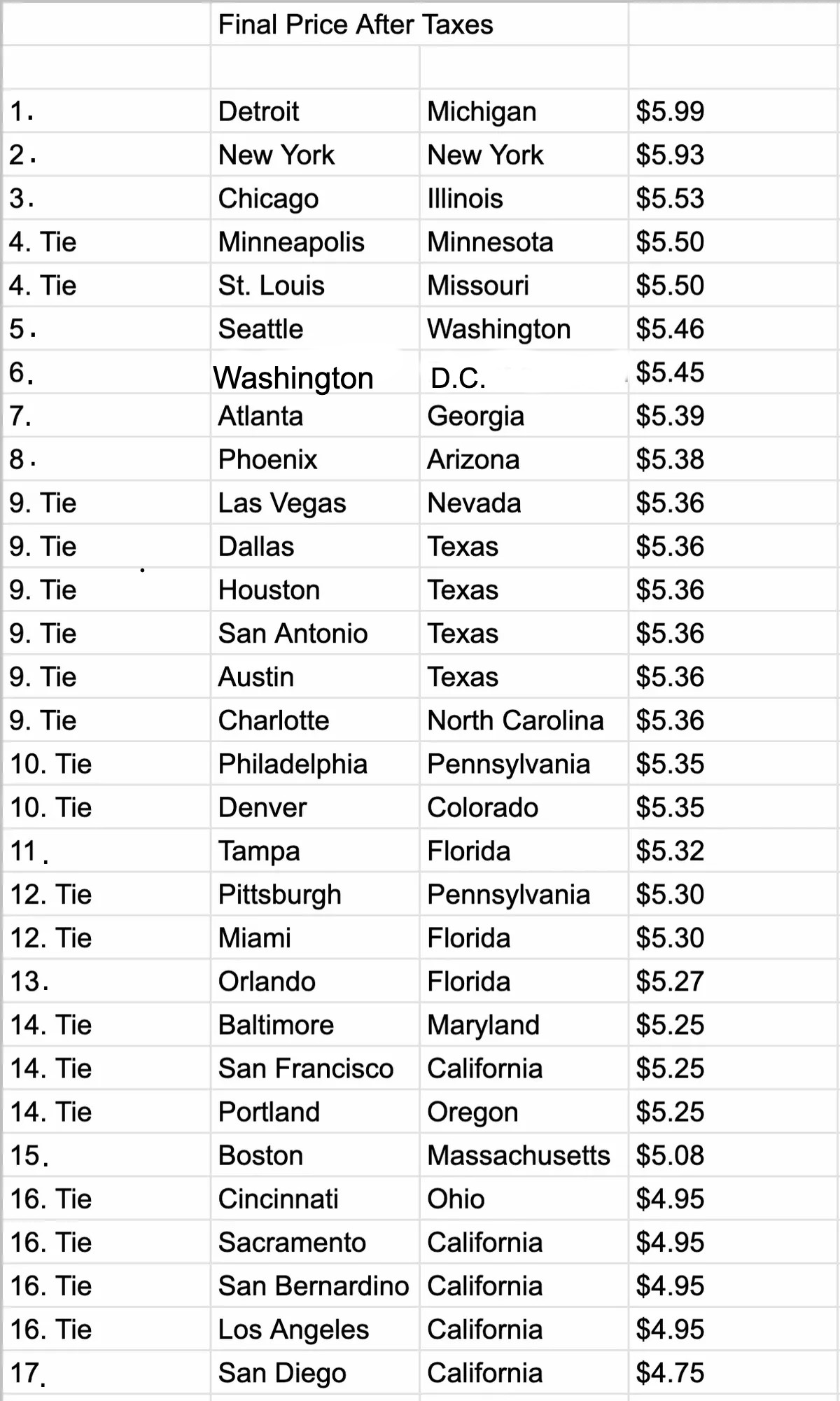
I knew the city was becoming more expensive by the day — but $6.55 was absurd, even in Washington, D.C.. Needing an explanation, I spent the rest of that afternoon using the mobile order feature on the Starbucks app to look up prices of Grande Iced Caramel Macchiato across the country. 

The prices, like everything else these days, made no sense. How could an Iced Caramel Macchiato be cheaper in San Diego than in Detroit? Or cheaper in Los Angeles than St. Louis? I fired up Microsoft Excel and embarked on a month-long truth-seeking journey to solve the mystery of the $7 macchiato. 

Local and “special” sales tax

I decided to record data from stand-alone Starbucks — meaning those not found in hotels or malls — in the downtown areas of the nation’s 30 largest metro areas. Yet, the hours spent compiling all of this data only left me with more questions. Why was coffee more expensive in Texas than California, and how could prices in St. Louis be comparable to downtown Manhattan?

Price of Starbucks Grande Iced Carmel Macchiatos

Price of Starbucks Grande Iced Carmel Macchiatos (Michael Karlis )


I didn’t notice that there were two different prices listed on the receipt until the following Sunday. The first being the actual cost of the drink, and the other being taxes. And so, I made another spreadsheet. 

It turned out that Johnson wasn’t lying, as Grande Iced Caramel Macchiatos were $4.95 in all but six of the metro areas. I soon realized that the extreme price variations were neither a product of inflation, supply shortages or America’s largest coffee chain. Instead, my $7 coffee might have been the fault of our state legislators (and by extension, the people that elected them).

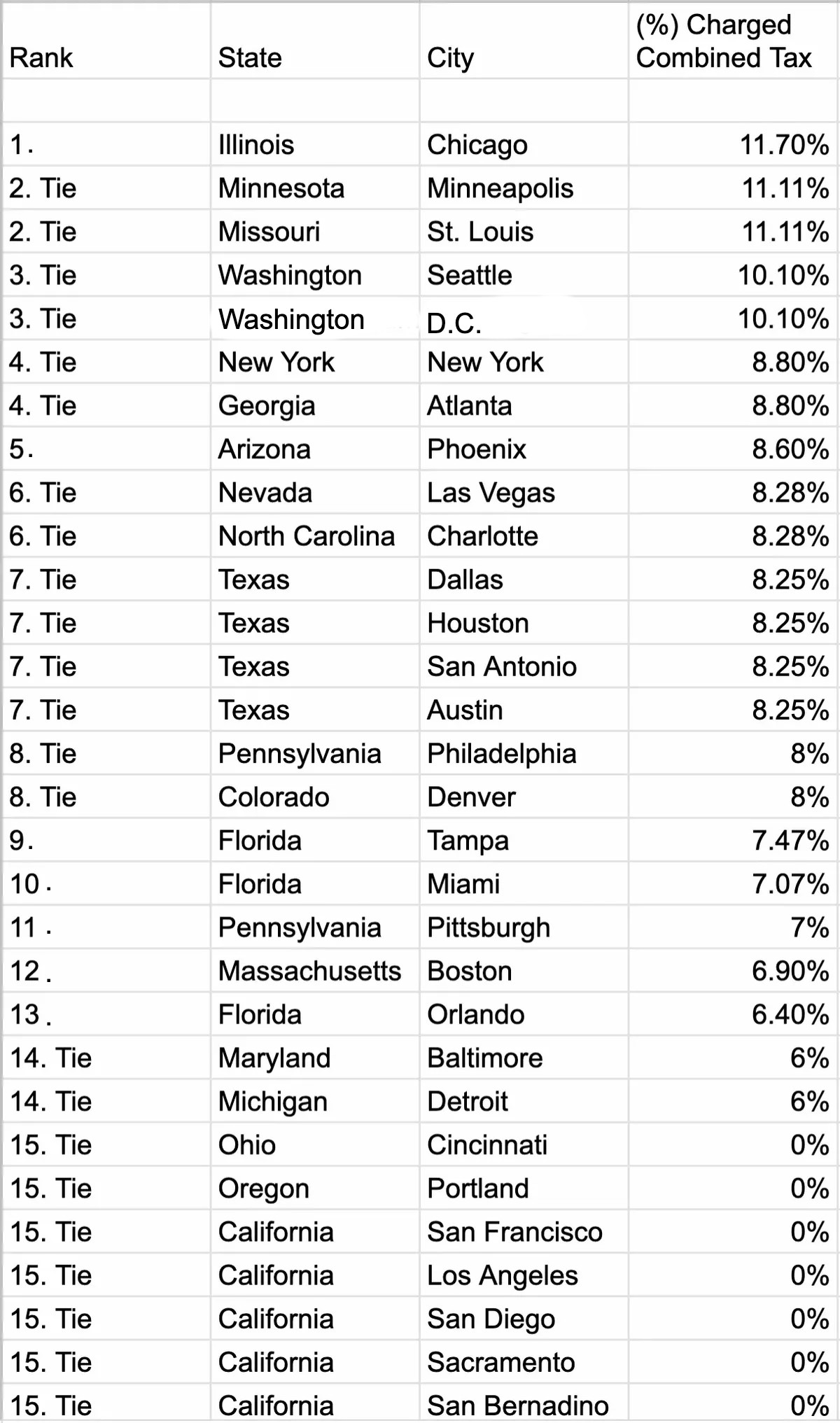
Combined State, County, Local Tax Rate on Starbucks Coffee

Combined State, County, Local Tax Rate on Starbucks Coffee (Michael Karlis )

I decided to convert the sales tax charged on the Starbucks app into a percentage, and check my math using Avalara, a tax compliance website with data for every U.S city. 

Admittedly, I was never great at math, but I found it hard to believe that I miscalculated the sales tax charged by Starbucks in half of the cities. And while businesses overcharging for sales tax isn’t that rare — Doordash, for instance, was sued in 2019 as part of a class-action lawsuit for allegedly overcharging sales tax —there was no way I had managed to discover the largest sales tax fraud in American history. So, the following Sunday, I made another spreadsheet. 

Let’s talk about mystery taxes

Some Starbucks locations were easier to clear of possible tax fraud than others. Although websites like that of the Massachusetts Department of Revenue and others claimed Boston’s sales tax was 6.25%, I was able to find the missing 0.75% charged by Starbucks buried on the Commonwealth’s Data Analytics and Resources Bureau’s website

The search for the additional 3% of sales tax levied by a Starbucks in Minneapolis was just as time-consuming. The tax was so secret that the sales tax calculator, found on Minnesota’s Department of Revenue’s website, couldn’t even explain where the additional tax came from. It took an entire day to find a PDF  — hidden in the deepest depths of the internet — explaining that restaurants in downtown Minneapolis are subject to an additional 3% tax in addition to the ones already levied by the city, county, and state. 

The only Starbucks locations potentially “overcharging” customers for sales tax were all in St. Louis, which is home to 138 “special taxing districts,” like “Community Improvement Districts.” 

The CID’s are usually in low-income areas, and the rates are dictated by property developers who use the tax revenue to subsidize their new developments. The oversight of CDI’s is so lax that 60% of them failed to report their earnings, and 90% never submitted budgets to the city, according to a 2018 report.

Since then, Missouri has published a map of all the state’s special taxing districts, but failed to include their sales tax rates. Instead, there is a separate website with a sales tax calculator that doesn’t work. The calculator, unable to determine the sales tax rate at several Starbucks locations, suggested calling Missouri’s Department of Revenue. Unfortunately, nobody picked up my calls. 

One can only assume that the 12.12% sales tax charged by Starbucks on South Kingshighway isn’t fraudulent. 

Local politics affect the price of your go-to coffee order

The CIDs don’t just appear out of thin air, though, but are approved by elected local officials, but it doesn’t seem like many people care enough to organize any significant opposition to subsidizing gentrification. And, if neither the governments of Missouri or Minnesota can provide an accurate sales tax rate using a calculator they provide on their websites, then it’s safe to assume that the residents aren’t aware of these taxes either. 

The mystery of the price of my Grande Iced Caramel Macchiato isn’t a mystery at all. The economies of our cities have been ravaged by the pandemic — decimating their streams’ revenue. And cities like Washington, D.C are already attempting to make up lost revenue by passing an absurd 10% beverage and food tax, which explains the price of my coffee in Dupont, and officials are even entertaining a 1.5 cent tax on every ounce of artificially sweetened beverages. 

Price gouging isn’t just caused by inflation or supply shortages; rather, it’s a combination of economic blight brought on by the pandemic and our disdain for the dullness of local politics. But maybe it’s time we start paying attention to the local officials we elected and how they’re taxing us before my Starbucks order reaches $10. 

“I have no regrets”: Uma Thurman shares her teenage abortion story in criticizing Texas ban

Uma Thurman has become the latest star to weigh in on Texas’ near-total abortion ban, which took effect on Sept. 1.

In a powerful new op ed in the Washington Post, Thurman revealed she had an abortion at 15 while in Europe, sharing her story in response to the ban. Thurman recalls closely following developments around the Texas law “with great sadness, and something akin to horror.”

“In my late teens, I was accidentally impregnated by a much older man,” Thurman recalled in the op ed. “I was living out of a suitcase in Europe, far from my family, and about to start a job. I struggled to figure out what to do. I wanted to keep the baby, but how?” 

Upon discussing the situation by phone in a difficult conversation with her parents, and while her mother was gravely ill on a hospital bed, Thurman says she realized she had no choice. “My childish fantasy of motherhood was soundly corrected as I weighed answers to their very precise questions,” she wrote. “I was just starting out in my career and didn’t have the means to provide a stable home, even for myself. We decided as a family that I couldn’t go through with the pregnancy, and agreed that termination was the right choice. My heart was broken nonetheless.”


Want a daily wrap-up of all the news and commentary Salon has to offer? Subscribe to our morning newsletter, Crash Course.


According to Thurman, her decision to have an abortion as a teenage girl is what ultimately paved the way for her to become everything she is today — including a devoted mother of three. “Choosing not to keep that early pregnancy allowed me to grow up and become the mother I wanted and needed to be,” she wrote.

It’s a sentiment that’s relatable to many of the nearly 60% of people who have abortions while already being parents. Despite how abortion is widely misunderstood as being at odds with parenting, children, and families, for many people like Thurman, it’s a vital health service that’s allowed them to plan and create — or not create — the families that are right for them. 

Thurman described her abortion as her “darkest secret” until now. “I am 51 years old, and I am sharing it with you from the home where I have raised my three children, who are my pride and joy,” she wrote. “My life has been extraordinary, at times filled with heartbreak, challenge, loss and fear — just like so many women’s lives — but also marked, like theirs, by courage and compassion.”

She continued, “I conceived my beautiful, magical children with men whom I loved and trusted enough to dare to bring a child into this world. I have no regrets for the path I have traveled.” Today, Thurman credits her abortion for granting her “the path to the life full of joy and love that I have experienced.” 

For years, anti-abortion stigma has pushed the narrative that abortion takes away possibilities when a child isn’t born. Anti-abortion ad campaigns often depict photos of babies with captions suggesting that if born, they could have been the scientist to cure cancer or the diplomat who would establish world peace. But Thurman’s story is one of many that should remind us of the infinite possibilities abortion gives to the already born, living people who have them — to become brilliant scientists, artists, thinkers, performers, leaders, parents, or anything they choose to be. 

Certainly more so than forcing someone to give up their life as they know it, carry an unwanted or unsustainable pregnancy, and give birth, abortion is about possibility, agency and power. Abortion is about all that each of us can be when we have power over our bodies and lives.

Texas’ abortion ban — which Thurman points out allows pregnant Texans to be “traumatized and hounded by predatory bounty hunters” — takes away that power. 

“The Texas abortion law was allowed to take effect without argument by the Supreme Court, which, due in no small part to its lack of ideological diversity, is a staging ground for a human rights crisis for American women,” Thurman wrote. “This law is yet another discriminatory tool against those who are economically disadvantaged, and often, indeed, against their partners.” In contrast, Thurman notes that “women and children of wealthy families retain all the choices in the world, and face little risk.”

As Texas’ abortion law remains intact nearly one month after taking effect and essentially rolling back Roe v. Wade, more and more prominent voices are speaking up. The day after Thurman’s op ed, “The Wire” creator David Simon announced he’ll pull his forthcoming HBO show from filming in the state over the ban. “I can’t and won’t ask female cast/crew to forgo civil liberties to film there,” he wrote in a tweet. “What else looks like Dallas/Ft. Worth?”

In sharing her story, Thurman is joined by more than 6,600 people who have had abortions and signed onto a recent amicus brief to the Supreme Court this week. Five hundred female athletes also signed an amicus brief demanding that the court protect abortion rights. Even as the law continues to face legal challenges at every level, it’s stories like those of Thurman and all who are able to live the lives they have today due to abortion care, that will power the movement for abortion rights on a cultural level.

“Monsters Inside” examines how a criminal’s claims of dissociative identity disorder made him a star

In “Monsters Inside: The 24 Faces of Billy Milligan,” Netflix’s latest, shocking true crime project takes audiences on a sordid and haunted journey through the life and alleged crimes of Billy Milligan. The man was famously accused of kidnapping and raping three women at the Ohio State University in the 1970s, only to be acquitted by citing and blaming the crime, which he confessed to, on his dissociative identity disorder

Decades later, myriad questions and contrasting perspectives remain about Milligan, his crimes, and his mental condition. After being acquitted, Milligan spent time at varying mental institutions, where psychiatrists analyzed and debated his condition for years. But as more and more media attention became attached to his case, and the continued sprees of crime and violence connected to his name, Milligan soon emerged as a star — dating women, having a wedding at a mental facility, living it up in Hollywood. 

But as authors wrote sympathetic or at least humanizing books about Milligan, his alleged victims – including three young women and very possibly several male murder victims  – vanished from the narrative. The same documentary that interviews Milligan’s sister about his being a doting uncle to her kids and a good friend of Milligan’s who actively aided him in escaping confinement, also speaks to s a law enforcement agent who expresses disgust with all of this. “No one cared about his victims,” he observed, noting how instead, the culture obsessed with and fixated on Milligan’s mental condition. 

“Monsters Inside” presents a compelling yet concerning story, as audiences may consider the ethical questions it raises about how media portrays mental illness, or the entertainment industry’s enduring obsession with serial killers and violent men like Ted Bundy. Such storytelling can often elevate violent men to celebrity-like figures, at the expense of their victims and other sexual assault victims, who are relegated to footnotes. 

These issues are among the many discussed behind the scenes in creating “Monsters Inside,” French director Olivier Megaton, who’s directed “Colombiana” and two of the “Taken” films, told Salon.

“For the entire documentary, we couldn’t just be against him, because you need to have not necessarily empathy, but you need to like the subject a little more to go inside, and show him, and understand what happened in his life,” Megaton said, of the creative decision to humanize Milligan despite his alleged crimes.

In the interview below, Megaton also discusses the cultural context of the crimes, the contrasts in American and European reactions to Milligan’s stories, and the common controversies that true crime and psychological stories like Milligan’s are often steeped in.

The intro sequence of the docuseries features many iconic cultural moments from the ’70s and ’80s. In telling this story, how important was it to contextualize it with the greater sociopolitical environment of this time period?

I’m a moviemaker, so I have so much love for the ’60s, ’70s, ’80s movies. Maybe it’s our European American dream. So, when we talked about this with the people at Netflix, I loved the idea because I felt that in the ’70s especially, in the U.S., it was just after that very specific youth revolution, and many things changed. For me, Billy Milligan was at the turn, especially with the science at the time. 

It was maybe the last big turn, and something very interesting. Cinematically, I loved the aesthetic of it, the cars, everything, for example, was much more interesting than today when you’re traveling everywhere in the world, and very much of it looks the same. In the social aspects, I liked to focus on the cultural turning point of the U.S. in the ’80s — there were many things that led me to that introduction.

Throughout the show, there’s a lot of debate over whether Billy’s condition was real, and connecting it with his violence. What were the internal conversations like about approaching issues of stigma and representing mental illness and personality disorders? 

I was very attracted by psychiatry in [“Exit”] my first movie about a serial killer, so I’ve always been involved and very interested in that. In Europe, we have kind of another approach about psychiatry, and a different history. So when multiple personality [disorder] suddenly arrived, I heard about this about 20 years ago. After this, I was shocked and puzzled by Milligan. When I heard about Billy’s story, the movie “Split” arrived, and I began to think about how there could be more room for a story like this to exist in the U.S. than in Europe.

I try to have a very specific approach and not just have the U.S. perspective, and be very open to European perspectives. I talked a lot to French psychiatrists, and they pushed me to dive a little more into this. I did a couple other documentaries, and just before I did a documentary on a conman known very well-known in France, Christophe Rocancourt, so I’ve always worked in that space of thinking how the mind is working, how gangsters worked, how common people would understand and react. 

So, it’s a wide field of research for me all the time, and it’s very interesting because when you’re making movies, you’re creating worlds. When you’re creating documentaries, you’re just adding to the reality, trying to find anything to make it clearer. A movie is the opposite, where you’re trying to escape reality. It’s important to have that back-and-forth travel between reality and fiction movies. In documentaries I try to dive and dive and dive and go very far into the subject, like an obsession, and it’s different with movies. 

Billy is one of the least clear subjects I’ve worked on, where in France, they’ll say it’s very clear – not true. On the other side, in the U.S., people were believing in this. It was very interesting to be between, and try to understand why. The answer was, in France, we hadn’t had cases like this. It’s not because it doesn’t exist, it’s because the concept does not exist there. So for me, in this documentary, the thing was not to believe or not believe Billy Milligan, but to understand how his story happened in the ’70s and ’80s in the US, why the social context allowed this, explore the words of psychiatrists and lawyers. I hope the documentary opened that door to the viewers.

There’s often criticism of true crime stories that focus on sexual assault perpetrators over their victims. What went into the decision to focus more on Billy than his victims?

In the beginning, I was focused on the victims, but the story became how Billy became a star in America. It was the beginning of this society of image, marketing, and so on, in the ’80s — there wasn’t room being made for the victims. [The documentary] was in the logic of what was going on in the ’70s and ’80s, the media’s images were going faster and faster. 

There was a lightning focus on Billy, where it was kind of a circus for the media. Then, the reality of what he had done disappeared because the circus was more interesting. This is why I fought against some people we interviewed, because they were still adding that, believing Billy. And I found that very strange, and wondered, “What about the victims?” I think that line came out three or four times in the documentary. 

We found one victim, but she never answered, because what’s very strange about true crime stories is to try and go back 40 years, where victims have tried to forget everything, to come back and reactivate the pain of what they experienced. So, we tried to have connections with them, but it was too hard because some forgot everything. 

This is what created Billy Milligan, which was an incredible story, because having 10 and then 24 personalities — he was seen as a freak for a long time, for many people in the press, until the ’90s, where even when he was known to have committed the crime, we were focusing on his story, not the victims. This is the world we’re living in. I don’t remember having a movie on victims of serial killers, but we have thousands of movies about serial killers. It may be that we’re just following that kind of guy, or this modern way of how our society likes to be afraid from those kinds of people.

So to clarify, there was effort made to contact and include voices from Billy’s victims or their loved ones? 

Yes, and so for example, we tried to contact one’s family, but found they didn’t have living relatives anywhere, and it was 40 years ago. When we talk about this kind of story that happened the ’70s and ’80s, it’s very hard to find living victims, because many will not want to testify or most of them, like the other people we interviewed, were quite old today. This is always the main problem, when you get too far from the story, where you don’t have witnesses today. For sure, you want to have everything, you want to have all the perspective and all the reality. But as I said, there are problems with reactivating the pain of the victims, or where it’s not really possible to catch them, because they’re dead or too old.


Want a daily wrap-up of all the news and commentary Salon has to offer? Subscribe to our morning newsletter, Crash Course.


How would you respond to common criticisms that true crime projects like “Monsters Inside” tend to reduce victims to a footnote, while elevating violent men? 

The strange thing about this miniseries is, it’s not really just true crime. From the beginning, there is the mainstream media producing true crime stories, but our subject is much wider. Netflix hadn’t done this sort of commentary before, where we start with this event, and try to find the reality of it. With Billy Milligan, we know he is guilty, and everyone says he was guilty of rape, but the problem is that he wasn’t convicted for reason of insanity, then afterward, for the alleged murders, because there was no body. And you can’t go to the end of a story in true crime unless you have those pieces of the story.

From the beginning, we knew we were going somewhere else. The issue was to try to tell a story and try to open doors for the audience to something different. This is what I try to do in all my documentaries, just to give people the choice to believe in this or question if Billy was a victim in some way or not. The whole thing is, after the four episodes, people have their own perspective about what they’ve seen and the story. In every documentary, you have that judgment at the end of is he guilty or not. But on this one, it’s not the same thing at all.

Billy is notably white, and was able to evade consequences for some of the horrifying acts he’s believed to have done. Were there internal conversations about addressing white privilege in the documentary?

Yes, for sure. So, it’s in Ohio, which was quite interesting to get into that Midwest state and try to understand the logic of it in the ’50s. I was surprised, shocked by the relationships with race in the ’50s there. And certainly, if Billy Milligan were a Black man, he wouldn’t [get away with] what he did as a white man. 

Specifically because Ohio was this middle America state, when I arrived there, I was used to working in the east or west coasts — there, it’s not the same U.S., the same people, the same logic. As a European, I was surprised. Being in Ohio was different. How Milligan escaped confinement, why people listened to him, why people believed him, those were examples of how he came from this [white] community. The mayor of Columbus was of course a Democrat, and he was against Billy, thinking Billy’s case was a mistake and he was faking, and another leader was more believing and was a Republican. It’s interesting that even in the ’70s, there was that political fight, and conflicts between social classes and communities already in this country, in middle states.

Some lines from the interview subjects really stick with you — there’s Billy’s friend Jim Murray saying “people only knew Billy as a rapist” and how he wanted to “show another side to him” in Murray’s play. In contrast there’s a law enforcement agent who’s upset that “no one cared about Billy’s victims” because of the fixation on his mental illness. How did you balance these dueling perspectives throughout the series? 

It was very hard, because Kathy [Milligan’s sister] knew him more than anybody, and the first thing we talked about was more about how she couldn’t accept he killed people despite knowing he did it, or that he raped girls. This is the first thing she told me. She didn’t tell me he’s not guilty, she always told me from the beginning, he is guilty, and he should have never done this. But it was her brother, and she was the only person on Earth who could protect him. That kind of duality of emotions was much more focused around her, Kathy. 

From the beginning, I was skeptical of Billy’s story, and I felt I knew he was lying from the beginning. That was what I felt deep inside. I had empathy for his victims from the beginning. But my job is like, in a trial, you need to show everything, you can’t only be on one side or only show black and white. I knew what I felt and what I was thinking, but knew I needed to show and tell everything, including his traumas and his past with Chalmers [Milligan’s allegedly abusive stepfather] and such, building the monsters he had inside. I needed to go very far and give all the things I knew of him. It’s not really a duality of Jim and the man from the FBI, or that they’re totally different, but it’s that they didn’t have the same approach. Even with Jim, when he talked about Billy, his friend, you could still hear Jim’s his fear and know he also feared Billy.

The conclusion of Episode 4 is particularly haunting as you see how Billy becomes a literal celebrity, hanging out with celebrities and playing an active role in developing movies about him. The episode seems critical of this. Were you concerned this documentary series could unintentionally be part of the issue of celebrification of violent men?

To be more specific, I feel Billy became a star even before the documentary. Hollywood was a kind of major achievement for him, but I felt he already was a celebrity with the locals in the ’80s. The fact that these books were made about him, that was already the project of making him somebody, a branded guy. The whole thing began much before [“Monsters Inside”]. Hollywood was the end of all this. 

With the last part of the series, and they were writing his story in Hollywood, for sure he met big people, but I felt this was the end, because this was where the reality came. When [James] Cameron realized Billy had already given the rights to his story, everything was gone. It took about 40 years to have the rights back, and to make something on this story. So, Hollywood was much more the end of his story. 

He was a celebrity, but when he was back in Miami and then later in life, there was more realization he was a conman, even though people were certainly fascinated by his story, and didn’t care about the morality of it. This was the crazy thing, and especially as directors, you’re meeting a lot of people, like criminals, gangsters, who want to be famous, and want to tell you their story. Most of the movies, except maybe comedies, are more like this, and how we try to understand and talk about human beings, and the way they may freak out, or screw up. So arriving in LA for Billy, it was that kind of freak movie for a lot of people. So I don’t really think he was fully a celebrity, and he just met celebrities because he was kind of in this network — but they very quickly understood they couldn’t do his movie and it quickly just exploded, and went back to reality.

“Monsters Inside: The 24 Faces of Billy Milligan” is now streaming on Netflix.

Florida’s new surgeon general, Dr. Joseph Ladapo, has ties to fringe group pushing bogus COVID cures

After nearly a year-and-a-half of sidelining his state’s top medical official, Gov. Ron DeSantis appears to have found a more ideological fit for the role — naming Dr. Joseph Ladapo, a Harvard-trained medical professor who likened the effects of the vaccine to eating fruits and vegetables and has cast doubt on the efficacy of masks, to a post as the state’s surgeon general.

At a press conference Tuesday morning announcing the news, Dr. Ladapo used the opportunity to dismiss those who have criticized Florida’s lack of public health measures to slow the spread of COVID-19, despite the fact that Florida is currently facing its worst surge of the virus yet. 

“We’re done with fear,” he said. “That’s been something that unfortunately has been a centerpiece of health policy in the United States ever since the beginning of the pandemic, and it’s over here. Expiration date. It’s done.”

Dr. Ladapo has made a name for himself over the course of the pandemic as someone unafraid to buck the consensus of the U.S. medical establishment. He even appeared in a controversial press conference last summer held on the steps of the U.S. Supreme Court by a little-known group called “America’s Frontline Doctors, led by a conspiratorial Texas physician named Stella Immanuel, who is best known for suggesting that certain ailments may be caused by sperm from sexual visitations from demons and/or alien DNA.


Want a daily wrap-up of all the news and commentary Salon has to offer? Subscribe to our morning newsletter, Crash Course.


At the event, more than a dozen medical professionals — some with spurious qualifications — spread a number of misleading claims, including that both zinc and the anti-malarial drug hydroxychloroquine can “cure” COVID-19 and that masks do not slow the spread of the virus. 

Dr. Ladapo, wearing a lab coat emblazoned with an “America’s Frontline Doctors” logo, spent time at the podium talking about the “unintended consequences” of COVID-19 safety measures, and touted hydroxychloroquine heavily. 

“It’s not good for Americans to be hearing just one perspective on this,” he said. 

Twitter, Facebook and YouTube took steps to remove a video of the press conference shared by the right-wing site Breitbart, but by then it was already too late — both former President Donald Trump and his son, Donald Trump Jr., had shared clips from the event, and before long the entire thing had gone viral among conspiracy theory groups dedicated to anti-vaccine and QAnon content. 

In the months since, the group has become a favorite among right-wing media outlets for adding a patina of medical credibility to COVID-19 treatments that pundits can pitch as an alternative to vaccination. Since last summer, both Dr. Ladapo and America’s Fronline Doctors have moved on to hawking the anti-parasite drug ivermectin as a treatment to COVID-19 — a development that has caused a run on the version of ivermectin used for livestock and led to a significant increase in poison control calls for those who have ingested it. There is little evidence either ivermectin or hydroxychloroquine work as COVID-19 treatments.

Unlike some other members of AFD, Dr. Ladapo does appear to have a current medical license with the California Medical Board. Before being named as Florida surgeon general, he was a physician and clinical researcher at the University of California, Los Angeles, the fact-checking site Snopes reported.

He also authored a series of op-eds in the Wall Street Journal over the past year, including one that said removing children from school is harmful to public health and another that suggested COVID-19 vaccines were more dangerous “than advertised.” In another, Ladapo warned the public not to “put one illness above all other problems in society,” a condition he called “COVID mania.” 

At Tuesday’s press conference to announce his new surgeon general, DeSantis took the opportunity to slam President Biden, accusing the president of hatred toward his state for a recent White House decision to distribute monoclonal antibody treatments to other states. 

“He hates Florida more than anything, and this is absolutely going to hurt people,” DeSantis said.

DeSantis has heralded the effectiveness of these treatments, and Florida — along with seven other states — has reportedly been consuming upwards of 70% of the national supply, according to The Washington Post.

Even after rationing began, however, Florida got the largest supply of the treatments, the U.S. Department of Health and Human Services said.

Dr. Ladapo’s new contract involves a two-year contract as surgeon general with a possible three-month extension, as well as a simultaneous position with the University of Florida College of Medicine. His ascension to the surgeon general post also requires confirmation by the state Senate.

Dr. Ladapo’s post with the University of Florida comes after his predecessor, Dr. Scott Rivkees, was the beneficiary of a similar deal. Rivkees had negotiated to continue working as a tenured professor at the University while he was employed full-time as surgeon general when he was appointed in 2019. He was the first to broker such an agreement, which was allowable due to a law governing the transfer of public employees between agencies. Dr Ladapo’s deal will enable him to do the same.

The news of a new surgeon general comes amid one of the state’s worst surges yet — with Florida recently passing 50,000 deaths since the pandemic began. 

Over this past year, DeSantis has advocated viciously against both mask and vaccine mandates. His former Surgeon General was sidelined early on, in April 2020, after breaking with DeSantis and advocating for social distancing measures just as spring breakers began to descend on Florida beaches. And as late as this summer, he was blocked from answering questions from members of the Legislature. He largely remained silent to the public until he announced he was stepping down last month.

A representative for DeSantis did not return a request for comment on this story.

Ladapo has not announced any new COVID-19 safety measures, though when asked about future actions at Tuesday’s press conference DeSantis did offer a hint at what he believed the job should be — saying that his new medical official would tell “the truth.”

“Telling the truth is important … and I think that’s what Dr. Ladapo understands,” DeSantis said. “You’ve got to tell people the truth, and you’ve got to let them make decisions.”​​ 


3 easy-peasy ways to cook green beans

It can be really easy to screw up cooking green beans. If you look away for just a minute, delicate beans can go from crisp-tender to over-cooked and mushy, and there’s no turning back. Plus when they’re at their peak, green beans have a vibrant green color and lovely spring flavor that shines when they’re barely cooked. Before your beans lose their brightness and a staple side dish is ruined, learn how to cook green beans three ways — boiling, steaming, and sautéing.

How to prep green beans

No matter how you cook them, it’s important to properly prep them. This means thoroughly washing and scrubbing them and then trimming the ends of any scraggly bits using kitchen shears or a paring knife. Haricots verts (aka French green beans) often come pre-trimmed, but be sure to give them a once-over to avoid eating any undesirable scraps. Discard or compost any beans that have brown or mushy spots and move forward with the rest.

How to boil green beans

Don’t overthink this one! The best way to boil green beans is to start with salted boiling waterThis isn’t like pasta where the water should be as salty as the sea, but don’t skimp on the salt either. A tablespoon or two should do the trick. Once the water has reached a rapid boil, throw in the beans, or rather, gently and carefully place them in the pot). Cook for just 3 to 4 minutes. Feel free to pull one out to give it a taste — in fact, you should do this! At the end of the day, the texture of the bean should be what you want so drain the water if they taste done, or leave them in for another 30 seconds to one minute to cook further.

From here, serve the cooked green beans as is, or sprinkle ’em with lemon juicegrated Parmesan cheese, fiery red pepper flakes, and a sprinkle of salt and pepper, of course.

How to steam green beans

Steaming green beans is an easy way to make a delicious side dish for weeknight dinners. So why would you steam vegetables instead of boiling them? Steaming is slightly healthier because it keeps some of the nutrients intact, but is also a more risk-free cooking method since they’re less likely to overcook. To steam them, create a double boiler by placing a steamer basket (or metal colander) in a medium-sized pot. Bring one to 2 inches of water to a boil, place the beans in the basket, and cover with a lid. The cooking time may vary based on the amount of beans that you’re preparing, but as a rule of thumb, start by steaming them for five minutes over medium-high heat and continue to cook until the beans have the perfect bite to them.

How to sauté green beans

To sauté fresh green beans, start by heating a stainless steel or cast iron skillet over medium-high heat. Add a couple of tablespoons of olive oil or butter. Once sizzling, add the beans, cover with a lid, and cook for 15 minutes until tender. As soon as the beans are cooked, garnish them as you please (but may we suggest minced garlic or a drizzle of maple syrup?).

* * *

Our favorite green bean recipes

Penelope Casa’s Garlic Green Beans (Judias Verdes con Ajo)

Dress up fresh green beans by sautéing them in extra virgin olive oil and then tossing them with minced garlic and lemon juice and zest. It’s a simple preparation that will be crowd-pleasing and easy to perfect.

Sautéed Green Beans with Garlic

The beauty of this recipe is that you can apply the cooking method to so many different vegetables beyond green beans (like Brussels sprouts!). But sautéing really is one of our favorite ways to cook flavorful, and definitely not mushy string beans.

Fuchsia Dunlop’s Sichuanese Dry-Fried Green Beans

Learn how to dry-fry green beans with this recipe. What’s dry frying, you ask? Well friends, it’s a very cool cooking method that calls for sautéeing green beans (or any vegetable, really!) in a dry skillet with just a tiny, tiny amount of oil. The result is also extra crispy, blistered veggies that are perfectly tender on the inside.

10 best Trader Joe’s products for kids

Welcome to Kids & the Kitchen, our new landing pad for parents who love to cook. Head this way for kid-friendly recipes, helpful tips, and heartwarming stories galore — all from real-life parents and their little ones.

* * *

Once upon a time, I scoffed at Sandra Lee and her “semi-homemade” juggernaut. I made my ratatouille from scratch, thank you very much. I rejoiced that a mole poblano would take me all day to cook. Then I had a kid, and — well — you’ve heard this song before.

Nowadays, I’m a believer (by necessity!) in cooking some things myself and using the prepared version of others. And as its many fans know, TJ’s is a prepared foods heavyweight. I often find myself layering roasted veggies and fresh produce on top of whatever prepared food I buy from there — I’m talking frozen naan and the like. These 10 items are the ones I turn to the most, and the mealtime lifesavers in my home.

* * *

10 Trader Joe’s must-haves

1. Frozen Garlic Naan

Khushbu Shah once wrote about the surprisingly fantastic Indian frozen food section at TJ’s. The paratha seems to be not quite as tasty as it once was, but that garlic naan remains solid. I pop it in the toaster to get it warm without also warming my house, then butter it or layer it with cheese, cream cheese, leftover veggies, chopped chicken, or sliced roasted eggplant — and it sells. The kid’s a fan.

2. Eggplant Garlic Spread With Sweet Red Peppers

I can’t sweat it out over homemade ratatouille as readily now, so I conjure its memory on the quick with this spread. I do doctor it up, though, with more olive oil, salt, fresh herbs, and even additional raw or roasted garlic. Then I take a pot of buttered noodles, dump half a jar of eggplant garlic spread on a portion of it, and serve it alongside the plain ones for “noodles two ways.” Maybe it’ll prove to be gateway eggplant for your kid. Sometimes you just need your RDA of veggies to come in a jar.

3. Caramelized Onion Dip

I buy two of these bad boys at a time. Caramelizing onions is meditative work on a good day, like on the days when you’re drinking cold Chardonnay by 3 o’clock. But you know what? Working parents don’t often get to caramelize onions. So buy this, because you will be slathering it on the above naan, plus burgers, hot dogs, and grilled chicken. You’ll also likely be dipping chips into it, and setting out the one tin you didn’t eat alone in a single session during your rare get-togethers with other adults.

4. Peanut Butter–Filled Pretzel Nuggets

The good trader just understands the peanut vector, from Bamba to these nuggets. The one day I forgot to bring a snack pack of these guys to daycare pickup, I listened to screams all the way home. I get it, kid; it’s just the hit of salty protein you need after a long day of driving a tiny red plastic car in circles.

5. Pork Gyoza Potstickers

Once, I wended my way to my Chinatown of choice to buy 100 dumplings for $5. Today, damn, these TJ’s potstickers are better than they need to be. I sauté them in a little vegetable oil, add a bit of water, then put a lid on the pan and steam them. They take about 10 minutes, and the kid loves them. (She has recently cottoned on to the fact that the vegetarian ones contain vegetables, so she’s on high alert, but for a while there, I could have put raw spinach in a dumpling wrapper and she would have wolfed it down.)

6. Pork Soup Dumplings

These are not quite the xiao long bao you had that one time on your whirlwind trip to Shanghai. But sometimes, you need a reminder to yourself of your pre-parent life. On certain Tuesdays, that’s gonna look like microwaved soup dumplings. Kids are amazed by them — are they soup or are they dumplings? They take up precious little freezer space. They are ready in 3 minutes. They are solid, and everyone wins.

7. Hold The Cone Chocolate Mini Cones

I didn’t know my two-year-old was capable of a deep, George Costanza-esque chuckle until I handed her one of these teeny-tiny chocolate-dipped cones, the ideal size for her little paw. I particularly love the little bit of chocolate TJ’s stashes in the point of the cone, as a dam against drips.

8. Chili Onion Crunch

Maybe in the before-times you made your own chili crisp. That’s fantastic; go, you. But this one is at the grocery store! When your meal — like, say, dumplings — needs something bright, textured, and spicy, you can spoon a little of this onto your plate. Invariably, your kid will want to try it, and it’s not so spicy that it’ll cause alarm.

9. Marinated Grilled Artichoke Hearts

Jarred and frozen produce is totally welcome when you can’t get to the farmers market (or any market). I layer these, sliced, onto naan with a fried egg, caramelized onion dip, and chili crisp. I blitz them in the mini prep with chickpeas for an any-ingredient “bean dip” my kid will eat. Look at that; there’s produce on the plate.

10. Frozen Butter Chicken With Basmati Rice

Sometimes I make my own curries, but sometimes I can’t. And that’s where Trader Joe’s comes in. The chicken tikka masala is just fine, and the fish korma and butter chicken are actually good. My kid will eat it; sometimes she just eats the rice. That’s OK. I pump up my portion with labneh or yogurt, any sort of chutney or pickled onions that are in the fridge, leftover veggies, and, yes, chili onion crunch.

Sorry, Sandra Lee; you were right.

Dogs at the Miami airport are being trained to sniff out COVID-19. Here’s how it works

Miami has officially become the first city in the U.S. to use COVID-19–sniffing dogs at an airport to help stop the spread of the coronavirus.

Two dogs — a Belgian Malinois named Cobra and a Dutch shepherd named One Betta — are currently being stationed at an employee security checkpoint. The detector dogs aren’t checking for COVID-19 on passengers, but rather employees as part of a pilot program that’s been extended through October. Their noses are a crucial weapon in a fight against COVID: currently, the state of Florida is at the tail-end of yet another deadly COVID-19 surge

According to the Miami Herald, the two dogs, who work Monday, Wednesday and Friday from 11 a.m. to 3 p.m., together detected at least two cases since last week.


Want more health and science stories in your inbox? Subscribe to Salon’s weekly newsletter The Vulgar Scientist.


“This pandemic has pushed us to innovate to stop the spread,” said Daniella Levine Cava, Mayor of Miami-Dade County, in a statement. “We’re proud to do everything we can to protect our residents. I look forward to seeing how the airport tests their skills and expanding the pilot program to other County facilities.”

Reportedly, the two dogs are able to detect COVID-19 in a person with an estimated 99 percent accuracy. While on paper that sounds incredible, the logistics of such an act are a bit confusing. Viruses, like coronavirus, are incredibly small, and do not alone produce a scent.

So how do dogs “smell” something so small and odorless? 

It turns out that when a person is infected with the COVID-19, or any disease, it causes metabolic changes that result in the production of something called volatile organic compounds (VOCs). VOCs are often associated with man-made chemicals, and are off-gassed from certain drying paints and lacquers. But volatile organic compounds also scent perfumes, and they are emitted by animals and plants as well. 

Certain VOCs are expelled from a person’s breath and sweat when they have COVID-19, and dogs can be trained to detect such scents.

“Scent-detection dogs can accurately detect low concentrations of volatile organic compounds, otherwise knowns [sic] as VOCs, associated with various diseases such as ovarian cancer, bacterial infections and nasal tumors,” said Cynthia Otto, director of the center and professor of working dog sciences and sports medicine. “These VOCs are present in human blood, saliva, urine or breath.”

In a typical training, various samples of these bodily fluids are used. If the dog correctly indicates a sample that was positive for the disease, the dog receives a treat. It’s similar to how dogs have previously been trained to detect other illnesses in people, like cancer.

“Being able to apply decades of research in this way, to provide an additional layer of protection to airport employees at Miami International Airport — it’s humbling,” said Dr. Kenneth G. Furton, FIU Provost and Professor of Chemistry and Biochemistry. “These dogs are another valuable tool we can leverage to help us live with this ongoing pandemic.”

To date, there have been a couple of studies indicating that dogs can successfully sniff out COVID-19 in people, but the accuracy often varies and not all have been peer-reviewed.  According to one pilot study that was published in the peer-reviewed journal BMC Infectious Diseases, eight dogs were trained for 1 week to detect saliva or tracheobronchial secretions of SARS-CoV-2 infected patients. The study was randomized, double-blinded and controlled. The dogs were able to differentiate between samples of those infected with COVID-19, and samples of those who weren’t infected. The dogs had a detection rate of 94% out of 1,012 randomized samples. The study’s authors noted that the data was very promising. 

For centuries, humans have tapped the power of the canine nose. Unlike human noses, which have 5 to 6 million scent receptors, dogs’ noses have 300 million scent receptors. This allows dogs to detect very tiny concentrations of odor that humans can’t. Working dogs have already proven to be successful in sniffing out firearms, drugs, and explosives.

But just how useful are dogs for combatting COVID-19?

“No one is saying they can replace a PCR [Polymerase Chain Reaction] machine, but they could be very promising,” veterinary neurologist Holger Volk at the University of Veterinary Medicine at Hanover in Germany told Nature. Polymerase Chain Reaction (PCR) machines are used in laboratory settings to probe DNA.

Miami isn’t the only city in the world leaning on COVID-19 detection dogs.

In August 2020, police in Dubai deployed 38 sniffer dogs to sniff out COVID-19 from human sweat samples. Dogs were also used at Helsinki Airport at an arrivals hall, where passengers were asked to wipe their skin and place the wipe in a cup, which the dogs then sniffed. If the result was positive, a passenger would be directed to the Helsinki University Hospital’s health information station. Officials in Helsinki found the process to be not only effective, but also budget-friendly.

“PCR test cost approximately 4 million euros per month and sniffing less than 100,000 euros” said Anna Hielm-Bjorkman of Helsinki University,a  docent in clinical research of companion animals.

Daughter blames Fox News’ Tucker Carlson for unvaccinated father’s death

On Monday, two children who lost their father to COVID-19 appeared on CNN to urge others to get vaccinated and blamed Fox News for his death.

Katie Lane said Fox News’ Tucker Carlson “played a role” in her father’s death. 

“There’s multiple reasons, I think. One of which was some of the media he ingested,” Lane said. “He watched some Tucker Carlson videos on Youtube. And some of those videos involved some misinformation about vaccines and I believed that played a role.” 

Patrick Lane died from COVID-19 and was unvaccinated and prior to his illness, was hesitant about getting vaccinated. Before he died, Katie said her father’s final words in a last call to her stepmom were that “he wished he was vaccinated.” 

Evan Lane, Patrick Lane’s son, stressed he wasn’t “anti-vaccine. He was just hesitant.” He said that if he was still alive by the time Pfizer’s vaccine was fully approved by the FDA, he most likely would have got vaccinated. 

At one point, before he got sick, Evans’ father didn’t want to hug Patrick Lane because he didn’t want to risk getting his son sick. Evan said “I didn’t even get to hug him before he left. And then before I knew it, he was gone.” 

Patrick Lane is one of many who have fallen victim to the vaccine misinformation spread by Carlson, who is the host of the most watched cable news shows, broadcasting to at least 3 million viewers. Carlson has repeatedly questioned the vaccine’s effectiveness, at one point suggesting the vaccine is deadly and that there is a cover-up behind the vaccine’s side-effects.

There is no evidence that the vaccine is deadly, and overwhelming evidence to the contrary, that the vaccine is safe and effective.

No exit for Democrats: Mitch has them trapped, and the path ahead is darker than ever

We’ve got a fair number of repentant former Republicans roaming loose on the political landscape these days. They like to tell us that the onetime Party of Lincoln must be thoroughly defeated and destroyed before it can be rebuilt as a respectable, mainstream center-right organization. That’s an encouraging team-building exercise, I guess — if we set aside everything about observable reality and play an extended game of Let’s Pretend We’re Grownups, like a bunch of eight-year-olds trying on Mom and Dad’s Clinton-era wardrobe.

Even looking past the question of whether the reconstructed GOP 2.0 these folks imagine would be remotely viable (as to which: ha!), we still have the question of who’s going to defeat the exceptionally nasty current version of the Republican Party, and how. These GOP apostates, it’s worth noting, were totally OK with cutting taxes for the rich and running up massive deficits on endless, pointless, destructive overseas wars. They find themselves deeply shocked, however, by the party’s swerve into overt racism, know-nothingism and borderline fascism, elements of the Republican coalition they believed could be kept in the basement indefinitely.

This call to arms by ex-Reaganites is presumably meant to fire up Democrats, who have been told repeatedly over the past 30 years or more that America’s changing demographics were certain to deliver them a permanent majority coalition someday very, very soon. In this less-than-inspiring vision of utopia, benevolent intersectional liberals would govern wisely and forever, while Republicans would be consigned to regional, resentful rump-party status until and unless they gradually became a lot more like Democrats. 

As you may have noticed, this keeps on not happening, and at this point the “emerging Democratic majority” is starting to sound like old-time Soviet dogma about true communism being just over the horizon. Yes, Democrats have won the popular vote in seven of the last eight presidential elections — while managing to lose two of those anyway — but for a variety of reasons I don’t need to rehearse here have found it impossible to hold or build congressional majorities, or to do much of anything with them when they have them. 

More important than any of that, although absolutely related, is how Democrats have responded to the obvious Republican assault on democracy over the last couple of years, in the manner of a truckload of Brookings Institution scholars stuck in cold molasses, determined to consider all sides of the question fairly and not to let anyone accuse them of acting hastily. I’m not suggesting that Joe Biden and Nancy Pelosi and Chuck Schumer haven’t expressed genuine alarm or said more or less the right things, because they have. But as you have perhaps observed, they haven’t leveraged those words into action: They haven’t ditched the filibuster or expanded the Supreme Court or passed any of the bills in front of them that are meant to fortify the right to vote, for the love of Jesus Christ. 

This isn’t a nice thing to say about a bunch of mostly sane and approximately reasonable people, but here’s the truth: If you set out to design a left-center political party that was fated to surrender, little by little, to authoritarianism — because of circumstances beyond its control, because of internal indecision and ideological fuzziness, because it faced an entrenched and deranged opposition party, because of whatever — you could hardly do better than the current version of the Democratic Party.


Want a daily wrap-up of all the news and commentary Salon has to offer? Subscribe to our morning newsletter, Crash Course.


This raises the question of whether the Republicans are the only party that needs to be badly defeated in order to recover a sense of purpose. Don’t get me wrong here: It would be far preferable if the Democrats could work out how to win power and then use it effectively. I’m not advocating voting against them out of some contrarian or puritanical impulse, and I’m not even dragging out the old Bernie vs. Hillary generational and ideological conflict for another go-round. (Of course that remains an important source of friction, but it’s genuinely not the central issue right now.)

If the current mishmash that is the Democratic Party simply isn’t up to the task, if it’s imprisoned by its donors and trapped in an old political paradigm while facing the birth of a new one, if it can’t summon up the energy or determination to act decisively on behalf of supposedly shared principles, then what the hell is the point? Maybe they’re the party that needs to be torn down and rebuilt, especially since the other one is an entirely lost cause.

Consider 2021 — yeah, I know you don’t want to, but we don’t have much choice. After the election of Joe Biden and the improbable reverse parlay of winning both Senate seats in Georgia — almost entirely thanks to the chaos-agent intervention of Donald J. Trump — liberals and progressives and normies of all descriptions exhaled audibly. We were back to “normal”! The nightmare had passed! Maybe the long-awaited Democratic majority had arrived at last, if only in ass-backward and highly precarious fashion … except nope, nobody believed that for more than a few minutes, considering that the day after the special elections in Georgia was the sixth of January.

I’m not saying that Mitch McConnell wanted to lose the Senate majority (I bet he had some choice words about Trump in private), but no one has ever accused Mitch of not knowing how to play the angles. He quickly understood how to turn the ambiguous results of 2020 to his advantage, and they were undeniably ambiguous: Democrats breezed into that election expecting big wins across the board, but instead lost most of their House majority and fell short in several prominent Senate races, failing to gain seats in Maine, Montana and North Carolina. 

While regular people celebrated a victory and the supposed end of the Trump era, Democratic leaders and insiders looked ahead to the 2022 midterms and began to whimper uncontrollably. McConnell could smell the fear, to put it bluntly, and rubbed his hands with Montgomery Burns-like glee. With a 50-50 Senate and Biden’s entire legislative agenda hamstrung by the filibuster and the nonsensical or corrupt Ringwraith fantasies of Joe Manchin and Kyrsten Sinema, he had the Democrats trapped. They knew it and he knew it.

In a display of ruthlessness and cynicism that’s impressive even by his standards, McConnell will force all 50 Democratic senators to vote on a budget and on raising the federal debt ceiling, which in quasi-normal times (and even under Trump) was done by bipartisan agreement. This will either force them to crumple and capitulate to whatever it is he wants (short version: more goodies for rich folks) or will create an invented wedge issue Mitch believes he can use to win back both houses of Congress next year. Republicans will pretend to run on fiscal responsibility but will actually run on a bunch of culture-war bullshit and promises to rig all future elections and unquestioned loyalty to a decrepit and defeated leader they all privately think is nuts. I’m sure looking forward to that, aren’t you? 

If Democrats lose conclusively to those people, then they deserve it. That’s a dark path, perhaps darker than any of us wants to contemplate. But I think there’s no avoiding this date with destiny, for the Democrats or the Trumpers or our entire so-called democratic experiment. If you see another one, light the way.

Anti-masker attempted to run Michigan health official off the road at 70 mph: report

A Michigan health official says an anti-mask activist tried to run him off the road at more than 70 mph after he announced a school mask mandate last month.

The Michigan Advance obtained an email sent by Kent County Health Department Director Dr. Adam London to county commissioners detailing the incident, which occurred shortly after London announced that masks would be required in pre-school through sixth grade, since children under 12 aren’t eligible for COVID-19 vaccines.

“I had a woman try to run me off the road at 70+ miles per hour…twice, on Friday night,” London wrote in his Aug. 22 email. “I think we have all seen the aggression and violence displayed at meetings across the nation during the past week.”

London also recounted some of the other abuse and violent threats he’s received from anti-maskers — “accusing [him] of being a deep state agent of liberal-progressive socialist powers that are working to undo the America they love” and calling him a “child-abusing monster.”

“Last week, I had a person yell out to me, “Hey motherf*cker, I hope someone abuses your kids and forces you to watch,'” London wrote.

In response to the threats of violence and the “attempted vehicular assault” against London, Democratic commissioners issued a statement affirming their support for the health director, but Republicans on the board declined to sign it.

“At an Aug. 26 Kent County Board of Commissioners meeting, a large and often raucous crowd spewed harsh and aggressive words for London, who had to attend the meeting virtually due to concerns for his physical safety,” the Michigan Advance reported, adding that many have called for his firing or resignation.

In his email to commissioners, London pleaded for help and compared anti-maskers to those who dismiss the Capitol insurrection as “a peaceful patriotic protest,” or the alleged plot to kidnap Democratic Gov. Gretchen Whitmer as “just guys joking around.”

“There is nothing to be gained by entertaining such people with dialogue,” London wrote, adding that he will not “needlessly expose” himself or his family to the “brute mob hatred” of people who try to force their views on others through intimidation and threats of violence.

“I think it is a grave mistake to unnecessarily give them targets and platforms,” he wrote. “There is a sickness in America far more insidious than COVID. You are more empowered to fight this disease than I am.”

“I will not participate in witch trials in which the science I’ve presented, and the opinions of legitimate experts, is reduced to the same stage as people living in echo-chambers of junk science, salespeople, and Youtube videos,” he wrote. “If you want to fire me, or censure me, or pass a resolution condemning me, by all means please proceed … But first, let me share my prayer with you: I pray that people more powerful than me, Democrats and Republicans, rise up with one voice and say, ‘we will not tolerate or provide quarter for this nonsense in our part of America.'”

London described himself in the email as a Christian who views his job as “an expression of faith.”

“Others are calling me a traitor to our nation and liberty who must be stopped at all costs,” London wrote. “Really? I’m the grandson of two WWII heroes, the son and step-son of men who served during Vietnam, and the brother of a soldier who served in Afghanistan. We proudly wave the flag at my house and in my office. Faith, Family and Country.”

“The fascist side of the Internet” gets hacked: Proud Boys, QAnon websites fall victim to Anonymous

The hacktivist collective Anonymous leaked over 150 gigabytes of private data after hacking the web registration company Epik, a popular domain host for far-right groups.

Popular far-right platforms like Parler, Gab and 8chan, as well as far-right extremist groups like the Proud Boys and QAnon, recently migrated to Epik after being banned from other platforms following the Jan. 6 Capitol riot for violating policies on hate speech and spreading misinformation. Last week, Anonymous dumped what it said was a “decade’s worth” of company data in a torrent file, including passwords, internal emails, home addresses, and phone numbers.

“After years of bolstering the worst trash the Internet has to offer, this is, truly, the Epik moment we’ve all been waiting for,” the group said in a statement it published along with the data dump, which was first reported by independent journalist Steven Monacelli.

“This dataset is all that’s needed to trace actual ownership and management of the fascist side of the Internet,” the statement said. “Time to find out who in your family secretly ran an Ivermectin horse porn fetish site, disinfo publishing outfit, or yet another Qanon hellhole.”

Extremism researchers say the leak is akin to a “Rosetta Stone to the far right” and is helping them find new links among the groups.

“It’s massive. It may be the biggest domain-style leak I’ve seen and, as an extremism researcher, it’s certainly the most interesting,” Megan Squire, a professor at Elon University who studies right-wing extremism, told the Washington Post. “It’s an embarrassment of riches — stress on the embarrassment.”


Want a daily wrap-up of all the news and commentary Salon has to offer? Subscribe to our morning newsletter, Crash Course.


Epik drew national headlines earlier this month after offering support to Texas Right to Life, an antiabortion group whose website was removed from GoDaddy because it solicited information on women who solicited abortions in violations of Texas’ new near-total ban. But Epik ultimately stopped working with the site because it violated their rules against collecting private information. Epik has in recent years become a safe space for far-right platforms that were booted from major web hosts like Amazon Web Services, though it has tried to take steps to shed some of its most toxic clients, cutting ties with the neo-Nazi site Daily Stormer and 8chan.

“The company played such a major role in keeping far-right terrorist cesspools alive,” Rita Katz, executive director of SITE Intelligence Group, which studies online extremism, told the Post. “Without Epik, many extremist communities — from QAnon and white nationalists to accelerationist neo-Nazis — would have had far less oxygen to spread harm, whether that be building toward the Jan. 6 Capitol riots or sowing the misinformation and conspiracy theories chipping away at democracy.”

Epik founder Robert Monster has drawn growing criticism for hosting extremist content. Monster has denied holding extremist views but following that Christchurch shooting in New Zealand that killed 50 people, he uploaded links to the shooter’s video and published his so-called manifesto. Monster insisted that his employees watch the video, which he claimed was faked, according to Bloomberg News.

Monster acknowledged the hack in an email to customers last week, alerting them of an “alleged security incident.”

“You are in our prayers today,” he wrote, according to the Post. “When situations arise where individuals might not have honorable intentions, I pray for them. I believe that what the enemy intends for evil, God invariably transforms into good. Blessings to you all.”

But the company has come under “ridicule” from researchers who have “marveled at the site’s apparent failure to take security precautions,” according to the report. None of the files were encrypted, researchers say, including data revealing the administrators of far-right websites and passwords. The hack also exposed personal data from Anonymize, a privacy service the company offered to users that wanted to hide their identity. Previous similar hacks have drawn investigations by the Federal Trade Commission and hefty settlements.

“Given Epik’s boasts about security, and the scope of its Web hosting, I would think it would be an FTC target, especially if the company was warned but failed to take protective action,” David Vladeck, the former director of the FTC’s consumer protection bureau, told the Post. “I would add that the FTC wouldn’t care about the content — right wing or left wing; the questions would be the possible magnitude and impact of the breach and the representations … the company may have made about security.”

Epik initially said it was unaware of the hack but Monster, on a “rambling three-hour live-stream” last week, acknowledged there was a “hijack of data that should not have been hijacked,” according to the report.

“If you have a negative intent to use that data, it’s not going to work out for you. I’m just telling you,” he said. “If the demon tells you to do it, the demon is not your friend.”

But extremism researchers have likened the leak to the “Panama Papers of hate groups,” Emma Best, co-founder of the nonprofit whistleblower group Distributed Denial of Secrets, told the Post.

“A lot of research begins with naming names,” she said. “There’s a lot of optimism and feeling of being overwhelmed, and people knowing they’re in for the long haul with some of this data.”

“The walls are closing in”: Mary Trump slams uncle after Donald Trump sues her, New York Times

Donald Trump on Tuesday filed a $100 million lawsuit against his niece, Mary Trump, and The New York Times, accusing both of “maliciously conspiring against him” to release secret documents that would harm his public image. 

“The defendants engaged in an insidious plot to obtain confidential and highly-sensitive records which they exploited for their own benefit and utilized as a means of falsely legitimizing their publicized works,” the suit, filed in New York’s Dutchess County, states. “The defendants’ actions were motivated by a personal vendetta and their desire to gain fame, notoriety, acclaim and a financial windfall and were further intended to advance their political agenda.”

Trump’s suit specifically alleges that his niece violated a previous settlement agreement that otherwise prohibited her from releasing his private tax information back in 2001. Mary, it claims, “smuggle[d] records out of her attorney’s office and turn them over to the Times,” whose reporters then used the information to “falsely legitimiz[e] their publicized works.”

The Times reporters named in the suit include Susanne Craig, David Barstow and Russell Buettner. The trio previously received a Pulitzer Prize for their in-depth reporting on Trump’s shady business empire back in 2019. They gained national recognition when they released a spate of bombshell reports a year earlier on how little Trump paid in federal income taxes. Craig, Barstow, and Russell, however, were not named in Mary Trump’s settlement from 2001. 


Want a daily wrap-up of all the news and commentary Salon has to offer? Subscribe to our morning newsletter, Crash Course.


In her book, Mary Trump detailed how she gave the above reporters access to documents that allowed them to publish these reports, providing insight into his “dubious tax schemes during the 1990s, including instances of outright fraud, that greatly increased the fortune he received from his parents”.

Mary Trump has demurred about the Tuesday suit, calling her uncle “a loser.”

“It’s desperation. The walls are closing in and he is throwing anything against the wall that he thinks will stick,” she said in a statement provided to NBC News. “As is always the case with Donald, he’ll try and change the subject.”

The New York Times, which plans to challenge Trump’s legal offensive, said that the former president’s suit is “an attempt to silence independent news organizations and we plan to vigorously defend against it.”

“The Times’s coverage of Donald Trump’s taxes helped inform citizens through meticulous reporting on a subject of overriding public interest,” the paper added. 

Over Twitter, Craig personally defended the reports, writing: “I knocked on Mary Trump’s door. She opened it. I think they call that journalism.”

Mary Trump has proven an outspoken critic of her uncle over the past two years, publicly releasing behind-the-scenes details in the Trump family’s dysfunctional interior life. Last year, she sued her uncle, as well as other members of the Trump family, for allegedly swindling her out of an inheritance.

Mike Pence’s 6-point plan to steal the election: Republicans leave roadmap for future authoritarians

One of the most important lessons of the 2020 election is just how easy it would be for someone with a little bit more savvy to upend the constitution and prevent the peaceful transfer of power in the future. Democracies don’t always crumble as a result of violent revolution. It’s often done by manipulating the law and using intimidation to ensure compliance.

The most famous example is the German Enabling Act of 1933, also known as The Law to Remedy the Distress of the People and the Reich. That law allowed Adolph Hitler to enact other laws, including ones that violated the Weimar Constitution, without the approval of either parliament or Reich President Paul von Hindenburg, effectively making Hitler a dictator. Through some adroit maneuvering and the detention of certain members of the Parliament, he was able to gain the two-thirds majority required and the courts all went along with it. The rest, as they say, is history.

Donald Trump is no Hitler, of course. He is not that clever. But he does have some of the same impulses, particularly when it comes to seizing power.


Want a daily wrap-up of all the news and commentary Salon has to offer? Subscribe to our morning newsletter, Crash Course.


This week we learned, through the new Woodward and Costa book “Peril,” that one of Donald Trump’s closest legal advisers, a law professor by the name of John Eastman, had prepared a memorandum to serve as guidance for the Vice President to overturn the election on January 6th. The memo laid out a six-point plan:

First: The Vice President begins the counting with the state of Alabama as usual.

Second: When Pence gets to Arizona, he sets the electoral votes aside under the premise that there was an alternate set of electors that had been submitted. Likewise, he also sets aside the votes of Pennsylvania, Georgia, Michigan, Wisconsin, Nevada and New Mexico under the false assertion that they too had sent alternate Trump electors. (They had not.)

Third: Pence then declares that the alternate states will not be included and since Trump then “won” the remaining votes, he has been reelected.

At that point he predicted the Democrats would “howl” and Pence would then compromise and decree that the vote could go to the House as the constitution allows in case of a tie. This would simply confirm a Trump victory since the Republicans controlled 26 out of 50 state delegations. Easy Peasy.

The remaining two points regarded commissioning Ted Cruz or Rand Paul to ensure that the filibuster remained intact so they could at least create a “stalemate” and allow states “more time to weigh in to formally support the alternate slate of electors.” (This explains the frantic calls by Rudy Giuliani and Trump even as the insurrection was in full effect to Senator Tommy Tuberville, R-AL exhorting him to “try to just slow it down so we can get these legislatures to get more information to you.”)

But most importantly, Eastman insisted that Pence not ask anyone for permission to do any of this and instead just declare that he had the authority and that was that. The course for Trump’s dictatorship would be set.

As we know, however, Pence dithered about all this before eventually asking former Vice President Dan Quayle what he should do. Quayle told him he had to follow the Constitution and perform his ceremonial duty as all previous Vice Presidents have done in this situation. (If his conscience didn’t already tell him that he needs to turn in his little American flag pin and enter another line of business.)

What we didn’t know until now was that this memo was circulated in January to some of Trump’s staunchest Republican defenders in Congress, Senators Lindsey Graham of South Carolina and Utah Senator Mike Lee, both of whom took it very seriously and had their top expert staff members look it over. They concluded that it was unconstitutional and in Graham’s words, “third grade.”

I guess we should be grateful that Trump’s lawyers were so lame because it’s quite clear that if they had been able to legally engineer this coup more professionally, people like Graham and Lee might very well have gone along with it. How do we know this? Because even though there was no evidence of voter fraud in the election, they didn’t dismiss the idea out of hand. They were apparently open to the idea that Pence really could overturn the election on January 6th. They’re both lawyers. They’re both conversant with the Constitution and, more importantly, with the concept of democracy in which the loser of the election accepts the results and bows out gracefully. And yet they didn’t object publicly to Trump’s Big Lie until thousands of rioters stormed the Capitol. Of course, there were dozens of other Republican officials also saying there were reasons to “investigate” and pushing various aspects of the Big Lie as well. But these two knew what Trump was trying to do and they said nothing.


Want a daily wrap-up of all the news and commentary Salon has to offer? Subscribe to our morning newsletter, Crash Course.


The lawyer who came up with this mad plot, John Eastman, gave a speech at the insurrection rally that told the whole story. In fact, one might even suggest it was the primary inspiration for the riot. He said he had petitions before the Supreme Court and he babbled a litany of false voter fraud claims before ending with this:

All we are demanding of Vice President Pence is this afternoon at 1:00 he let the legislators of the states look into this so we get to the bottom of it, and the American people know whether we have control of the direction of our government, or not. We no longer live in a self governing republic if we can’t get the answer to this question. This is bigger than President Trump. It is a very essence of our republican form of government, and it has to be done. And anybody that is not willing to stand up to do it, does not deserve to be in the office. It is that simple.

I don’t know if he believed that or if he’s just a Trump partisan willing to win by any means necessary. But it doesn’t really matter. This was a coup attempt. It was unsuccessful, but only because of the sloppiness with which it was put together, not because of the attempt itself. The Big Lie has since metastasized, largely at the hands of Republican officials who believe it will be useful to them in trying to regain power. Does anyone think that a more elegant “Enabling Act” wouldn’t be supported by most of them?

Trump’s greatest legacy may end being the fellow who showed Republicans just how dependent our democracy is on the goodwill and decency of the people who run it. He and his legal flunkies just left a roadmap for other unscrupulous authoritarians to follow.  

Do masks hurt speech development? It depends on the child

School has started in the United States amid the spread of the coronavirus delta variant, which has been rampant in some parts of the country and less so in others. With it comes a renewed focus on mitigation measures such as vaccination for staff and for kids who are eligible, social distancing, and masks.

Ongoing study — which has yet to be peer reviewed — suggests that masks work well to prevent SARS-CoV-2 transmission in adults, for whom the virus can lead to serious disease. But for young children, the tradeoffs are less clear, leading to debate among both experts and the public.

Opponents argue that masks in this age group make very little difference in transmission rates and risk harming children’s development — particularly speech. But the potential for harm doesn’t always translate into actual harm, other experts point out, making safety concerns like contracting Covid-19 paramount. The disagreement is intensified by the discrepancy in recommendations from major public health agencies.

The Centers for Disease Control and Prevention says to mask kids aged 2 and up indoors, while the World Health Organization recommends against masking kids five and under and says that the decision to use masks for kids six to 11 be made in consideration of various factors including local transmission rates and the “potential impact of wearing a mask on learning and psychosocial development.”

Some critics have played these guidelines against each other, but the advice is better understood as slightly different interpretations of the same underlying data, according to scientists who have advised the WHO on masking and are familiar with the CDC.

Although the speech pathology experts Undark interviewed were reluctant to definitively rule out any possibility of masks’ effect on kids’ speech, they all stressed that it isn’t likely to be a long-term problem for normally developing children. But widespread masking in preschools and childcare centers may cause difficulties for children who already have speech problems or other conditions that affect communication.

“Many children in the two-to-five age range can wear a mask quite well,” said Daniele Lantagne, a public health engineer at Tufts University who has worked at the CDC on public health interventions in the past and is also an adviser to the WHO on Covid-19 mask guidance.

“We need exemptions for those kids where they have speech needs or special needs,” she added.

* * *

Most normally developing children begin to talk during their first two years of life — and no medical experts recommend masks for children who are this young.

“Once the kids are above age two, there’s no concern about a mask interfering with their socio-emotional development, their language development, or their cognitive development,” said Diana Riser, a professor of developmental psychology at Columbus State University in Georgia.

When babies and young children learn to talk, they do look at the movement of other people’s mouths to help learn how to produce sounds, according to experts at the American Speech-Language-Hearing Association, or ASHA, and the American Academy of Pediatrics. But looking directly at the mouth isn’t strictly necessary, according to a joint blog post from both organizations, which addressed the potential for masks affecting speech development.

Diane Paul, director of clinical issues in speech-language pathology at ASHA, said the organization co-published the blog post after hearing from parents who were so concerned about harming their children’s development that they were considering asking caregivers and other children not to wear masks around them. But such worries, Paul said, were unnecessary “at this time.” Safety related to preventing Covid-19 is “more important than anything else,” she added.

Masks do restrict communication in some respects, said Paul. They dampen sounds, for instance, which may make the wearer harder to hear, especially if the listener has hearing loss, or there is a lot of background noise. Opaque masks also preclude speech reading, which many people who have trouble hearing rely on. (Older adults and people with cochlear implants have struggled in the pandemic because of this, though some people have adopted clear masks to try to address the problem.)

Some research suggests that reading emotions can also be more difficult when masks are worn. A study published in 2021 from researchers at the Italian Institute of Technology found that it was harder for participants to accurately read expressions from photographs if the subject’s mouth was obscured. While all participants in the study were less accurate when masks were present, toddlers faced the steepest drops (and were also the least accurate to begin with).

But young children can compensate for face masks by relying on gestures, listening for tone and words, and looking at the eyes, said Paul, who is also a speech language pathologist. And even if young kids are around people with masks, most will still have plenty of opportunities to see at least some faces.

When it comes to speech development, the biggest influences on young children are their parents and primary caregivers, explained Linda Bejoian, a speech language pathologist in private practice in New York City. Those caregivers are highly unlikely to be regularly masked around their kids for long stretches.

Riser echoed that sentiment: “So daycare, as long as you’re not putting them in it over 50 hours a week, there’s no problem,” she said. “That’s going to be true with mask wearing as well, because the bulk of the kid’s day they’re probably having unmasked interactions.”

* * *

For children who already have developmental delays, or conditions such as autism, hearing loss, or Down syndrome that interfere with their ability to communicate, mask wearing can present a real problem, experts said.

Children with these conditions are more reliant on visual cues than other kids, said Stephen Camarata, a speech language pathologist at Vanderbilt University and a professor of special education. Masking — both of adults and other kids — takes away that visual input. And masking, as well as the pandemic more broadly, can interfere with access to services.

Some data back up this concern. Twice in the early phase of the pandemic in 2020, the Royal College of Speech and Language Therapists, a professional organization in the United Kingdom, surveyed its membership and found that referrals to speech therapy dropped during this time period. The therapy that continued was less frequent, and often switched to other delivery methods, such as telehealth visits or instructing another person, like a parent or caregiver, in the therapy. (Other ongoing research in the U.K. suggests that lockdowns have had an impact on children’s speech and language skills, though the reasons are not yet clear. )

Bejoian, the New York City speech and language pathologist, said that while telehealth therapy was highly effective overall in her practice, some patients struggled with it. These patients needed manual therapy, where a therapist helps move their mouths or throat, or had difficulty seeing the therapist effectively over video.

In the U.S., children who fail to meet developmental milestones at pediatric appointments are generally referred for evaluation by a local early intervention specialist. The most recent annual reports for early intervention programs in Texas and California reflect the early days of the pandemic. Both states reported drops in early intervention referrals compared to the year prior. Data from Massachusetts compiled by the Boston Opportunity Agenda, a public-private partnership focused on reducing inequality in education, also shows a decrease in referrals during the pandemic, which the organization attributed to childcare closures and pandemic capacity limits — fewer childcare centers meant fewer opportunities to refer children to services.

In New York City, referrals to early intervention — and for communication delays in particular — also decreased early on in the pandemic, likely because so many kids missed well-child visits and in-person services, Lidiya Lednyak, the assistant commissioner of the Bureau of Early Intervention, told Undark over email. And New York’s data for 2021 showed a rebound to just under pre-pandemic levels.

It’s too early to tell if referral numbers will jump. Even if they do, it won’t be immediately clear how to interpret them, Paul said. Kids might be delayed in accessing services they would have needed anyway, she added, or could have new problems created in some way by the pandemic, such as a year spent learning remotely.

“That is a big concern of ours now — possible regression of skills and recovery of those skills,” Paul said. “Not, I might add, because of the masking situation, but because of the access situation.”

* * *

Further fueling the debate over masking in toddlers is the wide range of recommendations from health agencies worldwide — and in particular the divergent advice from the CDC and the WHO.

The recommendation reflects a different weighting of risks and benefits, said Lantagne, the Tufts public health engineer, and May Chu, an epidemiologist at the Colorado School of Public Health. Both are members of the WHO’s Ad-hoc Covid-19 Guidance Development Group, a cross-disciplinary committee that helped develop the organization’s mask guidelines.

“The benefits are not established, the harms are assumed at World Health. There’s not great evidence on them yet,” said Lantagne.

“I would say CDC and AAP are making their decisions more on a precautionary principle,” she added, which prioritizes Covid-19 safety above all else.

Chu pointed out that general Covid-19 safety might negate the need for young kids’ masks. “There’s just not enough evidence to say that children need to wear masks in public, providing that there are other mitigation approaches like distancing, like not going into enclosed spaces,” she said. Chu spent some 30 years at the CDC.

But the WHO’s recommendations should not be used to indict the CDC’s, Chu continued. Rather, she said, the WHO guidance should be seen as a floor, appropriate for all 194 member states, who may have different local conditions and levels of development that will inform their public health approaches.

Both Chu and Lantagne described the assumptions underlying WHO’s recommendations: Young kids can’t always wear masks correctly; they are at very low risk of serious illness or death; and they play a minor role in transmission.

Lantagne also noted that local conditions may require more caution. “If the outbreak is bad enough,” she said, “every kid needs to be in a mask.”

* * *

Alex Hazlett is a freelance journalist based in New York City. She covers parenting, science, and technology.

This article was originally published on Undark. Read the original article.

Biden may be the first president to take the risks of extreme heat seriously

After a historically hot summer with extreme heat events that killed hundreds of people in the Pacific NorthwestNew Orleans, and elsewhere, the Biden administration is taking action to protect Americans from extreme heat at work and at home. On Monday, the White House announced that it will start the process of creating a first-of-its-kind national heat standard for workers and promoted several other initiatives to increase access to cooling for the most vulnerable members of society.

“Rising temperatures pose an imminent threat to millions of American workers exposed to the elements, to kids in schools without air conditioning, to seniors in nursing homes without cooling resources, and particularly to disadvantaged communities,” President Joe Biden said in a statement.

Extreme heat kills more than 600 people in the United States every year, according to the Centers for Disease Control and Prevention, or CDC. Outdoor workers, such as those in construction and agriculture, are particularly at risk, although the plight of overheated warehouse workers has also been well documented. But heat-related deaths are widely understood to be undercounted, since heat can exacerbate underlying health conditions and is not always listed as a cause of death. 

One thing we do know for sure: Heat waves have already become more frequent and dangerous due to climate change. When a heat wave rolls through, there’s no longer any need to ask whether climate change played a role. The trend will continue to get worse. The annual number of days where heat and humidity combine to make it feel like it’s above 100 degrees Fahrenheit is expected to double by mid-century, according to research by the Union of Concerned Scientists.

A new labor standard would be a big deal. According to a Politico and E&E News investigation from August, nine previous presidents failed to improve protections for workers from extreme heat, despite recommendations from the CDC and the urging of many labor and environmental groups. 

“This action is long overdue,” said Juley Fulcher, a worker health and safety advocate at the watchdog group Public Citizen, in a statement. “Now it’s incumbent on the administration to rush to get a final heat standard in place to ensure workers across the country are able to safely do their jobs protected from the danger of heat stress.”

But the new standard has a long road ahead. Biden has instructed the Occupational Safety and Health Administration, or OSHA, to launch a rulemaking process next month, beginning with a public comment period to allow the agency to gather information on various aspects of heat exposure and protection. In the meantime, Biden has given OSHA a new mandate to improve enforcement of existing rules that require employers to protect workers from “recognized serious hazards in the workplace,” including heat-related hazards. 

That rule has done little to protect workers from heat in the past — there have been 384 documented heat-related on-the-job deaths since 2010, according to an NPR analysis of federal data. The agency will now ramp up investigations of complaints and workplace inspections on days when the heat index goes above 80 degrees F.

The announcement on Monday also highlights recently-issued guidelines for the Low Income Home Energy Assistance Program, which helps people pay their utility bills and has traditionally focused on subsidizing winter heating. The new guidelines will allow more program funds to be used to purchase air conditioners and reimburse cooling costs. A 2015 federal survey found that nearly 20 percent of people in the United States with an annual income below $20,000 don’t use air conditioning. 

In addition, the administration will provide funding and technical assistance to turn public schools into community cooling centers during extreme heat events and is launching a series of prize competitions for innovations aimed at protecting those most at risk of heat-related illness and death during heat waves.

The Interagency Working Group on Extreme Heat, which was created in July and is led by the Department of Health and Human Services, the National Oceanic and Atmospheric Administration, and the Environmental Protection Agency, will continue to coordinate additional research and programs.

“Justice for J6” rally in D.C. was a flop — but violent extremism remains a serious concern

Last Saturday, a much-anticipated Washington rally organized by a no-name TrumpWorld character was a complete bust, with only 50 attendees showing up to voice their support for Jan. 6 Capitol rioters, who were characterized at the event as “political prisoners.”

Yet given that this event fell flat, does that mean that right-wing extremism in the post-Jan, 6 era is still a problem? Researchers who monitor online forums and track in-person far-right gatherings say the answer is simple: Yes. 

“We condemn all violence, political violence,” former Donald Trump campaign aide Matt Braynard told rally-goers on Saturday — from a stage that was barely a foot off the ground while flanked by a security guard with a singular AirPod. “This is about justice and disparate treatment and equal treatment under the law,” he continued, attempting to create a frame of support around at least a few of the people arrested for their activities in or around the U.S. Capitol on Jan. 6. 

Even though this particular rally drew what could generously be considered a lackluster crowd, extremism experts who monitor right-wing ecosystems online and in the real world say the sparse turnout doesn’t represent the true scale of the threat posed by right-wing extremism. 


Want a daily wrap-up of all the news and commentary Salon has to offer? Subscribe to our morning newsletter, Crash Course.


Jared Holt, a resident fellow at the Atlantic Council’s DFR Lab, who researches and tracks right-wing social media posts and conversations, told Salon that threat remains “incredibly urgent.” 

“A small showing at Saturday’s event shouldn’t be mistaken for a reflection of the far right generally,” Holt said. “A lot of the dynamics we saw in play around Jan. 6 have since trickled into state and local politics, where there is often much less scrutiny and fewer resources to effectively address it.”

The fact that last Saturday’s gathering was a “bust” was “to be expected,” Holt said, reflecting “the lack of apparent organizing that we saw happening online before the event.” 

“This rally ended up getting Matt Braynard a ton of press, raising his profile from a no-name organizer,” Holt added. “What he does with this newfound visibility remains to be seen.” 

Oren Segal, vice president at the Center on Extremism at the Anti-Defamation League (ADL), largely concurred with Holt’s analysis, telling Salon that it’s important to focus on right-wing extremists in local communities around the nation. 

“Whether it’s harassing school boards, election officials or health care workers. we need to understand is that the front line against extremist activity and action is probably more local than it’s been in a long time,” Segal said. 

“For years, people thought of an international threat, and more recently, we’re thinking about these online spaces that can be very daunting,” he continued. “Well, when you see people harassing individuals in your community, when extremists are talking about the need to double down locally, they know, or hope, that eventually will have a greater impact nationally than going to the nation’s capital. I think maybe all eyes are on D.C. when all eyes ought to be in local communities to really understand the current extremist landscape.” 

Two pro-Trump attendees amid the dismal Saturday gathering showed up with flags bearing logos of the “Three Percenter” far-right militia. Yet when asked by Salon about the insignias, the duo claimed to be unaware of what the flags represent.

In a Tuesday afternoon press release, Braynard’s Look Ahead America organization announced that it planned to hold another “Justice for J6” rally next weekend at the state capitol in Albany, New York. Why the seat of New York state’s government is relevant to this cause — which involves alleged federal crimes committed on federal property — was not made clear.

Hillary Clinton tried to warn us — and paid the price. Let’s at least call Republicans what they are

During a speech in September 2016, Hillary Clinton — then the Democratic presidential nominee — warned the American people and the world of the dangers represented by Donald Trump and his followers. She described the “volatile political environment” of that moment:

You know, to just be grossly generalistic, you could put half of Trump’s supporters into what I call the basket of deplorables. Right? The racist, sexist, homophobic, xenophobic, Islamophobic — you name it. And unfortunately there are people like that. And he has lifted them up. He has given voice to their websites that used to only have 11,000 people, now have 11 million. He tweets and retweets offensive, hateful, mean-spirited rhetoric. Now some of those folks, they are irredeemable, but thankfully they are not America.

In many ways, Clinton was too kind. If anything, she underestimated how many Americans were in fact committed and enthusiastic human deplorables.

After that speech, Clinton was pilloried by the mainstream news media, some leading Democrats, and of course the Republican Party and right-wing propaganda hate machine. Clinton’s characterization of Trump’s “basket of deplorables” was described as insensitive and unfair to the “white working class” Americans that elites and out-of-touch Democrats had too often ignored.

That reaction to Clinton’s truth-telling helped to legitimate Trumpism and American neofascism (operating under the mask of “populism”) as something that was reasonable and understandable, rather than as a manifestation of racial resentment, a racist temper tantrum and a declaration of white supremacy. This reflected our society’s deep investment in a narrative of white racial innocence. In that logic, America is a great and exceptional country, and by implication, this is especially true of white people — especially those “real Americans” whose supposed patriotism and presumed Christian values render them a bit more American than anyone else.

Many members of the news media likely agreed with Clinton’s warnings in private, but the institution as a whole had been beaten into submission by Republican fictions about so-called liberal bias. So it was that Clinton’s warning about Trump and his “deplorables” — and their embrace of fascism — was deemed to be outside the limits of approved public discourse.


Want a daily wrap-up of all the news and commentary Salon has to offer? Subscribe to our morning newsletter, Crash Course.


If Clinton’s warnings had been heeded in 2016, we might be living in a quite different country today. America would not necessarily be drowning under a fascist tide which has imperiled our democracy and our future. Had Hillary Clinton been elected president, it’s also likely that far fewer Americans would have been killed by the coronavirus pandemic, and the nation’s economy might not have been pushed to the edge of a second Great Depression.

Matters are now so dire that it is now not a question of whether American democracy will succumb to a nightmare reign of full-on fascism but rather when that will happen. If America’s neofascist movement continues to gain momentum, Joe Biden will be relegated to the role of a speed bump or an asterisk in American history.

In the five years since the 2016 election, Hillary Clinton has continued her efforts to rally America’s pro-democracy forces against the right-wing and its fascist assaults. Last Tuesday, during a Guardian Live interview, she continued her warnings. The Guardian summarized her interview:

Hillary Clinton has said that the US was still in a “real battle for our democracy” against pro-Trump forces on the far right, seeking to entrench minority rule and turn back the clock on women’s rights. … Clinton fended off suggestions that the world was now witnessing the twilight of US democracy, but said: “I do believe we are in a struggle for the future of our country”…

“The January 6 insurrection at our capitol was a terrorist attack,” Clinton added, noting the parallel with the 9/11 attacks. … Clinton was also asked about the abortion ban passed in Texas at the beginning of this month, reversing gains for women’s rights won a generation ago.

“So you ask if I’m surprised or discouraged. I’m neither. I’m not surprised because I’ve been involved in the women’s movement, the civil rights movement,” she said. “I’ve seen the forces that are arrayed against progress when it comes to women’s autonomy, when it comes to the advancement of civil and political and economic rights. I know very well that the other side never gives up.

“They are relentless in their view of what is a properly constructed society, and in that view, white men are at the very top and nobody else is even close.”

Clinton’s observations are once again correct. Unfortunately, her recent comments also reveal how many other members of the American political class have failed to accurately describe the Republican Party and the neofascist movement.

Today’s Republican Party is in fact a right-wing extremist organization, and fascist in all but name. Its followers and voters embrace and act upon those values and beliefs. To claim that there is some other Republican Party, somehow separate and distinct from right-wing extremism — as too many commentators and political observers do — is to assert a difference that does not substantively exist. Ultimately, Hillary Clinton’s Guardian interview makes clear that she too fails to consistently and accurately describe the party that she warned us about five years ago.

Why does this error keep recurring? The American political class is emotionally, psychologically and professionally invested in the idea of “normal politics,” and a belief that our system and its governing institutions will survive all possible challenges.

That is an illusion. The Age of Trump and the ascendance of American neofascism represents the old order being cast aside and replaced by something different — in this case, something dreadful. Hillary Clinton and so many other American political insiders are deeply invested in the familiar, nostalgia-colored mores of American politics. To acknowledge the existential threat of the Jim Crow Republicans and the Trumpist movement is too traumatic and terrifying for the political class to properly contemplate. Indifference, fantasy  and soothing lies about how everything will inevitably be OK in America appear to offer a much easier path than doing the difficult and dangerous work required to save American democracy.

The slippage of language and its attempt to normalize the American fascist movement and Republican Party’s assaults on democracy will soon lead to ridiculous claims by the American commentariat and larger political class — if this hasn’t happened already — about a distinction between violent fascists and extremists and those who wear nice suits and prefer to operate without bloodshed. We can negotiate with the “reasonable” fascists, we will surely be told, in the interests of “consensus” and “bipartisanship.” 

But in fact, words have actual meanings. Fascism cannot be separated from violence, and it is incoherent beyond its fantasies of dominance and power and its desire to vanquish democracy and the truth. In the final analysis, there is no way to negotiate with fascists, because for them victory is all that matters. Reasonable compromise with such a force in a liberal democratic society is impossible, and any quest for it amounts to surrender. 

America’s political elites remain deeply and compulsively attached to the dream, hope and delusion that “traditional” Republicans will soon salvage the Republican Party and make it respectable and honorable again. In fact, the Republican Party’s “honorable” past is greatly exaggerated. Supposedly “reasonable” Republicans may have backed away from Donald Trump’s most egregious efforts to overturn the 2020 election, but they supported almost all of his policy goals.They were fully complicit, in other words, with his personal and political evil and destruction.

Donald Trump and his followers are now purging those remaining Republican politicians who are deemed to be traitors or otherwise disloyal to the movement.

While some establishment Democrats, such as President Biden, cling to outmoded notions of bipartisan compromise, numerous prominent former Republicans — including Tom Nichols, Steve Schmidt, Richard Painter and Max Boot — have warned that their onetime political home cannot be salvaged and must be burned down or completely rebuilt if American democracy is to be saved. These former Republicans are experts on the monster they helped to birth and sustain.

Political scientists and other researchers have repeatedly documented the decades-long drift from a median point of consensus, where there was considerable overlap between more liberal Republicans and more conservative Democrats on basic questions of public policy, to the present, when the Republican Party is far outside the mainstream of American politics.

Today’s Republican Party has more in common with neofascist political parties in Hungary, Poland, Turkey or Brazil than it does with mainstream democratic parties in advanced Western democracies. Public opinion polls and other research have also made clear that the Trump-controlled Republican Party is a personality cult. Its leaders and followers now embrace terrorism and other forms of political violence, as shown by their response to the events of Jan. 6 and Trump’s attempted coup.

Other research has shown that white supremacist views are the most important predictor of support for Trump and the Republicans, and that ordinary Republican voters have been almost fully propagandized into believing Trump’s Big Lie about the 2020 election — and the many little lies that support it. 

In her seminal 1951 book “The Origins of Totalitarianism”, Hannah Arendt offered the following description of how fascist-totalitarian movements such as Hitler’s Nazi Party were organized:

All the extraordinarily manifold parts of the movement: the front organizations, the various professional societies, the party-membership, the party hierarchy, the elite formations and police groups, are related in such a way that each forms the facade in one direction and the center in the other, that is, plays the role of normal outside world for one layer and the role of radical extremism for another….

The great advantage of this system is that the movement provides for each of its layers, even under conditions of totalitarian rule, the fiction of a normal world along with a consciousness of being different from and more radical than it. Thus, the sympathizers of the front organizations, whose convictions differ only in intensity from those of the party membership, surround the whole movement and provide a deceptive facade of normality to the outside world because of their lack of fanaticism and extremism while, at the same time, they represent the normal world to the totalitarian movement whose members come to believe that their convictions differ only in degree from those of other people, so that they need never be aware of the abyss which separates their own world from that which actually surrounds it. The onion structure makes the system organizationally shock-proof against the factuality of the real world.

Arendt’s description is a perfect fit for today’s Republican Party and neofascist movement. It is past time for America’s political class and the Fourth Estate, which claims to be a defender of American democracy, to use more accurate language and call this moment and movement what it is. To avoid doing that, out of some misguided impulse toward civility, is to do the work of aiding and abetting the fascist attack on American democracy and society.

Today’s Republican Party is using fascism to create a new 21st century American apartheid. With all due respect to Hillary Clinton, who tried to warn us, we must not mince words. Let us call such an abomination what it truly is.