Spring Offer: Get 1 Year, Save 58%

Trump and his MAGA allies are courting Black voters — but expert says “no one’s falling for that”

Beyond a velvet rope near the front door of Milwaukee’s Oak Barrel Public House last Wednesday night, Republican National Convention attendees who shelled out $500 could head upstairs to mingle with other VIPs at the Black Conservative Federation’s Kicks & Cocktails party.

Downstairs, a few dozen people mingled in the general admissions section — including a handful of Black delegates and convention-goers who said they're proud to be among the GOP's ever-present, ever-so-slightly growing minority of Black voters. 

"Byron Donalds and Tim Scott aren't fooling people into thinking all of a sudden that the GOP is for Black interest."

As she celebrated with friends, Tasha Hoggatt, a Trump delegate from California, said her favorite RNC speaker was former Trump trade advisor, Peter Navarro — who dehumanized migrants as “a whole army of illiterate illegal aliens” in a Wednesday speech he delivered hours after stepping out of prison following a four-month stint behind bars for contempt of Congress.

"He's Hispanic and he loves his country," Hoggatt said. "What he went through is what Black and Hispanic communities go through all day long – accused of crimes that he did not commit."

After midnight, security at the event allowed general admissions attendees to traipse upstairs into the VIP section: where high-profile and up-and-coming Black conservatives spoke about Trump and the GOP’s efforts to draw in Black voters on a message heavy on blasting illegal immigration and the increased cost of housing, energy and food.

Quenton Jordan, a Chicago native and vice president of the Black Conservative Federation, said his organization has knocked on over 200,000 doors in Wisconsin and other swing states, and that immigration issues are front-and-center of their grassroots work.

"The Black community is watching, and seeing that the resources you’re giving are to people who are here mostly illegally," he said. “Those are the same resources that we’ve been asking for – for decades.”

Black conservatives and the GOP have their work cut out for them given the Black community’s decades of loyalty to Democrats – along with data showing that under President Joe Biden, Black employment and median income have grown.

And just two days after the RNC, Biden announced he won't seek re-election — a move that could undercut the RNC's own strategy. Biden instead endorsed Vice President Kamala Harris, who is of Black and Indian descent, to run for the top of the Democratic ticket.

A Harris presidential run could further energize Black voters — particularly those who have urged Biden to endorse Harris if he were to drop out.

"I think VP Harris as the nominee will shore up any Black support that may have shifted toward Trump during Biden’s presidency," Sacramento State University political science professor Christopher Towler said.

Towler said polling of Black voters is often poor and overstates support for Trump — and he said he doesn't "necessarily expect the bad polling to get much better just because Harris is on the ticket."

"But I am hopeful that, over time, Harris can run a campaign that equally highlights her abilities as a Black leader and the threat that Trump represents to the Black community, which will increase her support by bringing more Black voters off of their couches and into the electorate ready to vote in November," Towler said.

Meanwhile, the GOP has long faced skepticism over the earnestness of its efforts to broaden its bench: The Daily Beast reported that the RNC this year scrapped a plan to open 40 new voter outreach centers in Latino, Black, Asian American, Native American, Jewish, and veteran communities in battleground communities.

Still, RNC leaders touted this year's RNC lineup as featuring more Black GOP speakers than ever: including Florida Congressman Byron Donalds, South Carolina Sen. Tim Scott, Detroit pastor Lorenzo Sewell, Texas Congressman Wesley Hunt, Democrat-turned-Republican Dallas Mayor Eric Johnson, Michigan Congressman John James and New York mother and activist Madeline Brame — whose veteran son was murdered in Harlem.

Brame, who said that Trump is "victim of the same corrupt system" that her family has faced, garnered cheers and ovations for her speech. "Poor and neglected communities like mine are suffering, and who else in here is sick and tired of being sick and tired?" Brame said. "The Democratic Party that poor minorities have been loyal to for decades including myself, they betrayed us. They stabbed us in the back. But mine eyes have been open."

Several speakers tried to argue that, under Trump, Black people thrived — and that only under Trump can Black people once again have a shot at achieving the American dream.

"Black people were sold on hope," Rep. James said. "Now our streets are rife with crime, our kids can't read and illegals are getting better help from Democrats in four days than we've gotten in 400 years. Look, our daughters were sold on hope and now they're being forced on the playing fields and changing rooms of biological males. America was sold on hope and now the world's on fire, our borders are wide open and Americans are going into debt to pay for their groceries."

"If you don’t vote for Donald Trump, you ain’t Black," James proclaimed in his RNC speech — a twist on Biden's often-mocked 2020 exhortation to Charlamagne tha God on “The Breakfast Club,” when Biden said: "Well I tell you what, if you have a problem figuring out whether you’re for me or Trump, then you ain’t Black.”

We need your help to stay independent

Unlike other speakers, Hunt, Scott and Donalds all pronounced Harris' name correctly as they blasted her and Biden at the RNC. Scott claimed the two are "giving illegal immigrants free hotel rooms while veterans sleep on the street." And Donalds claimed Harris and Biden created "massive inflation" and are in the "pockets of the far-left teachers unions."

House Majority Whip Tom Emmer, of Minnesota, used his speech to criticize Harris herself for opposing tariffs on China and accuse Harris of encouraging and enabling criminals and rioters in 2020.

Speaking to a group of African American delegates who gathered at the RNC last week, Scott took a more somber note: "As African-American conservatives, sometimes it's easy to feel like you are the only one. Anyone ever felt that way? You are not the only one. There are thousands, if not millions, all around the country who believe like we believe, pray like we believe, do what we know that needs to be done. If we keep doing, people will follow."

Scott said during an interview at the RNC, a young lady asked him if it's hard being a Black Republican.

"The second question was this — 'Are there people in leadership who want to keep Black conservatism in a corner?'" Scott said. "I said absolutely."

But, he added: "If you start looking around the country, you realize the team is growing. Our movement cannot be stopped."

Towler, who is the principal investigator of the Black Voter Project, said research suggests that just having more visible Black GOP lawmakers isn't enough to attract waves of Black voters. 

For example, Towler said when he polled Scott during the primary season, he performed "very poorly" among Black voters. 

"There's a good deal of scholarship that also suggests, yes, race matters when it comes to representation," Towler said. "But Black folk tend to look at policy stance, maybe even before race. And so just because you have a Black representative doesn't necessarily mean Black support if their policies are anti-Black or seem to be contradictory to the interests of the Black community. And so yes, the GOP might have more Black representation than ever before, but Byron Donalds and Tim Scott aren't fooling people into thinking all of a sudden that the GOP is for Black interest."

The RNC also brought out celebrities including influencer Amber Rose and rapper Forgiato Blow, who described Trump's own criminal record and his assassination attempt as allowing him to connect with the Black community.

Towler said his research on celebrity, politics and Black opinion shows that "no one's falling for that."

"There's not going to be a large amount of Black people that all of a sudden look at the Republican Party and say, 'Oh, you know, these celebrities are speaking up for them, we will too,'" Towler said.

Trump's also selling $399 gold sneakers to supporters on his website, which reads: "With a standout gold finish and the 'T' badge, these kicks are for true Patriots."

But critics have widely said that Trump's appeals to Black voters by relying on tropes like fancy sneakers or criminal records amount to promoting backwards racial stereotypes that hurt people of color.

Indeed — white nationalist Vincent James claimed that Trump's assassination would help Trump because: "if anything is gonna get the Black vote, it's getting shot at right after you just got convicted of multiple felonies."

THE POWER OF BLACK VOTERS

Since the mid-1990s, over 80% of Black voters have told Pew Research Center pollsters that they lean or are registered as Democratic — ranging from 86% in 1994, to 83% in 2023. 

The percentage of Black voters leaning or registered as Republican has remained relatively flat: from 13% in 1994, to 12% in 2023. 

Black voters are a loyal Democratic voting block: exit polls found 87% of Black voters backed Biden and 12% backed Trump. That's compared with 89% of Black voters saying they voted Clinton and 8% backing Trump in 2016.

"The Black community has been the strongest and most ardent supporters of the party in recent history," Towler said.

Black voters represented nearly one-fourth of Democratic primary voters in 2016, and roughly one-fifth of Biden's voters in 2020.

Black voters in battleground states have delivered sweeping victories for Democrats, including clinching South Carolina for Biden in 2020. A recent AP-NORC poll found half of Black Democrats wanted Biden to continue running — compared with one-third of white and Hispanic Democrats.

Meanwhile, the power of the Black vote could grow, with 34.4 million eligible Black voters expected in November 2024, according to Pew Research. That’s up 7% from 2020. 


Want a daily wrap-up of all the news and commentary Salon has to offer? Subscribe to our morning newsletter, Crash Course.


HISTORICAL LACK OF POLLING ON BLACK VOTERS

This year in particular, Republicans have claimed that Biden and Democrats are losing ground with Black voters, often pointing to polls and headlines they argue makes that case.

But Towler said there's no evidence that Black voters are leaving the Democratic Party at significant levels.

"It's overblown in these mainstream polls that don't accurately poll Black people," Towler said.

The Black Voter Project has conducted national polls of Black voters of its own dating back to its 2017 pilot national survey.

"The polling industry, as of the last couple of years, has had pressure on it to represent Black public opinion," Towler said. "And so they started to include sort of more tabulations and data that includes Black respondents, but the data that they present and collect is nowhere near accurate or representative. And so the industry's attempt to sort of satisfy this need to have a Black sample has only created poor, poor results, and in some ways, sort of false narratives about Black public opinion."

Tower said often, national surveys of about 1,000 could have 12% of responses from Black voters — coming out to about 120 responses.

"So for most of these small samples, one — the margin of error is astronomical, right?" Towler said. "If you're talking about 100 to 150 people, you're looking at an 8, 7, 9 percent margin of error. So even if you get 20% for Trump, it could be as low as 13% or as high as 27%."

"So there's not really telling us much," he said.

For example, 16% of 187 Black voters surveyed May 5-7 by YouGov said they would vote for Trump in November, with 65% for Biden.

A week later, 8% of 174 Black voters in a YouGov poll said they would support Trump, while 72% said they'd back Biden.

In 2020, polling saw a similar trend. An early May 2020 YouGov poll found 16% of 144 Black voters surveyed in early May supported Trump. The next week, that support apparently dropped to 4% of 150 Black voters.

Towler said in general, polls of over 1,000 Black voters in recent years have found that "Black support for Trump doesn't get any higher than 13%, 14% in most cases, and some polls have it under 10%."

WHAT THE POLLS THIS YEAR SHOW

So far this year, a handful of polls have surveyed more than 1,000 Black voters.

In a Black Voter Project's YouGov survey, 15% of 2,004 Black voters said they would vote for Trump while 62% selected Biden. The margin of error was 2.7 percent — meaning the percentage points could vary about that much. The survey was conducted from March 29 to April 19.

"iIt'll not necessarily turn Black people towards the Republican Party to vote for Trump, but keep them at home, keep them from voting altogether."

In 2020, the Black Voter Project didn't specifically ask voters about support for Biden versus Trump. Still, its June and July 2020 survey of 1,332 Black respondents found that 13% said they strongly or somewhat approved of Trump's presidency.

In April, a Pew Research Center survey found that 18% of 1,372 Black voters would vote for Trump or leaned toward him, while 77% answered Biden.

But in July, a subsequent Pew Research Center poll saw a lower level of Black support for Trump: with 13% of Black voters saying they back him.

Meanwhile, another July survey of 1,011 Black likely voters in seven battleground states found strong support for Biden or Harris over Trump: 76% versus 17%.

That Data for Progress/Split Ticket survey only looked at likely voters — which Towler said makes it hard to know whether it underestimates less engaged voters.

“The expectation now is that Harris will pull more voters off of the couch than Biden, and likely voter models don’t have the data to really address this claim,” Towler said.

Towler said before Biden's endorsement of Harris, this year’s limited polling suggests Trump may win an additional 1-2 percentage points among Black voters – an increase that’s within the margin of error.

"In 2016, Trump received less than 10% of the Black vote," he said. "In 2020 he received about 12% of the Black vote, and in 2024 it's looking like it might be like 12 to 14%. So, slight increases, but marginal."

"MORE FOR THE BLACK POPULATION THAN ANY PRESIDENT"

Trump and his surrogates have claimed that his presidency brought the nation its strongest economy ever — particularly for Black people.

"We've done more, and I say this, I say it proudly, more for the Black population than any president since Abraham Lincoln," Trump said while speaking at a Black Pastors roundtable at a Detroit church in June. "That's a big statement, and Crooked Joe Biden has done nothing for you except talk. It's only talk. The jobs were the best in the history of our country for African-Americans, for Black Americans."

At the Black Conservative Federation RNC's event, Tasha Hoggatt said Trump wants to make sure everyone has the opportunity to experience the American Dream.

"Trump's been helping Black communities when most people wouldn't," Hoggatt said. "It's about not giving people a handout, it's making sure people have resources."

Shana Gray, of Wisconsin, said the Republican Party's message on the economy — including a focus on consumer costs — is more reflective of what people are facing every day.

"Black people in this country, it’s time we give them – it's not owed to us, but we deserve to have a fair chance," Gray said. "It’s about time somebody will listen."

Kevin Anderson, a candidate for state office from Milwaukee, said he's bothered by governmental assistance and likes Trump's focus on lifting oneself up. Anderson said he hopes that tax cuts could help bring back factory jobs lost to China.

"People don’t understand when you take certain favors from the government, you make them the trustees of your household," Anderson said. "The Black community, we got the bad end of the stick. When the man was removed from the head of the household, they took away factory jobs and gave us assistance. We never got back on track. We’re still suffering from that."

But data shows that Black employment, home ownership and wages have risen since Biden took office.

In the month that Trump took office, the Black unemployment rate was 7.5%.

Black unemployment fell to a then-historic low of 5.5% in October 2019 before rising to 6.1% in February 2021 — before the onset of the COVID-19 pandemic.

In May 2020, Black unemployment reached a decade-high of 16.8%.

Trump "got to see what it is to be Black in America," one RNC attendee claimed.

Under Biden, Black unemployment dropped from 9.3% in January 2021 to a new historic low of 4.8% in April 2023. 

Black unemployment has since risen to 6.3% as of June — compared with the overall unemployment rate of 4.1%. 

Overall, the number of Black men and women over the age of 16 with full-time jobs has risen from 16,448,000 in 2019, to 16,683,000 in 2023

Meanwhile, the number of Black people over 16 with part-time jobs rose from 2,933,000 to 2,991,000 in that same time period.

Overall, wages have risen above the rate of inflation, which is slowing. And the median income of Black households is up 16% under Biden: from $46,420 in 2017 to roughly $53,860 in 2022.

In the first three months of 2024, Black people represented 45.7% of homeowners, compared with 42.7% in the first quarter of 2017. 

Still — the racial income and wealth gap has persisted, as the Brookings Institution has documented.

For example, in 2019, white householders had a median household wealth of $187,300, compared with $14,100 for Black householders and $31,700 for Hispanic householders.

By 2021, Black householders' median wealth reached $24,520 — about one-tenth of white householders' $250,400 in median wealth. 

Meanwhile, violent and property crime rates in the nation have plummeted since the 1990s, according to Pew Research Center. And FBI data shows the murder rate has also plunged.

TAKING "BLACK JOBS"

Trump has increasingly tried to attract Black, and Hispanic, voters by claiming that undocumented immigrants are stealing "Black jobs."

“The fact is that his big kill on the Black people is the millions of people that he’s allowed to come in through the border. They’re taking Black jobs now,” Trump said during the June presidential debate. “They’re taking Black jobs and they’re taking Hispanic jobs. And you haven’t seen it yet, but you’re going to see something that’s going to be the worst in our history,” he warned without specifying the danger.

Trump hasn't defined what exactly he means by "Black" or "Hispanic" jobs.

Navarro used his speech to warn of "murderers and rapists" and "a whole army of illiterate illegal aliens stealing the jobs of Black, brown and blue-collar Americans.”

Towler said there's evidence such appeals work for a "very small segment of the Black community" — primarily younger males.

Towler said in dozens of focus groups he's ran: "We do come across that one typically Black male participant who buys into the immigration talking points. And that does drive some of their opinion, and it might not even drive their opinion to support Trump, but it drives some of their opinion towards Democrats and sort of Democratic policies."

Towler said the biggest impact of such anti-immigrant rhetoric may be discouraging Black voters from turning out at all.

"In my opinion, those talking points, and most of the conservative talking points, are trying to create this false equivalency between the Democrats and Republicans, saying: 'You know, you might not buy into Republicans, but we're at least trying to do something where Democrats won't,'" Towler said. "And it'll not necessarily turn Black people towards the Republican Party to vote for Trump, but keep them at home, keep them from voting altogether."

Just one age group among Black voters saw a noticeable increase in support for Trump in 2020 — when 19% of Black voters aged 30-44 said they voted for Trump.

Other racial age groups that saw an increase in voting for Trump include whites aged 18-29 and Latinos aged 30-44. 

Towler said support for Trump among some young Black men may be driving his small boost in support.

"It's unrealistic to say that there's been any real statistical increase," Towler said. "But his support amongst the young Black community is higher than in the past, and that seems to be what's driving some of this narrative."

BLACK CONSERVATISM'S LONG ROOTS

At the Black Conservative Federation RNC's event, attendees spoke of the long effort to draw back voters to the party of Lincoln.

Towler said "there's always been a Black conservative, or Black Republican segment of the community."

"Ideals of Black conservatism also contain elements of self-responsibility and self-determination, which date back to Frederick Douglass," Towler said. 

Towler said throughout history, conservative appeals have worked in the Black community — "to a certain extent."

"This is not something unique to Trump," he said.

He said that Trump and his MAGA movement's anti-Black reputation means that Black voters who support him are especially highlighted. 

"Today it looks very contradictory because of the way that the MAGA movement has set its agenda very clearly against racial progress," Towler said.

"It's like: 'How can you be for Trump when he says such anti-Black things?'" Towler said. "But it really is just that there is a conservative element to the Black community, of people within the Black community who oftentimes tend to be younger, that de-prioritize their racial identity and prioritize other things, such as traditional family values, patriarchy, right? And buy into some of these more conservative ideals."

Towler said Black conservatism "often still includes a recognition of racial systems and racism."

"They look more towards economics, more towards family structure, traditional systems, more towards religious beliefs to dictate and sort of drive their opinions rather than their racial identity," Towler said. 

Kevin Anderson, a candidate for state office from Milwaukee, said he's drawn to the GOP focus on traditional family values.

"The way Trump says he wants to make America great again, I would like to make men the head of the household again," he said. "Because in the African-American community, there's a lack of respect for the man."

Hoggatt, the California delegate, said that the GOP's efforts to court minority voters are making at least some headway because Black and Hispanic communities tend to be "very conservative."

"The Democratic Party wants to destroy us — to make us slaves, to take over our lives," Hoggatt said. "What people escaped other countries for."

Gray, the Wisconsin Republican, said she's a fan of Trump's working a bipartisan criminal justice reform bill, and said she supports more such reform.

She said Trump — now with a conviction for falsifying business records as part of a scheme to keep information about extramarital affairs from voters — uniquely has the background to push for more changes to the criminal justice system.

"Not only is he an advocate for that, he has the experience," she said. "He got to see what it is to be Black in America."

“Trump-a-mania run wild”: The messy union of Donald Trump and Hulk Hogan

Last week’s Republican National Convention in Milwaukee was a coronation for aspiring dictator and God King Donald Trump. It was truly a spectacle that combined the aspects of a rock concert, “Christian” evangelical megachurch service, crime family gathering, bazaar, Mos Eisley cantina from "Star Wars" and a professional wrestling supercard. In total, the Republican National Convention was a fascist monster’s ball.

Using the language and logic of boxing and MMA, the first few days of the Republican National Convention were the undercard where the speakers praised Donald Trump, a man they now fully believe to be some type of superman with divine status following the attempt on his life in Butler, Pennsylvania and the now iconic moment where he rose from the ground, pumped his fist in the air and said “Fight, fight, fight!” as his followers looked on in awe.

Black and brown “conservatives” were trotted out on stage to play their very lucrative roles as professional “best black and brown friends” for a racist and white supremacist Republican Party and MAGA movement.

With Vice President Kamala Harris now poised to formally take the mantle as the Democratic Party’s presidential nominee, the MAGAfied Republican Party and its propagandists and agents will take off their masks and hoods even more as they viciously attack the first Black and Asian woman to occupy such a historic position. What is going to soon be unleashed against Harris by Trump and his agents will make Obama-era birtherism look gentle and kind by comparison.

As part of the Republican National Convention’s undercard and other preliminary events, Trump was repeatedly sanctified by an assortment of right-wing Christian theocrats as some type of prophet and martyr who will be a weapon for them in their war on democracy and modernity itself.

The Republican National Convention in Milwaukee also featured public rituals of humiliation. Here, a panoply of Donald Trump’s former critics, such as Nikki Haley and JD Vance (Trump’s vice president choice), took their turns on stage fawning over and praising him. Their humiliation is complete.

Donald Trump is much more than a man, he is a symbol and a character who imagines himself as a superhero in a story that he is writing in real time. After the attempt on his life in Pennsylvania, Trump is even more committed to the belief that he is a great man of history who may be immortal and chosen by God.

During his acceptance speech on Thursday night, Trump fully displayed his persona and identity as a type of professional wrestling heel (villain). As I explained in a 2017 essay here at Salon:

In keeping with that role, Trump has shown a flagrant disregard for the truth, pretends to be a victim when in fact he is the aggressor, is a bully, lords his wealth over others, cheats and has little regard for the rules. Trump's version of the heel professional wrestler is also a bellicose, verbally dexterous womanizer and misogynist. In professional wrestling, the secret to success is often described as "being yourself with the volume turned way up." Donald Trump has taken this maxim to the extreme. There appears to be little to no difference between Donald Trump the real person and Donald Trump the public persona and pro-wrestling-inspired politician.

To that end, Donald Trump was introduced by former WWF champion and hall of famer Hulk Hogan (Terry Bollea), who is one of the most important figures in the modern era of professional wrestling. Hogan, working with Vince McMahon in the 1980s (and then in the 1990s with WCW as the leader of the NWO faction), is one of the main figures responsible for taking professional wrestling from working class (sub)culture to the mainstream of global popular culture. For many in the mainstream news media and commentariat, watching Hulk Hogan introduce the 2024 Republican presidential nominee was unbelievable. For those of us who understand American politics and culture in this era of spectacle and gross distraction, where the American people have increasingly amused themselves to death, such a happening was utterly predictable if not anticlimactic.

Via email, Irvin Muchnick, investigative sports journalist and longtime observer of professional wrestling, explains the origins of the union between Donald Trump and Hulk Hogan:

Despite the pulverizing redundance, it seems important to record that Donald John Trump and Terry "Hulk Hogan" Bollea are kindred carnies. Trump has involved himself in WWE television shticks multiple times over the years, and his defunct Atlantic City casino hosted two WrestleManias. Linda McMahon — wife and principal co-owner, with allegedly depraved serial office sex abuser Vince McMahon, of WWE — was head of the Small Business Administration in the Trump administration. The McMahons were the largest and foundational donors to the fraudulent and self-dealing Donald J. Trump Foundation, which got fined and shut down by New York attorney general Letitia James. For his part, Hulk Hogan was the protagonist in a sex-tape scandal apparently engineered by his former friend, radio personality Bubba the Love Sponge, and his wife; Hogan's lawsuit over the circulation of the video, which put Gawker Media out of business, was underwritten in part by tech billionaire Peter Thiel.

In addition, both Donald Trump and Hulk Hogan have a very troubled relationship to the truth. They have also shown themselves to be racists.

We need your help to stay independent

Instead of what was widely expected—an acceptance speech to rival Adolph Hitler and Leni Riefenstahl’s propaganda film “Triumph of the Will”—Donald Trump did no such thing. Instead, at more than 90 minutes, Donald Trump gave the longest presidential nomination acceptance speech in history. It was sleep-inducing and contained many dozens of obvious lies. Trump droned on like he was delivering an address to the Supreme Soviet or like some other dictator demagogue detailing his grand plans before an audience that does not believe him but must feign enthusiasm. The corrupt and highly dangerous and now felonious ex-president’s obvious egomania and God complex, energy level, and pattern of speech, again, is more public evidence that he appears to be mentally and emotionally unwell.

Beyond the style and performance, the substance of Trump’s speech was a terrifying vision of an American dictatorship wrapped in the flag and carrying a cross and Bible all under the guise of “unity” and “patriotism.”

Via email David Altheide, who is the author of “Gonzo Governance: The Media Logic of Donald Trump," highlighted the role that the character Hulk Hogan played at this year’s Republican National Convention:

The Republican Party’s spectacle couldn’t get more make-believe until it did. It was Hulk on Trump—meme on meme. A pablum of entertainment and politics stirred by religion was served Thursday night. Terry Gene Bollea (AKA Hulk Hogan) of fake wrestling fame joined Kid Rock, evangelist Franklin Graham (Billy’s boy), and other power-sniffers in endorsing Donald Trump for President. Using biceps to help a flabby candidate with a bandaged ear, Mr. Bollea’s charge was to infuse masculinity into a visually bland gaggle of endorsers and supporters drawn to muscle pornography.  Appearing sans spandex like a cartoon character on stage as his real-persona-denying-his-persona and wearing a cross, the aging Hulk gave a fake motivational talk to a room full of “real Americans.” Proclaiming that as an entertainer, “I try to stay out of politics,” the character added “I can no longer stay silent.” A contrived growly voice assured the audience that he really did know “tough guys” and Trump was one of the toughest, “still kicking their butts.” 

One can’t be sure if the Trump revelers were becoming Hulkamaniacs. It was sort of working, Hulk Hogan had a little trouble ripping off his outer shirt to reveal a Trump/Vance tank top.

Hulk Hogan was then followed by Dana White, who is the CEO of Ultimate Fighting Championship. During his speech, White praised Trump’s courage and masculinity. White also spoke of his friendship with Donald Trump and how kind, altruistic and selfless he believes him to be. Dana White would also present Trump’s political ambitions as noble, driven by patriotism and love of country.    

Communications scholar Reece Peck explains that Dana White’s relationship with Donald Trump is something much more important than friendship: it symbolizes the rage at “the elites” and a type of toxic masculinity that is centered on violence and which is fueling right-wing fake populist authoritarianism in the United States and around the world. Via email, Reece explained to me:

Donald Trump’s more than 90-minute speech at the 2024 Republican National Convention was so rambling and uninspiring that there is not much to say about it. Maybe the most remarkable thing about the speech was who he selected to introduce it. It wasn’t his wife, one of his kids, or a member of his former Cabinet. He chose Dana White, the CEO of the Ultimate Fighting Championship. Let that sink in for a moment. Trump prioritized solidifying his association with an entertainment-combat sports media brand more than any other source of professional or personal legitimation.

White told the audience in attendance, “I’m in the tough guy business, and this man is the toughest, most resilient human being that I’ve ever met in my life.” Other pop cultural icons of the “tough guy business” were recruited to praise Trump’s exceptional virility. Conservative rock/rapper Kid Rock performed his song “American Badass,” and former WWF legend Hulk Hogan addressed the convention and claimed, “Let me tell you something, brother…Trump is the toughest of them all, a 'gladiator.'”

The climax moment of the tanned, bleached blond 70-year-old wrestler’s speech was when he took off his sports coat and broke into his signature shirt, tearing move showing his biceps, yelling, “Let Trumpmania run wild.” Witnessing this spectacle, commentators, including myself, couldn’t help but draw connections to the scene of fictional President Macho Camacho making his State of the Union address in Mike Judge’s 2006 comedic-dystopic film Idiocracy.

Reece offers the following caution about how the MAGAfied Republican Party and the larger neofascist movement are making strategic use of white “working class” identity politics:

For scholars researching masculinity, media, and politics, the RNC convention was “embarrassingly easy” to analyze, to use the words of a close colleague. It is hard to disagree with such a take. But progressives must be careful. They need to separate their critiques of Trump’s cartoonish appeals to hyper-masculinity from the right’s more foundational strategy to align itself with ‘lowbrow’ media genres and their audiences. While the UFC, Kid Rock, and entertainment wrestling represent ‘macho’ media, they are also clearly culturally coded as working-class. This dovetails with themes raised by more serious intellectual thought leaders at the RNC convention, like former Fox News host Tucker Carlson and Trump’s Vice-Presidential running mate JD Vance.

Blending rhetorics about Trump’s “natural” masculinity with more profound ideas about Trump’s “small d,” popular-democratic appeal, Tucker claimed that Trump’s response to the Pennsylvania assassination attempt proved he was an “organic” leader. “A leader,” he insisted, “is the bravest man. This is a law of nature.” Then Tucker pivoted to claim that Trump’s entire political career was driven by a duty to represent the people and the country. “Democracy,” Tucker argued, asserts the “proposition that the citizens of a country, own that country; they’re not renters, they’re not surfs and not slaves, they’re the owners of that country.”  Like Vance and Teamster President Sean O’Brien, Tucker framed Trump to be on the side of economic populist policies that help the American working class even though, during his presidency, his only major legislative achievement was a tax cut that benefited the ultra-wealthy. Still, progressives need to be vigilant against this new RNC strategy to present conservatives as the natural opposition to war and corporate power. It is very telling that Vance focused more on the “ruling class” who supported NAFTA and the Iraq Invasion than on Democrats.

After these introductions, Donald Trump finally took the stage. What he did next could easily be featured in a professional wrestling storyline. Trump used Corey Comperatore’s firesuit and helmet as props. (Comperatore was a former fire chief and a real hero who was killed at the rally in Pennsylvania when he shielded his family from the assassin’s bullets). Trump praised Comperatore's sacrifice while standing behind his firesuit and helmet. Trump then put his hands on the shoulders of the firesuit and kissed the helmet. Trump then took a check for a million dollars out of his pocket, donated by one of his wealthy friends, and announced that it would be given to Comperatore’s family. It was all a transparent display of fake empathy and sympathy from a man who has consistently shown that he appears to be incapable of such human compassion and concern.

Serious professional wrestling fans know this storyline very well: Donald Trump the heel has had a change of heart because of some recent event in his life and is now promising to be a good guy and to do right by the fans. The entire time the fans are waiting for the heel to show his true colors and to betray "the babyface" (the hero). Like Donald Trump, with his claims that he is a different man after the assassination attempt and will now seek “unity”, the heel has not changed. When the heel inevitably betrays the babyface—and the fans who gave him the benefit of the doubt—the audience will erupt with rage and boos and hate him even more.

Political scientist M. Steven Fish, who is an expert on political messaging and emotions, believes that Trump’s professional wrestling-inspired speech and performance could be turned against him and the Republican Party by the Democrats in the 2024 election. Via email he explained to me how:

The Republican National Committee’s aim was to have Trump float to the stage for his acceptance speech on a river of testosterone. 

The Hulk-Kid Rock-White show wasn’t an effective display of high-dominance politics; it was a parody of the fantasies of lonely, loveless, sexless men. Trump’s own egomaniacal whine of a speech only put the raisin on top of the pile of hormone-jacked Grade C beef the Republicans trotted out to background their nominee.

The question is: Will the Democrats flood social media with memes using these buffoons’ antics to show what a joke the Trumpified Republicans have become? The liberal party has largely forgotten the importance of being both tough and entertaining, and the clown show the RNC put on in Milwaukee for the moral bottom tenth gives the Democrats a raft of great material if they’ll only use it. Owning these harlequins should be a piece of cake, and the woman who spent most of her career sticking it to abusive husbands and predatory bankers could be just the man to get things moving.

Donald Trump is a character, the MAGA heavyweight champion of the world, who is playing a role as their hero and defender. In reality, Trump has contempt for his MAGA followers and is using them to get more power for himself. In the end, does the distinction even matter? Do the Republicans, MAGA people, and his rank-and-file supporters even care that they are “marks” who are being “worked” by Donald Trump?

On this, David Altheide, explains:

Hulk Hogan’s appearance and appeal to “Trump-a-mania run wild” attests to the power of entertainment and the visual and established memes in contemporary politics. Emotional propaganda appeals resonate when audiences internalize established media logic into perspectives, expectations, and language. Audiences are vulnerable to manipulation when marketing images and scripted products morph into everyday discourse and familiarity. Memes are the ultimate standard when a glance speaks volumes, and a chuckle is understanding. Manipulators seek the power of internalized familiarity. This is why a despot’s use of a cartoon-like meme to support a claim that “I will bring back the American dream' can become a nightmare.

On Sunday, President Biden passed the torch to Vice President Kamala Harris. In a professional wrestling storyline that turned frighteningly real, where the stakes are the future of the country and its democracy, the main event in the 2024 election is now "The Prosecutor versus The Criminal." The story that is the Age of Trump has been filled with so many twists and turns as to render it unbelievable (in professional wrestling terminology this would be described as being “overbooked”). But alas, this is where we are. On Election Day we will have control of “the book” and largely decide how the storyline turns out.  

“I’m crazy about Ringo”: From “Laugh-In” to “New Zoo Revue,” ’70s TV icons love the Beatles

Legendary “Laugh-In” creator George Schlatter, plus Doug and Emmy Jo (creators and stars of “The New Zoo Revue”), joined host Kenneth Womack for a special “Super '70s” bonus episode of “Everything Fab Four,” a podcast co-produced by me and Womack (a music scholar who also writes about pop music for Salon) and distributed by Salon.

Doug Momary and Emily Peden, better known as Doug and Emmy Jo, met while in summer stock theater and got married just prior to filming the pilot episode of their classic children’s TV show “The New Zoo Revue” (1972-'77). Still together today, the couple was surprised to learn that the show was the reason our host, now a world-renowned Beatles author and historian, discovered the band all those years ago. Doug was honored. “The Beatles were a big influence on me,” he explained to Womack. “When I composed songs for the show, I didn't want to compose down to the kids. I wanted to lift them up. The compositions were really quite complicated. We experimented. All the stuff the Beatles were doing, I tried to do . . . Every song and album was different, and that's exactly what I wanted.”

A self-taught musician, Doug composed over 600 songs for “The New Zoo Revue” and, as Emmy Jo said, he also created the characters (such as Freddie the Frog and Henrietta Hippo), worked on the costumes with Sid and Marty Krofft of “H.R. Pufnstuf” fame, and designed the sets. The show had such an impact that Doug, Emmy Jo and the cast were twice invited to perform for children at the White House during the Nixon administration. And as they’ve found, it still holds a profound influence on its fans today. “The stories we’ve heard – they bring tears to my eyes,” said Emmy Jo. “Some of these kids had had very difficult home lives, and they relied on us.”

Another show of the era that had an effect, albeit in different ways, was the irreverent sketch comedy “Rowan & Martin’s Laugh-In” (1968-73). “It was an accident,” creator George Schlatter explained to Womack. “NBC needed something to put on the air opposite ‘Lucy’ and ‘Gunsmoke.’ So I said, ‘I’ve got something.’ I had all these young character people, and we used bright colors – the audience was hungry for something that wasn't the usual.” The show ended up launching the careers of such stars as Goldie Hawn and Lily Tomlin, both of whom contributed to Schlatter’s 2023 autobiography, “Still Laughing: My Life in Comedy.” As he said, “When you come up with something that's not the same, you've got a good chance of success.”

LISTEN:

Part of that unusual formula included the show’s array of guest stars – including a bewildered Richard Nixon uttering the catchphrase “sock it to me” – and in 1970, a drummer named Ringo Starr. “He is a magical personality,” said Schlatter. “People of all ages identify with him because he’s an outrageous character, a treasure.” And today, he’s found himself a neighbor of Starr’s in Los Angeles. “He moved in about a half mile away. I rarely see him, but when I do, we laugh. I’m crazy about Ringo.” And that laughter has seen Schlatter through many decades. “Humor will be our answer. That’s it. If you can make people laugh, you can get by with anything.”

Listen to the entire conversations with these television icons on “Everything Fab Four” and subscribe via Spotify, Apple, Google or wherever you’re listening.

“Everything Fab Four” is distributed by Salon. Host Kenneth Womack is the author of a two-volume biography on Beatles producer George Martin and the bestselling books "Solid State: The Story of Abbey Road and the End of the Beatles” and “John Lennon, 1980: The Last Days in the Life.” His latest book is the authorized biography of Beatles road manager Mal Evans, “Living the Beatles Legend,” out now.

The Paris Olympics “anti-sex” beds aren’t what you think

On your mark, get set . . . celibacy?

The countdown to the 2024 Summer Olympic Games is officially on, with the opening ceremony in Paris taking place on Friday, June 26. As such, social media has been awash with all sorts of related news — including how the "anti-sex" cardboard beds from the 2020 Games have made a reappearance, with a number of athletes quite literally weighing in on the viral sleep setup. 

First introduced in the summer of 2021 in Tokyo, Japan, the seemingly flimsy beds, constructed from disposable cardboard, were labeled as "anti-sex" in a reported effort to decrease the risk of COVID-19 transmission. "Beds to be installed in Tokyo Olympic Village will be made of cardboard, this is aimed at avoiding intimacy among athletes," wrote Team USA Olympic runner Paul Chelimo on X/Twitter at the time.  "Beds will be able to withstand the weight of a single person to avoid situations beyond sports."

In a follow-up tweet, Chelimo quipped, "At this point I will have to start practicing how to sleep on the floor; cause If my bed collapses and I have no training on sleeping on the floor I’m done. More added stress heading into Tokyo!"

Olympic officials at the time swiftly dispelled the rumor of the bed's flimsiness after Irish gymnast Rhys McClenaghan shared a video of himself jumping on the bed to test its sturdiness. "Thanks for debunking the myth," the officials tweeted. "You heard it first from @TeamIreland gymnast @McClenaghanRhys – the sustainable cardboard beds are sturdy!"

Today, many have a different perception of COVID's contagiousness, leading some athletes to question the resurgence of the cardboard beds for the Paris Games. 

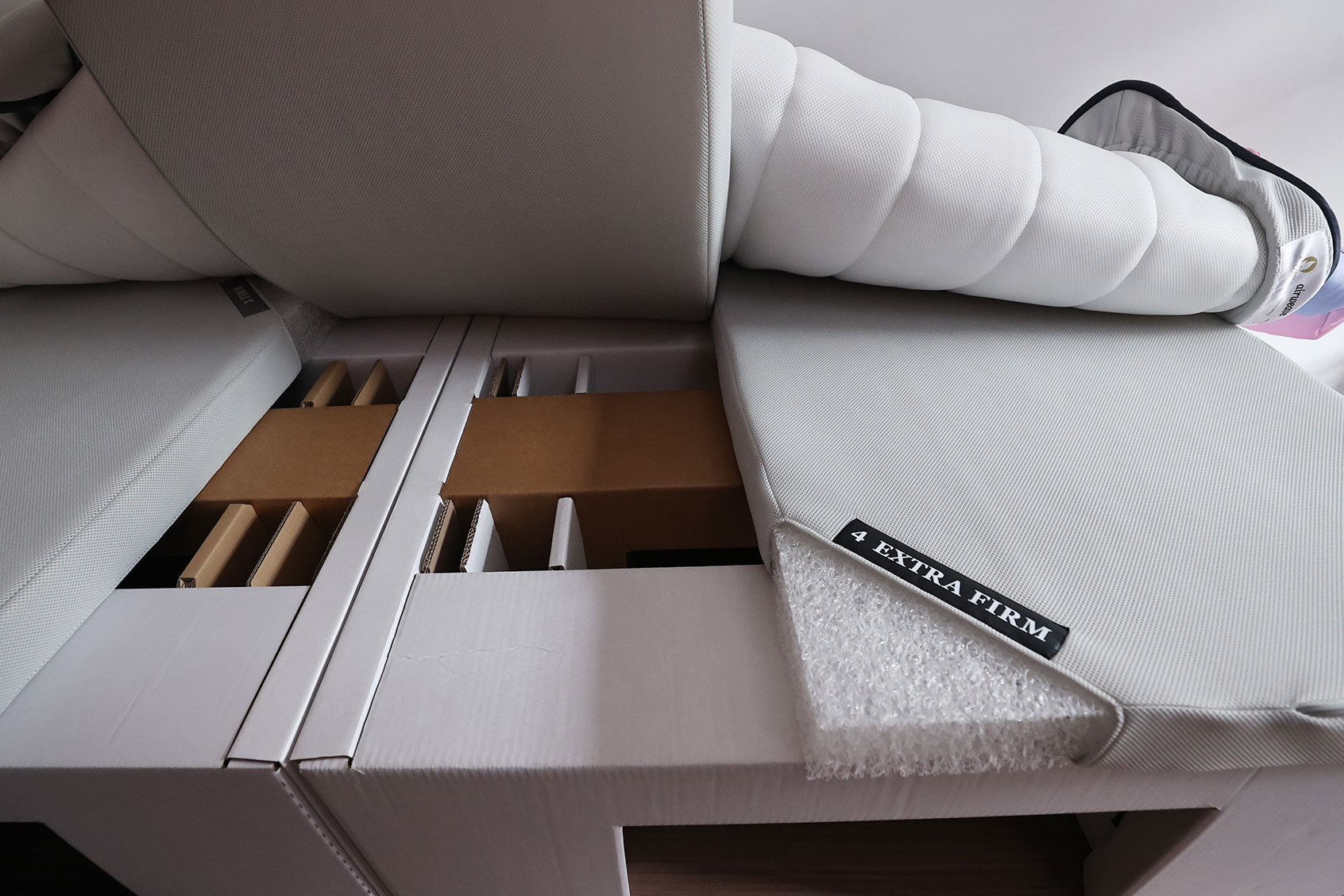
Olympic officials clarified in a recent TikTok why the beds are still useful: they're sustainable. While they're the same style as used for the Tokyo Olympics, they're "100% made in France" and consist of three "modules” meant to allow athletes to adjust the firmness and length based on their size. Officials also noted that the beds would be recycled in France after the Games.

Cardboard Bed Frame 2024 Paris OlympicsA recyclable cardboard bed frame is seen in a room in the Paris 2024 Olympic and Paralympic Village during a press tour in Saint Denis, near Paris, France, June 4, 2024. (Gao Jing/Xinhua via Getty Images)On July 20, McClenaghan took to social media once again to share a video of himself leaping and somersaulting on his bed, captioning the post, "Paris Oympics 'Anti-sex' beds debunked (again)."
After performing a series of moves in which he exerted his full body weight on the mattress in a "rigorous" fashion, McClenaghan claimed, "They passed the test. It's fake — fake news!"

https://www.instagram.com/p/C9pgQiytQYs/

British springboard diver Tom Daley shared footage of himself on Instagram showing the beds to his followers, explaining the nooks and crannies of the cardboard contraption — embossed with the phrase “Rêvez vos exploits de demain," meaning “Dream about your achievements of tomorrow” — and equipped with a mattress, mattress topper "and our own little Paris '24" comforter. 

"And as you can see, they're pretty sturdy," Daley said while jumping around on the bed.

https://www.instagram.com/p/C9uFX-ittTV/?hl=en

Rather than serve as sexy-time inhibitors, it would seem that the aim of the beds is to simply be recyclable and more environmentally friendly, as noted by TODAY.

Still, the sustainability underpinning the beds hasn't stopped some athletes from vocalizing certain comfort-related qualms. Aleah Finnegan, a Filipino-American gymnast representing the Phillippines, shared in a TikTok that her bed was "not very soft."

"They're not that comfortable," she concluded. 

In a separate TikTok, Australian water polo player Tilly Kearns stated that the mattress was "rock hard."

A spokesperson from Airweave, the company that makes the mattresses, told TODAY, "Airweave differs from traditional mattresses by containing no springs or foam — we’ve collaborated with sleep experts and athletes to optimize the performance-enhancing benefits of sleeping on an airweave mattress.

"We encourage all athletes to join us at the Mattress Fitting Center in Athletes Village for a personalized consultation, which uses our AI-based MattressFit app to analyze and recommend the best configuration for their body type/needs. We’ve had the pleasure of positively connecting with hundreds of athletes in Paris already and aim to meet hundreds more.

"Not only are Airweave mattresses unique because they’re fully customizable," the spokesperson continued, "the science-backed interwoven design also ensures a firmer sleeping surface that maintains ideal sleeping posture, effortless turning, better distribution of weight, and optimal breathability for longer periods of quality sleep."

“Illegitimate nominee”: Experts say GOP’s attacks on Kamala Harris echo ugly claims about Obama

Vice President Kamala Harris late Monday garnered the backing of enough Democratic delegates to win the party's nomination and face off against GOP nominee Donald Trump, an Associated Press survey found. But while the former California prosecutor has enjoyed surprisingly smooth sailing since she announced her candidacy Sunday, experts predict things can soon get tricky as the race heats up. 

Several state delegations convened Monday night to affirm their support for the vice president, including those in Texas and California. By the end of the night, Harris had the backing of well over the 1,976 delegates she would need to clinch the nomination, coming in at just under 2,700 delegates, according to the AP tally. Still, delegates are not bound to cast their vote for Harris at the virtual roll call ahead of the Democratic National Convention in Chicago next month, which party officials said will occur between Aug. 1 and Aug. 7, according to The New York Times

“When I announced my campaign for president, I said I intended to go out and earn this nomination,” Harris said in a statement posted to X Monday. “Tonight, I am proud to have secured the broad support needed to become our party’s nominee.” She added, “I look forward to formally accepting the nomination soon.”

The development capped off an explosive first 24 hours for Harris' newly minted presidential campaign that saw her set a new presidential fundraising record and add nearly 29,000 volunteers to her campaign following President Joe Biden's decision to bow out of the race. The pledged support also punted concerns that resistance among diehard Biden delegates would derail her nomination bid. 

"There had been concerns initially that there might be the equivalent of a very short Democratic primary, and there were concerns that, because she didn't do well in the primary in 2020, that this could lead to a problem to her this turn around," said Jennifer Lawless, the University of Virginia's political science department chair. "But that's no longer the case. She now faces an electoral landscape that is pretty much the same as whatever electoral landscape Joe Biden was going to face."

But experts also say the road ahead to the November presidential contest presents Harris with several greater challenges that even enthusiastic Democratic support can't upend — chief among them her lack of a defined public image and Republican attacks — especially on an abbreviated timeline. 

Kevin McMahon, a professor of political science at Trinity College, predicted that race and gender, by way of the racialized and gendered attacks conservatives have flung at Harris — a concern made more pronounced given she's likely to face off against an opponent "who's obviously very open to using racialized attacks or gendered attacks" — will become a key focus of the race that she would have to overcome. 

Republicans had begun leaning into racist and sexist attacks against Harris even before Biden exited the race and endorsed her, labelling Harris a "DEI hire," an allegation that she only attained her position because she benefitted from privileging policies and practices. In the aftermath of Biden's withdrawal, those GOP insults have continued and expanded to include mounting misogynistic claims that she slept her way into political power. 

GOP opposition has also arisen through threats to legally challenge the replacement of Biden on the Democratic ticket, with the Heritage Foundation, the right-wing think tank behind Project 2025, allocating millions of dollars to support such legal battles. However those potential lawsuits, legal experts told Salon Monday, stand little chance of amounting to anything in court should they even get there.

"Republicans have made it clear that they want to suggest that [Harris is] an illegitimate nominee. Although the law and the paperwork are not on their side — the Democrats have not held their convention yet so Biden was not an actual nominee who's being switched out, this is an actual process, there's an election — they're suggesting that this isn't fair and that it's bait and switch," Lawless told Salon, noting that such attacks are "consistent" with the way the GOP "suggested that Barack Obama was not a legitimate nominee because he wasn't qualified, and that he wasn't a U.S. citizen."

We need your help to stay independent

That narrative, along with claims that the Democratic Party is eschewing democratic means to select their nominee, is something that Republicans are "going to hammer" the party with and will end up sticking to it "no matter what," according to J. Wesley Leckrone, a professor of political science and the department chair at Widener University. 

"The question is how independents look at this. I think that's the perception because the right and conservatives are going to hammer away that they are the guardians of democracy, and it's really the Democratic elites that forced Biden out of the race and anointed Harris, who was not picked by the party voters," he told Salon.  

With just over 100 days until the election, Leckrone added that another challenge Harris likely will have to navigate is in defining herself as a candidate given that she's a "relatively unknown commodity" for many Americans despite being the sitting vice president because of the low-profile position she's taken in the Biden administration over the last three-plus years. 

That uncertainty also extends to her and the president's record, which Lawless said they have "not been able to communicate adequately to the American people."

"The economic upturn that the country has experienced is not translating into people's perception, and what we'll see over the course of the next few weeks is whether that was a problem with Joe Biden not being an adequate messenger, or if, even if you communicate that message well, it doesn't resonate," Lawless said, noting that the matter is a "challenge that's going to matter to independent voters."

In developing that public image of her over the next several weeks, Harris will also have to invest time in challenging the perception of her as a "San Francisco liberal who is unable to represent Middle America," an image the vice president has started to address by stopping in key battleground state Wisconsin and having a "vice presidential shortlist" that includes multiple Midwest governors. 

Harris, however, also has a number of advantages that her former running mate did not. Her relative youth and energy, Lawless said, appears to have injected a level of enthusiasm into the Democratic base in ways Biden did not while her racial and ethnic identities make it "a lot more difficult for Donald Trump to chip away at the Democrats advantage when it comes to Black male voters," which was a key part of the Republican strategy. "It seems like that strategy is going to fall flat on its face," she said. 


Want a daily wrap-up of all the news and commentary Salon has to offer? Subscribe to our morning newsletter, Crash Course.


On Sunday night, just hours after she announced her nomination, a mass call organizing to get Harris elected and fundraising convened on Zoom with upwards of 40,000 Black women, raising more than $1.6 million. Another call Monday night saw around 53,000 Black men endeavoring to do the same, raising another $1.3 million for Harris' campaign.

The vice president had already inherited Biden's political operation, which includes more than 1,000 staffers and the nearly $96 million in funds available as reported at the end of June. But in the first 24 hours after receiving Biden's endorsement, Harris received another $81 million in donations with contributions, according to her campaign, from more than 888,000 donors. Harris has since gone on to bank more than $100 million in donations. 

Endorsements from prominent Democrats, including Govs. Gretchen Whitmer of Michigan, Wes Moore of Maryland, Andy Beshear of Kentucky and J.B. Pritzker of Illinois, also rolled in Monday, adding to the spark in enthusiasm around the vice president's campaign and diminishing the pot of her potential Democratic challengers. 

Given those advantages, the question that remains is whether she can "use those qualities to her advantage" and mobilize voters who were questioning if the Democratic Party was the one for them, McMahon said.

For her part, the former California senator has already started to define the central themes of her campaign against Trump, seeking to contrast herself as a former prosecutor and law and order candidate with Trump, who was convicted of 34 felony counts earlier this year and faces two other criminal prosecutions at the state and federal level, while also emphasizing her defense of economic opportunity and abortion rights. 

"Donald Trump has demonstrated a very, very hostile relationship toward women of color over time, so in a lot of ways, this is his worst nightmare because he's often not disciplined, and if he engages in sexist and/or racist attacks, I think he's going to face significant backlash," Lawless said.

"What we've seen in 2018, in 2020 and in 2022 is that women don't like it and female voters don't like it when you treat them in a sexist way or try to take away their rights or what they've accomplished and earned," she added. "And I think the Republicans are probably in for a rude awakening." 

Celine Dion is rumored to make her comeback at the Paris Olympics

After being diagnosed with Stiff Person Syndrom (SPS) in 2022, Celine Dion is finally slated to make her return to singing at the Olympic Games in Paris, France. While the specifics of Dion's alleged performance remain classified, Variety reported that the "My Heart Will Go On" singer — who arrived in Paris on Monday at the Royal Monceau hotel near the Champs-Élysées — is rumored to make her debut at Friday's opening ceremony. 

The outlet reported that Dion may have teased her return to the stage in an April interview with Vogue France, in which she said, “I’ve chosen to work with all my body and soul, from head to toe, with a medical team. I want to be the best I can be. My goal is to see the Eiffel Tower again!"

Dion appeared before a New York City audience in June for the screening of "I Am: Celine Dion," a Prime Video documentary about her life and professional trajectory since being diagnosed with SPS. The singer shared that the project was meant to serve as a love letter to her fans by illuminating the reality of her disorder and the way it impacts her day-to-day life and ability to perform.


Worried about the health effects of the sugar in your breakfast cereal?

While Jerry Seinfeld, Melissa McCarthy, Amy Schumer and Hugh Grant got top billing, sweet breakfast foods from the 1960s are arguably the real stars of the recent movie "Unfrosted," a comedy loosely based on the invention of Pop-Tarts.

What's more, many of those breakfast products from the movie are still household names. When I was a child, I too enjoyed some of the sugary cereals featured in "Unfrosted," and I ate Pop-Tarts too.

In fact, I still have a box or two of these cereals squirreled away at my house, even though I'm well into adulthood, working as an assistant professor of nutrition and dietetics.

There are reasons why these foods are so popular – and why the cereal aisle in your supermarket looks much the same as it did decades ago. Their sweet taste, simple ingredients and powerful marketing promoting memorable cartoon mascots still resonate within us, even after our childhood is long over. No wonder projected revenues for the cereal industry in 2024 are US$22.5 billion for the U.S. alone, and global revenue is predicted to increase from $81.6 billion in 2024 to $139 billion in 2033.


Excess sugar intake increases the risk of breast and colon cancer.


The sweet appeal of sugary cereals

In a landmark study, researchers in 2006 gave rats a choice between saccharin-sweetened water or cocaine. Ninety-four percent of the rats preferred the saccharin. And this included a group of cocaine-addicted rats – 100% of them chose the saccharin.

Technically though, sweetness is not considered addictive. Rather, humans have an innate and universal preference for sweet tastes – particularly children, who tend to prefer sweeter foods than adults.

But that's not all of their appeal. Dating back to the time depicted in "Unfrosted," the marketing campaigns for breakfast foods have been enormously successful.

Most Americans are familiar with the Snap, Crackle and Pop kids, Tony the Tiger, the Lucky Charms leprechaun, the Trix rabbit, Toucan Sam from Froot Loops and dozens more.

More recently, millions watched when the first edible sports mascot – an enormous Pop-Tart – was devoured by the victors of the Pop Tarts Bowl, held in December 2023.

The commercial success of these foods, however, does not necessarily correlate to their nutritional quality.  


Added sugar is the villain

Although the sugar content of sweetened breakfast cereals has declined from 45.9% percent of weight in 1985, many cereals today still contain a lot of sugar, with more than 30% of their weight coming from sugar.

The next time you're in the cereal aisle, take a few minutes to look at the sugar content of your favorite brands, especially those you enjoyed as a child. Many of these cereals will have 10 to 14 grams of "added sugar" per serving, and some will have more. Some types of frosted Pop-Tarts have as much as 30 grams of added sugar per serving, which is two Pop-Tarts pastries.

Added sugars are empty calories; they are added to the product during the manufacturing process to make it taste better. This is in contrast to naturally occurring sugars, such as those in fruits or other whole foods that provide nutrients. The Dietary Guidelines for Americans, published by the U.S. Department of Agriculture, says added sugar intake should be no more than 10% of your total calories. The World Health Organization recommends even less added sugar – only 5% of calories.

Suppose, then, you take in 2,000 calories per day. Ten percent of that is 200 calories. One gram of sugar provides 4 calories. According to the U.S. guidelines, that means you should get no more than 50 grams of added sugar per day. Eat a serving of cereal with 14 grams of sugar, and you're almost 30% of the way there. Or go with the World Health Organization recommendations – 5% of a 2,000-calorie diet is 25 grams per day – and you're more than halfway to the daily limit.

That said, the less added sugar one eats, the better. Zero is best.


There's a big difference between the sugar in fruit and table sugar.


The science of sugar

The glycemic index shows how much a particular food affects blood sugar. Foods with higher numbers increase blood sugar more than foods with lower numbers.

A food with an index below 55 is low glycemic; a high one, above 70. Pure glucose, a simple sugar, has a maximum glycemic index value of 100.  

Although many cereals contain high amounts of added sugar, some also have a fair amount of fiber – and fiber lowers blood sugar. But even with this fiber content, most sweetened cereals have a value of 70 or more.

Other breakfast foods, like plain Greek yogurt and bananas, have values of roughly 35 and 55, respectively, making them low glycemic.  


Health effects

High-glycemic, simple carbohydrate foods like sweet cereal result in higher blood lipid levels, increased hunger and greater amounts of release of insulin. These are all factors for the development of heart disease and type 2 diabetes.

This happens because high blood sugar increases blood pressure. It also increases the formation of advanced glycation end products, which are molecules formed from sugars that can stiffen blood vessels and increase inflammation.

If added sugar intake exceeds 13% of total calories – on a 2,000 calorie diet, that's 260 calories, or 65 grams of added sugar a day – it increases your chances of dying from cardiovascular disease by 39%. And that's only one sugary bowl of cereal on top of the 50 grams the USDA says is the acceptable limit.

Conversely, diets with low-glycemic index values are related to improved markers of blood sugar, blood lipids and reduced body weight.


Reducing sugar intake

A good place to start when trying to reduce sugar intake is to read the Nutrition Facts label on the food's package, which lists the added sugar content.

Added sugars can also be found on the ingredients list, often labeled as glucose, fructose, maltose or sucrose. Or they may appear as other food ingredients, such as molasses, honey, jam, concentrated juice or syrup. Or it may be listed simply as sugar.

Recognizing the differences between serving sizes and the actual portion size is also critical. A serving size is what's described on the Nutrition Facts label; a portion size is how much you actually serve yourself.

Particularly when it comes to breakfast cereal, people consistently serve themselves more than the serving size, which means you're taking in more sugar than you think. People who free-poured cereal from a box into a bowl overestimated portion sizes of nine of 10 types of cereal, with the sole exception a style of cereal where the food is already portioned. I am guilty of this, as I fill my bowls at home to the top.

The amount being overserved varied from an additional one-sixth of a serving to more than one whole serving, resulting in 0.5 to 7 grams of additional sugar.

One way to fix this is to choose smaller bowls and spoons. This is a neat little trick, and research shows it actually works. Another way is to measure the serving size with a measuring cup.  

Currently, the Food and Drug Administration is discussing ways to regulate ultra-processed foods. Generally speaking, these are foods containing numerous ingredients formulated by industrial techniques. Ultra-processed foods include sugar-sweetened foods, such as many breakfast cereals.  

It's possible the FDA will demand mandatory reductions in added sugar content, similar to the current voluntary reductions advocated by the National Salt and Sugar Reduction Initiative, which is to reduce the mean percent weight of the sugar content of cereals by a little more than 5% by 2026.

But those reductions may be a long time coming. It took more than three years for the FDA to ban partially hydrogenated oils from food manufacturing after they were no longer recognized as safe. For now at least, your cereal aisle will continue to look much the same as it did in "Unfrosted."


Nathaniel Johnson, Assistant Professor of Nutrition and Dietetics, University of North Dakota


This article is republished from The Conversation under a Creative Commons license. Read the original article.

7-Eleven will soon sell Japanese snacks, beverages and on-the-go meals in stores nationwide

Nationwide 7-Eleven convenience stores are looking to revamp their business by introducing Japanese snacks into their lineup of U.S. menu offerings, The Wall Street Journal reported.

7-Eleven — despite being founded in Texas — is owned by a Japanese company, Seven & I Holdings. The latest reinvention effort hopes to make 7-Elevens in the U.S. more competitive and attractive to a larger cohort of consumers.

“Convenience stores have historically made their money by selling tobacco and gas but now, as cigarette sales continue to decline and many expect gas sales to slow, [convenience stores] are racing to find other sources of revenue and doubling down on food,” the WSJ explained in a video report.  

According to the outlet, the new menu offerings include ramen, rice balls, milk tea and more popular food items. It’s clearly a major change from the hot dogs, mini donuts, coffee and Big Gulp drinks that U.S. 7-Elevens are best known for.

Comparing 7-Elevens in the U.S. and Japan, the latter’s business model is “a lot more data-driven,” said Jinjoo Lee, a columnist for the WSJ’s Heard on the Street, covering retail and energy. 7-Eleven stores in Japan have long been praised for their variety of foods available at affordable prices. Following in the footsteps of Japan-style convenience stores, U.S. 7-Elevens are looking to make one-third of their sales from food. The company also hopes to upgrade the 17 nationwide commissary locations that supply food to its U.S. outlets.

Per the WSJ video, the commissaries have already started working with Warabeya, a supplier to 7-Eleven Japan.

“Mind your own business”: Tim Walz says the GOP is “stuck” with Trump and his felony convictions

Gov. Tim Walz, D-Minn., appeared on Fox News Tuesday and deeply angered Donald Trump by arguing that Republicans are "stuck" with a declining nominee while Democrats are energized by the ascendence of Vice President Kamala Harris.

With a smile on his face, Walz blasted Trump during his interview, The New Republic reported, pushing back on one of the hosts' claim that Democrats had "leapfrogged the entire democratic system" by replacing President Joe Biden with his second in command. Walz said Democrats' ability to address concerns about Biden's age stands in stark contrast to the GOP.

“Look, it doesn’t matter convictions, it doesn’t matter failed policies. [The] Republican Party is stuck with Donald Trump. He’s yours, you got him. Welcome to it,” Walz said. “The Democratic Party can make our decisions, we pick our nominee. Look, if you don’t like it, don’t vote for her in November.”

The Minnesota governor continued by arguing that voters will view the Biden administration’s strong economic policies favorably, noting the U.S. economy is the envy of other developed nations. He added that the administration didn’t spend time, like Trump, "cozying up to dictators" such as Hungary’s Viktor Orbán or Russia's Vladimir Putin, suggesting Republicans criticizing the Democratic Party should "mind your own business."

Trump did not care for Walz's appearance.

“Why did Fox News put up Tim Walz, Governor of Minnesota, where I am leading? They make me fight battles that I shouldn’t have to fight!” he wrote on Truth Social.

Walz, 60, is reportedly among the names being considered by Harris as her running mate, The New Republic noted.  

Walz neither confirmed nor denied his interest in running with Harris, but did share that the two have been in communication.

“We have the same values, we believe we can win in the Midwest,” he said, pledging to do “whatever’s necessary” to prioritize “personal freedoms” in Harris’s campaign.


Beyoncé approves use of her song “Freedom” for Kamala Harris’ campaign

Beyoncé has given Kamala Harris permission to use her song "Freedom" as part of the Vice President's presidential campaign, per what a source close to Harris told CNN.

On Monday night, Harris, who is the presumptive Democratic nominee after President Joe Biden dropped out of the 2024 presidential race, walked out to "Freedom" during her first official visit to her campaign headquarters in Delaware. CNN's source noted that Beyoncé gave swift approval to Harris' campaign — which reportedly requested the usage mere hours before the Vice President's inaugural speech as a candidate — a noteworthy move given that the singer-songwriter is notoriously stringent about sharing her music. 

On Sunday, Beyoncé's mother Tina Knowles took to her Instagram to endorse Harris for president, not long after Biden announced that he would be bowing out. “New, Youthful, Sharp . . . energy !!!!” Knowles wrote alongside a photo of herself next to Harris. “Putting personal Ego, power and fame aside. That is the definition of a great leader. Thank you, President Biden for your service and your leadership . Go Vice President Kamala Harris for President. Let’s Go."

https://www.instagram.com/p/C9tG5ypyakm/?hl=en

While Beyoncé has not formally endorsed Harris, her history of supporting Democratic candidates — and her fast-acting approval for "Freedom" — indicates that the star likely will be voting blue this November. In 2013, she sang the National Anthem at former president Barack Obama's inauguration. In 2016,  Beyoncé and her husband, rapper Jay-Z, performed at a pre-election concert for Hillary Clinton in Cleveland, Ohio. 

“I want my daughter to grow up seeing a woman lead our country and knowing that her possibilities are limitless,” Beyoncé said at the time, according to CNN. “And that’s why I am with her [Clinton].”

Scientists beg Etsy sellers to stop selling dead bats as ornaments

In the first comprehensive study ever put together on the illegal dead bat ornament trade, researchers publishing in the European Journal of Wildlife Research learned that one species in particular — the painted woolly bat (Kerivoula picta) — is disproportionately targeted.

A bright orange and fuzzy bat with a wingspan of 18-30 cm (around 7 to 12 inches) and a body length of 3-5.5 cm (1.2-2.2 in), the painted woolly bat is widely sold as jewelry, jarred curios and Halloween decorations by online retailers like Etsy, eBay and Amazon, according to the researchers from the University of California, Davis, City University of New York-Queens College and the International Union of the Conservation of Nature’s (IUCN) Bat Trade Working Group. They explain in their study that the bats are slaughtered in Asia, then imported to the United States.

"Overall, our study paints a troubling picture of a trade whose ecological impacts remain unknown (in the absence of population data) but that is likely illegal, unethical and unsustainable and may pose a biosecurity risk," the authors write. While it is unclear whether or not the bat trade is accelerating, given the paltry amount of concrete long-term data, "the global rise of e-commerce could exacerbate it just by enabling consumers anywhere to order bats to their homes and businesses, where previously they would have had to travel to physical markets," the authors explain.

The painted wooly bat comprised the majority of the bats among the 856 listings studied by the author (215), but there were other bat species as well — many of them painted to look more like the K. picta. Tennessee sold far more bats than any other state, among other things accounting for 45% of the painted wooly bat listings. To protect these bats, the authors recommend "formal legal protection for K. picta (by inclusion in the Convention on International Trade in Endangered Species), field studies to understand population trends and the supply chain and social pressure to curb demand, including grassroots action and research to understand its effectiveness."

Nestle’s Nespresso aims to capture Gen Z and coffee aficionados with their new “boutiques”

Nestle's Nespresso, which launched in 1986 before experiencing record profits throughout the pandemic, is now looking to tap into a new market. According to FoodDive's Christopher Doering, the company is looking to attract "Gen Z and others wanting to learn about coffee" via "immersive" coffee boutiques, which will be opening throughout the U.S. this year and next. The first boutique opened in Austin, Texas earlier this month and a Seattle location is planned for later this year.

Doering writes that the boutiques, "which contain interactive experiences tied to coffee and the Nespresso system" are also looking to prioritize sustainability and will include four main components: "a taste and discovery area," a coffee theater, a recycling center and a coffee bar (complete with "lounge space").

"Today’s consumers are looking for more meaningful connections. They are looking for more meaningful experiences," said Alfonso Gonzales Loeschen, the CEO of Nespresso North America. "What we’re looking for is to hopefully capture new audiences and have them come in and discover what Nespresso is and what coffee can be.”

Gonzalez Loeschen also says that the boutiques "will give Nespresso 'an advantage' over it competitors," noting to Doering that “it will continue to build our coffee credentials, our coffee expertise, or coffee quality of differentiation that we have versus the competitive set."

“Deadly skies”: Food allergy nonprofit calls for Snickers boycott following new flying-focused ad

FARE, or Food Allergy Research & Education, made news as a nonprofit earlier this year when they successfully asked Uber Eats to edit their Superbowl ad over concerns that it minded the seriousness of food allergies. Now, the group is calling for a Mars boycott over the candy-maker's  "Hungry Skies" campaign.

FARE has released this video, featuring the audio of someone having an allergic reaction and the visual of a plane window overlaid with the following text:

"Recently, Mars Inc. unveiled their hungry skies ad campaign promoting Snickers bars as the best remedy for the stresses of flying. However, for the millions of Americans with life-threatening peanut allergies, this solution only exacerbates their anxiety. Mars Inc., your ad poses a serious risk. We urge you to remove it. Don't make the 'Hungry Skies' the deadly skies."

According to a Monday release from FARE, an airplane is a unique environment in which passengers are without immediate access to emergency medical care or personnel. 

"While food allergy patients are advised to carry epinephrine autoinjectors with them, and many do, with more than 33 million food allergy patients in the US alone and 2.9 million passengers boarding flights daily from the US, there are going to be instances where the passenger may be without their epinephrine autoinjectors," the organization wrote. 

For instance, passengers may not be able to afford their autoinjectors or they may have forgotten them. In some cases, a reaction to an allergen may outpace their medication, and sometimes a first reaction takes place on a flight. 

FARE's video also featured the hashtag #BoycottSnickers. Snickers and Mars have not yet issued a response. 

Aperitivo renaissance: Embracing Italian snacking traditions in a modern world

Aperitivo culture on the whole, if you will, has had quite a moment recently — both at restaurants and in bookstore aisles. One of the first cookbooks I can recall tapping into the bounty of Italian snacking was Stacy Adimando's "Piatti: Plates and Platters for Sharing, Inspired by Italy," but in the years since, there's been such a huge surge in interest.

Much like everything lately, TikTok has been the thumb on the scale. The amalgamation of pandemic snacking, the second Italy-set season of “White Lotus” and the rise of “girl dinner" have actually catapulted the trend. 

To be clear, I’m not upset about it. I am half Italian and was born and bred in Northern New Jersey, so it should go without saying that my food lens is entirely colored by Italian and Italian-American flavors and influences. There has been many a meal during which I just eat my body’s weight in Parmigiano Reggiano, mozzarella and olives. I used to be obsessed with prosciutto and bresaola and the like, but since giving up all non-poultry proteins, I’ve been relegated to the wide, wonderful world of Italian cheeses, breads, condiments and primarily vegetarian treats.

There’s a certain live-and-let-live, laissez faire quality to eating like this. For people cosplaying as a vacationer on the Amalfi Coast, there may be no better gustatory way to approximate the sensation.

At its core, though, aperitivo, Italian happy hour and snacking culture is so much more than a trending topic or how one eats on holiday — it’s a years-old, cherished custom that has been commonplace and the “default” throughout Italy for generations.

Fried Sage LeavesFried Sage Leaves (Photo courtesy of Voracious / Deepi Ahluwalia)

Two recent cookbooks which best capture the true essence and ethos of aperitivo culture are Anna Francese Gass's "Italian Snacking: Sweet and Savory Recipes for Every Hour of the Day" and Stef Ferrari's "Stuzzichini: The Art of the Italian Snack." Salon Food spoke with both Gass and Ferrari to get a bit more insight into the trend, its storied history and, of course, their favorite snacks.

"Italians have undoubtedly mastered the art of the snack,” Gass said. “Bites of food, eaten at designated times of day can be found from the tip to toe [into] the land of the boot. Moreover, the intersection of food and tradition are central to Italian culture. Most snacks are connected to a particular region with each of Italy’s regions having a distinct identity, not only in architecture but in gastronomy based on climate, geography and topography."

We need your help to stay independent

Gass jokes with me that Italian food runs in her veins — and she’s not exaggerating. Her grandmother worked as a lunch lady at her mom’s elementary school. Gass’ mother eventually became a banquet chef (with Gass helping alongside her eventually) while five of her aunts work in the industry, two as restaurant-owners in Italy and another as the head of a fine dining restaurant kitchen.  

Ferrari similarly said Italian food is a key part of her genetic make-up. “This sounds trite at this point, but in true Italian-American style, some of my earliest memories are helping my nonna roll gnocchi down the tines of a fork,” she said. “It is truly in my blood.” 

She was soon exposed to “proper Italian aperitivo” through her family. 

Stef FerrariStef Ferrari (Photo by Antonio Diaz)

“My aunt and uncle and cousins live in Sabaudia, a small town in Lazio,” Ferrari said. “I visited for a few weeks at a time, 3 or 4 times per year, and they’re business owners — busy people. So we frequently would opt for ‘apericena’ [a conflation of aperitivo and cena, meaning dinner], instead of a proper meal.” 

After eventually moving to Florence in 2020, Ferrari sought community, as well as affordable dining options.  “Going out to public spaces for a drink and finding myself swimming in complementary snacks was appealing for many reasons,” she said. “But once I started to dig into the culture and history, I was even more compelled.” 

Pizza PocketsPizza Pockets (Photo courtesy of Union Square & Co. / Linda Xiao)
Obviously aperitivo drinks, like the perennially popular Aperol spritz, had gained huge traction in the United States and elsewhere globally, but Ferrari didn’t see this particular style of snacking growing along with it. “To me, it seemed like a missed opportunity since in Italy, you don’t have one without the other!” Ferrari said. 

“When I began working in food more than 20 years ago, I tried to step away and learn other cuisines in the world and that’s been a big part of my career,” Ferrari explained. “But what feels most natural to me — and easiest to execute intuitively — always comes back to Italian.” 

Gass’ book on Italian aperitivo culture is also deeply rooted in her family’s experiences. 

Anna Francese GassAnna Francese Gass (Photo by Liz Clayman)
"I started thinking how snacking, both sweet and savory, had been such a big part of my childhood,” Gass said. “I was born in Italy and came here at a young age. My mother maintained Italian traditions in our home and I was lucky enough to visit Italy regularly to spend time with our family."

She continued: "In Calabria, my grandmother was always baking taralli or preparing an antipasti platter. It wasn’t fancy but it was a constant and I loved it. Truly enjoying these moments more than lunch or dinner, I decided to take a deep dive into this cultural norm, region by region.” 

For instance, there’s stuzzichini, which according to Ferrari is a derivative of the word for toothpick, stuzzicadenti. 

“But I’ve also been told it relates to 'stuzzicare,' which means 'to tease,’ in this case, the appetite,” Ferrari said. “Regardless, the resulting word stuzzichini refers to the type of snacks you find served with aperitivo drinks. There are other names for these bites around the peninsula, too.”

Italian Snacking by Anna Francese GassItalian Snacking by Anna Francese Gass (Photo courtesy of Union Square & Co.)
Like sputini which, as Gass explained, is “a small, very informal bite of food to enjoy with family or friends.” The word is taken from the Italian word for quick — spunto — and tagged with “-ini,” a linguistic addition that means “small.” 

Aperitivo culture doesn’t stop at savory snacks. Small sweet treats are on the menu, too. 

 "I find desserts to be too sweet here in the States,” Gass said. “I am not a fan of frosting or over-the-top desserts. That being said, when in Italy, I can’t stop eating dessert. Reason being, Italians really don’t rely on sugar for flavor. Desserts have a much more subdued sweetness with zests of lemon, orange, hints of vanilla, nuts, dark chocolate and fruits always shining through. [So] I really used that process and goal when developing these desserts."

Crackers with Chocolate and AnchovyCrackers with Chocolate and Anchovy (Photo courtesy of Voracious / Deepi Ahluwalia)
Ferrari feels similarly. 

“I’m a huge nerd about food,” she said. “Not only do I love to eat and experiment, but I’m really interested in understanding why and how something works. In the case of the green pea cannoli, you have the sweet, creamy filling, the salty, crisp shell, the earthy pistachios. And the Aperol nuts have this bittersweetness that is just so representative of Italian aperitivo in general.” 

From their books, Gass names her Torta Tenerina and her Pizzette Delizia as two of the standouts from "Italian Snacking," while Ferrari highlights her Salvia Fritta Nella Birra (fried sage leaves), Cracker con Acchiughe, Cioccolato Fondente & Ricotta  (dark chocolate, anchovy and ricotta crackers), as well as the classic roasted chestnuts.

Stuzzichini: The Art of the Italian SnackStuzzichini: The Art of the Italian Snack by Stef Ferrari (Photo courtesy of Voracious)
Through their writing, both authors hope to offer readers a different look at Italisan cuisine, which can sometimes erroneously be discarded as heavy and homogeneous. 

“Italian food gets cast as this single thing — very culturally flattened at times — and I cannot be more emphatic about its diversity and inventiveness,” Ferrari said. “It’s also, without ever being precious about it, extremely sound from a culinary construction standpoint. No one talks about hydration levels or the balance of acidity and fat, salt, umami, sweetness — all the elements that make a great dish. They just create things intuitively, based on seasonality and availability, and it works. Which is why there’s so much simplicity in the cuisine and yet it’s infinitely satisfying and craveable.”

I couldn’t agree more.

Torta TenerinaTorta Tenerina (Photo courtesy of Union Square & Co. / Linda Xiao)
Gass captured the essence of the entire movement, if you will, when she told me: “Believe it or not, Italians don’t typically sit down to a very large dinner [on weeknights]. There is never a reason to overeat because the small bites keep you sated until the next meal. For merenda [after school snack], a child might have a small mortadella panino or a slice of apple cake."

"At dinner, overindulgence doesn't happen because you don’t come to the table famished," she added. 

You should be charring your summer squash — and topping it with spiced pecans

For many, BATA restaurant in Tucson, Arizona is synonymous with charred food — but BATA offers so much more than just charring.

“"I’ve been working on BATA since 2014,” chef Tyler Fenton told Salon Food. “It took so long to open, but I’m so glad that it did because we learned so much along the way. After opening our Italian-American concepts in Tucson, we wanted to plant our flag and establish a higher-level of standard for kitchen culture and sourcing in Tucson. BATA is our chance to do things the right, and responsible way."

The name itself hails from the Japanese word "rabata," a style of grilling. "It’s a wink to the influence we derive from Japan, while being a cool word. It’s a little mysterious and a nice conversation starter," Fenton said. 

The ingredients for all of BATA’s dishes are sourced from within a 400-mile radius of the restaurant. 

“Not only does our 400-mile sourcing rule support local farmers and purveyors, but it helps drive creativity,” Fenton explained. “When you have rules like that set in place, it keeps you focused and forces us to learn about the food that grows here in Arizona.” 

He added: "Tucson is 400 miles away from the ocean, so the ‘400 rule’ is for our seafood. Most of our ingredients come from much closer in proximity to the restaurant."

Chef Tyler FentonChef Tyler Fenton (Photo courtesy of BATA)
This principle also impacts the menu, which shifts from day to day. "Because we source within that 400 mile rule, we open ourselves up to the challenges that our local farmers and purveyors face daily,” Fenton said. 

For instance, the restaurant could order 50 pounds of cabbage, but only 20 pounds show up because that’s all that was ready to be harvested that day. 

We need your help to stay independent

“So, instead of a cabbage dish on the menu for a week, we can only serve it for two to three days, or [as long as] supplies last," Fenton said. "Sometimes our orders are delayed because the harvest window shifts back due to weather –– that has happened with our beet farmer. Of course, we could call someone at any time and order more cabbage from the commodity market, but that’s just not what we do. Because we source so locally, our farmers bring us what they can, when they can." 

While some automatically think of meat or animal proteins when it comes to grilling, that's not BATA's focal point. Fenton told me that "it’s somewhat of a personal thing. Eating primarily vegetables is how I’ve grown to eat because you can have more variety in a meal.” 

“It’s nothing against meat at all,” he said. “When you sit down at a table, you can have 10 different vegetables with all different taste profiles, so that’s the experience I wanted our guests to have. It keeps things light, it’s a reflection of what’s available and it’s a celebration of the fact that Tucson has a year-round growing season." 

In addition to grilling and cooking on the custom-designed hearth, Fenton also incorporates ash, oak and smoke into the dishes. "We use all of the obvious techniques –– like grilling something directly over the open flame –– but we push our creativity to think outside of the box and find unique ways to deliver that smokey flavor," he said. 

Fenton said they often take ingredients a step further, pointing to the smoked mushroom garum for which NOMA is famous. There, the ends of mushrooms are dried over a fire and turned into a ferment with rice, koji water and salt, which is then pressed and turned into a liquor used for seasoning. 


Want more great food writing and recipes? Subscribe to Salon Food's newsletter, The Bite.


“The smoky mushroom flavor is [a] night and day difference from what a grilled or fried mushroom would taste like,” Fenton said. “We make the same style ferment with smoked pumpkin and smoked beets, depending on the season."

He also uses ash "to nixtamalize wheat berries for our beef tartare," as well as incorporating it into a dish with honeynut squash during autumn. "I’ve always wanted to incorporate masa in some form on the menu because of our location in Tucson and it’s another one of those things that always pushes our creativity,” Fenton added. 

BATA also includes oak wood in lots of their dishes, which, as Fenton puts it, "may come as a surprise to most people because mesquite wood is the most common in the Southwest. But yes, oak does grow in Arizona!"

They opt for oak at BATA because the smoke is more delicate when compared to mesquite. 

“Our food tastes different than other restaurants in the area for this reason, so it’s a great conversation point,” he said. 

Chef Tyler FentonChef Tyler Fenton (Photo courtesy of BATA)
This attention to detail is something carried over into other elements of BATA’s culinary program. For instance, the restaurant is involved in heritage food crop preservation. 

"Our whole ethos is to source locally around seasonality while extending the lifespan of each ingredient as long as we can,” Fenton said. “It’s centered around sustainability. We push our creative limits by using offshoots of ingredients that we’d otherwise throw away, such as that smoked onion powder example I gave. This ethos carries over to our bar program, barbata."

At barbata, beverage director Karl Goranowski makes homemade vinegar out of leftover wine, using local yeast to turn it into vinegar. 

“Not only does this minimize waste, but it creates an unbelievable product unlike anything you can find on a shelf,” Fenton said. “There’s a ton of ambient yeast in Tucson so it turned out to be the best red wine vinegar we’ve ever made."

BATA’s Chef Tyler Fenton also shared a delectable seasonal recipe that’s reflective of the restaurant’s ethos, but can easily be made at home: Charred summer squash with boshi koji sauce, spiced pecans and alliums.

Note: Just a heads up that the recipe ingredients are listed in grams! Please don't be spooked or intimidated by that; it's a simple conversion (both this and this are good conversion calculators) — we promise.

Charred summer squash with boshi koji sauce, spiced pecans and alliums
Yields
4 servings
Prep Time
20 minutes
Cook Time
1 hour

Ingredients

1 to 2 standard-sized summer squash


For boshi sauce:

200 grams rice Koji

150 grams sweet potato miso

1,000 grams water

10 grams garlic

250 grams boshi (we use smoked melon, substitute store-bought umeboshi, likely reduce quantity needed for store bought)

650 grams tomato water

50 grams white vinegar

50 grams extra virgin olive oil 

150 grams water


For black lemon vinaigrette:

1 whole black lemon(substitute black lime)

400 grams white vinegar

25 grams salt

300 grams grapeseed oil


For spiced pecans:

About 1/2 cup pecans

Ground Cinnamon, Clove and Fennel seed (equal parts)


For pickled onion:

2 to 3 white onions, halved, peeled and thinly sliced

450 grams white vinegar 

250 grams water

60 grams sugar

40 grams salt


For garnish:

Chopped fresh herbs, like cilantro and parsley, but whatever you have on hand works

Directions

  1. Make the sauce: Simmer the first set of ingredients(up to boshi) until Koji is fully softened. Blend with the rest on high until very smooth. Taste and adjust if needed. Should be like a thick dressing, and aggressively seasoned.
  2. Make the vinaigrette: Blend and emulsify in oil (could substitute just fresh lemon or lime juice with salt and oil).
  3. Make the pecans: Boil pecans in heavily salted water for 1 minute. Strain. Wait 1 minute, then toss with powdered sugar, spices and salt. Spread on a silpat or silicon mat-lined sheet tray and bake for 15 minutes at 325 degrees fahrenheit.
  4. Prep. the squash: Half the squash and scoop the seeds. Cut the squash into oblique cuts.
  5. Prepare hot pickle liquid for pickled onions: Combine all ingredients, bring to a boil.
  6. Place onions in a heat proof vessel. Pour hot pickling liquid over onions, allow to cool to room temperature and then refrigerate. Prep extra, as pickled onions are great to keep on hand.
  7. Cook the squash: Toss the cubes with grapeseed oil and salt. Grill in basket directly on fire. You want a nice char on at least one side and to be hot through.
  8. Put in a bowl and toss with black lemon vinaigrette and additional extra virgin olive oil. Taste for seasoning.
  9. Plate: In a coupe bowl, place the squash in a wide circle. Fill the circle with room temp boshi sauce. On top of each squash, place pickled white onion. Garnish with herbs (cilantro and parsley, but can play around with that). Spiced pecans on top as well. Add a few drops of quality extra virgin olive oil on the sauce.

“House of the Dragon”: What it means when a dragon swipes right

The cat distribution system is a familiar meme to the very online, perhaps less so to “House of the Dragon” viewers.  That concept plays into the very real phenomenon of the pet owner who doesn’t plan to be. Sometimes we see the beginning of the coerced adoption process, with a person filming their first encounters with some adorable fuzzball up to the moment they decide to take them home.

Others jump on Instagram or TikTok to proclaim that they always hated kittens until one perfect little love nugget materializes at their doorstep and hypnotizes them into bending the knee.

This is all to say that the eventual match between Addam of Hull (Clinton Liberty) and Seasmoke, the riderless dragon Laenor Velaryon (John Macmillan) left behind doesn’t need much explaining to some. Seasmoke has been restless since Laenor pretended to die, Rhaenyra (Emma D’Arcy) once remarked to her confidante (and paramour?) Mysaria (Sonoya Mizuno), shrugging it off with a “Who can say why?”

Mysaria theorizes, “Maybe he’s lonely.”  Turns out she was on to something. Addam is restless too, you see, evident from his constant kvetching to his brother Alyn (Abubakar Salim). Ever since Alyn saved Corlys Velaryon (Steve Toussaint) from drowning during the Stepstones campaign, and Corlys has been approaching Alyn offering praise and promotion, Addam’s been pushing his brother to demand his due from the Lord of Driftmark.

For what, exactly? Episode 6, “Smallfolk,” dispenses with the too-subtle hints the show has been dropping since these two first appeared to show Alyn shaving silver stubble from his head. These two are Corlys’ unclaimed sons. Now that Corlys’ Targaryen wife Rhaenys (Eve Best) is gone, along with their two legitimate children, Addam and Alyn are his only remaining children. Alyn would prefer to fly under the radar.

House of the DragonClinton Liberty as Addam of Hull and Abubakar Salim as Alyn of Hull in "House of the Dragon" (HBO)Addam, meanwhile, is sick of being an anonymous shipwright, as one would be if one knew the head of a great house was their father. Earlier in the second season we see him stare at a dragon sailing through the sky above him and express his desire for an inheritance that guarantees he won’t have to dig for clams in his dotage. Lo and behold, in a development tailored for the “manifesting” crowd, one of the most prized assets in the realm drops down from the sky, lands in front of him and wordlessly says, "Mount me."

“Who rescued who,” am I right?

“Smallfolk” is one of those “House of the Dragon” episodes in which nothing major seems to happen. Rather, that may be how it seems to anyone who hasn’t read “Fire & Blood” or other George R.R. Martin works, we should say. 

Even so, this episode marks a couple of crucial shifts. First, it further clarifies why we’re being made to invest in what’s happening to these two heretofore lowborn randos along with Hugh the Blacksmith (Kieran Bew) and some barfly named Ulf (Tom Bennett). Second, and perhaps most importantly, it changes our common thinking about who gets to ride dragons in this mythology. 

“Game of Thrones” makes it seem as if the ability to bond with dragons is solely the province of Targaryens, which may be a function of the Velaryons’ absence in Daenerys’ time. 

Rhaenyra also holds to this theory, but it doesn’t pan out as she plans. At this point in the war, Rhaenyra is reminded the Blacks have no ground forces, only dragons. Her faction's largest and most battle-hardened, Meleys, was lost along with her rider and the would-be-queen’s most loyal advocate Rhaenys in the battle of Rook’s Rest. The remaining formidable beasts on her side are her Syrax and Caraxes, the fearsome Blood Wyrm bound to her uncle-husband and King Consort Daemon (Matt Smith). 

House of the DragonCaraxes in "House of the Dragon" (HBO)

These CGI beasts, along with their size, age, and temperament, matter more as “House of the Dragon” plods on.

That may not matter since Daemon is making moves on behalf of Daemon and not Rhaenyra, his niece-wife his brother named as the heir to the Iron Throne. 

These considerations, along with the obvious disrespect shown to her by her supposed allegiant lords, have made Rhaenyra desperate to find more dragonriders. So when her son Jace (Harry Collett) suggests putting out the call to recruit anybody with possible Targaryen lineage, Rhaenyra checks her own house first. 

Finding her most loyal Queensguard member Ser Steffon Darklyn (Anthony Flanagan) is a distant relative — the great-great-grandson of Aeriana Targaryen – she asks him to attempt to bond with a dragon, and he enthusiastically accepts the request. His father, the Lord of Duskendale, was recently beheaded by Ser Criston Cole (Fabien Frankel), and he’s thrown in with a ruler whose half-brother has stolen her inheritance. If she fails, he dies anyway, so why not test himself with dragonfire?

Unfortunately for good Ser Steffon, out of all the available options in the pit, including Vermithor and Silverwing, Seasmoke is the one who swipes left. Their meeting seems to go well at first, but alas, our Ser was too careful in responding to Seasmoke’s overtures, and their only date ends not with a match, but a toasty Darklyn death.

But this story has a happy ending. Once Seasmoke realizes what Rhaenyra is up to, he decides to reveal to the boy he’s been sniffing around (or stalking, if you want to be blunt about it) that Addam’s the one he wants and needs. Since Laenor is half-Velaryon and half-Targaryen, two families with direct ties to old Valyria (where dragons are said to have originated) this tracks. 

If a special relationship with dragons is about bloodlines, Seasmoke may sense something similar in Addam to what connected him to Laenor.

We need your help to stay independent

Allowing Seasmoke to make that choice brings attention to an aspect of the series that has been woefully underdeveloped until this point, which is that these dragons have personalities, moods and a level of agency that extends beyond sensing fear in potential riders.

We’ve come to expect that “House of the Dragon” does not introduce or distinguish its secondary or tertiary characters as well as its HBO predecessor did. If you’re faithfully watching this show you’re probably in it for the dragons, or to see Alicent’s (Olivia Cooke) malevolence rebound on her. Maybe you're celebrating the prequel’s glorious queerness, boosted yet again when Rhaenyra and Mysaria (finally) got to first base.

But really, those dragons and the potential damage they can inflict keep a lot of us coming back. A somewhat traumatized Ser Criston says as much when he tells Alicent the war belongs to them now. 

Therefore these CGI beasts, along with their size, age, and temperament, matter more as “House of the Dragon” plods on. Never mind how to train them; how in the heck do we tell them apart? The answer now and always has been various wikis or handy fan-created charts like this one:

Barring those, the writers have made reading about these Targaryen traditions something of a prerequisite, if not fundamental. 

Here's something worth knowing. Targaryens often place dragon eggs in cribs with their highborn babies with the hope that their hatchlings will naturally bond with them, which doesn’t always happen. 

Other dragons are claimed, as Aemond (Ewan Mitchell) does with Vhagar, the largest in the realm and the dragon who reluctantly killed her rider Laena Velaryon (Nanna Blondell), Daemon’s first wife, out of mercy. Vhagar has feelings, you see. So when Aemond made a pass at her right after Laena’s funeral she accepted, because what did either of them have to lose?

Daemon’s younger daughter Rhaena Targaryen (Phoebe Campbell), another half-Velaryon, did not get lucky in the same way.


Want a daily wrap-up of all the news and commentary Salon has to offer? Subscribe to our morning newsletter, Crash Course.


Charged to care for Rhaenyra’s youngest sons, along with the Blacks’ smallest dragons and four eggs – three of which will eventually pass to Daenerys – she’s spirited away to the Eyrie under the care of Jeyne Arryn (Amanda Collin, Salim’s “Raised By Wolves” co-star) while petitioning a prince in Pentos for their wardship. 

House of the DragonPhoebe Campbell as Rhaena Targaryen in "House of the Dragon" (HBO)In the previous episode, the Lady of the Eyrie grouses about not having any full-grown dragons to protect them. “Smallfolk” changes that tune somewhat when Rhaena, who resents being a nursemaid while her sister Baela (Bethany Antonia) gets to play “Top Gun” with Moondancer, stumbles on evidence that a mature if wild dragon is hunting nearby.

Assuming we’re being shown this for a reason, that places Rhaena in the position to assume the role of a “Fire & Blood” human character who hasn’t shown up yet, and may not need to. Rhaena fits that character’s description and has untapped drama potential, and if said dragon is the one we think it is, Rhaena might have a reason to make her sister envious.

Who can say if the dragon distribution system will be as generous to Rhaena as it’s been to Addam Hull? All we know is that she’s just a girl standing in proximity to a feral dragon, asking it to love her. Sticking around to see how that pans out makes it worth sticking with this show a little longer if only to enjoy the rescue memes. 

New episodes of "House of the Dragon" premiere at 9 p.m. Sundays on HBO and on Max.

Retaining flavor while removing caffeine − a chemist explains the chemistry behind decaf coffee

For many people, the aroma of freshly brewed coffee is the start of a great day. But caffeine can cause headaches and jitters in others. That's why many people reach for a decaffeinated cup instead.

I'm a chemistry professor who has taught lectures on why chemicals dissolve in some liquids but not in others. The processes of decaffeination offer great real-life examples of these chemistry concepts. Even the best decaffeination method, however, does not remove all of the caffeine – about 7 milligrams of caffeine usually remain in an 8-ounce cup.

Producers decaffeinating their coffee want to remove the caffeine while retaining all – or at least most – of the other chemical aroma and flavor compounds. Decaffeination has a rich history, and now almost all coffee producers use one of three common methods.

All these methods, which are also used to make decaffeinated tea, start with green, or unroasted, coffee beans that have been premoistened. Using roasted coffee beans would result in a coffee with a very different aroma and taste because the decaffeination steps would remove some flavor and odor compounds produced during roasting.


The carbon dioxide method

In the relatively new carbon dioxide method, developed in the early 1970s, producers use high-pressure CO₂ to extract caffeine from moistened coffee beans. They pump the CO₂ into a sealed vessel containing the moistened coffee beans, and the caffeine molecules dissolve in the CO₂.

Once the caffeine-laden CO₂ is separated from the beans, producers pass the CO₂ mixture either through a container of water or over a bed of activated carbon. Activated carbon is carbon that's been heated up to high temperatures and exposed to steam and oxygen, which creates pores in the carbon. This step filters out the caffeine, and most likely other chemical compounds, some of which affect the flavor of the coffee.

These compounds either bind in the pores of the activated carbon or they stay in the water. Producers dry the decaffeinated beans using heat. Under the heat, any remaining CO₂ evaporates. Producers can then repressurize and reuse the same CO₂.

This method removes 96% to 98% of the caffeine, and the resulting coffee has only minimal CO₂ residue.

This method, which requires expensive equipment for making and handling the CO₂, is extensively used to decaffeinate commercial-grade, or supermarket, coffees.


Swiss water process

The Swiss water method, initially used commercially in the early 1980s, uses hot water to decaffeinate coffee.

Initially, producers soak a batch of green coffee beans in hot water, which extracts both the caffeine and other chemical compounds from the beans.

It's kind of like what happens when you brew roasted coffee beans – you place dark beans in clear water, and the chemicals that cause the coffee's dark color leach out of the beans into the water. In a similar way, the hot water pulls the caffeine from not yet decaffeinated beans.

During the soaking, the caffeine concentration is higher in the coffee beans than in the water, so the caffeine moves into the water from the beans. Producers then take the beans out of the water and placed them into fresh water, which has no caffeine in it – so the process repeats, and more caffeine moves out of the beans and into the water. The producers repeat this process, up to 10 times, until there's hardly any caffeine left in the beans.

The resulting water, which now contains the caffeine and any flavor compounds that dissolved out from the beans, gets passed through activated charcoal filters. These trap caffeine and other similarly sized chemical compounds, such as sugars and organic compounds called polyamines, while allowing most of the other chemical compounds to remain in the filtered water.

Producers then use the filtered water – saturated with flavor but devoid of most of the caffeine – to soak a new batch of coffee beans. This step lets the flavor compounds lost during the soaking process reenter the beans.


This animation shows the steps to the Swiss water process.


The Swiss water process is prized for its chemical-free approach and its ability to preserve most of the coffee's natural flavor. This method has been shown to remove 94% to 96% of the caffeine.


Solvent-based methods

This traditional and most common approach, first done in the early 1900s, uses organic solvents, which are liquids that dissolve organic chemical compounds such as caffeine. Ethyl acetate and methylene chloride are two common solvents used to extract caffeine from green coffee beans. There are two main solvent-based methods.

In the direct method, producers soak the moist beans directly in the solvent or in a water solution containing the solvent.

The solvent extracts most of the caffeine and other chemical compounds with a similar solubility to caffeine from the coffee beans. The producers then remove the beans from the solvent after about 10 hours and dry them.

In the indirect method, producers soak the beans in hot water for a few hours and then take them out. They then treat the water with solvent to remove caffeine from the water. Methylene chloride, the most common solvent, does not dissolve in the water, so it forms a layer on top of the water. The caffeine dissolves better in methylene chloride than in water, so most of the caffeine stays up in the methylene chloride layer, which producers can separate from the water.

As in the Swiss water method, the producers can reuse the "caffeine-free" water, which may return some of the flavor compounds removed in the first step.

These methods remove about 96% to 97% of the caffeine.


Is decaf coffee safe to drink?

One of the common solvents, ethyl acetate, comes naturally in many foods and beverages. It's considered a safe chemical for decaffeination by the Food and Drug Administration.

The FDA and the Occupational Safety and Health Administration have deemed methylene chloride unsafe to consume at concentrations above 10 milligrams per kilogram of your body weight. However, the amount of residual methylene chloride found in roasted coffee beans is very small – about 2 to 3 milligrams per kilogram. It's well under the FDA's limits.

OSHA and its European counterparts have strict workplace rules to minimize methylene chloride exposure for workers involved in the decaffeination process.

After producers decaffeinate coffee beans using methylene chloride, they steam the beans and dry them. Then the coffee beans are roasted at high temperatures. During the steaming and roasting process, the beans get hot enough that residual methylene chloride evaporates. The roasting step also produces new flavor chemicals from the breakdown of chemicals into other chemical compounds. These give coffee its distinctive flavor.

Plus, most people brew their coffee at between 190 F to 212 F, which is another opportunity for methylene chloride to evaporate.


Retaining aroma and flavor

It's chemically impossible to dissolve out only the caffeine without also dissolving out other chemical compounds in the beans, so decaffeination inevitably removes some other compounds that contribute to the aroma and flavor of your cup of coffee.

But some techniques, like the Swiss water process and the indirect solvent method, have steps that may reintroduce some of these extracted compounds. These approaches probably can't return all the extra compounds back to the beans, but they may add some of the flavor compounds back.

Thanks to these processes, you can have that delicious cup of coffee without the caffeine – unless your waiter accidentally switches the pots.


Michael W. Crowder, Professor of Chemistry and Biochemistry, Miami University


This article is republished from The Conversation under a Creative Commons license. Read the original article.

“This is so sad”: Elon Musk called out for “awful” anti-trans rant about his own child

Tech magnate Elon Musk, the Tesla and X CEO who frequently aligns himself with prominent conservative figures and ideals, claimed in a recent interview that his transgender daughter is "dead" after being "killed by the woke mind virus."

Sitting down with far-right psychologist and media commentator Jordan Peterson, Musk spoke about his 20-year-old daughter, Vivian Jenna Wilson, one of six children he shares with ex-wife Justine Wilson, who transitioned in 2022 and dropped her last name, stating in court filings that she “no longer wishes to be related” to Musk “in any way.”

"So-called gender-affirming care is a terrible euphemism, that’s for sure," Musk said, citing California Gov. Gavin Newsom's support of legislation that saw the state become the first sanctuary for transgender youth as one of the reasons he moved Tesla's headquarters. "It’s child mutilation and sterilization under the guise of gender-affirming care.”

"In California, we believe in equality and acceptance," Newsom said in September of 2022 when he signed Senate Bill 107. "We believe that no one should be prosecuted or persecuted for getting the care they need — including gender-affirming care. Parents know what's best for their kids, and they should be able to make decisions around the health of their children without fear. We must take a stand for parental choice. That is precisely why I am signing Senate Bill 107."

Peterson alleged that doctors involved in helping minors transition were “contemptible cowards” and likened them to “the Nazis.”

“It’s evil," Musk said. "I mean, you’re taking kids who are obviously often far below the age of consent — almost every child goes through some kind of identity crisis, it’s just part of growing up — so it’s very possible for adults to manipulate children who have are having a natural identity crisis into believing that they are the wrong gender and that they need to be the other gender.”

“We have an age of consent for a reason," the billionaire continued. "The reason you can't get, say, tattoos below age 18 or drink or drive, and there are ages at which you can do things, is because if we allow children to take permanent actions when they’re 10, 12, 14 years old, they will do things that they subsequently greatly regret.”

“Why are you willing to make this an issue?” Peterson asked.

We need your help to stay independent

“It happened to one of my older boys, where I was essentially tricked into signing documents for one of my older boys, Xavier, before I had really any understanding of what was going on, and we had COVID going on, and so there was a lot of confusion," Musk replied. "I was told Xavier might commit suicide.”

“It wasn’t explained to me that puberty blockers are actually just sterilization drugs. So, anyway, so I lost my son," he said.

“They call it ‘deadnaming’ for a reason," Musk added, referring to the name a trans person uses before transitioning. "The reason it’s called ‘deadnaming’ is because, uh, your son is dead. So my son, Xavier, is dead, killed by the woke mind virus.”

“I vowed to destroy the woke mind virus after that and we’re making some progress," he claimed. 

Deadnaming refers to the use of a name a transgender person used before transitioning.


Want a daily wrap-up of all the news and commentary Salon has to offer? Subscribe to our morning newsletter, Crash Course.


Musk's comments came under fire on his social platform.

"I didn’t realize Elon’s child came out as trans but dear lord what an awful way to discuss your child," tweeted attorney Bradley Moss.

"This is every LGBT person’s nightmare reaction from their parents to them coming out," wrote NBC News editor Ben Goggin.

"This is so sad," added St. John's Law Prof. Tyler Rose Clemons. "My parents are lifelong Mississippians and deeply Christian/evangelical. But they have worked hard to maintain and even strengthen our relationship after my transition. It’s Elon who has been infected with an anti-woke mind virus. And it’s killed his humanity."

How to pinpoint the H5N1 mortality rate in humans

Just how deadly is the H5N1 avian flu? The virus, which is currently sweeping through U.S. dairy herds, rarely jumps to human beings, at least for now. But when it does the consequences can be grave: The World Health Organization reports that 52 percent of people known to be infected with H5N1 have died from the disease.

The figure has been widely cited in academic papers, public health communications, and media reports, where it can provoke apocalyptic visions. “Bird flu pandemic could be ‘100 times worse’ than COVID,” claimed one New York Post headline. An article in The Guardian leads with the WHO’s “enormous concern” about the spread of H5N1, which, according to one lead scientist quoted, has an “‘extraordinarily high” human mortality rate.

The actual picture, while still alarming, is more complicated. The WHO’s H5N1 mortality figure, an average of wildly different death rates from past outbreaks, doesn’t factor in mild cases that went undetected. Even less certain is how lethal H5N1 would be if it evolves to spread not just from animals to humans, but also from person to person.

That genetic twist would likely diminish H5N1’s virulence, experts predict, but no one can say how much less deadly it might become. And even a virus that kills far fewer than 52 percent of people would be devastating: As the world saw with the Covid-19 pandemic, even a death rate of 1 to 2 percent can be catastrophic.

But answering how lethal an H5N1 pandemic might be is no easy feat. A dive into that question reveals the ongoing challenges — and, some experts say, failures — of tracking the virus. And it offers a glimpse at the difficulty of communicating the risks and unknowns about an emerging pathogen.


Since the first human outbreak of H5N1 in Hong Kong in 1997, the disease has cropped up sporadically around the world, almost entirely infecting people who worked directly with poultry. Between Jan. 1, 2003 and May 3, 2024, the World Health Organization recorded 889 cases of H5N1 and 463 deaths. Dividing the total deaths by the number of cases results in what epidemiologists call a case fatality rate, or CFR, of 52 percent.

But CFRs are notoriously uncertain. “The fundamental problem is that a case is not a tightly defined scientific concept,” said Harvard epidemiologist Marc Lipsitch. “These numbers are something we have to use because we don't have something better, but people in the business are aware that they are potentially deceptive.”

When and where researchers look for cases can heavily bias CFRs. A virus that produces mild, undetected infections in 998 people, sends two people to the hospital, and then kills one of the hospitalized patients will have a CFR of 50 percent if public health authorities only manage to detect those two serious cases. But the true fatality rate would be one person in 1,000, or 0.1 percent.

Accurate CFRs are critically important in an outbreak because marshalling a public health response depends on understanding the disease’s severity. For example, when H1N1, also known as swine flu, emerged in Mexico in the spring of 2009, tens of thousands of mild cases went undetected, causing health authorities to overestimate the severity of the disease. In a study published later that year, Lipsitch and an international group of researchers from organizations including the Centers for Disease Control and Prevention estimated that the actual case count among Mexican residents that spring was about 100 times higher than officially reported.

On the flip side, though, if researchers overlook fatal cases they will underestimate the lethality of a virus. For instance, research suggests that health authorities initially undercounted deaths in a 2003 SARS outbreak in Hong Kong because they didn’t follow patients long enough to record everyone who died of the disease.

Like many experts, Peter Palese, a microbiologist at the Icahn School of Medicine at Mount Sinai in New York, thinks that the CFR of 52 percent for H5N1 calculated by the WHO likely overestimates the disease’s severity. To meet the WHO’s definition of an H5N1 case, the person must have had a fever and tested positive for the virus in a lab with the technical capacity to follow WHO protocols. Because many of the outbreaks have been in rural areas without sufficient testing capabilities, the case count is drawn almost exclusively from patients who were sick enough to be hospitalized. Meanwhile, said Palese, many milder infections likely went undetected, although the exact number of those silent infections is unknown.

“It is not completely clear whether these high fatality rates are real,” said Palese.

“These numbers are something we have to use because we don't have something better, but people in the business are aware that they are potentially deceptive.”

Outbreaks are like an iceberg where serious infections are immediately visible, but the larger numbers of mild infections are out of sight below the water line, said Malik Peiris, a virologist at the University of Hong Kong with extensive experience with H5N1. One of the best ways to get a more accurate case count, he said, is to test community members’ blood for antibodies against H5N1, which would indicate a previous infection: “That gives you a much more accurate picture of the bottom of the iceberg.”

Researchers have conducted dozens of such studies. But results from that research, said Peiris, “are a bit mixed and somewhat confusing.” While antibody studies of some H5N1 outbreaks find evidence of widespread mild infections, studies of other H5N1 outbreaks do not, even among people who worked closely with infected birds. Peiris described the disparity as “rather puzzling.”

It's possible, said Peiris, that antibody tests miss some cases. Type A influenza viruses such as H5N1 are characterized by the combination of two proteins on their surface: hemagglutinin, which can be one of 18 types numbered H1 to H18, and neuraminidase, numbered N1 to N11. Compared to the H1 and H3 proteins in the influenza A viruses responsible for seasonal flu, H5 proteins trigger a weaker response from the immune system, said Peiris: “People may be getting mildly infected, but it’s not enough to elicit an antibody response.”

Peiris and other experts described the current H5N1 outbreak in dairy farms as a prime opportunity to investigate how and where H5N1 is spreading as well as how we might contain it. But in many areas, farmers who are worried about the threat to their livelihood won’t allow officials on site to test workers or animals.

As of July 18, H5N1 has been identified in 163 herds of dairy cattle in 13 states. But wastewater surveillance data showing spikes of Influenza A outside of flu season in some regions suggests that H5N1 could be circulating more widely, said epidemiologist Michael Osterholm, who heads the University of Minnesota’s Center for Infectious Disease Research and Policy. “We’ve already missed a big chunk of potential worker infections,” he said. Still, even now, antibody testing would give us a "darn good picture” of the number of human cases.

“That’s the kind of thing we really need to get a handle on,” Osterholm said. “The absence of evidence is not evidence of absence.”

Between March 2024 and now, H5N1 surveillance has entailed monitoring about 1,570 people who have been exposed to infected animals and testing at least 62 people, CDC spokesperson Jasmine Reed wrote in an email to Undark.

“It is not completely clear whether these high fatality rates are real.”

There have only been 11 reported cases of bird flu in humans in the U.S. since 2022, according to the CDC, with just five of those confirmed as H5N1. All cases have involved farmworkers who worked with infected animals. The agency is also providing technical assistance on an antibody testing by the Michigan Department of Health and Human Services that is looking for asymptomatic infections among people who worked with sick cows.

But, like many experts, Osterholm is worried that testing is wildly insufficient. More than 9 million cows produce milk across all 50 states, according to the U.S. Department of Agriculture. And the dairy farm industry employs more than 100,000 people.

While Michigan appears to be ground zero for the current outbreak, Osterholm said, “I don’t believe for a second that’s really true.” Michigan’s agriculture and health departments have just been more proactive about surveillance and testing, he said: “I'm convinced, quite honestly, that if they can get on more farms in more states, you'll see this is much more widespread.”


Accurately assessing the lethality and spread of H5N1 is crucial to predicting what could happen next.

For now, H5N1 has proven deadly, but still hard for humans to catch. “If this were to become a pandemic virus,” Osterholm said, “it would have to go through major changes.”

What those changes would mean for the virus’ lethality, though, is unclear.

H5N1 could develop the capability for person-to-person transmission in a few ways. In the process of replicating, viruses could acquire random mutations that make them better suited to a human host. In addition, different types of viruses can swap genes through a process called reassortment. So, if a human or other animal were infected with both a typical human flu virus and H5N1, those viruses could generate a new strain that was both deadly and easily transmitted.

Only a small set of avian influenza viruses have evolved to infect mammals, said Thomas Friedrich, a University of Wisconsin virologist who studies the evolution of pandemic viruses. To infect a host, viruses latch on to receptors on the surface of cells, Friedrich explained. The receptors H5N1 binds to in birds are configured differently from most of those in humans. People only have bird-type receptors deep in the lungs, said Friedrich, where infection is associated with severe disease.

“That can help explain both why human infections with H5N1 viruses have tended to be very severe,” he said. “And why those viruses that infect those unfortunate humans have a hard time getting from that human to another one.” To efficiently spread from person to person, the virus would need the ability to attach to human-type receptors in the upper respiratory tract. Once it takes hold there, talking, sneezing, coughing, and even breathing will then spew it into the world.

While it would probably only take a couple of genetic changes to get to that point, said Friedrich, “we don’t find a whole lot of evidence that bird viruses infecting humans are evolving toward the ability to bind those upper respiratory tract cells.”

One theory for why, so far, H5N1 has not evolved to infect the upper respiratory tract in people is that the virus so successfully survives and replicates in the lower lungs that it outcompetes any mutations, said Friedrich. Data from his lab and others suggest that mutations that could bind with human-type receptors die off before taking hold.

“I'm convinced, quite honestly, that if they can get on more farms in more states, you'll see this is much more widespread.”

But that could change, he said, when the virus infects a species with both human-style and bird-style receptors. For example, researchers have pinpointed the start of the 2009 H1N1 pandemic to pigs, which can be infected with both human and bird flu. And a recent study in preprint that has not yet been peer-reviewed finds that cow udders can also contain both types of receptors and so could potentially become a mixing vessel for bird and flu viruses.

A new study published in the journal Nature suggests that may already be happening. A team of researchers from the U.S. and Japan found that H5N1 virus isolated from the milk of infected cows could bind with both human and bird receptors. Those results are controversial, however, as other researchers who’ve studied current strains of the virus concluded that it hasn’t become more specific to humans.

In the last two years, H5N1 has spread to nonhuman mammals such as foxes, skunks, cats, mice, and marine mammals — perhaps both because they are encountering more infected birds and because the virus has become better suited to mammalian hosts, said Friedrich. If the virus further evolved to infect the upper respiratory tract, rather than the lower lungs, of humans, researchers speculate that could make it less lethal, he said: “But there is no hard-and-fast rule that viruses don’t evolve to kill their host.”

Like many researchers, Peiris is concerned that if H5N1 becomes a pandemic virus, the mortality rate would be much higher than that of Covid-19. He pointed to a recent CDC study showing that an H5N1 virus isolated from a person infected in a recent outbreak was lethal to ferrets, which he said are the best animal model for human severity and transmission.

An H5N1 pandemic “would have catastrophic consequences,” he said. “I have no doubt about that.”

There is one hopeful note. In early 2024, Peiris and his colleagues published a study suggesting that previous infection with the H1N1 swine flu may provide some protection against H5N1. In testing blood samples collected from a random sample of 63 adult blood donors, the researchers found that antibodies resulting from a previous infection of swine flu also reacted to the N1 protein in H5N1. While that immune response wouldn’t block an infection entirely, it might mitigate its severity, said Peiris. The team is now studying that possibility in animal models.


For now, many public health experts remain frustrated by the lack of clear data on H5N1 — especially following similar problems in the early days of the Covid-19 pandemic.

Public health authorities should be doing far more testing for evidence of H5N1 in agricultural workers, said Jennifer Nuzzo, who directs the Pandemic Center at the Brown University School of Public Health. But even if they did test more, said Nuzzo, there is a need for standardized protocols.

“This is one of those things that we know we need to do,” said Nuzzo, who spoke with Undark in June. Since then, the CDC has published such protocols for antibody testing, which would make studies easier to compare because researchers have used different methods in previous outbreaks. That has been an issue in the past, when, Nuzzo said, “we jumped to very consequential conclusions based on these data that could very well be the product of a very biased study design.”

While Nuzzo would like to see more farmworkers tested regularly, she acknowledges that it’s a hard-to-reach population. Farm owners aren’t always cooperative. And the workers, many of whom are undocumented, may also be reluctant to submit to testing that they view as a threat to their tenuous lives in the U.S. In the meantime, Nuzzo is adamant that farmworkers should be offered vaccination against the virus.

Amid the uncertainty, some public health experts suggest, the public conversation about H5N1 has become disconcertingly contradictory, with reassuring messages that risks are low juxtaposed against warnings of a brewing pandemic.

Communication about the threat of H5N1 often lacks nuance and perspective, said Osterholm. Figures like a 52 percent death rate, he said, do little to capture the profound unknowns about an ever-changing virus. At the same time, statements saying that there’s little reason for the public to worry about H5N1 — like recent pronouncements from the CDC — appear to downplay the threat. For example, Nuzzo emphasized that the risk to farmworkers is not low.

It’s true that the virus currently poses little risk to the general public, said Osterholm. “But all that could change tonight.”

Amid the uncertainty, some public health experts suggest, the public conversation about H5N1 has become disconcertingly contradictory.

Many health authorities view the flood of alarming and conflicting information on Covid-19 as an example of how not to communicate during a pandemic. Public guidance from the CDC was confusing and overwhelming, according to a 2022 internal review.

A common mistake was oversimplifying information, stripping out essential details and glossing over unknowns, said Nuzzo. That undermined people’s trust in advice that changed along with the evolving scientific information. “You have to take people on the journey with you,” she said. “Because if you put a fairly high-consequence conclusion in front of them and don't kind of have anything to back it up, I think it's natural that people are going to feel skepticism.”

The public is much smarter than they’re given credit for, said Nuzzo, “And I think people are hungrier for more information, not less.”

This article was originally published on Undark. Read the original article.

Harris has the best 48 hours in presidential campaign history, raising $100 million since Sunday

The first 48 hours of Kamala Harris as a U.S. presidential candidate were better than any other candidate's first two days to date, MSNBC host Lawrence O’Donnell claimed Monday, the Daily Beast reported

“Kamala Harris has had the single best first day of any presidential candidate in history,” O’Donnell said. “And that was yesterday. She also just had the best second day in history of any presidential candidate.”

The MSNBC host called attention to Harris’ ability to quickly fill in the vacuum of hopeless resignation that many Democrats experienced when Joe Biden initially refused to drop out of the race — a “dream that was being thrown around” by people hoping Biden would drop out. 

Since Harris replaced Biden in the race for president on Sunday, the vice president and presumptive Democratic nominee has raised $100 million, according to her campaign, ABC News reported.

By Monday night, the vice president seemed to have secured her nomination at the Democratic National Convention in Chicago next month, based on verbal agreements of 2,668 delegates. Although this is well over the 1,976 required for a nomination, nothing is written in stone until delegates cast their official votes for their candidate of choice, the Associated Press reported.

“When I announced my campaign for President, I said I intended to go out and earn this nomination. Tonight, I am proud to have secured the broad support needed to become our party’s nominee,” Harris wrote in a statement posted by her campaign on X Monday night. “I look forward to formally accepting the nomination soon."

“I have a lot of respect for President Trump”: RFK Jr. dangled endorsement for White House job

Robert F. Kennedy Jr. spoke with Donald Trump’s campaign about endorsing the former president and taking a job overseeing health and medical issues in his administration, The Washington Post reported

Shortly after the attempted assassination of Trump on July 13, Kennedy was contacted by a person who knows the former president to set up a phone call between the two men. They spoke later that night and agreed to meet in person at the Republican National Convention in Milwaukee, The Post reported.

“All I will say to you is I am willing to talk to anybody from either political party who wants to talk about children’s health and how to end the chronic disease epidemic,” Kennedy said in an interview on Monday.

Kennedy and Trump also met in Milwaukee to discuss possible jobs Kennedy could take within a second Trump administration, as well as the possibility of Kennedy exiting the presidential race to endorse Trump. 

The conversations did not result in an agreement as there was concern from Trump’s side about the optics of promising Kennedy a job in exchange for an endorsement, sources told The Post.

“President Trump met with RFK and they had a conversation about the issues just as he does regularly with important figures in business and politics because they all recognize he will be the next president of the United States,” Danielle Alvarez, a Trump spokesperson, told The Post. 

Polls show Kennedy taking votes from both candidates at more or less the same rate. Despite his deliberations with Trump, Kennedy plans to continue his campaign.

“I have a lot of respect for President Trump for reaching out to me," Kennedy told the Post. "Nobody from the DNC, high or low, has ever reached out to me in 18 months. Instead, they have allocated millions to try to disrupt my campaign."

“She was a DEI hire”: Right-wingers slammed for responding to Kamala Harris with racism and misogyny

President Joe Biden’s decision to drop out of the 2024 race for the White House may have been a shock, but it should not have come as a surprise. For weeks, Democrats openly panicked about a landslide loss in November if the party kept an 81-year-old at the top of the ticket.

Republicans, including former President Donald Trump, sat back and watched the damaging spectacle unfold. What they did not do is plan for it to end.

As The Atlantic’s Tim Alberta reported earlier this month, Republican operatives were convinced that Trump had fatally wounded Biden’s campaign at their June 27 debate. But they also thought — and hoped and prayed — that Biden would stubbornly refuse to accept the political reality, hold on to the Democratic nomination and lead his party to disaster.

What Republicans did not do is any real planning for an alternative. Trump chose a running mate, Sen. JD Vance, R-Ohio, who appeals more to hard-right ideologues and donors like Peter Thiel than female swing voters in the suburbs; it was a pick that reflected confidence, if not hubris. Then, at the Republican National Convention last week, the GOP spent days going on about how their opponent was old, frail and weak, all but ignoring the 59-year-old vice president, former prosecutor and heir apparent, Kamala Harris.

“When convention speakers reached out to the GOP nominee’s campaign, gauging whether to hedge their speeches with attacks on Harris,” Alberta noted in an update this week, “they were told to keep the focus on Biden.”

That the Trump campaign and its media affiliates were inexplicably blindsided is apparent in their insta-response to Harris’ ascendance. Opposition research from the National Republican Senatorial Committee, provided to reporters on Monday, includes bullet points that try to paint Harris as “weird,” the evidence including that she laughs at “inappropriate” times and likes Venn diagrams. There are the usual lines of attack — conflating Harris’ diplomacy in Central America with her being a “border czar” — but it’s largely a cut-and-paste job.

It’s not that the NRSC isn’t bringing it’s best, but that this is the best the GOP can do. Republicans can also do much worse.

“One hundred percent, she was a DEI hire,” Rep. Tim Burchett, R-Tenn., said Monday, claiming the former San Francisco district attorney, California attorney general, and U.S. senator lacked the qualifications to even be a vice president (Vance, by contrast, has written one (1) book and been a senator for less than two years). Biden, he said, only picked Harris because she is of Black and Indian heritage.

“What about — what about white females?” Burchett asked, normally and not sounding a little suspect and actually kind of weird.

We need your help to stay independent

Playing to white racial anxiety, using the preferred euphemism of the day (DEI standing for diversity, equality and inclusion, now used as a stand-in for “affirmative action” and far worse), is not Republicans’ only play. There is also that old favorite, misogyny; combine it with racist dog whistles and you have your new 2024 talking points.

Matt Walsh, a self-styled "fascist" who watches Disney cartoons and gets offended for a living, asserted that Harris had only got to where she is by sleeping with powerful men and “begging for hand outs.”

Megyn Kelly, a former cable news personality who was fired by NBC for defending white racists donning “blackface,” likewise ignored Harris winning multiple contested elections in the country’s most powerful state and declared that the sitting vice president was an “unqualified political aspirant” who had chosen to “sleep her way into and upwards in California politics.”

On Fox News, Trump surrogate Kellyanne Conway managed to avoid calling Harris “colored” — what passes for a win in MAGA circles, and a test failed by former Trump advisor Seb Gorka — but her attacks were only marginally more subtle. Harris, Conway said, “doesn’t work hard” and “she does not speak well" (Trump appears to believe differently and is trying to back out of his scheduled debate with her).

Speaking Tuesday, former Republican lawmaker Joe Scarborough lamented his old party’s decline, arguing that the “DEI” and related attacks make the GOP looks like “total idiots,” alienating voters who are less online and steeped in far-right grievances. They might not completely understand what Republicans are going on about, but “they know it is probably racist.”

Since Harris locked up the Democratic nomination, the question for Republicans has been: "Can you be normal about a woman of color?" The answer so far is a resounding “afraid not.”

Trump, trying to get out of a scheduled debate with Kamala Harris, now says ABC “is not worthy”

Former President Donald Trump is continuing his push to get out of a debate with Vice President Kamala Harris.

After President Joe Biden announced he was dropping out of the presidential race on Sunday, Trump immediately complained about the second scheduled presidential debate, suggesting that it should be broadcast by Fox News instead of the "very biased" ABC. Trump agreed to the debate back in May.

The former president continued his complaining into Monday night.

“ABC Fake News is such a joke, among the absolute WORST in the business. They then tried to make ‘Sleepy’ look like a great President — he was the WORST, and Lyin’ Kamala into a competent person, which she is not,” Trump wrote on his website, Truth Social. “ABC, the home of George Slopadopolus, is not worthy of holding a Debate, of which I hope there will be many!”

The last presidential debate was a success for Trump’s campaign, largely due to Biden’s disastrous performance that eventually led to him stepping down as the Democratic nominee, overshadowing Trump's own poor showing.

Since Biden’s announcement, Harris’ campaign has raised over $81 million in donations. As support and momentum for her candidacy grew on Monday, Trump complained that his campaign had wasted time and money fighting Biden and accused Democrats of knowing that Harris would be their candidate all along.

“Shouldn’t the Republican Party be reimbursed for fraud in that everybody around Joe, including his doctors and the Fake News Media, knew he was not capable of running for, or being, President?” he wrote on Truth Social.

“She’s gone from cringe to cool in 24 hours”: Van Jones stunned at Kamala Harris TikTok phenomenon

The numbers don’t lie — swiftly following President Joe Biden’s exit from the presidential race, Vice President Kamala Harris’ campaign raised $81 million in the first 24 hours of her candidacy, Axios reported. Sixty percent of donors were donating for the first time in this election cycle and nearly 30,000 new volunteers signed up to help her campaign efforts.

“First of all, those are just the numbers that are easy to quantify,” CNN commentator Von Jones told the anchor Pamela Brown on Monday. “There’s something happening that’s hard to quantify,” he explained, pointing to her newfound popularity on TikTok.

Calling it “extraordinary,” Jones detailed how the vice president has risen to the occasion, seemingly, overnight after Biden dropped out of the race. He credited content creators and voters for reframing what he described as Harris’ “cringy” aspects, such as her laugh or her coconut tree comment

“She’s gone from cringe to cool in 24 hours as a whole generation has taken all the content and remixed it in all these incredible TikTok videos,” Jones told the panel. 

“For three weeks after Joe Biden had that debate debacle, we were kind of sitting outside the ICU with a death watch for democracy, just imagining what it’s gonna be like to have Donald Trump back in charge, what he’s gonna do to us,” the CNN commentator said. 

However, the minute Biden decided to step out of the picture, Harris “caught a rocket ship of enthusiasm and hop and just pent-up desire,” for Trump not to be President again, he continued, arguing that Democratic voters really needed to come face-to-face with what they considered the worst-case scenario to be able to support Harris as a candidate. 

“We are passionate about stopping Donald Trump and she has pulled together an unbelievable movement," he said. “This is not a campaign, this a movement.”