Spring Offer: Get 1 Year, Save 58%

ICJ says Israel must “immediately halt” its military offensive in Rafah, citing Genocide Convention

The International Court of Justice ruled Friday that Israel must immediately halt its military offensive in Rafah, Gaza. 

The court cannot enforce the order on its own, which came as a result of South Africa's case accusing Israel of genocide.

The 13-2 ruling comes after Gaza health authorities said at least 35,000 people have been killed under Israeli bombardment. Hundreds of thousands of people have also fled Rafah amid fears of a large-scale invasion, The New York Times reported.

“The court considers that in conformity with obligations under the Genocide Convention, Israel must immediately halt its military offensive, and any other action in the Rafah governorate, which may inflict on the Palestinian group in Gaza conditions of life that could bring about its physical destruction in whole or in part,” ICJ President Nawaf Salam said.

Since the ICJ can sometimes take years to rule on the merits of a case, it often issues “provisional measures” in an effort to stop a conflict from escalating in the meantime. South Africa’s government filed an urgent request for such a measure on May 10, accusing Israel of issuing evacuation orders in Rafah to “endanger rather than protect civilian life,” CNN reported.

Israel’s far-right National Security Minister Itamar Ben Gvir responded to the ICJ ruling on social media, posting a picture of Israel’s founder and first prime minister, David Ben-Gurin, with the quote: “Our future does not depend on what the Gentiles will say, but on what the Jews will do." Israeli opposition leader Yair Lapid likewise accused the court of “abject moral failure."

“Like a milky orange juice”: Alaskan rivers turning orange due to climate change, study finds

In Alaska, dozens of the state's rivers are turning orange and climate change seems to be to blame.

According to a recent study published in the journal Communications Earth & Environment, iron and other toxic metals are leaching into the water supply for 75 streams in Alaska’s Brooks Range. The scientists used remote sensing to determine that these substances began entering the river systems within the last 10 years, corresponding with a period when climate change caused increased warming and snowfall. The researchers theorize that the permafrost has started to thaw due to these developments, causing orange streams that have lower pH and higher concentrations of iron, sulfate and trace metals. In addition to turning the rivers an unnatural color, the permafrost thaw is creating health risks for nearby Alaskans.

"Stream discoloration was associated with dramatic declines in macroinvertebrate diversity and fish abundance," the authors write. "These findings have considerable implications for drinking water supplies and subsistence fisheries in rural Alaska."

In a press statement, the study's author described how the research team made the stomach-churning discovery that a pattern existed for Alaska's rivers.

“The more we flew around, we started noticing more and more orange rivers and streams,” said Jon O’Donnell, an ecologist for the NPS’ Arctic Inventory and Monitoring Network. “There are certain sites that look almost like a milky orange juice."

Rivers can change colors for a wide range of reasons. Yellow rivers often have problems with too much suspended sentiment; green rivers are likely colored that way due to algae; and blue rivers contain relatively clear waters. When rivers change colors, scientists can use their knowledge of river ecosystems to diagnose why.

"If you recall to visible light spectrum R-O-Y-G-B-I-V (red, orange, yellow, green, blue, violet), a significant 'red-shifted' trend simply means that there is a trend towards the red yellow end of the spectrum, which could mean a river is changing from green-blue to green," Dr. John Gardner, co-author of a study on river colors journal Geophysical Research Letters, told Salon in 2021. "Similarly, a 'blue-shifted' trend means a river is trending towards the blue/green end of the spectrum, which could mean a river is changing from yellow-orange to yellow, or green-yellow to green."

“Indications of apparent fraud”: GOP candidate may have submitted dead voter’s name to get on ballot

Republican Senate candidate Mike Rogers’ nominating petitions are being called into question by Michigan Democrats who are urging state election officials to examine what they say are "indications of apparent fraud," the Detroit Free Press reported Friday.

Senate candidates are expected to submit 15,000 valid signatures to get on the ballot. Democrats claim that over half of Roger’s 30,000 signatures may be illegitimate, with lawyers working for the party claiming to have found "patterns that indicate the presence of potential forgery and other fraudulent signature gathering tactics."

Rogers, considered a frontrunner for the Republican nomination, was endorsed by former President Donald Trump in March. Primary elections will be held in August.

The Michigan Board of State Canvassers received the request for a probe late Thursday. The same concerned parties last week asked the board to look into the petitions of other GOP Senate candidates, too, among them former U.S. Reps Justin Amash and Peter Meijer (Meijer dropped out last month).

"The apparent fraud uncovered demands an immediate investigation," Lavora Barnes, head of the Michigan Democratic Party, said in a statement.

A spokesperson for Rogers rejected the claims, calling them an "antidemocratic stunt."

Democrats say a review of a random sample from Rogers' petition sheets found that 23 percent of the signatures were from people who are not registered to vote, suggesting 6,500 of the nearly 30,000 signatures his campaign gathered may be invalid.

They also found indicators that suggest fraud related to the petition sheets that at least 18 signature gatherers for Rogers submitted 12,300 signatures between them. According to Democrats, the petition sheets include misspelled names, incorrect addresses and inconsistent handwriting.

Six voters whose names appear Roger’s petition sheets say they never signed them, according to the Democratic-comissioned review. An affidavit from one voter states that her brother could not have signed the petition because he died in 2022, The Detroit News reported.

The Democrats’ lawyers are led by Christopher Trebilcock claimed that state canvassers have previously upheld that fraud by a circulator on one sheet “calls into question” the validity of all the petitions submitted by that circulator, the Detroit News reported.

"If the board finds that any circulator submitted a fraudulent petition sheet, it should invalidate all of that circulator’s sheets — for any candidate," Christopher Trebilcock, a lawyer for Democrats, wrote in the letter to state officials.

“Hacks” wonders why saying sorry is rare in comedy

“Hacks” at its best is an exercise in wish fulfillment. That, and the regrettable gifts-with-purchase that come with realizing long-deferred dreams. The outcome of “Yes, And,” the season’s penultimate episode, proves this when at long last, Deborah Vance (Jean Smart) wins the job that has long eluded her after decades of playing to pliant Vegas slot jockeys content to giggle at the broadest pabulum.

Getting there took a lot of clawing through others' low expectations and moral flogging session at the finish line, courtesy of students at her alma mater, a situation she set in motion years before more of them were born. Her crime? Telling the same bad jokes that everyone else was telling. 

We’re constantly reminded that Deborah is one of the toughest people to work for in show business, and that the same that made her wealthy and iconic also makes her a bit monstrous. And yet, the love she shares with her protégé Ava (Hannah Einbinder) is obvious to anyone with a working heart.

Deborah understands that working with Ava makes her more than a sharper performer. Ava makes her a better person, whether Deborah likes it or not. Of course, the world isn't privy to the moments when Deborah shows she's grown by defending bisexual people to a group of her comedy contemporaries at a gathering from which they'd long excluded her. 

Ava, meanwhile, endures the brunt of Deborah's hazing in the form of verbal jabs about her appearance, and an anxiety-inducing threat of a lawsuit. 

The payoff is that the appeal Ava helped Deborah build makes her a contender again, a legitimate superstar with the weight to seriously campaign for the late-night hosting position she lost years ago due to bad press orchestrated by an envious ex-husband. Like Ellen DeGeneres before her, she was canceled before it was a thing. 

HacksJean Smart in "Hacks" (Max)Being a comedian on a hot streak holds new perils in the modern age, none as reputationally deadly as the Internet. A sure sign that every effort that Ava and her team have made on Deborah’s behalf is paying off is that a reporter from The New Yorker, Meena Elahi (Shakira Barrera), joins Deborah and Ava at Berkeley to shadow the comic as she’s set to her receive an honorary degree from alma mater, University of California, Berkeley.

Right on time, and not long after they set foot on Berkeley’s campus, a supercut of her decades-old material featuring her telling racist, sexist, ableist jokes begins tearing through social media. 

We’re talking seriously crusty fossils such as,  “Asians making cars? That’s like Polish people making lightbulbs!” and an inhumane zinger about migrants (“If we’re going to leave water at the border for these people, we might as well leave Spanish-to-English dictionaries too!”) that would play well to the Fox Nation crowd.

A significant number of students react by vowing to protest Deborah’s ceremony. Shortly afterward her manager Jimmy (Paul W. Downs) calls with the bad news that the network has canceled her test show. Deborah receives this in a state of total inebriation; she’s attending a frat party in the hopes of courting support among students who aren’t so P.C. (She also makes a guest appearance with the campus' improv squad, which doesn't go as well . . . but inspired the episode's title.)

Being a comedian on a hot streak holds new perils in the modern age, none as reputationally deadly as the Internet.

In her fury and vulnerability she parrots arguments many comics have made concerning outrage culture’s supposed chilling effect on their freedom to be edgy. “I'm sorry, people are too easily offended now! If you don’t like a joke, don’t laugh!” she bellows.

“They’re not,” Ava replies. Deborah points out that she was only making jokes that everyone was making at the time. Yes, Ava agrees, “And . . .  the jokes were hurtful. And sh**ty. Both things can be true. You get to be rich and famous for making jokes, and people are allowed to have their reactions to them.” 

But she really lashes out at Ava’s reasonable suggestion for a remedy. “I mean, why not use your comedian brain to fight through your defensiveness and think outside of yourself? Isn't that what good comics do? Why don’t you just apologize?”  

“No,” Deborah spits. “Never apologize for a joke.”

“Yeah, you keep saying that,” Ava says, “But why not?”

“Because . . . you just don't,” Deborah finishes, to which Ava can only respond, “OK. Good one.”

Given our regular eruptions over mythical cancel culture and its impact on comedy, the events of “Yes, And” were inevitable. “Hacks” co-creators Lucia Aniello, Jen Statsky and Paul W. Downs, who co-wrote “Yes, And” with Samantha Riley, designed “Hacks” to dialogue with the comedy side of the entertainment industry not only as it was in Deborah's day but as it is now. 

Deborah’s pride in being a vintage Hollywood diva is a main tension between her and Ava, who comes from the new school of confessional stand-up that believes in accountability. Deborah, being the flinty pugilist that she is, resents her younger comedy twin for pushing her to be more attuned to progressive, empathetic viewpoints. 

HacksHannah Einbinder in "Hacks" (Max)As always the series’ writers constantly err on the side of generosity when it comes to Deborah’s evolution, understanding her generation of female comics had to both navigate and placate the old boys’ network if they wanted to get anywhere. In this “Yes, And” reminds us that Deborah is in part modeled on Joan Rivers, who reserved her most scathing put-downs for herself. Even so, she regularly offended members of marginalized groups when she didn’t stop to think about the impact of her words or wasn’t counseled otherwise by her version of Ava.

But it also speaks to the widespread compulsion among industry luminaries to circle the wagons around their own when people excavate gross, lazy jokes told in the distant past that violates the current image we might have of them. Ancient terrible tweets confronted Trevor Noah after he became the new "Daily Show" host.

In 2018 Vulture compiled first-person accounts submitted by comics taking accountability for their past thoughtless material, a list that includes Weird Al Yankovic, Sasheer Zamata, Joel Kim Booster and Patton Oswalt — generally unproblematic folks in most of our imaginings. To a person they recount these missteps not from a position of defensiveness or shame, but as a matter of evolution and growth. 

Such insight also acknowledges that perpetuating odious views that have real-world consequences for people who are vilified for simply trying to exist isn't merely cruel, it's lazy hackery. James Acaster hilariously flipped out over the whole "I'm a stand-up comedian, I'm meant to challenge people!" five years ago. He'd probably have a few things to say about Deborah's supercut. 

We need your help to stay independent

This is where the wish-fulfillment aspect of “Hacks” kicks in most effectively because Deborah actually does get canceled in miniature. A Berkeley administrator tells her the school won't move forward with her ceremony in light of the planned protests out of caution and fear that violence might break out. 

Instead, the dean invites her to attend a town hall where students plan to air their grievances. Her crisis PR person advises her not to say anything. But Deborah goes against her advice and her own stubbornness and does something wildly uncharacteristic – she watches the supercut, and absorbs the shame.

Then she shows up to the student gathering to answer for her past mistakes.

Honest public contrition can augment a star's profile too.

“Hacks” doesn’t sacrifice its commitment to entertain amid Deborah’s teachable moment and doesn’t simply leave it at her apology. The laugh-out-loud moments in that scene don't undercut the sensitivity and significance of the situation, which includes Deborah delivering an unqualified apology.  “I think I'll just listen because I've said enough,” she tells the assembled Berkeley students. “And to be totally honest, I'm really afraid of saying the wrong thing.”

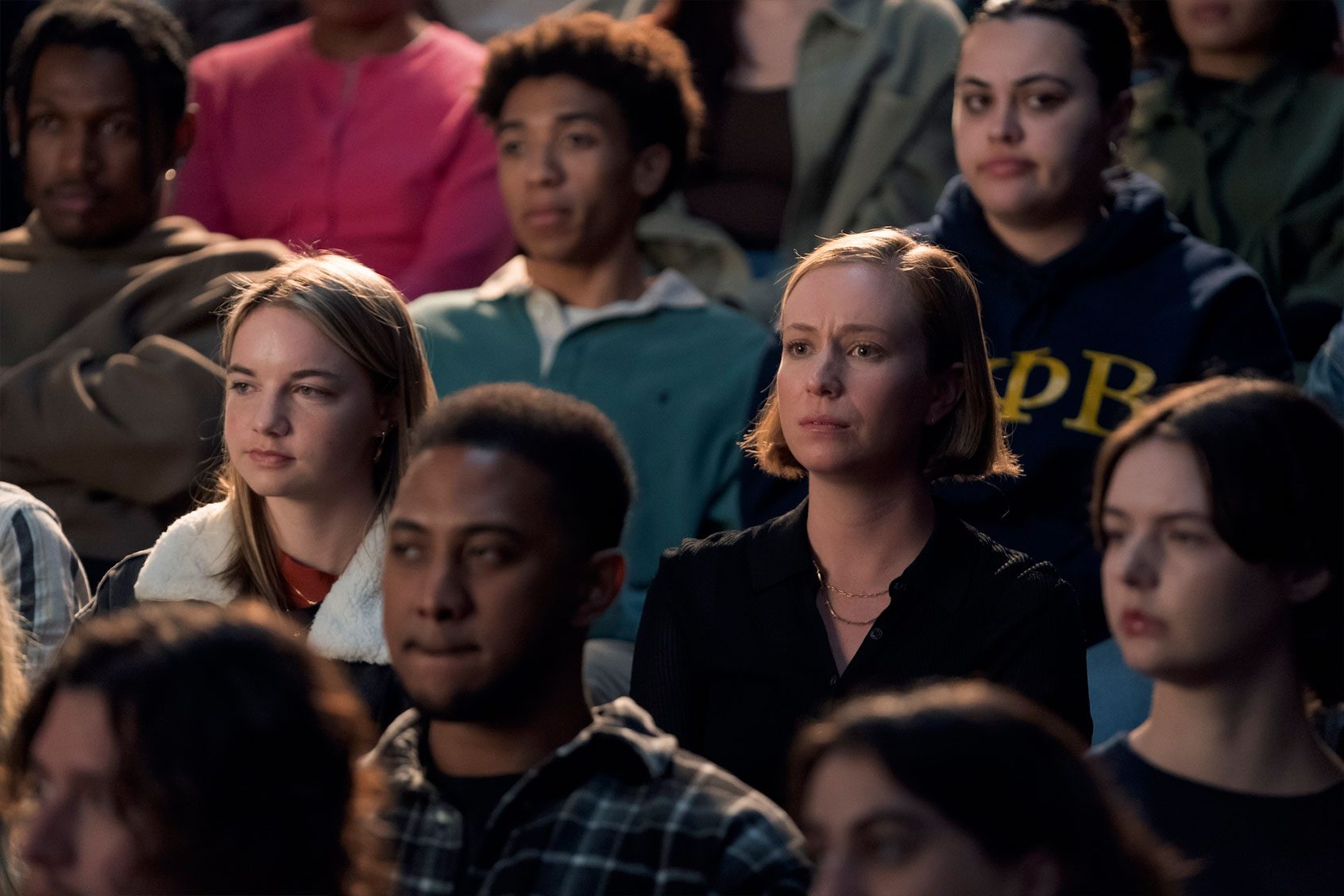
This sounds like a comedian’s nightmare if you believe the common cries of “free speech” and “it’s just jokes.” Deborah recognizes that too, and Smart does an excellent job of wordlessly performing her sense of humiliation at what her past version of herself said in public and thought was funny. Handling hecklers lobbing insults while cloaked in darkness is an artform. But to sit in front of a young woman who performs a tight two for in which she describes the Islamophobia her family has borne over the years, despite being Punjabi, takes another kind of bravery.

Vance also makes Deborah look visibly, painfully humbled when she admits in front of a roomful of strangers, along with a reporter who could send her back into exile with a single article, that she doesn’t know what the term “ableist” means.


Want a daily wrap-up of all the news and commentary Salon has to offer? Subscribe to our morning newsletter, Crash Course.


On Monday’s episode of “The Daily Show,” Jon Stewart weighed in on the conservative media’s penchant to harness “cancel culture” to gin feigned outrage for nearly every type of distraction while pointing out that the only people getting canceled are those standing up Donald Trump. 

“Outrage is the engine of our modern media economy,” Stewart says, “And sometimes, someone loses a job or something else happens like that, that should never . . . happen.”

In context, he’s talking about the likes of former Republican congresswoman Liz Cheney, one of the few who vocally opposed Trump’s poisonous influence on her party and lost her seat in the House as a result. This bears pointing out because one doubts that Stewart had much of a problem with Megyn Kelly being fired by NBC. 

Indeed, that hiring proves the point Ava makes while Deborah spins out. She assures her boss that despite how her brush with supposed cancellation feels, few celebrities at her level actually get canceled. To the woman who lost the late-night hosting chair in the same era when she told those cruel jokes this sounds like more smug assurances from a 20-something with no clue of what it means to suffer.

That makes the last lesson Deborah learns that much sweeter, which is that honest public contrition can augment a star's profile too.

“’Deborah Vance is by no means the obvious choice for late night. Her missteps are numerous and not entirely forgivable. No doubt there will be more,’” Elahi writes in her piece, which Ava reads aloud to Deborah. “’But for all Vance's typical Boomerness, there's a curiosity that goes beyond age and taps into something more human: our desire to understand each other.’”

Deborah is one of the greats. She also placed more value on joining comedy’s exclusively male echelon for most of her career only to reject its gatekeepers once they allow her in the room. She’s said and done many regrettable things, yes . . . and owning them helped her become the first woman to host an 11:30 p.m. show on a broadcast network, history actual TV networks have yet to make.

Elahi concludes that Deborah’s flaws exhibit someone trying to connect with humanity in her attempts to connect with her own, which some would say is the essence of great comedy. That, The New Yorker writer, makes her watchable. “Hacks” fans would certainly agree. 

New episodes of "Hacks" stream Thursdays on Max.

This summer could be even hotter than last year, climate scientists warn

Marine scientist Sharon Gray lives on a catamaran off the Florida west coast. Even though her state's governor, Ron DeSantis, recently signed a controversial law that effectively wipes references to climate change out of the state's statutes, Gray deeply worries about global heating. As the cyclical La Niña weather pattern in the Pacific combines with rising sea surface temperatures (SST), Gray predicts a "devastating" hurricane will occur in summer 2024.

While La Niña is unavoidable, the planet's rising temperatures are thanks to human burning fossil fuels. From Gray's point-of-view, this makes it "tragic" that climate change is now a politically-charged issue.

"My advice to voters is to make climate change the top priority and research [their] candidates’ positions before going to the polls."

"At its core, it’s basic physics," Gray said. Her employer the Rising Seas Institute — an organization that provides scientific education and advocacy to prepare for rising sea levels — tries to stay politically neutral precisely because climate change impacts most people equally. The organization's president and co-founder, oceanographer, John Englander, says that “ice melts at 32 degrees whether you’re a Republican or Democrat." Gray elaborates by pointing out that when climate change raises sea levels, the impact will not be limited to people living on the coasts.

"It has the potential to affect agriculture and freshwater supplies, disrupt supply chains and shipping routes, threaten critical assets and infrastructure, and [threaten] our national security," Gray said. "Hundreds of millions of people could be displaced — and they will all need somewhere to go. My advice to voters is to make climate change the top priority and research [their] candidates’ positions before going to the polls."

Gray is just one among many climate scientists who feel a growing sense of urgency as summer 2024 approaches. Earlier this month, the European Union's Copernicus Climate Service reported that rising heat caused the world's oceans to break temperature records every single day over the past year. 2023 overall was the hottest year on record, averaging temperatures 1.4º Celsius higher than pre-industrial levels. Nations that signed the 2015 Paris Agreement aimed to keep temperatures at 1.5º C lower than pre-industrial levels.

When it came time for the year's hottest season, summer 2023 brought with it suffocating wildfires, blistering heatwaves and billions of dollars in costly weather disasters. In summer 2024, conditions are expected to get even worse, although La Niña may offset this somewhat with its cooling effect.

"It may likely not be as hot as 2023 — because that was an El Nino event, which has now died down," said Imperial College London glaciology professor Martin Siegert. Yet despite this encouraging news, summer 2024 is still likely to be filled with natural disasters as a result of climate change.

"However, ocean surfaces are still warm," Siegert added. "And I expect heat waves and flash flooding from downpours over the summer. With weather, it is difficult to be precise, but the general trend will be for heat and increased sudden rainfall."


Want more health and science stories in your inbox? Subscribe to Salon's weekly newsletter Lab Notes.


"The patterns of where the flooding occurs — the droughts, the wildfires, the heatwaves — is yet to be set. Watch out!"

Kevin Trenberth, a distinguished scholar at the National Center for Atmospheric Research, who has published more than 600 articles on climatology, also told Salon that he believes in many respects, summer 2024 will be "more of the same."

"Wildfires are already breaking out in Canada," Trenberth said. "But which region will be most favored for drought and wildfire is yet to be determined. El Niño is about over: not quite yet. Under La Niña, the dry spots are quite different." He added that the "biggest risk is probably a very active hurricane season in the Atlantic. DeSantis and Florida should watch out, since they do not plan for such!"

In fact, on Thursday, the National Oceanic and Atmospheric Administration said on Thursday there's an 85% chance that this year's hurricane season will be an above-normal season, with an estimated 17 to 25 named tropical storms and 4 to 7 major hurricanes.

"Already, we are seeing storms move across the country that can bring additional hazards like tornadoes, flooding and hail," Federal Emergency Management Agency deputy administrator Erik A. Hooks said in a statement. "Taking a proactive approach to our increasingly challenging climate landscape today can make a difference in how people can recover tomorrow."

As bleak as the prospects are for humanity in summer 2024, it's likely only going to get worse after the current El-Niño-La-Niña cycle runs its course.

"The weather over the next year will be very different than over the past two years," Trenberth said. "The patterns of where the flooding occurs — the droughts, the wildfires, the heatwaves — is yet to be set. Watch out!" 

Trenberth also expressed alarm about the continued erosion of sea ice in the Antarctic and Arctic. "Thawing permafrost is a worry in Alaska and elsewhere," Trenberth said. "That destabilizes many buildings, roads and infrastructure, but each bit is local and getting a complete picture is hard."

Gray said that the upcoming summer will bring with it increased melting of the Greenland and Antarctic ice sheets, which will contribute to global sea level rise "with profound implications for coastal communities and ecosystems worldwide." As sea levels rise, a system of ocean currents that controls weather patterns all over the world known as AMOC (the Atlantic Meridional Overturning Circulation) will destabilize.

"The slowing of these currents can alter weather patterns and even the carbon cycle (by reducing the ocean’s capacity to sequester [carbon dioxide]), as well as amplify climate feedback loops," Gray said. She also raised alarm about a recent study in the journal PNAS that shows the Thwaites Glacier in Antarctica is in danger of collapsing as warm water from the ocean causes it to melt from underneath.

"The glacier itself holds ~2 feet of sea level rise, but these events never occur in a vacuum, and almost always lead to domino effects," Gray explained.

Englander added to that by saying, "Thwaites is the largest and most vulnerable, so is often the focus. But it is associated with five other glaciers, sometimes referred to as the 'Pine Island Glaciers.' By itself Thwaites is roughly capable of causing a foot and a half of global sea level rise. But the group would cause roughly 10 feet. It is sometimes referred to as a 'domino effect' but more accurately the same warming that affects Thwaites affects them all. Indeed, they are all melting, and accelerating in their speed to the ocean. Often we say they are destabilizing."

In the meantime, the "greatest immediate concern" is the melting polar sea ice, according to Siegert.

We need your help to stay independent

"It acts to cool the planet by reflecting sunlight and when not present, the sunlight is absorbed by the sea, leading to further heating," Siegert said. "Sea ice retreat since the early 1970s has led to Arctic heating at four times the rate of the rest of the planet, and in Antarctica two times. The polar regions seem to be accelerating warming rather than preventing it."

Yet even though Siegert described the climate crisis as "getting worse," he also proposed a solution that could help humanity make a long stride toward solving the ongoing existential problem.

"One way forward may be to consider emitting greenhouse gases as a 'pollution' that leads to extreme events and damages to lives and livelihoods," Siegert said. "In that case, it may be that the law can protect us from the emitters — holding them to account when known to willingly pollute the planet — and forcing damages to be paid for. Climate litigation thus would place a liability on companies and countries, and the way to reduce the risk would be via decarbonizing. The law exists to protect us, and our future."

Gray observes that the scientific community is currently debating how to raise awareness and communicate the science in ways that inspire action. The very fact that this debate is occurring is itself promising, as the gamut of approaches suggested all have the potential to catalyze meaningful change.

"Many believe that the message needs to remain positive so that people aren’t terrified into paralysis," Gray said. "Personally, I don’t think we should be making that decision for others. I believe our job is to honestly communicate the realities of the challenges we’re facing and trust people to handle the message."

She added, "The media has a large role to play in this, too. Accurate and consistent reporting is key."

Morgan Spurlock, director of “Super Size Me,” dies at 53

Morgan Spurlock, the documentary filmmaker behind the Oscar-nominated 2004 film “Super Size Me,” died Thursday due to complications of cancer. He was 53. 

In “Super Size Me,” Spurlock spent 30 days only eating McDonald’s meals for breakfast, lunch and dinner; as the title suggests, he also had to “super-size” his meal if the cashier offered. At the end of the month-long experiment, Spurlock claimed he gained 25 pounds and was experiencing liver dysfunction. While the film was a box office success —it grossed $22 million at the global box office — its accuracy has been questioned in the two decades since its release. 

In 2009, health writer and comedian Tom Naughton released the reply documentary “Fat Head,” in which he sought to refute Spurlock’s claims. Naughton made the point that several other filmmakers had gone on “McDiets” and lost weight and that those filmmakers had publicly shared or posted their daily food logs — something Spurlock refused to do. 

In 2017, Spurlock admitted as part of a social media post about the #MeToo movement that he was “part of the problem” and had a history of sexual misconduct, ranging from a rape allegation in college to settling a harassment claim from a former assistant at his production company, Warrior Poets. As part of the post, Spurlock noted that he hadn’t “been sober for more than a week in 30 years,” which some critics have argued may actually account for many of Spurlock’s results in “Super Size Me,” which researchers have been unable to replicate

Shortly after making that post, Spurlock stepped away from “Warrior Poets.” His last documentary, “Super Size Me 2: Holy Chicken,” looked at the marketing tactics the fast-food industry used to appear more nutritious. 

Spurlock’s family confirmed his death to Variety. 

“It was a sad day, as we said goodbye to my brother Morgan,” Craig Spurlock, who worked with his brother on several projects, told the publication. “Morgan gave so much through his art, ideas and generosity. Today the world has lost a true creative genius and a special man. I am so proud to have worked together with him.”


Fani Willis seeks to reinstate Trump charges, an “implicit concession” a trial won’t happen soon

Fulton County District Attorney Fani Willis has appealed a decision to drop charges in the 41-count indictment against former President Donald Trump and several co-conspirators in her Georgia election interference case. This comes after the Georgia Court of Appeals said it would consider Trump's motion to kick Willis off the case.

Prosecutors have accused Trump and some of his co-defendants allege of seeking to illegally demanding that Georgia officials convene a special legislative session to appoint pro-Trump electors as part of their scheme to steal the 2020 election. Although they were charged with the crime of "Solicitation of Violation of Oath by Public Office," Fulton County Superior Judge Scott McAfee ruled in March that the charge should be dropped due to a lack of sufficient detail in their indictment. However, he noted that prosecutors could pursue a new indictment with the charges reinstated.

Trump was directly named in three of the dismissed counts related to his effort, per prosecutors, to pressure Georgia Secretary of State Brad Raffensberger and “unlawfully influence the certified election returns."

Trump has pleaded not guilty to all charges. But because of the delays already, Willis’ decision to file an appeal and try to reinstate some charges suggests that the case is unlikely to go to trial before the November election.

“In some ways, it’s an implicit concession that it’s not going to happen before November,” Anthony Freis, a Georgia State University law professor closely following the case, told The New York Times.

ā€œCash for policy changes”: Dems say oil donors funnel millions into Trump legal fee “slush fund”

To be clear, nobody is persecuting the American oil industry. In 2023, the United States produced more barrels of crude oil than any other country on the globe, for the sixth year in a row, and exported more of them than any country has ever done before – almost a million barrels more, each day, than in the last year of Donald Trump’s presidency. But America’s wealthy elites are feeling persecuted these days: by President Joe Biden; by DEI or CRT or whatever we’re using as a stand-in for “diversity”; by the existence of trans people; by the acknowledgment that climate change exists. And when America’s wealthy elites get deep in their feelings, they open up their pocketbooks and ask the forces of reaction to take their damn money.

In a single day, Bloomberg reports, “oil executives and other deep-pocketed donors” threw some $40 million at the Trump campaign, driven by the former president’s pledge to “drill, baby, drill.” Dan Eberhart, a repeat Trump donor and CEO of Canary Drilling Services, explained that he and others in the industry “fear that the current regulatory approach in Washington amounts to death by a thousand cuts for oil and gas companies,” according to Bloomberg. Trump, by contrast, “repeatedly stressed that he stands for what’s good for America, and that we need energy to thrive and keep the economy growing,” in Eberhart’s telling (solar accounted for more than half of all new electricity added to the grid last year, but green energy doesn’t count).

The haul for Trump, who by this time next month could be a convicted felon, came after another meeting with America’s oil-and-gas elites where he promised to do the industry’s bidding – for the relatively low price of $1 billion. As The Washington Post reported, Trump, addressing the executives at his Mar-a-Lago resort, said that the 10-figure donation would be a “deal” given his pledge to undo the Biden administration’s environmental regulations, from restrictions on power plant carbon emissions to incentives for electric vehicles.

Senate Democrats are calling that a “quid pro quo.”

Time and time again, both Mr. Trump and the U.S. oil and gas industry have proved they are willing to sell out Americans to pad their own pockets,” Senate Finance Committee Chairman Ron Wyden, D-Ore., and Senate Budget Committee Chairman Sheldon Whitehouse, wrote in a letter Thursday sent to a host of pro-Trump fossil-fuel executives. They accuse the industry of helping Trump funnel campaign donations into “a slush fund to pay his legal fees,” and of being willing partners in an exchange of “campaign cash for policy changes.”

There are, from a major polluter’s perspective, legitimate grievances with the Biden administration. While there has been no war on energy, with carbon-neutral solar and wind deployments thanks in part to the Inflation Reduction Act, the White House has restricted oil and gas leasing on some federal lands and set a target of reducing carbon emissions to zero by 2050. (Trump, in his first term, did not set any goal for cutting emissions, instead electing to pull out of the Paris Agreement.)

We need your help to stay independent

For energy companies that have no desire to diversify away from fossil fuels, Trump is indeed a safer bet than the status quo, according to Kathy Mulvey, climate accountability director at the Union of Concerned Scientists. Trump could unilaterally undo much of Biden’s climate agenda, in part through executive orders the oil and gas industry has already drafted for him.

“Although there have been really important advances under the Biden administration, the oil and gas industry is still aggressively expanding its exploration and production at a time when the world needs to phase out fossil fuels,” Mulvey told Salon. In 2022, the industry profited from the spike in prices wrought by Russia’s invasion of Ukraine; it continues to rake in cash, with Exxon Mobil and Chevron, the two largest U.S. energy companies, each reporting more than $30 billion in profits last year.

Still, while the Biden administration is not proposing an overnight transition to green energy – many environmentalists would charge that it’s not being aggressive enough to stave off the worst impacts of a warming climate – it is, in its actions, reflecting the global and scientific consensus that carbon emissions must be reined in.

“Does a corporation that’s determined to stick with business as usual in fossil fuels see the writing on the wall, with actions that are being taken or could be taken? Yeah, they should see that,” Mulvey said.

Instead of transitioning to all the money that can be made in clean energy, though, some of the world’s leading contributors to climate change are banking on the return to power of an authoritarian who deems climate change a “hoax.” For the oil and gas industry, a democratic backslide is, like a warming planet, just another cost of doing business.

Gypsy Rose Blanchard’s ā€œprison-style energy drinkā€ recipe goes viral

Gypsy Rose Blanchard has taken to TikTok to share a tutorial for her “energy drink” recipe, which she used to make as an inmate. The video was posted at the request of one of Blanchard’s 9.8 million TikTok followers asking her if she could post content showing prison hacks.

“So, I’m about to show you how to make a prison-style energy drink with only four ingredients,” Blanchard begins her video. “I want to disclose that this is a non-alcoholic drink, so, I don’t promote alcohol on my channel.”

The drink itself calls for a bag of Jolly Rancher candies, Kool-Aid Tropical Punch singles, strawberry-flavored Fanta and Folgers instant coffee. “Everyone in prison usually makes these drinks because nobody gets Red Bull in prison,” Blanchard explained. “This is just something that we made to have, like, a homemade Red Bull.”

To make the drink, Blanchard first crushes up the Jolly Ranchers — which she says is “kind of [an] important” step — before making the coffee with water. A Kool-Aid packet is then added into a mixing bowl with the coffee. As for why she prefers the Tropical Punch variety, Blanchard says it’s because “any other flavor would actually just taste really disgusting.” The strawberry-flavored Fanta is also added to the mix “because the whole point is to make it kind of juicy flavored, like very fruity.”    

After mixing together the coffee, Kool-Aid and Fanta, Blanchard adds the crushed candy to enhance the fruity flavor. She serves the finished drink in a cup with ice, advising her followers to not drink it warm.

Blanchard’s recipe has since gone viral, amassing more than 26 million views in three days. Those who have tried the drink say it’s surprisingly palatable and not at all what they expected.

Aside from her TikTok, Blanchard will open up about her life post-prison in an upcoming documentary series “Gypsy Rose: Life After Lock Up” premiering June 3 on Lifetime.

Trump likes that Tom Cotton went to Harvard, making him a “top contender” to be his running mate

Donald Trump appears to have a few requirements for his running mate, including that whoever it is does what they are told and does not steal the spotlight. He would also prefer an Ivy League pedigree, according to The New York Times, which reported that Sen. Tom Cotton, R-Ark., a Harvard graduate, is now a "top contender."

According to three anonymous sources who have met with Trump, Cotton is a favorite, alongside North Dakota Gov. Doug Burgum and three of Cotton’s Senate colleagues: Marco Rubio, R-Fla., Tim Scott, R-S.C., and J.D. Vance, R-Ohio. According to the Times, Trump is also considering the five men for posts in his administration, should he win in November.

Where Cotton is concerned, there are some issues to consider. Trump has privately expressed his admiration for Cotton’s reliability and abilities as an effective communicator, as well as praising the senator's Army service and his elite education.

But Cotton voted to certify the 2020 presidential election, which could be a dealbreaker for a man who refuses to acknowledge his defeat. Still, Trump has slim pickings, as both Rubio and Scott also voted to certify the results, while Burgum verbally supported former Vice President Mike Pence’s choice to resist Trump’s pressure to overturn the election.

Trump considered Cotton for an administration post after he won the 2016 presidential election and the two worked closely during their time in Washington, specifically on immigration issues. However, picking Cotton would seem to offer a limited political upside, since he represents a state that already votes Republican in presidential contests. 

Additionally, the senator carries risks. The ticket’s appeal to moderate voters might be hindered by Cotton's endorsement of a national ban on abortions after 20 weeks of pregnancy. Cotton also called for deploying troops against protesters in 2020, and against pro-Palestine college students, which would limit his appeal to disaffected Democrats.

Trump appears to be in no hurry to pick his running mate, though, and a spokesperson refused to confirm the Times' reporting, saying that “only President Trump will rule a contender for Vice President in or out, and anyone claiming to know who he will choose is lying."

The zombie Trump effect

I am loath to discuss presidential election polls right now because they're all over the place and mostly within the margin of error which means the snapshot of the electorate we are seeing may be a mirage either way. There are arguments going on throughout the commentariat over whether the polling methodology is accurate and whether they are modeling the electorate correctly. I have no idea about that and frankly, I don't really care. It's enough to know that the election remains close which I suspect is intensely frustrating to everyone in both parties at this point. It seems as though we are destined to re-enact this polarized Groundhog Day election every four years and it's tiresome. 

For all of Biden's successes, he couldn't put an end to the single biggest problem we face and a lot of people hold him responsible for that failure, however unrealistic it may have been.

It's especially difficult for Democrats to deal with considering that their Republican opponent is once again the most odious candidate in American history, a crude brute currently facing 88 felony counts and a record that includes two impeachments and an attempted coup. It's as if the world has suddenly tilted off its axis and nothing makes sense anymore. 

How is it possible that the Republican Party and its voters would support such a man running for president again, and how can we explain that he's easily within striking distance of winning it? And how can it be possible that this would be happening in the face of what anyone in the past would have considered the successful presidency of Joe Biden, a man who brought us through the pandemic and the economic upheaval it caused without any of the scandal and drama of Trump's chaotic four years? 

So while I may not be reading the election polls closely right now, I am keenly interested in the surveys that may lead to an answer to those questions. Unfortunately, the data is downright disorienting. 

This week the Guardian released a new poll by Harris that surveys people's attitudes about the economy. It suggests that well over half the country is delusional. Polling shows that 55% of Americans believe the economy is shrinking, and 56% think we are in a recession. Neither of those things are remotely true, however. 49% believe the stock market is down for the year even though it's at a record high. Even more bizarre, 49% believe that unemployment is at a 50-year high, though the unemployment rate has been under 4%, a near 50-year low. 

The people who believe this blame Joe Biden for the allegedly bad economy, with 58% saying that his mismanagement will only make it worse in the coming year. They think Donald Trump the failed businessman who just got dinged for almost half a billion dollars in fines for his fraudulent business practices, will be better. Sadly, these numbers include around 40% of Democrats, so this isn't solely a partisan response. 

That's just crazy. The American economy is the envy of the world right now, the only industrialized country that's actually doing well. But Americans are so mired in negativity that they believe it's terrible. At least they think it's terrible for people other than themselves. Survey after survey shows they actually feel pretty good about their own finances and when asked how they think their local economy is faring they say it's doing well. It's the rest of the country that's in a recession. 

Consumer spending is way up. AAA said this week that they predict this is going to be the busiest Memorial Day travel weekend since 2005 and tourism is booming. So while 72% of respondents in that Harris poll said inflation is increasing (even though it's fallen sharply in the past year) it isn't stopping people from spending. And there's a good reason for that. Higher wages have outstripped inflation and have put more money in people's pockets. 

This phenomenon even has a name: vibecession. 

People's beliefs about the economy are based on vibes, not reality. And the vibe is that the economy is terrible, we have out-of-control inflation, job losses and a general economic crisis. This seems odd considering that we actually went through a real economic crisis that lasted for years just recently with the Great Recession of 2008, but people's memories are short. 

We need your help to stay independent

That's not to say that there aren't many people still living paycheck to paycheck — a perennial issue that isn't caused by current circumstances but is a huge problem for those who experience it. And it's certainly true that the economy was turned upside down during the pandemic with sharp increases in unemployment and inflation from all the supply chain disruption. But the government provided unprecedented support and the country came through it without the kind of massive economic suffering we normally would have had. Yet Joe Biden is widely considered a massive failure on economics. 

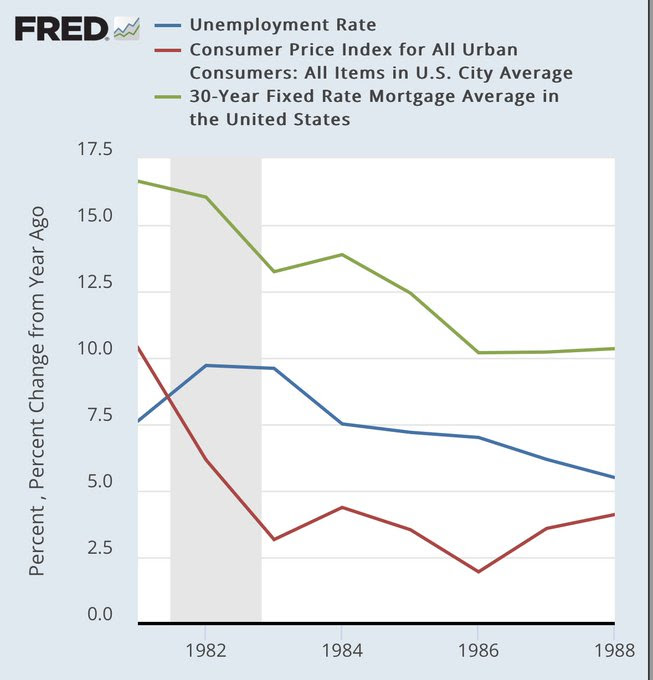
Recall that in 1984, Ronald Reagan ran on a campaign of "Morning in America" and he won a historic landslide victory. Here's what the economy looked like at the time: There was 7% unemployment, 4% inflation, and the average 30-year mortgage had a 13% interest rate. Compare that to the numbers I cited above. 

So why are Americans so negative about a much better economy 40 years later? 

I think there are a number of possible reasons. The first, which is backed up by the fact that people say their own finances are fine, is the media coverage of the economy. It has been relentlessly negative far beyond the point where it was justified. Now that it's focused on the horse race, it flogs polls like this one, creating a negative feedback loop wherein people think that since everyone else believes the economy is bad, it must be. This is where much of the "vibes" are coming from. 

There's also the toxic social media which is being manipulated from many different directions and distorting reality across the board. Whether people participate in it directly is immaterial. It seeps out into the broader culture and makes everyone less informed (or, at least, confused) in the process. 

But I think there's more to it than just that. The whole culture is caught in a negativity spiral that isn't really about the economy at all. It's about impotence. The public sees a whole host of institutions, norms, rules and laws disintegrating before its eyes and feels like there are no mechanisms that work to hold people accountable or reform the system, creating pessimism and apathy. 


Want a daily wrap-up of all the news and commentary Salon has to offer? Subscribe to our morning newsletter, Crash Course.


But mostly, it's just Trump.

His followers hear nothing but a non-stop litany of lies, angry grievances, denunciations and resentments so it's no wonder they're enraged about everything. And Democrats are simply worn out. The effort it takes to oppose him is overwhelming and watching the entire Republican establishment willfully deny reality and supplicate themselves to this con man in order to achieve power for themselves is profoundly dispiriting. 

He was supposed to be vanquished three and half years ago. And yet, like a zombie, he simply won't go down. For all of Biden's successes, he couldn't put an end to the single biggest problem we face and a lot of people hold him responsible for that failure, however unrealistic it may have been. He's in charge and this abominable presence just looms over American society spreading poison day in and day out.

I suspect that phenomenon is what's expressing itself in these economic opinions. Polls can't really capture the Trump "vibe" very well and I'm sure most people don't consciously know why they are feeling what they feel. The vocabulary that's offered to them by the media and the pollsters is the vocabulary of "issues," particularly the economy which is the one that's used most often to define Americans' sense of well-being. It's not "the economy, stupid." It's Trump. I don't think this will turn around for most of us until he is out of politics. We have to make sure that happens sooner rather than later.


Trump’s “Biden the assassin” fantasy is pure projection

No one thinks President Joe Biden tried to assassinate Donald Trump.

"Crooked Joe Biden’s DOJ, in their Illegal and UnConstitutional Raid of Mar-a-Lago, AUTHORIZED THE FBI TO USE DEADLY (LETHAL) FORCE," the former president wrote on his Truth Social platform this week. Earlier in the day, it was revealed that hidden classified documents were found in Trump's bedroom following the FBI's 2022 search.

Not even the people using their MAGA megaphones to say this believe their lies. Not Steve Bannon, not Trump's lawyer Christina Bobb, not Rep. Marjorie Taylor Greene, R-Ga. Trump himself definitely doesn't believe his own hysterics. We know he's lying whenever he's talking or typing. While there are always a few stray uber-morons out there who actually believe this crap, by and large, the audience for this conspiracy theory already knows it's a lie. The audience is participating in political theater, a collective effort to wage the fascist war on reality. 

Projection is a permanent psychological state for Trump and his allies.

The dutiful fact checks produced by folks like Glenn Kessler at the Washington Post aren't totally useless. For liberals and centrists, he does a good job of showing that the people saying this can not possibly believe it. The fact check is also helpful for publicly shaming your right-wing relatives who repeat the "Biden the assassin" lie on social media. Just copy/paste the link, but don't bother responding to the inevitable screeching meltdown from your now-embarrassed relatives about "fake news" and the "deep state." Arguing gives the lies too much credit. Just call them out and move on. 

As contemptible as this behavior is, however, it's important to take it seriously for one major reason: Whatever the MAGA right accuses its opponents of doing, they themselves are doing, or at least plan on doing.

Projection is a permanent psychological state for Trump and his allies. Trump spends all day, every day lobbing accusations at others, and without fail, everything he puts on other people better describes himself. He calls his opponents "crooked," "sleepy," "racist" and mocks their waistlines. It's on-the-nose, how much he's just describing what he sees in the mirror. Projection is a habit that has been embraced by his allies, to a point of obviousness that makes it feel like a waste of breath to observe it. Every finger pointed outward, with MAGA, would be better aimed at their own noses. 


Want more Amanda Marcotte on politics? Subscribe to her newsletter Standing Room Only.


This asinine "assassination" lie isn't just a deflection technique by terrible people trying to flee from their own nagging consciences. It's a threat. It needs to be understood as one. And it's not just a threat against Biden. This is the MAGA movement laying the foundation for what are their increasingly overt claims to be justified in using violence to suppress their political opposition. 

As Kessler wisely noted at the top of his lengthy fact check of Trump's "assassination" lie, the only person who is asserting a right to assassinate political opponents is Donald Trump. This is not an exaggeration. During oral arguments in front of the Supreme Court over the question of whether Trump gets blanket immunity for all crimes committed in office, Justice Sonia Sotomayor asked if a president should be allowed to "order someone to assassinate" someone running against him for office. Without hesitation, Trump's lawyer said political assassinations are an "official act" and therefore should be legal for a president.

He did not say out loud, but it is generally understood, that this only applies to Republican presidents. But the phony outrage over the completely imaginary assassination plot against Trump underscores that point. Every single person flipping out over Biden's non-existent attempted murder cannot wait to line up behind Trump if he actually does send assassins after political rivals.

In fact, they have already done so. Trump sent a mob to the Capitol on Jan. 6, clearly understanding they may very well kill the people inside. We know this because, on the day of the riot, he insisted on letting armed people into the crowd, arguing, "They're not here to hurt me." We know this because the insurrectionists chanted "Hang Mike Pence," and Trump defended them for it. We know this because he makes approving jokes about the attempted kidnapping of former speaker of the House Nancy Pelosi. We know this because he keeps promising to pardon the Jan. 6 prisoners who assaulted cops. The only thing stopping Trump from directly ordering people to kill his opponents is fear of legal consequences. If that concern is removed by the Supreme Court, there's no reason to think he'll hold back. 

Crucially, it's not just Trump. His game-playing on this is part of a larger trend of Republicans getting increasingly brazen in signaling support for political violence. The most alarming recent example comes from Texas, where Gov. Greg Abbott pardoned a convicted murderer, in a way that clearly sends the signal of permission for right-wing violence. 

The case of Daniel Perry is remarkable because of how unambiguous it was. The former Army sergeant has a history of both loud racism and conspiring to have sex with a minor. He called civil rights activists a "zoo full of monkeys" and spoke frequently of his desire to kill people who protest against police brutality. In 2020, he acted on that fantasy, plowing his car into a group of Black Lives Matter demonstrators. One of them, a white man named Garrett Foster, was carrying a gun, which is legal in Texas. As the jury found, the gun was just the pretext used by Perry to kill Foster. In an act of pure bad faith, it was also the pretext Abbott used to pardon Perry. 

False claims of "self-defense" are a favorite fascist tactic to justify violence. Even when racist mass shooters go to churches, temples, or grocery stores for the explicit purpose of mowing down as many random people as they can, they write self-pitying manifestos accusing the children, elderly people, and young parents they kill of being a supposed threat to the white race. By issuing this pardon, Abbott's message is clear: The claim of "self-defense" does not have to be believable. All that matters is that the perpetrator is right wing and the victim is perceived as not of the MAGA tribe. 

Trump, his minions, and his audience of parrots are all doing the same thing when they repeat this transparent lie about Biden's make-believe "assassination" attempt. Like Abbott, they have given up even trying to make their excuses for violence sound plausible. The fake justifications are becoming so paper-thin that it's a real wonder that they even bother pretending to have a reason anymore. 

Closing time in People vs. Trump: Hush-money case rests on the Trump Tower conspiracy

The first mission of a prosecutor’s closing argument is cementing the elements of the crime to the evidence. On Tuesday in Manhattan, it will be time for closing arguments in Donald Trump’s criminal trial for falsifying business records. Here’s one workmanlike way that prosecutor Joshua Steinglass might approach the task of tying together the evidence presented throughout a trial that began in April: Emphasize the “Trump Tower conspiracy” that prosecutors have proven. 

Ladies and Gentlemen,

My colleague Matt Colangelo’s opening statement began by telling you: 

This case is about a criminal conspiracy and a cover-up to corrupt the 2016 presidential election; then he covered up that criminal conspiracy by lying in his New York business records.

That’s the heart of this case.

You know the three categories of falsified records: checks, invoices, and vouchers maintained in the Trump Organization’s books. The conspiracy is a key way that the law makes a defendant criminally liable for all the acts done by his co-conspirators in furtherance of their agreement. Once the conspiracy is proven, it does not matter that it isn’t charged or that the defendant didn’t personally create some of the documents.

A second way that the defendant is liable is that even without a conspiracy, accomplices to a crime are responsible for the criminal actions of their partners.

The most direct way the defendant connects to the crimes, of course, is his own actions. The defendant or his sons signed 11 checks to Michael Cohen with a false stub notation, “Retainer.”

Falsifying business records is a felony whenever someone:

  1. Knowingly 
  2. Makes or causes to be made 
  3. A false entry in business records 
  4. With an intent to defraud
  5. Which includes an intent to commit another crime or to aid or conceal the commission of that other crime. 

You must answer five questions relating to those five elements of the crime. Proof beyond a reasonable doubt leads to “YES” on each one and to a guilty verdict.

1.) Were the business records false?

Yes.

The checks’ stubs falsely say they were for a “retainer”; the false invoices say, “per retainer”; and the vouchers say the same

We know they weren’t for legal expenses as posted in the books, or a retainer – and not just because no retainer existed. We know because three times since 2017 the defendant has admitted that the payments were reimbursements: on Twitter, in his government financial disclosure form, and in his lawsuit against Daniels. There he represented in court that he had reimbursed Cohen for paying her $130,000 on the defendants behalf to enter a nondisclosure agreement (NDA). Those admissions are undisputed.

Then there are the “smoking gun” notes from both Trump Organization Chief Financial Officer (CFO) Allen Weisselberg and Trump Organization Controller Jeffrey McConney about how the $420,000 total of the 11 checks Trump signed was reached. They also confirm that the checks were not for legal services but for reimbursement of the payment to Daniels. There is no evidence contesting the explanation you heard from Mr. McConney, corroborating Michael Cohen.

2.) Did Mr. Trump know they were false?

His admissions confirm his knowledge of the falsifications, which is reinforced by other evidence. As one example, David Pecker testified that the defendant was a penny pincher, careful to question any bill. The defendant told Trump Organization Mr.McConney that he’d be fired if he didn’t negotiate down every bill. The defendant often didn’t pay vendors at all, and praised Cohen when he compelled them to take $.20 on the dollar.

Your common sense tells you that neither the defendant nor his sons would have signed the 11 checks for $35,000 without inquiring and learning the reasons for those sums from his CFO or Cohen. Cohen testified that he, Trump and Weisselberg discussed those reasons at a January 2017 Trump Tower meeting.

3.) Is the defendant criminally responsible for making the false records? 

Let’s start with what’s easy. The defendant and his sons made 11 false records of checks by signing them. Plain and simple. 11 counts. All by themselves.

Then there are the false invoices and ledger entries. The law holds the defendant criminally responsible for them in two ways we’ve discussed – accomplice liability and co-conspirator liability. 

The scheme started, as Mr. Pecker told you, with the 2015 Trump Tower meeting agreement to take off the market scandalous stories about Trump by buying them and creating NDAs. The purpose was to take ownership of the stories away from the tellers. 

There is no dispute in the evidence that Mr. Trump was at the meeting. Nor is there dispute that the agreement was for his benefit, or that he agreed to the scheme, with Michael Cohen his go-between. 

We need your help to stay independent

As for Cohen’s and others’ actions to implement the scheme, Trump Organization paymaster Deborah Tarasoff testified that the defendant or his sons had to approve any check for more than $10,000. Phone records corroborate Cohen’s testimony that he called the defendant twice on October 26 before making the payment to Daniels.

Mr. Pecker testified that Trump didn’t like to pay hush money because “it always gets out.” Again, undisputed.

Hence why the payments were made by others before the election was inherent to the conspiracy. The falsified checks, invoices and ledger entries simply became the means after the election of continuing to hide the defendant’s involvement. 

The evidence clearly points to Weisselberg joining the conspiracy when he became the mastermind of how to cover up the reimbursement in the books as legal expenses. The defendant is liable as an accomplice and a co-conspirator to the false entries that Weisselberg directed.

4.) Did Trump intend to defraud?

Under the law, to defraud is to deceive. Corrupt businesspeople falsify business records to deceive someone. People wanting to keep a scandal covered up commit acts of falsification later to continue the deception. 

The testimony of Mr. Pecker, White House staffer Hope Hicks, Stormy Daniels’ attorney Keith Davidson, and Mr. Cohen establishes that the payment to Daniels was intended to deceive voters by suppressing a scandal. As described by Hicks, a Trump loyalist, the campaign was in crisis after the “Access Hollywood” tape surfaced on October 7, 2016. The defendant’s political prospects couldn’t afford the story of his sexual encounter with Daniels to get out.

The post-election coverup by false business records was intended to maintain that deception by also deceiving New York officials charged with preventing candidates from promoting their elections unlawfully and federal election officials charged with monitoring the limits on campaign contributions in quarterly reports. 


Want a daily wrap-up of all the news and commentary Salon has to offer? Subscribe to our morning newsletter, Crash Course.


A check from Trump to Cohen reimbursing him for the $130,000 – like invoices or ledger entries reflecting it – would create evidence that could lead to discovery of the original scheme. Hence, the Weisselberg “gross-up” to invent a phony trail of legal expenses and income to Cohen. That collaterally created reports of false reportable income that would deceive any state tax auditors by fabricating a false narrative leading away from any reimbursement

Doing so was a need both built into and a continuation of the Trump Tower conspiracy. Falsifying records – the crime – was necessary to prevent discovery of the deception. 

5. Did Trump intend to commit another crime or conceal it?

You may hear the defense claim that the conspiracy was not related to deceiving election or tax officials – and therefore unrelated to an intent to commit federal or state crimes. Rather, Mr. Blanche may claim that it was all about hiding an embarrassing sexual encounter from the defendant’s wife. 

Ask yourself: “Does that make sense?” Would someone go to all the trouble cooking books? There’s no evidence before you that the defendant’s wife ever looked at the books. 

Does the explanation that the defendant was exclusively concerned about family embarrassment conform with the evidence? Recall Keith Davidson’s testimony that the defendant and Cohen’s interest in the Stormy Daniels deal only peaked after the “Access Hollywood” tape. Once it emerged, the deal was negotiated within days.

Cohen, by having paid $130,000 payment to Daniels and not reporting it as a campaign contribution violated federal election law that limits individual contributions to smaller amounts and requires reporting. The payment also violated state election law, which criminalizes a conspiracy to promote a candidate by unlawful means. The unlawful means were the failure to federally report a campaign contribution. 

One last point: You will soon hear defense counsel attack Michael Cohen as dishonest. We do not ask you to believe anything Michael Cohen said that is not corroborated or logical when you apply your common sense to the entire mosaic of testimony, phone records, writings, texts and emails. 

This is not a case about Michael Cohen, it’s a case about facts. Documents and testimony from credible witnesses corroborate Cohen. The testimony of Hope Hicks corroborated Cohen when she told the court that the defendant failed to try to convince her in 2018 that Michael Cohen paid Stormy Daniels on his own and “out of the kindness of her heart.”

If a loyalist like Hope Hicks did not believe Trump’s explanation of Cohen “going rogue,” should you? Of course not. 

The totality of proof establishes beyond a reasonable doubt that Donald Trump was at the hub of a conspiratorial scheme to falsify business records with an intent to defraud New York officials, federal officials and the public in order to promote his own candidacy in the 2016 election. Your oath requires a verdict of guilt. 

“Very abnormal”: Expert worries pro-Israel megadonors trying to make Dems a “pro-Netanyahu party”

A fundraising arm of the American Israel Public Affairs Committee (AIPAC) has shoveled nearly $5 million into opposing incumbent Rep. Jamaal Bowman, D-N.Y., in his upcoming congressional primary as the group targets progressive critics of Israel's invasion of Gaza.

After contributing just over $2 million to the race last week, the United Democracy Project (UDP) super PAC has spent another almost $1.3 million on ads supporting Bowman's opponent, moderate Democrat George Latimer, and another nearly $1.4 million in negative advertisements about Bowman, campaign finance disclosures released Wednesday showed. 

Craig Holman, the government affairs lobbyist for progressive consumer advocacy organization Public Citizen, said that that sum is a "very abnormal" and "extraordinary amount" for an outside group to spend in a congressional race. He told Salon that congressional races typically only see outside spending totals in the hundreds of thousands of dollars for all candidates combined.

"When they spend this kind of money in a single congressional district in New York, that's very, very hard to overcome," Holman said. "I mean, there's no way Bowman can match that kind of spending. And that's just a small congressional district, so that kind of money is gonna have a very, very powerful effect on the election outcome." 

AIPAC's turn to campaign spending marks a new era of political participation for the pro-Israel lobbying group, which first started spending on campaigns during the 2022 election cycle. The group has been able to grow its influence by forming UDP, which can legally contribute unlimited amounts of money on ads and communications in races but can't coordinate with campaigns. 

UDP has contributed $4,813,617 to the New York District 16 since last Monday, including $2,342,021 supporting Latimer, according to Federal Election Commission data — and a Business Insider report indicated the spending may be higher than the publicly disclosed figures. Progressive and liberal PACs, including Justice Democrats and Working Families Party, on the other hand, have spent just under $300,000 to support Bowman or oppose Latimer since April.

An AIPAC spokesperson told The Guardian it regards Latimer as a "strong advocate for the U.S.-Israel relationship in clear contrast to his opponent who is aligned with the anti-Israel extremist fringe.” Bowman, however, has been a vocal critic of Israel's invasion of Gaza and was one of the first members of congress to call for a ceasefire. 

The super PAC's ads challenging Bowman, however, do not mention Israel at all, The Guardian reports. One ad from the super PAC instead accuses the New York progressive of pursuing "his own agenda," pointing to the differences between his policies and President Joe Biden.

These "sizable" contributions from UDP and the ads they run can impact the race by boosting constituents' awareness of a primary race and potentially turnout in the June 25 primary, which could lend itself to either candidate, Conor Dowling, a professor of political science at the University at Buffalo, told Salon. If the ads are successful, he explained, they could also "move the needle a little bit" in Latimer's favor.

UDP's spending and unmitigated contributions, including from wealthy megadonors, allow for larger amounts of money to "be spent in a way that it's perhaps somewhat more difficult for voters to make the link between what that group is about and why they are, in this case, attacking Bowman," Dowling added. "Whereas if it was the Latimer campaign or some other PAC associated with a moderate wing of the Democratic Party that might be a more informative signal to voters, and it might allow them to make a more informed decision about how to take the information that comes from the super PAC ad."

While a disparity in funding doesn't always matter, sizable ones "sometimes can," especially in races that historically have low turnout and voter interest, Dowling said.

We need your help to stay independent

Latimer has also seen greater success in fundraising, with the moderate Democrat raising more than $3.6 million to Bowman's just under $2.7 million, according to Open Secrets.

Republican donors have offered Latimer major support by way of campaign contributions, according to The Intercept, and AIPAC compiled almost a quarter of their funds. Almost half of Latimer's donations in the final quarter of 2023 also came through AIPAC, the outlet reports.

"AIPAC has exposed itself as nothing more than a vehicle for Republican billionaires to spend millions of dollars in Democratic primaries to attack Democrats of color," Usamah Andrabi, a spokesperson for Justice Democrats, told Salon in a statement. "Every voter in NY-16 should know that the ads and mailers they see attacking Jamaal Bowman are funded by the same MAGA megadonors who want to ban abortion, defend insurrectionists, and elect Donald Trump.”

Bowman told Salon in a statement: "AIPAC and its Republican megadonors are targeting me because I stand up for our community's democratic values — from a ceasefire to abortion rights and gun violence prevention — against Donald Trump's MAGA extremism. Unlike my opponent, I will never compromise on our most important freedoms and values for a PAC check from Donald Trump's donors.”

Though Latimer has held fundraisers hosted by Republicans, including a major bankroller of former President Donald Trump, his campaign has distanced itself from GOP-hosted fundraisers and told The Intercept he does not have control over who hosted the events. 

UDP did not respond to an email request for comment.


Want a daily wrap-up of all the news and commentary Salon has to offer? Subscribe to our morning newsletter, Crash Course.


The pro-Israel group setting its sights on Bowman via UDP represents the latest step in its efforts to influence the election outcomes in districts led by progressive representatives that have voiced opposition to Israel's handling of the war in Gaza. AIPAC is expected to spend at least $100 million this election cycle.

"AIPAC is trying and succeeding in having a big impact on this election," Holman said, adding: "You've got a single ideological group trying to influence what the Democratic Party stands for — that's cause for concern. This is not a broad-based effort. This is a single-minded ideological focus group supporting [Israeli Prime Minister Benjamin Netanyahu] trying to make the Democratic Party be a pro-Netanyahu party."

The results of UDP's efforts thus far have been mixed. In an Indiana congressional primary, UDP spent $1.6 million in a successful bid to stop former GOP Rep. John Hostettler, who has made antisemitic remarks in the past from regaining a seat in the House. It also took home a victory in Maryland after supporting Democratic candidate Sarah Elfreth, who defeated former U.S. Capitol police officer Harry Dunn. Neither Elfreth or Dunn made comments about Israel or Gaza during the race, The Guardian notes. 

UDP has also taken some losses, dropping $4.6 million in a failed bid to prevent Democratic congressional candidate Dave Min from beating out Democratic candidate Joanna Weiss in a California primary race earlier this year. According to The Intercept, AIPAC also failed to recruit at least two candidates to challenge progressive Rep. Summer Lee, D-Pa. 

New York District 16, a heavy blue region with large numbers of Black, Jewish and Latino constituents, elected Bowman, a member of the progressive "Squad" in Congress, in 2020.

"Bowman may be able to overcome that kind of spending if voters in the district find it quite offensive that AIPAC would be throwing $2 million into the election — and that is a possibility," Holman said, pointing to the National Rifle Association's failures in efforts to influence other congressional races. "But that, quite frankly, is Bowman's only lifeline here."

Dowling said, however, that the question is whether Bowman can mobilize supporters despite his funding disparity. 

"It's difficult to predict how the expenditures of these monies will affect turnout in the primary election, and that might be what ends up mattering the most," Dowling said.  

“Unbearable”: Women who accused Trump campaign of harassment face more harassment

ProPublica is a Pulitzer Prize-winning investigative newsroom. Sign up for The Big Story newsletter to receive stories like this one in your inbox.

Nearly eight years ago, convinced that she’d been treated unfairly, Jessica Denson sued Donald Trump’s campaign for workplace harassment.

Then she discovered the lengths Trump’s attorneys would go to hit back — and their unwillingness to stop.

Immediately, the campaign filed a counterclaim for $1.5 million. It won a $52,229 judgment, and the campaign froze her bank account and almost forced her into bankruptcy.

She found it humiliating when the campaign lawyers branded her a “judgment debtor” in a subpoena. They monitored her Twitter account, which had 32 followers, and submitted hundreds of pages of printouts to a judge. They even deposed her mother, grilling her about the family’s religious practices.

The judgment was ultimately thrown out by a judge, but her legal fight continues.

The process has been “unbearable,” Denson said, describing the unrelenting pressure she felt from Trump campaign attorneys. “This had become my life. I had no income and had this lien against me. It crippled my ability to work.”

The legal resources deployed to try to crush Denson’s case are not unusual. At least four women of color involved in the 2016 operation have been embroiled in legal fights with the campaign over workplace harassment, discrimination or violations of nondisclosure agreements. They have been subjected to scorched-earth tactics. For years, the Trump campaign has persisted, despite losing consistently, in at least some cases after it was clear that its efforts had damaged the women.

Trump was regularly updated on the women’s cases, according to two people familiar with the matters. In one, he wanted to escalate the dispute by filing a federal defamation lawsuit against the former employee, but his lawyers persuaded him it was best handled through confidential arbitration. Campaign lawyers urged him to settle the ongoing “legacy lawsuits” from 2016 before the 2020 election, but he declined.

Now as Trump engages in another presidential run, a judge’s order in one of those cases may force into public view the new details about staffers who lodged similar accusations. A federal magistrate judge has ordered the campaign to produce by May 31 a list of all discrimination and harassment complaints made during Trump’s 2016 and 2020 presidential runs, allegations that the campaign initially tried to keep confidential through rigorously enforced NDAs. Last year, a federal judge freed 422 employees of the 2016 campaign from confidentiality agreements in a class-action lawsuit brought by Denson, a major crack in the campaign’s strategy.

As the media has chronicled, Trump is a well-known bully. He has belittled and sought to dominate political rivals like Florida Gov. Ron DeSantis and former allies like Bill Barr, who was his attorney general. Trump and his surrogates have appeared to relish hounding or humiliating women who have verbally crossed him, including media and Hollywood stars and a long list of accusers who have complained over the years about sexual harassment or inappropriate conduct. (He has denied all of the allegations.)

But ProPublica found that Trump’s campaign used similar bullying tactics against its own workers. These fights have been waged out of the public eye against women with few resources to stand up against the campaign’s battery of lawyers, paid from a seemingly bottomless trove of campaign money.

The campaign is “still litigating these ridiculous cases that should have been settled” long ago, said campaign finance authority Brett Kappel of Harmon Curran, who has been tracking Trump’s civil and criminal cases. Trump’s strategy is the same one he’s used in other lawsuits: “Drag it out and make it as painful and expensive as possible for the opponent, and maybe they’ll go away,” he said.

The Trump campaign did not respond to a detailed list of questions. Spokesperson Steven Cheung in an emailed statement said one of the cases filed by a former campaign worker was “an absurd and fake story.”

Supporters are giving him money earned with “blood, sweat and tears,” Denson said. “And it is being turned around to terrorize people.”

As is being revealed now in the Stormy Daniels case, Trump’s chaotic 2016 campaign was governed by one overriding public relations strategy: Lock down any whiff of scandal that could be unflattering or compromising to the candidate.

Trump’s campaign used a trio of tools, borrowed largely from the Trump Organization, to ensure that. Allegations were met with swift denials. Employees were bound to silence by onerous NDAs that imposed a lifetime ban on disparaging Trump, his extended family or any of his companies. And the campaign’s lawyers brought in a phalanx of Trump-savvy outside lawyers prepared to crush.

How much the campaign has poured into such efforts is unclear, but it is likely millions, according to spending reports. Trump’s bills for all his many legal challenges — workplace harassment claims aren’t broken out — have topped $100 million.

Trump’s use of donor money to fight lawsuits against the campaign is legal, but experts say he has pushed the limits of laws that forbid using campaign contributions for legal matters that have nothing to do with running for office.

The campaign faced its first-known discrimination complaint in January 2016 when Iowa field organizer Elizabeth Davidson filed a case with a local civil rights agency claiming she had been underpaid because she was a woman. The law student had been fired and accused of violating her NDA by making “disparaging comments” to the press, according to the complaint. Davidson dropped her case without explanation in 2018. She did not return phone calls.

The Trump campaign brought out heavy artillery to try to discredit another female employee who filed a federal lawsuit in February 2019. Alva Johnson, a field operations director from Alabama, alleged pay disparities and a hostile workplace in 2016, but her most explosive allegation was that Trump engaged in “sexually predatory conduct” by kissing her without permission during a Florida campaign event.

To handle her case, the campaign hired attorney Charles Harder, best known for winning a privacy case in 2016 that financially destroyed the gossip website Gawker. Harder’s firm was paid $4.3 million for legal work on a number of campaign cases between 2018 and 2021, according to spending reports. Trump was then in the White House, and spokesperson Sarah Huckabee Sanders called Johnson’s accusation “absurd.”

Harder produced a video filmed by an unnamed supporter. It showed Trump kissing Johnson near her mouth as he approached her for the first time in a reception line. Harder argued the video showed the kiss was not forced; Johnson’s lawyers argued it proved the kiss was real and unwelcome.

A Trump-appointed judge threw out Johnson’s case in 2019, calling the kissing allegation a political attack, and gave her a chance to refile a complaint focused only on alleged pay disparities. She said recently in an interview she chose not to do so, largely because she was frightened for herself and her family as Trump supporters rallied to the president’s defense.

“I definitely heard about every possible way I could die,” she said. “We lived in a cul-de-sac, and they would just drive around with their Trump flags.”

Harder subpoenaed Johnson’s bank statements, extensive news media contacts and communications with potential employers. At one point, Johnson said, Harder offered to withdraw the complaint if she would apologize to Trump and leave the NDA in place. She refused. At another point, Trump wanted to countersue her for defamation, but his lawyers talked him out of it, according to two people.

In response to questions, Harder said his legal tactics were “100% permissible discovery in an employment case” and her attorneys did not object. “It’s called litigation, and it’s part of the legal process,” he said.

Johnson’s arbitration case dragged on long after Harder’s firm withdrew. The campaign brought in new outside lawyers, but by then, judges in Denson’s New York case had found the NDA invalid and other courts seemed likely to follow. If Johnson won, Trump’s NDA said the losing party must pay legal fees.

In August 2022, the arbitrator found Johnson’s NDA unenforceable and ordered the campaign to pay her lawyers $303,285. She said she personally received no money but “won the ability to speak.”

In a statement, Cheung, the spokesperson for Trump’s 2024 campaign, called Johnson’s account “an absurd and fake story that has previously been debunked and contradicted by multiple, highly credible eyewitness accounts.”

The campaign also relied on Harder in an NDA case it brought against former White House official Omarosa Manigault Newman, a Black former contestant on “The Apprentice” who wrote a 2018 tell-all book describing Trump as a racist. Trump smeared her on Twitter as a “low life.” Harder said he withdrew from the case before its conclusion.

Newman had signed an NDA in 2016 when she joined the campaign, and its lawyers demanded $1.5 million for violating the secrecy agreement. The case plodded along until 2021, when an arbitration judge ruled in Newman’s favor and found Trump’s NDA too vague to enforce. He ordered the campaign to pay $1.3 million to Newman’s lawyers. “The bully has met his match,” Newman declared at the time. She could not be reached for comment.

A discrimination case pending in a Manhattan court, however, might force the culture of Trump’s previous campaigns and their suppression efforts into the light.

Arlene “AJ” Delgado sued the 2016 campaign and three senior officials for discrimination after she became pregnant by her supervisor, Jason Miller, then the campaign’s chief spokesperson.

Trump had called Delgado a rising star when she went on the campaign trail as one of his Hispanic surrogates, and she expected an administration job. But she claimed that when she confronted Miller about her pregnancy, he told her Trump could not afford to have her “waddling around the White House pregnant.” Other senior officials shut her out of work discussions until her transition job ended with Trump’s inauguration, she claimed.

Ten days after Delgado delivered her baby, the Trump campaign filed a $1.5 million-claim against her for NDA violations. Delgado’s main offense, according to the campaign, was a series of angry tweets about Miller and Trump’s decision to promote him to White House communications director. The attorney on the case, Lawrence Rosen, who left LaRocca Hornik Rosen & Greenberg, as it was then known, late last year, and his former partners did not return calls or emails.

Miller did not respond to repeated attempts to seek comment.

The firm, now named LaRocca, Hornik, Greenberg, Kittredge, Carlin & McPartland, leases space in a Trump office building, and it has long been a favored legal vendor for the Trump campaign. It’s been paid at least $2.8 million since 2016 by the Trump campaign and its affiliated PAC, Make America Great Again, according to campaign reports. Rosen was described on the firm’s website as a “bulldog” litigator, and he recently surfaced in testimony from Trump fixer Michael Cohen as a lawyer involved in his effort to silence Daniels, a porn star.

Delgado, a Harvard Law School graduate, claims in the lawsuit filed in December 2019 that the campaign deprived her of a job and hurt her other employment prospects. Squaring off against campaign lawyers, she serves as her own attorney and has raised money for legal expenses, including taking depositions from top former White House officials, through GoFundMe.

Delgado recently accused the campaign of withholding information about its handling of harassment and discrimination cases. A LaRocca partner said in a court filing the campaign has disclosed all of the information it has on women’s complaints.

The judge ordered the campaign to produce a full list of cases by May 31. (It’s unclear whether there are any cases that have not emerged yet into public view.)

The LaRocca firm abruptly withdrew from the case, citing “irreparable differences” with the campaign, after five years pursuing Delgado in court.

As for former 2016 campaign staffer Denson, now an actress currently hosting a podcast, she continues to pursue her personal discrimination and retaliation suit, saying she wants her persistence to inspire others.

The federal judge’s decision in October 2023 to void NDAs for all 2016 employees, vendors and volunteers was a blow to the campaign. The campaign agreed to pay $450,000 to Denson’s lawyers and to no longer pursue employees for NDA violations.

Denson said her problems began when she went to work for the campaign’s data division as a national phone bank administrator, one of a dozen employees who reported to director Camilo Sandoval. She had no experience and believed she and another woman, a model, were hired simply because of their looks.

She claimed that Sandoval, who later worked in several high-ranking Trump administration jobs, made inappropriate comments and assigned end-of-day tasks to make her stay late. In one private meeting, she said, he reclined on a sofa. In a deposition, Sandoval denied many of Denson’s charges. He did not respond to calls or email.

Denson’s work on a Spanish-language project caught the attention of Steve Bannon, then the campaign’s CEO, who moved her to work on Hispanic outreach and raised her pay by $3,000 a month, her complaint said. Sandoval reacted angrily to the transfer and scolded her immediate boss for letting his “sheep wander.” He told her, “I hired you and I can also fire you,” she alleged.

Denson introduced emails Sandoval sent to senior officials describing her as a security risk who should be reported to the police and the Secret Service. He suggested she was stealing documents and may have had a role in mailing Trump’s 1995 personal tax return to a reporter at The New York Times, court records show. She claimed he hacked into her personal laptop while she was traveling. In a deposition, he denied accessing her personal information.

Based on Bannon’s encouraging emails about her performance, Denson thought she would be hired for Trump’s transition. But documents showed the campaign’s human resources director telling others, “Jessica is NOT ever to be hired onto transition, inaugural or brought to DC!” An email from Sandoval to senior official Stephen Miller said, “This bitch is out of control.”

She filed a lawsuit in New York state court in November 2017 claiming emotional distress as a result of “pervasive slander,” discrimination and harassment. A month later, Rosen pounced. On Christmas Eve, Denson got papers demanding that she face arbitration for violating her NDA by filing the suit. The campaign sought $1.5 million in damages.

Denson declined to go to arbitration, arguing that her right to a safe workplace was unrelated to the NDA, and the campaign won the judgment for legal fees by default. Rosen had her bank account frozen and went after $1,200 she had raised through GoFundMe.

“This is how cruel and scorched earth they were,” she said in a recent interview.

Denson said in her deposition that Trump campaign lawyers grilled her aggressively about her whereabouts. “Their obsession with my location was very frightening,” she said. “The fear has lived with me ever since.”

She felt further traumatized when the campaign demanded to see mental health and medical records. She was upset when they suggested to her during her deposition that her emotional damage was not extreme.

Denson’s cases followed a circuitous path, and at first she served as her own lawyer because she had no money to pay attorney fees. She remembered crying inconsolably late one night, fearing her situation was hopeless, then waking up to learn a judge had sided with her and had thrown out the judgment in the campaign’s favor as unfair.

In March 2021, a federal judge declared her individual NDA invalid under New York state contract law and said the campaign had used NDAs repeatedly to “suppress free speech.” Denson and her legal team moved forward to extend her victory to all 2016 staffers.

Legal experts say the class-action victory established a precedent that should deter future campaigns from trying to quash employees’ free-speech rights.

Denson and other women fighting the campaign have been struck by Trump’s repeated assertions in his own cases that his right to speak freely has been violated.

“I came to the campaign as someone who cared deeply about human rights, First Amendment, individual liberty; I thought I was working on a campaign that supported those values,” Denson said. “Then I saw the opposite of what this country stands for, going after perceived critics and trying to destroy them.”


ā€œI think they’re building an army”: Trump spews anti-immigrant sentiments at rally in the Bronx

Donald Trump doubled down on his anti-immigrant rhetoric and slipped into winding, irrelevant rambles at a campaign rally in The Bronx, New York — a county he lost by more than 65% in 2020.

Openers for the event on Thursday evening included Andrew Giuliani, son of Trump election theft co-conspirator Rudy Giuliani, who likened Trump to the New York Yankees, and boldly forecasted that he would carry the historically blue state in November.

Trump, who arrived at 6:30 pm — a half hour after his forecasted start time — emerged to the tune of Lee Greenwood’s “God Bless the USA” to greet a crowd of several thousand, notably less than the tens of thousands he planned to address at Madison Square Garden. From the jump, he began sending mixed messages to the city that was his home for more than six decades.

“I spent my life in the city I helped build,” he said, adding that New York is “the city we all love” before going on to bash “filthy encampments” of unhoused people and “mobs of migrants who are fighting our police officers and giving America the middle finger.”

One county over, Trump undergoes a criminal trial for falsifying records in order to conceal hush money payments and interfere in the 2016 election.

The former president then went on to tell the story of the Wollman Rink — an ice skating rink in Central Park — in great detail, drawing a nearly 15-minute anecdote about his role in its construction and seemingly losing the crowd. The rambling tale is emblematic of the increasingly incoherent and disconnected tenor of Donald Trump’s public appearances, which he’s kept to a minimum since his criminal trial began.


Want a daily wrap-up of all the news and commentary Salon has to offer? Subscribe to our morning newsletter, Crash Course.


Turning his attention to the upcoming June presidential debate, which his campaign agreed to, Trump decried “Fake Tapper,” complaining about proposed rules.

Promising “MAGAnomics,” Trump falsely claimed that he had the “best economy in history,” including the “best poverty rate, in terms of the positive number,” though the Dow Jones hit record highs in 2024, and President Joe Biden’s childhood tax credit slashed childhood poverty to their lowest numbers in recent memory.

Lamenting the withdrawal of U.S. troops from foreign wars under Biden, Trump suggested to the crowd that he would’ve extracted more gains from the Middle East.

“In the old days, to the victor belong the spoils. We don't do that,” he said. “We bombed the hell out of everyone, then we come back home. It's so sick,” Trump said.

Doubling down on claims that the 2020 election was rigged, Trump blamed Biden’s victory for the supposed deaths of Israeli hostages in Hamas custody. 

“It would’ve never happened if the election weren’t rigged,” Trump said, before bringing up the issue of immigration, one area where Democrats have lost momentum in New York state.

Digging back up a song by a civil rights activist, whose family sent a cease and desist letter to the former president for his perversion of its intended meaning, Trump recited the lyrics, which he interprets as an anti-immigrant rallying cry. His retelling of it, which details a woman who invites a snake into her home and is surprised when it bites him, is widely seen as racist.

“We will immediately begin the largest criminal deportation operation in our country’s history,” Trump said, echoing his promise to deport millions of undocumented immigrants inside the U.S.

To this, the crowd cheered: “Send them back! Send them back!”

“They want to get us from within,” Trump said, “I think they’re building an army.”

In another authoritarian moment, after saying that people "hate it" when he brings up Hungarian Prime Minister Viktor Orbán, Trump promised to embolden police who go after the “radical left.” 

"I'm going to indemnify all police officers and law enforcement officials throughout the United States to protect them from being destroyed by the radical left for taking strong actions on crime," Trump vowed.

It wouldn’t be a 2024 campaign event without a verbal flub, and Trump delivered, calling the crowd “hard-working patri-isch-tic” before giving up on the sentence and moving on.

Trump, who will face off against his one-time opponent and incumbent President Biden on June 27 in Atlanta, Georgia, capped off his remarks by calling the event “a love fest” despite the hundreds of counter-protesters, including representatives from multiple labor unions, outside the rally carrying banners reading, in both English and Spanish, “The Bronx says no to Trump.”

Senate Democrats open inquiry into Trump’s $1 billion ask from oil companies

Democratic lawmakers in the Senate have announced plans to investigate Donald Trump’s solicitation of a $1 billion dollar donation, coming as the former president allegedly promised donors massive savings from deregulation and tax breaks if he returned to office.

The inquiry into a meeting between Trump and the executives of numerous oil and gas firms will hinge on whether he attempted to tie the donations to favors. Reports suggest that the oil and gas industry has already prepared for a second Trump term, drafting a slew of new executive orders for him to sign on day one.

Per the New York Times, Sens. Sheldon Whitehouse, D-R.I., and Ron Wyden, D-Ore., wrote to top executives of eight oil companies, asking for details of the April meeting and inquiring whether a quid pro quo took place. They accused the group of recipients of “conferring [with Trump] on how to trade campaign cash for policy changes.”

The move, which underscores the deep financial troubles of the Trump campaign and its reliance on deep-pocketed billionaires, comes in line with the Trump campaign’s suggestions that it would end Biden-era green energy policies and restart significant oil drilling efforts.

 “This solicitation, coupled with troubling reports that fossil fuel interests and other companies have been drafting language for use in executive orders favorable to their businesses during a possible second Trump Administration, demand immediate additional inquiry,” Whitehouse and Wyden wrote, per Politico.

Though the solicitation itself may or may not be illegal, depending on the demands made at the meeting, it poses serious ethical concerns, critics say. 

Senate shoots down immigration reform once again, per Trump’s orders

The Senate voted down a bipartisan immigration reform package a second time, after Donald Trump urged Republicans to kill the bill to prevent a political win by his November opponent.

The bill, which would upgrade the asylum-seeking process, toughen border enforcement and increase security presence, and streamline deportations, ending the so-called “catch and release” practice, was carefully designed to reach across the aisle. 

But in January, Trump vowed to kill the bill, negotiated by Sens. James Lankford (R-OK), Chris Murphy (D-CT) and Kyrsten Sinema (I-AZ), sending GOP congressmen and senators to sink the compromise to keep Biden from quashing a key concern for voters in border states.

The 43-50 vote, more than a dozen shy of the necessary 60 to overcome a filibuster, was expected, with nearly all Republicans voting down the package, attempting to position the party as tougher on immigration issues.

“If Republicans were truly serious about calling the situation at the border an emergency, they shouldn't delay any longer. You can't call something an emergency one day and then suddenly kick the can down the road the next day,” Senate Majority Leader Schumer (D-NY) told his colleagues ahead of the vote. “So, to all those who have said for years we must act on the border, this is the chance to show you're serious about fixing the problem.”

Senate Republicans, who’ve proposed reforms in the last year much like those in the bill, say it’s a no-go, citing the Biden administration’s response to an influx of arrivals at the southern border and Majority leader Schumer’s attempts to deliver a political win for his party.

“This [vote] is about political messaging, and they understand it’s a big political vulnerability for them and I get why he’s doing what he’s doing,” John Thune, a Republican Senator from South Dakota said, before voting against the bill.

Sen. Lankford, the Republican who co-authored the plan, expressed frustration in his coworkers' vote on the bill, saying on the Senate floor that the plan is "no longer a bill and now it's just a prop." He argued that Democrats were only bringing his bill to a vote for political "messaging." 

The mystery of who’s trying to take Graceland from Riley Keough

A company has attempted to take the iconic multi-million dollar Graceland estate away from Elvis Presley's family.

The attempt has resulted in the actress Riley Keough, the granddaughter of Elvis Presley and current owner of the estate, to sue to halt the sale of her family's property. Keough inherited her grandfather's home after the death of her mother, Lisa Marie Presley who was the sole heir to the Presley mansion. Keough became the home's sole trustee established by Lisa Marie in 1993 to manage the Presley estate. Lisa Marie's sudden death and the change over of ownership resulted in a contentious battle with her grandmother and Elvis's wife, Priscilla Presley.

However, this time, the battle to keep Graceland in Keough's ownership is coming from outside forces, namely a company called Naussany Investments & Private Lending LLC. In a lawsuit that Keough filed this month, the actress claimed that the company planning to auction off Graceland does not exist.

Here's what we know about the lawsuit, the company and the recent ruling that halted an auction of the iconic Presley family home:

Lawsuit to halt the foreclosure sale of Graceland

Keough filed a claim last week in Shelby County Chancery Court in Tennessee to halt the sale of her family home, describing a fraudulent self-described lender that forged signatures on a nonexistent loan to force a foreclosure claim on Graceland. 

Keough alleged that Naussany Investment is fraudulently claiming that Lisa Marie had borrowed $3.8 million from them and had failed to repay the loan, using the property as collateral. Keough said in the court filing that Lisa Marie never borrowed money from Naussany Investments or gave it a deed of trust as the company alleged. The lawsuit also said the loan and deed of trust were never notarized.

“Elvis Presley Enterprises can confirm that these claims are fraudulent. There is no foreclosure sale. Simply put, the counter lawsuit has been filed is to stop the fraud,” the lawsuit said.

The company's background according to reporting from NBC News

NBC News reported that it has been "difficult to figure out much about the company or who runs it." While further researching the company on public records databases it found "no people in the U.S. with the last name Naussany and for any company with the name Naussany or the initials NIPL." No social media accounts were found linked to the company or any representatives. 

The only available information that NBC News found was from the Graceland court filings. However, even the case itself doesn't share much about the company. Some documents provided addresses from a company in Jacksonville, Florida, and Hollister, Missouri. Another address is in Kimberling City, Missouri. 

In Keough's lawsuit, she claimed that a person named Kurt Naussany sought out the millions allegedly owed to him and threatened to sell Graceland. The claim had an email and phone number for Kurt Naussany. However, NBC News said the number was disconnected and also sent an email to the address on Monday. The news broadcaster received a reply, saying Kurt Naussany left the company in 2015. The email stated that he “should not be on any paperwork to do with Lisa Marie Presley.” It continued that NBC News should contact Gregory E. Naussany, “as he handled all loans with Ms. Presley.” 

NBC News said it received another message from the Kurt Naussany email saying he knew Lisa Marie for years and “never did any loans for her.” The message added, “Please make sure you and all colleagues have names straight.”

On Tuesday, a Gregory E. Naussany sent the court a fax response to Keough's claims in which the person denied her accusations of fraud and asked if the company could continue with the auction.

The filing had a number and email address for Gregory E. Naussany, however, NBC News found that "no one picked up the phone or responded to texts sent to that number. But a request for comment to the email address Wednesday drew a response indicating that the company would drop the case after 'consultation with lawyers.'"

NBC News also asked for more information about the company and why there was no public information about them. They also asked to speak with Gregory by phone, however, he declined. The response said that more information would come in a future court document. “It’s apparent that Keough and LMP family was not aware of LMP mishandling of money and finances."

According to the court, there has been no new court filing from Naussany and no information about who is behind the company.

On Wednesday, a judge blocked the foreclosure auction of Graceland

After Keough's lawsuit filed last week, a Tennessee judge granted Keough a restraining order to halt the sale of her family home on Wednesday. The judge issued a temporary injunction against the proposed auction that had already been seemingly scheduled for Thursday, May 23. 

“It appears that you, Mr. Germany, your client will be successful on the merits,” Court Chancellor JoeDae Jenkins said to Keough's attorney, “providing that you prove the fraud that has been alleged.”

"The court will enjoin the sale as requested because, one, the real estate is considered unique under Tennessee law. And in being unique, the loss of the real estate would be considered irreparable harm," Jenkins said to a local CBS affiliate.

We need your help to stay independent

The judge found that the notary that signed the deed of trust from the said deal between Lisa Marie and Naussany Investment made in 2018 denies notarizing Lisa Marie Presley’s signature. The judge said he questioned the signature's authenticity and the deed of trust. The Shelby County Register of Deed shared that the office had no record of a deed related to Graceland.

The ruling upholds the previous ruling that was issued after Keough's lawsuit claimed that the sale was a fraudulent scheme.

"As the court has now made clear, there was no validity to the claims. There will be no foreclosure. Graceland will continue to operate as it has for the past 42 years, ensuring that Elvis fans from around the world can continue to have a best-in-class experience when visiting his iconic home," a spokesperson for Elvis Presley Enterprises Inc. said after the issued injunction.

Naussany Investment responded to the halt of the sale, “Due to the Deed of Trust not being recorded and the loan being obtained in different state, legal action would have to be filed in multiple states and NAUSSANY Investments & Private Lending will not acquire to proceed. That comes from consultation of the lawyers for the company. There was no harm meant on Ms. Keough for her mothers LMP mis habits and mis managing of money. The company will be withdrawing all claims with prejudice.” 

Google’s AI Overview seems to be spewing inaccurate, dangerous answers

Google’s new “AI Overview” feature, which provides aggregated results compiled by artificial intelligence above some search results, seems to be giving inaccurate and, in some cases, dangerous results.

Social media users immediately pointed out that the feature — which launched to the public earlier this month, superseding organic search results — was giving out some dubious responses. The engine, which holds over 90% market share in the search space, gave advice on cheese sliding off a pizza that raised some eyebrows: mix glue into the cheese.

But unappetizing recipes aren’t the most harmful results that the feature can kick out. Per one X user, Google responded to a prompt about sanitizing a washing machine with a potentially deadly recipe for mustard gas (a threat which the AI feature confirmed via a search.)

And while many large language models, including OpenAI’s Chat GPT and Meta’s Llama, scrub the internet for training data without permission, Google’s overview feature appears to be pretty blatant in its plagiarism. According to one X user, Google added the term “my kid’s favorite” to a smoothie recipe, borrowing the language from a recipe website that posted a similar concoction.

Google, developing the feature in response to Microsoft and Open AI's Bing CoPilot, claims that the program benefits smaller sites, pulling their content into results and reaching more searchers.

“With AI Overviews, people are visiting a greater diversity of websites for help with more complex questions,” an announcement of the feature read. “We see that the links included in AI Overviews get more clicks than if the page had appeared as a traditional web listing for that query.”

Critics worry that the AI-generated results will actually prevent click-through to the original providers of the information that Google sources, ultimately starving the publications that AI Overview relies on. The News Media Alliance, a body representing publishers, called for increased action against AI models which train on content without permission.

“AI companies recognize the value of this content, evidenced by marketplace arrangements, and they rely on quality content to train their systems. The continued unconstrained use by AI companies of publishers’ valuable content without proper compensation is unlawful,”Alliance President and CEO Danielle Coffey said in a statement on legal action against OpenAI.

Google includes a disclosure, “generative AI is experimental,” underneath the AI-generated results, but the results still pose a challenge in an age of growing dependence on computer-generated content.

If you’re searching for alternatives to the tech giant Alphabet’s search engine, heed the AI’s own advice and try a search engine that actually “prioritizes what you're looking for without bias."

How to grill fish: Culinary institute campus president gives tips and tricks

Los Angeles Campus President Lachlan Sands, whose restaurant career began in the kitchen at the seafood stalwart Water Grill, advises on how to achieve perfectly grilled fish and avoid missteps.


Clean Your Grill

This is the first step to making sure your fish cooks properly. The grill should be clean and smooth to ensure that the heat will diffuse effectively. Chef Lachlan explains that we put oil in a pan to create a viscous layer and to smooth over the micro serrations and micro scratches in the pan. “It’s the same for the grill,” he says. “You don’t want it to be rusty or dirty, you want it to be smooth.” He recommends putting oil on a paper towel to rub on the grill using a pair of tongs. “That won’t create a non-stick surface with a viscous layer, however, it will fill in the micro scratches that are on the grill that would otherwise diffuse the heat."


Protect the Fish

“If the fish has skin, the presentation side is always the skin side — it’s as simple as that,” he says. You must protect the skin before you put it on the grill. After seasoning with salt and pepper, brush the skin side of the fish with some mayonnaise. “Because it's an emulsion, it adheres to fish really well."


Stop the Shred

When on heat, sometimes the part of the skin that is not touching the grill will drape lower down and fall beneath the grill lines. “If you use a spatula or scraper, you’re just going to rip it,” Chef Lachlan warns, advising to let the fish cook two-thirds of the way through [time will depend on the type of fish] and lift it up using a carving fork instead of a spatula. “You can test to see if the skin has gotten the right color and crunchy consistency. Once it has achieved the right color, it will lift off on its own. You won’t have to force anything.” You can also use the carving fork to lift it slightly, then slide a fish spatula underneath the fork and above the grill. “If the fish doesn’t lift, it hasn’t been on there long enough.” 


Finish Gently

Once the bottom of the fish has that nice color, there are two options: Either close the grill or put a pan on top of the fish for about 10 or 15 seconds. The goal is to catch enough heat from the grill to cook the top of the fish so that it is just firm. “If the bone side gets just enough heat so it coagulates just beneath the surface, your guests won’t notice that that part is cooked less," he says.


Remember, It’s Not a Steak

“People think cooking fish is like cooking steak,” Chef Lachlan laments. He explains that, unlike steak, where the goal is to achieve the same temperature throughout, fish can have a gradual doneness from quite cooked on the skin side, all the way to lightly cooked on the bone side. “All fish reach temperature at different speeds,” he says. “It depends on the thickness and consistency of the flesh. That can take a bit of practice.”


More pro grilled fish tips:

  • If you are cooking fish that does not have skin, figure out which side had the skin and put the opposite side on the grill so that you always have your presentation side down.
  • Cook whole fish on both sides. “Because it's so thick, and there is a bone in there, it won't cook all the way through if you only cook it on one side.” He suggests waiting until the grill lines are formed on the bottom skin side, then painting the top with mayonnaise and flipping it over to cook it the same way.
  • Don’t move the fish! With the exception of getting that diamond pattern, by turning from 10 o’clock to 2 o’clock, you should not move the fish around on the grill.
  • According to Chef Lachlan, arctic char works well on the grill. “It cooks very fast, so it might be one to two minutes from start to finish,” he says. But when it comes to a thick, dense salmon steak, it may take three to four minutes to cook.

“The portraits are getting weirder and weirder”: A new painting of Kate Middleton is getting slammed

A new portrait of Kate Middleton has stoked considerable commotion on the internet for what many have said is an inaccurate depiction of the royal, a mere week after a painting of her father-in-law, King Charles III, also generated mixed reactions.

The painting was revealed by British fashion magazine Tatler as the cover image of the publication's July issue. British-Zambian artist Hannah Uzor was commissioned for the portrait and was inspired by a photo of the Princess of Wales wearing a long white gown at King Charles III's first state banquet after ascending the throne in November 2022. Middleton's hands are gently clasped in front of her, and she is shown wearing a pin that belonged to the late Queen Elizabeth II as well as the Queen Mary’s Lover's Knot Tiara, which was often worn by Prince William's late mother, Princess Diana. 

https://www.instagram.com/p/C7Qy93EtBeT/?hl=en

A statement provided to CNN by Tatler said that the painting serves to represent Middleton's “strength and dignity." In March, Middleton announced that she had been diagnosed with cancer, quelling monthslong rumors and speculation regarding her disappearance from the public eye following a planned major abdominal surgery. Uzor in the statement shared that Middleton's diagnosis had been factored into her vision for the cover image, saying, “All my portraits are made up of layers of a personality, constructed from everything I can find about them." In Tatler's Instagram post of Uzor's work, the artist is quoted as having said that Middleton "has really risen up to her role. She was born for this. She carries herself with such dignity, elegance and grace."

Uzor also noted that she analyzed a litany of photographs of the Princess of Wales to curate the painting. “When you can’t meet the sitter in person, you have to look at everything you can find and piece together the subtle human moments revealed in different photographs," she said. "Do they have a particular way of standing or holding their head or hands? Do they have a recurrent gesture?"

However, despite Uzor's ostensibly well-intended approach to the portrait, many have criticized her portrayal of the princess. "Unfortunately the artist has not ‘captured’ the beauty of the Princess of Wales. It really doesn’t look like her at all," reads one comment under Tatler's Instagram post.

"Who is making decisions on these commissions?" another commenter asked. "The portraits are getting weirder and weirder. This is quite amateurish, does not resemble HRH. Considering what she’s going through, I guess this will give her a good chuckle."

In another post shared by the magazine highlighting a recent royal tryptic of King Charles III, Queen Elizabeth II and now, Kate Middleton, one Instagram user sharply condemned the work, calling it "laughably appalling."

"What an insult to Kate," the user added. "Tatler, you should be ashamed putting this on the cover. A child would have done a better job. I’m so angry you've done this whilst she is so ill. Shame on you."

The intense and steadily ballooning reactions surrounding Uzor's depiction of Middleton may have been owing to the recent unveiling of Jonathan Yeo's portrait of King Charles III. The British artist, who previously painted official portraits for Prime Minister Tony Blair and Sir David Attenborough, completed the king's first portrait since his coronation at Buckingham Palace. The image is striking, largely for its strongly pronounced coloring — Charles is seen wearing a red Welsh Guards uniform, while a butterfly wavers just above his shoulder, which Yeo said symbolizes how “the subject’s role in our public life has transformed.” The entire background is bathed in scarlet, which quickly drew comparisons to hellfire and "Satanic servitude,"  and "rhubarb pie filling," amongst others. "Does it reference the colonial bloodshed produced by British imperialism?" one commenter asked under the Royal Family's Instagram post showcasing the portrait.

"I am unsure which is the worst portrait; at least Charles's finger looks like his," wrote one user on X/Twitter. "What are they trying to accomplish with Kate Middleton; is this what she will look like when she returns or if she ever returns?"

https://www.instagram.com/p/C68_S5iMWZg/?utm_source=ig_web_copy_link&igsh=MzRlODBiNWFlZA==

"I do my best to capture the life experiences and humanity etched into any individual sitter’s face, and I hope that is what I have achieved in this portrait," Yeo is quoted as having said in the British monarchy's Instagram post. "To try and capture that for His Majesty The King, who occupies such a unique role, was both a tremendous professional challenge, and one which I thoroughly enjoyed and am immensely grateful for.” 


Clues from bird flu’s ground zero on dairy farms in the Texas Panhandle

In early February, dairy farmers in the Texas Panhandle began to notice sick cattle. The buzz soon reached Darren Turley, executive director of the Texas Association of Dairymen: “They said there is something moving from herd to herd.”

Nearly 60 days passed before veterinarians identified the culprit: a highly pathogenic strain of the bird flu virus, H5N1. Had it been detected sooner, the outbreak might have been swiftly contained. Now it has spread to at least eight other states, and it will be hard to eliminate.

At the moment, the bird flu hasn’t adapted to spread from person to person through the air like the seasonal flu. That’s what it would take to give liftoff to another pandemic. This lucky fact could change, however, as the virus mutates within each cow it infects. Those mutations are random, but more cows provide more chances of stumbling on ones that pose a grave risk to humans.

Why did it take so long to recognize the virus on high-tech farms in the world’s richest country? Because even though H5N1 has circulated for nearly three decades, its arrival in dairy cattle was most unexpected. “People tend to think that an outbreak starts at Monday at 9 a.m. with a sign saying, ‘Outbreak has started,’” said Jeremy Farrar, chief scientist at the World Health Organization. “It’s rarely like that.”

By investigating the origins of outbreaks, researchers garner clues about how they start and spread. That information can curb the toll of an epidemic and, ideally, stop the next one. On-the-ground observations and genomic analyses point to Texas as ground zero for this outbreak in cattle. To backtrack events in Texas, KFF Health News spoke with more than a dozen people, including veterinarians, farmers, and state officials.

An early indication that something had gone awry on farms in northwestern Texas came from devices hitched to collars on dairy cows. Turley describes them as “an advanced fitness tracker.” They collect a stream of data, such as a cow’s temperature, its milk quality, and the progress of its digestion — or, rather, rumination — within its four-chambered stomach.

In hindsight, Turley wished he had made more of the migrating geese that congregate in the panhandle each winter and spring.

What farmers saw when they downloaded the data in February stopped them in their tracks. One moment a cow seemed perfectly fine, and then four hours later, rumination had halted. “Shortly after the stomach stops, you’d see a huge falloff in milk,” Turley said. “That is not normal.”

Tests for contagious diseases known to whip through herds came up negative. Some farmers wondered if the illness was related to ash from wildfires devastating land to the east.

In hindsight, Turley wished he had made more of the migrating geese that congregate in the panhandle each winter and spring. Geese and other waterfowl have carried H5N1 around the globe. They withstand enormous loads of the virus without getting sick, passing it on to local species, like blackbirds, cowbirds, and grackles, that mix with migrating flocks.

But with so many other issues facing dairy farmers, geese didn’t register. “One thing you learn in agriculture is that Mother Nature is unpredictable and can be devastating,” Turley said. “Just when you think you have figured it out, Mother Nature tells you you do not.”

Cat Clues

One dairy tried to wall itself off, careful not to share equipment with or employ the same workers as other farms, Turley recalled. Its cattle still became ill. Turley noted that the farm was downwind of another with an outbreak, “so you almost think it has to have an airborne factor.”

On March 7, Turley called the Texas Animal Health Commission. They convened a One Health group with experts in animal health, human health, and agriculture to ponder what they called the “mystery syndrome.” State veterinarians probed cow tissue for parasites, examined the animals’ blood, and tested for viruses and bacteria. But nothing explained the sickness.

They didn’t probe for H5N1. While it has jumped into mammals dozens of times, it rarely has spread between species. Most cases have been in carnivores, which likely ate infected birds. Cows are mainly vegetarian.

“If someone told me about a milk drop in cows, I wouldn’t think to test for H5N1 because, no, cattle don’t get that,” said Thomas Peacock, a virologist at the Pirbright Institute of England who studies avian influenza.

Postmortem tests of grackles, blackbirds, and other birds found dead on dairy farms detected H5N1, but that didn’t turn the tide. “We didn’t think much of it since we have seen H5N1-positive birds everywhere in the country,” said Amy Swinford, director of the Texas A&M Veterinary Medical Diagnostic Laboratory.

In the meantime, rumors swirled about a rash of illness among workers at dairy farms in the panhandle. It was flu season, however, and hospitals weren’t reporting anything out of the ordinary.

What finally tipped off veterinarians? A few farm cats died suddenly and tested positive for H5N1.

Bethany Boggess Alcauter, director of research at the National Center for Farmworker Health, has worked in the panhandle and suspected farmworkers were unlikely to see a doctor even if they needed one. Clinics are far from where they live, she said, and many don’t speak English or Spanish — for instance, they may speak Indigenous languages such as Mixtec, which is common in parts of Mexico. The cost of medical care is another deterrent, along with losing pay by missing work — or losing their jobs — if they don’t show up. “Even when medical care is there,” she said, “it’s a challenge.”

What finally tipped off veterinarians? A few farm cats died suddenly and tested positive for H5N1. Swinford’s group — collaborating with veterinary labs at Iowa State and Cornell universities — searched for the virus in samples drawn from sick cows.

“On a Friday night at 9 p.m., March 22, I got a call from Iowa State,” Swinford said. Researchers had discovered antibodies against H5N1 in a slice of a mammary gland. By Monday, her team and Cornell researchers identified genetic fragments of the virus. They alerted authorities. With that, the U.S. Department of Agriculture announced that H5N1 had hit dairy cattle.

Recalling rumors of sick farmworkers, Texas health officials asked farmers, veterinarians, and local health departments to encourage testing. About 20 people with coughs, aches, irritated eyes, or other flu-like symptoms stepped forward to be swabbed. Those samples were shipped to the Centers for Disease Control and Prevention. All but one was negative for H5N1. On April 1, the CDC announced this year’s first case: a farmworker with an inflamed eye that cleared up within days.

Thirteen dairy farms in the panhandle had been affected, said Brian Bohl, director of field operations at the Texas Animal Health Commission. Farmers report that outbreaks among the herds last 30 to 45 days and most cows return to milking at their usual pace.

The observation hints that herds gain immunity, if temporarily. Indeed, early evidence shows that H5N1 triggers a protective antibody response in cattle, said Marie Culhane, a professor of veterinary population medicine at the University of Minnesota. Nonetheless, she and others remain uneasy because no one knows how the virus spreads, or what risk it poses to people working with cattle.

Although most cows recover, farmers said the outbreaks have disrupted their careful timing around when cattle milk, breed, and birth calves.

Farmers want answers that would come with further research, but the spirit of collaboration that existed in the first months of the Texas outbreak has fractured. Federal restrictions have triggered a backlash from farmers who find them unduly punishing, given that pasteurized milk and cooked beef from dairy cattle appear to pose no risk to consumers.

The rules, such as prohibiting infected cattle from interstate travel for 30 days, pose a problem for farmers who move pregnant cattle to farms that specialize in calving, to graze in states with gentler winters, and to return home for milking. “When the federal order came out, some producers said, ‘I’m going to quit testing,’” Bohl said.

In May, the USDA offered aid, such as up to $10,000 to test and treat infected cattle. “The financial incentives will help,” Turley said. But how much remains to be seen.

Federal authorities have pressed states to extract more intel from farms and farmworkers. Several veterinarians warn such pressure could fracture their relationships with farmers, stifling lines of communication.

Having fought epidemics around the world, Farrar cited examples of when strong-arm surveillance pushed outbreaks underground. During an early 2000s bird flu outbreak in Vietnam, farmers circumvented regulations by moving poultry at night, bribing inspection workers, and selling their goods through back channels. “Learning what drivers and fears exist among people is crucial,” Farrar said. “But we always seem to realize that at a later date.”

A powerful driver in the U.S.: Milk is a $60 billion industry. Public health is also bound to bump up against politics in Texas, a state so aggrieved by pandemic restrictions that lawmakers passed a bill last year barring health officials from recommending covid-19 vaccines.

Texas Agriculture Commissioner Sid Miller said that when he heard that federal agents with the CDC and USDA were considering visits to farms — including those where farmers reported the cattle had recovered — he advised against it. “Send federal agents to dairy that’s not sick?” he said. “That doesn’t pass the smell test.”

From Texas to the Nation

Peacock said genomic analyses of H5N1 viruses point to Texas as ground zero for the cattle epidemic, emerging late last year.

“All of these little jigsaw puzzle pieces corroborate undetected circulation in Texas for some time,” said Peacock, an author on one report about the outbreak.

Evidence suggests that either a single cow was infected by viruses shed from birds — perhaps those geese, grackles, or blackbirds, he said. Or the virus spilled over from birds into cattle several times, with only a fraction of those moving from cow to cow.

Sometime in March, viruses appear to have hitched a ride to other states as cows were moved between farms. The limited genomic data available links the outbreak in Texas directly to others in New Mexico, Kansas, Ohio, North Carolina, and South Dakota. However, the routes are imprecise because the USDA hasn’t attached dates and locations to data it releases.

Researchers don’t want to be caught off guard again by the shape-shifting H5N1 virus, and that will require keeping tabs on humans. Most, if not all, of about 900 people diagnosed with H5N1 infections worldwide since 2003 acquired it from animals, rather than from humans, Farrar said. About half of those people died.

Occasional tests of sick farmworkers aren’t sufficient, he said. Ideally, a system is set up to encourage farmworkers, their communities, and health care workers to be tested whenever the virus hits farms nearby.

“Health care worker infections are always a sign of human-to-human transmission,” Farrar said. “That’s the approach you want to take — I am not saying it’s easy.”

KFF Health News is a national newsroom that produces in-depth journalism about health issues and is one of the core operating programs at KFF—an independent source of health policy research, polling, and journalism. Learn more about KFF.

Subscribe to KFF Health News' free Morning Briefing.

ā€œCompromised beyond measureā€: Experts urge Senate to pass SCOTUS ethics code amid Alito flag debacle

A prominent legal expert says Senate passage of Sen. Sheldon Whitehouse’s bill to require the Supreme Court to adopt a stronger ethics code could send a powerful message – even if its passage through the current House of Representatives is a likely impossibility.

Sen. Whitehouse, D-R.I., introduced his bill in February 2023 in the wake of ProPublica’s reporting on Justice Clarence Thomas’s long history of accepting gifts and trips from a powerful conservative billionaire friend. 

The nine justices announced unanimous opposition to the bill, which has languished since the Democratic-led Senate Judiciary Committee advanced the legislation in July 2023. Republicans in Congress and the Senate predicted the bill would go nowhere.

Still, the Supreme Court ended up adopting an ethics code that legal experts widely derided as unenforceable. 

James Sample, a Hofstra University constitutional law professor, said that the public pressure, along with Whitehouse’s bill, had an impact on justices long resistant to adopting such a code.

He noted that in 2011, Chief Justice John Roberts used his state of the judiciary remarks to dispute the very idea that there was any reason for such a code.

“Do I think that the court should or the Senate should pass the bill? Absolutely," Sample told Salon. "Do I think that it's likely to happen before the election? No, but crazier things have happened. And change is often precipitated by dramatic and easily understandable events. And, you know, if Justice Alito doesn't want Congress to impose an enforcement mechanism, he and Justice Thomas at some level have only themselves to blame.”

Sample said that if the Supreme Court had adopted an enforcement mechanism or honored longstanding norms, "we might not be having this discussion."

"There's at a certain point a dynamic whereby the court by failing to rein itself in, by failing to self regulate in a meaningful way, is presenting really only two options," Sample said. "Either we just accept a Supreme Court that is compromised beyond measure, and where there's no recourse. Or the other branches have a constitutional duty and power to step in and promote due process."

In the wake of The New York Times’ reporting on political flags flown at two Alito residences – including his beach house – Whitehouse is again calling for passage of his bill, which he said would add much-needed teeth. 

Legal experts, including University of Virginia School of Law professor Amanda Frost, have told Salon that Alito has a responsibility to avoid creating perceptions that undermine the judiciary's legitimacy with public political statements and affiliations.

Sample said he felt like the initial report of an upside-down flag – a symbol of the Stop the Steal movement — flown at the Alito home in the wake of the Jan. 6 insurrection was a “relatively minor kerfuffle” compared to concern over Justice Clarence Thomas’s ruling on Jan. 6 cases despite his wife’s role in the movement.

“The fact that there's a second flag, though, utterly contradicts Justice Alito’s initial explanation for the first flag,” Sample said. “And the fact that there's a second flag is actually an indication that not only is Justice Alito a partisan and participating in the political process in ways that judges are not supposed to, but that he actually has contempt for the very notion of judicial ethics concerns.”

Alito spoke to a Fox News reporter to defend the upside-down flag flown at his house, which he said occurred briefly and following a neighborhood dispute involving his wife.

ProPublica also revealed Alito's luxury fishing trip with a GOP billionaire Paul Singer, who later had cases before the court. 

“No one ever asks justices what the facts are,” Sample said. “Justices speak in right-wing media or leak through sources, but no official statements where you tell the truth or face penalties.”

We need your help to stay independent

SO, WHAT WOULD THE BILL DO?

The bill would give the Supreme Court 180 days to issue a procedure for individuals to file complaints alleging that a justice has violated the code of conduct, disqualification rules laid out in U.S. code § 455, “any other applicable provision of federal law” or “has otherwise engaged in conduct that undermines the integrity of the Supreme Court.”

Once the Supreme Court submits a complaint, the court would then submit it to a judicial investigation panel composed of five randomly selected judges from among the chief judges of each of the U.S. circuits.

The panel would review and investigate the complaints using hearings, testimonies and subpoenas. Then, it would present findings and recommended actions that could include dismissal of the complaint, disciplinary actions or changes to Supreme Court rules or procedures.

The panel could publish its findings about recommendations for dismissed complaints if it finds publication would further the public interest.

The counselor to the chief justice would also set rules for disclosure of gifts, income and reimbursements.

The bill also sets forth rules for disqualification: including when a justice knows a party to a proceeding spent money to support his or her nomination. Justices would also face disqualification when they, a family member or their private held entity receives a gift from a party in a proceeding. And justices would have a “duty to know” and to ascertain whether a proceeding could “substantially” affect their or their family’s financial interests. 

“If at any time a justice, judge, magistrate judge, or bankruptcy judge of the United States learns of a condition that could reasonably require disqualification under this section, the justice or judge shall immediately notify all parties to the proceeding,” the bill reads. 

Supporters say the bill would build on current ethics codes for federal judges.

The Supreme Court's current ethics code — based on the existing Code of Conduct for lower federal court judges — requires that judges and justices “refrain from political activity” and avoid “all impropriety and appearance of impropriety in all activities.”  And the Code of Conduct states that a “judge should not knowingly make public comment on the merits of a matter pending or impending in any court.” 


Want a daily wrap-up of all the news and commentary Salon has to offer? Subscribe to our morning newsletter, Crash Course.


WHO IS OPPOSING THE BILL?

Alito himself has balked at calls for more transparency and stringent ethical requirements, telling the Wall Street Journal last summer that “Congress lacks the power to impose a code of ethics on the Supreme Court.”

"The traditional idea about how judges and justices should behave is they should be mute,” Alito said. “But that's just not happening, and so at a certain point I've said to myself, nobody else is going to do this, so I have to defend myself."

Salon examined lobbying and nonprofit records, and found that the conservative Heritage Foundation reported lobbying on Whitehouse's bill in 2023. 

A representative of the Heritage Foundation did not respond to request for comment Thursday. 

Ginni Thomas, a former congressional staffer, once worked at the Heritage Foundation. Justice Thomas failed to report his wife's income from the Heritage Foundation from 2003 to 2007, the Los Angeles Times reported in 2011

In a July 2023 post, the Heritage Foundation derided the legislation as responding to a "fake 'ethics crisis' and seeking to create "new ways to manipulate the Supreme Court and its decisions." 

The conservative think tank criticized the bill for allowing "unlimited" complaints against justices.

WHAT COULD COME NEXT?

Legal experts say there's a growing consensus that the Constitution does not prove a barrier to Congress requiring the Supreme Court to adopt an ethics code with an enforcement mechanism. 

"The Constitution absolutely both not only permits Congress to do that, but really contemplates that Congress will do that," Jennifer Ahearn, senior counsel in the Brennan Center’s Judiciary Program, told Salon.

In a recent article in Hofstra Law Review, Ahearn and her co-author argued that because the court lacks the power of force or purse to wield its power, the public's "collective acceptance of the Court's authority… is the linchpin of its power."

"But, contrary to the views of Justice Alito and others, merely because there are limitations on Congress’s authority to regulate in this space, it does not follow that Congress has no authority to do so," the article reads. "Given the structure of the Constitution, Congress needs to protect both of these two types of judicial independence: independence from outside corrupting influences and independence from improper interference from the other branches."

Sample, who testified on the bill before the Senate Judiciary Committee last year, said that from the Supreme Court's inception, Congress has provided its funding, set the number of justices and regulated the court through the recusal statute. 

"While it is true that the court is a co-equal branch, as Justice Kagan has said pointedly in her remarks, if the court were not amenable to being regulated by the other branches, then it would be the only branch for which that would be true," Sample said. "And it doesn't make sense that that would be the structure that was intended without it being expressed."

Still — the bill's passage faces steep hurdles in Congress as it stands today.

But Sample said the bill's passage in the Senate could send another powerful message to the Supreme Court.

And Ahearn said that party dynamics could always shift.

"These things take time," she said. "And so you've got to work on them, even if you can't guarantee that they would pass in the timeframe that you would like."