Spring Sale: Get 1 Year, Save 58%

“Have you no decency?”: Congressional committee hearing abruptly ends after McBride misgendered

Rep. Sarah McBride might be willing to let the some Republican slights roll off her back, but not all of her fellow Democrats are willing to tolerate the disrespect.

Rep. Bill Keating, D-Mass., during a Tuesday meeting of the House's Europe Subcommittee after Chair Keith Self, R-Texas, misgendered McBride.

"I now recognize the representative from Delaware, Mr. McBride," Self said. 

McBride thanked the chair, calling them "madam," and began to speak before Keating demanded that McBride be addressed correctly. 

"Mr. Chairman, you are out of order. Have you no decency? I've come to know you a little bit, but this is not decent," Keating said.

Self attempted to continue the hearing before Keating jumped in again.

"You will not continue [this hearing] with me unless you introduce a duly elected representative the right way," Keating said. 

Rather than give in, Self banged his gavel and ended the hearing.

The Democrat from Delaware is the first openly transgender member of Congress, which has earned her no end of mistreatment from her Republican coworkers. Shortly before she took her seat on Capitol Hill, Speaker Mike Johnson, R-La., amended House rules to require that lawmakers use bathrooms in line with their "biological sex." Rep. Nancy Mace, R-S.C., has used McBride's time in Congress as a springboard to slots on conservative talk shows, where she can openly espouse anti-trans bigotry while getting in valuable national face time.

McBride, for her part, has said the Republican trans panic is nothing more than a distraction from the unpopular parts of the Republican agenda. 

"Every single time we hear them say the word 'trans,' look what they're doing with their right hand," she told CBS' "Face The Nation" in November. "Look at what they're doing to pick the pocket of American workers, to fleece seniors by privatizing Social Security and Medicare."

Trump promises to label Musk protesters domestic terrorists while cutting Tesla ad at White House

President Donald Trump beamed from in front of and inside a Tesla Model S on Tuesday, telling reporters gathered on the White House driveway that the electric vehicle was "beautiful."

The bit of promo for DOGE head Elon Musk's car brand made good on a promise that Trump made earlier in the week. The president swore in a Monday post to Truth Social that he would buy the car as a "show of confidence and support" for Musk. 

"Elon Musk is 'putting it on the line' in order to help our Nation, and he is doing a FANTASTIC JOB!" Trump wrote. "But the Radical Left Lunatics, as they often do, are trying to illegally and collusively boycott Tesla, one of the World’s great automakers, and Elon’s 'baby,' in order to attack and do harm to Elon, and everything he stands for."

Tesla stocks have flagged in the first few weeks of the Trump administration, with the automaker taking a hit due to faltering sales and Musk's ongoing association with Trump and European far-right parties. The White House-backed advertisement from Trump seems to be a bit of backscratching for Trump's campaign trail benefactor.

"It's a great product, as good as it gets," Trump said. "[Musk] has devoted his energy and his life to doing this, and he's been treated very unfairly by a very small group of people."

The backlash to Musk's smash-and-grab of the federal government has moved beyond Wall Street tickers into the real world. Across the nation, protesters have gathered outside Tesla showrooms and charging stations to rail against the CEO's actions. The "Tesla Takedown" actions have occasionally turned destructive. Trump promised on Tuesday to label any violence against Tesla dealerships as domestic terrorism, per a report from Reuters. 

“This is dangerous”: DOJ attorney was dismissed after opposing restoration of Gibson’s gun rights

A former pardons attorney for the Department of Justice says she was dismissed from her role after she opposed the restoration of actor Mel Gibson's gun rights.

Gibson, a prominent Tinseltown conservative who was recently nominated by President Donald Trump to serve as an ambassador to Hollywood, lost the ability to legally own firearms following a misdemeanor domestic violence conviction.

Elizabeth Oyer told the New York Times that Gibson's case came up as part of a wider effort to restore gun rights to people who had been convicted of crimes. Felons are barred from purchasing or owning handguns under federal law. Oyer told the outlet that she helped craft a list of nine people who could potentially have their rights restored, basing it on the age of their convictions and likelihood of committing another crime. Oyer said she was approached directly and asked to add Gibson's name to the list.

"This is dangerous. This isn’t political — this is a safety issue," Oyer shared.

Gibson pleaded no contest to battery of his ex-girlfriend Oksana Grigorieva in 2011. If that name rings a bell, it's likely because of an infamous tape where Gibson hurled sexist and racist remarks at the mother of one of his children. That leaked audio, along with an antisemitic rant the actor went on while being arrested for driving under the influence, dimmed the star of the one-time blockbuster draw. Oyer felt that Gibson was not a strong candidate for restoration.

"Giving guns back to domestic abusers is a serious matter that, in my view, is not something that I could recommend lightly, because there are real consequences that flow from people who have a history of domestic violence being in possession of firearms," Oyer told the Times.

Oyer added that she was pressured to make the recommendation by a senior official, who noted that Gibson had "a personal relationship with President Trump." She refused a second time and was fired on Friday. No announcement of the restoration of Gibson's gun rights has been made as of this writing.

In recent years, Gibson has made a slow and steady return to theater marquees while touting conservative views and conspiracy theories. The major supporter of Trump said that former Vice President Kamala Harris had "the IQ of a fence post" during the campaign season and floated the idea that recent Los Angeles wildfires were one piece of a sinister land grab

“Just going to be another airline”: Southwest bag fee riles social media

Bags fly free? Not for thee! 

Southwest Airlines is ditching its longstanding policy of not charging for two checked bags despite having built decades of brand identity and loyalty on such affordable offerings. 

The company on Tuesday announced a plan to “drive revenue growth and reward its most loyal customers” with free checked bags. Rapid Rewards A-List preferred members and those who pay for Business Select seats will still be able to check two bags free of charge, and A-List members — along with other select customers, per The Associated Press — will be allowed one checked bag. 

Southwest CEO Robert Jordan cited shareholder value and revenue growth as reasons for the change. “We have tremendous opportunity to meet current and future customer needs, attract new customer segments we don’t compete for today, and return to the levels of profitability that both we and our shareholders expect," Jordan said in a statement. 

It's not clear how much Southwest will charge for checking bags. Delta, United and American charge between $35 and $40 for the first checked bag. 

The policy change was greeted with overwhelming disapproval on social media. One user, @shannjann on X, tweeted an uproarious laughing GIF with the caption “southwest said ‘ya’ll broke??? US TOO!’.”

Others said Southwest has dumped the biggest incentive for customers to fly with them.

“It’s so interesting to watch companies purposely destroy their customer loyalty for no real reason,” user @LoveWammie tweeted. “Southwest was known for affordable, open seating, and free checked bags. Now they getting rid of all of it and just going be another airline.”

“If Southwest Airlines had assembled a focus group and asked them ‘what's the stupidest thing that we could do to ruin our company,’ this is what they would have come up with,” Doug Gladden, a Texas-based lawyer, wrote.

Why “Yellowjackets” and its unlikely survivalist women resonate with queer communities

Devout fans of "Yellowjackets" are familiar with the series’ penchant for providing more questions than answers. Who is pit girl? Or the Antler Queen? Or the man with no eyes? What are those strange symbols that keep appearing on trees and envelopes and slap bracelets? Is "The Wilderness" even real, and what defines that realness? But outside of the plot, grounded in our reality, is this: Why has a disturbing show full of violence, confusing supernatural elements and extremely “unlikable” characters garnered such a passionate fanbase largely comprised of young marginalized viewers?

"Yellowjackets" follows two timelines. In the late 1990s, a New Jersey high school girls' soccer team crashes in the middle of a remote Canadian forest and, driven by hunger and an eerie spiritual connection dubbed The Wilderness, begin to ritualistically hunt and eat each other to survive. In the 2020s, some of those girls have now grown into adult women navigating daily struggles alongside lingering trauma from their nineteen stranded months. Among the central cast we’ve followed from both timelines are Shauna (Melanie Lynskey), Taissa (Tawny Cypress), Natalie (Juliette Lewis), Misty (Christina Ricci) and, as of Season 2, Lottie (Simone Kessell) and Van (Lauren Ambrose), a collection of deeply imperfect women who we first meet as deeply imperfect girls.

As a YA author who primarily writes from the perspective of teenage girls, I’ve been privy to many conversations about “un/likable female protagonists.” And having been one myself not very long ago, I was already well aware of people’s inclination to relentlessly pick apart the actions of teenage girls. Mistakes and transgressions are crimes, age-appropriate immaturity is pathetic childishness, and any degree of sexuality that stems from a girl's wants rather than projected onto her by others is utterly condemnable. Audiences do not often grant female characters the same generosity they do their male counterparts when it comes to their complexity, nuance and due empathy. Obviously, this prejudice-fueled pattern is multifaceted, as this lack of grace similarly applies to characters who are queer, trans, of color, neurodivergent and/or marginalized in any other form. Engrained in this reception is the sense that these characters need to be punished at every turn, or otherwise be so flatly written that they limit the range of things they’re capable of doing that’ll be called into question. Which is precisely where "Yellowjackets" refuses to comply.

Audiences do not often grant female characters the same generosity they do their male counterparts when it comes to their complexity, nuance and due empathy.

You’d think a show that follows the transition from soccer champions to cultish cannibals would want to start us off with pure, innocent girls to emphasize the severity of their journey. But when we first meet these central characters, they are not the figureheads for virtue. Shauna is sleeping with her best friend’s boyfriend and Taissa intentionally brutally injures one of her teammates. As soon as they crash, Jackie abandons an on-fire Van to get out of the plane faster and Misty destroys the black box that could get them rescued so she can play hero as the most capable survivor for a bit longer. From the start, their desperation and willingness to do what it takes regardless of morals is evident, but they still aren’t explicitly presented as the poster children for who you’d want by your side in the middle of nowhere.

I said this was how we first meet the girls, but that’s not entirely true. The pilot episode begins with an eerie chase scene, as a girl in nothing but a white dress runs through a snow-coated forest until falling into a pit that impales her with wooden spikes. We then see the girls, masked and anonymous, ceremoniously cook and eat the girl. This serves as a captivating opener, setting the tone and path of the series, but also as a lens through which to view the everyday girls we meet shortly after who we see driving to school with friends, laughing in the locker room, cheering at pep rallies and going to parties, knowing their fate to come. Suddenly, what would otherwise be morally dubious transgressions or—as earlier established—classic teenage girl faults, are now glimpses into what these girls are capable of if the stakes are heightened. Shauna becomes the defacto butcher carving into the dead bodies of her friends; she knows how to physically engage in something that’s immoral. Taissa massacres the wolf eating Van’s face; she is not afraid of getting her hands bloody. Misty threatens to kill then covers the death of the only person to who she confesses her black-box crime; she knows how to hide the truth to serve her interests. Even the grayer but not “wrong” things they did prior to the crash shape their fortitude in The Wilderness, like Natalie being a designated gunman in contrast to the pre-crash accident where she attempted to defend against her abusive father with a gun, but left the safety off (though he still unintentionally died from his own mishandling of the weapon). 


Want a daily wrap-up of all the news and commentary Salon has to offer? Subscribe to our morning newsletter, Crash Course.


To be clear, while the girls are seen as capable of cruelty and violence, we are not meant to receive them as evil or go, "Well, obviously they’d start eating each other. Look at them." Their actions are multifaceted; they do what they must to survive. But they also show each other kindness and empathy. Shauna refuses to let Taissa sleep in the terrifying cabin attic alone, and Taissa supports Shauna through her pregnancy. Misty, perhaps overzealously, constantly tries to befriend and prove herself to the other girls. Natalie spends countless hours looking for Javi despite believing him dead, just to comfort Travis. Simply put, they are given genuine range. They unite to survive, they constantly bicker, they share clothes and food and chores, they dance and sing and dress up just to give themselves reasons to smile. They do their best. 

L-R: Silvana Estifanos as Teen Britt, Vanessa Prasad as Teen Gen, Jenna Burgess as Teen Melissa, Anisa Harris as Teen Robin and Steven Krueger as Ben Scott in "Yellowjackets." (Kailey Schwerman/Paramount+ with SHOWTIME)The few male characters in the past timeline emphasize the girls’ complexities as well. Javi—the youngest and most innocent—hides away for weeks after fearing the girls’ mushroom-induced violence, only to become the first intentional sacrifice when Nat chooses to let him drown and take her place as the next meal for the group. Travis is constantly being used—like as a path for Jackie to lose her virginity as revenge against Shauna, or a testing ground for communicating with The Wilderness for Lottie. And Ben, the only adult in The Wilderness, is a young gay assistant coach who loses authority and runs away after genuinely fearing he will be the next sacrifice. As of the time I’m writing this, he’s the scapegoat for whoever set the cabin on fire at the end of Season 2, something that’s heavily speculated was actually done by one of the girls. These guys don’t exist to make the girls look worse, but the way they function in the narrative provides the girls’ desperation—to live, to eat, to know the truth, to protect themselves—more nuance. We see that there are victims of their actions, that not everyone would do as they did in their positions. But not everyone could. 

The narrative does not encourage these characters to be good or kind or gracious. It does not affirm them for being vicious or violent or selfish either. The narrative simply lets them be.

Most of the main characters have at least attempted to murder someone, if not succeeded, and all of them have engaged in the ritualistic consumption of their peers while in The Wilderness. Combine that with more grounded transgressions like infidelity, indoctrination, neglect and stalking, and we are under no false pretenses that these are “good” people in any conventional sense. But while their actions themselves are not aspirational—at least one can hope—the sheer desperation demonstrated by these characters is inspirational. To paraphrase the dust jacket of my own book, "If We Survive This": these are not the girls who survive. And by that, I mean these are not the girls people expect to survive. But by Season 3, we’ve seen them through the unimaginable, and they’re still standing. Not by nature of easy, simple solutions. Yes, they’re traumatized. Yes, they’re morally dubious—and that’s a generous interpretation. Because yes, they’re human. 

The narrative does not encourage these characters to be good or kind or gracious. It does not affirm them for being vicious or violent or selfish either. The narrative simply lets them be. Viewers are not meant to walk away from each episode with a neat message about the morality of any of their actions; the complexities and messiness of their desperation to stay alive are far more compelling than anything as simplified as the former. What matters is this—they want to survive, and they do. They do not surrender to their circumstances; they do not accept their doomed fate. 

L-R: Lauren Ambrose as Van, Melanie Lynskey as Shauna and Tawny Cypress as Taissa in "Yellowjackets." (Colin Bentley/Paramount+ with SHOWTIME)In writing, there’s a saying that the relatable is in the specific. Crashing in the Canadian wilderness in 1996 with your soccer teammates and being stranded there for nineteen months is pretty specific. But by making these girls as layered as the show does, it’s easier for viewers to see them as real people instead of archetypes, which makes it easier to relate to and see ourselves in them.

In the wake of increasing hostility against marginalized communities in the U.S. (and across the global scale) it is unsurprising that young people, especially ones belonging to those communities, are scared. Some may find comfort in more joyous, conventionally affirming narratives that provide a form of escapism. But others may find comfort in stories like "Yellowjackets," which are still a form of escapism, yes, but are also deeply intertwined with contemporary fears about the future and making it out alive. There is something encouraging about art that affirms that someone like you or your friends has the gifts of complexity and endurance. Misty, a bullied and lonely outsider. Shauna, a teenage girl with an unwanted pregnancy she cannot terminate. Taissa, a closeted Black lesbian having to hide her relationship with Van, a closeted butch lesbian (played by a non-binary actor in the '90s timeline). Natalie, a victim of child abuse and adolescent addiction. Lottie (played by two actresses with part Māori heritage, though her ethnicity hasn’t been explicit in-show) who’s been suffering with mental illnesses since early childhood. While viewers and fans may often find themselves wincing at the actions of these girls, they just as often may find themselves identifying with them—wondering what it means for their own lives if someone like them could make it through such awful circumstances.

In the Season 2 finale, as these women attempt to recreate the ritualistic hunt they once relied on in their youth, Shauna, the chosen sacrifice, says, “You know there’s no it, right? It was just us!” to which Lottie replies, “Is there a difference?” While viewers like myself are still desperate for some answers, it is clear that whether there is a greater "it" wilderness genuinely pulling the strings, these girls were still undeniably the ones holding the weapons, fighting until the end to make it out alive.

Stock market slumps as Trump’s trade war grows

Between an escalating trade war, a slowed labor market and President Trump’s declining to rule out an imminent recession, the stock market has seen better days.

The S&P 500, which tracks the performance of the United States’s top 500 companies, experienced its worst day of the year on Monday, CBS News reported — plummeting by 3.3%, or 187 points. The Dow wasn't faring much better, plunging by 1,100 points on Monday afternoon before evening out to a net loss of 2.1%.

The slide followed Trump's appearance on Fox News' "Sunday Morning Futures," where he said recent economic red flags indicate a “period of transition.” 

“Look, we’re going to have disruption,” Trump said, “but we’re OK with that.”

“What I have to do is build a strong country,” he added. “You can’t really watch the stock market.”

On Tuesday, stocks slid again after Trump said he will put additional tariffs on Canadian steel and aluminum imports as a result of Canada retaliating with a 25% surcharge on electricity exports to the U.S. The Dow Jones Industrial Average fell 437 points after Trump's announcement, CNBC reported. 

China has reacted to Trump's tariffs by putting a 15% tariff on chicken, wheat and corn imports from the U.S., as well as a 10% tax on soybeans, pork, beef and fruit. 

Treasury Secretary Scott Bessent said the economic instability is the result of “detoxing" from the Biden administration. 

“There’s going to be a natural adjustment as we move away from public spending to private spending,” Bessent said Friday on CNBC. “The market and the economy have just become hooked and we’ve become addicted to this government spending, and there’s going to be a detox period.”

The comments reflect a "tolerance for pain on the part of the administration in pursuit of trade goals that are not necessarily entirely economic in nature,” said Ross Mayfield, Baird investment strategist, per CNBC.

“At this point I’m still in the camp that we’re not on the doorstep of a recession, but maybe a slowdown or growth scare," Mayfield told CNBC. "Non-recession sell-offs tend to be shorter and milder than the recessionary ones.”

The Supreme Court — and Black voters — may decide who controls the next Congress

The Supreme Court is set to decide whether the creation of a second Black-majority congressional district in Louisiana violates the 14th Amendment. Its decision, coupled with those of similar cases progressing in lower federal courts, could impact the outcome of the 2026 midterms.

The justices will hear oral argument later this month in Louisiana v. Callais, a federal redistricting case challenging the makeup of the 6th congressional district in the Bayou State. The district was drawn by lawmakers in 2024 to strengthen Black Louisianians' voting power, in accordance with the Voting Rights Act. Twelve Louisiana voters challenged the new map in federal court last spring, and the court scrapped the configuration, ruling that the district created an unconstitutional racial gerrymander. The state appealed that ruling to the Supreme Court, which has scheduled a hearing for March 24. 

With Democrats and Republicans gearing up for the 2026 midterms and control over a narrowly divided House of Representatives, this case — alongside similar litigation over minority-majority districts in Georgia and Alabama — could play a role in deciding the balance of power in the final two years of President Donald Trump's term. It's also a test of how willing the courts are to ensure American democracy extends to its growing minority populations. 

The razor-thin margin between Democrats and Republicans in the House — 214-218, respectively — means the 2026 midterms could come down to a number of factors, including the three congressional seats at issue in these cases, and both political parties are painstakingly aware of that, according to Kareem Crayton, the vice president of the Brennan Center for Justice.

"The courts' decision will have an impact on whether these districts exist, and whether they exist or not makes it more likely that or less likely that African Americans will have an opportunity to elect a candidate," he told Salon in a phone interview. "But also it has an impact on a partisan balance in Congress. So [if] these three seats — all a bunch of elected Democrats — are eliminated, then the road may be tougher for Democrats to get back to a majority. But conversely, it may be easier for Republicans to hang on to it."

Louisiana v. Callais began as Callais v. Landry in the U.S. District Court for the Western District of Louisiana. Twelve non-Black plaintiffs filed suit against the state over the new congressional district lines drawn in 2024's Senate Bill 8. Lawmakers redrew the district map as a result of the 2023 Robinson v. Ardoin decision, which required the creation of a second Black-majority district in the state in order for the congressional map to be compliant with section two of the Voting Rights Act. 

In a Sept. 2024 motion in the case before the Supreme Court, lawyers for the twelve voters argued that lawmakers "used racial identity to sift Appellees and thousands of other voters into U.S. House districts," overrepresenting Black voters and discriminating against others ahead of the 2024 election. 

"Republicans are surrendering a vital seat in Congress that could well squander their narrow majority, yet both the previous map and Appellees’ alternative proposal in the district court protected all five Republican incumbents," they added, calling on the justices to affirm the lower court ruling or dismiss the case. 

The district court last year sided with the plaintiffs, ruling that lawmakers predominantly relied on race when redrawing the new congressional map and failed to prove it's lines were narrowly tailored to further the state's interest in complying with the VRA. The map, the court said, violated the equal protection clause's protection against racial gerrymandering.

The state has since appealed that decision to the Supreme Court, which last year placed a stay on the district court's order barring use of the SB8 map. The Black plaintiffs from the Robinson case have joined the now-consolidated suit before the Supreme Court to ensure the second congressional district they fought for remains intact. 

In a statement to Salon, Stuart Naifeh, the NAACP Legal Defense Fund's Manager of the Redistricting Project who's representing the Robinson plaintiffs, accused the non-Black Louisianians behind the initial lawsuit of "trying to strip Black voters of a hard-fought victory" and a congressional map that provides them with "equal voice."

"The outcome of Louisiana v. Callais will not only determine the next steps for Louisiana's map and the application of federal laws to redistricting processes but will forecast the resiliency of our nation's democratic principles of fair and equal representation moving forward," Naifeh added. 

A lawyer for the appellees did not respond to an emailed request for comment. 

We need your help to stay independent

In both the other federal lawsuits that could influence the 2026 midterms, Caster v. Allen in Alabama and Pendergrass v. Raffensperger in Georgia, the plaintiffs have argued that the states' redrawn congressional district maps violate section two of the Voting Rights Act, which prohibits vote dilution for voters of color, and seek to defend the Black-majority districts drawn to remedy that violation. The GOP secretaries of state involved in the cases have raised arguments against the desired applications of the VRA for drawing the Black-majority districts at issue, citing the Supreme Court's decision outlawing race-based affirmative action while asserting that such protective measures must eventually end.

At the core of these lawsuits lies a critical challenge to the strength of American democracy, particularly for Black Southerners. As the cases challenge the quantity of Black-majority districts in these states — and in the Georgia and Alabama cases, whether U.S. voting power is still racially disparate enough to require any remedy at all  — they pose a threat to the tools of maintaining fair and equal representation for marginalized communities in an already weakened VRA. 

"There's been an attack on the enforcement tools like section five; section two remains a viable tool in the system, even though it's been attacked and narrowed considerably by [the Supreme Court]," Crayton said. "Maintaining the tool means that in these states, the legislatures will understand that they have to respect the population that lives there. So maintaining these two districts in Louisiana, the two districts in Alabama, the cluster of districts in Georgia, will matter. It matters, of course, because we test the court's legitimacy at being consistent with its interpretation of law."

Recent research from the Brennan Center found that the creation of Black-majority districts in Louisiana, Alabama and Georgia increased Black voter participation by up to 6% and reduced the voter turnout gap between Black and white voters by 2-4%.

"In a world where we know that elections can sometimes turn on a dime because of narrow margins, these numbers matter," Crayton said. "So just in terms of who wins and loses, that's a difference. As I say, after the election is over, what issues and communities the elected member is going to prioritize also matters."


Want a daily wrap-up of all the news and commentary Salon has to offer? Subscribe to our morning newsletter, Crash Course.


Nick Stephanopoulos, a Harvard election law professor who focuses on the American electoral system, added that Black-majority districts like the ones at issue in these cases are the "vehicle through which Black voters in these states obtain responsive representation in Congress; without them, the states' maps would be biased against the needs and interests of minority voters."

Stephanopoulos, however, disagreed on the level of impact these cases will have on Black voters' voting power in these states — and whether their decisions will influence the outcome of the midterms. He said that, in principle, these challenges shouldn't have much effect because they don't change the state's "underlying liability" under the VRA. Even if the Supreme Court agrees that the Louisiana congressional map is unconstitutional, there would still be a VRA violation that the state would need to remedy, he said.

"Section 2 litigation this cycle has already recognized the need for these districts, so the issue now is how to design maps that include these districts without violating the separate prohibition of racial gerrymandering," Stephanopoulos told Salon in an email interview. 

Democrats maintain, however, that the cases in Louisiana, Georgia and Alabama have the potential to undermine section two of the VRA. Republicans are attempting to revert back to their states' previous "gerrymandered" congressional maps that did not allow for adequate competition for the House majority either, argued Marina Jenkins, the executive director of the National Democratic Redistricting Committee. The NDRC's affiliate, the National Redistricting Foundation, was involved in the litigation for Robinson v. Ardoin.

"If these new, fair maps are dismantled, that would be at risk, and the ability for the American public to have their preferences translated to Congress, would certainly be at risk," Jenkins told Salon in a phone interview.  

Black voters overwhelmingly elect Democratic candidates in their elections and choose candidates based on how strongly they prioritize the community's needs over their own political or personal interests. Maintaining these districts can be important in making sure they have lawmakers who even know how to identify their needs, much less adequately and consciously represent them at the federal level, Jenkins said. Having two Black-majority districts in Louisiana, for example, allowed Black voters to elect their preferred candidates to Congress "for the first time in nearly 30 years," she added.

"They have elected Democrat new members of the Congressional Black Caucus," Jenkins said. "If those districts change, certainly those seats would be at risk."

Crayton's assessment of the case's importance assumes a middleground. Given that the justices preserved the Black-majority district and reaffirmed section two of the VRA in the 2023 Allen v. Milligan case in Alabama, he said he expects the Supreme Court to do the same here. The court's order would be that the states would have to redraw the districts in a different way, he predicted.

The current administration and government's flouting of incremental change for sweeping upheaval, however, makes the Supreme Court's possible decision far more uncertain, he said. That uncertainty increases with what he described as Chief Justice John Roberts' inconsistency on his commitment to only call balls and strikes as a justice. Roberts has been aggressive in cutting back voting rights and "pre-existing understandings of how the law works."

"I think the real test is whether or not John Roberts is as good as his word," Crayton said. 

"If this is their opportunity to surprise us and say, 'Oh yeah, no more Voting Rights Act,' it's an opportunity for them to say it. But it will come at cost," he added. "That's what's at stake here, whether or not this is a new era where we don't see the federal government as a valid force of advancing the right to vote."

Trump pledges to escalate economic war on Canada, saying annexation is “only thing that makes sense”

President Donald Trump is planning to further escalate his economic war on Canada as part of a push to annex his country's northern neighbor, he announced Tuesday.

In a post on Truth Social, Trump said he was imposing another 25% tariff on steel and aluminum imported to Canada, above the 25% he announced he previously. He said the increased taxes were a response to Ontario Premier Doug Ford imposing a 25% export tax on electricity to the United States, itself a response to Trump's decision to renege on a U.S.-Canada free trade agreement that he negotiated during his first term in office.

The increased taxes will go into effect on Wednesday, Trump said, adding that he would declare a "National Emergency on Electricity."

"This will allow the U.S. to quickly do what has to be done to alleviate this abusive threat from Canada," Trump said. "If other egregious, long time Tariffs are not likewise dropped by Canada, I will substantially increase, on April 2nd, the Tariff on Cars coming into the US. which will, essentially, permanently shut down the automobile manufacturing business in Canada."

Trump made no mention of fentanyl, which he and others in his administration have previously pointed to as a reason for an economic war on Canada, despite the fact that nearly all fentanyl smuggled into the United States comes through the southern border. Instead, Trump claimed that the U.S. subsidizes Canada's defense and that the "only thing that makes sense is for Canada to become our cherished Fifty First State."

"The artificial line of separation drawn many years ago will finally disappear," Trump threatened, "and we will have the safest and most beautiful Nation anywhere in the World."

The end of MAGA’s dominance: “The American people see the Democrats take down Trump themselves”

President Trump is a juggernaut. His shock and awe campaign against American democracy, the rule of law, civil society, the Constitution, and the norms and institutions has been extremely successful. Trump’s mastery of spectacle and mass media and his natural showmanship and charisma — in combination with the dark arts of politics and power that he learned from his mentor Roy Cohn — make him a formidable foe. The difficulty in trying to stop Trump and his MAGA movement is amplified by how the world is in the throes of an authoritarian populist era that is fueled by rage at “the system” and “the elites” and the existing order of things. In total, Trump and his MAGA movement are the product of much larger problems and disruptions both here in the United States and abroad that defy a simple solution.

"The Democrats will have a lot to work with. But no matter how bad things get, none of it will stick to Trump unless the Democrats make it stick."

What about the Democrats and the larger so-called resistance? They have been mostly ineffective — to the degree they have even been active and present. Since Trump has returned to power, the Democrats, for example, have decided that waiting for Trump and his MAGA Republicans to overextend themselves and for the American people to realize that they are victims of the Big (and little) Con is a viable strategy. Applying military strategy to the realm of “normal” politics, Trump is continuing his shock and awe campaign, and the Democrats are trading space for time.

Focusing in on Trump’s speech to Congress last week, the Washington Post describes the efficacy and result of this plan by the Democrats as:

The Democrats showed last week that presidential addresses to Congress are no place to formulate a resistance. Almost everything they did during President Donald Trump’s appearance highlighted weakness rather than strength. They had not one strategy but several. The sum was less than the parts.

Many Democrats came away worried that their party is even weaker than it appeared after Trump’s victory in November, and for now, Democrats might be left to hope that Trump and the Republicans will make enough mistakes to offer them a way back. But that is only one part of a comeback strategy if Democrats are to become broadly competitive.

The Democrats were handcuffed from the start Tuesday night as they sought to project the right amount of opposition. Too boisterous and unruly in their disagreements and they would embarrass themselves, playing into Trump’s hands and highlighting their powerlessness. Too passive and they would further anger their demoralized base that is looking for a spark of life from the leadership of the party. They were passive, yes, while trying to project mild resistance.

Winning by default and counting on one’s enemy to self-sabotage is not a viable strategy in an existential struggle. Such a strategy is also not very compelling for a public that is increasingly alienated, tired, afraid and mired in learned helplessness, as they see Trump and his MAGA movement and American fascism’s domination as inevitable and soon to be the new norm instead of as forces and outcomes that are contingent and still very much in doubt.

In an attempt to make better sense of the Democratic Party’s weak and passive approach to political battle in the Age of Trump and their ongoing failures of strategy and messaging — and potential ways to correct them and find victory — I recently spoke with M. Steven Fish, a professor of political science at the University of California, Berkeley. His new book is “Comeback: Routing Trumpism, Reclaiming the Nation, and Restoring Democracy's Edge.”

This is the first part of a two-part conversation.

How are you feeling? Trump has been back in the White House for eight weeks. His shock and awe campaign has been very effective. What are you doing to balance yourself and maintain some perspective — assuming you have been able to? 

His shock-and-awe campaign has been theatrical, but I’m neither shocked nor awed. Trump isn’t doing anything he didn’t promise to do, and his opening round has been more of a shit-show of bluster and flip-flops than an irresistible offensive. The key to remaining balanced is to focus on the fight and to give as good as we get. Trump’s high-dominance style has carried him this far, but he also has many weaknesses — if Democrats finally start to push their advantage.


Want a daily wrap-up of all the news and commentary Salon has to offer? Subscribe to our morning newsletter, Crash Course.


If Trump really follows through on everything he’s initiated since January 20, the economy will tank, veterans will quit receiving their benefits on time, American kids will be crippled by polio and dropping dead from measles, and America will become a contemptible international pariah and wholly-owned Kremlin subsidiary. And if Trump backs down, he’ll look weak. Either way, I’m sure you’ll agree the Democrats will have a lot to work with. But no matter how bad things get, none of it will stick to Trump unless the Democrats make it stick. Otherwise, Trump will continue to smash through every disaster and maintain his hold on the political arena.

What are your thoughts on James Carville telling the Democrats to "roll over and play dead" in his recent op-ed in the New York Times? Carville said the Democrats should “roll over and play dead” and “allow the Republicans to crumble beneath their own weight and make the American people miss us.” That does not seem like a winning strategy in an existential struggle for America’s democracy.

Carville is typically a fighter, and I know he isn’t proposing passivity as a long-term strategy. But, his New York Times piece does basically call for the same losing tactics the Democrats have been pursuing for years: Stand back, cede the narrative and headlines to Trump, and then wait for everybody to realize just how awful he is and rush to support the Democrats. That’s largely the way Biden ran his reelection campaign until he stepped aside; in fact, he explicitly said that he intended to make the election a referendum on Trump. Here we had a president who had been in power for almost four years and had racked up impressive accomplishments, including producing a roaring economy, but rather than make it about the Democrats’ triumphs, he chose to make it about Trump. That approach displayed timidity, pessimism, defeatism, and lack of self-confidence, which is why Trump was clobbering Biden in the polls even prior to voters realizing the extent of Biden’s weakness during his debate with Trump. Then, when Harris first stepped out as the party’s nominee-presumptive after Biden’s withdrawal, she offered a much higher-dominance act, but she then reverted to a low-dominance, let’s-make-it-about-Trump approach.

During the 2024 campaign, you and I had a series of conversations here at Salon and elsewhere. You also had an opinion essay in the New York Times warning that Trump is a high-dominance leader and that he had a high chance of winning if the Democrats did not adjust. They didn’t listen to you — or me or the others who were publicly warning about Trump’s popularity. Harris launched her campaign with a high-dominance performance but then faltered soon after her great debate with Trump. History will likely look back at that pivot as one that crystallized the Democratic Party’s failings and imminent defeat.

Absolutely. As you’ll recall, between the time Harris took over as the Democrats’ candidate in mid-July and the debate on September 10, she was a boss. She called attention to herself and her own great plans, projected exuberance, and limited her Trump-time to telling the truth about how horrible he is and not fit to be president. Armed with that approach, she electrified Democrats, put Trump on the defensive, and took the lead in the polls. But then her campaign reverted to ceding the spotlight to Trump, making the campaign a referendum on him and calling on everyone to be horrified by his appalling behavior.

"How much more evidence do the Democrats need that letting Trump be Trump and then hoping to pick up the pieces when he falters doesn’t work?"

The moment her campaign switched gears, which happened shortly after Harris shellacked Trump in the debate, you could hear the air hissing out of the tires and watch Trump get his momentum back. And as it turned out, all the groups the Democrats strove to stir to wounded umbrage weren’t much moved, and they weren’t impressed by the Democrats’ constantly being overcome by the vapors. The partisan gender gap between 2020 and 2024 actually shrunk, with Harris proportionally losing more women than men compared to Biden’s performance in 2020. And Trump made enormous strides with Hispanics and smaller but still substantial gains among Blacks and Asian Americans.

How much more evidence do the Democrats need that letting Trump be Trump and then hoping to pick up the pieces when he falters doesn’t work? Trump acts, and the Democrats stand back and wait for him to stumble. But Trump’s bungling has never been enough to bring voters over to us in sufficient numbers to stop him and rout Trumpism. Until the American people see the Democrats take down Trump themselves, he’s going to seem like a boss. 

Trump and his MAGA movement are winning, and quite easily. They know that storytelling and showmanship are the keys to winning and advancing their agenda. Why are Trump and his propagandists so good at this? Why are the Democrats so bad at it?

Democratic operatives still seem to think that Jack and Diane Sixpack sit down to the kitchen table shortly before the election and calculate which candidate stands closer to them on “the issues,” offers them more stuff, and “cares about people like them.” But there’s no evidence that anything of the sort actually takes place, and you can’t make a compelling story out of “the issues,” promises to add a dental option to Obamacare and patronizing reflections on how much people are hurting. It’s especially ludicrous to focus on voters’ purported despair rather than your own great exploits and plans while your own party is in power, which was the case in 2016 and 2024.

While Biden was still running, he did finally try to step out late in the campaign and claim credit for the roaring economy, but he was far too impaired by then to offer a forceful, resonant message. Beyond that, he was shut down by fretful Democratic party operatives and politicians who told him: How can you talk about “Bidenomics” when polls say so many people aren’t “feeling the benefits”?!

We need your help to stay independent

When Harris first stepped out as the nominee, she was all jauntiness and quick wit, but she then sank back into the party’s old habits. When asked whether people were better off than they were four years ago, Harris refused to answer. Why? Because polling showed that many people weren’t happy with the economy. When asked about immigration, she consistently intoned: “Our immigration system is broken.” No doubt that line played well in the Democrats’ focus groups. Never mind that her party had been in power for almost four years; the people were supposedly struggling to make ends meet and the immigration system was broken. Under her and Biden. And when asked how her policies would differ from Biden’s, she said she couldn’t think of anything. Why? We can’t be sure, but by some accounts, she was afraid of offending Biden. This is what poll-driven, fear-based, irrationally risk-averse messaging looks like. It thrills no one. It changes no minds. It leaves your opponent’s story as the one everybody hears.

Donald Trump’s story is basically: When I’m in power, you will enjoy the greatest economy in the history of the world. When the Democrats are in power the economy is horrible. Trump and his propagandists and other surrogates and messengers fill in his story with all kinds of facts and figures, many of which are not true, just pulled out of the ether. But Donald Trump does have a story, and it does convince a lot of people. Trump tries to shape public opinion rather than just respond to it. What would a more compelling message from Harris have sounded like?

Kamala Harris could have said something like this: You’re goddamn right we’re better off than four years ago! Back then, unemployment was 15 percent; under me and Biden, it’s lower than it’s been since the 1960s. COVID pushed inflation up, but Biden and I hammered inflation down to 2 percent — exactly where the Fed says it should be. Our economy is leaving other rich countries in the dust; it’s growing faster than all of them. America is the innovation capital of the world. Real wages have been growing for a year-and-a-half running. New business start-ups and corporate profits are surging. Every time I check the numbers, the Dow is setting records. When Trump left office, the Dow was 31,000; today it’s 42,000. Dream on, Mr. Trump! Fast growth, plunging inflation, rock-bottom unemployment — economists said it couldn’t be done. Oh, and by the way, the budget deficit is half of what Trump left us with four years ago.

This is what Democrats do: We come in and clean up the messes made by our Republican predecessors. Roosevelt did it after Herbert Hoover. Clinton did it after the first Bush, Obama did it after the second one, and Biden did it after Trump.

But you ain’t seen nothin’ yet. Under me, we’re going to make Biden’s good economy even better. Way better. No more kids in poverty in the richest, greatest country on Earth. Watch for the Dow to break 50,000. Why the hell not?

Today’s Democrats do not have a brand or compelling identity, and they are horrible political salespeople. Trump’s recent address to Congress is an example of Trump as the master of spectacle. For his audience it was perfect. Those outside of TrumpWorld and the MAGAverse thought his speech was a failure.

Nothing surprising there. Trump’s speech was grand theater. Vintage Trump, complete with all the props: The ranting about the Democrats’ supposed perfidies, the proclamation of a new Golden Age and the adoring families of the victims of violence perpetrated by undocumented migrants.

The Democrats’ responses, unfortunately, were also largely predictable, and altogether pathetic: Rep. Al Green getting thrown out for standing and waving his cane at Trump; the pink dresses (I still don’t get what that was supposed to mean); and the indignant flashing of the ping-pong paddles with their various messages. Then there was the flurry of Democratic responses on talk shows over the following several days. On Stephen Colbert’s show, Pete Buttigieg tore into Trump for not dwelling on people’s economic pain and for failing to lower egg prices.

But most abject of all was the Democrats’ formal response to Trump’s speech, delivered by the new senator from Michigan, Elissa Slotkin. American democracy is being dismantled by fascists and Trump is trashing a world order that has ensured American preeminence and prosperity for the past 80 years. Putin is very pleased. What did Slotkin have to say? “The Middle Class is the engine of our country…Michigan literally invented the Middle Class!… We need to bring down the price of things we spend the most money on: Groceries. Housing. Healthcare. Your car.” Of course, she hit on other points as well, but never did she offer anything other than the bromides the Democrats have been mouthing for as long as anybody can remember. Nowhere was there the slightest sense of urgency, alarm, anger, or fight. I’m sure Slotkin is a wonderful person, but it’s also noteworthy that she won her Senate race by 0.3 percent in a state where Gov. Gretchen Whitmer whipped her MAGA opponent by 11 points. Rather than turn to the harder-edged Whitmer — or, for that matter, Rep. Jasmine Crockett, Rep. Eric Swalwell, Senator Ruben Gallego, Senator Adam Schiff, or Gov. Josh Shapiro — to let loose on Trump, the Democrats chose Slotkin to make her heartfelt pitch for — what else? — the put-upon middle class.


“PATCO on steroids”: Trump’s TSA union busting sparks calls for a general strike

On Friday, the Trump administration made the largest union busting move in American history when it eliminated the collective bargaining rights for tens of thousands of Transportation Security Administration (TSA) workers who are responsible for screening the close to three million passengers who fly in the U.S. everyday.

In a press release put out by Department of Homeland Security (DHS) Secretary Kristi Noem, previously most famous for executing her 14-month old dog Cricket, the agency said, “eliminating collective bargaining removes bureaucratic hurdles that will strengthen workforce agility, enhance productivity and resiliency, while also jumpstarting innovation.”

Taken with Elon Musk’s push to summarily fire hundreds of thousands of federal civil servants without due process and close congressionally created agencies like USAID, this latest DHS illegal action represents an escalation in the Trump/Musk junta’s authoritarian consolidation of power. There can be NO power held by any collective interest that might in any way limit the power of the unitary executive. And it’s not just the unions formed by working people via collective action that Trump/Musk are targeting. Consider Trump’s latest executive orders targeting law firms with sanctions who have represented Trump’s opponents.

“I hope we learned the lesson of PATCO. It was entirely within our ability to rush to the side of air traffic controllers and imagine if we had done that in 1981 and what a different world we would have today."

Dr. Everett Kelley is the president of the American Federation of Government Employees that represents close to 800,000 federal workers in dozens of essential job titles from the Bureau of Prisons to the Veterans Affairs Administration that cares for millions of our veterans.

“Today, Secretary Noem and the Trump administration have violated these patriotic Americans’ right to join a union in an unprovoked attack,” Kelley said in a statement. 47,000 Transportation Security Officers show up at over 400 airports across the country every single day to make sure our skies are safe for air travel. Many of them are veterans who went from serving their country in the armed forces to wearing a second uniform protecting the homeland and ensuring another terrorist attack like Sept. 11 never happens again.

Sara Nelson, president of the Association of Flight Attendants-CWA, representing 55,000 Flight Attendants at 20 airlines, told Salon in an interview on Saturday that Noem’s unilateral move was “PATCO on steroids,” referencing President Reagan’s mass firing of 11,000 striking air traffic controllers.

The union president suggested that the ongoing assault by the Trump/Musk Junta on the unionized federal civil service should prompt a national general strike.

The PATCO move by Reagan, himself a former union president, kneecapped the American labor movement for a generation with union density dropping from twenty percent to ten percent. It had been as high as 35 percent in the 1950s. Not surprisingly, and we can say by design, American worker wages and benefits like pensions all flatlined as wealth concentration and inequality soared beyond what was seen during America’s Gilded Age. 

At the same time, Nelson warns Noem’s union busting puts the nation’s air travel security at risk while increasing the likelihood of even longer lines for passengers as TSA returns to the high turnover rate it saw before  the onset of collective bargaining and higher wages stabilized this essential workforce.

“First and foremost this is sending a message to the rest of corporate America that contracts don’t matter—-that you can just rip them up. This is going to have reverberations that everyone feels,” Nelson told Salon. “Canceling the collective bargaining agreements is an attempt to get us all to work for less and to make all of us desperate while also trying to break the federal government everywhere in order to privatize everything to put more and more in the hands of a few like Elon Musk….It’s all about authoritarian control and nothing less.”

We need your help to stay independent

Nelson continued. “Fundamentally, let’s recall what the TSA does and where it comes from. I am a Boston based flight attendant and I lost my dear friends on 9/11 on Flight 175. The security screening on that day was private security screening that went to the lowest bidder,” Nelson said. “When we formed the TSA and federalized the workforce that not only connected the TSA to all the other intelligence agencies to have the proper intelligence to be able to look for the real threats and be able to mitigate for that and that was really important.”

“My security improved once the TSA was formed,” Nelson said. “When we fought for AFGE to be able to get the bargaining rights of TSA’s transportation security officers my security improved again because you had a union and if people saw something that wasn’t right they could raise their hands and be clear and these issues would be taken seriously without fear of retaliation for doing so.”

Nelson said she’s excited by the response she’s getting from fellow labor leaders about standing up to the Trump and Musk attack on the federal civil service unions.

“I hope we learned the lesson of PATCO. It was entirely within our ability to rush to the side of air traffic controllers and imagine if we had done that in 1981 and what a different world we would have today. But this is even bigger than that and people are recognizing that,” Nelson said. “What we have to understand is that the people in charge, the people who are doing this are doing this to make the federal workforce miserable, to make all of us miserable and demoralized and shrink into our own space to inspire scarcity and competition among workers so that we don’t rise up together and stop them.”

Nelson continued. “This is the very purpose. This is not the normal consideration of how you run a successful workplace—it’s the very opposite of what the intention is here. Once you understand that then it becomes much easier to understand why we have very few options but to join together and  organize a general strike to put a stop to all of it.

RFK Jr. gives Elon Musk’s DOGE free rein to raid the federal health agency

Friday, the New York Times published a tasty palace intrigue story about a recent White House meeting that turned ugly when some Cabinet members complained about Donald Trump giving billionaire Elon Musk carte blanche to fire thousands of federal employees at random. Transportation Secretary Sean Duffy complained that he has "multiple plane crashes to deal with now," but Musk was trying to fire air traffic controllers. Secretary of State Marco Rubio lashed out at Musk over mass layoffs, sarcastically asking whether Musk "wanted him to rehire all those people just so he could make a show of firing them again." Musk, typically, responded by gaslighting the two men, denying his assault on the federal workforce, even as he continues to brag about the same behavior on X. Trump responded weakly by publicly claiming that, going forward, the approach to staff cuts will be "the 'scalpel' rather than the 'hatchet.'" The words are hollow, however, as Trump shows no actual sign of being willing to stand up to Musk, who is operating as the shadow president. 

While Duffy and Rubio quietly protest Musk and his "Department of Government Efficiency" (DOGE), one Cabinet member seems all too happy to welcome this opportunity to force social and economic collapse: Robert Kennedy, who heads Health and Human Services (HHS). Kennedy is letting Musk have whatever he wants, law or morality be damned. On Friday, all 80,000 HHS employees were sent an email asking them to resign for a pittance of $25,000, giving them only a week to decide. DOGE has also been handed an HHS database containing sensitive financial data about nearly all American workers, which was established to streamline child support systems. Career officials objected to letting Musk have private income data of millions, but they were overridden. 

Kennedy is letting Musk have whatever he wants, law or morality be damned.

This is happening at the same time Kennedy, who falsely claimed he was not anti-vaccine during his confirmation hearing, has moved to decimate vaccination access as swiftly as possible. He canceled the FDA's annual meeting to set the year's flu vaccine schedule and terminated a program to develop a pill form of the COVID-19 vaccine. Monday, the Washington Post reported that the National Institutes of Health were ordered to cut funding for research into vaccine acceptance. Texas and New Mexico are experiencing a measles outbreak, due to MAGA parents refusing to vaccinate children. Even though two people have already died, Kennedy has refused to advise vaccinating children, instead insisting parents use cod liver oil and vitamin A to treat the disease. (These "treatments" don't work and can make children sicker, according to actual doctors.) In 2021, Kennedy spoke glowingly of having measles as a fun experience for children, because they get a "great week" of staying home to watch TV. In reality, as the John Hopkins Hospital site explains, the best-case scenario is "high fever, cough, conjunctivitis (red, runny eyes), runny nose and a rash that begins on the face and eventually covers the entire body." If you're less lucky, it can cause permanent neurological damage or death. 

Kennedy, however, insisted that the real issue is the supposedly wretched diets of rural people in this county in Texas (over 90% of whom voted for Trump). "We see a correlation between people who get hurt by measles and people who don’t have good nutrition or who don’t have a good exercise regimen," he argued, insisting, without evidence, that the child who died may have had a poor diet. 


Want more Amanda Marcotte on politics? Subscribe to her newsletter Standing Room Only.


The depths of Kennedy's sinister plan, however, were revealed in last week's announcement that the Centers for Disease Control (CDC) have been ordered to "study" the link between autism and vaccines. That may sound good in theory — who doesn't love a study? — but in practice, the odds are high that such a "study" will be unscientific or even outright fabricated. We know this because there are literally hundreds of studies showing no such link. Kennedy has been shown these studies, over and over and over and over and over again, but every time, he pretends he didn't see the studies and insists he's holding out for "the science." The only study Kennedy will publicly endorse isn't really a study, but a blog post written by anti-vaccine activists. That history suggests he will only accept a preordained and false conclusion that demonizes vaccines. 

The biggest obstacle to drafting a fake "study" that "proves" vaccines are dangerous, of course, is the existing staff at HHS and its sub-agencies like the CDC. The bureaucracy is built out of real doctors and scientists who won't make up "evidence," especially not when the result is more disease and death. That's where Musk and DOGE come in. Their tactics are designed not, as advertised, to get rid of "waste and fraud." The goal of indiscriminate firing, threatening offers of "buyouts," and other abusive tactics is to run out people who are good at their jobs, in hopes of causing a total system collapse. For Cabinet members like Duffy and Rubio, who appear to believe it's better if children aren't starved or planes don't fall out of the sky, Musk's behavior is vile. For Kennedy, who loves the measles but hates the medical establishment, laying waste to the systems that protect Americans from disease is the entire point. 

The CDC has already been heavily targeted by Musk, who fired nearly 750 employees at the Atlanta-based agency, without any regard for what they do or how well they do it. The shotgun approach was such a disaster that the Trump administration then circled and begged 180 of the fired employees to come back. But while those people are spared — for now — this fits with a bigger picture of Musk taking a flamethrower to an unfathomable amount of medical research and prevention work, both here and abroad. 

Musk's plan to cut 80,000 jobs from Veterans Affairs is already wreaking havoc on medical research. As the New York Times reported over the weekend, along with providing health care to American veterans, the agency runs and funds much of the nation's cutting-edge medical research. For several reasons, including the ability to keep paperwork straight easily, veterans make a great population for such research. One of the benefits of being a veteran is access to new approaches for conditions, ranging from mental illness to cancer, that have proved unresponsive to more widely available treatments. In many cases, these problems arise from a veteran's time in service, such as being exposed to chemicals in Iraq or developing PTSD from battle trauma. But with Musk's slash-and-burn tactics, those veterans are being cut off from what is often their very last option for care. 

The New York Times also reported last week how Musk's decimation of USAID "has hobbled programs that prevent and snuff out outbreaks around the world, scientists say, leaving people everywhere more vulnerable to threatening viruses and bacteria." As the article notes, these diseases inevitably find their way back to the U.S., where they will meet increasing numbers of Americans who, because of MAGA, are refusing to take basic precautions like vaccination or even hand-washing. Kennedy's vision of a measles "vacation" for millions of American children is getting closer, but of course, it's going to involve mostly suffering and a lot of dying, and not so much fun time watching TV in bed. 

Kennedy obsessively insists there was a halcyon time before modern medicine — and especially before vaccines — that Americans were "healthy." His war on the medical establishment and health research is rooted in a view that cutting people off from doctors and hospitals — and especially from preventive care like vaccines — will somehow breed "sturdier" Americans who are "healthy again." The eugenicist urge is not far from the surface, right down to the tendency to see people who die of preventable illness as weak links who needed to be "culled" anyway. Of course, it's all nonsense. In 1900, an era that Kennedy hints was a "healthier" time, 18% of children died before age 5. Life expectancy was 47 years old for the average American, a full 30 years short of where it is now. Kennedy loves to talk about "chronic disease," but doesn't mention how once-common disabling conditions like gout, rickets, polio injury, or consumption have disappeared. Unfortunately, he's got a powerful friend in Musk, who also developed a radical and anti-scientific loathing of disease prevention during the COVID-19 pandemic. If they continue down this path, the measles horror show in Texas will be coming for the whole country. 

You don’t want to throw a measles party

Five years after COVID-19 was declared a pandemic, we seem to have a lot more contagious disease, not less. Some have called it the "Plague Years," or as journalist Ed Yong once described it, we might be living in the Pandemicene, “an era defined by viruses’ power over us.” 

The various conquered or almost conquered diseases making a comeback in these late years of COVID include tuberculosis, polio, syphilis, even dysentery. Also back is the world’s most infectious disease: measles.

In the first decade of tracking measles cases and deaths after it became a reportable disease in 1912, an average of 6,000 Americans died from the disease each year. But a vaccine for measles (now given as MMR, a three-in-one shot that also protects against rubella and mumps), has been available in the U.S. since 1963, when it was received with joy and relief. Measles was declared eliminated (meaning no local spread in a 12-month period) from the United States as of 2000. It was the largest country to have achieved this milestone. Worldwide, vaccination has prevented an estimated 57 million deaths since 2000. 

But cases have surged since the COVID pandemic. Some 107,500 people around the world died from measles in 2023 (and it was worse the year before); most of them were children under five. As the Centers for Disease Control and Prevention reports, “Because measles is highly infectious, failures of routine immunization services to reach children are rapidly revealed by the occurrence of outbreaks primarily affecting unvaccinated children.”

And indeed, in some areas, vaccination is becoming less fashionable. In a recent outbreak, lack of vaccination resulted in more than 200 cases so far, most concentrated in West Texas and New Mexico, with two deaths: a Texas child and a New Mexico adult, marking the first measles deaths in the U.S. in a decade. Neither victim had the vaccine (and, mind you, even vaccinated people still have a small risk of infection: the vaccine protects 95 percent of children who receive one dose of it and in 99 percent of those who receive the second dose, but this means breakthrough infections are still possible). The outbreak is still expanding.

If not shots, why not host a version of the 1970s chicken pox party? These social gatherings were designed to deliberately sicken children to "get it over with" in the days before vaccines existed. Though there has been no confirmed cases of this happening in the recent outbreak, Texas health officials have warned against the practice (which was documented in New York during a 2018-19 outbreak, contributing to rapid spread) and urged patients to get vaccinated. Some folks are definitely listening, with some Texas cities running out of MMR vaccines due to sudden increased demand.

While those behind the anti-vaccine movement have been busy reminding us that only a few children die of measles — tell that to their bereaved parents — they fail to point out a few vital things: One, that death is far from the only bad outcome to worry about. Two, that the claim that “I had measles as a kid and I’m fine” is a flagrant example of survivorship bias. Sadly, dead men, and dead children, tell no tales.

“It’s kind of a challenge working on measles,” Dr. Natasha Crowcroft told Salon in a video interview from Geneva, where she works as senior technical adviser (specializing in measles and rubella control) at the World Health Organization.  “Because everyone thinks ‘it’s just measles’. And there’s that ‘oh, I had it and I was fine’ kind of narrative you hear.”

Crowcroft says one of the reasons it’s difficult is because "actually, most people are fine. It’s a bit like driving a car compared to flying in a plane. Most people who drive a car are fine, and most people who fly in a plane are fine. But everyone worries about the plane, because if something goes wrong, it goes really wrong … So everyone gets measles if you don’t have the vaccine, and most people are fine. But because everyone gets measles these rarer effects actually end up being quite common.”

And indeed, in order to keep measles out of a community the vaccination rate in that community needs to stay above 95%. We’re not there anymore.

"Because everyone gets measles these rarer effects actually end up being quite common."

Of all human-infecting pathogens, measles has the highest basic reproduction number; that is, the average number of people who will be infected by a single case in a freely circulating population. For every measles case, 12-18 other people will be infected with the disease. About enough for a party.

“The reality is, we were in a much better place in 2019 than we are today,” Dr. Maimuna Majumder, a computational epidemiologist and faculty member at Harvard Medical School and Boston Children’s Hospital, told Salon in an email. “Even nationally, our vaccination rates have dropped below what is required for herd immunity against measles. This means that we have even more pockets of undervaccinated kids than we did in 2019 — and where people are unvaccinated, disease can spread. We’re seeing it happen right now as the Texas outbreak spreads beyond state lines. Given this, vaccine clinics (including mobile units that meet people where they are and make it easy to get vaccinated) are urgently needed.”

Our lack of preparedness is striking. Sofi Papamarko, now in her forties, is a rare person to have gotten measles in the 1980s, but before a late resurgence in the disease that hit the United States, quickly infecting 55,622 Americans between 1989 and 1991. At the age of 14, then, Papamarko contracted measles from a spell at summer camp north of Toronto. No one thought much of the mysterious rash she came down with a week or two after returning home. So she attended a wedding and her brother’s graduation.
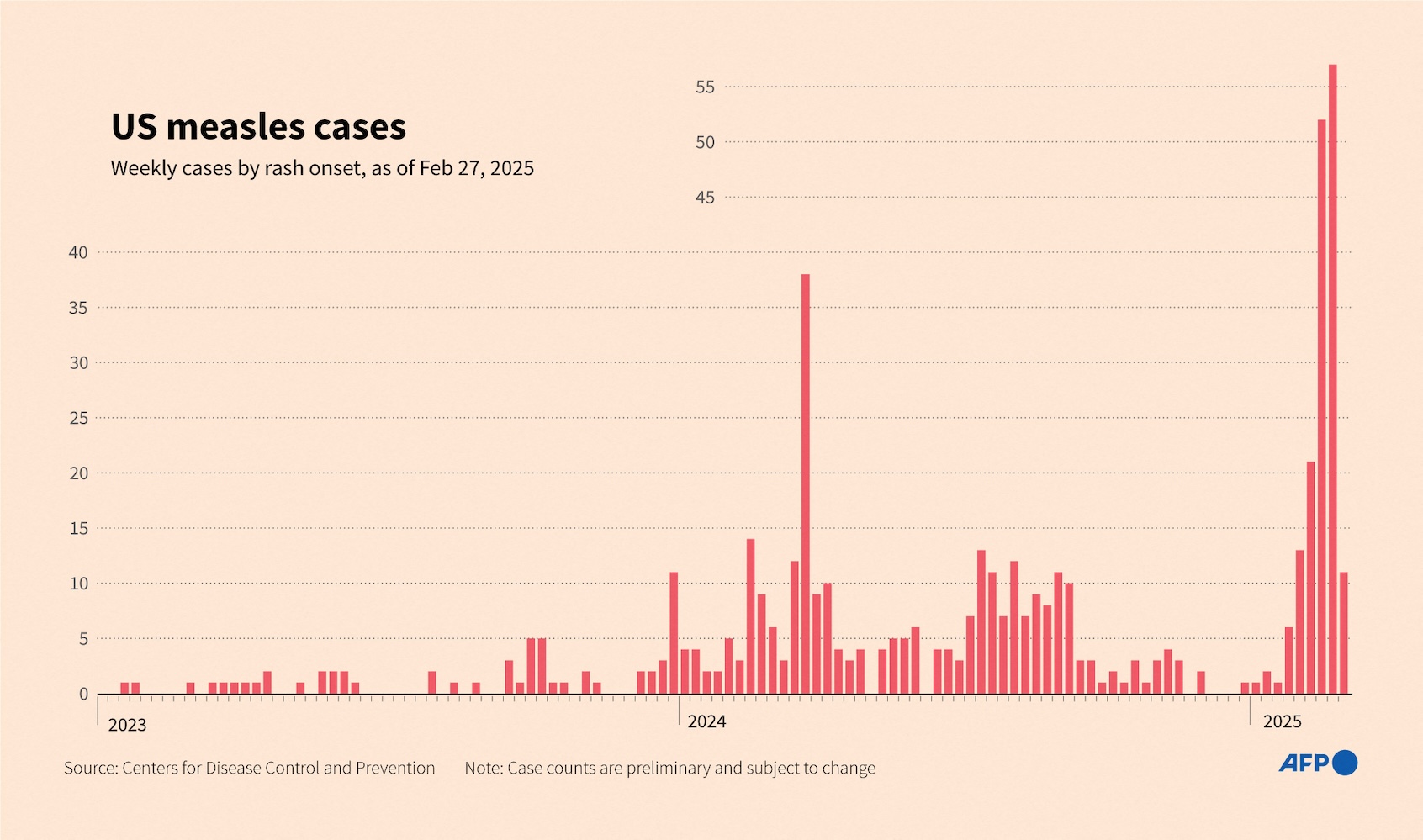
Infographic chart showing weekly measles cases in the US since January 2023, according to the Centers for Disease Control and Prevention data. (Graphic by Janis LATVELS and Nicholas SHEARMAN / AFP via Getty Images)

“We didn't know what it was until getting a letter from public health that said I may have been exposed to red measles from X date to X date at the name of the camp I attended,” Papamarko told Salon. "So it was pretty obvious at that point and when we went back to the doctor, he said I was a textbook case and he just had no idea because he'd never seen a case of measles in his entire career."

In fact, while there must be many older survivors of childhood measles around, most people with expertise in the disease in North America would have been much older than the children of the '40s and '50s… meaning that there are virtually no doctors practicing exclusively in the United States who have direct experience with measles at all. They’ll all have plenty of experience giving MMR vaccines, though — and that’s the happy reason for their lack of measles recognition skills. 

“I'm lucky in that I didn't suffer any long-term ill effects,” Papamarko said. “But I also don't think we were at all knowledgeable about how potentially dangerous the illness is. The internet didn't exist back then and the doctors we saw were pretty uninformed about it.”

So let’s talk about what happens after you send your kid to their measles party. The first dose of a measles vaccine is usually given after your baby is one year of age. So while you may have chosen to let your unvaccinated child get measles, you may be choosing for others as well, including families who have children too young to get vaccinated even if they desperately want the shot. 

It’s worth noting, if you live in an area with known outbreaks or if you are traveling with your baby, that the vaccine can be given as young as six months, so you should talk to your pediatrician about whether early vaccination might be wise. Some research suggests that it works but that its effectiveness, or perhaps effectiveness of some of the multiple ways in which children are protected following vaccination, may not last as long in kids who are vaccinated earlier than normal.

Your eyes, your ears, your lungs

Pneumonia is what most often sends a child with measles to hospital. One in 20 children with measles may get pneumonia, so the odds are high that someone at that measles party will get it. Pneumonia can be mild or it can be severe, and it can have long-term effects for a child, such as chronic lung disease, lung function deficits, and increased risk of adult asthma, chronic obstructive pulmonary disease unrelated to smoking, and bronchiectasis. And it can result in death: in fact, it’s the most common way measles kills young children. 

But it is far from the only threat. “Blindness is a very real threat to children with measles,” writes the American Academy of Ophthalmology. Measles was once the leading cause of childhood blindness, and there are several different ways in which it can harm vision. It can also cause temporary or partial but long-term vision loss. And retinitis, which can cause temporary or permanent vision loss during infection, can also appear years after the measles infection. 

You may have heard anti-vaccine claims that treatment with vitamin A is all you really need. This might come from official medical recommendations to provide a specific dose of vitamin A in cases of severe measles to reduce the risk of vision loss, which can be greater if the patient is malnourished or has a vitamin A deficiency. But a 2021 study, perhaps the first to look at whether there’s any reason to supplement vitamin A in young, hospitalized measles patients in higher-income countries where deficiency and malnutrition are less likely, found that it didn’t help reduce the risk of any complications of measles and it didn’t change the clinical course of the disease. Given that, and given the variety of risks measles infection poses for your sight, it would be far wiser not to get it in the first place. Vitamin A is also not effective at preventing measles infection, and it can be dangerous to take in large amounts.

One in ten measles infections results in an ear infection, often accompanied by bacterial sepsis, and can result in hearing loss. Most children infected with measles are under the age of five. This coincides with the key developmental period for acquiring speech and language. As a result, of some 112 children with measles-induced hearing loss in one retrospective study, about 84% were not capable of speech.

"Many have no frame of reference as to what measles can do to a child, family or community."

And your brain 

We’ve been here before, sort of. From 1989 to 1991, there was a resurgence of measles in the United States. During that time, 55,622 Americans came down with the disease. (For a variety of reasons, there used to be major disparities between vaccination rates of white vs non-white children, with rates 18% higher in white children in 1970. As a result, during that epidemic, non-white children were at four to seven times higher risk of infection and so at higher risk of long-term effects. Major targeted as well as universal policy initiatives were required to narrow that gap, and censoring words or banning concepts relating to race or ethnicity from epidemiological analyses and funding applications risks widening it again.)

The 1989 to '91 resurgence unfortunately gave us an opportunity to remember the terrible pain measles causes to families and communities. Swelling of the brain, resulting in death or damage that could involve any part of it, is perhaps the most frightening thing that measles can do to your child. It can occur as part of the initial disease, it can be an immune reaction that occurs just afterwards, or it can occur years down the line.

Famously, Olivia, the daughter of author Roald Dahl, died of encephalitis that occurred after she seemed to have almost recovered from a bout with the disease. He has written movingly of the way a bright and active child lost her faculties, becoming drowsy and then unable to do basic things: “I was sitting on her bed showing her how to fashion little animals out of colored pipe-cleaners, and when it came to her turn to make one herself, I noticed that her fingers and her mind were not working together and she couldn’t do anything.” 

Within an hour she was unconscious, and 12 hours later she was dead. Although Olivia died, other children may survive encephalitis, ending up with brain damage that can be severe or quite subtle, but life-changing for all that. 

“The person may seem like they function relatively normally, but they can really struggle with everyday activities,” Crowcroft explained to Salon. “I’m speaking to somebody who, for example, was still having trouble figuring out the order that you had to do things in. So she knew that to brush her teeth, you need a toothbrush and toothpaste and water, and you go to the bathroom, and you’d have the sequence of events. But she was having trouble figuring out what to do in what order.”

Issues child survivors of measles can carry into adult life range from similar difficulties with executive function and organizing daily life to personality problems, aggression or complete inability to function. 

“It may be less obvious, but still it can change the trajectory of where their life is going to end up,” Crowcroft said.

The worst long-term complication of measles is a form of delayed encephalitis called subacute sclerosing panencephalitis (SSPE). It’s a central nervous system disorder that only strikes seven to ten years after a measles infection, especially when the child was under two years old when they had that infection. It’s almost always fatal. 

“Often it’s hard to diagnose because it comes on as a progressive neurological problem,” Crowcroft explained. "A child who has seizures, has trouble walking, seems to be losing concentration, and no one’s really sure what’s going on, and it’s not until they do a spinal tap and find the evidence of measles infection in the cerebrospinal fluid that the diagnosis is made. So that can take some time because — well, again, it goes back to where we don’t have any measles around and everyone’s vaccinated and everyone’s forgotten about it.”

So the child gets measles (perhaps at the local measles party), gets red spots, recovers … and after seven years or perhaps a decade of loving and caring for and living with that child, they begin to lose their faculties and, other than a small percentage of cases in which spontaneous remission occurs, the vast majority die in a particularly cruel way. Families may never recover from the suffering of watching their child die from SPPE. 

There seems to be no relationship between how bad the initial case of measles is and whether the child later gets SSPE, making survival and "being fine" afterwards a poor measure of whether that measles party is a good idea. And disturbingly, a 2017 California study suggests that SSPE is far more common than was previously believed. Of the cases reported following the measles resurgence that ended in 1991, one in every 609 children under the age of 12 months at the time they contracted measles eventually came down with SSPE. As the authors of that study conclude, “SSPE cases in California occurred at a high rate among unvaccinated children, particularly those infected during infancy … SSPE demonstrates the high human cost of 'natural' measles immunity.” 

There’s also an adult-onset form of the disease that is again usually fatal, although more spontaneous remission seems to occur, especially if the adult was unusually young when they contracted measles. Like other measles complications, SSPE cannot be caused by the MMR or measles vaccine.

We need your help to stay independent

The health care system

“Events promoting intentional exposure to measles, such as 'measles parties,' can overwhelm local public health and medical services while endangering the lives and health of many community members,” warned Dr. Theresa Chapple-McGruder, associate professor of health policy and management at the University of Pittsburgh School of Public Health. In an email interview with Salon, she noted that the extreme infectiousness and long infectious period of the disease means isolation periods are necessary and are very long: 21 days for someone who’s just been exposed to measles but who lacks immunity. The alternative is returning to the days when one in 4 children was hospitalized every year due to measles.

Chapple-McGruder says that Americans have forgotten to celebrate successes, like the roughly 12,500 children’s lives saved in the past 25 years thanks to vaccination. The result: “Many have no frame of reference as to what measles can do to a child, family or community. We are seeing this firsthand with what is happening in Texas. I saw it firsthand during the Chicagoland measles outbreak of 2024,” Chapple-McGruder recalled. 

And then there’s another long-term effect of measles: it can wipe out your immune system’s memory, putting kids who’ve survived even a mild case at risk of far more frequent and severe cases of the entire Petri dish of infections in which kids are immersed at daycare and school by wiping out the antibodies they’ve previously acquired.  

All-cause mortality

Perhaps it should be obvious that if more people get more infections because measles has caused their immune systems to lose their memory of the pathogens they need to fight, some proportion of that greater number of people will eventually get really sick. But even if you are aware of that, abstractly, it can be hard to really grasp the implications. So yet another long-term effect might come as a surprise: you’re more likely to die of infectionany infection — if you’ve previously had measles. Getting vaccinated has long been known to reduce the amount of other infections a child gets. But looking at mortality data, it looks like the immune system is significantly disabled against other infections for up to three and perhaps up to five years, a period in which your child is more likely to die.

So once you’ve been to your measles party, it might be wise to hold off on that chicken pox party. Or any party, really. Or at least wear a mask.

Mind you, there’s another possible reason for lowered child death rates among vaccinated children, and that’s if the measles vaccine gives your child some kind of protection that goes beyond its goal of preventing measles infection. This is called a non-specific beneficial effect. There’s significant evidence to support this: for example, a generally lowered death rate (what the experts call a child survival benefit) from measles vaccination even in places where measles doesn’t exist. And children who are vaccinated with the MMR vaccine are less likely to be hospitalized with any infection. This effect is stronger in kids who are vaccinated at younger ages. 

Who wouldn’t line up to get this child survival benefit for their kids?

Money saved our marriage from COVID

The day the World Health Organization declared a global pandemic — March 11, 2020 — happened to be our 41st wedding anniversary. The virus then forced my wife Elvira and I to live apart from each other for the next 18 months — I in New York City, she in Italy, the two worldwide epicenters.

But luckily, I developed a survival strategy: I talked money with her. Oh, we talked family, too, as well as friends, food and, yes, our apocalyptic reckoning with microbes. But I talked money more than I ever had in my 68 years.   

Full disclosure: I had a decidedly iffy history with money. Early in my life, as a boy, a teenager and a young adult, I regarded money as vastly overrated. My family talked money ad nauseum. My response: What was the big deal? After all, my parents and grandparents paid for everything.

But I had an issue with money only until I grew up and had to make any. That changed my mind fast. Suddenly I realized — a shock to the system! — you needed legal tender in order to live.

So all through 2020, I talked money with Elvira — how much I was earning and how much I expected to earn. I updated her about retainers secured, projects completed, invoices sent out.

My reasons for talking money so voluminously that particular year were many. Five months before the pandemic officially started, I had left a job I loved after 12 years, my longest tenure ever, to open my own consultancy. So, accustomed to a regular paycheck from gainful employment for the previous 28 years, I was now a start-up, spelling a whole new ballgame. I had to hustle especially aggressively to bring in every dollar.

We need your help to stay independent

I had other reasons. We were maintaining households on both sides of the Atlantic, an expensive proposition. We also planned for me to move to Italy as soon as possible, likewise costly, and to invest in residential real estate. Oh, yeah, and I was scared the pandemic might kill us.

So making money for our family took on unprecedented importance. No wonder I talked a blue streak about money with Elvira — about the hourly billing rate I charged, the new clients I landed, the prospects I was pitching and my projected annual revenues.

As it turned out, business was good in 2020 despite the pandemic. I pulled down more income than I ever had in a single year in my 45-year career. I was understandably excited about that.

Fortunately, Elvira indulged me. She heard me out. I think she understood why I talked money so much. The more I talked money — and the more I reaped — the better I felt about all of us confronting a pandemic. My attitude, crazy as it sounds, boiled down to this: Maybe we were all going to die, but at least I was making money.

No wonder I talked money so much. Shock waves from the pandemic sent the world economy reeling. “The COVID-19 pandemic has posted unprecedented social-economic challenges and disruptions to societies and individuals,” a 2022 literature review in "Frontiers of Psychology" reported.

My attitude, crazy as it sounds, boiled down to this: Maybe we were all going to die, but at least I was making money

Some people were hit especially hard. About three in every 10 U.S. adults said they worried every day or almost every day about repaying debts, 29% worried about the ability to save for retirement, 27% worried about paying bills and about covering health care costs and 19% worried about footing the bills for rent or mortgage, according to a 2021 Pew Research Center survey of 10,334 people.

More to the point, a majority of couples (52%) “found it easier to talk about money” with each other, showed the 2021 TD Bank “Love And Money” survey. “Even with the clear financial set-backs imposed upon Americans by COVID-19,” a bank spokesperson said, “we’re seeing money conversations increasing among couples and the stigma around discussing finances diminishing.”

It was only later, after the pandemic receded into our collective rear-view mirror, that I recognized another, underlying reason I talked money so much in the teeth of my frustration and fear. It came from love — my love for Elvira, my love for our children and grandchildren, and my love of life. It was intended to reassure us all that we could stave off disease and death, that we would be OK.

And so for the first time I perceived money as more than merely a medium of payments exchanged for goods produced and services rendered. Never before had I recognized that through money we could express love. And that’s what I tried to do all through the plague: quantify that love via money.

It was as if talking money, and earning it, would act as a vaccine that endowed our family with immunity against all those nasty lethal airborne pathogens.

It was as if, in earning money for my family, I was saying, "Here you go. This is how much I love you. This is why I work so hard. This is what I do to make you happy."

I still talk money, but only now and then. I eventually managed to move to Italy. Our family was reunited. We consolidated our households.

Money still matters, and always will, but the pandemic came to an end. And right around the same time so did my need to talk money to get through it.

“Great difficulty”: Musk admits to trouble running DOGE and companies as Tesla stocks tumble

Elon Musk may have stretched himself too thin. 

The Tesla CEO and head of the Trump administration's Department of Government Efficiency told Fox Business' Larry Kudlow that he's found it hard to run his businesses and the hack-and-slash oversight agency during an interview on Monday.

"I just don’t want America to go bankrupt," Musk shared, as the price of a share of his electric vehicle company continued to plummet. 

Tesla's stock price has fallen by more than 35% in the last month. A single share of Tesla fell by more than $40 a share on Monday, plummeting along with the rest of the stock market after President Donald Trump raised fears of a recession. 

Former Trump admin official Kudlow pressed Musk on how he's coping with an increasingly busy schedule, asking how he's handling the required time away from running his companies. 

“You have given up your other stuff," Kudlow said. "How are you running your other businesses?"

"With great difficulty," Musk admitted.

A wealth manager who spoke with Salon earlier this month said the company's image lives and dies with Musk. His brand-toxic association with Trump has led to flagging sales and seemingly fueled Tesla's recent woes in the stock market.

"Companies spend billions of dollars a year on marketing, which Tesla doesn't do: The fundamental strategy of Tesla was that Elon was so likable,” Gerber Kawasaki Wealth & Investment Management CEO Ross Gerber told Salon. “But when you're driving up with Trump to meet with Putin, it's the worst advertising — and that's the problem."

Gerber's firm sold $60 million of Tesla stock in late 2024, fearing that Musk's continued association with Trump would stain his electric vehicle company. The most recent downturn in Tesla stock comes as activists have taken to protesting Tesla dealerships across the United States. In a notable example of the stink associated with Musk, a fleet of Cybertrucks taking part in a Carnival season parade in New Orleans were forced to abandon the parade route after being booed and pelted with beads. 

“You are not welcome here”: Trump promises “many” more arrests of pro-Palestine protesters

President Donald Trump celebrated the arrest of a former graduate student at Columbia University, saying the detention of the Palestinian activist and legal United States resident was "the first arrest of many to come" on Monday. 

"Following my previously signed Executive Orders, ICE proudly apprehended and detained Mahmoud Khalil, a Radical Foreign Pro-Hamas Student on the campus of Columbia University," Trump wrote on Truth Social. "We know there are more students at Columbia and other Universities across the Country who have engaged in pro-terrorist, anti-Semitic, anti-American activity, and the Trump Administration will not tolerate it."

Khalil was arrested at his home by Immigration and Customs Enforcement agents on Saturday night. Khalil's attorney, Amy Greer, told the Associated Press that ICE agents said they were acting on orders to revoke Khalil's student visa. Khalil had graduated from Columbia with a master's from the university's School of International and Public Affairs. Greer says she informed agents that Khalil was a lawful permanent resident of the United States with a green card. She says the agents then claimed they were revoking his green card.

Department of Homeland Security spokesperson Tricia McLaughlin told Columbia newspaper The Spectator that the arrest was "in support of President Trump’s executive orders prohibiting anti-Semitism."

Secretary of State Marco Rubio shared news of Khalil's arrest on Sunday, saying on X that the Trump administration will be "revoking the visas and/or green cards of Hamas supporters so they can be deported." 

On Truth Social, Trump muddied the waters between students and "paid agitators" before asking that "every one of America's colleges and universities" cooperate with ICE.

"Many are not students, they are paid agitators," he wrote. "We will find, apprehend, and deport these terrorist sympathizers from our country — never to return again. If you support terrorism, including the slaughtering of innocent men, women, and children, your presence is contrary to our national and foreign policy interests, and you are not welcome here."

Supreme Court to consider overturning Colorado ban on LGBTQ+ “conversion therapy”

The Supreme Court decided Monday to hear a challenge to a Colorado law banning "conversion therapy" for LGBTQ+ youth and young people questioning their sexualities or gender identities. 

The challenge to the 2019 law came from Christian therapist Kaley Chiles, who argued that its restriction on mental health care providers administering conversion therapy to people under the age of 18 violates her First Amendment right to free speech. Both a federal judge and a panel of the 11th Circuit Court of Appeals in Denver previously ruled to uphold the ban.

A ruling from the Supreme Court could have a nationwide impact. More than 20 states have banned the practice, which presses LGBTQ+ minors into disavowing their sexualities or identifying with the gender they were assigned at birth.

Critics of conversion therapy liken it to "torture." In a 2020 report, Victor Madrigal-Borloz, the United Nations' independent expert on sexual orientation and gender identity, called for the "extremely harmful" practice to be banned globally, citing the "pain and suffering" often inflicted on its targets.

The court will hear oral argument and decide the case in it's next term, which begins in October. 

In her petition, lawyers for Chiles say that the therapist frequently has clients who seek her counseling over concerns about their sexualities and gender identities and a belief that "their faith and their relationship with God establishes the foundation upon which to understand their identity and desires."

"The government has no business censoring private conversations between clients and counselors, nor should a counselor be used as a tool to impose the government’s biased views on her clients," Kristen Waggoner, the president of the conservative Christian advocacy group representing Chiles, Alliance Defending Freedom, told NBC News in a statement.

Colorado officials argue, however, that the law regulates physicians' conduct — not speech. They note in their brief that neither of the state's regulatory boards have received a complaint about Chiles' counseling nor have taken any action against her because of it. 

The “First Amendment allows states to regulate the professional practice of conversion therapy, like other unsafe and ineffective health care treatments, to protect minor patients from substandard professional care," lawyers for Colorado wrote.  

The Supreme Court has routinely denied previous challenges to conversion therapy bans, the most recent incident being in December 2023, when it rejected a challenge to a Washington state law. 

The Alliance Defending Freedom also represented a Colorado web designer who challenged a state anti-discrimination law because she did not want to create websites for same-sex weddings. The Supreme Court ruled in her favor in 2023. 

“The White Lotus” frenemies make a strong case for vacationing alone

Shedding friends is a painful fact of adulthood. If you haven’t experienced one or a few of these platonic divorces, congratulations – but I assure you, they will happen. Look to the left of you, look to the right of you. One of you will not be here in four years, possibly less.

But if you’re motivated to hasten the process, take a trip with your besties. There’s usually something that one friend can afford that the others can’t, or something that someone wants to do that someone who doesn’t will resent them for doing without them. British performer Savannah Gracey captured this relationship-straining phenomenon in a TikTok that made the rounds last year.

There’s no more efficient colonic for your contact list than booking a trip with shared accommodations for you and your pals — the more luxurious the better. Koh Samui, Thailand, where Season 3 of "The White Lotus" is set, is where grace and spirituality scrape against snake shows and sensual hedonism. There may be no riper locale for betrayal and homicide. Between Carrie Coon’s Laurie, Michelle Monaghan’s Jaclyn and Leslie Bibb’s Kate, however, the likeliest death this season may be their lifelong friendship.

There’s no more efficient colonic for your contact list than booking a trip with shared accommodations for you and your pals.

Jaclyn, Kate and Laurie enter their $15,000-a-night villa under the mistaken impression that their annual dinners and infrequent phone check-ins are enough of a bridge to keep their affection alive. Many friendships operate on a similarly low but steady electrical current. It takes spending sustained time with those same people, in bathing suits no less, to realize how far apart you’ve drifted ideologically, or sympathetically. 

Wealth has a way of sorting relationships when one friend's opulence brings out lustful envy in the others, the deadly sins most likely to drive daggers into the gut of any platonic bond. 

Michelle Monaghan in "The White Lotus" (Fabio Lovino/HBO)Jaclyn is a famous actress paying for everything which, of course, she’s happy to do! She’s in Los Angeles while Laurie works in New York and is on the other side of an ugly divorce. Somewhere in the middle — both geographically and figuratively — is Kate, all smiles about her life in Austin, Texas, and very secretive about her politics. Distant from the judging eyes of people they know and with every thinkable comfort at their fingertips, each drops their guard, just like the other guests. 

At first, the ladies are all giggles and clinking wine glasses, celebrating the fact that they’ve finally found time to connect. “You look amazing!” “No, you look amazing!” “You look incredible!” “No, you look incredible. . . ” and so on. 

Kate shares that this is their “victory tour,” not the midlife crisis vacation her husband thinks it is, but before they utter a line of dialogue, we can see the divisions.

Laurie’s haircut and off-the-rack fashion are modest compared to Jaclyn and Kate’s chunky gold jewelry and shimmering resort couture. Jaclyn’s heavy gold comedy and drama mask earrings are harbingers of the two-faced backstabbing ahead. They may have launched from the same circumstances but reconnect in their 40s as unequals. 

Jaclyn, recognized wherever she goes as a bonafide famous person, hears from wealthy socialite Kate that she is also a celebrity, albeit a local one. Telling her she is just “winning life,” Jaclyn goes on to gush about her multiple homes and beautiful kids and then swivels to Laurie, a midlevel corporate executive, offering only, “Everything you do is just so hard! You’ve always been so impressive, and the corporate world is so tough.”

“Uh huh,” Laurie says weakly, gulping her chardonnay.

Yes, Jaclyn’s all smiles and compliments until a tipsy Laurie retires, giving the others some one-on-one time.

Laurie’s a great friend, and such a hard charger, says Jaclyn, to which an agreeing Kate replies, “She looks great!” A few beats later, she slides in gossiping about Laurie’s menace of a kid and gnarly divorce. Jaclyn guesses her career has stalled out. 

“No wonder she looks defeated,” Kate sighs.

Carrie Coon in "The White Lotus" (Fabio Lovino/HBO)“I thought you said she looked great,” Jaclyn counters with a naughty look on her face, and Kate’s grin returns. “Well, uh, she does! But she also looks tired. Don’t you think? A little down?”

“Might be the drinking,” Jaclyn evilly coos. The pair express more venom about their pal before Jaclyn sighs, “I just love her so much!” 

Laurie, Jaclyn and Kate are the kinds of women who claim to buy into the O Magazine ethos of a woman having evolved beyond youthful insecurities in midlife. But sharing the attention of their studly Russian health concierge Valentin (Arnas Fedaravičius) hurtles them back to being competitive adolescents again. 

From the jump, Jaclyn pushes him on Laurie as a possible sexual conquest. She’s the only singleton of the three of them, and what happens in Thailand stays in Thailand. By the fourth episode, they've wrangled Valentin into taking them on a nightlife tour, and Laurie has warmed to the notion of seducing him.

We need your help to stay independent

And yet, when the trio trades the results of their biomarker tests, the Hollywood-toned and tucked Jaclyn is visibly dismayed — but still so positive, love her! — that “tired” Laurie has similar results to hers, including a low body fat percentage. Shortly after they smirk through that exchange, Jaclyn casually reminds Laurie and Kate that she’s married to a man a decade younger than she is.  

Since Jaclyn and Kate shared a little midnight gossip about Laurie we can assume, correctly, that Kate and Laurie will rip into Jaclyn about that.

It’s Kate’s turn, at last, brought on by Laurie and Jaclyn uniting in shock to find out that their friend has become a churchgoer. Laurie asks if talking politics with that crowd ever gets awkward, and Kate casually replies, “Why would it?” 

The full weight of their friend’s new identity smacks Laurie across the jaw. “Wait, are you a Republican?!” 

“No!” Kate says, appearing shocked at the implication, and once her friends relax again, she chirps. “I’m an independent,” before murmuring into her wine glass that her husband is a Republican.

Laurie asks the question on most viewers' minds. “You didn’t vote for Trump, though, did you?” Kate responds with a tight high-wattage grin, smizing like her life depends on it before deflecting with, “Are we really gonna talk about Trump tonight?” 

Being in places where other people are catering to your needs can inspire people who view vacation as a “get out of jail free card” to do and be their worst . . . the core premise of this show.

Mike White writes some version of the awful best friend archetype into each season, but he may have peaked with these three flavors of blonde, stunningly performed by Coon, Monaghan and especially Bibb. Kate’s “it’s no big deal” smirk through her non-confession to going MAGA should be the highlight of her For Your Consideration reel come awards season. 

Between the actors' silent conversations and the nuances of envy and backhanded slights White conveys through dialogue, these friends brutally play out the intimacy gap that can doom vintage friendships. That they’re hurtling toward that chasm’s cliff on vacation, however, feels painfully real. 

Getaways have a knack for testing relationships. We’ve long known that to be true about romantic pairings, but folks tend to be quieter about cutting off contact with companions with whom you’re otherwise compatible after a miserable trip. 

Unfamiliar places bring out everyone’s insecurities, and if the person who has long claimed to have your back doesn’t make you feel safe, that’s a problem. Being in places where other people are catering to your needs can also inspire people who view vacation as a “get out of jail free card” to do and be their worst . . . the core premise of this show.


Want a daily wrap-up of all the news and commentary Salon has to offer? Subscribe to our morning newsletter, Crash Course.


An entire subset of TikTok is titled “The Tea on Why Friendships End on Vacations,” where layman advisers explain why this is such a common issue. Most of the people offering their two cents are women in their 20s or 30s, which is about right. That’s the time of life when people may not have defined what vacationing means to them and cling to the importance of doing everything together.

At some point in adulthood, though, spending power becomes something your friends either share so everyone can have a good time, or flex so they can stunt on you. No place is better for bringing that to a head than a tropical destination where the drinks flow freely and there’s a staff available to clean up everyone’s messes.

With four episodes of Season 3 to go, we can’t say for certain that Jaclyn, Laurie and Kate’s weak sisterhood won’t survive this trip. But nobody can blame them if they were to take their next vacations separately — and solo.

New episodes of "The White Lotus" debut 9 p.m. Sundays on HBO and stream on Max.

Proposed cuts to SNAP benefits could deepen hunger and hurt local economies, experts warn

The Supplemental Nutrition Assistance Program has long been a crucial lifeline for millions of Americans facing food insecurity. Each year, approximately 42 million people rely on SNAP to meet their food needs. However, recent proposals from the Trump administration and Congressional leaders to roll back SNAP benefits nationwide are raising alarms, with many wondering how these cuts would impact their local communities. New data from the Urban Institute sheds light on just how significant the gap between SNAP benefits and local food costs could become if these cuts move forward.

A proposed rollback of the 2021 update to the Thrifty Food Plan — which determines the amount of SNAP benefits — would leave recipients with insufficient support to meet even the most basic meal costs in any U.S. county. According to the Urban Institute, the average meal cost would surpass the maximum SNAP benefit by 51%, leaving recipients on average $105 short per month. 

Some regions, especially those with high food costs, may face even steeper challenges.

In response, The Food Research & Action Center (FRAC) and over 1,600 national, state, and local organizations from every state have urged Congress to reject any cuts to SNAP. In a March 6 letter, these groups emphasized the crucial role SNAP plays not only in alleviating hunger but also in improving health outcomes and boosting local economies.

“Cuts to SNAP would not only increase food insecurity but also shift the burden of food assistance to local governments and charities, which cannot fully meet the need,” the letter read, in part. “For example, while emergency food programs help, they only provide one meal for every nine meals that SNAP supplies. The proposed cuts would further strain food banks, food retailers, and those serving vulnerable populations.”

It continued: “Additionally, reduced SNAP benefits would hurt the broader economy. Food retailers, including grocery stores and farmers' markets, depend on SNAP dollars to stay afloat. In areas where food retailers are already struggling, any reduction in SNAP benefits would have a catastrophic impact on businesses and the local economy.”

We need your help to stay independent

The Thrifty Food Plan, or TFP, which serves as the foundation for determining SNAP benefit levels, had remained unchanged since 2006. As Salon reported last year (following then-House Agriculture Committee Chairman Glenn “GT” Thompson’s proposal to cut SNAP’s budget by $30 billion) it wasn’t until 2018 that Congress passed a bipartisan provision to re-evaluate the plan every five years, with the 2021 update reflecting current dietary guidelines, the rising cost of food, and evolving household consumption patterns. 

As the Urban Institute’s Poonam Gupta and Elaine Waxman wrote in a report at the time, before the 2021 TFP update, the old TFP assumed an average family “consisting of a man, woman, and two children predominantly purchased milk, potatoes, fruits and rice, and spent roughly two hours a day preparing food from scratch, including tasks like hand-soaking dried beans.”

“All of these assumptions were proven to be grossly out of step with actual food preparation and consumption behaviors and are not grounded in the reality of everyday life,” they continued. “The reality is, our interactions with our food environment are constantly evolving as people and food systems grow and adapt to climate change and other external factors. In response, dietary guidelines, consumption patterns, and preparation times will continue to shift.” 

The 2021 update was significant, increasing the average SNAP benefit per meal by approximately 21%. However, proposed policy changes would reverse this progress, reducing the per meal benefit from $2.84 to $2.25. 

"The reality is, our interactions with our food environment are constantly evolving as people and food systems grow and adapt to climate change and other external factors. In response, dietary guidelines, consumption patterns, and preparation times will continue to shift."

At this reduced level, SNAP benefits would not cover the average cost of a modestly priced meal in any county across the U.S. Nationally, the average meal cost in 2023 is $3.37, leaving a stark gap between what SNAP provides and what families must pay to feed themselves. In total, families would fall short by $105 each month.

This shortfall would hit hardest for the nearly 40% of SNAP recipients who rely on the maximum benefit, which is often the only way they can afford to eat. Households that already struggle to make ends meet would face an even steeper financial burden, forcing them to choose between purchasing fewer, lower-quality food items or diverting funds from other essential needs.

As established by the Urban Institute, the impact of these proposed cuts will not be uniform. While SNAP benefits are based on a nationwide formula, food prices vary widely across the U.S. In high-cost urban areas like New York County or rural regions like Custer County, Idaho, meal costs are far higher than the average. In some counties, food prices are twice as high as the current SNAP benefit, creating an even greater discrepancy between available benefits and actual food costs.

Without adjustments for regional cost variations, SNAP recipients in high-cost areas will experience more severe challenges in feeding themselves and their families. The reduction in benefits could force households to cut back drastically on the quality and quantity of food they purchase, further exacerbating food insecurity, which is already a significant problem in many regions.

The economic repercussions of reduced SNAP benefits extend beyond individual families. Studies show that for every dollar spent on SNAP, up to $1.80 is generated in economic activity, particularly during economic downturns. Cutting these benefits would not only hurt families but also harm local economies. The reductions would ripple through food supply chains, impacting farmers, grocery stores, and food retailers. Jobs would be lost, and local businesses would see decreased revenue, especially in rural and southern areas where food insecurity rates tend to be higher than the national average.

"Any cut to benefits or reduced access to participation will have serious consequences for children, older adults, people with disabilities, and those living in rural areas who rely on this support to put food on the table."

Beyond the immediate financial strain, cuts to SNAP would also have long-term consequences for public health. Access to sufficient nutrition is directly linked to better health outcomes, including improved birth outcomes, better academic performance, and lower healthcare costs. According to a report by the Food Research & Action Center, SNAP has been shown to improve children’s test scores, reduce the incidence of chronic diseases, and lower rates of maternal and infant mortality.

For children in particular, the consequences of food insecurity are devastating. Reduced access to healthy meals and school nutrition programs would hinder children’s development, both physically and academically. School meal programs, which are often closely linked with SNAP, ensure that children receive at least one nutritious meal each day. Without this support, food insecurity would likely increase, affecting students’ ability to focus, learn and thrive in school. FRAC warns that the proposed cuts to school meals, in tandem with reductions to SNAP, would increase the number of children who experience food insecurity, thus perpetuating a cycle of poor health and educational outcomes.

As these legislative battles unfold, advocates are speaking out in large numbers. The letter from FRAC and over 1,600 organizations emphasizes the importance of SNAP not just for fighting hunger but for its broader impact on health and the economy.

“SNAP is one of the most effective programs we have to combat poverty-related hunger, improve health outcomes, and boost local economies,” said Crystal FitzSimons, interim president of FRAC. “Any cut to benefits or reduced access to participation will have serious consequences for children, older adults, people with disabilities, and those living in rural areas who rely on this support to put food on the table.”

“Silencing dissent”: Trump administration arrests pro-Palestine activist at Columbia University

Organizers are planning a rally Monday against President Donald Trump and his administration's arrest over the weekend of a pro-Palestine protester at Columbia University — a permanent resident who has been targeted for deportation.

Monday afternoon, protesters are set to gather at Federal Plaza in New York City in support of Mahmoud Khalil, the student who has been detained and who had served as a negotiator between the university and others protesting Israel's war in Gaza. The protest is being organized by groups including Shut it Down for Palestine,The People’s Forum and Writers Against the War in Gaza.

Khalil’s detention, and the administration’s promise to deport him for protesting, has sparked a sharp response among some Democrats, like Rep. Ayanna Pressley, D-Mass., who called Trump a dictator for his crackdown on speech and protest.

“A President who detains a protestor and revokes their legal status can only be called one thing: A dictator,” Pressley said in a post on Bluesky. “Silencing dissent is unlawful, unjust, and authoritarian through and through.”

Secretary of State Marco Rubio, responding to a news report about the arrest, promised to revoke “the visas and/or green cards of Hamas supporters in America so they can be deported.”

Khalil was initially detained in a New Jersey facility but has since been moved to Louisiana, according to ICE.

In a statement Sunday, ICE claimed to have detained Khalil “in support of President Trump’s executive orders prohibiting antisemitism, and in coordination with the Department of State, U.S. Immigration and Customs Enforcement Arrested Mahmoud Khalil, a former Columbia University graduate student. Khalil led activities aligned to Hamas, a designated terrorist organization.”

ICE did not explain how Khalil’s activities were “aligned to Hamas.” Khalil’s arrest represents an extraordinary development as he has not been charged with a crime.

“Canada will never ever be part of America”: Trudeau’s replacement immediately takes it to Trump

People have always wondered what it is about now former Canadian Prime Minister Justin Trudeau that Donald Trump just cannot stand. His politics aren't demonstrably different from any other center-left leader Trump has dealt with around the world and the U.S.-Canadian relationship, until now, had been the most congenial, peaceful and cooperative relationship in the history of both countries. I happen to think it's personal, as is so much of Trump's behavior toward his global counterparts.

Just as he admires Russian President Vladimir Putin for his strongman image or North Korean leader Kim Jong Un for his (plainly insincere) obsequiousness, he likewise loathed German Chancellor Angela Merkel for being a plain, dumpy woman and currently hates Volodymyr Zelenskyy for being, in Trump's mind, the instrument of the humiliation of his first impeachment. With Trudeau I think it's always been simple: juvenile jealousy of his youthful good looks. Trump is not a complicated man when it comes to his judgments of other people. He is, after all, a person who commonly hires people because they are "out of central casting."

During Trump's first term, his antipathy for Trudeau was evident from the start and it began with one of Trump's famous handshakes. He likes to try to dominate his peers by violently yanking their hands toward him. It often makes for bizarre awkward situations. But a couple of weeks after his inauguration, during the traditional visit between the two leaders, Trudeau resisted the "yank" at the White House door and then hesitated before taking Trump's weird palms-up outstretched hand in the Oval Office. The picture went viral.

The BBC even published a long disquisition on English physician John Bulwer’s 1644 "eccentric tome Chirologia: Or the Naturall Language of the Hand, Composed of the Speaking Motions, and Discoursing Gestures Thereof." to explain what had happened. (It said Trudeau's hand position wasn't disdainful but rather dejected while there was no explanation for Trump's odd gesture at all.)

It also didn't help that when Trump brought in Trudeau to a 2017 meeting with businesswomen, including his daughter Ivanka, the swoon was heard around the world. Trump clearly believed, and still does, that he was the leader with the movie star good looks and he didn't like it one bit.

If Trump expected that Trudeau's replacement was going to come crawling for forgiveness it appears that he was wrong.

From that point on, Canada was in Trump's cross hairs. Trump refused to meet with Trudeau at various meetings or shake his hand, and he constantly threatened to throw tariffs on everything whenever he felt he was being disrespected. They did finally agree on an update of the NAFTA treaty which Trump had characterized during his campaign as screwing the U.S. (It did, but not in the way Trump said it did.) They essentially ended up slightly tweaking it so that Trump could strut around like a hero.

I suspect that the straw that broke the camel's back was this moment caught on tape of world leaders having a laught at Trump's expense at that G7 after he absurdly announced that it had been decided that the very best location for the next meeting, scheduled to be held in the U.S., would be his Doral Golf Club in Florida.

Considering all that, I suppose it's not a big surprise that Trump would still hold a grudge and give Trudeau a hard time when he became president again. But never did anyone imagine that he would launch a full scale rhetorical assault on Canada itself, insult its people and proclaim that he wants to annex the country and make it America's 51st state.

Trump had said he planned to throw huge tariffs on Mexico and Canada during the campaign but nobody knew if it was just the usual Trump bluster or if he meant it. He went forward with them as promised and since then has gone back and forth so often that nobody knows what he's really after.

It's obvious that his deep antipathy toward Mexico stems from immigration and his belief that it is just another sh**hole country. He is sending combat troops to the border and has previously entertained plans to invade the country ostensibly to "take out" the drug cartels. As grotesque as it is, it isn't exactly a surprise. On the other hand, this ongoing threat to make Canada the 51st state, even repeatedly calling Trudeau "governor," is entirely unexpected.

We need your help to stay independent

According to the New York Times, what they first considered a typical Trump insult joke is now being taken very seriously by the Canadian government. They report that the phone calls between Trudeau and Trump as well the trade talks between the two countries are extremely acrimonious, beyond anything previously experienced. Trump has even said explicitly that he does not believe that the treaty which officially declared the borders between the two countries is valid and he intends to change it.

"The excuse that he’s giving for these tariffs today of fentanyl is completely bogus, completely unjustified, completely false,” Trudeau recently said of Trump. “What he wants is to see a total collapse of the Canadian economy, because that’ll make it easier to annex us.”

They seem to think he means it.


Want a daily wrap-up of all the news and commentary Salon has to offer? Subscribe to our morning newsletter, Crash Course.


On Sunday, Justin Trudeau stepped down as Prime Minister after 10 years as he had promised to do. He was very unpopular over the past year and his Liberal party was expected to lose to the conservatives in the next election. That is, until Trump started talking about making Canada into the 51st state and Trudeau started telling it like it is. The Liberals have surged in the polls and will probably call elections very soon to take advantage of it. The people of Canada, across the political board, are infuriated by Trump's audacious threats and they are not in any mood to cater to his insane impulses regardless of his tariff threats.

The party elected former central banker Mark Carney as the new Prime Minister and should they win the elections he will be the one to deal with Trump's antics going forward. Luckily, although he is a nice looking fellow, he isn't likely to inspire the extreme jealousy Trudeau inspired in Trump. But if Trump thinks that he will kow-tow to him, he may have another thing coming. His acceptance speech was a barnburner. Among other things, he proclaimed that "Canada will never ever be part of America in any way shape or form" and "My government will keep tariffs on till America shows us respect."

"Donald Trump thinks he can weaken us to divide and conquer," Carney made clear. "We can give ourselves far far more than Donald Trump can ever take away"

As I write this Trump has not written anything on Truth Social or offered a statement. If Trump expected that Trudeau's replacement was going to come crawling for forgiveness it appears that he was wrong.

The Republican Party and the vast majority of American elites have certainly been a perfect illustration of that. It's a shame that Americans have to look to our neighbor to the north for inspiration but we're grateful for it.  

“Just getting started”: We have yet to see the worst of Trump’s “spectocracy”

Are you not entertained?

America’s state of the union is horrible and rapidly becoming much worse. President Trump is the ringmaster, master of ceremonies and star of this horrible spectacle.

In her newsletter, historian Ruth Ben-Ghiat highlights the central role that the spectacle plays for the autocrat-authoritarian: “Anyone who studies authoritarianism, a political system that depends on propaganda, corruption, machismo, and violence, is well acquainted with the parade of sociopaths, sycophants, petty and grand criminals, and zealots who flourish in lawless environments where the performance of power is everything and the leader is elevated to a semi-divinity. In authoritarian states, ridiculousness often competes with brutality for center stage.”

The sum effect of the spectacle that is the Age of Trump is to make the American people feel powerless, disoriented, confused, and that they lack any agency over their personal destiny(ies) and the direction of their country, as David Remnick writes in a new essay at The New Yorker:

It was one thing to anticipate this prolonged political moment; it has been, these past weeks, quite another to live it. Each day is its own fresh hell, bringing ever more outrageous news from an autocrat who revels in his contempt for the government he leads, for the foreign allies who deserve our support, and for the Constitution he is sworn to uphold. Since beginning his second term, six weeks ago, Donald Trump has commandeered public attention to such an extent that it is hard to recall that there was ever a time when an American President went about his first weeks in office in a frenzy of activity characterized not by threat, chaos, and corruption but by discipline, competence, and compassion.

Ultimately, the spectacle is not secondary or peripheral to Trump’s authoritarian strongman approach to leadership and politics (and his core personality), it is central to it.

For example, Trump recently invited Ukrainian President Volodmyr Zelenskyy to the White House to sign a mineral rights agreement that would ostensibly help to guarantee Ukraine’s protection from future Russian aggression. Instead, Donald Trump and JD Vance publicly ambushed Zelenskyy and demanded that he show more public “appreciation”, i.e. beg Trump for America’s military assistance and other help. When Zelenskyy pushed back and refused to beg, the meeting ended without an agreement and he was told by Trump’s staff to leave the White House immediately. This came after several weeks where Trump, playing the role of professional wrestling heel and comedian, repeatedly attacked Zelenskyy with insults and mockery. The next day, Trump announced that the United States would “temporarily” cut off military assistance — which now includes sharing intelligence information — in an attempt to force Zelenskyy to negotiate “peace” on terms that would be very favorable to Putin and Russia.

Trump’s actions have been widely criticized as one of the low points in modern American history where “the greatest country on Earth” and “leader of the free world” is now de facto siding with Russia and other enemies of democracy and the West.

The Oval Office meeting with Zelenskyy was supposed to be a carefully staged spectacle and media event that would be shown around the world as an example of Trump’s high dominance leadership and strongman approach to government in which he is never to be challenged and all, both friends and foes, are to eagerly submit.

"Media mistakes can be consequential," media scholar David Altheide told Salon. "The recent dressing-down of Ukraine President Zelensky by President Trump and Vice-President Vance was a glitch on a media stage."

The discussion was staged with TV cameras present to promote Donald Trump’s strong leadership for a cease fire in the Ukraine-Russia war, although the underlying aim was to further his quest for a Nobel Peace Prize. It was to be a ceremony and a victory for harsh political pressure in the guise of statesmanship. But sloppy handling and poor execution by the Trump White House production company did not anticipate a discussion and disagreement about the price of Trump’s version of a cease fire.

As Altheide notes, "the importance of media competence and agility is underscored by this debacle as well as President Trump’s recovery attempt. Not getting the performance he desired led him to impugn President Zelensky’s motives, ability, and gratitude."

As compared to the debacle that was his meeting with Zelenskyy, Trump's address to a Joint Session of Congress last week was an opportunity for Trump to revel in his power as president and leader of the American "spectocracy." The New MAGA Order.

Trump’s speech was one of the longest in the history of the presidency. He received his narcissistic fuel from the adoring Republicans and other supporters and supplicants in the audience and in the media. He boasted and exaggerated about his “successes,” dissembled and lied, performed as “Donald Trump” the symbol and character, postured and threatened, and was and is the main character in a story of American carnage that he is writing and living in real-time.

We need your help to stay independent

The grossly surreal nature of Trump’s speech (and this era) was encapsulated by his triumphant return to the Capitol and Congress. Four years earlier, Trump’s MAGA followers attacked the Capitol as part of his coup attempt, running amok, battling the police, smearing feces on the walls of that historic building and the heart of American democracy, waving a Confederate flag, carrying a huge White Christian cross like they were Crusaders from the European Middle Ages and erecting a gallows to execute Vice President Pence and the other “traitors.” On Tuesday night, many of the same Republican members of Congress who were literally hiding for their lives on Jan. 6 applauded Trump as a conquering hero and their champion.

Via email, David Altheide also shared this analysis of Donald Trump’s address to Congress and how Trump, again, demonstrated his mastery of propaganda and the spectacle:

President Trump’s nearly 100-minute speech to Congress was a campaign talk of slow talking points supported by dozens of lies. His slow and measured delivery was built around pauses for applause and affirmation of his presence. It was very good television. As linguist Professor John McWhorter noted nearly 8 years ago, Trump never leaves the casual talk mode when speaking more formally, perhaps because he never developed a more adult style and some basic sophistication in school. His casual style epitomizes the intersection of narcissism and linguistics. Stuck with a limited vocabulary, his attention-based style of speaking reinforces his proclaimed stature and knowledge. For example, his talk to Congress used the following words a lot: most (28), beautiful (17), big (13), nobody (8), and incredible (6). He also referred to former President Joe Biden 13 times, while disparaging Democrats 4 times.

Ironically, President Trump’s limited use of language in short repetitive sentences is also well-suited to digital social media that stress few words, little context, and resonate emotionally, often with visual support. This style lends itself to the major themes Trump stressed, including power, dominance, punishment and threat.

Altheide went deeper with these specifics:

Power was apparent in noting his successful election, “all 7 swing states,” and signing 100 executive orders, taking 400 executive actions.

Dominance appeared in insults to President Biden, former Vice-President Kamala Harris, and Senator Warren (‘Pocahontas’). He also stressed his dominance on issues associated with the ‘culture wars,’ e.g., DEI, LGBTQ+, ‘And our country will be woke no longer.’

Punishment was apparent in boasts about negative characterizing and deporting of migrants, and firing of federal workers (‘we have hundreds of thousands of federal workers who have not been showing up to work.’)

Finally, threat was a dominant theme, also related to firing workers, “And any federal bureaucrat who resists this change will be removed from office immediately. Because we are draining the swamp.” Most poignantly were threats to take back the Panama Canal and annex Greenland.

The upshot is that a typical “big,” “beautiful,” “never seen before,” “incredible” Trump performance was presented to obedient Republican supporters and a divided country, without a hint of reconciliation, or a positive legislative agenda —except for a tax break that will benefit wealthy people.


Want a daily wrap-up of all the news and commentary Salon has to offer? Subscribe to our morning newsletter, Crash Course.


What about the Democrats? They continued with their months of being a hapless, ineffective, and neutered opposition party. Rep. Al Green of Texas showed some fire as he protested and heckled Trump. The Sergeant-at-Arms ejected him. Other Democrats sat in silence or displayed placards that had the words “liar” or “false” on them. Some Democrats walked out during Trump’s speech. In the face of Trump’s will to unlimited power, the Democratic Party’s response was not inspiring, an ongoing theme since they were routed by Trump and his MAGA Republican Party last November.

How did the mainstream news media cover Trump’s address to Congress? It repeatedly used language such as “partisan” and “polarizing”. Those descriptions have been robbed of their meaning and now distort and minimize Trump and his allies’ attempts to end America’s multiracial pluralistic democracy.

In another example of media malpractice and normalizing of Trump and his MAGA anti-democracy movement, the New York Times described his speech to Congress as exemplifying “Game Show Flair” where “A child with cancer, the mother of a murder victim and a newly admitted student to an American military academy were given the spotlight during the president’s speech.” This is an example of exactly how not to report on President Trump. There is nothing harmless or “game show-like” about Trump’s aspirations and plans to become the country’s first autocrat and ruler for life.

Donald Trump has only been president for seven weeks. His shock and awe campaign has been devastatingly effective in inflicting trauma and uncertainty on the American people, pushing the country closer to economic disaster, undermining the country’s democratic norms and institutions, making a mockery of the rule of law, destabilizing the international order and empowering Putin and Russia and other malign actors and enemies of democracy and freedom, and in total pushing the United States much closer to a state of competitive authoritarianism or outright fascism.

Echoing my warnings, Thomas Edsall explains how these are the good times compared to what comes next:

Assuming that the past six weeks are predictive of what’s next, expect an age of anxiety; expect the elimination of tens, if not hundreds, of thousands of jobs; expect the decimation of liberal institutions to go on for all four years of Trump’s second term; expect government services to deteriorate; expect reduced funding of the safety net; and expect more homelessness, hunger and disease. Expect poverty; expect the financial starvation of universities and of nongovernmental organizations; and expect unannounced raids, unreliable data and an America increasingly aligned with authoritarians worldwide. Expect a pervasive climate of suspicion and a preoccupation with revenge. Expect more suffering, more fear, less security and less happiness.

In other words, expect the worst.

This is not sustainable. Like individuals, societies have limits and can be pushed towards a state of psychological, emotional, psychic, spiritual and physical collapse.

During his address to Congress, Trump bragged and threatened that his administration “is just getting started.” Always believe the autocrat-authoritarian. They mean what they say both literally and figuratively.

What will America look like 30 days from now? Six months from now? A year in the future? I shudder at the very thought of this New MAGA America. But one thing is almost certain, Trump’s spectacle and theater of pain and domination will only get worse — much, much worse.

Banning “Enola Gay”: Pete Hegseth’s DEI paranoia knows no limits

During his confirmation hearing, Defense Secretary Pete Hegseth repeatedly insisted he is not a racist nor a misogynist, but wants "a Pentagon laser focused on warfighting, lethality, meritocracy, standards, and readiness." Despite his bellicose Christianity, however, Donald Trump's appointee had no problem violating the biblical commandment against bearing false witness. As soon as he was sworn in, Hegseth did exactly the opposite of what was promised. He and Trump have devalued merit, expunging experienced and dedicated military leaders for no real reason other than they are not white men. Hegseth demanded budget cuts. He backed Trump's refusal to send older weapons to Ukrainian fighting forces, allowing the U.S. military to update its stockpile. He's gone along with Trump's war on intelligence-gathering on Russia, which puts American troops at higher risk. He's supported Elon Musk's war on veterans, as well, which includes firing them from federal jobs and slashing 80,000 employees from Veterans Affairs

He's trying to remake the military into his fantasy of a country where straight white Christian men hold all the power and everyone else is marginalized, often to the point of exploitation.

Instead, Hegseth's priority — the better word is "obsession" — since taking office has been pushing the racism, misogyny, and queerphobia he denied during his confirmation hearing. Under the guise of eliminating "DEI" (short for "diversity, equity and inclusion," but used as a slur word by the right), Hegseth has waged all-out war on any evidence that people who aren't straight white Christian men can be effective soldiers. On top of purges of military leadership, Hegseth has canceled all military observances of Martin Luther King Jr. Day, Pride Month, Holocaust Days of Remembrance and any other occasion acknowledging the contributions of people who aren't straight white Christian men. He's also been on a rampage against military bases that dropped the names of Confederate leaders. Being pro-slavery is enough to exonerate literal treachery in Hegseth's view. 

Last week offered a sobering reminder of how Hegseth's bigotry blitz isn't just symbolic, but will harm real people. The Defense Department reversed a 1965 policy that bars defense contractors from using segregation at their facilities. Under the new rules, the Defense Department can hire firms with "whites only" bathrooms on-premise. Such workplaces likely don't exist in 2025, but with Hegseth's tacit encouragement, who knows how bad things will get. 


Want more Amanda Marcotte on politics? Subscribe to her newsletter Standing Room Only.


Another recent result of Hegseth's single-minded bigotry is at least kind of funny. In a frenzy to ban anything deemed "DEI," the Defense Department flagged photos and articles featuring the Enola Gay for deletion from all websites and social media posts. The Enola Gay was the plane that dropped a nuclear bomb on Hiroshima, Japan in 1945. The name was not a reference to homosexuality, but was given to the B-29 bomber by the pilot in honor of his mother, Enola Gay Tibbets. The database of banned images and references also includes a long list of any service members with the common last name "Gay." It appears Hegseth embraces Musk's view that so-called artificial "intelligence" can replace human workers. In this case, it's for the best, as no human being should waste their precious work hours on Hegseth's dogmatic desire to wipe history clean of all evidence that people who aren't exactly like him are worthy members of society. 

The story did result in some good jokes. 

Enola Gay will henceforth be known as Enola Straight. Fat Man and Little Boy are holding steady. apnews.com/article/dei-…

[image or embed]

— Schooley (@schooley.bsky.social) March 6, 2025 at 9:31 PM

But overall, this story is mostly a reminder that the U.S. is under siege from a fascist movement led by men who are trying to conceal their mediocrity. While he tries to play the victim of "wokeness," it appears that Hegseth's military career ended in failure. He has complained that the Army "spit me out," an apparent reference to how he was pulled off certain duties because his colleagues notified superiors that he has tattoos that are considered white supremacist symbols. No doubt it's personal for him, seeing so many women, people of color, and LGBTQ people rack up honors and promotions he didn't get during his many years of service. 

It's also ideological for him, however. As I've documented at Salon, Hegseth belongs to a far-right Christian church that teaches slavery was the pinnacle of race relations in the U.S. and that women should not work outside the home or even have the right to vote. These can't be written off as "private" religious views. The church is openly Christian nationalist, which means the leaders advocate for using the government to force their religious beliefs on the nation — basically, theocracy. Hegseth himself has declared a need for an "army" that could remake the U.S. into the far-right Christian society they desire. 

This story is a reminder that the U.S. is under siege from a fascist movement led by men who are trying to conceal their mediocrity.

It's not hard to see, therefore, what's going on here: Hegseth sees the U.S. military as a venue for his Christian nationalist social experiment. He's trying to remake the military into his fantasy of a country where straight white Christian men hold all the power and everyone else is marginalized, often to the point of exploitation.

One of the biggest Defense Department hires illustrates how deep Hegseth's extremism runs. As Anna Merlan at Mother Jones reported, the new deputy press secretary at the Pentagon is Kingsley Wilson, a 26-year-old who endorses the neo-Nazi "Great Replacement" theory that holds Jews are secretly trying to "replace" white Christians with immigrants of color. She has called for "zero immigration" and posts German neo-Nazi slogans. She also, just to show the bizarre depths of her fixations, endorses a horrifically anti-semitic conspiracy theory, as Merlan writes:

We need your help to stay independent

At least twice, Wilson also repeated long-debunked lies online about the lynching death of Leo Frank, a Jewish man who was kidnapped from a Georgia prison and murdered in 1915, claiming he was guilty of the murder for which most modern historians agree he was wrongly convicted.

Pretty much the only people who push these lies about the Leo Frank case are neo-Nazis and the KKK. The lynching of Frank was a precipitating moment for the rise of the KKK in the early 20th century. People who want to valorize the KKK have an interest in perpetuating the myth that Frank's lynching was justified. As professional grammarian Benjamin Dreyer noted on Bluesky, "Amateurs don't dabble in the Leo Frank case; that takes an exceedingly well practiced professional anti-Semite." 

But it's also an extension of a larger far-right effort to rewrite history to romanticize white supremacy and create a false story to justify Christian theocracy. Hegseth is deep in that world, and not just because he wants to recast Confederate generals as heroes instead of villains. The leader of his church has published quite a bit of misleading history, including two books defending chattel slavery in the American South, replete with false claims that slavery was a benevolent institution that served enslaved people's best interests. It's hard to imagine Hegseth is really focused on "warfighting, lethality, meritocracy, standards, and readiness." Instead, his energies seem mainly aimed at creating this fantasy world where straight white Christian men are the only ones who matter, and everyone else barely rates mention, unless they're recast as villains in this MAGA delusion.


Extinct megalodon shark was even bigger than previously thought

Fifteen million years ago, now-extinct species of dolphins, whales and large sea cows roamed the world’s oceans, topping the underwater food chain. Yet back then, any one of these creatures could become prey to the ocean's fiercest apex predator: the megalodon, a giant shark with massive teeth and a body the size of a whale.

In many ways, the so-called "monster shark" is regularly featured in TV marathons like "Shark Week" while spawning horror films like "The Meg." But the true size and shape of this extinct giant probably doesn't resemble the star of "Jaws."

Scientists have long debated the true size of the megalodon (Otodus megalodon), which went extinct about six million years ago. The debate remains unresolved in part due to sharks lacking bones and discovering cartilage skeletons is relatively rare. Still, several fossilized records of the megalodon have been discovered, and scientists have been able to piece together their best guess of what this massive shark probably looked like.

Based on one such spinal skeleton of the megalodon, a new study published in the journal Palaeontologia Electronica reports that the giant shark stretched 54 feet in length, or about the size of the cargo section of a semi-trailer truck. Because even larger megalodon vertebrae have been discovered elsewhere, the researchers also calculated that individuals of this extinct species could grow to be as large as 80 feet long, which is the average size of a blue whale and roughly equal to the height of the White House.

Finding out details about how this gigantic shark survived and eventually went extinct can help us better understand the potential consequences of other apex predators facing extinction today, researchers say. 

“As one of the largest carnivores that ever existed, deciphering such growth parameters of megalodon is crucial to understand the role large carnivores play in the context of the evolution of marine ecosystems,” said study author Dr. Kenshu Shimada, who studies the evolution of marine ecosystems at DePaul University.

"It is more likely than not that megalodon must have had a much slenderer body than the modern great white shark."

With no living relatives alive today, megalodon sharks were unique in that they were endothermic (warm-blooded), similar to opah fish, great whites and certain species of sharks that are partially warm-blooded. This is thought to have been an advantage allowing these predators to regulate their body temperatures in cooler waters so that they can more efficiently hunt within their coastal habitats spanning across every continent except Antarctica. 

On the other hand, being endothermic could have also contributed to megalodon's extinction, since constantly regulating body temperature like this would have expended more energy and thus required more food. The megalodon is thought to have gone extinct because a changing climate limited their food resources and great white sharks outpaced them evolutionarily as predators. 

Because of the perceived similarities between the megalodon and the great white, with the two having similar teeth structures, prior research estimating the megalodon's size used the great white as a proxy. Jack Cooper, a paleobiologist at Swansea University, led a prior study using the great white and some of its relatives as a reference point to estimate the megalodon's size and found it would have measured about 49 feet in length. Prior estimates hypothesized that the giant shark could have stretched up to 65 feet.


Want more health and science stories in your inbox? Subscribe to Salon's weekly newsletter Lab Notes.


However, the current study did not use the great white as a proxy. Instead, the researchers compared the megalodon to more than 150 other species to estimate how big its head and tail were and then added those sums to the existing fossilized record of the trunk to get the full body length.

“Our research team found that the modern great white shark with a rather stout body hypothetically blown up to the size of megalodon would not allow it to be an efficient swimmer due to hydrodynamic constraints,” Shimada told Salon in an email. “For these reasons, our new study strongly suggests that it is more likely than not that megalodon must have had a much slenderer body than the modern great white shark, possibly as slender as the living lemon shark.”

Lemon Shark, Negaprion brevirostris, Bahamas, Grand Bahama Island, Atlantic Ocean (Photo by Reinhard Dirscherl/ullstein bild via Getty Images)

While great whites are bulky, lemon sharks (Negaprion brevirostris) are more flat and elongated. The new study reports the megalodon to be slightly bigger than Cooper’s estimate. However, their analysis comparing various species to determine that the megalodon more closely resembled the lemon shark than the great white also includes whales, and it would have been helpful to see if this analysis held true with only shark comparators, Cooper said. For example, sharks move their tails horizontally and whales move them vertically to swim, which will have an impact on how their bodies move throughout the water, he explained.

“I get that approach because we are talking about a shark that is as big as a whale, basically,” Cooper told Salon in a video call. “But at the same time, whales and sharks swim in such different ways that it is naturally going to affect the hydrodynamics around them.”

We need your help to stay independent

Still, Shimada’s findings on how giant sea animals’ size affect their speed could help us better understand the evolution of large sea creatures today. Researchers in this study also revisited an analysis of fossilized placoid scales, or tiny tooth-like scales that cover sharks, from the megalodon. What they found was that these scales did not have ridges or keels typically found on fast-swimming sharks, and they estimated that the megalodon's cruising speed was between 1.3 and 2.2 miles per hour — about the same speed as the great white.

“Living gigantic sharks, such as the whale shark and basking shark, as well as many other gigantic aquatic vertebrates like whales have slender bodies because large stocky bodies are hydrodynamically inefficient for swimming,” Shimada said. “In contrast, the great white shark, with a stocky body that becomes even stockier as it grows, can be 'large' but cannot pass 23 feet to be 'gigantic' because of hydrodynamic constraints.”

The true size of the megalodon will remain open for debate unless a complete fossilized skeleton is discovered, Cooper said. With the chances of that being slim, studies like this can help piece together hypotheses on how this giant creature once carried itself throughout our ancient oceans. 

“We’re still going to see this as a gigantic shark that was eating whales, partially warm-blooded, and able to migrate,” Cooper said. “What we’re going to take away from this study is that we get a new hypothesis as to what the shark looks like and that its body mass was probably not quite as chunky as we thought it was.” 

“We shouldn’t have played it safe”: Walz critiques 2024 campaign strategy of “prevent defense”

Minnesota Governor Tim Walz may have a state to run, but he's still got plenty of time to look back on what with wrong with his failed 2024 bid for the White House. 

The one-time vice-presidential candidate told Politico that he thinks his campaign with former Vice President Kamala Harris tanked because Democrats believed they had the race in the bag. With the benefit of hindsight, Walz wished that the Democrats would have made time for more face-to-face interactions with voters.

“We shouldn’t have been playing this thing so safe,” Walz told the outlet. "I think we probably should have just rolled the dice and done the town halls, where [voters] may say, ‘you’re full of shit, I don’t believe in you.’”

In a campaign season that saw eventual victor Donald Trump record interviews with Joe Rogan and Adin Ross, Walz felt that the party was far too precious with their chosen candidates' media appearances. Walz said this strategy was born out of a sense of inevitable victory, the same sort of thinking that was behind the Democrats' last presidential election loss.

"We, as a party, are more cautious,” Walz said. "In football parlance, we were in a prevent defense to not lose when we never had anything to lose because I don’t think we were ever ahead."

Walz has pitched his vision for a bolder, more aggressive Democratic Party since November. With the collapse of Democratic turnout for Harris' moderate campaign, Walz thinks it's up to the party to meet voters where they are on more progressive positions.

"When we get back, which we will – we'll fight – I’ll tell you what people are going to expect is they're not going to expect us to tinker around the edge with the ACA [Affordable Care Act.] They're going to expect universal health care," Walz shared during a visit to "Fast Politics" late last month. “A saying I always said is, ‘You lead with good policy and good politics will follow.’"