Spring Sale: Get 1 Year, Save 58%

Trump’s target letter: A reckoning is near

All day Monday, former president Donald Trump’s Truth Social feed was active with posts ragging on Florida Gov. Ron DeSantis and re-posts of his fandom’s superhero memes. You would never have known that the night before he had been presented with a target letter from Special Counsel Jack Smith. On Tuesday, Trump fessed up and posted a rambling, incoherent official two-page “statement” announcing it to the world.

“Deranged Jack Smith, the prosecutor with Joe Biden’s DOJ, sent a letter … stating that I am a TARGET of the January 6th Grand Jury investigation, and giving me a very short 4 days to report to the Grand Jury, which almost always means an Arrest and an Indictment” the statement began after which it immediately devolved into whining and crying over his alleged persecution at the hands of well… everyone. He lamented, “it is a very sad and dark period for our nation.”

It is a sad and dark period for our nation that an accused criminal ex-president is the front-runner for the Republican presidential nomination. In fact, it’s tragic.

We need your help to stay independent

Late last night several news outlets reported that the target letter specified three crimes they are contemplating charging Trump with. According to ABC, it mentions “three federal statutes: conspiracy to commit offense or to defraud the United States, deprivation of rights under color of law, and tampering with a witness, victim or an informant.” Contrary to much speculation, the letter apparently did not mention sedition or insurrection.

He was protected from legal liability while he was president and since he refuses to acknowledge that he lost his re-election bid, he seems to think it should still apply to him now as he runs for president again.

Despite the fact that the letter refers to a conspiracy charge, no other targets have come forward to say they have been similarly informed. Trump’s former lawyer Rudy Giuliani would be a likely choice but he spent many hours with the Special Counsel during two “proffer” sessions and claims that he is neither a cooperator nor a target. His spokesman told ABC,

Any speculation that Mayor Rudy Giuliani ‘flipped’ against President Donald Trump is as false as previous lies that America’s Mayor was somehow a Russian Agent. In order to ‘flip’ on President Trump — as so many in the anti-Trump media are fantasizing over — Mayor Giuliani would’ve had to commit perjury because all the information he has regarding this case points to President Trump’s innocence.”

We’ll have to see how that shakes out because it could mean almost anything. It’s entirely possible that Giuliani remains more assured of his lawyerly prowess than he should be and those sessions actually implicated Trump — and himself. As for the other potential conspirators like John Eastman and Sidney Powell, who knows? All we are sure of at this point is that Donald Trump is very likely on the cusp of another federal indictment and this one is the big enchilada.

CNN reports that Trump has been on the horn to his allies on Capitol Hill twisting their arms to use their power to defend him. House Speaker Kevin McCarthy, R-Calif., stepped up to the microphone immediately after Trump announced the news and said, “Well, I guess under a Biden administration, Biden America, you’d expect this. If you noticed recently, President Trump went up in the polls and was actually surpassing President Biden for reelection.” (Recall that McCarthy took to the floor of the House chambers after January 6 and said the attack on the Capitol was “was undemocratic, un-American, and criminal,” and that “the president bears responsibility.”)

Trump also had a long conversation with House GOP Conference Chair Elise Stefanik, R-N.Y., brainstorming talking points for the caucus to circulate in his defense. This was apparently what they came up with:

Stefanik didn’t stop there, however, she also brought in yet another conspiracy theory which was echoed by other members and on Fox News. She tweeted:

It is no coincidence — on the same week that IRS whistleblowers are testifying about illegal corruption protecting the Biden crime family, Biden’s DOJ targets President Trump with yet another corrupt Witch Hunt.


Georgia Rep. Marjorie Taylor Greene was typically restrained in her recitation of the talking points, calling the target letter “bullshit” and saying that “the only way that the Democrats have to beat President Trump is to arrest him, smear him, charge him with ridiculous charges, all in a cover-up of Joe Biden’s crimes, Hunter Biden’s crimes.” She later tweeted out this charming comment:

Why do I have the feeling she’s also been on the phone with Donald Trump?


Want a daily wrap-up of all the news and commentary Salon has to offer? Subscribe to our morning newsletter, Crash Course.


On the campaign trail, Trump’s rivals were predictably wishy-washy. The New York Times reported that former South Carolina Gov. Nikki Haley didn’t address the merits of the issue and instead complained that it was a distraction from important issues and said “we don’t need all this drama.” Florida Gov. Ron DeSantis went with the talking points that it is “an attempt to criminalize politics and to try to criminalize differences” but tepidly pointed out that Trump could have come out more forcefully on January 6. Vivek Ramaswamy said, “it is un-American for the ruling party to use police power to arrest its chief political rivals,” while Sen. Tim Scott, R-S.C., who has been accusing the Democrats of weaponizing the Justice Department (DOJ) in his speeches, boldly pointed out that “it’s part of the distractions that are always going to be surrounding the former president.”

Former Arkansas Gov. Asa Hutchinson was the only one who actually addressed the big picture:

While Donald Trump would like the American people to believe that he is the victim in this situation, the truth is that the real victims of January 6th were our democracy, our rule of law, and those Capitol Police officers..”

The overriding theme among Trump’s defenders is this notion of a “weaponized” DOJ. Someone should remind Republicans, however, of the 27 different people that Trump said he wanted thrown in jail, from Hillary Clinton and James Comey to Marco Rubio to Tim Kaine to Robert Mueller to Presidents Biden, Clinton and Obama. He wanted to sic the IRS on his political enemies and there’s good reason to suspect he succeeded.

The reason Trump is being indicted for all these crimes is not because the “deep state” is out to get him but because he imperiously insists he is above the law and continually breaks it. He always has. When it came to taxes and various kinds of fraud he was able to worm his way out of any legal consequences because he was just another rich, white guy with friends in high places. When he became president his extreme narcissism and grandiosity took over completely and he stopped even pretending to believe that he had any limits. He used to say it all the time:

He was protected from legal liability while he was president and since he refuses to acknowledge that he lost his re-election bid, he seems to think it should still apply to him now as he runs for president again. It does not. Nobody’s “weaponizing” the Justice Department against this poor innocent MAGA martyr. There is a mountain of evidence that he broke the law in half a dozen different ways and he is long overdue for a reckoning. It looks as though it’s finally here. 

Why people tend to believe UFOs are extraterrestrial

Most of us still call them UFOs – unidentified flying objects. NASA recently adopted the term “unidentified anomalous phenomena,” or UAP. Either way, every few years popular claims resurface that these things are not of our world, or that the U.S. government has some stored away.

I’m a sociologist who focuses on the interplay between individuals and groups, especially concerning shared beliefs and misconceptions. As for why UFOs and their alleged occupants enthrall the public, I’ve found that normal human perceptual and social processes explain UFO buzz as much as anything up in the sky.

Historical context

Like political scandals and high-waisted jeans, UFOs trend in and out of collective awareness but never fully disappear. Thirty years of polling find that 25%-50% of surveyed Americans believe at least some UFOs are alien spacecraft. Today in the U.S., over 100 million adults think our galactic neighbors pay us visits.

It wasn’t always so. Linking objects in the sky with visiting extraterrestrials has risen in popularity only in the past 75 years. Some of this is probably market-driven. Early UFO stories boosted newspaper and magazine sales, and today they are reliable clickbait online.

Despite the growing interest, multiple investigations have found no evidence that UFOs are of extraterrestrial origin

In 1980, a popular book called “The Roswell Incident” by Charles Berlitz and William L. Moore described an alleged flying saucer crash and government cover-up 33 years prior near Roswell, New Mexico. The only evidence ever to emerge from this story was a small string of downed weather balloons. Nevertheless, the book coincided with a resurgence of interest in UFOs. From there, a steady stream of UFO-themed TV shows, films, and pseudo-documentaries has fueled public interest. Perhaps inevitably, conspiracy theories about government cover-ups have risen in parallel.

Some UFO cases inevitably remain unresolved. But despite the growing interest, multiple investigations have found no evidence that UFOs are of extraterrestrial origin – other than the occasional meteor or misidentification of Venus.

But the U.S. Navy’s 2017 Gimbal video continues to appear in the media. It shows strange objects filmed by fighter jets, often interpreted as evidence of alien spacecraft. And in June 2023, an otherwise credible Air Force veteran and former intelligence officer made the stunning claim that the U.S. government is storing numerous downed alien spacecraft and their dead occupants.

UFO videos released by the U.S. Navy, often taken as evidence of alien spaceships.

Human factors contributing to UFO beliefs

Only a small percentage of UFO believers are eyewitnesses. The rest base their opinions on eerie images and videos strewn across both social media and traditional mass media. There are astronomical and biological reasons to be skeptical of UFO claims. But less often discussed are the psychological and social factors that bring them to the popular forefront.

Many people would love to know whether or not we’re alone in the universe. But so far, the evidence on UFO origins is ambiguous at best. Being averse to ambiguity, people want answers. However, being highly motivated to find those answers can bias judgments. People are more likely to accept weak evidence or fall prey to optical illusions if they support preexisting beliefs.

We’ve heard this sort of thing before, along with promises that the proof will soon be revealed. But it never comes

For example, in the 2017 Navy video, the UFO appears as a cylindrical aircraft moving rapidly over the background, rotating and darting in a manner unlike any terrestrial machine. Science writer Mick West’s analysis challenged this interpretation using data displayed on the tracking screen and some basic geometry. He explained how the movements attributed to the blurry UFO are an illusion. They stem from the plane’s trajectory relative to the object, the quick adjustments of the belly-mounted camera, and misperceptions based on our tendency to assume cameras and backgrounds are stationary.

West found the UFO’s flight characteristics were more like a bird’s or a weather balloon’s than an acrobatic interstellar spacecraft. But the illusion is compelling, especially with the Navy’s still deeming the object unidentified.

West also addressed the former intelligence officer’s claim that the U.S. government possesses crashed UFOs and dead aliens. He emphasized caution, given the whistleblower’s only evidence was that people he trusted told him they’d seen the alien artifacts. West noted we’ve heard this sort of thing before, along with promises that the proof will soon be revealed. But it never comes.

Anyone, including pilots and intelligence officers, can be socially influenced to see things that aren’t there. Research shows that hearing from others who claim to have seen something extraordinary is enough to induce similar judgments. The effect is heightened when the influencers are numerous or higher in status. Even recognized experts aren’t immune from misjudging unfamiliar images obtained under unusual conditions.

Group factors contributing to UFO beliefs

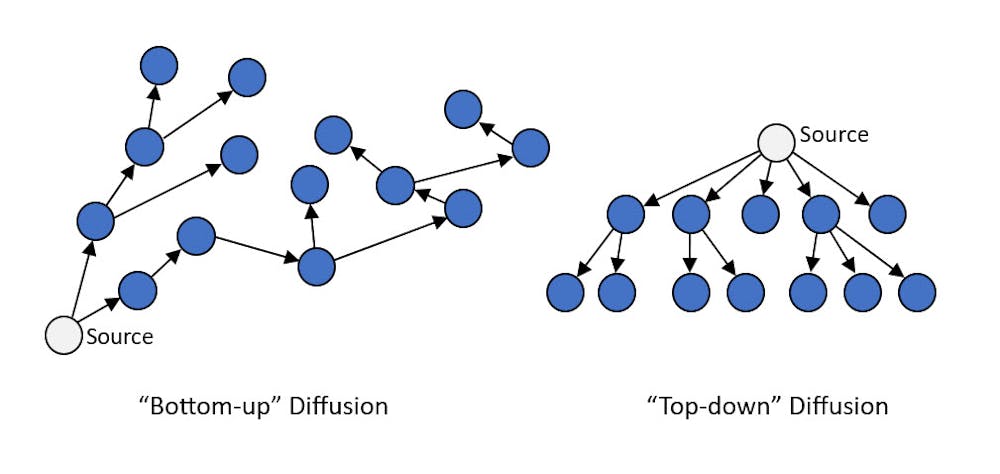
“Pics or it didn’t happen” is a popular expression on social media. True to form, users are posting countless shaky images and videos of UFOs. Usually they’re nondescript lights in the sky captured on cellphone cameras. But they can go viral on social media and reach millions of users. With no higher authority or organization propelling the content, social scientists call this a bottom-up social diffusion process.

In contrast, top-down diffusion occurs when information emanates from centralized agents or organizations. In the case of UFOs, sources have included social institutions like the military, individuals with large public platforms like U.S. senators, and major media outlets like CBS.

Two circle-and-line graphics, the left showing several circles connected to one another with lines, while the right shows one circle at the top connecting several other circles

The left image shows bottom-up diffusion, in which information spreads from person to person. The right shows top-down, in which information spreads from one authority. Barry Markovsky

Amateur organizations also promote active personal involvement for many thousands of members, the Mutual UFO Network being among the oldest and largest. But as Sharon A. Hill points out in her book “Scientifical Americans,” these groups apply questionable standards, spread misinformation and garner little respect within mainstream scientific communities.

Top-down and bottom-up diffusion processes can combine into self-reinforcing loops. Mass media spreads UFO content and piques worldwide interest in UFOs. More people aim their cameras at the skies, creating more opportunities to capture and share odd-looking content. Poorly documented UFO pics and videos spread on social media, leading media outlets to grab and republish the most intriguing. Whistleblowers emerge periodically, fanning the flames with claims of secret evidence.

Despite the hoopla, nothing ever comes of it.

For a scientist familiar with the issues, skepticism that UFOs carry alien beings is wholly separate from the prospect of intelligent life elsewhere in the universe. Scientists engaged in the search for extraterrestrial intelligence have a number of ongoing research projects designed to detect signs of extraterrestrial life. If intelligent life is out there, they’ll likely be the first to know.

As astronomer Carl Sagan wrote, “The universe is a pretty big place. If it’s just us, seems like an awful waste of space.”

Barry Markovsky, Distinguished Professor Emeritus of Sociology, University of South Carolina

This article is republished from The Conversation under a Creative Commons license. Read the original article.

Hey Republicans (and RFK Jr.): Nobody wants to see you do push-ups

There is a great deal that is upsetting, watching Robert F. Kennedy Jr. make a phony run for the Democratic presidential nomination. There’s the way he’s using this as a platform to push vaccine disinformation that has led to many deaths, and not just from COVID-19. For instance, his anti-vaccine campaign in Samoa led to a measles outbreak that killed 32 people, mostly children. There’s the shame he brings upon his family, especially his murdered father and murdered uncle, who spent their time in the Justice Department and White House promoting vaccination. There’s the way his conspiracism has metastasized, leading inevitably to anti-semitic mutterings blaming the pandemic on Jewish people. There’s also the recent revelation that most of his big donors are Republicans who are trying to rat-f*ck the Democratic nomination process. 

So yeah, he’s either evil or delusional to the point of not understanding that he’s evil. But Kennedy is also embarrassing himself by putting out photo and video content meant to prove that he, at age 69, is some kind of Apollonian model of physical perfection. 

No one tell him that such a debate, if it were even to happen, would involve talking with words instead of stripping off shirts and doing push-ups. 

We need your help to stay independent

Kennedy has denied that his large and muscular frame is the result of steroid abuse, instead insisting he merely works out 35 minutes a day and “I take testosterone replacement, which are appropriate to my age, and then I take a big fistful of nutrients.” People who actually work out regularly are skeptical of these claims, as it’s hard for someone in their 20s to get that big with such a lightweight routine, much less a man in his Social Security years. The video only added to the doubts, since he barely manages eight push-ups, something that should be easy for someone supposedly in the totally-natural great shape Kennedy is claiming. 

The Trump years have created a widespread GOP obsession with beefcake that is so over the top that Tom of Finland would suggest toning it down.

But there was one group of people swooning over this content: MAGA Republicans.

Redhats both fetishize feats of strength but also seem to have no real understanding of physical fitness, a combination that makes them just gullible enough to be impressed by Kennedy’s cringey display. The culmination of the self-own may be in this fawning Fox News interview, where host Steve Doocy raved about “sheer masculinity.”

Alas, this MAGA fixation on muscular male bodies is not limited to Kennedy’s shirtless displays. The Trump years have created a widespread GOP obsession with beefcake that is so over the top that Tom of Finland would suggest toning it down. It goes all the way up to Trump, who has a habit of insisting he’s a “perfect physical specimen,” despite the fact that everyone who can see registers him as a tubby old man. To somehow demonstrate this alleged peak physical fitness, Trump has a habit of sharing drawings or photoshops portraying him as a muscleman, and even trying to sell “digital trading cards” with such imagery. Remember when he posted this?

Most other Republicans are just self-aware enough to know that such photoshops fool no one. But they still fall right into that trap of trying to impress the MAGA base by bragging, often unconvincingly, about their manly physiques. Such as that time Sen. Chuck Grassley of Iowa and Sen. Tom Cotton of Arkansas started doing push-ups together in front of a crowd in Iowa, drawing mostly criticisms of their form. 


Want more Amanda Marcotte on politics? Subscribe to her newsletter Standing Room Only.


As Adam Wren wrote in a recent Politico article, “the 2024 presidential contest has careened into a kind of testosterone primary, a frenetic fit boy summer sidequest in which candidates are drawing fewer contrasts on policy and proving more keen on comparing feats of strength.” Along with Kennedy’s video, he points to how Miami mayor “Francis Suarez is bragging about placing sixth in an Independence Day 5K” and “Vivek Ramaswamy, a former nationally ranked junior tennis player, is flexing his weekly pickup victories over former collegiate athletes at a Life Time Fitness.”

Dehumanizing people as weak or sickly is a first step towards arguing they must be culled or controlled.

As happened with Kennedy, the efforts to prove manhood through fitness end up only inviting mockery. Suarez’s 5K claim, for instance, was immediately discredited when people pointed out he didn’t get 6th overall, but only in the 45-49 age group, which only had 16 runners. It’s all very silly, but that doesn’t change the sinister implications. For one thing, it equates strength with masculinity, a notion that gets even harder to fathom during the Women’s World Cup season. 

Worse, it equates masculinity with merit, portraying manhood as a necessary quality to be a leader. These attitudes are a big red flag for fascism, which has a long history of fetishizing physical fitness as a justification for dehumanizing other people. That came up a lot during the pandemic, when far-right figures tried to justify letting COVID-19 kill spread by falsely claiming physical fitness was shield enough against the disease. 

First of all, the claim that working out prevents COVID-19 is not true. But even if it did, the implications of this are deeply sinister. Plenty of people can’t do pull-ups: Disabled people, elderly people, babies, pregnant women, and the huge numbers of Americans who don’t spend hours at the gym a week. Are they just expected to die because Rep. Marjorie Taylor Greene, R-Ga., thinks they’re weak?

Such nonsense also lays the groundwork for other fascist arguments about who does and doesn’t count because of their bodies. Women, ethnic minorities, LGBTQ people, and disabled people are often targeted with stereotypes of bodily degeneracy, as a pretext for stripping them of basic human rights. There’s a reason that Trump and his acolytes like to portray immigrants as diseased or drugged-out, implicitly comparing them to supposedly pure-and-strong white Americans. Dehumanizing people as weak or sickly is a first step towards arguing they must be culled or controlled. There’s a reason that the discredited theory of eugenics laid the foundation for the Holocaust.

Toxic masculinity and fitness fetishization also do lesser but real harm to the authoritarian personalities that get caught up in it. Right-wing websites and influencers like Alex Jones and Joe Rogan are always grifting their audiences by pitching useless supplements with false hopes of physical perfectability. People who believe Kennedy’s silly claim about 35-minute workouts might get frustrated when it doesn’t work out for them and develop eating disorders or other bad health habits response. And, of course, there’s all the people who believed that only “weak” people need vaccines, and ended up either very sick or dying from COVID-19.

Working out is a good thing to do and being fit is a fine goal to have. It just turns to poison in the hands of fascists, who conflate fitness with moral superiority. Your push-up count says nothing about your character or fitness to lead. But your choice to post cringey workout videos as campaign fodder proves that you’re bankrupt in both departments. 

Trump leans on George Soros for campaign cash

Donald Trump continues to wallow in antisemitism and other white supremacist filth. In the most recent example, Trump’s 2024 campaign recently sent out a fundraising email that featured an image of President Joe Biden being controlled like a puppet by billionaire Democratic Party booster George Soros, a Holocaust survivor. The Chinese flag is in the background of the graphic.

Trump’s fundraising email reads:

The worst-kept secret in Washington is that Crooked Joe Biden is not truly in charge.

Even Joe himself keeps letting that slip…

“Biden says he’s ‘not the essential man’ during 2024 campaign fundraiser with Wall Street execs”

[SOURCE: Fox Business]

Did you ever think you’d hear the President of the United States – the COMMANDER in Chief – supposedly, the most powerful man in the world – say that he’s not essential?

Biden has also said that he thought that by becoming president, he’d have the power to give orders. But instead, he said he’s taking more orders than ever before.

Our Republic cannot and will not survive with a secret shadow president behind the curtain pulling the strings…

…Whether that’s China, George Soros, unelected bureaucrats within the Deep State, or God only knows who else.

The 2024 election will decide whether America still is a country of, by, and for the PEOPLE – or whether our once Free Republic has been permanently hijacked by a cabal of nameless, faceless puppet masters secretly controlling our country in the shadows.

It is important to note that Trump’s fundraising email is part of a much larger pattern of antisemitism by the global right-wing that has accelerated during the Age of Trump. On the right, there exists an obsessive focus on George Soros and the lie that he is the leader of a powerful cabal that secretly controls the world. The image used in the Trump campaign email is a near copy of the types of images used by the Nazis to dehumanize the Jewish people.

The inclusion of the Chinese flag is also part of the white supremacist antisemitic trope that Jewish people are somehow doing the work of anti-American foreign elements such as communists and socialists to infiltrate and undermine American society through their influence over Hollywood, the media, and banking.

“There is no fascism without racism.”

Trump’s most recent antisemitic filth also channels much older lies and conspiracy theories such as the Protocols of the Elders of Zio and the idea of “blood libel”.

I asked John Roth who, along with Leonard Grob, co-authored the book, “Warnings: The Holocaust, Ukraine, and Endangered American Democracy,” for his insights about the larger historical context for Trump’s most recent antisemitic attacks:

Antisemitism has been called “the longest hatred”.  These images are part of that dismal history.  Rooted in lies, their antisemitic tropes and canards are scarcely original.  Antisemites recycle them because they successfully incite hostility toward Jews and animosity toward Jewish communities. 

One of the most persistent and insidious falsehoods is that Jewish wealth controls politicians—of the “wrong” kind—and aims to dominate the world. Nazi antisemitism tarred Churchill and Stalin with a brush repurposed today by Trumpist antisemitism to smear Joe Biden as a puppet of corrupt Jewish power.

I also asked Federico Finchelstein, the author of “A Brief History of Fascist Lies,” for his thoughts about Trump’s most recent antisemitic attacks against Biden and Soros. 

This ad shows how racism & antisemitic conspiracy theories remain at the center of the current right-wing extremisms. There is no fascism without racism. Racism was at the center of the fascist worldview. It was central to fascists like Hitler and Mussolini because racism allowed them to lie about enemies of the nation. Racism and propaganda relied on each other. Sadly, we see the same pattern in Trumpism.

This ad is one more symptom of their fascist way of propagandizing.

In terms of speech, there is not much difference between Hitler’s paranoia and propaganda about Jewish financiers and the current attempts to turn one Jewish investor (G. Soros) into the source of all evils. The goal is to confuse people. These lies have the aim of shattering reality and replacing it with myth. If we are to learn from the history of fascism we should be worried about those like Trump, Bolsonaro, Modi, etc that want to manipulate these racist lies and beliefs into political weapons. In the past, the results of this propaganda were horrible, especially for the victims.

It is sad that after Holocaust and all the destruction and misery that fascism created, we still see these fascist lies and propaganda at the center of politics.

We need your help to stay independent

Donald Trump’s continued antisemitic escalations should not be “surprising” or “shocking”. In many ways, this is all utterly predictable, transparent, and the function of a type of path dependency.

In an essay here at Salon last week I explained how, “As detailed in historian George Fredrickson’s landmark book “Racism: A Short History,” there is a complex and overlapping relationship between the “religious” antisemitism of the European Middle Ages, the racist and white supremacist project of white-on-black chattel slavery, colonialism, imperialism, and then the Nazism and racial antisemitism of the 20th century. This translates into a type of path dependency, if not inevitable outcome: As the “conservative” movement becomes increasingly racist and white supremacist, it then becomes increasingly antisemitic. …

As Donald Trump finally faces serious consequences for his decades-long crime spree, he has become more antisemitic. This is true more generally for the MAGA movement, the Republican Party, and the larger right wing during the Trumpocene – but especially since the coup attempt on Jan. 6, and now the indictments of Donald Trump and his cabal for his and their crimes against democracy and society. Trump will only become more bold and gross as the 2024 presidential election approaches and the walls of justice close in.”

Donald Trump’s, the Republican fascists and larger white right’s antisemitic attacks over the last seven or so years (and examples of white supremacy and racism more generally) are almost too numerous to comprehensively list.

During the 2016 campaign Trump sent out or otherwise recirculated antisemitic images as part of their attacks Hillary Clinton; the Trump campaign has previously suggested that Bernie Sanders, who is Jewish, secretly controls Joe Biden; Trump infamously said in 2017 that the neo-Nazis and other white supremacists who participated in a lethal rampage in Charlottesville are “very fine people”; Trump’s senior adviser Stephen Miller has many documented connections with white supremacists and other hatemongers — and shaped the Trump regime’s policies to that end.

The Trump administration refused to properly honor International Holocaust Remembrance Day by deciding to omit the specific crimes against humanity suffered by the Jewish People.


Want a daily wrap-up of all the news and commentary Salon has to offer? Subscribe to our morning newsletter, Crash Course.


A majority of Republicans and Trump voters and followers believe in the white supremacist “great replacement” conspiracy theory lie which claims that there is a secret plot being orchestrated by “the deep state” and “globalists” (code for “the Jews”) to replace “white people” in America and Europe with non-whites and Muslims. Public opinion polls also show that, contrary to the abundant evidence, Republican and right-wing voters do not believe that antisemitism is a serious problem in the United States.

The QAnon conspiracy-lie, which is believed in by a majority of Republicans and Trump voters, is a 21st-century version of the Protocols of the Elders of Zion, blood libel and the lie that Jewish people kidnap children and drink their blood as a way of obtaining superpowers.

Contrary to how too many in the mainstream news media, the political class, and general public would like to believe, one cannot “flirt with” or “play footsy” with antisemitism and other forms of white supremacy and racism. Such language and beliefs do the work of minimizing and distorting – and therefore empowering and enabling — such beliefs and behavior in their various forms.

As seen with the Tree of Life massacre, the Buffalo massacre, and the El Paso massacre (and a large increase in hate crimes and other such violence during the Age of Trump and beyond) where white supremacists targeted Jewish people, black Americans, and Hispanics and Latinos for mass murder, antisemitism, racism(s), and white supremacy are lethal.

Ultimately, such values are an existential threat to America’s multiracial pluralistic democracy and the overall safety and security of the country. On this, Lenny Grob, who is co-author of “Warnings: The Holocaust, Ukraine, and Endangered American Democracy”, offered the following warning and call to action via email:

In the United States today much political grievance is inseparable from White nationalism, racism, and sexism. They breed and feed each other.  As those divisive “isms” infect American life, another—antisemitism, hatred toward Jews and their communities—resurges in the United States.  MAGA Republicanism harbors it.

The health of American democracy depends on rejecting antisemitism and embracing inclusive pluralism instead. Commitment to freedom of speech means that antisemitism cannot be silenced in the United States, but wise Americans will neither trust nor vote for any political party that harbors it.

John K. Roth agrees:  

Democracy’s existence invites its demise.  That’s partly because democracy encourages freedom of speech.  Without that freedom, democracy would scarcely exist.  But the quality of words matters.  When they spew antisemitism and condone anti-Jewish attitudes and actions—sometimes by saying nothing—threats against democracy multiply.  Democracy is vulnerable to antidemocratic power. To the extent that antisemitism exists, democracy does not. Whenever antisemitism is curbed and thwarted, democracy’s chances get better.

Donald Trump and the other Republican fascists are continuing to wallow in antisemitism because they have made a calculation that there is a large and receptive audience for such appeals among their voters and the “conservative” public at large. In short, Trump and the other neofascists would not be trafficking in antisemitism and other forms of racism and white supremacy if they did not have good reason to believe it works. Based on Trump’s fundraising numbers, his enduring popularity among MAGA and other Republican voters, and how he is tied with (or in many polls defeating) President Biden in a hypothetical 2024 rematch, there is a larger and hungry audience for such hateful and evil appeals to the worst and not the best of the American people and their collective character.

340,000 UPS drivers poised to strike over extreme heat, safe working conditions

This story is part of Record High, a Grist series examining extreme heat and its impact on how — and where — we live.

During a summer that has already shattered temperature records, the 340,000 drivers, dispatchers, and warehouse workers currently in contract negotiations with UPS — the United States’ largest unionized employer — have made climate change and extreme heat a headline labor issue. And if they don’t secure a contract by July 31, they are poised to initiate the largest single-employer strike in U.S. history.

On summer days, the back of a delivery truck can exceed 120 degrees Fahrenheit. When Viviana Gonzalez, a package delivery driver for United Postal Service in Los Angeles, pulls open the back of her truck, she often thinks: “Am I going to pass out back here? Will anybody find out that I’m here in the back of the truck?”

Gonzalez is all too aware of how dangerous her job can be. Since 2015, UPS has reported at least 143 heat-related injuries to the federal Occupational Safety and Health Administration. Last year, one of her co-workers, Esteban Chavez, died of heat stroke in his delivery truck after delivering his last parcel. “I’m a single mom,” said Gonzalez, “and being able to provide for my son means I have to suck it up.”

While climate change is making summers hotter and even more dangerous for delivery workers, Moe Nouhaili, a UPS driver in Las Vegas, told the Guardian that it’s the working conditions that make the heat so deadly. “It’s how they’re making us work, expecting us to meet these unrealistic productivity numbers even through the weather,” he said.

UPS often requires drivers and warehouse employees to work six days a week and more than 12 hours a day in the heat, and the company measures worker productivity by surveillance cameras and sensors inside trucks. Drivers say these tactics make it harder to take breaks. “The same amount of work that would be done in, say, 30 routes is now being forced to be done in 20 or 25,” said Nouhaili. “Less people get more work done.”

An increasing portion of the work is also done by part-time drivers who are paid less than full-time employees, as well as gig workers who often need to take on multiple jobs to make ends meet.

That’s why the UPS workers, who are part of the International Brotherhood of Teamsters union, have tied their heat-safety demands to other key issues: higher wages for all workers; more full-time jobs with full benefits; an end to forced overtime, surveillance, and harassment from management; and elimination of a two-tier wage system that pays part-time workers and newer employees differently for the same work.

According to Anastasia Christman, a senior policy analyst at the National Employment Law Project, many of these benefits and protections form the basis of climate justice at work and can better protect workers from the heat.


Want more health and science stories in your inbox? Subscribe to Salon’s weekly newsletter The Vulgar Scientist.


“Workers who are fighting for better health care benefits are going to be more physically able to deal with excessive heat, because they can address other underlying health problems,” she said. “An increase in pay might mean workers can spend time at home without having to take on a second job to support their family, eat healthy food, or afford to get an air conditioner in their house and really cool down and recover from the heat during their off-hours.”

She also argues that part-time employment, piece-wage and contract pay structures, and low-grade wage tiers can affect workers on the margins to a greater extent than others.

“These workers, who are overwhelmingly Black workers, immigrant workers, and women, literally can’t afford to take breaks or lose time to take care of their health,” she explained. By pushing for more full-time direct employees and fewer contractors, Christman said, workers build solidarity and make sure that certain job classes don’t disproportionately face environmental harms like extreme heat.

UPS workers negotiate a new contract once every five years, and the strike authorization in June was the result of a yearlong campaign on behalf of the union to build leverage at the bargaining table. The strategy appears to be working: In the last month, with the strike threat looming, UPS agreed to install air-conditioning systems in each of their delivery trucks, end the secondary wage tier that allows them to pay newer drivers less, and do away with mandatory overtime.

“UPS Teamsters have strategically navigated this process for maximum leverage against this multibillion-dollar corporation,” said Teamsters President Sean O’Brien. “At every step, we are forcing them to do what they don’t want to do, which is give our members more money and better protections at work.”

UPS workers in brown uniforms standing outside a warehouse, holding signs that say

UPS drivers practice picketing outside a warehouse in preparation for a potential strike at the end of the month. International Brotherhood of Teamsters

While air-conditioning will indeed offer welcome relief to UPS drivers in the heat, experts argue that at a global scale, energy-intensive cooling systems pale as a long-term climate-justice solution. Air-conditioning units burn more fossil fuels, increase ambient temperatures in cities, and are inaccessible to most outdoor workers — and most of the global population.

On its own, the company’s concession also doesn’t address the growing issues of pay, contracting, and worker productivity that drive workers to heat exhaustion.

So despite the gains, UPS workers are still not satisfied. The biggest remaining issue is pay: They are looking to raise the starting hourly wage for part-time workers from $15.50 to $20. And they have repeatedly said that if UPS does not meet their baseline wage demands, they will be forced to strike to win them.

In recent years, restaurant workers at Voodoo Donuts in Portland, Oregon; a McDonalds in Detroit; a Jack in the Box in Sacramento; and a Hooters location in Houston have collectively walked off the job to protect themselves from extreme heat. The Occupational Safety and Health Administration, which is in the process of developing a federal workplace heat standard, has acknowledged that taking collective action can help workers stay safe on the job and has developed a legal framework “to obtain the best possible relief for employees” when they choose to do so.

“The suggestion box sitting in the break room is not really the place to address the dangers of systemic heat exposure,” said Christman, the National Employment Law Project analyst. “When workers come together, they build power to really make changes at the workplace.”

The Teamsters union has plainly stated that this campaign will be an example for workers across the country. “What we do in these negotiations,” said O’Brien, “is going to set the tone for the entire country, the entire labor movement, moving forward. The UPS fight today may be your fight tomorrow.”

“It’s time for UPS to feel the heat,” said Rick Jordan, another delivery driver in Southern California. “We feel it all the time.”

This article originally appeared in Grist at https://grist.org/labor/340000-ups-drivers-poised-to-strike-over-extreme-heat-safe-working-conditions/.

Grist is a nonprofit, independent media organization dedicated to telling stories of climate solutions and a just future. Learn more at Grist.org

What the living owe the dead: Finding accountability for the Port Newark fire

News stories like the horrific fire aboard the Grande Costa D’Avorio docked at Port Newark that killed two of Newark’s bravest have a predictable narrative arc. The media focuses intensely as the very real human drama unfolds, and then we look away, as our gaze shifts to the next sensational story.

We live in a world where we are increasingly reliant on a global supply chain, we expect to deliver goods the same or the next day that may have originated anywhere in the world. How they arrive, who does it, what risks they take, or what corners are cut to make it all happen is usually of no consequence or concern to us.

That is until something like the Port Newark fire where the most selfless among us pay a price for our collective inattention to this global trade machine that generates billions and billions in profits by squeezing the margins.

In the short term, we do what we can for those we know that paid the ultimate price and then usually move on.

Newark firefighters Augusto Acabou, 45, and Wayne Brooks Jr., 49 who were killed fighting a fire aboard the auto-carrier Grande Costa D’Avorio on July 5, were posthumously promoted to the rank of Captain.

“There are only a few men and women that have to stand up when that bell rings — that have to stand watch while we are all asleep — that must respond when the call is made — that don’t have a stage of a mic — they don’t have the luxury of turning back,” Mayor Ras Baraka told mourners at the funeral mass for Captain Acabou at Cathedral Basilica of the Sacred Heart “When their name is called they must be present and accounted for with honor and pride without trepidation walk into fires while we sit to side and watch.”

Meanwhile, in a more invisible universe, where the 28-member crew from the Grimaldi line’s Grande Costa D’Avario exists, the Seamen’s Church Institute, a non-profit founded in 1834 to aid stranded mariners, took to Facebook to raise money to help them.

“These seafarers had to abandon ship immediately, leaving their belongings and visa papers behind,” SCI’s post explains. “Since they have been unable to leave the hotel, SCI Chaplains continue to check in regularly and provide for their requests, including toiletries and much-needed clothing. These complete sets of clothing, shoes, backpacks, and duffle bags were purchased through SCI’s “SOS Fund For Seafarers”— an emergency fund SCI established during COVID and sustained by the kindness and generosity of you, our donors. Thank you.”

Last year, SCI visited close to 11,000 seafarers whose work brought them to the Port of New York & New Jersey. Over the years, SCI has had to come to the aid of international seafarers who have been entirely abandoned by their foreign-owned shipping company.

During COVID, the international maritime workforce was thrust into a largely unreported humanitarian crisis.

“More than 300,000 seafarers are currently stranded on board ships, with some now have been working for more than 17 months at sea, without a break,” wrote the International Maritime Organization, during the pandemic. The IMO, the United Nations agency that oversees the maritime sector, added that “the crisis threatens the well-being of seafarers and puts navigational safety in peril.”

Long before the pandemic, the industry used automation and technology to justify significantly reducing crew size even as trade volume and profits continued to grow exponentially.

No doubt, the crew of the Grande Costa D’Avorio has an important story to tell investigators.

“A comprehensive formal investigation will be launched to determine the root causes and contributing factors leading to the shipboard fire,” according to a U.S. Coast Guard press release. “The investigation will be led by the Coast Guard in tandem with federal, state, and local entities including the National Transportation Safety Board, Bureau of Alcohol, Tobacco, Firearms and Explosives, New Jersey State Fire Marshal, New Jersey State Police, Newark Fire Arson Division, Essex County Prosecutor, and a host of safety agencies to ensure we gain a critical and necessary understanding of the incident.”

The Italian vessel is 12 stories high and was loaded with 1,200 cars as well as close to 160 containers bound for West Africa. The Port of Newark is operated by the Port Authority of New York and New Jersey and includes portions of Bayonne, Elizabeth, Newark, and Jersey City. The bistate agency relies entirely on the emergency services in the host communities which, in the case of Newark, has historically been under fiscal stress.

According to Newark Fire Chief Rufus Jackson, on the night of July 5, firefighters “found a working fire on the 10th floor — it was apparently five to seven vehicles fully involved [on fire]. The fire quickly extended to the 11th and 12th floors. The members made an attempt to extinguish the fire and because of the intense heat they got pushed back.”

Newark’s ill-fated response got off to a shaky start when NFD’s “Engine 16 quickly learned that their standard, 2.5-inch hose lines would not connect to equipment on the European-built ship,” reported the New York Times. “They were forced to use the vessel’s one-inch firefighting hoses, Newark’s Mayor Ras Baraka would later explain.”

The Newark fireboat wouldn’t start,” according to NorthJersey.com. And the FDNY, which has the region’s most robust marine-based firefighting capability, did not get a request for mutual aid until 12:40 a.m. July 6, with Fire Commissioner Laura Kavanagh approving the mutual aid response around 1 a.m., three and a half hours after the initial response.

The fire continued to burn for days and was only declared out by the U.S. Coast Guard on July 11th. During press briefings after the incident officials have said that typically precautions are taken when loading vehicles on auto carriers like the Grande Costa D’Avorio.

In June of 2020 an “electrical fault from an improperly disconnected battery in a used vehicle led” to a fire breaking out aboard the vehicle carrier Hoegh Xiamen that was docked in Jacksonville, Florida, according to the National Transportation Safety Board. The vessel was chartered by Grimaldi Deep Sea.

“Nine firefighters sustained injuries while responding,” the NTSB reported. “None of the vessel’s 21 crewmembers were injured. The fire took over a week to extinguish. The Hoegh Xiamen and its cargo of 2,240 used vehicles were declared a total loss valued at $40 million. In August 2020, after salvage operations were completed, the vessel was towed to Turkey to be recycled.”

In its final report, the NTSB determined that many of the vehicles has been loaded onto the vessel without their batteries being disconnected “which increased the risk of electrical arcing and component faults. During the loading operations, both the loading personnel and crew missed opportunities to address these hazards.”

The agency’s probe showed the detection of the fire was delayed because the vessel’s fire detection system had not yet been reactivated after the loading was completed. The local fie response was also delayed because the ship’s captain did not know how to contact first responders at the port. The NTSB ultimately determined the probable cause was the shipper’s “ineffective oversight” of the workers responsible for loading and securing the vessels.

“We found that used vehicles are often damaged and present an elevated risk of fire,” the NTSB concluded. “We believe that greater inspection, oversight, and enforcement are needed to reduce this risk.”

Evidently, there had been five similar incidents since 2015, including “a 2019 fire aboard Grimaldi’s Grande Europa,” according to the NTSB.

CBS News reported that the Grimaldi Group has had at least four other fires in recent years.

“Last February, a Grimaldi ferry caught fire near Greece. Authorities said at least eight people died,” CBS reported. “At the time, the Grimaldi Group said the fire started in an area of the ship where cars were parked. In November of 2019, an Italian fire brigade shared video of crews extinguishing a fire on a cargo ship operated by a Grimaldi company, Malta Motorways of the Sea. Firefighters said no one was hurt on the ship.”

A safety report from the Maltese government later concluded the fire was likely caused “most likely caused by fuel spilling accidentally onto a hot surface,” according to CBS.

Back in May of 2019, a Spanish rescue crew had to rescue “15 crew members after a fire started on a Grimaldi car carrier, and in March of 2019, Grimaldi’s Grande America caught fire then sunk off the coast of France. All 27 people onboard were rescued,” reported CBS.

As for the July 5 blaze, Grimaldi maintains “the crew of the vessel immediately activated the on-board fire suppression procedures while the local firefighting services were alerted, and their prompt response played a crucial role in containing and bringing the fire under control.”

Back in May of 2019, after the Grande Europa fire the Grimaldi Group issued a statement calling for more stringent regulations, according to the GCaptain, the international maritime news website.

“Following the umpteenth case of a fire that broke out on vehicles transported by cargo vessels, the Grimaldi Group launches an appeal to introduce more stringent controls and regulations on cargo sea transport, not only for rolling units but also for containers,” Grimaldi Group said.

The statement continued. “Notably, with reference to rolling freight, the Grimaldi Group requests that there be more controls on car batteries, which often cause short-circuits on board vessels, as well as in port terminals.”

Be great to know if the Port Authority of New York and New Jersey tracks any of this.

Michigan attorney general charges 16 in 2020 Trump fake elector scheme

Michigan Attorney General Dana Nessel announced on Tuesday that 16 fake electors who signed certificates falsely claiming that then-President Donald Trump had won Michigan in the 2020 election — including Kathy Berden, a Republican National Committeewoman from the state and Meshawn Maddock, the former co-chair of the Michigan Republican Party — have been charged with crimes related to the scheme

As CNN reported, all 16 individuals were charged with multiple felonies “for their role in the alleged false electors scheme following the 2020 U.S. presidential election,” Nessel’s office announced. The charges range from counts of election law forgery, which carries a maximum of five years in prison, to conspiracy to commit forgery, which carries a maximum of 14 years in prison. 

In a video released alongside the charges by Nessel, she said that “this plan, to reject the will of the voters and undermine democracy, was fraudulent and legally baseless.” She went on to say that the 2020 election was procedurally the same as every previous modern presidential election and reiterated that all allegations of widespread electoral fraud are false. CNN further reported that Nessel’s office “has not ruled out potential charges against additional defendants.”

The other side of concert etiquette: Miranda Lambert, tempers and why everybody is so provoked

Country music superstar Miranda Lambert is in hot water after a group of fans snapped a photo during her Las Vegas residency show and the singer stopped mid-song to call out their selfie, triggering an onslaught of criticism directed at the singer’s reaction.

When the flash went off, Lambert halted the show during her intimate ballad “Tin Man” to say, “These girls are worried about their selfie and not listening to the song. It’s pissing me off a little bit.” Scathing outrage on social media aimed at Lambert later ensued. People on Twitter commented, “Damn maybe y’all throwing things at the wrong singers,” referring to the latest puzzling trend of fans tossing objects not just on stage, but at the performers themselves.

One of the fans whom Lambert called out also went on “Good Morning America” to defend themselves. She said the interaction with the singer felt like they were back in school and “me and my friends did something that annoyed the teacher and she scolded us so she told us to sit down.” 

Lambert’s irritated response is open to interpretation. On one hand, publicly calling out and policing how concertgoers have fun – when they’re not harming anyone –  seems a bit harsh. On the other hand, had the fans taken a selfie during a fun, upbeat song that probably would’ve gone unnoticed. However, they snapped the pic with flash during a slow ballad, when any interruptions or distractions could ruin the mood. 

In the past, an artist could say such a comment, and it would soon be forgotten. But fandom has not only created its own space on social media – every moment, good or bad, is captured and shared – but also has become entitled to the point of making demands on performers and their behavior. This speaks to a certain recent pattern we’ve seen between fans and their increasingly disturbing parasocial relationship with celebrities. This case amplifies the ongoing conversation surrounding concert etiquette and our boundaries with performers.

We need your help to stay independent

Some say that the pandemic has directly affected this relationship, causing the line between performer and fan to slowly erode. And like Lambert but to a more extreme extent, there have been other instances of celebrities lashing out at fans. Steve Lacey smashed a disposable camera thrown at him and halted his show mid-performance during his tour. Kid Cudi walked off stage at Rolling Loud Miami after festivalgoers repeatedly launched items at him. Patti LuPone told audience members to “get the f**k out” because they didn’t mask up in a theater.

On the flip side, there have been several recent instances of fans throwing things at the performers themselves, Salon reported earlier this month. Bebe Rexha needed stitches after an audience member threw their cell phone at her head during a recent performance. Singer-songwriter Pink was aghast while performing when one fan chucked a bag reportedly containing their dead mother’s ashes onstage. The day before, she was gifted a cheese wheel.

Whether these interactions are intended to be violent or not, the cumulative effect is the same. It’s created a tense and particularly harsh environment for performers who are no doubt more on guard with their fans. These days it seems that the musician just can’t perform to their fans but also must keep a close eye on them for safety reasons. The country star hasn’t issued a statement but if she does, while she might apologize for her behavior, she could also cite the recent atmosphere of fans crossing the line. It’s safe to bet that she won’t be the last performer having to call for some sort of order from the stage.

We are free of the rigidity of peak pandemic lockdown but the accessibility to celebrities that it gave us virtually is no longer the norm. We have returned to seeing untouchable people on stages for concerts, films and other events but somehow the unspoken social contract that we had agreed upon previously seems to no longer apply. Regardless of how we feel about Lambert’s position as a celebrity or the incident in general, it’s time as audience members to decide if we have a larger responsibility to uphold this unspoken social contract of respect and safety.

More cats test positive for H5N1 “bird flu” in Poland, including a caracal

In Poland, more and more cats are testing positive for the H5N1 virus, known colloquially as “bird flu,” which is alarming health experts. The World Health Organization (WHO) released a statement on July 16 detailing the “unusual” deaths of cats across the country. So far, at least 34 cats have been infected and 25 have died, including 14 that were euthanized. One of the infected animals wasn’t a house cat, but rather a caracal, which is a medium-sized wild cat native to Africa.

“This is the first report of high numbers of cats infected with avian influenza A(H5N1) spread over a wide geographical area within any country,” WHO said. “The source of exposure of cats to the virus is currently unknown and epizootic investigations are ongoing. There are several possibilities for the source of infection, among which the cats could have had direct or indirect contact with infected birds or their environments, ate infected birds, or ate food contaminated with the virus.”

So far, there have been no documented cases of humans catching H5N1 from these cats. Among the general population, WHO considers the risk of this happening to be low. So, no need to worry about an outbreak caused by Sniffles the cat just yet. Nonetheless, the possibility it could happen isn’t zero. If H5N1 crosses over to humans, it could spell a new pandemic on par or even worse than COVID, and every encounter that humans have with a bird flu-infected animal increases the risk.

Malnutrition in South Africa: How one community wants resources to be spent

South Africa has persistently high rates of hunger and malnutrition among mothers and children. More than a quarter — 27% — of children under five are stunted and 61% of children are iron-deficient. 69% of women of reproductive age are overweight or obese and 31% are iron-deficient.

These figures paint a worrying picture. They suggest gaps in the country’s evidence-based nutrition policies and services.

One way to accelerate progress on malnutrition is through engaging with the people who are directly affected by policies.

South Africa’s health system strategy does include public consultation. But public participation is mostly limited to public meetings once a policy has already been drafted. This leaves little opportunity for substantial revisions. The lack of meaningful public engagement is also evident in how funds for mother and child nutrition are allocated. Decisions are left to policy makers and there’s little input from people on the ground.

Only by understanding what communities consider important can policies respond to the actual needs of individuals.

We are a group of social scientists at the University of the Witwatersrand who have been exploring approaches for public engagement. We designed a study that puts communities into the shoes of policy makers. We asked community members which programs they would prioritize if they were given a limited health budget.

The respondents in Soweto, an urban township in South Africa with constrained resources, didn’t focus much on health system programs. They put more emphasis on the underlying causes of malnutrition. To help mothers and children be well nourished they proposed: providing school breakfast; paid maternity leave; improved food safety; and establishing community gardens and clubs.

This article presents one approach for public engagement. We suggest policy makers, researchers and funders consider programs that communities view as essential for improving mother-and-child nutrition.


The study

To engage communities, we modified an exercise called CHAT (Choosing All Together). CHAT is a simulation exercise, something like a board game. It offers a practical way to involve the public in making healthcare decisions. It seeks to show not only which programs people prioritize, using a limited budget, but the values (assumptions, beliefs or perspectives) those priorities are based on.

Our research team modified CHAT specifically for the context of Soweto. Members of the community were invited to select a package of programs they saw as priorities to improve mother-and-child nutrition. Fifty-four adult men and women volunteered to part take in the exercise. As with policy makers in real life, they had to make difficult decisions around what to include in their package of programs, what to leave out (given a limited budget) and why. The volunteers had to discuss and debate their choices to convince one another why one program would be better for the community than another.

Participants worked together in small groups and they could select from 14 programs. Five programs were “nutrition-specific” (directly influenced the immediate causes of malnutrition) and delivered through the healthcare system (pregnancy supplements). Nine programs were “nutrition-sensitive” (addressed the underlying causes of nutrition) and accessed in non-health sectors (extended paid maternity leave).


The outcomes

Community members’ top three priorities were:

  • the provision of school breakfast  

  • extending paid maternity leave to six months and to those in informal employment

  • ensuring that food sold by street vendors and served in schools and creches was prepared in a safe and hygienic way.

Affordable healthy food, help in finding jobs and community gardens were other programs the participants considered important to improve their community’s mother-and-child nutrition.


I think community gardens can help everyone. To be able to, if you want to, grow vegetables and sell them to people, to be able to get money and teach children and other older people to do gardening.


The community’s choices reflect the values of fairness, equity, social justice and children’s well-being. Participants showed a willingness to consider other viewpoints and reflect on the consequences of their choices for the entire community.

Programs that would interrupt the intergenerational cycle of poverty were important. These included freeing up disposable income by growing more of their own food, enhancing their self-reliance overall — which could also uplift the neediest among them — and reducing their dependence on social welfare.

In the South African context of astronomical rates of unemployment (more than 60% among young adults), solutions like establishing community gardens represented paths to livelihoods, socio-economic empowerment and supporting the neediest in the community.


Translating public engagement into action

Public engagement is entrenched in the constitution and in various policy documents. But there are gaps. Even where public engagement has occurred it has had very little impact on policy making.

For South Africa to uphold its commitment to  equity in healthcare, engaging the public on ethical and social values should be part of a systematic process of setting priorities in government.

Addressing malnutrition will also require coordinated actions across many sectors. Our findings show that not all potential solutions (such as community gardens and extended maternity leave) would fall to the already overburdened health system.

The South African National Food and Nutrition Security Plan 2018-2023 already has cross-sectoral coordination as an objective, via the establishment of a multisectoral advisory council to oversee alignment of policies and coordinate and implement programs. Integrating public engagement, through using tools like CHAT, could complement such efforts.

Agnes Erzse, Researcher, SAMRC/Centre for Health Economics and Decision Science- PRICELESS SA, University of the Witwatersrand and Aviva Tugendhaft, Senior Researcher, SA MRC Centre for Health Economics and Decision Science,  PRICELESS SA, Faculty of Health Sciences, Wits School of Public Health, University of the Witwatersrand

This article is republished from The Conversation under a Creative Commons license. Read the original article.

Fresh herbs: How to extend their fleeting shelf life for long-lasting, bright flavor and color

A few years ago, I read Ocean Vuong’s “On Earth We’re Briefly Gorgeous” with a propulsive vigor. Oddly, the title of that book is also how I feel about fresh herbs, in all of their ephemeral glory.

I adore fresh herbs in any and all iterations. I love their brightness, the levity they bring, the flavors that permeate, the freshness, the color — the list goes on and on. They add a certain je ne sais quoi that quite literally no other ingredient can even remotely approximate (and certainly not any dried herbs: Dried rosemary is possibly the bane of my existence.)

Fresh herbs, though, can be finicky. In both chopping and preparing, in when and how to incorporate them into dishes and, of course, in storing them.

Lately, I’ve been commiserating about how nearly all of my fresh product  — especially peaches?  — tend to spoil or “go bad” within a day or two of purchasing them.

One of the worst culprits beyond stone fruit, though, is fresh herbs at large. Scallions wilting in the fridge, some windowsill basil collapsing in on itself while discoloring, some cilantro or parsley getting flimsy and slimy. One of the only herbs that I find has great constitution and can stand up to both time and temperature is fresh mint, one of my absolutely favorite herbs. But, alas, this is a story about how to properly store and preserve your herbs, so let’s get into it.

First and foremost, we must categorize our herbs. For Serious Eats, J. Kenji López-Alt writes that a good way to differentiate your approach is to first make note of your hardy versus tender herbs and then store base on that: tender herbs like parsley, dill or tarragon should be done in a paper towel method, while hardy herbs like rosemary, chives or sage could be done in what we’ll call the “Mason jar” method. Hardy herbs are sometimes also called robust herbs, while tender herbs are also sometimes called soft herbs.

If it helps to differentiate, think about their stems: if they’re edible and generally lighter, such as mint, then they fall into the tender category, but if they’re woodsy or a stem you’d normally discard  — such as rosemary  — then they’re hardy.

One of the best approaches is to remove your herbs from the supermarket or grocery bags immediately, washing them, drying them completely and then storing by tucking them into paper towels in a food storage bag that has been well-sealed. This is the aforementioned “paper towel” method which’ll work beautifully for tender herbs; I first learned this from Rachael Ray’s 30 Minute Meals back in the day. Conversely, the “Mason jar” method involves snipping the bottoms of your herb stems, storing the herbs upright in a jar with about an inch of fresh, cool water, and then sealing completely before refrigerating. 

Basil is its own animal, which should be treated like a literal bouquet of flowers. This method is a fun one: Treat them, literally, like flowers by propping them up in a mason jar, vase or glass with their stems or ends slightly trimmed. It’ll perfume your kitchen, look really appealing and fresh and will provide longer-lasting herbs than ons you’ve unceremoniously stuffed into the fridge drawer or your produce basket. 

To be frank, I’m often too lazy and just chuck my bags of herbs in the fridge without taking this step and I’m then mad at myself two days later when my herbs are unappealing or borderline unusable. Take heed and get ahead of the self-deprecation by just properly storing them the instant you get them into your kitchen. 

If you’re a freezer person, you can also freeze practically any herb to ensure its longevity and shelf life. The best bet for an approach like this is to blend an herb — or multiple herbs — after having blanched them for 10 to 15 seconds. Add a touch of oil and then freeze in ice cube trays. Conversely, you can also wash, dry and chop herbs, then add little piles to your ice cube tray before adding a bit of oil to cover. Either option works beautifully.

Another option is drying or dehydration, which you can do in an oven at a very low temperature, in an actual dehydrator or if you’re particularly gifted, perhaps even in an air fryer.


Want more great food writing and recipes? Subscribe to Salon Food’s newsletter, The Bite.


Generally, be sure to minimize excess light, which might cause quicker discoloring or yellowing and to ensure you’ve got just the right amount of moisture — be like Goldilocks: Herbs should have not too much and not too little water, so check that jar to ensure there’s still some water in the bottom. If it’s a bit low, add some fresh water. Also, be mindful of temperature. Some herbs should always be refrigerated, some should be left at room temperature, but in a summer like this one, with its excess humidity, incessant rain and outrageous heat, “room temperature” may not actually be conducive for most herbs  — or most pets and human beings, frankly.

These methods can help to extend shelf life for up to two weeks, which is a major upgrade from herbs that have been haphazardly stored. 

Some also advise hanging herbs in bunches via cooking twine, letting them dry in a dry place — but I haven’t had great (read: any) success with this approach. Feel free to store some herbs together or in bundles, but make sure you’re grouping like with like: parsley and cilantro or thyme and oregano, but don’t mix hardy and tender. 

You should have a very very very sharp, large chef’s knife for proper, efficient herb chopping without any sort of bruising, but knives are a conversation for another. For now, go forth with your herbaceous knowledge and if you haven’t yet, get your perfect, verdant herbs out of those cellophane supermarket bags pronto. They’ll thank you for your haste  — and so will your wallet, eyes and tastebuds.

MTG calls Jack Smith a “weak little b**ch” as GOP melts down over Trump Jan. 6 target letter

Former President Donald Trump’s Republican allies rallied behind him after he revealed that he received a target letter from special counsel Jack Smith, indicating he is likely to be indicted for a third time this year — this time for his role in the effort to overturn the 2020 election.

Far-right Rep. Marjorie Taylor Greene, R-Ga., called the target letter “absolute bulls**t.” 

“This is the only way that the Democrats have to beat President Trump is to arrest him, smear him, charge him with ridiculous charges,” said Greene, who has repeatedly defended the pro-Trump Capitol rioters. “All in cover-up of Joe Biden’s crimes, Hunter Biden’s crimes. It’s unbelievable. It’s hard to even recognize that this is our country. The American people are going to be furious. And what Jack Smith is doing is the weaponized government. He’s weaponizing the Department of Justice against President Trump in a complete lie about President Trump and January 6th. It’s outrageous. I can’t believe our country has to endure this.”

“Jack Smith is a lousy attorney,” Greene later tweeted. “His career is filled with mistrials, overturned cases, and judicial rebukes. He only targets Republicans because he’s a weak little bitch for the Democrats,” she added, repeating a phrase she recently used to describe former ally Rep. Lauren Boebert, R-Colo. 

House Republican leaders were also quick to condemn the Department of Justice for naming Trump as a target of the Jan. 6 investigation, including House Speaker Kevin McCarthy, R-Calif., who claimed that the former president was targeted due to his poll numbers.

“Recently President Trump went up in the polls and was actually surpassing President Biden for reelection. So what do they do now? Weaponize government to go after their No. 1 opponent,” he told reporters. “This is not equal justice. They treat people differently and they go after their adversaries.”

Shortly after the insurrection transpired, McCarthy stated that Trump “bears responsibility for Wednesday’s attack on Congress by mob rioters.”

“He should have immediately denounced the mob when he saw what was unfolding. These facts require immediate action by President Trump,” he added at the time.

House Minority Leader Steve Scalise, R-La., suggested Trump is facing a “double standard.”

“Now you see the Biden administration going after President Trump once again, it begs the question — is there a double standard? Is justice being administered equally?” he asked during a press conference.

But some of Trump’s Republican primary rivals used the target letter as an opportunity to take rare shots at the former president.

We need your help to stay independent

Nikki Haley, Trump’s former ambassador to the United Nations, warned on Fox News that Trump’s legal woes will “continue to be a further and further distraction.”

“We can’t keep dealing with this drama. We can’t keep dealing with the negativity. We can’t keep dealing with all of this,” she said.

Former Arkansas Gov. Asa Hutchinson emphasized that he has “said from the beginning that Donald Trump’s actions on January 6 should disqualify him from ever being President again.”

“Trump would like the American people to believe he is the victim… The truth is the real victims of J6 were our democracy, our rule of law, and the Capitol Police Officers,” he said in a statement.


Want a daily wrap-up of all the news and commentary Salon has to offer? Subscribe to our morning newsletter, Crash Course.


Florida Gov. Ron DeSantis argued that Trump should have “come out more forcefully” during the deadly Jan. 6 Capitol attacks, saying, “It was shown how he was in the White House and didn’t do anything while things were going on.”

He added, however, that to criminally penalize such behavior “is a different issue entirely.”

“We want to be in a situation where you don’t have one side just wanting to put the other side in jail,” he said.

Pennsylvania locomotive manufacturing workers are striking for greener jobs

Workers in Erie, Pennsylvania, are on strike, asking for familiar items like better pay, voting rights and health care benefits. They’re also asking for one unique condition: to shift their production plant to greener technology.

The plant workers in Erie, two hours north of Pittsburgh, manufacture locomotives for Wabtec Corporation. Locomotives are the engine of the train and generally run on diesel fuel. 

Manufacturing workers have been on strike since June 22 and are represented by the United Electrical, Radio, and Machine Workers of America union, or UE. Initial conversations to renegotiate working contracts began in April. Scott Slawson is the president of the local 506 UE chapter in Erie and said there are currently 1,400 workers on strike.

“The members are dug in for the long haul,” Slawson said. “This is a passionate fight for them and they’re willing to go the distance if required.” 

He said his union and train operator unions are working together to push for better environmental standards and greener technology in the industry. 

Trains aren’t massive polluters, but the industry is trying to reduce emissions. The transportation industry is responsible for the highest amount of greenhouse gas emission of all industries in the country, with rail being responsible for two percent of the sector’s emissions, according to the U.S. Department of Transportation. Compared to other options, both freight and passenger rail lines emit fewer pollutants than automobiles or planes. 

Still, trains are known to release air pollutants in the communities they operate in. For example, diesel emissions from locomotives are responsible for 70 percent of cancer risk in California and the rail industry releases 640 tons of air pollutants every year in that state alone. This reality recently pushed California regulators to create the nation’s first emissions regulations for trains.

The transportation industry is responsible for the highest amount of greenhouse gas emission of all industries in the country, with rail being responsible for two percent of the sector’s emissions

To prevent pollution, train companies would purchase and use emissions-reducing locomotives, commonly referred to as Tier 4 locomotives, from manufacturers like Wabtec. 

These machines decrease emissions by an estimated 70 percent more than their counterparts, according to industry projections. Top rail companies Norfolk Southern and Union Pacific have made pledges to reduce their emissions (30 percent by 2030 and net zero by 2050, respectively) and adopt some of these greener locomotives. 

The industry is moving slowly to make this change, according to a report from the investigative labor outlet Workday Magazine and the progressive public policy organization American Prospect. The Environmental Protection Agency told Workday that, as of 2020, 74 percent of all of the locomotives operated by major rail companies are Tier 2 or lower, with almost all smaller rail companies operating outdated, polluting technology.


Want more health and science stories in your inbox? Subscribe to Salon’s weekly newsletter The Vulgar Scientist.


Slawson wants to speed up this industry shift and said workers are using their voices to get it done. A report from the University of Massachusetts Amherst found that manufacturing green, Tier 4 locomotives at the Erie plant would create between 2,600 and 4,300 estimated new jobs, and additional several thousand in the region. 

“It’s not just about building the locomotive; it’s about requiring the rail industry as a whole to make this switch,” Slawson said. “Even though rail is one of the least polluting things out there, there still has to be a push to adopt the newest technologies.”

Organized workplaces and strikes are on the rise across the country. Industries across the nation are now dealing with the realities of what the transition away from fossil fuel dependency logistically looks like. The UE has said its industry is deeply tied to fossil fuel usage to power the cars they create and they want to break ties with the polluting past. 

“The company is not willing to make commitments towards assisting us in this venture and they’re not willing to make commitments to the workforce to allow us to do this,” Slawson said, “and that’s a problematic piece of this.”

In a statement to Grist, a Wabtec spokesperson said the company is disappointed the union has engaged in a strike and that “no one benefits from a walkout.”

“The company is a leader with a proven track record in developing environmentally zero or low-emission locomotives for the rail industry,” Tim Bader, Wabtec spokesperson said.

In addition to the Tier 4 locomotives, Wabtec also manufactures a green technology locomotive that is 100 percent battery-powered, known as a FLXdrive. Bader said Erie engineers, who are not striking, do significant design work for these locomotives, but the manufacturing is done on a “case-by-case basis factoring in plant capacity, location, cost competitiveness, and schedule.” 

Bader said most of the Tier 4 manufacturing is being done in Fort Worth, Texas.

Past labor battles over a green transition have been rooted in anxiety that as industries try and pivot away from fossil fuel use or polluting machinery, workers would be left in the lurch. This has played out before when offshore wind came to Texas and oil workers worried the transition would leave them behind

But, this doesn’t mean that workers in these industries don’t support the change. In 2021, 4,500 California oil workers signed on in support of renewable energy projects like wind and solar. That same year, the nation’s largest coal mining union announced its support for clean energy projects, albeit with a few caveats

Liz Ratzloff said the ongoing strike in Pennsylvania is an example of how industries not directly operating in fossil fuels are moving towards greeners solutions and their workers are demanding they be active participants in any sort of transition.

Ratzloff is the co-executive director of the Labor Network for Sustainability, a nonprofit advocacy group focused on the intersection of labor organizing and climate action. She said as the nation pushes for more renewable technologies in transportation, it makes sense the frontline workers creating those products are organizing.

“These companies are using this point of transition as a way to undo a lot of labor standards that have been won,” Ratzloff said.

Right now, the auto industry is preparing for a round of labor negotiations. The United Auto Workers, or UAW, are advocating for a guaranteed transition for workers who currently manufacture gas-powered vehicles to the manufacturing of EVs. The union, which represents roughly 400,000 active workers across the country, has criticized the lower pay associated with EV production. UAW has also called out the Biden administration for not requiring union laborers and fair pay standards when giving federal subsidies to EV manufacturers.

She said the strike in Pennsylvania echoes similar pushes in auto manufacturing to decarbonize and manufacture electric vehicles, all with fair pay. Auto industry workers who manufacture electric vehicles are often paid less than their legacy coworkers who create gas-powered vehicles, she said. For example, a battery cell manufacturing plant in Lordstown, Ohio currently has a starting wage of $16.50 an hour, with the chance to make up to $20 per hour after seven years. The plant, a General Motors project, replaced an assembly plant that closed in 2019 where GM union workers made double the current starting pay.

Ratzloff said the fight in Pennsylvania goes behind a push for a green transition and is ensuring that workers continue to have rights and a say in their jobs as the industry changes.

“[The Wabtec strike] shows the potential power of workers, communities, and the labor movement in addressing the climate crisis where companies are uninterested and unwilling, and the government is seemingly unable,” she said.

This article originally appeared in Grist at https://grist.org/labor/pennsylvania-train-engines-striking-green-jobs/.

Grist is a nonprofit, independent media organization dedicated to telling stories of climate solutions and a just future. Learn more at Grist.org


McDonald’s employees in the U.K. and Ireland allege a “toxic culture” of harassment and abuse

In the U.K., current and former McDonald’s workers are rallying to speak out about a “toxic culture of sexual assault, harassment, racism and bullying,” as reported by BBC, which has been investigating the working conditions at McDonald’s for months. During their investigation, the publication found ten specific instances of harassment and abuse, while workers allege that managers often downplay the complaints or, in some cases, actually instigate the harassment. 

“Multiple workers told us that McDonald’s managers at the outlets across the U.K. were responsible for the harassment and assaults,” the BBC reported, while former worker who went by Emily said that “it’s the expectation that if you work at McDonald’s you will be harassed.”

“Every one of the 177,000 employees in McDonald’s U.K. deserves to work in a safe, respectful and inclusive workplace,” Alistar Macrow,  the chief executive of McDonalds in the U.K. and Ireland, said in a statement to the BBC.  “There are clearly instances where we have fallen short and for that we deeply apologize.”

Ex-prosecutor lists likely Jan. 6 charges against Trump — and allies who could be charged as well

Special counsel Jack Smith sent a letter to former President Donald Trump notifying him that he is the target of his criminal investigation into efforts to overturn the 2020 election, which legal experts suggest signals that the end of the probe is near.

The letter, which was sent to Trump’s legal team in the past few days, suggests that the possibility of another indictment against the former president is imminent, sources told ABC News. Trump has already been indicted twice this year.

While it isn’t clear yet what kind of charges Trump could face, this is the second time Smith has informed Trump that he is a target of a federal investigation. The former president also received a letter regarding his mishandling of classified documents at Mar-a-Lago after leaving the White House and obstructing government efforts to retrieve them just days before he was indicted.

“Prosecutors send a target letter to a person after a grand jury has identified them as a likely defendant,” former U.S. Attorney Barb McQuade, a University of Michigan law professor, told Salon. “It usually accompanies an invitation to the target to testify to their side of the story. Because of the Fifth Amendment right against self-incrimination, a person is permitted to decline the invitation to testify, and usually does. While a target letter can come at any point in an investigation, in this case, I would expect that this letter signals that the end of the investigation is near.”

Former federal prosecutor Neama Rahmani told Salon that while target letters “aren’t required,” prosecutors can give targets the opportunity to testify before the grand jury and present evidence before they are indicted. 

“Trump will not testify, of course, but he received a similar letter before he was charged in the classified documents case, so this indicates that an indictment related to the 2020 election is likely imminent, in a matter of days or weeks,” Rahmani said.

Smith’s team has questioned multiple witnesses about efforts related to creating fake slates of pro-Trump electors in key swing states that were actually won by Biden, sources told ABC. 

We need your help to stay independent

Prosecutors are also examining Trump’s actions as well as his state of mind in the days leading up to and on Jan. 6, 2021, when a violent mob of his supporters forcefully breached the Capitol in a violent effort to overturn the outcome of the 2020 presidential election. 

“Special Counsel Jack Smith has taken a cautious approach in the documents case, both in terms of the charges and the venue, and I expect him to do the same thing in the election indictment,” Rahmani said. “The most likely charges are conspiracy to defraud the United States and conspiring or attempting to obstruct an international official proceeding. Seditious conspiracy charges are less likely. There may be unindicted co-conspirators or people like John Eastman and Rudy Giuliani may be charged, as well.”

Giuliani and Eastman have not received target letters, their lawyers said on Tuesday.


Want a daily wrap-up of all the news and commentary Salon has to offer? Subscribe to our morning newsletter, Crash Course.


The former president posted the letter to his social media platform Truth Social attacking Smith and his investigation. 

“Deranged Jack Smith, the prosecutor with Joe Biden’s DOJ, sent a letter (again, it was Sunday night!) stating that I am a TARGET of the January 6th Grand Jury investigation, and giving me a very short 4 days to report to the Grand Jury, which almost always means an Arrest and Indictment,” Trump wrote.

Last month, Trump was indicted on 37 counts related to stashing documents at Mar-a-Lago and obstructing government efforts to retrieve them. Smith’s team charged the former president with “felony violations of our national security laws” and “participating in a conspiracy to obstruct justice.”

Manhattan District Attorney Alvin Bragg also charged Trump on 34 counts of falsifying business records earlier this year. Trump pleaded not guilty in both cases.

The “Taco Tuesday” trademark battle comes to an end — except in New Jersey

Taco John’s, which has reportedly spent $1 million to defend the “Taco Tuesday” trademark, has put the kibosh on the lawsuit. According to The Wall Street Journal, chief executive of Taco John’s, Jim Creel, said: “It’s just not worth the amount of money it would take to defend it . . . We’d rather take that money and put it toward a good cause.”

As Salon Food wrote in May, Taco Bell released a statement saying: “How can anyone Live Más if they’re not allowed to freely say ‘Taco Tuesday?’ It’s pure chaos. Taco Bell seeks no damages or trademark rights in ‘Taco Tuesday.’ It simply seeks common sense for usage of a common term. In filing the legal petitions, Taco Bell is honoring people’s right to come together and celebrate the joys of tacos, on Tuesdays and every other day.” 

As of now, the term is generic and can be used by any restaurant — except for in New Jersey, where Gregory’s Restaurant & Bar, a Jersey Shore restaurant, owns the trademark in that state alone. Taco Bell has also filed a petition looking to cancel their trademark, but owner Greg Gregory said that “the restaurant would attempt to defend” the trademark, as reported by Wall Street Journal. Reportedly, David Olson of Taco John’s coined the term — originally “Taco Twodays” — in 1979 in Minnesota. 

Experts: Jack Smith’s latest move means Trump can’t use Judge Cannon to prevent pre-election trial

Legal experts expect Donald Trump to be indicted in the Justice Department’s Jan. 6 probe after he received a target letter from special counsel Jack Smith’s team, predicting it will blow up the former president’s attempts to delay his federal proceedings until after the 2024 election. Smith informed Trump that he is a target of the probe after bringing charges against him in the Mar-a-Lago documents probe. Trump has sought to delay the trial indefinitely, citing his election campaign.

“This means that Trump will be indicted in the January 6th investigation,” former federal prosecutor Renato Mariotti tweeted about the target letter. “This indictment will likely be brought in D.C. federal court, which means that the importance of Judge Aileen Cannon’s rulings in the Mar-a-Lago case are diminished.” MSNBC legal analyst Lisa Rubin agreed that the implication of the likely indictment in D.C. is that even “if Cannon caves to Trump’s demands not to set ANY trial date, she now can’t single-handedly prevent a federal trial before Election Day. The federal judges in DC have handled [hundreds] of 1/6 cases rapidly—and his should be no exception.”

Former U.S. Attorney Harry Litman called the looming D.C. indictment a “seismic event that among other things will recalibrate the timeline.” Most judges in D.C., he added, “are used to (and fed up with) Trump’s maneuvers and sensitive to need to move quickly.”

“Sounds like Rudy flipped”: Giuliani evades Jan. 6 target letter after meeting with prosecutors

Former President Donald Trump received a target letter from special counsel Jack Smith in the January 6 investigation but his former attorney, ex-New York City Mayor Rudy Giuliani, evaded a similar fate after meeting with prosecutors.

Giuliani has not received a target letter, his attorney told CNN’s Paula Reid, and he does not expect to be charged after he completed a voluntary interview with special counsel investigators several weeks ago. 

The former president on Tuesday announced in a lengthy statement shared on Truth Social that the special counsel had informed him that he was a target of the Justice Department’s probe into efforts to overturn the 2020 presidential election. Trump’s target letter could be a sign of another criminal indictment for the ex-president, per ABC News, which would mark his third in recent months. In June, Trump was federally indicted for allegedly mishandling classified documents at his Mar-a-Lago estate, and in March, a Manhattan grand jury voted to indict him on charges related to a 2016 hush-money payment made to adult film actress Stormy Daniels. 

Giuliani avoiding charges suggests that he may have “flipped to some degree,” national security attorney Bradley Moss tweeted. 

Ted Goodman, a political advisor to Giuliani, denied that he had “flipped.”

“Any speculation that Mayor Rudy Giuliani ‘flipped’ against President Donald Trump is as false as previous lies that America’s Mayor was somehow a Russian Agent,” he said in an email. “In order to ‘flip,’ on President Trump—as so many in the anti-Trump media are fantasizing over—Mayor Giuliani would’ve had to commit perjury because all the information he has regarding [this] case points to President Trump’s innocence.” 

Giuliani met with prosecutors for two days “queen for a day” proffer sessions, in which individuals share useful information with prosecutors in exchange for limited immunity, according to The Messenger

Giuliani attorney Robert Costello denied that the former mayor had flipped earlier this week.

“I can tell you point blank, outright, without fear of retribution or correction, there was no quid pro quo,” Costello told The Messenger. “We didn’t get anything in return. We were telling the truth and we had nothing to hide because Rudy Giuliani didn’t do anything wrong. It’s that simple.”

Costello added that “there is nothing” for Trump or anyone associated with him to “worry about because we didn’t implicate anybody in anything.”

Asked if Giuliani would accept a cooperation agreement in exchange for immunity, Costello said “I’m not gonna answer their speculative question like that. They’re not going to charge him.”

We need your help to stay independent

But while proffer sessions typically last for a day, it is highly unusual for Giuliani to have met with prosecutors for two days. 

“That is not standard operating procedure,” former federal prosecutor and defense attorney Mitchell Epner told the outlet. 

“One day? You don’t know what to make of [it],” added Trump’s former White House lawyer Ty Cobb. “Two days though suggests that the DOJ may be considering his value as a witness.”

An unnamed source told The Messenger that Costello would not have sent Giuliani in for one day, let alone two, without asking something in return. 

“I’m sure the pressure is immense,” the source said. “At this point in Rudy’s age and career, does that matter?”


Want a daily wrap-up of all the news and commentary Salon has to offer? Subscribe to our morning newsletter, Crash Course.


Attorney Joseph Bondy, who represented former Giuliani associate Lev Parnas in connection to the Trump Ukraine scandal, told the outlet that Giuliani finds himself in a “different landscape” now that he is “no longer protected by the Trump cabal.”

“The question is really, will he fall on the sword and protect the former president — who, it currently appears, could care less about him — or attempt to cooperate with the special prosecutor and mitigate the potential for conviction and a prison sentence at the age of 79?” he said. 

While Giuliani may have evaded charges in connection to the federal probe, “Rudy has decent odds of being charged in Georgia,” tweeted Georgia State University Law Prof. Anthony Michael Kreis. 

Fulton County, Ga., District Attorney Fani Willis informed Giuliani last year that he is a target of her probe into TrumpWorld efforts to overturn his 2020 election loss in the state. Willis is expected to hand down indictments in the probe in late July or early August.

Editor’s note: This article has been updated with a statement from Giuliani’s adviser.

Andrew Tate to remain under house arrest in Romania amid charges in human trafficking case

Andrew Tate will remain under house arrest in Romania for an additional month, a court ruled on Tuesday. Rape and human trafficking are among the charges that the “divisive social media influencer” faces, according to The Associated Press (AP).

Earlier this year, after three months in Romanian detention, Tate and his brother Tristan won an appeal to transfer to house arrest. Last month, DIICOT, which is the country’s anti-organized crime agency, requested that a judge prolong their house arrest. It’s reported that the brothers, who were formally indicted in June and deny the charges against them, will likely appeal the ruling.

According to DIICOT, seven female victims allegedly drawn to Romania under the guise of love were sexually exploited and subjected to violence. Per the AP, Tate has claimed that “there is a political conspiracy designed to silence him.” On Monday, he told members of the press that “the moral arc of the universe bends towards justice in the end.”

The 36-year-old former professional boxer has been banned from various social media platforms like Facebook, Instagram and TikTok. Tate has amassed 7.2 million followers on Twitter, where he has reportedly made “thousands of dollars under the site’s new ad-revenue program.”

“This sobering set of serious charges against Tate will hopefully be a wake-up call,” Salon’s Amanda Marcotte wrote in June. “When men brag about violence and egg each other on with competitive misogyny, it’s not just talk. Tate’s popularity isn’t just disturbing because teen boys are repeating his misogynist rhetoric in classrooms. There’s a very real danger that many of them are acting on his words in real life.”

Smoked shell-on shrimp: the gateway to at-home smoking

I’ve always found the practice of food smoking intimidating. Discussions about wood chip types and temperature gauges generally make me want to run and hide, as does the prospect of a hulk of bone-in meat demanding 10 hours to cook (which, let’s face it, usually ends up taking closer to 12). 

When my husband suggested we try a smoked shrimp recipe from barbecue expert Steven Raichlen’s stellar 2016 book, “Project Smoke.” I geared up for my usual insolent protest, until my husband described the process: 

Rinse and dry the shell-on shrimp; no cures, no brines — hell, no seasoning. Place them on an oiled rack in a smoker preheated to between 225 and 250°F (or, in our case, in a preheated charcoal grill containing a few handfuls of dry or soaked wood chips). Smoke for 30 to 60 minutes, peel and serve — hot! Or cold! Or with a dilly dipping sauce if you’re fancy!

Wait, that’s it? 

Simplicity aside, the gentle tinge of smoke lends savory depth to the sweet, toothsome shrimp, which has made this easy yet impressive recipe a favorite for dinner parties and Sunday afternoons. 

“I think smoked shrimp is an excellent entry point to smoking because it’s really just shellfish and smoke,” said Raichlen, who hosts “Barbecue University” on PBS and has written 31 books, including The Barbecue Bible” and “How to Grill.” “It will quickly and easily lead you to things like oysters, clams, mussels, scallops, all of which are also easy to smoke.”

Now I’ve done it.

Raichlen first came across this century-old shrimp smoking technique while visiting Bornholm, a Danish island in the Baltic Sea and the former smoked fish capital of Europe. 

“If you drive around this relatively flat island, every couple hundred yards you see towering white brick chimneys,” said Raichlen. “At one point there were 80 or 90 smoekhouses there, smoking everything from obvious salmon and eel to less obvious shrimp and herring. Being in the Baltic Sea facing the North Sea, it was kind of perfectly located as a source of seafood and a shipping point for dispersing it around Europe.”

Smoked shrimpSmoked shrimp (Photo courtesy of Maggie Hennessy )Bornholmers smoke their seafood with local beech wood chips. Alder, which can be easier to find stateside, has a similarly delicate flavor profile that won’t overpower the shrimp like mesquite or applewood might. The only drawback is that smoked shrimp can be harder to peel — particularly thinner-shelled shrimp that have recently molted. But you can facilitate this step by deveining the shrimp at the start of the process. To do this, make a lengthwise slit down the back of the shrimp with kitchen shears. Pull out the black vein using the tine of a fork or the point of a bamboo skewer. If this all seems too fiddly, remove the shell altogether, except the tail, and smoke the shrimp following the same method. Check them a little sooner for doneness; they will feel firm when cooked.

Cook’s Notes

For those without a smoker, a charcoal grill with a cloche-style lid works great. Raichlen doesn’t recommend smoking in a gas grill, however. “The problem is the wide venting in the back of most gas grills, which allows smoke to escape before it has a chance to flavor the food,” he said. Certain devices, like built-in or freestanding smoker boxes can help you achieve a partial smoke flavor. In a pinch, you can also wrap 2 cups of wood chips in a large sheet of heavy-duty aluminum foil and poke holes in the top. Position your foil packet under the grate directly over one of the burners. Run the grill on high until you see smoke, then reduce the heat to the desired temperature.

Steven Raichlen’s Smoked Shrimp
Yields
4 servings, as an appetizer
Prep Time
15 minutes
Cook Time
30-60 minutes

Ingredients

1 pound large shrimp (shells intact, heads on if possible)

Vegetable or grapeseed oil, for oiling the rack

Lemon Dill Sauce (recipe follows)

Lemon wedges, for spritzing


Directions

  1. Set up your smoker following the manufacturer’s instructions, and preheat to 225 to 250. Add the beech or alder wood (enough for 1 hour of smoking) as specified by the manufacturer. If you’re using a charcoal grill, fill a chimney a quarter to halfway with charcoal briquettes. Using a stick lighter, light the charcoal along with your fire starter of choice (we like these tumbleweed fire starters) and burn until they’re mostly covered in ash and glowing red. Once you have a hot bed of coals, gently place the beech or alder wood chunks or chips on top using tongs. (If using chunks, 2 to 4; if using chips, 1 ½ to 2 cups). 
  2. Meanwhile, devein the shrimp if desired using kitchen shears or a sharp paring knife, keeping the shells otherwise intact. Rinse, and blot dry. 
  3. Arrange the shrimp on a lightly oiled wire rack and place in the smoker. Smoke until golden brown and cooked through (the shrimp will feel firm when squeezed), 30 to 60 minutes, or as needed, depending on the size of the shrimp.
  4. Transfer the shrimp on their wire rack to a rimmed baking sheet to cool to room temperature. Or eat them hot out of the smoker, or chilled the next day. Serve with Lemon Dill Sauce (recipe follows) or honey mustard and lemon wedges.
Lemon-Dill Sauce
Yields
1 cup
Prep Time
5 minutes
Cook Time
0 minutes

Ingredients

½ cup mayonnaise

½ cup sour cream

2 Tbsp chopped dill

1 Tbsp fresh lemon juice

1 tsp grated lemon zest

Coarse salt and freshly ground black pepper


Directions

  1. Combine the mayo, sour cream, dill, lemon juice and zest in a bowl and whisk to combine. Season with salt and pepper to taste. Transfer to a serving bowl, and refrigerate until ready to serve.


How childhood trauma can lead to obesity in people with serious mental illness

People with a serious mental illness (SMI), like schizophrenia, often experience obesity. And in the UK, such people are almost twice as likely to be obese compared to those without a diagnosis.

People with SMI also have a greater risk of having other obesity related illnesses such as type 2 diabetes, respiratory disease, cardiovascular disease and heart failure. The result is a life expectancy that is 15 years less than the general population.

Many experts believe the greater risk of obesity is due to the medications used to treat mental illness. Antipsychotics, for example, have frequently been shown to impact body weight.

But that explanation does not consider the role that deeper psychological factors play in obesity. There is a body of research that suggests childhood trauma has a big part to play too.


Psychological trauma and obesity

Psychologists often refer to the trauma experienced in childhood as “adverse childhood experiences” (ACEs). Such experiences include abuse and neglect (both physical and emotional), mental illness and substance abuse in the home, witnessing domestic abuse and having an incarcerated relative.

This type of trauma is strongly associated with the development of mental illnesses in later life. This may explain why many people who are treated in psychiatric hospitals have had such experiences. For example, 70% of people in forensic psychiatric hospitals have at least one ACE, compared to 47% of the population of Wales.

Research also shows trauma can effect the way people behave. A recent study found someone who has experienced four or more adverse childhood experiences is twice as likely to have an unhealthy diet. This may explain why there is a 46% increase in the odds of adult obesity following exposure to multiple ACEs.

Despite this knowledge, however, little attention is paid by policymakers to the impact childhood trauma can have on obesity in people with serious mental illness.

Why is it that people who experience trauma in childhood have a greater risk of being obese? It is well known that people who have experienced traumatic childhoods engage in behavior that isn’t particularly healthy, such as self-harming, abusing drugs and binge eating. These people do this as a form of avoidance, to distract themselves from the difficult thoughts and feelings they experience.

The term used to describe this behavior is “experiential avoidance”.


Eating our emotions

Experiential avoidance can take many forms, but a common method is emotional eating, which is the tendency to eat in response to negative emotions. It is associated with the consumption of tasty food that is high in calories.

When someone emotionally eats, they can experience the numbing of intense negative emotion, can be distracted and feel a sense of comfort. This is because when we eat food with lots of fat and sugar, it activates the reward and pleasure areas centers of the brain. Eating foods high in fats and sugar is fine in moderation, of course. But the positive effects of eating tasty, high calorie foods are often short lived.

So, people who engage in experiential avoidance may rely on these foods and consume them to excess. This, according to research, is what can lead to weight gain and obesity.  

Currently, the treatment guidelines for people with SMI do not consider the impact that ACEs can have on obesity in this group of people. This is probably due to the emphasis placed on antipsychotic drugs as the main contributor to excessive weight gain.

And despite the negative impact that obesity can have on people with a serious mental illness, psychiatric services often overlook physical health issues because some psychiatric staff feel they are not adequately trained to deal with the physical health of their patients.

To improve physical health in people with a serious mental illness, it is important that mental health professionals and policymakers consider the impact that psychological trauma has on obesity in this group of people.

Promoting a trauma-informed approach to both psychiatric and physical health care is vital. In essence, this would involve care teams having a complete picture of their patient, mentally and physically and providing adequate training around the impact that psychological trauma can have on a person’s behavior.

Joseph Lloyd Davies, Lecturer in Applied Psychology, Cardiff Metropolitan University

This article is republished from The Conversation under a Creative Commons license. Read the original article.

“Die Hard” changed action movies in Hollywood – then it became part of the franchise problem

Thirty-five years after “Die Hard” hit theaters, the Bruce Willis vehicle maintains its rep as a chef-d’oeuvre due to its perennial relevance. The creaky debate concerning whether it’s a holiday movie guarantees it’ll resurface at Christmastime; in fact, the miracle at Nakatomi Plaza probably turns up on more people’s midwinter viewing lists than whatever happened on 34th Street.

If that’s true, one should also credit the John McTiernan-directed classic’s considerable influence on 1990s action cinema. For a little while every other action movie boiled down to “Die Hard In/On a (Fill in the Blank).” That decade was a bonanza for “Die Hard on a Plane” movies, a list that includes 1992’s “Passenger 57,” 1996’s “Executive Decision,” and the 1997 double serving of “Con Air” with Nicolas Cage and “Air Force One” starring Harrison Ford.

That trend hasn’t entirely faded, either. Few degrees of thematic separation stand between Willis’ “Die Hard” John McClane and John Wick, for instance. Each is a forlorn husband aching over the loss or impending loss of his wife; each presented a convenient outlet for his rage when organized criminals mess with him at an emotional nadir. (Also, would “John Wick” star Keanu Reeves be where he is today without 1994’s “Speed,” aka “Die Hard on a Bus”?)

None of the flicks “Die Hard” begat could replicate the essential ingredients that wowed the original’s audiences in the first place, which was the ordinariness of its heroes and main villain Hans Gruber, played by Alan Rickman.

Even 35 years ago, audiences were tired of watching slightly different versions of the same old story.

Willis was a TV star at the time, the scruffy heartthrob flirting with Cybill Shepherd’s elegant uptown girl in the detective dramedy “Moonlighting.” Rickman’s career was mainly in the theater. Reginald VelJohnson, who plays McClane’s LAPD buddy on the ground Al Powell, was living with his mother. For all those reasons and others, “Die Hard” was considered a gamble by 20th Century Fox. The studio only added Willis’ mug to the movie’s posters after it broke out as that summer’s biggest blockbuster.

Now, consider what might have happened if the studio hadn’t taken a chance on these stars and this script, an extensively mutated adaptation of Roderick Thorp’s 1979 detective novel “Nothing Lasts Forever.” Actually, you don’t have to tax your brain too much with that assignment, since it’s playing out in the form of endless TV show reboots, film remakes and franchise extensions beyond healthy lifespans.

Large studios would much rather freshen up old formats for a new generation or spend exorbitant amounts wringing out established IP than seeking out fresh ideas. That makes it highly unlikely that “Die Hard,” if it were pitched fresh in 2023, would see daylight, let alone a summer.

Think about what that would mean. None of Willis’ other movies, maybe not even “Pulp Fiction.” Instead, more Sylvester Stallone, more Arnold Schwarzenegger, more of those ‘roided-out toy soldiers that made ’80s action movies . . . well, they were fun too. But they were also brainless.

Bruce Willis In Die HardBonnie Bedelia is held down by Bruce Willis in a scene from the film ‘Die Hard’, 1988. (Photo by 20th Century-Fox/Getty Images)Many “Die Hard” fans with greater expertise than I have written about it, but in my admittedly biased opinion no appreciation is as thorough and affectionate as my friend and colleague Matt Zoller Seitz’s deep gaze into its legacy 10 years ago for RogerEbert.com.

Within that analysis, he calls out a reason the movie struck a chord with audiences that’s similar to what has gone missing in today’s CGI-polished action movies, which is down-to-Earth humanity.

“Viewers were so used to the Stallone/Schwarzenegger/Chuck Norris-type superman characters that the sight of a hero muttering to himself and even tearing up was startling,” Seitz observed. “This was no action figure. This was a man—a brave and physically capable man, one whose derring-do sometimes defied physics or seemed to, but a man nonetheless. It was easy to picture John McClane tending a grill in somebody’s backyard, arguing about the Yankees and cracking open another brew. “

More than three decades ago Willis’ McClane shifted our action expectations away from larger-than-life hulks. Today, the ones most likely to be placed before us probably work with the Hulk. Marvel is the mascot for the franchise overkill, although so far one of the season’s most financially successful movies is “Guardians of the Galaxy Vol. 3.”

Its Marvel sibling “Ant-Man and the Wasp: Quantumania” failed to return a profit after its late winter release. The earnings performances of their DCU competition “Shazam! Fury of the Gods” and “The Flash” were even more abysmal.

Moviegoers’ malaise isn’t limited to the superhero genre, either. Worldwide audiences didn’t drive to “Fast X” with the same vigor as its nine – nine! – predecessors. Ditto for “Transformers: Rise of the Beasts.” We shouldn’t be surprised that “Indiana Jones and the Dial of Destiny,” the final entry in the 42-year-spanning saga of Ford’s defining swashbuckler, is struggling to break even and bombing out in China, the American film industry’s most lucrative overseas market.

Harrison Ford in “Indiana Jones and the Dial of Destiny” (Lucasfilm)The seventh film in Tom Cruise’s “Mission: Impossible” franchise, “Dead Reckoning Part One” enjoyed a record-setting $235 million global take in its opening weekend, but its domestic opening was still softer than expected. You don’t have to squint to notice what the two titles have in common – two aging stars and stories that have recurred over several decades, changing little aside from the special effects even as the ways people watch their movies have evolved substantially.

As Hollywood enters what is classically its most lucrative season contending with a dual-strike by the Writers Guild of America and SAG-AFTRA, which represents film and TV stars, much of the industry’s grumbling from executive suites points out the terrible timing of the combined labor action. (Salon’s unionized employees are represented by the WGA East.)

The lesson here seems pretty obvious: less Indy, more indie.

The overall box office-driven marketplace was struggling before the strikes were called, with the New York Times citing that domestic ticket sales were down 20% from the last pre-pandemic summer blockbuster season in 2019. Back then box office sales were already off by 5% from the previous year, the National Association of Theater Owners reported at the time.

Many of the underlying reasons writers and actors are revolting are related to the same tyrannical obsession with established IP despite visibly diminishing returns. The streaming model’s woefully inadequate and lopsided compensation model plays a huge role in that. But another issue is the whopping budgets apportioned to those previously named financial flops or bombs in the making.

Much as I love Indiana Jones, its reported $300 million price tag requires it to make at least double that in ticket sales to earn what it cost. “Die Hard” cost $28 million to make in 1988. In today’s dollars, that’s around $72 million. Doing the math, what Disney and Lucasfilm are purported to have spent on “The Dial of Destiny” could have made four equivalent “Die Hard” swings, with enough cash left over for a scrappy, whip-smart independent film. The lesson here seems pretty obvious: less Indy, more indie.

Meanwhile, “Rambo III” came out a month and a half before “Die Hard” in ’88, and had a budget of $63 million, making it one of the most expensive movies of its time. It only cleared $53,715,611, according to Box Office Mojo. Even 35 years ago, audiences were tired of watching slightly different versions of the same old story. 

All that said, if Willis’ aphasia diagnosis hadn’t forced him to retire from acting last year, we might be logging the same complaints about “Die Hard,” whose four sequels never matched the intensity or ingenuity of the original. It spawned video games, comic books and references aplenty. McClane has a daughter and a son; I guarantee you there are treatments for TV spinoffs or narrative expansions floating around.


Want a daily wrap-up of all the news and commentary Salon has to offer? Subscribe to our morning newsletter, Crash Course.


So yes, “Die Hard” is, in its way, part of the problem. Barring the announcement of a new project, however, a better way to honor its legacy may be to view it as the strongest argument for a reset. Look at what placing a wild bet on X factors gave generations of movie and TV viewers.

VelJohnson, the TV Dad in those insurance company commercials, made such an impression as the vulnerable Al that shortly after “Die Hard” he made his network TV debut as Carl Winslow on “Family Matters,” the anchor of ABC’s era-defining “TGIF” programming block. Rickman became a comedy movie star and is beloved by Xers and Millennials as Severus Snape from the “Harry Potter” movies. (On a related note, Warner Bros. Discovery announced that it is remaking “Harry Potter” for Max as a TV series. Sigh.)

There is a way to plug into our affection for past classics while seeding the next generation of actors and filmmakers, mind you. “Creed III,” a second sequel to Michael B. Jordan’s “Rocky” series spinoff and his directorial debut, had a “Die Hard”-like estimated production budget of around $75 million and has grossed more than $275 million in global ticket sales.

Michael B. Jordan stars as Adonis Creed in “CREED III” (Eli Ade/MGM)John McClane was funny and frightened. He walked on glass barefoot but showed us how much that hurt; he leaped from a tall building in a single bound, but not without the assistance of a fire hose tied around his waist while pleading to God, “Please don’t let me die.” His willingness to grimace at his mortality and still face death with a laugh and “yippee-ki-yay, motherf****r” made Willis a marquee star, redefining gunslinging protagonists for a generation.

We may never see another like him. And until major studios break their addiction to comic book adaptations, all things Lucasfilm, and slightly refreshed stories about old musclemen, it may be a while before we meet his next version – someone we haven’t seen before.


Trump reveals he just got hit with Jan. 6 target letter from Jack Smith in furious Truth Social rant

Special counsel Jack Smith has informed former President Donald Trump that he is a target of the Justice Department’s investigation into efforts to overturn the results of the 2020 election. The letter was recently shared with Trump’s legal team, signaling the potential for a third indictment — ABC News reported that target letters are typically issued to notify individuals in a criminal probe that they could be indicted. ABC News and other outlets also reported that Trump was sent a similar letter from Smith ahead of his indictment for allegedly mishandling classified documents at his Mar-a-Lago resort.

Smith and his team of prosecutors have questioned witnesses to Trump and his inner circle’s efforts to “stop the steal,” specifically focusing on reported attempts to certify “alternate” slates of electors in states won by President Joe Biden that would have cast their states’ votes for Trump. Investigators have also gleaned information determining the ex-president’s behavior ahead of the Jan. 6 Capitol insurrection in an effort to discern the extent to which Trump was influential in fanning the flames of violence and civil unrest amongst his most ardent supporters. Trump announced the news of the target letter on his TruthSocial platform, referring to the special counsel as “Deranged Jack Smith” and perpetuating the false notion of a political “WITCH HUNT” that “IS ALL ABOUT ELECTION INTERFERENCE AND A COMPLETE AND TOTAL POLITICAL WEAPONIZATION OF LAW ENFORCEMENT!”

Israeli national treasures stranded in D.C. discovered stashed at Trump’s Mar-a-Lago resort: report

A number of Israeli antiquities are stuck at former President Donald Trump’s Mar-a-Lago estate in West Palm Beach as officials struggle to recover them, according to Israeli news outlet Haaretz

In 2019, Israel loaned a selection of national treasures to the U.S., including ancient ceramic candles, for a Hannukah celebration at the White House, which was then occupied by Trump. The artifacts were only meant to be kept for a few weeks but remained in the United States as a result of the COVID-19 pandemic and apparently ended up at Trump’s Florida resort, according to the report.

The director of the Israeli Antiquities Authority at the time, Israel Hasson, said the organization had intended for an employee to pick up the fragile artifacts, rather than send them by mail, according to Haaretz.

“Then COVID broke out, and everything got stuck,” Hasson said. 

We need your help to stay independent

Haaretz reported that Israeli authorities then contacted Saul Fox, a prominent Jewish-American donor to the Israeli Antiquities Authority, to keep the items until they could be returned to Israel. Instead, however, the artifacts wound up being stored at Mar-a-Lago, and it remains unclear whether the former president is aware of this.

According to Haaretz, the current director of the Israeli Antiquities Authority, Eli Eskozido, has enlisted the help of several groups in an effort to recover the treasures, including the Israeli Foreign Affairs Ministry, the Strategic Affairs Ministry, and a former U.S. Ambassador to Israel.


Want a daily wrap-up of all the news and commentary Salon has to offer? Subscribe to our morning newsletter, Crash Course.


FBI agents searched Mar-a-Lago last August, seizing dozens of boxes of documents and materials that Trump had taken home from the White House. He was federally indicted on charges that he mishandled classified documents in violation of the Espionage Act and obstructed government efforts to retrieve them. Trump has pleaded not guilty.