

Colin McEnroe

Lieberman and McCain: Kissing cousins in Connecticut

In Fairfield, the former Democrat stumps with the GOP front-runner -- and plants one on another Republican.

  • more
    • All Share Services

Lieberman and McCain: Kissing cousins in Connecticut

In retrospect, what happened between Rep. Chris Shays and Sen. Joe Lieberman here Sunday afternoon seems inevitable.

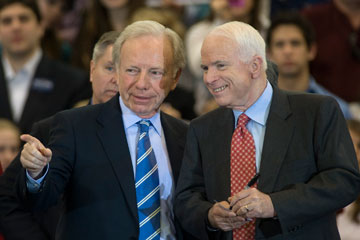
There, on the stage of the Fairfield University gym, in open-necked pink shirt and blazer and holding a mike, stood Shays, R-Conn., who kissed President Bush last week at the State of the Union address. He was introducing Lieberman, I-Conn., who even more notoriously exchanged a kiss with Bush at the same event in 2005. Lieberman’s job, in turn, was to warm up the crowd for Sen. John McCain, R-Ariz., who famously broke a long period of frost with the Bush administration by — eyes closed, nose burrowing into shoulder — hugging the president during a campaign stop in the summer of 2004.

As Shays handed the mike to Lieberman, Connecticut’s lone House Republican and its formerly Democratic senator drew very close together. From up on the press platform, it was hard to tell how close. “Did they?” I asked Hartford Courant reporter Mark Pazniokas. He was uncertain. “I was looking down to write something,” a blogger named Connecticut Bob chimed in. “I missed it.”

It was left to Lieberman to erase all doubts. “Notice we kissed each other,” he announced to the crowd of 1,500. “I don’t want to go into details.”

Though he still caucuses with the Democrats, Lieberman’s habit of crushing on Republicans, particularly the bellicose kind, is well known. But he and GOP front-runner McCain and Lieberman have swapped a lot more than spit. Like a yin and yang, they have been fetally curled toward each other for years. They have had their differences with the Bush administration on other issues, but together they have supported going into Iraq and have been even more supportive of staying there. Trying to get McCain elected president is only their latest joint initiative.

Getting Connecticut in the red column come fall, however, may be too much for McCain and Lieberman to ask. McCain won the state easily from George W. Bush in the 2000 Republican primary, and looks set to win it again Tuesday. He has been endorsed by Gov. Jodi Rell, and he was up 22 points in one recent poll. But Republicans have been decimated in a state that has become reliably blue in presidential elections. Some of the state’s voters have buyer’s remorse about the senator who shared the stage with him Sunday, in large part because of the issue that both McCain and Lieberman have made their own: Iraq.

Outside the gym, among the protesters who’d gathered for the McCain rally, the rancor was aimed at both the candidate and his biggest local booster, and it was about Iraq. Mary-Ann Tirone Smith, a successful crime novelist, held a sign that said, “Lieberman and McCain — Warlords.” It was streaked and spattered with faux blood, sort of like the cover of a crime novel.

Across the street from Tirone Smith with about 100 noisy antiwar protesters was Jim Dean, Howard Dean’s brother, who runs a grass-roots group called Democracy for America. Eight years ago Jim Dean was inside the same gym for a McCain rally. In 2000, “I was in that building for a guy who was against special interests and would take very seriously the act of sending other people’s kids to war,” Dean told me. “The John McCain I knew would never have voted for this war and wouldn’t be pandering to conservatives by taking a stand against a woman’s right to choose.”

Inside the gym, support for the Iraq war earned Lieberman and McCain their biggest applause of the afternoon. There was no doubt that the crowd had come to hear about security and the battle against Islamic terror, more than the economy or immigration or climate change. People who attended the 2000 event describe it as loud, raw and urgent; Sunday’s crowd included more casual political windowshoppers, and came to life mainly when McCain promised, about Iraq, “I will never surrender,” and when he made his usual promise to track Osama bin Laden to the gates of hell.

Even the Man from U.N.C.L.E. was there for that reason. “I’m listening to all of them,” he said. “The key for me,” said Robert Vaughn, who played TV master-spy Napoleon Solo from 1964 to 1968, “is how the next president handles Islamic jihad.”

And there were those in attendance who were drawn to McCain as a supposed maverick. Robin Sandler, who had brought his 12-year-old son from Branford, Conn., to see the candidate, said he admired McCain’s independence. But he was undecided, and was hoping for more signs of that independence. “He might say something that hits me in the face, or it might be more subtle, but I’ll know it when it comes,” he said.

McCain demonstrated his purported cross-party pull by showcasing his unusual coalition of centrist Republicans (Shays), movement conservatives (former Texas Sen. Phil Gramm, also onstage) and hawkish Democrats (Lieberman). He also brought out someone who made him look relatively young by comparison — his mother, Roberta, who turns 96 on Thursday. She was, however, one of the few women brought out for public display, at an event where the political celebrities skewed white, male and old. And whatever McCain’s appeal might be nationally, the presence of one of the other women onstage, ex-Rep. Nancy Johnson, spoke volumes about the fortunes of the Republican Party in Connecticut and New England.

“It’s a great day to be a Republican,” Dick Foley, a mirthful former GOP state chairman, teased me right before the rally. But in reality, the state GOP is a train wreck. Connecticut’s most popular Republican, the reclusive Gov. Rell, did not attend the Fairfield rally. To fill the stage with Republicans, McCain had to enlist two ex-members of Congress, Johnson and Rob Simmons, and a third who had not served since 1982, Larry DeNardis. Both Johnson and Simmons were swept out of office by Democrats in the 2006 election, Johnson after seven terms.

Democrats now hold two-to-one majorities in each chamber of the Legislature, and the top-ranking Republican state senator was recently forced out for asking a Mob-connected trash hauler to rough up his grandson-in-law. Shays, the Connecticut GOP’s only congressman, and the last Republican House member in New England, faces a tough fight this year from a well-funded opponent. And then there’s the matter of former Gov. John Rowland. From the stage, McCain delivered a slap at the state’s most famous Republican, who was not in attendance. “Governors are important,” he said. “You know, there were these two prisoners standing in a chow line, and one of them says to the other, ‘Hey, the food was better when you were governor.’” Rowland, a Republican, went to prison in 2005 for corruption.

Meanwhile, because of pressure from party insiders, and perhaps because of confidence in the party’s prospects this fall, the state’s Democratic hierarchy has done something it has resisted in the past. Lieberman’s decision to campaign with McCain alongside the remnants of the state’s GOP has earned Lieberman a public rebuke.

In 2006, when Lieberman lost the Democratic primary to Ned Lamont and ran as an independent, the state party establishment refused to sever its ties with him. Party big shots like Sen. Chris Dodd campaigned for Lamont, but state chairman Nancy DiNardo never really spoke out against him.

Lieberman won the general election with 50 percent of the vote by taking 70 percent of Connecticut’s Republican vote. He still feels slighted by the Democrats, and grateful to GOP voters. “I still have a few scars in my back,” Lieberman told the Republican crowd Sunday. “And it’s because of you and people like you around Connecticut that I have the privilege of continuing to serve. A lot of you crossed party lines to vote for me.”

DiNardo, for her part, finally boiled over last week and issued a blistering statement on Lieberman’s McCain-related activities. DiNardo pronounced herself “disappointed beyond words with Joe Lieberman, as are a lot of Connecticut Democrats — saddened, surprised, and truly disheartened by just how completely he has abandoned the Democratic principles that have guided him over the years and the Party whose members have supported him.” In particular, DiNardo accused Lieberman of going back on a campaign promise to help get a Democrat in the White House in 2008.

McCain, meanwhile, has amends to make with his own party. He and the hardcore Bushies, who once included Connecticut Lt. Gov. Michael Fedele, are still an uneasy fit. The Limbaugh crowd likes Mitt Romney better. Mary Matalin, on “Meet the Press” Sunday, was publicly baiting McCain to be a man and ask Mike Huckabee to bow out so McCain and Romney can go head to head. Even here in McCain-friendly Connecticut, far more Republican officeholders signed on with Rudy Giuliani than with McCain in the early going.

McCain does, however, have one person he can count on forever. Harry Truman said if you want a friend in Washington, get a dog. In McCain’s case, Lieberman will do.

After the event in Fairfield, Lieberman and McCain stayed close, churning through the crowd together to visit directly with the press. McCain once again had a chance to answer, i.e., not answer, the inevitable question about whether he would tap Lieberman for a running mate, as a fellow named Gore did in 2000. Lieberman has said he will not. McCain’s response on Sunday: “I say after next Tuesday, if we win then, there will be that consideration. Joe Lieberman has contributed so much to America, I would be honored to serve by his side in any capacity.”

Lieberman: A surge of buyer’s remorse?

Antiwar Connecticut voters find themselves with a pro-escalation senator -- and other Senate Democrats are scared to offend him.

  • more
    • All Share Services

Lieberman: A surge of buyer's remorse?

One day last week a grumpy citizen of Connecticut called my talk radio show and asked, half-seriously, if we could trade our senator, Joseph I. Lieberman, straight up to Nebraska for Chuck Hagel.

The caller’s point was that we want a Democrat and they want a Republican; and even though each senator wears the opposite political label, when it comes to Iraq, Hagel sounds like a blue-state Democrat, while Lieberman has proven more loyal to President Bush than many Republicans have.

Tempers are little frayed here in Connecticut because our junior senator spent last summer fighting for his political survival by insisting, among other things, that the policies he supported would result in troop withdrawals. Lieberman said some American troops would be able to leave Iraq by the end of 2006, and more than half would be out by the end of 2007. According to exit polls on Nov. 7, more than 60 percent of Connecticut voters opposed the war in Iraq and/or favored withdrawal of some or all troops, and nearly four out of 10 of those antiwar voters supported Lieberman. Lieberman had barely digested the food from his victory party before he spun 180 degrees and added his voice to the “surge” chorus.

Hagel, meanwhile, has been firm about insisting that adding troops merely piles disaster on top of disaster.

On Sunday, the two men squared off on “Meet the Press” for an exchange in which Hagel gave Lieberman the kind of chewing out you’d direct at a kid with bad grades, a busted curfew and a serious dent on the family car.

Lieberman had just insisted that all alternatives to Bush’s escalation amount to an advocacy of defeat. The enemy we’re fighting, he said, is the same enemy who attacked us on 9/11. If we are defeated, he said, “the consequences for us — and I want to be personal — for my children and grandchildren will be disastrous.”

“That’s ridiculous,” Hagel shot back.

“I’m offended that any responsible member of Congress or anyone else would even suggest such a thing,” he growled. “Senator Lieberman talks about his children and grandchildren. We all have children and grandchildren. He doesn’t have a market on that.”

You don’t hear people talk to Lieberman like that very often. You especially don’t hear Senate Democrats do it. They don’t dare, because he’s their Archie. Let me explain.

People who don’t like Joe Lieberman are forever comparing him to this or that pop culture figure. Two favorites are Supreme Chancellor Palpatine from the “Star Wars” movies, because of his fishy smile and his defection to the dark side, and Max Wright, the actor with the high forehead and quavering drone who played the father on the series “Alf.”

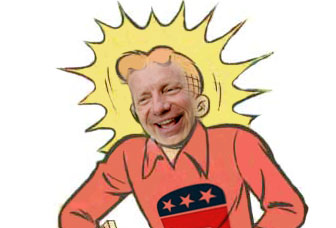
Ever since his November victory over Ned Lamont, however, Lieberman has reminded me more and more of another pop icon, Archie Andrews. Archie, the eternal senior at Riverdale High School, will be forever defined as a feckless seesaw tipping back and forth between Betty and Veronica.

Betty Cooper is a middle-class, populist dreamer. Veronica Lodge is an elitist plutocrat. Archie can’t make up his mind which one represents the apex of his desires, although he leans toward Veronica.

Betty is a Democrat. Veronica is a Republican. Archie is a nebbish granted inexplicable power simply by his own inability to make a permanent choice.

In a nearly deadlocked Senate, being fickle means being powerful. After the election, Lieberman therefore advertised himself as the least reliable member of the Democratic caucus by insisting that he be listed by the secretary of the Senate as an “Independent Democrat.” Last week, in a development noted by few, Lieberman’s office admitted to Congressional Quarterly that the whole I.D. thing seemed not to be catching on, and that, if Lieberman had to choose one or the other, he’d rather be known as an Independent than as a Democrat.

C.Q., at least, reported that it is going to consider Lieberman an Independent from now on: “With Lieberman’s latest shift, the Senate now has 49 Republicans and 49 Democrats, but the Democrats lay claim to the majority because both Lieberman and Vermont’s Bernard Sanders — who’s never considered himself a Democrat — continue to align themselves with the Democrats.”

Lieberman continues to act more like an A — Archie, that is. On the first Friday in January, he began the day with Betty, at an all-day retreat for Democratic senators. But, oops, Veronica crooked her finger, and Lieberman ducked out of the retreat to head uptown with Sen. John McCain for a joint appearance at the conservative American Enterprise Institute think tank, where Lieberman urged support of the president and a commitment to success in Iraq.

Desperate to appease Lieberman, lest he defect, the Democrats gave him the committee chairmanship he wanted, Homeland Security and Governmental Affairs. From his perch as ranking minority member in the last Congress, he staved off the charge from Lamont supporters that he was a Bush puppet with some tough talk about the White House failure to turn over relevant documents about its bumbled handling of the Katrina crisis.

At the end of last week, Newsweek reported that Lieberman had decided to back quietly away from requesting the missing Katrina documents. “The senator now intends to focus his attention on the future security of the American people and other matters and does not expect to revisit the White House’s role in Katrina,” a committee spokeswoman told Newsweek.

This news followed the president’s Wednesday night speech in which he mentioned the names of three people — the prime minister of Iraq, his own secretary of state and Lieberman — to whom he blew a verbal (this time) kiss for inspiring the idea of a bipartisan Iraq work group. No other relevant Democrat wants to be part of the group.

It’s not surprising that Lieberman is feeling Veronica’s pull. His own party chose Lamont in its primary. Connecticut’s other senator, Chris Dodd, made a commercial for Lamont, and Ted Kennedy stumped the state with the Nedheads. During the heat of the campaign, the kind words Lieberman heard came from Bush, from Vice President Dick Cheney, from Karl Rove, from paleo-con pundits like Rush Limbaugh and Sean Hannity. GOP donors took the hint. The Hartford Courant and the New York Times did extensive reporting on the money flowing to Lieberman from Republican sources. Not many Democrats have ever nicked Bill Kristol for $500 before. Who loves you, baby? The latest analysis on the site OpenSecrets.org shows 80 percent of Lieberman’s campaign money coming from outside Connecticut, which is very unusual for an incumbent senator in a densely populated, wealthy state.

What is surprising is the loneliness of Lieberman’s current stance. He made a career out of testing the waters pretty carefully. Even his most celebrated maverick moment, the denunciation of Bill Clinton in September 1998, was a pretty secure position.

“I was disappointed,” said Lieberman on the Senate floor, “because the president of the United States had just confessed to engaging in an extramarital affair with a young woman in his employ and to willfully deceiving the nation about his conduct.”

He went on to call the conduct immoral and to say Clinton should have addressed it with candor. Really. You think?

In this case, Lieberman seems not to have understood what a sharp turn public opinion was taking. A recent AP-Ipsos poll showed 70 percent opposition to the troop surge and only 29 percent supporting Bush’s handling of the war.

These days, I assume Lieberman drifts blissfully off to sleep picturing ecstatic crowds screeching as a historic McCain-Lieberman “fusion” ticket is announced. Lieberman turns 65 next month. I doubt very much he’ll run for Senate again at the age of 70, but I think he’d leap at a chance to run with McCain or to serve prominently in the next White House, an opportunity he will not have if a Democrat wins. Lieberman has proven to be a man of considerable vanity and ambition, and his best chance to slake those thirsts now seems to be, as Democrats turn away from him, at the Republican trough.

Unless Chuck Hagel punches him out first.

Continue Reading Close

The Lieberman spoiler

GOP candidate Alan Schlesinger has no chance in Connecticut. But he's made Lieberman his punching bag, to the delight of Lamont supporters.

  • more
    • All Share Services

The Lieberman spoiler

Alan Schlesinger thinks of himself as a piñata.

The Republican candidate for U.S. Senate from Connecticut feels like a papier-mâché punching bag, he says, because of the abuse he has taken from the media and his own party. The press has often acted as if he did not exist and the GOP leadership has treated him like a bombastic nut with no chance of winning.

Schlesinger is running against Democrat Ned Lamont and Democrat-turned-independent Joe Lieberman, the incumbent. Schlesinger gets angry sometimes, he says, when he thinks about the way President Bush “basically gave a wink and a nod for the big money to go out and support Lieberman.” He also got angry when the state party publicly called on him to withdraw from the race over allegations of erratic behavior at our nation’s fine gambling establishments. “I was thrown under the bus,” he gripes. “That’s what made fundraising so difficult.”

And he gets mad at the media, which has been covering something it calls “the Lieberman-Lamont race,” usually because it’s just too exhausting to type in a long third name with three syllables for a candidate pulling about 3 percent in the polls.

But that 3 percent was before last week, back in the day when nobody interviewed Schlesinger or wrote about him, and he had no money for TV commercials, which are the modern Cartesian proof of political existence. I buy TV time, therefore I am.

Last week, a funny thing happened. He debated Lamont and Lieberman. Schlesinger, who debates the two front-runners again Monday evening, likes to call this new phase of his campaign “The Piñata Strikes Back.”

A former mayor and state legislator, Schlesinger is what you might call a Goldwater Republican. In his case, not so much Barry as Morty Goldwater, the guy who used to hold forth in the Minnehaha Lounge at the Wonooscapomic Country Club. Remember Morty? He’d start out kind of charming and get louder as the evening rolled along. His opinions would get more forceful and possibly less grounded in fact, so that by around 11 p.m., he had pretty much half the barroom to himself.

In this particular Senate race, though, Morty Goldwater is just what the doctor ordered. The poll numbers were frozen in place, with three-term incumbent Lieberman headed toward a comfortable victory over Lamont, the guy who beat him in the Democratic primary. While waiting for the inevitable on Nov. 7, Lieberman and Lamont seemed locked in a struggle over who could be a less electrifying political presence. Then Schlesinger jolted the campaign out of its slumber with the first big exchange of the first debate on Oct. 16.

“Joe,” brayed Schlesinger, “you had more moral outrage about Mr. Clinton’s indiscretions than about North Korea’s nuclear proliferation.”

Stunned, Lieberman looked momentarily like the Scarecrow from “The Wizard of Oz” trying to give directions. “I thought the attacks were only going to come from this side,” he protested, flopping a straw-filled arm toward Lamont. “I didn’t realize they were going to come from that side,” he concluded, gesturing back toward Schlesinger.

The remark, of course, spoke volumes about Lieberman’s understanding of this race, which is that Republicans are supposed to raise tons of money for him and never lay a glove on him.

Schlesinger never got that memo.

In fact, by the second debate, Schlesinger and Lamont had developed a little tag-team wrestling act where one of them would hold Lieberman while the other punched him. Schlesinger described to Lamont a worker who failed to get the job done for 18 years.

“You’re a businessman like me. What would you say to a guy like that?” Schlesinger demanded.

“It’s time to go,” Lamont answered.

“You’re fired,” added Schlesinger, smirking at Lieberman, because that’s how he is.

With nothing to lose, Schlesinger will go on the attack again Monday night. The Lamont crowd, accordingly, now treats Schlesinger like a folk hero, even though Schlesinger has lobbed plenty of abuse at Lamont too. Schlesinger charges that Lamont is light on solutions and is a left-winger like Lieberman, whom he likes to characterize as the most liberal of all 100 U.S. senators. Since Lamont seems unable to help himself these days, his supporters are hoping Schlesinger will lend a hand by taking votes from Lieberman. Schlesinger bristles whenever he hears this. “Those are my votes,” he snaps. “Joe took them away from me in the first place.”

Lamont even used a little of his allotted time in the first debate to giving Schlesinger some “Hang in there, Alan” encouragement. Lamont cited himself as an example of a candidate who overcame long odds and said Schlesinger could do the same, which is a strange point to make, since Schlesinger’s stated goal is the destruction of both Lamont and Lieberman.

“If the press gives me a chance,” Schlesinger insists, “I’ll win the election.”

Well, perhaps not. After two strong debate appearances, Schlesinger’s poll numbers immediately skyrocketed all the way up to … 8 percent.

In those measly eight points, however, lies possibility. In a normal Senate race in Connecticut, a can of tuna running as a Republican finishes in the low 30s. In 2000, Waterbury Mayor Phil Giordano captured 34 percent running against Lieberman. Giordano was captured himself a few months later and is currently a 37-year guest of the federal prison system. Federal agents were wiretapping him in a corruption investigation, which they had to compromise because they overheard him arranging sex through a prostitute with two little girls. Think about that. His sex crimes were so vile, it was impossible to continue investigating him for corruption.

Nobody knew that in 2000, but nobody confuses a guy like Giordano with Jacob Javits either, and still he got 34 percent. Six years before that, Lieberman faced a nonentity named Gerry Labriola. Very nice fellow, but pretty much the goat staked out for the T. Rex in “Jurassic Park.” He pulled 31 percent.

Now a three-way race is different, I grant you, but all of the above tells me there is some kind of baseline number of Connecticut residents who always and only vote Republican. And that number is larger than 8 percent.

Schlesinger is also holding a magic bean.

“You can’t poll ballot position,” he reminded me this week. “The polls are underestimating my support from that.”

Schlesinger is on the top line of the ballot, pretty much jowl-by-cheek with M. Jodi Rell, Connecticut’s unreasonably popular incumbent governor. Rell is beloved mostly because she is not her predecessor, John G. Rowland, lately discharged from federal prison. Believe me, the guy who took over from Sauron got 57 percent of the vote in Middle-earth, and Rell will get 57 percent too.

Lieberman, meanwhile, is “Where’s Waldo?” on the ballot, a crossword puzzle coordinate on the order of five down and three across. Schlesinger told me he saw one ballot — they vary by town — on which Lieberman is all the way down on line seven.

Lately, Schlesinger, Rell and GOP state chairman George Gallo all seem to have made up a bit. Gallo even steered a token $5,000 to Schlesinger’s campaign. Rell said something nice about him in her own first debate with her Democratic challenger and declined to endorse Lieberman. This is tepid support, but at least it’s not all-out sabotage.

But to the national party, Schlesinger remains an obstacle at best. Bush advisor Karl Rove called Lieberman the day he lost the Democratic primary in August. Rove didn’t call Schlesinger, the nominee of his own party. Rove, George W. Bush, Dick Cheney and other Republican figures who continue to praise and aid Lieberman have not reached out to Schlesinger, and he has given up hoping to change their minds.

“They had so much invested in Joe Lieberman as ‘our kind of Democrat’ because of Iraq that they can’t pull the rug out from under poor old Joe now,” he says. “They made their bet.”

That is probably the wrong turn of phrase for a guy who has been hurt by the disclosure that he used a fake name on a “Wampum Card” (sort of a frequent-flier deal for bettors) while gambling at the Foxwoods Casino in eastern Connecticut. Pretending to be someone named Alan Gold would seem a harmless offense had not several lawsuits by casinos seeking unpaid debts also surfaced. Schlesinger settled those more than a decade ago. He denies having a gambling problem.

“I am so recreational,” he claims. “I am so busy these days that I can’t even go when my friends ask me. I think I’ve been once this year. It was a stupid story from the get-go. With all the stuff that’s going on, all they can do is pick on me for my Wampum Card?”

Meanwhile, he has emerged as the H. Ross Perot of this election. In 1992, Perot was a screwy spoiler who hurt the incumbent more than he hurt the challenger. “I’m a lot more mainstream than Perot,” notes Schlesinger.

As of Monday, Lieberman was showing leads of 12 and 17 points in the polls. Those numbers are probably wrong, because of the Schlesinger factor. He will get more than 8 percent. If he can jack himself up to 17 on Election Day, we may be up late figuring out who won.

Continue Reading Close

Unfamiliar taste of victory

At Ned Lamont headquarters, progressives bask in the triumph of their upstart candidate -- for the moment.

  • more
    • All Share Services

Unfamiliar taste of victory

At a certain point, amid the chanting and confetti throwing and the unambiguous, surging happiness on the faces of Ned Lamont supporters late Tuesday night in a Meriden hotel, I saw a certain appetite. Like hikers who’d been lost in the mountains, these people were being led down to their first real meal in a long time. They were hungry and grateful and a little overwhelmed.

They had beaten (for the moment) incumbent U.S. Sen. Joseph Lieberman, and the banquet spread before them had been so long in coming it was almost too good to be true.

Whether it was peace activist Flo Woodiel or gay and lesbian activist Shawn Lang or Hartford arts leader Will K. Wilkins, they said the same thing to me, in nearly identical words.

“I haven’t been on the winning side for a long time.”

Or, as Lang put it, “There was the Red Sox in 2004. And now there’s this.”

In the room were people who had believed in Ted Kennedy in 1980 and Jesse Jackson in 1988 and Jerry Brown in 1992 and Nomar Garciaparra in 2003. They had supported Democratic challengers against former Connecticut Gov. John Rowland and lost to him three times. They had lined up for Al Gore in 2000 and John Kerry in 2004, and what did they have to show for it?

New England is kind of set up to tell you that you have the wrong idea. The God of the Puritans doesn’t like you very much. The Kennedys die or suffer disgrace. Bill Buckner can’t field a slow roller. You should have dressed warmer (or cooler).

For this night, perhaps, these people had discovered a winning formula. Run against somebody who will hurt himself.

Because one thing seemed clear when Lamont wedged himself onstage with Rep. Maxine Waters, the Rev. Jesse Jackson and a throng of other Democrats who had supported him: the person to whom he owed the most was not there. Joe Lieberman was in Hartford.

Lamont is an independently wealthy businessman from Greenwich. At the dawn of 2006, nobody much had ever heard of him. In a matter of months he became famous as the only guy willing to run against Lieberman and willing, for that matter, to put up his own money to do it. Not a natural campaigner, he learned on the job, got better at answering questions and developed something like practiced ease in public situations.

He collected 146,000 votes on Tuesday and beat Lieberman by 10,000 votes and four percentage points. A solid win like that suggests that Lamont drew support from the mainstream of the party.

He still hasn’t become a great candidate. I’m not sure he’d do that well in a normal field of hopefuls scrambling for an open seat, but that isn’t the way this race worked. All Lamont had to do was be brave enough to get in the ring with Lieberman and argue a different position, primarily a position against Republican policies in Iraq. Lieberman did the rest, running a prickly and at times even haughty campaign that did not, until its final days, acknowledge the kind of trouble he had gotten himself into. Only then did the senator begin acting slightly less enthusiastic about the way the war is going and the way the White House is waging it.

As the night wore on, there was a persistent hope among Lamont supporters that Lieberman would now get out of the race. His fellow senator, Chris Dodd, was going to sit him down right away and have a tough talk, a number of politicians told me. They made it sound like an alcoholic “intervention,” when the family finally gathers to tell Dad he has a drinking problem.

“He’s not going anywhere,” Connecticut’s former governor and senator, Lowell Weicker Jr., muttered to me before the results were final: “He’s not giving up.” Weicker had surprised a lot of people by showing up in Meriden at the Lamont rally. “He’s got plenty of money and nothing to lose and he wants his job back.”

Weicker is in a unique position to know. Lieberman took the Senate job from him in 1988, and Weicker was instrumental in recruiting Lamont to run this year. He told me he will now form Independents for Lamont, to raise money and help the Democratic candidate in the much more complicated fight for votes in a general election.

Weicker was right, at least for the moment. Lieberman gave a speech that conceded only the numbers of the night. He had lost one balloting. He said it was halftime and Lamont was ahead with a whole second half to go. He denounced his opponent for “partisan politics” and for running on insults not ideas. The senator’s close advisor, Lanny Davis, formerly of the Clinton White House, said it would be absurd for Lieberman to give up just because of what 100,000 people did on one day in August. There were a lot more Connecticut voters to be heard from.

True, and it’s too early to get a full handle on what happened Tuesday, but even the Lieberman camp’s spin — this was a freak accomplishment on a hot summer day by a splinter group of radicals — didn’t hold up as well in the light of the numbers.

Turnout was the highest it has been for any primary in recent memory — 43 percent instead of a more typical 25. Despite an enormous effort by both sides to court the African-American vote by using extensive visits and robo-calls from Waters, Jackson, the Rev. Al Sharpton (all for Lamont) and U.S. Reps. John Lewis and Eleanor Holmes Norton (for Lieberman), ad blitzes on black stations, and fliers and palm cards, turnout seemed lowest in predominantly black urban neighborhoods. It appeared late Tuesday that both sides had spent a lot of time and money on a very small handful of votes.

“It would have been more efficient and a little cheaper to buy each one of those voters a Chevrolet,” one Lamont advisor said wryly.

Instead the Lamont team seemed to be pulling its strength from middle-class whites. “People who work for big companies invariably know a fellow worker in the Reserves,” Lamont get-out-the-vote guy Peter Tercyak, a state representative, told me. “They see their co-worker go to Iraq and maybe get sent back for a second tour, and when they finally get home, they don’t like what’s happened to that person.”

At first blush, the big turnout looks like good news for Lamont, who runs a distant second to Lieberman in polls predicting a general election that also includes Republican nominee Alan Schlesinger, an obscure figure beset by news stories about odd gambling behavior at Connecticut casinos.

With this kind of win under his belt, Lamont no longer looks like a boutique candidate fueled by support from a patchwork of niche voters. He got votes from lunch-pail Democrats, but he’ll have to work hard to introduce himself to the rest of the Connecticut electorate.

“There will be a lot of people after tonight who will want to trot him all over the country as some kind of rock star, a symbol of a new kind of politics,” said Weicker. “We need him to stay here and keep his nose to the grindstone.”

Continue Reading Close

How Joe went wrong

The Times' endorsement of his challenger is more bad news for Lieberman. But Connecticut Democrats have been thinking about a divorce for years.

  • more
    • All Share Services

How Joe went wrong

On Sunday, the two most influential newspapers in Connecticut issued endorsements in the Democratic primary race between U.S. Sen. Joseph Lieberman and Greenwich businessman Ned Lamont.

The Hartford Courant offered a tepid endorsement of the incumbent, arguing that since the war is only one issue and Lieberman votes with his party 90 percent of the time, there isn’t enough reason to turn him out of office.

What the New York Times said, on the other hand, was momentous. The editors endorsed Ned Lamont, accusing Joe Lieberman not just of shilling for George Bush’s war, but of providing Bush cover for his abridgement of civil liberties and expansion of presidential power. Whatever momentum Lieberman might’ve gained from Bill Clinton’s recent drive-by in Waterbury had been slowed with a few sharp words from the paper of record.

But newspaper endorsements have a notoriously iffy impact on political races. Though they can be used to good effect in advertising, it’s tough to find a voter who will admit to having been swayed by an editorial. Besides, both papers emphasized Lieberman’s support for the Iraq war, which I think misses the point. The reasons for Connecticut’s disenchantment with its junior senator long predate the invasion of Iraq or that kiss on the cheek from George Bush or even his strange crush on the whole Bush administration. Lieberman and his home state Democrats have been slogging for years through a troubled marriage, a slow, painful breakup straight out of an Ingmar Bergman movie. Indulge me in a little history.

In 1979, Joe Lieberman was the majority leader of the Connecticut state Senate. That august body took up, as it did every year, a bill that would have allowed people to create living wills so that their families would know their wishes as they lay dying.

The lobbying arm of the Catholic Church fought and beat the bill every year. During the long-winded 1979 debate, as Joe Lieberman sat listening to a Catholic colleague denounce the bill as “man playing God,” a 25-year-old newspaper reporter plopped down in a chair next to him.

“Why does it always break down that way?” the reporter whispered. “The more conservative argument always invokes God. The liberals always insist that God has no place in a debate in an American state legislature.” (Lieberman was playing nanny that year to a group of rookie liberal senators, mostly disciples of Rep. Toby Moffett, and one after the other they were rising to argue for separation of church and state.)

Lieberman whispered back and forth with the reporter. “Why doesn’t somebody make the argument,” the reporter asked Lieberman, “that medical science has exceeded the will of God by keeping people alive when they’re supposed to be dead? Why not suggest that living wills represent a kind of restoration, allowing people to live in communion with the will of their Maker?”

At that, Lieberman fixed the reporter with a serious look and said, “That’s the most interesting thing anybody has said to me all session.”

The reporter brightened at such praise, only to watch in disappointment as Lieberman voted against the bill, which failed again.

I was that young reporter. Call it the beginning of my education about Joe Lieberman. Sometimes what he says has nothing to do with how he’ll vote.

A few years later, the state legislature passed the damn bill. My mother now has a living will, which is a good thing because she’s near death. I spent last Thursday talking to nurses about nutrition and hydration. I spent part of Friday talking to Michael Schiavo, who came to Connecticut to endorse Ned Lamont. In 2005, on “Meet the Press,” Lieberman argued that Congress had a legitimate function in preserving Terri Schiavo’s 14th Amendment right to due process and in safeguarding her life and liberty.

“I would have kept the tube in,” Lieberman said. After 27 years, he is still tracking right on end-of-life issues.

“You can’t defeat an incumbent in America,” says David Pudlin, a Lamont supporter. “If they want to come back, the rate of return is closer to 100 percent than it is to any other number. We remember the ones who didn’t make it, and it usually involves financial malfeasance or sexual peccadilloes of a pretty unusual magnitude.”

Lieberman is not in danger of losing the Democratic nomination because of any scandal, says Pudlin, a former majority leader in the Connecticut House of Representatives. “Of all things, it’s about issues,” insists Pudlin wryly. “That’s almost un-American, if you follow electoral politics. It’s simply not done.”

Lieberman’s years in public life have been a steady drumbeat of disappointment for Connecticut Democrats, a liberal lot who do not share his often conservative views. End-of-life issues are just one example. In 1992, the state’s Democratic voters picked Jerry Brown over Bill Clinton in the presidential primary. Lieberman, meanwhile, spent the 1990s joining cultural conservative Bill Bennett in a kind of Sherman’s March through American culture, handing out Silver Sewer awards for sex and violence and denouncing such pornographic abominations as “Married  With Children.”

Tag teaming with Bennett was one of the senator’s early experiments in what he calls “bipartisanship,” which often entails adopting Republican positions without leveraging any concession from the other side. Tell me how Bill Bennett moved toward the middle to accommodate Joe Lieberman. Pretty much the way Bush and Cheney moved to the center to meet Democrats on Iraq. Not at all.

Yet Lieberman’s reputation in Connecticut is not purely that of an out-of-step conservative. It’s much more complicated, and frustrating, than that. He’s a serial raiser and dasher and re-raiser of hopes.

Gays trust him because he’s voted with them on a lot of big issues, but they don’t trust him because he voted for the Defense of Marriage Act in 1996. Once he even collaborated with Sen. Jesse Helms on a measure that would have stripped federal funding from public schools that counseled suicidal gay teens that their lifestyle was OK.

Women trust him because he’s a reliable vote for abortion rights and don’t trust him because he went off the reservation for the only significant vote (cloture) on the Supreme Court nomination of Samuel Alito. During the recent debate over requiring hospitals to provide emergency contraception for rape victims, Lieberman emitted a shockingly callous, and now famous, sound bite. He said it’s never more than “a short car ride” in crowded Connecticut to a more accommodating hospital.

That’s just the beginning of the catalog of gripes. Long before there were those TV love fests with Fox’s Sean Hannity that so enrage lefty bloggers there were earlier love fests with none other than Pat Robertson. On the apocalyptic evangelist’s “700 Club,” Lieberman complained about moral relativism, said there was too little religion in public life, and said he was pleased that people of faith were taking their principles into the political arena. In 2003, Connecticut political writer Paul Bass chronicled the scramble by the senator’s staff to scrub his image from a fundraising infomercial (also starring Robertson and Jerry Falwell) for a conservative religious group with which he had been involved. His 2004 campaign for the presidential nomination was so pitched toward the conservative, moralistic, Southern elements of the party that I jokingly suggested the slogan: “He may be a Jew, but he’s a better Christian than you are.”

Then there’s his famous 1998 denunciation of President Clinton, followed by his relatively hands-off approach to the darker, ultimately criminal scandals embroiling Connecticut Gov. John G. Rowland, with whom Lieberman maintained one of his famous bipartisan friendships. Nobody talks about it much, but there’s also a sour feeling among Democratic state office-seekers that Lieberman’s campaign help was often not to be found, especially as his own ambitions turned national. “Let’s put it this way,” one politician said to me. “There aren’t a lot of people who use the phrase ‘after all he’s done for me’ in explaining why they support Joe.”

Covering Lieberman is a good way to understand how misleading a voting record can be. (Are you listening, Courant editorial board?) Most members of Congress vote with their parties the preponderance of the time. There are other questions to ask. Did he vote differently on a much-more-important earlier amendment or cloture motion? Did he wait until it was clear his vote wouldn’t hurt the other side? Are his public pronouncements strangely different from his votes?

Consider Lieberman’s behavior during the confirmation of Clarence Thomas 15 years ago, well documented in this article from the political newsletter Counterpunch. Lieberman spoke avidly on behalf of Thomas and disdainfully about Democratic colleagues whose opposition was, he thought, too political. He was pretty much the last senator to commit to a nay vote, and only when his vote didn’t matter.

Lieberman wound up with no points against his license for Voting While Republican, even though he supported Thomas actively till the 11th hour. Interestingly, one of his arguments was that Thomas should be judged only on his actual decisions, not on his speeches or writings, a principle Lieberman would probably like to extend to himself these days. In areas such as affirmative action and school vouchers, Lieberman’s public statements have caused him more trouble among Democrats than any vote he has cast.

What has saved Lieberman, time and again, has been his famous charm and affability. When politicians and activists march into his office to complain about something he’s done, they walk in mad and emerge calm.

He’s done it to me too, and it’s more than smiling and nodding. Lieberman really seems to be listening and considering the possibility that you’re right and he’s wrong. And he usually makes it clear that he still likes you, even though you sharply differ with him.

That charm and affability have deserted him this summer. The 2006 Joe is one angry guy. One of the first signs was an explosion on my radio show this March. Lieberman hadn’t liked a column I had written the previous Sunday, and he blew up at me. The audio clip went all over the Internet on blogs such as Daily Kos and Firedoglake, which marveled at the crack in Joe’s legendary composure and crowed, “He’s losing it!”

He never really got his smile back. You might call that a political miscalculation, but I don’t think he can help it. Lieberman is truly appalled by the number of former friends who are now foes. He can’t hide it. It’s all over his face.

For years, the natives around here have been a little restless about Joe Lieberman. Shortly after 2000, I started to hear rumblings about the idea of running a progressive against him, but he was too powerful and too popular. Nobody saw the point of trying.

The New York Times and other national media outlets are right that the Iraq war — this deeply unpopular, catastrophic adventure — is what finally made the natives brave enough to act, and what may have ended Joe Lieberman’s tenure as a senator. But people in Connecticut know the war was only the tipping point. They have long memories of everything that came before.

Continue Reading Close

Why is Bill Clinton in Connecticut?

It helps his wife, and it helps Joe Lieberman connect with a group of long-neglected voters.

  • more
    • All Share Services

Why is Bill Clinton in Connecticut?

“They’re desperate. They’re losing,” Rep. Maxine Waters told me on Saturday. The California Democrat was 3,000 miles from home in Hartford, Conn., at Ned Lamont for Senate headquarters in the black neighborhood known as the North End. By “they” she meant the Joe Lieberman campaign.

Waters had just spent the day storming through the state, even knocking on doors, trying to persuade people to vote for Lamont, a white Greenwich millionaire she’d probably never heard of a few weeks ago. Even so, she can see in him great virtues, chief among them the fact that he is not Joe Lieberman. Lieberman and the very liberal Waters have been at it since at least 1995, when he chaired the centrist Democratic Leadership Council and spoke in favor of California’s anti-affirmative-action initiative. Waters would probably campaign for an attractive Ikea wall unit if it were running against Lieberman.

But as a campaigner, Waters can’t hold a candle to America’s greatest living “black” politician, who will make his own trip to Connecticut Monday afternoon, except he’ll be working for the other side. William Jefferson Clinton will appear at a rally in Waterbury on behalf of Lieberman, in hopes of rescuing the incumbent senator’s foundering reelection bid.

Why is Bill Clinton stumping for the man who famously rebuked him from the floor of the Senate during Monica-gate eight years ago? Part of the reason is personal. Clinton and Lieberman have known each other nearly 40 years. They met in 1970, when both were Kennedy disciples involved in a Connecticut-wide liberal insurgency that won Lieberman a state Senate seat.

Part of the reason is selfish. Lieberman may have chastised Clinton, but he has also provided a template for the other politician in the Clinton family. Hillary Clinton has undergone a gradual but very public transformation into a kind of Bride of Lieberman, hawkish on the war, adamantly pro-Israel and tracking right on social issues. She even likes to bash video games, just like Joe.

Hillary’s politics are Joe’s politics. If Lieberman sinks, it will raise a lot of questions about the current Clinton strategy, which is really just a post-millennial version of that old-time DLC religion. When I asked Waters why she thought Clinton was coming to Connecticut, she said there were rumors in Washington that he and his wife are freaked out by the sudden progressive insurgency. The DLC is putting down a small rebellion before it spreads. Thus, Bill, the DLC’s greatest success story, will be standing alongside former DLC chairman Lieberman in Waterbury mere hours after Hillary gives the keynote speech at the DLC’s annual national convention in Denver.

What Lieberman gets from Bill Clinton, meanwhile, is obvious, at least at first glance. The liberal base of the party has turned on Lieberman with ferocity. With two weeks to go before the Aug. 8 primary, he seems to be in free fall. Lamont has a four-point lead in the latest Quinnipiac poll, a 19-point jump in six weeks. Sean Smith, Lieberman’s campaign manager, espouses the idea that “low-information” voters swing elections. Some of those folks will surely be swayed by Clinton, and make up for all the liberal votes that are bleeding away.

But if you lose that many votes that fast, chances are you’re bleeding from more than one place. Lieberman’s handlers have been looking around for somebody, anybody, who might, you know, vote for him — some untapped bloc of loyal Democratic voters. How about, um, black folks? And to appeal to those black voters, how about calling in the white politician they like and trust above all others? Instead of, you know, Joe Lieberman.

There probably aren’t that many African-American primary voters — maybe 10 percent of registered Democrats, with a smaller percentage actually voting on Aug. 8. On the other hand, this will be an election of small numbers. I’m currently guessing a turnout of between 100,000 and 130,000, though I lean toward the higher total. If 65,001 votes win the primary, you don’t need to move a whole lot of votes to make a difference.

So Clinton is coming Monday, and Lieberman spent Sunday stumping in Hartford’s black churches, where, according to the city’s black leaders, nobody had previously seen him in his 18 years as senator. Lieberman staffers and Hartford Courant reporter Mark Pazniokas fell into an almost Aquinian discussion about Lieberman’s connection with African-American voters. Was he “reconnecting,” as many of the churchgoers were telling Pazniokas, or had he never disconnected at all, as the campaign kept insisting?

“His people will tell you he has been here, doing things quietly,” former Hartford mayor and state representative Thirman Milner, now a Lamont supporter, told me. “He must have been really quiet.”

Neither candidate, I’m sure, resonates much with black voters. Look at it musically. Lieberman became famous in 2000 for his plodding version on “Late Night With Conan O’Brien” of “My Way,” the whitest Frank Sinatra song ever. Lamont has recently unveiled some chops on the keyboards. He told me his best tune is John Lennon’s “Imagine,” which is ennobling but also white. I doubt Clinton is going to rip some serious Wilson Pickett on his sax in Waterbury, but you know one of his jobs while he’s in town is, metaphorically, to play that funky music.

If Lieberman’s sudden discovery of the black vote doesn’t work, of course, the Clintons will cut Lieberman loose like a sandbag on a sinking balloon. They already have, sort of. Each has made separate statements promising to support the Democrat chosen by party voters in two weeks, so no matter how many nice things the ex-president says in Waterbury, we should understand that today’s Joe Cool could be Aug. 9′s Joe Who?

But maybe the ploy will work because Waterbury is, after all, a lucky charm for Democrats. And it’s one that speaks to both Bill Clinton and Joe Lieberman’s dimly remembered roots. In 1960, John F. Kennedy abruptly added a Waterbury stop to his campaign schedule, and 40,000 people stood around until 3 a.m. waiting to see him. He spoke from the balcony of a beautiful and storied old hotel, the Elton. The night was celebrated by historian Theodore White as a turning point, and Pierre Salinger called it the greatest moment of that campaign. It’s a story both Clinton and Lieberman would know well, or would’ve known back in 1970. In the ensuing years, each has parked some of his youthful ideals and gotten behind the wheel of the shiny new centrism. And the Elton Hotel has become an assisted-living facility. Time is pitiless.

Continue Reading Close