Irin Carmon

“Not allowed to speak”: GOP silences D.C. rep

Rep. Eleanor Norton tells Salon how Republicans wouldn't let her talk at a hearing to ban abortions in her district

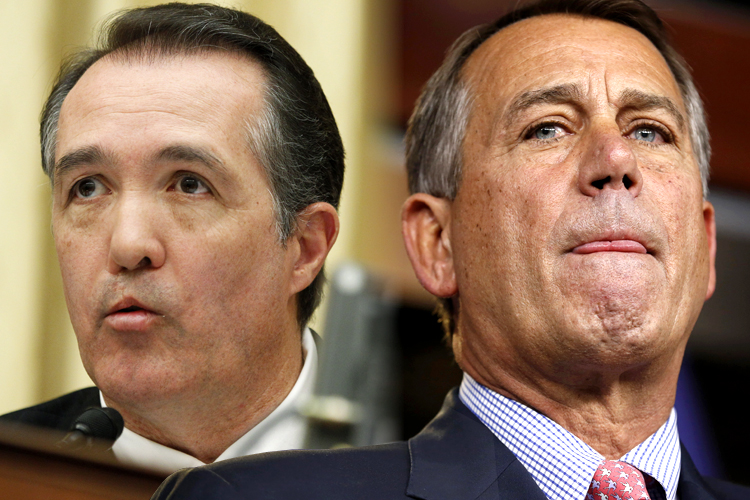
House Republicans seem to have learned this much in the past few months: It looks bad to turn away a woman from a hearing on women’s health. So when D.C. congresswoman Eleanor Holmes Norton was denied the courtesy of testifying at a subcommittee hearing yesterday in her district on banning abortions after 20 weeks, Chairman Trent Franks, R-Ariz., suggested a compromise of sorts.

“He said that the congresswoman could, if she desired, sit on the dais of the hearing, but she would not be allowed to speak,” Norton told Salon after the hearing. She declined an offer she said “no self-respecting member” would accept.

“I certainly didn’t give them that optic,” she said drily.

Franks was technically within his rights – per the rules, the Democratic minority was granted one witness, D.C. resident Christy Zinks, who had an abortion at almost 22 weeks after the detection of a severe fetal abnormality. Still, as Norton pointed out, “there is a long tradition that goes back more than a century of allowing members to testify on a bill that may touch upon the district.” Nancy Pelosi also condemned the move.

In the testimony she wasn’t allowed to give, Norton says the so-called Pain-Capable Unborn Child Protection Act “is the first bill ever introduced in Congress that would deny constitutional rights to the citizens of only one jurisdiction in the United States, and it is the first bill ever introduced in Congress that would ban abortions after 20 weeks of pregnancy.” Last year, House Republicans managed to strike a budget deal that would deny the District of Columbia the right to use its own Medicaid funds to pay for abortions — another byproduct of the fact that D.C. is ultimately under congressional oversight and has only partial self-governance.

Seven states have followed Nebraska in passing manifestly unconstitutional bans on later abortions without health exceptions, on the scientifically suspect notion that a fetus can feel pain after 20 weeks. So far, pro-choice organizations have declined to mount a legal challenge, for complicated reasons.

Norton called it a “stalking horse” for the overturning of Roe. “We understand we’re the vehicle, we know we’re not the object of affection,” she said. “What they want from the Congress is a federal imprimatur to continue their march in the states, to say, even the Congress has voted for a bill to limit abortion to 20 weeks.”

The National Right to Life Committee has called the bill its “top congressional priority for 2012,” and will score members based on their votes, even though it likely has no chance of getting past the Senate – or the president. “They are serious about this bill,” Norton told Salon. “They’re not playing.”

That said, she thinks that despite Franks’ zeal, other House Republicans have lost their zeal for fighting what’s still being called the war on women. An earlier Franks bill, seeking to limit race- and sex-selective abortions, didn’t make it to the floor. And on the House version of the Violence Against Women Act, fiercely opposed by the White House and women’s groups, “They keep saying that they’re working on a way to reach an accommodation, and for them, that is unusual to say,” Norton said.

“They didn’t anticipate the way the war on women, as it is called, has boiled up to the surface,” Norton said. “And they’re trying to quell it somewhat.”

“Leave women alone” act!

Experts say Dems should fight for these bills -- even though they'll never pass. The strategy worked for the GOP

(Credit: Benjamin Wheelock)

We are at a political moment that yields headlines like Politico’s recent “GOP scrambles to assuage women’s groups.” Such copy must have delighted Democrats on the Hill: It means they had managed to back Republicans into a corner. Said scramble was over the Violence Against Women Act, which contains expanded protections that Republicans have accused Democrats of adding to make them look anti-woman. Senate Republicans reluctantly allowed VAWA to pass, but on Wednesday the House passed a version stripped of those expanded protections. Since women’s groups have not been “assuaged” by that Republican answer to VAWA and the White House has threatened to veto a bill without the protections for Native American, immigrant and LGBT victims, Republicans can pick between falling in line and looking like, well, misogynistic jerks.

Democrats, it seems, have taken a page from the GOP playbook. For a long time, Republicans have introduced what looks like dead-end legislation and then used it to demagogue their opponents, like the Susan B. Anthony and Frederick Douglass Prenatal Nondiscrimination Act of 2011, which sought to fight the non-problem, at least in the U.S., of abortions motivated by race and gender. Then there are the more successful abortion restrictions and Planned Parenthood defundings that have trickled down from the federal level to sympathetic state legislatures, where they’ve found greater success.
If Democrats want to keep the GOP on the defensive on women’s issues — and not only maintain that gender gap that shows up in most polls, but mobilize women in the base — they should seize the moment and get ambitious. After all, the political conversation around women’s rights is still overwhelmingly reactive to the conservative agenda, and what victories there have been are partial — the potential for a moderately expanded version of VAWA and eliminating the co-pay on a range of women’s healthcare services aside.
I asked advocates and activists to think big and offer up a proactive policy wish-list. “I am inclined to suggest that we introduce a bill entitled, ‘Politicians Should Leave Women the Hell Alone Act,’” says Jon O’Brien, president of Catholics for Choice. Short of that, there are four main areas of focus here: reproductive health, employment issues, sexual assault and domestic violence protections, and foreign policy. Most of these bills wouldn’t have a chance of passing with the current composition of Congress, especially the House. But why leave the realignment to the right?

Reproductive health:

Comprehensive sex education. One provision of the Affordable Care Act includes state grant money for more comprehensive sex ed, but another brings back funding for abstinence-only education. “Too often people are blaming young people for not making the right decision but denying them information about it,” says Sarah Audelo, senior manager of public policy at Advocates for Youth. That’s where the Real Education for Healthy Youth Act would come in. (It was introduced in both the House and Senate in November 2011, but wouldn’t get far in today’s House.) It would establish a minimum standard for programs receiving federal funding, including factually accurate information about contraception and STIs, as well as an LGBT-friendly curriculum. Speaking of which, Audelo says, it’s time to do away with the so-called “no promo homo” provision in the Public Health Service Act, which prohibits the alleged promotion of homosexuality.

Public insurance coverage for abortion care. The National Abortion Federation notes that in 2003, 11.5 percent of women of reproductive age were covered by Medicaid, but they’re still denied abortion coverage except in certain states or in cases of rape, incest and life endangerment. Similar restrictions apply to federal insurance coverage for servicewomen, Peace Corps volunteers and Native Americans. The Military Access to Reproductive Care and Health for Military Women Act  – or MARCH for Military Women Act — would undo part of the damage. It was introduced in the House and Senate last year. More broadly, repealing the Hyde Amendment would go a long way in improving access.

Allowing nurse practitioners or physician’s assistants to provide first trimester abortions. A bill along those lines was introduced, unsuccessfully, in California. “We’ve known for years that appropriately trained NPs, CNMs and PAs have the skills and expertise to provide safe first trimester abortion care and increase women’s access to care,” says a spokeswoman for the National Abortion Federation. That access is threatened as the number of providers dwindles, which can result in later and more expensive abortions.

Making the pill and emergency contraception over-the-counter. The Center for Reproductive Rights is currently suing the FDA over its politicized handling of the morning after pill, forcing women under 17 to get a prescription. Meanwhile, some reproductive health advocates would like to see the pill itself go over the counter, currently in place in several other countries without incident.

Codifying Roe. The Freedom of Choice Act ensures the right to bear a child or the right not to, and prohibits state interference in exercising those rights.

Undoing the damage done by so-called conscience clauses. O’Brien would like to see a Protect Individual Conscience Act – “to protect the consciences of patients/employees and providers, rather than current moves to protect the ‘consciences’ of big businesses like hospitals and schools run by the bishops and other religious conservatives who suggest that corporations have consciences that trump the consciences of patients and healthcare providers.”

Work:

Equal pay. The Fair Pay Act, which would require employers to “study the internal alignment of their jobs and pay rates and fix it if women’s jobs are being undervalued,” gets introduced regularly but has never gone far, says Institute for Women’s Policy Research president Heidi Hartmann. That said, then-Sen. Obama supported it. “We need to resurrect the idea of comparable worth, of paying women’s jobs more relative to men’s jobs, because they have been historically undervalued,” Hartmann says. She adds that while pay discrimination for exactly the same job still happens, the more common phenomenon is women’s jobs being automatically paid less. Former Planned Parenthood president Gloria Feldt, author of “No Excuses: 9 Ways Women Can Change How We Think About Power,” notes that the Paycheck Fairness Act “strengthens laws prohibiting pay discrimination on account of gender.”

Paid family leave. Motherhood is the most important job! Unless there’s an actual workplace policy at stake, for mothers or for fathers. “Half of U.S. private sector workers don’t even have any paid sick days, so we are way behind other countries in income replacement for being sick, having kids, taking care of kids,” says Hartmann. She’d also like to see more workplace flexibility policies in place for subsidized childcare. Since pipe dreams are allowed too. This is another place where the U.S. lags behind other industrialized nations.

Caregiver credits. Retirement benefits are based on the highest 35 years of earnings, but women tend to be penalized for working fewer years in order to care either for children or elders. Hartmann proposes creating credits in the Social Security System to allow for earnings credits to caregivers. Lynn Paltrow of the National Advocates for Pregnant Women has a related, narrower suggestion: “Colleges and Universities that receive federal money must include in their economic courses discussion of the essential and overwhelmingly unacknowledged economic contribution women make to the GDP through their unpaid labor as childcare providers and homemakers.”

Fixing the leadership gap. Feldt would love to see a “a multi-billion-dollar public-private initiative to stimulate the burgeoning women’s leadership programs throughout high school and college years and beyond, to inspire a flood of young women to take this country to leadership parity in the next decade.”

Sexual assault and domestic violence protections:

Ending the rape kit backlog. Despite serial outrage, an enormous backlog of DNA evidence from rape kits remains untested. The SAFER Act would create the Sexual Assault Forensic Evidence Registry, which would create the Sexual Assault Forensic Evidence Registry, which will provide aggregate data to the public on the state of the backlog on a local, state, and national level. Katherine Hull of the Rape, Abuse, and Incest National Network says it would help “take thousands of rapists off the street, achieving justice for survivors.” This one, perhaps because it involves law enforcement accountability and would reallocate existing funding, actually has a decent chance of passing — it’s about to be introduced in bipartisan fashion by Sens. John Cornyn of Texas and Michael Bennet of Colorado.

Anti-discrimination provisions for survivors. “Just yesterday a colleague of mine got a call from Indiana about a woman who was fired because she has a protection order, and we have litigated these cases on behalf of survivors,” says Lisalyn Jacobs of Legal Momentum. She adds, “Unemployment insurance should be available to survivors of domestic and sexual violence and stalking if they need to leave their jobs because of violence against themselves or their immediate families.” Forty states already provide unemployment insurance to domestic violence survivors, but only seven provide it to both domestic violence and sexual assault survivors.

Foreign policy:

Ratifying CEDAW. The U.S. is among only seven countries plus the Vatican that haven’t ratified the Convention on the Elimination of All Forms of Discrimination Against Women (CEDAW). Says Feldt, “It may seem largely symbolic, but symbols drive thinking and thinking drives acting.”

Repealing the global gag rule. The Center for Reproductive Rights’ Nancy Northup called for a permanent lifting of the so-called global gag rule, which prohibits international organizations receiving U.S. funding from providing or even referring for abortions. It’s habitually implemented and rescinded depending on whether a Democrat or a Republican is in the White House.

Continue Reading Close

Culture war commencements

Obama's speech at Barnard and Romney's at Liberty were a stark illustration of their ideological differences

President Obama at Barnard College and Mitt Romney at Liberty University (Credit: AP)

It’s come to this: “An incredibly boring white guy.” That was how a “Republican official familiar with the campaign officials” described the “prized pick” for Mitt Romney’s vice presidential candidate. Framed as the Romney campaign’s desire not to make John McCain’s mistakes, it distills something fundamental about this election — how it’s become a culture war in the most profound sense, one way of looking at the world diametrically opposed to the other.

This is not supposed to be the “change” election, and yet somehow we have an incumbent who, at a commencement address at Barnard just today, approvingly drew continuity from “Seneca Falls to Selma to Stonewall,” and talked about black and Latina girls seeing themselves in his administration. His challenger, meanwhile, visibly hopes same-old and presumed competence carry the day. There was so much in the 2008 election that scrambled the familiar calculus and allegiances – the young black man with the exotic upbringing against Hillary, the white boomer woman; and McCain, the only “white guy” in the picture, recruiting a guns-and-baby-toting Republican woman praising Title IX. But this week all you have to do is read Barack Obama’s speech at Barnard and Mitt Romney’s at Liberty University to see a dichotomy as stark as the one on either side of a picket line.

What mattered in Obama’s speech wasn’t the standard praise for his wife, mother or mother-in-law, or his hopes for his daughters. It was how he talked about the Constitution, of which he said, “Yes, it had its flaws — flaws that this nation has strived to perfect over time. Questions of race and gender were unresolved. No woman’s signature graced the original document.” But, he added, “What made this document special was that it provided the space — the possibility — for those who had been left out of our charter to fight their way in. It provided people the language to appeal to principles and ideals that broadened democracy’s reach. It allowed for protest, and movements, and the dissemination of new ideas that would repeatedly, decade after decade, change the world — a constant forward movement that continues to this day.”

It’s a formulation that sees the inclusion and participation of the excluded – even when the process is painful – as the consummation of the country’s ideals, not something from which it needs to be “taken back.” Contrast that with Romney at Liberty this weekend, in which he cited David Landes to declare that “Culture makes all the difference … Central to America’s rise to global leadership is our Judeo-Christian tradition, with its vision of the goodness and possibilities of every life.” There was the purposeful declaration that “marriage is a relationship between one man and one woman,” the shout-out to the anti-gay marriage Chick-fil-A founder and various clergy, the sermonizing. And crucially, there was an invocation of resentment, of persecution: “Your values will not always be the object of public admiration. In fact, the more you live by your beliefs, the more you will endure the censure of the world.” (Who’s supposed to play the politics of victimization, again?)

As for “incredibly boring white guy,” no one sentient would deny picking Palin was a mistake, but it wasn’t a mistake because she was a woman – the implication of that unnamed Republican’s comment, intended or not. It was a mistake because the McCain campaign thought demographics alone would give them the sheen of being transformative, and it blinded them to all else.

It’s not crazy to think that this time, safety and competence might appeal at a time of economic uncertainty. The Romney campaign didn’t create the supposition that a white guy is the standard, the safe and the certain, or that “diversity” is something you get one chance to try — even if they’re only too happy to exploit it. But in the end, from what can be determined from her wildly erratic public performance, Palin turned out to be a fairly conventional social conservative. (The erratic part ended up making all the difference.) This time around, Romney and his camp are manifestly uninterested in heeding what, per Newsweek’s headline today, “New Mexico’s Governor can teach the GOP.” That would be Susana Martinez, the first Latina governor, a pro-life, pro-gun Republican who differs from Palin in a crucial way: The worst thing a critic is quoted saying about her is that she’s “maintaining a competent, minimalist administration so there’s nothing to hang around her neck during the next campaign.” That sounds … incredibly boring, actually.

It’s not just being female and Latina that would set Martinez apart from the current GOP direction, though given their steady alienation of those groups, that’s not nothing. She’s chosen not to be a mother, off-message for a Republican moment that considers elaborate mother-worship an effective rejoinder to accusations of misogyny, and she has no patience for what little we know about Romney’s immigration stance (“‘Self-deport?’ What the heck does that mean?”).

But most significantly of all, she essentially dismisses the fiercest conservative dogma of the moment, calling the mantra of “lower taxes” “this five-liner of nothingness,” to Newsweek. The primary caretaker for a disabled sister, she says, “I believe in providing services to adults and children who can’t take care of themselves … Sometimes Republicans engage in number-crunching analysis that doesn’t always take the neediest into account.” It was a clear shot at the Ryan budget, an article of faith for Republicans – and a reminder that even when wrapped in social conservatism, there’s a whole other sort of radicalism at stake in this election.

Continue Reading Close

“Birth control doesn’t matter”

A new survey reveals just how ignorant young people are about contraception and pregnancy

(Credit: restyler via Shutterstock)

When it comes to sex and reproduction, even the most mind-numbingly intuitive conclusions can be politicized or disbelieved. So they bear repeating and resubstantiation. Take this recent Guttmacher study on contraceptive knowledge. Surveying 1,800 men and women ages 18–29, the authors “found that the lower the level of contraceptive knowledge among young women, the greater the likelihood that they expected to have unprotected sex in the next three months, behavior that puts them at risk for an unplanned pregnancy.” In other words, access to factual information helps prevent risky behavior.

I’m holding myself back from saying “duh” here, but this still has to be reiterated at a time when abstinence-only education that doesn’t provide detailed information about contraceptive use, except occasionally to emphasize its limits, not only persists but recently got a federal stamp of approval. As an Advocates for Youth report on the impact of abstinence-only education noted, “Proponents of abstinence-only programs believe that providing information about the health benefits of condoms or contraception contradicts their message of abstinence-only and undermines its impact. As such, abstinence-only programs provide no information about contraception beyond failure rates.” That’s how you get terrifying statistics like this one from the Guttmacher report: In the survey, “60 percent underestimated the effectiveness of oral contraceptives and 40 percent held the fatalistic view that using birth control does not matter.” Overall, “more than half of young men and a quarter of young women received low scores on contraceptive knowledge.” It’s also how you get figures like the one from the CDC that found that 31.4 percent of pregnant teens didn’t use contraception because they “thought they could not get pregnant at the time.”

There are two reasons to be optimistic that some dent can be made in these depressing figures, and they both have to do with provisions of the Affordable Care Act. Much has been made of the mandate that insurance policies cover all FDA-approved contraceptive methods, but there’s another aspect that’s been relatively overlooked: the fact that the same provision includes free education and counseling about sex and contraception, at least for the insured. The second reason for optimism is that the mandate will make it far easier for women to get longer-acting and more effective forms of contraception like the IUD — which are also more expensive and which studies have shown women would be interested in if they could afford them. Incidentally, the recent Guttmacher study found that women who were using long-acting or regular hormonal contraception tended to score higher on overall knowledge.

It will be awhile before we know if these changes will move the needle on the nation’s unparalleled rate of unintended pregnancy. The women’s health provisions only go into effect for new plans in August 2012, and older plans will be initially grandfathered and eventually phased out. And of course, there’s another big fat if – whether the Supreme Court overturns all or part of the Affordable Care Act. The Obama campaign and its allies are keen to point out how such a move — or, perhaps, a legislative repeal down the line — will hurt women above all. The Center for American Progress recently released a report on “Women and Obamacare” (the campaign having officially embraced the derisively intended term). It declares Obamacare “the greatest legislative advancement for women’s health in a generation,” which may be true for reasons more depressing than inspiring: There have been very few advancements partly because there has been so much political defense played.

In addition to the reproductive health benefits, the report points to preventive care recommendations for which cost-sharing has already been cut: mammograms, pap smears, prenatal care and so on. According to the report, “close to 9 million women will gain coverage for maternity care in the individual market starting in 2014,” currently not covered in 78 percent of plans sold on the individual market. It notes that women are more frequent users of healthcare services than men, that they’re likelier to make the household decisions on healthcare and that they’re more vulnerable to losing coverage because they’re likelier to be listed as dependents on a partner’s plan. The Affordable Care Act also makes it illegal to engage in “gender rating” – charging women $1 billion more than men on the individual market – and bans states from discriminating on the basis of gender identity in their insurance exchanges.

The report does acknowledge two ways in which Obamacare falls short for women who were “left out of the law — undocumented and recent immigrant women and women who need abortion services.” It claims that “political compromises on abortion coverage were necessary to ensure passage of the Affordable Care Act” – still a bitter loss to reproductive rights groups, who memorably described women as having been “thrown under the bus” by Democrats – “but the work to obtain abortion coverage for all women continues.” The last part is particularly debatable, at least when it comes to any momentum on the funding issue from national Democrats, while Republicans in the states and federally have spent considerable energy trying to limit abortion coverage on even private insurance plans.

Still, if the Affordable Care Act is allowed to stand, the magnitude of having an actual, proactive reproductive health access policy shouldn’t be underplayed. Maybe we’ll get closer to a saner republic where hearing “birth control doesn’t matter” from people who don’t want to get pregnant is a quaint memory.

Continue Reading Close

Abortions made public

States want more data on abortion patients. Zealots want their hands on it. Shame is the new anti-choice strategy

(Credit: Cannaregio via Shutterstock/Salon/Benjamin Wheelock)

It was an “anonymous informant,” Operation Rescue claimed last week, after someone slipped them the April records of 86 women who were treated at Central Family Medical. The clinic’s lawyer was blunter. “It certainly appears to me that a crime was committed,” Cheryl Pilate told the Kansas City Star. Though the clinic (which performs abortions) had already reported a break-in to a locked dumpster, Pilate said it wouldn’t have contained patient records, which are shredded. The “informant” must have gotten the documents – containing names, addresses and details of procedures – another way.

“Our concern is for the privacy of these women and for their health and safety, for which Central Family Planning has shown very little regard,” said Operation Rescue’s Troy Newman – while posting photographs of the documents, partially redacted in black marker, online.

Antiabortion activists want to create the impression that one way or another, a woman’s decision to have an abortion will be discovered and exposed. The Central Family Medical incident is only the latest skirmish in a decades-long effort to undermine the privacy of abortion patients and harass doctors. In the early ’90s, for example, at least one group of clinic protesters printed on their signs the names of women seeking abortions that day, alongside “don’t kill your baby.” Such actions, while failing to make abortion illegal, have nevertheless managed to cloak it in a stigma that belies the fact that one in three women will have an abortion before the age of 45. Now, activists are seeking new ways to shame women who seek abortions, from requiring them to hand over personal information to actually hacking into their medical records.

Kansas has been ground zero for this: Last year, the Kansas Board for Discipline of Attorneys recommended that former Attorney General Phill Kline, a hero to Operation Rescue, have his legal license suspended indefinitely for mishandling the records from murdered abortion provider George Tiller’s clinic. (The Kansas Supreme Court will make the final call.) But the zeal to keep, and sometimes steal, abortion records casts a wide net.

In Texas, the state Department of Health is trying to implement a failed legislative measure that would require abortion clinics to report far more information about their patients to the state. In Florida, voters will weigh in on a ballot measure that would exempt abortion from the privacy clause in the state constitution, with the short-term aim being to strip minors of a right to privacy that would preclude parental consent. The U.K. recently jailed a hacker who stole and intended to publish the records of 10,000 women who visited the country’s largest abortion provider.

“It promotes the idea that abortion – or your privacy, if you have any – is not safe,” says Katie Stack, a graduate student and activist who spoke out about her abortion on an MTV special, “No Easy Decision.” That put her in close contact with the “online ministry” – the name antiabortion activists have given their efforts to reach women considering abortions through the Internet.

This has been the unstated goal of many activists in the antiabortion movement — and, sometimes, the stated one. “This might sound a little strange,” said antiabortion activist Lila Rose at the Value Voters Summit in 2009, but “if I could insist, as long as they are legal in our nation, abortions would be done in the public square, until we were so sick and tired of seeing them that we would do away with the injustice altogether … maybe then we might hear angels singing when we ponder the glory of conception.”

Rose won’t get her wish any time soon, but antiabortion activists are trying to use the Internet to have a similar effect. Rose was recently on a panel at the International Pro-Life Youth Conference about social media and pro-life activism, where topics included targeting women who are seeking information about abortion online, whether through Yahoo Answers or YouTube commenters – including figuring out where they live and recommending a crisis pregnancy center nearby.

“Privacy is very important to women who have abortions,” says Kate Cockrill, program director of the Social and Emotional Aspects of Abortion project, at the University of California, San Francisco. She points out that abortion is traditionally underreported even in confidential surveys, “which is a good indication that women don’t want to be associated with abortion experience in the eyes of someone who’s gathering data, even if it’s anonymous.”

Cockrill recently conducted a survey, as yet unpublished, that seeks to measure the impact of social stigma on women who’ve had abortions. It asked 641 women who had had abortions about 61 items, including questions about the fear people would gossip about you, judge you or hurt you, or the fear that you would lose an important relationship.

So far, she’s found that the women who experienced the most stigma were worried about being judged more than they were about being hurt or harmed, that they feared loss of social status and the ruining of their public identity, that they felt isolated and guilty, and that they feared community condemnation.

But as with other abortion restrictions, which create extra burdens in the supposed service of changing women’s minds, it’s not clear that anyone’s mind is being changed.

“Lots of women who feel a lot of stigma about abortions have abortion anyway,” Cockrill says. “If it’s not doing what antiabortion people want it to do, which is reducing the number of abortions, is it doing something on the other end, [after the fact]?”

Cockrill and her team are going to be using their scale in a study next year to look at the relationship between stigma and poor coping after abortion. Given that antiabortion activists have added to their obsessions the alleged harm abortion causes to women, there’s reason to believe that this is a self-fulfilling prophecy.

Women who have abortions, Cockrill says, “have a huge range of political views.” In fact, in her survey, only 62 percent of the women identified as pro-choice. (Seven percent identified as prolife, and 18 percent described their position as “mixed or neither.”)

“A lot of women don’t experience their abortions as a political act,” Cockrill says, partly an extension of the fact that they don’t see it as constitutive of their identity.

Whether it’s political rhetoric or individual ambivalence, these women are highly sensitive about whom they tell they had abortions. Sixty-four percent of the women in the study said they’d “withheld information about my abortion to someone I’m close to,” and 45 percent said they’d “lied to someone I’m close to about my abortion.”

They may not see it as political, but that silence functions as a vicious circle that antiabortion activists happily seize upon and promote. Cockrill says, “Some people say, ‘We need to have more people come out about their abortions.’ But it’s impossible to get more women to talk about their abortions if they don’t feel supported. And it needs to be on women’s own terms.”

Continue Reading Close

Why Obama’s in bed with abstinence-only education

Behind the administration's decision to fund a controversial sex education program

(Credit: woaiss via Shutterstock)

In the week since sex educators and activists called out the Obama administration for getting in bed with Heritage Keepers Abstinence Education, the Department of Health and Human Services has stayed silent on why the program had been added to a list of approved, “evidence based” programs for teen pregnancy and STI prevention – until now. In an interview with Salon, HHS spokesman Mark Weber said Heritage Keepers had met the criteria, “gone through a transparent, rigorous review process” and had “demonstrated outcomes” – in this case, delaying sexual activity, and that alone.

The controversy arose when, sometime in April, Heritage Keepers Abstinence Education was quietly added to an Office of Adolescent Health list of approved groups eligible for government funds — “the holy grail of the Administration’s commitment to a science-based approach to teen pregnancy prevention and a directive for grantees of the President’s Teen Pregnancy Prevention Initiative,” wrote four prominent sexual health experts in RH Reality Check. They accused HHS of “succumb[ing] to the political pressure of social conservatives and allowed the ideology of the right to prevail over the health and well-being of the nation’s youth.”

On April 30, over a dozen major organizations, including the ACLU and Human Rights Campaign, asked Secretary of Health and Human Services Kathleen Sebelius to explain Heritage Keepers’ inclusion. They said the program “ostracizes lesbian, gay, bisexual, and transgender (LGBT) youth; promotes heterosexual marriage as the only acceptable family structure; withholds life-saving information from sexually active youth; and uses fear-based messages to shame youth who have been sexually active and youth living in ‘nontraditional’ households.”

Like most abstinence-only programs, contraception and condoms aren’t on the agenda, nor is detailed information about sexually transmitted diseases or safe sexual behavior. Sample language from the student manual: “girls have a responsibility to wear modest clothing that doesn’t invite lustful thoughts.” Both aspects are awkward at a moment in which the president’s reelection campaign is struggling to have it both ways on gay marriage, as well as to paint itself as a champion of reproductive health.

The RH Reality Check piece also says that there is “limited evidence of effectiveness” of the Heritage Keepers program. But Christopher Trenholm, associate director of research at Mathematica Policy Research, which conducted the independent research evaluation for HHS, and whose previous work is cited as proof that the Heritage Keepers program doesn’t work, told Salon there are actually two different programs in question. The one in the 2007 Mathematica study that was found to have little impact on sexual abstinence, a complementary after-school program called Life Skills Education Component, differs from the health class curriculum that ended up on the HHS list.

This time around, Trenholm’s task was to grade the outside research that purported to back up the organization’s claims. HHS decided that every organization that got a moderate or high rating on doing what it said it did would end up on the approved list. Mathematica took a look at a 2011 study of Heritage Keepers Abstinence Education as taught to 2,215 7th- through 9th-grade students, which found that a year after participating in the program, “sexual experience” increased from 29 to 33 percent of students, compared to 43 percent of students in the control group. The study quality was deemed “moderate,” allowing Heritage Keepers to tout its HHS seal of approval on its website.

In other words, Heritage Keepers simply followed the rules of the “evidence based” system – and prevailed. The problem for supporters of inclusive and comprehensive sex education is that the HHS criteria say that studies “must measure program impact on at least one measure of sexual risk behavior or its health consequences.” That measure can be contraceptive use or fewer sexually transmitted infections, or it can be simply delaying sexual activity, as Heritage Keepers was found to do – but it doesn’t have to do both or all. And as written, it certainly does not mean that the program can’t marginalize LGBT students or shame students about their sexual behavior.

I asked Weber, the HHS spokesman, what would have to change for such groups to be left out of the program. Would the criteria simply have to be revised? “What we’re committed to is an open and transparent scientific process,” he repeated. That process appears to have been followed here – but it shows the limits of a narrowly technocratic approach.

Update. Critics respond to the HHS rationale: “HHS is being frighteningly shortsighted,” said Dr. Elizabeth Schroeder, executive director for Answer, a national sexuality education organization based at Rutgers University. “Heritage Keepers relies on fear, shame, distorted information and biases. Why are we supporting any program that discriminates against groups of students and endangers their health? How can the HHS justify putting its seal of approval on a sexist, homophobic curriculum?”


Continue Reading Close

Page 1 of 14 in Irin Carmon